




1. Introduction
Derived from a concept of ‘teleconnection,’ which originated in climate science (Trenberth et al., Reference Trenberth, Branstator, Karoly, Kumar, Lau and Ropelewski1998), telecoupling is a cross-disciplinary framework that captures the increasingly globalized interactions between coupled human and natural systems (J. Liu et al., Reference Liu, Hull, Batistella, deFries, Dietz, Fu, Hertel, Izaurralde, Lambin, Li, Martinelli, McConnell, Moran, Naylor, Ouyang, Polenske, Reenberg, de Miranda Rocha, Simmons, Vitousek, Zhang and Zhu2013). These interactions – ranging from trade, migration, and species invasion to pollution transfer, information flows, and climate-induced phenomena – reflect the systemic interdependencies of the Anthropocene. The telecoupling framework enables a complex and interdisciplinary analysis by breaking global systems into manageable but interconnected analytical units: sending systems, receiving systems, and spillover systems. Moreover, each system comprises agents, causes, and effects, with connections forged through the exchange of information, material, energy, people, capital, and organisms (Jahn et al., Reference Jahn, Newig, Lang, Kahle and Bergmann2022; J. Liu et al., Reference Liu, Hull, Batistella, deFries, Dietz, Fu, Hertel, Izaurralde, Lambin, Li, Martinelli, McConnell, Moran, Naylor, Ouyang, Polenske, Reenberg, de Miranda Rocha, Simmons, Vitousek, Zhang and Zhu2013) (Figure 1).
In the growing body of research on telecoupling, air quality (AQ) has featured as a side effect or indirect outcome of other telecoupled processes, such as trade or industrial expansion, rather than as a primary subject within this analytical framework (Perrin & Bernauer, Reference Perrin and Bernauer2010; Wu et al., Reference Wu, Yu, Shen, Hua, Zhao, Li and Ma2025). Traditional approaches to air quality management often focus on local sources and isolated policy responses. Air pollution, however, is not local but transboundary in nature, traveling from a neighboring household, industry, city, state, country, or even continent. It affects close and distant regions through a range of pathways. The pollutants involved have far-reaching and multifaceted impacts on health, the economy, climate, and the environment. Such intricate interplays between human and natural systems underscore the need to study air quality from a telecoupled perspective.
The telecoupling framework. Source: J. Liu, Reference Liu2014.

The concept of inclusive development, with its emphasis on socio-spatial distribution of well-being (Dekker, Reference Dekker2017) – including access to healthy air – provides an opportunity to examine these interplays from a telecoupled perspective. Vulnerable communities are disproportionately exposed to and affected by poor air quality, suffering greater health risks and economic disruptions. Moreover, urbanization, industrialization, and socioeconomic inequalities not only influence air quality but are also deeply shaped by it. This reciprocal relationship highlights that pollution is not merely a by-product of material flows, but is both driven by and affecting social systems through poverty, energy dependency, transportation needs, and global economic structures. Studying air pollution through this coupled socio-environmental lens thus enables a deeper understanding of how its drivers and impacts transcend borders.
The interconnectedness of air quality between Africa and the Global North illustrates the telecoupled nature of this socio-environmental issue. Pollutants such as Saharan dust can travel vast distances, affecting air quality, weather patterns, and climate conditions well beyond their points of origin (Dumont et al., Reference Dumont, Gascoin, Réveillet, Voisin, Tuzet, Arnaud and Voiron2023; Kok et al., Reference Kok, Adebiyi, Albani, Balkanski, Checa-Garcia, Chin, Colarco, Hamilton, Huang, Ito, Klose, Li, Mahowald, Miller, Obiso, Pérez García-Pando, Rocha-Lima and Wan2021; Q. Liu et al., Reference Liu, Huang, Hu, Dong and Li2022; Pu & Jin, Reference Pu and Jin2021; Rodríguez & López-Darias, Reference Rodríguez and López-Darias2024; Yu et al., Reference Yu, Chin, Yuan, Bian, Remer, Prospero, Omar, Winker, Yang, Zhang, Zhang and Zhao2015). Moreover, within Africa itself, wildfires – both natural and human-induced – as well as open burning and transportation emissions, are a significant source of air pollution (WHO, 2023b). While transboundary nature of air pollution is not unique to this region, though, it is a global phenomenon, the dynamics between Africa and the Global North are particularly significant due to both historical and contemporary emissions. Conversely, climate change exacerbated by emissions from industrialized regions, including Europe, can influence atmospheric conditions and air quality in Africa, increasing the frequency and intensity of wildfires as well as air pollution on the continent (Trisos et al., Reference Trisos, Adelekan, Totin, Ayanlade, Efitre, Gemeda, Zakieldeen, Pörtner, Roberts, Tignor, Poloczanska, Mintenbeck, Alegría and Rama2022; World Meteorological Organization, 2024). Moreover, as Europe and other industrialized regions pursue cleaner domestic environments, polluting industries are often relocated to less regulated regions including Africa (Newman et al., Reference Newman, Schulte, Morellini, Rahal and Leasure2024). The continent also bears the environmental costs of extracting critical minerals essential for the global green energy transition, such as those used in batteries and renewable technologies (Kimeu, Reference Kimeu2024; Martinez-Alonso et al., Reference Martinez-Alonso, Veefkind, Dix, Gaubert, Granier, Souli, Darras, Eskes, Tang, Worden, de Gouw and Levelt2023). While this article focuses on Africa–Global North linkages, it is important to acknowledge that other major industrial powers – such as China and other rapidly developing economies – also significantly contribute to global air pollution and atmospheric transformations (Gamso, Reference Gamso2018), shaping the broader context in which African air quality is embedded. Despite the far-reaching implications of air pollution in Africa, its drivers, impacts, and transboundary telecoupled dynamics remain insufficiently understood.
Across much of the continent, efforts to understand and manage air quality in Africa are currently hindered by a limited measurement framework and persistent data gaps (Garland et al., Reference Garland, Touré, Abiye, Brida, Heaps, Keita, Young, Wright, Alo, Garland, Touré, Chirinda, Kituyi and Liebenberg-Enslin2023; Hsu et al., Reference Hsu, Reuben, Shindell, de Sherbinin and Levy2013). Most African countries lack consistent, high-resolution ground monitoring stations; consequently, pollution is frequently monitored using low-cost, ground-based monitoring networks. While the existing data are useful, it is often fragmented, of variable quality, and therefore insufficient for comprehensive analysis (Garland et al., Reference Garland, Touré, Abiye, Brida, Heaps, Keita, Young, Wright, Alo, Garland, Touré, Chirinda, Kituyi and Liebenberg-Enslin2023). This lack of reliable, locally generated data not only hampers evidence-based policy but also limits the development of African perspectives and expertise on air quality, raising critical questions about how narratives and solutions around air quality in Africa can be meaningfully shaped without the full participation of African scholars and the communities most affected on the ground.
In recent years, air quality measurement infrastructure and data availability have improved in many places across the continent. However, this infrastructure still contrasts sharply with regions such as Europe, the USA, and China, where extensive monitoring networks provide detailed air quality information. For example, in sub-Saharan Africa, there is one monitor per 28 million people, in contrast to one monitor per 370,000 people in high-income countries (Health Effects Institute, 2022; World Bank, 2021). Satellite-based remote sensing offers a promising solution to this data scarcity by providing extensive open-access spatial and temporal coverage that can complement ground-based measurements. This potential is exemplified by air quality data from the OMI instrument, which played a pivotal role in raising awareness and informing air quality regulations in China by clearly revealing trends in pollutants such as NO₂ and SO₂ (Levelt et al., Reference Levelt, Joiner, Tamminen, Veefkind, Bhartia, Zweers, Duncan, Streets, Eskes, van der A, McLinden, Fioletov, Carn, de Laat, DeLand, Marchenko, McPeters, Ziemke, Fu, Pickering, Apituley, González Abad, Arola, Boersma, Chan Miller, Chance, de Graaf, Hakkarainen, Hassinen, Ialongo, Kleipool, Krotkov, Li, Lamsal, Newman, Nowlan, Suleiman, Tilstra, Torres, Wang and Wargan2018; Van Der A et al., Reference Van Der A, Mijling, Ding, Elissavet Koukouli, Liu, Li and Theys2017). Building on this success, similar applications of satellite data in Africa could support public awareness and policy development to curb growing air pollution challenges. Moreover, leveraging these data within a telecoupling framework – treating air pollution not just as a localized issue but as part of a globally interconnected system – can open new avenues for interdisciplinary research and foster cross-regional collaboration.
This article will explore the intricate interplay between natural, social, and spillover systems, as well as assess the level of interdisciplinary and transboundary scientific collaboration between Africa and the Global North. To do so, we first set the scene on air quality in Africa, review the legal and policy frameworks that shape air quality governance, and examine the ways that AQ can be measured. We then conduct a meta-synthesis of both academic and grey literature on the use of satellite data for air quality monitoring across the continent. This approach is particularly useful given the scarcity of ground-based measurements in Africa, which makes satellite data one of the few consistent sources for tracking air pollution. Our review pays special attention to links between air quality and diverse socioeconomic and spatial linkages, as well as the degree of interdisciplinarity and cross-geographical collaboration in the literature. The former will therefore encompass the diversity of disciplines represented in the research as well as in authorship teams, with particular focus on collaboration between African and non-African scholars and institutions. Finally, by integrating these dimensions into a structured analysis, the paper will highlight current gaps and opportunities for future (collaborative) research and action.
2. Understanding air quality in Africa
2.1. Status of air quality in Africa
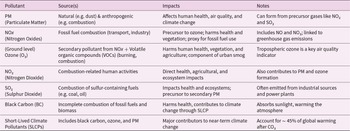
Air pollution is caused by both natural and anthropogenic sources. In Africa, the natural sources include desert dust particles and intense dry season savanna and woodland fires, while the anthropogenic sources of air pollution on the continent include fossil fuel burning in activities such as power generation and road transportation and other types of fires, such as domestic burning of coal and wood, burning crop residue, and waste burning at landfills (Marais et al., Reference Marais, Silvern, Vodonos, Dupin, Bockarie, Mickley and Schwartz2019). In terms of biomass burning, Africa accounts for about 72% of the total global burned area, 52% of the primary combustion aerosol global emissions (Andreae, Reference Andreae2019; Bond et al., Reference Bond, Doherty, Fahey, Forster, Berntsen, Deangelo and Zender2013; Brown et al., Reference Brown, Liu, Pokhrel, Murphy, Lu, Saleh and Chand2021; Isaxon et al., Reference Isaxon, Abera, Asfaw, Bililign, Eriksson, Malmqvist and Roba2022) and about 52% of the total carbon emissions. The latter includes 44% of CO global emissions, 36% of CH4 global emissions (Van Der Werf et al., Reference Van Der Werf, Randerson, Giglio, Collatz, Mu, Kasibhatla, Morton, DeFries, Jin and Van Leeuwen2010), and 60% of the total black carbon (BC) global emissions, which is twice the global average (Bond et al., Reference Bond, Doherty, Fahey, Forster, Berntsen, Deangelo and Zender2013). Nevertheless, on a per capita basis, Africa has the lowest emissions of all continents with an average of 1 ton of CO2 emitted annually by each individual (AJLabs, 2023). Table 1 summarizes information about key air pollutants and their characteristics.
Key air pollutants and their characteristics

Source: (Hsu et al., Reference Hsu, Reuben, Shindell, de Sherbinin and Levy2013; Prunet et al., Reference Prunet, Lezeaux, Camy-Peyret and Thevenon2020; Zaelke, Reference Zaelke2013).
Air pollution has been identified as the single largest environmental risk to public health globally, yet the burden and costs of air pollution are unequally distributed across distances, providing evidence of ecologically unequal and unjust exchange on multiple levels (Moran et al., Reference Moran, Lenzen, Kanemoto and Geschke2013; Rice, Reference Rice2007). Globally, there is substantial empirical evidence of the imbalanced flows of emissions between and within developed countries and developing countries. The research confirms that more affluent people and economies can shift the environmental costs of their consumption to distant places, usually with weaker regulatory frameworks and monitoring capabilities (Martinez-Alonso et al., Reference Martinez-Alonso, Veefkind, Dix, Gaubert, Granier, Souli, Darras, Eskes, Tang, Worden, de Gouw and Levelt2023; Newman et al., Reference Newman, Schulte, Morellini, Rahal and Leasure2024; WHO, 2021). In these places, air quality is degraded due to the production of global commodities (Kimeu, Reference Kimeu2024; Martinez-Alonso et al., Reference Martinez-Alonso, Veefkind, Dix, Gaubert, Granier, Souli, Darras, Eskes, Tang, Worden, de Gouw and Levelt2023), increased carbon emissions (Xiong et al., Reference Xiong, Millington and Xu2018) or deforestation (Jorgenson, Reference Jorgenson2006). These processes have significant negative impacts on society at large and socioeconomically disadvantaged and disempowered social groups in particular (Boillat et al., Reference Boillat, Martin, Adams, Daniel, Llopis, Zepharovich and Pascual2020; Borras et al., Reference Borras, Jennifer, Kay and Spoor2011; Peluso & Lund, Reference Peluso and Lund2011).
On the continental and regional level, local pollution, especially in urban and peri-urban areas, amplifies regional and transcontinental flows of air pollutants, including dust, aerosols, and combustion-related emissions (Atmosphere Monitoring Service, 2022, 2024; Duncan et al., Reference Duncan, West, Yoshida, Fiore and Ziemke2008; Kallos et al., Reference Kallos, Kotroni, Lagouvardos and Papadopoulos1998; Yan et al., Reference Yan, Zhu, Wang, Zhang, Luo, Qian and Jiang2021). Rising local pollution levels are a result of Africa's current rapid demographic change, urbanization, and economic development, including industrialization (Avis & Bartington, Reference Avis and Bartington2020; Awe et al., Reference Awe, Kleiman and Sánchez-Triana2022; Marais et al., Reference Marais, Silvern, Vodonos, Dupin, Bockarie, Mickley and Schwartz2019; World Bank and Institute for Health Metrics and Evaluation, 2016). Africa's cities are expanding at an unprecedented rate, often in the absence of adequate infrastructure, planning, and regulation (OECD/UN ECA/AfDB, 2022). Even with a limited air-quality monitoring network, the available literature indicates elevated levels of outdoor air pollution across the continent (Abera et al., Reference Abera, Friberg, Isaxon, Jerrett, Malmqvist, Sjöström and Vargas2020; Garland et al., Reference Garland, Touré, Abiye, Brida, Heaps, Keita, Young, Wright, Alo, Garland, Touré, Chirinda, Kituyi and Liebenberg-Enslin2023). The PM2.5 concentrations at many measurement sites, although not always well-quantified, are alarmingly high, surpassing national limits and recommended guidelines in many areas (Health Effects Institute, 2022; WHO, 2023a).
Within countries, poorer and more marginalized communities, as well as other vulnerable groups in both urban and rural settings, are often disproportionately exposed to poor air quality and its negative effects (Ferguson et al., Reference Ferguson, Taylor, Davies, Shrubsole, Symonds and Dimitroulopoulou2020). Recent statistics indicate that air pollution in Africa is the second leading cause of death on the continent, surpassed only by AIDS (Fisher et al., Reference Fisher, Bellinger, Cropper, Kumar, Binagwaho, Koudenoukpo and Landrigan2021). Such impacts have important implications for achieving inclusive development on the continent (Dekker, Reference Dekker2017; Woldai, Reference Woldai2020) and, subsequently, reaching the United Nations Sustainable Development Goals and Paris Agreements commitments or implementing suggestions made in the First Integrated Assessment of Air Pollution and Climate Change for Sustainable Development in Africa (United Nations Environment Programme, 2023a). In light of these transboundary and unequal dynamics, Africa can be considered as both a sending and receiving system for air pollution flows from the telecoupled perspective. It also becomes critical to examine how air quality is governed globally and within Africa, and to what extent existing policies and guidance frameworks are equipped to address both local challenges and global interconnections.
2.2. Air quality policy and guidance
Given that air quality outcomes are shaped by interactions across distant but connected social and ecological systems, it is essential to examine the policies that govern these dynamics across multiple scales. Understanding how air quality is managed, through legal and regulatory frameworks at the global, continental, regional, and local levels is particularly important in regions where local monitoring and enforcement capacities are limited.
Regulating air quality is complex, as air pollution results from a wide range of social, political, and economic behaviors, combined with geographical, environmental, and population conditions (Andres et al., Reference Andres, Bryson, Bakare and Pope2023; Scotford et al., Reference Scotford, Misonne, Tseng, McCarthy and Rudko2021). For instance, AQ policies should regulate diverse sources of emissions (industry, private vehicles, public transport, power generation, ships, etc.) and diverse behaviors that generate air pollution (through urban planning, control of individual pollution incidents, or other means (Abera et al., Reference Abera, Friberg, Isaxon, Jerrett, Malmqvist, Sjöström and Vargas2020)). Unlike climate change, which is governed by global agreements such as the Kyoto or Paris Agreement, or the ozone layer – regulated by the Montreal protocol – air quality regulation lacks a comprehensive international framework (Levelt, Reference Levelt2012). This absence is particularly concerning given that certain air pollutants, notably methane, particulate matter, and tropospheric ozone, have significant global impacts due to their roles as Short-Lived Climate Pollutants (SLCPs). Globally, despite a number of initiatives, there is still no binding commitment in public international law to a specific level of ambient air quality that is compatible with human health and the natural environment (Scotford et al., Reference Scotford, Misonne, Tseng, McCarthy and Rudko2021). Air pollution is therefore regulated through policies and frameworks (which are not always enforced) on the continental, regional, and national level.
2.2.1. Continental level
The key priority under the African Union Agenda 2063 goal of promoting environmentally sustainable and climate resilient economies and communities is to ‘develop/facilitate the implementation of Africa Quality Standards for air and other forms of pollution.’ The importance of improved air quality assessment across the continent has been reaffirmed by African policymakers multiple times. At the 15th session of African Ministerial Conference on Environment (AMCEN) in 2015, in Cairo, Egypt, ministers called for enhanced air quality monitoring and modelling and the need to develop an Africa-wide air quality framework agreement on air quality management in their declaration. This issue was addressed again at the 16th session of AMCEN (2017), Libreville, Gabon, where ministers acknowledged the region was facing increasing levels of air pollution, which has a negative effect on the environment and social and economic development in the region, as well as on human health and the well-being of the African population. The 2019 17th AMCEN Session in Durban, South Africa, concluded with Decision 17/2, which acknowledges the importance of SLCPs and the ‘need for an assessment of the linkage between policies to address air pollution and policies to address climate change’. Finally, the AMCEN Decision 18/4 (2022) “urge[s] African countries to support further development and implementation of the 37 recommended measures as a continent-wide Africa Clean Air Program, coordinated by strong country-led initiatives, cascaded to the Regional Economic Communities and higher levels of policy” (CCAC secretariat, 2021).
In terms of initiatives on the continental level, the Clean Air Initiative in Sub-Saharan Africa (CAI-SSA) and the Air Pollution Information Network for Africa (APINA) were launched by the World Bank and the Stockholm Environment Institute, respectively, in the late 1990s, in response to the deteriorating air quality situation in the region (CCAC secretariat, 2021). More recently, Clean Air for Africa: Partnership Forum for Integrated Action on Air Pollution and Climate Change was launched in (2023), following the publication of the first Integrated Assessment of Air Pollution and Climate Change for Sustainable Development in Africa (United Nations Environment Programme, 2023a). The publication demonstrates that significant improvements in air quality are achievable without altering the economic or population growth trajectories of African countries. The purpose of the Partnership Forum is therefore to create awareness, partnerships, and develop a road map for the implementation of the 37 measures identified across five key areas: transport, residential energy use, energy generation and industry, agriculture and food systems, and waste management to combat climate change, prevent air pollution, and protect human health and the environment simultaneously. The expected outcome of the Forum became the outline for developing the Africa Clean Air Program.
2.2.2. Regional level
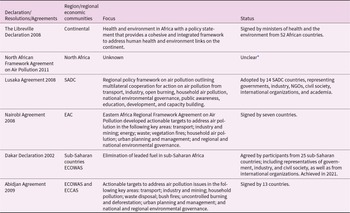
There has been significant regional progress in developing treaties and agreements concerning air quality in Africa, motivated by shared transboundary air pollution problems. Four key regional agreements call for cooperation on the harmonization of air quality standards, monitoring procedures, and data management: the North African Framework Agreement on Air Pollution (2011), the Eastern Africa Regional Framework Agreement on Air Pollution (2008 Nairobi Agreement), the Southern African Development Community (SADC) Regional Policy Framework on Air Pollution (2008 Lusaka Agreement), and the West and Central Africa Regional Framework Agreement on Air Pollution (2009 Abidjan Convention). All four enhance stakeholder participation in air quality management (Scotford et al., Reference Scotford, Misonne, Tseng, McCarthy and Rudko2021). An Air Pollution Information Network for Africa (APINA) played a leading role in the development and promulgation of regional framework agreements on air pollution. The short description of relevant agreements can be found in the Table 2 below. However, these agreements are yet to translate into comprehensive actions and policies in many signatory countries. While APINA is no longer operational, the African Group on Atmospheric Sciences (ANGA) working group has been established and operates on its basis.
Regional agreements on air pollution in Africa

* The Agreement is referred to in official documents of the United Nations Environmental Programme and NEPAD. Details about the focus and the status of this agreement were not found.
Source: (United Nations Environment Programme, 2023b).
2.2.3. National level
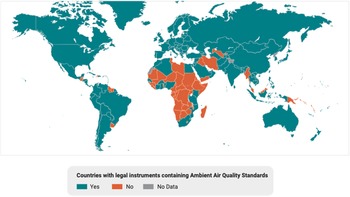
Air quality laws and regulations have been identified as one of the key policy actions for significantly improving air quality. Yet, in Africa, such regulations are still in the early stages of development and are often inadequate or absent (Scotford et al., Reference Scotford, Misonne, Tseng, McCarthy and Rudko2021). In fact, the majority of countries lacking legislative instruments that set ambient air quality standards are in Africa (Figure 2) (Scotford et al., Reference Scotford, Misonne, Tseng, McCarthy and Rudko2021). Legal and constitutional structures vary across the continent, which can determine how air quality laws are devised and implemented. Even where legal standards exist, the enforcement and compliance of these laws is highly variable.
Countries with legislative instruments setting ambient air quality standards (2021). Source: Scotford et al., Reference Scotford, Misonne, Tseng, McCarthy and Rudko2021.

While policy frameworks and guidance documents provide the structural foundation for addressing air pollution, their effectiveness ultimately depends on the availability and quality of air pollution data, as well as on the ability to make meaningful use of available data, through appropriate interpretation, analysis, and integration into decision-making processes. However, data access and capacity among government officials remain major barriers preventing policymakers in Africa from making informed, data-driven decisions to improve policies and their outcomes (Donback, Reference Donback2020). As such, understanding the methods currently employed to measure air quality is essential.
2.3. Assessing air quality in Africa
A number of methods of air quality monitoring are utilized to assess levels of air pollution, including ground-level monitoring (reference or regulatory grade monitoring stations and increasingly lower-cost, sensor-based technology), satellite-based remote sensing, visibility as a proxy and a ‘citizen science’ bottom-up approach. Depending on the types of pollutant, different assessment methods are used and, often a combination of measurement methods is applied (Vélez-Guerrero et al., Reference Vélez-Guerrero, Callejas-Cuervo and Alarcón-Aldana2023). Air quality assessment methods vary widely in scale, precision, and accessibility. Ground-level monitoring, using either high-accuracy reference stations or increasingly accessible low-cost sensors, offers detailed, localized data but is often limited in spatial coverage, especially in under-resourced regions. In contrast, satellite-based remote sensing provides broader spatial and temporal insights. Citizen science bridges the gap between scientific research and local communities, allowing lived experiences and grassroots insights to inform data collection and interpretation (see Pope et al., Reference Pope, Price, Woolley, Luiu, Alam, Avis, Bartington, Debebe, Getaneh, Greenfield, Howells, Khare, Weldetinsae, Lawson, Mishra, Neal, Newman, Singh, Teklu Wodajo and Wilder2024). Both proxy measures, such as visibility and citizen science approaches contribute valuable, though often less standardized, and sometimes creative, bottom-up data that can complement formal monitoring systems.
Satellite-based remote sensing, the main focus of this paper, offers a vital tool for monitoring air quality, especially in regions where ground-based measurements are sparse. Satellite sensors measure interference in the light energy reflected or emitted from the Earth, which is used to calculate concentrations of air pollutants such as PM, nitrogen dioxide, carbon monoxide, and ozone. In the case of particles, the satellite sensors measure the Aerosol Optical Depth (AOD) – the degree to which light has been absorbed or scattered by particles in the atmosphere. Using geophysical models and statistical calibration, scientists refine how to relate the satellite-based AOD observations to the surface concentration of PM2.5 (Avis & Bartington, Reference Avis and Bartington2020). Public platforms like Google Earth Engine (GEE) and the Copernicus Sentinel-5P Mapping Portal (S5P-PAL) have made this data increasingly accessible, even in low-resource settings.
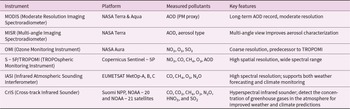
Among the instruments that have long supported air quality research, we should mention the Ozone Monitoring Instrument (OMI) (Levelt et al., Reference Levelt, Van Den Oord, Dobber, Mälkki, Visser, De Vries, Stammes, Lundell and Saari2006), the Moderate Resolution Imaging Spectroradiometer (MODIS) (Justice et al., Reference Justice, Vermote, Townshend, Defries, Roy, Hall, Salomonson, Privette, Riggs, Strahler, Lucht, Myneni, Knyazikhin, Running, Nemani, Wan, Huete, van Leeuwen, Wolfe, Giglio and Barnsley1998), Multiangle Imaging Spectroradiometer (MISR) (Diner et al., Reference Diner, Beckert, Reilly, Bruegge, Conel, Kahn and Verstraete1998), Infrared Atmospheric Sounding Interferometer (IASI) (Blumstein et al., Reference Blumstein, Chalon, Carlier, Buil, Hebert, Maciaszek and Simeoni2004) and Cross-track Infrared Sounder (CrIS) (Gambacorta & Barnet, Reference Gambacorta and Barnet2013). Today, the more advanced TROPOspheric Monitoring Instrument (TROPOMI) (Veefkind et al., Reference Veefkind, Aben, McMullan, Förster, de Vries, Otter, Claas, Eskes, de Haan, Kleipool, van Weele, Hasekamp, Hoogeveen, Landgraf, Snel, Tol, Ingmann, Voors, Kruizinga, Visser and Levelt2012) has set a new standard in spatial resolution and precision (Mcelroy, Reference Mcelroy2021). TROPOMI enables detailed attribution of emissions from both natural and anthropogenic sources – including industrial facilities, power plants, and biomass burning, and supports the mapping of climate-relevant gases like methane and ozone. Carbon dioxide emissions can also be calculated for point sources and regions, based on the detailed mapping of nitrogen dioxide (NO2) (Zheng et al., Reference Zheng, Geng, Ciais, Davis, Martin, Meng, Wu, Chevallier, Broquet, Boersma, van der A, Lin, Guan, Lei, He and Zhang2020). Table 3 provides a more detailed overview of key satellite instruments for AQ monitoring. Although these tools have influenced policy in high-income countries and were widely used to assess air quality changes during COVID-19 lockdowns (Cooper et al., Reference Cooper, Martin, Hammer, Levelt, Veefkind, Lamsal and McLinden2022; Levelt et al., Reference Levelt, Stein Zweers, Aben, Bauwens, Borsdorff, De Smedt, Eskes, Lerot, Loyola, Romahn, Stavrakou, Theys, Van Roozendael, Veefkind and Verhoelst2022; Prunet et al., Reference Prunet, Lezeaux, Camy-Peyret and Thevenon2020; Serrano-Calvo et al., Reference Serrano-Calvo, Veefkind, Dix, de Gouw and Levelt2023; Zheng et al., Reference Zheng, Geng, Ciais, Davis, Martin, Meng, Wu, Chevallier, Broquet, Boersma, van der A, Lin, Guan, Lei, He and Zhang2020), their application in Africa remains limited (see Figure 3 as one of a very few examples) (Dasgupta et al., Reference Dasgupta, Lall and Wheeler2020; El-Nadry et al., Reference El-Nadry, Li, El-Askary, Awad and Mostafa2019; Hu et al., Reference Hu, Landgraf, Detmers, Borsdorff, Aan de Brugh, Aben, Butz and Hasekamp2018; Marais et al., Reference Marais, Silvern, Vodonos, Dupin, Bockarie, Mickley and Schwartz2019; Shikwambana et al., Reference Shikwambana, Mhangara and Mbatha2020).
TROPOMI nitrogen dioxide (NO2) measurements over Nigeria: (a) yearly mean April 2019 (pre-Covid year) (b) monthly mean over 2020 (Covid-year). The reduction in the NO2 tropospheric column in the Covid year is clearly visible from space. Source: Dr. Henk Eskes, KNMI.

Overview of key satellite instruments for air quality monitoring

Source: own elaboration based on Blumstein et al., Reference Blumstein, Chalon, Carlier, Buil, Hebert, Maciaszek and Simeoni2004; Diner et al., Reference Diner, Beckert, Reilly, Bruegge, Conel, Kahn and Verstraete1998; Gambacorta & Barnet, Reference Gambacorta and Barnet2013; Justice et al., Reference Justice, Vermote, Townshend, Defries, Roy, Hall, Salomonson, Privette, Riggs, Strahler, Lucht, Myneni, Knyazikhin, Running, Nemani, Wan, Huete, van Leeuwen, Wolfe, Giglio and Barnsley1998; Levelt et al., Reference Levelt, Van Den Oord, Dobber, Mälkki, Visser, De Vries, Stammes, Lundell and Saari2006; Mcelroy, Reference Mcelroy2021; Veefkind et al., Reference Veefkind, Aben, McMullan, Förster, de Vries, Otter, Claas, Eskes, de Haan, Kleipool, van Weele, Hasekamp, Hoogeveen, Landgraf, Snel, Tol, Ingmann, Voors, Kruizinga, Visser and Levelt2012).
Satellite-derived estimates are critical for filling data gaps in areas without ground monitoring (De Sherbinin et al., Reference De Sherbinin, Levy, Zell, Weber and Jaiteh2014). While countries such as Egypt, Morocco, South Africa, Senegal, Ghana, Uganda, and Rwanda have begun developing real-time monitoring networks (Katoto et al., Reference Katoto, Byamungu, Brand, Mokaya, Strijdom, Goswami, De Boever, Nawrot and Nemery2019; Okello et al., Reference Okello, Nantanda, Awokola, Thondoo, Okure, Tatah and Oni2023), most of the continent still lacks reliable infrastructure for air quality management. The use of satellite data is increasingly recognized as an essential tool for decision-making (Woldai, Reference Woldai2020); nevertheless, persistent barriers hamper broader uptake of satellite data in Africa (but also worldwide). These include technical challenges like cloud cover interference, discrepancies between satellite measurements and policy-relevant indicators, and insufficient collaboration across scientific and policy communities (Engel-Cox et al., Reference Engel-Cox, Oanh, van Donkelaar, Martin and Zell2013; Hsu et al., Reference Hsu, Reuben, Shindell, de Sherbinin and Levy2013; National Research Council, 2007). Moreover, perceptions of data usability continue to limit integration into air quality governance – a problem echoed in other regions around the world. Enhancing the use of satellite-based measurements, particularly through accessible platforms, interdisciplinary collaboration, and cross-sectoral partnerships, represents a promising pathway toward better understanding and informing environmental, socioeconomic, and public health policymaking in Africa (Agbo et al., Reference Agbo, Walgraeve, Eze, Ugwoke, Ukoha and Van Langenhove2021; Tang et al., Reference Tang, Kumar, Méndez, Ahafianyo, Akinsanola, Ameko and LeveltForthcoming). In light of this potential, the following section takes stock of the current landscape of international and interdisciplinary collaborations, focusing on the intersection between natural and social science disciplines and partnerships between African researchers and those based in the Global North that have used satellite measurements of atmospheric composition.
3. Methodology
In the context of the identified persistent data gaps and to better understand the telecoupled nature of air quality (i.e., links between social and environmental systems over distance), the authors conducted a meta-synthesis of the existing academic and grey literature focused on the use of satellite data for air quality monitoring in Africa and its use in combination with socioeconomic, environmental, and health data. Meta-synthesis is a qualitative research method used to systematically review and integrate findings from multiple studies. It goes beyond simply summarizing existing literature; instead, it interprets and synthesizes findings to generate new conceptual understandings or theoretical insights (Hoon, Reference Hoon2013; Jensen & Allen, Reference Jensen and Allen1996). This method is particularly useful when dealing with diverse, fragmented, or interdisciplinary bodies of literature, such as the one on air quality in Africa. The present study followed the following steps to organize the meta-synthesis (Hoon, Reference Hoon2013).
Step 1: Locating relevant research and selection criteria
This review employed a convenient sampling technique, which involves selecting available literature sources based on their accessibility, ease of retrieval, and relevance to the research topic. The focus was on readily accessible sources, such as academic journal articles, books, online databases, and reputable websites. The sources were identified by using search engines, academic databases, and citation networks to locate key literature and using a combination of key words, such as “satellite data,” “remote sensing,” “TROPOMI,” “MODIS,” “OMI,” “vulnerability,” “health,” “socioeconomic impact,” “air quality,” “air pollution,” and “Africa” (among others). The years 2000–2024 (January) were chosen as a cut-off date for the search. The authors recognize that the convenient sampling approach may not provide an exhaustive overview of the entire literature on the topic; however, it yields valuable insights and serves as a starting point for further exploration.
Step 2: Classification and comparison of main findings
Τhe second stage of the meta-synthesis approach focused on exploring, analyzing, and compiling the descriptive analysis findings from the identified literature. Evidence from the studies under synthesis was categorized according to country/region, detailed location (if available), pollutant measured by the study, the remote sensors used to collect data, key conclusions, link to a socioeconomic/environmental/health impact, approach (siloed or interdisciplinary), and the science domain. A detailed table summarizing the publications can be found in the Supplementary material section (Figure S1).
Step 3: Synthesis
During the third stage, analyzed studies were synthesised. The synthesis of the findings was guided by a recurring emphasis on interdisciplinarity and cross-geographical knowledge exchange with Africa.
To capture the interconnected socioeconomic, environmental, and health dimensions of air quality impacts, this study employs the umbrella concept of inclusive development, which encompasses these interrelated aspects within a unified analytical framework (Dekker, Reference Dekker2017). It is used deliberately to also capture the issues related to marginalization and environmental (in)justice /(in)equality within existing debates.
To further uncover how African perspectives are (or are not) represented in the literature, the institutional affiliations of the first and last authors of the reviewed studies were analyzed. Affiliations were taken directly from the publications and categorized based on the location of the authors’ institutions into five groups: (i) non-African first author and non-African last author; (ii) African first and last author; (iii) African single author; (iv) African first author; non-African last author; and (v) non-African first author, African last author. No further “career tracking” of the authors was undertaken to assess their actual affiliation. It is important to note that there is high mobility among some of the scholars involved, which may have led to small inaccuracies regarding their actual origins and current home institutions. The key findings of the meta-synthesis are discussed in the following section.
4. Main findings
The literature scoping conducted for the purpose of this paper identified a total of 90 separate articles that use satellite data to assess air quality (and its potential impacts) in Africa. A clear increase in the number of reviewed publications has been observed since 2020 (Figure 4). Most of the publications analyze the situation in the Southern African region (mostly in South Africa itself) and East Africa (Kenya and Uganda). A growing trend is observed in West Africa, in particular publications from and about Nigeria (Figure 5). Data retrieved from MODIS were used most frequently, although a positive trend is also observed in terms of the use of data derived from OMI and TROPOMI. Increasingly, remote-sensing retrievals of aerosol optical depth (AOD) are being combined with atmospheric chemistry models to produce accurate and fairly resolved estimates of ground-level concentrations of PM2.5 (hence the popularity of data derived from MODIS). The following sections explore the intricate interplay between natural, social, and spillover systems through a lens of inclusive development. They also assess the level of interdisciplinary and transboundary scientific collaboration between Africa and the Global North.
Number of reviewed publications by year. Source: Own calculations.

Regional distribution within the reviewed publications. Source: Own calculations.

4.1. Satellite air quality data and inclusive development linkages
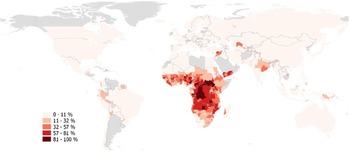
Population in low- and middle-income countries is disproportionately affected by polluted air. Constraints in terms of the accessibility, availability, and quality of healthcare provision further increase air-pollution-related mortality in developing countries (Lelieveld et al., Reference Lelieveld, Pozzer, Pöschl, Fnais, Haines and Münzel2020). Globally, approximately one in ten people exposed to unsafe levels of air pollution live in extreme poverty (Rentschler & Leonova, Reference Rentschler and Leonova2022). In sub-Saharan Africa, 405 million (or 57%) are directly exposed to unsafe PM2.5 concentrations (Figure 6). On an individual level, poverty may increase individual susceptibility to air pollution due to: poor health status and access to healthcare; unaffordable nutrient-rich foods; and the increased likelihood of living in proximity to polluting industries, biomass burning, and unpaved roads, or dependence on jobs that require outdoor physical labour (Katoto et al., Reference Katoto, Byamungu, Brand, Mokaya, Strijdom, Goswami, De Boever, Nawrot and Nemery2019).
Share of population exposed to unsafe PM2.5 levels and living in poverty at $1.90/day. Source: Rentschler & Leonova, Reference Rentschler and Leonova2022.

Although the adoption of satellite-based measures of air quality in health studies in Africa is in its infancy, research in this area is growing. In recent years, there is an observable increase in understanding air pollution trends and their associated health and environmental impacts in sub-Saharan Africa using available satellite data. Consequently, the satellite data in the reviewed articles are mostly used to assess the impact of poor air quality on population health (Bachwenkizi et al., Reference Bachwenkizi, Liu, Meng, Zhang, Wang, van Donkelaar, Martin, Hammer, Chen, Martin, Hammer, Chen, Martin, Hammer, Chen and Kan2021, Reference Bachwenkizi, Liu, Meng, Zhang, Wang, van Donkelaar and Kan2022; Etchie et al., Reference Etchie, Etchie, Adewuyi, Pillarisetti, Sivanesan, Krishnamurthi and Arora2018; Fisher et al., Reference Fisher, Bellinger, Cropper, Kumar, Binagwaho, Koudenoukpo and Landrigan2021; Fleischer et al., Reference Fleischer, Merialdi, van Donkelaar, Vadillo-Ortega, Martin, Betran and O'Neill2014; Heft-Neal et al., Reference Heft-Neal, Burney, Bendavid and Burke2018; Kalisa et al., Reference Kalisa, Clark, Ntakirutimana, Amani and Volckens2023; Larson et al., Reference Larson, Espira, Glenn, Larson, Crowe, Jang and O'neill2022; Lelieveld et al., Reference Lelieveld, Evans, Fnais, Giannadaki and Pozzer2015; Lin, Guo, Di, et al., Reference Lin, Guo, Di, Zheng, Kowal, Xiao, Liu, Li, Zeng, Howard, Nelson, Qian, Ma and Wu2017; Lin, Guo, Kowal, et al., Reference Lin, Guo, Kowal, Airhihenbuwa, Di, Zheng, Zhao, Vaughn, Howard, Schootman, Salinas-Rodriguez, Yawson, Arokiasamy, Manrique-Espinoza, Biritwum, Rule, Minicuci, Naidoo, Chatterji, Ma and Wu2017; Marais et al., Reference Marais, Silvern, Vodonos, Dupin, Bockarie, Mickley and Schwartz2019; Owili et al., Reference Owili, Lien, Muga and Lin2017). A number of studies indicate that PM concentrations in urban centers are considerably higher than the WHO guidelines and were found to vary considerably temporarily and spatially. Among the vulnerable groups often referred to, newborn children, young mothers, and the elderly are mentioned most often.
Some reviewed studies have important health- and climate-policy-related recommendations. For instance, using satellite estimations of air pollution and pollutant-mortality risk models, Lelieveld et al. (Reference Lelieveld, Evans, Fnais, Giannadaki and Pozzer2015) estimated the numbers of premature deaths attributable to air pollution globally (Figure 7). The authors suggest that ambient PM2.5 from commercial and domestic energy generation, agriculture, and traffic sources contribute the most to premature deaths worldwide. They calculated that premature mortality could be reduced by 4.54 million annually by mitigating both ambient and household air pollution, mainly through changes in commercial and domestic energy use, especially in Africa where domestic energy mostly relies on solid fuels. Without concrete and appropriate mitigation plans and policies, the authors expect a doubling of mortality from air pollution by 2050 considering the projected rates of increase in population and air pollution levels.
Mortality linked to outdoor air pollution in 2010. Source: (Lelieveld et al., Reference Lelieveld, Evans, Fnais, Giannadaki and Pozzer2015).

Within the reviewed articles, links are also made between: socioeconomic development and air pollution (Hickman et al., Reference Hickman, Andela, Tsigaridis, Galy-Lacaux, Ossohou and Bauer2021); air pollution and poverty (Rentschler & Leonova, Reference Rentschler and Leonova2022); agricultural activities and air pollution (Shikwambana et al., Reference Shikwambana, Mokgoja and Mhangara2022); identifying areas facing both high social vulnerability and air pollution levels (Clarke et al., Reference Clarke, Ash, Coker, Sabo-Attwood and Bainomugisha2022); and assessing air quality trends with the climate factors, socioeconomic indicators, and terrain characteristics (Martinez-Alonso et al., Reference Martinez-Alonso, Veefkind, Dix, Gaubert, Granier, Souli, Darras, Eskes, Tang, Worden, de Gouw and Levelt2023; Ouma et al., Reference Ouma, Keitsile, Lottering, Nkwae and Odirile2024). Furthermore, urbanization not only increases the number of people exposed to outdoor air pollution but also raises air pollution levels, which inevitably translates into new interactions between social and natural systems. Despite the fact that socioeconomic marginalization increases people's exposure and vulnerability to air pollution—and aside from the substantial evidence of this fact for the US—little evidence exists documenting the global or continental scale of poor people's exposure to harmful air pollution, especially in Africa.
Overall, despite a clear link between the air quality and inclusive development, the articles linking satellite air quality data to socioeconomic dimensions of well-being and related policy dialogues/interventions are sparse. Moreover, important limitations of the reviewed studies must be mentioned. The absence of long-term air quality data and a related monitoring network in most African countries make it difficult to develop a complete assessment of the magnitude of the air pollution problem (Pope et al., Reference Pope, Gatari, Ng'ang'a, Poynter and Blake2018; Singh et al., Reference Singh, Avis and Pope2020, Reference Singh, Bakare, Mazzeo, Avis, Ng'ang'a, Gatari, Bartington, Thomas, Bryson, Andres, Quinn, Burrow, Ndegwa, Mwaniki, Randa and Pope2022). Furthermore, satellite information at the local level can be reliable only after calibration with referenced ground-level data, which are largely lacking on the continent. Some studies have explicitly shown that satellite data-modeled outputs (for PM2.5) are not always consistent with ground-level monitoring observations over Africa (Awe et al., Reference Awe, Kleiman and Sánchez-Triana2022). Consequently, there has been and remains very limited available (and reliable) data on African air quality to date, which translates into limited available interdisciplinary research.
4.2. Satellite air quality data in interdisciplinary and inter-geographical knowledge exchange with Africa
4.2.1. Interdisciplinarity of air quality research
Greater dialogue between disciplines and transdisciplinary research fosters cross-fertilization by integrating diverse perspectives, methodologies, and types of knowledge to address complex challenges, like air pollution, in more holistic and innovative ways. While analyzing the literature, it becomes clear that studies using air quality satellite data in Africa adopt a mono-disciplinary approach (76% of the reviewed articles). These publications are mainly derived from natural sciences. They often apply generic and non-contextualized models based on satellite and ground-level air quality data. The remaining 24% of the articles take, or attempts to take, an interdisciplinary approach combining air quality satellite data with other types of data or studies in order to test potential impact of air quality on, most frequently, health (Bachwenkizi et al., Reference Bachwenkizi, Liu, Meng, Zhang, Wang, van Donkelaar, Martin, Hammer, Chen, Martin, Hammer, Chen, Martin, Hammer, Chen and Kan2021, Reference Bachwenkizi, Liu, Meng, Zhang, Wang, van Donkelaar and Kan2022; Etchie et al., Reference Etchie, Etchie, Adewuyi, Pillarisetti, Sivanesan, Krishnamurthi and Arora2018; Fisher et al., Reference Fisher, Bellinger, Cropper, Kumar, Binagwaho, Koudenoukpo and Landrigan2021; Fleischer et al., Reference Fleischer, Merialdi, van Donkelaar, Vadillo-Ortega, Martin, Betran and O'Neill2014; Heft-Neal et al., Reference Heft-Neal, Burney, Bendavid and Burke2018; Kalisa et al., Reference Kalisa, Clark, Ntakirutimana, Amani and Volckens2023; Larson et al., Reference Larson, Espira, Glenn, Larson, Crowe, Jang and O'neill2022; Lelieveld et al., Reference Lelieveld, Evans, Fnais, Giannadaki and Pozzer2015; Lin, Guo, Di, et al., Reference Lin, Guo, Di, Zheng, Kowal, Xiao, Liu, Li, Zeng, Howard, Nelson, Qian, Ma and Wu2017; Lin, Guo, Kowal, et al., Reference Lin, Guo, Kowal, Airhihenbuwa, Di, Zheng, Zhao, Vaughn, Howard, Schootman, Salinas-Rodriguez, Yawson, Arokiasamy, Manrique-Espinoza, Biritwum, Rule, Minicuci, Naidoo, Chatterji, Ma and Wu2017; Marais et al., Reference Marais, Silvern, Vodonos, Dupin, Bockarie, Mickley and Schwartz2019; Owili et al., Reference Owili, Lien, Muga and Lin2017). A limited number of the reviewed studies link air quality to some elements of the inclusive development (i.e., disability (Lin, Guo, Di, et al., Reference Lin, Guo, Di, Zheng, Kowal, Xiao, Liu, Li, Zeng, Howard, Nelson, Qian, Ma and Wu2017), community and occupational exposure (Kwarteng et al., Reference Kwarteng, Baiden, Fobil, Arko-Mensah, Robins and Batterman2020; Martinez-Alonso et al., Reference Martinez-Alonso, Veefkind, Dix, Gaubert, Granier, Souli, Darras, Eskes, Tang, Worden, de Gouw and Levelt2023); exposure of vulnerable residents to air pollution (Dasgupta et al., Reference Dasgupta, Lall and Wheeler2020); economic growth (United Nations Environment Programme, 2023b); urbanization (Wei et al., Reference Wei, Sun, Jiang, Shen, Liu, Zhang and Ouyang2021); link between socioeconomic development and air pollution (Hickman et al., Reference Hickman, Andela, Tsigaridis, Galy-Lacaux, Ossohou and Bauer2021); agriculture activities and air pollution (Shikwambana et al., Reference Shikwambana, Mokgoja and Mhangara2022); identifying areas facing both high social vulnerability and air pollution levels (Clarke et al., Reference Clarke, Ash, Coker, Sabo-Attwood and Bainomugisha2022); and assessing air quality trends with the climate factors, socioeconomic indicators, and terrain characteristics (Ouma et al., Reference Ouma, Keitsile, Lottering, Nkwae and Odirile2024). These studies, though, still tend to adopt a siloed approach. While they often reference the potential inclusive development impacts, they rarely test them using methods from both disciplines.
Although beyond the scope of this review, an observation was made about a growing body of literature that links vulnerability and some inclusive development lenses to air pollution in Africa—yet without the use of satellite data to establish the links (among others: urban climate justice (Corburn et al., Reference Corburn, Njoroge, Weru and Musya2022; Flanagan et al., Reference Flanagan, Mattisson, Walles, Abera, Eriksson, Balidemaj, Oudin, Isaxon and Malmqvist2021); risk exposure (Becerra et al., Reference Becerra, Belland, Bonnassieux and Liousse2020; Ngo et al, Reference Ngo, Kokoyo and Klopp2017); air quality and socioeconomic status (John & Das, Reference John and Das2012; Manshur et al., Reference Manshur, Luiu, Avis, Bukachi, Gatari, Mulligan, Ng'an'ga, Radcliffe, Singh, Waiguru, Wandera and Pope2023; Mutahi et al., Reference Mutahi, Borgese, Marchesi, Gatari and Depero2021; Ngo et al., Reference Ngo, Asseko, Ebanega, Allo'o Allo'o and Hystad2019; Olaniyan et al., Reference Olaniyan, Jeebhay, Röösli, Naidoo, Künzli, de Hoogh, Saucy, Badpa, Baatjies, Parker, Leaner and Dalvie2020; Rooney et al., Reference Rooney, Arku, Dionisio, Paciorek, Friedman, Carmichael, Zhou, Hughes, Vallarino, Agyei-Mensah, Spengler and Ezzati2012). The key methods of assessing air quality in the above-mentioned literature are either analysis of data derived from (lower-cost) ground-level sensors or engaged citizen science. Alternatively, the air quality data is retrieved from existing databases. This not only shows an increasing interest in establishing further evidence about the link between air quality and vulnerability, but it also indicates that the social science community is not aware, or not able to use, available air quality satellite data. These observations point to siloed approaches in both the natural as well as the social sciences. These silos result in and are the consequence of differences in access to and use of data, compounded by a lack of communication, co-creation, and cross learning around a common set of interdisciplinary data that can be used in both natural and social sciences.
4.2.2. Cross-geographical knowledge exchange
Regarding data, a number of global emission inventories have been published to date, and these have been used for air quality and climate change modeling in Africa (i.e., Duncan et al., Reference Duncan, Lamsal, Thompson, Yoshida, Lu, Streets and Pickering2016; Fioletov et al., Reference Fioletov, Mclinden, Griffin, Theys, Loyola, Hedelt and Li2020). These works used detailed emissions available at the regional scale for North America, Europe, and Asia, but not for Africa, for which there is a general lack of detailed anthropogenic inventories at the continental and regional scales. This means that the models that are currently used for air quality and climate change in Africa rely on global inventories that are primarily collected from outside Africa and based on generalized assumptions. This inevitably creates a bias and higher uncertainty in the assessment of air quality and its impacts on the continent. Recently, a new community modeling infrastructure has enabled the study of atmospheric composition and chemistry over Africa: The Multi-Scale Infrastructure for Chemistry and Aerosols Version 0 (MUSICAv0). MUSICAv0 has been designed to simulate air quality and chemical transport across multiple spatial scales (Tang et al., Reference Tang, Emmons, Worden, Kumar, He, Gaubert, Zheng, Tilmes, Buchholz, Martinez-Alonso, Granier, Soulie, McKain, Daube, Peischl, Thompson and Levelt2023). The model developed for East Africa, however, suggests that the region exhibits the largest model–in situ observation discrepancies (Tang et al., Reference Tang, Emmons, Worden, Kumar, He, Gaubert, Zheng, Tilmes, Buchholz, Martinez-Alonso, Granier, Soulie, McKain, Daube, Peischl, Thompson and Levelt2023). This means that to enhance monitoring processes across the continent, Africa must significantly improve its emission maps and atmospheric modeling capabilities, as even the best models cannot perform well without accurate and reliable data.
Excluding studies with a global scope, there are two major review articles on air quality issues in Africa: Simwela et al. (Reference Simwela, Xu, Mekondjo and Morie2018) and, more recently, Agbo et al. (Reference Agbo, Walgraeve, Eze, Ugwoke, Ukoha and Van Langenhove2021). Although the evidence base in Agbo et al. (Reference Agbo, Walgraeve, Eze, Ugwoke, Ukoha and Van Langenhove2021) has substantially grown in comparison to the Simwela et al. (Reference Simwela, Xu, Mekondjo and Morie2018) publication (which also looked at the air quality literature more broadly), both reviews highlight the very serious situation related to air quality in Africa, the lack of political responsiveness caused by limited data, and they also call for more research. Moreover, Okello et al. (Reference Okello, Nantanda, Awokola, Thondoo, Okure, Tatah and Oni2023) undertakes a scoping review of strategies developed and/or implemented in Africa for improving air quality and/or health outcomes, co-benefits of the strategies, potential collaborators, and pitfalls of current air quality management strategies in Africa. Neither of the reviews explicitly analyze the data source of the articles under review. An analysis of the references used in these review articles indicates that only a handful of publications have used satellite data, basing their analysis on mostly temporary ground measurements campaigns.
Regarding authorship, an increased number of articles authored by African scholars (as the first and the last author) has been noted in recent years. Although the publications written by non-African (first and last) authors still constitute over 50% of all the reviewed articles, the remaining 46% involved African scholars in either lead-authorship (40%, including solo publications) or as the final author (6%) (Figure 8). Among the articles first-authored by the scientists affiliated to an African institute (37 in total), only three of them published research on an African country other than the one in which their institution was based. This means that an important in-country expertise has been generated.
The affiliations of the reviewed articles’ authors. Source: Own calculations.

Most ‘non-African authors’ (first and last ones) were affiliated with institutions in North America (USA and Canada), Asia, and Europe. It should be noted that some of these authors do have links to Africa (i.e., they published while affiliated with a foreign institution during his or her (temporary) PhD contract but have since returned to their country of origin. Tracking the career paths of the authors was beyond the scope of this research). Despite this lack of precision, a small positive trend can be observed in increased capacity and interest in this climate-change-related topic among locally based scholars. This is an important observation, which would ideally lead to increased flow of research funding to African institutions, locally led research projects, an increase in African-led scientific publications, and finally, bringing local and contextual voices to the global discussion currently dominated by the ‘northern’ perspective (Overland & Sovacool, Reference Overland and Sovacool2020).
To this end, the authors of this article would like to reflect on the disciplinary and geographic composition of their team. We acknowledge that, like much of the scholarship on air quality in Africa, this paper is authored predominantly by researchers based in institutions located in the Global North. This mirrors an ongoing structural imbalance in academic publishing. However, our team is intentionally interdisciplinary (social and natural science) and intergeographical, with contributors from African and non-African institutions, including the University of Pretoria and the African Studies Centre at Leiden University. We believe that collaboration with African scholars is not only ethical and necessary but also vital. Local expertise provides critical insights into the lived realities, behavioral dynamics, and socio-political contexts that shape both the causes of and responses to air pollution. The work of African scholars, often under-cited, plays a critical role in identifying contextually grounded, African-led, home-grown solutions that are not only scientifically sound but also politically and socially feasible. Our inclusion of key African references throughout the paper is a deliberate effort to highlight this contribution and to align scientific research with the realities and agency of African communities and policy processes.
5. Conclusions
This paper has argued that air quality in Africa should be analyzed through a telecoupling lens, as a transboundary, interdisciplinary challenge rather than a localized environmental concern. The application of this framework reveals a number of complexities stemming from different telecoupled systems in relation to the Africa–Global North AQ dynamics. Sending, receiving, and spillover systems are constantly intertwined through the exchange of air pollution, as well as through the on-the-ground activities that exacerbate both the pollution and its subsequent impacts. Our analysis also reveals the uneven distribution of monitoring infrastructure, as well as the marginalization of African voices in the global air quality agenda. These dynamics are shaped by deeply embedded patterns of epistemic and environmental injustice, where knowledge production, data access, and policy influence remain disproportionately concentrated in the Global North, despite the most acute burdens of air pollution falling on vulnerable populations across Africa.
This article argues that the risk exposure to air pollution is shaped by socio-political and natural processes across multiple scales. A lack of or insufficient air quality data hampers a better understanding of this telecoupled phenomenon. National and local governments in Africa often lack, or possess only partial knowledge of, pollutants’ concentrations and trends, which makes it difficult to evaluate the effectiveness of the strategies and policies, select target values, and set priorities that are adapted to the local context (Okello et al., Reference Okello, Nantanda, Awokola, Thondoo, Okure, Tatah and Oni2023). Moreover, numbers, graphs, and pollution maps only tell half the story. The multi-scalar and interdependent nature of air pollution presents a complex landscape for air quality studies.
To this end, our meta-synthesis of 90 studies shows that while satellite-derived data holds significant promise for bridging critical air quality data gaps, its use remains limited and predominantly led by natural scientists, with very limited complementary discussions from the social science perspective. The siloed nature of current research, where natural and social sciences often operate in isolation, hinders effective communication, co-creation, and interdisciplinary learning, preventing the utilization of a common set of data for holistic research and policy development. Consequently, understanding spatial heterogeneity in the prevalence of air pollution, its differential impacts on various population groups, and regional and global responses are areas that require further exploration.
Furthermore, African scholars and institutions, though increasingly present in the literature, continue to face structural barriers to leading or shaping the research agenda. These are, among others, the lack of emissions data, ground-level monitoring for concentration validation, weak or lack of political frameworks, context-specific air quality assessment models, and the (above-mentioned) siloed approach within the research community. To address these challenges, it is crucial to prioritize awareness-building, contextualize progress, and highlight the unique challenges and solutions specific to monitoring air pollution in Africa. Satellite-based air quality data provides a promising source of information. Collaborative efforts involving multiple scientific disciplines from both the Global North and South are essential for creating sustainable and inclusive research and practice communities.
To address these challenges, we advocate for a transformative research agenda grounded in three pillars: interdisciplinary integration, inter-regional collaboration, and data justice. Central to this agenda is the concept of inclusive development, which we adopt as an umbrella framework encompassing the socioeconomic, environmental, and health dimensions of air quality impacts. By prioritizing locally relevant data generation, investing in capacity-building, and fostering reciprocal learning between disciplines and regions, it is possible to reposition air quality not only as a scientific or technical issue, but as a cornerstone of inclusive development and climate justice.
Ultimately, the telecoupling perspective offers a powerful analytical and practical tool to reframe the air pollution discussion in Africa. It encourages scholars, practitioners, and policymakers to move beyond fragmented, siloed approaches toward a more interconnected, equitable, and actionable understanding of how air quality links people, places, and policies across vast distances. Only by acknowledging and addressing these complex interdependencies can we hope to bridge disciplinary divides, promote interdisciplinary research between continents, and enhance our understanding of air pollution's socioeconomic impacts, ultimately contributing to more sustainable and inclusive development across the continent and beyond.
Supplementary material
The supplementary material for this article can be found at https://doi.org/10.1017/sus.2025.10019.
Acknowledgements
This paper draws on and develops an earlier working paper published by the African Studies Centre Leiden (Dekker et al., Reference Dekker, Kazimierczuk, Garland, Zweers and Levelt2024). The authors would like to thank all of the participants of the April 2022 workshop “The Power of TROPOMI to Bridge African Science and Policy” hosted by the Lorentz Center, Leiden, the Netherlands, for the many stimulating and thoughtful conversations that informed the development of this paper.
Author contributions
M.D. and P.L. designed and initiated the project. All co-authors were involved in literature gathering. A.K. performed analyses of the literature. A.K. and M.D. wrote the first concise draft and R.G., D.Z., and P.L. contributed to the further development. All authors read and approved the final manuscript.
Funding statement
This research received no specific grant from any funding agency, commercial or not-for-profit sectors. However, the intellectual reflections were influenced by discussions during the April 2022 Lorentz Center workshop, ‘The Power of TROPOMI to Bridge African Science and Policy’, financially supported by the Lorentz Centre, NWO-SDG research, KNMI, and ASCL.
Competing interests
None.






 Open access

