


Racial attitudes continue to play a decisive role in American electoral politics. Existing research demonstrates that stable predispositions toward racial groups strongly shape both policy (Jardina and Ollerenshaw Reference Jardina and Ollerenshaw2022) and candidate preferences (Buyuker et al. Reference Buyuker, D’Urso, Filindra and Kaplan2021) and explain partisan alignment and vote switching, particularly toward Republican candidates in recent presidential elections (Reny et al. Reference Reny, Collingwood and Valenzuela2019). While the predictive power of static racial attitudes is well established, far less is known about how within-person changes in racial attitudes influence subsequent political behavior. Understanding these dynamics is crucial because individuals’ attitudes toward race may shift over time in response to personal experiences, public events, or evolving perceptions of societal injustice.
Even less is known about the directionality of this relationship. Do changes in racial attitudes lead individuals to adjust their vote choice, or do voters revise their attitudes to align with the candidates they support? This question of reverse causality has received limited systematic empirical attention. Evidence from longitudinal research indicates that explicit racial and religious prejudice increased among Trump supporters while individuals opposed to Trump exhibited decreases in prejudice, reflecting the influence of elite rhetoric on Americans’ attitudes (Ruisch and Ferguson Reference Ruisch and Ferguson2022). However, these findings do not directly address whether within-person changes in racial attitudes translate into changes in candidate preferences, nor do they rule out the counterfactual that voters adjust their vote choice to match their changing attitudes.
Importantly, prior work suggests that the attitude–vote relationship is likely bidirectional. Enns and Jardina (Reference Enns and Jardina2021) demonstrate that vote preferences can themselves shape racial attitudes, and Engelhardt (Reference Engelhardt2021) finds that white Americans increasingly align their racial resentment with their partisan identities, suggesting that partisanship may exert at least as much influence on racial attitudes as the reverse. This bidirectionality complicates simple causal claims and motivates careful attention to temporal ordering. The present analysis uses a panel spanning three presidential elections (2016, 2020, and 2024) to provide within-person leverage while explicitly testing for reverse causal processes and acknowledging the limits of those tests.
This paper further distinguishes between two theoretically distinct dimensions of racial attitude change that prior work has often conflated: structural cognitive assessments (perceived discrimination against Black Americans) and affective evaluations (relative warmth toward white versus Black Americans). These dimensions are theoretically expected to operate through different mechanisms for reasons developed below. Across multiple specifications, within-person decreases in perceived discrimination strongly predict vote switching to the Republican candidate, whereas shifts in relative racial warmth show no such predictive power. First-difference and reverse-causality tests support a directional interpretation from attitudinal change to vote change for the cognitive dimension.
The analysis contributes in three ways. First, the three-wave panel isolates within-person dynamics across three presidential cycles, offering stronger causal leverage than cross-sectional or two-wave designs. Second, it distinguishes between affective and structural racial attitudes, demonstrating that changing beliefs about racial injustice, not affective bias, drive individual-level partisan shifts. Third, the panel design permits tests of reverse causality, providing evidence consistent with attitudinal change preceding vote change rather than the reverse, while explicitly engaging with the literature documenting bidirectional effects.
Racial Attitudes and Political Behavior
Racial attitudes shape political behavior through multiple channels. Early work conceptualized racial attitudes as stable orientations structuring policy preferences and candidate evaluations (Kinder and Sanders Reference Kinder and Sanders1996). Subsequent research refined these concepts, emphasizing symbolic racism and racial resentment as mechanisms underlying conservative policy preferences and responses to race-salient appeals (Kinder and Sanders Reference Kinder and Sanders1996; Sears Reference Sears1988). At the same time, affective evaluations, how much warmth or dislike individuals feel toward social groups, have been shown to influence political choices and intergroup judgments (Sides et al. Reference Sides, Tesler and Vavreck2019).
While both cognitive judgments and affective evaluations shape political behavior in cross-sectional data, their relative influence on changes in voting behavior remains less clear. Affective measures capture evaluative preferences, whereas cognitive perceptions of discrimination reflect grievance and status threat. Understanding which type of attitudinal change drives electoral shifts is crucial for explaining vote switching over time, and the answer may differ meaningfully from the static cross-sectional picture.
Activation and Dynamic Shifts in Racial Attitudes
Racial attitudes are dynamic and can be activated by political elites, media coverage, and salient events. Campaign messages highlighting racial issues or media coverage of racial incidents can prime underlying attitudes, influencing which considerations guide candidate evaluations (Gilens Reference Gilens1996; Valentino et al. Reference Valentino, Hutchings and White2002). When preexisting attitudes are activated in this way, individuals may adjust the weight they assign to different factors, producing shifts in vote choice between elections.
This dynamic perspective emphasizes that changes in attitudes within the same individual can have electoral consequences. Activation does not merely strengthen preexisting preferences; it can alter how individuals evaluate candidates and policies. Investigating these within-person changes enables identification of the specific attitudinal mechanisms driving vote switching, rather than relying on stable cross-sectional associations.
Perceived Structural Injustice
Perceived discrimination measures the belief that members of a racial or ethnic group face unfair treatment in society or within institutions. Unlike affective evaluations, it captures a cognitive judgment about fairness and social status, reflecting grievance that can motivate political behavior. The most direct prior evidence on this dynamic comes from Mutz (Reference Mutz2022), who finds that white Americans who perceived greater racial inequality in the wake of the 2020 Black Lives Matter protests were more likely to switch toward the Democratic presidential candidate. This result established that within-person changes in perceived discrimination carry electoral consequences. However, there is an open question on whether the discrimination–vote relationship is a durable feature of contemporary electoral politics or a product of the specific political moment created by the BLM protests.
Existing literature also does not distinguish between the cognitive and affective channels of racial attitude change, leaving unclear whether the same dynamic would hold for thermometer-based measures of racial warmth or whether perceived discrimination is uniquely consequential. The present analysis tests both questions directly: whether the discrimination–vote relationship extends to the 2020–2024 transition as the BLM moment recedes and whether cognitive assessments of discrimination are more electorally consequential than affective evaluations of racial groups.
Within-person changes in perceived discrimination are particularly consequential because they represent shifts in grievance rather than stable predispositions. These dynamic changes translate into vote switching because rising perceptions of injustice may make certain candidates more appealing due to alignment with perceived status threats or a desire to maintain the status quo.
Status Threat, Partisan Expectations, and Mechanisms Across Groups
Perceived discrimination can generate a sense of group-based grievance, particularly among individuals who view their group’s social position as threatened. The political consequences of such grievances depend on which parties are perceived as defending or challenging existing social hierarchies. In the contemporary U.S. context, the Republican Party has frequently been associated with appeals to cultural and racial status concerns, emphasizing policies and rhetoric that resonate with voters who perceive threats to the status of white Americans (Abramowitz and McCoy Reference Abramowitz and McCoy2019; Jardina Reference Jardina2019; Mutz Reference Mutz2018).
It is important to specify how this mechanism operates across racial groups, since the ANES panel is racially diverse and the primary status threat logic applies most directly to white respondents. White respondents, who account for the majority of partisan switchers in this panel, may interpret declining perceived anti-Black discrimination as a signal that racial equilibrium has been restored, reducing the perceived urgency of policies associated with the Democratic Party (Jardina Reference Jardina2019; Norton and Sommers Reference Norton and Sommers2011). For these respondents, decreases in perceived discrimination may reduce motivations to vote Democratic, increasing the probability of switching toward the Republican candidate. Conversely, increases in perceived discrimination heighten the salience of racial justice concerns, pulling voters toward the party more associated with progressive social change.
For respondents from racial minority backgrounds, perceived anti-Black discrimination may carry political relevance through distinct but directionally consistent mechanisms. Research on linked fate demonstrates that Black Americans and other minority groups often evaluate political candidates through the lens of group-level conditions (Dawson Reference Dawson1995). For these respondents, perceived discrimination against Black Americans may function as an indicator of racial progress. While the motivating logic differs across groups, the directional prediction remains the same: within-person decreases in perceived discrimination are associated with movement toward the Republican candidate.
H1: Within-person decreases in perceived discrimination are positively associated with switching toward the Republican presidential candidate.
Comparing Structural and Affective Channels
A central theoretical contribution of this paper is distinguishing between the political consequences of affective versus cognitive racial attitude change. While both dimensions predict stable partisan preferences in cross-sectional data (Engelhardt Reference Engelhardt2021; Sides et al. Reference Sides, Tesler and Vavreck2019), there are strong theoretical grounds to expect that they diverge in their capacity to drive within-person vote switching.
First, research on attitude–behavior consistency suggests that attitudes generate behavioral responses most reliably when they are cognitively elaborated and carry clear action implications (Eagly and Chaiken Reference Eagly and Chaiken1993). Affective evaluations, captured here by relative thermometer warmth toward white versus Black Americans, reflect diffuse intergroup sentiment that may shift in response to social exposure, media content, or interpersonal contact without implying a specific partisan valence or call to political action. A person can become meaningfully warmer toward Black Americans without that shift generating electoral motivation, particularly when neither major party has a clear, unambiguous advantage in appealing to intergroup warmth as such.
Second, the partisan realignment of recent decades has proceeded primarily along the lines of identity-based grievance and status threat rather than diffuse affective warmth (Achen and Bartels Reference Achen and Bartels2016). Voters who perceive threats to their group’s status respond to candidates and parties that mobilize around those grievances. Changes in perceived discrimination, as a direct measure of group-based status assessment, are better positioned than thermometer shifts to activate the partisan-sorting mechanisms that drive vote switching.
This paper also engages directly with Engelhardt’s (Reference Engelhardt2021) finding that white Americans increasingly align their racial resentment with their party loyalties, a result that implies partisanship shapes racial attitudes at least as much as the reverse. This finding is especially informative for the affective channel: if racial affect is particularly susceptible to partisan rationalization, then within-person changes in racial affect may be more likely to follow vote choice than to precede it, functioning as a consequence rather than a cause of partisan change. Cognitive assessments of structural injustice, being more grounded in observable real-world events (such as high-salience developments like the BLM protests, police-involved killings, or changes in media coverage of racial disparities), may be more resistant to motivated rationalization and therefore more likely to be antecedents of vote switching. This reasoning both provides additional theoretical grounding for H2 and motivates the reverse causality tests conducted below.
H2: Within-person changes in relative racial affect (warmth toward white versus Black Americans) do not significantly predict vote switching.
Perceived discrimination, by contrast, represents a cognitive assessment of unfair treatment and social status threat. Increases or decreases in perceived discrimination signal a change in the stakes of political decision-making, as individuals respond to perceived challenges to their group’s relative position or to societal fairness. These changes are more likely to generate political motivation and behavioral responses because they reflect concrete judgments about injustice and group competition rather than abstract evaluative feelings.
H3: The predictive effect of changes in perceived discrimination on vote switching is stronger than the effect of changes in relative racial affect.
Moderation by Ideological Strength
The electoral consequences of changing racial attitudes may not be uniform across the electorate. One theoretically important source of heterogeneity is ideological strength. A substantial tradition in political behavior research holds that strong partisan and ideological commitments constrain vote choice, leaving less room for attitudinal changes, even meaningful ones, to alter behavior (Converse Reference Converse1964). Voters with strong ideological identities may effectively anchor their vote choice to their preexisting commitments, limiting the capacity of shifting racial assessments to produce electoral change. Conversely, ideologically moderate voters, whose vote choice is less firmly anchored, may be more responsive to evolving perceptions of racial discrimination.
This reasoning generates the expectation that the relationship between within-person changes in perceived discrimination and vote switching should be weaker among ideologically strong respondents than among those with weak or moderate ideological attachments. Importantly, however, this is treated as a secondary, exploratory hypothesis. Existing research on partisan polarization suggests that party identification, rather than ideological extremity per se, is typically the stronger constraint on vote choice (Green et al. Reference Green, Palmquist and Schickler2004). The analysis therefore examines whether ideological strength conditions the discrimination–vote switching relationship, while remaining appropriately agnostic about the magnitude and significance of this interaction.
H4: The positive association between within-person decreases in perceived discrimination and Republican vote switching is weaker among respondents with greater ideological strength.
Data and Measures
Data comes from the American National Election Study (ANES) 2016–2020-2024 panel. This sample includes respondents who completed the ANES 2016 pre- and post-interviews and who completed the 2020 pre-survey at a minimum and who were reinterviewed in 2024 (N = 2,839). The presidential vote is measured from each wave’s post-election questionnaire. For all binary analyses reported, respondents are coded 1 if they voted for the Republican presidential candidate in a given wave and 0 if they voted for the Democrat. All respondents who voted for a third-party candidate, did not vote, or did not answer the question are dropped from the binary analyses.
Racial affect is measured using feeling thermometers for white and Black people, scored from 0 (least favorable) to 100 (most favorable). A relative affect index is constructed as white minus Black warmth (WMB) so that higher values indicate greater warmth toward white Americans relative to Black Americans, capturing more racially biased affect.
Perceived discrimination is measured using a single ANES item asking how much discrimination Black Americans face. The item is reverse-coded so that higher values indicate less perceived discrimination, which similarly corresponds to a more racially biased worldview. Together, both measures are oriented so that higher values reflect more racial bias, whether through affective preference for white over Black Americans or through underestimation of discrimination against Black Americans. This consistency in coding makes the interpretation of the coefficients straightforward: positive coefficients indicate that increases in racial bias predict movement toward the Republican candidate.
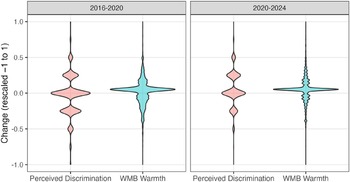
Perceived discrimination is measured with a single item, whereas racial affect (WMB) is constructed from two feeling thermometers. Within-person standard deviations are slightly higher for perceived discrimination than for WMB, suggesting that WMB may capture somewhat less short-term variation. Differences in measurement reliability could therefore attenuate estimated effects for WMB relative to discrimination. Distributions and descriptive statistics for both measures are reported in Table A1 in the Supplemental Appendix. Figure 1 shows the distribution of racial attitude change across the survey waves and confirms that change is distributed relatively equally across both racial attitudes and all time periods.
Within-person racial attitude changes by period.

Figure 1. Long description
Two violin plots compare changes in perceived discrimination and warmth toward white men over two periods, 2016-2020 and 2020-2024. Panel A: The left violin plot for the period 2016-2020 shows changes in perceived discrimination and warmth toward white men. The y-axis represents change rescaled from -1 to 1. The x-axis has two categories: Perceived Discrimination and WMB Warmth. The violin plot for Perceived Discrimination shows a wider distribution around 0, indicating more variability. The WMB Warmth plot shows a narrower distribution, suggesting less variability. Panel B: The right violin plot for the period 2020-2024 also shows changes in perceived discrimination and warmth toward white men. The y-axis represents change rescaled from -1 to 1. The x-axis has two categories: Perceived Discrimination and WMB Warmth. The violin plot for Perceived Discrimination shows a wider distribution around 0, indicating more variability. The WMB Warmth plot shows a narrower distribution, suggesting less variability.
Baseline ideological extremity is used as a moderating variable. The 2016 ANES ideology item is used to construct a partisan extremity measure as the absolute distance from the midpoint of the seven-point liberal-conservative scale. This variable is treated as time invariant and enters the fixed-effect interaction models as a moderator of within-person discrimination change.
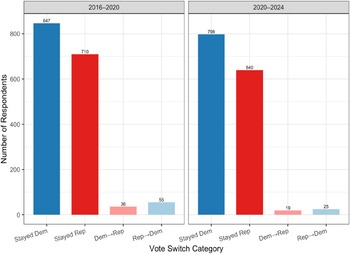
The sample is restricted to respondents who have at least two non-missing observed vote reports across the three waves (N = 5,366 observations). Figure 2 shows a summary of vote switching across the three presidential elections in the panel survey.
Vote switching by time period.

Empirical Strategy
The primary estimator is a first-difference model that operationalizes attitudinal and behavioral change as the period-to-period difference between adjacent waves. For each respondent, this produces two observations: the 2016–2020 change and the 2020–2024 change. The core model is: $\Delta RepVote_{it} = \alpha + \beta_1 \Delta Discrimination_{it} + \beta_2 \Delta WMB_{it} + \gamma_{2024} + \varepsilon_{it}$
where Δ indicates the period-to-period change between adjacent waves (2016→2020 or 2020→2024), γ2024 is an indicator for the 2020–2024 period, and standard errors are clustered by respondent to account for the fact that each respondent contributes two observations.
First-difference estimation removes time-invariant individual characteristics such as race, gender, education, stable personality traits, and baseline ideology, ensuring that observed associations reflect genuine within-person change rather than stable between-person differences. This operationalization is preferred over demeaned within-person deviation because deviation-from-mean scores do not distinguish which wave produced the change. Consider a respondent who voted Clinton (0) in 2016, Biden (0) in 2020, and Trump (1) in 2024. Their demeaned vote deviations for 2016 and 2020 would be identical even though no switching occurred between those waves; the deviation for 2024 would differ even though the switch occurred in the 2020–2024 period. Period-to-period first differences correctly locate the change in the period it occurred and therefore provide a more conceptually appropriate measure of vote switching.
To assess whether the discrimination–vote relationship holds across both electoral transitions, the pooled model is followed by period-specific first-difference models estimated separately for the 2016–2020 and 2020–2024 periods. To complement the primary first-difference models, a demeaned within-person linear probability model with respondent fixed effects is estimated as a robustness check and reported in Appendix B.
Assessing Reverse-Causality
To assess temporal ordering, event study pre-trend tests are used to evaluate whether vote switching predicts subsequent attitude change. Pre-trend tests ask whether the outcome variable was already changing before any treatment or intervention took place, suggesting the treatment did not actually cause the change (Chiu et al. Reference Chiu, Lan, Liu and Xu2026). I extend this logic to rule out reverse causality and ask whether the presumed outcome (vote switching) moves before the presumed cause (attitude change). If individuals are already shifting their vote choice before their attitudes change, the causal story runs backwards. A significant association in the pre-trend direction would suggest that individuals are adjusting their attitudes in response to partisan shifts, undermining the claim that attitude change precedes and causes vote change. This model is specified as: $Attitude_{i,t+1} = \alpha + \beta(\Delta Vote_{it}) + \varepsilon_i$
where Attitudei,t + 1 is respondent i’s racial attitude at the next wave, and ΔVotei,t is the change in their vote choice in the current period. A significant β would indicate that current vote switching predicts future attitude change, consistent with reverse causality. A non-significant β supports the interpretation that vote change does not drive subsequent attitude change, lending credibility to the forward-ordered claim that attitudes cause vote switching.
This specification is preferable to the more commonly used forward/reverse approach where ΔVote is regressed on ΔAttitude and then the two variables are swapped. When both the dependent and independent variables are measured over the same wave interval, swapping them cannot resolve which came first: both Δ terms span identical time periods, so the models are mathematically symmetric and share the same R2. The pre-trend test breaks this symmetry by using the attitude measure at a subsequent wave (t + 1) as the outcome, explicitly placing vote change at time t prior to attitude change at time t + 1 in the causal sequence.
A cross-lagged model is an alternative that similarly uses temporal ordering by regressing votet on votet−1 and attitudet−1 in one equation and attitudet on attitudet−1 and votet−1 in another (e.g., Englehardt Reference Engelhardt2021). The cross-lagged approach answers a slightly different question: whether the level of prior attitudes predicts later vote choice, net of vote inertia, and vice versa. The results of a cross-lagged model are presented in Supplemental Appendix C. The pre-trend test used in the main text instead focuses on changes in vote choice as the predictor of subsequent attitude change, which maps more directly onto the first-difference framework used in the primary analysis.
Heterogeneity by Ideological Strength
To test whether the effect of racial affect change varies by ideological strength, I estimate a fixed-effects LPM with an interaction term: ${\it{\Delta }}\textit{RepVot}e_{it}=\beta _{1}{\it{\Delta }}\textit{Discriminatio}n_{it}+\beta _{2}({\it{\Delta }}\textit{Discriminatio}n_{it}\textit{*IdeoStrengt}h_{i})\\+\beta _{3}WMB_{it}+\gamma 2020+\gamma 2024+\varepsilon _{it}$
This model specification tests whether respondents with stronger ideological attachment respond differently in response to changes in perceived discrimination. Because ideological strength is considered time-invariant, its main effect is absorbed by the person fixed effects, and the model identifies only the interaction slope.
Sample Restrictions and Robustness Checks
The primary analysis uses all respondents who voted for a major-party candidate in adjacent waves. Three robustness checks address potential sample restriction concerns. First, the main model is re-estimated, restricting the sample to non-Hispanic white respondents. White respondents account for the substantial majority of partisan switchers in this panel, and the theoretical mechanisms apply most directly to this group. Second, a broader outcome is coded in which a Republican vote equals 1 and all other outcomes (Democrat, third party, non-voter, and missing) equal 0, eliminating the concern that conditioning on major-party turnout introduces selection bias correlated with racial attitudes. Third, alternative directional specifications separately model switching toward the Republican candidate and switching toward the Democratic candidate, testing whether the discrimination effect is symmetric across directions.
Results
Table 1 presents the primary first-difference model. Results support H1 and H2, subject to the period-specific qualification discussed below. Consistent with H1, within-person increases in perceived discrimination (higher values = less perceived discrimination) are significantly associated with switching toward the Republican candidate (β = .018, SE = .005, p < .001). Consistent with H2, changes in relative racial warmth (ΔWMB) do not reach statistical significance. These results are further supported by the fixed-effects linear probability model reported in Supplemental Appendix B, which shows a significant effect of perceived discrimination on vote switching and a null effect of racial affect.
Primary first-difference model predicting ΔRepublican vote

Note: OLS first-different estimates. Δ = period-to-period change (2016→2020 or 2020→2024). Standard errors clustered by respondent. *p < .05, **p < .01, ***p < .001.
The small number of vote switchers in the panel raises questions about statistical precision. To address these concerns, power is calculated for each specification using the observed R2 as the effect size. The primary first-difference model operates on the full person-period sample (N = 2,729) and does not require within-person switching to identify the model. At this sample size, the model achieves 98.9% power. This high power has two implications: the significant discrimination result is robustly detected rather than a chance finding, and the null result for racial affect therefore reflects a genuine absence of association rather than insufficient power to detect it.
A key claim of this paper is that the effect of perceived discrimination change on vote switching is stronger than the effect of affective change (H3). To test this, a linear restriction test is applied using a clustered variance-covariance matrix. The test does not reach statistical significance, meaning that while the point estimates are consistent with the direction predicted by H3, the difference between them cannot be distinguished. I am unable to find support for H3. The paper’s primary empirical contribution rests on H1 and H2: within-person decreases in perceived discrimination predict Republican vote switching, and this effect is more precisely estimated and consistently significant across specifications than the warmth effect, even if the formal difference test is inconclusive.
Wave-by-Wave Results
Table 2 decomposes the pooled estimate by electoral transition. In the 2016–2020 period, ΔDiscrimination is statistically significant (β = .025, SE = .007, p < .001), replicating Mutz’s (Reference Mutz2022) finding with the same ANES panel. In the 2020–2024 period, the coefficient is positive but smaller (β = .009, SE = .006) and does not reach significance. ΔWMB Warmth is consistently non-significant across both periods.
Period-specific first-difference models

Note: OLS first-difference estimates estimated separately within each electoral transition. Standard errors clustered by respondent. *p < .05, **p < .01, ***p < .001.
This pattern raises questions about the temporal scope of the discrimination–vote relationship. The small number of switchers in the 2020–2024 period (N = 44 compared to N = 91 in the 2016–2020 period) substantially limits power in that subsample. At the same time, the possibility that the discrimination–vote relationship was more pronounced during the heightened racial salience of the BLM moment cannot be ruled out.
Reverse-Causality Tests
To assess whether the discrimination–vote relationship reflects attitudes driving vote choice rather than the reverse, I report event study pre-trend tests regressing future attitude change (Attitudet + 1) on current vote change (ΔVotet). These results are presented in Table 3. For perceived discrimination, the pre-trend coefficient is near zero and non-significant (β = −.040, SE = .201, p = .841), providing no evidence that vote switching in one period predicts how much discrimination respondents perceive in the subsequent period. This supports a forward-ordered process in which changing discrimination perceptions influence subsequent vote choice rather than the reverse.
The pre-trend result for WMB Warmth is significant (β = −.510, SE = .215, p = .018), indicating that switching toward the Republican candidate is associated with a subsequent decrease in relative warmth toward white versus Black Americans. This finding is notable but does not undermine the primary claims of the paper. It suggests that for the affective channel specifically, some attitude adjustment may follow vote choice, consistent with Engelhardt’s (Reference Engelhardt2021) finding that partisanship shapes racial attitudes. This does not implicate reverse causality for the discrimination channel, which is the paper’s primary predictor of interest. If anything, the WMB pre-trend result reinforces the theoretical distinction between the two channels: cognitive discrimination assessments appear more causally prior to vote choice, while affective warmth is more susceptible to post-hoc partisan rationalization.
Moderation by Ideological Strength
Table 4 presents the interaction between ΔDiscrimination and baseline ideological extremity. The interaction term is near zero and non-significant, providing no support for H4. Ideological strength itself has a marginally significant positive main effect (β = .008, p = .036), consistent with broader partisan sorting trends. The power analysis provides important context for interpreting the null interaction. The primary first-difference model (N = 2,729) has an estimated power of 98.9% to detect an effect of the observed size. The interaction model (N = 2,348) has an estimated power of 92.4%. Per Gelman et al. (Reference Gelman, Hill and Vehtari2021), reliably detecting an interaction effect requires approximately 16 times the sample size needed for the corresponding main effect; the current sample is almost certainly underpowered for detecting moderate interaction effects. The null interaction result should therefore be interpreted as inconclusive rather than as evidence against moderation by ideological strength.
Pre-trend results

Moderation by ideological strength

Note: OLS first-difference model. Ideological strength = |ideology − 4| on 7-point liberal–conservative scale. Standard errors clustered by respondent. *p < .05, **p < .01, ***p < .001.
Robustness Checks
Table 5 presents three robustness checks addressing sample restriction and outcome coding concerns. Results are broadly consistent with the primary specification across two of the three checks, with one noteworthy exception in the directional specification that warrants discussion.
Robustness checks

Note: All models estimated via OLS first-difference with standard errors clustered by respondent. *p < .05, **p < .01, ***p < .001.
Among white respondents only, the discrimination effect is virtually identical to the full-sample result (β = .019, SE = .006, p < .001), and the WMB coefficient is essentially zero (β <.001, p = .998). This near-total attenuation of the warmth effect among white respondents strengthens confidence in H2 and confirms that the primary findings are not driven by heterogeneity across racial groups.
Under the broad outcome coding in which a Republican vote equals 1 and all other outcomes, including non-voters and third-party voters, equal 0, the discrimination effect again replicates closely (β = .018, SE = .006, p = .001), while the WMB coefficient does not reach significance. This result indicates that conditioning on major-party vote choice in the primary specification does not meaningfully bias the discrimination estimate, addressing the concern that turnout decisions correlated with racial attitudes could introduce selection.
The directional specifications offer two additional findings. Switching toward the Democratic candidate is significantly predicted by increasing perceptions of discrimination (β = −.011, SE = .003, p = .001), and WMB is null. This symmetry across directions strengthens the substantive interpretation: decreasing perceptions of discrimination are associated with movement toward the Republican candidate, while increasing perceptions are associated with movement toward the Democratic candidate, consistent with H1.
In the specification predicting switching toward the Republican candidate specifically, the discrimination effect remains significant (β = .007, SE = .003, p = .036), but the WMB coefficient also reaches significance (β = .000, SE = .000, p = .012). This is the one result that is not fully consistent with H2. Ultimately, these results highlight the predictive power of changes in perceived discrimination. However, the unexpected finding when separating out switching to Democrat versus Republican candidates suggests that the relative strength of perceived discrimination over racial warmth is not perfectly symmetrical.
Vote Switching in Context
Across three presidential elections, 135 respondents switched their major-party vote choice (91 in 2016–2020, 44 in 2020–2024), representing approximately 8.5% of major-party voters with non-missing votes in adjacent waves. This rate is consistent with the broader literature on vote switching in polarized electorates: aggregate stability in presidential vote margins masks individual-level fluidity, but the proportion of genuine party changers in any single election is modest (Bartels Reference Bartels2000). The rarity of switching is precisely why panel data are necessary to study this phenomenon and why the fixed-effects and first-difference approaches are appropriate even with a small effective N of switchers.
Discussion
The primary substantive conclusion is straightforward and robust across estimators. Individuals who come to believe that Black Americans face less discrimination are more likely to move toward voting for the Republican presidential candidate. This result holds across multiple model specifications. These results demonstrate that the politically consequential component of racial attitudes is not affective bias but changing cognitive assessments of structural racial injustice, an insight missed by cross-sectional designs and most work centered on racial resentment scales.
These findings refine existing accounts of racial influence on voting. Symbolic racism, racial resentment, and other affective measures remain important in predicting policy and party preferences (Kinder and Sanders Reference Kinder and Sanders1996; Sides et al. Reference Sides, Tesler and Vavreck2019). These results, however, emphasize that cognitive beliefs about structural injustice deserve distinct attention. Perceptions of discrimination operate as a driver of partisan realignment in their own right. The pattern is consistent with scholarship that interprets contemporary partisan movement in terms of status threat and grievance rather than purely economic calculations (Abramowitz and McCoy Reference Abramowitz and McCoy2019; Mutz Reference Mutz2018). The effect of discrimination change across the partisan spectrum indicates that grievance can reach beyond marginal voters.
Theoretically, this implies that attention should be paid to dynamic beliefs about structural injustice such as changes in perceived discrimination over time. Policy debates, media treatments of racial incidents, and elite framing that affect perceptions of discrimination may have downstream effects on voting behavior that are not captured by cross-sectional measures of warmth or racial resentment. Political campaigns that emphasize structural injustice may therefore be particularly effective at converting attitudinal change into vote choice. In a time of heightened racial salience, shifts in perceptions of discrimination are a politically consequential process that deserves further theoretical and empirical attention.
Supplementary material
The supplementary material for this article can be found at https://doi.org/10.1017/rep.2026.10093.
Data availability statement
ANES data is publicly available at https://electionstudies.org/data-center/2016-2020-2024-panel-merged-study/. Replication code for this study is available at Harvard Dataverse at https://doi.org/10.7910/DVN/RESMPU.
Funding statement
None.
Competing interests
None.


 Open access

