




Introduction
In recent decades, profound shifts in the international landscape have positioned China’s rise as a transformative force that is reconfiguring regional and global power architectures. This transformation has extended beyond state-level diplomacy, reshaping how citizens conceptualize international relations, which leads to varying levels of engagement in public affairs and cultural exchanges. In today’s information-rich and globally connected environment, public meaning-making and sentiment have become not only more visible and accessible but also politically consequential in shaping state behavior and diplomatic dynamics. Japan’s public attitudes toward China represent a critical focal point. Over the past thirty years, responding to evolving bilateral relations, Japanese public affinity toward China has plummeted, with concerns over geopolitical conflicts, economic tensions, and ideological divides rendering China’s rise as a potential threat rather than a shared opportunity (Sonoda Reference Sonoda2021a; Wang Reference Wang2014; Xi and Primiano Reference Xi and Primiano2020; Xie and Jin Reference Xie and Jin2021; Zhai Reference Zhai2018).
Within this overall pessimism, however, an intriguing internal divergence has emerged: younger generations in Japan have demonstrated higher levels of affinity for China in the past decade compared to their older counterparts. This accelerating generational difference presents a compelling puzzle that challenges the postulate of social learning theory that political values are transmitted intergenerationally (Jennings et al Reference Jennings, Laura and Bowers2009), suggesting instead the effects of experience-driven generational orientations.
Drawing on generational cohort theory, collective memory, and prior empirical research on Japanese views of China, this paper examines the emerging generational divide by analyzing how experiences, memories, and evaluative frameworks differ across age groups and by mapping the distinct attitudinal patterns of Japanese cohorts. Specifically, this paper aims to (1) redefine Japanese generations in the context of views of China, (2) examine their attitudes toward China through a generational lens, and (3) identify the primary drivers contributing to affinity toward China among different generations. This will shed light on the reasons for the generational gap in Japanese public attitudes toward China.
Generational gap in attitudes toward China
A Yahoo! News article, titled “80% of Japanese People Feel No Affinity Towards China. Why is this the worst ever?,” published on May 19, 2016, reported on the Japanese Cabinet Office’s “Public Poll on Diplomacy” and conducted interviews with four Japan-based experts on the topic of changing perceptions of China in Japan. This article sheds light on why perceptions of China among Japanese people aged 50 and older have deteriorated significantly. All experts point to the historical memories held by each generation as a key explanatory factor. As far as we can determine, this news article represents the first attempt to examine age-specific differences in Japanese perceptions of China, followed by a commentary of Kawashima (Reference Kawashima2022) and Yamane’s (Reference Yamane2022) similar news report in Asahi Shimbun. In fact, a closer examination of the Japanese Cabinet Office’s “Public Poll on Diplomacy,” which started to show the results of surveys by age group, revealed that 2012 was the first year when older generations began to express less affinity toward China. Similar trends have been seen since then. Prior to 2012, there were no apparent differences in perceptions of China among age groups, so elderly Japanese attitudes toward China have worsened significantly over the past decade.
As of 2024, we can see similar generational differences in views in Australia and a completely opposite pattern of views in South Korea, Taiwan, and Malaysia, while views of the US and Russia showed no clear generational differences in (Cabinet Office, Government of Japan, 2024). Why do feelings of affinity toward China differ among age groups? When we look at the situation in Asian countries with this question in mind, we notice that the circumstances are different in countries and regions other than Japan.
In South Korea, younger cohorts tend to hold significantly more negative views of China. Recent surveys show that unfavorable sentiment among those in their 20s has reached 80%, nearly 20–30 percentage points higher than that of respondents in their 60s and 70s (Lee Reference Lee2025). This sharp generational divide reflects formative experiences such as the THAAD dispute and COVID-19, which curtailed exchange and reinforced mistrust. Young Koreans are especially attentive to China’s growing power and authoritarian politics, perceiving them as direct threats, but their views are conditioned by their political orientations and ideologies (Wang Reference Wang2018). At the same time, contentions over cultural originality have eroded their sense of national pride, fueling online “cultural wars” in which they confront an assertive Chinese state and hostile netizens (Cho Reference Cho2022; Yoon and Seo Reference Yoon and Seo2024). Consequently, unlike older cohorts who retain some sense of historical interdependence, younger Koreans have come to hold increasingly adversarial views of China, both at the state and social levels. In the Korean case, scholars have highlighted the significance of period effects and bilateral dynamics – rather than balancing acts in the broader environment – in forging young people’s attitudes (Jung and Jeong Reference Jung and Wool Jeong2016; Wang Reference Wang2018).
In Taiwan, the younger generation is said to be “naturally independent.” It is commonly argued that young people born and raised in an environment where conflict with China is a part of daily life have few opportunities to travel to China, and many of them consider themselves “Taiwanese, not Chinese,” meaning that they have a different perception of China than older generations. Specifically, while they are politically wary of China and reject political integration with China, they do not express strong reservations about economic ties (Chang and Wang Reference Chang and Wang2005; Liu and Li Reference Liu and Li2016). Similar observations can be made in Malaysia (Yeoh Reference Yeoh2018), while Japan exhibits a reverse generational gap.
Why does Japan show the opposite generational gap from other parts of Asia in their perceptions of China?
Generational cohort theory: Age, period, and cohort effects
Generation is broadly conceptualized as a group with similar characteristics. For example, a generational cohort is interpreted as a group of individuals born within a particular time frame who share formative experiences during adolescence and early adulthood, the stages of life most susceptible to impressionable events (Kupperschmidt Reference Kupperschmidt2000; Mannheim Reference Mannheim and Kecskemeti1952). These experiences are often composed of major historical, political, or technological developments. Rooted in Mannheim’s framework, this concept underscores that shared novel life events imbue cohorts with distinct collective memories, values, and behavioral tendencies, fostering a generational consciousness that persists across the lifespan (Jurkiewicz and Brown Reference Jurkiewicz and Brown1998; Mannheim Reference Mannheim and Kecskemeti1952).
A representative foundational framework for understanding how generational gaps emerge is the age, period, and cohort effects, established by Rhodes (Reference Rhodes1983). This framework, widely used to analyze age-related attitudinal and behavioral shifts, posits the following three distinct mechanisms: Age effects, driven by biological aging or evolving social roles, alter the priorities of an individual’s life and thus affect their psychological state over time; Cohort effects, reflecting relatively enduring value systems shaped by shared exposure to formative socio-historical events (Rosow Reference Rosow1978); Period effects, arising from transient social disruptions, such as financial crises or the COVID-19 pandemic, temporarily trigger attitude variations across all age groups. These three effects combine to shape distinct thinking and behavioral patterns across generations.
The absence of standardized criteria for cohort categorization is also highlighted among generation studies, marking one key challenge that complicates cross-cultural and cross-temporal comparisons. While the Western logic of categorizing generational groups, from the WWIIers to the Baby Boomers, has been widely accepted on a global scale, the specific characteristics as well as dividing boundaries of generational cohorts can vary across nations.
In Japan, generational identities are shaped by distinct historical events, cultural norms, and geopolitical relationships, which form unique collective memories, diverging significantly from those in the US. The work of Okamoto (Reference Okamoto2011) serves as one of the few representative studies on Japanese generational cohorts. Okamoto (Reference Okamoto2011) categorizes post-war generations as follows: (1) The Immediate Post-war Generation, born in or before 1946, who witnessed the reconstruction and engaged in intense debates over left-wing movements, democratization, war responsibility, and orientation shifts; (2) Baby Boom Generation, born between 1947 and 1949, who experienced the economic recovery periods and the universalization of the seniority-based, lifetime employment system; (3) New Wave Generation, born roughly 10 to 20 years after the Baby Boomers, who saw Japan rise to become a global economic powerhouse before experiencing the downturn after the burst of the bubble economy; (4) Second-Generation Baby Boomers, born in the early 1970s, who lived through the bubble economy but graduated into the Employment Ice Age; (5) Lost Generation, born in the late 1970s to early 1980s, who faced an increasingly unstable labor market and the emergence of non-regular employment in place of lifetime jobs. It can be evidently read that this Japanese cohort framework mirrors the Western model in terms of birth rate fluctuations, but adds an essential emphasis on economic cycles, which have profoundly shaped Japan’s post-war environment.
Moreover, Okamoto raises an interesting question: Who defines Japanese generations? While the first three cohorts are seen as internally shaped by shared experiences, the latter two are largely regarded as being identified and labeled from an external perspective (Okamoto Reference Okamoto2011). By differentiating the internal and external perspectives shaping cohorts, two approaches to cohort formation are underscored: one that emerges organically in response to major social changes or historical turning points, and another clustered by external categorizations based on demographic patterns or survey results. Although the latter approach might be questioned for its lack of persuasiveness due to potential interpreter bias or survey limitations, it has in fact been frequently adopted in numerous Japanese reports (e.g., Hiroi Reference Hiroi2024; Iwasaki Reference Iwasaki2022), which reveals several significant points:
-
(a) While some generational categories like “Second-Generation Baby Boomers” are commonly used, there is no fixed standard for generation classifications;
-
(b) Generational distinctions continue to serve as vital analytical references for institutions and government agencies to monitor social trends;
-
(c) The choice of generational categories often depends on the thematic focus of the study. For instance, in demographic research, terms like “Baby Boom Generation” and “Second-Generation Baby Boomers” are frequently used, whereas labels such as “Bubble Generation” and “Employment Ice Age Generation” appear in studies on work values or labor market conditions. Sato (Reference Sato2007) also adopts a generational framework to examine shifting work values and notes a growing emphasis on job stability among younger generations.
These phenomena suggest that generation definitions in Japan remain flexible and theme-driven, as long as the categorizations align with the broader logics of Japan’s social structure and demographic patternsFootnote 1.
Collective memory as a framework for generational identity
Collective memory, defined as a shared understanding and representation of the past and significant historical periods within specific communities, offers a more socially embedded framework for categorizing generations (Mustafa et al Reference Mustafa, Mukhiar, Jamaludin and Jais2021). These shared memories, often anchored in emotionally or politically charged events, not only reflect but also actively shape group values and boundaries (Campbell et al Reference Campbell, Twenge and Campbell2017). While the linkage between collective memory and generational identity has been empirically explored (e.g., Lee and Chan Reference Lee and Chan2018; Schewe and Meredith Reference Schewe and Meredith2004; Schuman and Corning Reference Schuman and Corning2011; Schuman and Corning Reference Schuman and Corning2016), deeper queries remain unresolved when examining the role of collective memory in defining generations: (1) Selective memorization of significant events: Why do some events gain salience as intergenerational touchstones, while others fade into oblivion? (2) Transmission mechanisms: How have the memories of those “selected” events been preserved and transmitted? (3) Heterogeneity in memory retention: Are individuals or generations shaped by those memories in similar ways?
With numerous events occurring throughout history, not all events are equally remembered, and the process by which certain episodes are elevated into collective memory is neither neutral nor automatic. It has been shown that events are more likely to be retained if they are of objectively extensive significance, emotionally engaging, or widely experienced (e.g., Lee and Chan Reference Lee and Chan2013; Schuman and Corning Reference Schuman and Corning2011). Furthermore, drawing on the concept of the “politics of memory” (Kramer Reference Kramer1996), collective memory is shaped by the desire to affirm group identity, selectively resurrecting, reinterpreting, or erasing historical events to legitimize contemporary ideologies. Wertsch and Roediger (Reference Wertsch and Roediger2008) highlight a conceptual distinction between collective memory as a fixed body of shared knowledge and as a dynamic process involving continual reinterpretation. The latter view suggests that collective memory is often controversial, underscoring the need to consider the remembering process as social and political debates rather than merely passive transmission. Unlike history, which aspires to provide an accurate and impartial account of the past, collective memory is inherently selective and identity-driven, where “what we choose to remember” is subordinated to “who we are.” In this sense, the endurance of memory hinges on its capacity to perform identity work, forge cohesion, or justify power structures.
Collective memory does not always equal similar memories among the public; rather, it can be interpreted and digested in diverse ways, especially across generational cohorts. Building on Mannheim’s (Reference Mannheim and Kecskemeti1952) generational theory, Schuman and Scott (Reference Schuman and Scott1989) proposed the critical years hypothesis, which conceptualizes society as a series of successive cohorts, each of which carries collective memories formed during major events experienced nationwide or worldwide around the ages of 10 to 30 (Schuman and Corning Reference Schuman and Corning2016). This hypothesis holds that people tend to recall events from their adolescence and early adulthood more vividly, since these periods mark their initial engagement with significant social and political issues, when they are cognitively mature enough to comprehend public affairs but still forming their social identities. Therefore, each cohort may form unique memories from events that occur during their critical years, triggering generational gaps in various fields. For example, many generational studies report a common finding that despite awareness and knowledge of certain major events, youth often portray these events with less detail, expressing relatively simplified or essentialized understandings (e.g., Lee and Chan Reference Lee and Chan2013; Schuman et al Reference Schuman, Akiyama and Knäuper1998). This generational gap may reflect the reinterpretation of collective memory in line with contemporary ideological frameworks rather than personal experience (Lee and Chan Reference Lee and Chan2013).
In short, generational cohort theory and collective memory theory provide frameworks to unpack the dynamics of generational chasms. Generational cohorts are defined not by biological age alone but by shared historical experiences that forge collective identity.
Japanese views of China: an overview
Scholarship on Japanese public opinion toward China has grown significantly since 2012, a year widely recognized as a pivotal point in China’s domestic and international trajectory (Takahara Reference Takahara2021). In the political domain, China has continued to expand its regional and global influence by cultivating strategic partnerships with developing countries, most notably through its flagship Belt and Road Initiative, which has become a cornerstone of its foreign policy outreach (Xi and Primiano Reference Xi and Primiano2020). Economically, China has leveraged its growing financial power to extend economic assistance and foster regional integration frameworks, with the aim of reshaping regional economic orders with Chinese leadership at the center. On the cultural front, China has promoted a narrative of “peaceful development” and soft power since the mid-2000s by advancing traditional Chinese culture abroad, primarily through institutions such as the Confucius Institutes and state-sponsored cultural diplomacy. Regarding national security, however, China has adopted a more assertive posture. Assertiveness in defending territorial claims, exemplified by escalations around the Senkaku Islands, has contributed to rising tensions with neighboring states, including Japan. These developments have significantly shaped how the Japanese public perceives China’s rise, not merely as a matter of economic opportunity but also as a potential strategic and ideological threat.
Against this backdrop, scholars have increasingly analyzed public attitudes toward China through two complementary analytical lenses: the macroscopic and microscopic perspectives. The macroscopic perspective examines country-level factors, including political and economic cooperation along with competition, cultural bonds, and broader geopolitical dynamics. These factors often shape collective sentiment and national discourse on China. In contrast, the microscopic perspective focuses on individual-level determinants, such as direct interpersonal contact with Chinese people and personal ideological orientation. By integrating these two perspectives, researchers aim to develop a more comprehensive understanding of how the Japanese public interprets and responds to China’s rise within the context of an increasingly complex and volatile regional landscape.
Country-level factors
Political ideology has been observed as a critical influencing factor, and some researchers claim that citizens from developed countries tend to prioritize political and ideological criteria and that individuals who perceive a higher level of democracy in China are more inclined to harbor favorable perceptions or consider China less of a threat (Huang and Chu Reference Huang and Chu2014; Xi and Primiano Reference Xi and Primiano2020; Xie and Jin Reference Xie and Jin2021).
Economic connection serves as another pivotal predictor. According to Sonoda (Reference Sonoda2021a), who used data from the 2018 Asian Student Survey, in the five countries surveyed, one factor that influenced perceptions of China was whether the growth of the Chinese economy was regarded as beneficial to their own country. In Japan, South Korea, and Singapore, a positive correlation was confirmed between expected economic benefits and positive perceptions of China.
Security concern is connected with threat perception, influencing people’s attitudes toward China. Threats arising from territorial conflicts have emerged as a central and definitive factor influencing nations’ perceptions of China in the past decade. Drawing on political threat theory, individuals who perceive external threats to their country’s political security tend to harbor more negative attitudes toward external groups (Gong and Nagayoshi Reference Gong and Nagayoshi2019). In line with offensive realist perspectives, powerful nations engage in assertive actions due to their possession of ample power, and China’s rise is widely interpreted through this offensive realist lens (Mearsheimer Reference Mearsheimer2006). As a result, discussions on the perceived threat posed by China are widespread, particularly in the context of Japan, which is entangled in territorial disputes with China.
Cultural factors have also been considered as potential influencing elements. Although it can be argued that cultural affinity within Asia has made a modest contribution to China’s positive image, overall, China’s cultural promotion – exemplified by Confucius Institutes – has not had a notable impact on Asians’ perceptions of China (Huang and Chu Reference Huang and Chu2014; Xie and Page Reference Xie and Page2013; Zhai Reference Zhai2018).
Individual-level factors
At the micro-level, research has drawn on theoretical frameworks from sociology and psychology to explore individual determinants of attitudes toward China. Major focal points include interpersonal contact, such as direct interaction with Chinese nationals, and identity-related variables, such as national pride, perceived cultural distance, or political ideology. While macro-level variables tend to explain broader trends in public opinion more effectively, micro-level factors often serve as meaningful complements, accounting for variation within demographic subgroups and enriching our understanding of how perceptions are formed and maintained at the individual level.
Contact, in this field, can be categorized into direct and indirect forms, both of which have had a discernible impact on shaping people’s perspectives. Direct contact is frequently discussed as a method to intervene in the negative evaluation of China resulting from country-level factors. Based on intergroup contact theory, intergroup contact contributes to reducing, resolving, and preventing intergroup conflicts arising from factors such as ethnic or political wars and has the potential to mitigate stereotypical impressions toward outgroups under specific circumstances (Brown and Hewstone Reference Brown and Hewstone2005). Applying this theory to investigate the attitudes of Japanese youth toward China, Zhai (Reference Zhai2018) proposes that contact can help improve their attitudes under certain conditions. Nelson and Carlson (Reference Nelson and Carlson2012) reveal a similar finding, indicating that personal contact, including travel experiences, plays a positive role in shaping perspectives on China’s influence. In terms of indirect contact, the spillover effect of cultural exposure has been highlighted to suggest that indirect and extended intergroup contact through exposure to media is associated with mutual understanding and positive intergroup attitudes between the Chinese and Japanese (Zhai Reference Zhai2016).
National identity also affects individuals’ evaluations of China. Social identity theory posits that an individual’s self-definition extends beyond the personal level to include a group level. Group identity emerges as a pivotal factor shaping individual social perceptions and behaviors. Zhai (Reference Zhai2016) found that heightened identity within the Japanese group intensifies national sentiments, contributing to a slightly more negative evaluation of China, particularly given the strained Japan-China relations. Moreover, Nelson and Carlson (Reference Nelson and Carlson2012) observed that individuals who take greater pride in their own country are less likely to attach value to the influence of other countries. In summary, individuals displaying a stronger sense of national identity tend to harbor less positive attitudes toward China.
Despite current fruitful examinations on Japanese views of China, inconsistencies in the influence of these key factors have been observed. For example, some studies suggest that political identity exerts little influence. Nelson and Carlson (Reference Nelson and Carlson2012) show that regime type is not a key factor determining individuals’ opinions on China’s influence. Zhai (Reference Zhai2018) shows that political and ideological differences between democracy and authoritarianism hardly affect Asian youths’ views of China’s rise. This divergence of results may be due to the wide range of subjects studied, with limited attention given to variation in individual perceptions and experiences, particularly across different age groups. To uncover the generational gap, this paper will focus on how individual cognition and emotion influence affinity toward China.
Research design
This paper adopts a two-phase quantitative approach based on the survey data retrieved from the Sasakawa Peace Foundation. In the first phase, we will apply analysis of variance (ANOVA) with the aim to establish a generational division tailored to the theme and objectives of this paper, while in the second phase we will employ logistic regression to identify key factors for Japanese citizens’ affinity toward China, examining the prominent drivers for cross-sectional comparison between generations. Through these approaches, this paper intends to figure out the underlying reasons for cohort gaps in current Japanese perceptions of China.
As we did not assume that the effects of every explanatory variable are constant across all categories, we did not use an ordinal logistic regression model but instead used a partial proportional odds model. As we will see in Table 3, our assumption proved to be true.
The dataset used for this analysis is the “Survey on Japanese Perceptions of China” (2023), conducted by the Sasakawa Peace Foundation. This survey represents one of the achievements of the foundation’s Japan-China Friendship Program, contributing to broader efforts in promoting mutual understanding and diplomatic dialogue. This dataset is adopted due to its unique focus on “affinity.” Unlike other surveys with similar topics, the “Public Poll on Diplomacy” explicitly started to employ the notion of “affinity” to chronologically track public sentiment toward major countries, including China. Such long-term tracking makes it possible to observe the emergence of generational differences in Japanese views toward China over the recent decade. Moreover, the academic relevance of affinity is anchored in consumer studies, where it is theorized as an affectively driven construct – rooted in feelings of liking, sympathy, or attachment toward a foreign country – and presented as an effective predictor of consumer behaviors (Oberecker et al Reference Oberecker, Riefler and Diamantopoulos2008). Extrapolating from consumer behavior to international relations, this suggests that affinity may serve as a more nuanced predictor of public engagement in cross-cultural or bilateral activities.
In addition to the five-point Likert measure of affinity, the survey also incorporates variables capturing China’s perceived political positioning, social development, cognitive engagement with China, as well as experience with Chinese people and China-related information. Specifically:
China’s perceived political positioning is represented by evaluation of current Japan-China relations and perceived growth in China–Japan power disparity in the past ten years, each scored on a five-point scale, with 1 equaling the lowest agreement and 5 the highest.
Perceived social changes are evaluated through respondents’ assessments of the extent to which they believe China has become a more open society, and the extent to which they consider China to have taken a more arrogant stance on the international stage.
Cognitive engagement includes people’s interest toward China, trust in China’s media reports on Japan, and knowledge about Chinese society. While interest and trust are measured on a five-point Likert scale, knowledge is assessed through ten factual questions about China, with the score corresponding to the number of facts correctly identified.
Experience consists of both direct contact with Chinese people and online information searching in different languages. Direct contact with Chinese people is measured on a five-point scale, while the use of different languages to acquire information is coded as binary variables.
The survey was conducted from August 18 to August 23, 2023, employing quota sampling to mirror Japan’s national demographic structure and collecting responses from 3,000 individuals aged 15 to 89 across all 47 prefectures. Participants were recruited through an online panel, with regional representation carefully maintained. In terms of occupational distribution, corporate employees formed the largest group across genders. Age-specific employment patterns were also clearly observable. While corporate employment was dominant among working-age cohorts, a significant portion of respondents aged 60 and above reported being unemployed (28.8%) or identified as homemakers (23.6%), indicative of a typical trend toward retirement. Among the youngest cohort in their 20s and below, approximately 17.2% were students, reflecting their ongoing educational pursuits.
As we employed a web survey, it is quite possible that those who have more to say are more represented, especially among older cohorts whose accessibility to the Internet is limited compared with younger cohorts.
When interpreting the characteristics of each generation, we also use the records of group interviews conducted on September 23, 2023. This interview was conducted among five people selected from those who participated in a public opinion survey conducted by the Sasakawa Peace Foundation that same year. Due to the COVID-19 pandemic, the interviews were conducted online, and comments were recorded with the consent of the subjects. This paper utilizes the comments made there.
Reclassifying generation in Japan
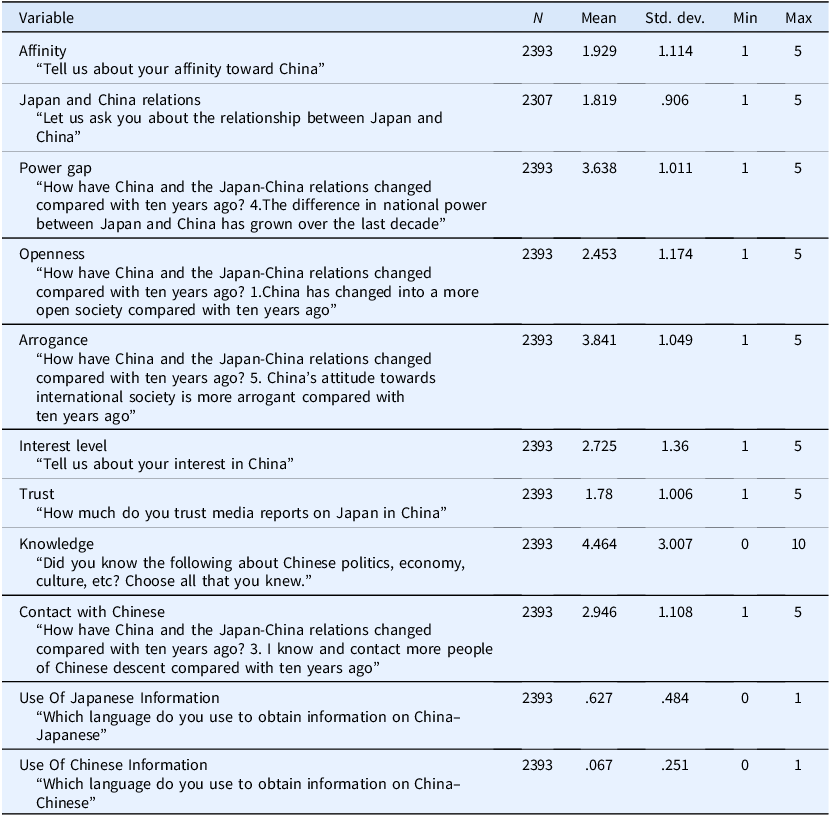
The ANOVA, frequently applied in generation studies for detecting generational gaps in views or attitudes (e.g., Dries et al Reference Dries, Pepermans and De Kerpel2008), is utilized here to delineate generational boundaries and thereby develop an evidence-based classification by testing whether significant differences exist in affinity levels and other relevant explanatory variables across age groups. Drawing on Japan’s socioeconomic background by generation as outlined in official reports from the Ministry of Health, Labor, and Welfare (Ministry of Health, Labor and Welfare 2023), this paper will first follow a five-year classification logic, presenting a preliminary grouping by dividing the questionnaire sample into ten age groups, and then implement an ANOVA-driven refinement to check the attitude variances between groups, regrouping those with similar attitude tendencies on the basis of the empirical results to enable empirical attitude clustering. The variables are extracted from the survey with the characteristics below (see Table 1).
Summary of variables on Japanese views and perceptions of China

Source: Survey on Japanese Perceptions of China, Sasakawa Peace Foundation, 2023.
One-way ANOVA tests are conducted to examine generational differences across ten variables related to attitudes and impressions of China. Bonferroni-adjusted pairwise comparisons are performed to highlight significant differences between age groups. Table 2 presents the F-statistics, p-values, and the direction of significant generational differences, with arrows indicating whether the youngest cohort exhibits higher (↑) or lower (↓) scores compared to older cohorts.
ANOVA results and highlighted comparisons between the youngest group and other age groups

Note: ***p < 0.01, **p < 0.05, *p < 0.1.
Source: Survey on Japanese Perceptions of China, 2023.
Among variables regarding people’s attitudes and impressions toward China, the most pronounced generational gap is demonstrated in their affinity toward China as well as the level at which they regard China as having grown into a more arrogant society in the past ten years. Moderate generational differences were also found for “Japan-China Relations,” “Power Gap,” and “Trust,” whereas variables such as “Interest Level” showed no significant age-related differences. In terms of affinity level, younger age groups, especially those aged between 15 and 27, display significantly different attitudes compared to older age groups. From the evaluation of China’s social change over the past decade, this generational gap has been further specified: the age group of 28 to 32 holds different judgments from those aged above 42, and those aged between 43 and 57 share varying opinions from those aged above 58.
These findings informed the construction of five generational cohorts, designed to capture both experiential and perceptual differences across age groups. This cohort classification is situated within a historical investigation, drawing on generational cohort theory and collective memory approaches, particularly the critical years hypothesis. Accordingly, this paper, grounded in the concept of cohort and period effects, identified key formative events most likely to have shaped each cohort’s worldview during their critical developmental years, laying the groundwork for analyzing their distinct attitudinal patterns.
Cohort 1: digital drift generation (People Aged 15–27)
For those aged between 15 and 27, this cohort, born between 1996 and 2008, came of age during a period marked by the decline of Japan’s economic privileges and the rapid rise of the digital era. Unlike older cohorts who experienced the post-war economic miracle, this group grew up with a diminished expectation of national economic dominance and instead developed adaptive, individualized values shaped by technological change. Their information landscape is digitally saturated, offering broad exposure to Chinese culture, society, and media via social network platforms.
From a political dimension, this generation may tend to manifest a reduced level of political involvement and attenuated international awareness (Tanabe Reference Tanabe2023). Their loose concern in the political arena may be attributed to the following interrelated factors: First, individualistic priorities might detract from their attention to global political issues, which to a certain extent can be inferred from their judgment that Japan-China relations have not significantly deteriorated over the past decade. Second, they lack lived memory concerning diplomatic conflicts between Japan and China decisive to the bilateral relations, and are only limitedly exposed to historical chapters emphasizing ideological rivalry both on a regional level and a global level. Third, they may be inclined to interpret prior geopolitical disputes with simplified or neutral stances, as they have restricted sources for obtaining pertinent information about those events and are less likely to memorize the learned past as vividly as those who actually lived through them (Lee and Chan Reference Lee and Chan2013; Schuman et al Reference Schuman, Akiyama and Knäuper1998). Consequently, despite their awareness of instability brought by China’s politics (Sonoda Reference Sonoda2021a), they are more likely to view China’s political landscape as less of a political threat or not to internalize the ideological tensions that older generations experienced, as evidenced in their optimistic evaluations of whether China has grown into a more open society and presented an arrogant country image during the past ten years.
From an economic perspective, this cohort tends to prioritize practical benefits during the assessment of international relations. As implied in the Analysis of Variances on the extent to which Japanese concur with “The difference in national power between Japan and China has grown over the last decade,” the younger clusters’ generally positive ratings and understanding toward the gap of national powers is indicative of a low possibility of feeling threatened by China’s economic rise among this group. Instead, with more exposure to inbound Chinese tourism and a digital economy that facilitates borderless consumer experiences, they may view China more as an economic partner than a competitor through the microscopic lens of sellers and buyers. This assumption is partially supported by Sonoda’s (Reference Sonoda, Sonoda and Xie2021b) analysis of Japanese youth, which shows that many of them believe China’s rise presents growing opportunities, an outlook that may positively contribute to their increased recognition of China’s global influence.
Regarding security concerns, the absence of direct or inherited memories of war could reduce their perception of China as a military threat. While Sonoda (Reference Sonoda2021a) finds that skepticism toward China’s peaceful rise remains a dominant factor shaping younger generations’ perceptions of China’s influence, threat theory and empirical evidence suggest that individuals with firsthand war experiences tend to prioritize regional stability and thus perceive China as more threatening (Zhai Reference Zhai2018). This implies that although younger cohorts are indeed affected by perceived threats from China, the impact may be less pronounced than among older generations who lived through the Cold War or the aftermath of World War II.
From a cultural perspective, this group shows measured ambivalence. While it is less likely for them to affirm deep-rooted cultural ties with China, partly due to restricted familiarity with the traditional and historical bonds, they have been increasingly impacted by interpersonal and digital interactions. Contact with Chinese tourists and exposure to user-generated content on SNS platforms like TikTok or YouTube also enable them to form impressions based on individual encounters rather than grand historical narratives (Kimura Reference Kimura2024). Consequently, their cultural outlook reflects a nuanced interplay of curiosity, adaptability, and experiential learning, which partially counterbalances ideologically or historically rooted skepticism.
Cohort 2: pragmatism generation (People Aged 28–42)
This cohort, born 1981–1995, spans the tail end of Japan’s lost decades and the dawn of the digital era. Despite growing up in a relatively stable economic environment, many entered the workforce during or after the Employment Ice Age, encountering a labor market defined by non-regular employment and limited upward mobility. They were socialized under the diffusion of digital media and globalization, with early exposure to online platforms molding both information access and cultural tastes. This generation has matured in the midst of China’s rise as a leading force in the global economy, experiencing firsthand the structural interdependence between Japan and China. During their formative years, the “apology fatigue” about historical issues, anti-Japan demonstrations, and the Senkaku Island disputes remain impressive, potentially leading to a more negative evaluation toward not only the Chinese government but also Chinese citizens.
Politically, this group may be inclined to evaluate China through a pragmatic, depoliticized perspective. While ideological crevices remain potent – as reflected in their top two reasons contributing to not feeling affinity toward China in the 2022 Sasakawa Peace Foundation survey – political affinity might be less dominant for them compared to older cohorts (Sasakawa Peace Foundation 2022). Their lower levels of political animosity reflect a shift from Cold War–era frameworks toward individualized, experience-based judgments. However, events like the Senkaku Islands dispute and recent geopolitical tensions still temper any unqualified support.
From an economic view, this cohort mirrors the patterns of the digital drift generation, displaying a tendency to emphasize the positive economic effects brought by China, such as work opportunities and gains in trade or other forms of economic cooperation, as evidenced in their high voting for economic connection when asked about reasons for affinity toward China and lower levels of perceived national power gap compared to older cohorts. This may stem from the harsh job market they faced during the Employment Ice Age, prompting them to prioritize living conditions over macro-level conflicts in political or ideological domains.
In terms of security issues, while aware of regional security concerns, this cohort typically does not prioritize them. Their geopolitical perceptions are more diffuse and framed within post-Cold War multipolarity. They may pay more attention to maritime friction, but such concerns can occasionally be balanced with an enhanced desire for regional stability and economic cooperation.
Culturally, this cohort might devote heightened attention to cultural factors, as evidenced by their top two reasons contributing to affinity toward China in the survey by the Sasakawa Peace Foundation (2022): increased Chinese tourism to Japan and perceived cultural connections between Japan and China. This cultural receptivity, unfortunately, operates through a dual mediation mechanism. Positive exposure to Chinese tourists and awareness of cultural exchanges enhance favorable perceptions, while simultaneously encounters with nationalist rhetoric among Chinese netizens and negative media portrayals in Japan create countervailing pressures. This dynamic tension results in a fragile cultural affinity that remains contingent upon the depth and breadth of cross-cultural encounters and information framing.
Cohort 3: transitional generation (People Aged 43–57)
This generation, born 1966–1980, was raised during the late stages of Japan’s rapid growth period and entered adulthood during the height and ensuing collapse of the bubble economy. They experienced a substantial reversal of fortune, growing up amidst an era of affluence but forced to deal with economic uncertainty in their careers during the Employment Ice Age (Kosugi Reference Kosugi2001). Their worldview was shaped by both the optimism of the “honeymoon” period of Japan-China diplomacy in the 1970s and its disenchantment in the 1990s with growing perceived assertiveness.
From a political dimension, this cohort is disposed to be politically ambivalent yet vigilant, reflecting an internal divide characteristic of a transitional generation, which can be underpinned by their intermediary position in most Bonferroni comparisons. Their political attitudes, as mirrored in their recognition of the interaction and relations between Japan and China, are less optimistic than those of younger generations but not as pessimistic as those of older cohorts, instead fluctuating between the two extremes. While not as ideologically rigid as older generations, they grew up during a period marked by nationalist debates over war guilt, textbook controversies, and democratic transitions across Asia. They have been clearly aware of the political divergence with China, though often filtered through a sense of disappointment rather than ideological hostility. In spite of the possibility for this cohort to hold up diplomatic engagement, they harbor doubts regarding China’s domestic governance.
From the angle of economic connections, this group can be more attuned to economic fluctuations, having seen both the benefits of regional trade and the vulnerabilities of overdependence (Yahuda Reference Yahuda2013). They are likely to appreciate China’s market as vital yet also unpredictable – a view in sharp contrast with the youngest cohorts, who feel far less threatened by the national power gap.
Security concerns are moderately salient for this cohort. Although not as heightened as in older generations, awareness of maritime tensions and the perceived deterioration of regional security architecture is notably present. Incidents such as the Senkaku Islands dispute and the escalation of Chinese military activities resonate with this group, who often interpret such developments as eroding the trust established during earlier phases of Japan-China diplomacy.
Cultural connection does not remarkably contribute to affinity toward China for this cohort, potentially due to the internal bifurcation within this group. The older members in this cohort may recall China through the views of shared traditional culture and post-war reconciliation, illuminated by influences such as NHK’s Silk Road series (Baba Reference Baba2014), whereas younger members in this cohort may be apt to adopt a more critical stance, framed by contemporary media narratives highlighting cultural friction. While cultural affinity persists to some extent, it is susceptible to being diluted by a sense of estrangement embedded in political discord and divergent social values.
Cohort 4: disenchanted generation (People Aged 58–67)
This generation, born 1956–1965, came of age during Japan’s economic miracle and the early phase of normalized diplomatic relations with China. Their formative years were defined by the broader tensions of the Cold War, with political views strongly influenced by the legacy of World War II, narratives of historical responsibility, and the ideological divide. They initially benefited from stable, lifelong employment, but later witnessed the gradual erosion of that system. As they have aged, their views toward China have increasingly solidified, particularly following a sharp reversal in perception during the 1990s. In most survey responses in recent years, their attitudes often converge with those of the 68+ age group, suggesting a generational alignment in outlook.
From the political perspective, this group exhibits an intensified sense of ideological divergence with China, similar to the preceding cohort for the same reasons. A large percentage identifies political differences as a barrier to affinity, reflecting deep-seated suspicion toward authoritarianism. For the majority, memories of domestic crackdowns and nationalist backlash in China are enduring touchpoints, reinforcing perceptions of China as a political “other.”
In terms of economic, despite recognizing China’s economic impact, this cohort tends to view the bilateral relationship through a zero-sum lens, wary of Japan’s declining global influence relative to China’s rise. Economic ties may be seen as necessary but fraught, especially in light of trade-based boycotts that stoked nationalist sentiment in both countries.
Security concerns represent a paramount dimension for this cohort, as evidenced by survey responses indicating that security confrontations substantially contribute to their disaffinity toward China. They associate China with rising regional instability, particularly in the East China Sea, where perceived threats from Chinese maritime activities and military modernization reinforce a defensive stance.
Cultural affinity is historically anchored but ambivalently harbored for this group. This generation may recall the friendship era and early exchange programs fondly, with a sense of nostalgia, yet these positive memories are often overshadowed by lingering wariness in the political arena.
Cohort 5: post-war generation (People Aged above 68)
The pre-1955 cohort came of age during Japan’s foundational post-war reconstruction era, a period that indelibly forged both Japan’s national identity and foreign policy orientations. As the last generation with living memory of World War II, they maintain the most straightforward cognitive and emotional connections to Japan and China’s confrontation during the wartime, which appears to be manifested in a double-layered historical consciousness: they exhibit greater reflection on Japan’s wartime responsibility while simultaneously developing heightened vigilance toward perceived security threats. Their earnest valuation of post-war peace, forged through personal experience with national trauma, renders them particularly attuned to China’s contemporary military posture. These competing impulses create a deeply ambivalent yet historically grounded perspective on China.
From a political view, this generation can be more attuned to ideological differences between Japan and China, which stems from direct exposure to the ideological divide during the late twentieth century. Many elders who witnessed firsthand both the idealism of early friendship – symbolized by cultural exchanges like China’s panda gift to Ueno Zoo and the NHK Silk Road documentary series – later experienced deep disillusionment with resurgent geopolitical tensions, particularly those that continuously escalated (Baba Reference Baba2014). This long arc of engagement and disappointment fosters a cautious, if not skeptical, political stance toward China, which is directly reflected in their persistent evaluations of China as increasingly arrogant internationally and showing limited progress toward social openness over the past decade in the 2023 Sasakawa Peace Foundation survey.
Economically, the older generation’s views are shaped by their experience of Japan’s economic rise, bubble economy, the subsequent collapse, and long-term stagnation that followed. As noted by Gong and Nagayoshi (Reference Gong and Nagayoshi2019), economic pessimism sometimes heightens receptivity to perceived threats from foreign powers. Younger cohorts who never lived through the peak periods may appear more tolerant of the status quo. In contrast, the older generation’s lived experience of Japan’s economic rise and subsequent stagnation has rendered them particularly sensitive to external economic challenges. As evidenced by the 2023 Sasakawa Peace Foundation survey, this cohort demonstrates significantly greater concern about the shifting balance of national power compared to other demographics – a sensitivity forged through their firsthand experience of Japan’s dramatic economic trajectory. Unlike younger cohorts who perceive China as an opportunity, older individuals may interpret China’s economic rise as a challenge to Japan’s status and stability, especially if they lack confidence in Japan’s current economic model.
In terms of security, this cohort’s attitudes are heavily shaped by their experience of the post-war peace narrative. Empirical research has suggested that wartime survival remains the most salient memory for twentieth-century cohorts, given its association with the sense of impending death and vulnerability of life (Schuman et al Reference Schuman, Akiyama and Knäuper1998). Their heightened sensitivity to war and instability, shaped by the collective memory of post-WWII upheavals and the Cold War, may amplify perceptions of China as a destabilizing force threatening regional peace.
As for the cultural aspect, older individuals tend to express greater knowledge of Chinese history and traditions. Still, their overall affinity toward China may be overridden by political skepticism. In other words, cultural familiarity does not necessarily translate into cultural closeness when political perceptions dominate the narrative.
Exploring reasons for affinity gap among cohorts
Generalized logistic regression examines how variables related to China’s perceived political positioning, perceived social changes, cognitive engagement, and experience differentially predict affinity across these refined cohorts, thereby identifying the key drivers of the generational gap (see Figure 1).
Japanese affinity toward China by cohorts.
Source: Survey on Japanese Perceptions of China, 2023.

The survey data from 2023 reveal a clear generational divide: disaffinity toward China rises sharply with age, climbing from 54.7% among the youngest cohort to 79.9% among the oldest. Conversely, affinity declines from 18.4% in the youngest group to just 4.6% in the oldest group. In the meantime, the proportion of respondents selecting “Hard to say” decreases steadily with age, indicating greater ambivalence among younger Japanese – an attitude that may fluctuate between positive and negative perceptions. The chart underscores that the generational gap persists in current Japanese society and points to the necessity of dissecting affinity for each generation to uncover the underlying factors driving these divergent attitudes across cohorts.
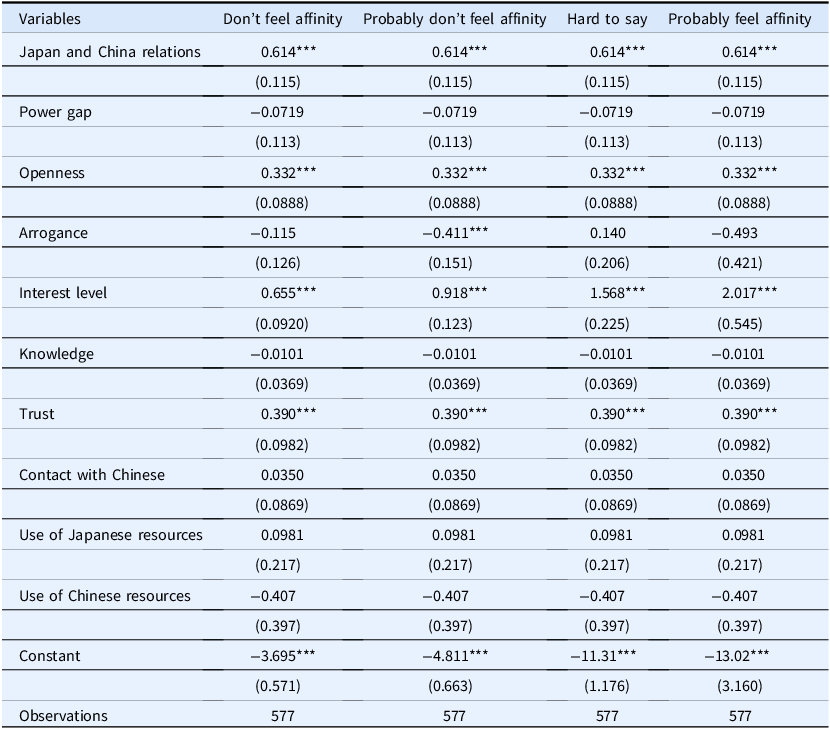
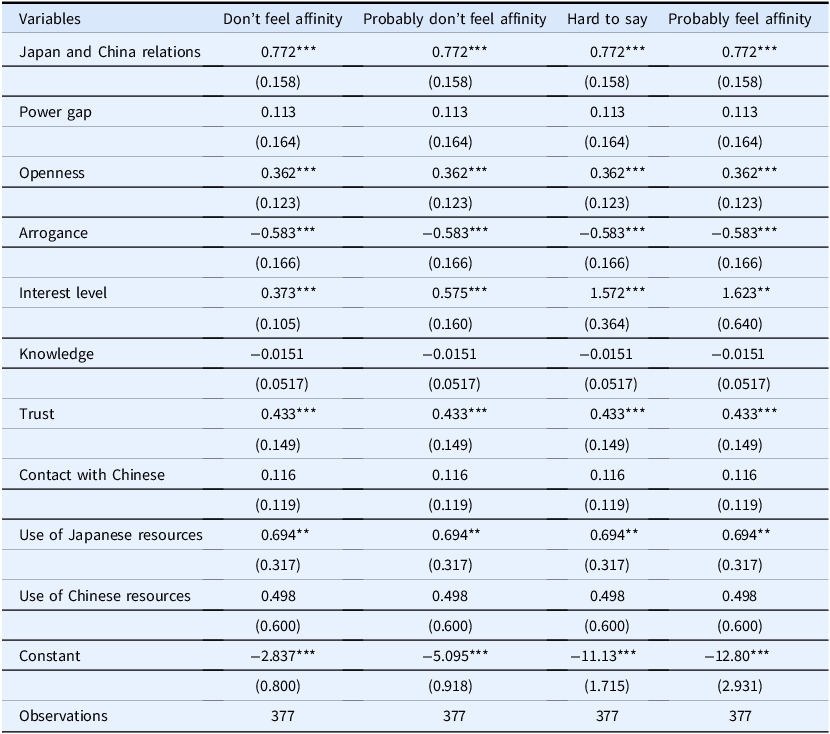
In general, perceptions of Japan-China relations largely define Japanese affinity toward China (see Table 3). Affective feelings such as interest and trust in Chinese media reports also help improve affinity levels: the more interest and trust they feel toward China, the more likely they are to have higher affinity toward China, and this impact is more significant among those holding positive evaluations of China. The tendency to obtain information about China, especially in Chinese, contributes to positive affinity levels, while the evolving perceived country image of China in the past ten years also plays a role in shaping their evaluation. Contact with Chinese people demonstrates relatively weak influence in ameliorating bias. Knowledge about China and the perceived power gap between Japan and China turn out to have little impact, suggesting a more subjective and intuitive evaluation system and a less influential impact from threat perception among the majority of participants.
Key influencers of Japanese affinity toward China

Note: ***p < 0.01, **p < 0.05, *p < 0.1.
Source: Survey on Japanese perceptions of China, Sasakawa Peace Foundation, 2023.
Pseudo R 2 = 0.2259.
Table 4 shows that, for the youngest cohort, their affinity is significantly influenced by proactive information-seeking behaviors, especially via Japanese and Chinese sources. Affective factors, such as interest in China and trust in information sources, play a prominent role as well. Their responses appear comparatively detached from political and social framings, indicated by weaker attachment to Japan-China relations and low awareness of China’s social changes over the past ten years.
Key influencers of affinity toward China among digital drift generation

Note: ***p < 0.01, **p < 0.05, *p < 0.1.
Source: Survey on Japanese Perceptions of China, Sasakawa Peace Foundation, 2023.
Pseudo R 2 = 0.1851.
According to one informant in this cohort:
From my own experience, I don’t have a very good impression of the media. In other words, I feel that the media in general, rather than just foreign or national media, is biased and out of touch with reality, and that the media’s reporting on both domestic and international matters cannot be trusted. I watch a lot of Japanese media, including CNN and BBC, but they don’t often cover Japanese issues, so I feel like I can’t really evaluate them.
Compared to senior cohorts, with no direct memory of past Japan-China interactions, they exhibit low sensitivity to changes in China’s national image, seeing China more through individualized, depoliticized perspectives. Regarding the influence of direct contact with Chinese people, surprisingly, the findings depart from prior empirical evidence that interpersonal interaction enhances mutual understanding. Instead, the youngest generation appears less responsive to such contact compared to their elder counterparts. This may be attributed to stronger online backlash that offsets positive impressions, or to a detached value system that separates interpersonal experiences from national-level judgments (Jou and Endo Reference Jou and Endo2016).
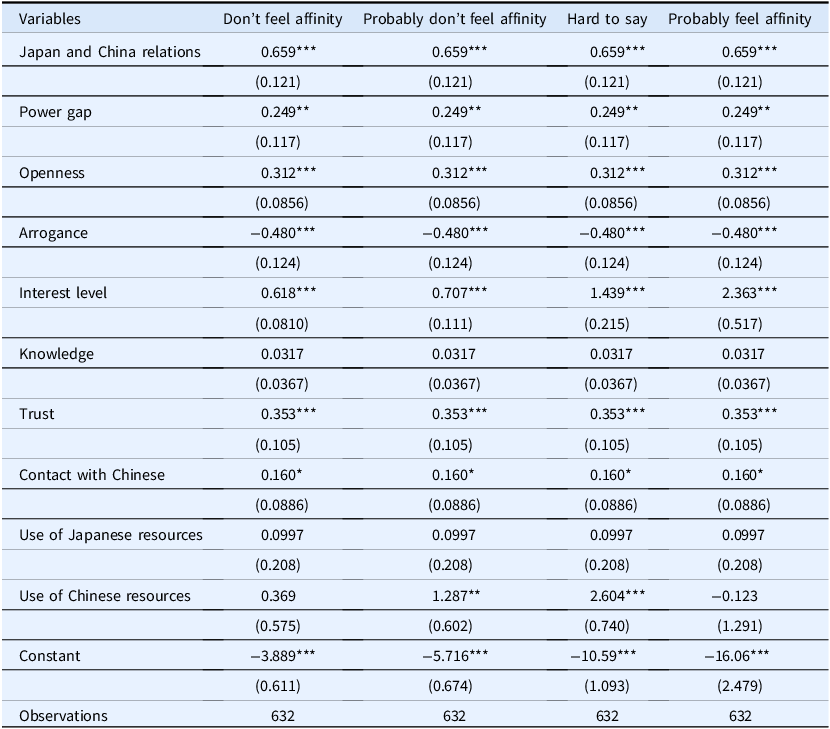
Table 5 shows that for the Pragmatism Cohort, perceived bilateral relations are the strongest predictor of affinity, indicating a heightened political awareness within this generation. Other significant variables include interest in China and trust in Chinese media reports, suggesting that affective engagement can effectively mitigate negative sentiments derived from political tensions. This cohort also keeps a close eye on changes in Chinese society, expressing higher levels of affinity when perceiving China as adopting a less arrogant stance on the global stage. Although contact with Chinese people exerts a marginal positive influence, it does not emerge as a primary driver of affinity.
Key influencers of affinity toward China among pragmatism generation

Note: ***p < 0.01, **p < 0.05, *p < 0.1
Source: Survey on Japanese Perceptions of China, Sasakawa Peace Foundation, 2023.
Pseudo R 2 = 0.2489.
The Transitional Generation shows a balanced influence of interest in China, perceived Japan-China relations, trust in Chinese media, and views of China’s social evolution (See Table 6). Among these, interest in China exerts the strongest effect: the more attentive they are to China, the more likely they are to hold positive sentiments. Perceived bilateral relations, trust in Chinese media, and perceived openness of Chinese society also play meaningful roles, suggesting that this cohort evaluates China through a multifaceted lens that incorporates political, informational, and social dimensions (Jou and Endo Reference Jou and Endo2016).
Key influencers of affinity toward China Among Transitional Generation

Note: ***p < 0.01, **p < 0.05, *p < 0.1.
Source: Survey on Japanese Perceptions of China, Sasakawa Peace Foundation, 2023.
Pseudo R 2 = 0.2454.
The following statement was heard from one interviewee of this generation. Although she has never been to China to see it for herself and therefore reserves her judgment, it is clear that she views China from various perspectives:
I’ve never been to China, but it doesn’t seem too pessimistic, and it seems normal. I hear pessimistic things from people around me, but I’ve never been there myself, so it’s not that bad. I hear about riots and other bad stories on the news, but I think that only a small part of the country is doing that, so it’s not so bad, and it’s not so good.
For the Disenchanted Generation, affinity is primarily constructed by political evaluations – especially perceived bilateral relations and perceived threat from the national power gap (see Table 7). Affective factors and perceptions of social change also play a role, though with less intensity. Compared to younger generations, they are more attentive to shifts in Chinese society, while interpersonal contact with Chinese people exerts only a marginal but still positive influence. Knowledge and information obtained from Japanese sources do not significantly affect their attitudes, but those who access information in Chinese are more likely to display comparatively fewer negative evaluations.
Key Influencers of Affinity Toward China Among Disenchanted Generation

Note: ***p < 0.01, **p < 0.05, *p < 0.1
Source: Survey on Japanese perceptions of China, Sasakawa Peace Foundation, 2023.
Pseudo R 2 = 0.2293.
This cohort is more concerned with political positioning, cognitive–affective cues, and social dynamics, reflecting a trajectory from early optimism to subsequent disillusionment. Raised during Japan’s post-war economic miracle, they came of age alongside the diplomatic normalization of the 1970s, when China was initially welcomed with hope and enthusiasm, particularly during the “honeymoon” phase of bilateral relations. However, this optimism gradually gave way to frustration as disputes over historical responsibility, escalating geopolitical tensions, and perceptions of China’s hegemonic ambitions took hold. What began as promise evolved into a sense of betrayal, leaving political considerations as their primary lens for evaluating China.
An informant belonging to this generation expressed strong concern that South Korea and China are using Japan for political purposes, saying:
In China and South Korea, there are a lot of news contents that are hostile towards Japan. South Korea recently changed its president to a pro-Japanese person, but they are still attacking Japan. Even in China, when I go there for work, I sometimes feel that they are being taught to view Japan as an enemy in propaganda. I got the impression that the news is being reported as if the whole country views Japan as an enemy.
The Post-war Generation mirrors the Disenchanted Generation in that political perceptions and symbolic cues dominate their evaluation of China (see Table 8). Their outlook is deeply rooted in the aftermath of WWII, shaped by post-war moral reflection and long-standing historical memory, which have cemented largely fixed attitudes. However, among members of this cohort who actively seek new information about China, affinity can improve notably, suggesting a residual openness despite generally entrenched views. Compared to the Disenchanted Generation, their perception of the power gap between Japan and China is less visible.
Key influencers of affinity toward China among Post-war Generation

Note: ***p < 0.01, **p < 0.05, *p < 0.1.
Source: Survey on Japanese Perceptions of China, Sasakawa Peace Foundation, 2023.
Pseudo R 2 = 0.2372.
One informant from this generation who has experience living in Shanghai for work expressed his anger at China’s increasing arrogance toward the international community compared to before, saying:
I think there is a lot of personal emotion involved, but when I see that China has been very vocal about the treated water from Fukushima, but has not accepted the data that Japan has provided saying that it is safe, and that the data from China that said it was safe has been deleted, I do feel a sense of distrust.
Conclusion and discussion
Drawing on both the collective memory and empirical results of different cohorts, this paper reclassified Japanese generations and argues that the divergence among Japanese generations stems from cognitive socialization mechanisms across cohorts. Growing up in diverse backgrounds and witnessing different stages of Japan-China relations, each cohort embraces a distinct pattern of perceiving and interacting with the world. In particular, the following aspects appear to be noteworthy when understanding the generational gap regarding their attitudes toward China.
The imbalance between curiosity and knowledge about China marks one of the key factors triggering generational divergence. The survey results show that younger cohorts demonstrate strong curiosity toward China, often engaging in proactive information-seeking and even consuming content in multiple languages. However, their knowledge acquisition is largely mediated by digital platforms that prioritize personalized and fragmented information flows, leading to partial and emotionally driven impressions rather than a coherent understanding of Chinese politics and society, which in turn undermines their political awareness. By contrast, older cohorts are equipped with a more structured body of knowledge, accumulated through traditional media and lived historical experiences. While they also have a significant level of interest in China, as their value systems stabilize with age, those critical perceptions have become increasingly crystallized, leaving them less open to revision in response to new information.
Moreover, older generations continue to anchor their affinity toward China predominantly in the realm of politics and bilateral relations. Their views are deeply shaped by collective memory of historical junctures and evolving power dynamics, whereas younger cohorts display a form of political detachment. The younger cohort’s evaluations are less responsive to shifts in Japan-China relations and more influenced by affective impressions and depoliticized cognition.
Another key divergence lies in how different generations interpret China’s social transformations. Older cohorts are concerned about these changes, but often in a critical or disillusioned manner, perceiving them as evidence of rising assertiveness or hegemonic tendencies. Younger cohorts, however, exhibit relative insensitivity to such developments, possibly due to both their limited historical memory and a more individualized worldview that situates China within personal, rather than geopolitical, frames of reference.
Returning to Wertsch and Roediger’s (Reference Wertsch and Roediger2008) distinction between collective memory as a “fixed body” versus a “dynamic process,” our stance lies in between; each generation’s memory and interpretation of Japan-China relations has its own characteristics, while the contents of their memory are constantly changing depending on what information they receive and how Japan-China relations evolve. In fact, regarding the “Post-war Generation,” Sonoda (Reference Sonoda2024), using longitudinal data from the Cabinet Office’s “Public Poll on Diplomacy” from 2002 to 2022, found a constant decline in affinity toward China, suggesting that their memory and interpretation are contingent on the changing environment surrounding them.
We believe that this paper contributes to the study of Japan-China relations by introducing a new analytical parameter: generation. As demonstrated in the analysis, each generation in Japan possesses distinct memories and interpretations of Japan-China relations, particularly after 2012, when the bilateral relationship began to shift away from the long-standing notion of “friendship.” Using data from the Pew Research Center’s “Global Attitude & Trend Survey,” Cai et al. (Reference Cai, Fan and Ikeda2025) point out that the youngest Japanese people – although their generational category differs from ours – tend to view China’s influence most positively, which shows the robustness of our findings.
Naturally, this study is not without limitations. The nationwide online survey may have produced sampling biases, and it is regrettable that we were unable to incorporate socioeconomic variables that could influence attitudes toward China in Japan due to the unavailability of suitable data. Several important questions also remain unanswered. Why does Japan exhibit a different pattern from South Korea, Taiwan, and Malaysia with respect to intergenerational differences? Why did such generational gaps begin to emerge around 2012? Further research is required to deepen our understanding of how generational dynamics shape perceptions of China-related issues in Japan.
In any case, with the proportion of older generations in Japan increasing, it is unlikely that views of China will improve dramatically unless there are major changes in the current Japan-China relationship. It will be necessary to continue to closely monitor perceptions of China in Japan.
Acknowledgement
We are grateful for the Sasakawa Peace Foundation for generous permission to use the data of 2023 survey. We are also thankful to the reviewers whose comments and questions were quite valuable.



 Open access

