

Introduction
In contemporary discussions on national and international equality policies, there is a growing recognition of the potential influence of the business sector on various aspects of gender equality, including women’s employment, work–life balance, or addressing the “glass ceiling.” In response to this potential, modern governance guidelines have embraced a gender mainstreaming strategy that encourages active business engagement, proposing a range of measures such as equality plans and their further contribution to other activities beyond their organizational practices, such as combating gender-based violence and participating in awareness campaigns. Also, those new governance approaches demand a more proactive role of business in participating and shaping equality policies, which is the main focus of this article. However, it is important to acknowledge that historically, business and business associations have often exhibited indifference and resistance to various measures and have lacked gender-diverse leadership roles (Casey et al. Reference Casey, Skibnes and Pringle2011; Engeli and Mazur Reference Engeli and Mazur2022). Regrettably, this history has often been marked by adversarial relations and conflict-prone interactions between business entities and equality actors in the public sphere.
Despite these challenges, promoting collaboration is a central tenet of gender mainstreaming policies. To contribute to this imperative, our research draws insights from collaborative governance, which involves various stakeholders in public decision-making processes (Ansell and Gash Reference Ansell and Gash2008). Over the past three decades, this field has explored strategies for ensuring effective collective management of public programs, particularly in cases involving social and business actors. We draw upon these insights to inform our study.
It is acknowledged that the involvement of private actors in collaborative governance would pose a threat to collaboration without always bringing benefits (Donahue and Zeckhauser Reference Donahue and Zeckhauser2012). In the equality realm, this risk means measures with no reach because that requires business efforts. Nevertheless, private sector participation is essential, as equality itself is a public good. This participation can be instrumental in bridging the gap between policy principles and actual implementation, especially in cases where businesses perceive policies as externally imposed.
In addressing private sector resistance to resolving wicked problems, it has been demonstrated that firm managers often employ a strategy of appealing to moral roles and aligning their actions with public values (Dudink et al. Reference Dudink, Taminiau and Veenswijk2023). Corporate Social Responsibility (CSR) represents a novel governance perspective advocating increased engagement of social stakeholders in business governance and more active business roles in shaping social policy (Scherer and Palazzo Reference Scherer and Palazzo2011). Within the CSR framework, some firms have demonstrated genuine commitment and served as catalysts for innovative organizational approaches to equality. CSR-oriented firms are well suited for collaborative policy endeavors and have been integral to our research.
Despite the potential impact of business engagement in equality policies, existing research from the policy domain predominantly focuses on theoretical frameworks or the roles of social and public actors and their relations (Waylen Reference Waylen, Goertz and Mazur2008; Squires Reference Squires2005). Studies from other disciplines, such as CSR and Business Ethics, also point out that empirical effort into the interactions between equality actors and the private sector is relatively scarce (Grosser and McCarthy Reference Grosser and McCarthy2019; Roggeband et al. Reference Roggeband, van Eerdewijk, van der Vleuten, van der Vleuten, van Eerdewijk and Roggeband2014) and a lack of co-participation in collaborative environments such as those devoted to promoting CSR has been observed (Kilgour Reference Kilgour2007; Grosser Reference Grosser2016).
Corporate actions toward equality are increasingly analyzed – with ambivalent results – but great programs within individual firms are insufficient. General policies involving diverse actors are needed to approach the complexity and structurality of equality problems. Our question, then, is what would be the expected contribution of firms’ participation in developing state policies, and what are the mutual visions of these possible contributions and roles, including the previous actors of the policy, such as equality associations and academia? It is imperative in our view to consider the perspectives of the other policy participants, as governance can be considered what emerges from the concerted efforts of the actors (Kooiman Reference Kooiman1993).
This research gap urgently requires attention, as the proliferation of theoretical frameworks and top-down directives outpaces empirical observations across diverse countries and policy contexts. A pertinent example of this disparity is evident in the gender mainstreaming strategy endorsed by influential entities such as the United Nations (UN), the European Union (EU), the International Labour Organization (ILO), and the Economic Commission for Latin America and the Caribbean (ECLAC) following the Fourth World Conference on Women in Beijing in 1995. While these entities have articulated ambitious gender mainstreaming goals, there remains a dearth of empirical research documenting the actual implementation and outcomes of these strategies in practice, especially regarding private sector participation from a policy development perspective.
Our research is centered on the Colombian context, the government’s initial effort to promote equality within the business sector. This initiative coincides with the introduction of gender mainstreaming guidelines and evolving demands placed on businesses (CONPES 16 2016). In Colombia, both equality policies (United Nations Women 2016) and corporate activities related to social responsibility and equality have seen significant developments (Bastidas and del Carmen Briano-Turrent Reference Bastidas and del Carmen Briano-Turrent2018).
Given the limited scope of public administration in some regions of Colombia, exacerbated by armed conflict and the low implementation of public social policies, the involvement of non-state actors in social action is pivotal. Additionally, power imbalances are more pronounced in Colombia and other Latin American countries, where corporations, including CSR-practicing firms, are often large entities owned by international networks or influential families. Furthermore, weak or non-existent trade unions further tilt the balance of power in favor of businesses.
Consequently, both the potential benefits and risks associated with collaboration are heightened. In light of this complex landscape, our research is guided by the gender equality work in policies and CSR, and collaborative governance learnings, emphasizing the critical role of addressing power imbalances, as well as of initial dynamics (Ansell and Gash Reference Ansell and Gash2008; Donahue and Zeckhauser Reference Donahue and Zeckhauser2012; Emerson et al. Reference Emerson, Nabatchi and Balogh2012).
Importantly, clarity of information is deemed essential for defining precise strategies and preventing misunderstandings, especially since governance shifts can generate conflicts arising from ideological differences and adaptation to new roles (Rhodes Reference Rhodes1996). The article hopes to contribute to this last aspect, as there is a lack of clear collaboration frameworks for the multi-actor promotion of equality (Gartzia Reference Gartzia2021), and the effort of shifting to new roles often goes unnoticed, especially in a potentially conflictual scenario. Businesses often contend with limited bandwidth for engaging in social action or policy design, potentially leading to disinterest, as observed in mainstreaming initiatives in other countries with well-established equality policies (Otero-Hermida and Bouzas Reference Otero-Hermida and Lorenzo2020).
In our inquiry, we focus on practical questions, including the contributions each participant can make to the policy and how these differential contributions can coalesce into joint action capacities. We also explore the legitimacy of new actors, such as businesses, in the policy arena and the mutual expectations between existing and new participants. Our aim is to enhance the design of participatory processes to mitigate conflict, foster enduring relationships, and promote shared responsibility.
Given the power imbalances in Colombia, we have conducted a participative decision-making process to anticipate potential issues and propose solutions, representing a novel approach in the field. Crucial Colombian actors, including respected academia, equality associations, influential businesses practising CSR across different regions, a pivotal business association, and other relevant social actors, have participated. We present their perspectives on themselves and other actors concerning the policy contributions they have defined and prioritized. Available in an open database, these results can facilitate collaborative planning by visually highlighting discrepancies with minimal time investment.
The participatory decision-making techniques employed in our research offer several advantages for collaborative initiatives. They prioritize process transparency and traceability, often overlooked aspects that can generate suspicion. These techniques promote mutual understanding from the outset, as actors collectively shape the participatory model and establish shared terminology before engaging in policy debates. These aspects contribute to trust-building, and the techniques have demonstrated utility in public policy design (Petrini et al. Reference Petrini, Rocha, Brown and Bispo2016; Gómez-Navarro et al. Reference Gómez-Navarro, García-Melón, Acuña-Dutra and Díaz-Martín2009; Peris et al. Reference Peris, García-Melón, Gómez-Navarro and Calabuig2013; Mas-Tur et al. Reference Mas-Tur, Roig-Tierno and Ribeiro-Navarrete2019) and CSR (Almatrooshi et al. Reference Almatrooshi, Hussain, Ajmal and Tehsin2018).
We anticipate our research findings will equip academics, policymakers, businesses, women’s associations, and other potential equality actors with analytical capacities to detect 1. Role Mismatches refer to disparities between how specific actors perceive their own contributions and how other actors perceive them, and 2. Role Shifts or these involve comparing current roles with those they played in the past, particularly regarding their transition from being policy targets to potential active actors in developing and designing the policies. We hope the article offers valuable insights to engage actors in ambitious equality endeavors, specifically avoiding the numerous risks the literature has detected regarding business and equality, and stimulating further discussions on mainstreaming policies.
Given the limited research on the topic – particularly on business participation in the policies – our results and role-mapping proposal aim to resonate in the underresearched South (Grosser et al. Reference Grosser, McCarthy and Kilgour2017) and the evolving governance contexts in Western countries. The new governance frames and business power in an increasingly transnational world is a crucial debate in social policy, and how this is affecting equality endeavors is an ongoing international discussion (Prügl and True Reference Prügl and True2014; Roberts Reference Roberts2015; Cullen and Murphy Reference Cullen and Murphy2018). In the following sections, we present our case study, the research framework, and, subsequently, our research findings, policy implications, and areas for further research.
CSR, gender mainstreaming policies, and business
Equality policies represent a multifaceted framework of measures to advance gender equality across various societal domains. These policies, however, are not founded on unquestioned assumptions regarding the nature of equality and the means to achieve it (Bacchi Reference Bacchi2005). Instead, they emerge as clusters of diverse perspectives (Verloo and Lombardo Reference Verloo and Lombardo2007).
Contemporary public policies call for a broader spectrum of actors to actively participate and accept increased responsibilities within new, more flexible governance models. A prime example of such a model is the gender mainstreaming strategy championed by influential international bodies, including the United Nations (UN), the European Union (EU), the International Labour Organization (ILO), and the Economic Commission for Latin America and the Caribbean (ECLAC), among others, following the Fourth World Conference on Women in Beijing in 1995.
Businesses find themselves in a position where they must respond to new global governance proposals. Companies frequently face heightened scrutiny in the context of evolving, ideologically charged environments, such as the privatization of services. They benefit from these new contexts, often without shouldering their fair share of collective responsibility. This disparity is precisely what the CSR discourse aims to rectify through its proposals and initiatives.
CSR discourse advocates for active business participation in fulfilling broader societal roles. In this evolving landscape, the state’s role transcends that of a mere regulator; it becomes a facilitator of processes and partnership builder. Simultaneously, businesses are compelled to address new social demands that extend beyond profit motives and their traditional roles as taxpayers or employers. The business sector emerges as a social partner, expanding its functions and adopting purposeful roles in shaping societal governance alongside other civil actors (Midttun Reference Midttun2004). In approaches like “corporate citizenship” (Matten and Crane Reference Matten and Crane2005), businesses assume a social role in safeguarding rights by providing social, civil, and even political rights. Their role becomes increasingly political, and responsibility shifts from being reactive or retrospective to becoming prospective (Scherer et al. Reference Scherer, Palazzo and Matten2014; Scherer and Palazzo Reference Scherer and Palazzo2011).
Within gender and equality, these possible and evolving CSR-based roles and collaborations present conflicting elements. First, we introduce the literature that nurtures this review. On the one hand, we rely on the literature specifically focused on gender and business from CSR perspectives, which in the last decade has changed its focus from whether gender matters in ethical behavior to what is the role of business in gender quality and female empowering (Fioravante and Del Baldo Reference Fioravante and Del Baldo2024; McCarthy Reference McCarthy2017; Johnstone-Louis Reference Johnstone-Louis2017). On the other, we rely on the gender policies literature, where the focus on business is also recent despite its relevance as one of the more influential and, at the same time, reluctant areas to social progression to equality (Engeli and Mazur Reference Engeli and Mazur2022).
Traditionally, gender policies have primarily involved equality organizations and government actors, particularly those embedded within institutions that advocate for gender equality (Valiente Reference Valiente2005). The participation of non-governmental actors has brought a positive focus on beneficiaries (McGauran Reference McGauran2009) and has helped preempt legal challenges to policy decisions (Chappell Reference Chappell2006). Furthermore, collaborative interactions among government actors, equality organizations, and academia – often referred to as the “velvet triangle” (Woodward Reference Woodward2004) – have been shown to facilitate favorable policy outcomes. The evolving processes of governance, fueled by globalization, have led to even more complex models, termed “velvet pentangles,” in which territorial entities beyond the state and businesses play increasingly influential roles (Roggeband et al. Reference Roggeband, van Eerdewijk, van der Vleuten, van der Vleuten, van Eerdewijk and Roggeband2014).
However, when we focus on the national implementation of these top-down governance models, the empirical research from countries like New Zealand (Casey et al. Reference Casey, Skibnes and Pringle2011) reveals that business associations often exhibit reluctance to engage in such collaborations. A similar scenario is observed in Spain, where public actors describe business representatives as indifferent to equality initiatives. Moreover, the legitimacy of business associations as key actors is questioned in certain regions (Otero-Hermida and Bouzas Reference Otero-Hermida and Lorenzo2020). Companies, especially larger and more influential ones, have been the main target of equality policies. The policy aimed at increasing the number of women on corporate boards has been the most widespread in Western democracies, with clear improvements in numbers reaching minimums of between 30% and 40%, although for the time being, no substantial changes in underlying gender norms have been observed that would allow us to speak of transformation (Engeli and Mazur Reference Engeli and Mazur2022). Business adaptation to these policies has been reactive, blocking or attempting to block more ambitious initiatives in favor of self-regulation, which in many cases has been ineffective, leading to more demanding state policies such as quotas in countries like Spain (Lombardo and Verge Reference Lombardo and Verge2022) or Belgium (Roos and Rabier Reference Roos2022).
From the CSR literature, leaving gender equality in the hands of individual organizations carrying out voluntary actions has been shown to be a weak option for the betterment of women and ethnic minorities, neglecting a broader context in which short-term market pressures are often prioritized (Dickens Reference Dickens1999; Reference Dickens1994). Thus, the inscription of equality promotion in arguments for improving business competitiveness and the economy – often observed in policy as well – where utilitarianism takes precedence over notions of social justice is often seen as problematic. However, a shift in this direction can be observed across the board, while at the same time, it is also noted that the two options often coexist – albeit often in opposing ways (Dickens Reference Dickens1999). Firm managers often employ a strategy of appealing to moral roles and aligning their actions with public values (Dudink et al. Reference Dudink, Taminiau and Veenswijk2023), also in the framework of equality since the development of managerial commitment – a key aspect – requires arguments of social justice and critical thinking of gender relations at the personal and organizational level, and not only of cost-benefit (Gartzia Reference Gartzia2021).
More generally, both mainstreaming and CSR approaches have been criticized for their limited scope and approach (Grosser and Moon Reference Grosser and Moon2005; Mukhopadhyay Reference Mukhopadhyay2016), and it’s argued that diversity management and gender mainstreaming can inadvertently reinforce neoliberal and bureaucratic logics, respectively (Prügl Reference Prügl2011). Gender mainstreaming aligns with frameworks that prioritize economic efficiency and soft measures such as monitoring instead of regulation (Jacquot Reference Jacquot2010) while potentially undermining principles of democratic equality (True and Mintrom Reference True and Mintrom2001). These strategies also involve a shift in focus regarding decision-makers, participants, and key policy actors, moving away from women’s associations and parliamentarians toward gender experts and bureaucrats (Squires Reference Squires2007). These shifts may have contributed to the stagnation of equality policies and even hindered initiatives aimed at improving the status of women (Squires Reference Squires2007).
Corporate “pinkwashing” (Lubitow and Davis Reference Lubitow and Davis2011), or using women’s social causes for profit while being part of the problem, has been widely discussed. However, also a limited scope has been observed, for instance, in public-private partnerships, mainly focused on women’s empowerment that appears to arise inherently from employment and absent from a reflection on working and social conditions, cultures and their consequences on women (Prügl and True Reference Prügl and True2014). The problem of not having women on corporate boards has been framed as a supply problem in the state debates in Australia (Newsome and Sheridan Reference Newsome and Sheridan2022) or the priority of increasing women’s numbers as participants to improve the reporting results instead of focusing on ameliorating women’s conditions have been observed in highly influential business (Tornhill Reference Tornhill2017).
The business case for equality promoted by public institutions sometimes assigns gender knowledge to expert networks instead of involving feminist movements. This risks instrumentalizing equality goals and excludes feminist actors from national policy debates. International corporations are also shaping knowledge production processes at the national level within new governance frames (Cullen and Murphy Reference Cullen and Murphy2018). It has also been observed that equality associations are not relevant actors in the initiatives of corporations seeking to move toward multi-stakeholder governance, but they do involve other social actors, such as those from the environmental sphere (Kilgour Reference Kilgour2007; Grosser Reference Grosser2016; Prügl and True Reference Prügl and True2014).
Changes in governance models usher in broader transformations in how equality/inequality and their associated narratives are framed within policies. The shifting governance context has prompted the feminist movement to explore market-oriented strategies (Kantola and Squires Reference Kantola and Squires2012) and innovative approaches to navigating the challenges of neo-liberalization (Grosser and McCarthy Reference Grosser and McCarthy2019). For example, strategies can be developed to raise funds from companies and overcome the inhibition of the state in this area. However, gender issues such as gender-based violence are perceived as uncomfortable, limiting the interest of many firms in them (Harwin Reference Harwin2017), and it has been reported that there is a risk of co-optation of the NGOs and associations by business interests that may affect gender associations (Grosser Reference Grosser2016).
Nevertheless, there are innovative initiatives that focus on highly invisible aspects as a result of efforts in partnerships with committed companies. This is the case, for example, of the valuation of unpaid work in sesame production in Nicaragua, which has produced notable effects on women’s autonomy and decision-making capacity in their households. However, these initiatives require accompanying policies or the necessary structural effects are limited; they constitute one step among others that are necessary (Butler and Hoskyns Reference Butler and Hoskyns2017).
The literature is generally critical. The ambitions of a feminist CSR are not confined in equal employment and its improvement but to expanding the CSR and the transformation of corporations themselves in a new structuring process that considers new missions, visions, strategies and procedures using a feminist perspective (Grosser Reference Grosser2016; Grosser and Moon Reference Grosser and Moon2019; Grosser et al. Reference Grosser, McCarthy and Kilgour2017; Prügl Reference Prügl2011; Gartzia Reference Gartzia2021; Fioravante and Del Baldo Reference Fioravante and Del Baldo2024), finishing with gender inequality as a resource exploited by business (Acker Reference Acker2004). On the other hand, the policy literature focuses on systemic transformation with similar ambitions, where the aim is not only to incorporate women but to bring about changes affecting what is valued and what is not (see Squires Reference Squires2007 for more references).
Given these challenges, most of the experts cited insist on the need to rethink governance models and policies where different stakeholders act to promote a more ambitious equality framework.
In summary, academia and women’s associations tend to have good relationships, while women’s organizations focus on engaging with the government (Grosser Reference Grosser2016). On the other hand, CSR corporations tend not to have partnerships with equality associations on their radar among the social actors they rely on (Kilgour Reference Kilgour2007; Grosser Reference Grosser2016; Prügl and True Reference Prügl and True2014). There is a lack of a solid and defined collaborative framework (Gartzia Reference Gartzia2021). However, equality associations, an actor that much of the literature points out as crucial as we have seen, are not included to fill this gap.
What can be described as a disconnect between the equality and business actors in practice possibly motivates the absence of empirical research on the subject and leaves open the debate on what each actor can contribute to in joint iniciatives, an aspect to which we are delving in this paper. Our inquiry had a focus that, to our knowledge, is unexplored; that is what could happen with the participation of business in the national equality policy definition, being a new actor that shall work with traditional ones such as women’s associations and academia, led by the government, as demanded by the cited governance models such as gender mainstreaming and CSR, that demand not only improving equality within their organizational realm but also contributing more to the endeavor.
As introduced before, in our view, considering business a social actor with a citizenship approximation as the CSR governance frameworks also propose, implies policy participation but, importantly, is needed to explore their capacities and possible contributions from the perspectives of the other actors involved, as equality is necessarily a collective outcome as governance is. This question leads us to the necessity of detecting mismatches in the actor’s perspectives and detecting role shifts, which are crucial aspects that configure the implementation of equality policies.
Considering the gap we pursue to fulfill, we have relied on the Collaborative Governance literature to build our research framework (section 3), which has explored multi-actor governance for more than thirty years, considering power relations from the beginning, a crucial aspect demanded from gender perspectives. We hope this can add solid basis and analytical power to our research. Nevertheless, first, we present our case study to understand its context of application better.
The Colombian case: equality policies and the role of business
Many of the cited CSR and mainstreaming approaches have evolved from an awareness of the impacts of neoliberalism and globalization on governance, although most theoretical frameworks and empirical research have originated in countries with well-established welfare state models. In contexts where the state’s presence is less stable, the influence of these shifts may be more pronounced. In the Global South, businesses are recognized for fulfilling social functions such as disaster management and the promotion of health programs, in addition to their traditional roles as employers (Turyahabwa Reference Turyahabwa2014). However, the extent of their contributions often hinges on perceived legitimacy and the institutionalization of these programs (Hönke and Thauer Reference Hönke and Thauer2014).
Colombia’s policy landscape has been notably influenced by new governance paradigms, particularly due to the country’s rapid transition. In the 1990s, Colombia grappled with significant violence and armed conflict, leading to its classification as a failed state (Marcella Reference Marcella2009). This turmoil severely limited its capacity to implement welfare state policies.
Following a period of relative stability, influential feminist organizations in Colombia transformed the national concern over violence into an international discourse. This feminist discourse not only addressed violence but also introduced concepts like gender mainstreaming (Astelarra Reference Astelarra2004), the use of indicators, and innovative models of governance from a distance (Céspedes-Báez Reference Céspedes-Báez2014).
Initially, public gender policies in Colombia were characterized by a lack of participation – a challenge that continues to demand improvement (Ruiz Reference Ruiz2009; Londoño Reference Londoño2016). Participatory processes revealed the difficulties inherent in these policies, leading to a better understanding of the perspectives, strengths, and weaknesses of government actors and women’s movements (Londoño Reference Londoño2016).
Colombia, influenced by World Bank guidelines, has a significant level of private sector involvement in developing public goods, such as infrastructure. However, these efforts are not always well received and can potentially impact political candidates (Angulo Amaya et al. Reference Angulo Amaya, Bertelli and Woodhouse2020). This dynamic may also influence the promotion and advancement of sustainability and CSR policies in the country (Casallas Tabares Reference Casallas Tabares2015). Nevertheless, it’s essential to acknowledge that inequality persists. Explicit equality policies, such as equality plans, are only just emerging in the most progressive companies. Families and businesses often make distinct decisions when employing women (Arango and Ríos Reference Arango and Ríos2015), even though women are crucial in driving change toward better livelihoods in contexts where conflict poses a scarcity of resources and an insecure scenario (Cely-Santos and Hernández-Manrique Reference Cely-Santos and Hernández-Manrique2021).
In response to these challenges, in 2013, the government’s equality body initiated the EQUIPARES Gender Equality Management Certification System to implement gender policies outlined in the National Council on Economic and Social Policy CONPES 161 document. This document serves as Colombia’s national policy on gender equality for women and includes an action plan for 2013–2016. This initiative, grounded in soft-law measures, aimed to transform organizational and social cultures and reduce gender disparities. It involves various stakeholders, including national public actors, the UN Development Program, the certification body, and businesses that voluntarily participate in the program. Evaluations indicated that businesses often lacked knowledge of gender equality, despite the government technicians who designed the program perceiving it as a positive departure from traditional monitoring and control approaches (DPEM 2017).
Notably, one of the identified success factors in policy analysis is the establishment of partnership networks involving a diverse array of actors, including academia, foundations, NGOs, and private firms – a recommendation aligned with new governance proposals. A significant challenge lies in constructing partnership networks capable of providing technical support and resources, both of which businesses can contribute (DPEM 2017). Thus, a key challenge identified is the need for businesses to transition into a more proactive role while simultaneously acknowledging their current role as targets of policy measures.
Collaborative governance research framework and study design
Our research focuses on mapping the expectations of actors – especially businesses, a potential new, powerful actor with a history of adversarialism in equality policies – with regard to their perceived contributions to a possible collaborative process. In this context, we have identified what we consider two possible contributions to the literature:
-
(a) Businesses’ views on their role and possible contributions to equality policies, given that new governance proposals encourage them to become proactive.
-
(b) The view of other equality policy actors – especially equality/women’s associations and academia, as opposed to public authorities – on the business sector’s role and possible contributions.
The term “role” is widely used in governance-related research in reference to organizations or institutions. It tends not to be defined but, rather, taken as understood, possibly because it comes from classical individual-oriented sociology. In our research, we prefer the concept of “role” over alternatives like “institutional function,” since role “connect[s] culturally defined expectations with the patterned conduct and relationships which make up a social structure” (Merton Reference Merton1957 p. 110). Moreover, the concept of “role” includes dispute, discrepancy, and difficulty meeting role-related expectations, whereas the concept of “function” is more often associated with consensus (Goode Reference Goode1960). As described below, we used participatory research techniques to gather the actor’s views. During the participatory process, the actors reached conclusions as to what they could contribute to policies and what other actors could expect from their participation. This is the use of the term role in this study. Although it is not necessarily far from the theoretical view of roles, this should be clarified.
Our research is primarily grounded in the Integrative Framework for Collaborative Governance, which places significance on the factors that influence collaborative regimes (Emerson and Nabatchi Reference Emerson and Nabatchi2015; Emerson et al. Reference Emerson, Nabatchi and Balogh2012). This model emphasizes the importance of “discovery.” In our study, discovery encompasses various recommendations, including consensus-based terminology definition, establishing shared criteria for evaluating information and alternatives, and clarifying mutual expectations. The participatory methods we employ are designed to address these critical aspects, as elaborated in the subsequent section (Figure 1).
Research design.
Source: The authors.
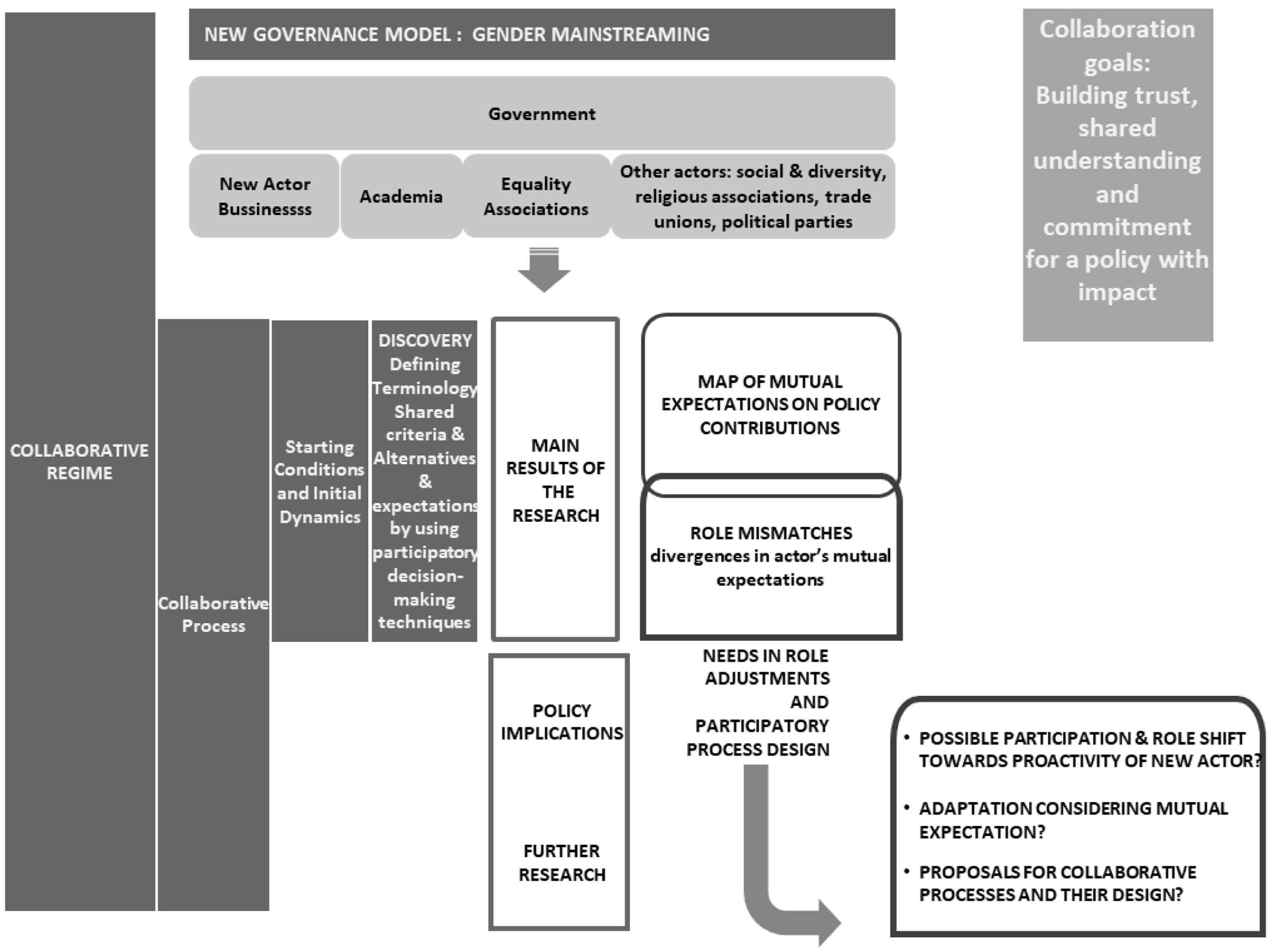
Expectations, in our context, refer to perceptions of other actors, their capacities, and the validity, relevance, or feasibility of achieving specific objectives. These expectations significantly shape how groups function and interact. We firmly believe that mapping expectations is pivotal for fostering trust, shared comprehension, and commitment – all essential for the success of collaborative efforts (Ansell and Gash Reference Ansell and Gash2008).
The initial stages of the collaboration are crucial to redirect potentially problematic interactions, even though this can be a challenging endeavor (Emerson and Nabatchi Reference Emerson and Nabatchi2015; Ansell and Gash Reference Ansell and Gash2008; Johnston et al. Reference Johnston, Hicks, Nan and Auer2011). Merely engaging in dialog can either reinforce actors’ preconceived notions or exacerbate conflicts (Ansell and Gash Reference Ansell and Gash2008). Mapping expectations as preconceptions can be instrumental in facilitating discussions, particularly given the historical adversarial nature of equality policies and the disconnection of the actors cited in Section 2.
Our focus extends to potential policy contributions stemming from various types of expectations for several reasons. First, we operate from a governance concept that views it as the collective outcome – not necessarily a cumulative one – of actors’ contributions resulting from their concerted efforts (Kooiman Reference Kooiman1993). Second, the lack of clarity regarding what is expected from the business sector could be a significant stumbling block for those advocating for equality. Moreover, participation by businesses may entail internal organizational changes in collaboration with other social actors. Mapping expected contributions can help establish the foundation for sustainable and co-responsible joint action, recognizing every effort and taking into account actual capacities rather than just desired or decontextualized ones. Our objective is to shift from mere consultation to genuine collaboration (Johnson and Howsam Reference Johnson and Howsam2018).
In consideration of these aspects, the roles that businesses may eventually assume result from the integration of their proposed contributions, along with the contributions that other actors expect from them. These issues are closely intertwined with the notion of perceived legitimacy. We employ two role-related concepts:
-
Role mismatches: These refer to disparities between how specific actors perceive their own contributions and how other actors perceive them. Our research was conducted with the assumption that we would uncover such discrepancies, and we intend to analyze their potential impact on collaboration.
-
Role shifts: These involve comparing actors’ current roles with those they played in the past, particularly regarding their transition from being policy targets to potential collaborators. In light of previously identified role mismatches, we will explore the possibility of a shift in the roles businesses play in equality policies.
Participatory methods
The collaborative literature underscores the importance of participants taking ownership of the collaboration by actively influencing decisions regarding the ongoing process itself (Ansell and Gash Reference Ansell and Gash2008). Consequently, our chosen method revolves around the use of a participatory multi-criteria decision-making approach known as the Analytic Hierarchy Process (AHP) (Saaty Reference Saaty2008). Vaidya and Kumar (Reference Vaidya and Kumar2006) and Saaty (Reference Saaty2008) offer comprehensive insights into this extensively recognized and widely employed multi-criteria decision-making method (Macharis et al. Reference Macharis, Springael, De Brucker and Verbeke2004).
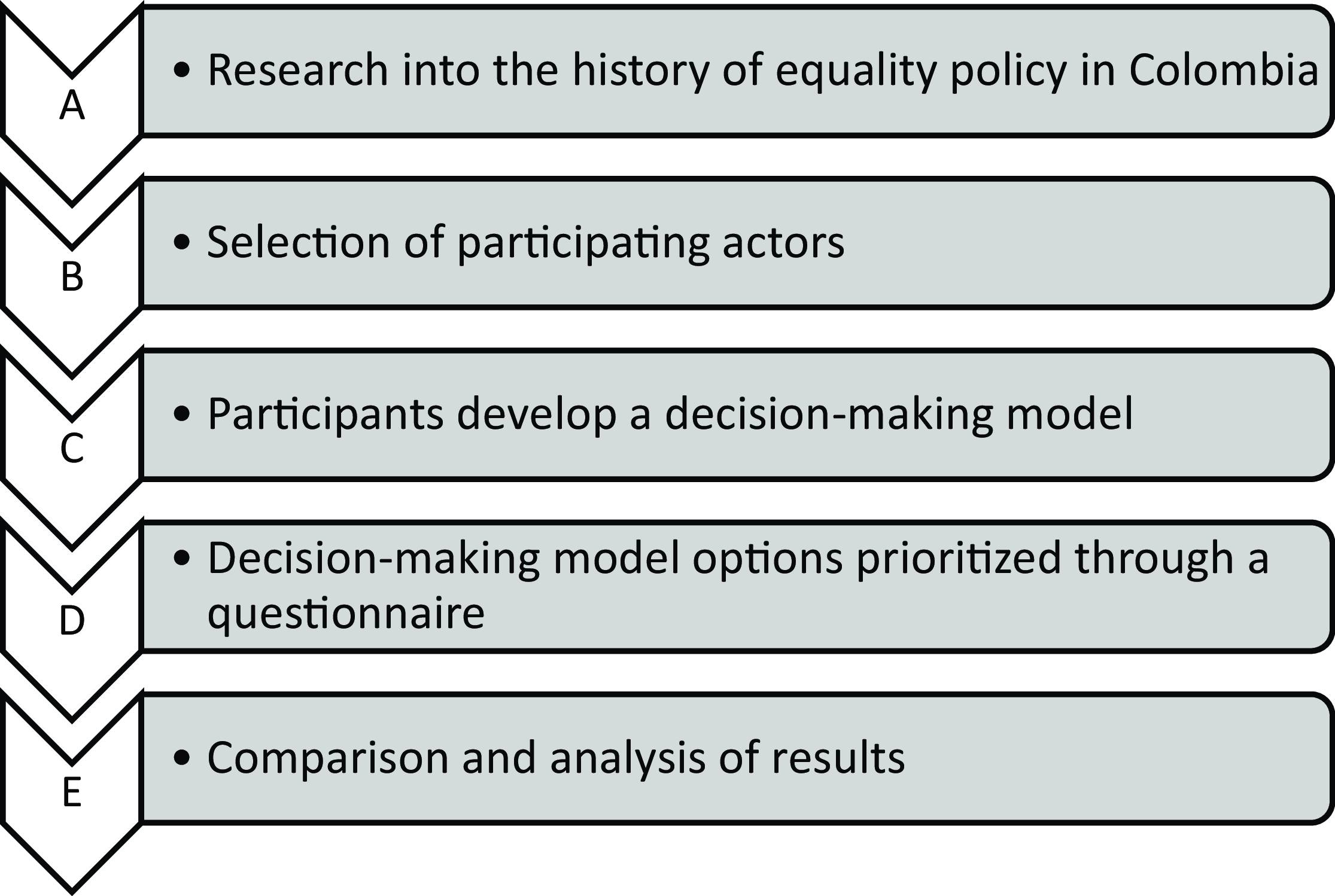
For detailed information on the procedure and calculations, please refer to an open dataset (Gonzalez-Urango and Otero-Hermida Reference Gonzalez-Urango and Otero Hermida2025). Figure 2 provides an overview of the phases involved in our AHP-based methodology.
-
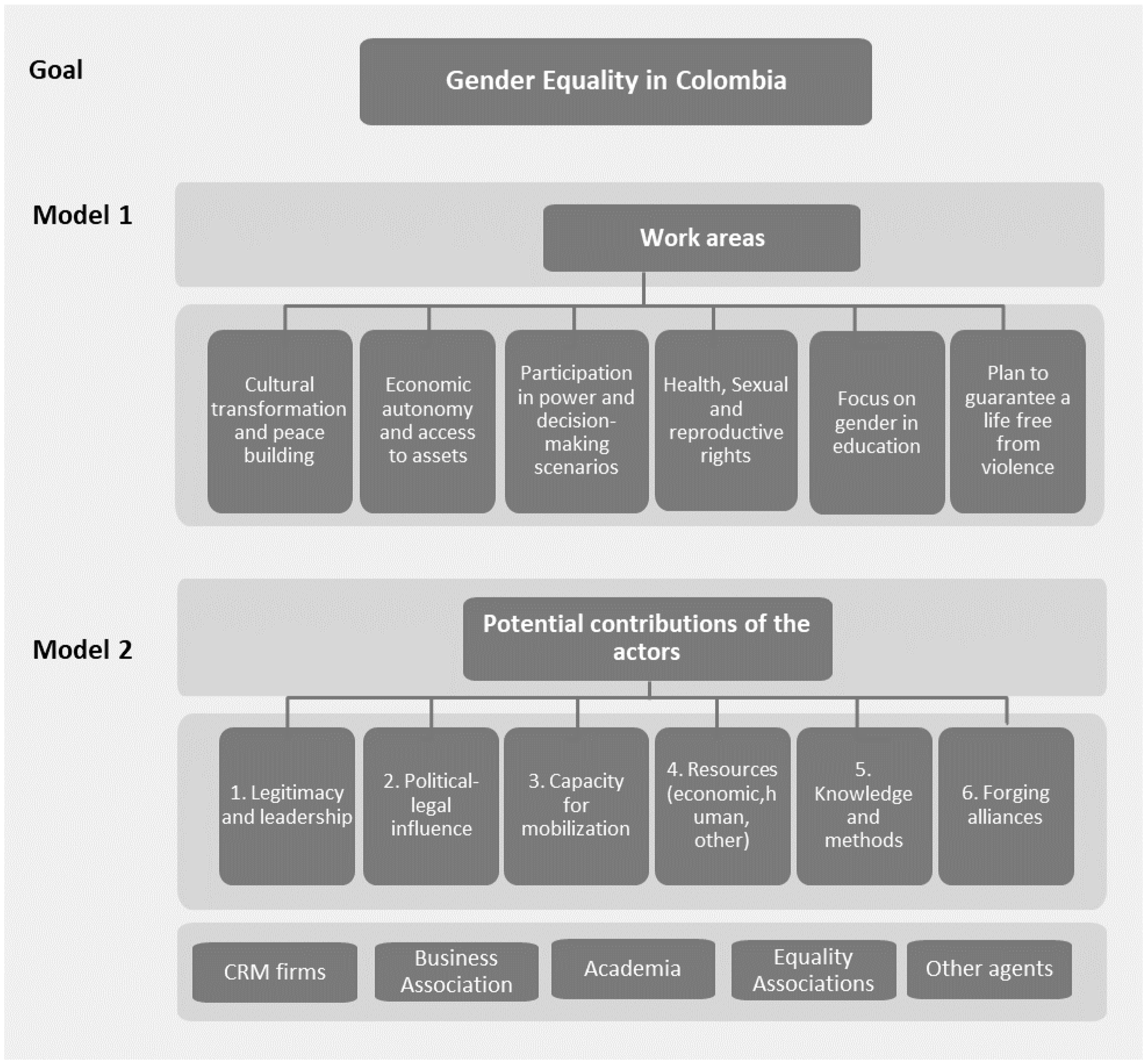
A. Equality policies in the context of Colombia: Our research began with an extensive literature review, as detailed above. Based on this review, we selected the CONPES Social 161 (2013) document as our primary source of input. This document outlines Colombia’s national equality policy, and action plan and proposes six key areas of work, such as cultural transformation, peacebuilding, health and sexuality, and economic autonomy with access to assets. A more detailed explanation of these areas is provided in the results section (Figure 3).
-
B. Selection of participating actors: Our selection process for participating actors was deliberate and guided by our research objectives. Public authorities were already represented in official documents, and their views would be considered in subsequent collaborative processes. As such, our fieldwork primarily focused on non-state actors, specifically those whom the government had called upon for participation.
Methodological proposal.
Source: The authors.
In our selection process for businesses and business associations, we specifically targeted entities that demonstrated a higher degree of activity and engagement in CSR initiatives. We established contact with these organizations through their participation in a Master’s program in CSR, which served as a platform for them to enhance their knowledge and expertise in these areas and were actively investing in training their personnel in various aspects of CSR, including social action and equality. These businesses represented a range of production sectors, including hotels, extractive industries, chemical industries, consumer production, and commercial distribution. All selected businesses were prominent and influential within their respective sectors.
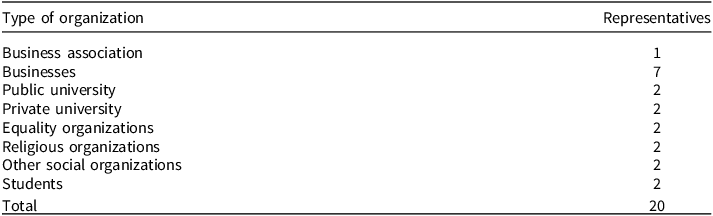
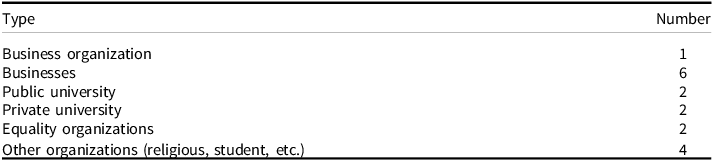
Also, we engaged equality associations and academics based on their significance within the Colombian context. In order to ensure comprehensive representation, other social actors were invited to participate at the suggestion of those initially selected. We gathered opinions from three distinct regions: the Central East, the Caribbean, and the Coffee Region. Our selection criteria were designed to prioritize diversity and the inclusion of influential actors, reflecting the real-world dynamics of policy design where a few but highly relevant stakeholders play a pivotal role. In total, twenty participants from nineteen different organizations took part in our research (Table 1). We deemed this number appropriate for our chosen methodology, as the quality and relevance of the participating actors held greater significance than their sheer quantity (Saaty Reference Saaty1999).
-
C. Developing a decision-making model: To create a comprehensive decision-making model, we engaged the participants in a structured process. Each participant was provided with the latest version of the CONPES Social 161 document, which outlined Colombia’s national equality policy. Participants were encouraged to propose alternative courses of action if they desired. The development of the model took place in two online sessions, spanning a total of four hours, in October 2017. Thirteen participants, actively contributed to this phase of the research. It’s worth noting that prior to their involvement, these participants underwent training in multi-criteria AHP techniques. This training ensured that they were well informed about the methodology’s capabilities, limitations, and potential applications.
Participating agents
Source: The authors.
Following the AHP methodology, participants collaboratively defined the prioritization model, which is presented in detail in the Results section (Figure 3). The resulting model consists of two key parts: the first part establishes the primary focus areas for action, while the second part assesses the contributions of various actors involved in the process.
-
D. The Prioritization Process: The prioritization process involves determining the specific weightings for the alternatives proposed through the decision-making model. This was accomplished by utilizing individual response questionnaires that were constructed based on the item definitions agreed upon by the participating actors (Table 2). The process unfolded in two main stages:
Decision-making model.
Source: The authors.
Agents participating in the prioritization process
Source: The authors
-
1. Prioritizing the Lines of Action: Participants assigned priorities to the various lines of action identified in the decision-making model.
-
2. Allocating Potential Contributions: Participants allocated potential contributions to each line of action based on their priority.
To carry out these prioritization tasks, pairwise comparisons of elements at the corresponding level were conducted using the Saaty fundamental scale (2008). Each criterion/alternative was compared to every other criterion/alternative, addressing the following questions:
-
a. Is criterion j1 equally important, more important, or less important than criterion j2?
-
b. Concerning criterion j, is alternative i1 equally preferred, more preferred, or less preferred than alternative i2?
To generate matrices of the elements and perform calculations such as the consistency index (CI), consistency ratio (CR), and normalized values for each criterion/alternative, we employed the SuperDecisions program. Additional information can be found in the (Gonzalez-Urango and Otero-Hermida Reference Gonzalez-Urango and Otero Hermida2025).
-
E. Comparison and Analysis of Results: To ensure the accuracy and reliability of the results, the individual responses from the questionnaires were subjected to a validation process. Additionally, preliminary results were shared with the participants to facilitate validation and garner feedback on the data, which was very useful to discuss the results.
Results
Based on the AHP methodology, participants defined the following prioritization model (Figure 3).
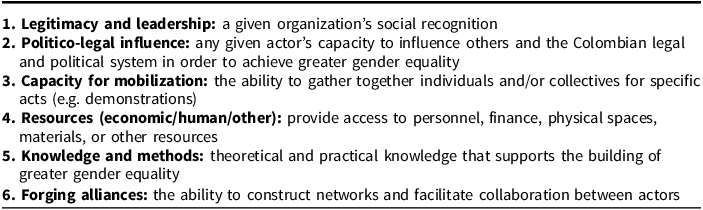
The participants made a collective decision to incorporate the lines of action outlined in the CONPES Social 161 document into the model. They effectively contributed by proposing specific contributions for each of these lines of action, creating tangible outcomes for the collaborative effort (Table 3). Importantly, these contributions were collectively defined, ensuring a shared understanding among all participating actors and aligning their interpretations of the terms used in the model. This particular played a crucial role in promoting clarity, transparency, and a common vision among the actors involved.
Potential contributions
Source: The authors
Then, the first prioritization phase resulted in the following work area: economic autonomy and access to assets. For methodological reasons, we considered it inadvisable to address all lines of action. The resulting questionnaire would have been exhausting, and responses might have lacked clarity. Participatory processes demand actors do more than just complete a questionnaire. They must develop the framework, validate results, and provide feedback on preliminary results; hence, avoiding fatigue and extractive research is essential. More details about this prioritization results are available online (Gonzalez-Urango and Otero-Hermida Reference Gonzalez-Urango and Otero Hermida2025).
The objective was to select one line of action so that the corresponding contributions could subsequently be assessed (Figure 4).
What contributions do you consider most important to advance toward economic autonomy and access to assets?
Source: The authors.
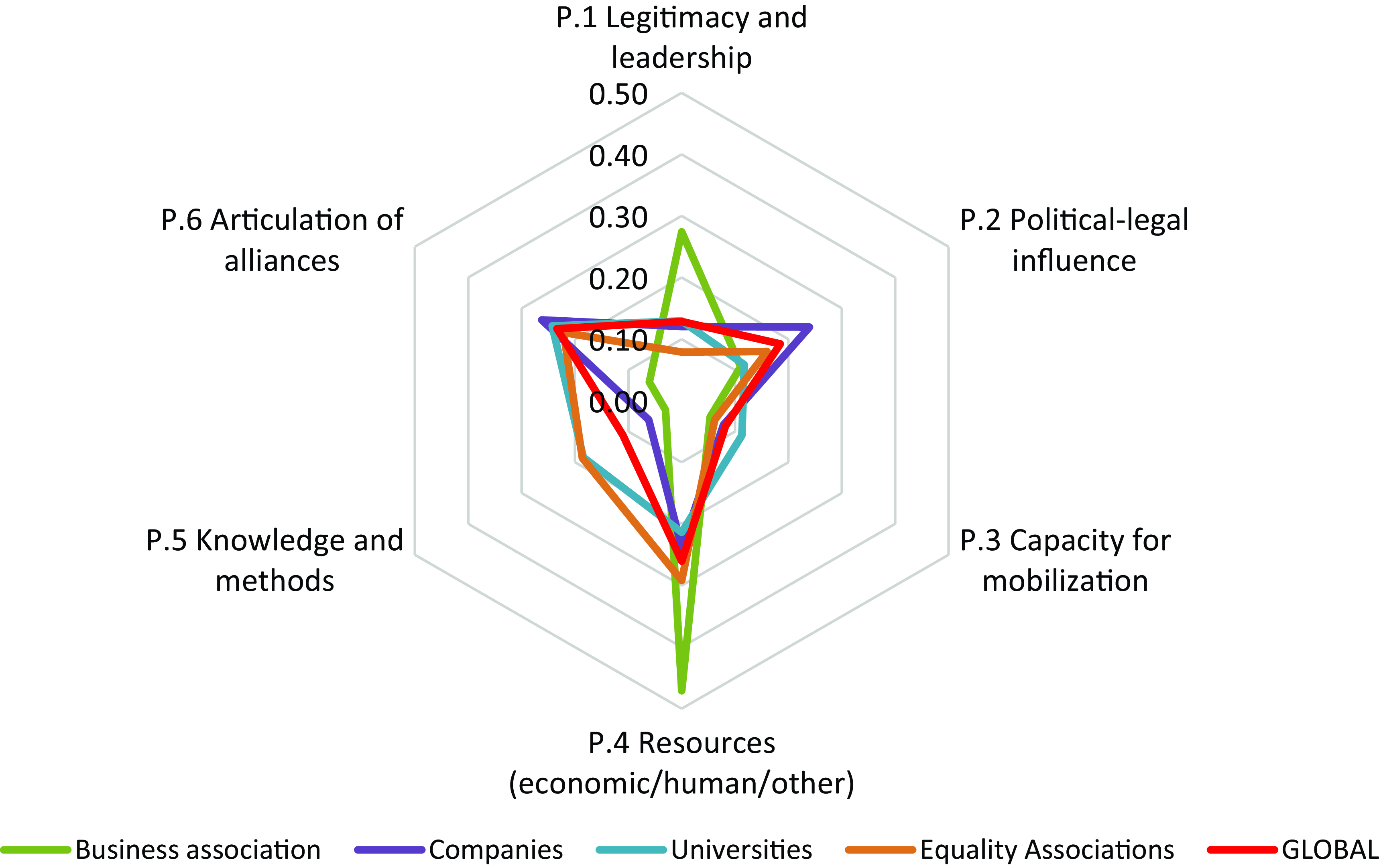
Resources was the issue most valued by the actors, although differences of opinion were observed. Substantial discrepancies existed with knowledge and methodologies. Universities and equality organizations valued this significantly more than the business sector. Companies accorded politico-legal influence more importance than others.
Additionally, an intriguing aspect of these findings is the realization that some actors may not assign significant importance to contributions that others view as their primary assets. For instance, equality associations may not fully recognize the value of their leadership and legitimacy, while business associations may underestimate the importance of forming alliances. These differing perspectives emphasize the importance of open communication and shared understanding among all actors involved in collaborative governance efforts. Addressing these disparities can lead to more effective collaboration and a more substantial collective impact.
Individual actors’ contributions to policy
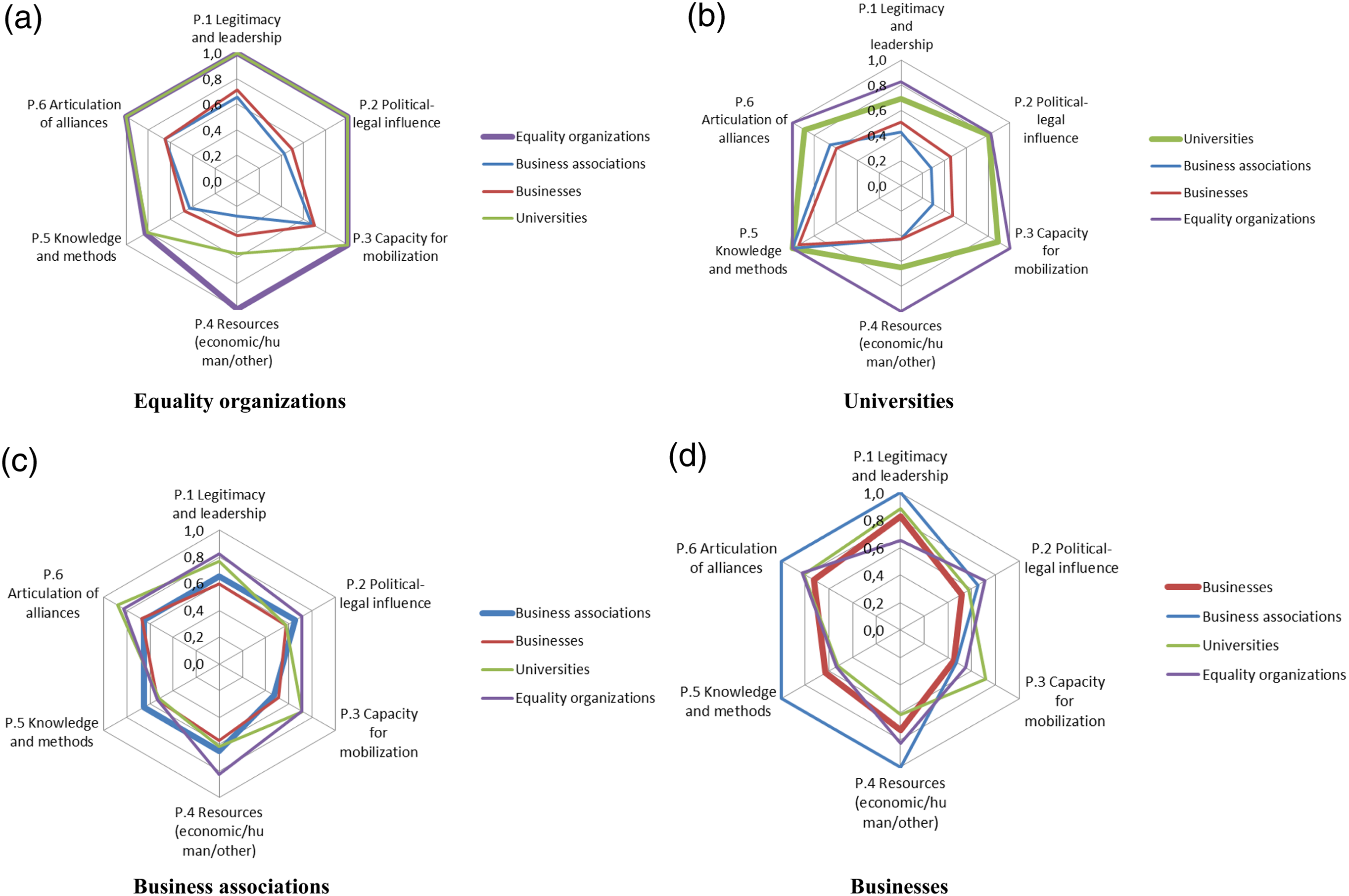
In Figure 5, we present each actor’s self-perceived capabilities and how other actors view them to advance toward economic autonomy and access to assets. These scores are measured on a scale from 0 to 1, with values below 0.43 considered low (Saaty Reference Saaty1999). However, it’s worth noting that the differences in perceptions among actors are more crucial than the actual scores. These differences highlight gaps in their expectations and provide valuable insights into the collaborative dynamics.
Self-perceived and perceived capabilities of main actors.
Source: The authors.
Perceptions of public administrations and other actors
Finally, we present the perspectives of both traditional and business actors regarding the capabilities of other relevant actors in Colombia to the selected line of action focused on economic autonomy and access to assets (Figure 6).
Views of other relevant actors.
Source: The authors.
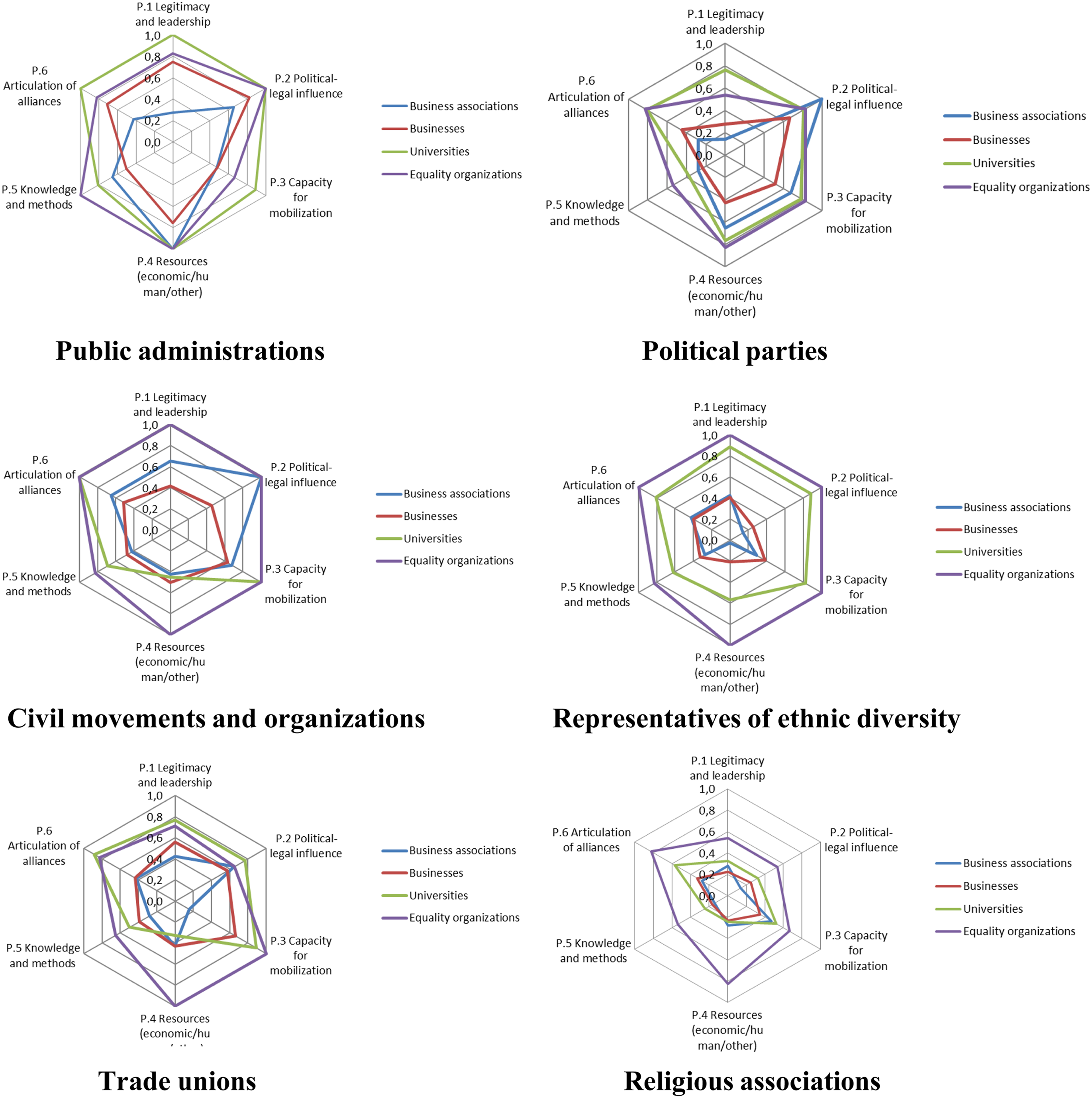
First, let’s note the results regarding leadership and legitimacy since this is fundamental to participation. Equality associations, public authorities, and other traditional actors are considered the most legitimate. However, there seems to be a consensus agreement that religious associations have limited potential and legitimacy, despite their remarkable presence in the gender debate in the country.
We believe these results may be of use in designing the initial dynamics of the collaborative process and, therefore, have made them available in Open Access (Gonzalez-Urango and Otero-Hermida Reference Gonzalez-Urango and Otero Hermida2025). Given the primary purpose of our article, the results section will now focus on the business sector. We will describe the actors’ opinions of businesses and compare these to the businesses’ opinions of themselves to observe possible role mismatches.
Overall, businesses are well regarded, although equality organizations are more critical of their leadership and legitimacy. As mentioned earlier, the evaluation of public equality policies in Colombia sought to engage companies for their potential contribution in terms of resources. Here we have a clear role mismatch since all the actors, including businesses, agree on the relevance of resources, although businesses rank their self-perceived contribution in this area lower.
Returning to our focus on business, other actors believe that they could contribute significantly to forging alliances. Businesses’ self-perception in this regard is lower, making this a less pronounced mismatch. This type of contribution is probably more common in Colombia than in other Latin American countries or Western countries. It is not unusual for important companies to take the lead in community-based peacebuilding, given their considerable interest in peace to foster economic activity and the state’s limited capacity to initiate this in some regions. All of these factors contribute to the significant influence and responsibility that businesses enjoy.
We found a sharper role mismatch with the capacity for mobilization and politico-legal influence. An actor’s capacity for politico-legal influence recalls other governance models in which social dialog and lobby groups have proved decisive in negotiations with the government, but also how influential businesses are framing the issues profiting from the top-down international initiatives that are built in new governance models as presented in section 2. Businesses undervalue their potential politico-legal influence in comparison with the views expressed by others, especially universities, which rate companies very highly in this regard. It is vital to notice that companies rate this contribution more highly than other actors. This emphasizes the significant influence they wield and how adeptly they navigate older and new governance models in which they hold greater power.
In light of our results, there may be a movement of Colombian CSR companies toward another complementary role in new governance models, such as gender mainstreaming. Businesses consider themselves to have a more legitimate role to play in equality policy, despite the fact that traditionally, the business associations have represented the sector on socio-political issues. The business associations themselves coincide with this view.
The business sector’s views of the traditional actors are also important. In general, they rate others lower than the ratings they receive. The entire business sector rates equality associations lower for all contributions than academia or the equality associations themselves. This is also true regarding universities, except for knowledge and methodologies, for which all actors rate them highly. Substantial discrepancies also exist with respect to the contribution itself: equality associations and academia rate it highly, while the business sector rates it very low. Finally, actors that may also be called upon to participate in equality efforts, such as trade unions, social movements, or ethnic diversity associations, generally receive low scores from the business sector, both for legitimacy and for other contributions. In contrast, equality associations and universities rate them highly.
Public authorities, which shall coordinate the collaborative process, receive very high scores from universities and equality organizations, whereas the business sector’s perception is generally critical. However, CSR companies consider public administrations are wholly legitimate participants in equality policy, whereas business associations disagree.
Coupled with the high overall scores businesses receive, these data do suggest they are expected to play a more active role in policies. The traditional actors consider this should extend beyond the provision of resources, making their potential role much broader than that outlined in the national policy document CONPES Social 161. However, the businesses’ self-perception – both regarding resources and other contributions – is more prudent.
Discussion and conclusion
In this section, we summarize the key findings derived from our study and explore their implications for policy and future research. Our article illustrates a case of evolving governance scenarios in a national context – Colombia –, prompted by gender mainstreaming and CSR models promoted by international organizations. This necessitates the inclusion of a broader spectrum of actors in the collaborative process to address complex societal issues. This expansion reaches beyond traditional gender actors, such as equality and women’s organizations or universities, to include entities like businesses. Business engagement in equality is expected to have a great positive impact on diverse issues such as women’s employment, career advancement or such as fighting against gender violence. However, corporate actors have been reluctant to conduct equality measures as targets of the policies, so it is challenging to incorporate them in more proactive roles as actors in policy development.
The findings are particularly significant within the literature on equality policies, given the scarcity of empirical research on business participation in such initiatives. They also contribute to the field of CSR in the context of equality and policy participation. The collaboration of diverse actors is crucial for promoting effective organizational change. This requires an innovative business case, but it must extend beyond individual firms, as even the most influential cannot tackle structural problems such as inequality alone.
First, our research highlights the importance of collectively defining the expected contributions of various actors in collaborative equality policies. These contributions encompass legitimacy, leadership, politico-legal influence, mobilization capacity, resources (both financial and otherwise), knowledge and methodologies, and the ability to forge alliances. This perspective may enrich the debate, as the literature often attributes more general functions (e.g., lobbying by equality associations) than specific contributions, and there is a lack of explicit collaborative frameworks for equality in the corporate realm (Gartzia Reference Gartzia2021). We argue that it is vital to identify what is collectively needed for the endeavor and then consider how each actor may contribute. This approach aids in identifying gaps that need to be addressed for capacity building.
Establishing a shared understanding of these specific contributions is foundational for effective collaborative governance and can be facilitated through participatory decision-making techniques that involve the collective definition of what is to be decided.
Second, our study identifies the potential for role shifts among actors within the policy landscape. We adopt a view of governance as the sum – not necessarily cumulative – of the contributions of actors, a result that emerges through their efforts (Kooiman Reference Kooiman1993) and how they adjust to their roles in changing governance scenarios (Rhodes Reference Rhodes1996).
In light of our results, Colombian CSR companies may evolve from being targets of equality policies to taking on a more active role as decisive participants in the equality policy network. CSR firms perceive themselves as having a more legitimate role in equality policy than business associations, which have traditionally represented the sector on socio-political issues, along with other actors.
Moreover, traditional equality actors, such as academia and equality associations, hold high expectations regarding the support that businesses can provide in terms of resources, leadership, articulating alliances, and political influence. Notably, these actors expect more than the basic role outlined in the national Colombian equality strategy. This positive outlook represents a departure from historical adversarial relationships and indicates a shift toward more cooperative interactions.
The expectations of the women’s movement regarding businesses as social partners are not extensively addressed in the literature, which tends to focus on bidirectional relations (e.g., funding from businesses to associations). Observations suggest that CSR multi-stakeholder initiatives may undermine the participation of equality associations (Kilgour Reference Kilgour2007; Grosser Reference Grosser2016; Prügl and True Reference Prügl and True2014), thus leaving little ground for empirical research on potential collaborations from a governance perspective.
Additionally, the literature lacks experiences from the Global South (Grosser et al. Reference Grosser, McCarthy and Kilgour2017). In many Northern contexts, the state provides some of the expected contributions. This is not the case in Colombia, particularly in certain regions where state reach is limited. Experiences from the Global South may help in understanding and anticipating collaborations in the states of the North where the state is retiring its support.
Encouragingly, CSR companies in Colombia regard public administrations as more legitimate participants in equality policies than other business actors. The perspective of CSR firms may has the potential to facilitate policy discussions and bridge the historical distrust between the private sector and public initiatives, moving beyond mere compliance with regulations that fail to introduce significant transformations in organizational practices – a significant issue observed in policies targeting businesses in many countries (Engeli and Mazur Reference Engeli and Mazur2022).
However, relevant role mismatches, where differences exist between actors’ self-perceptions and external expectations, must be highlighted as a third crucial conclusion, particularly concerning specific contributions. Notably, CSR firms perceive themselves as having a lower profile than other actors expect.
Contrary to expectations, our results reveal an imbalance in resource perception. Equality organizations believe they possess more resources than others attribute to them, while businesses, in contrast, perceive themselves as resource-scarce despite contrary expectations from other actors. Paradoxically, the equality associations, which literature tends to report as the weaker link in this contribution – poorly funded and resourced – find themselves with greater capacities than others attribute to them, particularly in a challenging environment with weak state support for social policies. This raises further questions about how, in national contexts, women’s and equality associations may resist the neoliberal shift and the limited corporate framing of equality in international arenas (Prügl and True Reference Prügl and True2014; Roberts Reference Roberts2015; Cullen and Murphy Reference Cullen and Murphy2018; Prügl Reference Prügl2017). This question requires a post-adoption framework, which is beyond the scope of this study and focuses on preliminary stages and business involvement. However, our findings may assist in pre-adoption analyses necessary to understand implementation and policy success (Engeli and Mazur Reference Engeli and Mazur, A2018). This finding underscores the critical role of knowledge and resources in collaborative governance, as emphasized in prominent proposals (Emerson et al. Reference Emerson, Nabatchi and Balogh2012; Ansell and Gash Reference Ansell and Gash2008). Imbalances in these factors can significantly influence the collaborative process.
Furthermore, our results shed light on a crucial aspect: the perceived relevance of contributions, irrespective of which actor is best positioned to provide them. While there is a clear consensus on the relevance of resources, it is noteworthy that businesses tend to undervalue the importance of knowledge and methodologies. Other studies have highlighted the challenges that a lack of knowledge in businesses poses to equality initiatives, such as corporate actions against gender-based violence, motivating claims against replacing the role of the state (Harwin Reference Harwin2017). Importantly, our findings indicate not only that businesses lack expert capacities but also that they do not consider them particularly necessary, even in this context, which involves greater complexity as it pertains to national policy rather than an individual organizational change scenario.
This finding is significant in identifying potential policy-focused issues and unintended consequences. Globally, we encounter both successful and dysfunctional examples of gender equality initiatives, as developed in section 2. Some approaches may inadvertently reinforce the public–private divide over gender issues, perpetuating the status quo and exacerbating inequality, as observed in previous studies (Jacquot Reference Jacquot2010; Lombardo et al. Reference Lombardo, Meier and Verloo2009; Harquail Reference Harquail2019). It is crucial to recognize that governance frameworks are not neutral. Both mainstreaming and corporate approaches to equality have been widely critiqued for their limited scope, which may divert policies from addressing the fundamental issues necessary for achieving effective gender equality (Dickens Reference Dickens1999; Reference Dickens1994; Grosser and Moon Reference Grosser and Moon2005; Prügl Reference Prügl2011; Jacquot Reference Jacquot2010; True and Mintrom Reference True and Mintrom2001; Cullen and Murphy Reference Cullen and Murphy2018; Grosser and McCarthy Reference Grosser and McCarthy2019; Kirton and Greene Reference Kirton and Greene, A. M2015; Kossek and Lobel Reference Kossek and Lobel A1996; Johansson and Ringbrom Reference Johansson and Ringblom2017). Knowledge, both critical and that which exposes the limitations and difficulties of the equality case, is also needed to avoid standardized practices that will not work effectively in organizations, as well as to articulate utilitarian visions – based on what equality brings to corporations – with those of social justice, empowering managers to lead changes (Gartzia Reference Gartzia2021).
Also, the business sector in Colombia rates the potential knowledge of equality and women’s associations very low, while these associations rate themselves highly, as do academics. Previous research has detected that women’s associations are often replaced by less contentious experts in multi-stakeholder forums addressing equality in business (Prügl and True Reference Prügl and True2014). We wonder if these low expectations regarding knowledge are shared more widely in international and other national contexts, potentially justifying the unjustifiable exclusion of women’s associations and movements in collaborative policy efforts on gender equality. Furthermore, in our case study, even if equality associations consider themselves resource-capable, they do not value their own legitimacy as highly as other actors do, which is necessary to argue against.
The risks highlighted in the literature warrant greater attention in light of our findings. Despite receiving positive assessments from equality actors, firms express more negative views of them, scoring them much lower than how equality actors perceive themselves, while scoring businesses more favorably. It is fundamental to note that we do not find only a scenario of dual ideological adversarialism or mere disconnection among the actors, but rather that businesses underestimate crucial actors. This significant asymmetry underscores the power imbalance already held by businesses. We call for further research to delve into these aspects in other national and international contexts.
The concerns raised in the literature prompt us to consider whether the demand for business participation in mainstreaming policies could serve as a Trojan horse for introducing more neoliberal elements into these initiatives. It is possible that companies’ reluctance to engage in gender policy events and assume the political roles outlined in new governance models has, to some extent, hindered a more pronounced shift toward limited perspectives.
Our findings suggest that businesses are not ready for policy participation in the Colombian case. The imbalances in the collaborative regime may be exacerbated by CSR business participation, though traditional businesses may pose even greater risks. Nevertheless, policy implementation is generally more successful when decisions are made collectively. This is especially important in the context of equality policy, where principles may be articulated in writing but do not always translate into concrete actions.
We conclude that the primary issue at hand is the absence of full mutual recognition, which is a fundamental aspect of the learning processes that can lead to shifts in the roles of various actors (Saarikoski Reference Saarikoski2000). We recommend a phased approach to the development of strategies for increased policy participation. Initially, it appears prudent to engage traditional actors while simultaneously fostering connections with potential business contributors (Renn et al. Reference Renn, Webler, Rakel, Dienel and Johnson1993; Luke and Luke Reference Luke and Luke1997). Subsequently, it will be necessary to re-evaluate the risks associated with business participation and the capacity of public facilitators to address power imbalances, as any significant disparities could jeopardize the entire collaborative process. This approach would provide businesses the opportunity to become more attuned to other participants and gradually access information about complex equality issues and the requisite knowledge needed to address them. We believe it is also advisable for companies to adopt a low-profile role initially, in line with their self-perceived role identified in our study.
Since the collection of our empirical data, an increasing number of firms have shown interest in promoting equality in Colombia, leading to the initiation of new multi-actor initiatives, particularly in the mining sector (CONPES 4080 2022). We hope that the analytical tools for detecting mismatches and role shifts, along with our proposals for reorienting these dynamics, can facilitate these emerging initiatives. The shared recognition of the importance of forging alliances can encourage a more proactive corporate role in advancing broader equality policies, akin to the significant roles some companies have played in other social matters within the country, such as peacebuilding.
We posit that many other countries may encounter similar challenges arising not only from ideological differences but also from the need for role adaptation in changing governance scenarios. Our analytical framework is easily adaptable to various policy contexts and nations, yet further research will be required to determine whether our proposal for action – specifically, delaying the incorporation of businesses into policy discussions, including CSR businesses, until greater mutual recognition is achieved – can be needed in other contexts.
Other general aspects merit further investigation. The involvement of women’s organizations in the governance of CSR initiatives has been proposed as a means to broaden the scope of such initiatives (Grosser Reference Grosser2016). This involvement could play a crucial role in fostering mutual recognition before businesses engage in collaborative policymaking efforts.
Moreover, mapping expected role shifts and role mismatches regarding jointly defined contributions could enhance reflexivity within these initiatives. A lack of explicit consideration of one’s own power position has been reported in these contexts (Prügl and True Reference Prügl and True2014), which is critical not only for collaborative governance but also for unmasking gender relations and their implications.
Given the limited experiences from which to draw conclusions, we hope that the reflections from our case study and the analytical tools proposed will pave the way for enduring collaborations that result in improved and ambitious policies. The challenges posed by new governance frameworks and business power in an increasingly transnational world are not only concerns for countries in the Global South. The implications for equality policies are part of an ongoing discussion, and understanding how business participation can be framed and implemented to avoid the aforementioned risks is a pressing question for scholars, policymakers, NGOs, women’s associations, and CSR businesses worldwide.
Data availability statement
This study does not employ statistical methods and no replication materials are available. The data treatment following participatory decision-making techniques can be consulted in Gonzalez-Urango and Otero-Hermida Reference Gonzalez-Urango and Otero Hermida2025, “Replication Data for: Business Engagement in Gender Equality Policy: Roles, Contributions and Expectations,” https://doi.org/10.7910/DVN/NEJN1K, Harvard Dataverse, V1
Acknowledgments
We would like to thank Monica García-Melón for her continuous support in our research work and Ingrith Rodriguez-Gutierrez for collaborating in collecting empirical material. Also, David Barberá-Tomás and Itziar Castelló for their valuable feedback, and the reviewers for their recommendations. We especially want to thank all the people who have devoted their time and reflection to this piece of work, building the participatory model, answering the resulting questionnaire, and giving feedback on preliminary results. This work was supported by the Universitat Politècnica de València [ADSIDEO 2017–2018]; Spanish Ministry of Science and Innovation [CSO2016-76828-R; IJC2020-044013-I]; Generalitat Valenciana [APOSTD-2020].


 Open access

