

Introduction
Antimicrobial resistance (AMR) poses a critical threat to global public health and approximately 700,000 people die yearly from AMR-related diseases. Reference Murray, Ikuta and Sharara1 In Thailand, AMR leads to around 88,000 cases and 38,000 deaths annually. Reference Pumart, Phodha, Thamlikitkul, Riewpaiboon, Prakongsai and Limwattananon2 The crisis is driven by improper antibiotic use in both humans and animals, including non-prescription use, unnecessarily prolonged treatment, broad-spectrum treatment, and delays in changing the administration route or de-escalating treatment. Reference Tang, Millar and Moore3,Reference Yuste, Matteo and Gruber4 Such practices increase healthcare costs, morbidity, and mortality. Reference Aminov5
The high rate of antibiotic misuse is associated with the knowledge, attitude, and prescription behavior of healthcare professionals, influenced by patient pressure and past clinical practice. Reference Morgan, Okeke, Laxminarayan, Perencevich and Weisenberg6,Reference Li7 For instance, a U.S. multicenter quality-improvement collaborative across neonatal intensive care units demonstrated that implementing core elements of an Antibiotic Stewardship Program (ASP), including ongoing education, resulted in up to a 34% relative reduction in antibiotic utilization, inappropriate prescribing, and antimicrobial resistance. Reference Dukhovny, Buus-Frank and Edwards8,Reference Enani9 A recent global systematic review and meta-analysis of antibiotic self-medication (ASM) in the general adult population across multiple countries reported that the prevalence of ASM in individual studies ranged widely from 0.65% to 92.2%, with a pooled global prevalence estimated at 43.0%. Reference Morgan, Okeke, Laxminarayan, Perencevich and Weisenberg10 Key factors driving ASM include individuals’ knowledge of antibiotics, a history of successful past experiences with self-treatment and the perception that an illness is minor. A subgroup analysis reveals that students are particularly prominent users of ASM, with a prevalence of 62.1%. Reference Morgan, Okeke, Laxminarayan, Perencevich and Weisenberg10 The ASM carries substantial risks including misdiagnosis, delays in receiving appropriate treatment, adverse drug reactions (ADRs), and potentially dangerous drug interactions. Crucially, the inappropriate use of antibiotics through ASM is a major accelerant of the global AMR crisis. Reference Morgan, Okeke, Laxminarayan, Perencevich and Weisenberg10
Medical students play a crucial role as future leaders in clinical practice. Their knowledge and attitude towards antibiotic use, which influence their current and future practices require assessment to guide appropriate educational interventions. Reference Hu, Wang and Tucker11 Several studies have investigated the knowledge, attitudes, and practices (KAP) of healthcare-related students about antibiotic use and resistance in Saudi Arabia, China, Uganda, Kenya, Tanzania, Turkey and Thailand. Reference Hu, Wang and Tucker11–Reference Precha, Sukmai and Hengbaru15 However, they mostly looked at general trends and didn’t separate preclinical from clinical students. These studies rarely evaluated the sources of information students rely on, nor did they explore the interrelationships between knowledge, attitudes, and practices. Most of the data also came from non-Thai settings, with little focus on behaviors like ASM or stopping antibiotics too early.
While ASM is a common practice in Thailand with a prevalence of 30.2% among the working-age population in major metropolitan areas due to the convenience of pharmacy access, non-strict medicine regulations and systemic barriers within the public healthcare system, Reference Chautrakarn, Khumros and Phutrakool16 there have been no previous studies specifically investigating ASM characteristics and their associated factors among medical student population.
Methods
Study design, setting and population
A cross-sectional survey study was conducted among preclinical- and clinical-year medical students from Thammasat University, one of Thailand’s largest public universities. In Thailand, students enter medical school directly after high school. The medical curriculum in Thailand is a 6-year program. The first 3 years are preclinical phase, focusing on foundational sciences in which microbiology and epidemiology are included, with limited clinical exposure. The final 3 years comprise the clinical phase, where students undergo hospital-based training and gain hands-on clinical experience. The study period was from 5 January 2023 to 13 February 2024. Our target population was medical students with a total number of 1,048 students. There are four different courses for Thammasat medical students; Thai program, English program, international program, and Collaborative Project to Increase Production of Rural Doctors (CPIRD). This study was conducted per the amended Declaration of Helsinki and received approval from the Human Research Ethics Committee of Thammasat University (Medicine) (approval number 036/ 2,566). An informative statement was included at the commencement of the anonymous online survey, and participants could provide their consent to participate by completing the survey. The confidentiality and privacy of data were maintained throughout the study period. The investigators had no access to data that could identify individual participants during or after data collection.
Study protocol and definitions
After conducting an in-depth relevant literature review, the researchers, consisting of one specialist in infectious diseases and three medical students, generated the online survey via Google Forms. The survey was segmented into four sections, including demographics (ten questions), factors influencing knowledge toward antibiotic use and resistance (five questions), knowledge toward antibiotic use and resistance (fifteen statements to respond), attitudes toward antibiotic use and resistance (eleven statements to respond), and self-medication with antibiotics (17 questions). Knowledge was assessed by correct responses to the provided statements about antibiotic use and resistance. Attitudes toward antibiotic use and resistance were evaluated by using the 5-point Likert scale on the provided statements (1 = Strongly disagree, 2 = Disagree, 3 = Neither agree nor disagree, 4 = Agree and 5 = Strongly agree). The survey was pretested with 20 medical students to assess its internal consistency, resulting in a calculated Cronbach’s alpha of 0.79. Missing data was minimized by mandating all responses in the survey. The full survey instrument and the prespecified “correct” responses used to calculate knowledge scores, are provided as Supplementary files. For self-medication with antibiotics, “premature cessation” of antibiotics was based on participant self-reported history of discontinuing antibiotics before completing the self-purchased package or duration recommended by the dispensing pharmacist or prescribing clinician for the leftover antibiotics used in previous episodes.
The researchers distributed an electronic poster along with the online survey link and QR code via social media related to medical student groups, such as LINE application, Facebook, and Instagram. Our study used convenience sampling, anticipating a good distribution of participating medical students in both preclinical and clinical years.
Statistical analyses
Statistical analysis was conducted using IBM SPSS Statistics Version 22.0. Descriptive data were presented in number (percent), median and interquartile range (IQR). Categorical variables were compared using the χ2 test. Continuous variables were compared using the Mann-Whitney U test. A P value less than .05 was considered statistically significant. Independent factors associated with knowledge score and self-medication with antibiotics were determined using multivariable logistic regression analysis with a calculated 95% confidence interval (CI).
Results
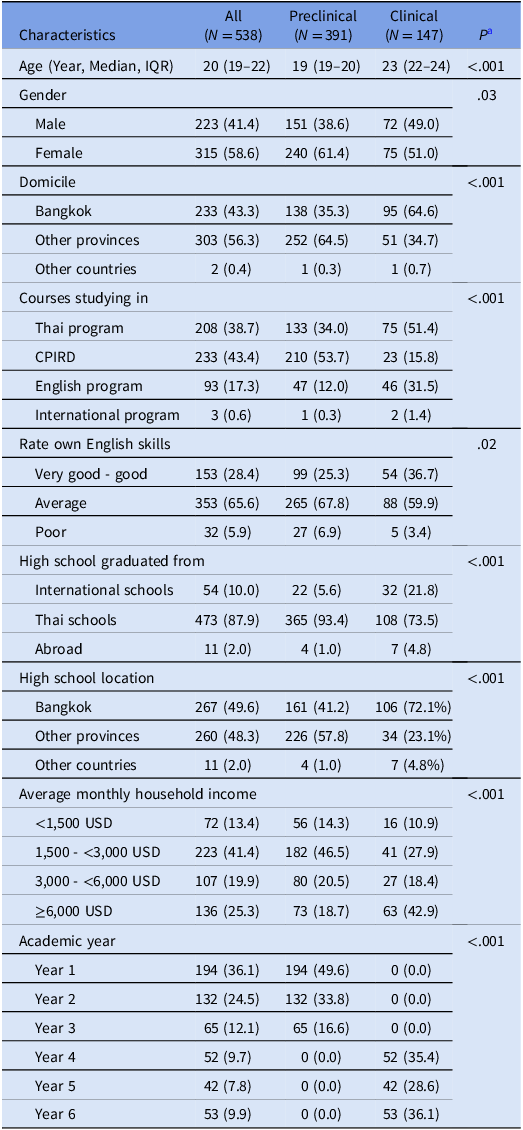
Demographics characteristics of the participating students (Table 1)
A total of 538 medical students participated in the study, with 391 (72.7%) in the preclinical years and 147 (27.3%) in the clinical years. The median age of participants was 20 years (IQR 19–22), 58.6% were females and 43.4% in the CPIRD course. Most of the students graduated from Thai high schools (87.9%) and rated their English skills as average (65.6%). Comparing between preclinical- and clinical-year students, higher proportion of clinical-year students were male, originally from Bangkok, studied in Thai or English program and graduated from international schools. Clinical-year students had higher monthly household income and rated their English skills higher than preclinical-year students.
Demographic characteristics of the participating students

Data are in numbers (%) unless indicated otherwise.
a Comparing between preclinical- and clinical-year students.
IQR = interquartile range.
Knowledge about antibiotic use and resistance
For sources of knowledge about antibiotic use and resistance, 66.9% and 53.5% of the participating students reported doing additional research on antibiotics and antibiotic resistance, such as enrolling in courses or searching the internet, respectively, while 83.3% had followed medical knowledge resources on the internet, such a Facebook pages. These sources vary in credibility and were not independently assessed in this study. A third of the students reported having family members work in the medical fields and 3.7% reported having a pharmacy as home business. These sources of knowledge were not significantly different between preclinical- and clinical-year students.
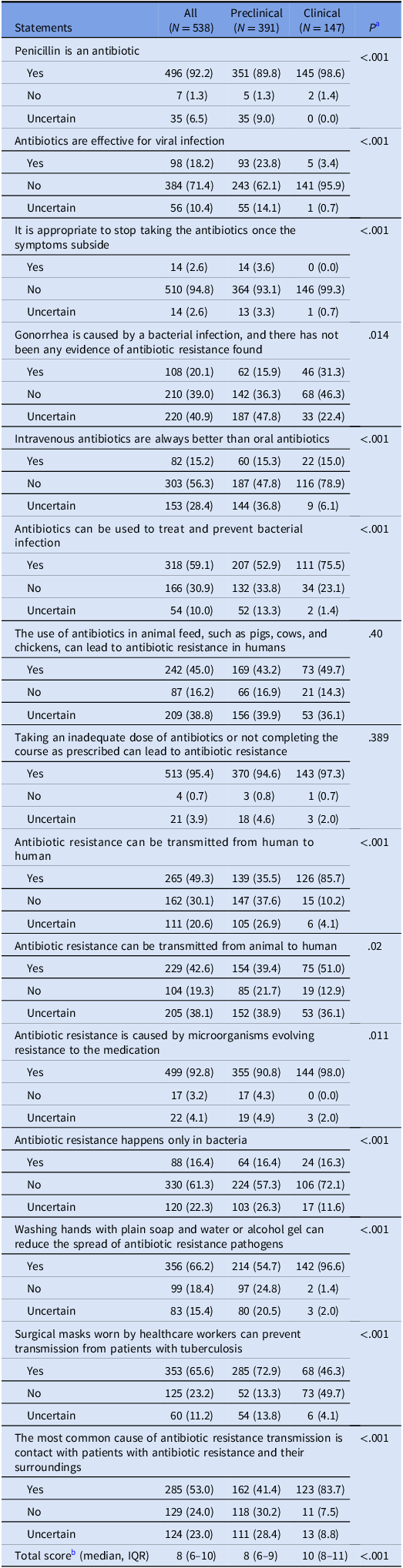
Table 2 demonstrates the students’ responses to the 15 provided statements about antibiotic use and resistance. The students had moderate level of knowledge with a median total score of 8/15. Less than 50% of the students correctly responded to the statements “Gonorrhea is caused by a bacterial infection, and there has not been any evidence of antibiotic resistance found,” “The use of antibiotics in animal feed, such as pigs, cows, and chickens, can lead to antibiotic resistance in humans,” “Antibiotic resistance can be transmitted from human to human” and “Antibiotic resistance can be transmitted from animal to human.” Clinical-year students had significantly higher knowledge scores than preclinical-year students (10 vs 8, P < .001). Significantly higher proportion of clinical-year students correctly responded to most of the statements about antibiotic use and resistance than preclinical-year students, except for the statements “The use of antibiotics in animal feed, such as pigs, cows, and chickens, can lead to antibiotic resistance in humans” and “Taking an inadequate dose of antibiotics or not completing the course as prescribed can lead to antibiotic resistance” (Table 2). In multivariable logistic regression analysis after adjustment for self-report English skills, monthly household income, locations of the graduated high schools, and sources of knowledge, higher academic year (β 0.60, 95% CI 0.47–0.73, P < .001) and male sex (β 0.79, 95% CI 0.36–1.22, P < .001) were independently associated with higher knowledge score.
Responses to the statements about antibiotic use and resistance among the participating students

Data are in numbers (%) unless indicated otherwise.
a Comparing between preclinical- and clinical-year students.
b Number of correct responses to the 15 provided statements about antibiotic use and resistance.
IQR = interquartile range.
Attitudes toward antibiotic use and resistance
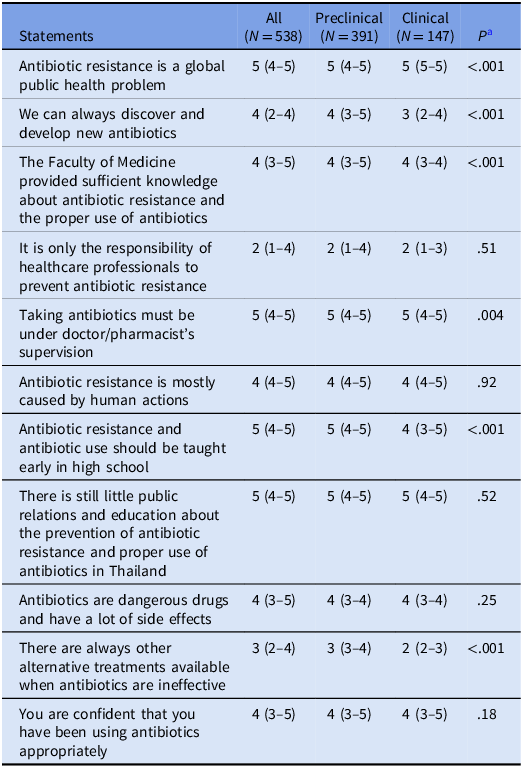
Table 3 presents the students’ perceptions and attitudes toward antibiotic use and resistance. Most of the students agreed that antibiotic resistance is a global public health problem, taking antibiotics must be under doctor/pharmacist’s supervision, antibiotic resistance is mostly caused by human actions, antibiotic resistance and antibiotic use should be taught early in high school and there is still little public relations and education about the prevention of antibiotic resistance and proper use of antibiotics in Thailand, while they disagreed that it is only the responsibility of healthcare professionals to prevent antibiotic resistance and there are always other alternative treatments available when antibiotics are ineffective. Comparing between preclinical- and clinical-year students, preclinical-year students were more-likely to agree that we can always discover and develop new antibiotic and there are always other alternative treatments available when antibiotics are ineffective.
Attitudes toward antibiotic use and resistance among the participating students

Data are presented in median (interquartile range) of the scores according to the 5-point Likert scale on the provided statements (1 = Strongly disagree, 2 = Disagree, 3 = Neither agree nor disagree, 4 = Agree and 5 = Strongly agree).
a Comparing between preclinical- and clinical-year students.
Self-medication with antibiotics
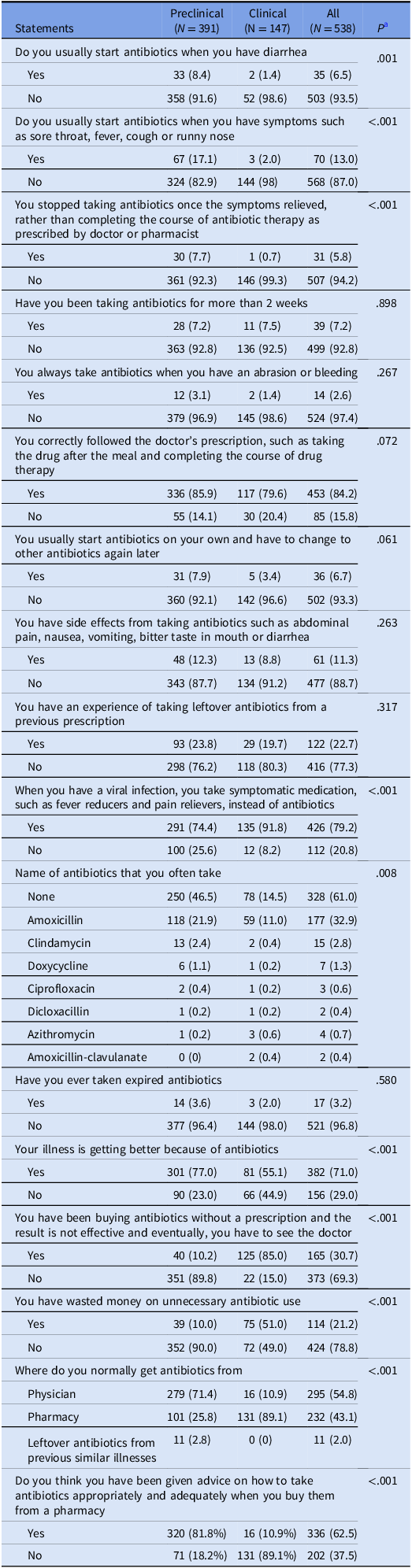
Practices of ASM reported by the students are shown in Table 4. Of the 538 students, 43% reported getting antibiotics from a pharmacy without prescription and 37.5% had not received adequate advice about antibiotic administration. For taking antibiotics without indications, 13%, 6.5% and 2.1% reported self-initiating antibiotics for any upper respiratory tract symptoms, diarrhea, and abrasion/bleeding wounds, respectively. Less than 10% reported starting antibiotics on their own, stopping antibiotics prematurely or taking antibiotics more than 2 weeks. The most common antibiotics reported for self-initiation were amoxicillin (32.9%), clindamycin (2.8%) and doxycycline (1.3%). However, 30.7% reported the antibiotics were not effective and 11.3% developed adverse reactions. By multivariable logistic regression analyses, being a preclinical-year student was independently associated with ASM, using antibiotics without indications, and premature stopping antibiotics (Table 5).
Self-medication with antibiotics among the participating students

Data are in numbers (%) unless indicated otherwise.
a Comparing between preclinical- and clinical-year students.
Multivariable logistic regression analysis for factors associated with self-medication with antibiotics among the participating students

Discussion
To the best of our knowledge, this is the first study in Thailand specifically focused on knowledge and attitudes towards antibiotic use and ASM among medical students and compares these findings between preclinical- and clinical-year students. Our results showed that medical students demonstrated a moderate to high level of knowledge on antibiotic use and antibiotic resistance consistent with other studies. Reference Lubwama, Onyuka and Ayazika13,Reference Okedo-Alex, Madubueze, Umeokonkwo, Oka, Adeke and Okeke17 However, significant educational gaps and misconceptions remain among preclinical-year students. This finding was confirmed by the multivariable logistic regression analysis and aligns with those found in Nigeria, China and Columbia. Reference Okedo-Alex, Madubueze, Umeokonkwo, Oka, Adeke and Okeke17–Reference Higuita-Gutiérrez, Roncancio Villamil and Jiménez Quiceno19 This suggests that current preclinical curricula may insufficiently emphasize practical understanding of antibiotics use and resistance. While clinical-year students typically undergo more intensive training and have completed clinical rotations along with real-world exposure through direct patient care in hospital settings, there are still gaps of knowledge in regards to antibiotic resistance burden in a specific infectious disease and transmission of drug resistance between animals to humans in this study.
The multivariable analysis further revealed that gender was also significantly associated with knowledge scores, with male students outperforming females. This association should be interpreted with caution due to potential confounding as male students were more represented in the clinical year group.
Attitudinal responses were generally positive but varied. Consistent with previous research, our findings demonstrated a strong agreement among medical students that antibiotic resistance as a major global health issue. Reference Okedo-Alex, Madubueze, Umeokonkwo, Oka, Adeke and Okeke17,Reference Gualano, Gili, Scaioli, Bert and Siliquini20 A previous study has also shown mixed belief about long-term effectiveness of antibiotics and development of antibiotic resistance. Reference Nukaly, Aljuhani and Alhartani21 In our study, preclinical-year students were more optimistic that new antibiotics can always be discovered and developed, and alternative treatments are always available than clinical-year students. These findings may reflect how increased clinical exposure contributes to a more realistic view of current therapeutic limitations and the growing threat of antibiotic resistance. Regarding medical education, most students felt their curriculum adequately covered antibiotic use and resistance. However, clinical-year students reported slightly lower satisfaction, indicating that as the study year progresses, they may perceive emerging gaps or unmet educational needs. There was also strong consensus across all academic years that the topics of antibiotic use and resistance should be introduced early, which were aligned with a previous study. Reference Minen, Duquaine, Marx and Weiss22
This study provides significant insights into self-medication with antibiotics among medical students in Thailand. We observed that 2–13% of the surveyed students reported ASM for upper respiratory tract symptom, diarrhea, and abrasion/bleeding wounds, aligning with the rate reported in another Thai study. Reference Precha, Sukmai and Hengbaru15 Placing our local findings within a broader context, the pooled prevalence of ASM among university students across various low and middle-income countries (LMICs) was notably high at 46.0% (ranging from 11.1% in Brazil to 90.7% in Congo). These varied prevalences reflect the differences in the specific definition and measurement of ASM, the complex interplay of socioeconomic factors, healthcare system structures, regulatory environments, and cultural beliefs that influence ASM practices in different regions. Reference Xu, Mu, Wang, Shi, Wang and Ni23 This underscores the need for interventions to decrease ASM and improve adherence to antibiotic regimens as prescribed among medical students. When analyzing on key behaviors, preclinical-year students demonstrated significantly higher rates of inappropriate antibiotic use compared to their clinical-year counterparts across several behaviors related to ASM. These findings were confirmed by the multivariable analysis and suggest that increased exposure to clinical content and structured education enhances awareness regarding antibiotic resistance, aligning with previous studies. Reference Precha, Sukmai and Hengbaru15,Reference Shitindi, Issa, Poyongo, Horumpende, Kagashe and Sangeda24
In terms of outcomes related to antibiotic use, 11.3% of the students in our study reported experiencing symptoms such as diarrhea or nausea following ASM, consistent with the findings from a previous study. Reference Chautrakarn, Khumros and Phutrakool16 In addition, 30.7% of the students reported that antibiotic use was not effective in treating their illness and 21.2% felt that they wasted money for unnecessary antibiotic use. There findings demonstrate the unnecessary adverse effects, anxiety and cost incurring by ASM. A significant 43.1% of students acquired antibiotics from pharmacies without a prescription. This was consistent with another study Reference Hassan and Koabar25 and highlights a persistent regulatory challenge in Thailand. This issue is compounded by the ease of access to over-the-counter antibiotics, which further normalizes unsupervised medication practices among the public. Our findings mirror trends reported in similar studies, Reference Hassan and Koabar25 reinforcing the urgent need for stricter enforcement of pharmaceutical regulations. Under Thailand’s Drug Act B.E. 2,510 (1967), most commonly used antibiotics are currently classified as “dangerous drugs” that may legally be dispensed in licensed community pharmacies under the supervision of a pharmacist without a physician’s prescription, while only a smaller group of antibiotics are classified as “specially-controlled drugs” that require a prescription. However, enforcement of these provisions is inconsistent, so most antibiotic classes remain accessible directly at pharmacies without a pharmacist supervision and/or prescription, and this is the regulatory gap that our findings underscore. Furthermore, a notable proportion of students (22.7%) reported using leftover antibiotics. This practice aligns with previous studies, Reference Shitindi, Issa, Poyongo, Horumpende, Kagashe and Sangeda24,Reference Shrestha, Barakoti, Shakya Gurung, Paudel, Sapkota and Deo26 indicating that previously prescribed, unused medications are a common source of drugs. This suggests that, in addition to emphasizing the importance of completing the full course of medication as prescribed, prescribing physicians should also dispense an appropriate quantity of medication to prevent any leftovers that could be used inappropriately for subsequent episodes.
Integrating comprehensive education on antibiotic use, resistance mechanisms, and antibiotic resistance prevention into the preclinical curriculum through lectures and case-based learning activities could help establish a strong foundational knowledge. Reference Wiese-Posselt, Lâm and Schröder27 Additionally, short courses, workshops, and seminars should be formally introduced into the curricula to provide repeated exposure and reinforcement of key concepts. Reference Lubwama, Onyuka and Ayazika13,Reference Huang, Gu and Zhang18,Reference Sakr, Ghaddar, Hamam and Sheet28 Simulation-based training and virtual patient cases should also be utilized, allowing students to practice clinical reasoning and decision-making. Reference Kononowicz, Woodham and Edelbring29 These interactive and experiential approaches improve students’ ability to apply knowledge in practice. Moreover, incorporating antimicrobial content into clinical rotations and encouraging interprofessional collaboration with pharmacists and microbiologists can further strengthen practical competence and preparedness for real-world prescribing. Reference Mohammed, Anand and Saleena Ummer30
The study has some notable limitations. First, being conducted at a single institution may limit the generalizability of the findings to medical students in other universities with different curricula or educational approaches. Second, an anonymous and self-administered design may be subject to misunderstanding and misinterpreting questions and statements in the survey as well as recall bias. In addition, knowledge assessment in the survey was not formally validated. Some knowledge items may not fully capture the complexity of clinical decision-making and should be interpreted with caution. Lastly, the study did not include an objective assessment of students’ actual ASM behaviors or clinical application of knowledge, which limits insights into their real-world competence.
Conclusions
This study highlights critical gaps in knowledge and attitudes toward antibiotic use and ASM among Thai medical students. While overall knowledge level was moderate to high, clinical-year students demonstrated significantly better knowledge score and attitudes and lower rate of inappropriate ASM behaviors compared to preclinical-year students. Comprehensive education on antibiotic use, resistance mechanisms, and antibiotic resistance prevention should be integrated early into the preclinical curriculum and be tailored according academic years.
Supplementary material
The supplementary material for this article can be found at https://doi.org/10.1017/ash.2026.10414.
Acknowledgements
We gratefully acknowledge the invaluable support provided by the staff of the Student Affairs Department at the Faculty of Medicine, Thammasat University, in facilitating the distribution of our electronic invitation poster and online survey link. Our sincere appreciation also goes to all the students whose participation was crucial to the successful completion of this study.
Financial support
None.
Competing interests
None for all authors.



 Open access

