


Background
Depressive disorders are the leading contributor to the global burden of disease among women of child-bearing age (Vos et al. Reference Vos, Flaxman, Naghavi, Lozano, Michaud, Ezzati, Shibuya, Salomon, Abdalla, Aboyans, Abraham, Ackerman, Aggarwal, Ahn, Ali, Alvarado, Anderson, Anderson, Andrews, Atkinson, Baddour, Bahalim, Barker-Collo, Barrero, Bartels, Basáñez, Baxter, Bell, Benjamin, Bennett, Bernabé, Bhalla, Bhandari, Bikbov, Bin Abdulhak, Birbeck, Black, Blencowe, Blore, Blyth, Bolliger, Bonaventure, Boufous, Bourne, Boussinesq, Braithwaite, Brayne, Bridgett, Brooker, Brooks, Brugha, Bryan-Hancock, Bucello, Buchbinder, Buckle, Budke, Burch, Burney, Burstein, Calabria, Campbell, Canter, Carabin, Carapetis, Carmona, Cella, Charlson, Chen, Cheng, Chou, Chugh, Coffeng, Colan, Colquhoun, Colson, Condon, Connor, Cooper, Corriere, Cortinovis, de Vaccaro, Couser, Cowie, Criqui, Cross, Dabhadkar, Dahiya, Dahodwala, Damsere-Derry, Danaei, Davis, De Leo, Degenhardt, Dellavalle, Delossantos, Denenberg, Derrett, Des Jarlais, Dharmaratne, Dherani, Diaz-Torne, Dolk, Dorsey, Driscoll, Duber, Ebel, Edmond, Elbaz, Ali, Erskine, Erwin, Espindola, Ewoigbokhan, Farzadfar, Feigin, Felson, Ferrari, Ferri, Fèvre, Finucane, Flaxman, Flood, Foreman, Forouzanfar, Fowkes, Franklin, Fransen, Freeman, Gabbe, Gabriel, Gakidou, Ganatra, Garcia, Gaspari, Gillum, Gmel, Gosselin, Grainger, Groeger, Guillemin, Gunnell, Gupta, Haagsma, Hagan, Halasa, Hall, Haring, Haro, Harrison, Havmoeller, Hay, Higashi, Hill, Hoen, Hoffman, Hotez, Hoy, Huang, Ibeanusi, Jacobsen, James, Jarvis, Jasrasaria, Jayaraman, Johns, Jonas, Karthikeyan, Kassebaum, Kawakami, Keren, Khoo, King, Knowlton, Kobusingye, Koranteng, Krishnamurthi, Lalloo, Laslett, Lathlean, Leasher, Lee, Leigh, Lim, Limb, Lin, Lipnick, Lipshultz, Liu, Loane, Ohno, Lyons, Ma, Mabweijano, MacIntyre, Malekzadeh, Mallinger, Manivannan, Marcenes, March, Margolis, Marks, Marks, Matsumori, Matzopoulos, Mayosi, McAnulty, McDermott, McGill, McGrath, Medina-Mora, Meltzer, Mensah, Merriman, Meyer, Miglioli, Miller, Miller, Mitchell, Mocumbi, Moffitt, Mokdad, Monasta, Montico, Moradi-Lakeh, Moran, Morawska, Mori, Murdoch, Mwaniki, Naidoo, Nair, Naldi, Narayan, Nelson, Nelson, Nevitt, Newton, Nolte, Norman, Norman, O'Donnell, O'Hanlon, Olives, Omer, Ortblad, Osborne, Ozgediz, Page, Pahari, Pandian, Rivero, Patten, Pearce, Padilla, Perez-Ruiz, Perico, Pesudovs, Phillips, Phillips, Pierce, Pion, Polanczyk, Polinder, Pope, Popova, Porrini, Pourmalek, Prince, Pullan, Ramaiah, Ranganathan, Razavi, Regan, Rehm, Rein, Remuzzi, Richardson, Rivara, Roberts, Robinson, De Leòn, Ronfani, Room, Rosenfeld, Rushton, Sacco, Saha, Sampson, Sanchez-Riera, Sanman, Schwebel, Scott, Segui-Gomez, Shahraz, Shepard, Shin, Shivakoti, Singh, Singh, Singh, Singleton, Sleet, Sliwa, Smith, Smith, Stapelberg, Steer, Steiner, Stolk, Stovner, Sudfeld, Syed, Tamburlini, Tavakkoli, Taylor, Taylor, Taylor, Thomas, Thomson, Thurston, Tleyjeh, Tonelli, Towbin, Truelsen, Tsilimbaris, Ubeda, Undurraga, van der Werf, van Os, Vavilala, Venketasubramanian, Wang, Wang, Watt, Weatherall, Weinstock, Weintraub, Weisskopf, Weissman, White, Whiteford, Wiersma, Wilkinson, Williams, Williams, Witt, Wolfe, Woolf, Wulf, Yeh, Zaidi, Zheng, Zonies, Lopez, Murray, AlMazroa and Memish2012). Rates of perinatal depression in low- and middle-income countries (LMICs) range from 18% to 25% (Fisher et al. Reference Fisher, Mello, Patel, Rahman, Tran, Holton and Holmes2012), while in Pakistan, rates of 28–38% have been reported (Rahman et al. Reference Rahman, Iqbal and Harrington2003 ; Khan et al. Reference Khan, Chiumento, Dherani, Bristow, Sikander and Rahman2015). Problems such as depression can have devastating effects on the whole family, especially children (Kastrup, Reference Kastrup2006). Studies have demonstrated strong independent associations with pre-term birth (Dayan et al. Reference Dayan, Creveuil, Herlicoviez, Herbel, Baranger, Savoye and Thouin2002; Grote et al. Reference Grote, Bridge, Gavin, Melville, Iyengar and Katon2010; Jarde et al. Reference Jarde, Morais, Kingston, Giallo, MacQueen, Giglia, Beyene, Wang and McDonald2016), poor growth and cognitive development (Rahman et al. Reference Rahman, Bunn, Lovel and Creed2007; Halfon et al. Reference Halfon, Larson, Lu, Tullis and Russ2014; Bennett et al. Reference Bennett, Schott, Krutikova and Behrman2016), higher rates of diarrheal diseases (Rahman et al. Reference Rahman, Bunn, Lovel and Creed2007), early cessation of breastfeeding (Rahman et al. Reference Rahman, Hafeez, Bilal, Sikander, Malik, Minhas, Tomenson and Creed2016a), and poor socio-emotional development (Herba et al. Reference Herba, Glover, Ramchandani and Rondon2016). In countries like Pakistan with some of the worst reported rates of infant mortality and morbidity (UNICEF, 2018) and the vast majority of mothers with depression receiving no treatment, the condition is a public health priority.
Psychological interventions are the first line of treatment for depression. While most LMICs including Pakistan have vastly underdeveloped specialist facilities for mental health, a number of trials from LMICs show that non-specialists can deliver them effectively (Rahman et al. Reference Rahman, Malik, Sikander, Roberts and Creed2008, Reference Rahman, Hamdani, Awan, Bryant, Dawson, Khan, Azeemi, Akhtar, Nazir, Chiumento, Sijbrandij, Wang, Farooq and van Ommeren2016b; Patel et al. Reference Patel, Weiss, Chowdhary, Naik, Pednekar, Chatterjee, De Silva, Bhat, Araya, King, Simon, Verdeli and Kirkwood2010; Chibanda et al. Reference Chibanda, Weiss, Verhey, Simms, Munjoma, Rusakaniko, Chingono, Munetsi, Bere, Manda, Abas and Araya2016). The Thinking Healthy Programme (THP), developed in Pakistan, is a cognitive behavior therapy (CBT)-based intervention for perinatal depression, delivered by lay community health workers (CHWs). THP consists of 16 sessions, starting from the last trimester of pregnancy to 10th month postnatal. The intervention employs imagery techniques by using culturally appropriate illustrations/pictures to help women identify unhelpful thoughts, alternative ways of thinking (helpful thoughts), putting these helpful thoughts into action, and problem solving when issues arise in practicing new behaviors (Rahman et al. Reference Rahman, Malik, Sikander, Roberts and Creed2008, Reference Rahman, Fisher, Bower, Luchters, Tran, Yasamy, Saxena and Waheed2013). The THP is the first psychological intervention to be incorporated into the WHO's flagship Mental Health Gap Action Programme (mhGAP) (World Health Organization, 2016).
Despite these advances, the majority of women with perinatal depression in low-income countries do not receive the treatment and a key barrier is the extensive training, supervision, and monitoring required by non-specialists to ensure they deliver the complex intervention to fidelity. Training of a large number of health workers is not feasible, costly, time consuming, and difficult to arrange (Murray et al. Reference Murray, Tol, Jordans, Zangana, Amin, Bolton, Bass, Bonilla-Escobar and Thornicroft2014). Moreover, ensuring the quality and consistency in training and supervision at scale can be challenging (Mangham & Hanson, Reference Mangham and Hanson2010).
The recent Lancet Commission on Global Mental Health (Patel et al. Reference Patel, Saxena, Lund, Thornicroft, Baingana, Bolton, Chisholm, Collins, Cooper, Eaton, Herrman, Herzallah, Huang, Jordans, Kleinman, Medina-Mora, Morgan, Niaz, Omigbodun, Prince, Rahman, Saraceno, Sarkar, De Silva, Singh, Stein, Sunkel and Unützer2018) has highlighted the use of digital technology as a major area for future research to assist the scale-up of mental health interventions. In recent years, digital mental health technologies such as web-based platforms and mobile applications have been frequently cited as potential methods of extending evidence-based interventions (Naslund et al. Reference Naslund, Aschbrenner, Araya, Marsch, Unützer, Patel and Bartels2017). In Pakistan, 87% of households own a mobile phone (National Institute of Population Studies, 2013), indicating the potential of digital technology for health promotion. However, at present, there are no Applications (Apps) that can assist in training a CHW to deliver an evidence-based intervention effectively in low-income settings (Fairburn & Cooper, Reference Fairburn and Cooper2011, Fairburn et al. Reference Fairburn, Allen, Bailey-Straebler, O'Connor and Cooper2017). Additionally, few studies have employed rigorous methodologies to evaluate the technological solutions to scaled-up training.
We developed and tested a technology-assisted training and supervision system for CHWs to be trained in an evidence-based intervention for perinatal depression in a post-conflict area of Pakistan to establish whether it can be an alternative to conventional specialist-led face-to-face training and supervision.
Methods
Study design
A single-blind, non-inferiority, individual randomized controlled trial design was employed. The non-inferiority design was chosen because a novel method of training was being compared with an established standard method of training.
Settings and participants
The study was conducted in District Swat, Khyber Pakhtunkhwa province, in the north of Pakistan. Swat has been exposed to multiple humanitarian crises over the last decade including large-scale armed conflict and floods. Following an insurgency by armed militants in 2006–2009, a massive military operation was carried out to regain control of the district. Around 2.5 million people were internally displaced as a result of the conflict between militants and the army in 2007 (Bile & Hafeez, Reference Bile and Hafeez2009). While the conflict continued, devastating floods in 2010 resulted in thousands of people losing their homes and causing destruction to roads, schools, and health facilities. Health systems were seriously affected. Almost one-third of the health facilities were destroyed (Din et al. Reference Din, Mumtaz and Ataullahjan2012). Currently, the health systems are fragile and transitioning toward normalcy. The psychological sequelae of these humanitarian disasters are apparent even years later; an epidemiological study reporting 38% of pregnant women had clinically significant psychological distress (Khan et al. Reference Khan, Chiumento, Dherani, Bristow, Sikander and Rahman2015).
In rural Pakistan, the community-based maternal and child health care is delivered through CHWs called Lady Health Workers (LHWs). LHWs are local women employed by Primary Health Care (PHC) under the National Programme for Family Planning and PHC initiated in 1994. LHWs are trained and supervised by Lady Health Supervisors (LHSs). Each LHS, based at the PHC facility, supervises between 15 and 20 LHWs. LHSs and LHWs receive no training to provide mental health interventions. The current study was conducted from March 2016 to November 2016 in three peri-urban Union Councils of Swat: Faizabad, Rangmohalla, and Saidu Sharif (a Union Council is the smallest administrative unit within a district). To recruit participants, the LHWs program administration in the three Union Councils was approached and information about the study provided. The LHWs program was requested to provide lists of LHSs and LHWs working in the Union Councils. All the LHSs and LHWs in the list were informed about the study. From the list of 139 LHWs provided by LHW program, 80 LHWs were randomly selected. Figure 1 Figure 2 shows the flow of participants in the study.
Participants' flow.

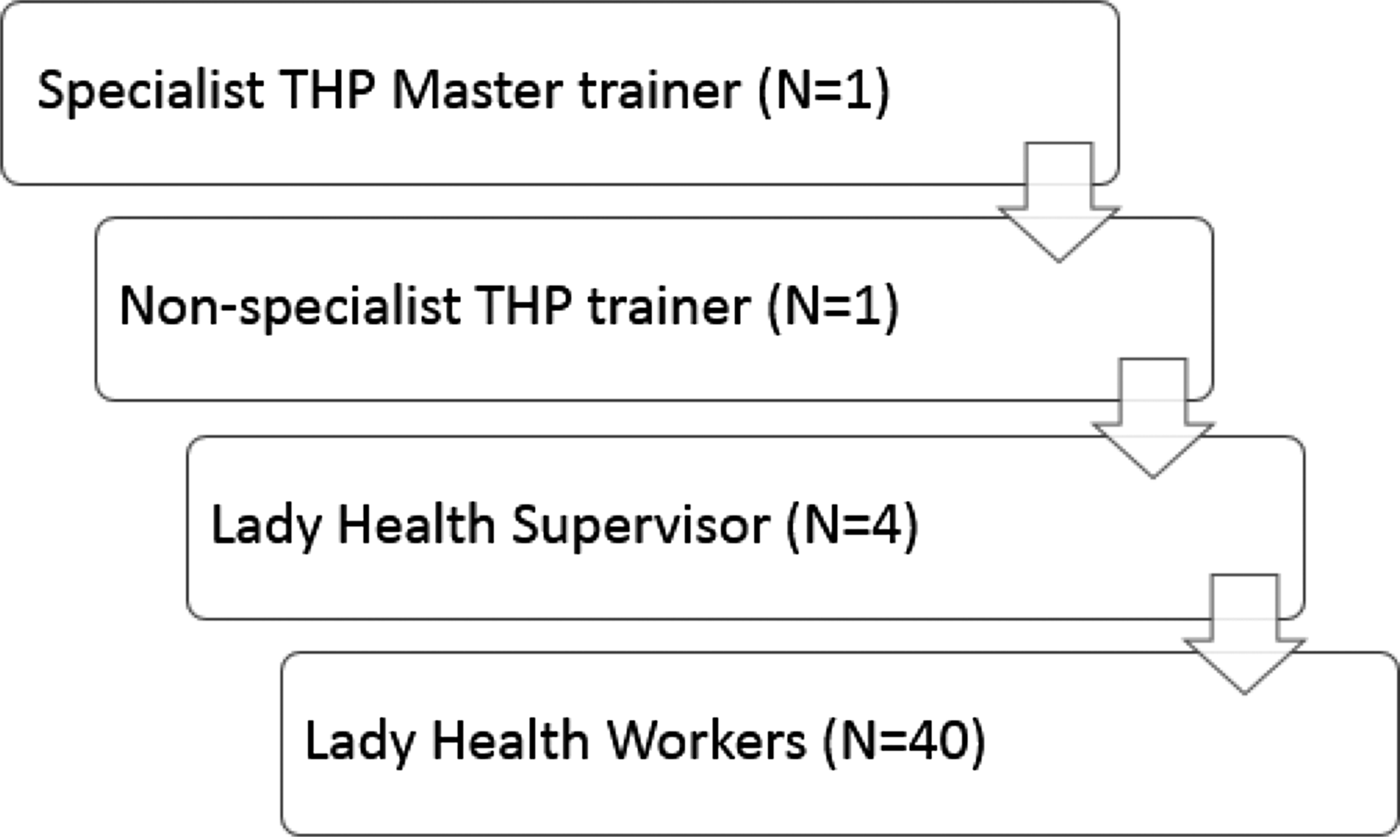
Cascaded training and supervision model in TACTS.
The study was approved by the Ethics Review Committee of the Human Development Research Foundation. All participants provided written informed consent to participate in the trial. Permission was taken from women whose households were visited for observations of routinely delivered sessions. The full trial protocol has been published previously (Zafar et al. Reference Zafar, Sikander, Hamdani, Atif, Akhtar, Nazir, Maselko and Rahman2016).
Technology-Assisted Cascaded Training and Supervision delivered to the intervention group
We adapted the original Urdu language paper version of the THP to a Technology-Assisted Cascade Training and Supervision (TACTS) system that included: (a) tablet-based application allowing standardized training to be delivered by non-specialist trainers; and (b) a cascade training/supervision model (Figure 2) where a specialist THP master trainer trained non-specialist THP trainers, who in turn trained and supervised LHSs. These LHSs then cascaded the training to the LHWs by integrating it into their routine training and supervision schedule. This cascaded model of training and supervision has been described as a feasible way of building capacity in mental health interventions at large-scale in LMICs (Murray et al. Reference Murray, Dorsey, Bolton, Jordans, Rahman, Bass and Verdeli2011).
Building on our previous work in this area (Hamdani et al. Reference Hamdani, Minhas, Iqbal and Rahman2015), we used a multimedia android-based training Application. Training materials were converted into narrative scripts in the Urdu language by a panel of THP trainers. Culturally appropriate real-life characters representing the trainers and the trainees were developed. An artist converted the characters into ‘Avatars’ (i.e. graphic images representing each character in the narrative), which were used to voice the narrative scripts. The narratives, with individual avatars representing LHWs, mothers, and key family members, were demonstrated through fictional scenarios depicting skills such as effective use of counseling, collaboration with the mothers' families, guided discovery using pictures (i.e. a style of questioning to probe mother's health beliefs), and setting health-related tasks. To enhance the learning of THP delivery skills, an option to view short videos of role plays was provided. The entire training process was interactive. The software was designed to prompt trainees to be involved in interactive activities such as commenting on the role plays, reflection on their learning, sharing of relevant experiences, and brain-storming about problem-solving strategies. These activities were designed to mimic activities conducted during face-to-face specialist-led training.
In the TACTS arm, a non-specialist THP trainer (psychology graduate, trained by specialist THP master trainer in a 5-day workshop) delivered the 20 h technology-assisted training spread over 5 days to the LHSs using the TACTS system. The LHSs then cascaded the 5-day training using the same TACTS system to 40 LHWs. The main role of the LHS facilitator was to help the LHWs navigate the App, stimulate discussion, and organize the role plays.
Supervision
The LHSs supervised the LHWs using TACTS as part of their routine monthly group supervisions at Basic Health Units. Supervision was focused on, sharing experiences to enhance motivation and problem solve as a group, rehearsing core intervention concepts via role plays and re-watching the training videos. Supervision was an integral part of promoting experiential learning following the training, and a separate module on supervision was developed for the LHSs to integrate this in their routine monthly group supervision of LHWs. This module consisted of guidelines for revising core intervention elements via role plays, reviewing the work of LHWs (case load, sessions delivered, difficulties encountered, and adverse events), sharing experiences, problem solving, and motivating LHWs.
LHSs were supervised by the non-specialist THP trainer remotely via Skype in a monthly group supervision of 2 h. LHSs discussed the challenges they faced during supervision of LHWs and difficulties they experienced in providing support and feedback to LHWs, addressed motivation and work stress, and reinforced intervention core concepts.
The non-specialist THP trainer received monthly supervision by a specialist THP master trainer for 1 h via Skype. Supervision focused on difficulties experienced in providing support and feedback to LHSs.
Conventional face-to-face training and supervision delivered to the control group
The LHWs in the control group were trained directly by specialist THP master trainers in a 5-day training program, using THP training materials (THP training manual and job aid). The specialist THP master trainers were mental health specialists – psychologists trained in CBT with an in-depth understanding of THP. During the training, trainers explained the core concepts of the intervention. Role plays were conducted to enhance LHWs' skills in counseling, family engagement, and managing challenging situations. Training was a combination of lectures, group discussions, role plays, and feedback on the role plays by the trainers and peers.
Supervision
Specialist THP master trainers provided monthly face-to-face group supervision directly to the LHWs. The average duration of a supportive supervision session was 2 h. Supervision focused on positive as well as challenging experiences of LHWs and brainstorming solutions as a group. Motivation of LHWs was ensured by sharing of success stories. Intervention content was rehearsed via role play followed by feedback from the peers and trainers.
The LHWs in both arms delivered the intervention to women in the community using the original paper-based THP manual.
Measures
The primary outcome was the competence of LHWs at 3 months post-training, measured by the ENhancing Assessment of Common Therapeutic factors (ENACT) rating scale, developed by Kohrt et al. (Reference Kohrt, Ramaiya, Rai, Bhardwaj and Jordans2015). ENACT is an 18-item scale to assess the competence of non-specialists via role plays or direct observation of a therapy session. The items are listed in Table 1. ENACT has been developed using a rigorous methodology and has shown good psychometric properties. Each item (also called a domain) is scored on a scale from 1 to 3, where 1 = needs improvement, 2 = partially done, 3 = done well. A composite score can be computed by adding all the items. The authors recommend that following training and practice sessions under supervision, a score of 80% of the total possible score represents a satisfactory level of competence. For the present study, an adapted ENACT composed of 16 items was used (excluding items 17 and 18 as these were more clinical relating to confidentiality and risk management). A score of 38 indicated the 80% level of satisfactory competence. ENACT has been used in Pakistan previously to measure the competence of health workers (Sikander et al. Reference Sikander, Lazarus, Bangash, Fuhr, Weobong, Krishna, Ahmad, Weiss, Price, Rahman and Patel2015).
Enhancing Assessment of Common Therapeutic factors (ENACT) domains and items (adapted for the Thinking Healthy Programme)

Competency assessments were conducted immediately after training (post-training assessment) and at 3 months post-training (follow-up assessment). Post-training assessment was conducted using structured role plays, while follow-up assessment was conducted through live observation by an assessor blind to the allocation status of the LHWs.
In addition to competence, we collected data on the cost from a program perspective. Data were collected on (1) direct costs associated with training of LHWs in THP using the TACTS system, and (2) information on the costs associated with the training and support of LHWs in the THP by the specialists following the conventional model. Data were also collected on the opportunity costs associated with the specialists' time. The information was gathered through semi-structured interviews with trainers covering details such as the venue of the training (the training space used), and the average number of hours worked by the specialists, LHSs, THP trainers, and LHWs. Data were collected throughout the study period. Information was also collected on the cost of developing TACTS and other related costs, e.g. communication costs, logistics costs, training material, and stationary.
Sample and power calculations
The primary outcome of the study was the mean competence scores immediately post-training and at 3 months. We defined non-inferiority as a difference of five points or less (corresponding to a 10% difference in the outcome measure score) in the mean competence score between the two groups. A sample size of 80 LHWs (40 LHWs in each arm) provided 99% power, accounting for an attrition rate of 25% at 3 months follow-up, to detect a five-point margin with a 0.05 one-sided α level.
Randomization and masking
The unit of randomization was the LHW. In all, 160 LHWs within the three Union Councils were identified. We randomly allocated 80 LHWs on a 1:1 ratio, stratified on the basis of LHS (equal number of LHWs from each supervisory zone). Randomization was conducted by an independent, off-site team member using a computer software. Allocation concealment was ensured by keeping the random assignments in sequentially numbered, opaque, sealed envelopes at the off-site center. Only outcome assessors were blind to the allocation status.
Data analysis
Quantitative data were analyzed using SPSS v21. Descriptive statistics (means and standard deviations) were computed for demographic characteristics. Mean differences in competence scores of two groups were computed using the independent sample t test.
Results
Figure 1 presents the trial profile. The mean age of the participating LHWs was 35.33 years (s.d. = 7.71) and the mean period of work experience was 12.15 (s.d. = 6.26) years. No significant differences were observed in demographic characteristics between both arms (Table 2). All the participants completed the training and post-training assessment. At primary end-point (3 months follow-up), 30 LHWs (75%) completed the assessment.
Demographic characteristics of LHWs

Results indicated no significant differences in the mean ENACT scores of the intervention and control groups at post-training (M = 24.97, s.d. = 5.95 v. M = 27.27, s.d. = 5.60, p = 0.079, CI −4.87 to 0.27). Competency scores in both groups improved at 3 months follow-up. However, no significant differences were observed in control and intervention arm scores at 3 months follow-up (M = 44.48, s.d. = 3.97 v. M = 43.63, s.d. = 6.34, p = 0.53, CI −1.88 to 3.59). The results are summarized in Table 3. Twenty-seven out of 30 (67.5%) LHWs in TACTS arm and 28 out of 30 (70%) LHWs in conventional arm achieved competence (score above 80%) at follow-up assessment.
Mean differences in primary outcome scores (competence) at post-training and 3 months post-training

Training costs
We found that the cost of training and supervision was 17648 PKR (USD 170) in the conventional training arm and 12195 PKR (USD 117) in the TACTS arm per LHWFootnote 1Footnote †. The technology-assisted training was about 30% less expensive than the specialist-led training and supervision, yet competence levels achieved were similar.
Discussion
This study evaluated conventional specialist-delivered face-to-face training of an evidence-based intervention for perinatal depression v. technology-assisted training by routine supervisors to LHWs in a post-conflict area of Pakistan. The results showed that similar levels of competence were achieved in both arms at post-training and 3 months follow-up, while the costs of THP-TACTS were 30% less than the specialist-led training and supervision.
The competency of LHWs improved in both arms over time with practice under monthly supportive supervision. This indicates that experiential learning and supportive supervision are crucial for such interventions. This also indicates that training and supervision with TACTS was effective in improving LHWs' skills, without the need for a specialist supervisor. Considering the lack of mental health specialists in resource-poor settings, this cascaded training and supervision, integrated within the healthcare system, could be a potential way to ensure delivery of psychological interventions with quality. Moreover, TACTS was found to be cheaper than the conventional training.
Technologies have been used in training health workers for different health conditions in LMICs. These include the use of mobile phone-assisted training health of workers in care of HIV (Zolfo et al. Reference Zolfo, Iglesias, Kiyan, Echevarria, Fucay, Llacsahuanga, de Waard, Suàrez, Llaque and Lynen2010), identification of breast cancer (Alipour et al. Reference Alipour, Jannat and Hosseini2014), antenatal (Palazuelos et al. Reference Palazuelos, Diallo, Palazuelos, Carlile, Payne and Franke2013), and neonatal care (Lund et al. Reference Lund, Boas, Bedesa, Fekede, Nielsen and Sørensen2016). Few studies demonstrate the use and effectiveness of such technologies for training health workers in delivering mental health interventions, especially for a common mental disorder. One such example is the proof of concept study in the UK where Fairburn et al. (Reference Fairburn, Allen, Bailey-Straebler, O'Connor and Cooper2017) conducted web-based 9 h CBT training of 102 therapists for eating disorders and found 42.5% scored above the competence scores immediately after training. Similarly, another study compared supported training (assisted by a trainer) and independent web-based CBT training of 8–9 h for eating disorders. No significant differences were found between both groups at post-training and almost half (48%) therapists met the threshold of competence at 6 months post-training (Cooper et al. Reference Cooper, Bailey-Straebler, Morgan, O'Connor, Caddy, Hamadi and Fairburn2017). In Brazil, Pereira et al. (Reference Pereira, Wen, Miguel and Polanczyk2015a) evaluated a web-based program to educate primary school teachers about childhood mental disorders and found that teachers in the web-based program had greater improvement in knowledge and understanding about mental disorders as compared to control groups. A pre-post study evaluated of an online course to enhance health professionals' knowledge about the clinical management of alcohol misuse in Brazil demonstrated significant improvement in knowledge about the clinical management of alcohol-related problems (Pereira et al. Reference Pereira, Wen and Tavares2015b). Hamdani et al. (Reference Hamdani, Minhas, Iqbal and Rahman2015) tested the effectiveness of training lay individuals (volunteer family members of children with developmental disorders) in behavioral management skills in rural Pakistan, and found technology-assisted training feasible and effective in improving outcomes of children with developmental disorders. Our findings are consistent with and add to this growing evidence in support of technological enhancements to training for mental health interventions.
Most studies have used online platforms for training health workers. One limitation of this approach is the requirement of a stable Internet connection that may not be available in remote, rural, resource-poor settings particularly in conflict-affected settings. TACTS employs an offline tablet-based application that can enhance the feasibility of this approach. Other risks of over-reliance on technology include the loss of human social contact, invasion of privacy and confidentiality, coercion or discrimination through tracking of individuals with mental health conditions (Patel et al. Reference Patel, Saxena, Lund, Thornicroft, Baingana, Bolton, Chisholm, Collins, Cooper, Eaton, Herrman, Herzallah, Huang, Jordans, Kleinman, Medina-Mora, Morgan, Niaz, Omigbodun, Prince, Rahman, Saraceno, Sarkar, De Silva, Singh, Stein, Sunkel and Unützer2018). Sound policies to regulate the use of technologies, as well as making these widely available even to the most marginalized communities, can circumvent these issues.
Two-thirds of the world's population now owns a mobile phone, half of which are smart phones. Mobile phones also contribute to half of the global Internet traffic. Even in many LMICs in south Asia, Africa, and Central America, mobile phone subscriptions exceed 80% of the population. Internet access is also increasing but varies from region to region, ranging from 34% in Africa to 80% in Europe. Reports indicate that there is an annual 4% increase in mobile phones subscriptions and 7% increase in Internet usage globally. This huge penetration of digital technology, even in the world's most impoverished areas, provide great opportunities to harness the power of the technology to overcome barriers and bridge the treatment gap for mental health problems. As technology becomes cheaper and more accessible, such approaches can be further refined so that immediate care is made accessible to prevent the sequelae of traumatic stress, anxiety, and depression as such communities rebuild.
This study has some limitations. It was conducted in a small but hard to reach area of conflict-affected Pakistan. We were unable to follow 25% of the sample at 3 months follow-up. However, we anticipated this keeping in view the context and accounted for this attrition in sample calculations. Longer term evaluation of LHWs' competencies was not carried out to assess the ability of TACTS in maintaining their levels of competency. Critically, our study did not evaluate the outcomes of intervention delivery to the target population. Future studies in larger populations, using a variety of health care providers and measuring clinical outcomes in patients, can furnish further evidence about the generalizability and effectiveness of the training.
Conclusion
This study suggests that technology can be successfully used to train health workers in hard to reach areas such as post-conflict settings. Scalability of evidence-based interventions in such areas is not feasible with the conventional intense specialist-led face-to-face training and supervision model. Technology-assisted training by non-specialists is equally effective and less costly than the conventional methods of training and supervision. Hence, technology can be a feasible, scalable, cost-effective, and sustainable strategy to train and supervise lay health workers in low-resource settings.
Acknowledgements
We are thankful to the Provincial and District Lady Health Workers Programme, KPK, particularly Dr Fahim Khan, Mr Khalid Khan, Mr Zahid Noor, Dr Said Khan, and Dr Zeshan Khan for their support in the implementation of the program. The study was funded by Grand Challenges, Canada (GCC # 0596-04) Government of Canada, under the Global Mental Health initiative.
Author contributions
PA, SS, and SUH wrote the first draft of the manuscript. JM and PA analyzed the data. NA, HN, IU, JM, AR, and SZ contributed to the writing of the manuscript. PA, SS, SUH, NA, HN, IU, AN, ZH, JM, AR, and SZ read and met the ICMJE criteria for authorship. PA, SS, SUH, NA, HN, ID, AN, ZH, JM, AR, and SZ agree with the manuscript results and conclusions. AR, SS, and SUH conceived and designed the study.
Declaration of Interest
The authors declare that they have no conflict of interest.


 Open access

