


Impact statement
Hydrometeorological extreme events, that is, floods and droughts, have major impacts on ecosystems and sectoral water uses such as shipping, agriculture, industry, energy, and drinking water. From looking back on a selection of historical events in the Netherlands, we learn that significant changes in policy and measures have been implemented in response to extreme hydrological events, especially with regards to floods. However, from recent extreme drought (2018–2020, 2022) and flood conditions (2021) and future climate projections, it has become clear that optimization of the current water management system will not suffice. A transformation is needed to deal with future hydrological extremes, requiring modifications in water system, water management, water use, and governance. We need to design, manage, and use the water system in a way that resilience to both floods and droughts is increased. This requires methods and tools to stress-test the system for both extremes, and knowledge of measures that reduce both risks. In regional adaptation strategies, the full flood–drought spectrum should be managed in a balanced way. A transformation of the current water system and water management will not always and at all locations be beneficial for all sectors. Stakeholder interactions are needed for just and equitable transitions and for translating long-term visions into concrete pathways for action.
Introduction
The European summers of 2018, 2019, and 2020 were characterized by low precipitation and high temperatures, which caused large-scale and intense droughts (Philip et al., Reference Philip, Kew, van der Wiel, Wanders and van Oldenborgh2020; Zscheischler and Fischer, Reference Zscheischler and Fischer2020; Turner et al., Reference Turner, Barker, Hannaford, Muchan, Parry and Sefton2021). These events, by some sectors felt as one multi-year drought, set a new benchmark in Europe (Rakovec et al., Reference Rakovec, Samaniego, Hari, Markonis, Moravec, Thober, Hanel and Kumar2022), and sparked societal and scientific interest in the nature of drought and event-specific climate projections (van der Wiel et al., Reference van der Wiel, Lenderink and de Vries2021, Reference van der Wiel, Batelaan and Wanders2022; Aalbers et al., Reference Aalbers, van Meijgaard, Lenderink, de Vries and van den Hurk2022; Blauhut et al., Reference Blauhut, Stoelzle, Ahopelto, Brunner, Teutschbein, Wendt, Akstinas, Bakke, Barker, Bartošová, Briede, Cammalleri, Kalin, De Stefano, Fendeková, Finger, Huysmans, Ivanov, Jaagus, Jakubínský, Krakovska, Laaha, Lakatos, Manevski, Neumann Andersen, Nikolova, Osuch, van Oel, Radeva, Romanowicz, Toth, Trnka, Urošev, Urquijo Reguera, Sauquet, Stevkov, Tallaksen, Trofimova, Van Loon, van Vliet, Vidal, Wanders, Werner, Willems and Živković2022; Gessner et al., Reference Gessner, Fischer, Beyerle and Knutti2022). With these droughts on our minds, the contrast to the 2021 summer floods in the Ahr, Erft, Meuse, and its tributaries in Belgium, Germany, and the Netherlands was large. These floods were caused by 2 days of extreme rainfall on hilly terrain and led to more than 200 fatalities and severe infrastructural damage (Kreienkamp et al., Reference Kreienkamp, Philip, Tradowsky, Kew, Lorenz, Arrighi, Belleflamme, Bettmann, Caluwaerts and Chan2021; Faranda et al., Reference Faranda, Bourdin, Ginesta, Krouma, Noyelle, Pons, Yiou and Messori2022; Lehmkuhl et al., Reference Lehmkuhl, Schüttrumpf, Schwarzbauer, Brüll, Dietze, Letmathe, Völker and Hollert2022). This string of very impactful hydrometeorological events, on both sides of the flood–drought spectrum, reminded policymakers and citizens that climate change is a reality and that increases in both droughts and floods require a shift in water management solutions. Additionally, climate change projections for the region (KNMI, 2021; Masson-Delmotte et al., Reference Masson-Delmotte, Zhai, Pirani, Connors, Péan, Berger, Caud, Chen, Goldfarb and Gomis2021) show strong decreases in mean summer precipitation, increasing winter precipitation, increased rainfall variability, more intense drought events (Cook et al., Reference Cook, Mankin, Marvel, Williams, Smerdon and Anchukaitis2020; Ukkola et al., Reference Ukkola, De Kauwe, Roderick, Abramowitz and Pitman2020), and more intense short convective rainfall events (Fowler et al., Reference Fowler, Lenderink, Prein, Westra, Allan, Ban, Barbero, Berg, Blenkinsop, Do, Guerreiro, Haerter, Kendon, Lewis, Schaer, Sharma, Villarini, Wasko and Zhang2021). This shows that a more anticipatory and adaptive approach to water management will be needed to, on the one hand, prepare for short-term climate-related shocks and, on the other hand, continuously evaluate long-term water management practices.
Hydrometeorological extreme events have major impacts on both terrestrial and aquatic ecosystems (Bartholomeus et al., Reference Bartholomeus, Witte, van Bodegom, van Dam and Aerts2011; Witte et al., Reference Witte, Runhaar, van Ek, van der Hoek, Bartholomeus, Batelaan, van Bodegom, Wassen and van der Zee2012; Reyer et al., Reference Reyer, Leuzinger, Rammig, Wolf, Bartholomeus, Bonfante, de Lorenzi, Dury, Gloning, Abou Jaoudé, Klein, Kuster, Martins, Niedrist, Riccardi, Wohlfahrt, de Angelis, de Dato, François, Menzel and Pereira2013; Kløve et al., Reference Kløve, Ala-Aho, Bertrand, Gurdak, Kupfersberger, Kværner, Muotka, Mykrä, Preda, Rossi, Uvo, Velasco and Pulido-Velazquez2014), infrastructure (Vardon, Reference Vardon2015), buildings (Sanders and Phillipson, Reference Sanders and Phillipson2003), greenhouse gas emissions (Stirling et al., Reference Stirling, Fitzpatrick and Mosley2020) as well as multiple sectoral water uses (Wlostowski et al., Reference Wlostowski, Jennings, Bash, Burkhardt, Wobus and Aggett2022). For instance, shipping is hampered by low water levels (Christodoulou et al., Reference Christodoulou, Christidis and Bisselink2020; Vinke et al., Reference Vinke, van Koningsveld, van Dorsser, Baart, van Gelder and Vellinga2022). Agricultural production is reduced under too wet or dry conditions or due to high salinity (Kroes and Supit, Reference Kroes and Supit2011; Hack-ten Broeke et al., Reference Hack-ten Broeke, Kroes, Bartholomeus, van Dam, de Wit, Supit, Walvoort, van Bakel and Ruijtenberg2016; Harkness et al., Reference Harkness, Semenov, Areal, Senapati, Trnka, Balek and Bishop2020; Shahzad et al., Reference Shahzad, Ullah, Dar, Sardar, Mehmood, Tufail, Shakoor and Haris2021; de Wit et al., Reference de Wit, Ritsema, van Dam, van den Eertwegh and Bartholomeus2022). Industrial and energy water uses are constrained due to low (summer) flow and increased water temperature under droughts and heatwaves (van Vliet et al., Reference van Vliet, Vögele and Rübbelke2013; Behrens et al., Reference Behrens, van Vliet, Nanninga, Walsh and Rodrigues2017; Tobin et al., Reference Tobin, Greuell, Jerez, Ludwig, Vautard, van Vliet and Bréon2018; Moazami et al., Reference Moazami, Nik, Carlucci and Geving2019). The drinking water sector is challenged by higher water demands during warm summers, increased salinization, and higher concentrations of various chemicals (Delpla et al., Reference Delpla, Jung, Baures, Clement and Thomas2009; Bonte and Zwolsman, Reference Bonte and Zwolsman2010; Koop and van Leeuwen, Reference Koop and van Leeuwen2017; Sjerps et al., Reference Sjerps, ter Laak and Zwolsman2017; Garnier and Holman, Reference Garnier and Holman2019; van den Brink et al., Reference van den Brink, Huismans, Blaas and Zwolsman2019; Wolff and van Vliet, Reference Wolff and van Vliet2021). Also, floods affect drinking water supply, by deteriorating water quality and destroying water supply infrastructure (Khan et al., Reference Khan, Deere, Leusch, Humpage, Jenkins and Cunliffe2015). Overall, sectors depend on both sufficient water availability and suitable water quality (Lissner et al., Reference Lissner, Sullivan, Reusser and Kropp2014; van Vliet et al., Reference van Vliet, Flörke and Wada2017). When sectoral water demands are not met, this can have major economic impacts (Naumann et al., Reference Naumann, Cammalleri, Mentaschi and Feyen2021).
In this short review, we provide our perspective on how the Netherlands and other countries in river deltas could manage water across the flood–drought spectrum for the next century, both from a water management and water governance perspective. Many countries in river deltas are highly engineered and managed (Renaud et al., Reference Renaud, Syvitski, Sebesvari, Werners, Kremer, Kuenzer, Ramesh, Jeuken and Friedrich2013); the Netherlands is no exception. These countries are densely populated and have intensive agriculture. Because of their location, river delta countries strongly depend on water management and activities in upstream-located countries.
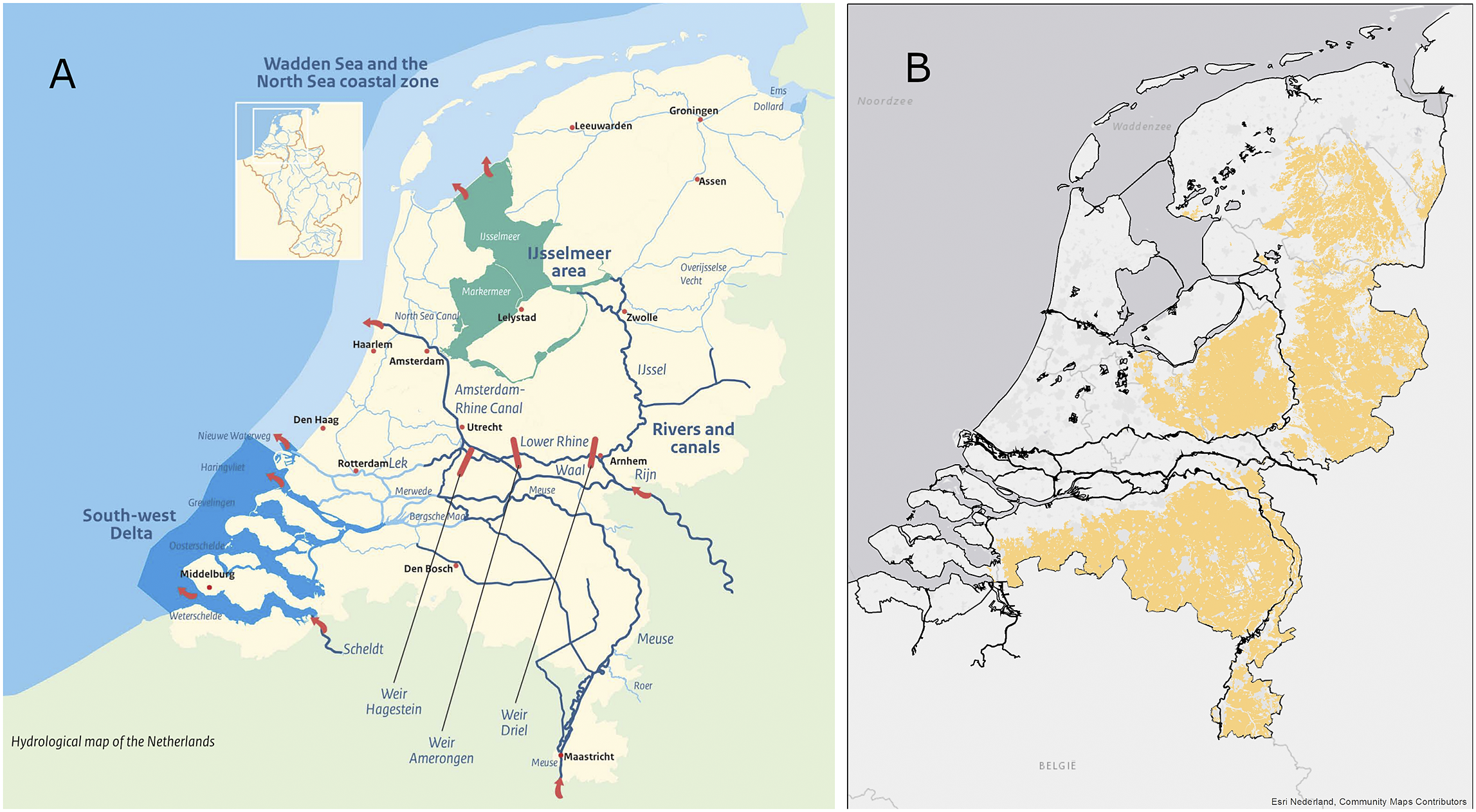
Traditionally, water managers and water utilities in the Netherlands focus on preventing floods, whereas they will also need to anticipate drought (Kabat et al., Reference Kabat, van Vierssen, Veraart, Vellinga and Aerts2005; Philip et al., Reference Philip, Kew, van der Wiel, Wanders and van Oldenborgh2020; Pronk et al., Reference Pronk, Stofberg, Van Dooren, Dingemans, Frijns, Koeman-Stein, Smeets and Bartholomeus2021; Brakkee et al., Reference Brakkee, van Huijgevoort and Bartholomeus2022; Brockhoff et al., Reference Brockhoff, Biesbroek and Van der Bolt2022; Mens et al., Reference Mens, van Rhee, Schasfoort and Kielen2022). The Netherlands is a low-lying country, partly below sea level, in the delta of the rivers Rhine and Meuse (Figure 1A). Low-lying regions face challenges such as soil subsidence and salinization (Querner et al., Reference Querner, Jansen, van den Akker and Kwakernaak2012; Raats, Reference Raats2015). However, there are also free-draining regions in the east and south of the Netherlands (Figure 1B) where droughts impact water availability for nature, agriculture, industry, and drinking water supply (Hendriks et al., Reference Hendriks, Kuijper and van Ek2014).
Hydrological map of the Netherlands (adapted from Rijkswaterstaat (2019)), including main rivers Rhine and Meuse (see inset), the IJsselmeer area (green) and the South-west Delta (dark blue). B. Free-draining higher grounds in the east and south (orange) and water-level regulated areas in the western and northern part of the country (adapted from de Wit et al. (Reference de Wit, Ritsema, van Dam, van den Eertwegh and Bartholomeus2022), CC BY 4.0).
We will first provide an overview of selected events across the flood–drought spectrum in the Netherlands over the last century that led to significant adaptation measures and associated governance arrangements. We then provide insight into recent (2018 onwards) and future drought and flood events and associated water management implications. Based on this exploration of historical events and future extremes, we provide our perspective on future water management and water governance across the flood–drought spectrum for deltas like the Netherlands.
Floods and droughts in the Netherlands
Policy-shaping events leading to the current water (governance) system
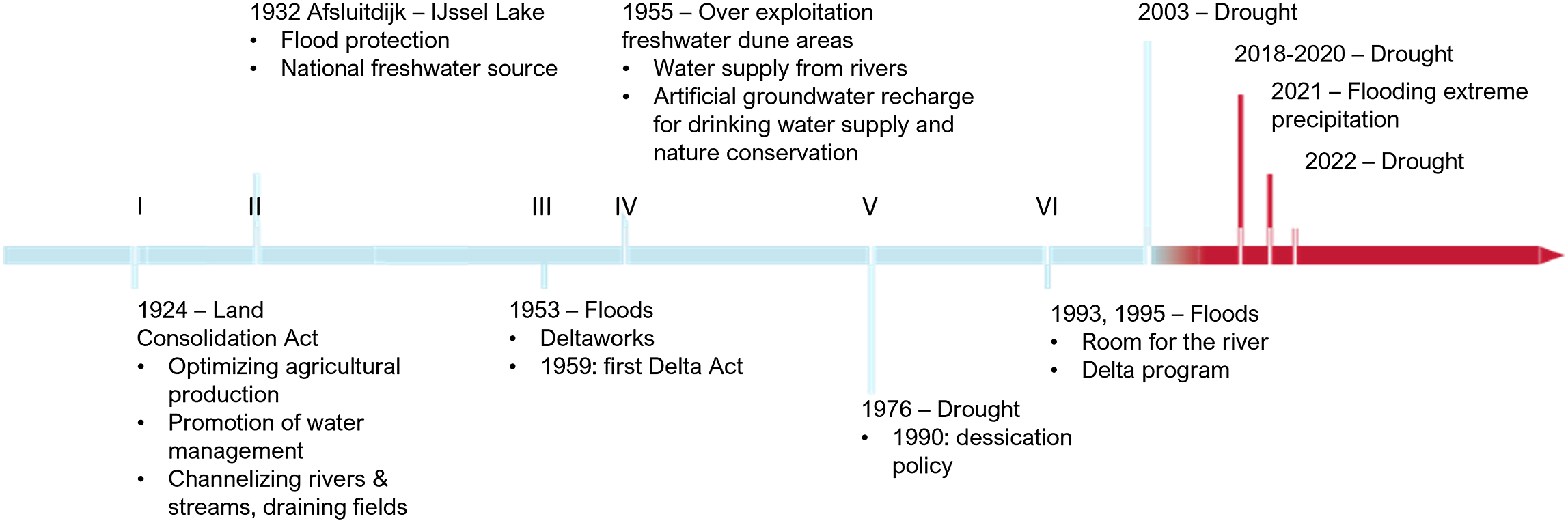
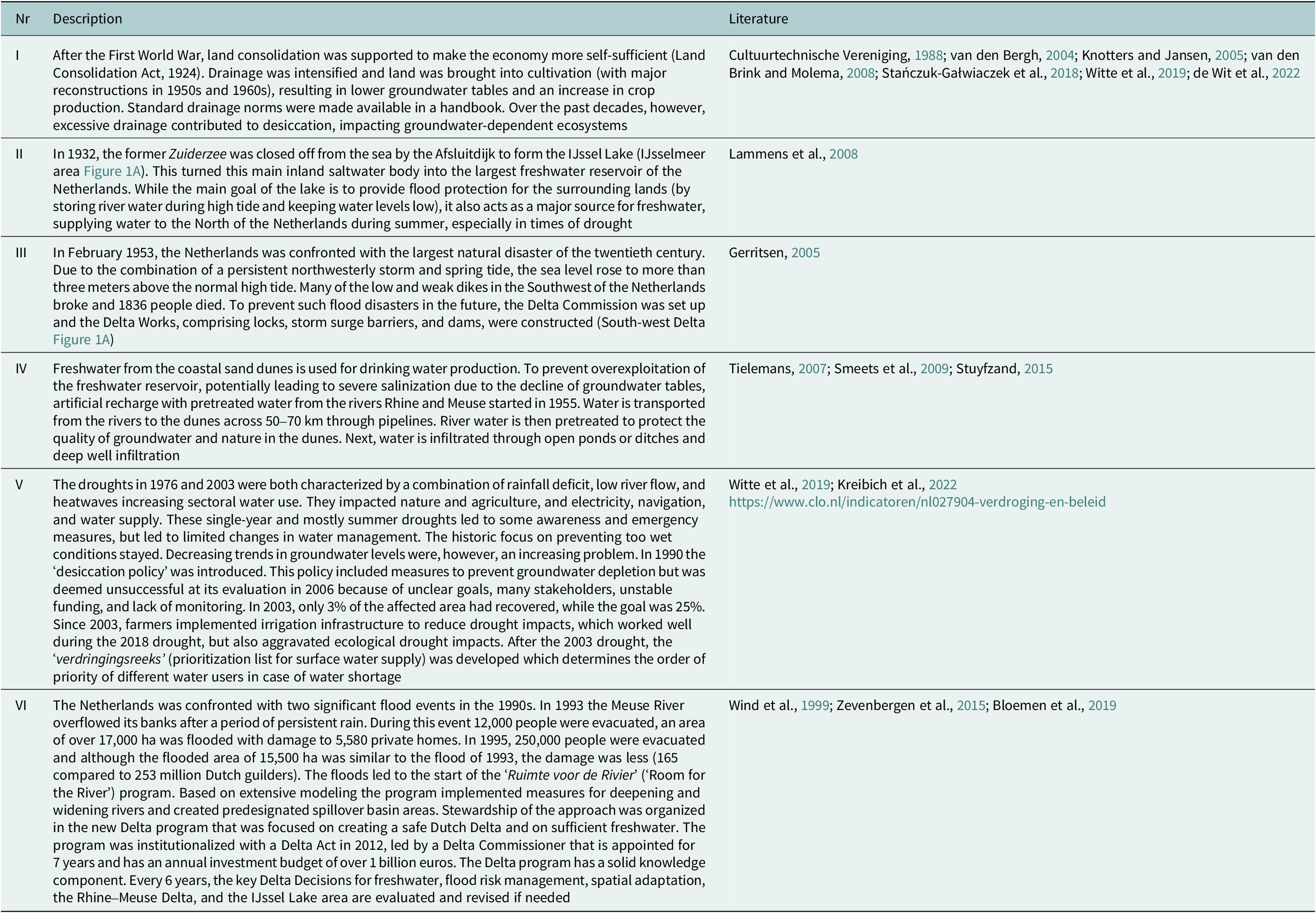
Over the last century, several extreme hydrological events and transformative changes in Dutch water management and water governance occurred. A historical, but not exhaustive, timeline of important events and changes is displayed in Figure 2 and Table 1. First of all, the overview shows that wet (e.g., 1953 flood, Table 1, III) and dry (e.g., drought of 1976, Table 1, V) extremes are not new. For some events, impacts led to the implementation of effective technological measures (e.g., pretreatment and infiltration of river water in dune areas for drinking water production, Table 1, IV) or new governance arrangements (e.g., the Dutch Delta program to prevent floods and safeguard freshwater supply, Table 1, VI).
Timeline of selected events of both wet and dry extremes in the Netherlands over the last century and, where applicable, important management or governance changes. The events are further described in Table 1.
Description of the events mentioned in Figure 2
Important to note is that measures can contribute to the adaptation to both extremes (reduce flood risk and drought risk). The Dutch water management system shows many examples where the system is optimized for the combination of flood protection and freshwater supply, although often with negative ecological consequences. For example, the IJssel Lake (IJsselmeer Area, Figure 1A) is controlled on lower water levels in winter and higher water levels during summer, the opposite of natural water level dynamics for freshwater ecosystems. Similarly, in the low-lying part of the Netherlands, the (ground)water levels are highly controlled, to both avoid flooding in winter and water level decline in summer. One reason for the latter is that peat dikes could dry out and fail, as happened in 2003 (e.g., Bottema et al., Reference Bottema, Gunn, Haastrecht, Vonk and Hemert2021). In fact, the main reason to supply water to low-lying areas during summer is to reduce peat oxidation, to reduce both subsidence and greenhouse gas emissions in view of the climate mitigation goals. Adaptation measures to one extreme could, however, also increase the hazard or vulnerability of the extreme at the other side of the spectrum. An example is the dense drainage system to provide optimal farming conditions in the free-draining higher areas (Figure 1B). The drainage system, designed based on extensive drainage research (Feddes, Reference Feddes1988), discharges water quickly, lowering groundwater levels in early spring and reducing waterlogging, which extends the growing season. The lower groundwater levels increase the impact of drought on, for example, agriculture and nature. Additionally, when cost-effective, farmers use groundwater for irrigation to overcome drought events later in summer (van Oort et al., Reference van Oort, Timmermans, Schils and van Eekeren2023), resulting in a further decline of groundwater levels. Adaptation measures, like drainage and irrigation, could thus contribute to desiccation of groundwater-dependent ecosystems.
Adaptation measures were especially successful in the prevention of floods and to deal with extreme precipitation events. Neither the occurrence of droughts in previous decades nor the measures to deal with droughts led to comparable significant changes in water management. The bias toward adaptation measures on the wet spectrum of the extremes, makes the Netherlands more vulnerable to the amplifying dry extremes experienced from 2018 onwards. As described in the introduction: these might be the benchmark for future conditions.
Amplifying hydrometeorological risks: Hydrological effects, management, and policy actions of recent extreme events
The summers of 2018–2020 were characterized by extreme drought conditions that challenged the Dutch water management. While the events are considered rare in the current climate, it is expected that future climate change will make similar events more frequent and intense (Philip et al., Reference Philip, Kew, van der Wiel, Wanders and van Oldenborgh2020; KNMI, 2021; van der Wiel et al., Reference van der Wiel, Lenderink and de Vries2021; Aalbers et al., Reference Aalbers, van Meijgaard, Lenderink, de Vries and van den Hurk2022). In addition, there is an increased probability that drought events will become multi-year events (van der Wiel et al., Reference van der Wiel, Batelaan and Wanders2022). Following these events, there was an increase in drought-related policy actions with several committees and reports focused on combating drought impacts. Most noticeable is the ‘Drought Policy Table’, which evaluated drought impacts and formulated knowledge questions and policy actions following the 2018 event (Ministry of Infrastructure and Environment and Ministry of Economic Affairs and Climate Policy, 2019).
In July 2021, an extreme river flood event occurred in the regions Ardennes, Eifel, and Limburg at the border of the Netherlands, Germany, and Belgium when the Ahr, Erft, and Meuse rivers and several tributaries flooded after a period of intense rainfall. It was extreme because of the large precipitation amounts over a large area, but also because of the timing of the flood, which occurred during the summer low flow season. More than 200 people died and critical infrastructure like roads and electricity transmission network was seriously damaged. Because the event exceeded the (regional) flood protection standards, Dutch citizens became more aware of their vulnerability to extreme events. A governmental evaluation committee (Ministry of Infrastructure and Water Management, 2022) concluded that extreme events cannot be avoided entirely, and measures like land use change is needed to reduce flood impacts. It also led to a debate on which measures could reduce peak flows as well as increase groundwater storage to deal with drought. Vice versa, the question arose whether recent drought measures may have intensified the summer flood. Furthermore, the floods of 2021 called for an improved and better-aligned transnational approach of river flooding and river management (Lehmkuhl et al., Reference Lehmkuhl, Schüttrumpf, Schwarzbauer, Brüll, Dietze, Letmathe, Völker and Hollert2022) and more focus on regional small rivers that are not protected by dikes. Additionally, it is important to mention that the Meuse river itself did not flood – a success story of the flood policy program ‘Room for the River’.
In 2022, Europe was hit again by a severe drought episode with significant impacts across the region, mostly related to low river levels. The low flows during this drought had a significant impact on shipping and the energy sector. Low river levels resulted in insufficient cooling water for (nuclear) power plants in parts of Europe and constraints in the provision of some coal-fired power plants due to low water levels. For most of Europe, climate change will further decrease these low flows (Marx et al., Reference Marx, Kumar, Thober, Rakovec, Wanders, Zink, Wood, Pan, Sheffield and Samaniego2018), and as a result, the vulnerable infrastructure will be further under pressure. While this can be partly managed by improved water management, there are limitations to physical water management measures in rainfed rivers where long periods of below-average precipitation will always result in drought. The drought event of 2022 also severely impacted agriculture and ecology and caused an increase in salinity levels of surface water in the western part of the Netherlands. The severity of the impact of this drought was also related to the perception of drought as a risk for society (Blauhut et al., Reference Blauhut, Stoelzle, Ahopelto, Brunner, Teutschbein, Wendt, Akstinas, Bakke, Barker, Bartošová, Briede, Cammalleri, Kalin, De Stefano, Fendeková, Finger, Huysmans, Ivanov, Jaagus, Jakubínský, Krakovska, Laaha, Lakatos, Manevski, Neumann Andersen, Nikolova, Osuch, van Oel, Radeva, Romanowicz, Toth, Trnka, Urošev, Urquijo Reguera, Sauquet, Stevkov, Tallaksen, Trofimova, Van Loon, van Vliet, Vidal, Wanders, Werner, Willems and Živković2022).
In November 2022, the new policy ‘Water and soil leading in land use planning’ was announced (Ministerie van Infrastructuur en Waterstaat, Reference Haag2022), an approach to make considerations about soil and water quality and availability more prominent within spatial planning. Instead of adapting land and water management to the preferred uses, the use should be adapted to the (semi-)natural land and water conditions, with the aim of making the country more resilient against hydrological extremes. This means, for example, no water-intensive farming in regions with a limited water supply and no new building activities in areas where flood prevention is too expensive or that are needed for water retention. This is a paradigm shift toward a more nature-based water management. This vision is also supported by the National Delta program that calls for a shift from ‘water management follows land use’ to ‘land use follows natural water availability’ and that pushes a ‘water transition’. This transition calls for a significant redesign of the land use-water system to provide a higher synergy between land and water in relation to water use: a (semi-)natural water system that can cope with drought and provide sufficient water of good quality. The water transition is further stimulated by ongoing policies like the national program for the Dutch rural areas (‘Nationaal Programma Landelijk Gebied (NPLG)’). A crucial role in realizing the shift from water follows land use to land use and water demand follows water availability is reserved for local and regional integral spatial planning processes (‘Gebiedsprocessen’). Because the water transition is intertwined with other sustainability challenges such as nitrogen pollution and biodiversity loss, a regional integrated approach toward these issues is vital for connecting different policy objectives and for building support for rural transitions.
Besides increased focus on ‘water and soil leading in land use planning’, there is continuous development in technological solutions to increase freshwater availability or reduce freshwater use. Especially in the coastal zone, subsurface technologies are being explored to increase freshwater storage in the brackish subsurface (e.g., Zuurbier et al., Reference Zuurbier, Raat, Paalman, Oosterhof and Stuyfzand2017). More recently, a pilot study started in which the exploitation of brackish water for drinking water production is being investigated (https://www.dunea.nl/algemeen/life-freshman). In the urban environment, new ‘blue–green infrastructure’ deals with multiple stresses and contributes to climate adaptation (Voskamp and Van de Ven, Reference Voskamp and Van de Ven2015). Blue–green roofs, for example, contribute to flood prevention, water storage, and cooling (Cirkel et al., Reference Cirkel, Voortman, van Veen and Bartholomeus2018; Busker et al., Reference Busker, de Moel, Haer, Schmeits, van den Hurk, Myers, Cirkel and Aerts2022). Rainwater ordinances are being introduced by multiple municipalities, like in Amsterdam where it builds upon the local climate adaptation network Amsterdam Rainproof (Willems and Giezen, Reference Willems and Giezen2022). Additionally, ‘water in the circular economy’ (Morseletto et al., Reference Morseletto, Mooren and Munaretto2022) and cross-sectoral approaches that integrate the municipal water cycle and natural water system get more and more attention. For example, the exploitation of unconventional water resources, that is, other than groundwater or surface water, like treated wastewater from industrial or domestic origin is currently being explored (Rietveld et al., Reference Rietveld, Norton-Brandão, Shang, van Agtmaal and van Lier2011; Dingemans et al., Reference Dingemans, Smeets, Medema, Frijns, Raat, Wezel and Bartholomeus2020; Narain-Ford et al., Reference Narain-Ford, Bartholomeus, Raterman, van Zaanen, ter Laak, van Wezel and Dekker2020; Pronk et al., Reference Pronk, Stofberg, Van Dooren, Dingemans, Frijns, Koeman-Stein, Smeets and Bartholomeus2021; Narain-Ford et al., Reference Narain-Ford, van Wezel, Helmus, Dekker and Bartholomeus2022). Especially for drought management, the Netherlands could build upon experiences in other countries, like Spain and England, which require water boards and water supply companies to have drought management plans (Estrela and Sancho, Reference Estrela and Sancho2016; Wendt et al., Reference Wendt, Bloomfield, Van Loon, Garcia, Heudorfer, Larsen and Hannah2021). Current scientific development in the field of drought and flood evaluates these extreme events in a more holistic way. For example, flood and drought impacts are analyzed using a risk framework, considering not only the hazard but also exposure and vulnerability, and impacts are evaluated in a multi-hazard and multi-sector approach (Ward et al., Reference Ward, Daniell, Duncan, Dunne, Hananel, Hochrainer-Stigler, Tijssen, Torresan, Ciurean, Gill, Sillmann, Couasnon, Koks, Padrón-Fumero, Tatman, Tronstad Lund, Adesiyun, Aerts, Alabaster, Bulder, Campillo Torres, Critto, Hernández-Martín, Machado, Mysiak, Orth, Palomino Antolín, Petrescu, Reichstein, Tiggeloven, Van Loon, Vuong Pham and de Ruiter2022). The dynamic adaptive policy pathways (DAPP) method (Haasnoot et al., Reference Haasnoot, Warren, Kwakkel, Marchau, Walker, Bloemen and Popper2019) has been developed to support decision-making under uncertain change, mainly regarding sea level rise but also has value for water management in general. And on a higher level, policymakers in the Netherlands are following these scientific developments in dedicated science-policy fora, such as the Expert Network on Freshwater and Drought (‘Expertisenetwerk Zoetwater and Droogte’), coordinated by the Ministry of Infrastructure and Water, and asked to provide scientific answers to policy questions.
Finally, with regard to water quality the Netherlands will also face an issue: in 2027 it will need to meet the water quality requirements of the EU water framework directive (WFD). It is currently expected that the Netherlands will not be able to meet these goals, amongst others due to nitrate pollution by the agricultural sector (Wuijts et al., Reference Wuijts, Van Rijswick, Driessen and Runhaar2023). The water transition will require more fundamental choices and transformative changes to existing land use and water systems and a change of governmental policies (Wuijts et al., Reference Wuijts, Van Rijswick, Driessen and Runhaar2023).
Conclusions and future perspective
From the mentioned expected impacts of climate change and increases in hydroclimatic extremes, it becomes clear that a water management transition is needed to better deal with both flood and drought risks. Such a transition will require modifications in water management and governance (Albrecht and Hartmann, Reference Albrecht and Hartmann2021).
The selection of historical events shows that both flooding and drought have occurred in the Netherlands and will continue to occur, causing significant impacts and challenges for water management. From looking back in history, we learn that significant changes in policy and measures have been implemented in response to extreme hydrometeorological events, especially with regards to floods. The past shows that the Netherlands has been able to develop transformative responses (Afsluitdijk, Delta Works, Room for the River) to events such as the 1953 disaster and the river floods in 1993 and 1995. Policies to deal with periods of drought were successful in some cases. The IJssel Lake now serves as an important freshwater reservoir for all freshwater users and surface water can be actively transported to large parts of the country. And for specific sectors, such as drinking water supply, large-scale technological measures were taken (e.g., using infiltration), resulting in successful recovery of the freshwater supply. However, where groundwater management is involved and where functions and interests are more closely intertwined, effective management and governance arrangements seemed to be more difficult, especially because specific sectors, for example, agriculture, were served. For example, the structural lowering of groundwater levels led to desiccation of groundwater-dependent ecosystems and increased soil subsidence. This makes multiple sectors more vulnerable to drought, as was visible in the drought of 2018–2020. Only after the extreme drought of 2018–2020 and flood of 2021, the Dutch government developed a vision to stimulate that water and soil become a more dominant factor in spatial planning.
Developing long-term visions for regions to reduce the exposure and vulnerability to floods and droughts can help to rethink the existing water management system. However, such a vision is challenging as droughts and floods act on different time scales: a flood is a typical acute crisis whereas a drought is a creeping hazard (Boin et al., Reference Boin, Ekengren and Rhinard2020). Besides these different timescales, measures implemented to minimize flood impacts often influence drought risk, and vice versa (Ward et al., Reference Ward, de Ruiter, Mård, Schröter, Van Loon, Veldkamp, von Uexkull, Wanders, AghaKouchak, Arnbjerg-Nielsen, Capewell, Carmen Llasat, Day, Dewals, Di Baldassarre, Huning, Kreibich, Mazzoleni, Savelli, Teutschbein, van den Berg, van der Heijden, Vincken, Waterloo and Wens2020). There are still many questions on how this trade-off between flood and drought adaptation plays out in the Netherlands and which measures should be implemented where to be beneficial for both. These research questions should be tackled in collaboration between scientists (from various water-related disciplines) and water managers. Furthermore, as the Netherlands is such a densely populated country, there is a fierce competition for land use and water use functions. The Netherlands will, for example, need to build 1 million houses until 2030, while it also needs more space for water-retention areas, buffer zones around nature areas and the transition to more renewable energy resources. Securing land for flooding and creating space for water storage may require a change of governance (from decentralization to centralization and from short-term responding to long-term preparing and transforming), a change of land use (agricultural land will be used for flood water storage, buffer zones around nature areas, peat growth, houses, or renewable energy or different (salt-tolerant) crops could be planted), and a change of policy instruments and their usage (such as a more dominant and decisive impact analysis of new spatial developments on the water system) (Albrecht and Hartmann, Reference Albrecht and Hartmann2021). Visions and policies to be designed should be coproduced and arise from stakeholder dialogs about trade-offs and synergies between multiple challenges and sustainability objectives. An example of multiple connected environmental challenges in rural areas are the nitrogen crisis, groundwater use, water quality, the energy transition and climate change mitigation, and adaptation challenges.
We need to design and manage the system in a way that resilience to both floods and droughts increases integrally. This requires methods and tools to stress-test the system for both extremes, and knowledge of measures that reduce both risks. In regional adaptation strategies, both extremes should be managed in a balanced way, considering the full flood–drought spectrum. Additionally, it has become clear that optimization of the current water system will not be enough. A transformation is needed to deal with future hydrological extremes. In this transformation, trade-offs in effects should be considered to evaluate the effectivity and desirability of policies or measures. Sharp choices will have to be made as to which damage and trade-offs we accept and which we do not. For example, the urgent need to reverse the decline of groundwater levels and limit soil subsidence and greenhouse gas emissions, requires a significant raising of groundwater levels, possibly making current agricultural practices impossible in some areas. And necessary restrictions on irrigation near nature areas will prevent damage to nature, but potentially reduce crop yield. Tools that support a structural evaluation of trade-offs are needed to identify what alternative practices are possible in order to limit cascading of damage to other functions and other policy issues. In addition, transparency about the risk of flooding and limited water availability must provide sectors with information for business decisions on how to adapt to more wet and dry circumstances.
The transformation of the current water management will not be easy and will not everywhere be beneficial for all sectors involved. Additionally, there will be no quick-fix solutions and no blueprint of climate-resilient water management. The future strategy to deal with floods and droughts will, however, need to combine changes in the water system and water management (e.g., to retain and recharge water), technological measures (to recharge, reuse, and discharge water), risk-based solutions (reducing exposure and vulnerability), water use (economical and efficient water use), societal changes (acceptance of damage and spreading of impacts), and supporting governance arrangements (including stronger transboundary cooperation to deal with river floods and low flows, and coordination arrangements for connecting multiple transition challenges). Although the future is uncertain, the principle of so-called ‘transformation pathways’ (Van der Brugge et al., Reference Van der Brugge, Rotmans and Loorbach2005; Clarke et al., Reference Clarke, Jiang, Akimoto, Babiker, Blanford, Fisher-Vanden, Hourcade, Krey, Kriegler and Loschel2014), applied across the full flood–drought spectrum, could provide a valuable framework in the development toward a sustainable management of future water resources, by involving stakeholders for just and equitable transitions and translating long-term visions into concrete pathways for action (Nalau and Cobb, Reference Nalau and Cobb2022).
Open peer review
To view the open peer review materials for this article, please visit http://doi.org/10.1017/wat.2023.4.
Data availability statement
Data sharing are not applicable – no new data are generated.
Author contribution
All authors contributed substantially to the conceptualization and drafting of the manuscript.
Financial support
This research received no specific grant from any funding agency, commercial, or not-for-profit sectors.
Competing interest
The authors declare none.


 Open access


Comments
Dear Sir/Madam,
Thank you for the invitation letter from Professor Richard Fenner and Professor Dragan Savic to write a review article for the new journal Cambridge Prisms: Water.
Following the suggested topic, I hereby submit a manuscript entitled ‘Managing water across the flood-drought spectrum – experiences from and challenges for the Netherlands’. In this short review we provide our perspective on how the Netherlands and other countries in river deltas could manage water across the flood-drought spectrum for the next century, both from a water management and water governance perspective.
Best regards,
Dr.ir. Ruud P. Bartholomeus