

Academic publication is a daunting task for most of us but especially for students. Students may feel that they are too inexperienced to participate given that they have not yet fine-tuned their writing skills, or they may be unfamiliar with the publication process. Faculty members may mentor and advise students on their writing, and coursework may include a seminar on publishing. Although professors can encourage students to publish articles from their courses, unless students are already familiar with the publishing process or are working closely with their advisor or teacher, they may not feel adequately prepared for the peer-review process. Additionally, publication records are increasingly important for securing academic and research-based jobs, with a focus on peer-reviewed journal articles over books and book chapters (Cramb et al. Reference Cramb, Ritchison, Hadden, Zhang, Alarcón-Tinajero, Chen and Jones2022). Consequently, encouraging students to publish early on in their careers will help familiarize them with the process, build confidence, and promote professional development (Sallee et al. Reference Sallee, Hallett and Tierney2011).
Many researchers feel “writer's block” when it comes to publication, in part due to time constraints with other obligations such as teaching, taking care of family, running a lab/excavation, holding additional paid employment, or because they were never trained on how to write an article or what processes are involved (Berdanier Reference Berdanier2021). All these complications are amplified for the student, who—in addition—lacks experience. One tactic for students is to partner with more advanced scholars in the writing and publication-submission process. In this way, students will become more familiar with writing a cover letter, preparing figures and tables according to journal standards, and, after peer review, tackling reviewer comments to improve an article. Students may also feel intimidated because they do not know enough about the topic to justify writing an article. For some authors, writing about a topic of personal interest may help to overcome these challenges. As archaeologists transition from graduate student status to early career scholars and beyond, writing should become less daunting, and it may even become enjoyable and fulfilling.
A PUBLICATION ASSIGNMENT
With this framework in mind, we incorporated publication fundamentals and, specifically, the peer-review process into the classroom through a writing assignment that was directly connected to publication in an academic journal. These were the goals of this assignment:
(1) Demystify the peer-review process with a roundtable-style mock peer review
(2) Prepare students for responding to critiques presented in reviewer comments
(3) Give students experience with the logistics of publication, such as including informative high-resolution images, tables, and cover letters
(4) Provide students with the opportunity to publish a non-peer-reviewed article in a major journal as sole or first author
With our goal of helping our students develop a range of professional skills, we undertook this exercise with graduate students directly engaging in the publication process. The context was a graduate seminar on ancient urbanism and inequality, where weekly writing assignments and two papers (including this publication assignment) were key components of the course. To facilitate students taking a gentle first step into publication, this assignment had the optional forms of (a) a book review or (b) a digital review (DR) article for the Society for American Archaeology's journal Advances in Archaeological Practice (AAP). The latter is the focus of this article. Although DRs are not formally peer-reviewed articles, we believe that they offer a suitable first step for learning about the publication process. Furthermore, we established a mock peer-review exercise to support the writing assignment. Given that this process included iterative rounds of feedback and revisions, like formal peer review, we saw our implementation as a reasonable substitute. This was also an opportunity for us as early career scholars to experiment with pedagogical techniques during the building of one of our first graduate-level courses. Here, we provide an overview of our process, our pedagogical framework, and the results, as well as a self-reflective critique of our efforts. We hope this will encourage other instructors to engage more graduate students in a real publication process and to encourage student participation in peer-review writing groups through structured coursework (sensu Sallee et al. Reference Sallee, Hallett and Tierney2011).
Assignment Inspiration
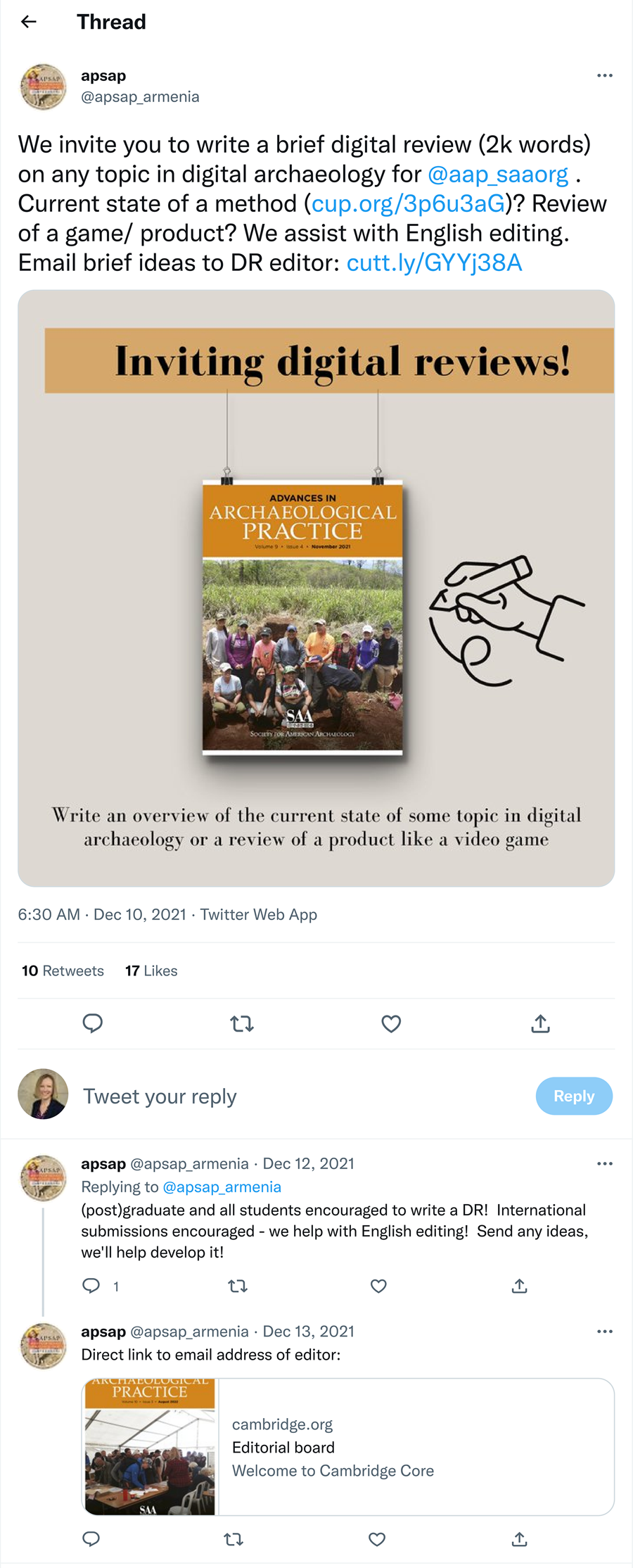
In late 2021, Thompson was finalizing the development of her first graduate seminar, to be taught in the spring of 2022. This seminar focused on ancient urbanism and inequality, through an archaeological lens, and it was intended for graduate students. With her strong belief in the importance of providing real-world publication experience for students, as outlined above, she intended this type of training and professional development to be a main focus and takeaway of the course. Coincidentally, she saw a post on Twitter encouraging submissions of DRs to AAP (Figure 1). The tweet especially encouraged students to submit DRs and suggested writing about video games (note: that account has since moved to Mastodon, https://fediscience.org/@apsap). Given Thompson's interest in archaeogaming (sensu Reinhard Reference Reinhard2018), several previous DRs had already attracted her attention, including Mol and colleagues’ (Reference Mol, Politopoulos and Ariese-Vandemeulebroucke2017) DR on the game Civilization 6 and Styles's (Reference Styles2016) DR on the Minecraft game. She also knew that several students enjoyed playing video games as one of their hobbies, so it was a natural step for her to incorporate writing a DR into the course as an integral method to teach good writing habits, the peer-review process, and the way to publish articles.
Screenshot of the tweet with the call for digital reviews for Advances in Archaeological Practice, including a reply encouraging student submissions specifically.
The first DRs appeared in AAP in 2016. The purpose of the digital reviews is to engage with archaeology and digital initiatives for a broader audience. Digital reviews were intended to evaluate digital media critically through an archaeological lens, highlight the relevance of digital archaeology techniques, and provide a venue for comparing digital archaeology media and methods (Perry Reference Perry2016). Recent DR articles have covered wide-ranging topics: from high-level overviews of important trends in digital archaeology (Kansa and Kansa Reference Kansa and Kansa2021; Liang Reference Liang2021) to investigations of public engagement through various digital media (Carpentier Reference Carpentier2022; Dennis Reference Dennis2018; Emmitt Reference Emmitt2022; Snyder Reference Snyder2022). Consequently, students can write about diverse topics that are of interest to them and integrate their hobbies into academic writing.
For students, DRs have the advantage of being shorter texts (around 2,000 words), not requiring formal peer review, and being freely available online. AAP provides some support for editing, and DRs are generally well illustrated. Optionally, authors can engage in independent research, including collecting and analyzing new data. In that regard, DRs are flexible and based on the interests of the authors and the digital media they write about. Yet, the DRs are real publications in a high-ranking journal for the discipline. A recent DR, entitled Machine Learning Arrives in Archaeology (Bickler Reference Bickler2021), has been cited 48 times in Google Scholar as of August 2023. DRs make excellent writing opportunities because students are often immersed in the digital realm in all facets of their lives, making the range of topics familiar.
Critical writing for a broad audience on current, relevant topics is an important skill. First, students are learning to survey existing literature with a critical eye and to synthesize ideas for a specific topic based on what has been done and written about before. Second, they are evaluating some new digital tool or medium, any of which might have relevant applications in the profession. Third, through our mock peer review, they are developing strategies for dealing with constructive criticism of their work, including iterative writing, which would be useful for grant applications or official reports. Fourth, they are gaining experience by providing feedback about the work of their peers (see also Watling et al. Reference Watling, Ginsburg and Lingard2021). Finally, the students are learning to articulate their ideas for a general audience and to present these ideas formally—again, skills that are useful in many life and work contexts. In addition, an official publication will stand out on a new scholar's resume.
The Pedagogical Context
Writing is both a challenging pedagogical area and an essential skill for students to learn (see Sallee et al. Reference Sallee, Hallett and Tierney2011). Luckily, dozens of books focus on writing, creating good writing habits, and getting published (e.g., Becker Reference Becker2020; Belcher Reference Belcher2019; Deetjen Reference Deetjen2020; Saramäki Reference Saramäki2018; Silvia Reference Silvia2007, Reference Silvia2015), whereas others focus on grammar, prose, and writing styles (e.g., Strunk and White Reference Strunk and White2000; Sword Reference Sword2012; Truss Reference Truss2003; Zinsser Reference Zinsser2006). Concepts from those books were applied to Thompson's classroom. However, the improvement of writing skills also required a close mentorship process, with iterative drafts receiving feedback, which is something we were able to provide in the context of our small and focused seminar.
Cobb and Croucher (Reference Cobb and Croucher2014:197) point out “the undervaluation of pedagogy and pedagogic research in archaeology” and later advocate for increased pedagogical research related to archaeology (Cobb and Croucher Reference Cobb and Croucher2020). Much prior literature on archaeological pedagogy has focused on the importance of fieldwork in teaching (Alsaud et al. Reference Alsaud, Salha, Affouneh, Shaqor and Issa2021; Cobb et al. Reference Cobb, Cobb and Azizbekyan2022; Everill Reference Everill2015), but this comes with challenging accessibility issues (Heath-Stout and Hannigan Reference Heath-Stout and Hannigan2020). We hope to encourage others to discuss their efforts specifically in teaching about writing, because this will inform the next generation of archaeologists. Like fieldwork, the teaching of the academic publication processes falls within the emerging educational theoretical domain of authentic assessment in higher education. Assessments are considered more authentic if they more truly align with the practices that students will encounter in their future professions (Ashford-Rowe et al. Reference Ashford-Rowe, Herrington and Brown2014; Nieminen et al. Reference Nieminen, Bearman and Ajjawi2023). Although books such as Writing Archaeology (Fagan Reference Fagan2006) focus on processes of writing for archaeologists, Fagan's book emphasizes writing shorter op-eds and books rather than peer-reviewed journal articles, highlighting the shifts in publishing practices in the past 15 years. Nonetheless, key concepts in Fagan's book echo those from more general writing practice manuals, which include writing often, revising one's work, and learning to receive criticism constructively.
Several aspects of teaching writing in the graduate student classroom have been explored in prior studies in other academic fields. Here, we consider these topics to frame our own pedagogical efforts. One aspect that challenges teachers is finding enough time during a single course to incorporate writing instruction and practice while teaching discipline-specific knowledge. Another aspect is how to embed writing into the social fabric of learning, such as through group peer review and editing. Some instructors have also delved into the emotional aspects of writing, and others have taken into consideration the inequalities of opportunities that different student authors might face in their personal lives.
In one example, Copenheaver and colleagues (Reference Copenheaver, Andrew Predmore and Fuhrman2016) taught a course about forest ecology that required students to undertake a research project and to write a manuscript that could be submitted for publication. They found that it was difficult to fit this into a single semester course, and students’ main takeaway was collaborative research rather than writing. Given that our archaeological assignment was focused on reviews, our students avoided spending significant time on data collection and more of their time on writing and rewriting, incorporating individual mentorship, learning about publication processes, and engaging in in-class workshops (sensu O'Hara et al. Reference O'Hara, Lower-Hoppe and Mulvihill2019).
Learning is often an inherently social process, and although writing itself seems like an individual task, working together on composition has potential benefits for learning to write. Students can collaborate to provide constructive feedback on each other's writing, In a course about writing in the social sciences, Nairn (Reference Nairn2020) established a system of collective group editing: each student would share a paragraph of their writing and the other students would offer feedback. This was done by projecting each paragraph onto a large screen and then editing in real time. In this way, the students “were able to observe each other's mental processes as they articulated and externalised their thinking to clarify meaning for the rest of the group” (Nairn Reference Nairn2020:889). The students reported favorable experiences with this collective writing process and found themselves adapting what they saw to their own editing processes.
Peer-writing groups offer a space where drafts of articles are circulated for feedback before they are submitted. Such groups often provide accountability (Belcher Reference Belcher2019; Sarnecka Reference Sarnecka2019) and help authors develop consistent writing habits (Sarnecka Reference Sarnecka2019; Silva Reference Silvia2007). When implemented in the classroom, formal structures for providing group feedback can also be helpful. Peer-review assignments teach students the other side of the coin—not just how to consider feedback from others but also how to provide effective peer reviews for others. Learning how to provide others with thoughtful, insightful, and useful feedback is an important skill that we should be teaching (Watling et al. Reference Watling, Ginsburg and Lingard2021).
Furthermore, few courses require students to write and revise a paper multiple times. This subconsciously teaches students that writing a paper only once is normal (Becker Reference Becker2020:40). Yet few manuscripts, fellowship applications, or grant proposals are accepted or funded on the first round of review. We often edit and revise an article numerous times before we send it to a trusted colleague or coauthor for review. Only after many drafts is an article officially submitted. Then, the article may go through several rounds of formal peer review and revision before being published. In the end, our work is improved through the feedback and insights of others. Consequently, peer review in the classroom teaches students this invaluable lesson by offering both written feedback and face-to-face discussions that allow for a back-and-forth between the author and reviewer. The goal is for students to learn how to improve their work through critical evaluations, some of which may be more negative or detailed than others.
Costello and colleagues (Reference Costello, Davis and Crocco2022) studied a course focusing on a social scientific investigation of a community youth leadership program. Students wrote up their results for publication, and the authors evaluated this aspect of the class. Their study emphasized the social constructivist context of learning, which foregrounds the interactions among learners in constructing new knowledge. In this course, students worked together on teams to conduct the research while improving their interpersonal skills through doing everything from selecting groups to managing team tasks. One interesting aspect of this project was their consideration of authorship order for the final publication. With large teams of up to 11 students, they had to develop a very specific system for determining author order. What they came up with was a scorecard that quantified each student's contribution and enabled them to order the authors based partially on the scores, a process that students found fair. Credit and authorship are very important but challenging aspects of the publication process, so it was valuable for the students to think through these issues. The teamwork management continued throughout their production of the article. After they submitted the article, they apportioned which students would deal with the comments from which peer reviewers.
Writing is, of course, an emotional and often stressful process, and each person comes from a different background, with diverse abilities and experience with writing. This can lead to potential inequalities in learning writing in the classroom and in writing for publication. For example, in Nairn's (Reference Nairn2020) course, mentioned above, the public projection of their drafts left some authors feeling vulnerable. Therefore, the instructor made significant efforts to build trust among the students, including sharing her own early-stage writing samples. In a course on social work that included peer review as part of the writing assignment, Adamek (Reference Adamek2015:213) found that “students transitioned from cautious reluctance about peer review to embracing it as a necessary part of the writing and publication process.” Learning how to view criticism about one's own writing in a positive light to help improve the end product—instead of perceiving it as a personal critique—and becoming comfortable with the process takes many years.
Recent acknowledgment of gender, racial, ethnic, and income inequities in the field-based sciences (Dowey et al. Reference Dowey, Barclay, Fernando, Giles, Houghton, Jackson and Khatwa2021), including archaeology, extend to grant writing and publishing (Beck et al. Reference Beck, Gjesfjeld and Chrisomalis2021; Fulkerson and Tushingham Reference Fulkerson and Tushingham2019; Goldstein et al. Reference Goldstein, Mills, Herr, Burkholder, Aiello and Thornton2018), professional networks (Leighton Reference Leighton2020), and our careers and everyday lives in general (Cobb and Crellin Reference Cobb and Crellin2022). These trends are present in graduate school and beyond. Noortyani (Reference Noortyani2016) highlights how students in developing countries face extra hurdles for writing internationally publishable academic articles in English. The students in her study lacked confidence in their language skills to express their ideas and in their knowledge to write in detail about certain subjects. Huerta and colleagues (Reference Huerta, Goodson, Beigi and Chlup2017) found that student self-efficacy—their belief in their own capacity to accomplish a task—was a significant predictor of how much writing anxiety they would face. We aimed to help assuage students’ writing and publishing anxieties by creating transparency in the process. Furthermore, we hope this exercise empowered students of all backgrounds in their writing process by creating a sense of community, commitment, and respect for each other's work and reducing potential inequalities in the classroom (sensu Cobb and Crellin Reference Cobb and Crellin2022).
THE PROCESS
Framed within this wider context of the teaching of writing, we built an assignment for our own course. Although this took place as part of an elective graduate seminar on urbanism and inequality, teaching practical skills was just as important as discussing the theoretical issues. Students enrolled in the class from several disciplines, including geography, biology, architectural preservation, and community and regional planning. Generally, students were in the first or second year of their master's or doctoral program, some aspiring to pursue an academic career, whereas others aimed to work in industry or government. The students also came from a variety of socioeconomic and identity backgrounds that may not be typical among university archaeologists in the United States, so we hope that our assignment opened an archaeological publication opportunity to a wider audience.
In addition to writing a DR, other assignments in the seminar included weekly reading responses, facilitating class discussions, and a final paper and presentation. The course took place over 16 weeks, from January 18 to May 8, 2022. As the course was starting, Thompson contacted Cobb, the AAP editor for DRs, directly, and he agreed to collaborate on this project over the course of the semester, including providing remote feedback to the students, which iteratively built off Thompson's responses. This allowed insights to be conveyed based on different areas of expertise and knowledge of what works well in DRs as students wrote and revised their articles.
The Assignment
Writing for publication was one of two major writing assignments in this graduate seminar, constituting 10% of the overall course grade. Students could choose whether to write a DR or a book review. All students participated in the roundtable mock peer review and provided feedback on each other's papers. In selecting topics, students were encouraged to merge their personal interests. Writing about video games, TV shows, or phone apps can be a great way to get students motivated and excited about academic writing. Other requirements of this assignment included that the topic be related to the course content on urbanism and inequality and be a distinctive and novel DR contribution in AAP. The DR assignment instructions followed the journal submission requirements: reviews should be approximately 2,000 words, contain at least four figures, and cite relevant scholarly literature. The guidelines for this DR assignment were adapted from Caroline Faria's (University of Texas at Austin geography professor) Book Review assignment guidelines (see Pande and McLaughlin Reference Pande and McLaughlin2022). Instructions were posted to the course Learning Management System (LMS), Canvas (see Supplemental Text 1 for the full assignment, minus details that relate only to the book reviews).
For the book review assignment, students could review any book related to the course topics of inequality and urbanism, including from among the books listed online by the Journal of Southeastern Archaeology. One student selected this option, and that student and Thompson worked with the editor of the Journal of Southeastern Archaeology on book options, and on revising and publishing the book review (see Cortina Reference Cortina2022). Another student selected a book from the library but did not publish the review. Book reviews were 800–1,000 words in length and did not require figures. This strategy allowed students to select the option most suitable for their situation and career goals.
In the Classroom
In the first week of class, on January 18, 2022, the instructor (Thompson) presented the assignment, explaining that writing for publication is different from the type of writing most students use for a class paper. Although class papers can be transformed into publications, most are not ready for submission right away. Furthermore, many students are unfamiliar with the process of iterative writing and lack experience receiving and incorporating feedback into their papers. The instructor explained that the purpose of the assignment was to write a first-authored article for publication and to learn about the peer-review process. Of the five students in the graduate seminar, three selected to write DRs, and two selected book reviews. By the second week (January 25), students had posted their ideas for a DR to the LMS, which ensured that students were not writing on redundant topics. In class, students shared their ideas, conceptualizing how their topic articulated with the course themes.
During the third week (February 1), students wrote brief abstracts about their ideas. The topics selected included the use of TikTok for education in archaeology, a review of a video game (Heaven's Vault), and a review of video game lore from the League of Legends as presented in the game and the Netflix TV series Arcane. Thompson collated these abstracts into a single document and sent them to Cobb for approval prior to moving forward with writing the DRs for AAP. At this stage, both Thompson and Cobb also provided some feedback on the abstracts, a habit that would continue throughout the writing process. In class, we briefly discussed the topics so that students had an opportunity to bounce around ideas and verbally articulate their thoughts.
In Week 4 (February 8), students submitted detailed outlines of their DRs. This ensured that students were thinking about their articles, and it provided the opportunity for everyone to give more detailed feedback on the direction of the writing. Feedback guided students to organize their storyline in a logical flow and to structure their article according to the DR format. Furthermore, the feedback focused on reminding students about several important writing goals: to keep their narratives focused and to remove tangents, to foreground archaeology, to weave in course themes and readings, and to emphasize the main takeaway of their review. We especially encouraged students to provide enough information for someone who is unfamiliar with the topic to understand their review, without delving into too many unnecessary details.
The students then wrote a full draft of their DRs with figures, which was due in Week 6 (February 22). After submitting the draft of the DR, a key component of the process was a roundtable mock peer review. The rough drafts were read by classmates, Thompson, and Cobb, all of whom provided feedback as if they were real reviewers, resulting in a total of six “reviewers.” Students were required to send their comments back to the authors before the class of Week 7. The following week (Week 7), on March 1, we held a roundtable mock peer- review discussion in class (Figure 2). With reviewer comments in hand, we went around the room, focusing on each article. Given that Cobb could not meet in person for the roundtable, Thompson presented his comments to the students. This allowed us to talk through many ideas, building on the written feedback.
Roundtable-style peer-review feedback and discussions on digital reviews (and book reviews) in class: (left to right) Yesenia Rubi Landa, Chris Ploetz, Yuhana Khan, and Camila Cortina, who were graduate students in spring 2022. (Photo by Amy E. Thompson.)

Students provided insights to each other in the same way that reviewers provide suggestions for peer-reviewed journal articles. Students’ feedback included ways to trim details that detracted from the main point of the DR, how to better incorporate course content and citations, ideas for new figures and tables, and thoughts on which figures either helped illustrate their main points or seemed extraneous. Additionally, they pointed out areas that needed further clarification or that might be confusing to a reader unfamiliar with the DR topic. At times, the student authors further explained the details of their media—such as the storyline of a TV show or game play of a video game—to help the class understand the main point and to distill information in a meaningful way to the readers. Students reported that this process was insightful and useful in revising their work, and that they enjoyed the feedback and roundtable-style discussions with their peers. At this point, in addition to peer feedback, Thompson and Cobb also provided detailed written feedback, including some copyediting for flow and clarity, suggestions about areas that needed more or less detail, and guidance for formatting the article for AAP.
After the roundtable mock peer review, students had three weeks to revise their DRs, write a cover letter, and submit their assignment to the LMS by March 29 (Week 11). The importance of cover letters, the ways they differ from abstracts, and their key elements were discussed in class, and sample cover letters and readings were provided on the LMS. Students were required to obtain departmental letterhead for their cover letters, and they were informed of the importance of using formal style, including the proper formatting, signatures, and appropriate salutations.
Consequently, this review-writing assignment occurred primarily during the first half of the semester, allowing students to focus on their separate final projects for the second half of the semester. The instructions for the assignment were broken into small tasks with multiple due dates. Students used feedback from their “reviewers” and revised their articles multiple times, following comments from Thompson and Cobb. This allowed for an interactive and iterative process of reviewing and revising their work. Although the course ended in early May 2022, feedback iteration has continued with the students on their drafts, preparing them for final publication in AAP (Table 1). Ultimately, the students were required to submit their work for publication.
Timetable for a Peer-Reviewed Digital Review Assignment in a Graduate Seminar.

GOAL ASSESSMENTS AND CRITIQUES
The end result of this effort is that the students have already published or plan to publish each of their sole- or first-authored works in a major journal. Along the way, students would hopefully realize the positive contributions of using peer-writing groups and peer feedback to improve their writing. The first drafts ranged in quality, and some took more effort than others to bring to publication level. A specific challenge involved keeping the topics focused and at an introductory level for a general audience, as well as improving writing clarity. The students generally did well by themselves on the detailed discussion of their target medium. They were able to evaluate the digital platforms and games while providing specific examples to demonstrate how the digital product did something well or could be improved. The course itself served as a venue for mentorship of the students. They learned the basics of peer review and publishing through interactive and iterative feedback and revisions, writing cover letters, signing an author agreement, and formatting the article, works cited sections, and images for publication. They remained engaged with the assignment given that it incorporated their own personal interests and hobbies directly into the writing (sensu Fagan Reference Fagan2006).
Student Perspectives
The students provided us with comments about their experiences. Overall, they were pleased with the process and found the roundtable mock peer review particularly valuable along with the iterative feedback from both Thompson and Cobb. Students pointed out that this was their first experience conducting a peer review. One student stated, “The roundtable peer-review workshop was valuable as many of us had not published before. . . . It was also fortunate that many of us were from different disciplines as that likely offered us outside perspectives that we might otherwise not be exposed to” (Chris Ploetz, personal communication 2022). Students noted that reading the papers of others helped them see what things worked well and what did not, and they used those observations to refine their own papers. They enjoyed working with their peers in a low-stakes environment. They also found that working directly with the DR editor was integral to the experience and a highlight of the process. One student said, “I loved working with an editor because it just gave us the experience of what it[’s] like even if it's not something I will do that much in my career” (Yuhana Khan, personal communication 2022). A student who wrote a book review provided similar feedback: “My favorite part of the assignment was being able to work with the [book review] editor to get feedback and actually get it published” (Camila Cortina, personal communication 2023).
However, students reported feeling a little rushed due to the timeline for the assignment, which they thought was too short. The instructor opted to require a full draft of the DR assignment to be completed by the middle of the semester to ensure that students were able to focus on their other final projects during the second half of the semester. One student suggested reducing regular course readings during some weeks to provide more time for the DR writing. On the other hand, of course, we all need to learn how to write while facing many competing demands on our time (Belcher Reference Belcher2019; Sarnecka Reference Sarnecka2019). Finally, one student noted, “It was at times overwhelming to go through six people's comments (four classmates, one instructor, and one editor). Comments would sometimes conflict with one another, which I think is fine since it's my choice to accept or reject changes at the end of the day” (Yuhana Khan, personal communication 2022). The students also noted that some of the reviewers provided too little constructive feedback. Learning about how to deal with conflicting or less valuable feedback is also important for new authors.
For all students in the class, this was their first exposure to writing for publication and the peer-review process. One student said, “The nature of the digital review was a great first writing project as it gives an idea for the [peer-review] process with lower stakes” (Chris Ploetz, personal communication 2022). Students enjoyed that the assignment combined their interests and hobbies with an academic course assignment. One stated, “I thought it was really awesome how we were able to tie class topics into a video game or digital platform” (Yesenia Rubi Landa, personal communication 2022). The student who wrote the book review acknowledged that the DR option was more creative, but “liked having the option for something more straightforward” given that she was finishing her master's thesis during the semester of the graduate seminar (Camila Cortina, personal communication 2023). One student commented that “the whole process was hands-on, which is exactly what I admire and expect from a graduate-level course” (Yuhana Khan, personal communication 2022).
Assessing Our Goals
Here, we reflect on each of the original goals laid out at the beginning of this article to consider what was accomplished and how we could improve our efforts to further archaeological pedagogy.
Goal 1: Demystify the Peer-Review Process. Our first goal was to introduce the peer-review process and encourage graduate students to begin publishing early by exposing them to a low-stakes peer-review environment in the form of a roundtable workshop. We included several levels of iterative feedback, from their incipient idea for their DR to their outlines, and multiple drafts of their article. In class, we held a roundtable-style workshop in which we discussed each student's article in detail. This provided students with the opportunity to talk through their reviews and to give each other verbal feedback in addition to the written feedback. Students reported that this opportunity helped them better understand the publication process while simultaneously learning as much from giving as receiving feedback.
Goal 2: Prepare Students for Responding to Criticism. Our second goal was to give students a chance to adapt mentally to the critical environment of their peers. Students received feedback from their peers, the instructor, and the DR editor—a total of six reviewers on each article. Some reviewers provided only minor feedback, whereas others provided substantial feedback, simulating a scenario often encountered in peer review. Students learned that feedback is often varied. As with actual peer review, it was up to the author to decide how to handle conflicting feedback. Students were welcome to meet with the instructor to discuss how they should revise their manuscripts.
Goal 3: Give Students Experience with the Logistics of Publication. A third goal was to remind students that publication is about more than writing the manuscript. Writing for publication includes supporting one's arguments with informative yet enticing imagery and data tables, and situating one's work through citing others (Deetjen Reference Deetjen2020; Saramäki Reference Saramäki2018). Additionally, cover letters are needed for manuscript submissions, and they are fundamentally different from the abstract. They should detail the broader importance of the article, key themes and findings, and the way the article fits within the scope of the journal (Becker Reference Becker2020; Saramäki Reference Saramäki2018). In this assignment, students had to integrate these items into their final submission for the course and, eventually, to AAP.
Goal 4: Provide Students with the Opportunity to Publish. The final goal of this assignment was to have students publish a sole- or first-authored, citable article, which could then be included in their CVs. Of the three students who did a DR, two are now published (Khan Reference Khan2022; Landa and Thompson Reference Landa and Thompson2023).
Self-Reflection and Critique
If we situate ourselves within the wider pedagogical universe, we observe that there are some ways that teaching writing for publication in archaeology is similar to other academic disciplines, and in some ways, it is unique. We are a relatively small field that needs to not only synthesize and communicate primary data but also articulate interpretations and theoretical discussions. As with other efforts at mentoring students in writing, we were challenged by the time frame of a single course. The assignment in this course foregrounded social learning through the use of the mock peer-review roundtable process. We hope that this course opened the publication process to a more diverse audience. Overall, we tried to teach writing by providing a learning scaffolding that balanced the structure of publication with giving the students agency. We emphasized the importance of writing as a continuous iterative process by highlighting peer feedback throughout the semester. The students seemed to gain confidence with a real publication process for a real audience. Given the dearth of articles discussing the teaching of writing for publication to archaeological graduate students, we hope that our efforts will encourage others to also share their pedagogical experiences.
Our goal was to provide students with an authentic educational experience. Although we achieved this, we see some potential challenges. First, the peer reviews were not anonymous, and some of the feedback was provided by other students in the class face-to-face. This impacted how critical they were comfortable being, compared to real peer reviewers. Students noted that their class peers often wrote few comments or “everything looks good” and did not provide truly critical feedback. In this way, the notorious “Review #2” was not present in this process. A future tactic suggested by a student is “[each student] focusing on just [. . .] one person's paper and giving it their undivided attention” (Yesenia Rubi Landa, personal communication 2022), which would, hopefully, encourage more detailed reviews by student peers. On the other hand, Thompson and Cobb provided substantial feedback, in the form of both copyedits and comments, with the goal of getting the articles published.
Related to this, the coursework took significant time for the instructor and editor, both of whom are assistant professors, and it leads us to consider how we could scale this program to a larger course size without spending too much time on a single task. The graduate seminar consisted of five students, which was manageable for the students, the instructor, and editor to provide feedback. However, if the class was larger—for example, 10–15 students—we would need to revise our strategy. One idea we have is to place more emphasis on the peer reviews among the students. This could include assigning each student one to three anonymous reviewers, and having each student, in turn, review one to three articles, which is similar to a single-blind peer-review model. This would more accurately reflect the actuality of peer review, allow students to provide more detailed feedback given that they have fewer articles to review, and potentially, allow students to provide more constructive criticism for their classmates’ articles. This strategy could be conducted in a small class of five as well, although in this situation, students may easily be able to pick out who their reviewer is, based on their knowledge of each persons’ writing and style of comments from class discussions, online writing responses, and other course assignments. By placing more emphasis on the grading of the review itself, this might also lead the reviewers to be more critical and, therefore, helpful. Another strategy would be to find more advanced students to provide feedback, which would also aid in their own professional development. Peer review is an essential part of the scientific method and is a real-world skill we should be teaching, so having more input from other students in an iterative manner is valuable to the reviewers as well. In addition to being peer reviewers, we also see the possibility that students can serve more as editors to help organize all the activities and provide more direct guidance on the direction of the articles. This would give them practice with another set of practical skills while allowing us to delegate more logistical tasks. Another approach to scaling up the assignment might include deploying new generative artificial intelligence (AI) chatbots to help provide students with detailed feedback on their papers (Cobb Reference Cobb2023).
We note that having the final DRs submitted and ready for publication by the end of the semester was not feasible. Consequently, we have continued to work with students beyond the scope of the graduate course. As of August 2023, two of the DRs were published. Since the course ended, progress on the DRs has varied—from months of slow progress as students face remote fieldwork and heavy course workloads to months of quick draft turnarounds. To facilitate the process, in January 2023, the editor and instructor suggested that students whose DRs were not ready for publication consider including a second author on their article if they wanted more guidance and help with streamlining their writing.
If we were to attempt to scale this exercise to a larger class of 10–15 students, perhaps after the initial writing and reviewing of the articles, each student could decide if they wanted to move forward with actual publication. In a class of five students, three of whom wrote a DR, it seemed feasible that they could all publish. However, continuing to revise the articles for publication has been a slow process. Requiring 10–15 students to publish would not be possible within the time constraints and would require working with multiple journals. Instead, just encouraging students to write and engage in peer review should make this assignment a positive experience, regardless of whether each student later gets the article published. Also, students could perhaps coauthor their DRs so that they could still gain publication experience, but with slightly less effort.
Building on the many prior experiments with incorporating publication into the classroom curriculum (Gassman et al. Reference Gassman, Maher and Timmerman2013; Romesburg Reference Romesburg2013; Schultz et al. Reference Schultz, Agrimonti and Higbee2016), we have focused our own in-class experiments specifically on final publication. Through multiple rounds of peer review, and the inclusion of an outside journal editor, we have tried to show our graduate students the intricacies of publication. This has allowed us, with the simpler requirements of DRs, to take the students from start to finish within the content of one course.
Acknowledgments
This assignment was inspired by Caroline Faria's book review assignment in her graduate seminar. We thank the five graduate students in the spring 2022 graduate seminar at the University of Texas at Austin and Benjamin A. Steere, the book review editor of the Journal of Southeastern Archaeology.
Funding Statement
The work described in this article was partially supported by a grant from the Research Grants Council (RGC) of the Hong Kong Special Administrative Region (HKSAR), China (Project No. HKU 27602920); and a Teaching Development and Language Enhancement Grant (TDLEG), 2022-2025, from the HKSAR University Grants Committee (UGC).
Data Availability Statement
No original data were presented in this article.
Competing Interests
Peter J. Cobb is the digital reviews editor for Advances in Archaeological Practice.
Supplemental Material
For supplemental material accompanying this article, visit https://doi.org/10.1017/aap.2023.18.
Supplemental Text 1. Digital Review Assignment Posted to the Course LMS (Canvas) Page.


 Open access

