

Introduction
The Canadian Pavilion at the 2019 Venice Biennale featured the film and video work of the Nunavut Inuit film collective Isuma (formerly Igloolik Isuma Films). A focal attraction for the Canadian exposition was the premier of the collective’s newest film, One Day in the Life of Noah Piugattuk. Filmed with Isuma’s characteristic unhurried pacing, One Day in the Life presents a 1961 encounter between a group of Inuit and a government functionary, known as only as Boss. Boss is intent on moving Piugattuk and his camp mates into the government administered town of Igloolik where they can be looked after, modernised and educated in the ways of the Canadian state. Piugattuk neither needs nor wants the “help” Boss is so desperate to provide. Because we know how it eventually turns out for Piugattuk and so many others – One Day in the Life is based on a life history narrative told by the real Piugattuk – the film serves as a vivid reminder that Inuit and non-Inuit Canadians held (and maybe still hold) vastly different ideas about what constitutes a good life.
The choice of Isuma to represent Canada at the Venice Biennale is noteworthy. The 2019 exposition was the first time that Canada selected Inuit artists for that elite art venue. It is also noteworthy because of the subject matter Isuma addresses. The collective is led by Inuk Zacharias Kunuk and Norman Cohn who is not Indigenous. The subjects Isuma takes on and their storytelling forms are entirely Inuit. All of Isuma’s films are political, but none more so than One Day in the Life of Noah Piugattuk. The film offers an Inuit retelling of an encounter between the actual Piugattuk and an unnamed representative of the Canadian government. The 112-minute film consists largely of the functionary’s increasingly insistent entreaties that Inuit move from their self-governed camps to the government-administered town and Piugattuk’s equally implacable deflection of the agent’s pleas.
Participation in the Venice Biennale – something that is primarily available to nations in the Global North – “can be viewed as a symbolic extension of actual colonial and imperial practices” (Moreno, Reference Moreno2010, p.9). By sponsoring Isuma’s pointed critique of 1960s era internal colonialism, Canada advances its contemporary image as a progressive, postcolonial and multicultural nation; a nation secure enough to admit past wrongs. Renisa Mawani (Reference Mawani2004, p.49) labels Canada’s willingness to acknowledge its past abuses of Indigenous peoples a “new national performance” of a better Canada, “one that seeks forgiveness for its shameful colonial past” and past actions that it claims no longer occur (see also Irlbacher-Fox, Reference Irlbacher-Fox2009). Yet, in showcasing the exquisite, professionally produced artistic work of the Isuma team, Canada does more than admit past wrongs. It simultaneously claims that no lasting harm was done by officials like the Boss. If Inuit filmmakers are this good, everything must be okay.
The 2019 Venice Biennale was not the first time that the Canadian state deployed Inuit art or filmic representations of Inuit in an international arena in ways that were meant to validate its activities in the North. In the middle decades of the last century, Canadian officials found that Inuit art was a good vehicle to present Canada as a young, vibrant and modern nation, and simultaneously, as a nation with deep cultural roots. Inuit art was available to be assimilated as a symbol of Canada because, according to Pupchek (Reference Pupchek2001), elites recognised it as “primitive art.” Labelling an Indigenous art Canadian strengthened settlers’ claims to a deep history. The designation as primitive firmly cemented its association with “the Folk,” the real inhabitants of the land, thus indigenising settlers. Canadians’ adoption of Inuit art as symbolic of the nation was nothing short of “the appropriation of new ancestors” for a very young country (Phillips, Reference Phillips2015, p.6). And the adoption of Inuit art as a national symbol supported the creation of a distinct Canadian identity, one that was separate from both Britain and the United States (Graburn, Reference Graburn1986).
In the immediate post-war period, as today, international celebrations of the artistic prowess of Inuit served more than one purpose. In this paper, we take Canadian officials’ deployment of Inuit art in international arenas in the 1950s and 1960s as a starting point to think about administrative practice during that era. Rather than focus on the foreign policy uses of Inuit art in the international arena, something that has been done well by others (Lennox, Reference Lennox2012; Potter, Reference Potter2020; Robertson, Anderson, Diggon, Moussa, & Smith, Reference Robertson, Anderson, Diggon, Moussa and Smith2013; Vorano, Reference Vorano2007, Reference Vorano2016), we turn our primary attention to a more mundane and overlooked value from deploying Inuit art in international diplomacy: namely, how the promotion of Inuit art brought positive attention to government activities in the North.
Government officials first recognised, developed, encouraged and promoted Inuit art during the initial phases of what was an enormous and fraught project to transform Inuit into modern Canadian citizens. Modern in this context refers to the institutionalisation of universal needs; Inuit were expected to develop tastes, habits and sensibilities matching those of urban settlers. We argue that regardless of the ways that Inuit art served Canada’s external affairs, the success of the art program consciously or unconsciously bolstered the magical thinking among those public officials who imagined that government could with the right inputs, according to a senior government official, “adjust a Stone Age people to a whole new way of living” (RG22 Vol 351 File 87-3-20 part 1, Library and Archives Canada). In addition to sustaining a belief among government officials that they could and should completely remake Inuit lives and livelihoods, the success of Inuit art likely deflected attention from the many things that were going wrong with that northern modernisation project.
The ideas we present in this paper originated in the first author’s project to document the ways that ethnographic research by anthropologists and other social scientists intersected with the administration of Canadian Inuit during the 1950s and 1960s. We note, however, that anthropologists were only marginal players in the work to establish an Inuit art industry. Data come from archival sources and from oral history interviews conducted by the first author with social scientists who conducted research for the Department of Northern Affairs and National Resources (DNANR) and its successors. Our interest in the use of Inuit art for diplomacy was prompted by the unanticipated discovery of documents in the Canadian national archives discussing logistical matters related to an exhibition of Inuit soapstone sculpture touring the west coast of the United States in 1954 and 1955. Included in this material was a memo describing the selection of two pieces of Inuit sculpture for the Canadian prime minister to give to Indian Prime Minister Jawaharlal Nehru “and his daughter” (RG22 vol 869 file 40-8-5 pt. 4 Eskimo Handicrafts Dec 56-Dec 57, LAC).
The gifts to Prime Minister Nehru and Indira Gandhi were not the first diplomatic gifts of Inuit art. The first, a stone sculpture of a mother and child, was bestowed on then Princess Elizabeth during her 1951 tour of Canada. The gift to the princess was described in Canadian, British and American newspapers of day as a delicate stone carving of a mother and child made with crude and simple tools by Munamee (Munamee Shaqu) of the Cape Dorset region. Though this gift was said to be presented “on behalf of the EskimoFootnote 1 people,” it was, in fact, selected from a collection of stone sculptures purchased by the government for sale through the Canadian Handicrafts Guild (Arctic Circle, 1951, p.77).
Within a few years of that first bestowal, Inuit sculpture and later graphic art became a preferred Canadian diplomatic gift and symbol of Canada and Canadians that was distributed in “embassies and consular offices around the world” (Vorano, Reference Vorano2016, p.316). An unnamed writer in Inuit Art Quarterly (1990/91, p.12) asserts that by the 1970s Inuit art was so widely identified as emblematic of Canada that it became “a favourite choice for gifts to foreign dignitaries.” By shifting Inuit art from a presentation made on behalf of Inuit to a gift from Canada, officials imbued the objects with a new force, one that originated with the Canadian state (Mauss Reference Mauss and Cunnison1967). Today, Inuit leaders recapture and reframe some of that symbolic force when they make gifts of Inuit art to Canadian officials during significant intergovernmental meetings. While cultural diplomacy usually involves the direct participation of artists or other culture producers, for the period that is the subject of this paper, it is unlikely that more than a few, if any, Inuit were aware where their art was exhibited, who purchased it, or how it was employed (Fig. 1).
Canadian Prime Minister Justin Trudeau receiving a drawing from Inuit Tapiriit Kanatami upon the signing of the Inuit-Crown Partnership Declaration in February 2017. The drawing, entitled “Homecoming,” was made by Annie Pootoogook (1969–2016).

Canadian Inuit art, qua Art, did not exist prior to 1948, and modern Canadian Inuit art was exhibited outside of Canada for the first time in 1953 and 1954. A collection of stone carvings toured prestigious fine art and natural history venues in the United States. A separate set of carvings, including the mother and child given to Princess Elizabeth, attracted attention of Europeans when they were exhibited at the prestigious Gimpel Fils Gallery in London in honour of Elizabeth’s 1953 coronation. Financial and logistical support from the Canadian government was integral to these exhibitions. However, when Inuit art was shared abroad, the audiences for the celebrations of Inuit artistic prowess included Canadians at home. The international exhibitions and diplomatic gifts of Inuit art served multiple domestic purposes. In addition to assuring government officials of the value of their activities towards Inuit, they demonstrated to Canadians the ongoing integration of Inuit into the Canadian mainstream. International and domestic reporting in newspapers and magazines helped to establish the monetary and social value of Inuit soapstone sculpture and prints as fine art and allowed Canadians to imagine that they knew something about Inuit at a time when few Canadians could meet any Inuit for themselves.
Inuit art in cultural diplomacy
We regard cultural diplomacy narrowly to refer to governmental practices in which art, music, theatre, popular culture, national cuisines, etc. are utilised to advance national interests at home and abroad. Examples of cultural diplomacy include language institutes, cultural exchanges, art exhibitions and performances directed at taste makers and at members of the general public in other countries, thus indirectly influencing political and economic affairs.
In modern nation states, culture in the form of arts, language, dress, cuisine, etc. has a “prominent role in national self-imagining” (Cull, Reference Cull2019, p.65) as well as in the way that nations present themselves to others. Scholars have noted that newly post-colonial states may engage in cultural exchanges to affirm their independence and sovereignty (Cohen, Reference Cohen2019; Lindsay, Reference Lindsay, Lindsay and Liem2012), while well-established states find that culture is a useful way to engage with diasporic communities (Isar, Reference Isar2017). States also use cultural diplomacy to improve international understanding (Huttunen, Reference Huttunen2017), to cement good relations and demonstrate international affinities (Fisher & McDonald, Reference Fisher and McDonald2016; Jordan, Reference Jordan2013) and to advance geopolitical agendas (Bleiker & Butler, Reference Bleiker and Butler2016; Vorano, Reference Vorano2016). Subnational entities may pursue international cultural activities as part of a politics of recognition (Fisher & McDonald, Reference Fisher and McDonald2016; Mark, Reference Mark2010). Cultural diplomacy is also thought to encourage foreign direct investment as well as to ease the way for domestic investment overseas or to improve the market for exports (Kim & Lee, Reference Kim and Lee2018; Robertson et al., Reference Robertson, Anderson, Diggon, Moussa and Smith2013).
The reconfigurations of borders, economies and alliances following the Second World War produced an atmosphere that encouraged cultural diplomacy alongside realpolitik. The value of cultural exchanges was made explicit with the establishment of UNESCO of which Canada was an enthusiastic member. Druick (Reference Druick2006) observes that Canada saw cultural diplomacy and participation in UNESCO as a way to promote Canadian values in the international arena. While UNESCO promoted the widespread belief that cultural diplomacy could be peace building, Cull attributes the importance of culture in international affairs during the Cold War era to competition for geopolitical influence. Western states and the Soviet Union assumed that “an idea implanted or in support of their ‘side’ was a victory” (Cull, Reference Cull2019, p.67).
While directed internationally, cultural diplomacy is not purely for international audiences. Presenting cultural products abroad also tells citizens that they have something to be proud of and helps “to forge a national image domestically” (Potter, Reference Potter2020, 56; also Kim & Lee, Reference Kim and Lee2018). International cultural performances and exhibits may provide citizens with an official or elite perspective on global and domestic issues. Cultural exhibitions are often a mirror in which the projected image of a nation is reflected back on itself (Thomas, Reference Thomas1992). According to Lindsay “in the late 1950s and early 1960s cultural tours and exchanges were a way that nations talked to each other, eyed one another, and through displaying what they were to various others, came to know that for themselves” (Reference Lindsay, Lindsay and Liem2012, p.207). This was precisely when Canada embarked on a program of cultural exchanges. Canada’s post-war period domestic and foreign policies positioned it as a middle power, allied with, but politically and culturally distinct from the United States, internationalist in its perspectives and policies – a position exemplified in the booklet Canada produced for distribution at the Brussels Universal and International Exhibition of 1958 (Canada, 1957). Polachová and Firtová (Reference Polachová and Firtová2014, p.82) cite a study showing that in the last several decades of the 20th century, apart from France, Canada spent more per capita on cultural diplomacy than any other country.
Inuit sculpture was displayed in the Canadian pavilion at Brussels alongside totem poles and Iroquois cornhusk masks. As noted above, Inuit sculpture was previously exhibited in London and at multiple venues in the United States. The London exhibit led to a multi-country tour of Western Europe followed by a tour of Eastern European countries including the Soviet Union (Vorano, Reference Vorano2007). The European tours, which were jointly organised by the Department of External Affairs and DNANR, included screenings of two highly contrived films, Angotee and Land of the Long Day, that purported to be honest depictions of Canadian Inuit living an untroubled, happy existence. The films and other government publications were meant to demonstrate that through Canadian administration of the North, Inuit were continuing to “pursue their immemorial way of life” (Canada, 1957, p.10).
Touring Inuit art in Eastern Europe was, in part, a Cold War strategy to counter the socialist realist art of the Soviets and their allies. Art historian Norman Vorano makes the point that seemingly apolitical Inuit art was a perfect instrument in Canada’s Cold War maneuvering. As primitive art, it was believed to be “uncorrupted by political or commercial” motivations (Vorano, Reference Vorano2007, p.462). And as modern art for art’s sake, it projected Western values of individualism that countered the socialist realist art of the Eastern bloc. Deployment of Inuit art through international exhibitions served to demonstrate that despite (or because of) Canadian administration of the North, Inuit were not suffering, but instead were thriving.
Nelson Graburn (Reference Graburn1986, p.6) quotes an unnamed senior government official as stating that the promotion of “uniquely Canadian Inuit art would show the world that Canada was indeed a ‘great Northern power.’” Still, it was not inevitable that Inuit art would be chosen to symbolise Canada. That seems to have occurred almost as an accident in that Inuit art came to the attention of government officials at the very moment that Canada was redefining its place in the world. The use of Inuit art in diplomacy occurred within the zeitgeist of the Royal Commission on National Development in the Arts, Letters and Sciences, better known as the Massey Commission (Canada, 1951), when Canada consciously and actively sought to define and institutionalise truly Canadian arts to set it apart from both Great Britain and the United States. The promotion of Inuit arts and culture within and beyond Canada’s borders also fit within “a national impulse to reimagine the cultural basis for pluralistic North American societies” in the period following the Second World War (Glass, Reference Glass2021, p.278). Canada was not alone in adopting Indigenous symbols as national symbols. During the same period that Canada claimed Inuit art as Canadian art, Australians drew on Aboriginal bark paintings for images of a “unifying Aboriginal motif [that became] representative of a modern Australian national identity” (Jordan, Reference Jordan2013, p.26). In both countries, as well, recognition of Indigenous art ultimately helped advance Indigenous peoples’ political goals and aspirations counter to the state’s subsuming narrative.
The invention of Inuit art
The story of the “discovery” of Inuit art is now well known (Crandall, Reference Crandall2000; Goetz, Reference Goetz1993; Graburn, Reference Graburn1986, Reference Graburn2004; Igloliorte, Reference Igloliorte, Harney and Phillips2018; Martijn, 1963; Myers, Reference Myers1984; Vorano, Reference Vorano, Harney and Phillips2018). Although Inuit had long made stone or ivory carvings to trade with occasional visitors to the North, there was no organised production of Inuit handicrafts for sale prior to 1948. That year, the artist James Houston obtained some small stone carvings from Inuit in northern Quebec, which he brought to the Montreal gallery of the Canadian Handicrafts Guild. This led to a contract from the government for Houston to purchase more Inuit handicrafts for the Guild. These were displayed for sale in 1949. Part of the mystification of Inuit art is the oft-repeated claim this first commercial exhibition of more than a 1000 pieces of Inuit art sold out entirely in just three days (for example Leechman, Reference Leechman1954, p.94).
In the post-war period, most Inuit in Canada lived in seasonally shifting camps, but were coming into increasing contact with American and Canadian military personnel and others establishing footholds in the post-war North. When the Canadian government first became interested in them, Inuit engaged in subsistence work for most of their foodstuffs but depended primarily on trading fox furs to purchase rifles, ammunition, cloth, flour, sugar, tea and other increasingly necessary manufactured goods. Contrary to the deputy minister’s claim, quoted in first pages of this article, that Inuit were a primitive “Stone Age people,” Canadian Inuit had by then had at least a century of experience with missionaries, whalers and fur traders. Fur prices were low in the immediate post-war period, and artistic production seemed to some government officials to be a way to provide Inuit with more reliable incomes than they could obtain from trading a commodity whose availability and price fluctuated widely. Thus, the Canadian government, initially through the Guild, employed Houston and his wife, Alma, to develop an Inuit art industry, focused primarily on stone sculpture. The government thus facilitated and financed the marketing of Inuit art. In the late 1950s, James Houston travelled to Japan to study block printing methods, which he then introduced to Inuit. With government support, Inuit in several communities established graphic print studios. The first in Kinngait (Cape Dorset), where the Houstons had established their base, is the most famous and, still, most prosperous of these studios. Most observers and collectors of Inuit art are familiar with a more or less detailed version of this story. A review of the extensive literature on Inuit art is beyond the scope of this paper. Further information on the history of Inuit art and on the lives and artistic practice of individual artists can be found in Crandall, Reference Crandall2000; Eber, Reference Eber1971; Graburn, Reference Graburn1976, Reference Graburn1986, Reference Graburn1998, Reference Graburn2004; Igloliorte, Reference Igloliorte, Jessup, Robertson and Morton2014, Reference Igloliorte2017, Reference Igloliorte, Harney and Phillips2018; Lalonde, Reference Lalonde2015; Lalonde & Ryan, Reference Lalonde and Ryan2009; Leroux, Jackson, & Freeman Reference Leroux, Jackson and Freeman1994; McMaster, ed., Reference McMaster2010; Swinton, Reference Swinton1972; Tiberini, Reference Tiberini2011 as well as in the pages of Inuit Art Quarterly. Importantly, art proved to be commercially successful, “becoming the largest and most reliable source of earned income in the North” (Graburn, Reference Graburn1986, p.6).
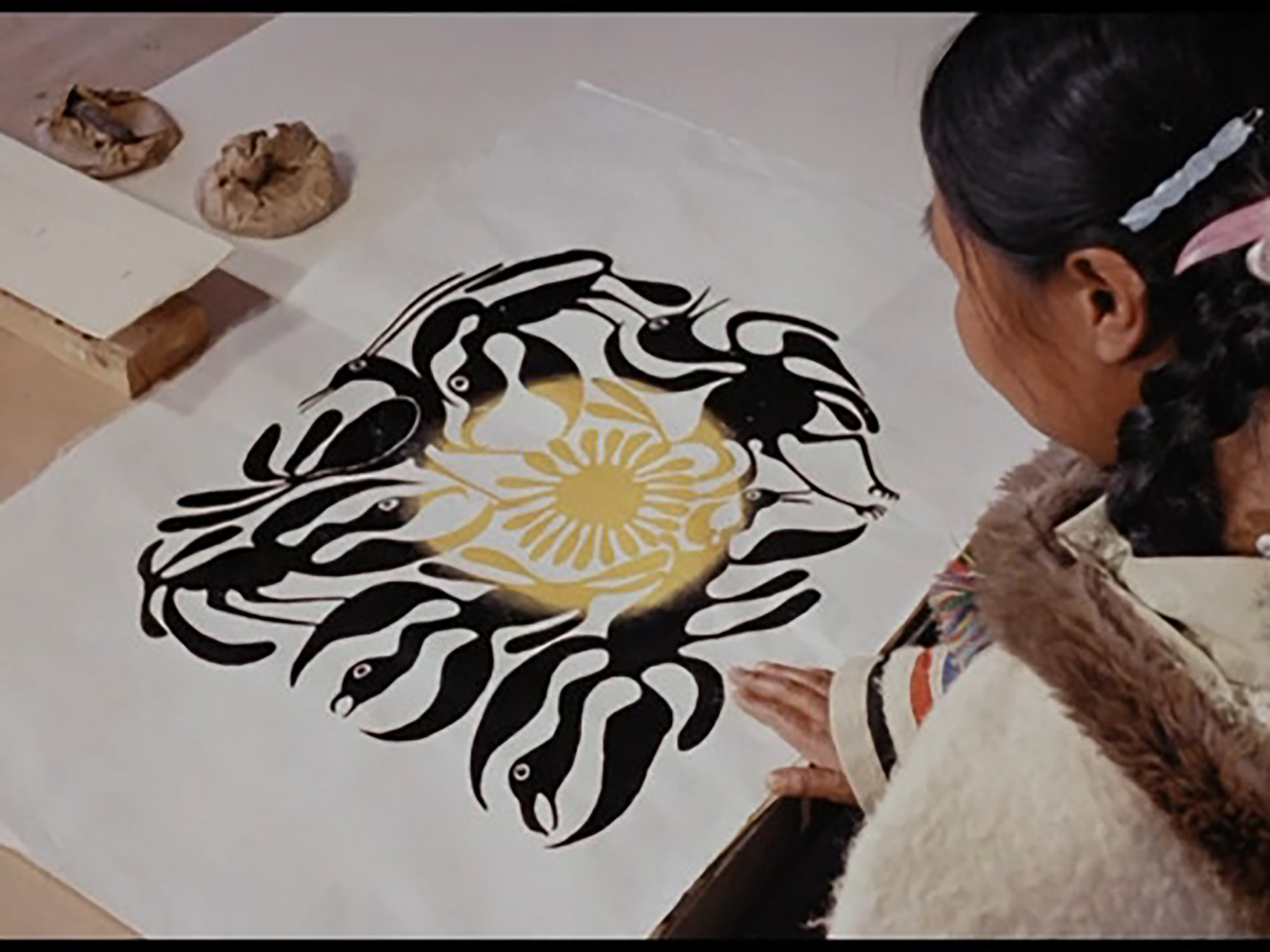
Less commonly recognised is the intellectual labour that the Houstons, and later George Swinton, performed to establish Inuit art as fine art. In Reference Swinton1965, Swinton published the first book about contemporary Canadian Inuit art. James Houston published articles in fine art magazines describing what he claimed were the techniques, artistic philosophies and working methods of Inuit sculptors (Reference Houston1952, Reference Houston1954a, Reference Houston1954b, Reference Houston1956a, Reference Houston1956b). Houston’s descriptions included fanciful stories demonstrating Inuit primitiveness and naivety about the external world. Both Houston and Swinton used their connections in the art world to develop venues where Inuit sculpture could be exhibited as fine art. For some of the earliest exhibitions of Inuit art, James and Alma Houston travelled south to meet with art critics and journalists, who then printed newspaper and magazine stories that explained Inuit art as part of ancient, possibly spiritual, traditions, asserted that no two pieces were alike, and expressed the “makers’ innermost feelings and affections” (Times of London, 1962). In one telling event, Alma Houston provided a voiceover “translation” of Kenojuak’s words in the National Film Board production Eskimo Artist: Kenojuak.
Johnniebo and Kenojuak stand with art advisor Terry Ryan, watching as a fresh impression of The Arrival of the Sun – printed, as Houston informs us, on “a piece of paper from the outside world, as thin as the shell of a snowbird’s egg” – is pulled from the stone matrix. Houston intones that Ryan is asking Kenojuak why she chose this topic, and she replies that she doesn’t know, but Johnniebo thought “the spirits must have whispered in my ear.” A translation of Kenojuak’s Inuktitut commentary reveals that Ryan is actually asking her if the print looks nice and she responds by pointing out an error made in interpreting her drawing: “There is supposed to be an eye here, but you missed the eye,” she says (Dyck, 2022, p.198) (Fig. 2).
Screen capture from Eskimo Artist showing Kenojuak examining the print.
We do not know whether Kenjojuak was aware of the enormous liberties that were taken with her words, but she was aware of at least some of the ways that the filmmakers manipulated reality. In what appears to be a highly paraphrased translation, curator Jean Blodgett reports some of Kenojuak’s description of making Eskimo Artist. James Houston told Kenojuak that the National Film Board wanted to make a film with her and her husband Johnniebo.
They wished to show not only printmaking but the traditional way of life, featuring Johnniebo and me. We agreed, and in the spring of 1962 [we] travelled [from our camp] to Cape Dorset. … We worked with the film crew every day for about three months. Often leaving [our baby son] at the nursing station during the day, [in place of the baby] I carried a pillow in my amautik [mother’s parka] during filming. Once the crew travelled by dog team to our camp at Etilliakjuk. Our snowhouse in the film was made of Styrofoam because it was already late spring and the snow was soft. I found it tiring to endure filming scenes repeatedly, and to wear the same clothing. However, with the money earned from the film-making, Johnniebo was finally able to buy a canoe which had belonged to Lukta [one of the printers]. For years, Johnniebo had striven to achieve independence and now at last was able to hunt alone. It seemed like a new beginning for us (quoted in Blodgett, Reference Blodgett1985, p.22).
Reporters and cultural commentators also picked up the Houstons’ repeated assertion that Inuit artists, like other authentic modern artists, were motivated to create art as a way to express ideas rather than by any potential for monetary gain.
Fine art, not folk art
It is not known how the initial decision to promote Inuit carving as fine art sculpture was made or who besides James Houston was involved in the choice to promote it as fine art rather than as handicraft or folk art. Almost immediately there were clear efforts to guide Inuit away from the production of souvenirs, to select pieces for exhibition that could be presented as fine art, and in some cases, to destroy pieces that could not (Goetz, Reference Goetz1993; Igloliorte, Reference Igloliorte, Harney and Phillips2018; Myers, Reference Myers1984; Paci, 1996). To be considered fine art, Inuit handiwork had to be regarded as more than merely decorative or finely made. It needed to be seen to speak to a universal aesthetic and appear to reveal the creativity and emotional character of the artist; precisely what the Houstons’ promotional work accomplished. Following the coronation exhibition at the Gimpel Fils Gallery, critics began to associate Inuit art with the work of prominent 20th century sculptors such as Henry Moore, Jacob Epstein and Ivan Mestrovic, who themselves had taken inspiration from the arts of so-called tribal peoples in Africa, Oceania and the Americas. About the coronation exhibition, Time Magazine reported:
The Eskimo sculptures looked strikingly modern. Yet, where most moderns can only try to imitate the power of primitive art—the caricature-like simplification, the economic, almost childlike use of detail—the Eskimo sculptors showed a force that set their work apart from the most sophisticated studio products. Without even elementary training in art, working by flickering lamps in their igloos, and using only the simplest tools on bone, ivory, and the green, grey, or black rocks of their Arctic home, the Eskimos told of what they knew: the dull strength of a musk ox, its heavy head lowered on thick shoulders; the rubbery, spreading massiveness of a sunning seal; the graceful curves of an otter’s sleek body (1953, p.66).
To back up their assessment, Time quoted a review in the Manchester Guardian calling the Inuit sculptures “Remarkable … Much of it is powerful enough to make the most fervent admirer of Henry Moore pause a moment and ask if there is not something to be said for sculptors who have no intellectual pretensions …” (1953, p.66). Canada’s National Gallery of Art began collecting Inuit sculpture in 1953, only after others declared it fine art. Fine art sellers and other public galleries in Canada were a bit slower to take Inuit art seriously. The first private gallery to promote Inuit art, the Robertson Galleries in Ottawa, began doing so only in the 1960s (Graburn, Reference Graburn1986, p.6).
As Vorano (Reference Vorano, Harney and Phillips2018) and others correctly observe, Inuit were never passive in their production of artworks. Yet, as with so many of Canada’s activities in the North, there was little or no effort to consult with the Inuit targets of government programmes. The assumed remoteness of Inuit from the modern, cosmopolitan world was critical to the myth making about Inuit motivations for carving. Though careful in his phrasing, Houston elided the distinction between modern Inuit and ancient archeological populations. He allowed readers to imagine that Inuit carved out of fealty to primordial animist beliefs. Taking their cues from Houston, critics and other promoters of Inuit art also invested it with spiritual qualities in which they connected the primitive beliefs assumed for Inuit to the ideascape of contemporaneous modern art. An art critic for the fashion magazine Vogue, for example, suggested that American viewers of Inuit sculptures touring the United States would be able to see into the minds and souls of the artists, who themselves were spiritually connected to animals. “So fully does [the Inuit artist] project himself into the animal’s mind that there are carvings, for instance, of birds on whose wings are drawn the land- and sea-images the creature would have seen aloft” (Saarinen, Reference Saarinen1954, p.104).
Houston averred that Inuit were natural artists, drawing on ancient traditions, modest and without any formal art training, but driven to create beautiful works as a kind of sympathetic magic and by an innate pride in fine artistry. The similarities of their arts with that of the “Moderns” demonstrated that Inuit, though culturally primitive and working only with “simple and crude tools,” were able to produce works of great art that spoke to universal (read Western) aesthetic values. Reviewing a booklet about Inuit sculpture written by Houston (Canada, 1955) and distributed by the Department of Northern Affairs and National Resources, Canadian artist Richard Tullie Lambert gushed that one must
compare Mother and Child by Oshaweetuk-a with Moore’s work and his fascination for negative shapes. Or consider Munamee’s Woman and Child with Epstein’s recent work. Surely they are not only saying very much the same thing, but saying it in a very similar manner. How have they and we arrived at the same thing at the same time? (Lambert, Reference Lambert1955, p.226).
Another reviewer of the same booklet made a nearly identical analogy. After associating Inuit artistic forms with Moore and with French sculptor Aristide Maillol, Montreal-based designer Henry Strub observed that it “is a strange coincidence that Eskimo artists have independently arrived at so many conclusions that we associate with what is most modern in art” (Reference Strub1954, p.32). Moore and other modern artists appropriated and reinterpreted tribal art motifs for universalist purposes, but Inuit sculpture was “real” tribal art with the same apparent aesthetic characteristics that appealed to those understood to know about art. None of the foregoing is meant to deny the quality or beauty of Inuit sculpture – much of it achieves an aesthetic that we have learned to associate with beauty and fine art.
For the first several years, the Houstons were the sole authorities on the lives of Inuit artists, and thus were free to invent a narrative about carvers’ motivations and work habits that helped define them as fine artists. What Inuit sculptors knew about where their work was displayed or how it was marketed is largely undocumented. While a number of Inuit sculptors and graphic artists of that era came to identify the work they did as art, this was certainly not the case in the beginning. For example, graphic artist Pitseolak Ashoona told Dorothy Eber (Reference Eber1971):
I became an artist to earn money but I think I am a real artist … I draw the things that I have never seen, the monsters and the spirits, and I draw the old ways, the things we did long ago before there were many white men. I don’t know how many drawings I have done but more than a thousand. There are many Pitseolaks now – I have signed my name many times (p.13).
And,
At first, after Sowmik [James Houston] came, I did lots of sewing. I made parkas and duffle socks with designs. Lots of women began to work … I used to embroider animals and all kinds of living things. But it was always $12 for a parka – even though it was hard to do.
Two winters – two years – after Jim came to live in Cape Dorset, he began to ask for drawings. Many people had been doing the drawings before I started. … I heard that Kiakshuk was drawing, and he was my very close relative – my mother’s sister’s son. Kiakshuk was drawing a lot and I wanted to do drawings, too, to make some money. … I think I made four small drawings. … I meant the drawings to be animals but they turned out to be funny-looking because I had never done drawings before. I took these drawings to Jim’s office. I was scared to go there at first but he gave me money – I think it was $20 (pp.68–70).
Graburn reports that despite Houston’s claims to the contrary, many Inuit carvers “including those who might be considered ‘artists,’ said that they loathed the activity” (1969, p.158), that they carved out of economic necessity rather than any creative compulsion and that they adapted their subject matter to what they were told were the expectations of buyers. For example, Pitseolak reported that Houston told her “to draw the old ways, I began to put the old costumes into the drawings and prints. Some days I am really tired of the old ways – so much drawing” (in Eber, Reference Eber1971, p.50).
Agents of colonialism gave Inuit sculptors and graphic artists explicit instruction to produce images that depicted the “old ways” at the same time that nearly all of those old ways were under assault by those same agents. One high ranking official argued “many people, and certainly many critics, attach importance to tradition in Eskimo art and are apt to become derogatory if they think that some new way of doing things has been totally imposed on the Eskimos by our culture” (C.M. Bolger quoted in Neale, Reference Neale1999, p.9). Strangely, the imposition of EuroCanadian culture was not a concern when Inuit were employed as labourers, miners, laundry operators or janitors. Loo notes “Ironically, Northern Affairs could celebrate the capacity of Inuit to adapt to wage labour,” but could not do the same when Inuit produced artwork that did not adhere to their ideas of Inuit tradition (Reference Loo2019, 47). One positive outcome of efforts to use art to present Inuit culture as unaffected by modernity was that artists preserved knowledge of cultural practices that “they were discouraged from or forbidden to practice in their own communities” (Igloliorte, Reference Igloliorte2017, p.109; also Graburn, Reference Graburn1998).
Protecting the market for Inuit art
While James Houston provided access to the art world and a language for describing Inuit art, it is unlikely he could have defined it as fine art without the concurrent involvement of other officials of the Canadian state. The government not only employed non-Indigenous artists (in addition to Houston) as advisors to Inuit carvers and graphic artists, but financially guaranteed a market for Inuit sculpture and prints, and beginning in 1961, provided funding for a jury of white art experts to select which images could be included in annual print collections. This jury, known as the Canadian Eskimo Arts Council (CEAC), was extremely conservative and rejected images that it said were of poor quality. In reality, it rejected images that did not adhere to the members’ ideas of what an Indigenous art should look like; and instead, “helped create a certain ‘primitive’ aesthetic that was … not fully representative of the traditional aesthetic of Inuit culture” (Campbell, Reference Campbell2021). The power of the CEAC was a source of great frustration, especially for artists from communities other than Kinngait. According to Mary Okheena, an artist from Ulukhaktok (Holman):
In the early eighties, we stopped going through the Eskimo Arts Council. I didn’t like it when I used to go down for their meetings, when they would pick out the prints to be printed for the year. A lot of prints that they rejected were the prints that some tourists and visitors would really like. Those people would come around and see the proofs and say “Wow! What time is this print going to come out and how much is it going to cost?” We’d tell them we have no idea. Then the Arts Council would reject all these prints that some people really liked. It made me feel real mad and I want to tell them this and that, but I couldn’t say anything (quoted in Condon, Reference Condon1995, p.181).
Very early on government officials recognised that Inuit art made a good symbol of post-war Canada. Inuit art worked as a national symbol, in part, because of its association with the North, which had long been “a code word for both the vast Canadian frontier and an idealized Canadian personality” (Rabinovitch, Reference Rabinovitch2011, p.19). It also mattered that Canadians had access to very little information about Inuit that did not originate with Houston or with other government sources. Few had ever met an Inuk or travelled to the North, and except for those in tuberculosis sanitaria, few Inuit had ever been in southern Canada. As Inuit art was established as fine art, it became a perfect vehicle to deploy a pre-packaged story about Canada as an Arctic power engaged in benevolent efforts to nurture the creativity of a primitive, yet modernising, Indigenous people.
The art of Inuit administration
Over the course of the 1950s, Canadian practice towards Inuit shifted from one of general neglect and nearly complete lack of interest to one of intervention in nearly every aspect of Inuit life. It is now clear that Inuit lands – for Cold War military purposes and mineral extraction – were the real focus of government attention. Nonetheless, by the early 1950s, the state had to acknowledge and respond to presence of a “population living inconveniently in an area between and coveted by the two Cold War antagonists” (Graburn, Reference Graburn, Harrison and Darnell2006, p.247). It was in this context that the Louis St. Laurent government (1948–1956) established the Department of Northern Affairs and National Resources (DNANR) in 1953 to administer Inuit and their lands.
R. Gordon Robertson, deputy minister (the most senior departmental bureaucrat) from 1953 to 1962, and his deputy and successor Bent Sivertz oversaw a massive expansion of government activities with respect to Inuit. Graham Rowley, a member of the agency, observed that in the decade following its creation, the role of the DNANR shifted from “absentee landlord to that of conduction of a well-developed and increasingly-entrenched colonial administration” (Rowley, Reference Rowley1988, p.20). Significantly, Robertson and Sivertz succeeded in transferring responsibilities for Inuit from “old Arctic hands” (largely traders, police and missionaries) to professional administrators, social workers and economic development specialists. In recent years, numerous scholars have worked to document the how Inuit experienced and responded to the demands of these modernisers. Though beyond the scope of this paper, a greatly abbreviated list of critical analyses include Cameron (Reference Cameron2015); Duffy (Reference Duffy1988); Farish & Lackenbauer (Reference Farish and Lackenbauer2009); Grant (Reference Grant1988); Kulchyski & Tester (Reference Kulchyski and Tester2007); Loo (Reference Loo2019); Marcus (Reference Marcus1995, Reference Marcus and Windsor-Liscombe2011); Mitchell (Reference Mitchell1996); Stern & Stevenson, eds. (Reference Stern and Stevenson2006); Stevenson (Reference Stevenson2014) and Tester & Kulchyski (Reference Tester and Kulchyski1994). Importantly, through the Qikiqtani Truth Commission (2004–2007) and other forums, Inuit themselves have documented the disruptive and destructive effects of government actions between 1950 and 1975 (Qikiqtani Inuit Association, 2014).
The belief that Inuit and the North could be developed along Canadian ideals followed from government officials’ assumption that Inuit lacked the cultural skills for modern life and that “development was a matter of addressing a deficiency in the Inuit” (Loo, Reference Loo2019, p.44). Although officials were well aware that Inuit faced ongoing racist discrimination in employment, education, housing, healthcare and commercial services, they chose not to address these structural issues (Stern, Reference Stern2019), instead insisting publicly that in the North “race lines are unknown” (Robertson, Reference Robertson1961, p.13).
In public, officials vociferously maintained that Inuit cultural practices were not being undermined by government actions; yet, the administrative project was nothing short of an effort to totally remake Inuit life. While many Inuit accepted, even desired some government services, they found themselves embedded in a “whole new cultural order” – a cultural order in which DNANR personnel imposed new demands on where and how they should live and greatly restricted their abilities to govern even the most intimate details of their own lives (Yatsushiro, Reference Yatsushiro1962, p.23). Government set out to change Inuit houses and housekeeping practices (Dawson, Reference Dawson2006; Marcus, Reference Marcus and Windsor-Liscombe2011; Tester, Reference Tester, P. and Stevenson2006; Tester & Kulchyski, Reference Tester and Kulchyski1994; Thomas & Thompson, Reference Thomas and Thompson1972); what people ate; where, when, and how they hunted (Kulchyski & Tester, Reference Kulchyski and Tester2007); and how they organised family life. Administrators attempted to manage Inuit work and leisure activities and even how they spent their incomes. Officials went so far as to arrange to monitor the private bank accounts and spending practices of Inuit employed at some DEW Line sites (RG85 ACC 85-86/220, Vol. 3, File A207-6, pt. 1, LAC) and freely admitted to providing social benefits to Inuit payees “in kind” because “money has little meaning” for people living in remote places (Canada, 1957, p.33).
Much of the modernisation project, like most colonial projects, was extremely troubled and the archival record reveals that from the department’s perspective, things were going wrong in nearly every arena of administrative intervention in the 1950s and 1960s. It was also clear from the ethnographic studies, it commissioned that Inuit were not quickly and easily transforming themselves into the model Canadian citizens that were presumed to be the norm in southern Canada (for example, Boek & Boek, Reference Boek and Boek1960; Clairmont, Reference Clairmont1963; Dailey & Dailey, Reference Dailey and Dailey1961; Ervin, Reference Ervin1968; Yatsushiro, Reference Yatsushiro1960). One of that stated aims for the anthropological work was to determine how Inuit were adapting to life in the government administered towns. For example, anthropologist Saul Arbess was directed to “trace response in the George River [Kangiqsualujjuaq] community to various departmental policies [and] make recommendations with regard to the achievement of departmental goals” (RG 85 Box 56 File 251-7/314 pt 2 LAC). Yet, interviews conducted by the first author and the archival record reveal that officials roundly rejected reports that were critical of the government and its agents in the North. Some Inuit did challenge or protest government actions, though at the time few Inuit were able to make themselves heard. One man wrote a letter to anthropologist Toshio Yatsushiro pleading for help understanding government decisions:
I know you all have bosses and you are supposed to follow certain rules. Do so, for the good of the [Eskimo] people and explain to us what they mean. We will try to cooperate and some of us will write it down so we won’t forget. If things were explained I’m sure that most of us would understand better, and in this way we can start understanding your ways. Some of us Eskimos may seem ignorant and not do as we’re told, but it is only because we are not able to understand you people (quoted in Yatsushiro, Reference Yatsushiro1960).
While Inuit concerns went largely unrecognised or, when recognised, were superseded by bureaucratic forms of knowledge, officials struggled against competing demands: First, that the administration of Inuit not reproduce the mistakes that had impoverished First Nations peoples. Widely held views of First Nations (known at the time as Indians) disparaged them as lazy, intemperate, and despite appearing to outsiders as having lost their own cultures were choosing not to adopt Canadian norms and values. Second, that Inuit be afforded all rights and benefits as Canadian citizens including access to formal education, wage employment, healthcare, modern technologies and urban lifestyles. Impossibly, government administrators were to ensure Inuit retained their distinct culture and identity – remained “self-reliant [and] of happy disposition” (Lesage, Reference Lesage1955) – while simultaneously becoming modern Canadians. The commercial success of the art program provided a mechanism to delay any attempt to resolve the contradictions of northern administration.
Publicising success, hiding failure
Commercial success of any art requires champions in the guise of critics, gallery owners and curators (Plattner, Reference Plattner1998). By promoting Inuit art to and through those taste makers, government officials contributed to its ultimate commercial success. At the time, however, much of the story of public demand for Inuit sculpture and galleries clamouring to obtain pieces were pure fabrications. While Inuit art was contributing to the modernisation project, early commercial success in the sense of returning a profit is doubtful. The claimed success of art did, however, become a way officials demonstrated they were accomplishing their impossible task of creating Inuit as individuals with the subjectivities of modern Canadian citizens who simultaneously retained their unique Indigenous culture. Innumerable booklets and magazine articles from government and its surrogates as well as newspaper stories fed to journalists asserted that Inuit artists were a sort of organic intellectual: untutored, natural artists who produced the most modern art out of pure creative fervour. Importantly, Inuit were said to be retaining their self-esteem and distinct culture as they modernised. In the effort to show that Inuit culture could survive modernisation, Inuit artists as creative individuals had to be subsumed within a flattened stereotype of the primitive hunter.
Sculpture in Canada, like sculpture everywhere today, has fewer devotees than painting. But we must not forget one notable Canadian sculptor who is unique and an authentic primitive, and he is the native Eskimo. Delightful figures of Eskimo men, women and children in their native costume, of polar bears, seals and walruses find their way down from the arctic wastes to the art stores of the southern cities (Canada, 1957, p.52).
Even the best of Eskimo artists is a hunter first, a carver second. His very life depends on his keenness of observation, his consciousness of every feature, of every movement, of every habit of the animals which provide his food. He knows the subjects he carves with an intimacy which the spareness of his life dictates (Canada, 1955, p.16).
There is a good deal of magic and mysticism attached to Eskimo art. The Eskimo does not carve for the love of carving alone. When an Eskimo carves a caribou, for instance, he will put a great deal of effort into it, in the hope that he can force nature’s hand and come across a caribou more easily on the hunt (Long, Reference Long1953).
We can be grateful that with the help of other people we have grown aware of the stature of Eskimo art, and we can be truly thankful that the Department of Northern Affairs is approaching a difficult problem with wisdom and restraint. …It is devoutly to be hoped that the Eskimo will be permitted to retain his strange ability to produce important works by giving him a lead role in this play, while at the same time adjusting to the atomic age. …Having eventually alleviated [harsh] conditions in the environment of the Eskimos, the efforts of our dedicated northern administrators in finding ways of bringing him prosperity and a life of plenty should be encouraged by every Canadian (Hume, Reference Hume1963, pp.3–5).
The [Cape] Dorset people are hunters and trappers. Their graphic art is an extension of their day-to-day life, in no sense a substitute for it. Most of the first sketches are done in the camps away from the main settlement. The sealskin stencils and stone blocks from with the limited editions of prints are taken are worked on by the flickering light of seal oil lamps or in the natural daylight of the summer tents (Baird, Reference Baird1961, p.17).
Despite absence of journalists and most others without official business in the Arctic, the government could not prevent all negative stories about their administration of Inuit. In a 1962 article, anthropologist Toshio Yatsushiro told readers of the popular magazine The Beaver that Canadian efforts to modernise Inuit lifeways was causing considerable strain among a previously free people. Government officials were involving themselves in nearly every intimate aspect of Inuit life to the extent that an Inuk was “no longer free to hunt when he pleases, to let his dogs roam unleashed, to pitch his tent wherever he pleases” (Reference Yatsushiro1962, p.23). Most damningly, Yatsushiro connected the situation of Inuit living in Iqaluit (Frobisher Bay) to his and other Japanese-Americans’ experiences in detention camps during the war.
Officials actively worked to counter any bad press about their administration of the North. Part of the way they dealt with negative press about northern administration was to flood media with good-news stories about the ways that government support for Inuit, and for their art especially, was enabling Inuit to enter the modern age, becoming productive Canadian citizens. The same year that The Beaver published Yatsushiro’s critical report, an entertainment reporter for the Montreal Star described the government’s activities to develop Inuit art as an “exciting partnership between a marvellously creative people and their sympathetic and loving agents” (Jarvis cited in Martijn, Reference Martijn1964, p.583). Also that year, anthropologist Edmund Carpenter, someone who Assistant Deputy Minister Bent Sivertz identified as a personal friend (O’Hara & Sivertz, Reference O’Hara and Sivertz2000, p.127) produced a laudatory essay for Natural History Magazine. “The Eskimos, through art, transform this world into one of order and beauty. The work not only invites our wonder: it reminds us that man makes his world livable by releasing hidden forms” (Carpenter, 1962). Art, it seems, was the way that Inuit simultaneously held onto to their cherished traditions and took on modern subjectivities (Fig. 3).
Soapstone sculpture of a seal most likely made in the early 1960s by Isaac Amitook (1916 – ?), E9-1, of Sanikiluaq, Nunavut. The sculpture was a gift to the first author from D. Lee Guemple.

Supporters of government efforts to develop Inuit art included individuals whose ties to government were not always explicit. Two anthropologists, Douglas Leechman of the National Museum and Edward Weyer a former editor of Natural History Magazine, writing six years apart (1954 and Reference Weyer1960, respectively) published magazine articles about Inuit art recycling nearly verbatim claims that had previously appeared in James Houston’s art magazine articles. Leechman’s piece also contained photographs that had been published with some of Houston’s writing. There was even a laudatory story in a 1962 issue of Canadian Banker. Its author, Peter Martin, was employed by a firm that managed the distribution of Inuit prints.
One prominent source of praise for government administration of Inuit was Edith Iglauer. In the early 1960s, Iglauer made several trips to Inuit communities as a guest of the Industrial Division of DNANR. The purpose was to produce popular magazine articles about the Canadian government’s efforts to establish co-operatives in Inuit communities, which were the principal community-level institutions associated with art production. Iglauer’s articles about the co-ops appeared in The New Yorker and formed the basis of her book The New People: The Eskimos Journey into Our Time (1966), later reprinted as Inuit Journey (Reference Iglauer1979). Iglauer described the work of government officials as nothing short of heroic and that they were sparing no effort to improve the lives of Inuit. In some cases, her writings were almost certainly a counter to criticisms that government officials were ignoring the needs of Inuit (for example, Mowat, Reference Mowat1959). She published an article in Maclean’s Magazine about the development of the art program in Baker Lake. Residents there were survivors of a deadly starvation described by Mowat, and caused, in large part, by government mismanagement. Iglauer explained that
responsibility for [Inuit] welfare lies with the federal government’s Department of Northern Affairs and National Resources, and that agency’s Industrial Division is engaged in a desperate battle to bring these impoverished people, decimated by disease and starvation back to a full life (Iglauer, Reference Iglauer1964, p.17).
Through art, something that Iglauer claimed Baker Lake Inuit had to be persuaded to try, they seem “to be carving a more secure world for themselves” (p.43). Iglauer described people so emotionally disabled by suffering that they were too frightened and hopeless to hunt and had become dependent on welfare (p.18).
If the people are half dead, their sculpture is not. It indicates a tremendous latent energy and will to create, and what makes its flowering so dramatic is the last-ditch nature of the government crafts program from which the carvings have sprung (p.19).
The message is clear: by unlocking their innate talents and becoming artists, the people of Baker Lake were regaining their self-confidence and with the support of a compassionate government were taking bold steps towards self-sufficiency.
Appropriate art?
Every government puts out good news stories to demonstrate that it is working effectively and efficiently for its citizens. The good news stories about Inuit art were remarkable because they were so pervasive and because of the very early focus on generating stories in the international press and about the reception of Inuit art abroad. Not all parts of government regarded Inuit art as appropriate for achieving Canada’s international goals. Even within agencies, there were differences of opinion about Inuit art, as is the case for most policy matters. The Department of Northern Affairs and National Resources, along with the National Film Board and External Affairs, collaborated to sell both Inuit art and the northern modernisation program to Canadians. Inuit art was a good news story about government activities among Inuit at a time when other government initiatives regarding Inuit were going wrong.
Positive press about Inuit and their art, largely fed to journalists, worked to deflect public attention from the ways that government administration in the North was failing Inuit. In the 1950s and 1960s, there was considerable debate within government about how and how much it should direct the daily lives of Inuit, a debate ultimately won by interventionists. In her Maclean’s piece, Edith Iglauer wrote that beyond the immediate goal of providing Baker Lake Inuit with a source of earned income from art sales, the intent was
to have the Eskimos form their own co-operative, as has been done successfully in seventeen other settlements in the Canadian Arctic. Working for themselves, with the initial income from carvings, handicrafts, graphics, trapping and a tourist industry, they might eventually invest in a bakery, or a barber shop, or a retail store, or other enterprises that would make Baker Lake a more healthy and diversified community (Iglauer, Reference Iglauer1964, p.43).
In addition to providing assurances to the public, we suspect that the success of Inuit art reassured northern administrators that their interventions in Inuit life were the correct course of action and that they could have similar successes in other arenas.
Given the high levels of subsidy, it is unlikely that art was the successful economic development project that it was initially depicted as. However, from the perspective of 2023, we can say that the investments the Canadian government made in Inuit art, both monetary and in the construction of a narrative, paid off for Inuit artists and for Canada’s cultural diplomacy. We do wonder whether James Houston or anyone else involved at the time could have imagined the diversity and creativity of contemporary Inuit artists evidenced in film work, multimedia installations, monumental sculpture, performance art, fashion design, graphic arts, and more.
This article has largely concerned the activities of government and other non-Indigenous actors in the creation and marketing of Canadian Inuit art in the context of northern administration during the 1950s and 1960s. Nonetheless, it is important to acknowledge that much has changed in the intervening years. The Canadian Eskimo Arts Council disbanded in 1989, replaced by the Inuit Arts Foundation. For the past two decades, Inuit artists comprised the majority of the board, and no major art institution would dream of mounting an exhibition of Inuit art without substantive involvement from Inuit. Inuit are employed as curators at several major Canadian museums and galleries.
Inuit artists, both past and present, have used art production to document their living cultural traditions as well as past practices. Inuit art is an assertion of cultural relevance and an act of cultural sovereignty (Igloliorte, Reference Igloliorte, Jessup, Robertson and Morton2014). In the words of Isuma’s Zacharias Kunuk:
How else could we build igloos for the film, sew clothing, make harpoons and run dog teams if our culture had died out? How could a cast and crew of sixty professional Inuit make a movie in Igloolik if we were all dropouts and drunks? Atanarjuat shows a national TV audience our culture from an Inuit point of view, not as victims but with the skills and strength to survive 4000 years with our identity intact. Inuit culture is alive; that is our statement, not yours (quoted in Wachowich, Reference Wachowich, Stern and Stevenson2006, pp.134–135).
Returning the example of the 2019 Venice Biennale, we ask what does Canada gain from sponsoring art works that are openly critical of the government and that strike at the heart of the colonial project? For Canada, it is not purely a form of “cultural decolonisation” as claimed by Garneau (Reference Garneau2013); we suggest that by showing its ugly past (with the emphasis on “past”), Canada seeks to uphold its international image as multicultural, open, democratic and as a promoter of human rights at home and abroad. Inuit art, now in many media, continues to show Canada in a positive light at home and abroad.
Some readers might be inclined to see our presentation of the events and activities described in this paper as a description of the ways in which Inuit are victims of colonialism. Nothing could be further from the truth. The story we have told is about the ways that government officials and their agents promoted Inuit art for diplomatic purposes and in order to be seen to be improving the lives of Inuit. But that is not the whole story. Inuit were not victimised by the use of their art in cultural diplomacy or by the promotion of their art as a fine art. In defining Inuit art as a fine art, its promoters created the conditions that have allowed Inuit art and artists to flourish in ways that those promoters never imagined.
Art can serve different purposes for different audiences. Writing about the European Union’s attempt to forge unity through assertions of a shared European culture, anthropologist Cris Shore (Reference Shore2006, p.7) puzzles over the fundamental contradiction between an EU cultural policy through which Europe is simultaneously “conceived as a unified and singular cultural entity, and … as a space of diversity, an amalgamation of many cultures, and by implication, of many peoples and interests.” We might pose a similar question about Canadian cultural practices that regard and, in some sense, appropriate Inuit art and cultural practices for all Canadian peoples. No one other than the artists control the content of Inuit art or the media in which contemporary artists work. Still, Inuit artists (and virtually all artists) remain dependent on a world art system in which relatively small numbers of elites direct museums and galleries, determine which artists receive grants and prizes, and select which arts and artists will participate in international exhibitions such as the Venice Biennale. In Canada, government remains an important actor in the culture industry, though perhaps not quite as directly as it was in the period that has been our focus in this paper. While Inuit recognise and value in their arts as symbols of cultural sovereignty, Canada also continues to make claims to Inuit art as cultural heritage.
Acknowledgements
The authors wish to thank Nancy Gephart, Peter V. Hall, Julia Murphy, Madelyn Prevost and two anonymous reviewers for their many helpful comments and suggestions. Errors of fact or interpretation are solely the responsibility of the authors.
Financial support
Research for this paper was supported by an Insight Grant from the Social Sciences and Humanities Research Council of Canada (#435-2017-0708).
Competing interests
The authors declare none.


 Open access

