


Introduction
Ice-core records from Alpine glaciers represent important information concerning Man’s long-term impact on his local atmospheric environment. While glacier sites in the tropics and in northwest Canada primarily provide useful paleoclimatic records, a clear record of atmospheric pollution until today is only available from glacier sites in the European Alps, especially from Colle Gnifetti, Monte Rosa, Swiss/Italian Alps (Reference Wagenbach, Oeschger and LangwayWagenbach, 1989). At this core-drilling site (Fig. 1) investigated since 1976 (Reference Oeschger, Schotterer, Stauffer, Haeberli and RöthlisbcrgerOeschger and others, 1978), significant down-core decrease in background level of liquid conductivity as well as in mean acidity level, sulfate, and nitrate reflects the change caused by Man-made emissions of the corresponding mineral acid precursors (Reference Wagenbach, Münnich, Schotterer and OeschgerWagenbach and others, 1988), with relative peak values having been reached around the mid-1970s (Reference Schotterer, Oeschger, Wagenbach and MünnichSchotterer and others, 1985). An important part of the interdisciplinary studies on Colle Gnifetti aims at describing the rather complex characteristics of firn and ice as embedding agent of such environmental, i.e. climatic and air-chemical, information on the relatively small and wind-exposed high-altitude saddle at 4450ma.s.l. Thereby, englacial temperatures are of fundamental importance due to their being coupled with firn stratigraphy (Reference Haeberli, Schotterer, Wagenbach, Haeberli–Schwitter and BortenschlagerHaeberli and others, 1983), surface mass balance (Reference Alean, Haeberli and SchädlerAlean and others, 1984), as well as geometry, flow, and age of firn and ice (Reference Haeberli, Schmid and WagenbachHaeberli and others, 1988).
Location map of Colle Gnifetti.

Besides their importance as essential background information, firn and ice temperatures at Colle Gnifetti are also interesting by themselves. Dry transformation of cold firn into low-density ice at high altitudes can greatly influence the composition and thermal state of polythermal valley glaciers (Reference HaeberliHaeberli, 1976; Reference Blatter and HaeberliBlatter and Haeberli, 1984). Moreover, a continuation or even acceleration of 20th century warming could lead to a general warming of high-altitude firn areas and thereby affect the stability of steep hanging glaciers in mountain regions (cf. Reference AleanAlean, 1985; Reference Haeberli and AleanHaeberli and Alean, 1985; Reference SchweizerSchweizer, 1988). In fact, strong thermal anomalies caused by 20th century warming are observable in Arctic firn areas (Reference Robin deRobin, 1983; Reference BlatterBlatter, 1987). Increased melt-layer frequency in cold Arctic firn seems to be coupled with such recent warming (Reference KoernerKoerner, 1977) and has been observed on Colle Gnifetti — i.e. in cold mid-latitude firn — as well (Reference Schotterer, Haeberli, Good, Oeschger and R>öthlisbergerSchotterer and others, 1981). Corresponding firn-temperature effects, however, have not been investigated so far in non-polar latitudes. The borehole on Colle Gnifetti now provides an opportunity for investigating the development of firn temperatures at a mid-latitude site during the 20th century, and its relation to air temperature.
The present paper describes borehole temperature measurements on Colle Gnifetti, draws conclusions with respect to the thermal condition of firn and ice formation at the core-drilling site, and discusses the results of model calculations concerning the development of high-altitude firn temperatures in the Alps during the recent past. In addition, a scenario of future warming is also modelled in view of future long-term firn-temperature monitoring.
Borehole Temperatures
On the basis of borehole temperatures measured in the tongue of Grcnzgletscher and temperature data reported by Fisher (Reference Fisher1953, Reference Fisher1954, Reference Fisher1955) and Reference Lliboutry, Briat, Creseveur and PourchetLliboutry and others (1976) from high-altitude sites in the Alps, the saddle area of the Colle Gnifetti core-drilling site was expected to be situated within the recrystallization infiltration belt of Alpine firn facies and mean annual (surface) firn temperatures (=MAFT) to be about –10° to –15°C (Reference HaeberliHaeberli, 1976). The first temperature measurements in a borehole drilled on Colle Gnifetti in 1976 with an electromechanical core drill down to 33 m depth confirmed these expectations (Reference Oeschger, Schotterer, Stauffer, Haeberli and RöthlisbcrgerOeschger and others, 1978): air temperature within the open borehole as measured on 9 September 1976, 15 h after termination of drilling activity and installation of thermistors, was –14.4°C at 15 m depth, steadily increasing with depth to reach –14.0°C at the bottom of the hole (=BH). The hole with the thermistors was filled with snow and marked with a wooden pole. However, the pole soon disappeared for unexplained reasons, making a geodetic survey of the borehole coordinates and a repetition of the temperature measurements impossible. Extrapolation of the measured temperature profile using the temperature gradient (0.025°Cm−1) observed between 12 m and BH gives a mean surface temperature of roughly –15°C. This temperature value closely corresponds to the mean annual air temperature (= MAAT, –14° to –14.5°C) which can be estimated for this altitude using the commonly applied, but possibly too low (?), 0.65°C100m−1 environmental lapse rate and a MAAT of –8.5°C at the Jungfraujoch, 3580ma.s.l., roughly 80km north of Colle Gnifetti. Hence, the influence of meltwater production during snow deposition and firnification is weak and indeed limited to the formation of thin and horizontal, near-surface ice layers as indicated by the core stratigraphy (cf. also Fig. 7). A linear regression calculation of MAFT in wind-exposed Alpine summits, crests and saddles as a function of altitude (Fig. 2) gives a mean gradient of 1.06°C100m−1, i.e. 1.63 times higher than the assumed lapse rate of MAAT — probably an effect of temperature and altitude-dependent meltwater infiltration and refreezing. If one assumes that time variations in air temperature lead to corresponding vertical shifts in firn-temperature zones, an enhancement of MAFT changes by about 1.6 with respect to MAAT changes could be anticipated. In view of the strong snow erosion on the wind-exposed saddle, mean values of MAFT and accummulation (b = 0.35 m w.e. year−1) measured on Colle Gnifetti agree surprisingly well with values compiled by Reference Herron and LangwayHerron and Langway (1980) for polar regions.
Mean annual temperature of high-altitude firn and ice summits. Data are from Reference HaeberliHaeberli (1976), Reference Haeberli and AleanHaeberli and Alean 1985), and this paper. Horizontal gradients between individual sites are assumed to be negligible. The Mont Blanc information concerns two different sites in the summit area (cf. Reference Lliboutry, Briat, Creseveur and PourchetLliboutry and others, 1976).

Two holes at a distance of 1 m apart were drilled into the saddle in 1977 with the same equipment as in 1976. The first hole reached a depth of 50 m and was used for testing the reliability of temperature measurements in open boreholes. The main uncertainties involved with this measurement technique concern the time necessary for thermal adjustment of the borehole after termination of thermal disturbance from (mechanical) drilling activity and the question of potential air convection with density inversions in the open borehole. On 21 August 1977, 25 h after the installation of the thermistor chain, temperatures were measured in the open borehole at depths of 20m (–14.5°C), 30m, 40 m and 50m (–13.8°C). The hole was then filled with surface snow of about –7°C and thermal adjustment observed during a 24 h period (Fig. 3). Complete thermal adjustment to within measuring accuracy (0.1°C) took less than 17 h and temperatures in the snow-filled borehole remained stable within less than 0.06°C during the following 8 months until 13 April 1978. Temperatures closely matched those measured in the other borehole which was kept open. Two conclusions can be drawn from this experiment: (1) given the borehole diameter of about 115 mm and temperature gradients of 0.02–0.03°Cm−1, air-convection effects in the open borehole do not occur, and (2) thermal disturbance from mechanical core drilling and snow filling dissipate soon, i.e. within 24 h to less than the measurement error of one-tenth of a degree. It is, however, noteworthy that the commonly applied extrapolation scheme for correcting short-term borehole temperatures with respect to drilling disturbance (cf. Reference Fertl and WichmannFertl and Wichmann, 1977) would have given a static borehole temperature which is too cold by several tenths of a degree (Fig. 3). The second borehole drilled in 1977 reached a depth of 65 m, where the drill was lost due to mechanical failure. Temperatures in this open borehole were measured in April 1978 with a chain of ten thermistors which had been specially calibrated by the Swiss Federal Office of Metrology (Wabern, Bern) to a few hundredths of a degree. After installation, the chain was three times pulled up a short distance in order to enable measurements at 2 m intervals and always remained in place during 24 h before readings were taken. The temperature gradient below 40 m depth was 0.024°C and extrapolation of the temperature profile to the bed at about 95 m depth as first located in April 1978 by radio-echo sounding (F. Thyssen, Münster, Germany) indicated basal ice temperatures of about –12° to –13°C (Reference Blatter and HaeberliBlatter and Haeberli, 1984).
Adjustment of borehole temperature at 20 m depth after snow filling of the borehole in August 1977. Inset; extrapolation of thermal adjustment in the borehole (20 m depth) after snow filling following the common procedure for bottom-hole temperature measurements after Reference Fertl and WichmannFertl and Wichmann (1977), for comparison, with to as time t0 thermal disturbance (here by snow filling) and Δt as time after snow filling.

Near-surface firn temperatures over the whole saddle area were estimated in 1980 by measuring temperature differences with respect to the 1977 drill site in 2 m deep holes mechanically drilled in a regular grid with a 50 m mesh width for the installation of survey stakes. Significantly warmer temperatures than those measured at the 1977 drill site were only encountered at the foot of Zumsteinspitze. No simple relation between the distribution of surface temperatures and the amount of incoming solar radiation was found, possibly due to the positive coupling of surface-energy input, melt-layer frequency and mass balance (protection of cold snow against wind erosion; Reference Alean, Haeberli and SchädlerAlean and others, 1984). Using the so-measured differences in near-surface temperature in combination with the information on 10 m temperatures and temperature gradients obtained from the 1977 boreholes as described above and more extensive radio-echo data on bedrock depth, a rough guess of basal temperatures was made (Fig. 4). This procedure neglects effects due to frictional heating and ice advection; in addition, results from radio-echo soundings were later adjusted to results from deep drilling (cf. Reference Haeberli, Schmid and WagenbachHaeberli and others, 1988) and, finally, temperature gradients in the later measured saddle borehole to bedrock turned out to be, for so far unknown reasons, lower than those determined in the 1976 and 1977 boreholes. Thus, the calculated basal temperatures are approximate and, in fact, about 1°C lower than the later calculated two-dimensional profile (cf. Fig. 5). They nevertheless clearly indicate that the ice base around the drill site is far below the melting point everywhere and, hence, that sliding at the glacier bed can be neglected in attempts to model the temperature, flow and age of firn and ice in the saddle area.
Estimates of basal ice temperatures at the Colle Gnifetti core-drilling site (point information and isolines in °C); dashed line with arrow indicates main flowline leading to the saddle borehole (B 821); Β 770 and B 822 are other boreholes drilled in 1977 and 1982 (cf. text).

Geometry, ice-flow velocities (vx is horizontal, vy is vertical component), 10m temperatures (Ts) and two-dimensional calculation of englacial temperatures along tlic flow-line leading to the saddle borehole, (cf. Reference Haeberli, Schmid and WagenbachHaeberli and others, 1988, for depth and velocity data).

1982 saw the completion of two boreholes reaching a silty layer which is assumed to represent the basal layer immediately above bedrock: one 124 m deep borehole (B821) was drilled on the Swiss side of the saddle, about 65 m southwest of the 1977 boreholes (Reference Schotterer, Oeschger, Wagenbach and MünnichSchotterer and others, 1985), and another one (B822), 65 m deep, at a place about 180 m upslope along approximately the same flowline as estimated from stake surveys (Reference Haeberli, Schmid and WagenbachHaeberli and others, 1988). Temperature measurements were carried out in the open 124 m borehole (B821) in 1983 with a similar precisely calibrated thermistor chain as used in 1978. Comparison of overlapping readings at G m intervals between 42 and 90 m depth indicates that the accuracy of absolute values is within 0.2°C and that temperature differences measured at various depths using the same thermistor are reproducible within 0.05°C. Figure 6 summarizes the results: temperature is –14.1°C at 12 m depth and steadily increases to –12.2°C at the glacier bed in fairly good agreement with previously calculated basal temperatures. Temperature gradients are lower than in the 1976 and 1977 boreholes, increasing from 0.015°Cm−1 between 30 and 60 m depths to 0.018°Cm−1 between 60 and 90 m depths and to 0.019°Cm−1 between 90m and BH (cf. Table 1). Heat flow along borehole axis varies around a value of about 50mWm−2, a low value which must be expected at such exposed topographic peaks (cf. Reference Bodmer and RybachBodmer and Ry-bach, 1984). Using these measurements and applying corrections for paleoclimatic effects from the Ice Age as discussed by Reference Haeberli, Rellstab and HarrisonHaeberli and others (1984), the thickness of subglacial permafrost on top of Monte Rosa can be roughly estimated at about 1000–1500 m.
In order to parameterize flow models for temperature calculations, six shallow boreholes were mechanically drilled and 10 m temperatures measured along the surface flowline in 1985. The results are compiled in Figure 5 and confirm that MAFT varies within a few tenths of a degree only, i.e. within the measuring accuracy, along the flowline leading to the 124 m borehole. A 10 m temperature, warmer by about 2°C, was measured at the foot of the Zumsteinspitze slopes only. At the 124 m borehole from 1980, 10 m temperature as measured in 1985 was 0.7°C colder than in 1983. This difference is assumed to be an effect of short-term temperature variations and has been accordingly corrected for in all shallow boreholes along the flowline when used for two-dimensional model calculations.
Measured borehole temperatures (dots) and calculated steady-state profiles (solid lines)(v0.5, v1.0 and v1.5 vertical surface velocities of 0.5, 1.0 and 1.5 m year−1) for the drilling site at Colle Gnifetti (saddle borehole B 821).

Measured and calculated temperature gradients (°C km1) on Colle Gnifetti

Model Calculations
Englacial temperature distribution is mainly determined by glacier geometry, the velocity field, snow/firn ice conditions with the corresponding physical properties involved, climatic conditions at present and in the past, and gcothermal heat flow. These parameters are interrelated in a complex manner: climatic changes directly influence the glacier geometry, the distribution of firn and ice, and the thermal conditions at the surface; indirectly, they also affect advective heat transport and frictional heating due to ice flow. Complex feed-back mechanisms are involved including long-term changes of geothcrmal heat flow. In order to get a view of thermal conditions in an existing ice body with limited data available, several simplifications must be introduced for modelling purposes. The consequences of such commonly used simplifications have been discussed by Reference PatersonPaterson (1981) (cf. also Reference RitzRitz, 1987; Reference WaddingtonWaddington, 1987).
The temperature distribution in an isotropic ice body with defined geometry and boundary conditions is decribed by the heat equation (Reference Carslaw and JaegerCarslaw and Jaeger, 1959):

where κ is thermal diffusivity,

Steady-State Condition
Considering the small horizontal velocity (1 m year−1) and the almost constant 10 m temperatures along the flowline, a one-dimensional model indeed appears to be adequate for calculating the temperature profile. The one-dimensional temperature profile with density/depth-dependent thermal diffusivity is governed by Equation (2):

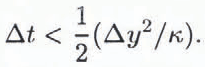
The dependence of thermal diffusivity on temperature is weak and, hence, is not considered here. Equation (2) was solved using the explicit finite-difference method (Reference SmithSmith, 1978; Reference Mitchell and GriffithsMitchell and Griffiths, 1980) by running a time-dependent model until transients were small. The calculations were done using a one-dimensional grid with 2 m intervals Δy The time steps Δt were chosen to meet the stability criterion (Reference MortonMorton, 1980):
A steady-state situation

-
(1) Constant surface temperature Ts = –14.1°C, as selected to fit the lower half of the measured profile.
-
(2) Thermal diffusivity as a function of density according to Reference PatersonPaterson (1981, p. 186, equation 1) and Reference Haeberli, Schmid and WagenbachHaeberli and others (1988, fig. 2).
-
(3) Bottom temperature gradient of the ice.

-
(4) Vertical surface velocity vy(y0) = l myear−1 according to the stake survey: the vertical velocity profile described in Reference Haeberli, Schmid and WagenbachHaeberli and others (1988) was used to include effects due to firn compaction:
where Η is glacier thickness, μ is ratio between surface density and maximum ice density, and λ−1 is scale-depth parameter of density increase (cf. Reference LingLing, 1985). -
(5) In view of the various complications involved (e.g. three-dimensional effects, horizontal gradient of gcothermal heat, incompleteness of velocity and temperature input data), frictional heating (Q) was calculated in a simplified way (έ is strain rate, T is shear stress):


where y is local depth and α is surface slope along the main (lower) part of the flowline,

(Reference PatersonPaterson, 1981 p. 39).
Figure 6 compares the measured (dots) and the calculated temperature profiles (solid line). Measured and calculated values remain within measurement accuracy (0.2°C): the calculation strongly suggests that the measured profile at Colle Gnifetti is close to a steady state. The curves v0.5) and v1.5) are results of a model run with v(y0) = 0.5 and 1.5 to show how the temperature profile is influenced by changes in the accumulation rate and submergence velocity without changing the geometry. In reality, average accumulation rates may have varied by less than ±20% with a slight tendency towards a 10% increase during the 20th century (Reference Schotterer, Haeberli, Good, Oeschger and R>öthlisbergerSchottcrcr and others, 1981, fig. 6). The chosen range of ±50% is therefore extreme and, hence, also illustrates the uncertainty range of the calculation due to other effects (such as, for instance, more complicated velocity/depth functions). By considering the two extreme values for the accumulation rate, the obtained temperature difference at the bottom is about 0.5°C. It can be concluded that changes in the accumulation rate have a small effect on the temperature profile and, therefore, the temperature field in this area is primarily governed by the surface temperature. The influence of secular thickness changes cannot realistically be investigated due to the lack of quantitative input data. From the reconstructed history of 20th century accumulation rates (Reference Schotterer, Haeberli, Good, Oeschger and R>öthlisbergerSchottcrcr and others, 1981) and old photographs (Reference Haeberli, Schmid and WagenbachHaeberli and others, 1988), however, geometric changes of the firn saddle during the past century can be assumed to have been rather unimportant. The striking difference between the ncar-steady-state condition at Colle Gnifetti and the strong anomalies observed in firn-temperature profiles from the Arctic points to the fact that 20th century warming of cold firn was much less pronounced in the Alps than at higher latitudes of the Northern Hemisphere.
A two-dimensional model calculation was performed to obtain a general picture of the temperature field along the flowline. The two-dimensional stationary temperature field is governed by the equation:

Equation (3) was solved using finite differences (Reference RunchalRunchal, 1972; Reference Mitchell and GriffithsMitchell and Griffiths, 1980). A two-dimensional lattice was defined, with a horizontal grid interval Δx = 5 m and a vertical interval Δy = 2 m. The boundary of the area is given by polygonal lines defined by the corner points. The calculation was based on the assumptions of constant near-surface temperatures and a constant bottom-temperature gradient of 0.019°Cm−1. The velocity vector

The calculated temperature is shown in Figure 5. The isotherms are roughly parallel to the surface and basal temperature varies little in the saddle region, being below –12°C everywhere. The contribution of horizontal advection is small because horizontal temperature gradients are insignificant. In fact, even weaker three-dimensional effects (lateral advection at depth) may in-fluence the borehole in the saddle area rather than the two-dimensional advection along the flowline considered here (Reference Haeberli, Schmid and WagenbachHaeberli and others, 1988). It can therefore be assumed that horizontal advection is negligible with respect to temperatures in the saddle borehole.
Englacial temperature profiles for each month in the year. Inset: average annual surface-temperature variation at Colie Gnifetti as inferred from measured mean annual firn temperature in the saddle borehole (B 821) and air-temperature variations (monthly means) at Jungfraujoch.

Time-Dependent Evolution
In order to estimate how deep the seasonal variations in surface temperature affect the measured borehole temperatures, a model calculation was performed using monthly means of air temperatures as recorded at Jungfraujoch (3576ma.s.l, 46°33’N; Reference AellenAellen, 1988) and an annual mean surface temperature Ts = –14.1°C for the saddle borehole on Colic Gnifetti. Figure 7 shows temperature profiles for each month. Firn temperature obviously reaches melting conditions at the surface during daily cycles and under special energy-balance conditions only (radiation/wind; cf. Reference Beck, Wagenbach and MünnichBeck and others, 1988). Differences between annual extremes are 14°C at the surface, 1.5°C at 5 m depth, and less than 0.3°C at 10 m depth. Below a depth of 15 m, seasonal temperature variations do not measurably deviate from the annual mean any more. Based on this result, the uppermost two points of the measured temperature profile are considered to be affected by seasonal temperature variations and are therefore disregarded in the following discussion of long-term temperature changes.
The same one-dimensional model as described above was used in combination with a time-dependent surface temperature for estimating the influence of past and potential future temperature changes on today’s englacial temperature profile. In reality, surface temperatures are the result of the complex energy balance at the snow/atmosphere interface. Air temperature, however, is the only meteorological parameter for which reasonably long-term data scries exist. MAAT values were therefore used to estimate effects of changing surface-boundary conditions. 100 year time series of Grand St. Bernard (45°52’N, 2479ma.s.l.; main chain of the Alps) and Siintis (47°51’N, 2500ma.s.l.; northern slope of the Alps) in Switzerland, and Upernavik (73°N) in West Greenland are considered here (Smithsonian Institution, 1927, 1934, 1947; U.S. Department of Commerce, 1959, 1968, 1981, 1987; Reference SchüeppSchüepp, 1961). Deviations from the 100 year average (ΔΜΑΑΤ) are plotted in Figure 8. All three records show a trend towards increasing air temperatures at the secular time-scale, with some superimposed shorter-term (decadal) fluctuations. The warming trend, however, is less pronounced at Grand St. Bernard than at Säntis and Upernavik. To reproduce englacial temperature profiles at Colic Gnifetti from the available time scries of air temperature, model calculations were run on the assumption of steady-state conditions before 1880 and following the development of ΔΜΑΑΤ at Grand St. Bernard, Säntis and Upernavik for the period 1880–1980 as depicted in Figure 8. No changes in the accumulation rate and the geometry are considered because of lack of information. For the same reason, a steady-state assumption for the period before 1880 has been considered here; somewhat earlier beginning of secular warming at the end of the Little Ice Age may, in fact, have taken place but would only slightly influence the bottom part of the temperature profile (cf. Fig. 10). The effect of a change in the accumulation rate on the temperature profile can be admitted to be small, as shown before. The calculations were performed on the basis of (a) a constant surface temperature Ts (corresponding to the differences between ΔΜΑΑΤ1980, ΔAMAAT1980 and Ts1980) for the time before and up to 1880 to simulate steady-state conditions prior to recent warming trends, and (b) a variable surface temperature according to Figure 8.
Long-term aeries of the deviation of mean annual air temperatures at Grand St. Bernard (GSB), Säntis (S) and Upernavik (U). The three series have been smoothed with a nine-point binomial filter.

Measured (dots) and calculated (solid line) englacial temperatures for the drilling site at Colle Gnifetti. The label s.s. indicates the one-dimensional steady-state profile. The labels GSB, S and U indicate time-dependent calculations of firn-temperature profiles according to time series of ΔΜΑΑΤ from Grand St. Bernard, Säntis and Upernavik. All calculations are one-dimensional.

Equation (3) was numerically solved with boundary conditions:

with Kr = 3WK−1m−1 (Reference Drewry, Allen and JessopDrewry and others, 1984; cf. also Reference Vonder Mühll and HaeberliVonder Mühll and Haeberli, 1990) and Ki = 2.1WK−1m−1 (at 0°C; Reference PatersonPaterson, 1981), where Kr and Ki are the thermal conductivity of bedrock and ice. For the time-dependent case, thermal adjustment of below ground must be taken into account: the bottom boundary condition was therefore displaced from the ice base into the bedrock by a distance (several kilometers) which cannot be reached by surface-temperature variations within the considered time-scale. Figure 9 shows the measured (dots) and the calculated temperature profiles (solid lines). The line labelled s.s. shows the steady-state profile from which the time-dependent calculation for 1880–1980 was started. The lines labelled GSB (Grand St. Bernard), S (Säntis) and U (Upcrnavik) show the calculated profiles for 1980 with the non-stationary boundary condition as explained above. The results illustrate how air-temperature variation in the Northern Hemisphere over the past 100 years would have influenced borehole temperatures at Colic Gnifetti. The temperature profile calculated with the time series from Grand St. Bernard comes closest to the measured profile. This remains true if ΔMAFT is assumed to be 1.6 × ΔΜΑΑΤ as suggested in connection with altitudinal gradients (Fig. 2). The general offset of the calculated GSB curve from the measured profile is due to most recent effects still hidden within the seasonal temperature fluctuations; below 20 m, however, the profile is parallel to the measured one. This result suggests that mean firn temperature at the Colle Gnifetti drill site closely follows mean air temperature as measured at nearby weather stations and that Grand St. Bernard as well as Colle Gnifetti, both situated in the main chain of the Alps, are predominantly influenced by climatic conditions frequently connected to the Mediterranean area, where 20th century warming was less pronounced (Reference Meyer zu DüttingdorfMeyer zu Düttingdorf, 1978). The temperature profiles calculated with the time scries from Säntis and Upernavik illustrate effects of stronger secular warming. The corresponding differences in temperature gradient (and, hence, heat flow) with respect to the profile measured on Colle Gnifetti cannot be attributed to measurement uncertainties (cf. Tabic 1). Enhancing variations in ΔMAFT by a factor of 1.6, as discussed above, would make the differences even greater.
Measured (dots), steady-state (s.s.) and time-dependent temperature profiles on Colle Gnifetti following an assumed increase of firn-surface temperature by 1°C in 20 years until steady-state is reached again; all calculations are one-dimensional.

Temperature-time function for different depths on Colle Gnifetti following a surface-temperature rise of 1°C in 20 years until steady state is reached again (one-dimensional calculation).

Figure 10 shows model calculations of future englacial temperature profiles, assuming that the surface temperature rises by 1°C during the 20 years following 1980 and then remains constant. After this surface-temperature rise, a new steady-state situation will take about 10000 years to be reached. Figure 11 shows the time-dependence of the adaptation to the new steady-state situation for different depths. The calculated rates of temperature changes will be used for the design of a long-term firn-temperature monitoring programme on Colle Gnifetti.
Other scenarios of future warming could easily be considered. Such calculations would, however, not add significantly new aspects to the understanding of potential changes, because a number of uncertainties involved remain obscure. Especially, a better understanding of the interrelation between energy input at the surface, dust deposition, melt-layer formation, protection against wind erosion, accumulation and firn temperature should be reached (cf. Reference Alean, Haeberli and SchädlerAlean and others, 1984). Time-dependent balance, geometry and flow would have to be modelled as well as effects of three-dimensional flow. Such efforts require adequate data concerning time variations of glaciological parameters to be collected.
Conclusions and Perspectives
The borehole measurements given here and model calculations allow one to draw the following conclusions concerning thermal conditions at the Colle Gnifetti core-drilling site:
-
1. Mean surface temperature of the firn (near –14°C) is close to mean air temperature.
-
2. Influence of mcltwater in the firn is weak and limited to near-surface melt-layer formation under special conditions of radiation and wind (recrystallization infiltration belt of Alpine firn zones).
-
3. Firn and ice at the saddle borehole and along the flow-line leading to it are cold throughout with basal temperatures below –12°C and subglacial permafrost extending into bedrock by probably about 1 km or more.
-
4. Mean firn temperatures appear to reflect regional mean air temperatures — in this case as measured at Grand St Bernard in the main chain of the Alps.
-
5. In contrast to the situation in Arctic firn areas, borehole temperatures measured on Colle Gnifetti are close to steady-state conditions and, hence, do not exhibit striking signs of 20th century warming.
Attempts to deal with three-dimensional aspects of ice flow are presently being undertaken and detailed measurements of surface processes are also being carried out. A programme for monitoring englacial temperatures is presently being prepared.
Acknowledgements
Thanks are due to a number of colleagues but especially to W. Schmid for assistance in the field and P. Gnos for manufacturing thermistor chains. H. Blatter, A. Iken, J. Schweizer and D. Wagenbach critically commented on the manuscript. We also thank two anonymous referees for helpful suggestions. B. Ncdela prepared the drawings, S. à Marca helped with word processing, and S. Braun edited the English.



