


Asylums’ adoption of printing and periodical publishing from the late 1830s was related to two major developments on both sides of the Atlantic: the growing accessibility of print and printing presses and the spread of the moral treatment of insanity. As the periodical press permeated daily life, and printing equipment became cheaper and easier to use, the introduction of presses into asylums was a practical move. The presses served multiple purposes: recreational, therapeutic, as well as administrative. This chapter identifies various factors that contributed to the introduction of printing in asylums and addresses concerns about the exploitation of patients’ labour hidden behind the theory of moral therapeutics. It also reflects on the symbolic meaning of the press, its association with civilisational progress, and the influence of such ideas on the early adoption of periodical publishing in America and Scotland. While presses were almost never bought solely for patients’ benefits, they offered novel opportunities for inmates to exercise initiative and agency as partners in the development of early psychiatry, as well as civilisation.
Buying printing equipment was a financial commitment that publicly funded mental institutions could not always afford or justify. Requiring nothing more than paper and writing tools, manuscript periodicals were much easier and cheaper to produce, and several nineteenth-century asylums had handwritten periodicals before or instead of printed ones. Apart from the ‘Bethlem Star’ of Bethlem Royal Hospital, which ran for as long as five years (1875–1880), manuscript periodicals were more modest and short-lived projects than their printed counterparts. Their readerships were significantly smaller, restricted to fractions of the institutional populations. The ‘Glasgow North Briton’ (1835–1836) of the Glasgow Royal Asylum was ‘generally circulated among [the institution’s] reading Patients’.1 The ‘Illuminator’ of the Pennsylvania Hospital for the Insane, was equally exclusive: ‘It was issued on a very large sheet, in beautiful manuscript, but as it was a part of the editorial duties to transcribe the whole, only three copies were prepared, and they [were] intended for the inmates of the house, and its officers.’2 The ‘Illuminator’ is the only English-language manuscript title that seems to have survived, though access to its copies in the Pennsylvania Hospital Historic Collections is currently closed.3 It was launched on 1 April 1843 and was issued every Saturday. Around 15 July, a second ‘volume’ was started. While still consisting of a single folio, its pages expanded from 12 × 8 to 15.5 × 10 inches. It continued until at least 12 August of that year.4 The fragility and limited circulation of manuscript periodicals restricted their use, but their successful execution and popularity among the asylum populations often inspired more ambitious projects, motivating physicians to invest in printing presses or come up with alternative arrangements for publishing periodicals. Such were the cases of the ‘Asylumian’, which preceded the Opal in the New York State Asylum, and the handwritten predecessors of Under the Dome of Bethlem Hospital.5 The Gartnavel Gazette, discussed in Chapter 4, also had its beginning as a handwritten circular.
It is hardly a coincidence that the first asylum periodicals were conceived precisely when printing of various scales became more accessible. The proliferation of periodicals in the nineteenth century corresponded with the diversification of both readers and print producers. As printing presses became cheaper, portable, and easier to use, the mass publishing industry was complemented by a rapidly developing small-scale and amateur press that catered to communities of various natures and sizes. Politically and socially marginalised groups (such as racial and ethnic minorities), local literary societies of labourers and artisans in Britain, American pioneers, businessmen and young literary aficionados, and ship crews scattered in distant corners of the world all employed the press for various purposes, such as self-representation, self-improvement, education, and entertainment.6 Though asylum periodicals were often portrayed as ‘literary curiosities’ in the press, in this context, mental institutions appear as hardly exceptional sites of publishing.
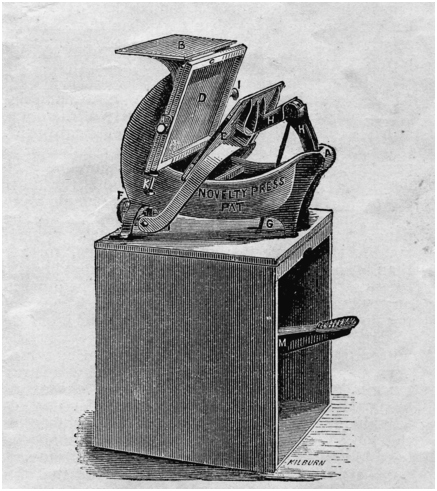
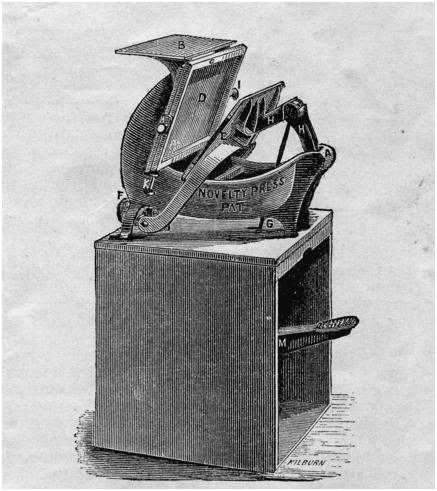
There is little evidence of the types of presses that mental institutions employed for producing periodicals. The needs of asylum publishing hardly required the speed and efficiency of steam presses, so hand presses were the preferred choice. Size and type, however, varied in response to an ever-growing choice and depended on the needs and resources of the institution. The Meteor of the Alabama Insane Hospital is the only periodical that discloses details of its technical production. It was printed on a Quarto Novelty Press, like the one shown in Figure 1.1.7 It was known as a cheap, compact, and easy-to-use piece of machinery, or, in the words of its distributors, the ‘best amateur printing press yet invented’.8 Dr William Hutcheson, the superintendent of the Glasgow Royal Asylum, vaguely described the press that produced the Chronicles of the Monastery as ‘a small press’, not suitable for printing the annual reports in-house, and he explained that the institution could not afford a bigger machine.9 In comparison to these machines, the one housed in the New York State Asylum printing office must have been significantly bigger and sturdier. At the end of 1851, it was able to print 1,230 copies of the monthly Opal, in addition to the American Journal of Insanity, which had international distribution.10 The choice of type and size of the press thus depended on the financial situation of the institution as well as the intended purposes and publishing scale.
Quarto Novelty Press, like the one used for printing the Meteor of the Alabama Insane Hospital. Its various parts are labelled with letters from A to M.
Institutional and Therapeutic Uses of Printing Presses and Periodical Publishing
Compared to their handwritten counterparts, printed periodicals were more ambitious attempts to engage diverse readerships. The complexity of their production posed challenges, but they presented more opportunities too, both for individual patients and institutions. Produced in large numbers (up to a few thousand copies), they were often distributed outside institutions, generating profit or inciting exchanges with the outside world. The introduction of presses into asylums served various recreational, therapeutic, and administrative purposes. Asylums that featured printing or periodical publishing tended to be run by physicians who advocated the moral treatment and the healing power of work and amusement. Though farming and gardening were the most common forms of occupation, the therapeutic activities had to ideally be selected with care. In his report for 1843, Dr William Rockwell of the Vermont State Asylum for the Insane (also known as the Brattleboro Retreat) observed that:
We find that patients recover sooner by employing them in their former occupations, than in those to which they were never accustomed. It seems to awaken their former associations, and the mind is more readily drawn into its natural current of thoughts and ideas – leaving its late wild and extravagant notions.11
As print trade professionals and amateur enthusiasts were admitted into asylums, superintendents had to consider acquiring presses or coming up with other arrangements for offering suitable employment.12
Though publications’ purposes varied, therapeutics is frequently mentioned among them. Periodical publishing was a particularly valuable activity, providing work as well as recreation. Both writing and printing could promote healing through distraction, as Dr Rockwell’s reflection on the Asylum Journal suggests:
The publishing of the Journal has greatly contributed to the employment, comfort and restoration of our patients. It has furnished agreeable employment to many. Several have recovered while engaged in printing. Many have been diverted from their delusions, while writing or selecting for the paper. Few can write, but many can select for the same. And I know of nothing better calculated to arouse the insane from their listless inactivity, or fix the attention from wandering to different subjects, than writing or selecting for a weekly periodical.13
Patients themselves perceived publishing as restorative. After his discharge from the Royal Edinburgh Asylum, printer-poet Alexander Smart (1798–1866) described the work for the Morningside Mirror as ‘an excellent and beneficial hobby for such of the patients as were smit with a love for scribbling, or whom the gods had made poetical’.14 As I have argued elsewhere, he also expressed a firm belief in the benefits of the physical exertion required by activities such as printing:
From my observation of the dreamy life of inaction in the eastern house, resulting from the higher class of patients in that department not being inured to, or capable of, manual labour, I think the chances of recovery there are much less than in the western house [where the poorer patients resided].15
Keeping the body and the mind busy was therefore at the core of therapy, as the healing potential of occupation was attributed to the distraction from the suffering it provided.16
A complex process, involving multiple steps and requiring focus, skill, and physical effort, printing could be an especially absorbing type of employment. Like writing and editing, it demanded concentration and good knowledge of spelling and grammar. However, setting the type on a composing stick was a skill that took time to master, especially if one wanted to do it with speed and accuracy. Fitting the type and the furniture, locking the chase, and then operating the press at the right pressure required further training and physical strength. Knowledge about the maintenance of the press, the type, and the other utensils was also necessary to ensure the good quality of the final result. In the fast-paced commercial printing office, this work was often stressful and detrimental to printers’ physical and mental health: by the mid nineteenth century, printing was already associated with respiratory disease, lead poisoning, exhaustion, and alcoholism.17 But in the asylum, publishing could transform into a therapeutic activity in which patients engaged willingly, even if they had no previous experience.18 Judging from the Gartnavel Gazette, discussed in detail later in this book, enthusiastic patients could develop their printing skills quite quickly. The first issue of the Gazette appeared a little over a month after the untrained gentlemen behind it requested to use the press.19
The consumption of periodicals was also considered to have healing potential. In the same report that mentions the Glasgow Royal Asylum’s acquisition of a printing press, Dr William Hutcheson depicts reading as an activity ‘calling forth and exercising the moral and intellectual powers and preventing the Patient from brooding over his own morbid thoughts’.20 As Laura Blair has recently shown, medical professionals and inspectors saw reading provision as fundamental to the good management of asylums. Suitable reading material in asylums became part of the curative institutional environment: ‘“Good” books took on a similar function to paintings, statues, plants and other decoration as objects which encouraged self-control and rational behaviour, promoting patient recovery.’21 As Blair suggests, not all reading was beneficial: physicians selected carefully the reading material with which patients engaged.22 Sensationalist accounts of crime, war, and death in the press, for instance, could be detrimental to patients’ well-being.23 As a result, in the early years of the moral treatment period, staff in several asylums took measures to limit patients’ exposure to distressing or otherwise ‘unhealthy’ reading.24 These practices affected asylum periodicals too: a patient’s account of a murder was excluded from the copies of the Morningside Mirror that were circulated internally.25
Regardless of these caveats, newspapers and periodicals were widely distributed in nineteenth-century mental institutions. According to Dr William Rockwell of the Vermont Asylum, periodical publications were unique in their provision of healthy and engaging reading matter for a wide audience: ‘Our newspapers furnish a kind of reading which is not found in books. Many will look on a newspaper, and read here and there an article, who would not open a regular treatise.’26 Newspapers and periodicals were perceived as better suited to the distractable minds of patients, as their contents were served in shorter portions, did not require linear perusal, and discussed various topics. Asylum periodicals thus provided additional reading, while also having the added value of being produced by fellow patients. As sources of entertaining reading and healthy occupation, the publications were well-suited to serve the purposes of the moral treatment.
The uses of printing equipment in asylums were not limited to therapy, as an article in Excelsior of the Murray Royal Asylum suggests:
in many Asylums there are Printing Presses [italics in original]; sometimes intended only for the use of the Establishment, as in the larger English Pauper Asylums; in other cases, established for the benefits of the Patients, as in Edinburgh and Dumfries; and in a third class, used for both purposes, as at Hanwell.27
The beneficial purposes of the presses referred to here are related to the publishing of patients’ writing: the author hints at the Morningside Mirror at the Royal Edinburgh and the New Moon at the Crichton Royal Asylum, as well as the ‘printing press at Hanwell Lunatic Asylum, at which the printer lunatics print the blank forms used in the house, and also the effusions of the mad poets’.28 While this statement suggests that the acquisition of presses was often motivated by interests in patient’s welfare, it also highlights the fact that presses were acquired for institutional uses – for printing admission forms, certificates, annual reports, and other documents and publications.
In fact, printing machines were rarely employed solely for patients’ benefits. The second-hand press at Hanwell was purchased at the suggestion of a house surgeon, Dr Begley, who ‘pointed out the practicability of usefully employing several Printers who are at present Patients in the Asylum’.29 The press was originally used to print out the blank forms for the asylum, before issuing the creative work of patients. The presses at the Royal Asylums that Excelsior describes as solely ‘recreational’ were used for administrative printing too. When launched in 1844, the New Moon of the Crichton was printed externally. The purchase of a press in 1847 and a generous donation of type by J. and W. McDiarmid of the Dumfries Courier in 1852 enabled the Crichton Institution to publish both the New Moon and its annual reports in-house.30 Between 1847 and 1852, however, patients operated the press to produce a library catalogue and programmes for concerts, plays, and other cultural events in the asylum.31 After acquiring a press in 1845, the Royal Edinburgh Asylum used it both for launching the Morningside Mirror and for producing ‘schedules, diet lists, &c.’, as well as the annual reports.32 Asylums that acquired presses thus rarely used them solely for patients’ publications. Administrative printing and smaller jobs were often the primary, or at least an equally important, function.
In-house presses allowed establishments to cut some of the operational costs. Studying the Opal of the New York State Asylum, Maryrose Eannace has observed that ‘the coincident residency of a patient who was also a professional printer would have helped improve the economic feasibility of publishing a patient-written periodical’.33 As the acquisition of a press was frequently motivated by the presence of people who could or were willing to learn how to operate it, there was hardly a coincidence. Rather than paying external printers, asylums could invest in printing equipment and get patients to produce all their documentation and publications, as well as patients’ periodicals, at significantly reduced costs. Patients were not oblivious to this aspect of their ‘treatment’. An 1883 press account of the work conducted in the printing office of the New York City Asylum on Wards Island reveals that: ‘one poor fellow, who used to be on the Sun, looked up from his case and announced that the Herald would pay at least forty-six cents per “em” for such extra type-setting. In a moment the whole room had stopped work, and long explanations were necessary to avert the strike.’34 Relying on ‘the steam-power used in the laundry’, the asylum’s printing office was at the time catering to the needs of the Department of Public Charities and Correction of New York City.35 In practice, this meant supporting the operations of eight hospitals, five asylums, an alms house, an orphan asylum for Black children, two workhouses, a penitentiary, the city prisons, and a few more agencies and establishments.36 The discontent of patients, who had previous experience of publishing and an awareness of the rates of pay for that kind of labour, is hardly surprising.
Evidence about patients’ monetary reward for their printing and publishing work is not readily available, but there are indications that some of that labour was paid. The publication of the Retreat Gazette in the Hartford Retreat in Connecticut and the Gartnavel Gazette in the Glasgow Royal Asylum was motivated by the printers’ desire to support their families, but the achievement of these goals is uncertain. Dr Mackinnon’s 1844 report on the governance of the Royal Edinburgh Asylum mentions a ‘small remuneration which can be afforded for work done in the asylum—an increase of which is to be included in our desiderata’, but it also states that the compensation ‘only meets certain cases, and those not adequately’.37 The success of the Conglomerate of the Middletown Homeopathic Hospital in New York State resulted in patients’ remuneration, though the superintendent’s report for 1891 reveals that patients’ choice how to spend their earnings might have been limited: ‘Financially, it [the Conglomerate] is not only self-supporting, but it is helpful to its workers in that it gives to those who do the manual labor such compensation that with their earnings they have been enabled to clothe themselves, thus saving expense to the State or to their friends.’38 Not all patient-printers necessarily needed or wanted to be remunerated for their work. Operating the press was taken up by some, usually higher-class, paying patients as a hobby. Such an example is James Buchanan and his gentlemanly circle who launched the Gartnavel Gazette (see Chapter 4). Alexander Smart, a working-class poet and printer, also saw his work for the Morningside Mirror as ‘a pleasant source of recreation’.39 Whatever provision there was for patients working in the printing office, it was less costly than relying on the regular services of external printers.
With that in mind, the motivations behind institutions’ acquisitions of presses appear suspicious. Doubts about the exploitation of patients’ labour and wrongful confinement have been expressed since the nineteenth century, and printing, as a form of work, should be interrogated as well. According to Erving Goffman, the promise of therapy and improvement masks the reality that work in mental institutions ‘derives from the working needs of the establishment’.40 Patients’ work was often resorted to as a means for sustaining asylums and, in certain cases, generating profit. This applies especially to the second half of the century, when increasing demand resulted in massive, overcrowded, and underfunded institutions, many of which shed their therapeutic purposes altogether and transformed into what Waltraud Ernst describes as ‘self-supporting if not lucrative manufactories or agricultural enterprises’.41
The history of asylum periodicals occasionally raises similar concerns. As patient-printers provided useful and low-cost services, letting them leave, especially when there were no competent substitutes, ran against institutional interests. Patients such as the editors of the Meteor and the Gartnavel Gazette openly declared that their printing skills were the sole reason for their prolonged confinement. Revealing their stories later in the book, I will show that these concerns were not unfounded, but there were other aspects of their situations that affected their stay. A particularly alarming case is the home of the Opal, the New York State Asylum, which acquired a printing press in 1847 and by the end of the century functioned as a major printing office with five machines and a bookbindery, relying on patient labour.42 It served the needs not only of the host institution but of a dozen other state establishments, as well as the State Commission of Lunacy, several private hospitals for the insane, and medical publications such as the American Journal of Insanity and the State Hospital Bulletin.43
Indeed, patients occasionally printed physicians’ publications. In the 1850s, a copy of William Tuke, the Founder of the York Retreat by his great-grandson and physician at the Retreat at the time, Daniel Hack Tuke, was sent to Edinburgh phrenologist George Combe, bearing an inscription disclosing that the volume was printed at the Retreat ‘by a deaf, dumb, & insane patient’.44 Asylum periodicals themselves advertised their institutions to the public and presented their superintendents as knowledgeable experts in the treatment of madness, hence attracting funding, donations, and new patients. The Asylum Journal (1881–1886) of the Public Lunatic Asylum for British Guiana is worth mentioning as an example of a periodical that was invested exclusively in the promotion of the institution and its superintendent. Printed by inmates, it was written entirely by Dr Robert Grieve and contained his accounts of the operations of the asylum and his reflections on the treatment of insanity.45 These examples reveal potential for exploitation of patients’ free or low-cost labour for the benefit of asylums and medical professionals – an issue that will be repeatedly addressed throughout this book.
Interpretations of patients’ work solely as abuse, however, obscure contemporary attempts to counteract exploitative or repressive practices, as well as positive experiences of working in the printing offices of institutions. Dr William Lauder Lindsay (1829–1880), physician superintendent of the Murray Royal Asylum in Scotland and editor of its periodical, Excelsior, was a vocal opponent of any attempts to take advantage of patients’ labour and rely on it for financial benefits:
Some authorities go the length of asserting that a pauper Asylum, with a sufficiency of farm land, should be self-supporting. But this is probably an extreme view, one based on the idea of economy or the interests of the ratepayer, rather than on that of cure or the interests of the patient. It should never be forgotten that the chief object of an Asylum is the cure and comfort of the insane, and all questions of economy and profit should be subsidiary or subservient to this grand aim and object.46
This recognition of malpractice and advice against it shows that the failings of the asylum system were not necessarily rooted in neglect or ill-meaning intentions.
Furthermore, the use of patients’ labour in asylum printing offices in the pursuit of institutional or physicians’ interests does not mean that patients did not benefit from their work, either directly or indirectly. During Dr Amariah Brigham’s governance of the New York State Lunatic Asylum in Utica between 1842 and 1849, patients evidently participated in the running of the institution and in the broader mission of promoting better understanding and treatment of insanity. In his report for 1844, Dr Brigham expresses ‘great obligation’ to patients for their writing work, revealing that ‘in drawing up this report four different patients have been employed as amanuenses’.47 In 1847, eight out of the eighty-six employees of the asylum were former patients, suggesting their willingness to remain and support the institution past their discharge.48 Printing equipment was purchased in the spring of the same year and was set up by patients themselves. The first productions of the press were institutional documents and publications: ‘numerous blanks and small bills for the Asylum, … an edition of the “Act to organize the State Lunatic Asylum,” also an edition of the “Rules and Regulations and By-Laws adopted by the Managers,” and the October [1847] and January [1848] numbers of the “American Journal of Insanity.”’49 There are indications, however, that this work was not necessarily forced upon the patients, nor driven solely by institutional interests. While some of the inmates involved were printers by trade, Brigham mentions two who at the time were learning how to use the new equipment – a process requiring some degree of autonomy and self-motivation.
The involvement of patients in the publishing of the quarterly American Journal of Insanity is also worth discussing. Though considered the first psychiatric medical journal, its early statements of purpose had an egalitarian ring to them. The aim stated in the first issue was ‘to popularize the study of insanity, – to acquaint the general reader with the nature and varieties of this disease, methods of prevention and cure’.50 It also suggested its usefulness to ‘members of the medical and legal profession, and to all those engaged in the study of the phenomena of mind’.51 Its openness to diverse audiences, including the general public, is understandable, considering that at the time psychiatry was yet to establish itself as a specialist subject. By the fourth volume (1847–1848), however, the Journal’s objective was redefined: It claimed to have been ‘established to benefit the Insane by extending a knowledge of their wants and claims’.52 Patients’ involvement in the printing of the Journal at the same time is hardly coincidental, especially since the first patient-made issues also contained patient’s contributions, such as a poem by ‘J. M. B.’ titled ‘The Maniac’.53 In her detailed exploration of the New York State Asylum’s magazine, the Opal, Maryrose Eannace observes that patients’ writing, such as letters and personal accounts, featured frequently in the Journal under Brigham’s editorship, suggesting that he valued their contributions. She also shows that the launching of the Opal was likely his idea, though his death interrupted his plans.54 The publishing of a separate patients’ publication appears to have been the next step in a partnership between the physician and his patients, which, though unequal, could be mutually beneficial and founded on respect.
Contrary to Goffman’s argument that work in the institutions does not bring the same rewards as regular employment, such as just remuneration or respectability, printing and publishing periodicals in the asylum could have indisputable benefits for patients.55 As Vesna Curlic points out, ‘in the case of pauper patients, especially, their labour was a tool of agency, which allowed them to bargain for more luxuries which were beyond their means, otherwise’.56 Patients’ literary efforts usually resulted in higher status within the institution and sometimes created opportunities for recognition and personal and professional development beyond the asylum. Alexander Smart’s work for the Morningside Mirror secured him greater freedom of movement in the institution and access to the wards of the higher-paying patients.57 A contributor to the Meteor of the Alabama Insane Hospital, likely the editor, stated that he too had gained greater mobility: ‘He has now a key of his own and usually walks alone or attended with one or more dogs. He is free to confess that he enjoys his walks more since he could select their time and place.’58 Even if work in the asylum did not benefit patients in the same way as external employment, neither did it expose them to the same challenges and distress. In the asylum, Smart ‘was given a chance to retreat from the taxing life of a professional printer and rediscover the pleasure of practising his art in a relaxed setting, without the pressures of the marketplace’.59 His and several of the other case studies in this book suggest that work in the asylum could be a source of pleasure, healing, and a sense of fulfilment.
The privileges that working as a printer or an editor of a periodical secured within the institution, however, were conditional and could be lost. The freedom of movement that periodical editors enjoyed, for instance, was likely tied to the successful performance of their literary work. If they were to write about institutional life, they needed greater access to the grounds and to all the events that took place in the asylum. Eannace has suggested that the special status was contingent on patients’ productivity. In her discussion of one of the printers of the Opal, she notes that, while industrious in the printing office, the patient was kept in the ‘posher’ first hall of the New York State Asylum, but he was ‘demoted … to a lower hall when he ceased being competent in his printing work at the asylum’.60 She argues that this movement replicated social realities outside the institution: the inability to prove professional competence or compete in the market cost one their social standing.61 Such institutional ‘demotions’ could however be driven by factors unrelated to patients’ productivity too, such as their behaviour towards staff and fellow patients. The implementation of work in different institutions varied, but in my view of the early applications of the moral treatment, I side with Jennifer Laws’s statement that ‘the broader ethic of work apparent in the retreats owed little to the developing consciousness of the capitalists’.62 In Alexander Smart’s case, the Royal Edinburgh Asylum allowed him to demonstrate his professional expertise and receive meaningful rewards that promoted the restoration of his confidence in his own abilities.63 In the liminal space of the asylum, the very meaning of work could change, making it hardly distinguishable from a pleasurable and aspirational recreation. It is therefore important to recognise patients’ compromised position in institutions, while leaving room for positive or more nuanced experiences.
Symbolic Uses of the Press
‘The newspaper,’ one author in the Asylum Journal of the Vermont Asylum wrote, ‘is the chronicle of civilization, the common resorvoir [sic] into which every stream pours its living waters, at which every man can come and drink; it is the newspaper which gives to liberty its practical life – its constant observation – its perpetual vigilance – its unrelenting activity’.64 Launching periodicals was not only a practical decision but also a symbolic act for patients and physicians alike. In The Politics of Language, Olivia Smith argues that in the late eighteenth century, ‘civilisation was largely a linguistic concept, establishing a terrain in which vocabulary and syntax distinguished the refined and the civilized from the vulgar and savage’.65 As a key medium of language in the nineteenth century, print assumed a central position in the cultural imagination, representing civilisational progress, enlightenment, and liberation. These associations were consolidated by growing literacy rates, access to education and proliferation of printed materials, leading Alexander Smart to call the press ‘a giant of power’ in one of his poems.66 Cheap, widely circulated, and sustaining consistent readerships through its regular appearance, the periodicals became a powerful manifestation of print. Its role in national identity formation imbued it with additional cultural significance, as the following quote from the 1860 United States census suggests: ‘Among the elements which determine the characteristics of a people, no branch of social statistics occupies a more important place than that which exhibits the number, variety, and diffusion of newspapers and other periodicals.’67 The idea that the press was at the heart of every civilised nation impacted the emergence and spread of publishing in asylums and can also suggest explanations for the phenomenon’s popularity and early spread in Scotland and the United States.
In 1853, Dr Isaac Ray, one of the founding members of the Association of Medical Superintendents of American Institutions for the Insane, attributed the spread of insanity among Americans to the advanced state of civilisation they had achieved:
The press and the rostrum, the railway and the spinning-jenny, the steam-engine and the telegraph, republican institutions and social organizations, are agencies more potent in preparing the mind for insanity, than any or all those vices and casualties which exert a more immediate and striking effect …. The present is an age of great mental activity, all over Christendom, and especially with us …. Here is no standstill.68
Ray’s commentary is part of a broader discourse on progress that was widespread in Britain, Europe, and America. As Bonea et al. have argued, nineteenth-century journalistic, literary, and medical writings repeatedly conveyed ‘perceptions of increased “velocity” in thought and action, of wear and tear on the brain, [as] part of an emerging diagnosis of the problems of modernity’.69 British and American physicians enthusiastically championed the thesis that insanity was a side effect of rapid civilisational progress. Medical writers often named technological development, wider access to education, increased social mobility, and ceaseless competition as risk factors for intellectual and emotional overexertion. The unmanageable dispersion of print was also a major risk factor, as Ray explains:
No single incident of civilization has contributed so much to maintain the mental activity of modern times, as the art of printing, and at no period since its invention have its benefits and its evils been more widely diffused …. The multiplicity of books and of readers, not only evinces a degree of mental activity which, a century ago, would have been thought to be scarcely within the bounds of possibility, but much of the literature of the day is more or less directly addressed to the lower sentiments of our nature, thereby impairing that supremacy of the higher which is indispensable in a healthy, well ordered mind.70
Here, Ray expresses concern about both the quantity and the quality of reading material, while reinforcing the symbolism of the press as a vehicle of civilisation. His commentary also suggests that psychiatrists were keen contributors to broader discussions of reading in relation to health.71 By displaying expertise in distinguishing ‘healthy’ from ‘unhealthy’ reading, he underscores the profession’s importance in civilisational development: as Reiss has argued, they aspired to ‘doctor’ not only individual minds but also culture.72 Though official sources such as the 1871 census of England and Wales suggest that the ‘theory that insanity is a product of civilisation … is entirely unsupported by evidence’, insistence on the correlation between progress and insanity was key to proving the importance of the emerging specialism of psychiatry.73 That rhetoric positioned asylums as strongholds of civilisation and superintendents as their privileged guardians, prescribing sanity-preserving measures and guiding the insane back to reason.
Under the moral treatment, healthy, well-regulated mental occupation through cultural activity became a central point of physicians’ therapeutic programmes within and beyond asylums. Reiss interprets the phenomenon as ‘a sort of neocolonial cultural warfare’.74 According to him and other scholars, asylum periodicals contributed to a grand project of ‘civilising’ the insane, as they promoted ideals of refinement and civility. In his study of the Opal, Reiss argues that the very existence of the periodical of the New York State Asylum shows the intertwining of sanity and literary ability: ‘The history of the Opal (and related journals at other institutions) makes clear that the asylum authorities had an essentially literary model in mind when they imagined outcomes for their patients. To acquire the polite arts and to learn eloquence, disciplined reading, and correct composition were essential, not only for developing literary sensibility, but also for healthy character formation.’75 Turner makes a similar point about the New Moon, arguing that an institutional ideology of ‘refinement as wellbeing’ permeates the magazine – a ‘curative emphasis [that] equates intellectual pursuit with psychological improvement, [correlating] a heightened civility with developed sanity’.76 These models suggest a strictly top-down movement of initiative, however, neglecting patients’ own understanding and uses of print. A closer look at individual patients’ stories reveals a more complex reality.
In his classification of inmate adaptations to institutional reality, Erving Goffman lists behaviours such as withdrawal from interaction, refusal to cooperate, ‘conversion’ to the prescribed, and ‘colonization’ – the resourceful use of the limited resources available to construct a ‘stable, relatively contented existence’.77 Drawing on this categorisation of behaviours, Jessica Campbell shows how long-term patient contributors to the Morningside Mirror ‘colonised’ the institutional environment by creating ‘literary personae as a means of reconstituting their identities and [carving] out their own space within the asylum’.78 The cases discussed throughout this book show that patients used publishing for their own agendas and relied on the symbolism of the press to preserve their identity and self-worth. Furthermore, though publishing in asylums was indeed a ‘civilising’ project, the target was not only the insane. As I show in Chapter 7, patients could also employ the press to enlighten their sane readers – by interrogating the fundamental ideals of humanity, liberty, reason, and progress on which civilisation was allegedly built.
Discourses on insanity as the price of progress inspired intercultural comparisons. For instance, the authors of the British Manual of Psychological Medicine, one of the first psychiatric textbooks, argued that ‘the liability to mental disease is greater (other things being equal) in a civilized and thinking people, than in nomadic tribes, or in any race whose intellectual faculties are but little called into action. Knowledge brings with it its miseries as well as its blessing’.79 The civilisational classification shown here encouraged not only racial but also national comparisons, according to which insanity became a mark of high achievement. Thus, Isaac Ray argued that, unlike ‘the people of the old world’, Americans were more likely to go insane due to the mental strain of the ‘abundant opportunities that are offered for the pursuit of wealth, and the consequent variety and novelty of the enterprises undertaken for this purpose’.80 Here, Ray refers to the white population only: Black people’s mental illness was mostly invisible during the Antebellum period and was afterwards repeatedly misattributed to their inability to handle their emancipation.81 Later in the century, the belief expressed by Ray forged a new diagnosis – neurasthenia – perceived as a uniquely American phenomenon resulting from over-ambition and excessive stimulation of the nervous system.82 As Eannace points out, the understanding of insanity as a mark of distinction was not limited to white Americans: ‘the English had already staked out madness – most specifically, melancholia – as “the English Malady.”’83 American reframing of white insanity as a sign of cultural advancement should thus be understood as part of constructing a national identity distinct from England.
Similar nationalistic sentiments are found in Scottish psychiatric writings, which also reveal asylum periodicals’ role in the competition of civilisation. In the January 1878 issue of Excelsior of the Murray Royal Asylum in Perth, the superintendent Dr William Lauder Lindsay summarised the state of periodical publishing thus:
We point with some pride to the fact that these serials [the New Moon and the Morningside Mirror], which are 34 and 33 years old respectively, and are therefore, counted by man’s years, only in their prime – are both Scotch. It is singular that our sister country, which makes such a parade of the doings of its Asylums in the Times, Daily Telegraph, or other influential newspapers – metropolitan or provincial – cannot, or at least does not, produce a single Asylum serial! That such an anomaly should long remain a reproach against England [emphasis in original], which perpetually boasts that its Asylums are the first in the world, we can scarcely believe. For the richer, larger, wealthier, more powerful Asylums of England have for the last half century been following the lead of ‘puir Auld Scotland’ in all that constitute the essential features of what is now known popularly as the ‘Modern’ or ‘Humane’ system of Treatment of the Insane.84
Throughout its run, Excelsior made other comparisons between Scottish and English practice. In 1866, it observed that: ‘On the whole they [asylum libraries] seem far less common in England than in Scotland – a fact significant of the superior literary tastes of the Scotch people’.85 Taking stock of asylum periodicals in circulation in 1873, another article concluded that at the time:
three [titles] are edited in Scotland by Scotchmen: one by a Scotchman in England: and one by an Englishman in England. Ireland possesses none. We can account for the number of these literary journals issued in Scotland only by supposing that the ‘ingenium prefervidum Scotorum’ [italics in original] of the age expresses itself in literary effort, whether the mind of the community is in health or disease: that the Scotch, even when they have a ‘bee in their bonnets,’ exhibit in this way their superior education and their higher general culture.86
Excelsior represented periodical publishing as a civilisational achievement in which Scotland excelled. It suggests Scottish physicians’ drive to prove their superior professional ability through facilitating cultural and literary activity in their institutions. It also encouraged pride among the patients and staff of the Murray Royal and other Scottish institutions, by highlighting the importance of their publishing efforts.
In their construction of national identities, both Scotland and America pursued distinction from England through an ideal of universal education and social mobility. Nineteenth-century Scotland boasted a remarkable working-class literary scene and a widespread and active network of subscription and circulating libraries and Mechanics’ Institutes.87 Similarly, in America by the 1820s, ‘the republican standard of a politically informed electorate within a generally educated, moral citizenry had become a national mandate’.88 Publishing became an aspirational activity, a potent tool of self-improvement and social mobility. In her discussion of post–Civil War amateur newspapers, Jessica Isaac proposes that, while affluent youths treated newspaper publishing as a hobby and an opportunity to socialise, less privileged amateurs
were more likely to use amateur journalism to learn about writing, editing, and printing. Furthermore, they pursued amateur journalism to create meaningful social and professional relationships. They produced an amateur newspaper to groom themselves for middle class adulthood, to shape identities that would enable participation in spheres more privileged than those in which they had grown up.89
Resonating with the ‘lad o’ pairts’ myth in Scotland according to which any young man, however disadvantaged, could rely on accessible education to improve his station in life, the phenomenon demonstrates the importance attributed to periodical publishing and editing in America.90 Maureen Park and Robert Hamilton have suggested that the Scottish tradition of accessible education informed occupational therapy and cultural engagement in the Crichton Royal Asylum: it had a library, a museum, a theatre club, a rich programme of concerts, lectures, and entertainments, as well as a magazine.91 Similarly, Jill McMillan has suggested that the longevity of Crichton’s New Moon and the Royal Edinburgh’s Morningside Mirror was due to the ‘long standing tradition of literacy in Scotland or … the continued influence of useful knowledge movements in the country’.92 The ideal of universal education and the promise of social mobility through cultural activity did not necessarily match reality.93 The reiteration of these national narratives, however, was itself a source of motivation. As Weiss observes, ‘it’s not the point whether or not Scotland had superior literacy rates and education levels, or whether this national self-image was “true”, it’s what they believed to be true, which is more potent’.94 These aspirations to self-improvement through literary activity could be powerful stimuli for pursuing or encouraging innovative and experimental literary projects such as publishing in mental institutions.
Infused with nationalist sentiments, ideas of progress could have thus influenced periodical publishing in asylums. They might explain why the practice was picked up with particular enthusiasm in Lowland Scotland and the American Northeast: by 1860 there were six American, five Scottish, and only one English publication of High Beech Asylum in Essex, which has not survived.95 As I show in the following chapters, the launch of new titles often depended on patients’ initiative and the movement of staff and information between institutions. However, here I would like to suggest that Scottish and American physicians, as well as patients recognised the press as a symbol of progress and a potential source of prestige. The asylum periodical thus bore a particular cultural value. The fact that the titles known to date have been kept in institutional archives or have gained publicity through mentions in physicians’ reports, medical journals, and the press is significant. It shows that in these locations, asylum periodicals were considered especially important – enough to keep them running, talk about them, and preserve them throughout the years. Though other titles might be found in the future, it is unlikely that more printed asylum periodicals existed continuously without drawing attention. The launch of these publications tended to be celebrated with pride and enthusiasm by physicians and publicised in the press. The asylum periodicals that might resurface in the future will likely be publications that were distributed only internally, had small circulations, or were short-lived projects that lacked institutional support. Evident patterns in the distribution of asylum periodicals reflect processes of cultural self-representation and attribution of value, as much as potential local and national cultural differences and peculiarities. They reveal a comparatively greater enthusiasm among Scottish and American early psychiatrists to enable, promote, and participate in experimental publishing ventures in their institutions.
There are a few other country-specific factors that might have contributed to the early popularity of asylum periodicals in Scotland and America. Both countries had comparatively high portions of the population involved in publishing and the related trades in these areas. The proportion of the Scottish population involved in the book trade seems to have been especially high. Bill Bell estimates that ‘between 1841 and 1901, an average of 26 per cent more of the nation’s workforce was employed in the print and allied trades than in England and Wales, with Edinburgh showing a rate, on average, 68 per cent higher than London’.96 The print trade also grew rapidly in the big American port cities in the Northeast, where printing had to meet the pace of bustling commerce and demographic expansion. According to Allan Pred, ‘printing and publishing, with over 2,000 workers, was New York City’s single most important industry in 1840’.97 Growing numbers of people involved in publishing increased the likelihood of asylums receiving people with professional experience in the trade. That in turn promoted the launching of periodicals.98 Whether superintendents tried to cut institutional expenses or match patients’ professional occupation following the moral treatment’s principles, the presence of qualified printers was often used to justify the acquisition of printing presses.
In addition, the asylums that first adopted periodical publishing tended to reward patients with greater freedom of movement and to offer voluntary boarding, which was especially popular in Scotland.99 Several of the early publications (Retreat Gazette, Asylum Journal, New Moon) involved collaboration with local printers and patients’ use of their offices. In other cases, patients launched or supported the publications after their official discharge. Such was the case of Chronicles of the Monastery, which was started by a patient who had decided to stay in the Glasgow Royal Asylum as a voluntary boarder (see Chapter 3). William Shields remained in the Crichton Royal Asylum after his recovery and was hired as the official printer of the New Moon.100 William Selden George (1825–1881), discussed in greater detail in Chapter 2, launched the Asylum Journal at the Vermont Asylum while a patient but continued to print it after his release. A few years later, having left Vermont, he revised and published a selection of articles in a separate volume, titled Bedlamiana: or Selections from the ‘Asylum Journal’ (1846).101 The reproduction of the Journal’s contents at a time when George was no longer connected with the asylum indicates his appreciation for his literary work in the asylum and his ability to use both his experience in the institution and public interest in insanity to his advantage. These examples show patients’ initiative and autonomy, suggesting that they could also use the asylum and contribute willingly to the expansion of the press.
Naturally, patients’ participation in civilisation and its promises of liberty was limited. The American ideals of personal freedom and opportunity were in particularly stark conflict with the treatment of insane citizens who were stripped of their civil rights to vote, own property, and sign contracts. As Eannace observes in her discussion of the Opal:
the removal of at least some who are institutionalized from active participation in the American project abrogates the ideals of the project. In this vein, there continues to be much mention [in The Opal] of the loss of liberty and of citizens’ rights.102
Nevertheless, the fact that patients were offered platforms of expression, such as the Opal, shows that the ideals were not entirely divorced from reality. Though the asylum printing press often served institutional rather than therapeutic purposes, patients also recognised it as a powerful tool of influence and liberation. Reflecting medical, social, and literary ambitions, the publication and preservation of asylum periodicals are profound testimonies to the cultural value of these publications and the progressive aspirations of the institutions and patients that produced them.

 Open access