

Introduction
How do population characteristics affect the link between group identity and group politics? Research on identity and politics generally agrees that shared identity is important. For example, individuals are more likely to vote for a political candidate with whom they share a group identity (Bobo and Gilliam Reference Bobo and Gilliam1990). Key to this relationship are theories of racial context, which consider political outcomes as a function of the relative size of a group in an area. Prior work has found that attachment to group identity and political engagement among members increase as group size increases (Miller et al. Reference Miller, Gurin, Gurin and Malanchuk1981) and argues that group size is the driving force behind identity-related preferences. Thus, voting for co-racial candidates is not a function of shared identity per se but of the supply of co-racial candidates due to a larger population (Fraga Reference Fraga2016). However, research on context overlooks an additional factor: group diversity.
What happens when the group itself is relatively heterogeneous and comprised of different subgroups? As the size of the overall group changes, within-group population dynamics may complicate expectations about group identification and, consequently, political behavior around group interests. In the case of Asian Americans, there is documented variation in pan-ethnic identification relative to an individual’s national origin or ethnic identification (Lien et al. Reference Lien, Collet, Wong and Ramakrishnan2001; Wong et al. Reference Wong, Ramakrishnan, Lee and Junn2011). Understanding the consequences of within-group dynamics is crucial to understanding the role of group size in facilitating the connection between individual identity and political outcomes that have been extensively studied in prior research. This research, however, often takes for granted the role of group homogeneity. If national origin group boundaries are distinct, the salience of pan-ethnic identity may lessen due to divergent interests and attitudes of the different subgroups. Findings from prior work accounting only for group size may be masking important dynamics between institutional features and political outcomes.
This article examines group identification as a function of the group’s population context. I argue that accounts relying on a population-based explanation for group politics need to account for within-group heterogeneity in addition to size. In doing so, I unite two separate strands of literature, theories of context and theories of pan-ethnic identification, to provide a theoretical basis for understanding how and when pan-ethnic identities become meaningful. I focus on the Asian community in the United States and build on research that emphasizes the distinctions within the pan-ethnic label between national origin groups. Though the role of group diversity is an important consideration for any group that has sufficient subgroup differences, Asian Americans provide a robust benchmark for this exploration.Footnote 1 Cultural differences between Asian national origin groups are likely more salient given strong ties to countries of origin (Lee Reference Lee2015). Unlike other groups, Asians do not have a common non-English language, increasing the costs of navigating group divisions. Thus, Asian Americans arguably present a least-likely case for the emergence of pan-ethnic identity such that examining the effect of group heterogeneity is most notable in this setting.
To examine the relationship between population dynamics and Asian pan-ethnic identification, I analyze a typology of localities using two dimensions of population: group size and group diversity. Using Census population data, I create a measure of Asian group size based on the proportion of Asians in a locality relative to the total population. I also create a measure of Asian national origin diversity that captures the degree of heterogeneity within the Asian community in a locality. This 2×2 typology permits the following characterization of localities: places that are (1) Large Population and High Diversity, (2) Large Population and Low Diversity, (3) Small Population and High Diversity, and (4) Small Population and Low Diversity. Using original survey data, I then examine the potential institutions and social mechanisms that connect population dimensions to pan-Asian identification and compare their presence across the four types of localities. A key assumption in this theorization is that institutional structures and social relations reflect differences in group size and diversity in those places.
Using data from the 2016 Collaborative Multiracial Post-Election Survey (CMPS), I find that accounting for group diversity, beyond group size, reveals significant differences in pan-Asian identification among Asian respondents in different localities. While individuals in localities with a larger Asian population more strongly identify as Asian (as prior work would predict), there are diverging results when we account for the diversity of the Asian community. Places with larger Asian populations and higher levels of diversity report lower levels of identification and linked fate with other Asians. On the other hand, in areas with a lower level of national origin diversity (i.e., where one national origin group comprises a large proportion of the Asian community), Asian individuals express higher levels of group attachment. Second, results from a novel survey show that respondents in localities with large Asian populations and lower levels of diversity are more likely to report higher levels of community resources. However, we do not see similar discernible differences between localities for intergroup relations, highlighting the role of cultural resources and organizations in strengthening pan-Asian identity. In the following, I provide an overview of prior research on racial context and group size, describe and present analysis from the CMPS and a novel survey, and conclude with recommendations for future work studying racial context and identity.
Background
Group Identity and Context
Group identity is an important feature of politics. On the elite side, identity serves as a heuristic, filling in informational gaps about politicians’ ideology and policy preferences (Jones Reference Jones2013; Karl and Ryan Reference Karl and Ryan2016). For the mass public, shared identity can serve as a means of organizing collective interests, making coordination around group-related interests more feasible (Habyarimana et al. Reference Habyarimana, Humphreys, Posner and Weinstein2007). The ability of shared identity to organize political interests is particularly salient in the context of Asian American politics, given barriers to developing a pan-ethnic identity arising from differences in culture and language between national origin subgroups. Asian pan-ethnicity only emerged in the late 1960s among Asian student activists, many of whom were second-generation immigrants, when English became available as a means of communication and coordination (Espiritu Reference Espiritu1992).
The importance of Asian group identity is well-documented. Asian Americans are more likely to register and turn out to vote for an Asian candidate than for a non-Asian candidate (Leung Reference Leung2021; Sadhwani Reference Sadhwani2021; Uhlaner and Le Reference Uhlaner and Le2017) and are also more likely to view Asian candidates more favorably than non-Asian candidates (Schildkraut Reference Schildkraut2013). Experimental work attributes these relationships to the politicization of Asian identity (Junn and Masuoka Reference Junn and Masuoka2008). Behaviorally, stronger group identification may increase nonvoting political engagement, such as campaign contributions (Lien Reference Lien1994; Wong et al. Reference Wong, Lien and Conway2005). This body of work generally agrees that Asian group identity has political consequences, especially among stronger identifiers. However, these findings may conflate the factors that explain both pan-Asian identity salience and political outcomes by overlooking geographic factors.
A compelling line of research emphasizes the role of context in shaping politically salient identities and behaviors, primarily due to socialization processes facilitated by local conditions (Huckfeldt et al. Reference Huckfeldt, Plutzer and Sprague1993). Though scholars variously refer to “racial”, “social”, or “population” context, they are common in their characterization of salient place-based features. Context encompasses the structures and experiences that reinforce and inform an individual’s sense of identity and place in politics. In this way, group identification can be thought of as an expression of the very structures and experiences encountered on a daily basis in one’s locality.
Theories of context can thus be used to argue that identity itself is not necessarily the salient feature driving preferences and behaviors but local context. This is not to say that identity is unimportant, but rather that the presence of factors that encourage identification and group-oriented attitudes is likely confounded with population characteristics. For example, in places with a larger Asian population, we may expect there to be more community organizations that actively promote national origin or pan-Asian events, which may be why research finds stronger pan-Asian identification and political mobilization in those areas. Notably, extant work on context overlooks the role of subgroup characteristics and considering how divisions within a group may contribute to the documented effects of context on outcomes. This study characterizes two dimensions—group size and group diversity—within local context that structure the development and maintenance of Asian group identity.
Context and Group Size
Research studying the role of context usually measures it as the relative proportion of a racial group in a geographic area and has established a link between identity and population density of a group in a locality. Bledsoe et al. (Reference Bledsoe, Welch, Sigelman and Combs1995) find that Black Americans living in predominantly Black neighborhoods report greater racial solidarity. Lau (Reference Lau1989) outlines several similar explanations for why “social density” of a community matters for the maintenance and development of group identity, all of which suggest that the larger one’s group is, the more likely one is to identify with the group. Notably, Lau posits an upper bound to the effect of group size—when social density is high, we should expect less identification with the group because the need for a group identity decreases. Along these lines, Rim (Reference Rim2009) finds that the role of linked fate in mediating political behavior is attenuated for Asians who live in Honolulu, where a majority of the population is Asian.
Anoll, Davenport, and Lienesch (Reference Anoll, Davenport and Lienesch2025) provide guidance for understanding the means by which context matters by separating it into three types: geographic context (relative proportion within a geography), social context (the ties one has with ingroup members), and psychological context (self-reported closeness). By characterizing context in these varieties, researchers can be more specific about which features of context actually matter, whether it be the exposure to ingroup members, the social aspects of community, or psychological effects. Importantly, this conception of context parallels another strand that understands context as a function of local resources, broadly defined. Ethier and Deaux (Reference Ethier and Deaux1994) show that group identity is maintained by ethnic-oriented resources that affect an individual’s ability to think about themselves in terms of a specific group identity. However, they also find selection effects in the consumption of the resource based on whether one is a strong identifier (and thus more likely to access resources) or a weak identifier (and more likely to be threatened by the prevalence of resources). Wilcox-Archuleta (Reference Wilcox-Archuleta2018) demonstrates the importance of “ethnic stimuli” in a locality, highlighting the presence of and interactions with ethnic-named businesses and other co-ethnics as factors that increase the importance of group identity. This line of research emphasizes the importance of local structures in facilitating the types of interactions between individuals that either strengthen or weaken their attachment to a racialized identity (Lawler et al. Reference Lawler, Ridgeway and Markovsky1993; Jimenez Reference Jiménez2010). Sanchez and Masuoka (Reference Sanchez and Masuoka2010) further this argument by showing a positive relationship between social context and group identity importance. Similar to “ethnic stimuli” is a characterization of social capital in Zhou (Reference Zhou2009), which reflects the social structures and local institutions in neighborhoods that provide targeted resources to immigrant communities. Moreover, Okamoto (Reference Okamoto2006) emphasizes the importance of organizations and structural conditions that can promote or deter pan-ethnic coordination.
In addition to facilitating social interactions, these local structures may reflect targeted political efforts wherein community organizations are prime channels through which campaigns or targeted policy implementations can mobilize co-racial individuals (Cho et al. Reference Cho, Gimpel and Dyck2006; Nuamah and Ogorzalek Reference Nuamah and Ogorzalek2021). The consequence of these efforts has been well-documented: as the Asian population in an area increases, turnout among Asian voters also increases, often regardless of whether the candidate is Asian (Fraga Reference Fraga2018; Jang Reference Jang2009; Sadhwani Reference Sadhwani2022). Moreover, not only do turnout and participation increase, but so does symbolic representation of group interests from White politicians (Vishwanath 2024) and subsequent entry of Asian candidates (Fraga, Gonzalez, and Shah Reference Fraga, Juenke and Shah2020).
Beyond structural and social resources, there is ample evidence that local context often reflects salient social and psychological processes as a function of group size. The contact hypothesis, which argues that the growing presence of an outgroup often increases positive affect towards that group (e.g., Oliver and Wong Reference Oliver and Wong2003), though mixed (e.g., Bobo and Hutchings Reference Bobo and Hutchings1996; Enos Reference Enos2014; Key Reference Key1949), highlights the importance of interactions between racial groups as one grows in size. Experiences with discrimination, political mobilization, local community structures, and involvement in local networks all likely matter. Local context can be framed as a summary construct of exposure to others, potentially ingroup or outgroup, and of the politicized experiences that come about as a function of population dynamics. This framing naturally raises the question of variation in exposure: if we believe that the presence and the degree of presence of other groups are politicizing processes, then we must consider which groups one is being exposed to. Studies of context typically characterize ingroups based on racial background and overlook ingroups that may exist within a pan-ethnic group.
Accounting for Group Diversity
Undergirding the research on group size and context is the assumption that group identity is a coherent label and that population size is a sufficient metric for capturing group presence in politically-relevant contexts (e.g., electoral districts). The usefulness of group size as a measure is attributable to the relations between one’s ingroup and an outgroup. As a marginalized ingroup grows in size, incentives to coalesce around a mobilizable identity increase, usually in response to increasing pressures from a dominant outgroup seeking to maintain social order (Hainmueller and Hopkins Reference Hainmueller and Hopkins2014; Quillian Reference Quillian1995). Pan-ethnicity in this context emerges instrumentally in response to potential threats or incentives to group attachment. Moreover, the role of group size in increasing the saliency of physical or social resources in contributing to group identity makes sense when groups are relatively homogenous and face lower costs of coalition-building (Jang Reference Jang2009; Lien Reference Lien2004). However, what happens when the group itself is subjected to potential divisions? Asian pan-ethnicity complicates these assumptions, given the degree of heterogeneity in national origin (Okamura Reference Okamura2008)—whereas group size affects outgroup tensions, group diversity affects ingroup tensions.
Socially, diversity in a pan-ethnic community has implications for how connected subgroups feel towards each other and to communal identity. Whether the image of “Asian America” applies to an individual depends on where they stand within their community. Gay (Reference Gay2004) finds evidence showing that not only does group size matter, but so does the socio-economic status of the people in the group. Relatedly, Junn (Reference Junn2007) describes the process by which the image of Asian America shifted from “coolie to model minority” due in part to the influx of high-status workers after the Exclusion Act was repealed in 1965. Heterogeneity also potentially affects the nature of intergroup relations between individuals of different national origin backgrounds. As Okamoto and Mora (Reference Okamoto and Mora2014) articulate, pan-ethnicity is not static but rather a byproduct of “an inherent tension derived from maintaining subgroup distinctions while developing a sense of metagroup unity.” Someone who lives in a predominantly Chinese community may have a different conception of “Asian”, which may affect their attachment to the Asian identity, especially if they are not Chinese. While this may be a product of residential homophily (Kim and White Reference Kim and White2010), the consequence of geographic concentration and distribution of different Asian national origin groups in a locality can be observed in daily interactions with community members and neighbors (Sanders Reference Sanders2002). Findings from Cho et al. (Reference Cho, Gimpel and Dyck2006)—that local environments facilitate information flow, which is weaker in neighborhoods with greater concentrations of foreign-born residents—suggest that internal differences between Asian national origin groups have meaningful consequences. Individuals’ experiences within a community affect identity salience, especially depending on whether one is part of a dominant subgroup in their community and the institutions and resources their community has to facilitate information flow. The salience of pan-Asian identity and one’s attachment to it is a response to social incentives structured by local context.
Institutionally, whereas group size may affect whether a cultural organization is founded, group diversity may affect the type of organization that develops, whether it be one with a pan-ethnic focus for broad appeal or a focus specific to a national origin group. For example, Kim (Reference Kim2020a) shows that pan-Asian coalitions were more likely to form in localities where Asian national origin groups were larger and shared similar political interests, compared to places where subgroups were smaller. In turn, these resulting coalitions and organizations provide resources to support the interests of their local community (see Kim Reference Kim2020b; Okamoto and Gast Reference Okamoto and Gast2013). These resources vary in the degree to which they support pan-ethnic identity, depending on how the coalition was formed. Additionally, other forms of structural resources beyond community organizations can speak to the daily lives of residents in a community, spanning from the presence of ethnic restaurants and grocery stores to the visibility of non-English language writing on storefronts.
Expectations for Pan-Ethnic Identity Importance as a Function of Size and Diversity
Key to this article, diversity does not operate on its own. The theoretical expectations of how group size and group diversity affect pan-ethnic identity must be considered together. Prior work argues that higher levels of intra-Asian diversity and that national origin groups having sufficient numbers to organize on their own can subvert the realization of broader group interests at the pan-ethnic level (Chai Reference Chai2005; Chandra Reference Chandra2007; Espiritu Reference Espiritu1992). The risk of being miscategorized for a different national origin or racialized as just “Asian” can potentially create resentment towards other Asians, particularly when numbers are smaller (Flores and Huo Reference Flores and Huo2013; Steele Reference Steele1997). Thus, any theory of local context and group identity necessarily needs to be interactive, accounting for both group size and group diversity.
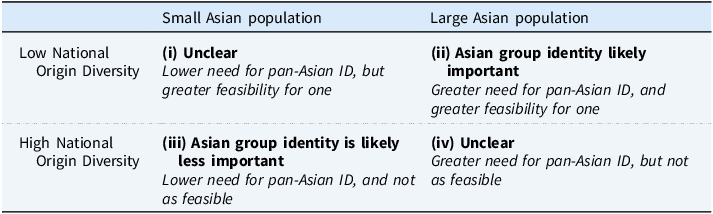
This body of research can be summarized by Table 1, which organizes locality types as a 2×2 matrix defined by Asian population size and national origin diversity. Research on context has largely focused along the column dimension, comparing places based on the size of the Asian community. Pan-Asian identification can reflect a need for identity-relevant resources, which are more available with increasing population size. Moreover, increasing the group size of a minoritized group increases the relevance of a group identity with respect to racial outgroups. In areas with relatively smaller Asian populations, opportunities for the emergence or presence of structures that promote a collective group identity are limited compared to areas with larger populations, where individuals are more likely to encounter other Asian individuals and where pan-Asian and ethnic organizations are more likely to be established.
Two dimensions of place: locality types and Asian group identity

Table 1. Long description
A table categorizing locality types based on Asian population size and national origin diversity. The table has two columns and two rows. The columns are labeled Small Asian population and Large Asian population. The rows are labeled Low National Origin Diversity and High National Origin Diversity. Row 1: Low National Origin Diversity, Small Asian population: Unclear. Lower need for pan-Asian ID, but greater feasibility for one. Large Asian population: Asian group identity likely important. Greater need for pan-Asian ID, and greater feasibility for one. Row 2: High National Origin Diversity, Small Asian population: Asian group identity is likely less important. Lower need for pan-Asian ID, and not as feasible. Large Asian population: Unclear. Greater need for pan-Asian ID, but not as feasible.
National origin diversity shapes whether pan-Asian identity is feasible as a coordinating frame among Asian subgroups. More diverse communities will need to overcome greater costs to coordination compared to more homogeneous communities. However, these costs are also a function of the size of the pan-ethnic group. In areas with large and homogenous Asian populations (cell ii), pan-Asian identification is most likely to be meaningful, as the larger group size increases the presence and viability of Asian voters and homogeneity permits easier coordination around a shared identity. In contrast, in places with smaller Asian populations that are more diverse (cell iii), pan-Asian identity may be less meaningful because the smaller group size makes it difficult to develop structures to support a pan-Asian identity across all subgroups.
Cells (i) and (iv) represent contexts in which countervailing forces produce less obvious expectations. In areas with smaller, homogenous Asian populations (cell i), incentives for a group identity are more salient because of their smaller numbers. However, it may be that the need for a pan-Asian identity is lower because a national origin identity provides sufficient coverage. In cell (iv), with a larger population that is more diverse, pan-ethnic identity may be important as a means of optimizing representation and visibility of small Asian subgroups but also may be difficult to achieve given divergent political demands and institutional structures that reflect specific national origin interests. The result is not necessarily the absence of a pan-Asian identity, but one that is more instrumental or conditional on external incentives. Worth noting is that the processes that characterize need and feasibility likely differ across localities. For example, while pan-ethnic identity may arise in large and diverse localities as a response to mobilization efforts, in more homogenous localities with larger Asian populations (cell ii), pan-ethnic identity may be important because “Asian” is synonymous with the dominant Asian subgroup, upon which many of the available structures and mobilization efforts are based.
Focusing on the ways in which local geographic characteristics structure group identity helps us better understand the connection between racialized identities and power. In the case of Asian pan-ethnicity, this connection reflects the consequences of institutional efforts to categorize heterogeneous groups of people under one label. The empirical approach of this paper first uses observational analysis to descriptively compare pan-Asian identification across the four different types of localities. I then present data from an original survey to explore potential mechanisms across these localities. The mechanisms measured are derived from extant theories of context and consider two classes of mechanisms: physical resources and social resources.
Measuring Group Size and Diversity
To measure group size, I use population data from the 2018 American Community Survey, which provides 5-year estimates, and calculate the proportion of Asian residents in a zip code relative to the total population in that zip code. The ACS is advantageous to other administrative datasets in providing population data for different national origin groups at the zip-code level. Zip codes are coded as “Small Population” if the Asian population is less than or equal to 15% and “Large Population” otherwise. The 15% cutoff is based on similar population categories used in Sadhwani (Reference Sadhwani2022) which are based on population distributions in California. The analysis in Sadhwani (Reference Sadhwani2022) suggests that 15% is about the threshold at which we see mobilization of Asian voters and where evidence of identity salience begins to emerge. A fixed threshold is used here, rather than a relative one (e.g., varying across states), so that the classification of localities as “Small” or “Large” reflects comparable levels of group presence that may support similar institutions and structures relevant to group identity processes. The use of zip code as a geographic level of locality may also be subject to critique, given that definitions of community vary not just across persons but also across locality type (rural vs. urban) and region. Wong et al. (Reference Wong, Bowers, Rubenson, Fredrickson and Rundlett2020) show that personal perceptions of geography often do not comport with objective measures based on administrative definitions. Wong et al. (Reference Wong, Bowers, Williams and Simmons2012), however, suggest that these misperceptions are of more concern at a larger level of geography (e.g., county). Relevant to this study, Velez and Wong (Reference Velez and Wong2017) demonstrate that ZCTA-based measures of community correlate better than personalized measures with perceptions of racial group size.
To measure national origin diversity, I compare the size of the largest national origin subgroup in a locality and consider localities to be “High Diversity” when the relative sizes of national origin groups are such that no one group dominates numerically (and “Low Diversity” otherwise). While this measure does not specifically account for the individual sizes of every group present, the lack of a dominant group necessarily implies that subgroups have some degree of equal presence, numerically, in the locality. Zip codes where the largest subgroup is less than or equal to 40% of the Asian community are coded as “High Diversity”, as no group numerically dominates. Conversely, zip codes in which the largest subgroup is more than 40% of the Asian community are coded as “Low Diversity”. The 40% threshold corresponds to the 25th percentile of the proportions of the largest Asian subgroup, as shown in Appendix Table S1. While the 50th percentile value corresponds to a majority (51.8% specifically), I take the lower threshold under the assumption that any influences of group dominance likely emerge before a given subgroup constitutes a majority of the Asian community.
The main analysis focuses on this measure of group dominance for conceptual simplicity (i.e., whether there is a group with a large notable presence), as well as to account for measurement concerns related to data availability. Diversity is measured using data available from the Census, which only records the following national origin groups: Chinese, Indian, Filipino, Japanese, Korean, and Vietnamese. Groups not in this list are recorded as Other. Consequently, calculating a diversity measure like the Herfindahl-Hirschman index (HHI), which mechanically requires data for all relevant groups, may be suboptimal given that national origin groups outside of this list are relegated to the “Other” category. Framing diversity as a question of dominant group presence sidesteps this measurement concern. Nonetheless, I provide robustness checks in considering other measures of diversity, such as the HHI and alternative thresholds (e.g., 50%), as well as supplementary analysis considering the role of an individual’s membership in a dominant group.
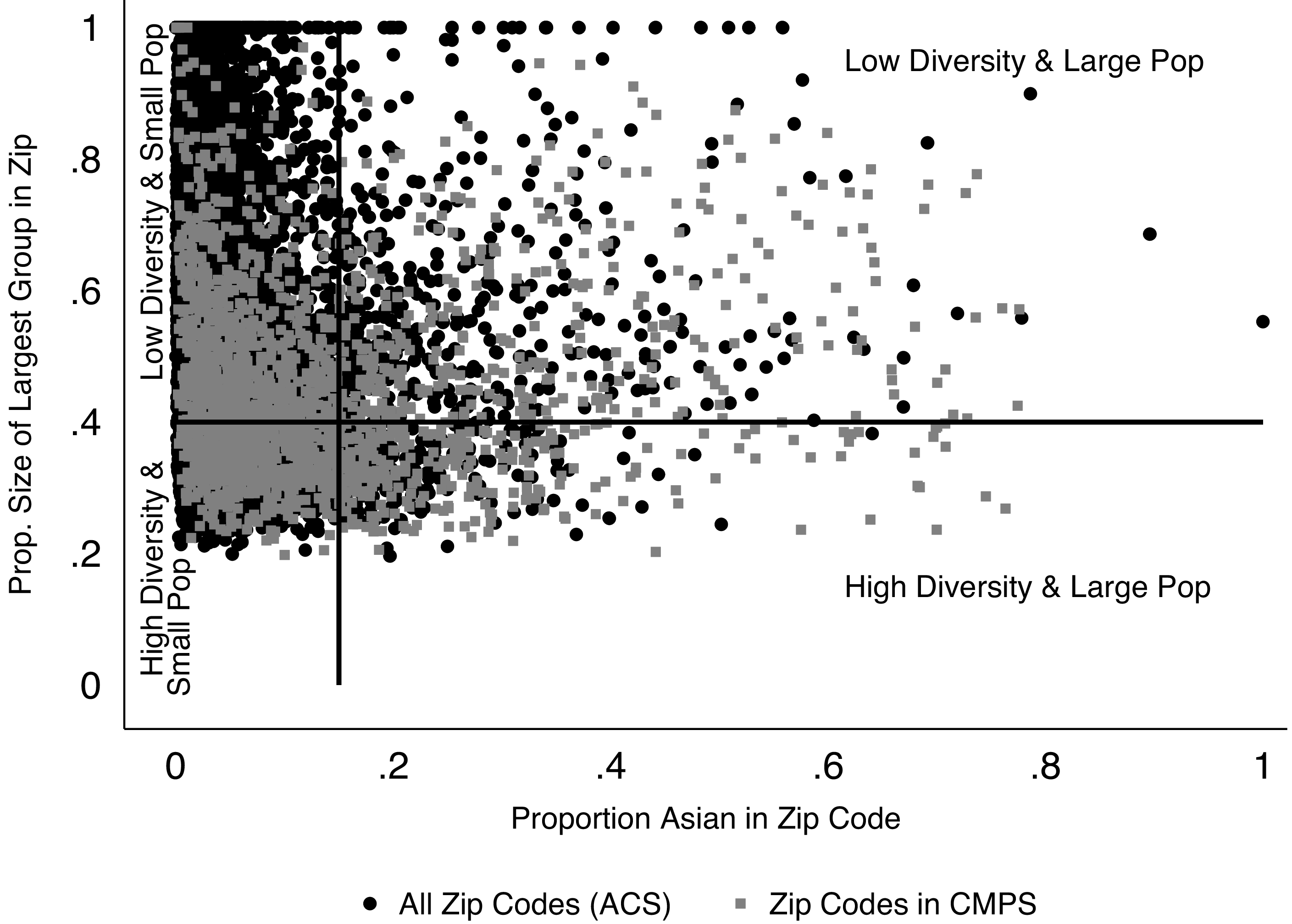
Figure 1 visualizes the distribution of zip codes across these two dimensions, with Asian population size on the x-axis and the proportion of the largest national origin group on the y-axis. Black circles represent zip codes drawn from the 2018 ACS, representing the entire set of zip codes in the US where there are Asian residents recorded in the Census. Gray squares indicate the zip codes that are also in the CMPS sample. The thresholds used to code areas as High/Low Diversity (40%) and Large/Small Population (15%) are marked by the x and y axes, respectively.
National origin group diversity vs asian population size.
Note: Data are from the 2018 American Community (N = 21,506) and the 2016 CMPS (N = 2,985).

Unsurprisingly, most Asians in the census live in small population zip codes. Adding the second dimension of diversity additionally shows that there is a sizeable degree of variation among localities with small proportions of Asians. Figure 1 suggests that geographic variation may not be limited to or driven only by variation in Asian group size but may need to also factor in within-group heterogeneity. Mechanically, we should expect clustering in the top-left region—as group size decreases, the likelihood that one group will dominate numerically increases. This may be driven by immigration patterns and selection into areas where there are preexisting national origin ties (Zavodny Reference Zavodny1999). It is worth noting that the distribution of zip codes from the CMPS generally approximates the distribution from the Census, though there is an underrepresentation of zip codes that are low diversity and small population. I address this concern later in the analysis.
CMPS Analysis: Pan-Asian Identity Importance across Locality Types
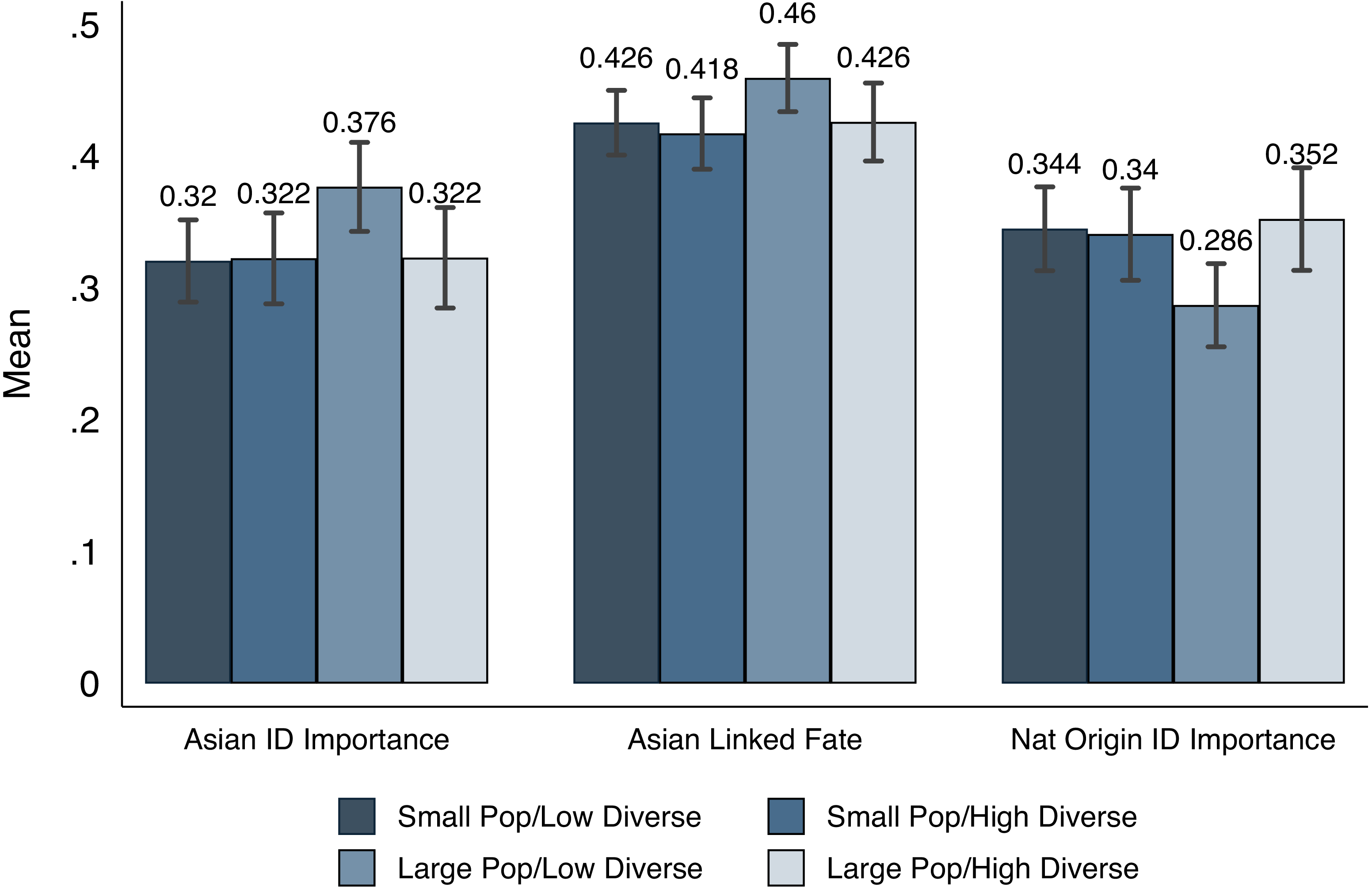
What does Asian identity importance look like across these four locality types? I measure identity importance using data from the 2016 CMPS (Frasure et al. Reference Frasure, Wong, Vargas and Bareto2016). I restrict the sample to survey participants who identify as Asian (demographic statistics and distributions are provided in Table S2–S4). Asian group identity is captured using three different survey items. The first is a measure of identity importance, in which respondents are asked to rank their Asian identity relative to their national origin and American identities. This item takes a value of 1 if they rank their Asian identity as most important and 0 otherwise. The second is a measure of linked fate: “Do you think what happens generally to Asian people in this country will have something to do with what happens in your life?” Third is a measure of importance for national origin identity, which takes a value of 1 if a respondent ranks it as their most important identity relative to their Asian or American identities. Figure 2 compares the means of these three outcomes across locality types. Individual bars within a cluster, differentiated by color, report the outcome mean for a specific locality type, with 95% confidence intervals, reflecting the proportion of respondents within a particular type of locality. There are several observations worth noting in looking at Asian Identity Importance and Asian Linked Fate, both of which measure attitudes towards the pan-ethnic group.
Group identity measures across locality types.
Note: Population and diversity are calculated at the zip code-level. Data are from the Census and 2016 CMPS.
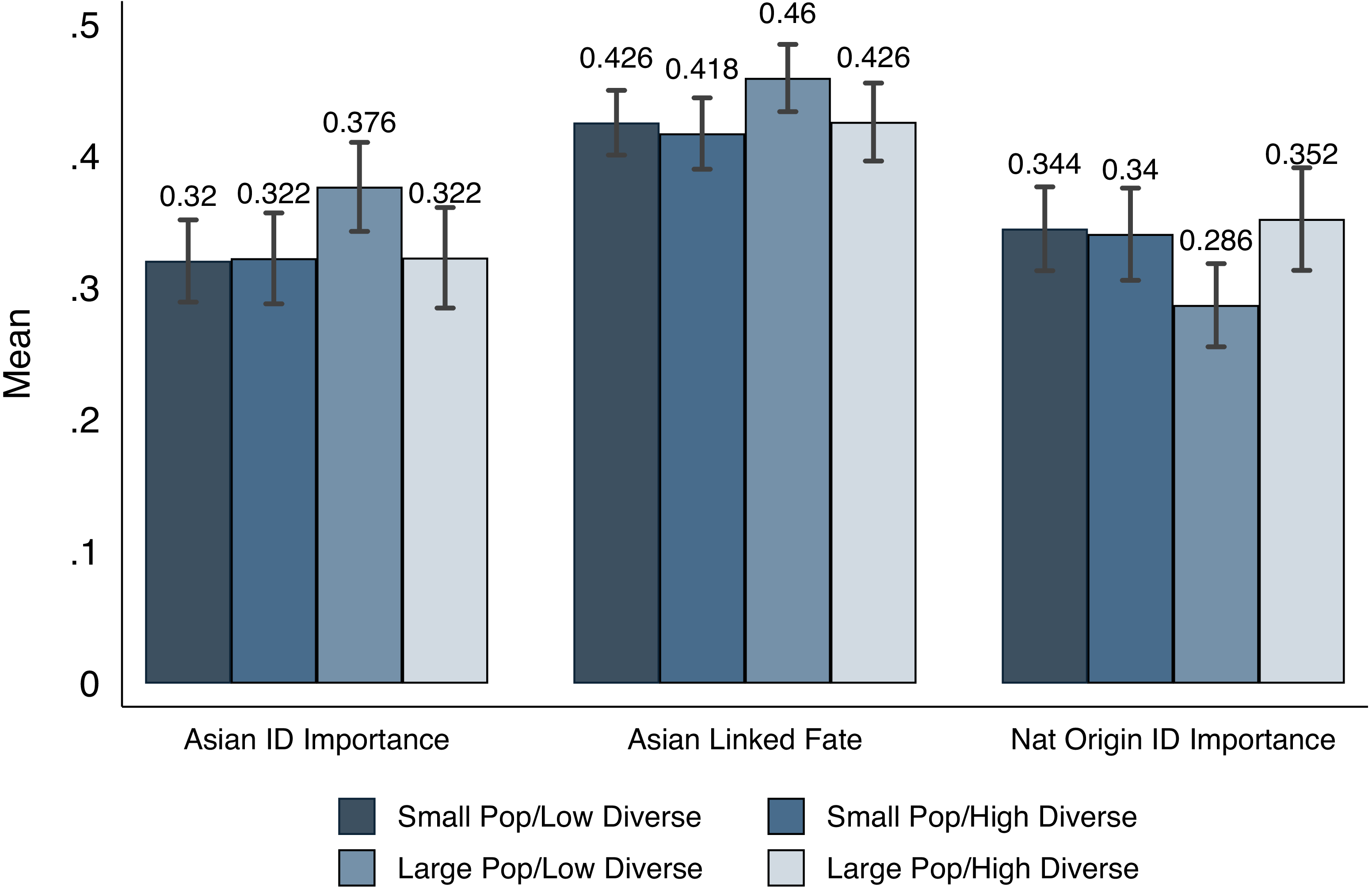
First, consistent with extant research, there are significant gains in identity importance when we go from small to large population among low diversity localities. That is, among places that are low diversity (more homogeneous), Asian identity importance is significantly higher in places that have larger populations (difference = .05, std err = .02). This is also true for Asian Linked Fate (diff = .03, std err = .01). Second, identity is less important in areas with greater diversity that also are large population. In places with larger populations, there is a significant decrease in identity importance in high diversity areas compared to low diversity areas, going from .376 to .322 (diff = .05, std err = .02). Finally, though there are notable differences between Asian identity importance and Asian-linked fate, with the latter being significantly higher than the former, the patterns within each measure are nonetheless similar across the two (Figure S1 presents these results with standardized values). Overall, we see suggestive evidence that identity is more salient in localities with larger Asian populations, but that are also more homogenous. For reference, a regression-based version of Figure 2 is provided in Table S6, along with a covariate-adjusted specification with similar patterns in the adjusted-means.
We see a different story with ethnic or national origin identity importance. Similarly, in large population areas, moving from a high to low diversity locality (increasing homogeneity) decreases national-origin identity importance (diff = .06, std err = .02), as opposed to increasing Asian identity importance. Because the two identity importance measures are mutually exclusive—respondents are asked to rank order their pan-ethnic and national origin identities—we can interpret the difference as a change in the relative importance ordering of pan-Asian identity over national origin identity in large population/low diversity places (though this does not necessarily mean that national origin identity is unimportant to a respondent). Thus, in places with a sizeable Asian population, greater diversity correlates with greater attachment to national origin identity in lieu of one’s pan-ethnic one. However, in low-diversity areas, large population areas report less importance of national-origin identity. One’s sense of “Asian” identity may be well-represented by their own national origin group if it is also the largest one in the community, as is suggested by the significant difference in the two large population/low diversity bars (diff = .09, std err = .03).
For robustness, Appendix Figures S2 and S3 recreate variants of Figure 2 based on two alternative codings of diversity: using a higher threshold at 50% and using HHI scores. HHI scores, though traditionally used to capture the degree of market competition, similarly account for the dominance by a particular group in addition to the sizes of each group. In this robustness specification, high and low diversity are determined relative to the mean of the distribution of the HHI scores across the set of zip codes in the ACS. Across the three robustness checks, I see generally similar patterns across locality types as in the main analysis.
Analysis of the 2016 CMPS data shows that identity importance varies across the four typologies, highlighting the importance of accounting for within-group diversity in addition to group size. Prior findings that show the importance of increasing population in increasing gains to group-based resources may be driven by a focus on places that are particularly homogeneous. Including group diversity in empirical examinations will help us better understand why there are not similar population effects in places that are more diverse. However, analysis of the CMPS data is descriptive and cannot tell us what the underlying local features are that may explain why we see such variation. To this end, I present evidence from novel survey data that is designed to show how diversity, when interacted with group size, potentially influences group identity through different types of resources.
Original Survey: Measuring Physical Versus Social Resources
What are the differences between locality types in the potential mechanisms that drive differences in identity importance? While pan-Asian identity may be conditional on a number of processes, such as perceived threat or exclusion, mobilization, and social and organizational interactions, these mechanisms operate through institutional and social resources embedded in one’s locality. I conceptualize these resources as two categories: physical resources related to organizational presence and social resources related to interactions with others. I measure these concepts using data from a novel survey, fielded across two time periods. The first version (Survey 1) was run in the summer of 2022 on two online survey platforms, Lucid Marketplace (n = 199) and Prolific (n = 1,245) in the summer of 2022. A second iteration of the design (Survey 2), which included select survey questions from the first version as well as additional items, was fielded in the spring of 2023, again on Lucid Marketplace (n = 1,933) and Prolific (n = 976). The second run of the survey was conducted both to collect data on additional survey items as well as to quota-sample across the four locality types. Quotas were only used on the sample from Lucid Marketplace, which allowed for targeting by respondent zip code. Summary statistics and distributions for the demographics of both samples are provided in Table S2–S4. Participants were eligible if they identified as Asian on prescreen questions provided by both platforms and were paid between $1.50–1.75 for participating in the survey, which took about eight minutes to complete on average and was conducted in English. To categorize a respondent’s locality type, I rely on the respondent’s self-reported zip code and merge on the locality indicators created using data from the ACS.
What Matters for Group Identity?
As discussed in Anoll et al. (Reference Anoll, Davenport and Lienesch2025), the influence context has over identification and can operate via different channels. I adopt this framing in the survey instrument by creating measures for two classes of resources that affect one’s sense of group identity: physical resources and social relations. These two categories reflect the manifestation of group concentration and the identity-relevant processes arising from it. First, the physical presence of resources in a locality, including both community organizations and businesses, speaks to an individual’s access to spaces that are oriented around group identity. Having a larger presence of these spaces in a locality can both contribute to one’s sense of identity and determine whether one’s national origin identity is emphasized. To measure this in the survey, respondents are asked about their experiences with community organizations and cultural centers, which often include programing around cultural events or provide language-specific resources, both of which contribute to one’s sense of identity (questions provided in Appendix A). In addition to organizations, I draw on Wilcox-Archuleta (Reference Wilcox-Archuleta2018) and ask respondents about the presence of ethnic restaurants and stores. Question wording for the individual items is provided in Appendix A1. The items are asked on a five-point Likert scale from “strongly disagree” to “strongly agree” and then rescaled from 0 to 1. For analytic simplicity, I create an index by taking the average of the seven individual items. Summary statistics for the index and the individual items are also provided in Table S5.
Second, the concept of social relations in this setting focuses on factors that contribute to an individual’s sense of group membership, particularly those related to group-based resources that are traditionally measured using attitudinal items such as group consciousness or linked fate (Wong et al. Reference Wong, Lien and Conway2005). In the survey, the following items relate to interactions with others, specifically the extent to which they encounter other Asians and how connected they feel to other Asians and members of their national origin group. Frequent encounters of different Asian subgroups, which may be more likely in more diverse localities, may inform what “Asian” means in those localities and whether it follows a particular prototypicality or is more pan-ethnic in nature. Along these lines, respondents are also asked to what extent they feel connected to other Asians in their community and people with whom they share a national-origin background. The general connection one feels towards others in their community likely affects whether one identifies with a broader, pan-ethnic identity relative to their national-origin one. To support the development of these items, I provide descriptive results from a survey item that measures the importance of different identity-relevant factors. Survey respondents are asked, “When you think of your Asian identity, which of the following are most important in contributing to your sense of identity?” Responses to this are presented in Appendix Figure S4. Family and friends, i.e. one’s social network, are by far the most important factors respondents identify as contributing to their Asian identity. Food is also relatively salient, reinforcing the importance of including resources that increase access to and availability of food-related resources relevant to one’s culture.
Physical and Structural Resources
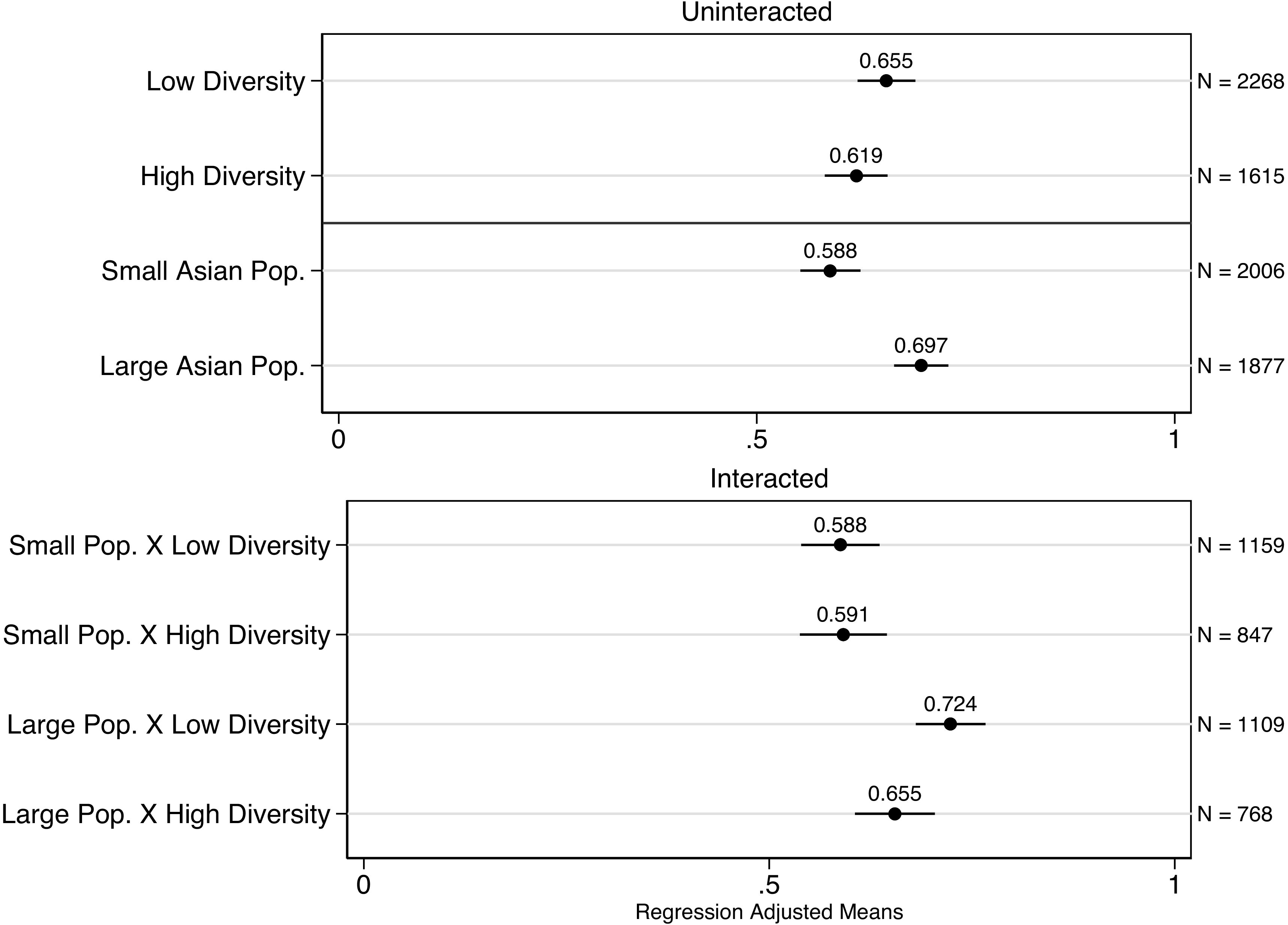
Figure 3 presents regression-adjusted means for the resources measure across locality. Given that responses are from opt-in sample, I account for demographic variation by adjusting for respondent gender, age, and partizanship. For simplicity, I average the individual measures into one index for each respondent, with results for the individual items provided in the appendix (individual indices for Survey 1 and 2 reported Appendix Figure S5).
Perceived resources index by locality type.

The top panel of Figure 3 presents means based on the uninteracted dimensions of locality, which are provided for baseline reference to better understand the means from the interaction between population size and diversity level, which are presented in the bottom panel. Taken at face value, we see there are no differences between High and Low diversity localities. As expected from prior work on group size, there is a significant difference between places that have larger Asian populations relative to smaller population areas. However, the interacted results reveal the importance of diversity within the context of group size. There is a significant difference in resources between places that are Large Population/Low Diversity and Small Population/Low Diversity, a difference that is not observed when comparing Large Population/High Diversity and Small Population/High Diversity. The role of group size is primarily driven by homogeneity of the Asian population.
I draw on theories on coalition-building to understand the salience of homogeneity (lower diversity) in generating physical resources—e.g., it may be easier to coordinate on community organization identities when there are fewer competing group interests (see Kim Reference Kim2020a). Interestingly, I do not see significant differences between the types of resources—whether pan-Asian or national origin specific—across localities. Figure S6 in the appendix splits the main resources index into an index specific to pan-Asian organizations and businesses and one specific to national origin groups. While there are no distinct differences between indices within a locality type, the trends across localities are persistent regardless of if I use the pan-Asian or national-origin specific indices, with Large Population/Low Diversity localities having the highest score.
The survey responses measure what respondents perceive about their localities. How well do those perceptions track with the actual presence of organizations? I draw on IRS Form 990 data which provides a set of nonprofit organizations by zip code. IRS Form 990 is completed by eligible tax-exempt organizations, data from which are collected and made available by the IRS as annual extracts. Relevant for this study, I use the IRS’s Exempt Organization Business Master File Extract, which provides information from filers of Form 990, Form 990-EZ, and Form 990-PF. I restrict to organizations who filed a 990 form between 2015 and 2019 and remove duplicates (e.g., the same organization may have different Employer Identification Numbers in different years) and organizations with PO Box addresses. Using the names of the organizations, I code organizations as being either pan-Asian or national origin specific, with specific coding details provided in the Appendix. The survey measure in Figure 3 captures an individual’s perception of the presence of both community organizations and business storefronts (restaurants, stores, etc.), while this measure of actual organization presence captures prevalence of organizations (and not businesses). The assumption here is that the number or proportion of businesses scales with the number of nonprofit organizations in a given locality.
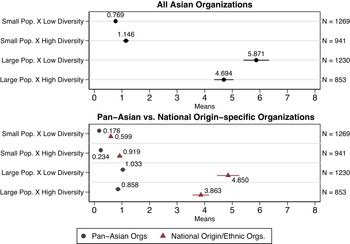
Analysis of the IRS data suggests that respondents’ perceptions of organizations generally track with their actual presence. Figure 4 presents the presence of Asian organizations by locality type for zip codes represented in the original surveys, with all (Asian) organizations in the top panel and then separated out by whether the organization is pan-Asian or specific to a national origin group in the bottom panel. In the top panel, I observe similar patterns in the presence of organizations, with the greatest average number in localities that are Large Population and Low Diversity. As with the survey measure of physical resources, the difference between Low and High Diversity areas with Large Populations is statistically significant (diff = 1.18, p < .01). Thus, the survey measure of perceived presence of physical institutions appears to correspond with their actual presence. Notably, this difference holds even when I separate organizations by pan-Asian focus or national origin focus, as shown in the bottom panel of Figure 4. Moreover, the prevalence of pan-Asian organizations in Large Population and High Diversity areas becomes indistinguishable from those in either of the Small Population localities.
Prevalence of non-profit organizations by locality type.

The analysis of the original survey data is limited to the zip codes of respondents in the survey, which may raise concerns about selection and representativeness of individuals who are more likely to take surveys and their localities. Appendix Table S3 reports the proportion of overall zip codes that are represented in either the 2016 CMPS or the original survey. Small population localities are especially underrepresented by survey sampling. To address this, Appendix Figure S10 presents the average number of organizations across all zip codes from the Census. Importantly, I find no statistically significant difference between the prevalence of organizations in Low vs. High Diversity, Large Population localities. This differs from the survey findings—the IRS-based outcomes are likely due to the underrepresentation of larger, more rural localities. To this end, I adjust the count of organizations in a zip code by land area to create a measure of organization density. Smaller zip codes, like those in urban areas, may have not only more organizations per ten-square mile but individuals in those areas are more likely to see those organizations. In contrast, organizations in larger zip codes may be more spread out. The bottom panel of Figure S7 presents organizational density across localities, which recovers the general pattern observed in Figures 3 and 4 (Figure S8 presents these results split by organization type).
Social and Intergroup Relations
The previous section highlighted the importance of physical and structural resources for Asian group identity. Are there similar differences across localities for resources that are more socially oriented? The following analysis suggests that physical and structural resources are more salient drivers of group identity than social processes.
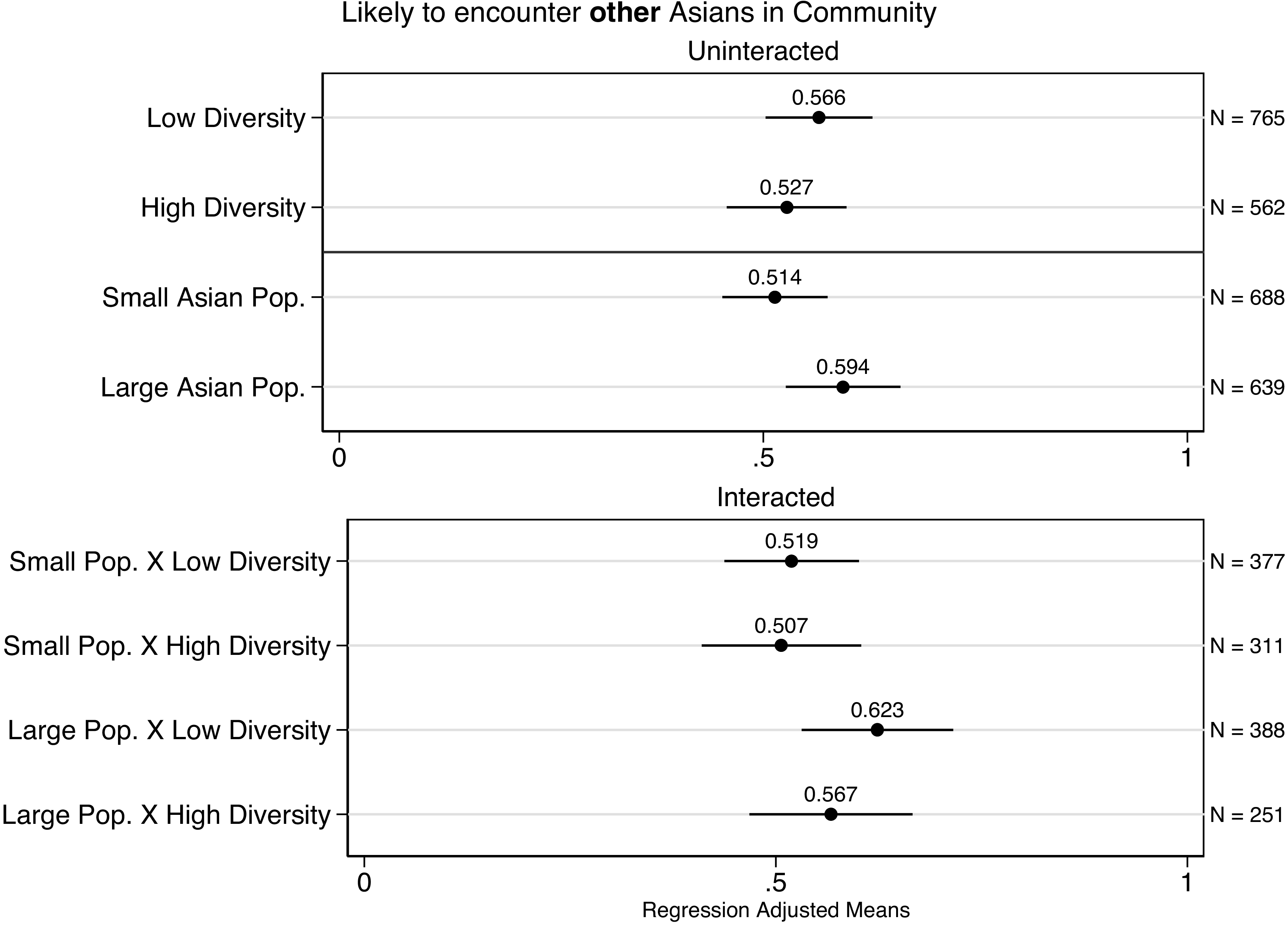
Figure 5 presents a similar set of descriptive analyses for the social relations items across locality types. Respondents are asked the extent to which they are likely to encounter different Asian subgroups in their daily lives and respond on a four-point Likert scale from “not at all” to “very often”, which is then rescaled to take values from 0 to 1. The implicit assumption here is that seeing Asians from different subgroups, which is likely a function of population size and diversity, has some effect on one’s perception of and orientation toward pan-Asian identity. I ask respondents about their interactions based on regional categories (i.e., East, South, and Southeast Asian) rather than national origin due to the difficulty and problematic nature of trying to assume one’s background based on physicality. Regionality does not address these concerns, but it at least allows for some measurement that is tractable.
Intergroup contact by locality type.
Note: Data are from Survey 1.1. Other refers to Asians from other national origin groups based on regionality.

Unlike the results for resources, the measure of intergroup contact does not suggest particularly notable differences between localities. One explanation could be attributed to the fact that these are self-reported perceptions of one’s interactions with other Asians in the community. If groups are socially segregated, even in areas with large populations and high levels of diversity, the perception does not necessarily reflect the actual composition of groups in a given locality. However, the fact that respondents in large pop/low diversity localities report a higher salience of Asian identity, yet do not report similarly greater levels of intergroup contact, may support the argument that frequency of contact with Asians from other regions, on its own, does not have much bearing on the salience of pan-Asian identity.
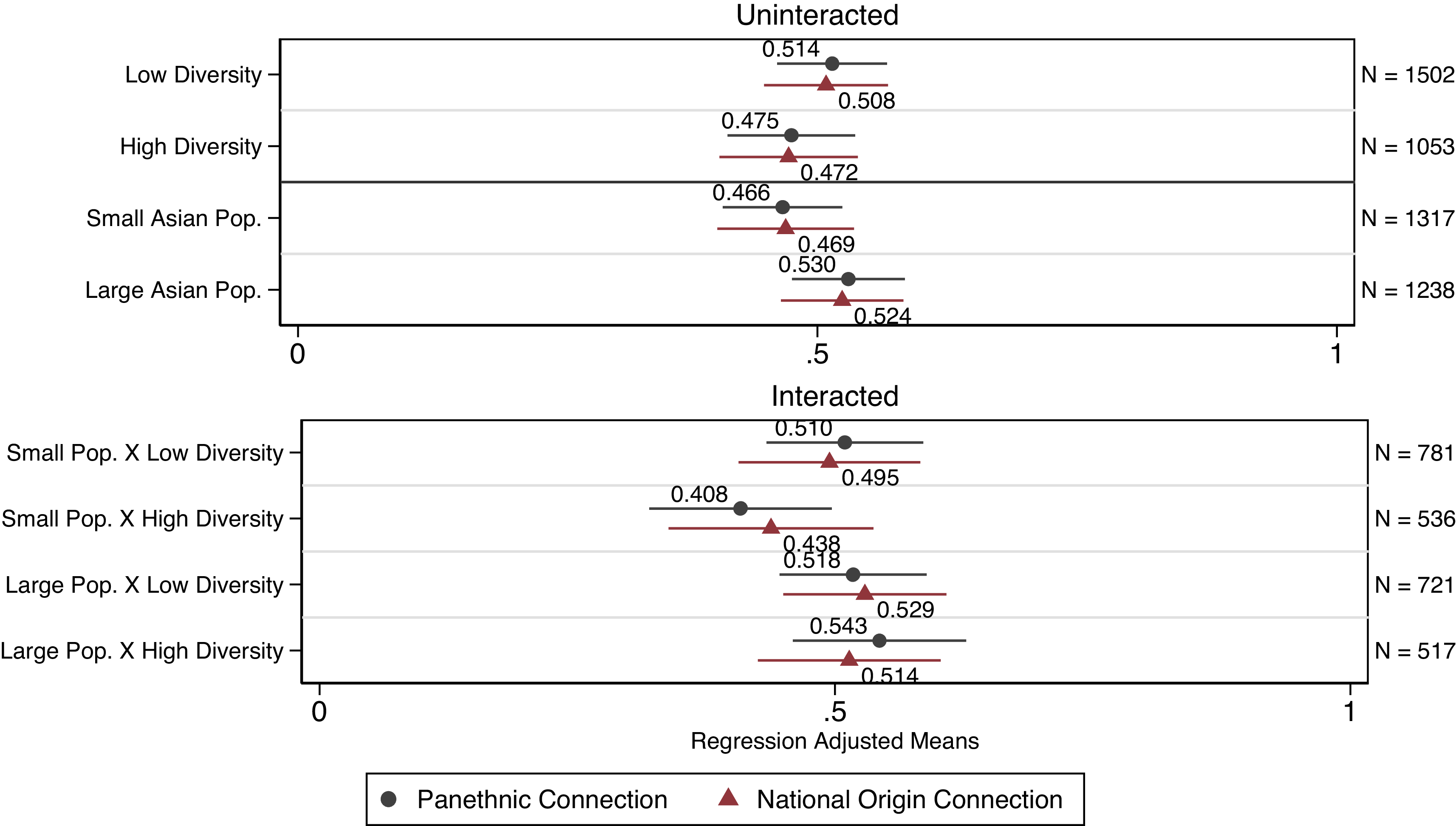
Using a different measure of group relations, Figure 6 presents the results for the measure of connection to others in one’s community, split by connection to other Asians (Pan-ethnic Connection) and to other members of the respondent’s national origin group (National Origin Connection). These items are asked on a four-point Likert scale and rescaled from 0 to 1. As with the intergroup contact measure, I again find a similar lack of differences across locality types. Additionally, there do not appear to be differences between connections to one’s specific national origin group or Asians more generally. This may seem counterintuitive: we may suspect that greater diversity increases competition between national origin subgroups and dilutes the cohesiveness of a pan-Asian identity, but a weaker pan-ethnic identity does not negate its existence entirely. It could be the case that greater divisions spur coalition building across subgroups (Kim Reference Kim2020a), leading to hard-won ties that are observationally equivalent to connections in other locality types where connection is easier to come by. Notably, the lack of significant variation in social relations between localities need not be dispositive of the expectation that large population/low diversity areas are unique in their ability to maintain a pan-ethnic group identity. Rather, we can interpret the results to suggest that physical and structural resources are more overtly present than social ones in localities with larger, more homogenous communities and subsequently are likely more obvious in how identity-specific processes are facilitated. The social and psychological processes that drive identity creation and importance likely function through channels that are not tied solely to local context.
Connection to others by locality.

Appendix B provides an additional source of potential interactions that may influence one’s group identity: religiosity. Religious affiliation and institutions offer a community space that facilitates social interactions and are particularly salient for certain Asian subgroups. Wilcox-Archuleta (Reference Wilcox-Archuleta2018) uses a respondent’s religious attendance as a measure of social interactions between co-ethnics that increases attachment to pan-ethnic identity. I expand this measure by considering religiosity more generally, relaxing the assumption that if religion does facilitate social contact, it may not necessarily be restricted to church attendance. In Figure B1, I find a different trend across localities, highlighting the role of religion, particularly in localities that have small Asian populations.
In all, these descriptive results highlight the role of physical resources in reinforcing pan-Asian identity, as well as the relevance of national origin diversity when studying the consequences of population dynamics on group-based attitudes. In particular, areas with low levels of diversity and a relatively large Asian population are more likely to have physical resources and exhibit greater salience of individuals’ sense of group identity.
Individualized Experience within the Asian Community
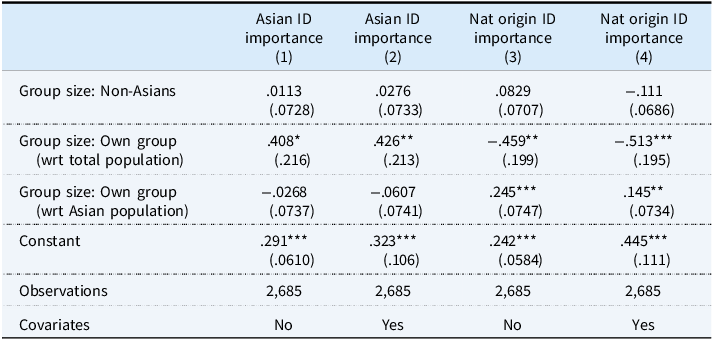
An unanswered question in the current analysis is whether an individual’s membership in a dominant group matters in localities that have a dominant national origin group. Whether an individual is part of the largest group in a community likely affects the salience of a pan-Asian identity to that person. I present a regression model in which an individual’s identity importance is a function of the size of a dominant outgroup (non-Asians), the size of the individual’s own group with respect to total population, and the size of the individual’s own group with respect to the Asian population specifically. An individual’s group size relative to the overall population captures the degree to which one’s own Asian subgroup competes with the dominant outgroup. On the other hand, group size relative to the Asian population captures the degree to which one’s own Asian subgroup competes with other Asian subgroups. I suspect these population dynamics are salient in driving the importance of either pan-ethnic identification or subgroup identification, given that the incentives to choose one over the other are a function of different outgroup pressures. I also include a covariate-adjusted model using individual-level demographic variables that have been noted in prior research to be relevant for group identification, such as generation, income, and education (e.g., Lien et al. Reference Lien, Conway and Wong2003).
The regression results in Table 2 suggest the population factors that matter for pan-Asian identity importance are different than those that matter for national origin identity importance. Columns 1 and 2 show that it is only when one’s own national origin group is increasing relative to the overall population that pan-Asian identity has any relevance. Conversely, what appears to matter for a respondent’s national origin identity is their own group size, but specifically with respect to the Asian population. This comports with expectations of national origin identity being more salient than pan-Asian identity in cases when an individual’s own group size constitutes a large proportion of the Asian population. However, this gain in national origin identity importance is likely limited by what is happening relative to the overall population size. As an individual’s own national origin group increases in size with respect to the overall population, national origin identity decreases (in favor of pan-Asian identity).
Identity importance as function of respondent’s own group size
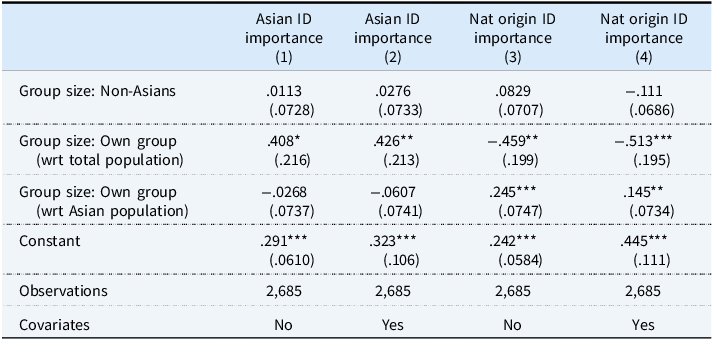
Table 2. Long description
A table with four columns and five rows of data, plus additional rows for constant, observations, and covariates. The columns are labeled as Asian ID importance, Asian ID importance, Nat origin ID importance, and Nat origin ID importance. The rows are labeled as Group size: Non-Asians, Group size: Own group (wrt total population), Group size: Own group (wrt Asian population), Constant, Observations, and Covariates. Each cell contains numerical values and standard errors in parentheses. The table presents regression results indicating the factors influencing pan-Asian and national origin identity importance. Notable trends include significant values for the own group size relative to the total population and Asian population, with varying impacts on identity importance.
Robust standard errors in parentheses. ***p < .01, **p < .05, *p < .1. Covariate-adjusted specification results are provided in the Appendix in Table S7.
Discussion
In the study of politics and identity, it is often difficult to fully account for the factors that contribute to both the construction and maintenance of that identity and to the outcomes of interest. This study focuses on local context and introduces a dimension overlooked in prior work, group diversity, bringing into the fold intuitions from research on Asian American politics and national origin backgrounds. Using survey data from the 2016 CMPS, I find evidence that community context plays an important role in explaining Asian American political identity, particularly when factoring in the level of national origin diversity in a locality. Asian identity is most salient in places that have larger Asian populations that are more homogeneous. Evidence from two original surveys additionally shows that large population, low diversity localities are also where identity-based organizations and community resources are more prevalent and likely reinforce pan-Asian identification. The finding that physical and structural resources are more salient compared to social contact is consistent with an institutional account of identity maintenance. Physical institutions are not only a reflection of group identity but also active in reinforcing it by providing spaces where membership is defined and practiced. Without accounting for group diversity in studying the role of context on group politics, we risk conflating multiple factors that enable a positive relationship between identity and behavior. If identity is a salient part of understanding these group behaviors—if we care about political outcomes as a function of population characteristics—we must contend with how identity is constructed such that it is a salient factor. These results highlight a framework for understanding politicized identities as not static reflections of one’s circumstances and experiences but as a dynamic process in which one implicitly responds to those circumstances and experiences.
There are several limitations to the present analysis. First, the survey item used to measure a respondent’s national origin background in the CMPS asked respondents to choose their primary background, which does not permit measurement of multiple national origin backgrounds. Given the nontrivial rates of mixed ancestry among Asian Americans (as well as mixed racial identity), being able to account for an individual’s multiple national origin backgrounds is crucial. Second, while the CMPS measures Asian-linked fate, there are not similar items for national origin identity. Given the importance of diversity of national origin groups in a locality, including additional questions that capture perceived connection and linked fate with other members of one’s national origin group will help better contextualize responses to items on the attitudes towards the broader pan-Asian group.
Second, while these population-based measures can only proxy a community context, subsequent research focusing on exactly how they proxy community context will provide fruitful insights to this topic. For example, Anoll et al. (Reference Anoll, Davenport and Lienesch2025) introduces measures of context based on social and psychological factors that are weakly correlated with each other. An important observation here is that one’s community and one’s experiences within it cannot be randomized. This points to a concern about selection: it is likely the case that localities where there is greater need for a pan-ethnic identity develop and provide the resources for pan-Asian identity to grow and become salient. Thus, the present study could simply be measuring the effect of manifestations of group identity importance on group identity importance itself. This concern may be mitigated to some degree by the fact that institutions are relatively “sticky” (Boettke et al. Reference Boettke, Coyne and Leeson2008). The presence and prevalence of structural institutions that contribute to the development of group identity are likely a consequence of the population dynamics that created the need for a pan-ethnic identity in the first place.
Third, with regards to methodology, the presented survey design suffers from a limitation of being conducted primarily in English. This naturally excludes potential, eligible participants who would have taken the survey in another language. While this concern extends beyond the present study and reflects more general issues around opt-in online survey pools, advances in surveying technology will likely improve language-based accessibility for future endeavors. Moreover, the original survey design does not provide sufficient insights into which specific mechanisms are at play, just that there are differences across localities of those measured. Future work examining the conditions under which certain institutional or social features are more influential will prove valuable.
Finally, the measure of diversity used in this study is limited in its focus on numerical dominance. Within-group diversity of heterogeneity measured as a function of relative population size only tells us about the presence of groups relative to each other. Little can be inferred about the actual competitiveness and relationships between subgroups that may additionally lead to the patterns in local resources and institutions that we observe. Extant measures of diversity primarily focus on single dimensions, such as relative group size or physical segregation. We do not yet know how these different measures perform in relation to each other or what other factors might be necessary in understanding internal group dynamics. As such, the intuitions drawn from this measure may not be applicable to localities where context facilitates diversity-relevant processes differently. There are potential concerns around external validity in cases where the dominant group in a locality is not one of the larger national origin groups. Diversity and group size in such a context likely reflect different racializing processes than in localities where Chinese or Indian communities constitute the dominant group. Future work examining within-group diversity will benefit from considering more refined and sophisticated measures of diversity that account not only for numerical composition but also for differences in culture, physical geography, and socioeconomic factors, all of which may contribute to group heterogeneity.
Broadly, this study is an initial foray into studying the politicization of group pan-ethnicity from a perspective of local context. Extant research already explores conditions under which cross-racial coalitions can form. Future research on group identity and context can focus on place-based factors that facilitate the emergence and reinforcement of group boundaries. The ability of identity-based coalitions, developed in response to context, to function as politically viable units depends on the environments in which they emerged. Though the study focuses on Asian Americans, these insights are likely applicable to other groups whose membership is constituted largely by immigrant members. Such communities are comprised of disparate subgroups and whose pan-ethnic or group identity is constructed in part due to external forces and emerges through shared local experiences. Moreover, the measure of diversity used in the present study proxies heterogeneity by the presence, or lack thereof, of a numerically dominant group. This presents a theoretical limitation in our ability to understand the particular political dynamics among and between specific groups. Future studies ought to consider additional dimensions of heterogeneity, such as socioeconomic factors or positionality with other non-White racial groups, as well as physical distribution or composition of national origin subgroups.
Supplementary material
The supplementary material for this article can be found at https://doi.org/10.1017/rep.2026.10089.
Data availability statement
Data and code are available upon request.
Acknowledgments
The author would like to thank ISPS at Yale for support in carrying out this research. This publication was made possible in part by funding support from the Rapaport Family Foundation. The statements made and views expressed are solely the responsibility of the author. I greatly appreciative of feedback from discussants and participants at American Politics Workshop at CSAP, WPSA, MPSA, and APSA. Finally, I am particularly grateful to Greg Huber, Allison Harris, Jae Yeon Kim, Marc Meredith, and anonymous reviewers who provided invaluable feedback that improved the project.
Funding statement
This publication was made possible in part by funding support from the Rapaport Family Foundation. The statements made and views expressed are solely the responsibility of the author.
Competing interests
The authors have no relevant financial or nonfinancial interests to disclose.
Consent to participate
Informed consent was obtained from all individual participants in the study.
Ethics approval
This study was reviewed and deemed example by the Yale Institutional Review Board.


 Open access

