




1. Introduction
Evidentiality is defined as the linguistic encoding of the source of information that a speaker has access to, indicating how they acquired knowledge about an event, through direct experience, inference, report, or other means (see Willett, Reference Willett1988; Johanson and Utas, Reference Johanson and Utas2000; Aikhenvald, Reference Aikhenvald2004, 2018). Evidentiality is commonly divided into two broad types cross-linguistically: grammatical evidentiality, where the source of information is obligatorily encoded through dedicated morphological markers (e.g., affixes or clitics), and non-grammatical evidentiality, where it is expressed through optional lexical, modal, or syntactic strategies. While the former constitutes a formalized grammatical category in some languages, the latter relies on more flexible means such as verbs, adverbs, or constructions that convey how information was obtained. Grammatical evidentiality and non-grammatical evidentiality are presented in sections 1.1 and 1.2. French is detailed in section 1.3.
1.1 Grammatical evidential systems
A number of languages display obligatory grammatical evidentiality systems, though these vary considerably in their structure. Some, such as Turkish, mark a direct–indirect contrast through verbal inflectional suffixes (e.g., Aksu-Koç and Slobin, Reference Aksu-Koç, Slobin, Wallace and Nichols1986; Arslan, Reference Arslan2016; Aksu-Koç and Arslan, Reference Aksu-Koç, Arslan and Johanson2024). Other languages, such as Quechua, encode a three-way evidential distinction through enclitics, distinguishing direct (witnessed/experiential), reportative, and conjectural sources (Faller, Reference Faller2002). By contrast, languages like Tuyuca exhibit a more fine-grained system, obligatorily marking five types of information sources: visual, non-visual sensory, inferred from evidence, reported, and assumed (Barnes, Reference Barnes1984). This illustrates substantial cross-linguistic variation in both grammaticalization and typology of evidentiality.
Most psycholinguistic insights into grammatical evidentiality stem from developmental studies focusing on children. One of the foundational empirical works in this area is by Aksu-Koç (Reference Aksu-Koç1988), who examined the comprehension and production of evidential morphemes among Turkish-speaking children aged three to six. She found that children typically acquire the direct evidential marker earlier, with the indirect marker emerging several months later. However, her data also suggested that young children may not initially grasp the contrast between direct and indirect information sources. Another seminal study by Papafragou et al. (Reference Papafragou, Li, Choi and Han2007) investigated the acquisition of evidentiality in Korean and its relation to children’s reasoning about information sources. Their results showed that although three- and four-year-old Korean-speaking children struggle with the comprehension of evidential forms, they nonetheless perform like English-speaking peers in non-linguistic information-source tasks (see also Ozturk and Papafragou (Reference Ozturk and Papafragou2016) for further research on Turkish). Overall, the available evidence suggests that children require time to fully master the mapping between information sources and their corresponding evidential markers.
It is important to note that the grammatical status of evidentials remains under debate. Recent theoretical accounts take different approaches to determine whether evidentiality constitutes an independent grammatical category or (part of) modality (e.g., Cornillie, Reference Cornillie2009). Further discussions concern whether evidentials express ‘interpersonal knowledge’ (Tantucci, Reference Tantucci2013) or primarily encode a ‘mode of access’ rather than an information source (Izquierdo Alegría and Cornillie, Reference Izquierdo Alegría and Cornillie2017). Other proposals classify grammatical evidentials from a functional-conceptual perspective (Boye and Harder, Reference Boye and Harder2009). For an up-to-date synthesis, we refer the reader to Mélac and Leclercq (Reference Mélac and Leclercq2024). The present article does not take a stance on these issues.
1.2 Non-grammatical evidential systems
In contrast to the relatively well-studied developmental trajectories in languages with grammatical evidentiality, far fewer studies have investigated languages in which evidentiality is not grammaticalized but instead expressed through what Aikhenwald (Reference Aikhenvald2004) terms evidential strategies, including syntactic means. Beyond the diversity of evidential morphology – verbal affixes, enclitics, particles or copular forms – evidential meanings can also be encoded via syntactic constructions. For instance, Cinque (Reference Cinque1999) proposed an evidential functional head, drawing on parallels between the position of evidential morphemes and the placement of evidential adverbs in languages without grammatical evidentials.Footnote 1 However, detailed syntactic analyses of evidentiality remain limited (see Speas, Reference Speas2008 for a review).
Moreover, non-evidential languages can encode the source of information through a range of lexical and modal means. In English, for instance, evidential meaning may be conveyed by perception verbs (e.g., I hear, I can see), perception-based copular expressions (e.g., it looks like, it sounds), cognition verbs (e.g., I guess, I imagine), and verbs of speaking (e.g., be said to, they say). It can also be expressed through modal auxiliaries (e.g., must, should), adverbs (e.g., apparently, allegedly), and complex prepositional expressions (e.g., according to), illustrating the diversity of lexical strategies available for marking evidentiality (e.g., Whitt, Reference Whitt2010; Mélac, Reference Mélac2022 from which this list is taken). A few recent studies have shown that English also employs different syntactic structures, particularly with perception ‘raising’ verbs (e.g., look like/sound like/feel like), to indicate the information source available to the speaker. For example, John looks like he is sick implies that the speaker has directly perceived evidence for John’s condition (see Whitt, Reference Whitt2010; Mélac, Reference Mélac2022 for overviews).
Furthermore, Rett and Hyams (Reference Rett and Hyams2014) reported that English-speaking children (ages 2-7) can associate syntactic structures with information sources similarly to adults. In Dutch, Koring and De Mulde (Reference Koring and De Mulder2015) examined children’s understanding of the raising verb lijken ‘seem to’ (ages 6-9) and found that children explicitly associated this form with direct witnessing, even though it does not encode speaker certainty. Similarly, Angelopoulos et al. (Reference Angelopoulos, Bagioka and Terzi2023) investigated Greek children’s comprehension of two types of embedded clauses under the perception verb ‘see’: (i) finite complement clauses introduced by oti ‘that’ (as in (1)), and (ii) pseudo-relative clauses introduced by pu ‘who/that’ (as in (2)). Note that pseudo-relatives differ from canonical relatives in that they describe events rather than individuals (see Cinque, Reference Cinque1992; see also section 1.4.2).
(1)
Ída
oti
kápi̱os
éfiy̱e
see.pst.1sg
that
someone
leave.pst.3sg
‘I saw that someone left.’
(2)
Ída
kápion
pu
éfiy̱e
see.pst.1sg
someone.acc
rel
leave.pst.3sg
‘I saw someone who/that left.’
Using a sentence-picture matching task, Angelopoulos et al. (Reference Angelopoulos, Bagioka and Terzi2023) presented scenes that supported either inferential reading (e.g., an empty chair drives the participant to infer that someone has actually left) or a directly witnessed reading (e.g., someone visibly leaving). The findings showed that Greek children begin to converge with adults in mapping evidence sources to sentence types around age 9, and that both groups reliably associate pseudo-relative clauses with direct witnessing. These results align with previous findings that clause type modulates the interpretation of perception in English and Dutch (see Asudeh and Toivonen Reference Asudeh and Toivonen2012; Rett and Hyams, Reference Rett and Hyams2014; Koring and De Mulde, Reference Koring and De Mulder2015).
1.3 Evidential meanings in French
Like English and Modern Greek, French is not usually considered to exhibit a grammatical evidential system. Rather, evidentiality in French has traditionally been characterized as primarily lexical, manifested through verb semantics such as perception verbs, cognition verbs, modal verbs, but also through adverbials, and certain adjectival phrases, as shown in (3) (e.g., Benveniste, Reference Benveniste1966; Dendale and Van Bogaert, Reference Dendale and Van Bogaert2007, Reference Dendale and Van Bogaert2012; Squartini, Reference Squartini2008; Dendale and Izquierdo, Reference Dendale and Izquierdo2014; Leclercq and Mélac, Reference Leclercq and Mélac2021; Dendale and Vanderheyden, Reference Dendale and Vanderheyden2025).
(3)
a.
Verbs of perception: voir ‘see’, entendre ‘hear’, etc.
b.
Verbs of cognition/opinion: croire ‘think/believe’, sembler ‘seem’, etc.
c.
Modal verbs: se pouvoir ‘be possible that’, devoir ‘must’
d.
Adverbs: peut-être ‘perhaps’, sûrement ‘surely’, apparemment ‘clearly’, etc.
e.
Adjective phrases: être sûr ‘be sure’, c’est vrai ‘it is true’, c’est possible ‘it is possible’, etc.
Evidentiality in French has also been shown to have a grammatical dimension, as mood and tense can contribute to evidential marking. However, this grammatical encoding of evidentiality in French is optional. This is illustrated in (4), where the conditional mood conveys an epistemic value, and in (5), where the future tense is conjectural (Dendale and Van Bogaert, Reference Dendale and Van Bogaert2012).
(4)
Il
y
aurait
quinze
victimes.
it
there
have-cond
fifteen
victims
‘There could be fifteen victims.’
(5)
[on sonne]
Ce sera
le
facteur.
it rings
this be-fut.3sg
the
postman
‘[The bell rings] It has to be the postman.’
As far as acquisition is concerned, Palasis (Reference Palasis2024, Reference Palasis2025) investigated spontaneous speech in French children between 2;5 and 5;11 to determine whether their syntactic structures reflected evidential meanings. Her results showed that French-speaking children tend to use finite complement clauses with the perception verb voir ‘see’ to express indirect evidence (e.g., J’ai vu que quelqu’un est parti ‘I saw that someone has left’), whereas they use relative and pseudo-relative structures for directly observed events (e.g., J’ai vu quelqu’un qui est parti ‘I saw someone who has left’). In addition, these children frequently use ECM constructions (aka, Exceptional-Case-Marking constructions) to convey direct witnessing. An ECM construction is one in which the subject of an embedded infinitive clause receives an accusative case, as in ‘I saw Mary singing/I saw her singing’).
Although the syntactic dimension of evidential marking in French has occasionally been noted in the literature (e.g., Granville Hatcher, Reference Granville Hatcher1944), it has not been systematically investigated in adult speakers, and the field remains largely unexplored. To address this gap, the present study experimentally investigates the same three types of subordinate clauses embedded under the perception verb voir ‘see’ in French: finite complement clauses, infinitival ECM complements, and (pseudo-)relatives.
1.4 Rational for the study
In this article, we examine whether French, like English and Modern Greek, makes use of optional syntactic evidential strategies. Building on the literature introduced in sections 1.2-3, we assume that French subordinate clauses appearing under perception verbs may express different evidential meanings. This assumption rests on the rationale that different syntactic realizations of perception verb subordinate clauses can signal whether the speaker has direct or indirect access to the information source. Following Willett (Reference Willett1988)’s categorization of information sources, namely direct versus indirect, with the latter subdivided into hearsay/reporting (i.e., the speaker was informed of the event by someone else) and inference (i.e., the speaker expresses an inference about the event), we examine four types of constructions appearing under perception verbs: relative clauses, pseudo-relative clauses, infinitive ECM constructions and tensed complement clauses. These four types of constructions are introduced in the next subsections.
1.4.1 Relative clauses
Relative clauses as in (6) are (restrictive) relative clauses, where the noun homme ‘man’ is modified by the embedded clause qui joue au football ‘who plays football’. Semantically, the relative clause restricts the reference of the noun ‘man’. In other words, the determiner phrase (DP) l’homme refers to a specific person, maybe Leo Messi.
(6)
J’ai
vu
l’homme
qui
joue au
football
sur le banc.
I=have
seen
the man
who
plays at.the
football
on the bench
‘I saw the man who plays football on the bench.’
The example in (6) should be comparable to a sentence like (7) as they both express witnessing:
(7)
J’ai
vu
Leo Messi
sur le banc.
I=have
seen
Leo Messi
on the bench
‘I saw Leo Messi on the bench.’
In both (6) and (7), the perceiver directly sees the man who plays football/Leo Messi. Structurally, the perception verb c(ategorially)-selects for a DP in both cases (e.g., Bianchi, Reference Bianchi2002; Cecchetto and Donati, Reference Cecchetto and Donati2023) and s(emantically)-selects for an individual. In generative linguistics, c-selection and s-selection refer to two different kinds of selectional requirements that predicates impose on their arguments: c-selection (categorial selection) constrains the syntactic category of the argument (e.g., determiner, complementizer or prepositional phrase; see e.g., Chomsky, Reference Chomsky1965; Bresnan, Reference Bresnan1972), whereas s-selection (semantic selection) constrains its semantic properties or thematic roles (e.g., animate, edible, agent; see e.g., Grimshaw, Reference Grimshaw1979). (For more discussion on c- and s-selection, see e.g. Grimshaw, Reference Grimshaw, Baker and McCarthy1981; Pesetsky, Reference Pesetsky1982, Reference Pesetsky1992, Reference Pesetsky1993, and more recently, Moulton, Reference Moulton2009).
1.4.2 Pseudo-relative clauses
Pseudo-relative clauses have been claimed to be structurally and semantically different from (restrictive) relatives. Pseudo-relatives have been described as involving an event (and not an individual) that is always interpreted as being directly perceived by the subject of the main clause (e.g., Radford Reference Radford1975; Casalicchio Reference Casalicchio, Carrilho, Fiéis, Lobo and Pereira2016a). Consequently, the tense of the verb in the pseudo-relative is always anaphoric to the tense of the perception verb. In other words, what the speaker sees in (8) is Raphaël playing football at the moment of the perception.
(8)
J’ai
vu
Raphaël qui jouait/*joue/*jouera
au football.
I=have
seen
Raphaël who played/plays/will.play
at.the football
‘I saw Raphaël playing football.’
Thus, pseudo-relatives differ from restrictive relatives in that they describe events rather than individuals (Cinque, Reference Cinque1992). In other words, the speaker actually saw the event of Raphaël playing football (and not only the individual Raphaël who happens to play football in his free time). Moreover, pseudo-relative clauses involve proper names, while restrictive relatives do not (e.g., Cinque Reference Cinque1992; Grillo and Costa, Reference Grillo and Costa2014; Pozniak et al., Reference Pozniak, Hemforth, Haendler, Santi and Grillo2019).
1.4.3 Infinitive ECM constructions
Similarly, infinitive ECM constructions, as in (9), also involve anaphoric tense, in the sense that the tense of the embedded clause is defective (non-finite). Again, the event in the ECM infinitive clause is interpreted as directly witnessed by the speaker:
(9)
J’ai
vu
Raphaël
jouer
au football
hier/*demain/*maintenant.
I=have
seen
Raphaël
play.inf
at.the football
yesterday /tomorrow/now
‘I saw Raphaël play football yesterday.’
Casalicchio (Reference Casalicchio2016b) argued that this type of ‘Event Perception Construction’ in Romance is bi-clausal, involving anaphoric (embedded) tense. (see e.g., Radford, Reference Radford1977; Burzio, Reference Burzio1986; Rizzi, Reference Rizzi1992; Guasti, Reference Guasti1993; Sheehan, Reference Sheehan, Ledgeway and Maiden2016, a.o.; see also Sheehan and Cyrino Reference Sheehan and Cyrino2024 about ECM under perception verbs lacking a Tense Phrase in English and Brazilian Portuguese). Pseudo-relatives and ECM-constructions are semantically and syntactically very similar: both s-select for an eventuality (an event) and both c-select for defective clauses, in the sense that the embedded tense is anaphoric on the matrix tense, suggesting that these two constructions involve similar (or very similar) structures (see e.g., Cinque, Reference Cinque1992; Casalicchio, Reference Casalicchio, Carrilho, Fiéis, Lobo and Pereira2016a about pseudo-relatives being small clauses in Romance and Stowell, Reference Stowell1983, Reference Stowell and Freidin1991 for perception verb complements as VP small clauses). In Casalicchio (Reference Casalicchio, Carrilho, Fiéis, Lobo and Pereira2016a), a small clause is a structure that expresses a basic Subject–Predicate relation, independently of how much syntactic structure it contains. In other words, what defines a small clause is not its size or whether it looks “reduced,” but the fact that it consists of a subject and a predicate standing in a predication relation (see Belletti, Reference Belletti2008). Note that we do not take a position on the precise syntactic structure of these clauses in French (nor in any language). They look very similar, yet the recent literature on the topic has shown that they must involve different semantics and syntax (see e.g., Moulton and Grillo, Reference Moulton, Grillo, Bui and Ozyildiz2015). A detailed analysis of pseudo-relatives and infinitival constructions lies beyond the scope of this article.
1.4.4 Tensed complement clauses
Finally, perception verbs can also display tensed embedded complement (CP) clauses as in (10):
(10)
J’ai
vu
que Raphaël a joué/
I=have
seen
that Raphaël has played/
joue/jouera
au football.
play.3sg/play.fut.3sg
at.the football
‘I saw that Raphaël has played/plays/will play football.’
In contrast to relative, pseudo-relative and ECM infinitive clauses, when the embedded clause is a tensed CP complement, the subject of voir ‘see’ loses its direct evaluation of the event depicted in the embedded clause. Concomitant to this, direct witnessing meaning is also lost (or becomes less prominent), replaced by an inferential meaning where the subject possibly evaluates the resultant state of the event depicted but not the event itself.
In section 1.4, we considered four different embedded constructions under the same lexical perception verb voir ‘see’. We reported that relative, pseudo-relative and infinitive ECM clauses may encode direct witnessing of the speaker, whereas tensed complement clauses may encode inferential readings through evaluation of resultant states. These preliminary observations led us to hypothesize that French speakers may actually employ syntactic and lexical evidential strategies through which they can express different forms of information sources available to them.
1.5 Research questions
Building on the literature reported in section 1, the main assumption of the current study was that French may express evidential strategies by using different perception verb complements according to different types of information sources. We explored the following research questions:
-
• (RQ1) To what extent do adult French speakers associate different types of subordinate clauses with varying degrees of direct witnessing?
-
• (RQ2) To what extent do adult French speakers identify the types of information sources encoded by different kinds of subordinate clauses?
-
• (RQ3) When presented with a context indicating direct witnessing, inference, or hearsay, are adult French speakers able to select and produce the expected type of subordinate clause according to information source?
To address these research questions, we conducted a series of three experimental studies administered to three different groups of French native speakers. These experiments are presented in section 2.
2. The Experiments
Experiment 1 investigated how French speakers (n = 51) responded to a witnessing rating scale task which tested the three types of constructions involving perception verb subordinate clauses. Experiment 2 involved a source identification task during which French native speakers (n = 81), for each type of subordinate clause structure they were presented with, identified one of three possible information sources: direct witnessing, inference, or hearsay. Experiments 3a and 3b included context-sentence matching tasks in which French native speakers (n = 89) were given direct or indirect information source contexts and were asked to complete the discourse with one of the two subordinate clause structures appropriate to the information source available from the context. The participants were given a choice between a complement and a pseudo-relative clause in Experiment 3a, and between a complement versus an ECM infinitive clause in Experiment 3b.
2.1 Experiment 1: Witnessing rating in source identification study
The goal of the first experiment was to determine whether French adult speakers associated different syntactic structures with different types of information sources (i.e., direct vs indirect).
2.1.2 Method
2.1.2.1 Participants
A total of 51 adult participants, who speak French as their first acquired language from birth, were recruited at Université Côte d’Azur in the South of France. A total of 51 participants took part in the study (39 female, 12 male), with a mean age of 24.2 years (SD = 4.1). Participants were university students at the time of testing, enrolled in a bachelor’s degree or higher. They confirmed that they did not have any psychiatric or language disorder that may have influenced their language processing ability. They signed an informed consent form to allow us to use the experimental data anonymously without their personal information, which was not recorded during data collection. An experimental session took around half an hour and was conducted face-to-face in the university premises. The participants were awarded with course credits in return for their participation. We declare that the procedures of the study are in accordance with the Declaration of Helsinki and were approved by the ethics committee for research on human subjects at Université Côte d’Azur (CER File no. 2023-040, approved 20 August 2023).
2.1.2.2 Stimuli
A total of 32 sentences across subordinate structures were created in four conditions, yielding 128 experimental sentences: (i) Complement clauses with the verb voir ‘see’, (ii) Relative clauses, (iii) Infinitive ECM clauses, and (iv) Complement clauses with the verb dire ‘say’. We tested three types of subordinate clauses under the perception verb voir ‘see’: complement clauses (11), relative clauses (12), and Infinitive ECM clauses (13). The fourth condition (14) displayed a complement clause under the verb dire ‘say’, in order to provide a control condition. Indeed, the only expected interpretation triggered by on m’a dit que ‘I was told that’ is indirect information, because the main clause unambiguously states that the event is reported by hearsay.
(11)
Complement clauses with
voir
(‘see’):
Hier,
j’ ai
vu
que quelqu’un a
imprimé
un document.
yesterday
I=have
seen
that someone has
printed
a document
‘Yesterday I saw that someone printed a document.’
(12)
Relative clauses with
voir
(‘see’)
Hier,
j’ai
vu
quelqu’un
qui
a imprimé
un document.
yesterday
I=have
seen
someone
who
has printed
a document
‘Yesterday I saw someone who printed a document.’
(13)
Infinitive ECM clauses with
voir
(‘see’):
Hier,
j’ai
vu
quelqu’un
imprimer
un
document.
yesterday
I=have
seen
someone
print
a
document
‘Yesterday I saw someone print a document.’
(14)
Complement clauses with
dire
(‘say’):
Hier,
on m’a
dit
que quelqu’un a imprimé
un document.
yesterday
one me=has
told
that someone has printed
a document
‘Yesterday I was told that someone printed a document.’
All the sentences displayed identical tense in both clauses (past tense) in order not to create a bias towards direct or indirect interpretation. Indeed, a present-past tense mismatch, as in (15), triggers an indirect interpretation, because the event has already taken place, whereas a past-present tense mismatch is ungrammatical, as in (16).
(15)
Je
vois
que
quelqu’un
a
imprimé
un
document.
I
see
that
someone
has
printed
a
document
‘I see that someone has printed a document.’
(16) *
J’ai
vu
que
quelqu’un
imprime
un
document.
I=have
seen
that
someone
prints
a
document
‘I have seen that someone prints a document.’
2.1.2.3 Procedure
The materials were programmed with the PsychoPy version 2021.2.3 (Peirce, Reference Peirce2007), using the Latin Square design in which a participant saw only one quarter of the experimental items (n = 32) with equal number of items from each condition in a crossed balanced manner. Similar numbers of participants were recruited in each of the four lists. The participants were presented with the experimental sentences described in Section 2.1.2.2, a sentence per trial, in the middle of a 14-inch DELL laptop screen in 0.05 spatial units in letter height using the Open Sans fonts in black colour over light grey background. Underneath the sentence, a five-point Likert scale rating slider bar appeared labeled with pas témoin ‘not witness’ and témoin ‘witness’ at the left and right sides of the scale. The rating scale moved from 1 to 5. The participants were instructed to read the sentence without any time pressure and evaluate whether the speaker had directly witnessed the action described in the subordinate clause or not. The participants were further told that they should respond on a scale from 1 to 5, according to information source and confidence in their choice: (i) ‘not witnessed, without doubt’; (ii) ‘not witnessed, but I am not 100% sure’; (iii) ‘I don’t know’; (iv) ‘witnessed, but I am not 100% sure’, or (v) ‘witnessed, without doubt’. Participants could select only one of the rating options, which they did by hovering their mouse cursor over the intended response on the rating slider and clicking on it. The participants were given three practice items at the beginning of the experiment, which were designed as unambiguously illustrating response types (i), (iii), and (v) (see examples (17), (18), and (19), respectively).
(17)
Hier,
il
paraît
que
quelqu’un
a
volé
une
yesterday
it
appears
that
someone
has
stolen
a
voiture
juste
devant
l’
immeuble.
car
right
in.front.of
the
building
‘Yesterday, it appears that someone stole a car right in front of the building.’
(18)
Hier,
le chat
du
voisin
a
attrapé
une
souris.
yesterday
the cat
of.the
neighbor
has
caught
a
mouse
‘Yesterday, the neighbor’s cat caught a mouse.’
(19)
Hier,
j’ai
assisté
au
défilé
du
carnaval.
Yesterday
I=have
attended
at.the
parade
of.the
carnival
‘Yesterday, I attended the carnival’s parade.’
Each trial was completed once the participant responded, and the next trial started automatically. The participants were told to take their time to evaluate each sentence, and there was no time limitation.
2.1.3 Predictions based on RQ1
Based on our linguistic analysis that French employs syntactic and lexical strategies to encode evidentiality, we make the following specific predictions for the four different subordinate structures tested in Experiment 1:
-
(a) A complement clause with dire ‘say’ should licence indirect evidentiality only, as the speaker reports information obtained by hearsay (‘I was told that’). Participants are therefore expected to rate these clauses as (i) ’not witnessed, without doubt’. This construction served as a baseline/control condition, i.e., the reference point for interpreting evidentiality.
-
(b) Despite the use of the perception verb voir ‘see’ in the main clause, a complement clause embedded under this perception verb is expected to trigger indirect evidentiality, suggesting a resultant state or inferential interpretation rather than direct witnessing. Participants were thus expected to rate these clauses as either (i) ‘not witnessed, without doubt’, or (ii) ‘not witnessed, but I am not 100% sure’.
-
(c) We expected relative clauses with voir ‘see’ to be interpreted as possibly direct, indicating that the speaker may have directly witnessed the action. Participants were expected to rate these clauses as either (iii) ‘I don’t know’ or (iv) ‘witnessed, but I am not 100% sure’.
-
(d) Finally, infinitive ECM clauses with voir ‘see’ encode direct evidentiality unequivocally. Participants were expected to rate these clauses as (v) ‘witnessed, without doubt’.
2.1.4 Data analysis
Rating data were preprocessed and trials that were faster than 200ms and slower than 20 seconds were removed. This was done to ensure that the responses given haphazardly were eliminated, which led to the removal of 6.1% of the data (94 observations out of 1,864). Instead of running a traditional linear regression analysis, we preferred to use an ordinal approach since scale data often constitute an ordinal continuum (i.e., from 1 to 5) rather than a pure continuous data array (Cliff, Reference Cliff2014). Therefore, we factorised each rating point on the scale as a level representing witnessing status from 1 to 5. These ordinal scale data were then analysed using the Cumulative Link Mixed Models from the Ordinal package in R version 2023.4.2.3 (Christensen, Reference Christensen2015). Individual data participants and items were included as random intercepts to be able to account for random variability across participants and items.
2.1.5 Results
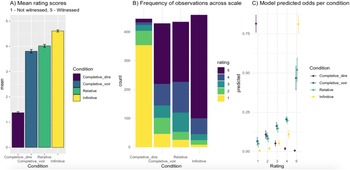
Table 1 shows the mean rating scores across the four conditions in terms of the witnessing scale, where 1 indicates ‘not witnessed without doubt’ and 5 indicates ‘witnessed, without doubt’, and the model outputs from a Cumulative Link Mixed Model (CLMM). Figure 1 exhibits the mean rating scores (1A), frequency distribution of scale responses across conditions (1B) and model predicted odds per condition (1C) from the rating data in Experiment 1. A monotonic increase in witnessing ratings across Complement_dire < Complement_voir < Relative < Infinitive ECM is clearly visible. The model compared each condition to the baseline condition, which is the Complement_dire, and the outputs showed that the Complement_voir, the Relative and the Infinitive ECM conditions were more often rated as witnessed than the Complement_dire condition, the coefficients ß increased monotonically across conditions (see Table 1). Spacing (0.52) was highly significant, indicating that responses to the ordinal scaled categories were not evenly spaced.
Mean and standard deviations (SD), rating scale represent the participants’ perspective whether the speaker witnessed the action or not, on a scale from 1 (not witnessed) to 5 (witnessed). Threshold represents cut-off boundaries between ordinal categories on the scale, spacing takes into account the distance between these boundaries

Mean rating scores (A), frequency distribution of scale responses across conditions (B) and model predicted odds per condition from the rating data in Experiment 1.

Since the outputs from the CLMM model did not allow us to directly compare each condition difference, we computed Benferroni-corrected post-hoc comparisons. These comparisons showed that the Infinitive ECM condition is more strongly associated with direct witnessing as compared to the Relative (ß = –0.83, SE = 0.08, z = –9.57, p < .0001), the Complement_voir (ß = –0.96, SE = 0.08, z = –11.01, p < .0001), and the Complement_dire conditions (ß = –3.36, SE = 0.17, z = –31.37, p < .0001). The Complement_dire condition, by contrast, is strongly not associated with a form of witnessed information in comparison to the Complement_voir (ß = –2.39, SE = 0.09, z = –25.27, p < .0001) and the Relative condition (ß = –2.53, SE = 0.09, z = –26.35, p < .0001). There were no differences between the Complement_voir and the Relative conditions (ß = –0.13, SE = 0.07, z = –1.67, p = 0.33).
These results suggest that our participants consistently interpreted the infinitive ECM clauses as encoding direct evidentiality, while they interpreted the complement dire structures as encoding indirect non-witnessed evidentiality (see Figures 1A-1C). Furthermore, contrary to our predictions, complement clauses with voir were rated closer to the “witnessed” end of the scale (with a mean rating of 3.7, see Figure 1A). However, a closer look into the data shows that proportions of responses with an interpretation of highly witnessing (5 on the rating scale) range around 50% of all responses in both the Complement_voir and Relative conditions (see Figure 1C). The other half of responses in these two conditions showed variable and less confident ratings. As there were no statistical significant differences between the Complement_voir and Relative conditions, it is conceivable that both the conditions showed variable evidential interpretations.
2.1.6 Interim discussion
Based on these results, we conclude the following: complement clauses with dire are clearly interpreted as not witnessed, consistent with their reportative nature. This aligns with our expectation that these constructions trigger indirect evidentiality. The other three structures – infinitive ECM clauses, relative clauses, and complement clauses with voir – were all rated as highly witnessed, although they showed significant differences in their ratings. Infinitive ECM clauses and relative clauses were rated the closest to witnessed, suggesting they are more strongly associated with direct evidentiality. Complement clauses with voir, despite being expected to signal indirect evidentiality, were rated closer to “witnessed”, indicating a potential overlap in how these structures are interpreted in terms of evidentiality.
These findings suggest that while there is a clear distinction for dire constructions, the syntax of complement clauses under voir might be more complex than initially anticipated, perhaps encoding both direct and indirect evidentiality depending on other factors still to be uncovered.
Given that the first experiment focused solely on whether the event was witnessed or not, without differentiating between reporting and inference, we designed a second experiment to probe these nuances more deeply. The goal was to investigate whether the different syntactic structures trigger specific types of evidentiality – whether direct or indirect, and whether the speaker’s role (witness, reporter, or inferrer) affects the interpretation.
2.2 Experiment 2: Forced-choice in source identification questionnaire study
Experiment 2 aimed to determine whether adult French speakers are able to distinguish between three different information sources, namely, direct witnessing, inference, and report, which are assumed to map onto different perception verb constructions. In Experiment 2, we administered a source identification questionnaire that included the pseudo-relative condition, which was absent from Experiment 1 and allowed us to tease apart pseudo-relative and restrictive relative clauses. Indeed, relative clauses are described as referring to individuals, whereas pseudo-relative clauses refer to events and allow direct perception only (see section 1.4).
2.2.1 Method
2.2.1.1 Participants
A total number of 81 adult speakers, who speak French as their first acquired language, were recruited in the South of France (53 females, mean age = 32.21, SD = 15.18). The participants were distinct from those reported in Experiment 1. At the time of the testing, most of the participants were university students at Université Côte d’Azur. Participation was not remunerated. None reported any psychiatric or language disorders that may have hindered their admission in the study. All participants provided informed consent online prior to the study.
2.2.1.2 Stimuli
We expanded the 32 sentences in Experiment 1 from four to five conditions, totalling 160 experimental materials: (i) Complement_dire, (ii) Complement_voir, (iii) Relative, (iv) Pseudo_relative, (v) Infinitive ECM clauses (see examples (20)-(24)). As in Experiment 1, all the embedded clauses were under the perception verb voir ‘see’, except the complement clause with dire ‘say’, which provides the control condition. All the stimuli displayed identical tense in matrix and embedded clauses.
(20)
Complement clauses with
dire
‘say’
Hier,
on
m’a
dit
que
quelqu’un
a
yesterday
one
me=has
told
that
someone
has
imprimé
un
billet
de
train.
printed
a
ticket
of
train
‘Yesterday, I was told that someone printed a train ticket.’
(21)
Complement clauses with
voir
‘see’
Hier,
j’ai
vu
que
quelqu’un a
imprimé
un
yesterday
I=have
seen
that
someone has
printed
a
billet
de
train.
ticket
of
train
‘Yesterday, I saw that someone printed a train ticket.’
(22)
Relative clauses with
voir
‘see’
Hier,
j’ai
vu
quelqu’un
qui
a
imprimé
yesterday
I=have
seen
someone
who
has
printed
un
billet
de
train.
a
ticket
of
train
‘Yesterday, I saw someone who printed a train ticket.’
(23)
Pseudo-relative clauses with
voir
‘see’
Hier,
j’ai
vu
Georges
qui
a
imprimé
yesterday
I=have
seen
Georges
who
has
printed
un
billet
de
train.
a
ticket
of
train
‘Yesterday, I saw George who printed a train ticket’
(24)
Infinitive ECM clauses
Hier,
j’ai
vu
quelqu’un
imprimer
un billet de train.
yesterday
I=have
seen
someone
print.INF
a ticket of train.
‘Yesterday, I saw someone print a train ticket.’
2.2.1.3 Procedure
The materials were programmed using Google Forms (Google Inc., 2024) and were administered individually to the participants under the supervision of a research assistant. The participants were asked to read sentence stimuli containing perception verb constructions (see examples 20–24) and to determine whether the speaker directly witnessed the event described in each sentence. For each sentence, the participants were asked to choose one of the three possible sources of information: (i) I was present when the event took place; therefore I was a direct witness of the event I describe (direct witnessing); (ii) I was not present when the event took place; therefore I infer that the event took place (inference); (iii) I was not present when the event took place; therefore I report the event by hearsay (report).
Each participant was presented with 32 experimental sentences, with each sentence appearing in only one of five possible versions for that participant. This forced-choice paradigm allowed us to explore whether specific perception verb subordinate constructions were more likely to trigger certain types of evidentiality (direct witnessing, inference, or report), providing deeper insights into the role of syntax in evidential marking in French.
2.2.2 Predictions based on RQ2
We asked whether French speakers link direct witnessing, inference, or reported information sources to different subordinate clauses. We make the following specific predictions for the five different subordinate structures tested in Experiment 2:
-
(a) Complement clauses with dire ‘say’, as in (20), should be associated with indirect evidentiality and specifically be interpreted as reportatives, where the speaker relies on information provided by a third party (i.e., hearsay).
-
(b) We also expect complement clauses with voir ‘see’, as in (21), to trigger indirect evidentiality, interpreted as involving inference, where the speaker infers that the event happened rather than directly witnessing it. However, in light of the results from Experiment 1, it is conceivable that voir complement clauses in Experiment 2 may alternate between direct and indirect information source interpretations.
-
(c) Relative clauses with voir and an indefinite head noun (i.e., restrictive relatives, as in (22)), should be interpreted as potentially involving direct evidentiality, suggesting that the speaker directly observed the event.
-
(d) Relative clauses with a proper name head noun (i.e., pseudo-relatives, as in (23)) are predicted to be possibly interpreted as involving direct evidentiality, reflecting the speaker’s direct observation of the event, as with restrictive relative clauses.
-
(e) Infinitive ECM clauses like (24) are predicted to unambiguously encode direct evidentiality, implying that the speaker directly witnessed the event.
2.2.3 Data analysis
The frequency counts data were analysed using the Pearson’s Chi-squared test. Following Tomczak and Tomczak (Reference Tomczak and Tomczak2014), we calculated the Cramer’s V as a determiner of the effect size of associations tested in the Chi-squared test. The associations were visually depicted utilizing the Correspondence Analysis (Greenacre, Reference Greenacre2017) with the package ‘ca’ in R (Nenadic and Greenacre, Reference Nenadic and Greenacre2007). To further understand the association patterns, a set of Bonferroni-corrected post-hoc tests were computed using the chisq.posthoc.test function.
2.2.4 Results
Table 2 shows the frequency counts for each response type across the five experimental conditions. The frequency data were transformed into a 5×3 frequency table, containing the syntactic conditions by the response options. A Pearson’s Chi-squared test revealed a significant association between the conditions and responses: χ2(8, 2582) = 1789.8, p < .001. The effect size, measured by Cramer’s V (0.589), further supports this strong association.
Frequency counts of participants’ responses in information sources of inference, report and witnessing across different kinds of syntactic structures. Each cell represents raw counts and percentages, per condition responses top-down add up to 100%. Note there were 32 experimental items per condition

Table 3 exhibits the outcomes from a set of post-hoc pairwise comparisons using Bonferroni corrections, which were conducted to further investigate the significant Chi-Square association between condition and response type. Positive residuals represent a strong association, while negative residuals indicate underrepresentation of a response type in a condition. The adjusted standardized residuals indicate deviations from expected frequency based on independence assumption calculated for each cell in the frequency table. The Complement_dire condition was strongly associated with Report (in 86% of cases; Residual = 37.34, p < .001), while this condition received only few Witness responses (Residual = –27.21, p < .001), confirming their role as encoding indirect evidentiality, where the speaker relies on information verbal report from another speaker. The Complement_voir condition, by contrast, showed a strong association with Inference (Residual = 17.37, p < .001). That means that Complement_voir sentences were rather dissociated from Witness or Report responses based on the expected frequency. This result confirms our initial hypothesis that complement clauses with voir primarily license inference, possibly based on observation of resultant states. Further, the Infinitive ECM, Relative, Pseudo-relative conditions show associations with Witness. Particularly, the Infinitive ECM condition was the most strongly linked to Witness (Residual = 19.04, p < .001) while being underrepresented in Inference (Residual = –10.90, p < .001) and Report (Residual = –11.99, p < .001). This aligns with our prediction that infinitive ECM clauses are virtually unambiguous in encoding direct evidential meanings (93.6%). In addition, relative (70.7%) and pseudo-relative clauses (68%) were predominantly interpreted as involving direct witnessing, supporting our hypothesis that these structures are strongly associated with direct evidentiality. The difference between the two types of relatives is not significant.
Outputs from Bonferroni-corrected pairwise comparisons between different response types in relation with conditions

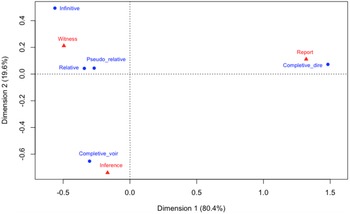
Figure 2 depicts these associations based on a Correspondence Analysis plot. Principal dimensions 1 and 2 were extracted from chi-square distances, showing the percent explained associations (i.e., dimension 1 explains 80.4% of the association structure). Blue points represent the syntactic structures used with the verbs voir or dire. Red triangles indicate the information source options. The proximity between blue dots and red triangles reflects the strength of their association. This confirms that Infinitive ECM, Relative and Pseudo-relative clauses are strongly associated with the speaker’s direct witnessing, as these conditions were plotted close to each other. However, Infinitive ECM clauses show stronger association as compared to other Witness indicators since the Infinitive condition has a residual position further away from the zero-centre point. By contrast, the Complement_dire condition’s association with reportative and the Complement_voir condition’s association with inference are clearly very strong.
Correspondence Analysis plot visually depicting the associations found between syntactic conditions and information source answer options.

2.2.5 Summary of results and interim discussion
Contrary to Experiment 1, Experiment 2 allows us to tease apart reporting and inference, as shown in Figure 2. The Complement_dire condition was strongly associated with Report, as expected (control condition). The Complement_voir condition, by contrast, showed a strong association with Inference and not Report. These results allow us to provide a more fine-grained interpretation of the Complement_voir condition than in Experiment 1: they suggest that the participants in Experiment 1 considered as witnessed an event that was actually inferred. Finally, the Infinitive ECM, Relative, Pseudo-relative conditions show associations with “Witness”, particularly the Infinitive ECM condition. These results align with our prediction that infinitive clauses under voir unambiguously encode direct evidentiality only.
2.3 Experiment 3: Context-sentence matching questionnaire studies
To complement the comprehension-based findings of Experiments 1 and 2, we conducted a production-oriented study to determine whether the same patterns of evidentiality would be found in participants’ linguistic productions. To this end, we devised two discourse completion tasks with context-sentence matching questionnaires. Experiment 3a specifically contrasted complement clauses and pseudo-relative constructions under voir, whereas Experiment 3b compared complement clauses and infinitive ECM clauses under voir.
2.3.1 Method
2.3.1.1 Participants
A total of 89 adult participants (mean age = 38.6, SD = 15.62, 60 females) who spoke French natively from birth were recruited and admitted to one of the two experiments: Experiment 3a (n = 41) and Experiment 3b (n = 48). The participants were different from those reported in Experiments 1 and 2. The participants were students enrolled at Université Côte d’Azur, but were not compensated for their time.
2.3.1.1 Experiment 3a: Stimuli and predictions
For the two context sentence matching questionnaires in Experiments 3a and 3b, we adapted the 32 sentence materials used in Experiments 1 and 2, and we created 32 information source contexts in two conditions:
-
• (i) An Indirect information context condition, in which the participants were presented with the resultant state of an event or action, as illustrated in (25a). According to our hypothesis, this scenario was expected to trigger an inferential interpretation.
-
• (ii) A Visual direct information context condition, in which the participants were presented with an event or action to which they actively participated, as shown in (25b). According to our hypothesis, this scenario was expected to trigger a direct witnessing interpretation.
(25)
Information contexts
a. Indirect:
Vous
avez
trouvé
sur
la
table
du
salon
une
You
have
found
on
the
table
of.the
living.room
a
photo
de
Jean
prise
la
veille.
photo
of
Jean
taken
the
day.before
‘You found on the living room table a photo of Jean taken the day before.’
b. Visual direct:
Vous
êtes
entré.e
dans
le
studio
photo
de
votre
ami
You
are
entered
in
the
studio
photo
of
your
friend
Jean
en
plein
shooting.
Jean
in
full
shooting
‘You entered the photo studio of your friend Jean during a photoshoot.’
We provided two structurally distinct options: a complement clause with voir, as in (26a), and a pseudo-relative clause with voir, as in (26b). The participants were instructed to select only one of the two sentences based on indirect or direct information context. In Experiments 1 and 2, complement clauses with voir were generally interpreted as conveying indirect evidence, whereas pseudo-relative constructions were more likely to be associated with direct evidence. We therefore predicted associations between (25a) and (26a) on the one hand, and (25b) and (26b) on the other hand.
(26)
a. Option 1: complement clauses with voir
J’ai
vu
que
Jean
a
pris
une
photo.
I=have
seen
that
Jean
has
taken
a
picture
‘I saw that John took a picture.’
b. Option 2: pseudo-relative with
voir
J’ai
vu
Jean
qui
a
pris
une
photo.
I=have
seen
Jean
who
has
taken
a
picture
‘I saw John who took a picture.’
2.3.1.2 Experiment 3b: Stimuli and predictions
The same 32 information source contexts were used in Experiments 3a and 3b. The difference with 3a lies in the choice of clauses. Whereas complement clauses with voir were present in both experiments (26a and 27a are identical), pseudo-relative clauses in Experiment 3a (as in 26b) were replaced with infinitival ECM clauses in Experiment 3b (as in 27b). Substituting pseudo-relative clauses with infinitival ECM clauses was motivated by the aim to test a syntactic structure that appeared to be more closely associated with direct perception (as shown in Experiment 2; see Table 2).
(27)
a. Option 1: complement clauses with voir
J’ai
vu
que
Jean
a
pris
une
photo.
I=have
seen
that
Jean
has
taken
a
picture
‘I saw that John took a picture.’
b. Option 2: infinitive with voir
J’ai
vu
Jean
prendre
une
photo.
I=have
seen
Jean
take.inf
a
picture
‘I saw Jean take a picture.’
The predictions in Experiment 3b were identical to those in Experiment 3a. In the Indirect information context, we expected the participants to prefer the complement clause with voir. In the Visual direct Information condition, we predicted that the participants would choose the infinitival ECM clause, as it unambiguously encodes direct evidentiality, emphasizing the speaker’s direct perception of the event (see Table 3).
2.3.1.3 Procedure
The sentence materials were presented on Google Forms (Google Inc., 2024) and were administered individually to the participants under the supervision of a research assistant. They were instructed to take their time to read each information context carefully and select the most appropriate sentence continuation to form a coherent context-production sentence pair.
2.3.2 Results
The data from Experiments 3a and 3b were transformed into a 2×2 frequency table. Table 4 presents the frequency counts of participants’ preferred responses across the Visual direct and Indirect information conditions: complement clauses versus pseudo-relative clauses in Experiment 3a, and complement clauses versus infinitive ECM clauses in Experiment 3b.
Frequency counts of participants’ selection of syntactic options across direct witnessing and indirect information conditions. Each cell represents raw counts and percentages, per condition responses top-down add up to 100%

2.3.3 Results and interim discussion from Experiments 3a and 3b
For Experiment 3a, a Pearson’s Chi-squared test revealed a strong and statistically significant association between the conditions and responses: χ2(1, 1152) = 397.08, p < .001. The effect size, measured by Cramer’s V (0.587), suggests a moderate association between Conditions (Indirect vs. Direct Context) and Response Types (Complement vs. Pseudo-relative). This association was further examined through a series of Bonferroni-corrected post hoc tests. In the Indirect information source condition, the complement clauses responses showed a significant positive deviation from the expected frequency (Residual = 19.98, p < .001), while the pseudo-relative responses were much less frequently preferred (Residual = –19.98, p < .001). This result confirms that complement clauses are strongly preferred in indirect contexts. In the Visual direct information source condition, pseudo-relative responses were selected more frequently than pure chance (Residual = 19.98, p < .001), while complement clauses were less frequently preferred as a potential response to complete a direct information context (Residual = –19.98, p < .001).
In summary, the post hoc analyses revealed a clear pattern of response preferences: the Indirect information source condition triggered a strong preference for complement clauses, accounting for 92.5% of all responses in that condition, whereas the Visual direct information source condition showed a higher frequency of pseudo-relative responses (63.9%). The low preference rate of pseudo-relative clauses in the indirect contexts is consistent with the findings from Experiment 2. Our participants’ preference for complement clauses with voir for indirect information sources (92.5% of all cases) converges on this structure’s strong association with inference found in Experiment 2.
We found that the use of complement clauses in direct information contexts was slightly higher than expected (36.1%). This means that, in Experiment 3a, when given an indirect information source context, the participants preferred a complement clause with voir with very high confidence, affiliating this structure with inferential meanings. However, when given a direct witnessing information source context, the participants still consider using a complement clause with voir, albeit less often than a relative structure. These results suggest that complement clauses with voir are not rigidly tied to indirect evidentiality. The lexical ambiguity of voir – which can function either as a perception verb (triggering direct perception) or as an inferential verb (selecting for a propositional complement) – renders the construction flexible enough to compete with pseudo-relative clauses even in contexts that typically favor direct evidential encoding. Without additional cues – like information about the surrounding context, the intended interpretation may remain unsolved. Overall, this finding highlights a degree of variability in the evidentiality encoding of complement clauses and underscores the need for further research into the factors shaping their distribution and interpretation across different information-source contexts.
Regarding Experiment 3b, a Pearson’s Chi-squared test revealed a strong significant association between the conditions (Indirect vs Direct) and response types (Complement vs Infinitive ECM; χ2(1, 1466) = 739.52, p < .001). We calculated the effect size estimation Cramér’s V to be .710, indicating a strong association. For the Indirect information source condition, complement clauses were the preferred response option (Residual = 27.24, p < .001), whereas infinitive ECM clauses were dispreferred (Residual = –27.24, p < .001). In contrast, in the Visual direct information condition, infinitive ECM clauses were by far the preferred option (Residual = 27.24, p < .001), while complement clauses were dispreferred (Residual = –27.24, p < .001). The preference for complement clauses with voir in the Indirect information source condition, observed consistently across Experiments 3a and 3b, supports the hypothesis that such clauses are closely associated with indirect information sources and are well-suited to inference-based contexts. In Visual direct information contexts, infinitival ECM clauses were selected in 79% of cases, corroborating the prediction that these constructions are suitable for expressing direct witnessing of the speaker.
3. General discussion
3.1 Summary of aims and results
This study was guided by three central research questions: (i) the extent to which adult French speakers associate different types of subordinate clauses with perception verbs to different degrees of witnessing (RQ1), (ii) whether and how French speakers identify types of information sources that different kinds of subordinate clauses encode (RQ2), and finally (iii) whether French speakers prefer the hypothesized kind of subordinate clause for given information source contexts (RQ3). To answer these questions, we designed three experiments.
In order to answer RQ1, Experiment 1 investigated how French speakers rate witnessability of events according to four different subordinate clause structures. The results showed that our participants rated infinitive ECM clauses to be very likely witnessed, while they rated the complement dire ‘say’ structures as less likely witnessed. Importantly, the participants showed variability in their ratings of complement and relative voir ‘see’ clauses, which showed ambiguous readings between witnessed and unwitnessed connotations. In order to answer RQ2, Experiment 2 investigated how French speakers map five different subordinate clauses (i.e., the same as in Experiment 1 plus pseudo-relatives) to three different information sources (i.e., direct witnessing, inference, and report). The results showed that our participants identified direct witnessing as the appropriate information source for infinitive ECM, relative and pseudo-relative clauses, whereas complement voir clauses were rather associated with inferential meanings. The complement dire clauses were expectedly associated with reportative meanings. Finally, to answer RQ3, Experiments 3a and 3b investigated which type of embedded clauses French speakers produce according to two types of contexts (i.e., indirect information and visual direct contexts). The results showed that the French speakers preferred complement clauses with voir to complete indirect information contexts indicating inference based on resultant states of a given event. However, we should note that they also considered, albeit to a rather minimal extent, complement voir for direct witnessing contexts as well. In contrast, the participants almost unambiguously preferred pseudo-relative and infinitive ECM clauses for contexts indicating the speaker’s direct witnessing.
In response to our overarching aim, we explored whether French, similar to other non-evidential languages, such as English, employs syntactic and lexical evidential strategies to indicate information sources, particularly under perception and reported verbs in subordinate clause structures. Because our response is positive, we are able to confirm that French provides different perception verb constructions that allow the speakers to convey different information sources. In more detail, we confirmed that (i) infinitive ECM clauses with voir are strongly associated with direct witnessing, (ii) pseudo-relative and relative clauses with voir are also associated with direct witnessing, (iii) complement voir varies in its behaviour in referring to inferential contexts based on resultant states and direct witnessing, and finally (iv) complement dire clauses are strongly associated with reported information. We should note that the French participants’ choices of syntactic options in reference to ‘evidential’ contexts are likely to be guided by the lexical semantics of the verbs voir ‘see’ and dire ‘say’. Implications of these evidential evaluations are discussed in Section 3.2.
3.2 J’ai vu! Direct witnessing expressed in subordinate clauses
Across all experiments, infinitive ECM clauses with voir were found to be consistently associated with direct “witnessing” interpretations. In Experiment 1, participants rated infinitives as the most prototypical form for direct perceptual access. This interpretation was reinforced in Experiment 2, where infinitives were consistently categorized under the “Witness” label, and again in Experiment 3b, where they were strongly preferred in contexts presenting visual, first-hand evidence. These results confirm the assumption that infinitive ECM clauses under voir unambiguously are associated with events the speaker directly observed. This finding converges with those reported by Palasis (Reference Palasis2025) who showed that French-speaking preschoolers can produce ECM infinitives and (pseudo-)relatives to convey direct information. The use of infinitives for direct witnessing seems also compatible with Badoc et al. (Reference Badoc, Tavernier and Arslan2025) who showed that when French adults were instructed to retell deceitful versions of events, they tended to produce an elevated number of infinitives under voir followed by affirmative adverbs to ascertain well-assimilated witnessed knowledge to sound more accountable.
(Pseudo-)Relative clauses also pattern with direct evidentiality, though less robustly. In Experiment 2, relative and pseudo-relative constructions were generally associated with the Witness label, suggesting that they are also interpreted as expressing direct perceptual access. Experiment 3a confirmed the pattern: pseudo-relative clauses were preferred in visual contexts, while dispreferred in indirect contexts. However, their preference rate was lower than that of infinitives, indicating that although encoding direct evidentiality, they may be more context-sensitive or pragmatically modulated.
These results suggest that the direct evidential meaning is directly related to the semantics of the perception verb: in all three cases (restrictive relative, pseudo-relative and ECM Infinitive clauses), the perceiver directly eye-witnesses its object: either an individual (Leo Messi, in Section 1.4.1, ex. (6-7)) or an entire event (j’ai vu Raphaël qui joue au football / j’ai vu Raphaël jouer au football ‘I saw Raphaël playing football’, in Section 1.4.2-1.4.3, ex. (8-9))
Whereas relative clauses involve DP complements (e.g., Bianchi, Reference Bianchi2002; Cecchetto and Donati, Reference Cecchetto and Donati2023), pseudo-relatives and ECM constructions are both semantically and syntactically similar in that they s-select for an eventuality (i.e., an event) and c-select for structurally deficient or “defective” clauses. In both cases, the embedded tense is anaphoric on the matrix tense, indicating a lack of temporal independence, which supports the idea that these constructions involve reduced or non-finite clausal structures. This structural parallelism suggests that pseudo-relatives and ECM complements are closely related, possibly instantiating the same underlying configuration. In support to this, pseudo-relatives have been analysed as small clauses in Romance (Cinque Reference Cinque1992; Casalicchio Reference Casalicchio, Carrilho, Fiéis, Lobo and Pereira2016a, see also Section 1.4.3), while ECM complements of perception verbs have long been treated as VP-level Small Clauses (e.g., Stowell Reference Stowell1983, Reference Stowell and Freidin1991).
3.3 On m’a dit que! Reported information expressed in complement clauses of dire
Complement clauses under on m’a dit que ‘I was told that’ are clearly associated with indirect evidentiality. Indeed, they were consistently interpreted as reported evidence (Experiments 1 and 2), hence aligning with their lexical semantics (the main clause unambiguously states that the event is reported by hearsay) and functioning as a control for indirectness.
3.4 J’ai vu que! A special note on inferential and witnessed meanings expressed in complement clauses of voir
Complement clauses with voir showed a more nuanced pattern: while initially interpreted as direct in Experiment 1, Experiment 2 revealed that this witnessed rating probably reflected inference from visual evidence. This inference-based reading was further supported in Experiment 3, where complement clauses with voir were preferred in indirect contexts but still showed non-negligible use in direct ones. These findings suggest that complement clauses with voir constructions straddle the line between direct and indirect evidentiality, with flexible interpretation shaped by context.
The variable evidential behaviour of complement clauses with voir in French sets them apart from analogous constructions in English and Dutch (see Asudeh and Toivonen Reference Asudeh and Toivonen2012; Rett and Hyams, Reference Rett and Hyams2014; Koring and De Mulde, Reference Koring and De Mulder2015), where raising ‘perception’ verb (‘look like/sound like/feel like’) complements signal direct evidentiality more reliably. In our data, complement clauses with voir were consistently associated with inferential readings – particularly in contexts where the speaker draws conclusions from visible resultant states rather than directly perceiving the event itself. This suggests that their evidential profile is primarily inferential, even when rated as “witnessed” in more coarse-grained tasks. One possibility is that the lexical semantics of voir in French licenses a broader evidential range than its English and Dutch counterparts, accommodating both direct and indirect (inferential) readings. Understanding the precise conditions under which complement clauses with voir are interpreted as direct – versus inferred – remains an open question and calls for further investigation, particularly into the role of aspect, event structure, and contextual cues.
With this discussion in mind, we can now address the broader question of whether different syntactic structures signal different sources of information. While the data support a partial distinction, the hypothesis in its strongest form appears overly restrictive. Specifically, indirect evidentiality is consistently marked by complement clauses paired with the matrix verb voir, whereas direct evidentiality is conveyed through infinitival ECM clauses, relative clauses and pseudo-relatives, again with voir, with no significant distinction between the two types of relative clauses. These findings suggest that voir in French functions as more than a purely lexical verb: It licenses indirect evidentiality through tensed complement (CP) clauses, but it does not appear to favour any particular syntactic construction for the expression of direct evidentiality.
3.5 Conclusions and future directions
This study investigated the assumption that French subordinate clauses under perception verbs may express different evidential meanings. Across three experiments, we showed that the groups of French speakers interpreted syntactic complements in French under the perception and reporting verbs voir and dire as expressing indirect inferential and reportative evidential meanings, respectively, whilst they associated voir complements with infinitival ECM and (pseudo-)relatives to indicate direct witnessing of the speaker. We therefore conclude that French subordinate clauses under the perception verb voir do express different evidential meanings.
Future research might want to focus on the status of other perception verbs in French. Interestingly, not all verbs allow the same range of syntactic structures. Whereas entendre ‘hear’ and sentir ‘smell’ can select complement clauses, ECM infinitive clauses, or appear with (pseudo-)relative constructions, other perception verbs such as goûter ‘taste’ and toucher ‘touch’ among others, do not. Further theoretical and experimental work is needed to clarify this domain.
Acknowledgements
We are grateful to Fiona Meyer for her assistance during data collection. We are grateful to the editors Bryan Donaldson and Dalila Ayoun. We also thank the audience at the International Conference (Un)Reality and Evidentiality in Language, Cognition, Society organised at the University of Cyprus in October 2024, for their constructive feedback. We also thank the audience of The syntax and semantics of perception workshop at the 58th Annual Meeting of SLE in Bordeaux, France.
Abbreviations
- acc
-
accusative
- cond
-
conditional
- fut
-
future
- inf
-
infinitive
- nom
-
nominative
- sg
-
singular
- dp
-
determiner phrase
- cp
-
complementizer phrase
- pp
-
prepositional phrase
Authors’ contributions
Conceptualization: Author_1, Author_2, Author_3; Supervision, Methodology and Project administration: Author_1, Author_2, Author_3; Analysis: Author_3; Writing – original draft, review & editing: Author_1, Author_2, Author_3.
Competing interests declaration
The authors declare none.
Funding
This project is supported by the European Union’s Horizon 2020 research and innovation programme, Marie Skłodowska-Curie grant (agreement no. 838602) awarded to Seçkin Arslan.
Open data statement
Data, code and stimulus materials from the experiments reported in this paper can be found at the OSF platform via the following link: https://osf.io/8erhv
Ethics approval statement
Procedures reported in this article were approved by Université Côte d’Azur (File no. 2023-040, approved 20 August 2023).





 Open access

