


The previous chapters substantiate three important developments for democratic representation in the age of globalization. First, Chapters 4 and 5 demonstrate that economic integration has constrained parties’ room to maneuver. When parties hold executive power and their countries are deeply embedded into the international economic system, they find it difficult – sometimes impossible – to keep the promises they made to voters. We find that the globalization constraints are particularly stifling for center-left parties. Their policies are often in conflict with the pressures of the global economy.
The disruptive effects of globalization on promise breaking have marked electoral consequences. Chapter 6 provides observational and experimental evidence that voters punish governing parties when they fail to keep their campaign promises. Moreover, voters don’t let politicians off the hook for promise breaking because of globalization. On the contrary, the electoral consequences of promise breaking have become even larger as globalization has deepened. The increased salience of promise keeping and breaking can be attributed to the increased focus on governing competence in party competition. As the room to maneuver available to governing parties has become constrained and the ideological differences between them have become smaller, parties increasingly attempt to distinguish themselves by their governing competence. The ability to formulate and follow through on campaign promises is a marker of this.
Political parties of the left and right are affected by globalization’s constraints, but in different ways. Leftist parties are particularly negatively affected by globalization’s constraints when they hold executive power, being unable to keep many of their campaign promises as a result. Moreover, Chapter 7 shows that leftist parties have strong disincentives to adjust their ideological positions toward the center ground, which would underpin campaign promises that are easier to fulfil within the constraints of globalization. While rightist parties may face fewer constraints from globalization when holding executive power, they have faced enormous pressure to moderate their traditional commitments to neoliberal economic policies, which do not meet the concerns of lower and middle-income citizens who increasingly expect their governments to protect them from economic insecurity caused by globalization. Chapter 7 shows that mainstream parties on the right have adjusted their ideological positions on the socioeconomic dimension by moving toward the center. The center ground is, however, not a safe place for traditionally rightist parties. By moderating their socioeconomic ideological positions, rightist parties may have taken the hard edges off their support for neoliberal policies, but they still do not offer policies that entail sufficient protection for middle-class citizens exposed to the vagaries of global markets. At the same time, ideological moderation risks alienating many of their traditional supporters that favor more economically liberal positions. Chapter 8 shows that many center-right parties adopt populist rhetoric and policies to escape this predicament.
We argue that parties attempt to circumvent the challenges of globalization partly by being more ambiguous in their electoral appeals. Leftist parties use ambiguity to avoid punishment for promise breaking. Ambiguous campaign statements are reconcilable with a broad range of subsequent government policies and are therefore unlikely to be perceived by voters as broken promises. Rightist parties use ambiguous language to obscure the fact that their positions do not appeal to key supporters. For center-right parties, ambiguity obfuscates the fact that their centrist policies offer little respite to middle-class citizens exposed to the economic risks associated with globalization, while also weakening their commitment to traditional supporters that favor more radical neoliberal policies.
While ambiguity may be politically expedient, effective promissory representation requires that parties make clear and unambiguous electoral appeals. The contents of parties’ electoral appeals to voters form a key link in the democratic chain of command and control (Figure 1.1). These provide voters with relevant information to assess which parties propose policies that align closest with their own preferences. Furthermore, when voters assess governing parties’ performance, they may look back on what those parties promised in previous campaigns, possibly reminded of broken promises by the government’s critics. In other words, campaign statements inform citizens’ prospective and retrospective evaluations. If parties cloak their electoral appeals in a “fog of ambiguity” democratic representation cannot work effectively (Downs Reference Downs1957: 136).
The analyses presented in this chapter are based on a unique dataset with measures of ambiguity in 293 English-language party election programs from six countries spanning 1970 to 2019. The findings reveal a clear and significant trend: Political parties tend to adopt more ambiguous language in their campaign programs when operating in highly globalized economies. In line with our theoretical argument, both leftist and rightist parties resort to vague language when constrained by globalization, albeit for different reasons. We find that the incentives to use ambiguity are particularly pronounced in the realm of economic policies. Economic policies are most directly affected by globalization, as international trade agreements, financial markets, and global competition impose strict limits on governing parties’ ability to fulfill promises related to taxation, trade regulation, or job creation. By using vague language in these areas, parties can avoid committing to specific measures that may be difficult or impossible to deliver under global economic pressures.
This chapter advances the book’s broader goal of tracing how globalization reshapes promissory representation by focusing on a less studied, yet consequential, dimension of party strategy: the ambiguity of electoral appeals. By examining the relationship between economic globalization and the vagueness of election platforms, we show that as the constraints of global markets intensify, parties respond not only by shifting their policy positions but also by strategically obfuscating their commitments. This strategic ambiguity allows parties to maintain electoral support across increasingly heterogeneous constituencies while preserving flexibility in government. The chapter therefore identifies an additional mechanism through which globalization weakens democratic accountability. In doing so, it also contributes to the growing literature on ambiguity in globalized party competition, offering new insights into how parties navigate the dilemmas they face due to the constraints associated with economic globalization.
The Electoral Foundations of Ambiguity
Ambiguity is technically defined as “a probability distribution over points in the issue space” (Tomz and Van Houweling Reference Tomz and Van Houweling2009: 84). Suppose we visualize an actor’s clear policy position as a single point in a policy space, such as a point on the left–right dimension. An ambiguous position is one that is not represented by a single point, but by several points in that space. The more spread out those points are, the more ambiguous the actor’s position is. In the context of electoral appeals, ambiguity comes in two main forms: vagueness and ambivalence (Nasr Reference Nasr2022).
Vagueness refers to the use of language that is unclear and creates uncertainty about precisely what a party stands for (Eichorst and Lin Reference Eichorst and Lin2019). While concrete language carries a relatively narrow range of reasonable interpretations of what the party intends to do, vague language carries a broader range of possible interpretations (Klein and Rovatsos Reference Klein, Rovatsos, Nowen, Van Rooij, Sauerland and Schmitz2011). For example, a party might state, “We will reform the healthcare system to make it more efficient and accessible.” While this statement focuses on a specific policy area – healthcare reform – it is vague because it does not specify what kind of reforms the party is proposing. Will they introduce market-based reforms, increase public funding, or cut bureaucracy? The phrase “more efficient and accessible” could mean many different things depending on the details of the proposed reforms, leaving voters uncertain about the party’s actual policy intentions.
The use of vague language might seem incompatible with campaign promises, as we define them in Chapter 4, but these are distinct phenomena both conceptually and empirically. According to Comparative Pledges Project researchers, a pledge is “a statement committing a party to one specific action or outcome that can be clearly determined to have occurred or not” (Royed, Naurin, and Thomson Reference Naurin, Royed and Thomson2019: 24). Furthermore, the narrow definition of campaign promises stipulates that the “criteria used to judge the fulfilment of pledges are in principle provided by the writers of election programmes, not by the researcher” (Thomson Reference Thomson2001: 180). This definition of campaign promises suggests that these statements are generally clearer than many other statements found in parties’ election programs. However, given the flexibility of language, some campaign promises may be vaguer than others. For instance, pledging to lower the basic rate of taxation from “11 to 8 percent” is clearer than pledging a “substantial reduction” in the basic rate of taxation. Moreover, parties’ electoral appeals consist of more than just lists of promises, and we are interested in the clarity of that totality of text. The language parties use to describe the general principles they support, the problems they seek to address, their own performance in government, and the performance of their political opponents is also relevant. The entire corpus of parties’ electoral appeals makes up a broad conception of parties’ promises. In addition to these important conceptual differences, there is also a telling empirical difference. In Chapter 4, we present evidence that globalization does not cause parties to make fewer (or more) campaign promises (Figure 4.8). By contrast, the main finding of this chapter is that globalization is associated with mainstream parties using significantly vaguer language.
Ambivalence is a distinct form of ambiguity and refers to situations in which a party makes different statements, all of which may be quite clear in their own terms, but taken together create uncertainty about where the party stands (Lo, Proksch, and Slapin Reference Lo, Proksch and Slapin2016). Election programs may include multiple statements on an issue that indicate sympathy for different perspectives. For example, a party might say, “We support strong border security to protect our country’s interests, but we also believe in the importance of welcoming immigrants who contribute to the economy.” Both parts of the sentence are clear on their own, but taken together, they create uncertainty about how the party would handle immigration policy. Would the party prioritize border security or be more lenient toward immigrants?
Another type of ambivalence is at the ideological level, where a party may take left-leaning positions on some issues and right-leaning positions on other issues. For example, a party might advocate for free-market policies, such as tax cuts and deregulation, while also supporting social welfare programs, like universal health care. Each stance is clear and understandable on its own, but together, they create ideological ambivalence. Is the party right leaning in its economic policies, or left leaning in its support for social safety nets? This creates ambiguity about where a party stands ideologically, but it does not preempt retrospective sanctioning for promise breaking, as parties’ record of promise keeping is distinct from the ideological consistency of those promises. Moreover, as the strength of left–right ideology wanes in many countries, such consistency may become less relevant to many voters.
Is Political Ambiguity Politically Costly or Beneficial?
Early models of campaign communication argued that political candidates have few incentives to use ambiguity in their election appeals, mainly because voters dislike it (Bartels Reference Bartels1986; Shepsle Reference Shepsle1972). Since these early theoretical arguments, several empirical studies have shown that the use of ambiguity by political candidates can reduce voter support and trust. One of the key studies by Tomz and Van Houweling (Reference Tomz and Van Houweling2009) uses experimental methods to demonstrate that voters tend to prefer candidates who take clear and specific policy positions. Their findings suggest that ambiguity undermines electoral support by creating uncertainty about a candidate’s future actions, leading to lower levels of trust. Voters penalize candidates who use ambiguity, particularly when clarity is expected on important issues. Similarly, Lo, Proksch, and Slapin (Reference Lo, Proksch and Slapin2016) argue that while ambiguity may offer short-term benefits in attracting a broad audience, it often results in long-term voter dissatisfaction and distrust. Their analysis of political speeches and electoral outcomes through text analysis reveals that ambiguous messaging is negatively correlated with satisfaction among voters. Over time, voters tend to respond to such messaging with skepticism, leading to a decline in trust toward ambiguous candidates. Further, Bowler and Karp (Reference Bowler, Donovan and Karp2004) suggest that voters often interpret ambiguous positions as signs of opportunism. Politicians who fail to take clear stances are seen as less trustworthy, and this perception damages their credibility with the public. Finally, Tomz and Van Houweling (Reference Tomz and Van Houweling2009) examine how voters react to issue ambiguity, finding that voters tend to view ambiguous positions negatively, often perceiving them as attempts to conceal a candidate’s true intentions. This perception is particularly harmful in contexts where transparency is highly valued, leading to significant drops in both trust and support. These studies collectively highlight the risks that political ambiguity poses to voter confidence and electoral success.
Despite the general public’s dislike of ambiguous political communication, political parties often blur their political messages. In fact, many election campaigns are replete with examples of parties and party leaders taking ambiguous stances on important issues, so much so that parties’ use of strategic ambiguity has received considerable attention from scholars and practitioners. In the United States, presidential candidates are frequently criticized for remaining vague on key policy issues (Bartels Reference Bartels1986; Tomz and Van Houweling Reference Tomz and Van Houweling2009). For instance, Joseph Biden won the 2020 presidential election while remaining vague on key issues including US policy toward China (BBC 2021). Before the German federal election, Social Democratic Party leader Gerhard Schröder used vague language on policies to reduce unemployment (Andrews Reference Andrews1998). During election campaigns held in Greece in the midst of economic crises in 2012 and 2015, the main parties of the left and right made vague promises about changing the terms of Greece’s bailout deal without offering specifics as to what those changes would be or how they would get creditors to agree. Even in the United Kingdom, where governing parties usually expect to govern alone and are able to fulfill most of their campaign promises, the Conservative Party was criticized for vague and conflicting statements on tax policy before the 2010 general election (Watt Reference Watt2010).
Despite voters’ dislike of ambiguity, parties can benefit from using it strategically (Nasr Reference Nasr2022) and therefore may sometimes find it expedient to “becloud” their policy positions (Downs Reference Downs1957: 136). Parties often aim to build broad coalitions of support, and using ambiguous language can allow them to appeal to a wider range of voters, including those with divergent or undecided preferences (Somer-Topcu Reference Somer-Topcu2015). Downs’ foundational work (Reference Downs1957) suggests that rational political actors use ambiguity to increase their appeal across a spectrum of voter preferences. By avoiding overly specific policy commitments, a party can maintain flexibility and reduce the likelihood of alienating any particular group.
Empirical studies provide evidence that when used strategically ambiguity can help political parties to broaden their appeal (e.g., Hersh and Schaffner Reference Hersh and Schaffner2013; Lo, Proksch, and Slapin Reference Lo, Proksch and Slapin2016). This is because voters often project their own views onto politicians who take ambiguous positions, interpreting the lack of clarity as alignment with their own preferences. This dynamic, sometimes referred to as “preference projection,” allows parties to sidestep polarizing issues that might drive voters away if addressed explicitly. As a result, parties can use ambiguity to maximize voter support without committing to positions that could hurt them later in the election process.
Moreover, as Meirowitz (Reference Meirowitz2005) points out, ambiguity can serve as a defensive mechanism, particularly in the early stages of a campaign when parties may still be gauging voter sentiment. In these moments of uncertainty, ambiguous language allows parties to avoid premature commitments that might provoke a backlash. By delaying firm positions, parties can adjust their electoral appeals as they gather more information about voters’ preferences and the political landscape. Similarly, Page (Reference Page1976) suggests that ambiguity can shift the focus away from divisive issues, steering the campaign discussion toward areas where conflict is minimal, including broad, universally appealing themes such as economic growth and national security.
Political ambiguity also plays a crucial role in managing the internal dynamics of parties. Ambiguous language helps reduce internal conflicts between different factions within a party, including activists and donors (Bräuninger and Giger Reference Bräuninger and Giger2018; Dahlberg Reference Dahlberg2009; Elkjær and Iversen Reference Elkjær and Iversen2020). By keeping policy statements vague, party leaders can maintain the appearance of unity, which is essential for building a strong public image. A divided party is often perceived as weak, which can hurt its chances of winning elections. Ambiguity allows parties to minimize the visibility of internal disagreements, offering a facade of consensus that can attract more broad-based support.
Additionally, ambiguity can be particularly advantageous in highly polarized or closely contested elections, although researchers disagree on whether the effect of polarization on ambiguity is positive or negative. Some argue that in situations where voters are deeply divided along ideological lines, ambiguity helps parties attract “swing voters,” who may lean one way but are not firmly committed to a specific party (Tomz and Van Houweling Reference Tomz and Van Houweling2009; Tromborg Reference Tromborg2021). By avoiding clear stances on contentious issues, parties can prevent swing voters from being repelled by positions that they might oppose. Similarly, Spoon and Klüver (Reference Spoon and Klüver2015) find that in highly polarized environments, political parties – especially smaller or newer ones – might have incentives to use ambiguity. They suggest that polarization can make it difficult for smaller parties to compete on a clear ideological basis, as the larger, established parties often dominate distinct ideological spaces. To survive, smaller parties may resort to ambiguity as a way of appealing to a broader base without directly challenging more powerful political actors. By contrast, Han (Reference Han2020) argues that increased polarization may reduce the use of ambiguity, as parties feel pressure to differentiate themselves more clearly from their opponents in a polarized system. In such contexts, ambiguous stances could be detrimental, as voters demand stronger ideological clarity to distinguish between parties. Tolvanen, Tremewan, and Wagner (Reference Tolvanen, Tremewan and Wagner2022) take a distinct position in this debate, contending that the effect of polarization depends on party size and electoral strategy. Their research demonstrates that while major parties in polarized systems might avoid ambiguity to secure their established voter base, minor parties often find it strategically useful to remain ambiguous to avoid alienating potential supporters and to prevent locking themselves into niche positions.
Another key factor in parties’ use of ambiguity is the issue-specific competitive context. Rovny (Reference Rovny2012, Reference Rovny2013) argues that parties are more likely to remain silent or use ambiguous language on issues where they do not have a clear advantage or distinct stance, particularly in competitive party systems. If a party does not “own” a particular issue – meaning they are not seen as the most competent or credible on it – they are likely to avoid discussing it in clear terms. This allows the party to evade potential criticism or backlash in weak areas, while focusing their program on issues on which they are stronger. This strategy is particularly effective when facing strong competition, as ambiguous language prevents opponents from easily attacking the substance of their policies. Rovny and Polk (Reference Rovny and Polk2020) further expand on this by showing that parties often use vague language in policy areas where there is no clear electoral benefit to clarifying their stance. Instead, parties strategically emphasize issues on which they have stronger reputations, while remaining ambiguous on other issues to avoid alienating voters or making unnecessary commitments. Their research also finds that this is more common in multiparty systems, where competition is more intense, and parties must balance a wide array of policy positions to appeal to diverse constituencies.
In sum, while ambiguity carries the risk of reducing electoral support and trust, if used carefully, its benefits can outweigh these risks. Parties use ambiguity to appeal to broader sections of the electorate, delay backlash, manage internal conflicts, and create a flexible program that can adapt to changing political circumstances. These mechanisms have provided remarkable insights into parties’ use of ambiguity from different perspectives, and they provide a powerful rebuttal to earlier arguments that ambiguity is inherently costly and that rational political actors would avoid ambiguity at all times.
Ambiguity as Blame Avoidance Strategy
We argue that ambiguity can serve as a strategy of blame avoidance for political parties that fear both retrospective and prospective sanctioning in the context of economic globalization.
First, ambiguity can be a useful strategy for rightist political parties that must balance the competing interests of distinct constituencies. Voters who expect governments to protect them from the economic risks associated with globalization are one broad constituency. Some of these protections may take the form of generous public social security and vocational education programs, which function as safety nets and retraining opportunities for employees who lose their jobs due to global competitions and capital movements. Other protections may include regulations of industries that guarantee strong labor rights. Within this broad constituency, some citizens will be drawn to the allure of populist policies that target immigrants, economic elites, and the openness of the international economy itself. Another distinct constituency that center-right parties are typically aligned with consists of the winners of globalization. These include highly educated, wealthy citizens who often favor market-friendly, economically liberal policies. Center-right party donors often include business interests that lobby for such policies too. By employing ambiguity, center-right parties can craft messages that appeal to these distinct broad constituency groups without committing fully to one side or the other, allowing each constituency to interpret the parties’ programs in ways that align with their own preferences.
The use of ambiguity to appeal to a broad range of voters is well documented in the political science literature. Somer-Topcu (Reference Somer-Topcu2015), for instance, highlights how ambiguity enables parties to attract a larger electorate by allowing different voter groups to see their own views reflected in vague or flexible policy statements. This flexibility is crucial to maintaining a diverse coalition, as voters are more likely to support parties that they perceive as being closer to their own positions, and ambiguity allows parties to project such proximity without making firm commitments. If rightist parties were to take clearer stances on socioeconomic issues, they would risk alienating at least one of their target constituencies. If they were to clearly endorse protectionist measures, they would face the wrath of wealthy voters and business elites, who benefit from market openness and international trade. Conversely, a strong endorsement of neoliberal economic policies would alienate many working and middle-class voters, who feel threatened by the forces of globalization. Ambiguity, therefore, allows these parties to keep both constituencies engaged.
Second, ambiguity helps leftist parties avoid retrospective sanctioning. These parties’ capacity to deliver on their campaign promises is severely undermined by the constraints of globalization. When voters expect parties to make ambitious promises during campaigns, but political parties are uncertain about their ability to fulfill those promises once they hold executive power, they worry about voters sanctioning them at the next election for not fulfilling their promises. In response, parties have strong incentives to use strategic ambiguity to avoid retrospective sanctioning by voters in future elections. Since ambiguous campaign statements are reconcilable with a broad range of subsequent government policies, they are unlikely to be perceived as broken promises by voters. In a different context, Aragonès and Neeman (Reference Aragonès and Neeman2000) show how the need for “wiggle room” after elections, which is certainly the case in the context of globalization constraints, increases parties’ use of strategic ambiguity.
The findings in Chapters 4 to 6 form the basis of our argument on the impact of globalization on ambiguous communication during electoral campaigns. In Chapters 4 and 5 we show that although parties often successfully fulfill their campaign promises if they gain sufficient governing power after elections, globalization severely constrains their ability to do so. Economic globalization not only prevents parties from keeping their campaign promises, but it also limits their ability (or willingness) to pursue policies that are responsive to public opinion if they hold executive power after elections (Ezrow and Hellwig Reference Ezrow and Hellwig2014; Hellwig Reference Hellwig2015). Chapter 6 shows that voters punish parties for failing to keep their promises and reward those that do, a finding that is well-established in the existing literature (Matthieß Reference Matthieß2020; Naurin and Oscarsson Reference Naurin and Oscarsson2017; Stokes Reference Stokes2001). Our analyses add that the electoral punishment for breaking promises is particularly harsh in countries that are deeply integrated into the global economy.
In sum, there are strong theoretical arguments to expect that political parties are more likely to use ambiguity during election campaigns when they operate in countries that are more deeply integrated into the international economy.
Creating ambiguity through vagueness is a superior strategy for preempting political sanctioning by voters compared with reducing the quantity of campaign promises they make. Modern political parties are compelled to have comprehensive blueprints for governing, and failure to do so exposes them to the criticism that they lack governing competence. This means that parties must make comprehensible statements, even if nuanced and sometimes vague, on all electorally salient areas of policy. In line with this argument, comparative research shows that parties make many specific campaign promises in a broad range of institutional, political, and economic contexts (Naurin, Royed, and Thomson Reference Naurin, Royed and Thomson2019). Parties make a comparable number of promises whether they be left-wing or right-wing parties, incumbents or challengers, or in systems where single-party governments or coalitions are the norm. In Chapter 4 we find no significant effect of globalization on the number of election pledges. There is, however, a weak tendency for parties to make more pledges to expand programs in contexts where governments are more exposed to economic globalization. This suggests that parties may indeed adapt the contents of their electoral appeals rather than the quantity of promises they make.
Not all types of ambiguity may be effective in protecting parties from retrospective sanctioning by voters for broken promises; the use of some types might even backfire. There are strong reasons to suppose that ambivalence is a less effective type of ambiguity than vagueness, as it exposes the party to criticism for being inconsistent, which voters generally dislike. Furthermore, ambivalence does not protect a party from future retrospective sanctioning, since governments’ actions are likely to be congruent with some statements and incongruent with other statements. Vagueness, by contrast, does shield the party from future accusations of promise breaking and does not expose the party to accusations of internal inconsistency in relation to their campaign appeals. Another type of ambivalence is at the ideological level, where a party may take left-leaning positions on some issues and right-leaning positions on other issues. This creates ambiguity about where a party stands ideologically, but it does not preempt retrospective sanctioning for promise breaking, as parties’ record of promise keeping is distinct from the ideological consistency of those promises.
Before presenting the evidence for our theoretical argument, we reiterate a point we made earlier in the chapter about the limited use of ambiguity as a political strategy, even in its “vague” form. Voters fundamentally dislike ambiguity, such that parties should use it only if the political benefits (i.e., minimizing retrospective sanctioning for promise breaking or obfuscating unpopular positions) exceed the political costs (i.e., sanctioning for using ambiguous language). If ambiguity did not incur political costs, all political parties would have incentives to use ambiguous language most of the time. But ambiguity is costly, such that parties use it only when it is politically expedient.
Beyond voters’ fundamental dislike of ambiguity, there are other reasons why parties limit the use of vague language in their campaign appeals. First, concrete language may in fact serve to temper voters’ expectations of what to expect from parties when in office, while vaguer language might raise expectations. In this sense, while vagueness may reduce the likelihood of future retrospective sanctioning for promise breaking, it may exacerbate retrospective sanctioning for failing to meet the high expectations that were fed by candidates’ espousal of lofty but vague ideals. Second, parties are policy seekers as well as office seekers, which means that party members and factions need assurance that the party will promote certain policies when in office. Excessive use of vague language on issues of core concern to the party faithful will not go down well. Finally, parties need a blueprint for government when they enter coalition negotiations or executive office as a single party. Election programs that are too vague provide little in the way of guidance to party leaders, ministers, and senior officials when the parties that authored them enter office. These costs limit parties’ use of ambiguity across a broad range of contexts and ensure that they continue to issue at least a mixture of clear and vague statements. What is at stake here is the relative proportion of concrete and vague statements. The theory suggests that globalization is associated with a greater proportion of vague campaign statements, at least for parties that are determined to attain and remain in power.
Comparative Analysis
The main analyses focus on the ambiguity of language in 293 election programs by forty-four parties across six countries between 1970 and 2019: Australia, Canada, Ireland, New Zealand, the United Kingdom, and the United States.Footnote 1 Although our analysis is limited to party programs written in English and drawn from countries where English is the primary language, this sampling choice is guided by the need for consistency and comparability in our measures of ambiguity. Our preferred approach relies on a validated English-language dictionary to detect linguistic vagueness, which currently cannot be reliably applied across multiple languages without introducing measurement error. Focusing on English-speaking democracies ensures coherence in the application of text-based methods and improves the internal validity of our results.
At the same time, the selected countries reflect meaningful institutional and historical diversity. These cases vary in electoral systems, welfare regimes, patterns of party competition, and the timing and extent of economic liberalization. Importantly, several were not liberal market economies during earlier periods covered in our study, and their political and economic trajectories provide valuable variation for testing our theoretical claims. This institutional heterogeneity speaks directly to long-standing literatures on embedded liberalism (Hays Reference Hays2009), democratic corporatism (Katzenstein Reference Katzenstein1985), left-labor power (Garrett Reference Garrett1998), varieties of capitalism (Hall and Soskice Reference Hall and Soskice2001), and welfare state regimes (Esping-Andersen Reference Esping-Andersen1990), which all emphasize the importance of domestic institutional context in mediating the effects of globalization. The range of institutional configurations and globalization trajectories represented in the sample enhances the generalizability of our findings across advanced democracies.
The sample is restricted to 1970 and later because our preferred measure of countries’ exposure to economic globalization, the Konjunkturforschungsstelle (KOF) Index that we use in previous chapters, is available for this period. We do, however, present some descriptive information on ambiguity going back to 1960. The unit of analysis is the election program, which is unique to each political party and election year.
As discussed in Chapter 4, parties’ election programs (platforms or manifestos) are the most appropriate sources for understanding parties’ campaign appeals to voters. First, election programs are formal documents that outline a party’s official policy agenda and serve as a public commitment to voters about the actions the party intends to take if elected. These documents are crafted with careful consideration, as they are used not only to attract electoral support but also to differentiate the party from its competitors. Second, election programs are comprehensive, covering a wide range of policy areas from economic strategies and healthcare reform to foreign policy and environmental goals. This broad scope allows voters, analysts, and political scientists to gauge the party’s priorities and how it intends to address the most pressing issues of the time. Unlike campaign speeches or debates, which may focus on only a few select topics or respond to immediate issues, election programs provide a structured and detailed vision of the party’s overall vision and their promises to voters. Moreover, voters and political commentators often hold parties accountable for the promises made in their election programs. This gives manifestos a weight and significance that other campaign materials lack. Lastly, election programs are the result of internal party deliberation and compromise, reflecting the views of a party’s broader leadership, members, and stakeholders. This makes them a more accurate reflection of a party’s goals, ideology, and specific policies than off-the-cuff statements or campaign rhetoric. For scholars, election programs are an essential resource for analyzing changes in parties’ ideologies and policy commitments over time. We source the texts of political parties’ election programs from the Manifesto Project database (Lehmann et al. Reference Lehmann, Franzmann, Al-Gaddooa, Burst, Ivanusch and Regel2024).
Dependent Variable: Ambiguity as Vagueness
The main dependent variable is the level of vagueness in the texts of parties’ election programs. As discussed previously, the most effective form of ambiguous political communication is the use of vague (as opposed to ambivalent language). To measure Political Ambiguity as vagueness, we follow Eichorst and Lin (Reference Eichorst and Lin2019) and apply an English-word dictionary of concrete and vague words from the 2015 Linguistic Inquiry and Word Count (LIWC) database. The LIWC database contains a set of word dictionaries that intend to capture different psychometric concepts in text or transcribed dialogue, such as positive/negative emotions, causal statements, concern, inhibition, assent, and many others (Tausczik and Pennebaker 2010). The dictionaries were created through an iterative expert coding approach. For the 2015 LIWC database, coders were asked to use their experience and previous versions of the LIWC to create an initial word list for each psychometric concept. Then, using a large corpus of documents, other candidate words were identified through their repeated association with the seed words in different documents. They were then passed back to the experts, who separately assessed the suitability of candidate words for the final dictionary.
We use the LIWC dictionary that was created to measure certainty and tentativeness. The fact that this is an established measure used in a wide range of fields, rather than one specifically designed for our study, preempts the concern that the measure was specifically designed to obtain the results that our theory expects. To cite a few examples of the previous applications of this measure in the psychology and psychometrics literature, it was used to assess the effects of emotionally charged written text on survivors of sexual abuse, cancer, and ankylosing spondylitis (Batten et al. Reference Batten, Follette, Rasmussen Hall and Palm2002; Creswell et al. Reference Creswell, Lam, Stanton, Taylor, Bower and Sherman2007; Hamilton-West and Quine Reference Hamilton-West and Quine2007), to examine the impact of testosterone supplements on language (Pennebaker, Booth, and Francis Reference Pennebaker, Booth and Francis2007), to show the effects of language specificity on reactions to affective claims and emotional expression (Centerbar et al. Reference Centerbar, Schnall, Clore and Garvin2008; Kahn et al. Reference Kahn, Tobin, Massey and Anderson2007), to map out the social spheres of students’ university community experience (Mehl and Pennebaker Reference Mehl and Pennebaker2003), and to detect the effects of different types of deception and lying on participants (Hancock et al. Reference Hancock, Curry, Goorha and Woodworth2007). More relevant to political science, the dictionary was leveraged to analyze socialization and discourse within the Chinese-American community (Tsai, Simeonova, and Watanabe Reference Tsai, Simeonova and Watanabe2004), and to deconstruct the effects of the September 11, 2001 terrorist attacks on public speeches of elected officials (Pennebaker and Lay Reference Pennebaker and Lay2002).
We generate a count of concrete and vague words in each election program using the dictionary of concrete and vague words. The dictionary contains thirty-eight words coded as imparting tentativeness (e.g., seem, probably, hoping, hesitant) and twenty-eight words coded as imparting certainty (e.g., never, confident, clearly, exact, guarantee). Several of these terms are coded as root words; for instance the words “certain,” “certainty,” and “certainly” are all coded as imparting certainty but are counted as a single instance in the dictionary. We processed the documents by removing all stop words (e.g., the, a, is, and in) and then identifying the proportions of ambiguous and certain words over the total remaining words in the text. We generate a measure of the ambiguity of each election platform by (1) subtracting the proportion of vague words from the proportion of certain words, and then (2) taking the inverse of this measure.Footnote 2 For ease of interpretation, we standardize our measure to a mean of 0 and a variance of 1. A larger value indicates a more ambiguous (vague) election program, while a lower value indicates a more concrete one.
Figure 9.1 illustrates variation in Political Ambiguity as vagueness across the six countries using violin plots. While the average ambiguity is relatively consistent across countries, it varies significantly across political parties and over time.
Comparing ambiguity across countries, 1960–2019
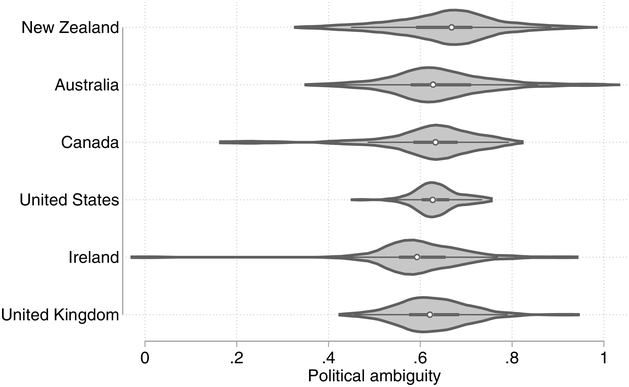
Figure 9.2 illustrates variation in ambiguity over time by taking the average of ambiguity across all election programs in each year. The graph illustrates significant variation in ambiguity over time, but no clear trend. One might wonder why we would not experience a general trend toward political ambiguity given our argument that globalization, which has generally increased over time, should affect the vagueness of language that parties use. One reason is that while most countries in our sample have become more integrated into the global economy over time, there is significant variation across countries. In addition, globalization has leveled off in the last decade. The lack of a clear trend also reduces our concerns that any effect of economic integration on ambiguity might be driven by a positive trend in both variables over time.Footnote 3
Political ambiguity over time
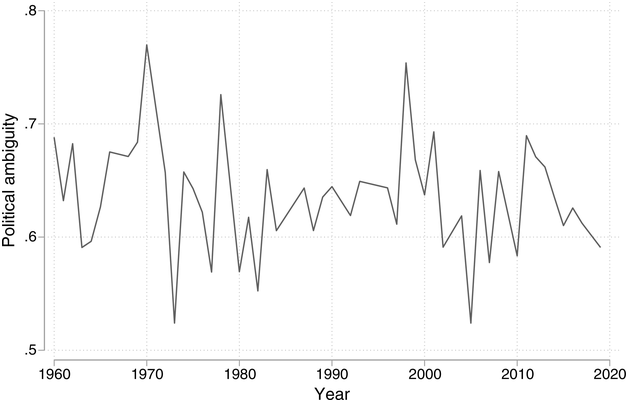
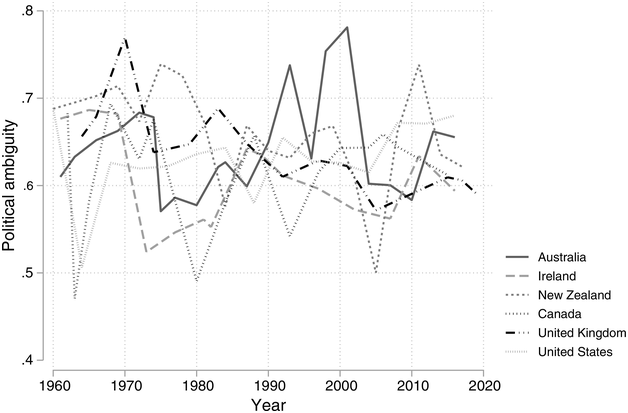
Figure 9.3 shows that the extent to which parties use vague language also varies significantly across the six countries. Although there is significant variation within each of the countries over time, Canadian parties have on average tended to use less vague language, while parties in New Zealand generally use relatively more vague language. Mainstream Australian parties sharply increased the level of ambiguity in their election appeals in the late 1990s and early 2000s. It is noteworthy that this followed a sharp increase in Australia’s exposure to the international economic system, following the economic reforms implemented by the Hawke and Keating governments, which reduced tariffs and exposed many industries to disruptive international competition.
Political ambiguity by country
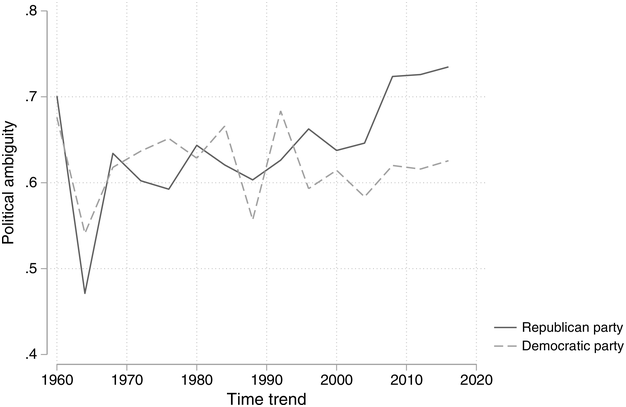
Finally, Figure 9.4 graphs political ambiguity for the two main parties in the United States. The graph demonstrates that average ambiguity varies across parties and over time. While the Democratic Party has remained relatively stable in the level of ambiguity since the 1990s, the Republican Party has exhibited a steady increase in its use of ambiguous language since the late 1980s. This coincides with a sharp rightward shift of the Republican Party. This combination of ideological radicalism and ambiguous language provides some tentative support for the idea that parties on the right have incentives to obscure their positions from voters, not because they fail to keep their promises, but because their policies are at odds with many voters’ expectations that governments protect them from economic risks.
Political ambiguity in the United States by political party
Principal Explanatory Variable
As in previous chapters, our principal explanatory variable is the extent to which individual countries are integrated into the global economy. Again, we use the KOF Globalization Index (Dreher Reference Dreher2006).
Globalization is the extent to which a country is integrated into the international economy, including information on trade in goods and services, trade regulations, tariffs and agreements, foreign direct investment, investment restrictions, and capital account openness. Data are from Dreher (Reference Dreher2006). We transform the measure into z-scores to simplify the interpretation of the coefficients.
The six countries examined here are all highly developed economies and are therefore exposed to the international economy to a considerable extent. Nonetheless, there are marked differences in the relative levels of exposure to globalization. The observed values of Globalization range from 39 to 90 (on the 0 to 100 scale), with a mean of 67 and standard deviation of 13. The sample includes countries with medium, relatively constant levels of globalization (New Zealand, United Kingdom), countries that experienced very low integration in the 1970s and 1980s and a sharp increase in the 1990s (United States, Canada), and one deeply integrated country that also experienced a substantial increase (Ireland). The following analyses distinguish between trade and financial globalization.
Control Variables
To address omitted variable bias, we include control variables at the levels of countries, election years, and election programs that have been used in previous research. At the level of election years, we control for:
Economic Growth measures a country’s gross domestic product growth. Data are from the World Development Indicators.
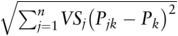
Polarization accounts for party system polarization for each country election and is calculated using the following formula:
 , where is the vote share (as a proportion) for party (from the set of parties n in country k), is the ideological position of party in country , and is the weighted mean of all parties’ left–right position in country . Following Eichorst and Lin (Reference Eichorst and Lin2019), we rescale the Manifesto Project measures of parties’ left–right positions from a −100 to 100 scale to a 1–10 scale. Data are from the Manifesto Project data (Lehmann et al. Reference Lehmann, Franzmann, Al-Gaddooa, Burst, Ivanusch and Regel2024).Footnote 4
Effective Number of Parties is measured as the inverse of the sum of squares of the proportion of seats that each party holds after election on a scale of 0–1.Footnote 5 Data are from Laakso and Taagepera (Reference Laakso and Taagepera1979b).


At the level of election programs, we control for several characteristics of the authoring parties:
Incumbent is a binary variable that is measured as 1 if the political party holds executive office at the time of the election campaign and 0 otherwise. Data are from Seki and Williams (Reference Seki and Williams2014).
Coalition is a binary variable that is measured as 1 if the political party is a partner in a government coalition. Data are from Seki and Williams (Reference Seki and Williams2014).
Vote Share accounts for the vote share of the political party in the previous election. Data are from the ParlGov database (Döring and Manow Reference Döring and Manow2015).
Niche Party,Footnote 6 following Bischof (Reference Bischof2017), is an additive index of the extent to which parties predominantly compete on niche market segments neglected by their competitors, rather than addressing a broad range of segments. Data are from the Manifesto Project dataset.
Party Age measures the log of the number of years since the political party was established. Data are from Eichorst and Lin (Reference Eichorst and Lin2019).
Left–Right Position is a variable identifying partisan ideology on the left–right axis from the Comparative Manifesto Project. It is measured using the left–right (RILE) scores, which are also derived from parties’ election programs. Data are from the Manifesto Project (Lehmann et al. Reference Lehmann, Franzmann, Al-Gaddooa, Burst, Ivanusch and Regel2024; Volkens et al. Reference Volkens, Krause, Lehmann, Matthieß, Merz, Tegel and Wessels2019).
We present descriptive statistics of all variables in the online Supplementary Material. To facilitate interpretation, all nonbinary variables are standardized to a mean of 0 and a standard deviation of 1.
Globalization Increases Parties’ Use of Ambiguous Language
Since the dependent variable varies between 0 and 1, statistical analysis assuming a normal error structure can produce biased and incorrect estimates. We estimate beta regression models with a logit link function, which use an error structure appropriate for our data (Papke and Wooldridge Reference Papke and Wooldridge1996).Footnote 7 All estimations include robust standard errors, country fixed effects, and a time trend. The inclusion of country fixed effects allows us to control for any unobserved factors that are constant within countries over time and further isolate the relationship between Globalization and Political Ambiguity.
The exponentiated coefficients from the model depicted in Figure 9.5 summarize the effects of our key explanatory variable, Globalization, and other explanatory variables that have been examined in previous studies of Political Ambiguity. Full numerical results in tabular format are presented in the online Supplementary Material.
Main results: globalization and ambiguity in parties’ election appeals
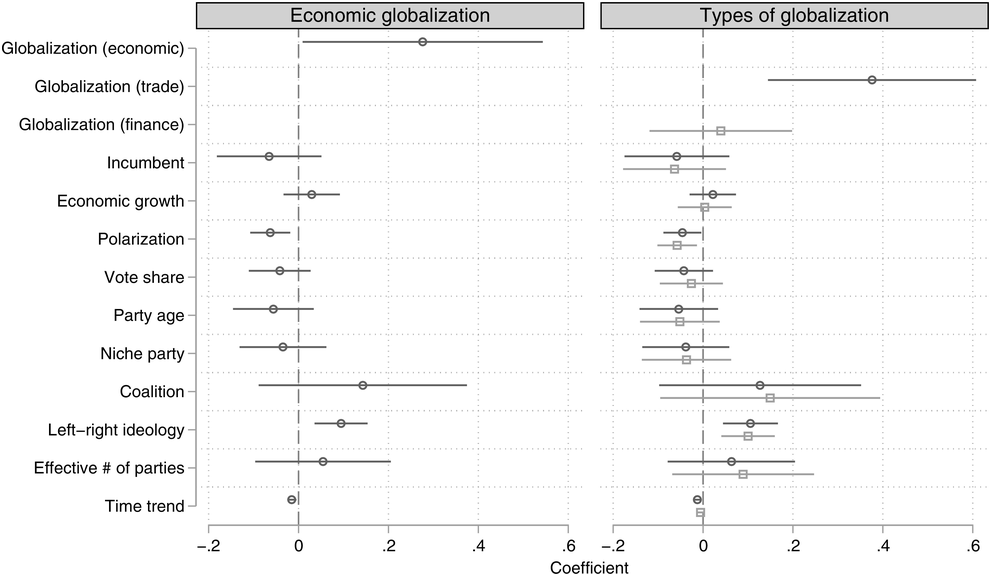
Figure 9.5 Long description
Two dot and whisker plots with similar x-axis displaying coefficients from negative 2 to 0.6 with a dashed line at x = 0 and y-axis displaying 13 variables, namely Economic globalization, Trade globalization, Finance globalization, Incumbent, Economic growth, Polarization, Vote share, Party age, Niche party, coalition, Left right ideology, Effective number of parties, and Time trend. The left hand plot is labeled globalization with less data points while the right-hand plot is labeled types of globalization with more data points. Economic and Trade globalization stand out as the highest coefficients.
Figure 9.5 indicates a positive coefficient of Globalization on Political Ambiguity measured as vagueness (left-hand graph). Since the coefficient is only marginally significant at the 10 percent level, we explore whether the effect is conditional on the type of globalization. The right-hand graph presents models that separate the effects of Trade Globalization and Financial Globalization. We find that there is no significant covariation between Financial Globalization and Political Ambiguity, but a positive covariation between Trade Globalization and Political Ambiguity. These results suggest that parties’ need to use ambiguous language is greater during times of greater Trade Globalization. The insignificant findings of Financial Globalization support the view that governments retain more room to maneuver in financially integrated markets (Mosley Reference Mosley2000, Reference Mosley2003). As discussed in Chapter 3, financial elites hold policy preferences on a narrow range of macroeconomic indicators mainly relating to governments’ fiscal responsibility. If financial investors believe national governments are fiscally responsible, national governing parties retain considerable room for maneuver to pursue their preferred policies. As a consequence, we will focus on Trade Globalization for the remainder of the analysis.
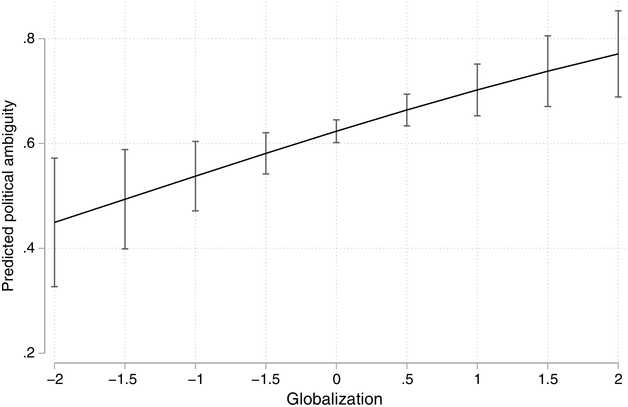
The effect of Trade Globalization is substantively important. An increase in Globalization by 1 standard deviation is associated with a 37 percent increase in Ambiguity, all else being equal. The predicted values in Figure 9.6 further illustrate that the level of Ambiguity increases from around 0.5 at low levels of globalization to 0.7 at high levels of globalization. This is a large effect given that the dependent variable varies between 0 and 1.
Predicted levels of ambiguity at different levels of globalization
Turning to our control variables, we find effects of Left–Right Ideology on ambiguity. Political parties to the right of the ideological spectrum are significantly more ambiguous in their election programs than parties to the left, even after controlling for economic and electoral contexts. Second, in line with existing research, parties make clearer statements during election campaigns at higher levels of polarization. The time trend is negative in most of the models, which indicates that election programs have become less ambiguous over time, reducing concerns that our findings on Globalization are driven by time trends. None of the remaining control variables are significant in the main model.
Conditional Effects of Globalization on Ambiguity
The preceding analysis provides strong evidence in support of our main theoretical expectation, namely that exposure to the international trading system leads mainstream parties to use vaguer language. We already pointed out that the impact of globalization on ambiguity is conditional. While we find a strong, significant positive association between trade globalization and vagueness, there is no such association for financial globalization.
This section further explores this conditional relationship in the following four ways. First, we show that de jure trade globalization has a more marked effect on the level of vagueness than de facto trade globalization. Second, as expected, trade globalization is significantly and positively associated with vagueness but not with ambivalence. Third, trade globalization is significantly and positively associated with vague language in economic policy areas but not in other areas. Fourth, as expected, trade globalization is significantly and positively associated with the vagueness of language used by both leftist and rightist parties.
De Jure Globalization Drives Strategic Ambiguity
The distinction between de jure and de facto measures of globalization is that the former refers to the openness of the country on paper in terms of its rules and regulations, while the latter refers to actual flows of goods and services:
De Jure Globalization measures the extent of a country’s trade globalization using information including trade regulations, trade taxes, tariffs, and trade agreements. Data are from Dreher (Reference Dreher2006).
De Facto Globalization measures the extent of a country’s trade globalization, using information including actual trade in goods, services, and the diversity of trading partners. Data are from Dreher (Reference Dreher2006).
Are parties more likely to respond to de jure or de facto globalization when they gauge the level of vagueness in their electoral appeals? In terms of the constraints of globalization that we discuss in Chapter 2, de jure globalization refers mainly to the constraints of international law. De facto globalization, by contrast, refers more directly to the influence of market actors, since these are empowered as actual flows of goods and services across borders become more important. To the extent that party officials who draft election programs perceive international law to be a heavier constraint on their room to maneuver than market actors, the de jure measure may exhibit a stronger effect than the de facto measure. Rules and regulations may also be perceived by party officials as more stable and predictable than the influence of market actors. Consequently, rules and regulations may be a more certain guide to the future constraints that parties face in government after the elections.
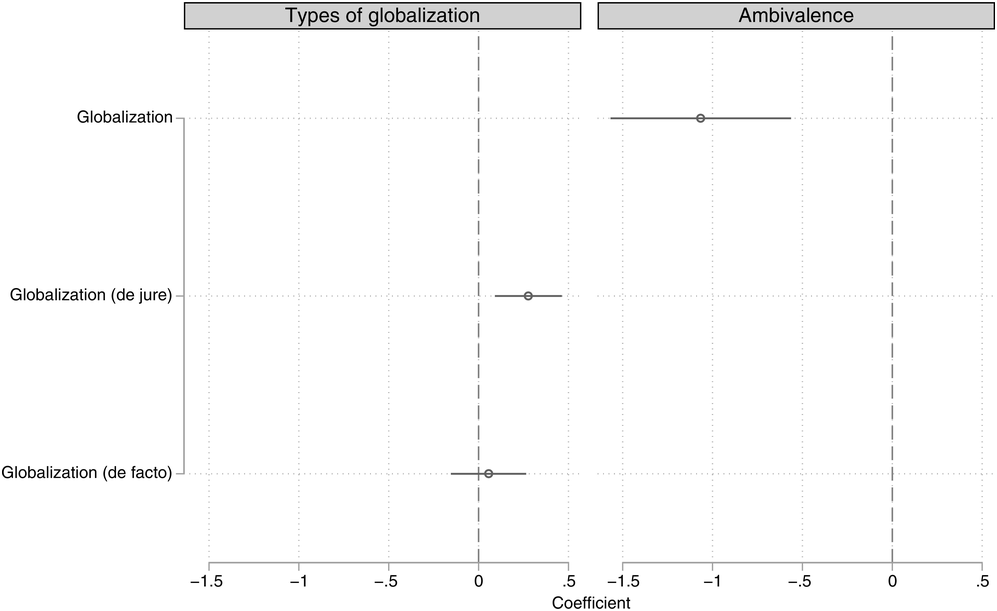
Figure 9.7 (left-hand graph) presents the results of a model in which we include de jure and de facto trade globalization instead of the overall trade globalization index. Full tabular results of the model are presented in the online Supplementary Material. It appears that while both measures are positively associated with higher levels of vagueness, it is only the de jure measure that is significant. This suggests that it is primarily the openness of countries in terms of their rules and regulations that drives mainstream parties to use vaguer language.
Exploring types of trade globalization and ambivalence
Globalization Reduces Parties’ Use of Ambivalent Language
We now explore parties’ use of ambivalent language, meaning statements that may represent different sides of the same issue and could potentially be construed as inconsistent. Unlike vagueness, where the language is unclear or open to broad interpretation, ambivalence arises when a party makes multiple statements that reflect different or contradictory perspectives, creating uncertainty about where the party truly stands. As argued previously, in contrast to vagueness, we do not expect ambivalence to be an effective strategy for avoiding retrospective sanctioning by voters for promise breaking. Therefore, we do not expect globalization to be positively associated with ambivalence.
To measure Ambivalence, we apply the measurement approach developed by Lo et al. (Reference Lo, Proksch and Slapin2016), who use scaling techniques that consider the diversity and distribution of a party’s positions across the ideological spectrum. The key is to quantify how often parties express conflicting stances on the same issue or related issues, creating a “spread” or “distribution” over possible policy positions, which they interpret as ambivalence. Their method uses text analysis tools to detect and quantify the extent of mixed or opposing signals within political communication, thus offering an empirical measure of ambivalence in election programs.
Figure 9.7 (right-hand graph) presents the results where we replace the vagueness measure with the measure of Ambivalence as the dependent variable. We omit all other variables for ease of presentation, but they are included in the model. The full tabular results are presented in the online Supplementary Material. As we expected, the effect of globalization on Ambivalence is indeed not positive. It is, however, negative and significant, which may suggest that parties are less likely to use ambivalent language if their country is more integrated in the global economy. As we had no theoretical prior to expect this finding, we view this finding as highly tentative.
Ambiguity as Vagueness Is Focused on Economic Policies
Returning to the measure of Ambiguity as vagueness, we find that while globalization affects governments’ room to maneuver across a range of issues, its effects are particularly pronounced in relation to economic policies. These policies – such as taxation, market regulation, employment policy, infrastructure, monetary policy, and fiscal policy – are most directly impacted by global market forces, international competition, and transnational economic agreements. The integration of global financial markets and the influence of multinational corporations can severely constrain a government’s ability to impose high corporate taxes or implement strong market regulations without risking capital flight or trade retaliation. A case in point is the European Union’s Stability and Growth Pact, which limits the fiscal deficits and public debt levels of its member states, effectively restricting their domestic economic policies. Similarly, the pressures of global competition and adherence to international trade agreements often limit a government’s ability to provide subsidies to struggling domestic industries.
While economic policies are most obviously constrained, some noneconomic policies may also be affected by globalization. Social policies like education and healthcare expansion may be compromised by the economic impacts of globalization. A government that promises to expand access to preschool education or improve healthcare services might find itself unable to fulfill these promises if globalization-induced budget shortfalls – such as reduced tax revenues from declining industries – limit available public funds. In this sense, the fiscal impacts of globalization can ripple out into other policy areas. Nonetheless, governments still retain a relatively higher degree of autonomy over noneconomic domestic policies such as education, welfare, and public health. Many countries, particularly in Northern Europe, have maintained robust welfare states despite operating in highly globalized economies. Moreover, some social policies appear further removed from the constraints of globalization, for instance social policies that involve citizens’ individual and collective rights, such as gender equality and reproductive rights.
National governments’ foreign policies may also be less visibly affected by economic globalization than domestic economic policies. However, national economic interests, which in a globalized world are defined by international considerations, also significantly affect states’ foreign policies. Defense and military policies, for instance, may be defined by geopolitical strategy rather than global market dynamics. At the same time, governments formulate defense policies in the context of military alliances, which involve economic interdependencies. NATO member states, for example, are economically dependent on each other for defense spending and procurement agreements. This economic interdependence can shape how members approach foreign interventions or respond to geopolitical threats. Likewise, national governments’ external policies on foreign aid and humanitarian assistance may be partly driven by noneconomic considerations. At the same time, national governments’ foreign aid and humanitarian assistance programs are affected by their trade relations, as the provision of aid often follows established trade relations between developed and developing countries. Some foreign policies specifically refer to national governments’ decisions on whether to bind themselves to the constraints of globalization, such as whether to enter into free trade agreements or other forms of cooperation with other countries.
The Manifesto Project provides a way of exploring the possible differences between the effects of globalization on ambiguity across different policy areas (Klingemann, Hofferbert, and Budge Reference Klingemann, Hofferbert and Budge1994; Lehmann et al. Reference Lehmann, Franzmann, Al-Gaddooa, Burst, Ivanusch and Regel2024). Manifesto Project researchers coded every sentence or quasi-sentence of each manifesto into one of fifty-six thematic categories. Chapter 7 uses these data on thematic emphases to examine ideological shifts by parties. Each of these thematic categories refers to different policy domains, which enables us to distinguish between text that refers to three broad policy areas: economic, social, and foreign policies:
Economic Policies refer to the Manifesto Project’s economic policy domain. This contains policies related to economic management, fiscal policy, taxation, employment, trade, state intervention in the economy, and economic growth and infrastructure policies.
Social Policies refer to three of the Manifesto Project’s policy domains. The freedom and democracy domain includes text on political rights, civil liberties, democratic governance, and rule of law. Positions on transparency, anticorruption measures, and democratic reform also fall into this category. The welfare and quality of life domain covers social services, health, education, and welfare programs. The fabric of society domain focuses on cultural, religious, and social norms. This domain also covers moral issues such as family values, same-sex marriage, gender equality, and reproductive rights, as well as immigration and, law and order policies, including crime prevention and policing.
Foreign Policies correspond to the Manifesto Project’s external relations domain. This includes text on international cooperation and multilateralism, foreign aid and humanitarian assistance, defense and military spending, trade agreements, and globalization.
While the distinction between economic, social, and foreign policies is useful for analytical purposes, in practice, these boundaries can be difficult to maintain because one policy area often incorporates elements from another. For example, economic policies frequently include aspects of foreign policy, particularly in the context of trade agreements, international economic cooperation, or sanctions. A party’s program on economic growth or job creation may explicitly reference international trade agreements or foreign investments, blurring the lines between what might be classified as purely economic versus foreign policy. Similarly, social policies can also incorporate economic and foreign policy elements. For example, a party’s program on education or health care might include proposals related to the economic cost of these programs or even reference international partnerships that influence domestic policymaking. Immigration policy is another area where social, economic, and foreign policies converge. It may be listed under social policy in a party’s election program but typically involves foreign policy (international agreements and relations) and economic considerations (labor markets and public spending).
With these caveats in mind, we apply the measure of ambiguity as vagueness to each of these broad policy areas in each election program, thus generating a set of three separate vagueness measures for each document, for economic, social, and foreign policies separately. We use these to build three separate datasets of party programs split by issue areas, on which we run the same regressions as applied previously. The level of analysis is the political ambiguity at the level of party election program policy area. Figure 9.8 presents the results for our analysis of ambiguity in each of these policy areas. Each coefficient presents the effect of Globalization on Ambiguity. For parsimony, we omit the other control variables in the graph, but we present full tabular results in the online Supplementary Material.
Main results by policy area
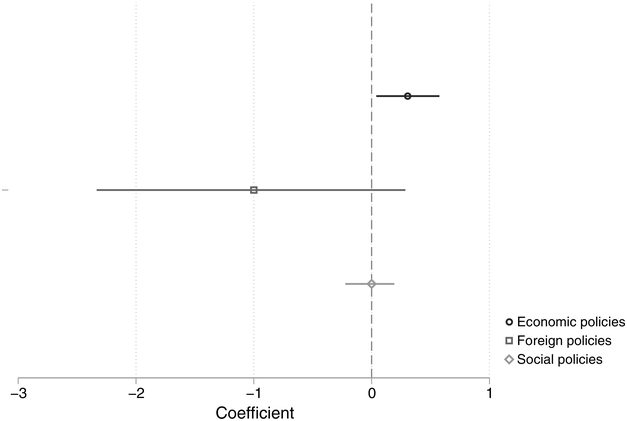
In line with our tentative expectation, we find that the positive and significant effect of Globalization on Ambiguity is driven primarily by parties using vague language when writing about economic policies. The coefficients on social and foreign policies are both indistinguishable from zero. Keeping in mind the caveats that we discussed, this lends further support to our argument that it is globalization constraints that lead parties to use more ambiguous language in their campaign appeals as a strategy to avoid prospective and retrospective sanctioning.
Parties of All Ideological Positions Respond to Globalization with Ambiguity
Exposure to economic globalization leads mainstream parties across the ideological spectrum to use vaguer language, although they do so for different reasons. Leftist parties use ambiguity as a way of avoiding future retrospective sanctioning for promise breaking. These parties often find it particularly hard to keep their campaign promises due to the constraints of globalization. Since breaking promises carries electoral costs (i.e., political candidates who break promises become less likable and their vote shares decline), parties have incentives to minimize those costs when they know that promise breaking may occur. Being vague is a way of avoiding future blame for breaking promises. Rightist parties face a different kind of pressure. They are typically less constrained by globalization when they attempt to fulfil their traditional commitments to neoliberal policies. But these parties have faced pressures to appeal to different constituencies. On the one hand, they must appeal to working and middle-class voters who are demanding more protection from the economic risks of globalization, some of whom are also succumbing to the allure of populist movements. On the other hand, they must appeal to their traditional constituencies who continue to favor free markets. For the right, vagueness is a way of reconciling these competing pressures.
To test the effect of economic globalization on parties with different ideological positions, we add an interaction term between the variables Globalization and Party Ideology. This enables us to examine whether the effect of Globalization on Ambiguity differs depending on parties’ ideological positions. Since we expect that it does not, this interaction should be insignificant. Parties’ ideological positions are measured using data from the Manifesto Project (Volkens et al. Reference Volkens, Krause, Lehmann, Matthieß, Merz, Tegel and Wessels2019), which are discussed extensively in Chapters 4 and 7. We present the results graphically in Figure 9.9, while the full tabular results are in the online Supplementary Material.
Effect of globalization on ambiguity for different party ideologies
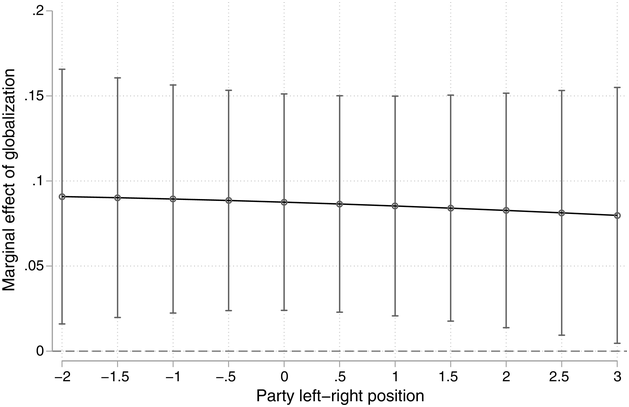
Figure 9.9 shows that the effect of Globalization on Ambiguity is not conditional on political ideology. Parties of the left and right are equally affected by globalization in this respect; the coefficient associated with Globalization is significant for parties along the entire left–right spectrum. The interaction term between Globalization and Party Ideology is insignificant. The findings provide additional evidence for our theoretical argument that parties assess the potential electoral costs associated with the clarity of language they use in their campaign statements. While left-wing parties use ambiguity to avoid future retrospective sanctioning for breaking promises, right-wing parties use ambiguity to appeal to broader voter bases that have different views on the desirability of government intervention.
Discussion
This chapter explores how parties strategically employ ambiguity to navigate the constraints imposed by globalization and avoid electoral punishment. We build on the evidence presented in earlier chapters, where we demonstrate that economic integration limits the policy autonomy of national parties, particularly center-left ones, making it difficult for them to fulfill their campaign promises when in government. This constraint, which is more pressing for left-of-center parties whose platforms often conflict with global market pressures, leads to a critical dilemma: How can parties present their policies to voters without risking electoral backlash for broken promises? At the same time, globalization has put pressure on center-right parties to moderate their ideological stances on some key socioeconomic policies, as many citizens’ expectations of their governments have increased. The question for parties of the right is how they can appeal to their traditional constituencies that favor free markets as well as the rising expectations of many voters.
Ambiguity in political communication serves as a strategic solution to multiple dilemmas faced by parties in globalized contexts. First, ambiguous language allows parties to make campaign statements that can be interpreted in different ways, providing greater flexibility once in office. This flexibility is crucial for avoiding retrospective blame for broken promises, particularly for leftist parties that anticipate difficulty in fulfilling their campaign commitments due to economic constraints imposed by globalization. Center-left parties use ambiguity to appeal to their base without making explicit commitments that they may not be able to deliver. Second, ambiguity also enables parties, especially those on the right, to appeal to broader and more diverse audiences. By not committing to a specific policy direction, these parties can attract support from multiple factions without alienating key constituencies. In this way, ambiguity serves not only as a blame avoidance strategy but also as a tool for broadening electoral appeal in a polarized and globalized political environment.
The findings show that trade globalization, particularly de jure trade globalization, is positively related to ambiguity in the form of vagueness. By analyzing a dataset of 293 party platforms across six countries from 1970 to 2019, we demonstrate that parties make significantly more ambiguous statements when they operate in highly globalized contexts, especially as it relates to economic policies. This trend holds across different political ideologies and contexts, suggesting that globalization influences party communication regardless of their ideological orientation. Of the two kinds of ambiguity – vagueness and ambivalence – vagueness is a more effective strategy for parties to follow, albeit with limits. Vagueness is less likely to expose a party to criticism for inconsistency. By contrast, ambivalence can lead to voter dissatisfaction, as it might create even more confusion about where a party truly stands on important issues. Our findings support the argument that vagueness is a more prevalent strategy in globalized contexts as compared with ambivalence.
The use of ambiguity has far-reaching consequences for democratic accountability. By making vague campaign statements, parties reduce voters’ ability to hold them accountable for broken promises, potentially undermining the quality of democratic representation. Yet, this strategy is a rational response to the constraints posed by globalization, which limits the ability of national parties to deliver on ambitious promises. While ambiguity helps parties avoid electoral punishment, it comes at the cost of reducing the clarity of political communication, weakening voters’ ability to make informed decisions based on party platforms. This trade-off between electoral strategy and democratic accountability remains a central tension in the globalized political landscape.
The use of ambiguity as a strategic political tool rests on the assumption that voters are less likely to hold governing parties accountable for breaking campaign promises when those parties made vague campaign statements. The existing literature provides ample evidence that ambiguity enables parties to appeal more broadly to electorates to minimize punishment for proposing unappealing policies, so-called prospective sanctioning (Hersh and Schaffner Reference Hersh and Schaffner2013; Lo et al. Reference Lo, Proksch and Slapin2016; Somer-Topcu Reference Somer-Topcu2015; Tomz and Van Houweling Reference Tomz and Van Houweling2009). However, there is less evidence that parties that make vague statements avoid future punishment for breaking their promises, so-called retrospective sanctioning. Do vague campaign statements indeed ameliorate the negative political consequences of promise breaking that we establish in Chapter 6? This is the question we will turn to in the next chapter.
Political parties use ambiguous language in their campaign appeals for different reasons. Previous research has established that ambiguous language, if used judiciously, can help parties to broaden their electoral appeal (Hersh and Schaffner Reference Hersh and Schaffner2013; Lo, Proksch, and Slapin Reference Lo, Proksch and Slapin2016; Somer-Topcu Reference Somer-Topcu2015; Tomz and Van Houweling Reference Tomz and Van Houweling2009). It allows them to avoid polarizing stances, enabling different voter groups to interpret the party’s campaign statements in ways that align with their own preferences. As we argue in Chapter 9, this is particularly relevant to parties on the right that face an increasingly polarized support base due to globalization. Another reason for parties to use ambiguous language is that it shields them from future retrospective sanctions by voters. If they were to make clear promises, they may be forced to break those promises when in government and then be punished by voters at the next election. This is particularly relevant to center-left parties, as globalization places significant and heavy constraints on them when they attempt to fulfill their campaign promises (Chapter 4). However, we know much less about how ambiguity helps parties to avoid retrospective sanctions for breaking promises, which is the focus of this chapter.
Ambiguous campaign statements reduce the likelihood that voters will sanction parties for enacting policies that do not align with their (voters’) policy preferences for two related reasons. First, vague campaign statements regarding the specific policies a party intends to implement make it hard for voters to pinpoint exactly what was promised. Because vague language leaves room for multiple interpretations, voters may struggle to determine whether the party delivered what it promised. For instance, a promise to “reform the tax system” could mean different things to different people: some might expect lower taxes for businesses, while others might expect simplified tax filing. If the party enacts some tax adjustments but not in the way a segment of voters anticipated, it becomes unclear whether the government’s actions amount to a kept or broken promise. Voters might make inferences about what policies a party will enact based on the party’s ambiguous statements. However, if the party’s actions in government do not align with those inferences, voters may not conclude that the party broke its promise. Second, vague campaign statements give parties the flexibility to claim success through various policy measures. If the wording of a campaign statement is broad enough, a governing party can frame their actions as fulfilling a promise even if the policy does not match voters’ expectations exactly. For example, a promise to “improve education” might lead some voters to expect increased funding for public schools, while others might expect a focus on curriculum reform. If the party implements only minor changes, they can still claim they followed through on their education promise, reducing the likelihood that voters see this as a failure.
For those reasons, our baseline expectation is that ambiguous campaign statements reduce the severity of voters’ sanctioning of politicians for decisions that do not align with voters’ policy preferences. Ambiguity makes it harder for voters to identify specific policy breaches, offering flexibility in policy interpretation, and lowering expectations for full delivery. This strategic ambiguity helps parties avoid direct accountability for failing to enact promised policies, ultimately shielding them from electoral punishment.
We are, however, primarily interested in the use of ambiguity in the context of globalization, which leads us to formulate our ambiguity-in-globalization expectation. We argue that the use of ambiguity is effective even in the context of globalization’s constraints. As we find in Chapter 6, retrospective sanctioning is particularly strong in the context of economic globalization. In the globalized conditions under which many governing parties, particularly on the left, find it harder to fulfill their campaign promises, they are punished more severely by voters for breaking promises. Ambiguity, we argue, is a way of mitigating this punishment. This leads us to expect that even under globalization constraints, ambiguous campaign statements reduce the severity of voters’ sanctioning of politicians for decisions that do not align with voters’ policy preferences. This ambiguity-under-globalization expectation is a particularly demanding test of the effectiveness of ambiguity due to two considerations. First, voters might give politicians some slack when broken promises are due to the constraints of globalization, reasoning that the broken promise was beyond the governing parties’ control. Second, voters may dislike the use of ambiguous language so much that any benefit parties gain from avoiding breaking an explicit promise is outweighed by voters’ irritation at politicians’ refusal to take a clear stance. When voters attach more importance to parties’ ability to formulate feasible promises as indicators of their governing competence, this second consideration may be more important in globalized contexts. To the extent that these other considerations are important, the evidence will not support our expectation that ambiguity is effective even under globalization’s constraints.
To test these expectations, we return to the preregistered survey experiment on voters’ responses to broken campaign promises, which we examine in previous chapters. In parts of this survey experiment, we varied the levels of ambiguity of the statements made by the politician who featured in the experiment. The findings show that ambiguity significantly reduces the severity of the punishment that voters impose on the politician when he failed to deliver on his promise or took actions that were contrary to voters’ preferences. Moreover, ambiguity is effective even when respondents are presented with information on globalization shocks that make their preferred policies less feasible. These results provide strong evidence in support of the effectiveness of ambiguity in shielding governing politicians from electoral punishment. Survey experiments inevitably have an artificial quality to them, which is both their strength and their weakness. The artificialness of the experimental setting allows us to isolate the effects of individual treatments in ways that would be impossible with an observational research design. Critics of survey experiments usually point to their weaknesses in terms of external validity, which relates to the extent to which we can generalize the findings from an experiment to other more realistic settings. This limitation is why it is important to consider the findings from this survey experiment with the findings from the observational analyses of party behavior from the other chapters. Taken together, they form an integrated body of evidence that broadly supports our theoretical argument.
Experimental Design
The survey experiment analyzed in this chapter examines whether voters punish politicians for breaking campaign promises. As the experiment was introduced in Chapter 6, here we summarize only the essential elements of the experimental setup and focus on the additional treatments examined in this chapter, namely, vague and ambivalent campaign statements.
As discussed in Chapter 6, the experiment was preregistered and fielded online with YouGov in the summer of 2024. After excluding respondents who failed attention checks, the final sample consists of 4,277 US adults, recruited to be broadly representative of the population using demographic quotas (age, gender, race, education, region, and 2020 presidential vote). Details of the sample characteristics and balance across treatments are provided in the online Supplementary Material and summarized in the figures in Chapter 6. Respondents are first asked about their party identification and their stance on corporate tax incentives. Based on these responses, each is presented with a hypothetical candidate (Gary Clark) from their preferred party (Republican or Democrat), who makes a campaign statement about corporate tax policy. The statements align with the respondent’s policy views, allowing us to isolate the effects of ambiguity.
The key innovation in this chapter is the introduction of message-type variation. Respondents are given a candidate who makes either a clear, vague, or ambivalent statement about tax incentives. While clear statements express an unambiguous policy position, vague statements use imprecise language, and ambivalent ones include internally inconsistent cues. This design allows us to assess how voters respond to different types of ambiguity in campaign communication.
All respondents are presented with the following information:
We would now like you to consider the following hypothetical scenario. Gary Clark was a [Democratic/Republican] candidate for the state legislature. During the campaign, he made several statements about corporate tax policies, including the following statements:
We randomly assign one of the following three statements to respondents who oppose tax incentives:
[T1: Clear Statement] “We need to make sure that large companies pay their fair share in our state, so that we can invest in policies that promote economic growth and give hard-working Americans the chance to join or maintain their place in the middle class. I will fight to end tax breaks for large companies in our state.
Time and time again, we see that tax incentives for large companies do not pay off in real economic gains and often fail to produce jobs. We need to end corporate tax breaks to ensure that large companies pay their fair share and contribute to the well-being of Americans in our state.”
[T2: Vague Statement] “We must invest in policies that promote economic growth and give hard-working Americans the chance to join or maintain their place in the middle class. We need corporate tax policies that ensure we reach this goal.
My priority is the well-being of my fellow Americans. I support tax policies on large companies that help our economy to grow and create new jobs.”
[T3: Ambivalent Statement] “We need to make sure that large companies pay their fair share so that we can invest in policies that promote economic growth and give hard-working Americans the chance to join or maintain their place in the middle class. I will oppose unfair tax breaks for large companies in our state.
Time and time again, we see that tax incentives to large companies have paid off in real economic gains and the creation of jobs. I will support corporate tax incentives to ensure that large companies remain in our state and contribute to the well-being of my fellow Americans.”
Respondents who favor tax incentives also receive one of three statements. While the vague and ambivalent statements are the same as in the previous treatment, respondents who favor tax incentives and are randomly assigned a “clear” statement are given the following statement:
[T1: Clear Statement] “We must promote economic growth, create new jobs, and give hard-working Americans the chance to join or maintain their place in the middle class. I will fight to expand tax incentives for large companies in our state, so they stay and grow, and contribute to this goal.
Time and time again, we see that tax incentives for large companies pay off in real economic gains and job creation. We need to expand corporate tax incentives to ensure that large companies remain and contribute to the well-being of Americans in our state.”
We then inform the respondents that Gary Clark won a seat in the state legislature and that the state legislature is voting on a bill that would introduce new tax incentives for large companies. We ask respondents to say how they thought Gary Clark will vote. Responses could range from being very confident that Clark would support the bill to being very confident that he would oppose the bill (a 5-point scale that includes the option to be unsure of how Clark would vote).
Our second treatment involves a globalization condition for half of our respondents (the control group does not receive any treatment and serves as our sample for testing our first hypothesis). The globalization condition introduces a globalization shock that makes the policy that Gary Clark favored (and the respondent preferred) less likely. Half of the respondents who oppose tax incentives are treated with the following information (the other half receives no information):
Between the election campaign and the vote, large companies began moving their operations to foreign countries that offered new tax incentives. This threatened to increase unemployment and the state’s ability to fund public services because of falling tax revenues. This was a big part of the debate on the bill introducing new large tax incentives for large companies. Some people who were previously against tax incentives for large companies now argued in favor of them in this new situation.
Half of the respondents who favor tax incentives are treated with this alternative information (the other half receives no information):
Between the election campaign and the vote, the global economy and our main overseas markets took a significant downturn. This threatened to increase unemployment and the state’s ability to fund public services because of falling tax revenues. This was a big part of the debate on the bill introducing new large tax incentives for large companies. Some people who were previously in favor of tax incentives for large companies now argued against them in this new situation.
Our third treatment is Gary Clark’s vote on the bill. We randomize respondents such that half of the respondents are informed that Gary Clark voted in favor of the bill, and half of the respondents are informed that Gary Clark voted against the bill. This means that across the possible positions in favor or against tax incentives, respondents are randomly confronted with a situation in which Gary Clark breaks his promise and a situation in which Gary Clark keeps his promise.
After we provide respondents with Gary Clark’s vote, we ask them to evaluate him on his “likeability.” Respondents could rate Gary Clark on a scale from 0 to 10 where 0 is “dislike a great deal” and 10 is “like a great deal.” We also ask respondents whether the following phrases describe Gary Clark:
1. Someone who represents his constituents well
2. A politician who is open minded
3. A person who lacks integrity
4. A politician who keeps his campaign promises
5. A politician who adapts well to changing circumstances
6. A politician who is competent
Experimental Results
Before presenting the main experimental results, we assess whether the type of statement treatment works as expected. We expect that voters who are presented with a vague statement to be much less confident about how the candidate would vote. This, in turn, makes voters less likely to be certain about whether the candidate broke his promise, therefore leading to reduced sanctioning. To test this assumption, we asked respondents the following after the candidate Gary Clark made his statements:
Gary Clark won a seat in the state legislature. Now, the state legislature has to vote on a bill that will introduce new large tax incentives for large companies. How do you think [Democrat/Republican] Gary Clark will vote?
Possible responses were: I am very confident that Gary Clark will vote for the legislation, I am confident that Gary Clark will vote for the legislation, I am confident that Gary Clark will vote against the legislation, I am very confident that Gary Clark will vote against the legislation, I am unsure how Gary Clark will vote.
Figure 10.1 presents a histogram of the responses, indicating the range of certainty across different statements. In our sample, almost 35 percent of respondents are unsure about how the candidate would vote. If the assumption that ambiguity reduces voters’ certainty is supported, we would expect that respondents who receive a vague or ambivalent statement to be less certain about how Gary Clark will vote. Our expectation is borne out by the data. Those who receive vague or ambivalent statements are significantly more likely (p<0.001) to say that they are uncertain about how Gary Clark would vote.
Voter confidence about the politician’s vote
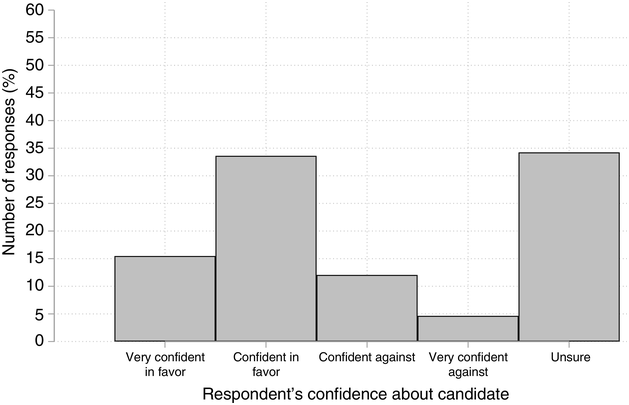
Moving to the main results, we first use difference-in-means tests to analyze whether vagueness is effective in reducing the severity of voters’ sanctions for broken promises, in the absence of a globalization shock. Figure 10.2 presents the results graphically. The graph shows the means for each sample using a light gray square, including 95 percent confidence intervals, as well as a histogram with information on sample distribution at various values of the dependent variable along the x-axis, here Politician Likeability.
Main experimental results
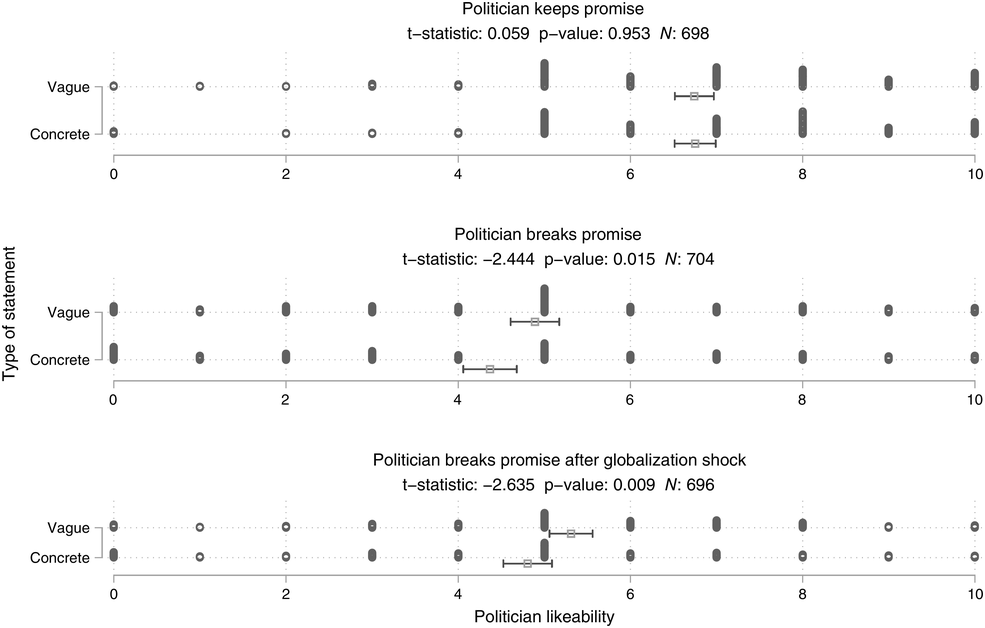
Figure 10.2 Long description
The three samples from top to bottom are separated by the politician keeping his promise, breaking it, and breaking it after globalization shock. The mean for each sample is represented by a light gray square with red bar confidence intervals. The top plot has 698 observations, a t-statistic of 0.059, and a p-value of 0.953. The middle plot has 704 observations, a T statistic of negative 2.444, and a p-value of 0.015. The bottom plot has 696 observations, a t-statistic of negative 2.635, and a p-value of 0.009.
The top graph compares the mean likeability when Gary Clark (1) voted in line with voters’ policy preferences after making a vague statement and (2) voted in line with voters’ policy preferences after making a concrete promise and keeping that promise. The middle graph compares the mean likeability when Gary Clark (1) voted against voters’ policy preferences after making a vague statement and (2) voted against voters’ policy preferences after making a concrete promise and breaking that promise. First, we find that respondents like candidates who break their promises significantly less than those who keep them. The average likeability rating of candidates falls from 6.75 for politicians who keep their concrete promises to 4.36 for candidates who break a concrete promise and 4.89 for candidates who vote against voters’ preferences after making a vague statement.Footnote 1 Second, we find no significant difference in the likeability of candidates that keep their vague versus concrete promises, indicating that voters do not punish politicians who make vague promises (unless those candidates vote against voters’ policy preferences). The results further support our main hypothesis, that respondents significantly (p<0.015) reduce their support for politicians who break concrete promises as compared with politicians who vote against voters’ preferences after making vague campaign statements. Vagueness pays off in reducing the severity of electoral punishment for perceived broken promises.Footnote 2
Table 10.1 shows that these results are robust to different outcomes.Footnote 3 Respondents who are treated with a vague statement, and then informed that Gary Clark voted against their preference on tax policies, are significantly more likely to believe that Gary Clark represents his people well, adapts well to changing circumstances, is open minded, has integrity, is good at keeping promises, and competent than respondents who are treated with a Gary Clark who breaks a clear promise.
| Concrete | Vague | Diff | p-value | |
|---|---|---|---|---|
| Represents people well | 4.72 | 5.23 | 0.51 | 0.00 |
| Open minded | 5.21 | 5.47 | 0.26 | 0.04 |
| Lacks integrity | 5.70 | 4.97 | −0.73 | 0.00 |
| Good at keeping promises | 3.98 | 5.03 | 1.05 | 0.00 |
| Adapts well to changing circumstances | 5.30 | 5.56 | 0.26 | 0.04 |
| Competent | 5.13 | 5.50 | 0.36 | 0.01 |
Note: The table presents the results of difference-between-means tests in a sample where the politician breaks his promise, comparing the treatment group where the politician makes a concrete promise to the treatment group where the politician makes a vague promise.
The bottom graph of Figure 10.2 presents the results for respondents who are treated with an adverse globalization shock. This comparison is crucial for testing our expectation that even under globalization constraints, ambiguous campaign statements reduce the severity of voters’ sanctioning of politicians for decisions that do not align with voters’ policy preferences. As expected, and as in the results without a globalization shock, voters’ punishment is significantly harsher when politicians break a clear promise (likeability is 4.81) than when politicians vote contrary to respondents’ policy preferences after making a vague campaign statement (likeability is 5.31, p<0.004).
In addition, we find that respondents rate politicians who vote contrary to their policy preferences after making vague campaign statements or who break clear promises less harshly when a globalization shock occurs than in the absence of a globalization shock. When politicians vote against respondents’ policy preferences after making vague campaign statements, they receive milder punishment when a globalization shock occurs (likeability is 5.31 in the bottom graph) than without a globalization shock (likeability is 4.89 in the middle graph). The difference is significant in a difference-between-means test (p<0.015). The same is true for politicians who break clear promises after a globalization shock (likeability is 4.81 in the lower graph) compared with politicians who break clear promises without a globalization shock (likeability is 4.37 in the middle graph, p<0.021).
Are Vague Statements More Effective than Ambivalent Statements?
Our main argument and analysis so far focused on politicians’ use of vagueness as a strategy for avoiding retrospective sanctioning for promise breaking. In Chapter 9, we argue that ambivalent statements, meaning multiple statements that lean in different directions, are generally less effective at forestalling future punishment by voters of politicians who do not act in line with voters’ preferences. Figure 10.3 compares respondents’ assessments of a politician who makes vague statements with a politician who makes ambivalent statements. “Keeping the promise” means that the politician votes in line with the respondent’s preferences, while “breaking the promise” means that the politician votes against the respondent’s preferences. Voters often project their own policy preferences onto politicians who make vague or ambivalent statements.
Is vagueness better than ambivalence?
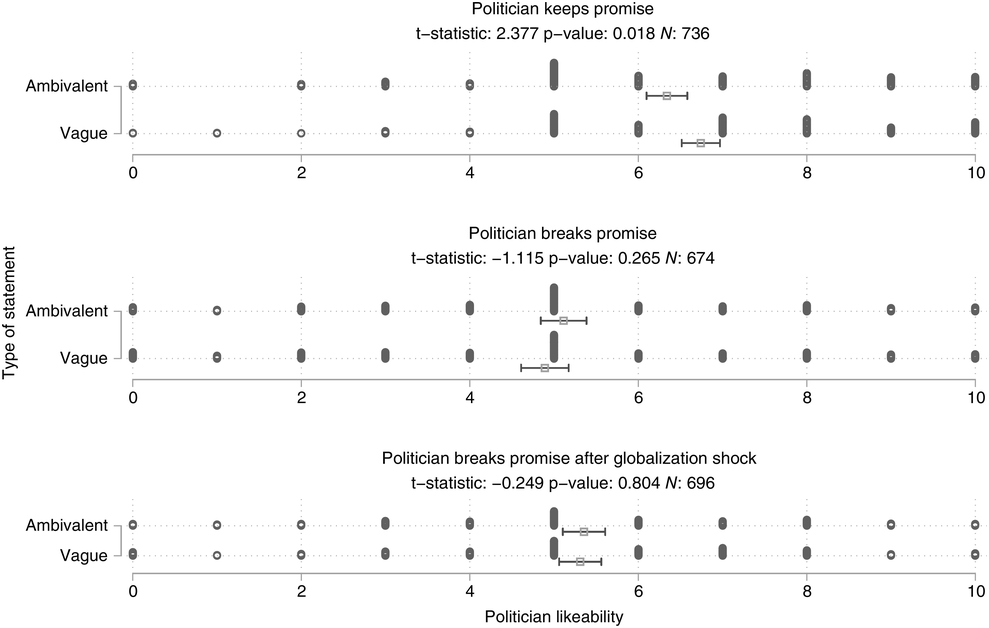
Figure 10.3 Long description
The three samples from top to bottom are separated by the politician keeping his promise, breaking it, and breaking it after globalization shock. The mean for each sample is represented by a light gray square with red bar confidence intervals. The top plot has 736 observations, a t-statistic of 2.377, and a p-value of 0.018. The middle plot has 674 observations, a t-statistic of negative 1.115, and a p-value of 0.265. The bottom plot has 696 observations, a t-statistic of negative 0.249, and a p-value of 0.804.
In line with the previous results, breaking promises (in this case, voting against respondents’ preferences) significantly reduces support for the politician. However, against our expectations, ambivalent statements are not significantly more costly than vague statements, whether there is a globalization shock (bottom graph) or not (middle graph). Table 10.2 shows that the null results are robust across different outcome variables.
| Vague | Ambivalent | Diff | p-value | |
|---|---|---|---|---|
| Represents people well | 5.23 | 5.22 | −0.01 | 0.97 |
| Open minded | 5.47 | 5.60 | 0.13 | 0.30 |
| Lacks integrity | 4.97 | 4.95 | −0.02 | 0.88 |
| Good at keeping promises | 5.03 | 4.97 | −0.06 | 0.69 |
| Adapts well to changing circumstances | 5.56 | 5.74 | 0.18 | 0.15 |
| Competent | 5.50 | 5.46 | −0.04 | 0.77 |
Note: The table presents the results of difference-between-means tests in a sample where the politician votes against respondents’ preferences (breaks his promise), comparing the treatment group where the politician makes vague statements to the treatment group where the politician makes ambivalent statements. The results include respondents independent of whether they receive the globalization treatment. The results are robust if we split the sample by respondents who are treated with a globalization shock and respondents who are not treated with a globalization shock.
The evidence does not support the expectation that vagueness is a superior strategy to ambivalence. We assumed that voters are more likely to believe that candidates who make ambivalent statements would vote in line with their (voters’) preferences than candidates who make vague statements. However, this does not appear to be the case. The difference between respondents who are exposed to a vague politician compared with those who are exposed to an ambivalent one is insignificant with respect to respondents’ average level of confidence about how the politician would vote (p<0.97).
One potential explanation for this nonfinding is that respondents might give politicians with whom they have a partisan affinity the benefit of the doubt. Recall that we present respondents with a candidate that matches their own partisanship. While this allows us to isolate the main effect we are interested in, it may limit the extent to which we detect the full implications of ambivalence, particularly if citizens are less forgiving of ambivalence (or inconsistency) in the statements of candidates who do not match their own partisanship, as the existing literature suggests (Bonilla Reference Bonilla2022; Naurin Reference Naurin2011; Naurin, Soroka, and Markwat Reference Naurin, Soroka and Markwat2019; Simas, Milita, and Ryan Reference Simas, Milita and Ryan2021).
Nonetheless, in line with our main argument, voters generally disapprove of ambivalence. Even when politicians keep their promises (top graph in Figure 10.3), the average likeability score for ambivalent politicians (6.33) is significantly lower than the average likeability score for vague politicians (6.74, p<0.018). This is in marked contrast to our findings in Figure 10.2 where we find no significant differences between vague and concrete statements.Footnote 4 While these comparisons were not preregistered, they indicate that voters have an inherent dislike of ambivalence (less so of vagueness). As such, the findings shed light on why politicians do not tend to increase their use of ambivalence in contexts in which governments are highly exposed to globalization, as they do in relation to vagueness.
Overall, the experimental results provide evidence that politicians can use ambiguous statements to improve public support. The use of vague language in election campaigns allows politicians to minimize the future electoral costs of breaking promises. While we do not find a strong difference between ambivalence and vagueness when politicians vote contrary to citizens’ preferences, voters generally dislike ambivalence, even when politicians vote in line with their preferences. These results support our explanation of why parties use vague language when their country is deeply integrated into the global economy. Parties know that globalization’s constraints may limit their capacity to keep their campaign promises and also that carefully calibrated use of vague language, rather than making specific promises, can mitigate future electoral punishment for breaking promises.
Discussion
This chapter examines how politicians use ambiguity in their campaign statements to reduce the severity of voters’ punishment of them for breaking campaign promises. Ambiguity in the form of vague campaign statements is an effective way for parties to reduce the severity of electoral punishment for breaking clear promises. Making vague statements is often a better strategy than making a clear promise and breaking it, even when the party may be able to make a case that the broken promise was due to globalization constraints beyond its control. While previous research provided robust evidence that ambiguity helps parties appeal to a broader range of voters, we know less about how ambiguity shields parties from retrospective sanctions for broken promises. There are two key reasons why ambiguity helps parties avoid being held accountable for broken promises. First, ambiguous campaign statements make it difficult for voters to clearly identify what was promised, creating confusion about whether a promise was broken. Even when voters formulate expectations about what candidates will do based on vague campaign statements, actions that contravene these expectations may not result in harsh electoral punishment. Second, ambiguous statements give parties more flexibility when they enter government office. Governing parties may claim success by framing their actions as fulfilling a broad and flexible interpretation of their previous commitments.
The findings strongly support our theory that ambiguity helps insulate political parties from electoral punishment, and they align with the key finding from Chapter 9 that parties’ election programs contain vaguer language when countries are more deeply integrated into the international economy. The evidence from the survey experiment supports our main expectation that vagueness mitigates the negative electoral consequences of promise breaking. This holds even when promise breaking was accompanied by globalization-induced shocks that made concrete promises less feasible. Politicians who voted contrary to voters’ preferences after making vague statements receive lighter punishment from voters than candidates who broke clear promises that are in line with voters’ preferences.
Parties’ use of ambiguity to avoid future electoral punishment for promise breaking has significant negative implications for democratic accountability. Promissory representation is weakened when parties blur their commitments excessively. Voters lose the ability to assess effectively whether parties have delivered on their promises, undermining their ability to hold elected officials accountable. When governing parties’ accountability to voters is weakened, governments can implement policies that may not reflect what voters want. This disconnect between promises and policies undermines the fundamental mechanisms of promissory representation, according to which electoral commitments are supposed to guide voters’ expectations and governing parties’ actions. If policies no longer align with voters’ preferences, the quality of substantive representation deteriorates, weakening the democratic process. Chapter 11 concludes by bringing together the book’s main findings and their implications for the erosion of democratic representation.
At the core of promissory representation lies a fragile yet powerful contract between citizens and those who represent them. This foundational idea rests on the belief that political parties must be held accountable for the promises they make to the electorate. It is through this promise keeping mechanism that citizens shape the direction of government policies. The integrity of democracy hinges on this exchange, where voters’ trust in their representatives’ promises is matched by representatives’ obligation to fulfill those promises once in office. Voters expect their leaders to deliver on their campaign promises or face the consequences for failing to do so at the ballot box. The expectation is straightforward yet profound: In return for political power, parties must deliver what they promised. This cyclical process of promise, action, and electoral judgment is what breathes life into democratic representation, keeping it vibrant, responsive, and linked to public opinion. Without it, the fabric of promissory representation unravels.
For this bond to hold, and for promissory representation to work, three key assumptions must hold. First, parties must have sufficient agency to make campaign promises that appeal to significant parts of the electorate. This means that parties must have the autonomy to design policies without being overly constrained by external forces. Without this agency, promises made during election campaigns would fail to resonate with voters, leaving voters disenchanted with the choices they face. Second, parties must have a reasonable level of certainty that they can keep the promises they make. This assumption hinges on governing parties’ control over the levers of public policies and the stability and predictability of the political and economic environment in which they operate. If parties cannot keep their campaign promises, they cannot reliably promise specific policies in the first place. Moreover, when parties do make and then break campaign promises, they undermine voters’ trust. Broken promises signal to voters that their representatives lack the governing competence to anticipate which policies are feasible and practically implementable when holding executive office. Third, voters must hold parties to account for their performance in terms of making promises that appeal to them and for keeping or breaking the promises they previously made if they were in office. For electoral accountability to hold, parties must make campaign promises that are clear enough for voters to assess whether they have been kept. If promises are too vague, voters will struggle to determine whether a party has fulfilled its commitments. Clear promises also allow voters to evaluate whether parties’ proposed policies align with their own preferences. When parties fail to make clear promises, the accountability mechanism of democracy breaks down, as voters lose the ability to select parties based on their policies and to sanction parties based on their performance in terms of promise keeping.
These assumptions are the pillars that uphold the system of democratic representation. When they hold true, voters can hold parties accountable for their actions, and elections serve as a tool for ensuring that public policies are broadly in line with public opinion, at least of those citizens who supported the parties that hold executive power. But when these assumptions are weakened, the effectiveness of democratic representation erodes.
Globalization and the Breakdown of Democratic Representation
Globalization has fundamentally undermined these pillars, thereby disrupting democratic representation as it is understood from the perspective of mainstream promissory representation. As countries become more deeply integrated into global markets, parties increasingly face constraints that limit their ability to make and keep their campaign promises. These constraints come in many forms: international trade agreements, the pressures of global financial markets, the demands of multinational corporations, the interdependencies of global supply chains, and the rising expectations of citizens in response to globalization’s economic risks. The autonomy of national governments to implement policies has been reduced, especially when those policies conflict with global economic imperatives. The debate over globalization’s impact on democracy is polarized; some argue that globalization fosters democracy by promoting economic growth, while others contend that it erodes national sovereignty and accountability. Our research firmly supports the view that globalization poses a threat to meaningful democratic representation in established democracies.
Globalization undermines the quality of democratic representation in several ways. It reduces governing parties’ ability to deliver on the promises they made during previous election campaigns. Voters punish governing parties for breaking promises, although it seems that much of this is beyond the control of governing parties, particularly when they promise leftist policies. At the same time, mainstream parties’ responses to the constraints of globalization are undermining the potential for meaningful choice and accountability. Ideological competition is narrowing, while obfuscation in the form of ambiguous electoral appeals has increased. Mainstream parties, particularly those on the center-right, have increased their use of populist rhetoric in response to the constraints of globalization. Mainstream parties’ failure to formulate and keep credible campaign promises has not led voters to eschew promise keeping as a way of assessing governing parties’ performance. On the contrary, electoral rewards for succeeding or (more commonly) punishments for failing to fulfill promises are even larger in the context of globalization. Parties’ attempts to avoid electoral punishment for promise breaking, including the use of strategic ambiguity and populist rhetoric, erode accountability, as these reduce the presentation of clear and feasible policy alternatives to voters. This erosion of accountability strikes at the core of promissory representation.
Our analyses, which draw on a diverse range of methods and data – including large-n observational studies, in-depth case studies, and controlled survey experiments – demonstrate several ways in which globalization undermines promissory representation:
First, globalization reduces the likelihood that governing parties keep their campaign promises. The constraints of global economic systems, including international trade agreements and financial dependencies, limit the ability of governing parties to enact the policies they promised during campaigns. This is particularly evident in economic policies, where global market forces often override national priorities. However, the constraining effects of globalization reach far beyond economic policies narrowly defined, as governments’ attention may be diverted by international crises, and fiscal constraints imposed by market forces affect a broad range of policy areas.
Second, voters punish governing political parties that fail to deliver on their promises. In highly globalized contexts, holding parties accountable for their ability to keep promises has become even more important to voters, who increasingly rely on this as a measure of governing competence. Ironically, this shift is partly because governing parties have less impact on their countries’ general economic performance in the context of intense international economic integration. Many voters are aware that the general state of the economy is at most only partly attributable to government policies and often more influenced by the state of the global economy. However, while parties may attempt to deflect blame by attributing broken promises to the constraints of globalization, our results show that this strategy offers limited protection. Voters still penalize parties for failing to follow through on their commitments and do so even more harshly in the context of globalization.
Third, parties moderate their ideological positions on economic policies, often moving toward the center. As globalization has deepened, many parties, particularly those on the right, have adjusted their promises to appeal to citizens who demand more protection from the economic risks associated with open economies. This ideological moderation often comes at the cost of clarity, as parties attempt to balance competing demands from business elites and middle- and lower-income voters who feel left behind by globalization. The adoption of populist rhetoric by mainstream center-right parties is one way they attempt to navigate this tension. This also further undermines the potential for accountability, as populist rhetoric is largely devoid of substantive and feasible policies, instead attempting to evoke an emotional response from potential supporters.
Fourth, mainstream parties increasingly use ambiguous language in their electoral appeals in response to the constraints of globalization, making it more difficult for voters to hold them accountable. Using ambiguous language helps parties to remain flexible once in office, allowing them to adjust their policies in response to global pressures. However, ambiguity is of limited use to addressing the fundamental problem. Notwithstanding the increased use of ambiguous language, most parties still feel compelled to make large numbers of specific campaign promises, many of which they cannot keep when they take control of the executive after elections. One of the reasons that parties continue to make many specific promises is that voters are unlikely to be persuaded by general statements alone. Concrete proposals are still necessary. Moreover, where ambiguous language is used, voters struggle to determine which parties they agree with and whether or not governing parties have kept their previous promises in those areas. This undermines the key accountability mechanisms that are central to promissory representation.
We arrived at these key insights through a multi-method approach that combines large-n quantitative analysis, survey experiments, and qualitative insights:
In Chapters 4 and 5, we examine the difficulties governing parties face in keeping their promises due to the constraints of economic integration. Using large-n observational data, we analyze the fulfillment of election pledges across different countries and time periods. To probe the underlying theoretical mechanisms, we complement this quantitative analysis with a qualitative study based on archival material and elite interviews. This allows us to gain deeper insight into how globalization constraints influence the decision-making of party leaders and government officials. We find that promises related to social welfare, labor protections, and economic redistribution are particularly difficult to keep, especially for center-left parties whose platforms often conflict with global market forces. The combination of large-scale data and qualitative insights reveal that economic integration restricts governing parties’ policy autonomy, making it harder for them to follow through on key electoral commitments, and demonstrate that these effects are driven by the constraining forces of globalization.
In Chapter 6, we employ a combination of large-n observational research, experimental methods, and an in-depth case study to explore the electoral consequences of broken promises. We analyze voting behavior using a dataset of election results and party performance in terms of pledge fulfillment in globalized contexts. Complementing this, our survey experiment directly tests how voters respond when politicians break their promises, showing that voters punish politicians more severely in highly globalized environments. Our qualitative interviews with citizens further reveal the complex and lasting impact of promise breaking. Even decades after a prominent case of promise breaking, voters display disappointment and disillusionment, even when combined with sophisticated understanding and loyalty. Taken together, these analyses provide strong evidence that parties face immediate and lasting consequences for breaking campaign promises.
Chapters 7 and 8 focus on the ideological shifts that globalization has prompted in right-leaning parties. Through large-n quantitative analysis of parties’ election programs, we track how these parties have moderated their socioeconomic positions, moving toward centrist policies on socioeconomic policy themes. At the same time, they have increasingly adopted populist rhetoric, particularly on issues related to immigration and national identity, as they seek to appeal to a broader voter base. These chapters highlight the strategic recalibration parties undergo in response to globalization, showing how economic moderation is balanced with cultural populism.
Chapters 9 and 10 focus on parties’ increasing use of vagueness in their electoral appeals as their countries have become more exposed to economic globalization. In Chapter 9, we analyze party manifestos and political speeches across six Western democracies using text analysis and large-n statistical analysis. We find that as globalization increases uncertainty in governance, parties are increasingly using vague language in their appeals. This vagueness allows them to avoid making clear commitments, providing flexibility in policy implementation and helping shield them from the electoral consequences of broken promises. Chapter 10 builds on this by analyzing the electoral consequences of political ambiguity, using experimental data to show how voters respond to vague promises. Vagueness reduces voters’ ability to hold politicians accountable for breaking promises. By obfuscating their campaign messages, politicians can escape the full extent of electoral punishment that voters typically impose on governing politicians who break their promises.
This multimethod approach – combining quantitative analysis, survey experiments, and qualitative case studies – offers a broad perspective on how globalization affects democratic representation. The integration of different methods provides a nuanced understanding of the complex dynamics between political parties, voters, and global economic forces.
Counterarguments Are Complacent
There are two main counterarguments in response to the far-reaching conclusion that globalization has significantly undermined the practice of democracy, particularly as it is understood through the lens of promissory representation. Both responses engage with the idea that parties are increasingly constrained by global economic forces, limiting their ability to make and keep promises, but they differ in how they perceive the future of these constraints and the ideal of promissory representation.
Deglobalization
The first response is that we are entering an era of deglobalization, where states are reclaiming control over their economies and reducing their dependence on international markets (Bello Reference Bello2002; Bremmer Reference Bremmer2007; Rodrik Reference Rodrik2012; Stiglitz Reference Stiglitz2018). Unlike periods of reduced globalization due to temporary crises (e.g., the COVID-19 pandemic and some measures following the 2008 financial crisis), deglobalization is viewed as a structural shift, driven by changes in policies, political ideologies, and economic strategies. The increasing geopolitical tensions between major powers, notably the United States and China, have led to a movement toward “selective decoupling,” where countries are attempting to protect strategic sectors (such as technology, energy, and critical infrastructure) from global market forces (Baldwin Reference Baldwin2016; Tooze Reference Tooze2021). According to this view, the COVID-19 pandemic further accelerated deglobalization trends in certain industries by exposing the vulnerabilities of global supply chains. Countries implemented travel restrictions, lockdowns, and trade barriers that disrupted global trade and investment flows. The crisis led many governments to emphasize economic self-sufficiency, particularly in critical sectors like medical supplies, food, and technology (Evenett Reference Evenett2020). Politicians from populist parties have further promoted deglobalization, arguing that globalization has led to job losses, income inequality, and loss of national sovereignty. They have also led to increased support for antiglobalization measures, as seen in the United States under Donald Trump and the United Kingdom with Brexit (Norris and Inglehart Reference Norris and Inglehart2019; Rodrik Reference Rodrik2018). The resurgence of nationalism has manifested itself in trade restrictions, withdrawal from global agreements (e.g., the United States pulling out of the Paris Climate Agreement under Trump), and a focus on “self-sufficiency” (De Vries and Hobolt Reference De Vries and Hobolt2020; Helleiner Reference Helleiner2019).
Deglobalization could reduce the pressures that globalization places on national governments, potentially allowing parties to regain some autonomy in policymaking and promise keeping. It may thereby alleviate some of the constraints that have eroded democratic representation. Parties could once again make campaign promises with a greater degree of confidence that they will have the agency to fulfill them. This would reinvigorate the mechanisms of accountability that are central to promissory representation, as voters could vote for parties knowing that those parties will keep their promises. In this scenario, the relationship between parties’ campaign promises and government policies could be restored, leading to a revival of promissory representation.
Although there are signs of selective decoupling, particularly in strategic industries and between certain major economies, the broader forces of economic integration have remained constant. The most sophisticated measure of the degree of overall economic globalization to which countries are exposed is the Konjunkturforschungsstelle (KOF) Globalization Index, which we used throughout our analyses. This measure shows no marked downward shift for the set of established democracies that are the focus of our inquiry. In fact, despite political rhetoric suggesting a retreat from globalization, there is limited empirical evidence that supports the idea of sustained or broad-based deglobalization. What we observe instead is a transformation in the structure of globalization, away from unregulated liberalization and toward more managed forms of global economic governance. Countries may be more cautious about certain dependencies (e.g., in semiconductors or energy), but they continue to deepen trade and investment relations in other areas, especially services and digital economies.
This evolving nature of globalization means that the structural constraints we highlight remain salient, even in an era of increased protectionist rhetoric. Governments may pursue more interventionist policies, but they continue to face binding international rules, economic interdependence, and market pressures that limit their room to maneuver. For instance, while US President Donald Trump imposed tariffs as part of his “America First” agenda, many of these measures were either scaled back, waived, or circumvented in response to backlash from domestic industries, diplomatic pushback, and international supply chain disruptions. Similarly, Brexit was framed by its proponents as a move to restore sovereign control – particularly over migration – but in practice, UK governments have struggled to gain meaningful autonomy over migration policy. Labor shortages, legal commitments, and political pressures have undermined its ability to radically diverge from pre-Brexit patterns. In fact, net migration to the United Kingdom has increased since Brexit: Between 2020 and 2023, net migration rose from 111,000 to 906,000, far exceeding pre-Brexit levels and undermining promises to “take back control” of the country’s borders. Much of this increase was driven by non-European Union migration, including new visa schemes for health and care workers, students, and humanitarian routes (e.g., for Ukrainians and Hong Kongers), reflecting persistent economic and geopolitical pressures. Rather than regaining control, the United Kingdom has simply shifted the composition of migration without significantly reducing its scale. This demonstrates how even dramatic institutional breaks do not necessarily increase governments’ policy autonomy in a globalized world.
Selective decoupling from China also does not liberate Western governments from the broader constraints of international economic integration. On the contrary, such decoupling often leads to a reconfiguration – rather than a retreat – of globalization. Governments seeking to reduce dependence on China have intensified economic cooperation with like-minded allies, forging new agreements on supply chains, semiconductors, and critical minerals. For example, European countries have deepened collaboration within the European Union on securing access to rare earth elements and safeguarding technological sovereignty. These are all moves that sustain, and even amplify, international interdependence. Similarly, the United States has expanded trade and investment ties with strategic partners in Asia and the Americas, reinforcing its integration into alternative global networks. These shifts suggest not the end of globalization but its evolution into more politically curated and strategically aligned forms.
Even in a selectively deglobalized world, the interdependencies created by decades of globalization will not disappear, and the challenges to promissory representation will persist. Global trade, finance, and supply chains remain deeply embedded in the institutional and economic frameworks of advanced democracies. International agreements and the disciplining pressures of global markets continue to shape domestic policy options, meaning that the fundamental constraints on promise making and promise keeping that we identify in this book remain firmly in place – even in an era of selective deglobalization.
Promissory Representation Has Always Been Flawed
The second response takes a more skeptical view of promissory representation itself. This response suggests that democratic representation has never functioned according to the principles of promissory representation, even before the rise of globalization (Achen and Bartels Reference Achen and Bartels2016; Riker Reference Riker1982). Chapter 2 discusses these critiques of promissory representation extensively, where we acknowledge that the practice of democratic representation has long differed from the ideal of promissory representation. Parties have always faced complex challenges in making and keeping promises, due to factors such as the need to share power with other parties in coalitions, unforeseen economic crises, and the inherent complexity of governance. In this view, the ideal of promissory representation has always been unattainable, as parties could rarely anticipate the full range of challenges they would face once in government.
While this critique holds merit, and there are theoretical and empirical reasons to question whether democratic systems have ever fully embodied the principles of promissory representation, globalization has undeniably exacerbated the difficulties that parties face in keeping their promises. Global economic forces have introduced new constraints that further reduce the capacity of parties to deliver on their campaign commitments. These constraints are not simply a continuation of long-standing difficulties in governance but represent a fundamental shift in the relationship between national governments and their electorates. Globalization has deepened the disconnection between parties’ promises and subsequent public policies, making it even harder for voters to hold parties accountable.
Even if promissory representation has always been a challenging ideal to attain, it remains a central framework for understanding democratic accountability. Voters continue to expect that political parties will keep their promises, and political scientists and policymakers continue to use promissory representation as a benchmark for understanding how democratic representation works and for evaluating democratic performance. The fact that globalization has further diminished the potential for promissory representation to be realized in practice only underscores the need to address the consequences of this trend.
Harnessing Populism’s Challenge to Restore Democratic Accountability
The breakdown of promissory representation has been accompanied by rising support for populist parties. Globally, public support for populist parties has grown from around 2 percent in 1980 to nearly 25 percent today (Chwieroth and Walter Reference Chwieroth and Walter2019). In Europe, the average vote share of right-wing populist parties in legislative elections has more than tripled from 5.4 percent in the 1970s to close to 17 percent today and their share of legislative seats tripled to 12 percent today (Milner Reference Milner2021b; Norris and Inglehart Reference Norris and Inglehart2019). Populist movements thrive by criticizing the inability of mainstream parties to deliver on their promises and by portraying themselves as champions of the common people against corrupt elites (Mudde Reference Mudde2004; Norris and Inglehart Reference Norris and Inglehart2019). In France, Italy, and Hungary, among other countries, populist parties have gained significant traction by leveraging economic discontent and fears about immigration, while in the United States, Donald Trump’s successive presidential campaigns tapped into voter anger over globalization, loss of manufacturing jobs, and perceived national decline (Hobolt and Tilley Reference Hobolt and Tilley2014). A cornerstone of Trump’s appeal was his blunt, bold messaging, which often contrasted with the ambiguous and technocratic language of the political establishment. He criticized both the Republican and Democratic parties for failing to deliver on key issues like job creation and immigration control, blaming this on a mix of corruption, incompetence, and globalist interests. Trump’s slogan, “drain the swamp,” encapsulated his message that mainstream politicians were dishonest and incapable of delivering on their promises. He critiqued the trade deals of previous administrations as harmful to US workers, promising bold actions like pulling out of the Trans-Pacific Partnership and renegotiating the North American Free Trade Agreement.
In France, the rise of the radical right in the form of the National Front (subsequently rebranded as the National Rally) has been traced to the broken promises of the Socialist government of the 1980s, which we examined in Chapter 6 (Hargreaves Reference Hargreaves2012). Marine Le Pen, leader of the National Rally, has long criticized mainstream French parties, especially the center-right Republicans and the Socialist Party, for their failure to protect jobs, improve living conditions, and control immigration. She has argued that these parties make vague, noncommittal promises and fail to take decisive action once in power. Her 2017 presidential campaign was built around strong, direct promises such as leaving the Eurozone and curbing immigration, in stark contrast to what she framed as the “wishy-washy” stances of her opponents, including Emmanuel Macron. Across these contexts, populists have built support by offering clear sounding and radical policy proposals, often focused on rejecting global economic integration, reducing immigration, and reasserting national control over economic and political decision-making (De Vries and Hobolt Reference De Vries and Hobolt2020).
A range of institutional reforms have been proposed to counter voters’ disaffection with conventional politics and to enhance electoral accountability. Some proponents of electoral reforms argue that proportional representation systems, as opposed to majoritarian systems, help to ensure that electoral outcomes more accurately reflect public opinion (Lijphart Reference Lijphart1999). Additionally, reforms such as recall elections and referendums allow voters to hold parties accountable more frequently, outside the regular election cycle (Bowler and Donovan Reference Bowler and Donovan2000). These mechanisms can provide voters with a way to demand accountability in real-time, rather than waiting for the next general election. Deliberative democracy initiatives, such as citizens’ assemblies or participatory budgeting, have been suggested as ways to involve citizens in policy discussions and thereby increasing their efficacy (Fishkin Reference Fishkin2011; Smith Reference Smith2009; Warren and Pearse Reference Warren and Pearse2008). While such institutional reforms are in many cases meritorious, the practical challenges to implementing them, which often include constitutional amendments requiring broad support, can make them unfeasible. Moreover, they do not directly address the causes of the present malaise, which we contend lie mainly in political elites’ responses to the constraints of globalization.
Likewise, efforts to promote political education and civic engagement among citizens are laudable and part of the remedy but not a panacea (Delli Carpini and Keeter Reference Delli Carpini and Keeter1996; Galston Reference Galston2001; Goodman Reference Goodman2017; Nie, Junn, and Stehlik-Barry Reference Nie, Junn and Stehlik-Barry1996). Voters need to be knowledgeable about the political process and the constraints that governing parties face. This equips them to hold parties accountable without falling prey to populist simplifications. Engaging voters more deeply in political processes also fosters a stronger connection between citizens and their representatives. Political knowledge helps citizens identify both the promises political parties make and whether political parties in government fulfilled their promises (Duval and Pétry Reference Duval and Pétry2018, Reference Duval and Pétry2023; Thomson Reference Thomson2011). Althaus (Reference Althaus2003) found that political education and awareness of constraints help voters better distinguish between feasible commitments and empty rhetoric or emotional appeals. However, we did not find evidence that voters are unable to hold governing politicians accountable for broken promises. On the contrary, they are effective at doing so, particularly in contexts that are highly exposed to the constraints of globalization.
Citizens are not generally the root of the malaise that afflicts many established democracies; mainstream political elites are, especially for the ways in which they have responded to the constraints of globalization and the populist challenge. A recent comparative study concluded that while public support for populist parties has increased, public support for populist values has remained relatively constant (Bartels Reference Bartels2023). There have long been significant minorities of the public who hold illiberal values or are at least impressionable. The behavior of mainstream political elites has enabled these illiberal sympathies to fester and develop into the populist disease that is rampant in many liberal democracies. Mainstream parties, particularly those on the left, have made promises they could not keep due to the constraints of globalization. Many mainstream parties on the right have adopted more populist language (Bale and Rovira Kaltwasser Reference Bale and Kaltwasser2021; Bakker, Jolly, and Polk Reference Bakker, Jolly, Polk, Hobolt and Rodon i Casarramona2021; Kriesi et al. Reference Kriesi, Grande, Dolezal, Helbling, Höglinger, Hutter and Wüest2012; Mudde Reference Mudde2019). Mainstream parties across the ideological spectrum have used vaguer language, albeit for different reasons. These strategies have exacerbated the problem, fueling the populist flame. Instead of winning back voters, mainstream parties have come across as insincere or opportunistic when trying to appeal to populist sentiments. This has not only failed to quell the populist surge but has, in some cases, further legitimized populist narratives by reinforcing the perception that mainstream parties are merely adapting their rhetoric to win votes rather than genuinely addressing the issues at hand (Albertazzi and McDonnell Reference Albertazzi and McDonnell2015; Meguid Reference Meguid2005).
While this book is mainly about diagnosing the illness rather than formulating the cure, an outline of the remedy can be detected in the main findings. The first step is to recognize that mainstream parties’ current responses to the constraints of globalization are readily explicable based on their core concerns with office seeking and policy seeking within prevailing institutional constraints. At the same time, these responses have been counterproductive. Rational parties seek to minimize the risks of electoral punishment for failing to fulfill campaign promises in a globalized economic environment with all the constraints that brings. In response, they have chosen ambiguity coupled with many hundreds of smaller campaign promises, often with a distracting topping of vacuous populist rhetoric. This gives them flexibility when they hold government office after elections but also makes it harder for voters to hold them accountable. In stark contrast, populist parties offer simple, direct, and emotionally charged solutions to complex problems, which stand out compared with the ambiguous and technocratic language of mainstream parties. By focusing on restoring national sovereignty and taking strong stances against globalization, populist leaders promise to return control to “the people,” a message that resonates deeply with voters who feel abandoned by traditional politics.
A more effective response to the crisis brought by globalization is for mainstream parties to reinvigorate the key elements of promissory representation through a coherent strategy that consists of both self-promotional and combative measures. A realistic and effective response would acknowledge the political imperatives that have driven mainstream parties to their current responses. These include the changing political landscape that has accompanied the rise of populist movements, and the costs as well as the benefits of countries’ exposure to economic globalization.
The self-promotional part of an effective response by mainstream parties refers to the ways in which they present their campaign promises and their record of promise keeping. Mainstream parties should commit to highlighting coherent sets of key campaign promises that are both ambitious and fulfillable. This would be a major departure from many parties’ current practice, which consists of making many hundreds of detailed promises combined with vague language that obscures priorities. Detailed and technical policies have important roles to play in relation to maintaining internal party cohesion and providing a blueprint for government, but they are generally ineffective forms of communication in the face of populist parties’ seemingly bold guarantees. Party strategists need to get better at formulating their key messages in language that resonates more broadly with citizens. This includes being more rigorous and clearer about which campaign promises to highlight. The findings from Chapter 10 show that ambiguity serves a function for mainstream parties; it insulates them from electoral punishments for breaking clear promises. However, the underlying research that we discussed also shows that voters value transparency and support parties that make clear policy proposals, even if those proposals are constrained by external factors. If implemented judiciously, making fewer but more compelling clear promises could serve the same function as using vague language to avoid the negative sanctions that follow the breaking of many campaign promises. The success of this approach depends on parties being upfront about the constraints imposed by globalization, while still outlining the main policies they intend to pursue within those constraints.
Mainstream parties’ key campaign promises should include clear stances on the issues that populist parties have campaigned on without resorting to divisive populist rhetoric. The findings from Chapters 7 and 8, taken together, indicate that this is possible. In response to globalization’s constraints, many mainstream parties on both the left and right have increased the attention they devote to themes typically associated with populist parties, including support for a strong military, nationalist values, traditional morality, and law and order. This increasing prominence of nonsocioeconomic themes has also been documented in previous research (e.g., Ezrow and Hellwig Reference Ezrow and Hellwig2014; Hellwig Reference Hellwig2015). However, while right-of-center parties have also embraced the use of populist rhetoric, leftist parties generally have not. Moreover, leftist parties have remained broadly consistent in their support for their core ideological principles in response to deepening globalization. This indicates that mainstream parties can address issues associated with nationalism and traditional values without resorting to populist language. Mainstream parties have the potential to develop nationalist visions that usurp populists’ nascent ownership of this narrative while preserving liberal principles. Although mainstream parties’ alternative nationalist visions should be derived from their own core ideological principles, this will involve direct confrontation and contrast with the divisive narratives put forward by populists.
More effective self-promotion extends to the coverage of mainstream parties’ records of promise keeping when they are in government. Governing parties themselves should highlight this performance more prominently when they stand for reelection. There are also benefits to institutionalizing public monitoring of promise keeping. Our research indicates that mainstream governing parties, particularly those on the left, have often struggled to keep their campaign promises due to the constraints of globalization (Chapters 4 and 5). Parties therefore need to ensure that their key campaign promises balance ambition with realism, in the sense that they can be fulfilled within the prevailing constraints faced by governments. If parties were to make fewer but more compelling promises, as we suggest they should, they would be in a stronger position when it comes to reporting on their own performance in terms of keeping their previous campaign promises. Political scientists and media organizations have an important role to play here too. Online promise trackers have successfully reported on the extent to which campaign promises have been kept or broken, making valuable contributions to public discourse. These efforts are commendable and should be expanded with more sustained funding. The institutionalization of tracking the fate of campaign promises could include greater legislative scrutiny or even independent auditors, whereby the government’s performance in relation to the fulfillment of governing parties’ campaign promises is assessed independently.
Combative measures, which involve direct confrontation with populist parties, are also part of a more effective response by mainstream parties. Beyond denying populists an effective monopoly on nationalism, mainstream parties should home in on populists’ weaknesses far more aggressively than they have done in the past. Populists often make bold, straightforward promises that resonate with voters’ immediate concerns. This is both a strength and an Achilles heel. The clarity of these promises – such as promises to reduce immigration, boost local industries, or dismantle perceived elite-driven systems – makes them highly vulnerable. The clear and unequivocal nature of populists’ campaign promises leaves little room for reinterpretation or justification when governments’ actions and outcomes fall short of expectations, as they often do. Voters tend to dislike this pattern of overpromising and underdelivering, which can lead to declining public support if voters receive trusted information on populists’ poor performance.
Notwithstanding the constraints of globalization, populist parties in government, like their mainstream counterparts, often fulfill significant numbers of their campaign promises. The frontal attack on populist parties should extend to cases in which populist governing parties keep their campaign promises and pursue their broader agendas, because they are vulnerable here too. The fulfillment of some populist promises has undermined democratic norms and constitutional principles, including freedom of speech and the rule of law. While citizens know that promise keeping is important, they are also aware that other things matter too, including being governed by parties that are responsible and competent. In some contexts, efforts to dismantle democratic institutions have provoked widespread civic mobilization and renewed support for democratic norms. These reactions suggest that while populism poses a significant threat, it can also awaken public resistance and revitalize demands for transparency, accountability, and effective governance. Particularly in places where populists have gained governing power, mainstream parties should do more to nurture and grow public resistance to populist agendas.
There are notable examples where mainstream parties have adopted some elements of the strategy outlined here, and in doing so have regained ground against populist challengers. These cases highlight how mainstream parties can respond effectively to the rise of populism through clear campaign promises that address voters’ concerns. For example, in the lead-up to the 2019 general election, Spain faced a significant rise in populism, especially from the far-right party Vox. To counter this, and rather than resorting to populist rhetoric,Footnote 1 the mainstream Spanish Socialist Workers’ Party (PSOE), led by Pedro Sánchez, made clear promises on social policies, particularly around employment, pensions, and gender equality. Their focus on clear economic and social reforms helped to distinguish their election program from the more extreme rhetoric of populist parties and was one factor that helped PSOE secure enough seats to form a government after the election. Similarly, facing Marine Le Pen’s populist National Front, Emmanuel Macron’s campaign in the 2017 presidential election centered around clear, centrist promises on reforming the French labor market, increasing European cooperation, and modernizing the economy (BBC News 2017). His specific, progressive agenda on economic reforms and European cooperation distinguished him from Le Pen’s protectionist and nationalist agenda. Macron’s clarity on these issues played a crucial role in securing his victory, as voters gravitated toward a centrist alternative to populism.
There is no foolproof strategy that will lead to victory over populists every time. Party strategists need to be aware of the distinction between the long-term strength of an effective strategy and tactical errors that can cost them dearly in a particular election. In the 2024 US presidential election, mainstream candidates aimed to clarify their policy positions to counter the rise of populism, particularly from candidate President Trump and others in the Republican Party. In their successive campaigns, President Joe Biden and then Vice President Kamala Harris both presented sharp messages on economic recovery, job creation, and protecting democracy. These Democratic candidates made clear and specific promises around bolstering the middle class, combating inflation, and improving infrastructure through continued investment in projects like those funded by the bipartisan Infrastructure Investment and Jobs Act. They also emphasized the clear gains from these policies, distinguishing the Democratic Party platform from the vague and populist promises by Trump’s Republicans. The Democrats’ platform was perhaps too long and detailed, which meant the campaign messaging that voters received from campaigners was not as sharp as it could have been. However, the basic strategy of highlighting responsible promises and performance in the face of populist vacuousness was sound. Pundits have offered a profusion of diagnoses of the errors that cost the Democrats the White House, and we do not intend to add to these. What we can glean from our analyses, and we think it is important enough to state boldly, is that mainstream parties generally benefit from outlining their plans in clear and feasible ways and then demonstrating that they delivered on those plans.
When faced with the growing threat of populism, mainstream parties should sharpen their messaging by focusing on smaller numbers of key promises that address citizens’ concerns while rejecting populist rhetoric. Mainstream parties need to mount more aggressive frontal attacks on populist contenders, homing in on populists’ inherent weaknesses on two fronts. The first is that populists often make promises that they break when they enter government. The second is that populists tend to make promises that, if kept, do not address the underlying issues and, moreover, assault values that are widely shared in democratic societies. Mainstream parties can differentiate themselves from their populist rivals through clarity and decency, which would allow them to reconnect with a disillusioned electorate eager for authenticity and competence. The path forward for mainstream parties lies not in echoing populist rhetoric, but in reinvigorating the foundational principles of accountability and representation. As we confront the challenges of a globalized world, with all its complexities and constraints, mainstream parties must rise to the occasion. At this pivotal moment, the future of democratic governance hangs in the balance, resting on whether mainstream parties choose to embrace clarity and transparency or continue down the path of ambiguity and avoidance that has brought democracy to the brink. It is a choice not only for their political survival but for the preservation of democracy itself.
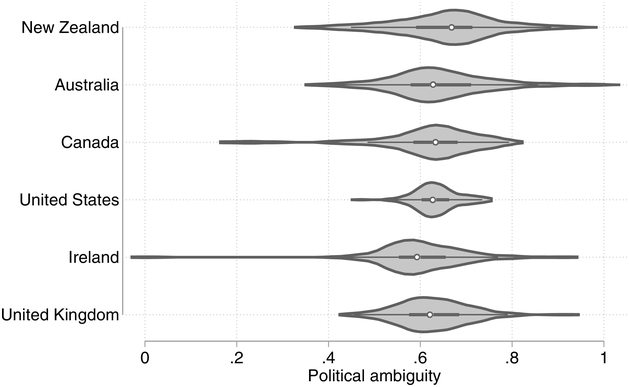
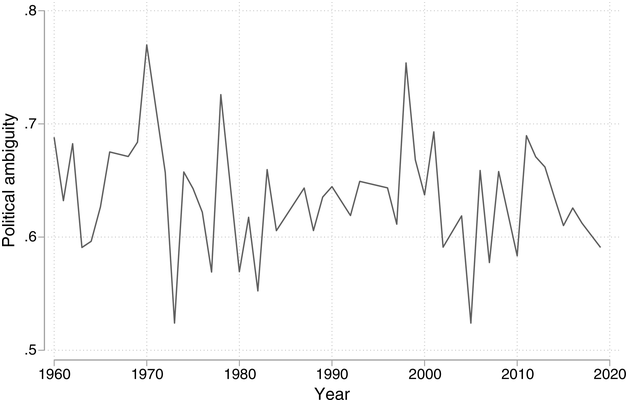
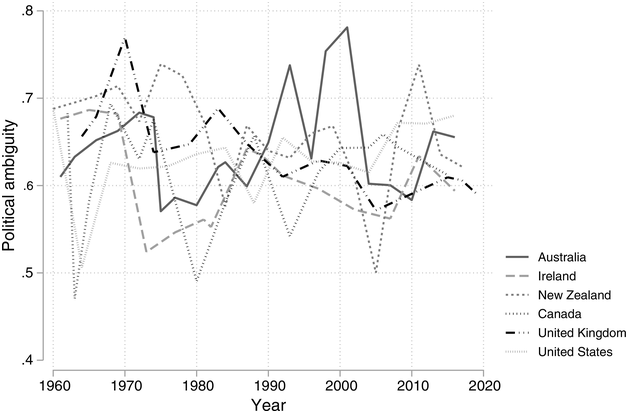
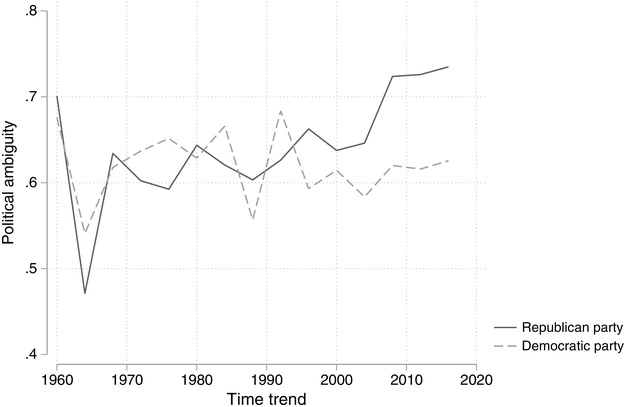
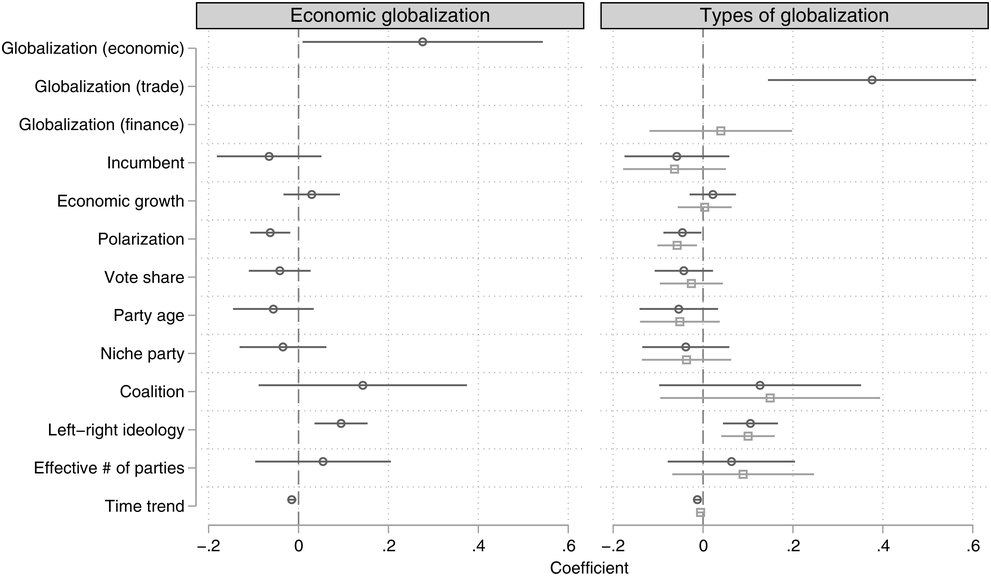
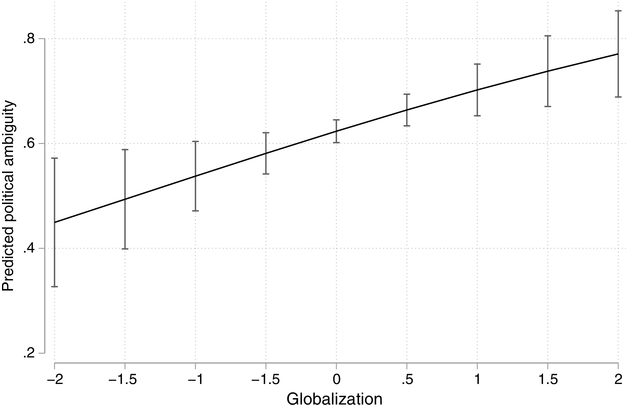
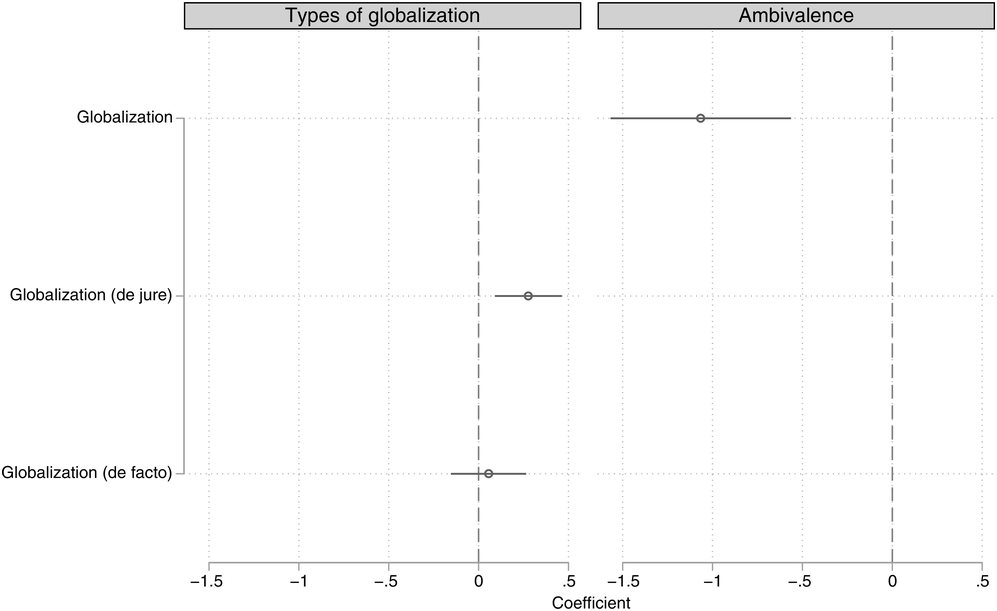
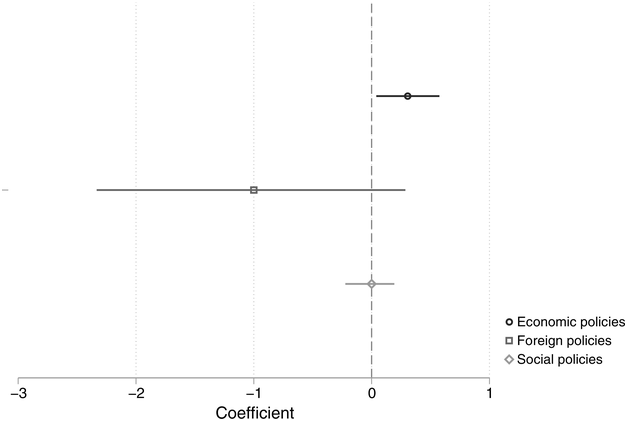
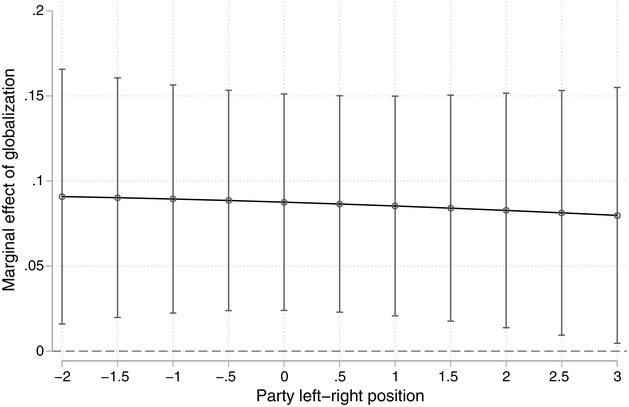
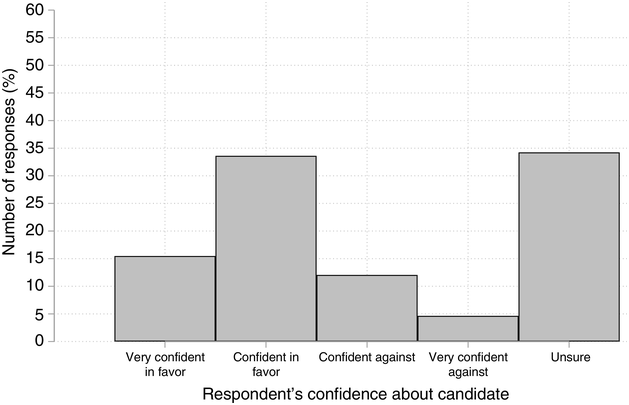
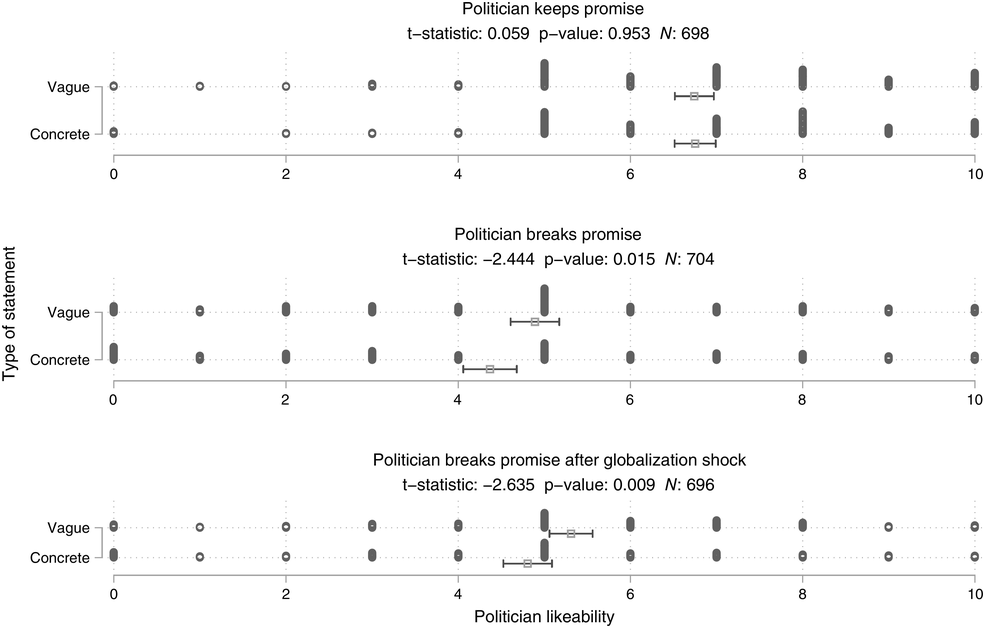
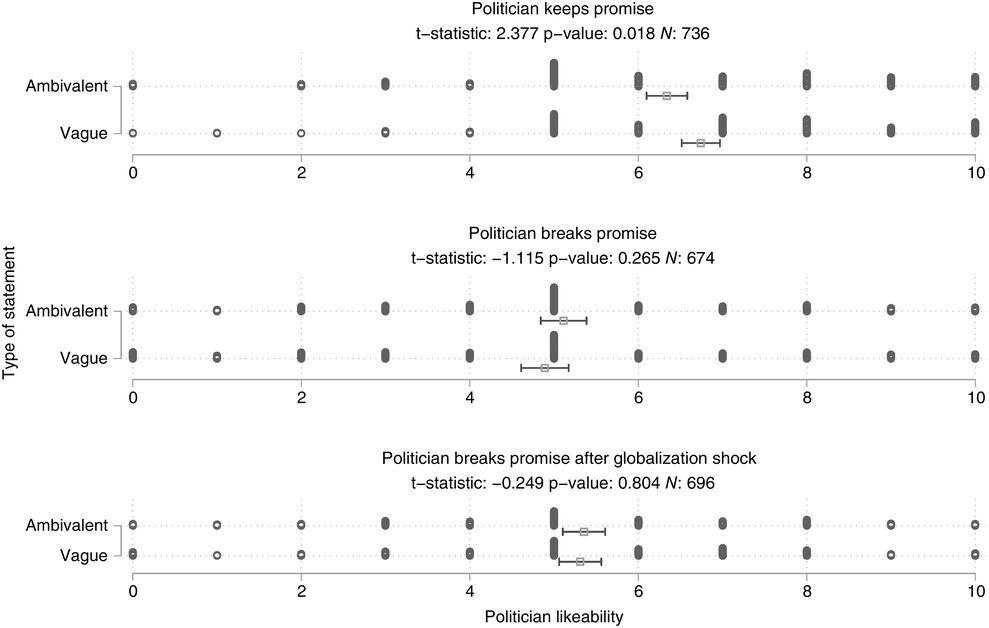

 Open access