

One of the most intractable problems of development is the trap of “corruption-causing-poverty-causing-corruption.”Footnote 1 In other words, countries are poor because they are corrupt, and they are corrupt because they are poor. As Chapter 2 shows, poor countries typically exhibit the most economically debilitating forms of corruption, including petty bribery and extortion. Once such corruption becomes endemic – settling into an “equilibrium,” as social scientists say – is it possible to break free?
Chapter 3 sheds some light on this question from a macro-historical perspective, focusing on two forces that shaped China’s structure of corruption: an overhaul of the economy paired with nationwide procedural reforms. This chapter turns to a micro perspective, going inside the tens of thousands of Party-state agencies across China that run the machinery of governance. This allows us to home in on a question pertinent to all developing countries: how can the state keep poorly compensated public agents from harassing businesses for petty gains and induce them to support long-term development goals?
The scholarly literature proposes two solutions to this problem. The first is to “skip straight to Weber” by replicating the best practices of first-world public administration in developing countries.Footnote 2 Pay is too low? Raise it. Bureaucracy is overstaffed? Slash it. Petty corruption is rampant? Vow to punish it. Although these measures appear correct in principle, in practice, they routinely fail and may even backfire, raising administrative costs and undermining public sector morale.Footnote 3
The second solution, as Fisman and Golden underscore, is to “trigger a change in social norms.”Footnote 4 Social norms are important, and muck-raking journalism and public protests can help citizens hold corrupt elites accountable. But norms cannot fill empty stomachs. Poorly paid bureaucrats often steal, extort, or moonlight in order to subsist.Footnote 5
Reform-era China charted an unusual pathway out of this vicious cycle. Its solution was to allow street-level bureaucrats to extract some payments to top up their paltry formal salaries, while also aligning their financial incentives with long-term economic development objectives. Essentially, the state applied a profit-sharing model to the communist bureaucracy. Public employees in China are entitled to a slice of the revenue generated by the local government and the particular department to which they belong.
In China’s opaque bureaucracy, compensation practices are often vilified as “organizational corruption.”Footnote 6 This chapter employs a mixture of qualitative and quantitative evidence to shed a different light on these incentive structures. On top of extensive interviews with local bureaucrats, I analyze a first-of-its-kind dataset that measures the actual amount of compensation – both formal and fringe – among county governments.
My core finding is that in China the golden goose maxim – restraint today yields long-term benefits – is not just a parable but a reality. Extracting fees, fines, and levies enriches local bureaucrats in the short term, but increasing compensation in the long run requires expanding the formal tax base by recruiting and retaining businesses. The Chinese bureaucrats whom I interviewed would regard this as self-evident, but in fact, outside of China, the norm of public administration is that civil service pay is divorced from economic performance.Footnote 7 This is the first study to demonstrate the systematic links between public compensation and financial outcomes in the Chinese bureaucracy.
Paying Bureaucrats through Profit-Sharing
As Max Weber points out, all public officials in pre-modern states were de facto entrepreneurs. Although they received little or no formal pay from the state treasury, they were allowed to generate income through the prerogatives of public office by extracting taxes and fees from local residents, running monopoly trades, or accepting gifts in exchange for services (what we now regard as bribes). Weber termed these rights “prebends” or rents.Footnote 8 In modern economic terms, prebendalism is a form of profit-sharing that allows public agents to keep a full or partial share of the revenue their offices collect.
In pre-modern times, prebendal practices brought certain advantages, but they also created problems. On the one hand, by allowing public administrators to “self-finance,” rulers did not have to pay regular wages in money, which was especially burdensome in the absence of fully monetized economies and stable tax collection. On the other hand, entrepreneurial officials often seized as much as they could, resulting in excessive predation and even popular revolts. As Weber explains, facing these risks, modern governments gradually replaced prebendalism with “fixed salaries paid in money” – a norm of public administration that we now take for granted in the first world.Footnote 9
In Western Europe and the United States, the transformation of public administration from prebendal to state-funded and from profit- to service-oriented took centuries to complete,Footnote 10 whereas in contemporary developing countries, this transition is still in progress. But standard theories of public administration are ahistorical and first-world-centric; they posit norms in present-day industrialized democracies as universal. In fact, notions of profit and practices of profit-sharing, which are “ruled out” in Western public administrations, still exist in the Chinese bureaucracy.Footnote 11
Classical theories of public sector wage incentives build on Becker and Stigler’s seminal 1974 article,Footnote 12 which argues that in the presence of effective monitoring and disciplinary mechanisms, higher “efficiency” wages will deter public employees from abusing their power for personal gain. Adapting this notion, Besley and McLaren identify a second public compensation scheme that they call “capitulation wages,” where formal salaries are so low that bureaucrats are expected to be corrupt.Footnote 13 This, they claim, is the norm in most developing countries.
These theories suffer two limitations. First, they ignore history, depicting incentive structures in static terms and providing no insight into processes of change. The second limitation is that they consider only two types of income for public agents – formal salaries and corrupt monies (such as bribes), ignoring a third category: perks and allowances that are neither formalized nor illegal. Yet such practices are common in developing countries. For example, according to a World Bank report, in ZambiaFootnote 14
Fringe benefit and monetary allowances have progressively been used as a major vehicle for increasing compensation, particularly for upper-middle level and senior civil servants. The allowances have included: acting, special duty, hardship, responsibility, non-practicing, commuter, transport, risk, security, extraneous duty, field, overtime, honoraria, accommodation leave, transfer, entertainment, telephone, utility, mileage, subsistence, settlement, uniform among others.
Because standard policy prescriptions ignore this amorphous category of public compensation, they focus on raising only formal wages to deter corruption. Yet China’s experience shows that this intermediate category of “fringe benefit and allowances,” which as we will later see, make up 76 percent of total compensation among county-level bureaucrats, can function as a variety of “efficiency wages” under certain circumstances.
Chinese Bureaucracy 101
Before diving into the details of compensation practices, it helps to know some basic facts about the Chinese bureaucracy. Although China is a unitary political regime, it has one of the world’s most economically and administratively decentralized public administrations.Footnote 15 While the central government lays out the national vision and broad policy parameters, subnational governments exercise tremendous autonomy over their own economic and social development plans.Footnote 16 They also fund and deliver the bulk of essential public services such as education, health, public safety, pensions, and urban infrastructure, at levels exceeding many federal governments, including the United States.Footnote 17
The Chinese bureaucracy is massive. By 2007, the Party-state apparatus, excluding the military and state-owned enterprises, consisted of 50 million employees,Footnote 18 roughly the size of South Korea’s entire population. This corps must be divided into at least three layers, as summarized in Table 4.1. The top one percent – roughly 500,000 officials at the chu rank and above – make up China’s “political elites.”Footnote 19 A middle layer of civil servants – roughly 19 percent of personnel – perform management roles in party or state agencies.Footnote 20 The remaining 80 percent are non-civil service public employees, such as clerks, inspectors, police officers, health-care workers, and township cadres, who directly deliver services to citizens. Whereas political elites are appointed and rotated across offices by the Party, most bureaucrats are stationed for life in one location under the supervision of the personnel departments of the administrative branch.Footnote 21
| Layer | Approximate share of personnel size | Characteristics | American equivalenta |
|---|---|---|---|
| Leaders and elite officials | Top 1 percent | Officials at xianchu rank and above | Political appointees |
| Directly appointed by party | |||
| Rotated across locales and offices | |||
| Civil servants (gongwuyuan) | 19 percent | Perform management roles in Party-state agencies | Mid-level managers |
| Not rotated; managed by personnel department | |||
| Non-civil service public employees | 80 percent | Directly deliver services to and interact with citizens on daily basis | Street-level operators |
| (shiye renyuan) | Not rotated; managed by personnel department |
a Wilson (Reference Wilson1989).
Elite officials are evidently powerful figures in China’s authoritarian hierarchy, but the remaining 99 percent of the administration should not be dismissed as trivial. Far from it, this group runs the daily machinery of governance and implements policies at the street level. As Lipsky emphasizes, “Although they are normally regarded as low-level employees, their actions actually constitute the ‘services’ delivered by government.”Footnote 22 Moreover, in the reform era, rank-and-file officers, clerks, inspectors, and even school teachers are more than just public service workers – they are potential entrepreneurial agents. In the early stages of economic take-off, local governments mobilized public employees to recruit investors through their personal networks.Footnote 23 Street-level bureaucrats can be either “grabbing” or “helping” hands.Footnote 24 They can inhibit entrepreneurial growth by arbitrarily extracting fees and fines and harassing businesses with excessive inspections, or they can foster the economy by connecting entrepreneurs with one another, providing amenities and personalized services for investors, organizing conventions, and more (Box 4.1).
Chinese local bureaucrats often go to great lengths to attract and serve investors. One example is an urban district (equivalent to township) government in Chengdu, which faced exciting prospects after the arrival of a new pro-business leader.
As one of the district’s officers described it, “We hope to forge a friendly business environment by providing all-round services, for example, applying for permits, filling out paperwork, coordinating among various departments, parking, schooling, taking care of the surrounding sanitation, and so on. We want to serve businesses well, because every business has a thick network behind it, including friends and business associates. If we serve one investor well, we can access and mobilize these resources and attract more investors, thereby promoting our district’s economic development and tax revenue base.”Footnote 25
Apart from enjoying increased tax revenue and staff bonuses, the district office benefited from a business-sponsored refurbishment. As the district leader recounted, “Our office used to be so shabby, even the walls are not painted. Last year, because we served an enterprise well, it donated more than 100,000 Yuan to renovate our office and also bought computers for our staff members.” He described this sponsorship as “an affectionate reciprocation of our excellent services.”Footnote 26
With few exceptions, studies of political incentives in China have focused only on promotion incentives among elites (see Chapter 6 for a similar analysis of city leaders centered on their downfalls).Footnote 27 However, the top one percent and the remaining 99 percent are motivated by different sets of incentives. Leaders and elite officials aim for higher office, greater personal power, or both. But, for most bureaucrats, the chances of ascending to elite ranks are exceedingly small.Footnote 28 Mid-level managers and street-level operators care less about rising to power than mundane things such as salary and perks. As one officer stated, “Incentives for regular folks like me are quite simply incentives supplied by material benefits.”Footnote 29 This chapter’s analysis of bureaucratic compensation centers on this neglected bulk of “regular folks,” who rarely feature in media reports.
Paying the 99 Percent of the Bureaucracy
Like in many other developing countries, formal salaries in the Chinese bureaucracy are standardized at abysmally low rates across the country. Following a wage adjustment in 2006, the most junior civil servant (Grade 1) received only 290 Yuan (US$45) a month, rising to a maximum of 450 Yuan (US$67) with longer years of service.Footnote 30 In 2011, entry-level civil servants at a county government in Sichuan province received only 830 Yuan in official wages per month, less than the county’s minimum wage of 850 Yuan for workers.Footnote 31 As part of Xi’s fight against corruption, civil service pay was most recently increased in 2015, which raised the monthly salary of the lowest-ranking officer to 510 Yuan (US$82) and that of the highest-ranked to 5,250 Yuan (US$845).Footnote 32
As Xu Songtao, a former Vice-Minister of Personnel Management acknowledged, formal public salaries have always been too low, too compressed, and woefully behind rapid inflation.Footnote 33 The central government has raised them several times since 1978, but the increases were small and failed to accommodate wide regional disparities (see Figure 4.3). On the surface, this scenario fits Besley and McLaren’s description of “capitulation wages” – wages so low that governments in effect “abandon any attempt to solve either the moral hazard or adverse selection problem via wage incentives.”Footnote 34 So why don’t we see widespread petty corruption in China, as we do in Bangladesh and India (Chapter 2)?
It is because formal wages were only part of the story. Since the 1980s, local bureaucracies in China routinely topped up salaries with perks including overtime pay, bonuses, free meals, free vacations, subsidized housing, entertainment budgets, and daily necessities such as food, electricity, and gas.Footnote 35 They also supplied items of collective welfare, for example, spacious buildings, new office furnishing, and subsidized child care.
Observers dismissed these perks as “organizational corruption” or “non-transactional corruption,”Footnote 36 because they are associated with arbitrary extraction of fees and fines, departmental slush funds, discretionary spending, and other unsavory practices. In even harsher terms, Fan et al. describe the provision of fringe benefits as “embezzlement.” According to them, “Consumption of the state budget by officials … occurs on a massive scale, with surprisingly feeble attempts to stop it.”Footnote 37
Are Chinese bureaucrats really free to plunder public budgets? My fieldwork uncovers a different reality. Local bureaucrats are not on a rampage. Instead, the practice of topping up “capitulation wages” with extra benefits follows an internal set of rules. Chinese public employees are compensated in a “dual-track” manner: fixed formal wages combined with variable allowances and perks.Footnote 38 This structure may be found in other developing countries too,Footnote 39 except that, in China, the supply of fringe benefits was regulated and linked to financial performance, such that it functions as a monetary incentive.
In China allowances and perks are pegged to two sources of income: local tax revenues and the fees and fines extracted by individual agencies. Consider the hypothetical case of Cadre Li (“cadre” is a common Communist term for bureaucrat), who works for the Construction Bureau of Jade County. Cadre Li receives a nationally standardized formal salary. In addition, he receives allowances from the state budget of Jade County, which draws upon tax income generated and retained by the county. There is also a third stream of benefits from Li’s home department, the Construction Bureau, which generates income by collecting fees, fines, user charges, and profits from subsidiary services. Drawing on this non-tax income, each department disburses staff benefits such as overtime pay, group vacations, free meals, and even gift cards.
Essentially, this is a profit-sharing scheme, where public employees take a cut of the revenue produced by their organizations. Normally, profit-sharing exists only in the private sector, and even then, it is usually limited in scale.Footnote 40 Reform-era China, however, practiced profit-sharing in the entire public administration.Footnote 41 Even more unusual is that it linked staff remuneration to both tax and non-tax income. The relationship of staff pay and perks to local tax income is akin to a dividend system, whereas its connection to the fees and fines collected by individual departments functions like a commission.
Why didn’t the local states simply stop individual agencies extracting rents and pay them entirely through tax income? The reason is simple: most local governments cannot afford to do so. As one finance bureaucrat explained, “We don’t have enough tax revenue to feed the bureaucracy and invest in economic development at the same time.”Footnote 42 Another bureaucrat added that if the state removed the departments’ rights to spend the fees, fines, and charges they collect, “they would have no motivation to generate revenue for themselves,” and consequently, “the financial burden of our county would be too large.”Footnote 43
That is why budgetary authorities in many locales pledged to retain their “spending rights” (shiyong quan) despite the extractive risks of allowing departments to partially self-finance. This compromise between the budgetary authorities and individual departments is known as a “refund” (fanhuan). For example, one county government in Jiangsu guaranteed all its departments a universal 70 percent “refund,” meaning they had discretion to spend up to 70 percent of their income on staff benefits and administrative expenses.Footnote 44 In this county, unused funds rolled over and accumulated, such that each department in effect “owned the means of administration,” to use Weber’s term.
One consequence of de facto profit-sharing is that gaps in actual compensation widened over the years even as formal salaries scarcely budged, because localities and departments possess vastly uneven capacity to generate income. Public employees in different localities, even ones that are geographically adjacent, may receive starkly unequal levels of remuneration (as my analysis in the next section will show). Within each locality, staff benefits also vary across departments. Agencies that enjoy access to rich streams of income through their regulatory power over booming economic sectors are known as “greasy agencies.” Those with few means are dubbed “distilled water agencies.” As one county-level bureaucrat mused, “Even an idiot knows the gap [in income and benefits] between the Construction Bureau and the Archives Office.”Footnote 45
Grabbing and Helping Hands
Put succinctly, bureaucratic compensation is derived both from “helping” (attracting and retaining businesses) and from “grabbing” (extracting fees, fines, and payments). This institutional arrangement explains an abiding paradox in China: the coexistence of developmental and predatory behavior among street-level bureaucrats.Footnote 46 Existing theories focusing on promotion incentives may account for why local leaders encourage growth,Footnote 47 but to explain the contradictory economic behavior of street-level state actors, we must turn to monetary incentives – particularly compensation practices.
That Chinese street-level bureaucrats obtain income both from “helping” and by “grabbing” from businesses raises a collective action problem: why wouldn’t these bureaucrats choose only to “grab” (extracting fees, fines, and profits for their departments) and neglect pro-business efforts that would benefit the entire locale? The reasons, I found, are two-fold. One obvious factor is that local leaders, whose careers and self-enrichment are tied to prosperity, would not passively allow their subordinates to undermine business interests; they have incentives to institute controls, which I will discuss later. But there is a more interesting and less obvious restraint: street-level bureaucrats believed that curbing extractive behavior served their long-term self-interest. In their own words,
Of course taking care of the big picture, that is, growing our local economy, is more important than departmental self-financing. This is because it is a healthier model of development. It promotes a healthy progression of our staff welfare and budgets. Activities that involve departments sourcing revenue for themselves are ultimately unstable. They are hungry one year and not hungry the next. It is not healthy.Footnote 48
If the overall economy prospers, then our departments will also benefit. Conversely, if each department only thinks about organizing or extracting revenue for itself, then, if our enterprises cannot survive, they will leave. Our local economy will be finished. Consequently, each department’s finances will worsen. This will turn into a vicious cycle. Only when we all work together can we promote local economic development. In the long term, only this strategy can benefit every department.Footnote 49
As Manion argues, “shared expectations” about the structure of payoffs shape the behavior of state actors.Footnote 50 In most poor countries, development outcomes are divorced from bureaucratic efforts, and time horizons are short. What distinguishes China is that even street-level bureaucrats know they have a personal financial stake in economic performance, and that curbing extraction today will benefit them over the long term.
Hypotheses Derived from Fieldwork
Field research is essential for uncovering phenomena that are unreported in the literature, as O’Brien emphasizes.Footnote 51 But are findings from interviews falsifiable? How do we know whether they are generalizable across larger groups of respondents? In the analysis that follows, I examine whether there is support for two qualitative findings.
H1: In the short term, agency collections raise bureaucratic compensation more than tax revenue.
H2: In the long term, however, tax revenue raises compensation more than agency collections.
In the regression analysis that follows, I aim to test whether patterns in numerical data support my narrative – if so, we may be confident that the remunerative practices and incentive logic uncovered through my fieldwork are not anecdotal, but generalizable.
New Data on Fringe Compensation
Topping up low formal public salaries with extra allowances and fringe benefits – which I will term “fringe compensation” – is a common practice across developing countries. For example, in Tanzania, in-kind benefits were estimated to constitute 400 percent of formal salaries among senior bureaucrats and 35 percent among regular public employees.Footnote 52 Yet previous analyses measured only formal salaries, relying on estimates made by country experts or formal wages reported in IMF sources and statistical yearbooks.Footnote 53
Measuring fringe compensation is difficult because these practices are often scattered, unrecorded, and not monetized (for example, free vacations and food hampers). In China, this component of remuneration is widespread yet secretive because authorities fear criticisms of corruption. My dataset breaks new ground by estimating levels of fringe compensation across county governments in one Chinese province – Shandong – which is more populous than the United Kingdom and Australia combined. This is the first dataset that measures fringe compensation not only in China, but in any developing country.
To construct this dataset, I leveraged a previously unavailable source: line-item budgets at the county level.Footnote 54 Other China specialists have employed only publicly posted yearbook budgets, which list public expenditure by broad categories (e.g., education, agriculture). These budgets do not indicate whether a given amount goes toward social spending, infrastructure, or the provision of cadre pay and benefits. Line-item budgets, on the other hand, disaggregate public spending into remunerative and non-remunerative items. Table A4.1 in the appendix details how I deconstructed these budgets into my dataset.
Specifically, my dataset is drawn from line-item budgets compiled by the Finance Bureau of Shandong, a province situated on the Northern coast. With 90 million residents, it is the second most populous province in China. Economically, Shandong is one of China’s fastest-growing regions, though not as wealthy as Jiangsu or Zhejiang on a per capita basis. Within the province, there is wide variation in economic development, including some highly urbanized areas and many rural counties. Hence, although my data comes only from Shandong, this province is fairly representative of middle-to-high income provinces in China (Figure 4.1). The line-item budgets cover almost all the counties in the province, 136 in total, except for a few dropped due to redistricting, from 1998 to 2005.
This dataset suffers from several limitations. First, although my data source is much more detailed than conventionally analyzed budgets, the information is still aggregated and coarse compared with line-item budgets in developed democracies. The original data source lists line-item spending only by county, not by departments within each county. We therefore cannot tell which department spent the listed items or which individuals benefited from them. Second, these budgets do not specify whether particular expenditures were financed by tax or non-tax revenue. Therefore, my empirical strategy is modest: I examine the correlations between the relevant revenue sources and overall compensation levels in order to draw inferences about the underlying incentive structure.
Zouping, one of the 136 counties in Shandong province where I did research.

Opening the Black Box of Public Compensation
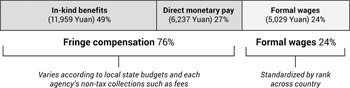
Before proceeding to the regression results, it is useful to explore the descriptive patterns in my data, since no quantitative analysis to date has examined fringe compensation in China. (Note that all monetary values have been adjusted for inflation and are expressed in 1998 prices.) Figure 4.2 provides a disaggregation of total public compensation – formal and fringe – among the county governments in Shandong. Table A4.3 in the Appendix provides a summary of descriptive statistics for the variables in my analysis.
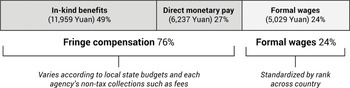
An average county in Shandong had about 16,000 officials and public employees. Between 1998 and 2005, the mean value of total compensation was 23,226 Yuan (US$3,600) per employee per year. Not surprisingly, formal wages were low, averaging only 5,029 Yuan (US$770) per year, lower than average urban wages of 11,022 Yuan (US$1,695) in Shandong province during the same period.Footnote 55 Fringe compensation constituted 76 percent of the total, and came in two forms: direct monetary pay (such as bonuses and overtime pay) and indirect, in-kind benefits (such as entertainment and vehicles). Although bonuses were previously highlighted as a key monetary incentive,Footnote 56 they comprise only 1.4 percent of total compensation in my data. In-kind benefits took up the lion’s share at 49 percent. The average amounts are not extravagant; they constitute a living wage.Footnote 57
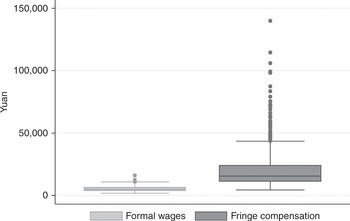
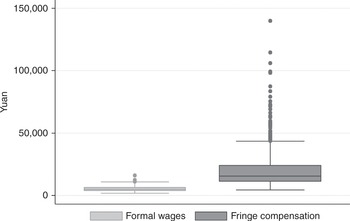
Patterns of geographic variation are consistent with my narrative. Formal wages varied little across the counties, reflecting the fact that formal public salaries are standardized. By contrast, regional variance in fringe compensation is much wider, as shown in Figure 4.3. In 2005, they ranged from as low as 4,752 Yuan to as high as 125,454 Yuan – a 26-fold difference. Compared with the Weberian norm of fixed and flat public salaries in first-world countries, the finding of such gaps within a single province is striking. To put this pattern in context, imagine that public employees in one county of California were compensated 26 times more than their counterparts in another Californian county.Footnote 58
My data includes three main sources of revenue for local governments: tax revenue, agency collection, and fiscal transfers. In China, local governments are not authorized to create their own taxes, but they are allowed to retain a certain portion of tax revenue according to tax-sharing rules. Most Chinese taxes are business-related taxes, such as the value-added tax. Expanding the tax base, therefore, requires attracting businesses. Agency collection amounts to the revenue collected by individual departments, mainly through fees and fines. Finally, fiscal transfers comprise financial aid and earmarked grants from higher-level governments. Although land proceeds occupy a growing share of local public finances, they are excluded from my analysis because they are an earmarked fund that can be legally spent only on land and construction purposes. Local leaders who misappropriate these funds to disburse staff allowances and perks will not only be criminally liable, but will also compromise the infrastructure projects that are key to their political success.Footnote 59
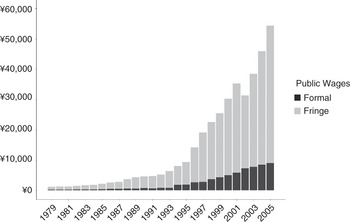
In addition to the county-level data used in this chapter, it is useful to look at longitudinal patterns from a separate dataset that measures actual compensation among sub-provincial (city and county) governments in Shandong, from 1979 to 2005. As we see in Figure 4.4, in 1979, when market reforms began, the majority of public compensation was in the fringe category, although the amount was meager in absolute terms. From 1979 to 1993, the initial phase of market liberalization, formal wages barely budged, whereas fringe allowances and benefits nearly doubled. From 1994 onward, central authorities raised formal salaries several times, but even by 2005, the effect was small.
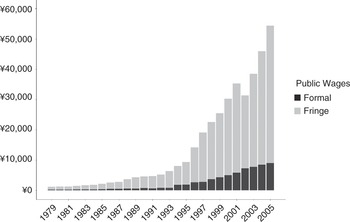
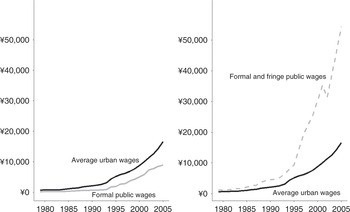
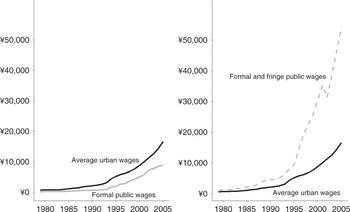
The left plot in Figure 4.5 shows that formal public wages fell consistently below average urban wages in the province, which on the surface confirms a scenario of “capitulation wages.” When fringe components are added, however, as shown in the plot on the right, an average civil servant earned considerably higher income than an average urban worker, and furthermore, this gap expanded over time.
Putting the Golden Goose to the Test
The purpose of my regression analysis is not to prove that revenue causes spending (obviously, it does), but rather to test whether the correlation patterns are consistent with expectations of how profit-sharing operates in the Chinese bureaucracy. In particular, we wish to know whether the golden goose maxim holds in practice, as follows.
H1: In the short term, agency collections raise public compensation more than tax revenue.
H2: In the long term, however, tax revenue raises compensation more than agency collections.
Standard regressions estimate a composite effect of a given explanatory variable over an outcome, but they don’t distinguish between short- and long-term effects. The single-equation error-correction model (ECM), on the other hand, is designed to estimate the parameters of the short- and long-term effects of the explanatory variables (three sources of public revenue) on the dependent variable (levels of public compensation).Footnote 60
In my analysis, the dependent variable of interest is total compensation (formal and fringe components combined) per public employee, or comp.Footnote 61 All fiscal variables are expressed in per capita terms. I condition on a number of factors: population size, share of urban population, and total number of public employees. To control for time-invariant unobserved effects across the county governments (for example, leadership idiosyncrasies), I include county fixed effects. To control for unit-invariant exogenous shocks, e.g., aftershocks of the Asian financial crisis, I also include year fixed effects. I ran a separate specification that also conditioned on GDP per capita, which is excluded from the final regression, as it does not change the direction or statistical significance of the results.Footnote 62
An ECM requires that analysts specify the dependent variable as a differenced value, i.e., this year’s value minus the previous year’s value. In addition, the regression must include (a) the lagged dependent variable (value from the previous year), (b) lagged values of all explanatory and control variables, and (c) differenced values of all explanatory and control variables.
For short-term effects, we examine the differenced values of all explanatory and control variables. The coefficients indicate the estimated contemporaneous effects of a unit change in the explanatory variable on the outcome. In my case, this is an estimate of how changes in each revenue stream in a given year correlate with changes in bureaucratic compensation levels in the same year. For long-term effects, we examine the estimated coefficients of the lagged values. These coefficients are estimates of the long-term effect on compensation levels over multiple time periods. The rate at which this long-term effect manifests itself is calculated using the error-correction term, which is the value of the lagged dependent variable. Total effects refer to the sum of short- and long-term effects.
Table 4.2 reports the results of my regressions. First, let’s explore short-term effects, which are indicated by the differenced value of each variable, denoted in the table as D. The variables D. tax revenue, D. agency collection, and D. fiscal transfers each register a statistically significant and positive effect on comp, indicating that an increase in all three revenue streams raises compensation in the short term. But the magnitudes of their effects differ. Agency collection has the largest coefficient (20.21), compared with tax revenue (13.18) and fiscal transfers (4.51). This means that, consistently with H1, an increase in agency collections raises bureaucratic compensation more than tax revenue in the short term. Specifically, a unit increase in agency collection is correlated with an increase in compensation by 20 Yuan, whereas an equivalent increase in tax revenue will boost it by only 13 Yuan. Expressed in the plain language of a Chinese bureaucrat, this result verifies the following: “From a short-term perspective and the narrow view of one department, it appears that it makes so much more money this year by collecting more fees.”Footnote 63
| Revenue source | Dependent variable: total compensation |
|---|---|
| Fiscal Variables (short-term effects) | |
| D. tax revenue per capita | 13.18*** (1.43) |
| D. agency collections per capita | 20.21*** (2.06) |
| D. fiscal transfers per capita | 4.51*** (1.44) |
| Fiscal Variables (long-term effects) | |
| L. tax revenue per capita | 13.45*** (1.74) |
| L. agency collections per capita | 2.52 (2.29) |
| L. fiscal transfers per capita | 3.14** (1.46) |
| Control Variables | |
| D. population | 170.76*** (34.70) |
| D. urban share of population | −7.23 (12.16) |
| D. no. of cadres | −1.43*** (0.13) |
| L. population | 220.65*** (39.50) |
| L. urban share of population | −12.00 (18.71) |
| L. no. of cadres | −0.75*** (0.16) |
| Lagged DV (Error-correction term) | −0.41*** (0.04) |
| County fixed effects included? | Yes |
| Year fixed effects included? | Yes |
| Constant | 5,239.08 |
| N | 952 |
| R2 | 0.50 |
Standard errors are given in parentheses. Note: * p < 0.10, ** p < 0.05, *** p < 0.01.
When we examine long-term effects, however, the results are reversed. Long-term effects are indicated by the lagged value of each variable, denoted as L. In Table 4.2, L. tax revenue posts a statistically significant and positive coefficient, whereas the coefficient for L. agency collection is positive but not statistically significant. A unit increase in tax revenue registers a long-term effect of raising compensation by 33 Yuan, which, according to the ECM model, plays out over multiple time periods in percentages.Footnote 64 Simply put, consistently with H2, these results indicate that expanding the formal tax base raises public compensation over the long term, but extracting fees and fines for one’s agency may not. It supports an earlier statement made by a Chinese bureaucrat: “Growing our local economy is more important than departmental self-financing … because it promotes a healthy progression of staff welfare and budget.”Footnote 65
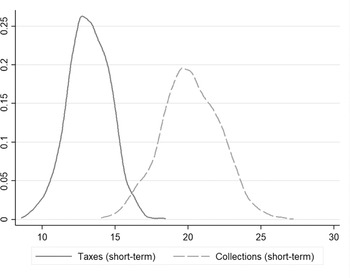
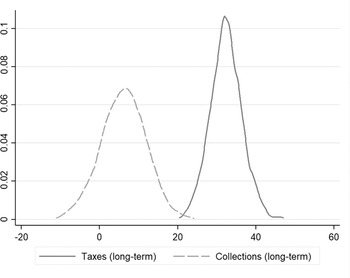
For a visual representation of the regression results, following the approach of King et al.,Footnote 66 I simulated the short-term and long-term effects of a unit increase in tax revenue versus agency collections on cadre compensation. This approach visualizes the distribution of possible values of Y (compensation levels) based on parameters and standard errors specified in Model 1. Figure 4.6 illustrates the short-term effects. In this figure, agency collections lies on the farther end of the x axis, indicating that on average agency collections increase compensation more than tax revenue in the short term. But the upper-bound parameters of tax revenue overlap with the lower-bound values of agency collections, which means that, even in the short term, higher tax revenue may raise compensation levels more than agency collection.
Increasing agency collections was more rewarding in the short term.
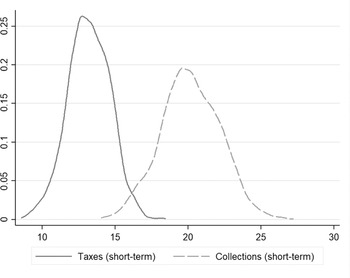
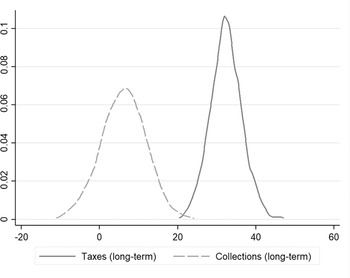
Figure 4.7 simulates the long-term effects, in which we see a reversal of the patterns. Tax revenue lies on the farther right end of the x axis, which means that expanding the formal tax base correlates with substantively higher levels of compensation than extracting more fees and fines. Importantly, even the upper-bound predicted parameters of agency collections are lower than the lower-bound values of tax revenue, indicating that the long-term effects of tax revenue dominate those of agency collection at the 99 percent confidence level.
Expanding the tax base was more rewarding in the long term.
In sum, the empirical analysis supports my qualitative findings. Compensation rates in the county bureaucracies are directly tied to fiscal performance, both tax revenue and agency collections. In the short term, extracting fees, fines, and user charges is more financially rewarding for bureaucrats than tax growth. But, over the long term, growing the formal tax base by attracting and retaining investors generates higher remuneration and staff benefits than extracting rents.
Carrots and Sticks
Local Chinese bureaucrats know that it doesn’t pay to kill the goose (the health of the local economy) that lays the golden eggs (their pay and perks).Footnote 67 My statistical analysis shows that this belief is grounded in reality. How was the belief formed? One possibility is that over time, as local bureaucrats experience consistent payoffs from profit-sharing practices, they converged upon an unwritten but common set of expectations, which they eventually took for granted. This is reinforced by county bureaucrats’ informal comparison of their compensation with that of counterparts from other counties, with whom they regularly interact during study trips and higher-level meetings, and through office gossip. When they find that wealthier counties pay their staff members significantly more, it persuasively demonstrates that growing businesses and tax income is the best way to secure generous compensation, as one bureaucrat expressed:Footnote 68
Our compensation is only about half that of bureaucrats in adjacent County Y. Our formal salary is the same, but the difference lies in subsidies and allowances, which is paid according to local tax revenues. County Y offers their staff a transportation subsidy and extra bonuses for achieving targets, but not our county. Why the big difference among the counties? Our county is poor!
Additionally, leaders periodically and explicitly remind staff members of their personal stake in supporting local economic development. For example, at a staff meeting in a city of Fujian province that I studied, the deputy mayor intoned: “Do not forget the fact that taxes paid by our enterprises are closely and personally connected to your benefit. Taxes collected go toward paying your allowances. So serve our enterprises well!”Footnote 69 Over time, as this city’s economy took off and the tax base grew, it stopped relying on fees and fines as a supplemental source of income for its local agencies.
National Administrative Reforms
While carrots are important, they work only when combined with the appropriate sticks – mechanisms of control and punishments at both the national and local levels. In Chapter 3, I described the sweeping procedural reforms that Premier Zhu Rongji rolled out in 1998 to create a modern public administration that would complement a modern market economy. These budgetary and fiscal reforms increased state capacity to monitor and control financial transactions at lower tiers of government and among individual departments. Recall that many of the problems associated with agency-level corruption in the 1980s and 1990s, such as departmental slush funds (xiaojinku), arbitrary extraction of fees, fines, and levies (sanluan), and extortion (tanpai), resulted from excessive decentralization of bureaucratic self-financing and self-remunerating. All public organizations engaged in these practices, but, in the early decades, there was little centralized monitoring or enforcement of penalties.
In the 2000s, the procedures by which agencies collected and spent revenue underwent a quiet revolution, which becomes apparent when we disaggregate the life cycle of fee collection. Prior to the 2000s, fees and fines were simply “collected and spent” (zuoshou zuozhi). For example, an inspector who accused a producer of violating regulations could demand a fine on the spot. He could then pocket a bribe, deliver the fine in cash to departmental coffers, or do both. Before the 2000s, it was almost impossible to track these numerous transactions. As a result, embezzlement and misappropriation were rampant (see Chapter 3). As one Ministry of Finance (MOF) official said, “We caught wrong-doers many times. But there were always more of them. It became clear to us that the system had gone wrong. So the system had to change.”Footnote 70
One major reform spearheaded by the MOF in 2001 was the creation of the Treasury Single Account (TSA), which was first piloted at the central level and then extended to subnational governments. The treasury system governs the structure of bank accounts in the entire public sector, and deposits and disburses public funds. Previously, public bank accounts were highly fragmented across levels of administration, regions, and departments. Before 2001, the default practice was that individual public units would set up “transitory accounts” at their own discretion. Because these accounts proliferated and were not linked to one another, even the MOF could not know how much other ministries collected and spent. Moreover, any transfer of funds had to pass through multiple layers and hands. As a senior official at the MOF related, in one instance, it took almost 10 months for the unit of another Ministry to receive its budgeted funds. Even within the central government, it took at least a month for funds to reach intended recipients.Footnote 71 Such extreme fragmentation not only hindered the execution of budgetary plans, but also enabled the diversion and misuse of public funds at all levels.
Reform of the treasury system began with the establishment of Treasury Disbursement Centers (TDCs) throughout the country, which process claims and make payments to vendors. The MOF outlawed transitory accounts and consolidated all existing accounts into a single network so that they can be easily traced. To be sure, some agencies still violate these rules, but doing so is now clearly illegal.
After consolidating the network of accounts, the MOF required public units to make payments to employees and vendors through TDCs so that all expenditure could be centrally monitored. By 2006, the MOF was able to track every revenue and expenditure item in over 20,000 central-level public organizations at any point in time. As one MOF official remarked, “If someone in the bureaucracy goes to dinner with official funds, we know exactly where they dined and what they ate.”Footnote 72 In recent years, the spread of digital payments has further enhanced fiscal transparency within the bureaucracy.
The introduction of cashless payments of fees and fines also aided the centralization of public accounts.Footnote 73 Instead of collecting payments in cash, regulatory officers are now required to issue a “non-tax revenue collection certificate.” Like official receipts, these certificates are issued by the provincial governments and each one carries a bar-code so that payments can be traced.Footnote 74 To pay fees, citizens take the payment certificate to a bank at any administrative services center, where they receive an official receipt. The bank then directly deposits the fee into a centralized treasury system. Monitoring cameras deter staff members at administrative services centers from collecting petty bribes.Footnote 75
As I argued in Chapter 3, these capacity-building measures only check non-transactional malfeasance; they do not prevent bribery. Officials may still receive kickbacks for procurement deals that are legally processed through the TDCs. Nor can these reforms withstand political pressures from corrupt powerful leaders who can override the system or collude with subordinated auditors to embezzle funds on a grand scale, as seen in the case of Chen Liangyu, the former provincial Party chief of Shanghai.
Still, there is no doubt that the post-1998 reforms have increased fiscal transparency, especially among street-level bureaucrats. In short, these institutional reforms have heightened the risks of getting caught for stealing. Unsurprisingly, cases of embezzlement and the misuse of public funds have precipitously fallen since 2000, as shown in Chapter 3.
Additional Local Measures
On top of nationally mandated administrative reforms, some local governments devised their own measures for curtailing the extortion and harassment of businesses by local agencies. This is especially common among poor localities, which rely heavily on individual departments to make up for their budgetary shortfalls by collecting fees and fines.
Some local governments established specialized monitoring agencies that review and approve requests from other departments to conduct inspections and collect payments from local businesses. In one county in Hunan province, the Office for Enhancing the Business Environment performed such a function. Chiefs of other agencies who conducted inspections without prior approval from this office could be reported to the county leadership and penalized.Footnote 76 This office was also put in charge of holding regular feedback sessions with companies and attending to their complaints about harassment.
In the poorest locales, where bureaucratic predation was most widespread, the local leadership issued a blanket order to prohibit inspections and fee collection from businesses on certain days of each month. In Hubei province, this was known as “leave businesses alone days” (qiye anjingri). As a county-level disciplinary officer described, “The purpose is to give our enterprises a peaceful environment to operate. Otherwise, they can’t take it if they are inspected every day. Sometimes county-level officials conduct inspections, followed by city-level regulators. They can’t do business this way.” In addition, the prohibitions were built into the cadre-evaluation system, such that bureau chiefs would be held accountable for violations made by their staff members.Footnote 77
Relying on individual agencies to partially self-finance is meant to be a crutch, not a permanent solution. In the wealthiest locations I studied, such as in Shanghai, districts and counties have become sufficiently wealthy to pay their civil servants entirely through formal tax income. As a result, these locales do not need draconian control measures to curtail bureaucratic extraction. Nor do they require strong incentives for self-financing through informal refund procedures. But these cases are more the exception than the norm. Because most local governments are still financially constrained,Footnote 78 their objective is not to eradicate the collection of supplemental income, but rather to regulate it.
Why Standard Reforms Fail
More broadly, this chapter sheds light on why replicating “best practices” in developing countries frequently fails. Standard public sector reforms, adopted by international agencies such as the World Bank and national governments,Footnote 79 aim to slash redundant staff and raise formal wages to deter corruption. A number of African countries also tried to pay salaries according to performance by importing Strategic Performance Management (SPM) models from industrialized OECD countries and the private sector.
Although such reforms seem right in principle, they rarely work in practice. For example, in 2007, the Nigerian government increased wages by 15 percent across the board. The result was “a huge financial burden on public services with little in the way of positive outputs,”Footnote 80 African scholar Oluwu concludes. Similarly, Uganda tried to pay civil servants a living wage but gave up due to unsustainable costs.Footnote 81 Meanwhile, attempts to import pay-for-performance models from the first world soon fell apart because evaluating “performance” in patronage-dominant contexts proved unrealistic. These examples illustrate “capability traps,” which Andrews, Pritchett, and Woolcock define as “a dynamic in which governments constantly adopt ‘reforms’ to shore up legitimacy and ensure ongoing flows of external financing yet never actually improve.”Footnote 82
Why did seemingly straightforward, technical reforms fail? First, firing bureaucrats and public employees is always politically contentious. Second, raising formal wages across the board poses a huge burden to state budgets, and without robust monitoring and administrative capacity, it does not ensure less corruption or better performance.Footnote 83 Third, pay-for-performance models imported from wealthy industrialized economies are premised upon first-world conditions,Footnote 84 namely, that civil servants receive a secure living wage and that politics is separated from public administration. Where these conditions have been established, governments can set and enforce standards of performance, centered on citizens’ rating of public services and accountability. The problem with much of the prescriptive literature in public administration is that Western models are marketed as universally applicable to developing states even though they are not.
The problems that plagued Nigeria and Uganda were also present in China. But instead of “skipping straight to Weber,” China adapted preexisting prebendal practices and pegged bureaucratic compensation to fiscal performance. This does not mean, however, that other developing countries should simply “copy” what China did – to do so would be to repeat the folly of mimicking best practices from the West.Footnote 85 What we should take away from China’s experience, rather, are broad lessons and principles, of which I highlight three.
First, if policymakers expect bureaucracies to promote growth and deliver services, then they must think about giving rank-and-file public agents a personal stake in the outcomes of their efforts, a condition woefully absent in the developing world. Indeed, as Klitgaard remarked, “the problem of public sector incentives in developing countries seems not yet to have been noticed by scholars and aid agencies.”Footnote 86 China’s bureaucracy is unusual in its focus on monetary incentives, but non-monetary incentives such as organizational solidarity and a sense of purpose may be just as important.Footnote 87 That said, filling stomachs is an imperative; inspirational messages alone cannot whip public workers into action. Public administrations in developing countries must therefore consider a mixture of non-monetary incentives and monetary incentives beyond formal pay.
Second, instead of skipping straight to Weber, policymakers should develop transitional strategies of administrative reform. Qian points out that in China “transitional institutions,” such as dual-track pricing (part centrally planned, part market-based), worked, because “they improve economic efficiency on the one hand, and make the reform a win–win game and interest compatible for those in power on the other.”Footnote 88 Qian’s logic extends to the realm of administrative reform. As this chapter shows, the compensation structure in the reform-era bureaucracy is also “dual-track” – part fixed wages, part variable benefits. China did not become trapped in cycles of petty corruption because as local governments became wealthier, they compensated bureaucrats with increased tax revenue. China presents one example of transitional administrative institutions, but many other forms may exist or be improvised in other national contexts.
Third, the literature in public administration should acknowledge its first-world, Western-centeredness. Just as scholars of non-Western countries are routinely expected to justify the generalizability of their cases, scholars of public administration who study countries such as those in Western Europe and the United States should acknowledge the same caveat – their models are limited to first-world conditions.Footnote 89 For example, the vast literature on “public service motivation” assumes that civil servants need not worry about salary or subsistence, which is not the reality faced in countries like China and Uganda.Footnote 90
The Value of Discovery before Testing
Apart from its substantive findings, this chapter also illustrates a particular style of mixed-methods research – relying on in-depth fieldwork to discover practices that were hitherto undocumented or misrepresented in the literature (for example, how fringe compensation works in the Chinese bureaucracy), and then testing qualitative findings using statistical analyses (whether developmental behavior really benefits bureaucrats more than extractive behavior).Footnote 91 Political scientists have long debated the merits of qualitative research in opposition to quantitative research.Footnote 92 The classic textbook Designing Social Inquiry, by King, Keohane, and Verba (KKV), argues that both qualitative and quantitative research should abide by the same standards of logical inference.Footnote 93 While I completely agree that qualitative research must be conducted rigorously, I would argue that KKV’s methodological paradigm misses two key points.
First, before we can proceed to test any causal argument, we must first discover an interesting problem and/or possible solutions. For example, in cancer studies, medical scientists must first have discovered the ailment of cancer, described its manifestations, and speculated about its possible causes, before future generations of scientists could test a particular cause of cancer using statistical data and regressions. Similarly, in the social sciences, discovery through observation and immersion is indispensable. Had I not spent time talking with local Chinese bureaucrats, I wouldn’t have known how they were actually compensated, let alone have hypothesized the incentive logic behind their profit-sharing practices. In this instance, my hypotheses were inductively derived from “soaking and poking,” to use Fenno’s famous phrase, rather than deduced from abstract assumptions.Footnote 94 It is unfortunate, however, that such qualitative work is increasingly dismissed as mere “description” and perceived as inferior to statistical methods.Footnote 95 As one graduate student once asked me, “Why didn’t you do research?” I did – discovery is research.
Second, mainstream methodological norms, such as those advanced by KKV, presume first-world conditions, where the context and “rules of the game” are transparent and firmly established. But, in developing and transitional countries, how things really work on the ground is generally obscure because informal, unwritten practices prevail and quality data are lacking. Thus, unlike the study of first-world countries, that of the developing world demands far more on-the-ground investigation. Oftentimes, in these settings, what matters most and how it matters hasn’t even been discovered, let alone understood and made ready for hypothesis testing. Those who study or try to “help” developing countries through the lens of first-world experiences often end up chasing the wrong questions or problems.Footnote 96
This chapter illustrates that a simple qualitative discovery can transform theories and the way we collect numerical datasets. Through interviews, I found that fringe compensation in the Chinese bureaucracy isn’t just “corruption” – it comprises about three-quarters of average compensation and performs an important incentive role. And such compensation exists across public administrations across developing countries. If this reality is taken into account, we can open up new theories and tests of public wage incentives. For example, Di Tella and Schargrodsky present an intriguing test of the relative effects of stronger audits and higher wages on corruption among public hospitals in Argentina. Their data on wages, however, were obtained through interviews that asked hospital staff for “their nominal wage,” omitting fringe pay and benefits, which could be significant, as we saw in China.Footnote 97 The inclusion of intermediate categories – neither formal nor corrupt – can revise and expand our understanding of bureaucratic incentives.
Conclusion
How can poor and institutionally backward countries escape the trap of “corruption-causing-poverty-causing-corruption”? This chapter illustrated that fringe compensation, which is neither formal salary nor illegal monies, can serve as a form of efficiency wages. To incentivize economic performance, Chinese local states evolved profit-sharing practices that linked the personal payoffs of tens of millions of bureaucrats both to their locality’s tax income and to their agency’s non-tax collections. However, in the long term, fostering economic growth is more beneficial for bureaucrats than extracting rents. This was common knowledge among the Chinese public agents I interviewed – and my statistical analysis of bureaucratic compensation patterns reflected their beliefs.
China’s unorthodox experiences must not be seen as a template for copying, however. Their value lies in highlighting the need for deeply contextual research that uncovers realities in developing countries and tailors solutions to them. As Riggs pointed out decades ago, the study of developing countries calls for theories of governance and public administration that reflect their capability constraints.Footnote 98 Such research has been particularly lacking in the design of incentives and transitional administrative institutions.
Having unpacked the incentive structure of the bottom 99 percent of China’s bureaucracy, the logical step is to move up the hierarchy. Chapter 5 will turn to the top one percent of political elites who rule over local jurisdictions. Profit-sharing for leaders follows a different logic: the more economically prosperous the locality, the more personal rents they can extract – not in the form of petty allowances or perks, but as massive graft.


 Open access