


1. Introduction
Engineering design has long relied on rigid-body mechanisms (RBMs) to achieve complex motion. Their discrete joints, bearings, and fasteners enable precise articulation but introduce friction, wear, and assembly weight that can limit performance. Compliant mechanisms (CMs) offer an alternative, achieving motion through elastic deformation rather than mechanical articulation. By reducing joints and part count, CMs can provide lighter, simpler, and often more reliable solutions, supporting innovation across aerospace, biomedical, and soft-robotic domains where multifunctional, low-maintenance motion is essential (Reference Howell, Magleby and OlsenHowell et al., 2013; Reference Sorgonà, Serafino, Giannini and VerottiSorgonà et al., 2024; Reference Sorgonà, Cirelli, Giannini, Brischetto and QuadriniSorgonà et al., 2025).
Advances in Design for Additive Manufacturing (DfAM) and architected lattice structures now allow designers to tailor stiffness, anisotropy, and mechanical deformation with high precision (Reference Thompson, Moroni, Vaneker, Fadel, Campbell, Gibson, Bernard, Schulz, Graf, Ahuja and MartinaThompson et al., 2016; Reference ZadpoorZadpoor, 2016; Reference Pradel, Zhu, Bibb and MoultriePradel et al., 2018). Yet despite this industrial relevance, many design engineering graduates lack a deep conceptual understanding of how flexible motion arises.
Design education increasingly takes place in digital environments, where CAD and optimisation are introduced early. While these tools enable precision and rapid iteration, they can obscure underlying mechanics, allowing students to generate feasible geometries without understanding how geometry, stiffness, and force interact to produce motion. Research in design cognition and pedagogy warns that introducing automation too early can suppress reflective reasoning and conceptual retention before foundational understanding develops (Reference Prince and FelderPrince & Felder, 2006; Reference Kirschner, Sweller and ClarkKirschner et al., 2006; Reference Dym, Agogino, Eris, Frey and LeiferDym et al., 2005; Reference Adams, Turns and AtmanAdams et al., 2003).
Evidence from cognitive psychology shows similar patterns. An MIT Media Lab study found that students using AI-assisted writing tools produced adequate outputs but showed reduced neural engagement and weaker recall than unaided peers (Reference Kosmyna, Hauptmann, Yuan, Situ, Liao, Beresnitzky, Braunstein and MaesKosmyna et al., 2025). Although conducted in a writing context, the underlying dynamic is transferable to design education: automation can yield feasible solutions while bypassing the reasoning that develops deep understanding. Reference Kosmyna, Hauptmann, Yuan, Situ, Liao, Beresnitzky, Braunstein and MaesKosmyna et al. (2025) describe this as cognitive debt – the accumulation of outputs that exceed comprehension.
Design-cognition studies likewise show that digital environments shape how designers think and evaluate ideas, narrowing conceptual exploration and altering reflection patterns (Reference Gero and MilovanovicGero & Milovanovic, 2020; Reference Milovanovic and GeroMilovanovic & Gero, 2022; Reference Škec, Štorga and GeroŠkec et al., 2024). While digital proficiency remains essential, these findings highlight the need for embodied, conceptual understanding before automation. When students first explore how force paths and geometric deformation generate motion, digital tools can reinforce – rather than replace – this reasoning. This principle underpins the foundation-first approach developed in this study.
Professional accreditation frameworks reflect this priority. The UK Engineering Council’s UK-SPEC expects graduates and Chartered Engineer candidates to demonstrate sound mechanical understanding, analytical reasoning, and creative application (A1–A5, C2, D3) (Engineering Council, 2020). The tactile, foundation-first approach proposed here is intended to offer a practical route toward developing these skills by engaging students with physical and paper-based representations of flexibility and motion before digital tools.
Building on earlier frameworks for compliant structure design and sub-motion categories (Reference Air and WodehouseAir & Wodehouse, 2022; 2023), this study introduces a hands-on approach for teaching compliant mechanism design and explores whether early tactile engagement can strengthen conceptual understanding and confidence. The study focuses on deformable lattice structures as a foundational subset of CMs: their predictable geometric deformation and visual legibility make them effective for early exploration of compliance before analytical or optimisation-based tools. Positioning lattice-based compliance as a first step provides a tangible route to understanding geometric deformation before progressing to more complex or material-driven compliant systems.
While hands-on learning is well established in engineering education, limited research has examined the sequencing of tactile reasoning prior to digital modelling within compliant mechanism design. Existing CM teaching typically introduces analysis through beam theory, simulation, or topology optimisation. This study contributes by reframing lattice-based compliance as a structured conceptual scaffold that precedes digital tools, positioning geometric deformation as a first-order design reasoning activity rather than a simulation output. It therefore initiates an argument about instructional sequencing: foundational, embodied reasoning may help prevent premature reliance on automation and support deeper conceptual understanding before computational optimisation is introduced.
2. Background and literature review
Research on CMs has expanded across technical domains, yet educational approaches to teaching compliance remain limited. Advances in additive manufacturing, materials design, and mechanical metamaterials have deepened understanding of how geometry and flexibility generate motion, but less attention has been given to how these insights translate into design education. This section reviews developments that contextualise the approach proposed here: compliant structure design principles, digitisation in design learning, and theoretical perspectives from design cognition and experiential learning that motivate tactile, foundation-first methods.
2.1. Compliant mechanisms: advantages and applications
CMs are widely adopted in aerospace, biomedical, and soft-robotic systems, where single-piece flexible components reduce failure risk and enable compact, multifunctional designs (Reference Howell, Magleby and OlsenHowell et al., 2013; Reference Sorgonà, Serafino, Giannini and VerottiSorgonà et al., 2024; Reference Sorgonà, Cirelli, Giannini, Brischetto and QuadriniSorgonà et al., 2025). Deformable lattice structures form a distinct sub-type of CMs characterised by periodic geometry and distributed flexibility. Their behaviour arises from controlled geometric features rather than material elasticity alone, making them well suited to additive manufacturing and conceptual learning contexts. This study therefore treats lattice-based compliance as a pedagogical entry point for understanding motion through structural deformation.
Compliance is often introduced to students through force and stress analysis – beam bending, shear, and elastic deformation in classical mechanics. While analytically essential, these methods can separate mechanical behaviour from geometric reasoning. The approach developed here instead frames deformation as an observable design phenomenon, linking load paths, geometry, and motion within a unified framework.
Advances in DfAM enable architected lattice and metamaterials with tuneable stiffness and anisotropy (Reference Thompson, Moroni, Vaneker, Fadel, Campbell, Gibson, Bernard, Schulz, Graf, Ahuja and MartinaThompson et al., 2016; Reference ZadpoorZadpoor, 2016). Although earlier DfAM studies explore how these capabilities influence design reasoning (Reference Pradel, Zhu, Bibb and MoultriePradel et al., 2018), undergraduate curricula rarely teach how geometric distribution of deformation generates compliant motion. When CMs are covered, they are typically approached through simulation or topology optimisation, where computational efficiency may overshadow physical reasoning.
2.2. Current educational practice and limitations
Traditional mechanics provides critical grounding, yet increasing reliance on digital tools has shifted learning toward computational interfaces. Research suggests that early dependence on digital environments can limit understanding of mechanical behaviour (Reference Prince and FelderPrince & Felder, 2006; Reference Kirschner, Sweller and ClarkKirschner et al., 2006; Reference Dym, Agogino, Eris, Frey and LeiferDym et al., 2005; Reference Adams, Turns and AtmanAdams et al., 2003), particularly in CM design, where anticipating distributed compliance is central.
Design-cognition studies reinforce this concern. Reference Gero and MilovanovicGero and Milovanovic (2020) found that digital environments shape how designers frame and evaluate ideas, narrowing conceptual exploration. Later work observed similar shifts in collaborative studios, where interfaces altered reflection and reasoning patterns (Reference Milovanovic and GeroMilovanovic & Gero, 2022; Reference Škec, Štorga and GeroŠkec et al., 2024). These effects parallel cognitive-psychology findings on reduced engagement under automation (Reference Kosmyna, Hauptmann, Yuan, Situ, Liao, Beresnitzky, Braunstein and MaesKosmyna et al., 2025), suggesting that premature automation can redirect attention from mechanical reasoning to interface management – a form of cognitive debt. Introducing manual and tactile reasoning early may help rebalance understanding and creativity.
2.3. Theoretical basis for hands-on learning
Constructivist and experiential frameworks emphasise active exploration as a basis for durable understanding. Reference KolbKolb (1984) describes learning as a cycle of experience, reflection, conceptualisation, and experimentation, while inductive and problem-based approaches support deep comprehension and creative problem-solving (Reference Prince and FelderPrince & Felder, 2006; Reference Kirschner, Sweller and ClarkKirschner et al., 2006; Reference Dym, Agogino, Eris, Frey and LeiferDym et al., 2005; Reference Adams, Turns and AtmanAdams et al., 2003). In design education, hands-on tasks help students connect abstract theory with practice and encourage reflective reasoning aligned with professional design activity (Reference CrossCross, 2023).
From a cognitive perspective, the approach aligns with Cognitive Load Theory (CLT) (Reference SwellerSweller et al., 1988; Reference Paas, Renkl and SwellerPaas et al., 2003; Reference Sweller, van Merriënboer and PaasSweller et al., 2019). Removing complex digital interfaces initially reduces extraneous load while maintaining germane effort devoted to understanding force paths and geometric deformation, mitigating the cognitive debt linked with premature automation (Reference Kosmyna, Hauptmann, Yuan, Situ, Liao, Beresnitzky, Braunstein and MaesKosmyna et al., 2025).
Learning also benefits from moderate challenge. When tasks demand effort yet remain manageable, learners experience desirable difficulty (Reference Kornell and BjorkKornell & Bjork, 2008), strengthening retention and transfer. The paper-based activities sustain this challenge by requiring students to reason about geometric deformation without relying on simulation or optimisation tools.
3. Methodology
3.1. Teaching approach for compliant mechanisms
This study applies insights from previous compliant structure research (Reference Air and WodehouseAir & Wodehouse, 2022; 2023) to a new educational context by reinterpreting the compliant redesign stage of the framework – where motion regions of an RBM are identified and replaced with suitable lattice structures – as a hands-on, foundation-first activity. The redesigns functioned as conceptual prototypes, enabling students to explore compliant mechanism principles through geometric deformation and lattice behaviour. The workshop uses this stage to support reasoning about deformation and motion without digital tools and evaluates its impact on conceptual understanding and confidence in CM design.
Designed for short workshops or studio sessions, the method is intentionally non-digital at the outset. Students use 3D printed lattice samples and structured worksheets to redesign RBMs as compliant systems. Tactile engagement supports visualisation of deformation and force transmission, fostering embodied understanding that later informs digital modelling. This approach draws on experiential and inductive learning principles linking theory and practice through physical engagement and visual reasoning (Reference KolbKolb, 1984; Reference Prince and FelderPrince & Felder, 2006; Reference Dym, Agogino, Eris, Frey and LeiferDym et al., 2005; Reference Adams, Turns and AtmanAdams et al., 2003).
The activity makes reasoning explicit by directing attention to how geometry enables motion. Manual analysis keeps focus on underlying mechanics and supports adaptability (Reference Kirschner, Sweller and ClarkKirschner et al., 2006; Reference CrossCross, 2023). Consistent with CLT (Reference SwellerSweller, 1988; Reference Paas, Renkl and SwellerPaas et al., 2003; Reference Sweller, van Merriënboer and PaasSweller et al., 2019), removing digital interfaces reduces extraneous load, allowing effort to concentrate on relationships among structure, flexibility, and motion. Although students engage intrinsic and germane load by analysing motion, selecting lattices, and predicting deformation, this effort supports learning. By engaging in this reasoning themselves rather than delegating it to software, students avoid the cognitive debt associated with premature automation (Reference Kosmyna, Hauptmann, Yuan, Situ, Liao, Beresnitzky, Braunstein and MaesKosmyna et al., 2025). The challenge remains desirable rather than overwhelming, strengthening schema formation (Reference Kornell and BjorkKornell & Bjork, 2008).
By integrating these principles into an accessible format, the method supports the analytical and reflective capabilities expected of professional engineers (Engineering Council, 2020). A pilot workshop evaluated how effectively this foundation-first approach supports conceptual learning without computational tools.
3.2. Implementation of the workflow
The process introduces students to compliant mechanism design through five structured stages: analysing an RBM, identifying motion and force directions, selecting appropriate lattices from reference sheets, mapping compliant regions, and annotating predicted deformation and anchor points (Figure 1).
Step-by-step workflow of the guided compliant redesign activity

Figure 1 Long description
A diagram illustrating the step-by-step workflow of a guided compliant redesign activity. Panel A: The diagram begins with selecting a rigid-body mechanism (RBM) to redesign, identifying motion and forces, creating a 2D sketch of motion/forces, matching to sub-motions, and selecting a lattice. Panel B: Shows various lattice options with behavior descriptions, including Sinusoidal 1, Kagome 1, Chiral 1, Re-entrant 1, Semi-Rigid 1, Quadratic 1, Sinusoidal 2, Kagome 2, Chiral 2, Chiral 3, Semi-Rigid 2, and Quadratic 2. Panel C: Illustrates the sketch redesign process, detailing cell dimensions, orientation, beam thickness, force direction, cells per row and column, and anchor points. The diagram includes applied force, motion, and reaction force annotations.
Students began by selecting an RBM and creating a 2D sketch to map motion directions, applied and reactive forces, pivot points, and regions of deformation. They then identified sub-motions and matched these with lattice types using a lattice reference sheet (Sheet B). Throughout this stage, groups handled 3D printed samples of the lattices to observe deformation and stiffness, comparing physical behaviour with the reference sheet. This tactile and visual interaction helped them reason about how compliant geometries could replicate the motions of RBMs. The activity introduces lattice-based reasoning as an initial stage in understanding compliant motion before computational modelling. By engaging with geometric deformation through physical samples and guided sketches, students establish a conceptual bridge between tangible motion and the analytical modelling that follows in later design stages.
The workflow encouraged analytical reasoning about geometry and flexibility before automation, ensuring that students developed conceptual understanding of compliant motion before progressing to digital modelling or optimisation tools.
3.3. Workshop design and delivery
A pilot was conducted with 18 design engineering students (second-year undergraduates to postgraduates) as part of a voluntary departmental workshop series in the Department of Design, Manufacturing and Engineering Management (DMEM). As compliant mechanisms are not yet part of the curriculum, the session served both as an introduction and an initial evaluation of the approach. The 60-minute format explored whether a short, hands-on activity could support understanding of compliant design principles before engagement with digital modelling. It demonstrated that the method can be implemented without prior student CM experience. Students worked in six groups of three, with two short questionnaires administered solely for research purposes. Participants were recruited from an existing design engineering cohort and volunteered for the research component of the session.
The session followed a five-stage sequence:
-
1. Pre-workshop questionnaire (Q1) – measured baseline familiarity, confidence, and perceived understanding of compliant mechanisms.
-
2. Discovery-based warm-up – adapted from Howell’s notebook exercise (Reference ElDiwinyElDiwiny, 2023); students identified three everyday objects that use flexibility to function and three that could be redesigned to do so, priming intuitive reasoning about compliance.
-
3. Introductory presentation – concise overview of CM fundamentals, applications, benefits of flexible structures, and mechanical (sub-)motion categories.
-
4. Guided redesign activity – the main 30–40-minute task in which students analysed motion, selected lattices, and produce annotated sketches of compliant redesigns.
-
5. Post-workshop questionnaire (Q2) – repeated key measures in Q1 and included items on perceived usefulness, likelihood of future application, and qualitative reflections.
Figure 2 shows the worksheet materials and lattice samples used in the activity. Each worksheet followed a consistent layout: Sheet A guided the redesign process from motion identification to lattice selection; Sheet B presented twelve lattice structures (Figure 3), with annotated behaviours, suitable motion types, key features, and beam-thickness guidance; and Sheet C provided space to integrate the selected lattice into the redesigned mechanism, including lattice cell layout. 3D printed samples accompanied the worksheets, enabling students to explore stiffness, flexibility, and deformation behaviours before applying these observations in their redesigns.
(a) Sheets A, B, and lattice samples used (b) hands-on testing of a Chiral 3 lattice

Illustrations of the twelve lattices on Sheet B, and the 3D printed samples

Groups selected a mechanism from a provided set – door latch, spring-loaded gate latch, staple remover, centrifugal clutch, carabiner hook, or shelf hinge – representing diverse motion types while remaining feasible within the session. All analysis and redesign work was completed on paper without digital tools, focusing attention on geometry and motion reasoning. The 40-minute activity allowed groups to sketch annotated concepts, discuss motion logic, compare lattice patterns, and combine individual reflection with peer discussion in a compact learning experience.
3.4. Research design and data collection
A mixed-methods exploratory pilot design evaluated the feasibility and early learning signals of the workshop. The study did not aim to establish causal superiority over digital-first instruction, but to assess instructional clarity, perceived conceptual development, and practical viability within a small cohort. The workshop involved 18 design engineering students working in six groups of three as part of a scheduled departmental workshop session. Participation in the research component (questionnaires and anonymised worksheet analysis) was voluntary.
3.4.1. Instruments and data collection
Quantitative data were collected through short pre- (Q1) and post-session (Q2) questionnaires, measuring five constructs: familiarity with CMs; perceived understanding; confidence in designing CMs; likelihood to investigate CMs further; and likelihood of application in future projects. Core familiarity, understanding, and confidence items were repeated verbatim in Q1 and Q2 to enable direct comparison of pre–post mean scores.
Closed-response items used 5-point Likert-scales anchored to the construct: familiarity (1 = No familiarity; 5 = Strong familiarity), understanding (1 = No understanding; 5 = Strong understanding), confidence (1 = Not at all confident to 5 = Very confident), and post-session intentions (1 = Not likely at all; 5 = Very likely). Participants also indicated (yes/no) whether they had undertaken independent research on CMs after learning about the workshop, to identify potential prior exposure.
Qualitative data were collected through open-ended responses inviting reflection on clarity, engagement, and conceptual learning. Student worksheets and redesign sketches were also retained and reviewed to evaluate evidence of applied compliant design reasoning.
3.4.2. Data analysis
Quantitative responses were analysed using descriptive statistics, including mean values and relative percentage change between pre- and post-session responses. Given the small cohort size (n = 18), inferential statistical testing was not conducted, and findings are interpreted as indicative rather than statistically generalisable. Open-ended responses were examined using inductive thematic coding, with themes derived iteratively by the authors to identify recurring patterns related to clarity, engagement, and conceptual reasoning. Worksheet evaluations assessed adherence to the design process, accuracy of motion identification, appropriateness of lattice selection, and quality of lattice integration. The instruments were developed specifically for this exploratory pilot to capture perceived conceptual shifts within the short workshop format, rather than to function as a validated psychometric scale.
4. Results overview
The analysis of questionnaire responses and student redesigns suggests that the workshop may have enhanced students’ understanding, confidence, and engagement in compliant mechanism design.
4.1. Questionnaire findings
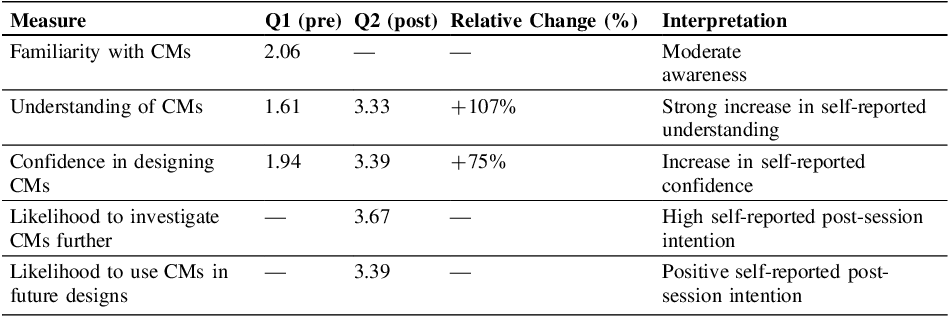
Pre- and post-session questionnaires captured changes in familiarity, understanding, confidence, and intentions to explore compliant mechanisms further. Results showed consistent conceptual and attitudinal gains across all measures (Table 1).
Summary of pre- and post-session questionnaire results

Note: Relative percentage change calculated from mean scores on a 5-point scale; n = 18
Mean self-reported understanding increased from 1.61 to 3.33, indicating a substantial shift in self-reported conceptual reasoning about deformation and flexibility following the session. Confidence in applying compliant design principles also increased, while participants expressed strong intentions to investigate the topic further (mean = 3.67) and apply it in future projects (mean = 3.39). Qualitative feedback supported these findings, clustering around three themes:
-
1. Clarity and accessibility – Worksheets were described as clear, structured, and easy to follow.
-
2. Conceptual understanding before digital work – Students reported improved insight into flexibility and motion when reasoning manually and expressed greater readiness to apply these concepts in CAD or simulation environments.
-
3. Engagement and applicability – Students expressed enthusiasm for using CMs in future projects and suggested follow-up sessions integrating simulation and testing.
4.2. Evaluation of student redesigns
The completed worksheets and student redesigns were reviewed to assess how effectively participants demonstrated compliant design reasoning. Each of the six groups selected one RBM from the provided set, covering linear, reciprocating, rotary, and oscillating motion types. Evaluation focused on four aspects of learning and design reasoning: (1) adherence to the design process; (2) accuracy in identifying motion regions and types; (3) appropriateness of lattice selection; and (4) effectiveness of lattice integration to the redesign, including cell dimensions, orientation, scale, and anchor points.
Across the six redesigns, students consistently followed the process and correctly identified directions of motion through physical interaction with their RBMs. Most groups selected lattices suited to the intended motion and refined their designs through orientation or cell adjustments to achieve predictable deformation. Occasional over-estimation of stiffness occurred in larger-cell lattices but reflected early-stage approximation rather than conceptual misunderstanding.
Figure 4 shows one group’s redesign of a centrifugal clutch. The original RBM combines rotary input with outward radial motion of the clutch arms. Students selected the Chiral 3 lattice, drawing on its auxetic and rotational characteristics indicated on Sheet B to replicate both rotary drive and radial expansion. In working through this redesign, students were not only reasoning about motion but also engaging with anisotropic deformation and directional stiffness, using the physical samples to understand how beam thickness, cell geometry, and auxetic properties influence the resulting motion. This embodied, material–structural intuition is rarely developed through digital teaching.
Original rigid-body mechanism and student compliant redesign of a centrifugal clutch

Figure 5 presents a redesign of a door latch combining rotary input and linear reciprocating motion. The group selected the Chiral 2 lattice based on its rotational compliance characteristics indicated on Sheet B and, through hands-on testing, found that rotating the cells by 45° increased compression and produced a smoother release. This demonstrated iterative refinement through tactile feedback.
Collectively, these redesigns indicate that students could translate RBMs into compliant systems through geometric reasoning and physical exploration. Their annotated sketches demonstrated sound application of compliant design principles, including motion identification, lattice choice, and integration strategy.
These outcomes indicate that the hands-on activity effectively supported conceptual understanding before the introduction of digital modelling. The redesigns also highlight how the activity strengthened spatial and geometric reasoning while providing a tangible foundation for later computational modelling and digital environment stages.
Original rigid-body mechanism and student compliant redesign of tubular door latch

4.3. Integration within design engineering curricula
The approach was designed to complement, not replace, conventional digital workflows. Once students demonstrate conceptual understanding through paper-based redesigns, they can transition to CAD modelling, simulation, and more advanced CMs, reinforcing the progression from tactile reasoning to computational validation.
This method aligns with the UK-SPEC learning outcomes by strengthening analytical reasoning (A1–A5), creative synthesis (C2, D3), and integrative thinking across disciplines (EA3). Through manual analysis of lattice flexibility, load paths, and deformation, students developed mechanical understanding that connects geometric deformation behaviour with design intent – skills expected of graduate and Chartered Engineers. Embedding this activity within early design or mechanics modules can provide a foundation for later computational work, supporting reflective practice and design reasoning across the curriculum.
5. Discussion
This research presented a foundation-first approach for teaching compliant mechanism design through tactile, paper-based methods and an initial pilot evaluation. The discussion interprets what these findings reveal about learning processes in CM education and situates them within broader debates on design cognition, digital learning environments, and professional formation.
5.1. Validation and limitations
The pilot results suggest that a short, non-digital activity may support students’ conceptual understanding and confidence in analysing motion and deformation. Gains in lattice selection and motion reasoning, alongside self-reported familiarity and confidence, indicate that the paper-based format fostered explicit reasoning about deformation without automation.
Interpretation is bounded by several constraints. The cohort was small (n = 18) and relatively homogenous, limiting statistical breadth. The study did not include a comparison group and observed shifts therefore cannot be attributed solely to instructional sequencing. Measures relied partly on self-reported familiarity, understanding, and confidence, which may reflect perceived rather than objectively verified competence. Inferential statistical testing was not conducted due to the exploratory pilot design, and findings should be interpreted as indicative rather than generalisable.
Implementation required fabrication of an initial set of lattice samples. In this pilot, twelve TPU 92A samples were printed using a desktop FDM and shared across groups. Scaling to larger class sizes would require either additional print sets or structured rotation of physical samples within workshop groups. Variation in selected rigid-body mechanisms may also have influenced redesign depth. Future research should involve larger cohorts, controlled comparisons, and longitudinal assessment of retention and transfer.
5.2. Cognitive, educational, and digital implications
These findings align with research suggesting that premature automation can displace reflective reasoning in design contexts (Reference Gero and MilovanovicGero & Milovanovic, 2020; Reference Kosmyna, Hauptmann, Yuan, Situ, Liao, Beresnitzky, Braunstein and MaesKosmyna et al., 2025). By foregrounding geometric deformation before simulation, the approach encourages students to internalise how form generates function, reflecting professional patterns that alternate between abstraction and representation (Reference CrossCross, 2023). In CLT terms, reducing early interface complexity minimises extraneous load while preserving germane effort devoted to understanding force paths and structural behaviour (Reference Sweller, van Merriënboer and PaasSweller et al., 2019). Digital tools can then extend rather than replace this reasoning.
Embedding hands-on reasoning early can strengthen transitions into CAD, simulation, and optimisation. When mechanical understanding precedes digital modelling, students enter computational environments with clearer causal reasoning, reducing unnecessary cognitive load and mitigating cognitive debt (Reference Kosmyna, Hauptmann, Yuan, Situ, Liao, Beresnitzky, Braunstein and MaesKosmyna et al., 2025). The tactile stage complements traditional mechanics, forming a coherent progression from physical reasoning to computational modelling.
5.3. Future research directions
Future work should extend validation across larger and more diverse cohorts and compare paper-first and CAD-first trajectories. Longitudinal tracking could examine whether early tactile reasoning influences later digital performance and design creativity.
Integrating digital verification loops – modelling redesigns in CAD and analysing them via FEA – would connect conceptual and computational learning. Modular RBM prints with interchangeable lattice inserts could further support mixed physical–digital experimentation. Embedding this workflow within DfAM, deformation analysis, and topology optimisation modules would allow automation or AI-assisted tools to be introduced once conceptual mastery is established.
6. Conclusion
Building on conventional analytical teaching of force and deformation, this paper introduced a foundation-first educational approach for teaching compliant mechanism design through tactile, paper-based reasoning. Using structured worksheets and physical lattice samples, students analysed motion and lattice deformation behaviours, made explicit design decisions, and articulated their reasoning, laying the groundwork for subsequent digital exploration. The pilot workshop provides early evidence that such embodied engagement may support conceptual understanding and confidence in reasoning about flexibility and motion, showing that early manual exploration promotes deeper learning before the introduction of digital tools.
Grounded in design-cognition theory and Cognitive Load Theory, the approach illustrates how design education might balance cognitive challenge and accessibility by foregrounding physical reasoning and externalised thought. It encourages students to connect geometric form with mechanical behaviour and to build reflective awareness – skills that underpin analytical judgement and creative synthesis in professional engineering practice. The framework therefore offers a practical, low-resource entry point for cultivating the habits of mind expected in graduate and Chartered Engineers.
Future work will expand validation through larger and more diverse cohorts, comparative studies between paper-first and CAD-first learning, and integration with CAD/FEA verification and 3D-printed testing. Embedding this tactile, cognition-centred approach within early-stage design and mechanics modules has the potential to reinforce a more reflective, iterative, and responsible culture of learning in compliant mechanism and engineering design education.
Acknowledgement
We thank the LMC and NMIS for their support and access to resources. We are also grateful to Dr Alexander ‘Freddie’ Holliman for facilitating the pilot during the Made on Wednesdays session with students in DMEM and extend special thanks to the participating students.




 Open access

