

INTRODUCTION
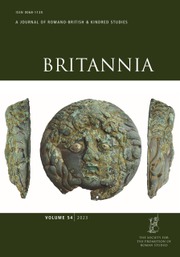
This paper publishes for the first time in detail the statue discovered at Teynham, Kent, in July 2023, and the context in which it had been deposited, adjacent to a mausoleum.Footnote 1 The statue shows a triton riding a ketos: a sculpture of this completeness, subject matter and quality is an exceptional find from Roman Britain.Footnote 2 The mausoleum context from which it derives and its subsequent depositional history is also rather unusual and not well paralleled in the province. The post-excavation phase of the excavation project has only recently begun, but the authors felt that it was important to make the findings about the sculpture available to a wider audience at the earliest opportunity. The paper also provides the chance to reflect on the wider context of such sculptures as elements of funerary architecture and on the significance of routes through northern Kent as interfaces for commemorative display. The symbolic associations of the figure in a funerary setting are also reviewed, whether eschatological or biographical, noting also the possible local resonance of a marine divine figure so close to the sea and the channel coast monuments which celebrated Roman ability to cross Ocean.
THE MAUSOLEUM AND BURIAL CONTEXT FOR THE STATUE
The Teynham triton was discovered during the excavations of a monumental Roman building complex beside Watling Street, west of the village of Teynham (borough of Swale, Kent) (fig. 1).Footnote 3 The Swale estuary between the Isle of Sheppey and the mainland is currently located some 3 km to the north, with the Conyer Creek extending further inland in the direction of the site. However, the modern shoreline will have been inundated in the Roman period, bringing access to the sea much closer to the site (fig. 2).Footnote 4 The complex's principal structure is represented by a foundation slab formed of compacted crushed chalk, measuring 7.8 m by 7.5 m and with a thickness of 0.5 m. The building would have been a well-built masonry structure and was undoubtedly a prominent monument overlooking the Roman road.Footnote 5 A further possible small (c. 1 m square) monument or statue base was found to the south of the walled inner enclosure close to the road. The complex is interpreted as a mausoleum, with a central burial monument within an enclosure with its roadside location and plan paralleled at other funerary monuments from Britain and neighbouring provinces. The burial associated with the central monument is assumed to have been destroyed during the demolition of the complex but several cremation burials were documented on its margins. Crucially the triton sculpture discussed in this paper is best paralleled in funerary art. There is a superficial resemblance to the plans of Romano-Celtic temples within enclosures, but some of the typical features, for example an outer ambulatory, were not discovered.Footnote 6 Equally there was no evidence for the votive assemblages typical of many temples. The location suggests that the complex and central mausoleum was a roadside funerary monument of a wealthy local resident (possibly associated with a Roman villa found previously at Bax Farm further to the north: fig. 2)Footnote 7 and probably drawing on iconography associated with Roman maritime deities such as Neptune (equated with the Greek sea god Poseidon) or Oceanus.
Plan of the site at Teynham, Kent, showing main features and preliminary site phasing. (© Canterbury Archaeological Trust)

A projection of how the Swale estuary would have looked in the Roman period. Teynham, Bax Farm and Watling Street are shown. (© Canterbury Archaeological Trust)

The mausoleum structure was situated a little north of the centre of a 30 m wide sub-square walled enclosure. The enclosure wall was constructed on a foundation formed of crushed chalk, laid on flint nodules. What remains of the enclosure's south wall, facing the Roman road, appeared to include the same types of high-quality stone observed for the mausoleum, thereby maximising the display of wealth and status. Opposing entrances into the enclosure were located centrally through both the south and north walls. The enclosure was set within a wider outer precinct measuring c. 65 m wide, defined by ditches on its south, east and west sides. The precinct extended at least 70 m to the north, continuing beyond the excavation area. Spot-dated pottery recovered from the earliest ditch fills suggest that this was constructed in the late first to early second century a.d. and continued in use into the late third century. The outer precinct extended southwards to flank the Roman road, alongside which an earlier roadside ditch was also exposed, with dating evidence from this ditch suggesting construction of the road in the mid-first century a.d. Parallel ditches perpendicular to the road situated either side of the outer precinct may represent land boundaries, introducing a further element of segregation between the funerary complex and the farmland beyond.
It appears that the superstructure of the building was demolished in the late Roman period, probably by the mid-fourth century a.d., though it may have been abandoned earlier in the late third century (see also below).Footnote 8 Investigation of the stone rubble associated with the demolition identified large quantities of iron-rich red sandstone (Folkestone beds) from the Medway and Sevenoaks area, Thanet sandstone from the north Kent coast and Tufa ashlar fragments from local spring-water deposits, in addition to large quantities of hard white Cretaceous Dolomitic French Chalk possibly from the Seine estuary and Marquise oolitic limestone from northern France. Recovered architectural elements included cornicing, ashlar, step moulds and a column shaft fragment. Within the rubble, a second sculptural fragment was also recovered: a carving of drapery in Marquise oolite (fig. 3). Marquise oolite is of particular interest as its supply and use have been linked with the Classis Britannica, being exploited, for example, by naval personnel for funerary monuments at Boulogne and the altar dedicated at the naval base at Lympne by a prefect of the fleet, Lucius Aufidius Pantera.Footnote 9
Fragment of Marquise oolite, seemingly carved with drapery. (© Canterbury Archaeological Trust)

Although no elements of the mausoleum superstructure survived demolition, the location of the exterior wall was apparently represented by a robber trench excavated above the perimeter of the foundation slab. Several internal features were noted, cutting the foundation slab and sealed by demolition rubble. These include a small pit cut into the south-eastern area of the foundation slab, and several post-holes, possibly to support an internal structure rather than the roof – while rectangular surface scars perhaps indicate internal partitions or even the footprints of sarcophagi or coffins. A ground-penetrating radar survey conducted across the footprint of the mausoleum foundation slab did not identify any underlying burial chambers. The surface of the foundation slab was laid at least 0.4 m below the surrounding Roman ground level, indicating that the interior floor level of the building may also have been below ground level. The rammed chalk of the foundation was unbroken, with no obvious points of access; however, a mixed chalk and clay bedding deposit laid on the surface of the foundation midway against the west side might represent the remnant of a bottom step leading down into the interior.
Traces of opus signinum and a tufa-based concrete recovered from the demolition debris are likely to represent remnants of interior surfacing, including flooring, though none survived in situ.Footnote 10 Fragments of lead sheeting, possibly representing a broken-up coffin, along with a coin of Constantine I dated to a.d. 333, were recovered from the demolition debris, the latter indicating that the demolition phase likely occurred around or after this date.Footnote 11 Four urned Roman cremation burials (one contained within a Dressel 20 type amphora) were located along the inner western edge of the walled enclosure, while a further three urned and four un-urned cremation burials were located outside, between the walled enclosure and the outer precinct boundary ditch. These burials are likely to be related to the active use of the mausoleum by its founding group and provide additional evidence in favour of the sculpture being part of a funerary monument. There were also some 31 later inhumation burials that post-date the burial of the triton statue and the demolition of the mausoleum complex.Footnote 12
THE CONTEXT OF THE STATUE
The statue was discovered in a water tank measuring 3.2 m long by 1.9 m wide and 0.66 m deep, which lay outside the ditch beyond the eastern precinct boundary (fig. 1).Footnote 13 The earth-cut tank had been lined with alluvial clay and revetted with oak (Quercus sp.)Footnote 14 planks held in place by corner posts. The wooden elements had been burnt in situ, hence their survival. It is likely to have been constructed at the same time as the mausoleum as a water-storage tank, perhaps even as a place for washing and cleansing before entry into its outer enclosure. The tank was connected to a contemporary ditch running parallel to the outer enclosure of the mausoleum by a short channel or leat extending from its north-west corner, presumably enabling the tank to be drained. A well shaft located immediately to its south provided an easy supply of fresh water and was in use from the late first to second century a.d. prior to eventual infilling by the late third century. The lower fill of the tank (post-dating its disuse) and the adjoining leat and ditch each contained pottery of late first- to third-century date.
When found, the statue appeared to have been placed front down on to the still hot embers of a pyre, built over the disused and partially infilled tank (fig. 4). The head of the triton had been removed and placed on its side separately within the same deposit, before the pyre debris and statue were completely sealed with a clean redeposited brickearth fill that was seen to have been heat-affected by the pyre. It would seem that the triton was ritually decapitated, ‘cleansed’ by fire, then buried prone (in a ‘burial’ reading). The right hand of the sculpture, which almost certainly held a conch shell, had also been broken off but had not been buried with the body and head. Unfortunately, this was not recovered from elsewhere on the site. The possible motives for the treatment of the statue in this manner are discussed in more detail below.
The sculpture as discovered in the water tank outside the precinct. (© Canterbury Archaeological Trust)

THE TRITON AND KETOS STATUE
Carved in Hassock sandstone (see below), the statue depicts a triton seated on the back of a ketos (sea-monster) (fig. 5).Footnote 15 The head, which was found detached from the statue at the time of discovery (see above), is rather asymmetric in appearance (fig. 6). His lips are thick with a deep hollow on their left side, but not on the right; they are also crooked, as if he is affecting a slight sneer. The nose is triangular and in profile, very slightly hooked. Of the two large eyes, the right is rather better rendered than the left; it has an elliptical bulge for the eyeball and an off-centre pupil, which is adjacent to the eyelid. The pupil of his left eye is also not centred but placed towards the top of the eyeball. This suggests a deliberate attempt to show the triton gazing heavenwards, as often seen on Hellenistic sculpture.Footnote 16 His cheeks are puffed and, viewed square on, his chin appears crooked, angled more to his left than his right (although this might be quite deliberate, and hints at one of the positions from which the sculpture was intended to be viewed). He has a low hair-line with the hair itself modelled in rows of repeated upward hoop-like tufts. The curls on the back of the head are noticeably less well defined, but nonetheless, like the upward gaze of his eyes, this again follows Hellenistic conventions for representing kings and other idealised male figures, mortal and divine (fig. 7).Footnote 17 No obvious attempt has been made to depict his ears. In profile, his head is narrow, flattened at the back. There are some slight ridges on his neck, which might be an attempt to depict fins or gills (see the discussion of the Glyptoteket triton below for comparison).
The triton and ketos sculpture, reconstructed with head in place. (© Canterbury Archaeological Trust)

Detached head of the statue, as viewed from the front. (© Canterbury Archaeological Trust)

Detached head of the statue, as viewed from the back. (© Canterbury Archaeological Trust)

The triton's chest is rather drawn back, with an unconvincing attempt to depict the pectoral muscles. He has bulbous nipples, rather more suited to a female. His belly protrudes outwards and his navel is elliptical rather than circular. He has an impressive mass of pubic hair made up of elliptical loops. His penis is triangular and pointed and his testicles bulbous.
The figure's left arm is bent at the elbow such that his hand rests on his hip. The hand is very poorly sculpted, with the thumb as long as the fingers and the forefinger and middle finger too close together before a wide gap to his ring finger which in turn merges with his little finger. He holds what might perhaps be an oar,Footnote 18 the terminal of which sits on top of his left thigh. The shaft of the oar – assuming it is this – is square in section and runs up alongside his left forearm. It terminates in a subtriangular component with a square socket (34 mm deep) which perhaps contained a metal rod. If so, the rod was presumably the armature for the rest of the object. The alternative to an oar would likely be a rudder, or possibly a trident. On his left shoulder is the rectangular stub of a puntello (i.e. a sculptural support or strut) to support the missing attribute. His right arm probably rests on the tail of the ketos (but see an alternative interpretation of this below) and is bent upwards; it almost certainly once held a conch shell to his pursed lips. His right shoulder has the remains of a puntello to support the conch.
The triton's thighs are out of proportion with his torso, with no attempt to depict any muscles. His right leg turns into a fin with five ridges just below the knee. His left knee is lower than his right, and the fin may reappear behind that of the right, but this partly depends on how the sculpture is interpreted (see below). On his upper right thigh there are faint traces of scales, carved as a series of triangles, running from his hip to below his testicles (see also discussion of the Glyptoteket Triton below). His back is rudimentarily modelled and his buttocks rather ill defined (fig. 8). He has a fin, similar in form to those on his lower legs, on each shoulder. Parts of the triton are rather poorly finished, for example the side of his rib cage below his left armpit.
The triton and ketos sculpture, as viewed from the reverse side. (© Canterbury Archaeological Trust)

As stated, the triton is seated on the back of a ketos, the body of which effectively forms the plinth. Its elongated head – which rather resembles that of a boar – has a long snout that overlaps the triton's left leg with five fangs. Just behind this is a down-turned crescent, which is presumably meant to represent the mouth. The eye is carved as an ellipse with a triangular pupil. The ketos has a mane and a crest, composed of a series of conjoined elongated ovoid loops. In general terms, the features of the ketos are rather poorly defined, suggesting perhaps that the sculptor had less understanding of the image he was trying to create.
There are two ways of interpreting the remainder of the sculpture. The first is that the serpent-like body of the ketos extends from the head back and around the triton to emerge again behind and above the latter's right leg. The body then loops again before descending and emerging as the tail with a crescentic terminal to the triton's right. In this interpretation, the lower part of the triton's left leg reappears behind his right and terminates in a fin, similar to that of his right leg, but here shown overlapping the ketos's tail. In addition, one of the ketos's fins is depicted on the back of its tail, mimicking the form of those on the triton's shoulder blades.
The alternative interpretation is that the tail seen from the front actually belongs not to the ketos but to the left leg of the triton and emerges behind his right leg, which would bring the sculpture more in line with its closest continental parallels (see below). In this reading, the aforementioned fin would instead belong to the triton. This reading would oblige the body of the ketos to extend out to the triton's left (or to the right when the sculpture is viewed from the front) with the twist of its neck only viewable from the reverse (fig. 8). This makes the ketos look rather cramped, but if the statue is part of a sculpture group, then this interpretation may make more sense – and perhaps suggests that another marine deity sat on the ketos, perhaps a nereid (see below). Whatever the arrangement, the combination of a triton in direct association with a ketos, the former possibly riding the latter, appears to be unusual, which perhaps suggests that the sculptor was unsure how to make a clear distinction between these two elements.
The sculpture seems likely to date to the late first to second century a.d. Although sculpture is notoriously difficult to date, this is based upon three factors. Firstly, stratigraphic information for the construction of the inner ditched enclosure around the mausoleum complex allows it to be provisionally dated, on the evidence of pottery, to the late first to early second century a.d. (see above). Therefore, the sculpture – and presumably other figurative and decorative elements produced to embellish the tomb – can reasonably be dated to this time. Secondly, other pieces of sculpture in Hassock stone have been dated to the first to third centuries, broadly in line with this date.Footnote 19 Lastly, a suggested dating on stylistic grounds to the late first to second century a.d. is also compatible with this suggested date.Footnote 20
BRITISH PARALLELSFootnote 21
Of the few British parallels in stone for this sculpture, all are fragmentary and none were carved in the round. There are two relevant reliefs from the south of Britain and a small number from around Hadrian's Wall. From the pediment of the temple of Sulis Minerva at Bath survives a fragment which mostly consists of the drapery of Victory and a globe, but also part of a male torso with ‘skirt or foliage’.Footnote 22 This has been suggested to be a triton with its pair on the other side of the pediment, but of which no fragments have survived. There is also a possible relief of a triton which has been sculpted into a sandstone niche from Priory Field, Caerleon.Footnote 23 Henig argues that the hair on the relief cascades in a manner that suggests fronds of seaweed and draws the conclusion that the bottom half of the sculpture was likely to be fish-like. He describes the bust's expression as ‘lugubrious’, and one does wonder why, if a triton was intended, his expression is not more befitting (e.g. with puffed cheeks). In our view, the incomplete preservation makes it hard to claim the Caerleon stone definitively as another example.
Although carved in low relief, a fragment of a mythological scene from Old Carlisle, Cumbria, now in the British Museum, provides some interesting points of comparison (fig. 9).Footnote 24 The main surviving part of the relief shows a bearded triton, this time with the fish body beginning at his waist and very prominent fins on his hips. His tail coils two or three times and ends in a trilobate fin. He holds what Allason-Jones suggests is a trident in his raised right hand which rests on his shoulder, although this is rather difficult to make out. Of greater interest is the conch shell in his left hand: this seems to be held such that the narrow end is away from his mouth, so, unusually, it is not in the correct position to be blown. Two other pieces of sculpture are thought to come from the same monumentFootnote 25 and, as referenced by Allason-Jones, were thought by Toynbee possibly to belong to a funerary monument – obviously of major relevance in the context of this paper if that was indeed the case.Footnote 26 The only other examples from Britain in stone come from a distance slab found at Hag Knowe, Dumbartonshire,Footnote 27 and the tombstone of Curatia Dinysia from Chester, which has a pair of tritons with impressively long tails in the spandrels of the niche. These tritons also have their cheeks puffed out and hold conch shells to their lips, although their piscine features begin at the waist.Footnote 28
Relief of a triton from Old Carlisle, Cumbria (British Museum reg. no. 1870,1013.40). (© The Trustees of the British Museum)

Beyond stone sculpture, a few parallels to the triton are found in metalwork and mosaic. A solid silver sculpture of a triton forms the handle of the lid for the flanged bowl in the Mildenhall treasure (fig. 10). The triton wears a wreath and holds the conch shell to his face, although it meets his chin rather than his lips. He holds a globular object with indents in his right hand, which rests on his knee: it is unclear what this represents.Footnote 29 A triton also appears in the marine thiasos frieze on the Bacchic platter, reaching out to a nereid seated on the back of a ketos.Footnote 30 Staying with silver plate, a tritonFootnote 31 features in the bowl of one of the cignus-type spoons in the Thetford treasure (fig. 11). The depiction here may provide a useful proxy for the oar potentially held by the Teynham triton, if we are correct in thinking that a metal armature supported an oar, which could perhaps have been crafted in another material such as wood (see above).
Triton on the lid of the flanged bowl from the Mildenhall treasure, Suffolk (British Museum reg. no. 1946,1007.12). (© The Trustees of the British Museum)

Drawing of a silver cignus-spoon from the Thetford treasure, Norfolk, with triton (British Museum reg. no. 1981,0201.50). (© The Trustees of the British Museum)

Finally, there are a small number of tritons that appear on Romano-British mosaics. The main panel of the mosaic from Dewlish, Dorset, almost completely obliterated by plough damage, may feature four tritons supporting a circular central medallion, with only one of these partially preserved.Footnote 32 If the interpretation is correct, instead of genitals the triton has a rather odd tripartite wing and only his human thighs are shown, not the lower parts turning into fish tails. Three tritons occupy a panel at Brading, Isle of Wight.Footnote 33 The central figure is a triton with genitalia and rather spindly-looking fish legs ending in tripartite fins; he holds an oar over his right shoulder and a bowl on his left. He is flanked by tritons, one of which holds a pipe (as opposed to a conch shell) and the other a pedum; both have pairs of wings extending from their hips and long curling tails which begin at their waists. Both have a nereid riding on their tails with billowing scarves. The strangest depiction of a triton comes from Rudston, Yorkshire, where he accompanies an equally odd-looking Venus.Footnote 34 Here the triton, with an olive-green torso, has only a single red fish tail beginning halfway down his thighs. He holds what appears to be a flaming torch in his right hand across his body, while his other hand is extended outwards with fingers curled back towards him. In summary, while the generic figure is familiar within the province, Roman Britain provides no direct parallels with the Teynham triton.
CONTINENTAL PARALLELS IN STONE
A much larger number of sculptural images of tritons survive from continental Europe, of which some examples are considered in this section and more in the discussion of funerary monuments (below). The Teynham triton has affinities with the conventions used for triton sculpture of Hellenistic and Roman date.Footnote 35 Probably belonging to a temple to Poseidon, the head and torso only of a triton, thought to date to the first century a.d., discovered at the Palazzo Grimani, Venice, and now in the Staatliche Museen, Berlin, provides a good example of the common type.Footnote 36 This piece differs from the Teynham triton, as the fish part of the body again begins at the waist – this seems to be the commonest manner in which Triton was depicted. A potentially better parallel therefore is a statue from Pamukkale, Turkey, but published information and images are limited. The image on the Arachne database does, however, show the triton from the back with legs splayed, one of which has turned into a curling fish tail, making it certain that the piscine part does not begin at the waist and the sculpture likely has genitals.Footnote 37
However, the best classical parallel for the Teynham triton is in the Glyptoteket in Copenhagen (fig. 12).Footnote 38 Although restored in places, the sculpture is mostly complete. Even if the Glyptoteket triton has the impressive classical plasticity that one would expect of a sculpture that was certainly part of a monument in Rome (of uncertain nature), something like it would have served as a model for the sculptor of the triton under discussion here. In that regard, there are some interesting parallels between the sculptures that are worth noting. The manner in which the Glyptoteket triton turns his head and cups his hand around the terminal of the conch shell provides a likely analogue to how the Teynham triton too probably held the conch to his lips. The Glyptoteket triton's hair, curling and quiffed as if tossed by wind and wave, illustrates the model for the coiffure translated into the stylised hoop-like tufts on the Teynham figure. There is also a parallel between the manner in which the Glyptoteket triton rests his elbow in the end of his piscine tail, just as the Teynham triton rests his forearm on the ultimate twist of the ketos's tail (or his own, in the alternative interpretation). Like the Teynham triton, the Glyptoteket figure also has the remains of a puntello on his right shoulder. The Glyptoteket triton has clear fins beneath both ears and his chin, which likely confirms the intention behind the traces faintly visible on the Teynham triton. The same can also be said of the upper thighs, where fins made up of a set of conjoined triangles again provide a likely parallel for how these would have looked on the Teynham triton. These are also visible on both front and back of the Glyptoteket triton. The thighs of the latter have pronounced ridges on front and back which run down from the scales to his knees; it is not clear what this is supposed to represent, but these are not repeated on the Teynham triton. The pubic hair is more discreet on the Glyptoteket triton, and unlike the Kent sculpture, the musculature of the torso is expertly done. Unfortunately, the attribute that the Glyptoteket triton held in his right hand is missing, but the stub of a puntello on his right shoulder suggests this was substantial enough to require additional support: perhaps it was an oar, held in a similar manner to that depicted on the Thetford spoon (fig. 11). At the top of his left arm is another stub of a puntello which would have supported the conch. Unlike the Teynham triton, his back and shoulder blades have no evidence of fins (fig. 13). Finally, the trilobate tail of the Glyptoteket figure's left leg seems more typical for how tails are usually finished; the plain terminal of the Teynham triton, whether it belonged to him or the ketos, is out of the ordinary. For the puffed cheeks of the Teynham figure other parallels are needed, for example those of the Triton pulling the chariot of Neptune on the late second- or first-century b.c. Paris-Munich relief.Footnote 39
The Glyptoteket triton, Copenhagen, front view. (© Ny Carlsberg Glyptotek)

The Glyptoteket triton, Copenhagen, back view. (© Ny Carlsberg Glyptotek)

An attractive sculptural group from the Avenches-En Chaplix mausoleum, Switzerland, exemplifies the adoption of triton images in northern Europe, showing a nereid seated on a triton's long, curling tail (fig. 14) (as noted above, a nereid may have once been a feature of the sculptural group at Teynham). This statue is also quite strongly provincial in style, with a parallel to be made with the modelling of the triton's pectoral muscles, for instance. Unlike the Teynham triton, however, the Avenches triton is bearded and his piscine lower half begins at his waist.Footnote 40 Broader potential parallels between the En Chaplix site and Teynham are discussed below.
Triton and a nereid from the Avenches-En Chaplix mausoleum, Switzerland. (© AVENTICVM – Site et Musée romains d'Avenches)

In summary, there are a small number of sculptures in the round discovered on the continent that provide useful parallels for the Teynham triton, although notably none associates a triton directly with a ketos.
PETROLOGY OF THE SCULPTURE AND OTHER STONE MATERIALS FOUND AT TEYNHAM
Through detailed hand specimen analysis of the sculpture it has been possible to identify the stone as a very good quality Hassock sandstone from the Lower Cretaceous (Hythe Beds) of the Maidstone area, from a quarry probably alongside the banks of the River Medway. The stone, which is best described as a pale olive green (when wetted) medium-grained sandstone with numerous speckles of black iron oxide and white areas of fine quartz, is of the very highest quality. It has few signs of weathering, suggesting that it was protected from the elements, since the green mineral glauconite has not oxidised to brown (the implications of which are discussed below). This variant can be described as a freestoneFootnote 41 and has broken bivalve fragments (almost certainly Exogyra), a common shell type for the Hassock sandstone. The triton's left cheek has a circular shaped calcite vein known as a watermark running down it (fig. 6). This and the bivalve fragments show this type of Hassock stone has a high calcareous (lime) content.
In addition to the sculpture, the site produced a sizeable stone assemblage. More work is needed, but preliminary petrological analysis shows that there is a great variety of high-quality stone (freestone) used in sculptural carving and architectural fragments. Indeed, except for the Richborough arch, fort and amphitheatre, this is one of the most diverse and rich assemblages of stone in Kent.Footnote 42 This reflects the site's excellent road and riverine access afforded by the proximity of Watling Street and the Swale Estuary, which flows into the Thames Estuary and thence to outcrops of stone along the Medway and northern French coast.
These are the two main areas of extraction. Lower Cretaceous outcrops from the Medway valley are centred around Maidstone (about 30 km distant), containing not only Kent Ragstone for rubble, but also high-quality iron sandstone from the Folkestone Beds in the Sevenoaks area. Collectively this group was closely linked with major construction projects in London such as the landward defensive wall.Footnote 43 Stone sourced to the French coast includes cream Jurassic limestone from Marquise in the Boulonnais used in an item of possible sculptural drapery (see above and fig. 3) and white Cretaceous Dolomitic French Chalk in architectural elements from the site. As noted above, the use of Marquise oolite has been linked with the Classis Britannica.
Petrologically and stylistically this stone assemblage is of national, if not international, importance. The great variety of different coloured red, white, green and cream native and continental stone types used as dimension stone (i.e. cut stone for building), architectural cornices, column drums and sculpture, collectively provided the traveller and visitor with an arresting display of the mausoleum owner's wealth.
THE FORM OF THE COMPLEX AND TOMB
Having discussed the sculpture's petrology and its stylistic parallels in Britain and beyond, to what type of tomb monument might it have belonged? To illuminate the possible form of the tomb, some selective comparisons are made with other monuments from Britain and especially from Gaul and Germany, where preservation allows for better understanding of monument superstructure (table 1).Footnote 44 The enclosing of the Teynham tomb is easily paralleled locally and beyond.Footnote 45 Walled enclosures for monumental (and non-monumental) tombs, squaring up to the street, have long been documented in Kent.Footnote 46 As well as the enclosures noted above, to the east and south of Teynham, for example, walls at Ospringe and Sutton Valence enclose large numbers of burials. These precincts could present monumentally in their own right, either through the massiveness of their walls, as at Southfleet, through the proliferation of boundary elements (walls, banks, ditches, etc.) or through the enclosing of considerable space, as again at Southfleet, or at Swanscombe. The double enclosing (wall and ditch) attested at Teynham is a little less frequently paralleled. This is partly because the smaller scale of investigation for many tombs would not identify any outer ditches (or outer walls) enclosing much bigger areas.
roman mausolea on routes from southwark to the channel (excluding canterbury)

Enclosed tomb complexes by the road have clear and extensive parallels. In Britain, for example, enclosure by walling, sometimes embellished with sculpture, is documented at Shorden Brae, west of Corbridge, Wood Lane End, north-west of St Albans, and the recently excavated tomb from Corby.Footnote 47 Tombs from neighbouring provinces identified below as possible comparanda for the Teynham tomb were similarly demarcated. Bounded by its own bank and ditch as well as the cut for roadside drainage, the massive foundations of the multi-tier mausoleum at Faverolles (Haute Marne) were found close to the Langres–Reims route, and the exedra tombs from En Chaplix were placed in extensive walled grounds hard by the route leading towards Lake Neuchâtel from Avenches.Footnote 48
The substantial surrounding enclosure buttressed the monumental presence of the Teynham mausoleum (and others), potentially lending it wider visibility. The precinct framed the edifice but likely frustrated access to it, deflecting practical encroachment and enhancing exclusivity. As at Teynham, some other enclosures also contained potential subsidiary monuments, occasionally the burials of a wider group.Footnote 49 Often, however, these extensive spaces seem largely devoid of other burials. Perhaps they were set aside for assembled funerary or commemorative sacrifice, of the kind prescribed by the ‘Testament of the Lingon’, the famous second-century aristocratic will from eastern France. These likely took place in the saepta (enclosed spaces) the will defined.Footnote 50 The same document implies the exploitation of funerary spaces as orchards, both an embellishment and potential source of income for commemorative activity.Footnote 51 Such funerary gardens are better documented in epigraphic evidence, but archaeological examples can be claimed. At Barnwood, on the approaches to Gloucester, for example, traces of tree-planting give an idea of the possible archaeological profile of such a garden, though none were detected during fieldwork at Teynham.Footnote 52
Allowing for the size of the foundation, the triton/ketos sculptural group and other sculptural fragments, as well as the rubble surviving from demolition, the substantial size of the mausoleum which once stood at Teynham is undoubted. It is difficult confidently to suggest the specific form it might have taken, but some possibilities can be rehearsed. It may have taken a tower-like multi-tiered form, of the type richly documented in northern Europe in Rhône–Rhine axis regions and attested by much more limited evidence in Britain (discussed further below). Typically, such mausolea tapered upwards from stepped plinths over their foundations, via a podium, aedicula (shrine-like entity) or tholos (circular ‘pavilion’) to an imbricated roof. Their variability is endless, in plan, height, interpolation of additional storeys, and the elaboration around vertical (colonnades, blind arcades, pilasters, etc.) and horizontal articulations (pedestals, cornices, attic elements, etc.). As well as epitaphs, many carry rich decoration, including architectural members, relief-carving over extensive areas of monument surfaces and free-standing sculpture.Footnote 53 Over time the emphasis shifts from open elements to house sculpture in aedicula or tholos, epitomised in the late first-century b.c. ‘tomb of the Julii’ at Glanum, to the solid pillar-like tombs embodied by the third-century a.d. Igel memorial near Trier. The existence of likely tombs of this kind in Britain is demonstrated, for example, by fragments of the distinctive imbricated (scaled) elements from their roofs.Footnote 54 Alternatively, the Teynham remains belonged to a different category of substantial monument, also tiered, but enclosing tomb chambers rather than being solid, for example accommodating vault (hypogea) and rooms above. The evidence for opus signinum flooring noted above makes the existence of such an interior burial chamber more likely in this case. In Britain the Landmark Court structure and perhaps that at Grange Farm offer recently excavated examples of this type in the same region (along with the older discovery at Stone-by-Faversham), though the excellent preservation of the Weiden tomb in Cologne illustrates the interior of such vaults and their decoration more fully.Footnote 55 The temple-form chambers preserved at Lanuéjols (Lozère), or Fabara (provincia de Zaragoza), the latter over a burial vault, give an idea of the scale and sophistication of the form and decoration of the superstructures for monuments of this kind.Footnote 56 The absence of a burial chamber cut into the floor at Teynham (or beneath the chalk foundation slab described earlier), indicates a different form of burial process to Lullingstone (see below), with the dead potentially housed in containers on the floor of the slightly recessed chamber.
At present, it is hard to offer a confident attribution of the Teynham mausoleum to any of these types. The tower tombs at least indicate the possible scale monumental mausolea could reach, especially the Glanum and Igel tombs, still standing to respective heights of 16 and 23 m. Monuments from Faverolles (Haute Marne) and Avenches-En Chaplix, also with triton decoration (see above) are estimated to have been of similar heights, extrapolating from the evidence of fragmentary architectural elements.Footnote 57 Fuller assessment of Teynham will await further analysis of surviving fragments. For the present we note that in plan its foundations are the equal of the some of the larger monuments noted above.Footnote 58 However, the surviving depth is less than that of many comparable monuments, perhaps indicating a height lower than some larger examples.Footnote 59 Whatever the specific form it took, other impressive buildings in the tomb's wider setting in north Kent allow patrons with architectural ambition of this type to be envisaged. The octagonal baths at Bax Farm villa, a few hundred metres to the north-west, exemplify the wherewithal of local elites in this regard.Footnote 60 The surviving Dover lighthouse, its Roman fabric preserved to a height of c. 13 m, and above all the Richborough arch reveal what could be achieved by imperial sponsorship, likely enacted through local delegates. The possible echoes of the latter monuments in the mausoleum are considered a little further below.
Finally, tomb monuments of this kind were also likely embellished with colour, though this has been demonstrated in few cases.Footnote 61 The colour variety of building materials attested at Teynham (see above) is rather unusual, and marks an alternative or complementary way of achieving polychrome effects. What is documented of the roadside complex at Titsey, Surrey, conventionally identified as a temple but in form and plan with significant resemblance to the Kent walled mausolea, offers a parallel in the deployment of a similar variety of coloured stone.Footnote 62
THE PLACEMENT OF THE SCULPTURE AND THE ‘MEANING’ OF TRITON/KETOS
Tritons are a common funerary motif in Roman imperial period art, appearing on stelae, mausolea and sarcophagi, often with other sea-creatures.Footnote 63 They can be young, as at Teynham, or bearded; they can be winged, feathered and finned (these embellishments are not always easily distinguished). Sometimes they metamorphose at the waist, sometimes at the knees as here. More commonly they appear as ridden, for example by nereids, rather than as riders. As discussed above, most blow the conch shell, but some play other instruments. Mostly they hold an oar or rudder in their other arm, sometimes in the crook of the elbow, sometimes brandished. This potential variety, allied with the possibility of elongating their form by extending their coils, makes them well adapted to multiple positions on monuments and in sculptural compositions.Footnote 64 The ketos itself is a less familiar funerary motif. It occasionally appears in its own right as the monster intent on devouring Andromeda, but more commonly contributes to a happier tone, being one of a variety of cavorting hybrid creatures within the marine thiasos, i.e. the joyful cavalcade which provides a maritime equivalent to the terrestrial retinue of Bacchus.Footnote 65
The uncertainty over the form of the tomb's exterior (see above) makes it hard to offer confident statements about the placing of the sculpture. Although it seems less likely that the triton was placed on the tomb exterior (unless in some very sheltered position), because it shows few signs of weathering (see above), the possibility must be considered that it was once placed outside, partly because tritons regularly occur as exterior sculpted decoration on tombs of the type discussed above as potential parallels from continental provinces.
On such mausolea tritons are documented in varying positions, but almost always in pairs.Footnote 66 On the tomb of the Julii, paired relief-carved tritons and marine monsters including kete appear on the frieze above the quadrifons (four-way arch) storey; on the Igel tomb they gambol with kete and other marine monsters in the relief carving on the stepped plinth.Footnote 67 For free-standing or more fully modelled figures the mausolea at Faverolles and Avenches mentioned above and the Poblicius tomb from Cologne give us more directly relevant possibilities for Teynham, all three being dated to the first half of the first century a.d. At Faverolles, Simone Deyts argues that substantial triton figures (parts of two have survived) were placed at the transition between monument storeys, on the corner spaces above the cubic podium left by the octagonal shape of the block above. Arms seemingly raised to attack, the bearded tritons, larger than the Teynham figure, were likely counterparts on the tomb itself to the life-size lion guardians Deyts places in front of the mausoleum.Footnote 68 The Poblicius tomb illustrates how tritons could serve as acroterial sculpture, occupying the broad ledge left where the roof angled up steeply above the aedicula below.Footnote 69 These large, expressive figures look directly out from their plinths on either side of the roof, their long serpentine bodies looping behind them. The sculpted decoration of the two exedra-plan mausolea at Avenches-En Chaplix illustrates another possible placing. Among the surviving sculpture from both tombs were fragments of paired panels, respectively tritons (north mausoleum) and griffins (south) carrying nereids, set antithetically at the ends of the curving attic above the podia. These panels, larger than the Teynham find, are carved in high relief rather than as free-standing figures, though are partially modelled in the round in the heads and upper parts of bodies.Footnote 70 A further possibility might be to place the Teynham triton as a free-standing sculpture on the enclosure wall, independent of the mausoleum proper, but figures of this type, like the Shorden Brae lions and stag groups, for example, are again usually carved much more fully in the round.Footnote 71
It is hard to assign the Teynham sculpture confidently to any one of these settings. It is smaller than all of the examples mentioned (as well as others) and its focus is in general much more one-sided. Since the ratio of roof area to mausoleum varies considerably, it is not impossible that the Teynham sculpture could serve as a roof acroterion on a narrower ledge than that of the Poblicius tomb. For example, small sea creatures, too fragmentary otherwise to identify, occupy all four corners of such a ledge on the second-century mausoleum at Délémont-Communance (canton Jura), while griffins and sphinxes occupy similar positions on the Vervoz tomb.Footnote 72 But even these figures are larger: the Teynham sculpture seems too small to have occupied a prominent acroterial position. The same caveat also applies to comparison with the Faverolles figures placed lower on the superstructure. On the other acroterial and related figures there is some frontal emphasis in the carved detail (privileging head, torso front limbs etc.), but carved detail is overall more evenly distributed; in comparison the panel-like modelling of the Teynham sculpture favours one side in its detail.Footnote 73 Since the figure's modelling invites a side-on view, it is perhaps therefore more plausible that (as at Avenches) it was set antithetically with a parallel group, for example as peripheral decorations with a framing role for another sculpture or inscription more centrally placed.Footnote 74
As well as size and modelling, the key objection to outside display remains the lack of weathering. However, if the sculpture was instead placed inside the tomb, then our comparanda are much reduced. The fabric of tomb interiors is typically very poorly preserved and very little evidence survives for the placing of sculpture. The Weiden tomb offers the best-preserved example from northern Europe, where funerary portraits were likely set on top of the kline-like boxes on either side of the tomb.Footnote 75 Alongside the lateral niches, also large enough to house sarcophagi, the Lanuéjols tomb chamber offers a smaller axial niche, suitable for life-size portrait statuary, but there is no direct evidence for what was accommodated. What survives of the fabric of the Landmark Court and Grange Farm tombs suggests slot-like spaces within which similar arrangements for inhumation burial containers might have been possible. The lack of weathering on the Minories eagle from East London suggests that it had been displayed in a niche-like space within a mausoleum.Footnote 76 The triton/ketos pair is a similar size to the eagle and has a similar emphasis in decorative detail on one side as well as limited signs of weathering.Footnote 77 However, it is harder to imagine as a focal element of a tomb's decoration, given that it may potentially reward a view from the side, approaching from the left, as much as from the front (see above).Footnote 78 Within a tomb's interior it is tempting to place it in a niche to the left of the viewer as she entered the tomb, with a counterpart figure on the right, given the convention of using tritons as paired framing figures (see above). If placed in the interior, the Minories eagle and the Teynham triton evoke the divine figures under whose auspices the mourners acted, both during the burial itself and in subsequent commemorative rituals.Footnote 79
Establishing the triton's role within the wider decorative programme of the monument is equally challenging. Like other substantial monuments, the Teynham mausoleum was embellished with further sculpture, and in all likelihood also a carved epitaph, and paint. The range of potential decoration is hinted at in other British evidence, including fragments of decorated architectural members and isolated free-standing figures such as lions and sphinxes.Footnote 80 The spolia from Stanwick, derived from at least one tower tomb of third-century a.d. date, give a slightly fuller indication of the form figural tomb decoration might have taken.Footnote 81 They include a relief carving of a marine deity, a shell niche framed by dolphins, a barbarian or giant trampled by a rider and mythological figures, as well as a scrap from a likely epitaph. The wider corpus of carved images from tombs also included other examples of water gods.Footnote 82 However, the more extensive surviving decoration from neighbouring provinces enables some exploration of the range of resonances potentially open to the passer-by on Watling Street.
The most confident assertion here is that an abundance of decoration at Teynham in its own right likely communicated the resources and sophistication of sponsors. As a common tomb motif (like masks, lions, sphinxes, etc.) the triton served to confirm the funerary, and thus protected, status of the space it embellished.Footnote 83 On a funerary monument, the presence of creatures of Ocean like the triton and ketos has commonly been read from an eschatological perspective. They have been argued to evoke the voyage across that body of water (and its perils) to the Blessed Isles and/or the blessed state of those who arrived on that farther shore in the train of the thiasos, though not all have agreed.Footnote 84 Remembering that both tritons and kete are also members of the marine thiasos, they can also be read as a marker of the felicitas enjoyed by the fortunate living whose wealth paid for the tomb and whose relatives were interred here. Continuing a social reading of the tomb's iconography, it is tempting to invoke aspects of local context to take this further., remembering both the proximity of the sea – the Swale estuary was perhaps only 3 km to the north and the channel ports at Richborough and Dover only 30 km distant – and the many villas founded on the fertility of local soils (fig. 2).Footnote 85 On the Igel tomb the juxtaposition of sea gods and commercial transport (the hauling of barges is shown in a register between Cupids riding dolphins above and tritons and fantastic sea creatures below) on the stepped plinth has been argued to ‘heroise’ the mercantile activities of villa owner-traders, an association extending into the water motifs found among the mythological images higher on the tomb.Footnote 86 Perhaps a similar symbolic game was in play here, celebrating in allegorical form the commerce which turned the produce of a local villa estate into wealth. In Roman literature ‘tuneful Triton’, the herald of Neptune, could calm the waves with a blast on his conch shell; securing his benevolence may have proved attractive to those mariners operating in the unpredictable waters of the English Channel and North Sea.Footnote 87
The other possibility, taking into account the local context of east Kent, is that the maritime reference was to a military career, for example to a high-ranking role in the Classis Britannica.Footnote 88 For several reasons this is hard to assess, as in such a case there would likely have been a more direct representation of military service in other elements of tomb decoration; for example, the battle scenes on the tomb of the Julii and the frieze of arms at Faverolles have both been taken to indicate prestigious service in the Roman army by those commemorated.Footnote 89 Symbols of a naval career do occasionally appear in funerary commemoration. His former life as a sailor before being enrolled in legio II Adiutrix is likely indicated in the trident and dolphins which occupy the gable end of a soldier's stele from Lincoln.Footnote 90 Although the sarcophagus was for his daughter, the hybrid sea creatures which framed her epitaph likely referred to the career of Marcus Verecundinus Verus, praepositus reliquationis of the praetorian fleet at Misenum (where she was buried) in the mid-third century a.d.Footnote 91 It is difficult, however, to assess this systematically, since in general what survives in other provinces of the tombs of prefects or centurions from the Roman fleets comprises only epigraphic fragments, rather than decorative sculpture. The example of the Poblicius tomb, for a veteran of legio V Alauda, shows how a triton need not be attached to a specifically naval biography.
Whatever the biography of the individual buried, it is tempting to speculate a little further about the possible echoes of nearby imperial monuments which viewers might have seen in the Teynham complex. Gilles Sauron has argued that stepped Roman tower tombs like those at Glanum or Faverolles consciously echoed the form of a monumental lighthouse like the Pharos at Alexandria, the latter including massive bronze tritons as part of its decoration. In his argument, the prestige of the Pharos as an ancient marvellous structure and its embodiment of cosmic eternity in linking earth, land and water, topped with a fiery ether, made it a suitable reference point for grandiose tombs.Footnote 92 The relative proximity of the surviving Dover lighthouse has been noted (see below), perhaps a potential local model for emulation. Sauron's argument has been disputed, but the connection is perhaps a little easier to argue on a site so close to monumental Roman lighthouses on both sides of the Channel.Footnote 93 It is also tempting to consider echoes of an even more potent imperial monument, the Richborough arch, the symbolic gateway to the province which celebrated conquest of Ocean, a reputational by-product of successful invasion of Britain.Footnote 94 While what little survives of the latter (scraps of inscription and architectural sculpture) suggests an austere decorative programme, it seems not impossible that the Richborough monument once carried some pictorial allusions to Ocean, perhaps echoed at Teynham.Footnote 95 Whatever the case, the local resonance of the image of a marine divinity linked to Ocean is unlikely to have been lost on passers-by.Footnote 96
THE TEYNHAM TRITON IN THE CONTEXT OF FUNERARY MONUMENTS IN BRITAIN AND THE CONTINENT
In the final part of this paper, we turn to the wider context of the sculpture and associated mausoleum complex.Footnote 97 To what sort of funerary landscape might the sculpture and its mausoleum have belonged?
Placing the Teynham discovery in its provincial context is challenging, for the simple reason that, in contrast to neighbouring provinces, there are few recent synthetic studies of funerary monuments in Roman Britain. They have not proved attractive to study because of their apparent iconographic poverty, poor preservation (the product of relentless recycling from the Roman period onwards) and limited documentation, especially of antiquarian discoveries. The consequence is an intrinsic difficulty even of confidently assigning the disiecta membra of many monuments specifically to funerary contexts.Footnote 98 It is perhaps no surprise that the most recent syntheses have come from scholars who have worked on continental Europe, characterised by more abundant surviving evidence and a stronger scholarly tradition in the study of funerary art and architecture. To Manuela Struck's outline of funerary display in Britain, including its monumental facet, Markus Scholz adds a characterisation of evidence from the province within a larger assessment of monuments in northern Europe. To some extent the latter overcomes the siloing which has also bedevilled the study of commemoration in Britain, where separate strands of scholarship engage with excavated evidence, carved decoration and inscriptions.Footnote 99 However, scope nonetheless remains for work to develop a better characterisation of funerary monumentality in the round.Footnote 100 Alongside other recent discoveries and analyses of spolia, the Teynham site offers significant opportunities for revisiting this subject.Footnote 101 In placing the Teynham group in a wider context, the following paragraphs may suggest lines of enquiry for this larger topic.
THE SPATIAL CONTEXT – A GRÄBERSTRASSE THROUGH KENT
Consideration of the setting of the Teynham mausoleum brings into sharper focus the privileging of Roman routes through Kent as an interface for elite self-representation through funerary monuments. The route from London to the Channel, i.e. Watling Street and associated secondary roads, can be identified as an extended Gräberstrasse, punctuated by monumental tombs (fig. 15; table 1). The concentration of monumental tombs in Kent was recognised by Jessup 65 years ago, but the clustering adjacent to key routes deserves greater emphasis.Footnote 102 This clustering is difficult to parallel elsewhere in southern Roman Britain, with the partial exception of the margins of the civitas of the Catuvellauni.Footnote 103 Recognising this monumentality requires the combination of the evidence of in situ remains of monuments and of detached fragments of their superstructures. Many of the tombs noted below typify the problems of survival and documentation outlined above. With the partial exception of tumuli, all the structures considered here are heavily robbed or comprise fragments displaced from their setting, making a funerary purpose often likely rather than proven and compromising comprehension of date and detail.
Sites discussed in the text that have produced comparable evidence for the Teynham triton and mausoleum, as well as the local road network in Kent and key coastal sites. Sites: 1 Southwark, 2 Keston, 3 Otford, 4 Lullingstone, 5 Swanscombe, 6 Southfleet, 7 Plaxtol, 8 Holborough, 9 Gillingham, 10 Lockham, 11 Sutton Valence, 12 Sittingbourne, 13 Teynham, 14 Ospringe, 15 Stone-by-Faversham, 16 Bishopsbourne, 17 Barham. (© Canterbury Archaeological Trust)

Despite aggressive re-use of their built fabric, some of the best evidence for monumental tombs in Londinium has been identified in Southwark. Excavations on Great Dover Street of monument and enclosure foundations of first- to third-century date give the clearest example from Britain of a monumentalised urban street of tombs. Sculptural fragments, including a pinecone and head of a river god, hint at their embellishment. Other Southwark finds extend this evidence of funerary display more widely across London's southern margins, above all the hypogeum excavated in 2022 from Landmark Court, its massiveness and rich decoration (tessellated floor, painted plaster), rivalling late Roman tombs from Rhine and Danube cities.Footnote 104
Beyond London, findspots of monumental tombs become more sporadic. Some tombs, or their precinct boundaries at least, were placed directly by Watling Street itself (Margary route 1).Footnote 105 Excavated in 1799–1802 with further fieldwork in 2001, the outer boundary enclosing the walled cemetery with richly furnished third-century burials at Southfleet demarcated a space which extended up to the road itself near Springhead. The positioning and massive walls of the inner enclosure meant that it ‘would have caught the eye of every traveller.’Footnote 106 Further along the road, a few kilometres respectively west and east of Teynham, are two further mausolea, at Sittingbourne and Stone-by-Faversham. Found in 1879 during brickearth extraction, a walled cemetery on the south side of Watling Street at Sittingbourne enclosed the foundations of likely circular mausolea. At Stone-by-Faversham, the thick-walled structure close by the road is the remnant of a likely masonry tomb with internal burial chamber. Neither structure is closely dated.
Other monumental memorials were located close to subsidiary routes which cut through the North Downs or led to the coast.Footnote 107 At Keston, near the road leading towards Lewes, a monumentalised cemetery with a very large buttressed tumulus and rectangular masonry tomb was created in the third century a.d., contemporary with the transformation of the nearby villa. The late Roman temple-tomb at Lullingstone, its burial vault sunk deep into the chalk behind the villa, is not the only mausoleum from the Darenth valley; upstream an octagonal structure, a likely tomb, was sited within the long-lived cemetery at Frog Farm, Otford. Approximately 15 km to the south-east the barrow within the walled cemetery at Plaxtol overlooked the river Bourne where it cut through the north Downs to join the Medway. To the north of Watling Street, monumental tombs were built at Swanscombe, west of the Ebbsfleet and at Grange Farm east of Gillingham, overlooking a meander of the Medway channel. Both were very heavily robbed, the former in particular lacking definitive evidence of its funerary purpose. At the latter a mausoleum was likely built between a.d. 250 and 300, close to an aisled building combining evidence of elite living and intensive metalworking. From the Medway valley and the route branching south from Watling Street at Rochester (Margary route 13), further monuments can be identified: at Holborough, the mid-imperial tumulus excavated in the 1950s before its destruction by quarrying, borrowed from its setting – a spur above the river Medway – and a neighbouring Bronze Age barrow to enhance its visibility within the Medway valley. South and east of Maidstone the hillside position of the monuments (square and circular in plan) at Langley gave them prominence within their enclosure by the road from Rochester towards Hastings.
East of Teynham the evidence thins but remains suggestive. Canterbury's cemeteries have been closely mapped, but their monumental façade is more hinted at than established conclusively.Footnote 108 The south-east margin of the city, near the roads leading to Richborough and Dover, likely housed several barrows around the Dane John mound, and a temple structure of fourth-century date at Augustine's House, perhaps linked to a funerary cult.Footnote 109 Epitaph fragments provide overlooked evidence of monumental tomb construction around the city. Atypically for Roman Britain, they comprise thin plaques, c. 2–4 cm thick, rather than stelae, mainly in marble. They were likely once affixed to mausolea or their enclosing walls (see below).Footnote 110 Towards Richborough evidence of tomb building diminishes, though the limited investigation of the latter's cemeteries constrains what can be said. The tomb partly built over by the third-century fort's walls and the lion sculpture, perhaps once an acroterial figure or an enclosure guardian, hint at mausolea which may await future discovery.Footnote 111 Between Canterbury and Dover the sparse documentation for monuments at Barham and Bishopsbourne, respectively right by the road (north-east side) and on rising ground c. 2.5 km to its south-west, suggest that this route (Margary route 1a) also continued to attract monuments as it neared the coast.Footnote 112
Despite the caveats, the evidence points cumulatively in a clear direction. In a three-day journey by road from London to the channel ports a traveller would have traversed a landscape punctuated by funerary monuments.Footnote 113 These were one component of a monumentalised route through the North Kent plain, comprising the road itself, including its recurring straight stretches and bridges spanning Medway (and Thames), the adjacent villas and sanctuaries, especially at Springhead, and the city of Canterbury.Footnote 114 The route was bookended by termini which showcased imperial authority, the public buildings of London and the quadrifons arch at Richborough.Footnote 115 Into this ensemble the mausolea introduced imposing monumentality directly onto the street frontage, tombs becoming likely familiar waypoints, marking out the rhythm of the road.Footnote 116
CONCLUSIONS
As an ambitious roadside tomb, the Teynham mausoleum complex joins an ensemble of funerary monuments dotting Watling Street (and its tributary routes), waypoints on the roads which traversed the North Kent plain for 100 km from Southwark to the Channel coast. Joining scraps of sculpture and inscription from tombs elsewhere en route,Footnote 117 the triton/ketos combination hints at the symbolic ambitions of such monuments. The Teynham tomb's superstructure, as currently envisaged perhaps a multi-tiered monument (pending the post-excavation process), likely integrated the triton/ketos pair within a more complex decorative scheme, though the specific significance of the scene depends very much on the context in which it was set – and as discussed, the weathering on the sculpture rather suggests that it was displayed inside the tomb. Established in the same landscape as villas on the rich agricultural land of the North Kent plain and adjacent Downs, tombs of this kind claimed an ancestral presence, consolidating property rights perhaps sometimes derived from a land grab around the Roman conquest.Footnote 118 More ephemeral funerary display, seen in the grave good assemblages of sépultures privilegiées, for example, or the distribution of lead coffins, has some focus in the same areas.Footnote 119 The unfolding of this funerary phenomenon is not only a function of the wealth gained by exploiting local resources. Tomb and sculpture find parallels in the memorials of eastern Gaul and the Rhine valley, likely generated through the cross-channel and transcontinental mercantile networks in which Kent was enmeshed, exemplified in the shrine of Nehalennia in the Scheldt estuary, or the Tabard Square dedication by the moritix Tiberinius Celerianus, from Gallia Belgica.Footnote 120 While not matching the intense monumentality seen in roadside commemoration in neighbouring provinces, the Kent route might be seen as the cross-channel extension of the close relationship between road and memorial in the Rhineland and eastern Gaul.Footnote 121
The disparate range of stone types utilised at Teynham, particularly from northern Gaul including the oolite from the Marquise in the Boulonnais, might suggest the possible logistical involvement in the supply chain for the tomb of the Classis Britannica. However, despite the presence of a maritime deity any further naval involvement here is equivocal and need not imply a more direct role in the construction of the tomb, or an association with its original occupants.
As for the sculpture itself, it is not unusual to find Hassock stone in Roman sculpture in the south-east part of the province, in particular London.Footnote 122 However, what sets the example from Teynham apart from the many other surviving examples in this grouping is the sheer intricacy and depth of carving. It is carved in the round, with exquisite detail, and is in pristine condition. It is without doubt the best surviving example of sculptural carving in this stone. Notwithstanding some uncertainty about the arrangement of figures, the sculptor shows a clear sensitivity to the conventions for carving tritons, while exploiting the opportunity for innovating within the traditional representation in the combination of triton and ketos. The forms of these marine beings are translated into a local style which takes account of the raw material, perhaps exploiting the green colour of the Hassock stone (before oxidisation) as especially appropriate to the marine subject.Footnote 123 Without the survival of other decoration, it is hard to identify the specific symbolic resonance of the choice of image, but the possible responses of Roman viewers can be rehearsed, reading into the sculpture references to an ideal afterlife for mortals and to celebration of earthly success.
As discussed above, the final use and infilling of the clay-lined water tank, associated with the deposition of the triton, seems likely to have been broadly contemporary with the likely demolition of the mausoleum in the early to mid–fourth century a.d. Given that the triton seems most likely to have been placed inside the burial chamber, that means that it was at least a century, if not more, before the figure was removed from his place of display and buried, seemingly with some ceremony, within the appropriate context of the similarly decommissioned water tank. As also discussed, it appears as if the triton was ritually killed before burial, with a deliberate decapitation and the removal of his main attribute, the conch shell, and burial in the prone position with a burnt deposit, possibly from a pyre set above the pit. It might be tempting, in a Constantine or post-Constantine world, to ascribe this damage and clearly highly structured deposition to Christian iconoclasm.Footnote 124 While this cannot be ruled out, one must be careful to invoke such motivations, since there is ample evidence for the dismantling and disarticulation of sculpture throughout the Roman period in Britain.Footnote 125 The motivations of those concerned in this case appear respectful in terms of the choice of burial location, but with great care also taken to emphasise ceremonially the end of his influence as an active religious icon. Without more specific evidence, why the funerary monument was dismantled and the triton statue treated in this manner is currently unclear. Nevertheless, the Teynham triton is without doubt one of the most significant and exciting discoveries to have emerged from Roman Britain in recent times.
ACKNOWLEDGEMENTS
Mathew Freeman, Stephen Thompson, Helen Bullen and Julian Moat of Chartway Partnerships Group provided logistic support during the excavation, with project funding provided by Chartway and Moat Homes. Simon Mason, Principle Archaeological Officer, and Lis Dyson, Heritage Conservation Manager, KCC Heritage Conservation monitored the works and provided valued on-site discussion. John Pearce would like to thank Rebecca Levitan, Stefanie Hoss and Owen Humphreys for discussion and references. Richard Hobbs would like to thank Jill Cook for supporting a research trip to the Glyptoteket in Copenhagen, and Cecilie Brøns for facilitating access to their triton sculpture; also Sophie Delbarre-Bärtschi for her assistance with details of the Avenches monument. The excavation was supervised by Adrian Gollop, with support from Isobel Alexander, Enid Allison, Ian Anderson, Richard Best, Martha Carter, Matthew Charlwood, Paul Crame, Mark Denyer, Blake Galloway, Jack Goodman, Marion Green, Heather Hanson, Alexandria Hewitt, Susanne Jost, Rosalind Morcroft, Francis Morgan, Katie Potter, Adrian Murphy, Callum Richardson, Dale Robertson, Adelina Teoaca and Christopher Wolton. The triton statue was cleaned and stabilised by Adamson Conservation Limited. Damian Goodburn examined the charred timber planking within the water tank. Charred wood samples were identified to species by Marvin Demicoli, Museum of London Archaeology. Ground Penetration Radar of the mausoleum and surrounds was conducted by SUMO Services Limited. Aerial imagery was by FlyingPix Limited. The authors are grateful to the peer reviewers of this paper, including Martin Henig (who subsequently de-anonymised himself) for providing helpful suggestions as to how the paper could be improved, and Will Bowden for his careful edits.


 Open access

