


Introduction
Over the last 40 years, a change has occurred in determining the role that non-governmental organisations (NGOs) can play in constructing and providing social services to inhabitants of various territorial units (Lindsay et al. Reference Lindsay, Osborne and Bond2014, p. 193). This role has been emphasised in the new public governance (NPG) concept (Morgan and Cook Reference Morgan and Cook2014 (eds.); Morgan and Shinn Reference Morgan, Shinn, Morgan and Cook2014; Osborne et al. Reference Osborne, Radnor and Strokosch2016; Osborne and Strokosch Reference Osborne and Strokosch2013; Radnor and Osborne Reference Radnor and Osborne2013; Sørensen and Torfing Reference Sørensen, Torfing, Nicholls, Simon and Gabriel2015; Torfing and Triantafillou Reference Torfing and Triantafillou2013; Wiesel and Modell Reference Wiesel and Modell2014). The concept highlights the significance of sectors outside the public sphere in not only providing but also constructing social services (Bryan and Sapeha Reference Bryan and Sapeha2015, p. 250). The social sector is no longer treated (similar to the economic sector) as the less expensive (in relation to the public sector) provider of services and has instead been re-approached (contrary to the economic sector) as possessing the ability to shape the participatory attitudes of citizens in the co-construction and co-production of social services (Morgan and Shinn Reference Morgan, Shinn, Morgan and Cook2014, p. 6). In other words, citizens and their unofficial associations are becoming, together with NGOs, both the constructors and producers of social services (Fotaki Reference Fotaki2011; Pestoff Reference Pestoff2012; Pestoff et al. Reference Pestoff, Brandsen and Verschuere2012; Powell et al. Reference Powell, Greener, Szmigin, Doheny and Mills2010).
According to NPG, collaboration between public institutions and NGOs is viewed through the prism of its advantages. According to Banyan: ‘At the heart of new public governance (NPG) is the notion that partnerships, collaboration and engagement produce qualitatively better outcomes for communities. What one organisation cannot accomplish alone, a network may leverage their collective resources and energy for joint action’ (Reference Banyan, Morgan and Cook2014, p. 101). The determinants of such collaboration can be analysed through an organisational perspective in which focus is placed on the assets of the organisations themselves, as well as an individual perspective centred on the influence of the traits of leaders of public institutions and NGOs in establishing collaboration between them (see Mitchell et al. Reference Mitchell, O’Leary and Gerard2015, p. 688; Unceta et al. Reference Unceta, Castro-Spila and Fronti2016, p. 195). These traits can make such collaboration either easier or more difficult.
The aim of this article is to assess the role of selected traits of NGO leaders in determining the chances of collaboration between NGOs and rural gmina offices in central, post-socialist Poland.Footnote 1 These traits include social competences, locus of control, assertive confrontation, openness to experience, education, age and sex. We begin by presenting the social context of collaboration between NGOs and rural gmina offices in post-socialist Poland. This context is constituted by exposure to the LEADER approach and, currently, community-led local development.
Collaboration Between Rural Non-governmental Organisations and Public Institutions in Post-socialist Poland
In post-socialist countries, the NGO sector is still being shaped and supported by, among other sources, grants from international institutions (Chimiak Reference Chimiak2016, p. 52–58; Fagan Reference Fagan2006; Furmankiewicz et al. Reference Furmankiewicz, Janc and Macken-Walsh2016). Many do not perform any activities due to a lack of resources, a lack of members or disillusionment on the part of existing members with the numerous procedures that must accompany the acquisition and accounting of resources (Działek Reference Działek2014; Zajda Reference Zajda2017).
Clientelism (understood as the dependence of NGOs from public institutions, including local authorities) still occurs among rural NGOs (Furmankiewicz and Macken-Walsh Reference Furmankiewicz and Macken-Walsh2016, p. 21). Karolewski (Reference Karolewski2016, p. 256) pointed out, ‘informal mechanisms of interest representation’ still dominate in post-socialist states, and not all organisations that have an NGO status are actually independent of public institutions; thus, it is sometimes the case that NGOs, dependent on financial grants, become ‘paid lobbyists’, as exemplified by leisure time associations, such as local sports clubs.
The initial impulse to establish collaboration (in accordance with the NPG concept) between rural NGOs and public institutions in these states was the implementation of the LEADER approach and, currently, community-led local development.Footnote 2 Studies conducted in post-socialist states (Furmankiewicz Reference Furmankiewicz2012; Furmankiewicz and Macken-Walsh Reference Furmankiewicz and Macken-Walsh2016; Kovach and Kucerova Reference Kovach and Kucerova2006; Macken-Walsh and Curtin Reference Macken-Walsh and Curtin2012; Majerova Reference Majerova2009; Marquardt et al. Reference Marquardt, Möllers and Buchenrieder2012; Pawłowska Reference Pawłowska2017; Zajda Reference Zajda2014; Zajda and Kretek-Kamińska Reference Zajda and Kretek-Kamińska2013) indicate numerous problems associated with intersectoral collaboration between these organisations. In Poland (similar to other countries), local action groups have traditionally been dominated by local power elites—representatives of the public sector (Furmankiewicz and Macken-Walsh Reference Furmankiewicz and Macken-Walsh2016, p. 14). However, this does not mean that intersectoral collaboration in accordance with the NPG concept—the co-construction and co-production of social services within the framework of local action groups—is not possible. Indeed, the success of the LEADER approach determined the implementation of community-led local development. Furthermore, NGOs and public institutions can collaborate outside these organisations. According to Polish legislation, the forms of collaboration between these entities are regulated by, among others, the Act of law of 24 April 2003 on Public Benefit and Volunteer Work, Art. 5, item 1. However, we should bear in mind that not all these forms are in agreement with the NPG concept. According to the legislation, collaboration between NGOs and public institutions can refer to commissioning public works to NGOs, the mutual passage of information concerning planned courses of action, the consultation of projects of normative acts, the creation of common advisory and initiative panels, the execution of local initiatives based on agreements and collaboration-based partnership agreements. Therefore, when analysing the forms of collaboration described in the legislation, we can see that collaboration is understood, in a broad sense, as (1) the mutual passage of information, (2) the execution of tasks commissioned to NGOs by rural gmina offices and (3) the co-construction and co-production of services possible according to partnership agreements. Cooperation between NGOs and the public sector is also possible as part of projects financed by the European Social Fund or as a part of local initiatives (Kotarba Reference Kotarba, Pawłowska and Gąsior-Niemiec2015, p. 65). It is not always formal. The emergence of formal partnerships (as is the case in other countries) is at times preceded by the informal cooperation of interested entities (see van Tulder et al. Reference van Tulder, Seitanidi, Crane and Brammer2016, p. 2), which representatives define as a partnership (Kotarba Reference Kotarba, Pawłowska and Gąsior-Niemiec2015, p. 64).
The terms co-construction and co-production are understood differently (Pestoff Reference Pestoff2012, p. 1105–1107). Voorberg et al. (Reference Voorberg, Bekkers and Tummers2015, p. 1347) state that ‘in the literature the concepts of co-creation and co-production were often seen as interchangeable. There is empirically no striking difference between both concepts, and within bodies of knowledge different meanings are given to both concepts’. In reference to the NPG concept, we focus on the phenomenon of collaboration between rural gmina-based NGOs and rural gmina offices. This collaboration is defined as a form of interaction, which implies the co-construction and co-production of social services as a part of partnership agreements. Partnership agreements can be formal and written; however, in rural areas, informal contacts between the leaders of local authorities and the leaders of NGOs, and the ensuing practices of these contacts, are often more important. In other words, the fact that institutions do not base cooperation on written legal contracts, in which the rights and obligations of both sides are determined in accordance with the principles of partnership, does not mean that these institutions do not collaborate in accordance with these principles. In reference to the approach suggested by Kotarba (Reference Kotarba, Pawłowska and Gąsior-Niemiec2015, p. 65) (who analysed the theoretical possibilities of cross-sectoral cooperation in Poland), co-construction is defined as common, i.e. assuming the participation of two sides, planning and creating of social services, whereas co-production means providing that service, also assuming the participation of both sides.
Relatively few empirical studies on cooperation between NGOs and public institutions (taking into consideration the co-construction and co-production of social services) have been conducted in post-socialist states (Mikušova Meričkova et al. Reference Mikušova Meričkova, Nemec and Svidronova2015), particularly in rural areas. Polish researchers focus primarily on the idea of cooperation itself. Firstly, they report on its potential advantages, taking into account the significance of NGOs for activities directed at resolving social problems, satisfying social needs, representing the interests of disadvantaged groups, maintaining close contact with residents of various territorial units and their propensity to implement innovative actions, which exceeds that of the public sector (Zajda Reference Zajda2017). Secondly, the researchers emphasise the difficulties of cross-sectoral cooperation, its occasional apparentness and its social impact (Pawlowska and Gasior-Niemiec Reference Pawłowska and Gąsior-Niemiec2015). Therefore, when designing studies in Polish rural areas, we bore in mind that formal written partnership agreements can be differently implemented in practice. Some agreements can imply the co-construction and co-production of social services, which do not occur in reality. That is because NGOs can give into pressure exerted by local authorities and state in their documents that there was cooperation in the scope of co-construction and co-production of social services, when in fact the NGOs implemented the projects by themselves. We also took into account that an NGO, which is formally responsible only for providing a social service, in accordance with guidelines issued by the gmina office, may actually produce and provide the service along with this office, which is not reflected in formal documentation. Taking all of this into consideration, our own research was based on the opinions of NGO leaders, which may reflect reality to a greater extent than existing documents.
Traits of NGO Leaders and the Potential of NGOs to Enter into Collaboration
Few studies describing leadership traits that can influence cooperation between NGOs and other entities can be found in the source literature. Among these traits, gender has been mentioned. After conducting a review of the relevant literature, AbouAssi et al. (Reference AbouAssi, Makhlouf and Whalen2016) indicated that according to numerous studies, organisations led by women collaborate more often with other entities than those led by men. Referring to studies by Foster and Meinhard (Reference Foster and Meinhard2002) on the predispositions of organisations to collaborate, they emphasised that ‘NGOs managed by women may be more likely to enter into collaborative relationships than organisations run by men. The psychosocial development of women is more compatible with being a successful collaborator; women are more communal and consensus builders and prefer participatory and collective approaches to solving problems more than men’ (AbouAssi et al. Reference AbouAssi, Makhlouf and Whalen2016, p. 445).
The second trait of NGO leaders that can facilitate collaboration between their organisations and other entities is openness to experience—a trait listed in the five-factor model of personality (together with extraversion, agreeableness, conscientiousness and neuroticism) (McCrae and Costa Reference McCrae and Costa1987, Reference McCrae, Costa, Boyle, Matthews and Saklofske2008; McCrae and John Reference McCrae and John1992). The Big Five model is often used as a basis for measurement of personality predictors of the effectiveness of actions taken by various organisations (i.e. not only NGOs), including their potential to collaborate with other entities (Hassan et al. Reference Hassan, Bashir and Abbas2017, p. 75; Soomro et al. Reference Soomro, Salleh, Mendes, Grundy, Burch and Nordin2016).
The source literature more frequently indicates traits that facilitate leadership of organisations and that can influence their activities. These traits include interpersonal skills (King Reference King2004, p. 478), such as social skills (AbouAssi et al. Reference AbouAssi, Makhlouf and Whalen2016, p. 437), which are also described as social competences (Riggio et al. Reference Riggio, Throckmorton and Depaola1990, p. 799). These traits can be considered especially useful for leaders of various organisations due to the need to clearly communicate one’s position and display assertiveness in situations in which matters of interest are involved in a way that minimises the social costs of oppositional reactions.
Stump and colleagues (Reference Stump, Ratliff, Wu, Hawley and Matson2010, p. 23) stated that social competences are a ‘little understood construct that nonetheless remains a hallmark of positive, healthy functioning across the life span’. There are a few definitions of social competences. However, what we know for certain is that an individual can possess various social competences and, as Riggio (Reference Riggio1986, p. 650), an expert on the subject, pointed out: ‘The relation between any single social skill dimension and social effectiveness (i.e. positive or desirable social outcomes) may not always be linear. Possessing too much of any one of the basic components of social skill, in relation to other key social skill components, may be dysfunctional. In another study, the author highlighted that such competences (e.g. emotional expressivity, emotional sensitivity, emotional control, social expressivity, social sensitivity, social control; Riggio and Taylor Reference Riggio and Taylor2000, p. 651) ‘indeed consist of an ability, or group of abilities, that facilitate the initiation, development and maintenance of human relationships’ (Riggio et al. Reference Riggio, Throckmorton and Depaola1990, p. 799).
People who display high social competences find it easier to enter into various social interactions. Riggio’s studies indicate that various social competences correlate to various degrees of an internal locus of control. An increase in a given competence does not always indicate an increase in one’s internal locus of control (Riggio et al. Reference Riggio, Throckmorton and Depaola1990, p. 800).
In the context of the social competences of NGO leaders, we should draw attention to the issue of reacting to social influence or resistance to social impact.
The notion of resistance has a broad range of meanings, indicating such concepts as reactance, negativity, rebellion and disobedience. However, in the context of findings by various authors (Apter Reference Apter1982; Brehm Reference Brehm1966; Brehm and Brehm Reference Brehm and Brehm1981; McDermott Reference McDermott and Apter2001), we can perceive resistance as both a function of interpreting social situations and a subjective inner experience. In this sense, resistance constitutes a readiness to resist unwanted influence and social restrictions (cf. McDermott Reference McDermott and Apter2001; Knowles and Riner Reference Knowles, Riner and Pratkanis2007; Pasikowski Reference Pasikowski2016a). This readiness should be understood as a conscious mental attitude of the subject, who is capable of immediate reaction, which is directed at limiting the influence of an external impact which he/she perceives as unwanted and opposed to himself/herself (cf. Apter Reference Apter1982, Reference Apter and Apter2001a, Reference Apter and Apterb; McDermott Reference McDermott and Apter2001). This reaction can assume various forms (Bukobza Reference Bukobza2009; Dowd et al. Reference Dowd, Milne and Wise1991; McDermott Reference McDermott, Apter, Kerr and Cowles1988; Stenner and Marshal Reference Stenner and Marshal1995) and can be characterised using two more general properties (Ames Reference Ames2007; Ames and Flynn Reference Ames and Flynn2007; Deluty Reference Deluty1979). The first property is an activity, i.e. the degree to which one directly enforces or defends one’s position, which can be described using two poles: passive to active (cf. Aggleton and Whitty Reference Aggleton and Whitty1985; Fernandes Reference Fernandes1988; Goffman Reference Goffman1961; Knowles and Riner Reference Knowles, Riner and Pratkanis2007; Thomas et al. Reference Thomas, Donnell and Buboltz2001; Zimbardo Reference Zimbardo2008). The second property is acceptance, which is described as the strength with which a person acknowledges the source of the pressures and restrictions he/she experiences, with the intent to build or sustain social relations (Pasikowski Reference Pasikowski2016a, Reference Pasikowskib). Doing so would consist of becoming agreeable (conforming) to the opinions and convictions of others and in presenting oneself as attractive in the eyes of others (cf. Jones and Wortman Reference Jones and Wortman1973; DeLamater and Myers Reference DeLamater and Myers2011). In the case of both behaviours, the aim is to obtain access to certain goods and benefits or to preserve the existing state of affairs. Such behaviours are treated as being within the bounds of interpersonal persuasion techniques (Blickle Reference Blickle2003; Bohra and Pandey Reference Bohra and Pandey1984; Ellis et al. Reference Ellis, West, Ryan and DeShon2002; Gordon Reference Gordon1996) and are interpreted in terms of reducing the degree of dependence on others (Baumeister Reference Baumeister1982).
After combining these two properties, i.e. activity and acceptance, in a two-dimensional system, four forms of resistance can be identified: the expression of negative emotions and aggression, passiveness, apparent adaptation and the assertive expression of one’s position (Pasikowski Reference Pasikowski2016a, Reference Pasikowskib), all of which can prove useful in building a profile of NGO leaders, i.e. people who enter into numerous interpersonal and group relations, in the course of which matters of importance from the point of view of the role of such a leader are negotiated.
Another trait indicated in the source literature in the context of fulfilling the role of NGO leaders, and in the context of their activity, is education. Based on representative studies conducted in Poland, Sułek (Reference Sułek, Czapiński and Panek2013, p. 290) noted: ‘Educational attainment, especially in the case of higher education, not only contributes to membership in voluntary organisations—persons with higher education are also more likely to work in such organisations. As a result, persons from the upper social strata, and in particular persons with higher education, are several times more likely to be elected and serve in civil organisations’.
The theoretical findings listed above justify the search for a set of specific traits of NGO leaders that can influence the establishment of collaboration between their organisations and other organisations and institutions, including public institutions. Some of these traits can be characterised as purely psychological variables, while the others pertain to sex and education. Even though the age variable is not emphasised in the source literature, it was included in our analysis. The social perception of a leader’s age can have significance in terms of such traits as responsibility and credibility (Spisak et al. Reference Spisak, Grabo, Arvey and Van Vugt2014; Van Vugt and Grabo Reference Van Vugt and Grabo2015), which can in turn influence collaboration with representatives of public institutions in accordance with the NPG model. In the light of the above findings, we formulated two basic questions:
(1) Do psychological traits of rural NGO leaders, such as social competences, readiness to resist unwanted social influence, locus of control and openness to experience, determine the establishment of collaboration between these organisations with rural gmina offices?
(2) Does the set of traits of these leaders that determines the establishment of collaboration between rural NGOs and rural gmina offices include sex, age and education?
We sought answers to these questions by building a logistic regression model, based on data collected in 2017.
Method
Participants
Participants in this study comprised 104 leaders of NGOs. The results from 13 respondents were rejected from the analysis, five due to insufficient data and eight because of strong deviations from the study results. The final analysis included data from 91 respondents: 62 women and 29 men. The average age of the respondents was 53 (mean = 52.68, median = 52, standard deviation = 12.54, asymmetry = 0.16, kurtosis = − 0.37, min = 27, max = 83), and its empirical distribution did not deviate significantly from the normal distribution (Shapiro–Wilk = 0.89, p = 0.5743). The distribution of education in the sample was as follows: 13 people with vocational education, 32 people with secondary education, five people with first-degree university education and 41 people with second-degree university education.
Tools
Five independent tools were used in the study: the interview questionnaire, the PROKOS (Eng. Social Competences Profile) questionnaire, the Człowiek w Pracy (Eng. Person at Work) (CP) questionnaire, the Questionnaire of Readiness to Resist and the Openness to Experience (O) scale from the NEO-FFI personality inventory. The reported validity of the tools was established in separate investigations by their authors. Information concerning each tool is presented below.
The interview questionnaire included the following question: Did the NGO under your management collaborate with a rural gmina office in the year 2016 as part of a partnership agreement, i.e. cooperate with a gmina office in the construction and production of specific social services?Footnote 3 The questionnaire was also used to ask the respondents about their age, sex and education.
The second tool was the PROKOSFootnote 4 questionnaire, created by Matczak and Martowska (Reference Matczak and Martowska2013), which is used to study social competence profiles. The PROKOS is usually applied in studies conducted in sociocultural contexts in Poland. There is no English version of the questionnaire. Conversely, Polish adaptations of tools developed by foreign authors, which could have been used instead of the PROKOS, were also unavailable. The PROKOS questionnaire allows for the measurement of social competences in five dimensions, which correspond to the following scales extracted by the authors through validity studies:
(1) assertive competences (AFootnote 5-14 items)—expressed by the ability to exert influence on others while respecting the standard of socially acceptable behaviours and preserving balance between soliciting for the realisation of one’s needs and aims and the social approval of one’s conduct.
(2) cooperative competences (K-16 items)—characterise people who can collaborate with others in an effective and harmonious manner. These competences are connected with a tendency to take helpful actions and with a conviction about one’s effectiveness in this scope.
(3) sociable competences (T-11 items)—connected with initiating and maintaining informal contacts and with coping in situations of social exposure.
(4) community competences (S-6 items)—the ability to initiate and implement social goals and to involve other people in activities which serve those goals. These competences are particularly necessary for people working in public benefit organisations.
(5) social resourcefulness (Z-13 items)—expressed through the ability to obtain goods and evoke expected behaviours in other people.
The authors determined the scales’ internal coherence to be 0.82–0.89 (Cronbach’s α) and that their structural, convergent and differential validity was satisfactory. Convergent validity was assessed in the course of studying correlational relationships with numerous tools measuring similar constructs with regard to social competences. Differential validity was assessed through correlations with tools measuring opposing constructs.
Another tool used in the study was the Człowiek w Pracy questionnaire by Matczak et al. (Reference Matczak, Jaworowska, Fecenec, Stańczak and Bitner2009). The questionnaire is designed to measure the locus of control with regard to the conditions of one’s occupation—in this case, activity as part of an NGO. The questionnaire is usually applied in studies conducted in sociocultural contexts in Poland. There is no English version of the questionnaire. Polish adaptations of tools by foreign authors, which could have been used instead of the questionnaire, are also unavailable in Poland. In the course of validation study, the authors discovered that the questionnaire possesses a two-factor structure. The first factor is called the Sense of Control Locus (PUK-41 items), while the second, which encompasses positions of control, is called the Control Scale (19 items). Further studies allowed the authors to highlight two additional factors within the PUK scale. These factors were given the following names:
(1) control ideology (ik-27 items)—used to measure generalised perceptions of people’s influence on the course of their activities, aims and actions.
(2) personal control (ko-14 items)—used to measure convictions about the possibility of controlling one’s fate and deciding one’s activities.
The results of these scales are used in the diagnosis of the locus of control.Footnote 6 The positions of both scales concern convictions and perceptions with regard to the context of work. Internal coherence of the control ideology and personal control scales was tested, taking into account separate age groups. The average Cronbach’s α was 0.83 for CP(ko) and 0.88 for CP(ik). The assessments of convergent and differential validity conducted by the authors of the tool demonstrated that it provided credible measurements.
Another tool implemented in the study was the Questionnaire of Readiness to Resist (QRR) (Pasikowski Reference Pasikowski2016a, Reference Pasikowskib), which is used to measure resistance in situations of interpersonal influence. The questionnaire is characterised by a four-factor structure. The positions of each factor create separate scales, which are described as follows:
(1) retaliation (Rt-6 items)—used to measure readiness to the targeted expression of anger and dislike and taking action against or to the detriment of those from whom one experiences pressure.
(2) assertive confrontation (Ac-6 items)—used to measure readiness to openly communicate one’s lack of consent to unwanted social impact, supported by the search for arguments that could change the situation while respecting the rights of others.
(3) opportunism (Op-5 items)—readiness to instrumentally create an impression of submissiveness that would enable one to secretly fulfil his/her goals or minimise potential losses connected with open objection.
(4) inertia (In-3 items)—used to measure readiness to restrict contact, withdraw, avoid, refuse or reject actions, possibly connected with hostility towards people trying to exert influence or towards pressure.
Validity assessment showed that the convergent and differential validity of the scales, as well as their homogeneity, which had a Cronbach’s α of 0.71–0.83, were satisfactory.
The final tool used in the study was the Openness to Experience scale (O) from the Polish version of the NEO-FFI Personality Inventory (Zawadzki et al. Reference Zawadzki, Strelau, Szczepaniak, Śliwińska, Costy and McCrae1997), which is used to measure the personality trait which expresses cognitive interest, tolerance towards novelty and the tendency to seek and assign positive value to novelty. In the Polish validity assessment, the scale had similar validity to that of the original studies, with a homogeneity value of Cronbach’s α 0.68.
Procedure
Empirical studies were conducted between January and April 2017 in the Lodz voivodeship, which is in central Poland. It belongs to a group of five Polish voivodeships (of which there are 16 in total) with the lowest number of associations and foundations per 10 thousand people (Adamiak et al. Reference Adamiak, Charycka and Gumkowska2016, pp. 9, 29).
The study covered NGOs with headquarters in all 29 rural gminas situated around the three largest cities of the voivodeship (Lodz, Piotrkow Trybunalski, Skierniewice). All the rural gminas in which the study was conducted were supported by local action groups, which means that the idea of collaboration between NGOs and public institutions, such as rural gmina offices, was somewhat implemented in their areas. Therefore, on the one hand, the studies were conducted in the voivodeship characterised by low citizen involvement in the form of formalised NGOs; and, on the other, the rural gminas where these organisations were situated were receiving support from local action groups. A small number of NGOs could paradoxically help such organisations in their collaboration with rural gmina offices. The leaders of these NGOs could, relatively easily, establish contacts with representatives of rural gmina offices and seek their cooperation, which would consist of the co-construction and co-production of social services.Footnote 7
The study participants were leaders of NGOs (associations, unions of associations and foundations) situated in these rural gminas. The leaders were identified by members of the organisations during telephone or email contact made by researchers. In all organisations, only one leader was selected. The study did not include sports clubs, adhering to information (mentioned earlier in the article) found in the source literature.
Based on the database of NGOs bought from the Central Statistical Office in Poland, the researchers determined the number of organisations in the area of the selected rural communes to be 397. Bearing in mind the problems with updating the Central Statistical Office database described in the source literature (Działek Reference Działek2014; Zajda Reference Zajda2017), the purchased data were verified. During the 4 weeks prior to the beginning of the study, at least three attempts were made to contact representatives of each organisation by phone or email (at three different times during the day, including the evening). The verified sampling frame from which the organisations were selected by means of a lottery consisted of 142 subjects. Based on this number (N), the minimal size of the sample for dependent individual sampling was determined, with an estimated confidence level (CL) of 0.95, an estimated value (f) of 0.5 for an unknown fraction size and a 5% estimation error (e). The sample size was n min = 103.87. Thus, 104 organisations were selected. The sample is representative of the studied communes. Unfortunately, 13 cases were excluded from the analysis due to insufficient data, and eight because of outlier results. Admittedly, the reduction in sample size decreases the credibility of the inference, with the established criteria underlying the necessary sample size (N = 142, CL = 0.95, f = 0.5, e = 0.05). However, data loss will seem more acceptable and under control, when it is noted that the number 91 corresponds with the situation in which the estimation error (e) is 6.2%, thus being just over 1% higher than initially expected. With an estimation error of 6.5%, the minimal sample size would be 88 units.
After contacting the leaders of the selected organisations, we asked each one to fill out a set of psychological questionnaires in the presence of an interviewer. Moreover, each respondent was individually asked questions from the interview questionnaire prepared by the researchers. The study was carried out in accordance with a correlative scheme comprising a single-point measurement of a set of traits predicted in the theoretical model. Responses to requests for cooperation and the respondents’ sex were coded in binary. In the case of cooperation, the value attributed was ‘1’; otherwise, the value was ‘0’. Men were attributed ‘0’, and women were attributed ‘1’. The variants of the ordinal variable ‘education’ were attributed the following value levels: vocational education—1, secondary education—2, first-degree university education—3, second-degree university education—4. The cumulative values corresponding with the individual scales of the other questionnaires were treated as continuous variables.
The analysis consisted of two stages. In the first stage, we used measures of statistical description to characterise the traits of NGO leaders that were included in the studies. In the second stage, we used logistic regression analysis to assess the role of these traits in determining the chances for collaboration between NGOs and rural gmina offices.
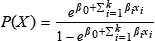
Logistic regression is recommended when the dependent variable has a dichotomous form, as well as when the aim of the data analysis is to test the models of relationships between the dependent variable and variables treated as its determinants (Hosmer et al. Reference Hosmer, Lemeshow and Sturdivant2013; Kleinbaum and Klein Reference Kleinbaum and Klein2010; O’Connell Reference O’Connell2006; Osborne Reference Osborne2015). The variants of the dependent variable in the analysis were success and failure. Success signifies fulfilling a given criterion, e.g. the presence of a given phenomenon or value, while failure means that the criterion was not fulfilled. This method allowed us to estimate the natural logarithm of success probability (more generally, the chances of success taking place), not the intensity of the dependent variable, as in the case of linear regression. Additionally, it offered us the opportunity to use the term chances of success (to this end, we calculated the odds ratio), which differs from probability in that it assumes values in the range (0, + ∞). To describe the model of logistic regression and assess the chances of success, we used the following equation:
Formula 1 Equation of logistic regression
where
 is the constant,
 are direction coefficients for the
 variables in the model, and e is Euler’s number, i.e. the basis of the natural logarithm, which in this equation constitutes a constant with an approximate value of 2.718. P(X) assumes values in the range of (0, 1).
In the presented study, the dependent variable constituted collaboration between NGOs and rural gmina offices, as declared by NGO leaders. Statistical inference was conducted on the assumed level of statistical significance α = 0.05.
Results
Out of 91 leaders of the studied NGOs, 68 (75%) indicated that their organisations collaborated with rural gmina offices on both the co-construction and co-production of social services in 2016.
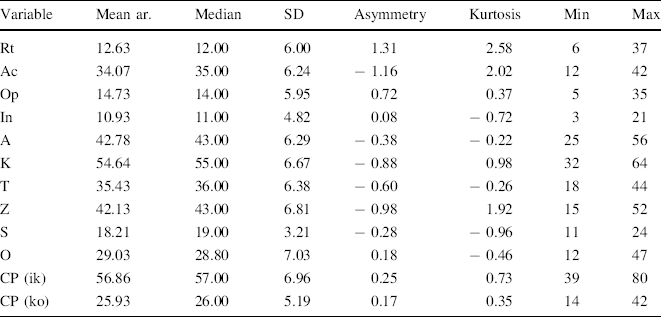
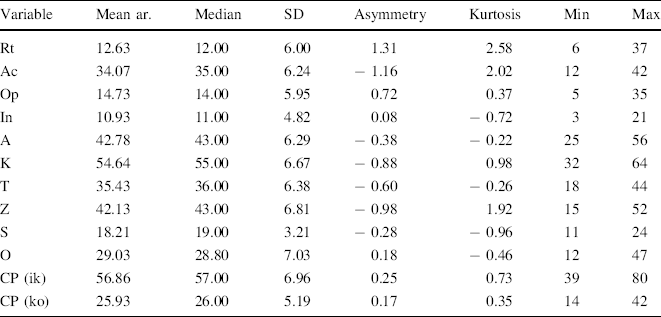
The first stage of data analysis was a statistical review of the descriptive measurement results of traits of the studied NGO leaders, i.e. their social competences, readiness to resist, locus of control and openness to experience (Table 1). The characteristics of the age, sex and education of the leaders were provided in an earlier section of this article.
Descriptive statistics.
Variable |
Mean ar. |
Median |
SD |
Asymmetry |
Kurtosis |
Min |
Max |
|---|---|---|---|---|---|---|---|
Rt |
12.63 |
12.00 |
6.00 |
1.31 |
2.58 |
6 |
37 |
Ac |
34.07 |
35.00 |
6.24 |
− 1.16 |
2.02 |
12 |
42 |
Op |
14.73 |
14.00 |
5.95 |
0.72 |
0.37 |
5 |
35 |
In |
10.93 |
11.00 |
4.82 |
0.08 |
− 0.72 |
3 |
21 |
A |
42.78 |
43.00 |
6.29 |
− 0.38 |
− 0.22 |
25 |
56 |
K |
54.64 |
55.00 |
6.67 |
− 0.88 |
0.98 |
32 |
64 |
T |
35.43 |
36.00 |
6.38 |
− 0.60 |
− 0.26 |
18 |
44 |
Z |
42.13 |
43.00 |
6.81 |
− 0.98 |
1.92 |
15 |
52 |
S |
18.21 |
19.00 |
3.21 |
− 0.28 |
− 0.96 |
11 |
24 |
O |
29.03 |
28.80 |
7.03 |
0.18 |
− 0.46 |
12 |
47 |
CP (ik) |
56.86 |
57.00 |
6.96 |
0.25 |
0.73 |
39 |
80 |
CP (ko) |
25.93 |
26.00 |
5.19 |
0.17 |
0.35 |
14 |
42 |
Rt retaliation, Ac assertive confrontation, Op opportunism, In inertia, A assertive competences, K cooperative competences, T sociable competences, Z social resourcefulness, S community competences, O openness to experience, CP(ik) control ideology, CP(ko) personal control
When we refer the mean values of the sample measurement to reference values in the population, we can see a rather high intensity of social competences (T), openness (O), assertive confrontation (Ac) and inertia (In), as well as a moderate intensity of retaliation (Rt), opportunism (Op), control ideology (CP(ik)) and personal control (CP(ko)).
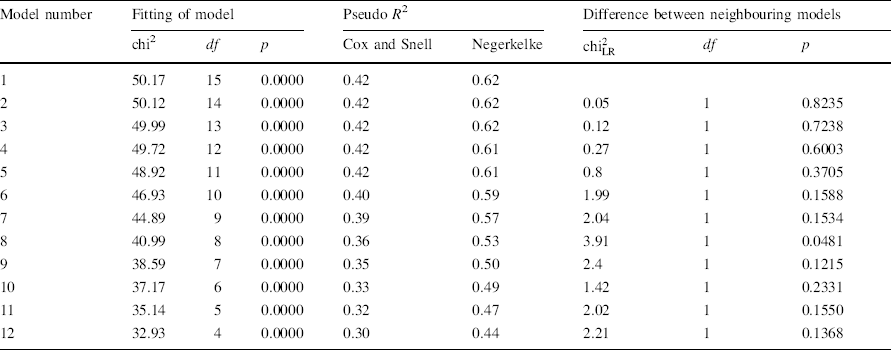
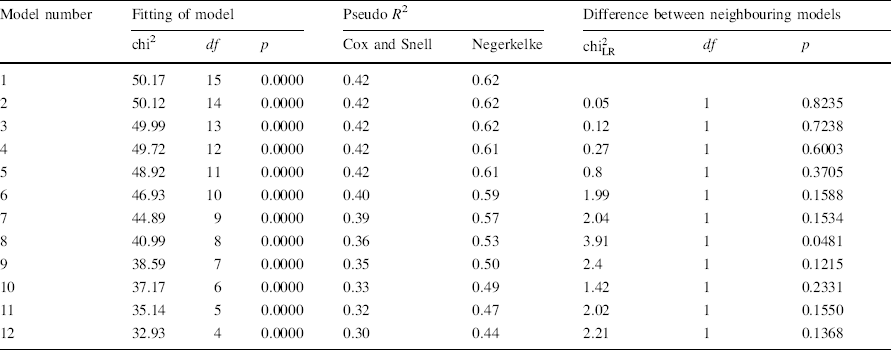
The second stage of data analysis consisted of a logistic regression analysis, in accordance with the step backwards pattern with regard to the variables in the model with a statistically insignificant directional coefficient. At the point of departure, we took into consideration all independent variables, i.e. measurement results in the QRR, PROKOS and CP subscales, as well as data concerning the sex, education and age of the respondents. Then, in the case of each successive model, we removed the variable with the lowest value according to the chi2 Wald test (statistically insignificant) from among those variables with statistically insignificant directional coefficients. The value of this test constituted the final elimination criterion, preceded by an earlier evaluation of the statistical likelihood ratio (
 —likelihood ratio), which refers to the difference between the chi2 coefficients of fitting the compared models. In Table 2, we presented the parameters of fitting the created models. The goodness-of-fit estimation was carried out using the quasi-Newton method.
Fitting logistic regression models.
Model number |
Fitting of model |
Pseudo R 2 |
Difference between neighbouring models |
|||||
|---|---|---|---|---|---|---|---|---|
chi2 |
df |
p |
Cox and Snell |
Negerkelke |
|
df |
p |
|
1 |
50.17 |
15 |
0.0000 |
0.42 |
0.62 |
|||
2 |
50.12 |
14 |
0.0000 |
0.42 |
0.62 |
0.05 |
1 |
0.8235 |
3 |
49.99 |
13 |
0.0000 |
0.42 |
0.62 |
0.12 |
1 |
0.7238 |
4 |
49.72 |
12 |
0.0000 |
0.42 |
0.61 |
0.27 |
1 |
0.6003 |
5 |
48.92 |
11 |
0.0000 |
0.42 |
0.61 |
0.8 |
1 |
0.3705 |
6 |
46.93 |
10 |
0.0000 |
0.40 |
0.59 |
1.99 |
1 |
0.1588 |
7 |
44.89 |
9 |
0.0000 |
0.39 |
0.57 |
2.04 |
1 |
0.1534 |
8 |
40.99 |
8 |
0.0000 |
0.36 |
0.53 |
3.91 |
1 |
0.0481 |
9 |
38.59 |
7 |
0.0000 |
0.35 |
0.50 |
2.4 |
1 |
0.1215 |
10 |
37.17 |
6 |
0.0000 |
0.33 |
0.49 |
1.42 |
1 |
0.2331 |
11 |
35.14 |
5 |
0.0000 |
0.32 |
0.47 |
2.02 |
1 |
0.1550 |
12 |
32.93 |
4 |
0.0000 |
0.30 |
0.44 |
2.21 |
1 |
0.1368 |

In all models, the iterative estimation function reached convergence (model fit to empirical data), which means that the results of the analysis were not burdened with distortions caused by insufficient fitting. The data presented in Table 2 indicate that each of these models differs significantly from the model that includes only the constant (chi2). It is therefore justified to take it into account in predicting collaboration between NGOs managed by their leaders and rural gmina offices (dependent variable). The predicted significance of the models proved to be justified, as we can see by the coefficients of determination (pseudo R 2), which show the extent to which the probability of success for a given dependent variable is explained by the regression model. In the model that includes all the variables, the chances of predicting collaboration were 62% and decreased with the elimination of successive variables; however, it did not fall below 44% in the final model, in which the number of predictors was reduced to four. It should be added that apart from the final model (number 12), model number 8 also drew our attention with its significantly higher fit than previous models (the p value in the final column).
A presentation of the predictors was carried out based on data from model 12 with reference to the results in models 8, 7 and 3. This decision was supported by the number of statistically significant predictors in these models, as well as by the similarity in the goodness of fit to the data and the size of chance of predicting the independent variable.
A comparison of the model fit coefficients of models 12 and 8 (the first model that differed significantly from the previous ones: chi2 = 3.91, df = 1, p = 0.0481) showed their mutual similarities (chi2 = 8.06, df = 4, p = 0.0895) in spite of difference in the number of parameters (which equalled 4). Thus, the differences between these models consisted mostly in the number of significant predictors and their credibility. On the other hand, models 12 and 7 (the model directly preceding the first model, which differed significantly from the previous ones) showed significant differences in goodness of fit (chi2 = 11.96, df = 5, p = 0.0353). This result is in accordance with predictions. A similar result was obtained in the comparison between models 12 and 3 (chi2 = 17.06, df = 9, p = 0.0478), the latter of which possessed the highest number of statistically significant parameters, i.e. for the Rt, In, A, Z, CP (ik), CP (ko), age and education variables. However, in this comparison, attention should be drawn to the value p, which indicates that the probability of not rejecting the null hypothesis (which assumes similarity between both models) did not decrease significantly.
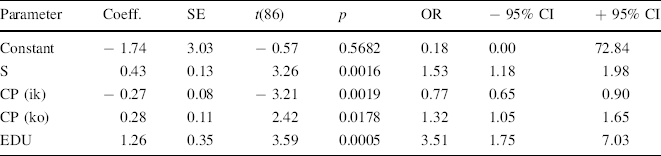
Although the final form of the model is of key significance, referring to the results of the comparison with rejected models allows us to consider the initial theoretical assumptions concerning the set of predictors to be justified. The presentation of the components of the final model can be found in Table 3.
Logistic regression model no. 12 for the cooperation with rural gmina offices.
Parameter |
Coeff. |
SE |
t(86) |
p |
OR |
− 95% CI |
+ 95% CI |
|---|---|---|---|---|---|---|---|
Constant |
− 1.74 |
3.03 |
− 0.57 |
0.5682 |
0.18 |
0.00 |
72.84 |
S |
0.43 |
0.13 |
3.26 |
0.0016 |
1.53 |
1.18 |
1.98 |
CP (ik) |
− 0.27 |
0.08 |
− 3.21 |
0.0019 |
0.77 |
0.65 |
0.90 |
CP (ko) |
0.28 |
0.11 |
2.42 |
0.0178 |
1.32 |
1.05 |
1.65 |
EDU |
1.26 |
0.35 |
3.59 |
0.0005 |
3.51 |
1.75 |
7.03 |
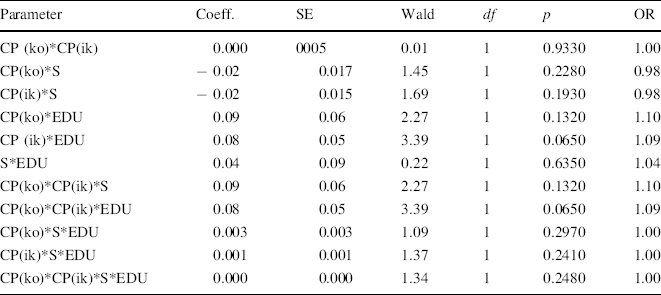
The data analysis also included the possibility of first-, second- and third-order interactions between predictors present in interaction model 12. However, none of them were statistically significant, which means that the effect of the predictor’s impact on the explained variable was additive in nature. The results are shown in Table 4.
Interactions in logistic regression model no. 12.
Parameter |
Coeff. |
SE |
Wald |
df |
p |
OR |
|---|---|---|---|---|---|---|
CP (ko)*CP(ik) |
0.000 |
0005 |
0.01 |
1 |
0.9330 |
1.00 |
CP(ko)*S |
− 0.02 |
0.017 |
1.45 |
1 |
0.2280 |
0.98 |
CP(ik)*S |
− 0.02 |
0.015 |
1.69 |
1 |
0.1930 |
0.98 |
CP(ko)*EDU |
0.09 |
0.06 |
2.27 |
1 |
0.1320 |
1.10 |
CP (ik)*EDU |
0.08 |
0.05 |
3.39 |
1 |
0.0650 |
1.09 |
S*EDU |
0.04 |
0.09 |
0.22 |
1 |
0.6350 |
1.04 |
CP(ko)*CP(ik)*S |
0.09 |
0.06 |
2.27 |
1 |
0.1320 |
1.10 |
CP(ko)*CP(ik)*EDU |
0.08 |
0.05 |
3.39 |
1 |
0.0650 |
1.09 |
CP(ko)*S*EDU |
0.003 |
0.003 |
1.09 |
1 |
0.2970 |
1.00 |
CP(ik)*S*EDU |
0.001 |
0.001 |
1.37 |
1 |
0.2410 |
1.00 |
CP(ko)*CP(ik)*S*EDU |
0.000 |
0.000 |
1.34 |
1 |
0.2480 |
1.00 |
The sign of particular directional coefficients calculated for the variables in model 12 (Table 3) indicates that the probability of collaboration between NGOs (managed by their leaders) and rural gmina offices increases with the increase in the leaders’ level of education and the results of the S and CP(ko) scales and the decrease in the results of the CP(ik) scale.Footnote 8 In contrast, the odds ratio (OR) coefficients indicate that the probability of establishing collaboration with rural gmina offices increases nearly fourfold when the level of education is increased, increases by nearly 50% alongside an increase in the results of the S scale and increases by 30% alongside an increase in the results of the CP(ko) scale, by 1 point. A 1-point increase in the CP(ik) scale results in a 23% (OR = 0.77) decrease in the probability of cooperation with rural gmina offices. After substituting the values of directional coefficients into formula 1, we obtained the following model of logistic regression:
Formula 2 Equation of logistic regression for cooperation variable

When we substitute the concrete values obtained through individual measurements of the variables for the variable symbols, it is possible to calculate the probability of an NGO, managed by a given person, to enter into cooperation with a rural gmina office.
We need to emphasise that the presented model gives us a 44% chance of predicting the odds of cooperation (corrected pseudo R 2). This is a significant effect, bearing in mind the complexity of the conditions for establishing cooperation between NGOs and rural gmina offices, which is connected with the existence of many possible determinants of such cooperation. The obtained results allow us to recognise some of them, as well as to assess their degree of importance.
Conclusions
The results of the conducted analysis allow us to provide a positive answer to the questions raised in the introduction; however, this answer needs to be elaborated further.
The overall good fit of the models to the data confirms the validity of the theoretical assumptions, which means that all the models tested during these analyses can be considered valuable in the scope of predicting the odds of cooperation between rural NGOs from the selected region of central Poland and rural gmina offices (in accordance with the NPG concept). However, the key role in determining cooperation with rural gmina offices, consisting of the co-construction and co-production of social services, is played by education, social competences and locus of control. Among this set of traits, we need to highlight the education of NGO leaders, the increasing level of which was the most decisive for establishing cooperation between these organisations and rural gmina offices. This allows us to formulate a practical conclusion concerning the need to invest in raising the level of education of citizens in rural areas who are active in NGOs.
The significance of social competences for such cooperation is in accordance with expectations that NGO leaders (who become involved in cooperation with rural gmina offices) are characterised by the readiness to take pro-social initiatives. Thus, social competences can and should be the subject of education in a post-socialist country in which individualist values predominate over collectivist values (Łabędź Reference Łabędź, Pawłowska and Gąsior-Niemiec2015, p. 76). In other words, people who are active in NGOs (especially their leaders) are characterised by a higher level of social competences in relation to the overall population; however, their motivations for involvement can be questioned by those with whom they are in contact (including rural gmina offices), which could, in turn, threaten to reduce their social activity. The education of these leaders, which highlights the significance of social competences in the context of their activities in rural areas of a post-socialist state, may ultimately be helpful in developing, shaping and raising their competences.
The final, crucial trait which determines the cooperation between NGOs and rural gmina offices is the locus of control. The data analysis reveals that the odds of such cooperation increase alongside an increase in conviction on the part of the leaders of such organisations that current and past experiences connected with the context of work and activity, as part of these organisations, depend on factors which are beyond their individual influence; conversely, the odds of cooperation decrease with the conviction that, in general, people in work environments have little influence over the course of their professional careers. The apparent contradiction should be viewed as a compromise between the conviction of maximised individual control over one’s fate on the one hand, and the conviction of minimised influence over professional careers on the other. However, we need to remember that the intensity of both characteristics, as measured by the personal control and control ideology scales, does not deviate from the level found in the general population, on which the standardisation of the CP scale was performed. In the context of possible actions in support of leaders’ individual potential, which determines cooperation between NGOs and rural gmina offices, it seems worthwhile to foster balanced convictions about the potential to influence the environment and take effective action, while also shaping beliefs about the importance of individual factors for the effective achievement of one’s own goals.
The general characteristics of NGO leaders in relation to the traits considered in this study require a separate comment. These leaders are characterised by high and moderate intensities of such traits. This seems understandable in the context of the role they assume and the tasks with which this role is connected. In other words, assuming the role of leader may be subject to an individual selection mechanism that favours people with a suitably high intensity of such traits. It is possible that these traits are amplified while carrying out tasks connected with managing an organisation.
Finally, it should be noted that the results of the conducted analysis allow us to formulate predictions concerning the establishment of cooperation with rural gmina offices, depending on the intensity of social competences, locus of control and the education of NGO leaders. This could prove useful in the diagnosis of leaders’ capabilities, so that suitable action to reinforce their individual potential, which determines cooperation between their organisations and rural gmina offices, can be taken.
We would like to stress that all the models we tested displayed good fit. This is clearly formulated in the text. This means that all the considered variables played a role in the fitting process; however, those most important for cooperation are included in the final model. Thus, the fact that a single variable, such as sex, was not a significant predictor in the present configuration of variables does not mean that it will also be irrelevant in a different study, and in a different context.
Several limitations of the study should be noted. The first is the reduction in sample size due to insufficient data and outlier results. However, it was necessary for the continuation of analyses, with the minimisation of biases caused by the problematic results of individual replies and difficulty in gaining data from the population. Despite this fact, the estimation error is possible to define and control, as described in Method section.
The second limitation involves the use of the interview questionnaire method and the analyses based on the declarations made by respondents, which (due, for instance, to the possible interviewer effect) may not reflect reality. In other words, it is possible that respondents all too often declared their cooperation with gmina offices in accordance with the NPG model. However, as noted earlier, the advantages of this research method were the deciding factors in rejecting the analysis of existing documents at the disposal of NGOs or gmina offices. The practices of gmina offices and NGOs may differ from the content of such documents. Moreover, these documents do not reflect the specific character of rural communities in which (as we have mentioned) informal contacts, agreements between NGO and gmina office leaders, are more significant than written agreements. Besides, obtaining such documents (especially from gmina offices) is an immensely difficult organisational task, and often just asking for the documents results the leaders’ reluctance to participate in the study.
Finally, we realise that there are many conditions of cooperation between rural gmina offices and non-governmental organisations. In the article we only analysed those connected with traits of leaders of rural non-governmental organisations.
In particular, the sociocultural conditions of cooperation between rural NGOs (in accordance with the New Public Governance concept) and public institutions deserve analysis. Raising these issues is a very ambitious and complex task, as it requires taking Polish history into account. Firstly, the partition period should be considered, when Poland lost its independence, and the policies of the invading powers with respect to rural residents’ freedom of association. Secondly, the socialist period should also be taken into account, when such activity was also not fostered, but during which the existing traditional forms of rural residents association were present. Moreover, in such analyses it is of key importance to focus on contemporary consequences of historical conditions, which can influence cooperation between rural gmina offices and NGOs. One such consequence is clientelism, which is mentioned in the article. Taking into consideration all of this, undertaking such research poses a scientific challenge, the details of which cannot be described in this article.
Acknowledgements
Many thanks to the sponsor of the research project entitled, ‘Local systems of social innovations in rural areas’ (Grant: 015/19/D/HS6/00690)—National Science Centre from Poland and to the reviewers for their critique and suggestions. We are, however, ultimately responsible for the contents of this article.
Authors’ Contribution
Katarzyna Karolina Zajda was involved in conceptualisation (lead), funding acquisition (lead), methodology (supporting), writing original draft (equal), and Slawomir Pasikowski contributed to conceptualisation (supporting), formal analysis (lead), methodology (lead), writing original draft (equal).
Funding
This study was funded by the National Science Centre [Poland] (Research Project Reference No.: 015/19/D/HS6/00690, DEC-2015/19/D/HS6/00690, Contract No. UMO-2015/19/D/HS6/00690).
Compliance with Ethical Standards
Conflict of interest
The authors declare that they have no conflict of interest. Additionally, the authors confirm that this work is original and has not been published elsewhere, nor is it currently under consideration for publication elsewhere.


 Open access

