

In 1897, Alexandre Promio carefully cranked his Cinématographe Lumière camera, capturing a procession of Egyptian cameleers and Europeans in bowler hats crossing the frame in front of the Pyramids of Giza. In this way, archaeology entered the nascent world of filmmaking. There were no genres yet, and no conventions, rules, or audience expectations to conform to. Early filmmakers were pioneers: constantly and competitively reengineering their technologies, building their audiences and industries from scratch, and inventing a new language—cinema—which has since dominated twentieth- and twenty-first-century human communications. For archaeology, however, this diverse and risky world of film (and its offspring, television) has often left us desiring more: more authorial agency, more storytelling options, and better crediting of the original archaeological research (discussed in Rogers Reference Rogers2019; for recent examples see Aspöck Reference Aspöck2012; Gately and Benjamin Reference Gately and Benjamin2017; Morgan Reference Morgan2014; Thomas Reference Thomas2015). In particular, archaeologists have been seeking ways for digital media and technologies to overturn archaeology's own hierarchies as a discipline and instead explore new modes of knowledge creation, coproduction, and engagement (Perry Reference Perry, Chapman and Wylie2015:205; Piccini and Shaepe Reference Piccini and Shaepe2014; Shanks Reference Shanks, Clack and Brittain2007). Now, 123 years after archaeology was first captured on film, the medium is undergoing its most extensive transformation yet. Filmmakers, technologists, and digital creatives are combining traditional linear filmmaking (digital, VHS, and celluloid) with new digital technologies. Genres and authorial boundaries are fuzzier than ever. Given that video is projected to account for 82% of all web traffic by 2022 (CISCO Systems 2018), it is a timely moment to reconsider archaeology's relationship with film and the latest possibilities for archaeological storytelling. One new genre of potentially great value to archaeology is the i-Doc. Although there are few i-Docs specifically about archaeology,Footnote 1 there are many that parallel archaeological practices and objectives from which we as archaeologists can learn and, perhaps, emulate when devising our own public engagement, dissemination, and collaborative projects. In this review, the i-Doc is defined, two examples are closely evaluated, and the broader merits and shortcomings of the i-Doc sector for archaeology are discussed.
WHAT ARE I-DOCS?
i-Doc, also called “interactive documentary” or “immersive documentary,” is a film genre in its infancy. There are no clear taxonomies or production pathways yet (that is, how a work is funded, commissioned, constructed, and distributed). Definitions are unstable: practitioners and theorists are even debating whether i-Docs should be considered part of the documentary film genre at all or whether it is an entirely new art form (Aufderheide Reference Aufderheide2015:70). Some coherency can be found in Aston and Gaudenzi's definition, which states that an i-Doc is “any project that starts with an intention to document ‘the real’ and that uses digital interactive technology to realize this intention” (Aston and Gaudenzi Reference Aston and Gaudenzi2012:125). This is a definition in line with filmmaker John Grierson's equally vague but widely used definition of documentary as “a creative treatment of actualité” (in “The Documentary Producer,” Cinema Quarterly, 1933, quoted in Ward Reference Ward2005:10). A clearer sense of the i-Doc can be gleaned by looking at the i-Docs that exist. They are nonlinear digital interactive stories constructed from moving imagery and audio that document the real world—that tell stories about the real world. In line with the Griersonian mission of the documentary genre, many i-Docs also have a social justice bent and seek to challenge the status quo. i-Doc as a genre capitalizes on the ever-changing technologies of storytelling, including but not limiting themselves to archival film and video, live streaming, cross-reality (XR), virtual reality (VR), augmented reality (AR), 3D film, 360˚ video, drone capture, photogrammetry, videogrammetry, 3D models, 3D and 4D sound, and gaming. They operate across multiple digital and social media platforms, and they traverse cinema, phone, computer screens, VR headsets, and site-specific installations. Perhaps most intriguingly, they allow for coauthoring not only with their audiences but even with computer algorithms and AI. In i-Docs, storytelling is not limited by what can be recorded or animated, but by what can be coded. Importantly, creators follow the premise coined by anthropologist and filmmaker Vassiliki Khonsari: “story first, technology second,” which differentiates i-Docs from interactive websites, tours, and some games (Munday Reference Munday2016).
MORE THAN IMMERSIVE
Hunt for the Inca Ruins (2017) is a short interactive documentary by investigative journalism unit Frontline, part of the American Public Broadcasting Service (PBS). The eight-minute film uses 360˚ video capture to immerse the audience in the archaeological setting, and it is accessible online via VR headsets, desktop computer, or smartphone. Although 360˚ video is hardly new to archaeology, it often fails to go beyond visual novelty. Here, even though Hunt for the Inca Ruins's use of 360˚ is simple, the length is short, and the documentary devices are traditional (e.g., voice-over narration, graphics, lower thirds, music, verité-style filming), the primacy given to storytelling easily elevates the story above other 360˚ recordings of archaeology to a form that is surprising, fresh, and genuinely engaging (Figure 1).
Hunt for the Inca Ruins, viewed as in 3D for a VR headset, showing site recording in process. Used with permission of Frontline/Public Broadcasting Service 2017.

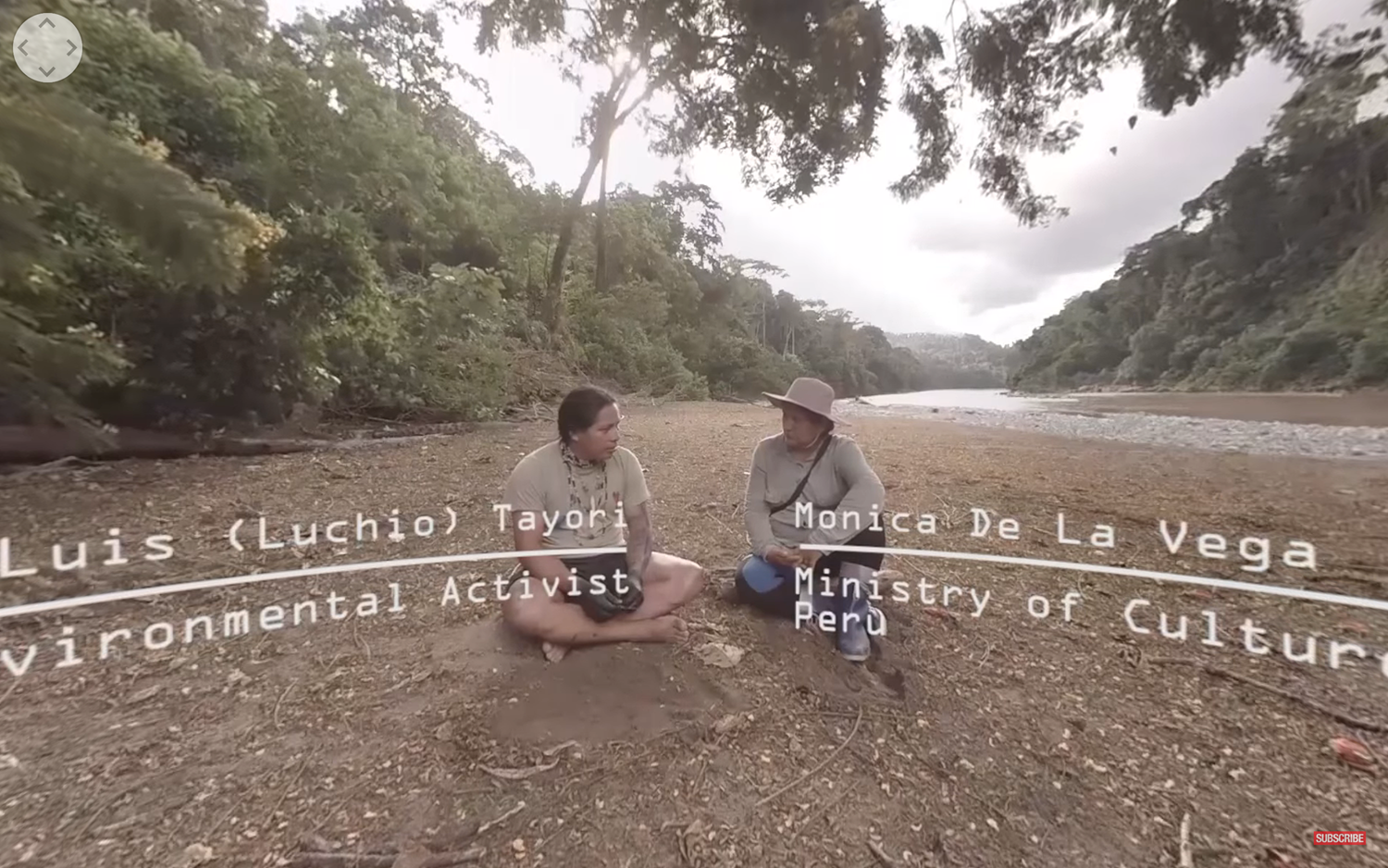
In Hunt for the Inca Ruins, viewers join Lucho Tayori of the Harakmbut tribe on an expedition into Peru's Amazon rainforest (Figure 2). Tayori seeks to have an undocumented Incan house formally assessed by two Peruvian Ministry of Culture archaeologists in order to include it within the tribe's protected reserve. The stakes are high: the area is flagged for oil and natural gas development, subject to looters, and only official listing can prevent the reserve's destruction. The journey to the site is difficult, and when one of the archaeologists is injured and turns back, the Harakmbut's endeavor is put in jeopardy: can they save their heritage?
Hunt for the Inca Ruins, viewed as a 360° video on YouTube, featuring Luis Tayori and archaeologist Monica De La Vega. Used with permission of Frontline/Public Broadcasting Service 2017.
Hunt for the Inca Ruins is more than an immersive experience. As a field archaeologist who has worked with Aboriginal stakeholders in commercial prospecting and developments in Australia, I found it at once an all too familiar narrative and an accurate representation of the nature of archaeological survey. Even though the scientific process was largely absent from the narrative, this too is arguably an honest depiction. In my experience, the scientific procedures of archaeology are the simplest aspects of the job, whereas physical hardships and politics are far more challenging and high stakes. The emphasis on story over style allows the personalities and the social relevance of archaeology to take precedence, and the gap between community and bureaucratic needs is an aspect of heritage rarely made visible to outsiders. I also appreciated seeing an archaeological story that was not about famous or spectacular sites, but rather about the cultural significance of ordinary places and the environment.
Because Hunt for the Inca Ruins is a product of journalism rather than academia or activism, it was regrettably short on credit information (both for the filmmakers and archaeological researchers), details of underlying research, and actionable steps for viewers—which, taken together, feels like a missed opportunity. And although it is more humanizing and revealing than the standard educationally driven online tours that proliferate in archaeological and museum outreach, Hunt for the Inca Ruins is admittedly less affecting than traditional documentary films where one's connection with the subject matter has time and space to grow. The audience reach, however, is considerable: although it had only 45,900 views on YouTube over a three-year period, it also drew over 2,773,000 views on Facebook, including over 11,000 shares and 900 comments to date. What Hunt for the Inca Ruins does particularly well—and what is most promising for archaeological storytelling—is how it elegantly demonstrates Khonsari's principle “story first, technology second,” elevating immersive technologies into meaningful, shareable stories that not only retain an online audience's attention but that are also nuanced, memorable, and worthy of the people and pasts they represent.
STORYTELLING WITH INTENT
A very different case study is the i-Doc Saydnaya (Amnesty International 2016), which profiles a prison of the same name near Damascus, Syria. Neither journalists nor human rights monitors have been able to enter the prison, so the only information about it comes from satellite imagery and survivor testimonies, which together suggest that Saydnaya is a site of torture and mass executions. Between 2015 and 2016, Amnesty International, in collaboration with Forensic Architecture (FA), which is based at Goldsmiths, University of London, investigated the prison using testimonies from 84 survivors, former guards, family members, and others. FA used these findings to create a 3D model and an i-Doc, which Amnesty International, in turn, uses to center its associated human rights campaign.
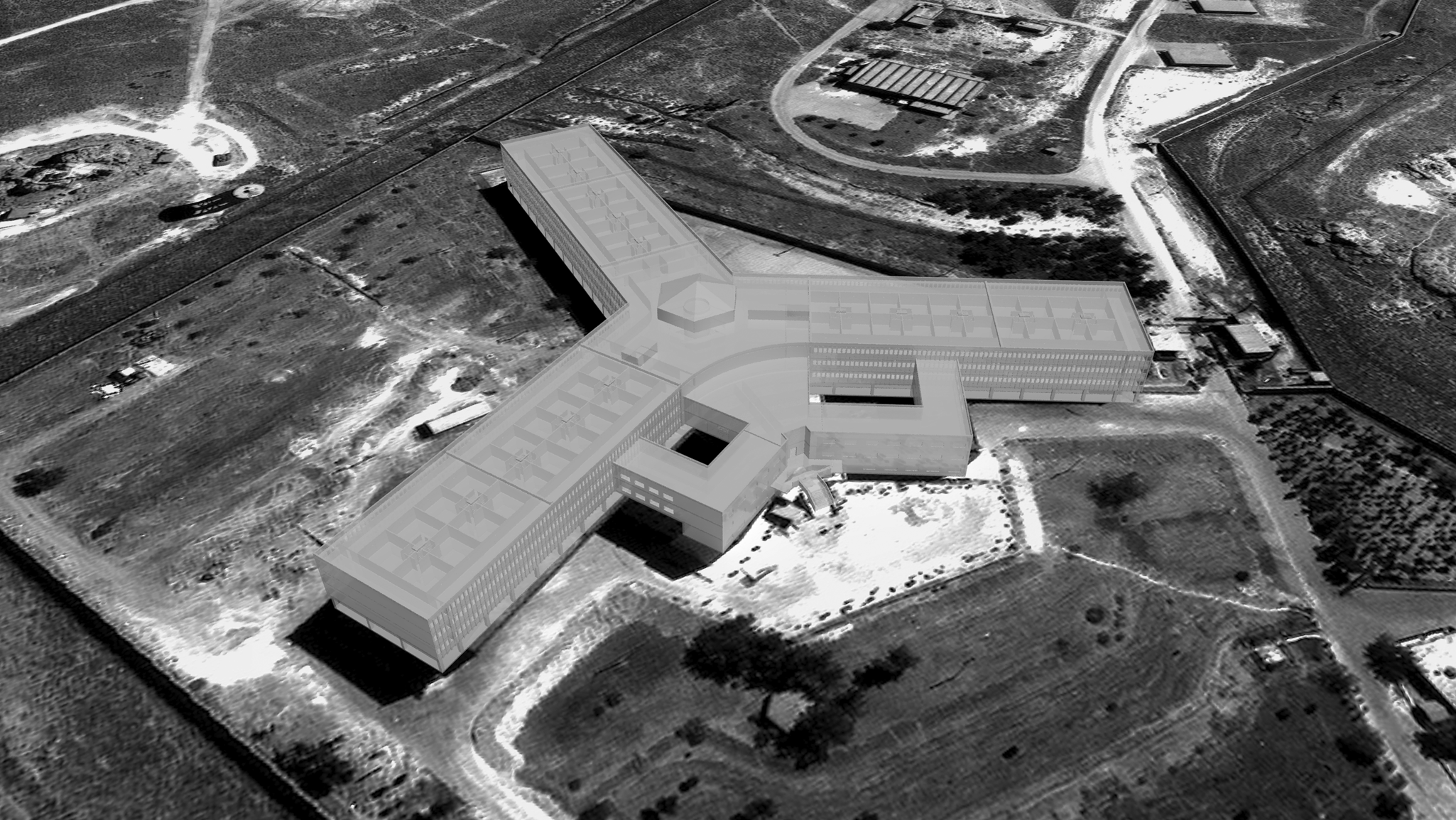
The Saydnaya i-Doc operates on three levels. First, as a work of spatial storytelling, it combines satellite imagery, archival film, interviews, animations, forensic acoustics, and 3D architectural and object modeling to reconstruct life in Saydnaya virtually. Second, it is a campaigning tool: users are directed throughout the i-Doc to write letters (hosted on the platform) to lobby governments into political action. Users are encouraged to share the i-Doc via social media embedding, thereby recruiting the audience into being collaborators in the campaign. Third, the 3D model produced by the project (Figure 3) serves as evidence within Amnesty International's Human Rights report (2017) and the report's future legal applications.
Saydnaya prison, as reconstructed by Forensic Architecture using architectural and acoustic modeling. Used with permission of FA 2020.
As an i-Doc, Saydnaya has some limitations. Although the videos and report can be viewed on smartphones, access to the full interactive experience is restricted to desktop computers, which limits its reach. In addition, the click-and-grab interface is clunky and awkward, which may be frustrating for VR buffs and gamers—but then again, it is not attempting to be a game.
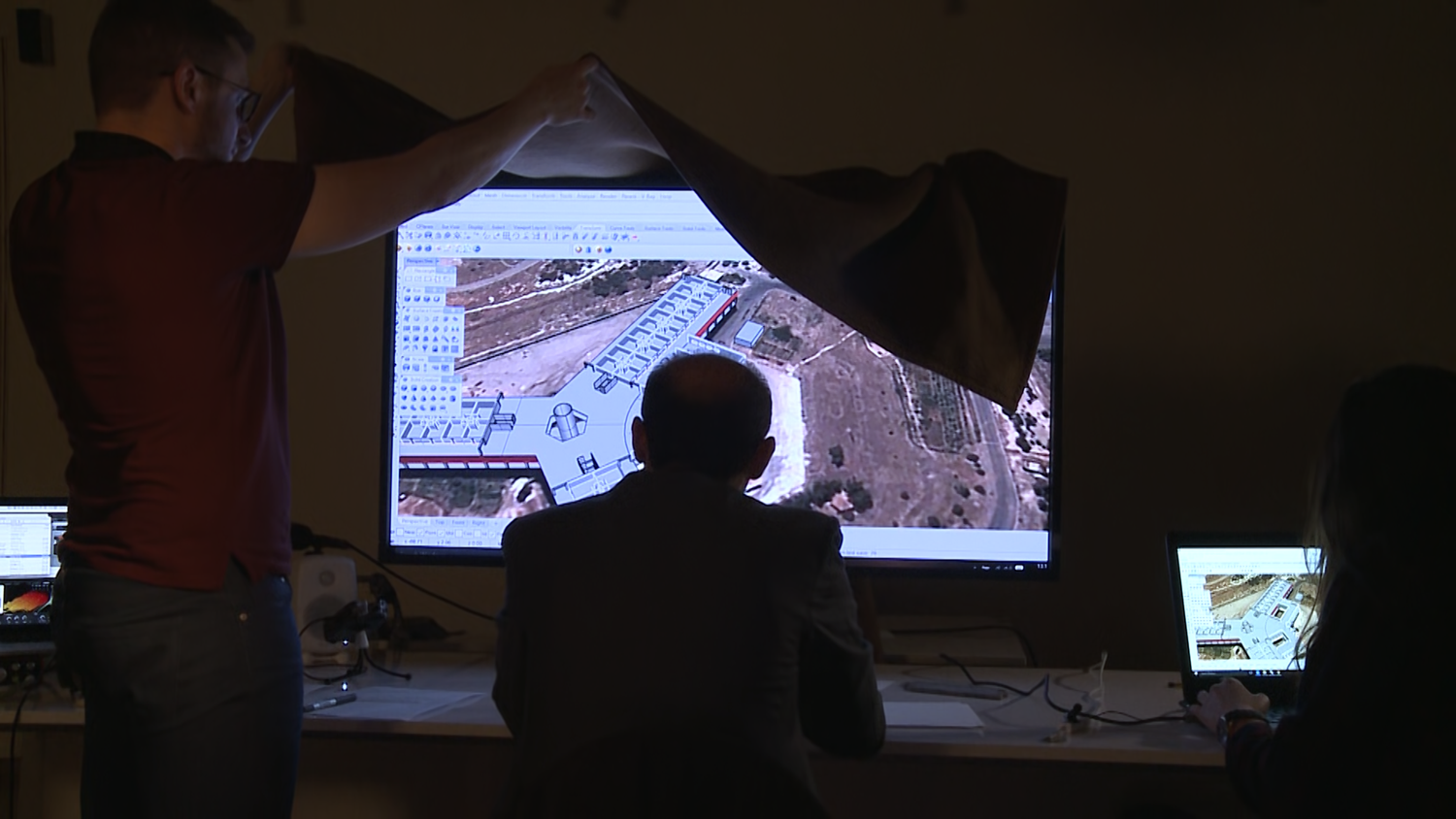
As an immersive experience, it is deeply confronting. I chose to watch the videos first rather than encounter them within the 3D model (the other option). Consequently, the soundscape was explained to me by the survivors before I experienced it. Once I was immersed in the model, the full meaning of the soundscape hit me—the footsteps, whispers, drips, shouting, blaring music—and I found I had to take off my headphones repeatedly, look away, and just breathe. My reaction was that visceral. Saydnaya is an expertly woven story of sound, 3D modeling, and oral testimony that not only humanizes an otherwise inaccessible place but also potently demonstrates how profoundly affecting immersive storytelling can be (Figure 4).
A detainee works with Forensic Architecture researchers to re-create elements of the prison in April 2016. Used with permission of FA 2020.
In archaeology we often work on sites or with objects that are evidence of horrific violence or atrocities, whether in the distant or recent past. Forensic Architecture's Saydnaya demonstrates a possible solution to some of the problems archaeologists face in how to undertake digital, community, and public engagement around such places. Not only does Saydnaya show how a place can be made to exist virtually (nothing new there), but it also provides an example of how to do this in a way that is at once factually accurate, respectful to participants, emotionally affecting, and socially constructive—elements that together enable a fair representation of the site, research project, and people involved. Importantly, the production process itself and the underlying research are codependent, informing each other. Instead of the film being a tag-on made after the fact, the authors “write with film”—the production is part of the research question, method, and findings. Saydnaya also demonstrates how we can ethically approach personal and politically sensitive stories about the past. For example, the participants clearly work as coauthors in the modeling and, consequently, in the storytelling, and the collaborative process shown in the videos appears to be sincerely empowering to survivors. As Diab Serriya, one of the witnesses, says, “You've made me really happy. I'm so relieved about this being done right, finally it's done. People should know what happened there, how many people were tortured, how many died” (FA 2020). In this way, film's usual hierarchies of authorship, knowledge creation, and storytelling are reduced and replaced with an ethic of participant co-creation and collaboration. Saydnaya also shows how stories can be effectively designed with marketing or activism intentions so as to direct audiences to take real-world actions. A similar approach could be adopted in archaeology when communicating about sensitive sites, such as endangered heritage, sites of past violence, and shipwrecks. Finally, Saydnaya shows how other valuable types of information such as updated reports or articles can be literally embedded into the storytelling structure, such as the inclusion of Amnesty International's official “Syria: Human Slaughterhouse” report (2017), which was published after the i-Doc's launch and made accessible within the 3D model. Users can therefore access and assess the accuracy and quality of the model, the original research, and the authors’ credentials themselves via Amnesty International's embedded report as well as Forensic Architecture's detailed project profile on its website (FA 2020).
LOOKING FORWARD, LOOKING BACK
Challenges remain as archaeology begins to engage with i-Docs. The risk now, as highlighted by Urrichio (Reference Urrichio, Aston, Gaudenzi and Rose2017), is that the market behind these new technologies is more interested in pushing the boundaries of what is possible and less concerned with addressing problems of truth, representation, agency, access, governance, or ethics across these new media. And as Aufderheide observed, new technologies cannot solve the old problems of “truthfulness” that have existed since filmmaking began (Reference Aufderheide2007:126).Footnote 2 Consequently, we as archaeologists still need to come to terms with our expectations of film and archaeology's place within it, and vice versa, before we commit to new formats like i-Docs (Rogers Reference Rogers2019:244).
Other challenges are more of a practical nature. The i-Docs sector still has no stable software engines for creating i-Docs (Hight Reference Hight, Aston, Gaudenzi and Rose2017:89). Hosting is also an issue because video servers are tied to ad servers, so web-based i-Docs compete for the bandwidth required to support interactivity (Golding, cited in Dovey Reference Dovey, Aston, Gaudenzi and Rose2017:279). This may change with improvements in VR platforms and 5G rollouts, although as Dovey posits, the field may also never stabilize (Reference Dovey, Aston, Gaudenzi and Rose2017:273). Financially, no i-Doc has yet achieved the commercial success of a cinematic documentary film, and with high costs and little to no remuneration, i-Docs are unlikely to appeal to profit seekers. The audience reach and impact of i-Docs is also debatable. The average i-Doc user appears to spend only short periods committed to a website (as little as 2.5 minutes). And as for AR, VR, and 360˚, these can be experienced only by single-viewer or small audiences, and they are still largely restricted to touring schools, festivals, galleries, and special events (Aufderheide Reference Aufderheide2015:77; Dovey Reference Dovey, Aston, Gaudenzi and Rose2017). To further confound matters, “impact” proves to be a nebulous concept that is difficult to measure beyond hits and users’ “time spent” (as frequently used in website impact assessments)—especially given that time is not necessarily an indicator of quality of engagement, and viewer metrics can infer neither long-term social change nor co-creator/participant benefits (Dovey Reference Dovey, Aston, Gaudenzi and Rose2017:274; Nichols Reference Nichols2016:200). Distribution pathways and funding streams are insecure due to the fact that i-Docs are simultaneously open source and free to access, yet they lack market demand. From one angle, these dilemmas could also be viewed as an unfettering of digital documentary storytelling from the demands of commercial interests, marketing metrics, and closed-source technologies. From another, acknowledging that nothing online comes for free, and that internet users are already being made to “pay” for content by surrendering their personal data (Moskowitz Reference Moskowitz, Aston, Gaudenzi and Rose2017:172), we can probably expect the same trade-off to begin to occur in the i-Docs sector.
So far, i-Docs have survived for over 20 years, and they continue to gain the positive critical reception along with the technological and social infrastructure they need in order to be sustained. i-Docs are showcased and awarded across the broadcaster and film festival circuits, as well as in journalism and technology sectors, from the Emmys and Cannes to the Pulitzers and the Webbys. Practitioner hubs—such as the i-Docs Symposium and MIT's Open Documentary Lab, as well as the subconferences held at Sheffield Doc/Fest, Tribeca, Cannes, Sunny Side of the Doc, and IDFA DocLab—suggest that the industry is committed to their further development. Yet, this new media landscape is also akin to that of early cinema, including all the economic, legal, technological, artistic, ethical, and economic challenges and opportunities it faced. As the i-Docs sector continues to experiment and evolve, it is up to archaeologists to engage with and make the most of this new format.
Acknowledgments
This review is partially based on a presentation at CAA 2018, and it draws from the author's doctoral thesis (Rogers Reference Rogers2019). Thanks to Dr. Sara Perry, Professor Stephanie Moser, and Dr. James Miles for their kind support.



