Introduction
Digital technology facilitates information sharing among activists, enabling previously untenable collective action; however, it also affords autocrats new vectors of control, allowing them to surveil and subjugate dissenters, coopt opponents, preempt, and repress dissent (Dragu & Lupu, Reference Dragu and Lupu2021; Keremoğlu & Weidmann, Reference Keremoğlu and Weidmann2020; King et al., Reference King, Pan and Roberts2013; Roberts, Reference Roberts2018). Evidence suggests the credibility of both sides of the argument. Digital technology has intensified the dictator’s dilemma of gaining enhanced information from the internet while maintaining control at the same time (Feldstein, Reference Feldstein2021; Frantz et al., Reference Frantz, Kendall-Taylor and Wright2020). The gains include increased commerce and economic prosperity, and greater information available about citizens’ preferences, whereas controls are important for censorship and repression of dissent.
The dilemma is amplified in the context of online opinions. In general, public opinion is a double-edged sword in an autocratic setting. Given limited channels for gathering citizens’ preferences, public opinion data allows autocrats to gauge public sentiment and respond better to citizens’ demands (Chen & Xu, Reference Chen and Xu2017); but they can also spiral out of control and destabilize regimes (Feng et al., Reference Feng, Wang and Wang2023; Hassid, Reference Hassid2015; Jiang et al., Reference Jiang, Meng and Zhang2019). Expressions of online public sentiment are, therefore, monitored and subject to constant surveillance and censorship in autocracies. In the offline world, this is equivalent to setting up a public speaker’s corner that permits the free expression of ideas but at the same time sends plainclothes police to monitor the discussion, intercepting, and removing people when they veer into sensitive topics or when debates become too heated. Analyses of the management of online opinion also provide a critical window into understanding the way the state conducts digital repression and exercises digital statecraft.
Main Arguments and Methodology
In this Element, we examine how the Chinese state manages, moderates, and represses online opinion. Drawing on public procurement documents, we study how the Chinese Communist Party (CCP) organs and Chinese government agencies at national and subnational levels have intended to manage online expression of public opinion. We read into their intentions by scraping and analyzing more than 3,000 public procurement documents that solicit bids for the provision of services related to the moderation of online public posts about party-state institutions. A vast majority of the providers are for-profit corporations, opening a Pandora’s box of state‒business dynamics. Private corporations, along with for-profit arms of state-owned enterprises (SOEs) and public sector organizations, are extensively involved in surveillance of public opinion on behalf of the party-state. Our empirical investigation of public procurement documents reveals what services are solicited and how they will be provided, the monetary value of the transactions, and the locations of service providers and procurers.
By “managing online opinion,” we mean monitoring and analyzing online content, detecting politically sensitive posts, deciding whether the posts violate rules, and if they do, determining the course of action and doling out punishment. Drawing from an analysis of more than 3,000 public procurement documents, we found that the Chinese state has outsourced various functions of online surveillance to three types of providers: private corporations, public sector organizations, and for-profit arms of SOEs. These providers deliver technical knowhow, professional expertise, personnel training, and location-specific political advantages that allow the party-state to harness big data, technology, and skilled personnel to moderate the expression of online sentiment. Our data on government procurement contracts also allows us to categorize the services procured into several risk levels and delineate the providers by location (by province and centrally administered municipality), ownership nature of firms (SOEs, private firms, or public sector organizations), and whether the procurer and provider are located in the same province.
Furthermore, we conducted nearly a dozen elite interviews with various stakeholders in the ecosystem of online opinion management, namely company executives in the opinion management business; directors of propaganda departments at a university, Xinhua Daily and other local newspapers, a public sector organization, and party standing committees; the chief of a local public security bureau; the CEO of a national-level newspaper; and a manager at an internet giant (Weibo, Tencent, or Douyin). These primary elite interviews conducted from August 2022 to August 2024 – challenging to secure in the tightly controlled political environment under Xi – shed light on the stakes involved in the management of online sentiment, the outsourcing of surveillance, the segments of surveillance and censorship conducted in-house, and manner in which it is conducted as well as the punishment of online offenders from the perspectives of procurers, providers, and public security. (See Appendix C for the full list of interviewees.)
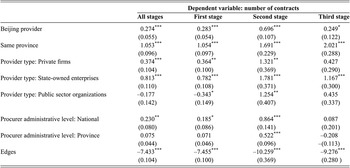
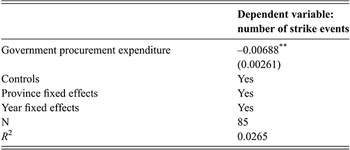
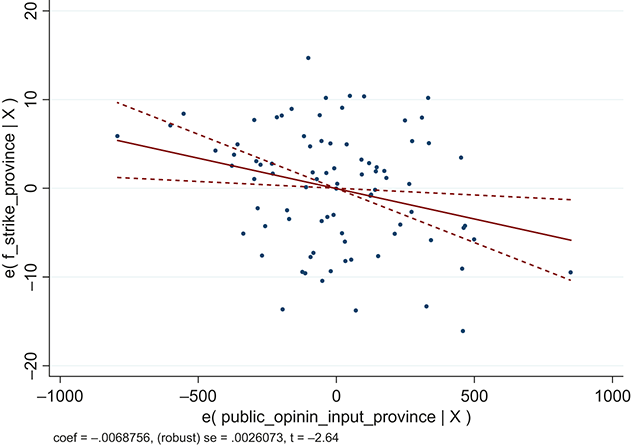
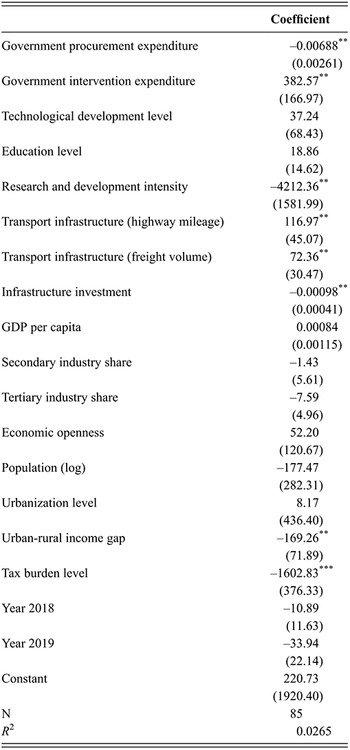
We found that outsourcing surveillance is intended to augment state technical capacity to monitor and moderate online sentiment that state procurers will not be able to do otherwise. Outsourcing surveillance services to private and other for-profit cooperations brings onboard a range of technical expertise that enables party-state agencies and organs in China to detect preemptive signs of dissent, moderate online content that varies according to its threat level, determine the appropriate course of action for offensive posters, and address the political implications of online mass incidents. We also found that procurers usually prefer providers located in the same province and state-owned over private enterprises, ceteris paribus. When it comes to higher-risk services, however, their preference switches to Beijing-based providers and even greater preference for SOEs over private firms. We also found that government procurement expenditure has a preemptive effect on reducing labor strikes, lending evidence for online opinion management serving as a form of preventive repression.
Literature Contribution
This Element contributes to the literature on digital repression, state‒business relations, and conduct of digital statecraft in general. While digital repression and its relations with mass mobilization, censorship, social control, and regime durability have been the subjects of intellectual inquiries elsewhere (Gueorguiev & Malesky, Reference Gueorguiev and Malesky2019; Han, Reference Han2018; Hobbs & Roberts, Reference Roberts2018; Miller, Reference Miller2018; Roberts, Reference Roberts2018; Pop-Eleches & Way, Reference Pop-Eleches and Way2021), in this Element, we focus on an aspect that has thus far attracted little or no attention – that is, state’s outsourcing of digital surveillance to private and for-profit entities, rather than conducting it themselves. We argue that the outsourcing of digital repression augments the state’s technical capacity, enabling it to moderate online content in a differentiated manner instead of applying a one-size-fits-all approach. It thus serves a purpose different from the outsourcing of repression in traditional contexts, that is, plausible deniability (Ong, Reference Ong2018, Reference Ong2022). In other words, outsourcing of digital repression is about augmenting state capacity, whereas state outsourcing in the physical world, where repressive agents are in plain sight, is motivated by evasion of accountability.
The rise of private technology companies in the US, such as Google and Meta, has given rise to “instrumentarian power” that subverts the state’s regulatory power (Christin, Reference Christin2017; Zuboff, Reference Zuboff2020). State–business relationship dynamics are, to say the least, “different” in China, much to the state’s advantage. Beyond the notion that private businesses in China are becoming an appendage of the state (Liu, Reference Liu2024; Pearson et al., Reference Pearson, Rithmire and Tsai2023; Zhang, Reference Zhang2021), our findings suggest that by outsourcing surveillance of online content to for-profit corporations, the Chinese state has augmented its power to shape social behavior via these corporations. Just as importantly, we found that state procurers have an inherent preference for working with SOEs in terms of political risky services because their regime-insider status could help mitigate such risks.
Digital technology has fundamentally transformed the nature of statecraft (Fourcade & Gordon, Reference Fourcade and Gordon2020). In the digital age, the unit by which the state assesses the legibility of society has transformed from census data and statistics collected by the bureaucracy (Scott, Reference Scott1998) to big data enabled by algorithms. More importantly, algorithms-enabled governance extends beyond a high modernist state that compromises local knowledge for universality, which Scott (Reference Scott1998) criticizes – it captures fluidity and local richness. In the digital era, the source of state power has also shifted to the scale of data in its possession; however, unlike census data, the state no longer has the mandate to monopolize digital data collection. Data-driven corporations, many of which are privately owned, have become “partial sovereigns” or “private authorities” in domestic politics and international relations (Srivastava, Reference Srivastava2023). In the West, the prevailing relationships between the state and these corporations range from commercial cooperation and private challenges to the state to one that threatens the state’s domination and undermines its legitimacy (Fourcade & Gordon, Reference Fourcade and Gordon2020). Accordingly, the center of gravity has shifted from the traditional collector of statistics to a landscape of governance where power accrues to whichever entity or corporation holds the most data (Taylor & Broeders, Reference Taylor and Broeders2015).
Yet, in the context of China, the balance of power is still in the state’s favor despite the prevalence of digitalization of data. Outsourcing of surveillance has enabled the exercise of digital statecraft, akin to its exercise of everyday state power in the offline world (Ong, Reference Ong2022). The Chinese state has extended the contours of that power to the digital realm, enabling it to not only influence how netizens interact but also to preempt collective actions against the state. Instead of “competing sovereigns,” private platforms are reigned in and controlled by the Chinese state – as the latter decides what functions and institutions to outsource to private entities. In the realm of online opinion management – the focus of this Element – state procurers consciously decide what aspects of digital surveillance to outsource to private corporations versus SOEs. While state procurers may work with private providers for standardized technical solutions that are low-risk in nature, they inherently prefer dealing with SOEs – particularly those based in Beijing – with respect to politically-risky services, such as handling of offending posts, punishment of offending posters, and training of in-house personnel to deal with online mass incidents. The regime-insider status of the SOEs privileges direct access to the central leadership, giving rise to opportunities to include in internal briefings to the leadership crafted narratives that frame their clients in a favorable light. This is an inherent advantage of Beijing-based SOEs that other types of providers are not able to duplicate.
This Element is divided into five sections. In Section 1, we provide an overview of public opinion literature in China, with emphasis on the Party’s attempt to control and shape online opinion. In Section 2, we review theoretical literature on digital repression, state outsourcing of surveillance to for-profit businesses, and the consequent reshaping of state‒business relations. In Section 3, we explain our data source and methodology and present our descriptive statistics. We state our empirical findings in Section 4, consisting of text analysis, inferential network analysis, and a regression analysis that provides evidence for the preemptive nature of digital repression in staving off collective action. Concluding remarks appear in Section 5.
1 Public Opinion Management in China
1.1 Growth of the Internet and Its Implications for Public Opinion
Prior to the 1990s, government-controlled media, such as television stations, newspapers, magazines, and Element, were the key channels through which Chinese citizens acquired information. The content of these government-controlled media could be easily manufactured by the state, and public opinion was not an issue of concern for the government at that time. Following the advent of the internet and the proliferation of internet platforms, however, the government could no longer control public content. In fact, online public expression continues to challenge the legitimacy of the CCP more than ever after the emergence of the internet. This calls for the dedication of the Party’s resources to the management of online opinion.
The Chinese public first connected to the internet in 1987. By 1994, the three largest internet portals, Sina, Netease, and Sohu, had gone public on the NASDAQ. Since then, the number of Chinese internet users has grown exponentially, exceeding one billion by 2023, making China home to the largest number of internet users in a single country anywhere in the world. The internet has also popularized the use of social media in China. “Social media,” translated as “self-media” (zimeiti) in Chinese, empowers internet users to self-publish content, comment on public events, and communicate with other netizens – a practice unimaginable before the internet became available. Even though freedom of expression is still elusive in China, self-media has vested in the people the power of self-expression in mediums the party-state lacks the capacity to fully regulate or control. Thus, it elevates the right to express opinions and grievances to an entirely new level in China.
The most popular social media platforms in China include WeChat (45 percent market share in 2021), Douyin (25 percent market share), followed by Weibo and Kuaishou (20 percent market share each), Bilibili (8 percent), Little Red Book (7 percent), and Zhihu (4 percent).Footnote 1 Weibo, a microblog launched by Sina in 2009, was designed to facilitate the formation of public opinion in China (Stockmann & Luo, Reference Stockmann and Luo2017). From 2012 to 2018, the number of Weibo users grew rapidly with an annual growth rate of 30 percent. Its popularity declined after the government clampdown of internet celebrities or “big Vs,” that is, opinion leaders with large numbers of followers. After the crackdown, its popularity declined and was overtaken by WeChat, founded by Tencent in 1998. In contrast to Weibo, WeChat was designed to foster social relationships by facilitating information sharing, e-payment, online gaming, and other functions. Despite Weibo’s smaller user base, it remains important in shaping public opinion because of its nature as an open platform.
Interactive communication on social media has the potential of vastly amplifying extreme public sentiment. When the COVID-19 virus first broke out in early 2020, the death of “whistleblower” Dr. Li Wenliang, who alerted the public to the possibility of a new type of pneumonia, sparked an outpouring of grief and public outrage on Weibo over a cover-up of the outbreak by Wuhan officials. In summer 2022, the mishandling of the stringent lockdown by Shanghai municipal authorities also sparked outrage on Weibo. Shanghai residents posted pictures of relatives denied hospital care and arbitrarily deployed to makeshift quarantine centers as well as inhumane lockdown conditions. Despite increased government control over social media in recent years, Weibo still has the capacity to ignite public grievance over issues of concern, particularly those related to social injustice and the official abuse of power.
In 2011, Tencent, one of the largest internet companies in China, launched WeChat (Weixin), a smartphone-based social networking app. Unlike Weibo, it is a walled app, that is, users must add others as “friends” to be able to see their posted content. WeChat allows registered users to send text, voice, photos, and videos; make calls to one another; post content to a “circle of friends”; create “public accounts” for public viewing; and conduct financial transactions. Because of its multiple functions, particularly its utility for users to communicate with family and friends conveniently, it quickly became the most important daily communication tool in China. Starting with 157.9 million registered users in 2012, the number of WeChat users continued to grow after 2018, with an estimated 1.3 billion users by 2023, surpassing the number of Weibo users by many times. Almost all Chinese adults have a registered WeChat account, including farmers in the most remote mountainous regions.
1.2 Management of Public Opinion in China
In China, where few mechanisms for public accountability exist, online opinion serves as an important barometer of social moods to gauge public sentiment. “Online mass incidents,” that is, complaints about local officialdom, corruption, police violence, or the abuse of labor rights by a large group of netizens persistently over time, convey information to relevant authorities regarding the source of public grievance; however, negative sentiment directed against government officials can damage the CCP’s legitimacy. Similarly, online mass incidents can evolve into street protests, thus inviting the party-state to intervene, particularly before they spiral out of control.
After the Tiananmen Incident in 1989, the Central Propaganda Department was revamped to strengthen the media’s role in maintaining social stability and preventing political liberalization (Brady, Reference Brady2008, pp. 44–47). During the mid-1990s, the CCP not only promoted nationalism to shore up popular support, but it also carefully curated patriotic propaganda work to direct nationalism against foreign targets. A prime example was the government-sanctioned mass rallies at US embassies after the US bombing of the Chinese embassy in Belgrade in 1999 (Brady, Reference Brady2008, pp. 51–56). When faced with growing corruption and abuse of power by local government officials, the CCP expanded “public opinion supervision” (yulun jiandu) in the 2000s to encourage news media to report official misconduct. The prevalence of online media that cannot be controlled through traditional propaganda tools has, however, posed novel challenges to the Party (Creemers et al., Reference Creemers, Morgan, Verhulst and Price2013, pp. 274–275). The traditional propaganda techniques of licensing and media directives are ineffective in dealing with public opinion in the digital media age. Print media is not only regulated by government licensing, but it also tends to be region-based and has only regional circulation; whereas online media platforms, such as Weibo, abolish geographical boundaries and bring together all citizens with access to the internet (Creemers, Reference Creemers2017, p. 97).
Stated in the introduction, internet surveillance poses a fundamental dilemma for the Party. Although the CCP recognizes the growth of the internet as essential for economic development and gauging public sentiment, it is also acutely aware of the potential peril to its grip on power. The central leadership uses social media to monitor local officials and detect malfeasance. Online public platforms, such as Weibo, allow for the expression of wide-ranging voices, some of which are critical of the government. Netizens regularly call attention to social injustice and local government malfeasance; they occasionally galvanize support for collective action (Qin et al., Reference Qin, Strömberg and Wu2017). During the more liberal 2000s, netizen activism provided ammunition to liberal-minded political leaders in their power struggle against hardliners, yielding positive policy change (MacKinnon, Reference MacKinnon2011). Online activism associated with the Sun Zigang incidentFootnote 2 and the Wukan protests over land grabs in Guangdong under the liberal party secretary Wang YangFootnote 3 are testament to the power of the internet to bring about positive policy change (Associated Press, 2012; China Labour Bulletin, 2013).
Negative online sentiment can quickly spiral into uncontrollable mass rage or online mass incidents that hurt the CCP’s legitimacy. The central government learned a hard lesson from the 2011 Wenzhou train crash, in which two high-speed trains collided and caused 40 deaths and 200 injuries. The fatal accident caused the public to question the safety of high-speed rail in China. When the propaganda authorities tried to cover it up by issuing directives to bar journalists from covering the incident, netizens took their anger online, demanding “the right to know the truth!” (Bondes & Schucher, Reference Bondes and Schucher2014; Branigan, Reference Branigan2011).
The Party has learned that it must occupy the “public opinion battlefield” (yulun zhanchang) (Creemers et al., Reference Creemers, Morgan, Verhulst and Price2013, p. 275), yet it has neither the capacity (Yang, Reference Yang2009) nor the intention to eliminate all expression of public opinion (Lorentzen, Reference Lorentzen2013). Social media serves as a tool for protest surveillance (Qin et al., Reference Qin, Strömberg and Wu2017). Research has shown that the Party is most likely to intervene in online conversation at the tipping point of its evolution into collective action – it silences comments that instigate social mobilization rather than those that express negative or vitriolic criticism of the government (King et al., Reference King, Pan and Roberts2013).
A dominant strategy in online crisis management is to mobilize internet commentators to neutralize or overturn negative sentiment. This internet strategy, known as “astroturfing,” mobilizes either paid individuals or volunteers to moderate discussion and manipulate public opinion (Han, Reference Han2015).Footnote 4 Part of the so-called “fifty-cent army” in China, these internet commentators are allegedly paid fifty cents for every post (Fong, Reference Fong2014).Footnote 5 They are frequently deployed during “online mass incidents” to prevent negative opinion from erupting into collective action. In 2008 after the Weng’an riots, in which rioters in a city in Guizhou set fire to government property to vent anger over the abuse of official power in the suspicious death of a young girl, online commentators were quickly deployed to pacify public outrage (Hung, Reference Hung2010).
1.3 Incentive Structure of Government Officials
To understand how local officials manage online opinion, we must appreciate the changing bureaucratic and incentive structure of local officialdom. In the past two decades, cadre evaluation has shifted from the prioritization of growth to that of social stability and subsequently national security; furthermore, compared to his predecessors, Xi Jinping’s approach of managing online public discourse is more centralized, top-down, and proactive (Creemers, Reference Creemers2017).
Before Xi took power in 2013, the Ministry of Industry and Information Technology, operating under the State Council, oversaw the technical aspects of information and networks while the State Internet Information Office (SIIO) supervised internet content. The SIIO was set up in 2011 to implement guidelines and laws for the dissemination of internet information, including the investigation of unlawful websites and the punishment of offenders. The SIIO was renamed the Cyberspace Administration of China or CAC (guojia hulianwang xinxi bangongshi) in 2014. It was transformed into the executive arm of the newly established Central Leading Group for Cybersecurity and Informatization – a powerful central party organization – that Xi leads directly (Bandurski, Reference Bandurski2017; Fedasiuk, Reference Fedasiuk2021).Footnote 6 The CAC took over law enforcement related to the internet from the Ministry of Public Security (Luo & Lv, Reference Luo, Lv, Tusikov, Haggart and Scholte2021).
At the inaugural meeting of the Central Leading Group, Xi emphasized “no national security without cybersecurity” (meiyou wangluo an’quan jiu meiyou guajia anquan) (Niu & Yuan, Reference Niu and Yuan2022). This has several implications for internet control. First, cybersecurity has been elevated to the level of national security. Previously, informatization and internet networking were considered important symbols of “modernization” and part of economic development. Now under Xi, internet networking is directly linked to national security. Second, the Party central has taken the helm of cybersecurity work, with coordination from the State Council. Third, online opinion ‒ as part of internet network security ‒ has become integral to national security. In short, the Party must prioritize online opinion, which it perceives as having a direct impact on its ruling legitimacy. Accordingly, government officials at all levels have attached substantial importance to the moderation and management of online opinion.
The central government has also introduced a series of accountability measures for government officials with respect to emergency management and comprehensive social governance of online opinion.Footnote 7 Handling online opinion could quickly spin out of control, yet it is an integral part of local governments’ emergency management (difang zhengfu yingji guanli). Government officials are subject to accountability measures and punishment that fall under “comprehensive social governance” (shehui zonghe zhili), a broad concept encompassing both social security (shehui zhi’an), indicated by the occurrence of criminal cases, such as theft, robbery, and killing; and social stability (shehui wending), measured by the number of collective petitions or major online opinion incidents, such as the outbreak of negative publicity or scandals involving government departments.Footnote 8 We underscore incidents that threaten social security and social stability as having a “veto” effect on the performance of local officials: Officials are subject to punishment if they fail this task, even if they excel in other aspects of their work.
In view of the overwhelming emphasis on national security, which encompasses internet security, President Xi has called for a whole-of-society approach to maintain social stability, including preventing online mass incidents. This approach extends beyond motivating the bureaucracy to use institutional incentives to mobilizing the society – including government-affiliated and nongovernment organizations such as financial institutions (see interview quote below) – to prioritize the preservation of physical and internet security.
Our interview with the manager of a Xinhua Daily subsidiary specializing in online opinion management reveals this very point:
We have three major types of clients. First, the municipal and county governments, which are assessed by the higher authorities on their ability to monitor and analyze major public opinion incidents. Second, government departments that deal with people’s livelihoods, such as the water conservancy department or environmental protection bureau that regularly receives public complaints about polluting enterprises. Third, financial institutions, such as a bank in Jiangxi province that had issued illegal high-interest loans to absorb savings, which then became the target of public complaints.
The response from the manager in charge of online opinion management at a local newspaper affirms the interview #3 and divulges more details about the nature of demand for these services:
We offer services in this area, including monitoring, manual warning, research and assessment, and customized training in online opinion management. Most district (qu) and county (xian) governments spend about 200,000‒300,000 RMB annually, the demand for which mostly comes from party and government organizations, but also schools, state-owned and private enterprises. From the provinces down to cities and districts, government departments that deal with people’s livelihoods, such as drug supervision, transportation, health, water conservation, civil affairs, etc., are generally very concerned with online opinion (because they are at the forefront between state and society). The Internet Information Office (wangxinban) has taken over the power of propaganda offices in the departments that dealt with these issues. Focus is more on managing online than offline opinion.
Regarding public sector organizations (shiye danwei), schools and universities are among the largest consumers of online opinion management services. Our interview with a director of the propaganda department of a university revealed why and how the university sector attaches strong importance to it:
Public opinion management is crucial for universities, especially during the pandemic. At our university, it is directly looked after by the university’s party secretary (the most powerful university administrator, even ahead of the principal). At universities, the publicity department under the university party committee is responsible for public opinion management for the university. Furthermore, in our university, the student affairs department, the faculty work department, and the security department, each has its own personnel taking care of public opinion work, while being coordinated by the publicity department of the university party committee.
In recent years, the government has further introduced several laws that laid the legal groundwork for social control in the digital age, such as the 2016 Cybersecurity Law, the 2021 Data Security Law, and the 2021 Personal Information Protection Law. Together, they provide cyber regulatory agencies with greater legal power, such as the power to access citizens’ personal information, to demand enterprises and internet platforms to turn in requested data, and to regulate citizens’ online behavior, such as punishing posters of sensitive content.
1.4 The For-Profit Industry that Manages Online Opinion
Management of online opinion has become an integral part of the government’s propaganda work. Despite the emphasis on all-encompassing dimensions of national security in Xi’s administration, party officials and government bureaucrats lack the technical capacity to properly manage internet security, including surveillance of online opinion. Outsourcing surveillance to technical professionals is thus a logical solution to the constraint of state capacity. Consequently, this has led to the emergence of an industry of market-based public opinion management firms (Batke & Ohlberg, Reference Batke and Ohlberg2020; Hou, Reference Hou2020).
As early as 1997, a total of 850 registered firms specialized in public opinion-monitoring in China, and party-state entities as a whole employed more than two million people to analyze and report online opinion and social trends (Fong, Reference Fong2014). The size of the online opinion industry grew by 10 percent annually during 2016‒2021, from 7.5 billion RMB in 2016 to 13.4 billion RMB in 2021(Co-Research Network, Reference Network2023).Footnote 9
Prior to 2006 and even before the internet became widespread, several semimarket public opinion service organizations already existed, such as the Institute of Public Opinion established in 1986 at Renmin University, the first of such in the country (Wang, Reference Wang2019).Footnote 10 At present, four main types of public opinion service providers operate in China. First, public opinion-monitoring centers set up by government agencies to research and handle public opinion. Second, public opinion service organizations set up by the central media, namely, the People’s Daily and Xinhua News Agency. Both central media organizations have subsidiaries specializing in the provision of for-profit public opinion services. Third, public opinion research organizations created by universities mainly to provide predictive public opinion consulting services. And fourth, fully commercialized private public opinion service corporations, including technical companies, such as Topsy and Bonfigure, and public relations companies organized to provide comprehensive public opinion services, such as Blue Cursor. Among these service providers, the People’s Daily (part of People’s Daily Holdings), the Xinhua News (part of Xinhua News Agency Holdings), and Topsy and Blue Cursor are A share-listed companies in mainland China.
Growth of this for-profit industry is driven by state demand. In addition to the prominence of internet security featured in cadre evaluation, each individual local government agency must “manage” negative public sentiment directed at it. The decentralized nature of the Chinese bureaucracy implies that all party-state organs are duplicated at all administrative levels from the national and provincial (municipal) to the prefecture, county, and so forth. Each entity must devote resources to manage online opinion ‒ public complaints about service, concerns over abuse of power, corruption, mishandling of cases that may lead to “mass online incidents” – that will impact not only the standing of the party-state organs but also performance of the party-state leaders. For instance, when food safety concerns arise in a certain municipality, the onus is on the local food safety bureau to address those concerns before they spiral out of control or escalate to the local party committee, their local reporting agency.
In essence, all party-state organs at each administrative level may demand various services related to online opinion management: monitoring, detecting, issuing early warnings, reporting, content analysis, and handling of offenders. In 2004, the Central Propaganda Department set up a public opinion-monitoring and information bureau to coordinate surveys on sensitive topics, monitor opinions, and commission surveys to provide timely responses to issues of public concern. By 2006, local governments nationwide and public sector organizations had established a bureau within their units (Wu, Reference Wu2018).
Furthermore, public sector organizations (shiye danwei), including schools, universities, research organizations, SOEs, and hospitals, are also potential buyers of such services. These public sector organizations are governed by party committees within them, which report to their respective local party committees (difang dangwei). Much like the party-state organizations, these organizations are similarly evaluated – and thus responsible – for public opinion related to them and the occurrence of protests on campus. In November–December 2022, after three long years of Zero COVID lockdown, students across scores of universities in coastal cities participated in the “White Paper Protests,” expressing solidarity with the fire victims in Urumqi, demanding the end of the Zero COVID Policy and political freedom. During times of social instability, students’ online posts and discussions as well as views expressed by the public are of paramount importance to universities.
2 Theoretical Framework
We draw theoretical inspiration from bodies of literature pertaining to digital repression, outsourcing of repression, and state–business relations. In this section, we briefly review the relevant literature and underscore our contributions.
The digital age has afforded autocrats new technologies for controlling and reshaping state–society relations. In the early days of the internet’s development, analysts were enthusiastic about its democratizing effects: The internet helped to establish solidarity and enabled mobilization on an unprecedented scale (Diamond, Reference Diamond2010; Shirky, Reference Shirky2009). Twitter was perceived to be a key enabler of the Arab Spring (Tufekci, Reference Tufekci2017), yet powerful authoritarian states like China and Russia have demonstrated their capacity to censor online discourse and manipulate public opinion (Dickson, Reference Dickson2018; Hoffman, Reference Hoffman2022; Uniacke, Reference Uniacke2021; Zhao, Reference Zhao2018). For autocratic regimes, digital repression helps to identify regime opponents, monitor regime insiders, gauge public sentiment, manipulate the information environment, compel compliance, and improve perceptions of the regimes by allowing for online participation and deliberation (Xu, Reference Xu2021).
There is a plethora of studies that examine how authoritarian states, including China, conduct censorship to silence criticism and prevent collective action (Gueorguiev & Malesky, Reference Gueorguiev and Malesky2019; King et al., Reference King, Pan and Roberts2013; Miller, Reference Miller2018; Pop-Eleches & Way, Reference Pop-Eleches and Way2021; Roberts, Reference Roberts2018). Existing research has also extensively examined how netizens circumvent government censorship in what is often described as a “cat-and-mouse” game (Chang et al., Reference Chang, Hobbs, Roberts and Steinert-Threlkeld2022; Chen & Yang, 2019; Han, Reference Han2018; Hobbs & Roberts, Reference Roberts2018). What has been left unexamined – but of no less significance – is state’s outsourcing of digital repression to nonstate entities, including private corporations, private actors, and ordinary citizens.
2.1 Outsourcing Surveillance
Since repression provokes resistance and backlash, there is rationale why an autocratic state may not deploy its state agents in physical repressive acts. Instead, autocrats may outsource to thugs or gangsters, and mafias, violent repression that will likely delegitimize the governments (Ong, Reference Ong2018; 2022; Volkov, Reference Volkov2002) or outsource nonviolent repression to local power brokers or relational nodes with the capacity to pressure or persuade the targeted citizens (Deng & O’Brien, Reference Deng and O’Brien2013; Ong, Reference Ong2019).
In the offline world, the Chinese state outsources repression by engaging nonstate actors to do its bidding, in order to reduce resistance and backlash, and to provide plausible deniability (Ong, Reference Ong2022). In the digital realm, where the physical act of repression – that is, surveillance – is unobservable to begin with, might outsourcing repression serve a different objective? We argue that in the digital world, it is intended to enhance state capacity to carry out repressive acts that the state would otherwise lack the technical knowhow to do. Digital repression is sophisticated and technically demanding; the Chinese Party-state organizations lack the manpower or technical capacity to monitor and manage online content, yet investment in in-house capacity is inherently costly. Online opinion management in China is not nationally centralized but instead decentralized to provincial and lower administrative levels. The demands from party-state clients have spawned a multibillion RMB for-profit industry in the management of online content in China (Batke & Ohlberg, Reference Batke and Ohlberg2020).
Outsourcing of state functions takes the form of delegation of roles on a formal (de jure) or an informal (de facto) basis.Footnote 11 Outsourcing of surveillance explored in this Element involves signing of formal contracts between state procurers and for-profit providers. It is thus a deliberate intention of state entities to outsource such surveillance functions to private and for-profit corporations, rather than one based on political expediency by which informal outsourcing tends to be motivated. Existing studies are in congruent with this Element, pointing to increasing prominence of state outsourcing of institutional functions to digital platforms, citizen participation in online censorship, social credit system, and other types of state monitoring (Liu, Reference Liu2023; Liu, Reference Liu2024; Yang, Reference Yang2025; Zhang et al., Reference Zhang, Xu and Liu2025).
2.2 Preventive Repression
Outsourcing surveillance raises the question of whether digital repression is aimed at preempting or reacting to visible contention. Is the Chinese state’s outsourcing to for-profit technology firms intended to detect warning signs of dissent and prevent potential collective action from taking place? Or is it meant to address the consequences of collective action? Existing literature suggests digital technology bolsters state capacity to stifle the ability of opposition groups to mobilize dissent preemptively (Keremoğlu & Weidmann, Reference Keremoğlu and Weidmann2020). In addition, the costs of preventive repression decline with the advancement of technology over time (Luo & Lv, Reference Luo, Lv, Tusikov, Haggart and Scholte2021). To maintain social stability and remain in power, authoritarian regimes must please or repress citizens under their rule (Svolik, Reference Svolik2012). The emerging consensus is that digital technologies strengthen authoritarianism in China rather than undermine it (Hoffman, Reference Hoffman2022). The precision of information enabled by digital surveillance allows autocrats to carry out targeted repression rather than relying on cooptation to buy support from citizens (Xu, Reference Xu2021). Scholars have demonstrated that to curtail offline collective action (King et al., Reference King, Pan and Roberts2013b), the Chinese authorities deploy censorship by increasing the friction of accessing information (Roberts, Reference Roberts2018). Autocrats must also acquire information from citizens and sometimes allow them to air their grievances on public platforms. By allowing citizens to publicly express their opinions on social media, the regime can learn about citizens’ policy preferences (Chen & Xu, Reference Chen and Xu2017).
2.3 Redefining State–Business Relations
The ways in which outsourcing surveillance works in China redefine the nature of state–business relations – another body of literature to which this Element contributes.
The advent of big data has allowed for the harvesting of troves of personal data by private corporations, such as Google and Meta, for commercial gain. The so-called “instrumentarian power” (Zuboff, Reference Zuboff2020) results in the subversion of the state’s regulatory power by private technology firms. Because the US government and institutions, including municipalities, lack the technical expertise to fully harness their data, they must delegate certain tasks to the private sector (Christin, Reference Christin2017). Technology has, therefore, bolstered the power of private technology corporations by giving them more leverage over the state. As delegation to the private sector intensifies, it fundamentally reshapes state–business relations – making the state more reliant on private technology firms for basic state functions.
This Element draws on government procurement data to study state–business relations, a common practice in economics literature. Existing literature suggests politically connected firms that obtain government procurement contracts can transfer benefits to politicians through channels like tunneling (Mironov & Zhuravskaya, Reference Mironov and Zhuravskaya2016) and political donations (Baltrunaite, Reference Baltrunaite2020; Titl & Geys, Reference Titl and Geys2019). Politicians can, however, also exploit their power to favor the allocation of procurement contracts to politically connected firms, leading to increased procurement costs, an argument supported by empirical studies from Italy (Baltrunaite et al., Reference Baltrunaite, Giorgiantonio, Mocetti and Orlando2021) and the Czech Republic (Baránek & Titl, Reference Baránek and Titl2024). In particular, the longer a politician’s term of office (Coviello & Gagliarducci, Reference Coviello and Gagliarducci2017) or the greater the discretion of officials responsible for procurement (Baltrunaite et al., Reference Baltrunaite, Giorgiantonio, Mocetti and Orlando2021), the more likely collusion is to occur between a politician and politically connected firms, resulting in higher procurement costs.
Research on procurement contracts of artificial intelligence (AI)-based facial recognition monitoring technology in China reveals the role of businesses in meeting the state’s objective of political surveillance. Beraja et al. (Reference Beraja, Kao, Yang and Yuchtman2023a) found that the occurrence of local unrest in China leads to more purchases of facial-recognition AI technology by the local governments to enhance political control, which has the effect of suppressing unrest in the subsequent period. AI innovation has facilitated the development of the government’s technological tools for political control, which in turn has stimulated further cutting-edge innovation (Beraja et al. Reference Beraja, Yang and Yuchtman2023b). Together, these studies suggest that state and digital businesses can either collaborate to innovate or collude to suppress dissent.
Recent research based on Chinese government procurement contracts demonstrates politicians’ preference for state firms when incentives and risks increase, ceteris paribus. For example, Tang et al. (Reference Tang, Wang and Wu2025) found that the stronger the political incentives mayors face, the more likely they are to favor local businesses in the government procurement process; however, Li and Liu (Reference Liu2023) found that the anticorruption campaign initiated by Xi Jinping in 2013 has led to significant job insecurity for local officials, resulting in more favoritism toward SOEs.
In this Element, we argue that technology has similarly configured state–business relations in autocratic states like China but not in the manner it has in the USA. Chinese technology firms also have tremendous capacity to collect and harness private data for commercial use, perhaps even surpassing those in the USA. Super-apps like Tencent and Alipay that enable Chinese citizens to conduct everyday transactions, from paying utility bills to taking out a microloan, have access to multidimensional consumer data. The distinction is, the Chinese state can exploit private data about the citizens to extend its reach into and control society. Private corporations have consequently become the state’s appendages that penetrate deeply into and grip society – in congruent with the emerging literature on the political economy on China that suggests the private sector is becoming an extended arm of the state (Liu, Reference Liu2024; Pearson et al., Reference Pearson, Rithmire and Tsai2023; Zhang, Reference Zhang2021).
More importantly, we argue there are limitations to the outsourcing of state functions – in this case, digital surveillance – to private corporations. On politically sensitive and risky services, such as punishment of offenders and justification of remedial actions, state procurers have a distinct preference for SOEs, owing to their regime-insiders status that reduces political risks, and provides the privileged opportunities to gain political favors with the central party leadership. In other words, the phenomenon of the private sector acting as an appendage of the state is bound by the scope condition that the services rendered are low-risk and technical in nature. Outsourcing of repression in this context primarily serves the purpose of bolstering state capacity to impose surveillance on society that it will not be able to do otherwise – an important argument we have alluded earlier.
2.4 Hypotheses
Based on the theoretical framework, we formulate several testable hypotheses for empirical investigation.
First, the purpose of outsourcing surveillance is to acquire specialized external expertise, that is, to augment the state’s existing technical capacity.
Second, the strategy of digital repression is preventive in nature to preempt collective action from taking place.
Third, when faced with greater degrees of risk, procurers will prefer dealing with state-owned providers and those based in Beijing. These providers provide political advantages that help to mitigate risks and elevate the procurers’ profiles.
3 Data Source, Methodology, and Descriptive Statistics
3.1 Data Source and Methodology
Our primary data comes from the Chinese Government Procurement Website (zhongguo zhengfu caigouwang) and procurement sites of the respective twenty-two provinces, four municipalities, and five autonomous regions, where we collected 3,243 government procurement bidding documents awarded from 2009 to 2021. Each document contains information regarding an invitation to bid and the successful bid.
Procurement documents consist of both transacted notices (chengjiao gonggao) and winning tender notices (zhongbiao gonggao). The two types of notices were matched according to the relevant procurer, provider, and solicited service, and then combined accordingly into a single document. A typical procurement document contains information about the procurer and provider of services, time of transaction, transacted or winning bid value, and details of services procured. The procurers comprise party-state organsFootnote 12 at various administrative levels and across regions as detailed in Section 3.2. The providers include SOEs, private firms, public sector organizations, and others.Footnote 13
3.2 Descriptive Statistics
The average value of the winning bids was RMB 659,329; the minimum and maximum values of the winning bids were RMB 2,438 and RMB 18.4 million, respectively. Table 1 indicates that national-level procurers, which are the central party-state organizations, have registered the highest value of winning bids, averaging RMB 271.4 million. They are followed by those at the Beijing municipal level that registered average winning bids of RMB 197.5 million with 219 transactions, the highest in the sample. Guangdong, Zhejiang, and Shaanxi provinces are the third, fourth, and fifth largest procurers, respectively.
| Procurer by province/municipality/administrative level | Winning bids (million RMB) | Number of transactions | |
|---|---|---|---|
| 1. | National | 271.4 | 189 |
| 2. | Beijing | 197.5 | 219 |
| 3. | Guangdong | 143.2 | 161 |
| 4. | Zhejiang | 88.9 | 193 |
| 5. | Shaanxi | 65.8 | 105 |
We further categorize the procurers of services by party-state organizations and divide them into the following finer categories:
a) Party Committees (dangwei): party propaganda departments, internet offices, and other party committees.
b) Government Agencies (zhengfu buwen): government offices; education, research, culture, tourism, and health agencies; government bureaus in charge of market regulations and food and drug supervision; and other government departments.
c) Public Security, Procuratorates, and Courts (gongjianfa).
d) Public Sector Organizations (shiye danwei): schools, news media, research institutes, hospitals, and other public institutions.
e) Others: SOEs, military, and social groups.
Table 2 shows public sector organizations as the largest procurers by the number of procurers and the value of transactions, followed by party committees, government agencies, and public security, courts and procuratorates. More importantly, after breaking them down into subcategories, internet offices and party propaganda departments constitute the two largest categories, followed by schools, and government agencies in education, research, culture, tourism, and health combined.
| Procurer by type | Number of procurers | % | Transaction amount (mil RMB) | % |
|---|---|---|---|---|
| Party Committees | 844 | 29 | 587.5 | 29 |
| Internet Offices | 452 | 15 | 273.6 | 14 |
| Party Propaganda Departments | 285 | 10 | 251.4 | 12 |
| Other Party-Committee Departments | 107 | 4 | 62.5 | 3 |
| Government Agencies | 739 | 25 | 484.8 | 24 |
| Education, Research, Culture, Tourism, Health | 162 | 5 | 121.1 | 6 |
| Market Regulation, Food and Drug Supervision | 116 | 4 | 53.6 | 3 |
| Government Offices | 26 | 1 | 23.4 | 1 |
| Other Government Departments | 435 | 15 | 286.7 | 14 |
| Public Sector Organizations | 948 | 32 | 679.3 | 34 |
| Schools | 352 | 12 | 134.4 | 7 |
| Other Public Institutions | 596 | 20 | 544.9 | 27 |
| Public Security, Procuratorates, and Courts | 339 | 11 | 192.6 | 10 |
| Others | 91 | 3 | 73.8 | 4 |
| Total | 2,961 | 100 | 2,018.0 | 100 |
We divide the providers by firm types into these categories:
a) Private Firms (siying qiye),
b) State-Owned Enterprises (guoyou qiye),
c) Public Sector Organizations (shiye danwei), and
d) Other Corporations, all of which are for-profit businesses.
Table 3 shows that private firms made up about 63 percent of the total providers, but 58 percent of the total value of winning bids. Even though SOEs constituted only 27 percent of total providers, they accounted for 32 percent of the total value of winning bids. Together, they are indicative of the higher value-added nature of services provided by SOEs compared to private firms. However, we underline SOEs, the largest of which are the People’s Daily or Xinhua Daily, for their for-profit subsidiaries that specialize in providing online content management to third-party clients. Thus, the term “state-owned enterprises” belies the nature of their operation.
| Number of providers | % | Number of winning bids | % | Winning bids (mil RMB) | % | |
|---|---|---|---|---|---|---|
| Private Firms | 2,096 | 62.6 | 1,850 | 62.0 | 1,092.7 | 57.8 |
| State-Owned Enterprises | 899 | 26.9 | 806 | 27.0 | 593.2 | 31.4 |
| Public Sector Organizations | 207 | 6.2 | 193 | 6.5 | 110.8 | 5.9 |
| Other Corporations | 145 | 4.3 | 133 | 4.5 | 92.8 | 4.9 |
| Total | 3,347 | 100.0 | 2,982 | 100.0 | 1,889.5 | 100.0 |
Relatedly, we highlight single-sourced contracts, as opposed to those subject to competitive consultation or public bidding, as more likely to be awarded to SOEs (46 percent of them) rather than private firms (34 percent).
The complex nature of opinion management requires several levels of technical capacity. We divide them into three stages, according to the content of bidding contracts, from the relatively straightforward and automated to more complex tasks that require human analysis and judgment (Wang, Reference Wang2019):
a) Detection and Preventive Warnings: monitoring online content and sounding alarm bells about potential threats;
b) Analysis and Judgment: analysis of content, assessment of its political sensitivity, and making judgment on the course of actions; and
c) Reporting and Punishment: “handling” the offenders, including deleting content, reporting to relevant authorities, and handing out punishment.
Table 4 shows the three stages of opinion management – detection and preventive warnings, analysis and judgment, and reporting and punishment – accounting for 61 (54) percent, 24 (28) percent, and 15 (18) percent, in terms of transaction volume and value of winning bids (in parentheses), respectively. The discrepancies between the two shares suggest the two latter stages comprise services of higher monetary value, compared to the first stage. Contracts spanning multiple service categories are included in each relevant category to reflect the full scope of procurement. Notably, 43.6 percent of the total number of contracts cover more than one stage of service, of which 43.1 percent involve detection and preventive warnings – suggestive of the fundamental role of early-stage preemptive measures.
| Procurement notices | % | Transacted volume | % | Winning bid (mil RMB) | % | |
|---|---|---|---|---|---|---|
| Stage One: detection and preventive warnings | 1,966 | 61.7 | 1,463 | 61.1 | 837.2 | 54.2 |
| Stage Two: analysis and judgment | 749 | 23.5 | 572 | 23.9 | 428.6 | 27.8 |
| Stage Three: reporting and punishment | 469 | 14.7 | 359 | 15.0 | 278.2 | 18.0 |
| Total | 3,184 | 100.0 | 2,394 | 100.0 | 1,544 | 100.0 |
The early-stage services of detection (jiance) and preventive warnings (yujing) are most likely to be outsourced compared to those in the later stages, a point supported by our interviews.
We would only outsource detection and preventive warnings to external firms, but everything else we try to resolve it in-house or seek resolution from the higher authorities, says a deputy chief of public security.
Services such as detection, preventive warnings, and perhaps analysis and judgment will be outsourced. Reporting and punishment cannot usually be handled by third parties. Government departments like ours place more trust in SOEs because data security is involved in these services, says the director of a district propaganda department.
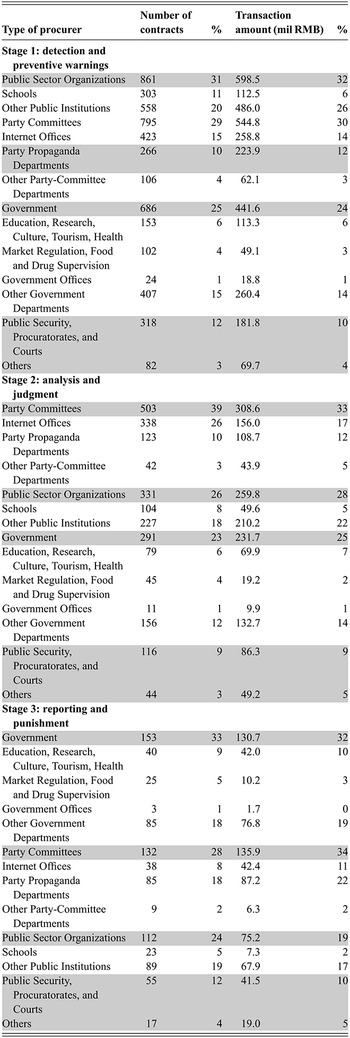
Table 5 provides the summary statistics of procurers’ contracts divided by stages of services. Public Sector Organizations, Internet Offices, and Party Propaganda Departments are most involved in purchasing the first-stage detection and warning services. Internet Offices and Party Propaganda Departments are, however, the two largest consumers of services that allow them to analyze internet posts and make judgments (second stage) and “handle” the offenders (third stage). What is noteworthy is government agencies in education, research, culture, tourism, and health combined, which accounted for only 6 percent of the first-stage service, took up a 10 percent share in outsourcing “punishment” service.
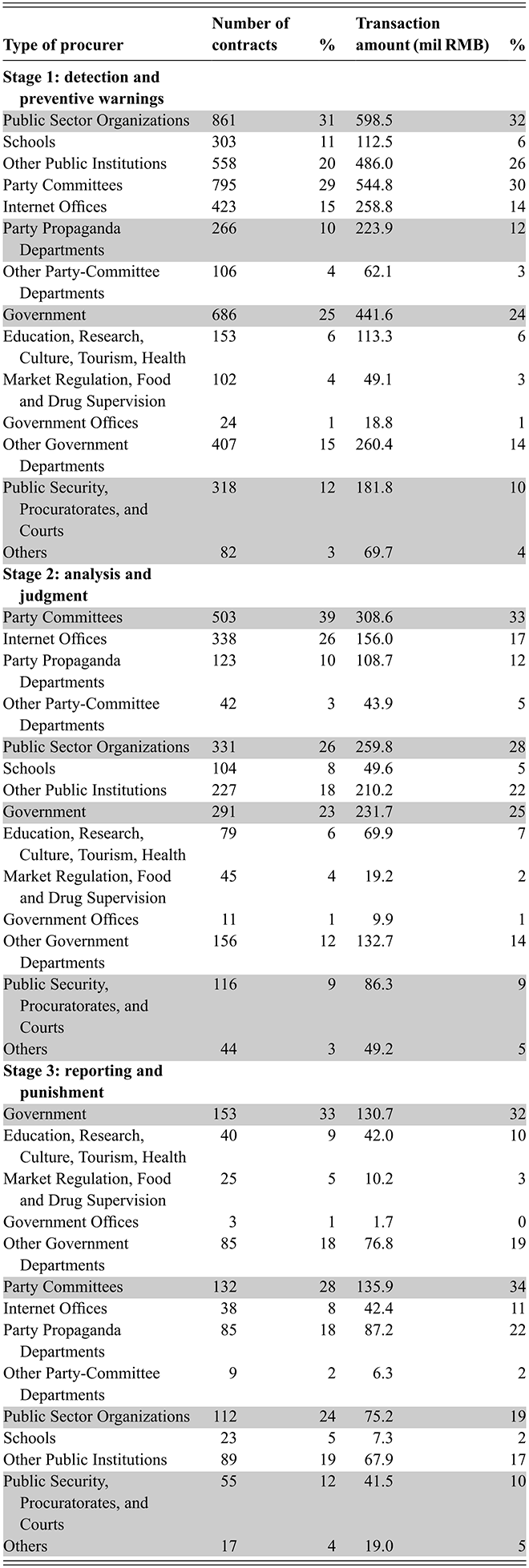
Table 5 Long description
The table presents the number of contracts and transaction amounts for each procurer type within each service stage. For Stage One (detection and preventive warnings), Public Sector Organizations hold the highest number of contracts: 861 contracts, accounting for 31 percent of the total number of contracts, with a transaction amount of RMB 598.5 million, accounting for 32 percent of the total transaction value of all contracts in this stage of services). For Stage Two (analysis and judgment), Party Committees have the highest number of contracts: 503 contracts, accounting for 39 percent of the total, with a transaction amount of RMB 308.6 million, accounting for 33 percent of the total). For Stage Three (reporting and punishment), Government has the highest number of contracts: 153 contracts, accounting for 33 percent of the total, with a transaction value of RMB 130.7 million, accounting for 32 percent of the total.
3.3 Procurer‒Provider Relations
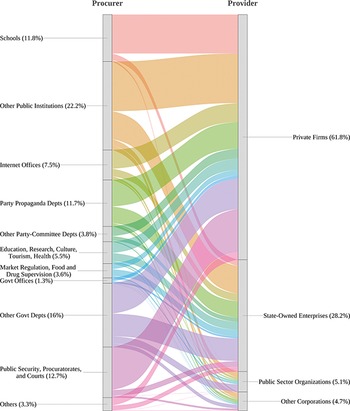
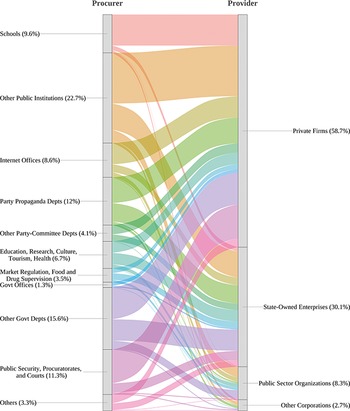
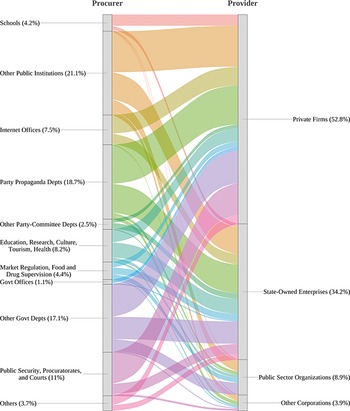
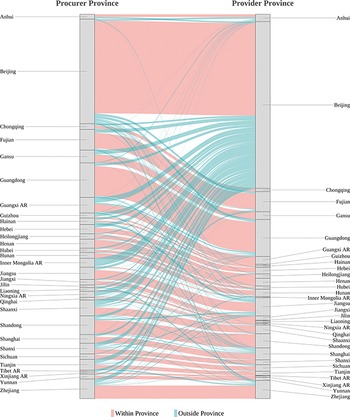
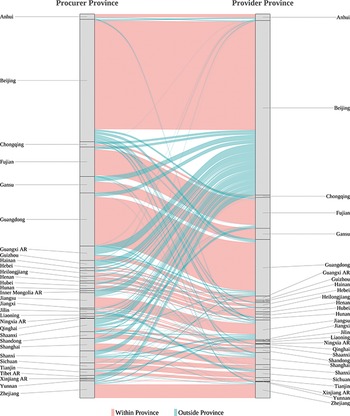
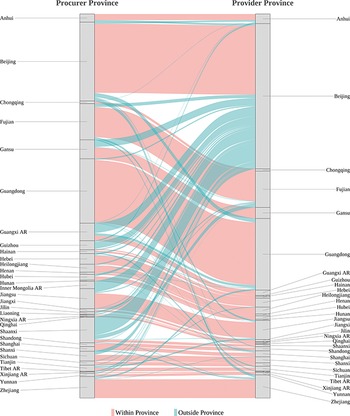
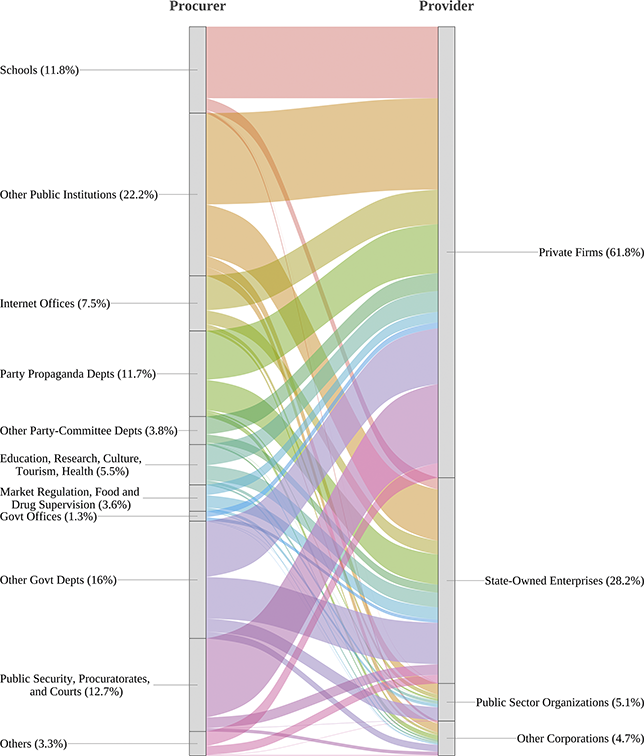
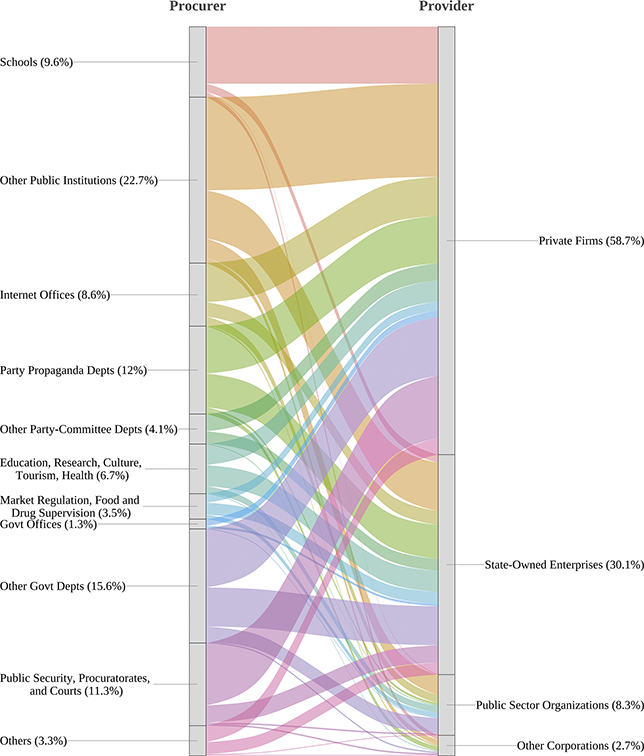
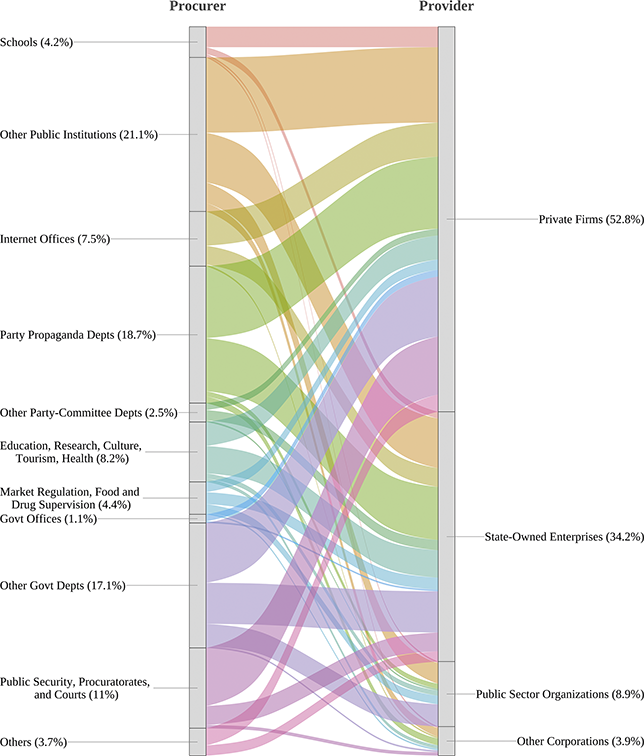
In this section, we examine the relationships between the procurers of services (party-state organizations and public sector organizations) and the providers that are bid-winning firms (SOEs, private firms, public sector organizations, and others). We visualize the relationships between the procurers and providers in Figures 1, 2, and 3, which present the flow of contracts in each of the three stages of opinion management. The first axis in the figures represents the total number of contracts procured by each procurer type. The second axis represents the total number of contracts provided by each provider type. The width of the links between the first and second axes shows the total number of contracts between each pair of procurer type and provider type. For example, among the procurers in Figure 1, “other public institutions,” such as newspapers and broadcasting stations, have the largest number of contracts (22.2 percent), the majority of which are awarded to private companies.
Contract distribution for first-stage services (detection and preventive warnings)
Contract distribution for second-stage services (analysis and judgment)
Contract distribution for third-stage services (reporting and punishment)
For the services in the first stage (detection and preventive warnings), private firms account for 61 percent of the contracts by provider type, followed by SOEs (28 percent), and public sector organizations (5 percent).
Across almost every procurer type, most contracts are awarded to private firms. Among these, public security, procuratorates, and courts (84 percent), schools (82 percent), and other party-committees (63 percent) award the highest proportion of their contracts to private firms. While government bureaus overseeing market regulation and food and drug supervision award a greater share of contracts – 46 percent – to SOEs, private firms remain a close second, accounting for 39 percent of the contracts.
SOEs generally account for the second-largest share of contracts across each of the procurer types, their share tends to be significantly lower than that of private firms. Private firms account for between 40 and 85 percent of contracts for each procurer type, whereas SOEs supply only between 11 and 46 percent. This suggests that there is a strong preference among procurers for outsourcing the initial stage of online opinion management to private firms.
As shown in Figure 2, the same patterns are observed in services in the second stage (analysis and judgment). Private firms supplied up to 58 percent of these contracts, followed by SOEs (30 percent), and public sector organizations (8 percent). Across all the procurers, between 35 and 80 percent of their contracts were awarded to private firms; and between 11 and 47 percent of them, to SOEs.
Figure 3 suggests, however, that for services in the third stage, which involve the handling and punishment of offenders, private firms account for a relatively smaller share (52 percent); whereas SOEs take up a larger share than in the first two stages (34 percent). The relatively lower (higher) shares of private firm (SOEs) are perhaps unsurprising given the higher political sensitivity of these services and the political and locational – Beijing-based – advantages offered by the SOEs.
4 Empirical Analysis
We apply quantitative text analysis to the government procurement contracts to identify salient terms and themes that characterize each stage of online opinion management. We look at the most common terms and contexts in which specific keywords of interest are used in each stage of service. These provide a view of the priorities and focus of each phase of online opinion management. Next, we employ inferential network analysis to find out whether certain procurers are more likely to contract particular services from specific providers. Specifically, we are interested in finding out whether procurers are more likely to outsource certain stages of online opinion management to private firms or SOEs, Beijing-based providers, or providers co-located in the same province. We employ an exponential random graph model (ERGM), which allows us to examine the likelihood of these preferential ties. To investigate the preemptive effect of digital surveillance on collective action, we set up a regression analysis to examine the relationship between public procurement expenditures and labor protest as a proxy for collective action.
4.1 Text Analysis of Procurement Documents
To better understand the services rendered at each stage of online opinion management, we apply quantitative text analysis to the full texts of the government procurement bidding documents. We examine keyword-in-context concordances to identify salient terms and topics in the contracts at various stages of service.Footnote 14 We minimally preprocess the corpus comprising the procurement documents and then tokenize the text.Footnote 15 Then, we divide the corpus into three subsets, one for each respective stage of online opinion management.Footnote 16 This is followed by an examination of the most frequent terms in each set of documents and then the concordances related to the keywords for the specific services rendered at each stage, for example, “monitoring” (jiance) and “warning” (yujing) for the subset of contracts from the first stage; “analysis” (fenxi) and “judgment” (yanpan) in the second stage; and “punishment” (chuzhi) in the third stage.Footnote 17
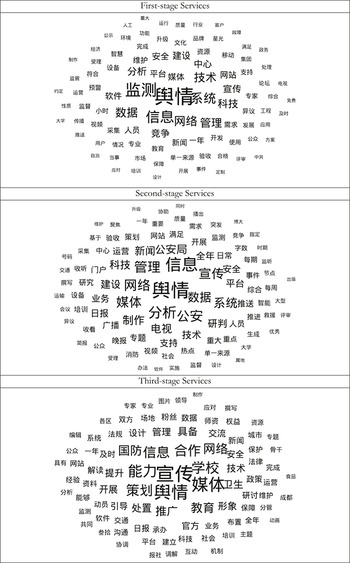
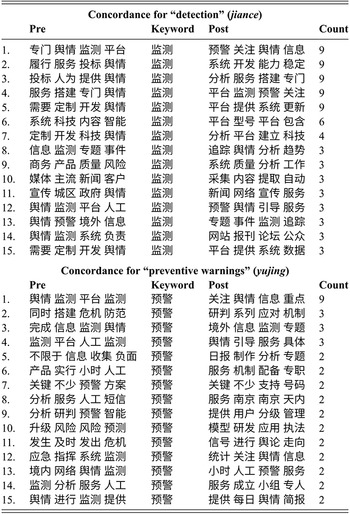
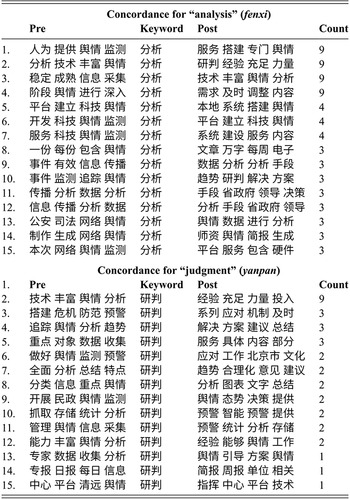
The results for concordances reveal distinct contexts in which “public opinion” (yuqing) is mentioned in each stage of the contracts. We present the most frequent terms in contracts at each stage of service in Figure 4. The distribution of terms across the three stages reveals key differences in the focus and complexity of services requested at each stage. Despite the common focus on the management (guanli) of public opinion (yuqing) and information (xinxi) across stages, these keywords are surrounded by different terms at each stage, suggesting distinct services with which they are associated.
Most frequent terms in each stage of online opinion management
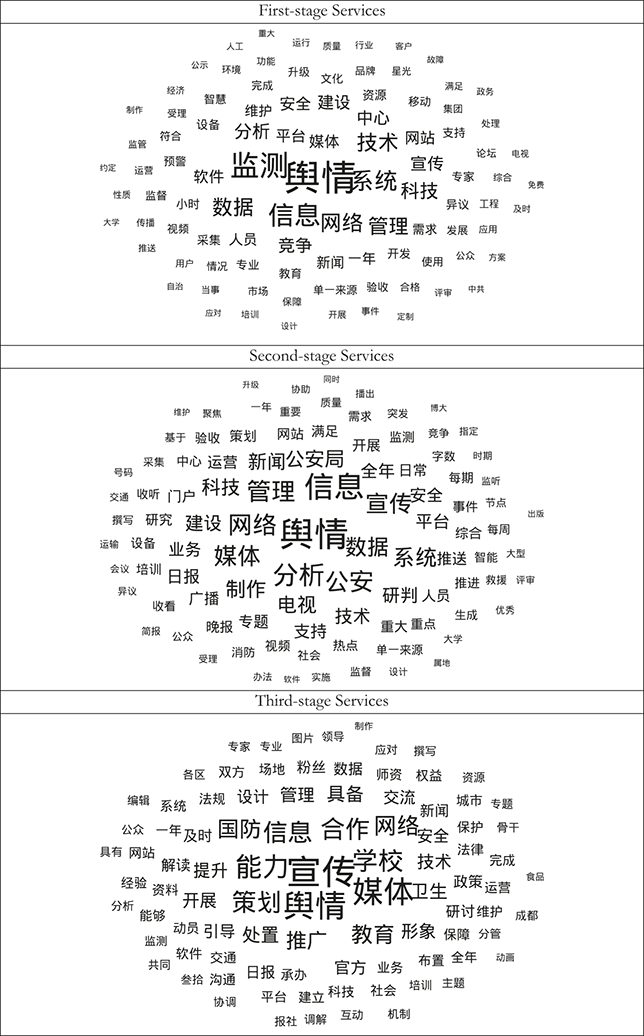
The first stage primarily revolves around monitoring and information gathering. Terms like monitoring (jiance), system (xitong), and platform (pingtai) dominate, emphasizing the foundational infrastructure for canvassing large amounts of public opinion data (shuju). Proactive data scanning with the use of both advanced big data technologies (keji, jishu) and AI (rengong zhineng) as well as manual labor (rengong) allows authorities to gauge the overall tone and direction of public opinion and detect early signs of dissent (yiyi).
In the second stage, a discernable shift occurs toward in-depth analysis of public opinion, with a focus on assessing the risks of public sentiments and undertaking measures to prevent or mitigate these risks. Terms like analysis (fenxi), judgment (yanpan), and management (guanli) emerge, reflecting the transition from mere monitoring to evaluating trends and formulating strategic responses. A greater focus is placed on data processing and research (yanjiu), including addressing major (zhongda) or emergency mass incidents (tufa shijian). The prominence of the term public security (gong’an) reveals the procurers’ priority in maintaining public order in online opinion management.
The third stage shifts from broad surveillance and early risk detection to swiftly responding to major online opinion emergencies. These services are overwhelmingly sought by propaganda (xuanchuan) departments. The focus is on crisis management, where service providers are expected to provide rapid response systems for dealing with breaking or hot-button (redian) online opinion incidents, such as strategic plans (cehua), means of punishing (chuzhi) offenders, maintaining clients’ image (xingxiang), and guiding (yindao) public discourse. The service infrastructure supports both real-time intervention and long-term governance by upgrading (tisheng) systems (xitong) that continuously monitor, store, and evaluate online opinion. Overall, the aim is to reinforce a strategic, scalable, data-supported governance system capable of neutralizing potential threats to public security and responding to and shaping online opinion.
Taken together, we find evidence of the formidable capacity of the Chinese party-state apparatus – via the outsourcing of surveillance – to penetrate society, reminiscent of the notion of the panspectron (Creemers, Reference Creemers2017). By providing comprehensive and constant surveillance of the citizenry, these services enable the authorities to command an extensive grasp over the landscape of online expression. Total data collection allows the authorities not only to take the pulse of public sentiment but also to anticipate and defuse social contention before it germinates.
Next, we analyze the concordances for each stage of online opinion management in detail.
Stage One: Detection and Preventive Warnings
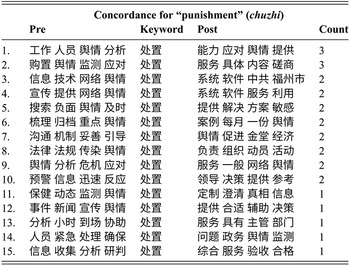
Stage One involves establishing comprehensive monitoring systems, in order to maximize data collection. We examine the context in which the keywords detection (jiance) and warning (yujing) are used in contracts requesting these services.Footnote 18 In Table 6, we present the sequence of terms that come before (“pre”) and after (“post”) the keywords of interest, also known as keyword-in-context concordances.Footnote 19 The contracts specify the procurement of monitoring platforms (jiance pingtai) that enable the collection of mass public opinion (yuqing). These specialized (zhuanmen) monitoring platforms are tailored (dingzhi) based on the needs (xuyao) of clients. Procurers solicit bids (toubiao) from service providers to develop these monitoring systems (jiance xitong). Eligible bidders are those with no less than three years of prior experience and have a good reputation in this industry, according to this contract:
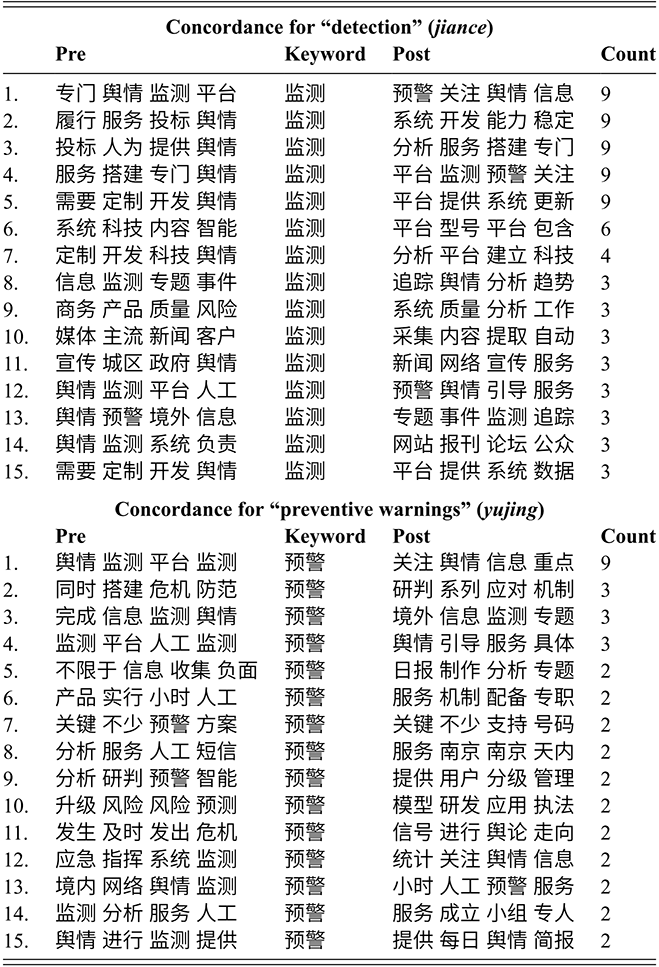
Table 6 Long description
The table displays the respective concordances for the keywords detection (jiance) and preventive warnings (yujing). The context before and after the keyword as well as the number of occurrences for each sequence of terms are shown. The most frequent sequence of terms surrounding detection relates to the development of dedicated and customized public opinion monitoring platforms. The most frequent sequence of terms surrounding preventive warnings mentions public opinion monitoring platforms and public opinion information.
供应商 (或投标人) 的资格要求: (1) 符合《中华人民共和国政府采购法》第二十二条的规定; (2) 投标人需从事相关行业不少于3年, 在业内有较好口碑; (3) 投标人需从事过文化类舆情信息服务 [ … ]
The results suggest three core components in the services rendered in Stage One:
First, method and frequency of data collection. The rigor and coverage of monitoring is reflected in the service requested in the following contract – it specifies the procurement of monitoring platforms (jiance pingtai) that employ smart technology (zhineng) or big data technologies, such as web crawling, cloud computing, and AI, to harvest (caiji) and distinguish or classify sensitive information captured from various internet sources. Monitoring systems are expected to canvas vast amounts of online opinion data (shuju) across various online platforms, including websites (wangzhan), daily newspapers (ribao), forums (luntan), microblogs, and public (gongzhong) media platforms like Weixin, Weibo, and Tieba. Both domestic news portals and foreign (jingwai) websites are covered.
监测系统功能要求1.利用网络爬虫技术、云计算技术、人工智能技术等先进技术, 对互联网上的敏感信息进行采集、识别, 支持对新闻类网站、新闻客户端、微信公众号、微博、论坛、博客、贴吧、电子报刊、问答类知识平台、问政平台、领导留言板、视频网站在内的主要网络媒体信息的抓取。2.图片识别: 对图片微博、聊天记录截图、涂鸦图片、拉横幅图片、旧文新发截图中包含的文字内容进行识别, 发现敏感信息进行预警推送。3.多媒体舆情监测: 系统利用关键词匹配、人工智能等多种技术, 实现对视频网站、抖音、快手、秒拍、西瓜视频、火山视频、B站等多媒体平台内的舆情信息进行采集、分析、预警。4.信息源定向采集: 根据工作需要, 对新闻网站、论坛、百度贴吧、微信公众、手机客户端、高危的微博账号、twitter账号、Facebook账号进行主动添加, 实现定向监测。
Monitoring involves tracking (zhuizong) emerging trends (qushi) in public opinion incidents (shijian), which is conducted around the clock (24 xiaoshi bujianduan) and in real-time (shishi).
采购需求: 通过舆情监测系统对网站、论坛社区、微博、微信公众号、短视频 APP 、广播电视台等舆情主要载体进行全天 24 小时不间断监测, 对舆情事件起因、传播趋势、传播路径和节点, 新闻媒体反应等进行实时监测。 (Contract no. 898)
Monitoring also covers commercial matters, such as the quality (zhiliang) and safety risks (fengxian) of products (chanping). In the following contract, the Shanghai Food and Drug Administration procures services in monitoring and assessing the risks (fengxiang pinggu) surrounding public opinion and discussion on food, drugs, cosmetics, and medical services:
提供“四品一械” (食品、药品、化妆品、医疗器械, 并可随法定职能变化而相应变化, 以下均统称为“四品一械”) 舆情监测和舆论引导服务事项, 并进行风险评估和风险交流。
As the contract below suggests, aside from comprehensive canvassing of online opinion, targeted monitoring of high-risk accounts on Weibo, Twitter, or Facebook may also be required. Monitoring systems must be capable of monitoring not only text-based content but also video content from mainstream platforms, such as huashan, xigua, miaopai, kuaishou, duoyin, quanmin xiaoshipin, Bilibili, and meipai. This also includes television content across no fewer than 300 television programs worldwide. Within ten minutes of broadcast, the information retrieved should be browsable and searchable. Automated translation capabilities in no fewer than 100 languages are also expected:
互联网舆情监测服务系统: 1.全网监测: 系统监测范围可覆盖网站、微博、微信、论坛、贴吧、App、网络视频、电视、小视频、自媒体、报刊、境外网站数据等全网信息进行监测。2.小视频监测:支持火山、西瓜、秒拍、快手、抖音、全民小视频、哔哩哔哩、美拍等主流平台。3. 电视监测:支持不少于全球300套电视节目、超过6000档电视栏目; 从电视播出后, 系统可以在最快10分钟的时间即可被浏览和搜索到。4.网络视频监测:支持内容中含视频的信息监测。5.境外监测与翻译:支持Twitter、Facebook等境外信息监测, 提供指定站点、作者的定向采集, 支持境外跳转; 可提供不少于100种语言的自动翻译, 以及繁简体及中英文自动转换识别。[ … ] 7.评论采集:提供评论信息采集, 如: 微博、贴吧、论坛、网媒等。
Second, nature of reporting and analysis. Beyond data collection, monitoring services involve data processing and in-depth analysis. This serves the purpose of keeping decision-makers informed, enabling them to fully grasp the dynamics of public opinion. Service providers are required to construct data management systems that classify and index data:
标包号建设内容预算: A包: 含数据加工与管理工作, 建设内容包括: 1、数据管理系统建设2、数据资源体系建立3、数据加工整理 (255万元) 。B包: 含知识管理与服务工作, 建设内容包括: 1、数据分类标引2、国土资源知识管理平台建设3、知识服务应用系统建设 (325万元) 。C包: 含管理监测与决策分析、系统总体集成工作, 建设内容包括: 1、管理监测与决策分析监测与决策分析平台建设专题分析系统建设2、系统总体集成系统集成框架建设: 门户系统、服务总线、服务构建与运行支撑工具智能推送服务建设应用系统集成 (520万元) 。
By incorporating search engines and information mining technologies, these systems should enable clients to manage their own online opinions. This includes processing web page content, sensitive word filtering, clustering and classification, topic detection, and statistical analysis. Public opinion data collected are used to generate summaries, briefings, and analytical reports, to inform decision-makers in their management of public opinion:
网络舆情监控系统是利用搜索引擎技术和网络信息挖掘技术, 通过网页内容的自动采集处理、敏感词过滤、智能聚类分类、主题检测、专题聚焦、统计分析, 实现各单位对自己相关网络舆情监督管理的需要, 最终形成舆情简报、舆情专报、分析报告、移动快报, 为决策层全面掌握舆情动态, 做出正确舆论引导, 提供分析依据。
Third, intelligent early warning systems alongside surveillance systems. Underscoring the preventive dimension of censorship, these intelligent early warning systems rely on year-round twenty-four-hour manual warning (rengong yujing) by dedicated personnel (zhuanren), ensuring continuous vigilance and rapid response to emerging public opinion issues:
安排专人提供7*24小时365天人工预警服务, 对于涉及到辖区涉稳、突发、领导、环保、意识形态等相关信息半小时内电话通知或推送到微信群
The preventive approach toward management of online opinion is reflected in the features of a “popular event database” described in the contract below. The database not only catalogs events, allowing users to quickly access information on trending topics, but also offers analysis of emerging developments, dissemination points, netizen distribution media rankings, sentiment distribution, and public opinion leaders:
热点事件库: 系统提供每日全国热点事件库功能, 方便用户快速查看国内热点舆情事件, 并提供综合分析。分析维度至少包含发展趋势、传播节点、情感分布、网民分布、媒体排行、网民观点分析、意见领袖统计等。
The integration of automation and artificial intelligence (zhineng) enables early warning systems to discern subtle changes in public discourse, forecast shifts in attitudes, and highlight emerging public sentiment before it develops into a significant threat. Risk forecasting (fengxian yuce) highlights the predictive capabilities required of monitoring systems to anticipate and identify potential threats before they materialize. Early identification of escalating (shengji) risks (fengxian) allows for emergency response (yingji) to prevent or mitigate their impact.
Early warning systems alert stakeholders by providing early warning signals (xinhao) in real-time via text message (duanxin), Weixin, or mobile clients. User (yonghu) personalization of these systems with flexible settings for period of warning, frequency of warning, keywords, and early warning recipients further enables a tailored and responsive approach to crisis management:
舆情预警采用数据自动推送技术在热点事件第一爆发点以短信、微信、邮件、移动客户端推送、弹窗等方式对相关人员提供预警, 确保第一时间掌握信息动态, 进行正确引导, 并满足对数据监控方案参数的个性化设置, 灵活设置预警接收的时间段、接收频率、关键字方案组合、预警接收人等。
Rigorous monitoring and early warning requirements further demonstrate the desire of authorities to leave no stone unturned in maintaining a monitoring operation that effectively manages public opinion. Customization also ensures that clients can respond to potential crises with greater precision, tracking topics most relevant to their operations and concerns, for example. The following contract spells out specific expectations that underscore the scale of the monitoring process. They stipulate detailed requirements for the number of monitoring plans, keywords, early warning plans, and early warning keywords:
监测方案个数不少于20个, 关键词个数不少于500个, 预警方案个数少于10个, 预警关键词个数不少于500个。
This suggests it is imperative that monitoring systems are not simply expansive but are also designed to detect nuanced shifts in public opinion, enhancing the ability of the authorities to accurately understand the pulse of public sentiment.
Moreover, the systematic storage and archiving of early warning information ensures that data is accessible for future reference. Early warning information must be systematically stored and archived to enable data query and ‒ critically ‒ that “no major public opinion information” is missed:
智能预警:支持最新预警信息弹窗显示, 并且今日所有的预警信息自动存储到预警信息专栏, 根据时间线倒序显示今日所有预警信息, 并支持筛选当天、24小时、近七天和自定义时间的舆情信息, 保证预警信息有序存档, 不错过任何一条重大舆情信息。
By creating an organized and searchable archive, clients can quickly retrieve past data to review past crises or predict future trends. This suggests that online opinion management is not only about preventing present crises but also about creating a robust, data-driven foundation for effective management in the long term.
Stage Two: Analysis and Judgment
Contracts in the second stage center on the development and deployment of emergency command platforms (yingji zhihui pingtai), a shift from the mere data collection and general reporting in the first stage. Table 7 shows that, in this stage, the focus is on the establishment of command systems and platforms designed for in-depth (shenru) analysis, review, and risk assessment of public opinion.
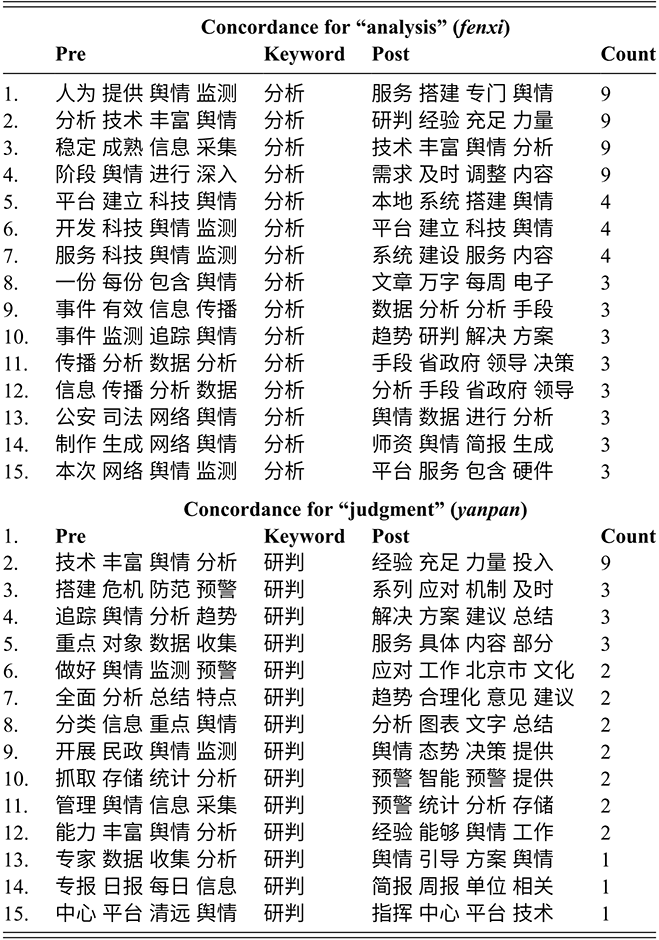
Table 7 Long description
The table displays the respective concordances for the keywords analysis (fenxi) and judgment (yanpan). The context before and after the keyword, as well as the number of occurrences for each sequence of terms are shown. The most frequent sequence of terms surrounding analysis relates to the provision of public opinion monitoring and analysis services, abundant experience, resources, and capabilities in public opinion analysis and judgement. The most frequent sequence of terms surrounding judgment relates to technology and sufficient experience in public opinion analysis and judgement.
Typically, contractors providing services in the second stage also perform tasks in the first stage; the sheer scale of data collected from comprehensive surveillance provides the foundation for judging (yanpan) and resolving (jiejue) major public opinion risk (fengxian) before they escalate. Emergency command platforms are designed to anticipate risks, allowing clients to identify influential public opinion leaders in real time and devise strategic responses to mitigate these risks. The second stage thus reinforces a preventive and proactive approach toward online opinion management.
Bidders are required to have strong development capabilities for public opinion-monitoring, reliable and mature information collection and analytical techniques, rich experience in public opinion analysis and assessment, and sufficient manpower. They should be able to customize the development of a public opinion-monitoring platform based on the purchaser’s public opinion work needs and provide subsequent system updates and upgrades, optimization and improvement, data accumulation, classification and storage, and other services as the following contract suggests:
要求投标人有较强的舆情监测系统开发能力、稳定成熟的信息采集分析技术、丰富的舆情分析研判经验、充足的力量投入, 能够根据采购人舆情工作需要定制化开发舆情监测平台, 并提供后续的系统更新升级、优化完善和数据累积、归类存储等服务。
This stage of opinion management features two core components: analysis (fenxi) and judgment (yanpan). “Analysis” combines both human skills (renwei) and technology (keji). This hybrid approach leverages the skills (jishu) and experience (jingyan) of professional analysts for data interpretation. They are expected to have a deep understanding of social trends and technical infrastructure to screen and process the vast amounts of data (shuju) collected from online platforms:
中标单位提供至少10名专业舆情分析师作为日常工作支撑, 其中至少6名具有网信项目服务经验的工作人员常态化到采购单位的办公场所驻点办公, 开展互联网信息搜集汇总、分析筛选、统计报送等相关工作, 实行7×24小时值班工作制。
Service providers need to conduct timely (jishi), efficient, and accurate analysis, judgment, and tracking of public opinion information:
在信息采集的基础上中标人需通过机器智能分析、研判的方式, 对舆情信息进行及时高效精确的分析、研判、预警、追踪。
Service providers supply analysis across several dimensions, revealing not just what is shared but also who drives the conversation (see Appendix B for an example of a contract that details these service requirements). They are expected to deliver extensive reporting, ranging from daily briefs (jianbao) or weekly essays (meizhou wenzhang) to specialized thematic research reports on foreign affairs or domestic issues:
服务要求: 境内外网络舆情监测预警 (365天7*24小时人工预警服务) 阶段性总结专报 (20篇), 境内外信息综合报告 (《每日信息》) (300份), 专项问题研究(10篇), 舆情专题分析 (100篇), 涉外专题研究(10篇) 。
These electronic (dianzi) reports keep leadership (lingdao) informed and provide up-to-date actionable intelligence to guide decision making (juece) and policy solutions (jiejue fang’an).
These reports also include statistical analysis (tongji fenxi), which offers a summary of the distribution, trends, start and end times of widely shared media, an overview of public opinion events, event trends, buzzwords, opinion leaders, popular original Weibo posts, popular forwarded Weibo posts, transmission channels, sentiment analysis, blogger geographical distribution, forwarding ranking, male‒female ratio, domestic‒overseas ratio, hired internet commentators ratio, follower analysis, proportion of sensitive content, proportion of reposting, reposting by region, and more. Tracking of reposting pathways provides information about how public opinion circulates and gains traction, offering valuable insights into opinions that resonate most with the public. These expectations for analysis are captured in the following contract:
分析报告包含舆情事件概述、事件趋势、热点词、意见领袖、热门原发微博、热门转发微博、传播途径、情绪分析、博主地域分布、转发排名、男女比例、海内外比例、水军比例、粉丝分析、敏感占比、转发占比、转发地域等。
These detailed insights provide not only a holistic view of how public opinion forms and spreads, but also information that enables authorities to track down specific individuals driving online conversations. By examining elements like the popularity of specific posts or reposting behavior, authorities can identify key influencers and trace the origins of widely shared content. Data points about the distribution of commentators provide further context for identifying the demographics and networks associated with the particular – popular or problematic – posts. In short, the richness of the data allows for the construction of digital footprints of individuals who may amplify certain narratives. This in turn allows clients to undertake swift action to manage emerging public opinion issues.
The second core component of services in this stage is judgment (yanpan), which involves predicting and mitigating potential public opinion risks. Like the analytical phase, the judgment process is deeply reliant on advanced technological tools to efficiently track, collect (shouji), and evaluate vast amounts of data (shuju). This process also demands rich (fengfu) technical skills (jishu) and experience (jingyan).
The judgment process has three key characteristics. First, identify emerging trends (qushi) and prevent (fangfan) potential crises (weiji) before they escalate. Second, assessment is closely associated with crisis management and the development of effective crisis response (yingdui) mechanisms (jizhi). This emphasizes the importance of conducting scientific assessment of data, offering rational (helihua) suggestions and tailored solutions (jiejue fang’an).
采购标的的验收标准; 以月度、季度、年度为单位, 对涉警舆情进行阶段性情况进行全面分析, 总结特点, 研判趋势, 提出合理化意见建议。采购标的的其他技术、服务等要求。发生重大突发涉警舆情后, 能够做到迅速响应, 24小时投入足够的人工和技术力量提供必要的舆情监测、分析与评估服务。如有需要, 能迅速派工作人员到达采购人指定地点协助开展工作。采购标的的验收标准; 以月度、季度、年度为单位, 对涉警舆情进行阶段性情况进行全面分析, 总结特点, 研判趋势, 提出合理化意见建议。
Third, an essential aspect of online opinion management is actively guiding and shaping public opinion. This involves strategic effort to influence and guide (yindao) public opinion about events, whether by managing public perception or promoting positive image of clients. As illustrated in the following contract, service providers are expected to “promote the sustainable and healthy development of public security new media”:
采购标的需满足的服务标准、期限、效率等要求; 制定科学评估标准, 不断健全完善评估指标体系、更新评估范围, 全面采集相关运营数据, 对全国公安微博、微信、头条号、短视频账号等公安新媒体按月度、季度、年度进行科学评估并形成排行榜单及时对发展成效特点及存在问题进行梳理总结, 提出改进意见建议, 推动公安新媒体持续健康发展。
In other instances, service requirements include publicizing and disseminating collected data “to shape a positive image” for the client, in this case the Anhui Culture and Tourism Bureau:
服务要求: [ … ] 收集安徽文化和旅游相关的大数据, 并对收集到的数据进行二次加工、宣传、传播, 以数字内容塑造安徽文旅的良好形象。
The importance of guiding public opinion is underscored by the Shanghai Public Security Bureau’s solicitation for a single-source procurement (danyi laiyuan caigou). The contract clearly states: “The COVID-19 outbreak, and complex changes in global situation, have brought enormous challenges to public security work. Under this context, continuous strengthening of the monitoring and analysis of police-related public opinion and improving the timeliness and professionalism of opinion guidance have become an important aspect of public security work”:
采用单一来源采购方式的原因及说明:2020年, 上海公安机关瞄准“打造世界一流警务工作”的发展定位, 努力完成服务国家战略和城市发展、维护社会大局安全稳定、深化公安智能化建设、纵深推进警务变革、推动基层社会治理创新、锻造高素质公安铁军等六大任务。但与此同时, 新冠肺炎疫情的暴发蔓延, 以及国际局势的复杂变化, 为公安工作带来了诸多挑战。在此背景下, 持续加强涉警舆情监测与研判, 进一步提升舆情引导时效性与专业性, 成为公安工作的一个重要方面。
In addition, the demand for opinion experts to train client personnel also reflects the importance of building internal capacity for managing public sentiment. The excerpt of the contract below articulates the requirement of the China Center for Animal Health and Epidemiology for the service provider “to cooperate on a sustained basis, provide after-sales service and technical training, and be able to guarantee the smooth operation of the animal public opinion analysis platform”:
能够长期与中国动物卫生与流行病学中心合作并进行售后服务和承担技术培训, 能够保障动物舆情分析平台平稳运行。
Although contracts at this stage often require service providers to perform “judgment services” (yanpan fuwu) and opinion guidance services, they typically offer little detail on how these should be conducted. What is clear, nonetheless, is that the purpose of these services is to enable early prediction and intervention in potential public opinion risks. The emphasis on the centralized command systems reflects the need for a structured mechanism for continuous assessment of public opinion and management of narratives before they escalate or destabilize. In short, “judgment” involves evaluation of emerging issues and their potential impact, in order to inform clients on how to shape and guide public sentiment.
Stage Three: Reporting and Punishment
In the third stage, the focus shifts from broad surveillance and early risk identification to rapid response (xunsu yingdui) to major public opinion crises (weiji). Table 8 presents the most frequent sets of terms that occur alongside “punishment” (chuzhi). While the earlier stages reflect a proactive and preemptive approach toward managing online opinion, this final stage of services appears to be more reactive. It emphasizes the timely (jishi) detection of emerging opinion trends (dongtai) and solutions (jiejue fangan) to support decision-making (juece) by leadership (lingdoa).
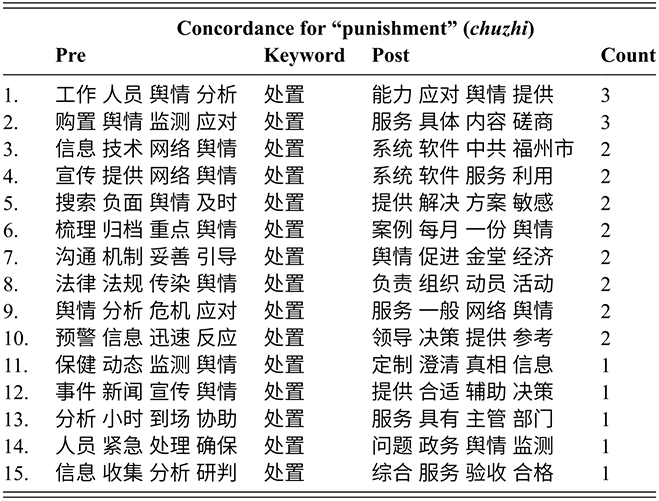
Table 8 Long description
The table displays the respective concordances for the keyword punishment (chuzhi). The context before and after the keyword as well as the number of occurrences for each sequence of terms are shown. The most frequent sequence of terms surrounding punishment relates to the capacity to analyze and handle (yingdui) public opinion.
A notable aspect of this stage is its reliance on manual labor and human capacity (gongzuo, renyuan, nengli) to respond to (yingdui) and contain crises in real time. Textual evidence from the contracts suggests that this phase is labor-intensive, where dedicated human personnel are expected to conduct continuous monitoring and coordinate interventions. In this context, procurers seek integrated service (zonghe fuwu) as well as scientific and effective solutions that combine early warning, analysis, judgment, and punishment:
目前, 新华社中国经济信息社为各级政府部门、各大金融机构以及海内外大型企业提供舆情监测、舆情咨询、舆情培训等服务, 多次为用户化解舆论危机, 与用户建立良好的合作关系。围绕可能出现的重大负面舆情, 中国经济信息社具备及时处理舆情危机的能力, 提供科学有效的舆情预警、分析研判和处置等一体化解决方案。
Punishment services are primarily associated with state-owned media outlets like the Xinhua Daily and the People’s Daily (Renmin Ribao) and involve command systems that operate from the CCP’s political center. Procurers leverage trusted and well-established state-owned media outlets that possess rapid and far-reaching dissemination capabilities. For one, Xinhua News Agency’s China Economic Information Service is a preferred provider in many single-sourced contracts (as in the single-sourced contract above). The higher proportion of single-source procurement in punishment services (32 percent, as compared to 14 percent for the first stage and 18 percent for the second stage) can be attributed to the politically sensitive nature of the service involved.
These service providers are required to have the technological infrastructure to effectively intercept and filter rumors, delete defamatory content, and shut down violative accounts. In the following procurement notice by the Yunnan Provincial Cultural Market Comprehensive Administrative Law Enforcement Directorate, which sources directly from Yunnan Tianmiao Information Technology Company, service providers are required to take a three-pronged approach – technical interception, manual processing of reports, and tools for refuting rumors. When sensitive opinions such as rumors about “unreasonably low-price travel” are deemed to be untrue by the authorities, service providers must block further dissemination of the information and delete rumor-mongering articles:
申请理由: 根据《云南省人民政府关于印发云南省旅游市场秩序整治工作措施的通知》 (云政发〔2017〕19号) 、《云南省人民政府关于加快推进旅游转型升级的若干意见》 (云政发〔2018〕38号) 文件要求, 充分发挥新浪、今日头条自媒体具有极高的传播速度与传递规模的特点, 利用其所创造出的巨大扩散力量, 正确引导舆论, 对接抵制谣言建立的技术拦截、举报人工处理、辟谣工具这三大系统。在“不合理低价游”信息、敏感舆情信息被权威机构判定不实情况下, 提供协助阻断信息的进一步传播、删除造谣文章, 封停违规帐号等服务, 云南天淼信息科技有限公司是北京新浪互联信息服务有限公司在云南省唯一业务公司, 申请该项目新浪合作部分单一来源采购供货商为云南天淼信息科技有限公司。
Public opinion guidance in this stage is more assertive. Whereas the previous stage focused primarily on assessing the existing discourse, the approach here shifts toward active efforts in shaping the information environment. This contract provides a lucid description: “The guidance of public opinion in response to major crises involves disseminating true and authoritative information, clarifying fallacies, refuting rumors, distinguishing right from wrong, and ‘reassuring people’”:
舆情应对引导, 针对我省出现的突发重大公共事件、较大网络舆情, 及时、迅速进行有理有据的舆论引导, 传播真实、权威的信息, 澄清谬误、批驳谣言, 辨明是非、稳定民心。
The long-term goal of opinion management is to build a scalable infrastructure that not only reacts to real-time development but also steers the future trajectory of public discourse. These service requirements are reflected in the following contract on Beijing’s Chaoyang District Public Opinion Big Data Upgrade Project that seeks a unified big data management platform that tracks every aspect of the district’s public opinion landscape, including new media content from district committees to townships. This is enabled by the creation of robust big data platforms that sort (shuli) and archive (guidang) important (zhongdian) pieces of public opinion. This process is further aided by the provision of monthly case studies (meiyue anli) to ensure ongoing evaluation of public opinion:
朝阳区舆情大数据升级项目: 朝阳区融媒体中心舆情大数据管理平台经过前期的建设, 已经初步具有舆情采集及监控、舆情事件管理及监控、舆情预警管理及监控、区重点舆情归档、舆情趋势分析及大屏展示, 移动舆情管理等较为完善功能, 并已经构建了存储区内舆情的大数据平台。在此基础上, 通过本期的升级建设, 旨在形成融媒体中心的媒体大数据概念、完善并扩大舆情监测范围的同时, 将全区委办局、街乡新媒体内容纳入数据管理范围, 形成全区新闻工作类统一的大数据管理平台。
We noted earlier, however, that only a small proportion of services in the third stage is outsourced; most “reporting and punishment” is conducted in-house. Our interviews suggest no single universal approach or pattern to the politically sensitive stage-three services. All online mass incidents must be reported to a higher-level government and party committee as well as a cyberspace administration office. Local governments are often keen to conceal incidents by seeking assistance to delete undesirable posts and calm negative sentiment, but the central government under Xi has centralized the power of post deletion. The interviews provide nuanced details on how online mass incidents are resolved, and online offenders are handled:
The last stage of service is rarely outsourced. Now, it is administratively challenging to delete posts. Only the Cyberspace Administration Office (wangxinban) has the power to delete posts, and they only have prerogative over local media or online incidents that happen in their territories. In the past, different cyberspace administration offices can coordinate with each other, but now that the central office has centralized the power, only they could delete posts across different jurisdictions, says the director of a department of a local newspaper that specializes in online opinion management.
It is useful to differentiate between online mass incidents that of political nature and those that are not. Mass incidents that have political implications are beyond our capacity, which higher authorities will intervene directly. If the incident has no political implication, such as public complaints of a general nature, we will ‘calmly observe’ to see if it will subside over time, says a CEO of a public sector organization (shiye danwei).
Online mass incidents in our county come from these social media platforms: Douyin, Kuaishou, Weibo, Jinri Toutiao (Today’s Headlines), Tianya Shequ, Hongdou Shequ, etc. Once we discover an incident, or an incident is reported to us, our office (the propaganda department) will immediately activate the public opinion emergency handling mechanism and send a report to the corresponding functional department for verification, in accordance with the principle of territorial management (shudi guanli). The department will then have to file a situation report with our office within five working days. After we have conducted some analysis, we will report it to the county party committee and government (one level up) and to the Cyberspace Administration Department (wangxin bumen) one-level up,” says the director of a district-level propaganda department.
In the past, clients looked for companies like ours to delete (undesirable) online posts. But nowadays deletion of posts may not necessarily help to calm public sentiment. We will sit in on public opinion response meetings. For instance, there was a recent drowning incident where four children died. The local government wanted to trivialize the situation [hinting at deleting relevant online posts]. But we suggested they should first understand the situation, clarify responsibility, and release a statement as soon as possible. We are often asked to deliver lectures on how to handle situation like this, says the manager of a Xinhua Daily subsidiary that specializes in online opinion management.
4.2 Beijing-Based Providers and Within-Province Contracts
Evidently, Beijing-based providers have a unique advantage in online opinion management – the depth of their political connections and access to high-level decision-makers in the national capital. Beijing-based procurers strongly prefer working with providers based in the same municipality. Out of a total of 615 contracts (RMB 548.05 mil), Beijing-based purchasers top the within-province (municipality) contracts, accounting for 84.8 percent of their total number of contracts. These contracts make up 48.5 percent of the total contracts received by Beijing-based providers. The advantage of being located in Beijing is the depth of political connections and access to high-level decision-makers in the national capital. Trailing behind Beijing in within-province contracts are Fujian (139 contracts or RMB 95.66 mil), Shandong (129 contracts or RMB 67.92 mil), and Guangdong (116 contracts or RMB 132.23 mil).
Figures 5, 6, and 7 present the distribution of contracts, based on their value, between procurers and providers in different provinces for each stage of service provision.
Contract distribution by province for the first-stage services (detection and preventive warnings)
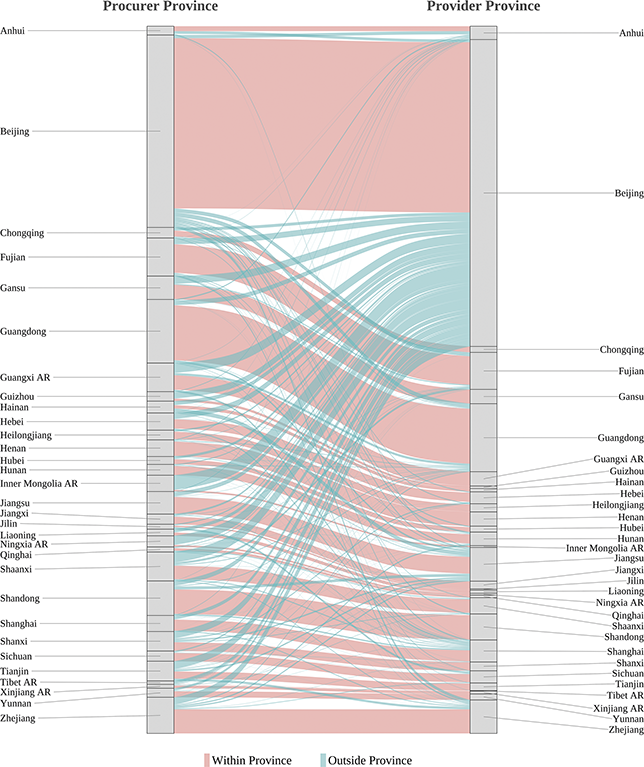
Contract distribution by province for second-stage services (analysis and judgment)
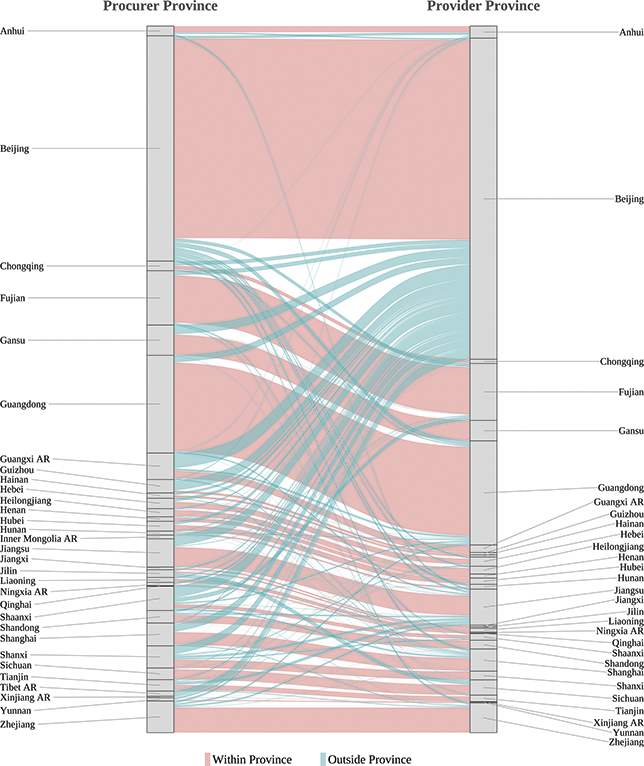
Contract distribution by province for third-stage services (reporting and punishment)
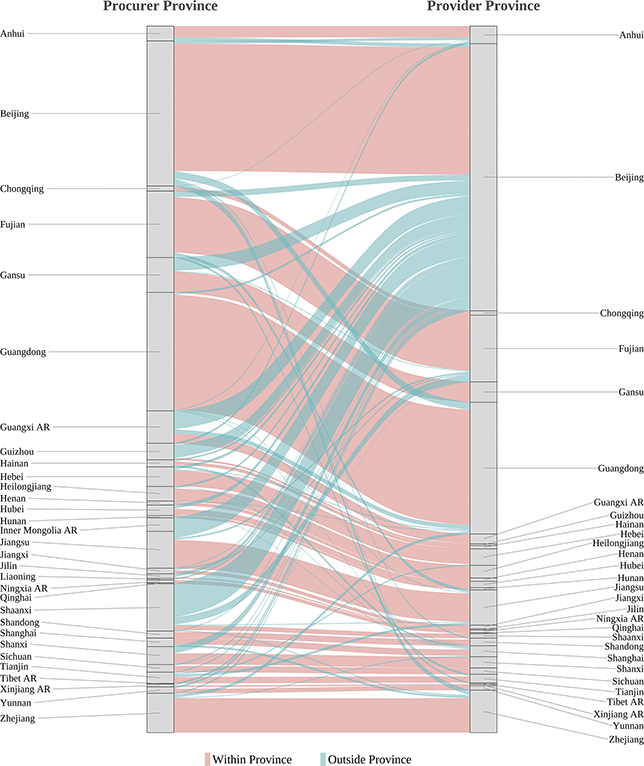
The axes show the provinces of procurers and providers respectively. Flows from the left axis to the right axis represent the value of contracts purchased by procurers in one province from providers in another province. For example, in Figure 5, which presents the distribution of contracts for services in the first stage (detection and preventive warnings), a large proportion of contracts purchased by procurers from Beijing are awarded to providers based in Beijing. This suggests that Beijing-based procurers outsource services almost exclusively to local providers. Procurers in other provinces also tend to outsource to Beijing-based providers, except for Zhejiang, Shandong, Guangxi, Guangdong, and Fujian. Zhejiang, Shanghai, and Hunan also received winning bids from other provinces.
Shown in Figure 6, similar patterns are observed for the second-stage services, except transactions from outside provinces to Beijing become fewer (thinner lines), while within Beijing transactions have slightly increased. Across procurers from various provinces, the proportion of contracts outsourced to the providers outside the province – and to providers in Beijing – is considerably higher than in the first and second stages of service provision.
For the final-stage services, some provinces, such as Zhejiang, Guangdong, and Fujian, have dealt mostly with within-province providers even though many other provinces still outsource those services to Beijing-based firms (see Figure 7). As noted earlier, Beijing-based firms, which are largely SOEs or the subsidiaries of Xinhua Daily or People’s Daily, could provide direct channels of communication to top party leadership that firms located outside Beijing are unable to provide.
A closer look at the procurement contracts involving Beijing-based providers offers further evidence that Beijing-based state-owned media companies are exclusively sought out because they are politically reliable (zhengzhi kekao), beyond having extensive experience in public opinion management services. In many cases, these contracts are awarded through single-source procurement (danyi laiyuan caigou), 70 percent of which went to Beijing-based SOE providers.Footnote 20 In the following single-source contract, the Beijing Municipal Transport Committee contracted the People’s Daily Online (Beijing renmin zaixianwangluo) to provide monitoring and analysis services because it is an “industry leader” (lingjunzhe) and its public opinion services are trusted to be highly authoritative (quanwei chengdu gao) and professional (zhuanye xing qiang):
北京交通委需要权威程度高、专业性强的舆情服务, 协助开展与北京交通相关舆情监测、预警、分析研判、应对处置、舆情引导和舆情报告编写等工作, 满足北京交通委掌握社会民意, 了解社会各阶层民众对北京交通的态度、看法、意见和行为的需求, 为优化首都交通运输布局, 发挥整体优势和组合效率。[ … ] 该公司是舆情行业的领军者, 可为北京交通委舆情服务提供理论的高度与保障; 该公司全部系统为自主研发, 舆情监测系统平台符合国家网络安全和信息化的规范要求, 运行稳定。
A further advantage Beijing-based providers have is that they have the necessary infrastructure that is compliant with national regulatory frameworks, which make them uniquely suited to meet the scope of work required by procurers. Procuring entities oftentimes justify directly contracting certain providers by citing legal and technical constraints that limit the pool of eligible providers. In the same contract as above, directly sourcing from the People’s Daily Online is justified on the basis that its platform complies with the national cybersecurity regulations. It is also the only company that deploys servers overseas to collect public opinion data. In addition, it is also able to coordinate with the three major telecom operators in China to set up dedicated and secure communication lines to ensure the confidentiality of public opinion data collected:
该公司全部系统为自主研发, 舆情监测系统平台符合国家网络安全和信息化的规范要求, 运行稳定; 该公司在电视监测技术先进, 可以监测上星卫视等关于北京交通的相关电视报道, 并提供文字转换服务, 供交通委日常宣传及负面信息决策提供参考; 该公司保密机制完善, 保密技术可靠, 购置了专属服务器, 并协调三大电信运营商架设了专有通信线路, 可保障北京交通委舆情数据的安全性; 该公司具有行业内唯一境外部署服务器采集舆情数据, 可真正实现外媒舆情信息直接监测和采集, 确保北京交通委对境外舆情监测的全面性、及时性和安全性。
Across multiple provinces, China Economic Information Service (zhongguo jingji xinxishe, CEIS), a subsidiary of Xinhua News Agency, is entrusted with delivering exclusive information services for various levels of leadership. In the contract below, the Gansu Provincial People’s Government procures first- and second-stage services directly from CEIS. Here, CEIS is tasked to provide comprehensive information services, including think tank reports for provincial leaders:
《智库报告.甘肃领导专供》、《经济分析报告》、卫星专供信息、网络舆情分析报告等多项综合信息服务。
The following contract awarded to CEIS similarly involves the publication of articles in internal communication platforms, specifically the Cadre Forum section of the Guangxi Provincial Leadership Exclusive Bulletin:
每年定期在《广西领导专供》专刊内的《干部论坛》栏目刊发领导业务文章。
In another contract (below), the Qiandongnan Miao and Dong Autonomous Prefecture People’s Government Office of Information Management contracts CEIS to provide exclusive information services for the Guizhou leadership. This includes specialized information on leadership policy decisions, government affairs, and the construction of a new socialist countryside.
1. 提供专供信息服务, 内容包括: 领导决策信息、政务专供信息、经济专供信息、新农村建设、园区建设、行业资讯; 2.提供《政务专供报告》电子版1份, 全年不少于50期; 3. 提供全年不少于完成4个点题调研课题; 4.提供定期分析报告, 每周提供7份《新华社经济分析报告》 (全年不少于50期) ; 5.提供舆情监测月报及一次舆情培训服务 (全年不少于12期) ; 6.提供《贵州领导专供》30份每月分3次通过邮寄方式送达。
As the earlier contracts awarded to CEIS reveal, it has a longstanding reputation in providing authoritative and comprehensive news information services to provincial party leadership, a service strongly desired by regional government procurers. Because “the services procured are of a high degree of specificity and uniqueness, other companies do not possess the capability of delivering the required services.” In other words, the lack of competitive bidding for contracts awarded to Beijing-based SOEs is justified given their unique offering:
采用单一来源采购方式的原因及相关说明: 中国经济信息社 (现更名为: 中国经济信息社有限公司) 是新华通讯社直属机构, 按照新华社统一部署, 自2016年1月1日起, 新华社国内分社原信息业务合作的签约、服务工作全部划转至中国经济信息社。新华社长期以来有针对性地为黔东南州提供了大量权威、丰富的新闻信息服务, 为黔东南州的建设和发展提供了有力的信息支撑, 内容包括领导决策信息、政务专供信息、经济专供信息、经济分析报告、舆情监测报告、每日新华电讯、新华内参等内容, 该项目具备一定特殊性和唯一性, 其他公司不具备提供这些服务内容的能力。
Taken together, these reflect the specialized role of SOEs in the delivery of leadership-facing content. Beijing-based SOEs occupy a privileged position in the industry landscape of online opinion management. With the predominance of single-source procurement used in these contracts, certain types of services are effectively reserved for a narrow set of state-related providers.
4.3 Likelihood of Contract Formation
To examine whether certain procurers are more likely to contract with certain providers, we employ inferential network analysis to analyze the likelihood of contract formation between a set of actors. Specifically, we apply an ERGM to find out which set of actors in the network is more likely to have a contract with one another. This sheds light on the nature and varied patterns of state‒business relations in the management of online opinion.
An ERGM is appropriate in this context as it allows for complex interdependencies between dyads. The preceding analysis suggests that the formation of contracts is likely contingent on prior experience or prevailing preferences of procurers for particular service providers. Although procurers predominantly contract with private firms in the first and second stages, there is a stronger preference for SOEs when it comes to third-stage services involving more politically sensitive tasks. Procurers also appear to directly seek out Beijing-based providers to fulfill these roles. The evidence presented earlier demonstrates that some providers, such as state media companies or their subsidiaries, are favored over others because of their established track records or technical capacities.
Given the need for advanced technologies, human expertise, and at times highly customizable solutions for surveillance and opinion management systems, we expect dyadic interactions between procurers and providers to be nonindependent of other interactions. Moreover, while some contracts are open to competitive bidding, others are awarded through single-source or limited tender processes. This reflects the role of prior ties or preexisting preferences of procurers. These dynamics create a procurement environment where contracting decisions are influenced by other contract relations within the network, reinforcing the need for a network-based model like an ERGM.
We construct the network of contracts as a bipartite network because of the two unique modes, or classes, of actors: procurers and providers. Nodes represent either a procurer or a provider. Edges, or ties (here, contracts), are formed between pairs of nodes belonging to different modes. In our network, edges occur only between procurers and providers and do not exist among procurers or providers. The network is unidirectional, where edges extend only in one direction, from procurers to providers. Because a bipartite network requires actors to belong in distinct modes and ties to belong between actors of different modes, the data is cleaned up in the following ways: actors who are both procurers and providers, and their contracts, are removed from the network.Footnote 21 At times, contracts between the same actors (i.e., self-loops) are also removed.
4.3.1 ERGM Results
An ERGM model enables us to investigate systematically with which providers procurers are more likely to have contracts. We set up the ERGM model as follows: each procurer is associated with an administrative level – national, province (municipal), or prefecture. Each provider is associated with these attributes: province (categorical variable), if the provider is located in Beijing (where 1 = yes), and provider firm type (private firms, SOEs, public sector organizations, and other suppliers). The ERGM results appear in Table 9. The first model estimates the likelihood of a contract between procurers and providers at all stages, and the next three models estimate the likelihood of a first-, second-, and third-stage contract, respectively. The ERGM coefficients are interpreted much like logistic regression coefficients, where each coefficient is the change in the log-odds likelihood of a tie for a unit change in the predictor.
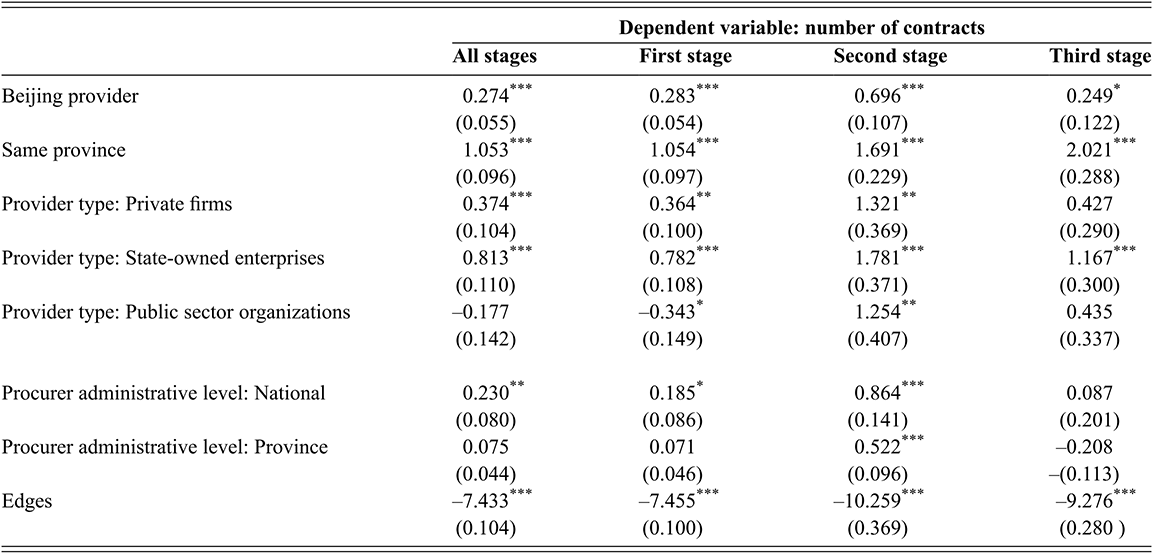
Table 9 Long description
The table presents the E R G M results across four model specifications: contracts in all stages of services, first-stage services, second-stage services, and third-stage services. The dependent variable is the number of contracts. The results show that procurers prefer forming contracts with providers from Beijing and also with providers from within the same province as themselves.
In the full model that considers the likelihood of contract formation across all stages, the results show that procurers prefer forming contracts with providers from Beijing, based on the positive and statistically significant coefficient. Specifically, if the provider is from Beijing, the log-odds of a contract forming increase by 0.274, holding all else constant. This corresponds to a 31 percent increase in the odds of contract formation with Beijing-based providers, compared to those from other provinces, holding all else constant. Procurers are also more likely to contract with providers from within the same province as themselves. The odds of contract formation are higher – almost twice as high – when procurers and providers are from the same province, compared to when they are from different provinces. The predicted probability of such within-province contracts is approximately 0.74. Furthermore, procurers prefer procuring services from both private companies and SOEs, as compared to other corporations. This is reflected in the positive and statistically significant coefficients for Provider Type: Private Firms and Provider Type: State-owned Enterprises, whereas Provider Type: Public Sector Organizations has a negative coefficient that is not statistically significant. The reference category is Provider Type: Other Suppliers. Private firms and SOEs are significantly more likely to receive contracts, with odds that are approximately 45 percent and 125 percent higher, respectively, relative to other corporations. In contrast, relative to other suppliers, public sector organizations have lower odds (about 16 percent) of being contracted, although this effect is not statistically significant. Finally, national-level procurers are about 25 percent higher odds of procuring contracts compared to those at the prefectural level.
In first-stage contracts, the patterns are largely consistent with the full model. Beijing-based providers have approximately 30 percent higher odds of receiving contracts than those from other provinces. Procurers are also substantially more likely to contract with providers from the same province, with 187 percent higher odds of within-province contracting. In this stage of service, both private firms and SOEs continue to be favored. Private firms have about 44 percent higher odds, and SOEs have about 110 percent higher odds of being contracted relative to other suppliers. Procurers at the national level are also more likely to have contracts than prefectural and provincial procurers.
In the second stage of services, similar patterns of contract formation hold. Beijing-based providers have about 100 percent higher odds of receiving contracts than those from other provinces. Within-province contracts are more likely than contracts across provinces. Procurers are about three times (four times) more likely to work with private companies (SOEs) than other corporations. They also prefer working with public sector organizations than other kinds of suppliers. Finally, procurers at the national and provincial levels are also more likely to have contracts than those at the prefectural level.
In the third stage of services, Beijing-based providers have 28 percent higher odds of receiving contracts compared to providers from other provinces. Procurers continue to exhibit a strong within-province tendency. In this stage, SOEs continue to be preferred providers, with 221 percent higher odds of being contracted than other suppliers. The coefficient for private firms remains positive but loses its statistical significance.
The results provide several key insights into preferences for outsourcing surveillance. The significant preferences for Beijing-based providers suggest a centralization of online opinion management in the capital. This preference is consistent with our earlier expectations that Beijing-based providers are likely to have a better understanding of the priorities or requirements of the authorities due to their proximity to the central government or policymakers, which makes them more attractive to procurers. Their access to the central leadership privileges them to position their clients in favorable light before their political superiors. This is often done by inclusion of positive narratives of their clients’ cases in the internal briefs (neican) to the central leadership. Furthermore, the tendency for procurers to contract with providers from the same province as themselves reflects a reliance on local networks to deal with online opinion issues, especially for the first two stages of service. Familiarity with local political, social, and economic conditions, as well as proximity to clients, enhances surveillance and timely crisis response.
Notwithstanding the technological expertise of private companies, procurers still prefer working with SOEs, evidenced across all stages of service; but the gap between state-owned and private firms is particularly stark for service in the third stage. Consistent with our earlier findings, the preference for contracting with SOEs is stronger in higher-risk and politically sensitive services, such as the punishment of online posters.
Taken together, findings from the descriptive and inferential analyses suggest that the state outsources the tasks in online opinion management, but it is selective with whom it chooses to work. Procurers work with trusted state-owned firms and strategically positioned providers for various kinds of services in what is after all a sensitive and politically salient process of online opinion management. Selective outsourcing is indicative of a strategy of leveraging the expertise of specialized service providers while still asserting control over critical functions in the moderation of the online sphere.
4.4 Preventive Repression: Online Opinion Management as a Preemptive Measure
Here, we examine the impact of online opinion management on forestalling social unrest as an indicator of its effectiveness as a preventive repressive measure. Specifically, we estimate the effect of the level of government expenditure on online opinion management on labor strike events. For our dependent variable, we construct a count variable of the number of strike events in each province using data from the China Labor Bulletin. Our independent variable of interest is a measure of the amount of government procurement expenditure on online opinion control by each province, using data from the China Government Procurement Network and the Provincial Government Procurement Network. Our analysis covers the period from 2018 to 2020 after matching government procurement data and strike data; province-year is the unit of analysis. We expect a negative relationship between the level of government expenditure and strike events in a province in a given year, indicating greater surveillance leading to less social unrest in the same locale.
We control for economic and social development of each province and include a variable for Government Intervention Intensity, which is a measure of general budget expenditure as a proportion of GDP. We incorporate proxies for the level of technological development and education using measures of the proportion of government expenditure on science and technology (Technological Development Level) and education (Education Level), respectively. We also include a measure of the total research and development expenditure as a proportion of GDP (Research and Development Intensity). We account for the level of infrastructural development in a province: Transportation Infrastructure (Highway Mileage) is a measure of the total highway mileage; Transportation Infrastructure (Freight Volume) is a measure of the total freight volume; and Infrastructure Investment is a measure of fixed assets investment. In addition, we include a number of economic and social covariates, including GDP per capita, Secondary Industry (% of GDP), Tertiary Industry (% of GDP), Economic Openness (total volume of imports and exports/GDP), Population (log), Urbanization Level (proportion of urban population), Urban‒Rural Income Gap (average income of urban residents/average income of rural residents), and Tax Burden Level (tax income/GDP). Data for these indicators are obtained from the Wind database, China Financial Yearbooks, and China Statistical Yearbooks.
We employ a linear regression model with provincial and year fixed effects:

 is the number of strike events in a province i in year t+1. We lag the dependent variable by one period to account for potential reverse causality. The explanatory Government Expenditureit is the amount of government expenditure on online opinion management in province i in year t. Xit represents the battery of control variables, δi represents the province fixed effect, τt represents the year fixed effect, and εit represents the error term. We use robust standards errors to overcome the problem of heteroscedasticity. The coefficients measure the estimated effect of government procurement expenditure (on online opinion control) in the current year on the number of strike events in the following year.
The results of the linear regression appear in Table 10 (the full results are presented in Appendix B). As expected, the coefficient for government procurement expenditure is negative, indicating that higher amounts of procurement expenditure on online opinion management are associated with fewer strike events in the next time period. This negative relationship is illustrated in Figure 8, which shows the level of government procurement expenditure on the horizontal axis and the number of strike events in the following year on the vertical axis. The regression results suggest that procurement expenditure by a province on public opinion control in the current year can significantly reduce the number of strikes that occur in the following year. Every one million RMB investment in government procurement expenditure is associated with 0.688 fewer strikes in the following year.
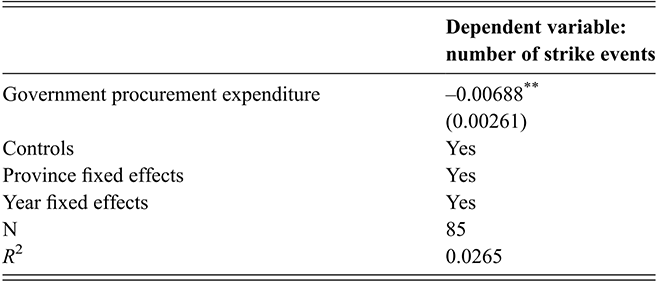
Table 10 Long description
The table presents the linear regression results of the impact of government procurement expenditure on online opinion management on the number of strike events. The dependent variable is the number of strike events. The results show that higher government procurement expenditure is associated with lower number of strike events.
Estimated effect of government procurement expenditure on number of strike events
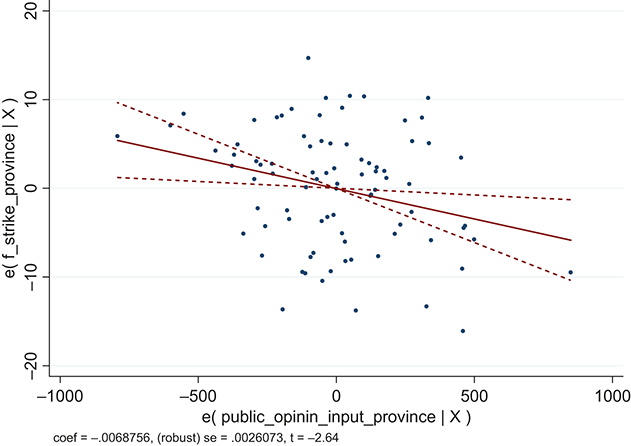
5 Conclusion
This Element represents a systematic attempt to investigate the way the Chinese state conducts digital repression by studying how it outsources surveillance of online opinions to for-profit corporations. In addition to the novel approach of using public procurement contracts to study statecraft, we also conduct elite interviews with various stakeholders in online opinion management, including industry professionals and government bureaucracies.
Online opinion is a double-edged sword to the Chinese state: Given the prevalence of internet penetration, the regime must permit some degree of social discourse to take the pulse of society; however, it also needs to ensure online expressions stay within certain confines and do not lead to collective action. Unlike traditional public opinion, management of online sentiment requires a high degree of technical capacity to analyze trends in big data, moderate discussion, and steer discourse sentiment before it turns overwhelmingly negative. Surveillance and moderation of online sentiment take place on a decentralized basis, across almost all party-state organizations at the national, provincial (municipal), and lower administrative levels in China. State outsourcing of these services has spawned a multibillion RMB for-profit industry specializing in the management of online opinion. The industry players include private technology companies, for-profit subsidiaries of state-owned media companies, and public sector organizations like universities.
Through text analysis of government procurement contracts, we found evidence for the state’s solicitation of various technical services throughout various stages of online opinion management. At the first stage of detection and monitoring, procurers often look to acquire software that automates these services, issues preventive warnings, and provides standard reporting. The second stage of service is also preemptive in that it seeks technical expertise in risk and crisis assessment as well as provision of analytical reports for the assessment.
As for the final and third stage, procurers establish partnerships with trusted and well-established for-profit subsidiaries of state-owned service providers, such as Xinhua Daily, that have the requisite technical infrastructure to provide rapid crisis responses and the political networks to elevate the status of the procurers and put them in favorable light. However, we must emphasize that services in the third stage are seldom outsourced because of their political sensitivity. If they were, procurers lean on skilled personnel and seek training of in-house staff from state-owned media providers to improve their real-time capacity to respond to online crises. By way of contrast, our interviews suggest most of online incidents are elevated to the higher-level cyberspace administration office, party committee, and government for resolution by administrative measures.
The strong preference for Beijing-based providers arises from their superior political connections with the central government due to their close proximity to the national-level party-state organizations and policymakers. The tendency for procurers to contract with same-province providers in turn reflects a preference for local trusted networks. Familiarity with local socioeconomic and political conditions enhances surveillance and enables timely crisis response. In summary, while the Chinese state outsources digital surveillance extensively to for-profit technology firms, the logic that explains the formation of contract partnership follows one of acquisitions of technical knowhow and political advantages to complement those of the procurers.
Our findings also suggest that outsourcing surveillance is a strategy of preventive repression: it preempts offline collective action from taking place. Specifically, our regression analysis showed negative association between increased expenditure on public procurement of online opinion management services and reduced strike events in the following time period.
Unlike outsourcing repression in the offline world – intended to minimize the costs of resistance and backlash by engaging nonstate actors in doing the state’s bidding (Ong, Reference Ong2018, Reference Ong2022) – digital repression conducted by for-profit firms is by nature hidden in plain sight. The purpose of outsourcing surveillance is to bolster the state’s technical capacity to conduct digital repression. This enables the Chinese state to exercise statecraft in the increasingly contentious and high-stakes digital world.
Our findings resonate with other aspects of digital control in China. The ubiquitous social credit system also augments state power to monitor, evaluate, and control its citizens according to a set of state-endorsed morals and values. This newfound state power stems from its capacity to integrate social-credit data collected by private and public entities as well as regional platforms into the National Public Credit Platform (Cheung & Chen, Reference Cheung and Chen2022; Liang et al., Reference Liang, Das, Kostyuk and Hussain2018). By harnessing big data collected by state and private data corporations, the social credit system allows the state to exercise its statecraft by either conferring rewards or doling out punishments to citizens according to its own set of definitions.
The reach and prowess of the Chinese autocratic state is well recognized, but what is less recognized is the private sector and for-profit state entities that the state mobilizes to penetrate society – offline and online – in order to shape social behavior. We hope this Element precipitates a new agenda that centers state‒private and for-profit partnership in the analysis and study of statecraft. Specifically, we believe two areas of research offer promising returns. One, online censorship – to what extent does the state extend the strategy of outsourcing to private firms and/or the online masses to conduct censorship? To what extent does the famed Mao’s strategy of mobilizing the masses apply to online censorship? Second, under what conditions does the state prefer outsourcing to private firms vs. for-profit entities of state-owned firms? While our study points to the political nature and risk level of services concerned, deeper dive into this question will further crack open the Pandora’s box of state–business relations, and the political future of private sector development in China.
To what extent do our arguments travel across country contexts? The arguments in this Element, principally state outsourcing of digital repression to for-profit entities to shape online behavior, are subject to these scope conditions. First, very few autocratic states boast a robust internet ecosystem where private corporations provide abundant services that cater to the demand of state surveillance. One could argue this maybe a function of the decentralized nature of internet surveillance in China, and the institutional pressure on regional and local party-state agencies to monitor online sentiment affecting them. Without the demand from the state, there is little to no reason for private providers of surveillance solutions to exist. Without the prevalence of for-profit surveillance technology firms, there is simply no provider to which the state could outsource the services; the demand and supply of this industry is thus endogenously driven to some extent. Second, to the extent that outsourcing is a principal-agent problem, the principal must have the capacity to rein in the agent and keep them on a tight leash. Hence, effective state outsourcing to private entities presupposes strong state capacity to monitor and discipline the agent’s behavior. While our public procurement data does not allow us to trace agents’ behavior, the competitive nature of online opinion management industry and our interview data with the stakeholders and industry insiders suggest state procurers hold the upper hand in the principal–agent relationship, perhaps with the only exception of their relations with Beijing-based state-owned media companies. The presence of both of these scope conditions – the prevalence of private surveillance technology providers and strong state capacity – suggest other autocratic regimes may have difficulties duplicating the effectiveness of the CCP regime’s digital repression strategy.
Appendix
A. Examples of Contracts
1. Example of a contract in the first stageFootnote 1
(a) Contract procured by the Office of the CCP Xiqing District Committee Cybersecurity and Informatization Leading Group, Tianjin Municipality (中共天津市西青区委网络安全和信息化领导小组办公室机关)Footnote 2 :
1、危机应对建议:要求提供7*24小时的人工预警, 在舆情发生的第一时间及时发出危机预警信号, 进行舆论走向和社会心理定势的预测分析, 并提出舆论应对建议。2、舆情监测平台培训:系统学习舆情监测系统使用、设置, 加强相关工作人员的舆情分析处置能力, 为应对舆情提供强有力的支持。3、舆情监测平台:7*24小时对互联网信息 (20000多家网站、5000多家论坛博客、1100多家报刊、300多家境外媒体、主流新闻客户端、新浪微博) 实时监测、采集、内容提取及自动消重。4、信息推送服务:以监测平台为依据, 通过手机短信、电子邮件、定制化APP、微信等多种方式提供人工7*24小时定制化信息报送及数据。5、舆情专报:用于对突发舆情事件进行整体分析和梳理, 内容包括主题事件概述、传统媒体对事件的关注点分析、网民对事件的主要观点以及建议等, 依据相关数据, 做定性、定量分析。6、常规报告服务: 包括舆情快报、日报、周报、月报和年报, 定期整理和更新、舆情档案数据库。7、保密承诺: 要求在合作期间, 对我单位信息提供具有法律效应的保密承诺书。
(b) Contract procured by the Yangtze River New Town Management Committee in Wuhan’s Changjiang District (武汉长江新城管理委员会)Footnote 3 :
项目名称: 2021年长江新城官方微信公众号和微博运营维护及舆情监测服务
服务要求: 一年服务期里具体实施官方微信、微博的运营维护及舆情监测
(c) Contract procured by Shandong Provincial Drug Administration (山东省药品监督管理局机关)Footnote 4 :
采购项目分包情况: 标包货物服务名称数量投标人资格要求本包预算金额 (最高限价, 单位: 万元) A舆情监测和政务微博、微信、头条号管理项目。
2. Example of a contract in the second stage
(a) Contract procured by the Propaganda Department of the Fujian Provincial Committee (中共福建省委宣传部):Footnote 5
采用单一来源采购方式的原因及说明:1、中国经济信息社有限公司是新华社直属企业, 全面负责新华社经济信息产品的生产和服务, 同时中国经济信息社有限公司是新华社经济智库建设的承载主体和研究平台。2、新华社是中国国家通讯社和世界性通讯社, 承担着信息总汇的职能, 并拥有覆盖全球的新闻信息采集网络。2015年11月, 新华社入选首批国家高端智库建设试点单位, 成为党中央、国务院、中央军委直属的十家综合性研究机构之一。依托新华社的全球布局、舆情监测分析系统、采编网络和对媒体和互联网舆情监测积累的舆情数据、分析经验和资源优势, 中国经济信息社有限公司的信息采集网络覆盖全球180个国家和地区, 以及国内30多个省、市、自治区, 建立了覆盖各领域的经济信息采集、加工、分析等服务体系, 开发了动态资讯、深度分析、数据查询、即时行情、交易撮合等产品和服务, 可针对福建省的境内外经济信息需求, 对相关经济信息进行采集、整理、保存、加工, 并提供专业、权威的经济分析报告、重点产业、行业发展研报、信用评级和咨询、舆情监测等服务, 可提供线上实时查询、线下定制化的智库咨询和提供境内外多语种舆情监测等服务。3、中国经济信息社有限公司作为中国经济信息事业的开创者, 构建了覆盖多个领域的信息产品和服务体系, 成为国内规模最大、服务领域最广、产品种类最全的经济信息服务机构之一, 且中国经济信息社有限公司是国家金融信息安全和人民币国际化的 “新华财经”、“一带一路” 倡议的 “新华丝路”、社会诚信体系建设的 “新华信用” 和国家能源安全的上海石油天然气交易中心四大国家级信息服务平台唯一的建设运营机构。4、综合考量中国经济信息社有限公司的唯一性, 特别是品牌、渠道、大数据技术、资源、公信力的独特优势, 符合本项目智库服务的需要, 其它供应商基本不具备相关技术和力量。因此, 采用单一来源采购的方式采购该项目。
服务要求 : 1、提供聚焦福建高质量发展的智库专题报告; 2、提供聚焦国家战略在闽落地实施的智库专题报告; 3、提供围绕“十四五”规划实施福建经济社会发展的智库报告等详见单一来源采购文件 1、提供围绕 “后疫情” 时期经济快速恢复的智库报告: 5份/期, 共4期, 每期字数下限3000字; 2、提供疫情期间国内外舆情监测报告: 2份/期, 共50期, 每期字数下限2000字; 3、提供聚焦福建省内重点舆情监测报告: 2份/期, 共4期, 每期字数下限3000字等详见单一来源采购文件 1次. 1、提供《政务智库报告》: 5份/期, 共50期, 每期字数下限3000字; 2、提供《经济分析报告》: 5份/期, 共50期, 每期字数下限3000字; 3、提供《国务院常务会议专报》: 5份/期, 每次国常会召开后, 每期字数下限1000字等详见单一来源采购文件。
3. Example of a contract in the third stage
(a) Procurement contract by Mudanjiang City Municipal Bureau of Ecology and Environment (牡丹江市生态环境局)Footnote 6 :
采购需求: 项目概况: 1.负责牡丹江市环境保护局微信公众号、官方微博发布内容的审核、编辑及日常管理维护; 2. 协助牡丹江市环境保护局相关工作人员整合新闻宣传工作, 协助进行日常新闻采写; 3. 按照要求每天更新微信及微博相关信息; 4. 运维团队具备新闻采写能力; 5. 按照要求及时做好微信、微博相关宣传; 6. 投标申请人拥有丰富的运营经验; 7. 具有对环保行业政策的理解和分析能力, 能够根据行业发展动态对运营内容进行及时前瞻的调整, 提高资讯水平; 8. 实时应对牡丹江市生态环境方面各类网络舆情事件的引导及处置; 9. 编写新闻及信息人员必须是党员。 服务期限: 1年; 服务、安全要求: 实时关注行业动态, 以及重要的时间节点上生态环境战线的重点宣传内容, 掌握生态环境战线舆论导向, 实时关注本地民生新闻, 社会热点, 有策划地主动推送, 营造良好环境氛围。
B. Regression Results
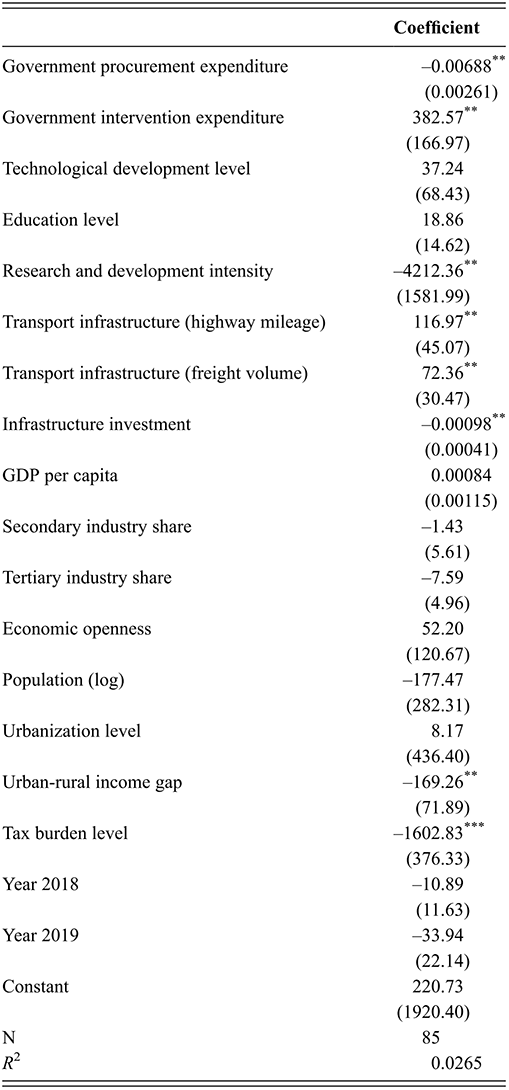
Table 0.1 Long description
The table presents the full results of the linear regression estimating the association between government procurement expenditure on online opinion management and the number of strike events. The dependent variable is the number of strike events. The results show that higher government procurement expenditure is associated with a lower number of strike events. The coefficient for the explanatory variable of interest, government procurement expenditure, is negative and statistically significant at the 5 percent level. Among the control variables, government intervention expenditure and transport infrastructure (measured by highway mileage and freight volume) are each positively associated with strike events, with coefficients statistically significant at the 5 percent level. The coefficients for research and development intensity, infrastructure investment, urban-rural income gap, and tax burden level are each negative and statistically significant. The coefficients of the remaining control variables are not statistically significant.
C. List of Elite Interviewees
| No. | Position | Unit | Gender | Date |
|---|---|---|---|---|
| 1. | Deputy director of the party committee propaganda department | A university in Beijing | M | 8–26–2022 |
| 2. | Deputy director | A county party standing committee | M | 8–26–2022 |
| 3. | Manager of a department in charge of online opinion management (yuqing bumen) | Xinhua Daily | F | 8–26–2022 |
| 4. | Deputy director | A county party standing committee | M | 8–29–2022 |
| 5. | Director of a district propaganda department | A city in Guangxi province | M | 8–30–2022 |
| 6. | CEO of a public sector organization (shiye danwei) | A national-level public sector organization | M | 9–28–2022 |
| 7. | Head of a department in charge of public opinion management (yuqing bumen) | A local newspaper | M | 9–28–2022 |
| 8. | Deputy chief of public security | A county-level public security bureau | M | 4–15–2023 |
| 9. | CEO | A national-level newspaper | M | 4–15–2023 |
| 10. | Manager | An Internet giant | M | 8–14–2024 |
University of Michigan
Mark Dincecco is Professor of Political Science at the University of Michigan. His research analyzes the long-run historical determinants of the political and economic development patterns that we observe today, with a focus on Europe and Eurasia. Dincecco has published numerous articles in leading academic journals across both political science and economics. His most recent book is From Warfare to Wealth: The Military Origins of Urban Prosperity in Europe, the winner of the William Riker Best Book Award. Dincecco received his PhD in Economics from UCLA.
About the Series
The Element Series Political Economy provides authoritative contributions on important topics in the rapidly growing field of political economy. Elements are designed so as to provide broad and in-depth coverage combined with original insights from scholars in political science, economics, and economic history. Contributions are welcome on any topic within this field.