


1. Introduction
In the life cycle of a product, the use phase can have significant environmental impacts depending on the behavior of the user (Reference LilleyTang and Bhamra, 2008; Reference Tang and BhamraLilley, 2009). Effectively designing products and interventions for this phase can lead to meaningful behavior change when thoughtfully implemented, with successful examples including visualizing energy consumption Footnote 1 or incentivizing desirable behaviors (Reference Coskun, Zimmerman and ErbugLockton et al., 2008; Reference Lockton, Harrison and StantonCoskun et al., 2015). Within this field of design for sustainable behavior (DfSB), a variety of frameworks have been used to categorize the strategies, from Lilley (Reference Lilley2009)’s eco-feedback/behavior-steering/persuasive technologies framework to the design with intent framework (Reference Lockton, Harrison and StantonLockton et al., 2008), bringing together findings from many disciplines. In human-computer interaction research, similar frameworks have been developed (Reference DiSalvo, Sengers and ttirDiSalvo et al., 2010), adding additional strategies like goal-setting and social comparison. While these frameworks all seek to characterize the behaviors or products being used to encourage sustainable user behavior, few studies have approached this field through the lens of interaction modality, particularly the similarities and differences of physical vs digital methods.
As digital products and services become more ingrained in daily life, it is crucial to explore their potential to drive sustainable user behavior. Emerging technologies (e.g., GenAI, VR/AR, etc.) mean information is being disseminated and collected more easily than ever before. The ongoing advancement of artificial intelligence (AI) and other emerging technologies continues to shape the digital transition, creating new opportunities to address challenges within the DfSB domain (Reference Su, Vezzoli and NanSu et al., 2023). However, many challenges exist in applying DfSB principles to the design of products and product-service systems (PSS). These include variability of target consumers, knowledge gaps in developing standardized evaluations and methods, and lack of long-term studies on these interventions (Reference Gustafsson, Harild and PigossoGustafsson et al., 2021). This paper explores if digital applications, with their ability to quickly scale, swiftly adapt to user behaviors, and update in real-time, present unique opportunities for intentional sustainability-driven use (Reference Mosca, Manunza, Manca, Vivanet and FornaraHan et al., 2023; Reference Han, Shevchenko, Yannou, Ranjbari, Esfandabadi, Saidani, Bouillass, Bliumska-Danko and LiMosca et al., 2024).
This work examines DfSB methods and the product areas explored over the past decade in digital and physical products, services, and product-service systems (PSS). Using a systematic literature review of research in product/engineering design, and human-computer interaction (HCI), it identifies trends across PSS technologies and evaluates how strategies align with different modalities. These insights aim to guide the development of new DfSB interventions that effectively leverage emerging technologies.
2. Methods
Literature screening overview

To identify design strategies for promoting sustainable user behaviors across digital and physical products, services, and PSS, a systematic literature review was conducted using the PRISMA framework. The review focused on product/engineering design and human-computer interaction research and involved searching the Scopus database. Three key topic areas were developed to guide the search: product-service systems, environmental sustainability, and design for sustainable behavior. A keyword list was created for each area to refine the search strategy. The following search string was used:
(“Product Service System” OR “PSS” OR “Product Service Solution” OR “Product as a service” OR “Serviti?ation” OR “Product Design” OR “Service Design” OR “Product Development” OR “Sustainable Products” ) AND (environment* OR sustainab* OR circular* OR eco* OR “environment* impact” OR “environment* W/2 impact” OR “environment* W/2 sustainab*” OR “environmentally responsible”) AND (“intentional design” OR “persuasive design” OR “persuasive technology” OR “design for sustainable behavior” OR “environmentally responsible behavior” OR “design for sus-tainability” OR “Sustainable Behavi*r” OR “Sustainable Consumer Behavi*r” OR “Sustainable Consumption” OR “Sustainable Use” OR “Green Behavi*r” OR “Green Consumer Behavi*r” OR “Green Consumption”)
To be included in the review, only papers published since 2014 (the last 10 years) were considered. Additionally, the papers had to meet the following criteria: 1) they must be empirical studies, 2) they must refer to a specific product, service, or product-service system (PSS), 3) they must discuss an intervention or method aimed at encouraging user behavior, and 4) they must include discussions on environmental sustainability.
The initial Scopus search surfaced 299 papers. After a title, keyword, and abstract screen, 49 papers remained. To expand the corpus, additional relevant articles were identified from the reference lists of these 49 papers, bringing the total to 79 papers. Notably, many of the articles obtained from references were from the human-computer interaction field, suggesting that slightly different terminology may be used when conducting DfSB studies in this domain. One paper was excluded due to access issues. After a close read of all the articles, 39 papers were included in the final analysis. Notably, one of these papers presented two distinct case studies, which were treated as separate entries for analysis purposes. An overview of this filtering can be found in Figure 1.
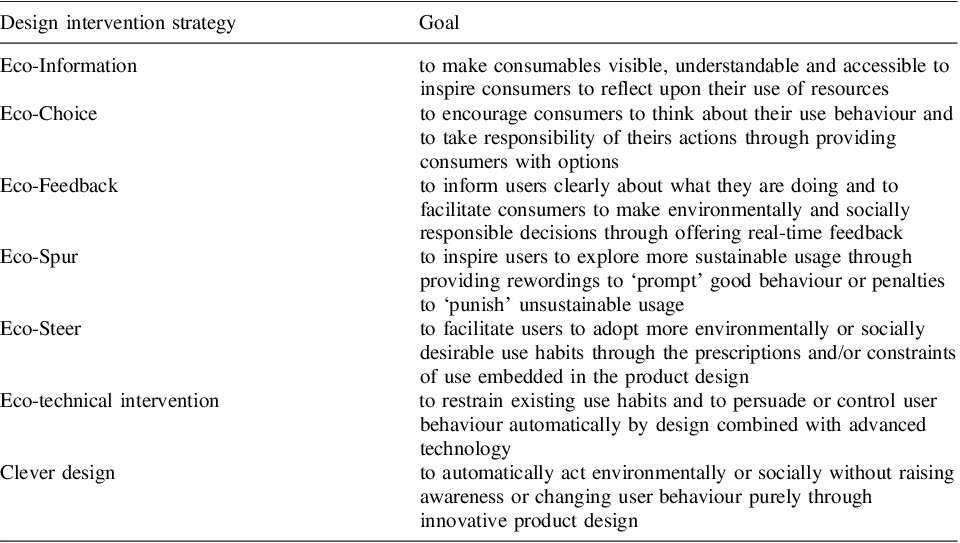
Papers were coded based on several criteria: intervention modality (digital, physical, or other), application area, behavioral outcome (if measured), technology type (if applicable), contribution type, and the specific DfSB strategy(s) employed. Contribution types were categorized using the framework from Coskun et al. (Reference Coskun, Zimmerman and Erbug2015), which classifies conceptual and empirical studies based on their outcomes and methods. Since this review focuses strictly on empirical contributions, conceptual studies are not included in the results. DfSB strategies were coded according to the design intervention strategies outlined by Bhamra et al. (Reference Bhamra, Lilley and Tang2011), as summarized in Table 1.
Overview of DfSB strategies proposed by Bhamra et al. (Reference Bhamra, Lilley and Tang2011)

3. Results
Figure 2 shows the distribution of included articles by year. There is an increase in DfSB papers over time, confirming and extending findings from Coskun et al. (Reference Coskun, Zimmerman and Erbug2015) and Gustafsson et al. (Reference Gustafsson, Harild and Pigosso2021) that the field continues to gain interest in the research community. Of the 39 papers analyzed, 20 were journal papers and 19 were conference papers. Future work could explore analyzing conference posters and demos where available, which may highlight additional prototypes that may have not been archived. A variety of applications were analyzed across the corpus of papers, as seen in Figure 3. Resource consumption (both energy and water) appears across all intervention modalities, reflecting a consistent trend in DfSB behavior since the field’s emergence, as consumer behavior is the primary driver of environmental impact for energy-consuming products (Reference Tang and BhamraTang and Bhamra, 2009). The product areas that appear in the digital/physical overlap all represent tangible areas of daily life, from cooking to using paper towels to waking up on time for work, that have opportunity to leverage digital technologies to influence sustainable user behaviors. Overall, a greater diversity in applications appears in digital interventions (or those with a digital component), showing the flexibility that this modality supports in engaging with different fields. While resource consumption was and remains a primary focus of DfSB interventions, as evidenced by research in the 2000s and early 2010s (Reference Hansson, Pargman and PargmanBhamra et al., 2011; Reference Bhamra, Lilley and TangHansson et al., 2021), emerging technologies are enabling broader applications of DfSB. These new applications include empowering sustainable decision-making in areas like food and apparel, promoting product and furniture longevity through emotional connections, and providing real-time feedback on eco-driving behaviors.
Articles included in the study organized by year of publishing

Product application areas, color-coded by type. The overlap represents interventions categorized as both physical and digital. The numbers in parentheses represent the number of studies that utilized each technology in a given modality (e.g., “water (8)” indicates that eight studies used water as an application area in that modality)

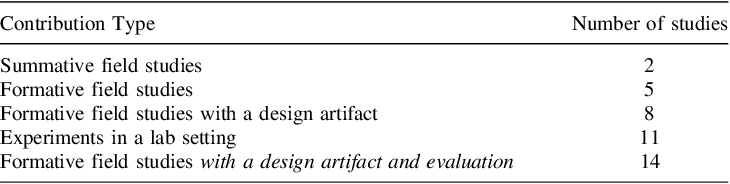
Distribution of contribution types, as categorized by Coskun et al. (Reference Coskun, Zimmerman and Erbug2015)

3.1. Intervention types and modalities
In the 39 studies analyzed, a total of 53 design interventions were observed. Within these 53 interventions, 21 digital interventions were present, 16 physical interventions, 15 physical interventions with digital component(s), and 1 digital intervention with physical components. Interventions are defined according to the components with which users regularly interacted with. For example, redesigning a sink so that its outflow rate is slower and users are visually motivated to user less water is a physical intervention (Reference Halabieh and ShuHalabieh and Shu, 2024). On the other hand, a browser extension that nudges users toward sustainable fashion choices is a digital intervention (Reference Hu, El-Rashid and BertelsenHu et al., 2024) as it is completely online. A mix of these two interventions can occur, for example, a mobile app that receives information from a smart egg tray in the user’s fridge to raise awareness about food waste is primarily digital (app) but has a physical element with which users interact (egg tray), and would thus be categorized as digital with physical component (Reference Carulli, Bordegoni and SpadoniCarulli et al., 2022). The final modality is exemplified by a coffee maker that provides real-time energy consumption feedback. While physical in nature, it incorporates digital components to enable its functionality and is thus categorized as physical with digital components (Reference Cor and ZwolinskiCor and Zwolinski, 2015). About half of the studies analyzed were either lab experiments or field studies which propose and evaluate a design artifact (Table 2). Still, about a third of studies don’t provide an evaluation of their intervention. This highlights a key challenge in DfSB: the lack of standardized evaluation methods and metrics. Future studies should explore in-field or living lab evaluations to measure intervention effects, observe habitual practices, and assess long-term impacts, addressing a significant gap in the field (Reference Gustafsson, Harild and PigossoCoskun et al., 2015; Reference Coskun, Zimmerman and ErbugGustafsson et al., 2021).
The classification of each intervention by both DfSB strategy and modality can be seen in Figure 4. The most frequently used DfSB strategy among digital interventions was eco-information. In the digital space, eco-information was found to be most successful when transparency and traceability of data was prioritized (Reference Hina, Islam and DhirStolz et al., 2024; Reference Stolz, Hammerschmidt and PoseggaHina et al., 2024). Eco-information was increasingly used as a strategy for online shopping and fashion, highlighting an area where relevant sustainability data can be strategically displayed to the user alongside the existing webpage. This strategy is more difficult to convey for in-person apparel shopping, where information sharing is more limited and static in nature.
Design interventions analyzed according to DfSB framework and PSS categorization

3.2. Design strategies and technological trends
Eco-feedback was the most commonly used strategy overall, and saw implementation in both physical and digital contexts. Several studies observed that eco-feedback lead to more successful behavioral outcomes in digital interventions. For example, water consumption was more effectively reduced when an individual’s usage was displayed on a screen compared to when a physical intervention (such as water usage visually decreasing proportionally from a fish tank) was used (Reference Sohn and NamSohn and Nam, 2015). Feedback was especially impactful in digital interventions when the feedback was compared against peer usage (Reference Burel, Piccolo and AlaniChiu et al., 2020; Reference Biørn-Hansen, Katzeff and ErikssonBiørn-Hansen et al., 2022; Reference Serna-Mansoux, Chapotot, Millet and MinelBurel et al., 2016). Across physical and digital interventions, it is important to consider the affect and tone of any eco-feedback provided when designing a new PSS, though there are mixed results on the relationship between positive/negative feedback and its effect in the short- and long-term (Reference Saadi and YangSerna-Mansoux et al., 2014; Reference Bao, Burnell, Hughes and YangBao et al., 2019; Reference Chiu, Kuo and LiaoSaadi and Yang, 2020). To enhance the effectiveness of eco-feedback interventions, additional measures can be incorporated, such as the use of conversational AI agents that provide emotional connections alongside eco-feedback (Reference Berney, Ouaazki, Macko, Kocher and HolzerBerney et al., 2024). These agents can offer personalized recommendations and foster a sense of engagement, potentially leading to more sustainable behavior changes.
Alongside eco-feedback, eco-spur was also frequently seen as successful in the digital interventions due to its ability to set individualized goals or incentives, which can be easily tailored for different target users and environmental attitudes when using platforms like mobile apps or consumption sensors (Reference Huang, Ke, Lin, Shi and ZhangWithanage et al., 2014; Cor and Zwolinski, Reference Cor and Zwolinski2015; Reference Carulli, Bordegoni and SpadoniCarulli et al., 2022; Reference Withanage, Ashok, Otto and OttoHuang et al., 2023). In a similar vein, eco-steer was successfully enacted in digital interventions which collected user’s usage data and sought to make suggestions and modifications to tailor to that particular user, as seen in the paper Tariff Agent, where users could easily switch energy plans through text message suggestions based on their your electricity use (Alan et al., 2016).
Almost all eco-choice interventions incorporated a digital component. These interventions were particularly effective when they collected user data and provided options tailored to individual usage patterns. While many relied on automation to assist in decision-making, a key finding was the importance of offering flexible levels of user control and involvement. This flexibility was shown to enhance both user satisfaction and the overall success of the interventions (Reference Jensen, Kjeldskov and SkovAlan et al., 2016; Jensen et al., 2018). Physical interventions were clustered in one of five ways: (1) adding a functional constraint to a task, (2) changing operational complexity, (3) changing physical workload (Reference Sohn and NamSohn and Nam, 2015), (4) asking the user to set a goal, and (5) influencing user emotions. Functional constraint was the most often used (7 occurrences), which often served to steer or spur the user’s behavior a particular way, for example in saving water while using the faucet (Reference Halabieh and ShuSohn and Nam, 2015; Reference Sohn and NamHalabieh and Shu, 2024). Influencing user emotion was the next most popular category (4 occurrences), shown in examples that look to evoke product attachment (Reference Kowalski and YoonKowalski and Yoon, 2022), nostalgia (Reference Ranscombe, Blijlevens and ThurgoodRanscombe et al., 2022), or encouragement vs guilt (Reference Saadi and YangSaadi and Yang, 2020).
When looking at the evolution of technologies over time, there is an increasing diversity in the types of technologies used (Figure 5). As technologies advance, they open up new opportunities by becoming more powerful and offering new affordances. The use of internet of things (IoT) and embedded systems is consistent over time, while more personalized technologies like mobile apps, AI, and social media, begin to see visibility in later years. As newer technologies emerge, they not only increase data processing capabilities, but they also provide more tailored, user-centric experiences. For example, the growth of mobile apps and AI has enabled greater personalization, improving user engagement with sustainabil-ity efforts and adapting to user attitudes. Social media offers real-time feedback and community-driven motivation to users, which has shown success in encouraging sustainable behaviors.
Technologies implemented overtime, color-coded by type. The numbers in parentheses represent the number of studies that utilized each technology in a given year (e.g., “loT (3)” indicates that three studies implemented loT devices that year)

4. Discussion
Many of the barriers encountered in implementing DfSB strategies (Reference Gustafsson, Harild and PigossoGustafsson et al., 2021) may be addressed through the affordances provided by digital technologies. Specifically, the integration of digital techniques enables the personalization and adaptation of products, allowing interventions to better respond to the varying behaviors within large consumer groups. Furthermore, technologies like social media, AI, and chatbots can help quickly implement and scale intervention ideas, helping address barriers around enacting DfSB due to time and resource issues, as well issues with realizing interventions into long-term behavior change. Digital interventions, spanning from basic consumption sensors to complex AI models, provide valuable data on the use phase of products. Technologies like AI afford additional possibilities like improving accuracy of PSS offerings and predicting consumption patterns to avoid waste (Reference Natarajan, Paula, Dremel and UebernickelWatson, 2017; Reference Alcayaga, Wiener and HansenAlcayaga et al., 2019; Reference WatsonNatarajan et al., 2022). This data is particularly valuable for addressing the significant data scarcity issue that designers face when trying to gain a deeper understanding of how products are utilized in real-world contexts (Reference Ceschin and GaziulusoyPolizzi di Sorrentino et al., 2016; Reference Polizzi di Sorrentino, Woelbert and SalaCeschin and Gaziulusoy, 2016). By integrating these technologies, designers can access real-time insights that facilitate more informed, evidence-based decision-making when developing sustainable products. To address other existing barriers, data-driven DfSB strategies enable the expansion of a design's target user base and facilitate the execution of long-term studies on sustainability behaviors (Reference Montecchi and BecattiniMontecchi and Becattini, 2020) by making scalable studies possible and less resource-intensive.
As data-driven technologies continue to play an increasingly prominent role in implementing sustainability and circular economy principles across the life cycle (Reference Su, Vezzoli and NanHan et al., 2023; Reference Han, Shevchenko, Yannou, Ranjbari, Esfandabadi, Saidani, Bouillass, Bliumska-Danko and LiSu et al., 2023), this review focuses specifically on empirical studies that explore their application within the use phase. There is an opportunity to revisit many early studies in DfSB (Reference Froehlich, Findlater and LandayLockton et al., 2008; Reference Lockton, Harrison and StantonFroehlich et al., 2010) with the integration of items like novel sensing techniques or data processing to increase efficiency and therefore effectiveness.
While there is significant potential to use emerging technologies to promote sustainable behaviors, it must be done with careful consideration. First, it is important to assess how the technology itself may affect the overall environmental impact. For example, adding an LED screen to display a user's power consumption while vacuuming might encourage more efficient use, but if the environmental cost of producing and incorporating the screen outweighs the savings from improved behavior, the net sustainability effect would be negative. To address this, evaluation methods like life cycle assessment (LCA) can be used to measure the impact of specific interventions. However, modeling the use phase of a product's life cycle is a large problem when conducting LCAs (Reference Polizzi di Sorrentino, Woelbert and SalaPolizzi di Sorrentino et al., 2016; Daae and Boks,
Reference Daae and Boks2015), largely due to challenges with evaluation, as reflected broadly in DfSB. Even with the incorporation of emerging technologies, additional challenges may remain with rebound effects, though there is still a lack of consensus on how to effectively measure these broader impacts (Reference PigossoPigosso, 2024). Additionally, considerations of data privacy and ethics must be integrated into the design process if new digital data-collection methods are to be used (Reference Ploderer, Smith, Howard, Pearce and BorlandPloderer et al., 2012). For example, if AI is to be used for user interaction or data collection, designers should consider consulting the Guidelines for Human-AI Interaction framework (Reference Amershi, Weld, Vorvoreanu, Fourney, Nushi, Collisson, Suh, Iqbal, Bennett and InkpenAmershi et al., 2019), which can provide a lens on employing these techniques with the users in mind.
5. Conclusion
This paper presents a review of empirical design for sustainable behavior interventions in PSS across physical and digital products. A limitation of this study is that commercial products were not included in the analysis. Future research that examines these products could provide valuable insights into current consumer behavior at a larger scale, helping to better understand how sustainability interventions impact a broader market. The review finds technologies involved in DfSB interventions are diversifying with time, allowing for personalization and increasing levels of information to be conveyed to the user. Affordances of digital technologies are posited as addressing many of the diversity and resource barriers that DfSB practitioners may face. Notably, as emerging technologies enable more automated DfSB approaches, it is important to incorporate flexible levels of user control and involvement with the intervention for optimal success. Overall, this review provides a snapshot of how digital and physical technologies are being incorporated into DfSB interventions and highlights opportunities to use new technologies to support the design of new sustainable products and practices.
Acknowledgements
This material is based upon work supported by the National Science Foundation Graduate Research Fellowship Program under Grant No. 2146752. Any opinions, findings, and conclusions or recommendations expressed in this material are those of the authors and do not necessarily reflect the views of the National Science Foundation.





 Open access

