Introduction
The quality and quantity of prescribing in primary care represents a fundamental determinant of the clinical and cost-effectiveness of the UK NHS. The NHS spends ∼£8 billion a year on primary care drugs in England (National Audit Office, 2007), and therefore the potential to generate health benefits through improving the quality with which this resource is utilised is considerable. However, optimising primary care prescribing requires a detailed understanding of the complex array of factors that underpin the millions of individual prescribing decisions made every year by general practitioners (GPs). With the disbanding of primary care trusts (PCTs) and creation of GP commissioners in the form of clinical commissioning groups (CCGs), which are due to go live in April 2013 (Department of Health, 2012), then this issue of optimising primary care prescribing falls solely on the GP's shoulders.
In 2009, a report identified considerable variation between the ‘expected’ and ‘actual’ usage of 12 drugs, each of which had been the subject of a positive appraisal by the National Institute for Health and Clinical Excellence (NICE) (NHS Information Centre, 2009). The report also identified unexpected disparities in drug usage between PCTs. Unfortunately, having identified such variations, the reasons underlying them were not explored further. Such crude comparisons are largely of value in hypothesis generation and can raise a series of hypotheses concerning the extent to which such identified variations in prescribing behaviour can be explained by demographic or other ‘legitimate’ local influences.
The available evidence suggests that GPs’ attitudes to prescribing new drugs arise from a complex interaction of deeply held beliefs (Strickland-Hodge and Jepson, Reference Strickland-Hodge and Jepson1982; Prosser et al., Reference Prosser, Almond and Walley2003; Prosser and Walley, Reference Prosser and Walley2003; Mason, Reference Mason2008) concerning their attitude to risk (Prosser et al., Reference Prosser, Almond and Walley2003; Mason, Reference Mason2008), their gender, their experience (Dybdahl et al., Reference Dybdahl, Andersen, Kragstrup, Kristiansen and Søndergaard2005; Chauhan and Mason, Reference Mason2008), their personal ideology (Prosser and Walley, Reference Prosser and Walley2003) and their propensity to prescribe in general (Dybdahl et al., Reference Dybdahl, Andersen, Kragstrup, Kristiansen and Søndergaard2005). The confidence that clinicians have with the evidence base underpinning the guidance (Heller et al., Reference Heller, Edwards and McElduff2003; Mason, Reference Mason2008) and their perception of the benefits (Sheldon et al., Reference Sheldon, Cullum, Dawson, Lankshear, Lowson, Watt, West, Wright and Wright2004) will also influence their decision to incorporate NICE guidance into their prescribing practice. An associated factor is the complexity of the issued guidance and how difficult it is to incorporate into everyday practice (Sheldon et al., Reference Sheldon, Cullum, Dawson, Lankshear, Lowson, Watt, West, Wright and Wright2004). The features of the new drug itself, such as its cost, budgetary implications and mode of administration will also have an impact on GPs’ prescribing. Uptake is also greater in cases where the new drug addresses a need that is perceived as being unmet by currently available therapeutic options (Chauhan and Mason, Reference Chauhan and Mason2008).
From these myriad of factors affecting GP prescribing, two distinct classifications are made from an economic perspective: ‘demand’ factors (prescribing decisions determined by the individual circumstances presented to the clinician by the patient needs) and ‘supply’ factors (the experience, education, training, expertise, information and knowledge available to the clinician). This study is concerned with determining the ‘supply’ factors that affect primary care prescribing, using data from English PCTs, and aims to put the results in the context of the newly created CCGs.
Methods
A detailed regression analysis was undertaken of prescribing in six therapeutic areas for which there were prescribing data available. The therapies with a single indication were chosen for ease of analysis:
• treatment of hypercholesterolaemia (ezetimibe),
• non-benzodiazepine hypnotics for insomnia (zaleplon, zolpidem and zopiclone),
• smoking cessation (varenicline),
• hormonal treatments for early breast cancer (anastrazole, exemestane and letrozole),
• primary and secondary prevention of osteoporosis (alendronate, etidronate, risedronate, raloxifene, strontium ranelate and teriparatide) and
• obesity treatments (orlistat, sibutramine and rimonabant).
The independent variables were sourced from publicly available PCT-level data and included: socio-economic variables to categorise the PCT populations and determine how such variables contribute to the prevalence of the therapeutic areas being modelled; variables to capture PCT priorities and usage of alternative modes of treatment; and variables that aimed to capture the ‘efficiency’ of the PCT, which may indicate how proactive they are at searching for and implementing guidance.
A separate regression model was built for each therapeutic category to assess the extent to which different influences affect the different areas of drug utilisation. Ordinary least squares regression was chosen with a logged-dependent variable, although two other regression specifications were explored and deemed less appropriate. In each case, the modelling process commenced by a simple specification incorporating five or six variables, which were used as proxies for an underlying factor that was expected to significantly influence prescribing in this therapeutic area, was guided by the evidence in the literature. Variables were added sequentially and remained in the model if they added to its explanatory power. The modelling process therefore followed a stepwise approach with insignificant variables (assessed using the t-test) being replaced with proxies for the same broad category (Dougherty, Reference Dougherty2002). Any variable that was significant at the 10% level remained in order to ensure that the final model specifications provide the best possible fit, given the data available and the stepwise model building procedure used. Full modelling methodology is available on request from the author.
Results
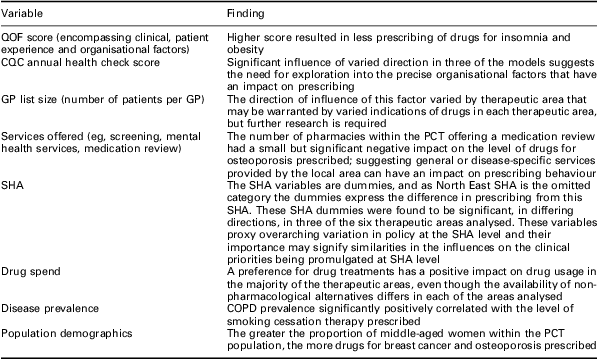
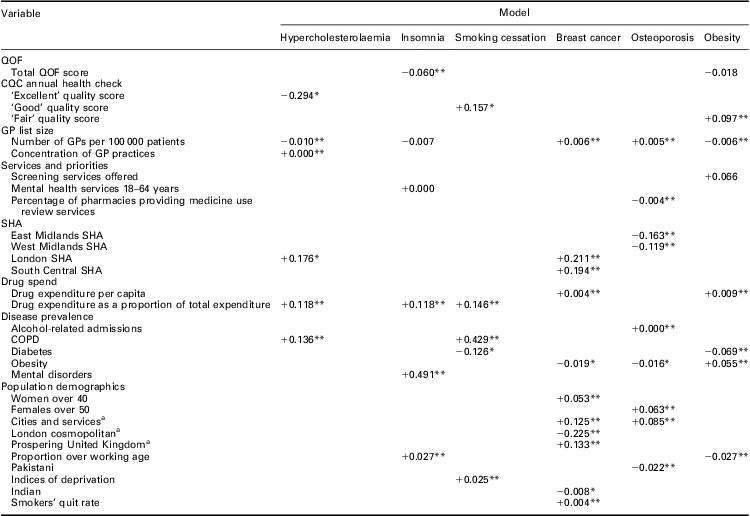
Drug utilisation in the six therapeutic areas analysed varied significantly between PCTs in England. Undoubtedly, much of this variation can be attributed to differing prevalence rates resulting from variations in the make-up and demographics of the population served by each PCT. However, a wide range of other factors were also identified as exerting a significant influence on prescribing activity at PCT level (see Table 1). The results from the regression analysis are presented in Table 2. As the models are built on logged dependent variables, the coefficients, as presented in Table 2, are interpreted as a unit change in the value of the explanatory variable that results in a change in drug usage on the log scale, as indicated by the coefficient value. Taking its exponential will then transform the change in drug usage back onto the original scale.
Overview of the key variables found to correlate with drug use at the PCT level

PCT = primary care trust; QOF = Quality and Outcome Framework; CQC = Care Quality Commission; GP = general practitioner; SHA = strategic health authority; COPD = chronic obstructive pulmonary disease.
Regression results for the six models showing the variables found to correlate with drug use at the PCT level
PCT = primary care trust; QOF = Quality and Outcome Framework; CQC = Care Quality Commission; SHA = strategic health authority; COPD = chronic obstructive pulmonary disease.
aONS supergroup area classifications.
*Significant at the 5% level.
**Significant at the 1% level.
A number of generalised influencers were identified, which appeared to impose an impact in most of the therapeutic areas analysed, and these were reinforced by individualised factors that influenced prescribing in each individual therapeutic area. A notable finding is that PCT organisational standards also seem to influence levels of prescribing; these encompass the aspects measured by the Quality and Outcome Framework (QOF) system and the Care Quality Commission's (CQC) annual health check.
Discussion and conclusion
The results of this study, although limited to only six therapeutic areas, suggest the need for service provision to be better tailored to the specific needs of the populations being served. Improving the understanding of the various internal and external influences on demand in each therapeutic area would result in a better ‘fit’ between the need for and the supply of services. It would also allow national guidance to be interpreted in light of local circumstances and enable easier identification and correction of any local barriers to the implementation of such guidance.
This analysis is largely hypothesis generating given that it is impossible to conclude whether higher or lower uptake is optimal in a broad overview research of this nature. However, it is clear that there are large unexplained variations in primary care prescribing. The intricacies of the factors specific to each model according to disease area, treatment alternatives and recommended usage cannot be overlooked. Some of the variation in final model specifications may be attributable to the lack of availability to account for all the influential factors identified in the literature, whether this be the inability to incorporate pharmaceutical influence on GPs prescribing or the lack of a precise measure of osteoporosis prevalence. However, what is highlighted is the need to avoid sweeping recommendations without consideration of the complexity of disease treatment in each area. Pinpointing more precise factors determining prescribing efficiency requires both improvements in the data available at the micro level, and more detailed local analyses to place prescribing levels in the context of local needs and priorities.
Although this analysis was based on PCT-level data, the explanatory variables focus on features of the populations served by GPs and as such the results remain valid at the GP commissioner level. Analyses of this nature are likely to be of even greater value at the CCG level, as more focused estimates can be generated utilising detailed data sets and a larger sample of comparators. Such analyses would provide an invaluable method by which CCGs can begin to identify the needs of their populations and the extent to which such needs are currently being met in the optimal manner.
With the disbanding of PCTs within the United Kingdom and budgets moving to CCGs, the role of efficiently and effectively managing prescribing will fall to GPs. This is a marked shift in roles and one that could potentially cause mixed priorities within the treatment room: on one hand, treating the patient on the basis of clinical judgement, and on the other hand attempting to reduce health-care spending. However, there are ways to reduce health-care spending without compromising patient health, which is the prime goal of the coalition government's agenda for the NHS, as outlined in the UK Government (2012). One such way is by ensuring that primary care prescribing is efficient and effective. To achieve this, mechanisms need to be put in place now to ensure that GPs are able to monitor their prescribing and reduce unnecessary drug usage. Further research into the reasons for variations in prescribing also needs to be conducted at the CCG level.
Acknowledgements
Prescribing data provided by the NHS Information Centre for Health and Social Care.
All opinions expressed herein are those of the authors and do not represent the opinion of NICE or the NHS.
Research completed as R.E. Houten's dissertation project placement at NICE for MSc Economics and Health Economics at the University of Sheffield. NIHR/MRC/ESRC joint studentship awarded for study on this course.
The authors gratefully acknowledge the invaluable expertise of Dr Alan Haycox, who commented on drafts of the manuscript.