





Introduction
Political secularism – the separation of religious and governmental institutions – can take various forms (Parekh Reference Parekh2000; Gunn Reference Gunn2004; Fox Reference Fox2008; Kuru Reference Kuru2008; Calhoun, Juergensmeyer and VanAntwerpen Reference Calhoun, Juergensmeyer and VanAntwerpen2011; Fox Reference Fox2015, Reference Fox2016; Buckley Reference Buckley2017). A simplified typology identifies three main versions. The first, which we term ‘benign secularism’ (also called ‘passive’ or ‘weak’ secularism), is characterized by state neutrality and the protection of religious freedom – the state treats all religions equally and guarantees the free exercise of faith. The second form, which we label ‘hostile secularism’ (sometimes known as ‘active’ or ‘strong’ secularism), is antagonistic toward religion. This form not only enforces the separation of religion and state, but also seeks to regulate or even eradicate public – and at times private – expressions of religion.
In this article, we argue for the existence of a third form of secularism, which we term ‘discriminatory secularism’. This form, pervasive throughout Europe, differs from both benign and hostile secularism by creating not a balanced but an uneven religious playing field, where certain faith traditions receive preferential treatment while others face disproportionate discrimination. Crucially, this discrimination against religious minorities is justified not on religious grounds but on secularist principles such as women’s rights, children’s rights, and animal rights. Theoretically, discriminatory secularism aims to foster social cohesion, tolerance, and pluralism through a nonreligious, universalist conception of human rights. In practice, however, it disproportionately restricts minority faith communities. For instance, states that follow the laïcist model of religion and state have increasingly adopted this form of discriminatory secularism, legitimized explicitly by the principle of laïcité itself (Gunn Reference Gunn2004; Kuru Reference Kuru2008). In France – the original laïcist state – the government particularly targets public expressions of Muslim faith, including women wearing the hijab and burqa outside the home, public prayer, and the availability of halal products in supermarkets. In effect, laïcité has been weaponized to legitimize Islamophobia and discriminatory state policies toward the French Muslim population. Importantly, the critique we present here is not of secularism per se but of the inconsistent application of secular principles that tends to burden minority religions more heavily.
We contend that discriminatory secularism is not only a normative concern but also a significant security issue (Farr Reference Farr2008; Grim and Finke Reference Grim and Finke2010). We theorize that discriminatory secularism fosters a culture of hostility toward religious minorities, thereby increasing the likelihood of violence against members of these communities. Such violence is often justified by claims that minority religious practices undermine the secular foundations of the state and threaten social cohesion. To test this theory, we conduct a statistical analysis of European states from 2003–2017, finding that higher levels of discriminatory secularism are strongly associated with increased physical violence against minority religious groups. These findings remain robust across a variety of model specifications and statistical methods.
This article proceeds in five parts. The next section tackles the question of what discriminatory secularism is and how it differs from other forms of political secularism. We then theorize how discriminatory secularism encourages anti-minority violence. The following two sections discuss the data and methods used in the analysis and present the results. A concluding section situates the findings of the analysis in the context of policy and suggests some avenues for future research.
What is discriminatory secularism?
The secularism literature generally distinguishes between two primary forms. The first, which we term benign secularism, describes a model in which the state maintains neutrality toward religion while permitting the public expression of religious beliefs. This model upholds both freedom of religion and freedom from religion, accommodating religious practices in public life as long as they do not infringe upon the rights of others. It fosters a positive and cooperative relationship between religion and the state while preserving institutional separation. Religion is acknowledged as a public good, and religious voices are welcomed in the public sphere, ensuring that all religious groups operate on a level playing field (Iannaccone, Finke and Stark Reference Iannaccone, Finke and Stark1997; Stark and Finke Reference Stark and Finke2000). Importantly, benign secularism neither subjugates religion to the state nor reduces it to a captive entity; instead, it allows religious institutions a degree of autonomy to govern themselves relatively free from governmental interference (Toft, Philpott and Shah Reference Toft, Philpott and Shah2011). Simultaneously, the state relinquishes any authority to regulate or suppress individuals’ free exercise of their religious beliefs (Stepan Reference Stepan2000).
The second form of secularism is what we term hostile secularism. Unlike benign secularism, hostile secularism demands a strict separation between religion and the state, often seeking to exclude religion from the public sphere altogether. It regards faith as a private matter and aims to minimize or eliminate religious influence on public policy, education, and government affairs. While hostile secularism may single out certain religious minorities for especially harsh treatment, its foundational ideology is fundamentally anti-religious, leading to the broad suppression of religious difference and the restriction of religious freedom (Kuru Reference Kuru2008).
Hostile secularism manifests in two general forms. The first – religious subjugation – is characteristic of atheistic states that adopt an openly antagonistic stance toward all religion. In the former Soviet Union, for example, the state demonstrated hostility toward religion across the board. It targeted both majorities and minorities; it destroyed both churches and mosques. Today, the communist model of secularism is evident in countries such as China, Cuba, and North Korea. A variation of this model exists in the Southeast Asian countries of Laos and Vietnam. The second form is religious co-optation, exemplified by secular Arab nationalism. Unlike the communist model, states governed according to the logic of secular Arab nationalism do not seek to eliminate religion but instead regulate it extensively to reinforce autocratic power and serve national interests. This model differs from other forms of hostile secularism in that rulers attempt to control religion by co-opting it. Secular Arab autocrats often support a moderate strain of the dominant faith tradition, making religious institutions dependent on and beholden to the government as a means of keeping religion’s public influence in check.
While benign and hostile secularism represent opposite ends of the religious freedom spectrum, they share a key similarity: neither seeks to create an intentionally unbalanced religious playing field where certain religions are favored by the state while others are disproportionately repressed – at least in principle. In benign secularism, the state remains religiously neutral, neither discriminating against nor favoring any religion (or doing so only minimally). In hostile secularism, the state represses all religions without (or with minimal) discrimination. Although in some cases of hostile secularism – particularly in the Arab world – the state may co-opt a dominant religious tradition by granting it unique privileges, even that tradition remains subject to strict state regulation (Fox Reference Fox2015: 2).
Discriminatory secularism differs from other forms of political secularism by creating, in practice, an unbalanced religious playing field where minority religious groups face disproportionate discrimination by the state compared to majority religious groups. States restrict the religious practices of minority communities because these practices are perceived to contradict the secular foundations of the state and to threaten social harmony and stability (Esbeck Reference Esbeck1988; Linz and Stepan Reference Linz and Stepan1996; Kuru Reference Kuru2008). Increasingly, discriminatory secularism is institutionalized across Europe through rulings by the European Court of Justice, which has issued landmark decisions on the rights and limits of Muslim employees wearing religious headscarves in the workplace, as well as the rights of employers to make religious affiliation and conformity prerequisites for employment or grounds for differential treatment of employees (Pin and Witte Reference Pin and Witte2020: 223).
Interestingly, discriminatory secularism is prevalent in countries often regarded as bastions of freedom, with most states practicing it clustered in Europe (Fox Reference Fox2019a; Fox Reference Fox2021). Europe is not only the most secular region globally in terms of religious belief and practice, but this secularism is also deeply embedded in government institutions and often expressed through laws and policies that disproportionately target religious minorities (Cesari Reference Cesari2013; Fox and Akbaba Reference Fox and Akbaba2015a; Fox Reference Fox2019a; Fox, Finke and Eisenstein Reference Fox, Finke and Eisenstein2019). For example, the French model of secularism – laïcité – incorporates elements of benign secularism, such as state neutrality in religious affairs and freedom of conscience, while simultaneously imposing strict limits on public religious expression and restricting practices perceived to conflict with the secular founding principles of the French Republic. In practice, religions seen as threatening the neutrality of the public square or liberal values face greater restrictions. While most European states do not fully adopt the laïcist model, many draw inspiration from it, particularly in efforts to regulate religion in public life. As a result, Europe experiences higher levels of anti-minority religious discrimination than other liberal democratic states. One global analysis of minority religious discrimination finds that ‘non-Orthodox Western and European democracies’ exhibit far greater frequency and intensity of anti-minority discrimination than democracies elsewhere (Fox Reference Fox2021: 331). Supporting this, Pew Research Center data show that Europe has experienced some of the largest increases in restrictions on religious minorities in recent years (Diamant Reference Diamant2019).
European secularism has developed over the longue durée, shaped by complex social, economic, and political changes across centuries. Yet, this distinctive form of secularism has recently combined with new developments to produce something unprecedented. In particular, demographic shifts driven by immigration, increasing religious diversification, and high minority birth rates have fueled widespread societal anxiety that European countries are rapidly losing their cultural heritage and identity. This anxiety, in turn, has created fertile ground for a culture of hostility toward minority groups to take hold, often expressed through antisemitism and Islamophobia.
Opportunistic political leaders have capitalized on these anti-minority sentiments, portraying religious pluralism as an existential threat to national unity, stability, and security. In countries such as Austria, France, Germany, Greece, Hungary, Italy, the Netherlands, Poland, Slovenia, and Switzerland, politicians have routinely scapegoated Muslim communities, blaming them for various societal problems to mobilize electoral support. Right-wing parties – France’s National Front, Germany’s Alternative and PEGIDA parties, Hungary’s Jobbik, Austria’s Freedom Party, Poland’s Law and Justice Party, Slovenia’s Democratic Party, Switzerland’s People’s Party, Italy’s Northern League, and Greece’s Golden Dawn – have increased their political influence partly by rejecting minorities. These parties have championed laws and policies that impose increasingly restrictive measures on religious minorities, purportedly to safeguard national religious heritage and identity from perceived external threats (Fox Reference Fox2008, Reference Fox2016, Reference Fox2020).
Restrictions on minorities often arise in response to a range of motivating events, both domestic and international. These triggers may be religious or nonreligious in nature. Religious factors can include demographic shifts caused by immigration and refugee crises, cultural diversification, and violent acts committed by members of particular faith traditions abroad (Grim and Finke Reference Grim and Finke2010). Anti-minority restrictions may also stem from nonreligious developments – economic downturns, pandemics, or foreign policies enacted by distant states – for which local minorities are unfairly scapegoated. Consequently, religious minorities who visibly and openly practice their faith in ways that challenge the dominant culture are especially likely to bear the brunt of faith-based restrictions.
The European commitment to secularism results in restrictions on the practices of minority faith communities across several key areas. These include bans or limitations on wearing religious garments in public, prohibitions on ritual animal slaughter as practiced in Jewish kosher and Muslim halal traditions, and regulations on infant male circumcision (Cesari Reference Cesari2013; Fox Reference Fox2020: 140, 155–156). These restrictive laws and policies disproportionately affect minority religious groups – primarily Jews and Muslims – and are justified through secular ideological principles (Fox Reference Fox2021). Below, we examine each of these issues in more detail.
First, several European countries prohibit or restrict Muslim women from wearing Islamic face coverings such as the niqab and burqa in public – garments that many Muslims consider religious obligations (Behiery Reference Behiery2013). Austria, Belgium, Bulgaria, Denmark, France, the Netherlands, and Switzerland have implemented full or partial bans on the veil. Other countries, including Croatia, Italy, Malta, Norway, and Spain, impose restrictions in specific regions or municipalities. The European Court of Justice has upheld the right of European employers to ban headscarves in the workplace. Although these laws do not explicitly mention any religion, they are widely understood to target Muslims and are therefore often referred to as ‘burqa bans’ (Saiya and Manchanda Reference Saiya and Manchanda2020a).
Supporters of these policies justify their opposition to the public wearing of Islamic dress on explicitly secular grounds, particularly through a secular conception of women’s rights. Islamic face coverings are seen as symbols of female oppression that dehumanize women. As Federiga Bindi explains, the veil ‘goes against the most basic Western principle: looking into someone’s eyes as the way to build trust’ (Dempsey Reference Dempsey2016). Former French President Nicolas Sarkozy, defending legislation to outlaw burqas, condemned public veiling as a violation of ‘women’s dignity’ and a sign of ‘subservience and debasement’ (Chrisafis Reference Chrisafis2009). Proponents argue that such bans empower Muslim women by liberating them from oppressive cultural norms that inhibit their participation in public life. In sum, the public wearing of the Islamic veil is viewed as incompatible with shared secular Enlightenment values regarding women’s rights (Fetzer and Soper Reference Fetzer and Soper2005).
Second, discriminatory secular states restrict the practice of ritual animal slaughter as performed in the Muslim halal and Jewish kosher traditions (Van Der Schyff Reference Van der Schyff2014). In both faiths, ritual slaughter is considered mandatory for food production and has been practiced for centuries in Islam and millennia in Judaism. A key aspect of these practices is the prohibition against stunning animals prior to killing. Opponents of ritual slaughter argue that the practice constitutes senseless cruelty and ground their objections in animal welfare and rights concerns (Zoethout Reference Zoethout2013). In 2020, the European Court of Justice ruled that states may lawfully prohibit halal and kosher slaughter methods. Currently, Belgium, Denmark, Germany, Greece, Iceland, Norway, Sweden, and Switzerland have laws restricting ritual slaughter (Fox Reference Fox2020: 155), with several other countries contemplating similar legislation. Once again, we observe that these restrictions, justified through secular commitments, disproportionately impact religious minority communities.
Third, some European states regulate the circumcision of infant males – a practice central to both Islam and Judaism, with roots tracing back to the ancient covenant between God and Abraham in the biblical book of Genesis. Opponents of infant circumcision invoke children’s rights, arguing that the procedure causes significant pain to a non-consenting child and is irreversible. In 2012, a German court ruled that a ‘child’s right to physical integrity trumps religious and parental rights’. (Following public protests by Jewish and Muslim communities, the federal government later enacted legislation permitting infant circumcision.) Fox (Reference Fox2020: 155) observes that while most European countries do not ban infant circumcision outright, some, such as Denmark, Norway, and Sweden, impose strict regulations. The issue has also sparked intense debate in Belgium and Finland, although proposed restrictions on infant male circumcision were ultimately rejected.
In all three cases – restrictions on the public wearing of the veil, ritual animal slaughter, and infant male circumcision – these limitations apply exclusively to religious minorities, primarily Jews and Muslims. Majority Christian populations do not engage in these specific practices: Christian women do not wear face coverings and generally do not cover their hair; Christianity places no dietary restrictions on its followers; and circumcision is not a religious requirement for baby boys in Christianity. While Fox (Reference Fox2020) demonstrates that the causes of religious discrimination are complex and multifaceted, it is clear that the form of political secularism prevalent in much of Europe is distinctly discriminatory. Importantly, restrictions on minority religious practices are justified not on religious or theological grounds but on secular ideological principles – specifically women’s rights, animal rights, and children’s rights (Saiya Reference Saiya2025c). European policymakers tend to frame these restrictions using secular Enlightenment values rather than religious language. Moreover, the particular ways in which European states restrict minority religious communities are unusual and rarely found outside this context. Table 1 provides a summary of the differences among the three forms of secularism discussed.
Three forms of secularism

Still, one might argue that the pervasive anti-minority discrimination throughout Europe is not secular but religious in nature, given that many European states establish or favor traditional forms of Christianity. We contend, however, that it would be mistaken to interpret this discrimination as religious rather than secular. This is because Christianity in Europe has largely become a secularized religion. Even when European states support Christianity, they do so within a secular framework designed to serve secular purposes (Modood and Sealy Reference Modood and Sealy2022). In this context, Christianity functions more as a marker of identity than as a theological belief system, emphasizing Europe’s shared Christian civilizational heritage (Brubaker Reference Brubaker2017). Unlike Christianity in the United States, Latin America, or Africa, which often has a stronger theological foundation, European Christianity coexists with secular liberalism (Cremer Reference Cremer2023). Brubaker (Reference Brubaker2017) calls this paradox ‘civilizationalism’ – a distinctly European ideology rooted in Christian heritage, secular liberalism, and Enlightenment values and defined in opposition to perceived non-European or non-Western ‘others’. This secularized form of Christian identity is unsurprising given the generally higher levels of religious belief and practice found in Christian-majority countries outside Europe. Nevertheless, European secularists broadly value Christianity’s cultural and historical contributions, acknowledge the deep entanglement of secular institutions with Christian heritage, and view the presence of foreign religions as a serious threat to these Christian traditions. As a result, Christian identity in Europe overlaps significantly with secular identity.
None of this is to suggest, of course, an unqualified set of rights for religious communities. Freedom of religion, like any freedom, presupposes justifiable limits, most notably when the right to act on one’s religious beliefs infringes on the rights of others, undermines the common good, endangers the rule of law, or threatens the secular foundations of the state. With these caveats acknowledged, a genuinely secular state guarantees freedom to religious groups and individuals to the fullest extent possible, in this way circumscribing its own power and ambit by acknowledging what many people consider to be most important in their lives.
Furthermore, research indicates that higher levels of religiosity tend to reduce support for restrictions on minority faith communities within the secular contexts of Europe (Bohman and Hjerm Reference Bohman and Hjerm2014; Helbing Reference Helbling2014; Carol, Helbling and Michalowski Reference Carol, Helbling and Michalowski2015; Hoffman and Rosenberg Reference Hoffman and Rosenberg2023). Fox, Finke, and Mataic (Reference Fox, Finke and Mataic2021) argue that increased religious activity and commitment lead to less discrimination against Muslim and Jewish minorities because these groups are perceived as potential allies in resisting secular encroachments. In other words, people from different faith traditions often unite to oppose the state’s secularizing pressures.
In summary, existing theories of political secularism generally hold that religion should be separated from governmental institutions, fostering a neutral and balanced religious landscape where no faith community is favored or repressed disproportionately. While these frameworks have been valuable in advancing our understanding of religion-state relations, we argue that this key assumption is flawed. In Europe, political secularism often produces an uneven religious playing field, privileging certain religious groups over others. We term this phenomenon discriminatory secularism. The following section explores how states practicing discriminatory secularism contribute to societal religious violence.
How discriminatory secularism encourages violence against religious minorities
The laws and policies discussed earlier – restrictions on religious dress, ritual animal slaughter, and male infant circumcision – have fostered an environment of hostility toward religious minority communities. This anti-minority culture is reinforced by various actors within majoritarian groups, including secular politicians, right-wing extremists, and Christian civilizationalists, who view minority religious practices as threats to national culture and identity. We argue that discriminatory secularism extends beyond issues of religious freedom and has profound consequences for societal cohesion. In countries where minority religious groups face discrimination, dominant faith traditions often feel entitled by their privileged status to treat minorities as second-class citizens (Finke, Martin and Fox Reference Finke, Martin and Fox2017). Finke and Harris (Reference Finke, Harris and Fox2012: 55) note that ‘when a religious group achieves a monopoly and holds access to the temporal power and privileges of the state, the ever-present temptation is to openly persecute religious competitors’. While such hostility often appears as nonviolent prejudice or harassment, discriminatory secularism can also foster violent attacks against minority groups. For example, in France, laïcité-based policies have alienated Muslim communities, fueled the growth of a radical right political movement, and promoted societal discrimination against Muslims (Almeida Reference Almeida2017; Hauser Reference Hauser2021). This marginalization has, in turn, contributed to increased attacks against French Muslims.
Accumulating evidence indicates that attacks against Jews, Muslims, and their holy sites have sharply increased across various European countries, particularly in the aftermath of major crises like the 2008 global financial recession and the Covid-19 pandemic. Both events fueled Islamophobic sentiments and anti-Semitic conspiracy theories, creating fertile ground for violence against minority communities Blum Reference Blum2023). While some of this violence is perpetrated by other minority groups – for instance, the Israel–Hamas conflict has triggered Muslim-Jewish violence in Europe (European Union Agency for Fundamental Rights 2024: 66) – such minority-on-minority violence represents only one dimension of the issue. A potentially more consequential dynamic, and the focus of this article, involves majority-on-minority violence (Henne, Saiya and Hand Reference Henne, Saiya and Hand2020; Saiya, Manchanda and Wadidi Reference Saiya, Manchanda and Wadidi2024; Suntay Reference Suntay2025; Saiya Reference Saiya2025a, Reference Saiya2025b). Majority violence carries weight for two reasons. First, by definition, religious majorities outnumber minorities, meaning there are more individuals who can become radicalized and give greater societal support for majoritarian violence. Second, majorities often pursue grander ambitions, such as purifying their countries from perceived ‘contaminating’ forces, whereas minorities tend to advocate for more limited goals, like securing equal rights.
Studies have shown that discrimination at the state level – including specific laws and policies targeted at minorities – fosters anti-minority violence within society (Saiya Reference Saiya2017a, Reference Saiya2017b; Saiya and Scime Reference Saiya and Scime2019; Saiya and Manchanda Reference Saiya and Manchanda2020a, Reference Saiya and Manchanda2020b; Henne, Saiya and Hand Reference Henne, Saiya and Hand2020; Saiya Reference Saiya2021; Saiya, Manchanda and Wadidi Reference Saiya, Manchanda and Wadidi2024; Saiya Reference Saiya2024, Reference Saiya2025b; Saiya and Manchanda Reference Saiya and Manchanda2025a, Reference Saiya and Manchanda2025b; Suntay Reference Suntay2025). This can include attacks against minority holy sites (Zellman and Majli Reference Zellman and Malji2023). Importantly, however, none of these works speak directly to the issue of political secularism.
We argue that a commitment to a discriminatory form of secularism can encourage anti-minority violence arising from three different sources. First, it can originate from Christian actors. This secularized Christianity is not theological but instead emphasizes the Christian histories, identities, and cultures of traditionally Christian European states, along with the perceived necessity to defend Western Christian civilization against the perceived threat of multiculturalism in its various forms. Christian civilizationalists are particularly opposed to the spread of Islam across Europe and to visible Muslim religious expressions in public spaces, such as Muslim women wearing the burqa.
Consider the case of Anders Breivik, a Christian terrorist responsible for nearly 400 deaths and injuries in separate attacks in Oslo, Norway, in 2011. These sequential attacks constituted the worst episode of violence in Norway since World War II, with most casualties occurring at a summer camp organized by the Workers’ Youth League. Breivik’s 1500-page manifesto, 2083: A European Declaration of Independence, outlines his grievances in detail (Breivik Reference Breivik2011). Fundamentally, Breivik believed that Norway – a Christian country – was engaged in a hidden war against multiculturalism and religious pluralism. He wrote, ‘Christians then must commit themselves to the struggle of bringing to bear every political framework to perfect submission under God!’ (Breivik Reference Breivik2011: 407). He strongly opposed the multicultural policies of the Norwegian Labor government, which he saw as corrupting Christian European culture. He declared that ‘multiculturalism (protolegitimized moral relativism) must be deconstructed and delegitimized’ (Breivik Reference Breivik2011: 407). Breivik viewed Europe as under siege from mass immigration, particularly from the Islamic world, which he believed was contaminating ‘monocultural Christian Europe’, and he saw himself as the ‘Savior of Christianity’ (Breivik Reference Breivik2011: 1404).
Second, violence can also originate from extremist secular groups such as neo-Nazis and other white supremacist organizations. Unlike Christian civilizationalists, these groups tend to justify violence against religious minorities primarily through racist, rather than religious, arguments – although they often appropriate Christian myths and symbols for their own purposes. Groups such as Blood and Honour, Combat 18, Feuerkrieg Division, Generation Identity, National Action, Nordic Resistance Movement, and Order of Nine Angles have gained notoriety for their commitment to ethnic purity. These organizations promote hatred against both racial and religious minorities and have increasingly engaged in violent acts in recent years. Their ideology is largely driven by the theory of the ‘Great Replacement’, which posits that the indigenous European population is being systematically replaced by non-European migrants (Counter Extremism Project 2021).
Third, anti-minority violence can arise from a broader culture of hostility toward religious minorities that is diffuse and not tied to any specific organized group or ideological movement. In such cases, attacks often take the form of spontaneous or opportunistic ‘hate crimes’ carried out by individuals or small groups within society. These acts of violence are frequently fueled – whether indirectly or directly – by the incendiary rhetoric of right-wing politicians and religious leaders who stoke fear and suspicion of minority communities. Notable examples include Dutch parliamentarian Geert Wilders’ vocal campaign warning of an Islamic takeover of European civilization, French President Emmanuel Macron’s expressed intent to shut down certain Islamic social and educational organizations, former Austrian Chancellor Sebastian Kurz’s legislative proposals to ban political Islam, and Hungarian Prime Minister Viktor Orbán’s framing of Muslim migration as a national security threat. Far-right political parties have similarly mobilized significant popular support by promising to defend their nations against the perceived threat to Western civilization posed by religious minorities.
In other cases, the targeting of minorities may have less to do with overt discrimination, but rather the asymmetric application of secular principles, which reflects structural and cultural majoritarianism in which Christian norms are embedded in national identity and public institutions to such a degree that they are perceived as ‘neutral’ or ‘traditional’, while minority religious expressions – especially Islamic and Jewish practices – are treated as ‘foreign’, ‘threatening’, or ‘incompatible’ with liberal-democratic values. This does not necessarily imply conscious or coordinated discrimination by policymakers. Instead, it highlights how ostensibly neutral laws (such as bans on headscarves or religious symbols) can have disproportionate effects on religious minorities. In some cases, these patterns may be reinforced by latent cultural biases, including Islamophobia or anti-Semitic tropes, but the mechanism is often one of implicit exclusion rather than overt hostility.
Whether the targeting of minorities is deliberate or the product of the asymmetrical application of secularism, it frequently leads to what scholars have termed ‘securitization’, a concept defined as the process by which ‘an issue is presented as an existential threat, requiring emergency measures and justifying actions outside the normal bounds of political procedure’ (Buzan, Waever and de Wilde Reference Buzan, Waever and de Wilde1998: 23–24). Applied to religion, securitization theory posits that political and religious leaders intentionally stoke anti-minority hostility by framing minority religious communities as threats to the nation’s culture and way of life, thereby indirectly legitimizing violent hostility against them (Cesari Reference Cesari2013; Fox and Akbaba Reference Fox and Akbaba2015a, Reference Fox and Akbaba2015b; Saiya and Manchanda Reference Saiya and Manchanda2020a, Reference Saiya and Manchanda2020b). This perceived threat to the social fabric posed by religious outsiders is constructed as requiring urgent responses outside the normal legal and political channels, even in liberal democracies – manifesting as discriminatory laws and policies targeting these communities (Cesari Reference Cesari2013; Fox and Akbaba Reference Fox and Akbaba2015a, Reference Fox and Akbaba2015b). Religious minorities, cast as existential threats, must be neutralized for the preservation of the dominant religion and the nation’s cultural identity (Fox, Finke and Eisenstein Reference Fox, Finke and Eisenstein2019; Fox and Topor Reference Fox and Topor2021). Such discriminatory frameworks at the state level provide rhetorical justification for societal-level anti-minority bigotry and violence, as dehumanizing discourse from political and religious elites offers extremists the cover to target minorities with impunity (Giner-Sorolla, Leidner and Castano Reference Giner-Sorolla, Leidner, Castano, Michael and Danielle2016; Piazza Reference Piazza2020). In short, there is a powerful and reciprocal relationship between anti-minority rhetoric emanating from the top and extremist violence from the grassroots (Saiya Reference Saiya, den Dulk and Oldmixon2014; Saiya Reference Saiya2015a, Saiya and Scime Reference Saiya and Scime2015; Saiya Reference Saiya2017a, Reference Saiya2017b; Saiya Reference Saiya2018; Saiya and Fidler Reference Saiya and Fidler2018; Saiya Reference Saiya2019a; Saiya and Scime Reference Saiya and Scime2019; Saiya Reference Saiya2020; Saiya Reference Saiya2021a; Saiya Reference Saiya2021b; Saiya Reference Saiya2022; Saiya Reference Saiya2024; Saiya Reference Saiya2025a, Reference Saiya2025b).
Some research suggests that religious hostility within society may be a cause, rather than a consequence, of government discrimination against religious minorities (Grim and Finke Reference Grim and Finke2010; Fox Reference Fox2020). For instance, Henne and Klocek (Reference Henne and Klocek2019) find that regimes experiencing religious conflict tend to adopt more repressive policies toward religious groups within their borders. Conversely, other studies indicate that government policies concerning religion can actively encourage social hostilities, including religion-related violence (Akbaba and Taydas Reference Akbaba and Taydas2011; Basedau, Pfeiffer and Vullers Reference Basedau, Pfeiffer and Vullers2016; Saiya Reference Saiya2018; Henne, Saiya and Hand Reference Henne, Saiya and Hand2020). One reason for these differing findings may lie in the distinct variables used to measure religious group treatment – some focus on state support for religion (eg Henne, Saiya and Hand Reference Henne, Saiya and Hand2020), while others examine anti-minority discrimination (eg Grim and Finke Reference Grim and Finke2010).
We argue that the relationship between governmental discrimination and societal violence is likely cyclical. Prejudice against minorities within society may prompt states to adopt discriminatory policies (Sarkissian Reference Sarkissian2015), which in turn can fuel further religious hostility and violence in society. Nonetheless, we maintain that religious violence rarely emerges absent an enabling environment – one often shaped or facilitated by state treatment of religion. For example, in a study of global religious terrorism, Saiya (Reference Saiya2018: 8) asserts that ‘a careful examination of the historical record shows that widespread terrorism usually follows rather than precedes repressive policies’. Naturally, religious violence in society can then lead governments to impose additional restrictions, perpetuating a cycle. Governments have the power to break this vicious cycle by relaxing restrictions on minority faith communities. In the context of Europe – the focus of this study – it is evident that discriminatory state policies have preceded and exacerbated societal violence.
In summary, across all three pathways, anti-minority violence is justified under the guise of defending a distinctly European or Christian secularism. In this way, secularism becomes an insidious rationale for intolerance, hostility, and violence directed at religious minorities (Adida, Laitin and Valfort Reference Adida, Laitin and Valfort2016). We theorize that higher levels of discriminatory secularism in Europe correspond to increased physical attacks against religious minorities. From this, we propose the following hypothesis:
Hypothesis 1: Countries exhibiting higher levels of discriminatory secularism will experience more physical attacks against religious minorities than countries with lower levels of discriminatory secularism.
Data and methods
To test for our hypothesis, we first compiled a panel dataset consisting of 28 European countries for the period 2003–2017 (a time period corresponding to data availability). The dataset contains information on our theoretically central independent variable, secular discrimination, several control factors, and our dependent variable – attacks on Jews, Muslims, and their associated holy sites. We limit our analysis to Europe because, as we have argued, it is the region of the world most likely to see the widespread practice of discriminatory secularism. At the same time, the fact that many countries in Europe do not practice discriminatory secularism provides ample variation on the independent variable (see below). The total number of observations may be slightly less than expected owing to missing data for some of the control variables.
Dependent variable
To test our hypothesis that higher levels of discrimination against religious minorities in ostensibly secular states correspond to increased violence against these groups, we use the number of attacks against Jews and Muslims, including their houses of worship and other sacred sites, in a given country and year as our dependent variable (Attacks). We define anti-minority attacks as instances of physical violence perpetrated by non-minorities against religious minorities. We limit our analysis to attacks against Jews and Muslims to align the analysis with our theoretical framework. The data for the dependent variable is derived and coded from the Global Terrorism Database (GTD), maintained by the National Consortium for the Study of Terrorism and Responses to Terrorism (START). The GTD is an open-source database that documents over 200,000 terrorist incidents worldwide from 1970 to 2020 (National Consortium for the Study of Terrorism and Responses to Terrorism 2022). To ensure data accuracy, we included only cases where the identities of both perpetrators and victims were clearly established. Consequently, the results we report below likely understate the effect of the independent variable on the outcome variable.
Independent variable
To operationalize our concept of ‘discriminatory secularism’, we utilize data from Round 3 of the Religion and State (RAS) Project (Religion and State Project 2021) (see also Fox Reference Fox2008, Reference Fox2015, Reference Fox2016, Reference Fox2020). The RAS dataset captures the extent of state involvement in religious affairs across multiple dimensions, including official religion status, government support for religion, restrictions targeting majority religions, and restrictions targeting minority religions. It contains over 100 individual variables relevant to these dimensions. Consistent with our theoretical framework, we aggregate three specific measures of anti-minority discrimination from the RAS data – restrictions on the public wearing of religious dress, restrictions related to observing religious dietary laws, and restrictions on infant male circumcision or other rite-of-passage ceremonies – into a composite index of ‘discriminatory secularism’ (Discriminatory_secularism). Clothing and dietary restrictions are coded on a scale from 0 to 2, while circumcision restrictions range from 0 to 1 within our sample. The composite index thus theoretically ranges from 0 to 5, although in our dataset the maximum observed value is 4. Because the RAS dataset only extends through 2014, we carry forward the 2014 values to cover the subsequent three years (2015–2017). This composite index, focusing specifically on restrictions imposed uniquely on religious minorities and not on majority religious groups, serves as an ideal proxy for our concept of discriminatory secularism.
Control variables
In addition, our models incorporate several covariates to account for demographic, geographic, political, and economic factors that may influence anti-minority violence. Including these controls allows us to more accurately isolate the effect of discriminatory secularism on our dependent variable. Our first set of controls accounts for general country characteristics that might impact societal violence. Our first general country characteristic accounts for the logarithm of a country’s total population (Population_logged), as larger populations tend to experience higher levels of violent conflict simply due to their size. Second, we include the logarithm of gross domestic product per capita (GDP_capita_logged) to account for economic development, as higher levels of economic prosperity are generally associated with lower incidences of conflict along religious lines (Norris and Inglehart Reference Norris and Inglehart2004). Third, we control for the logarithm of the country’s geographic area (Area_logged) to capture the influence of physical size on the distribution and spread of violence. Smaller, more densely populated countries may be more vulnerable to outbreaks of violence. All three variables are drawn from the World Bank (2021). Finally, we include a dummy variable coded ‘1’ for countries located in Western Europe and ‘0’ otherwise.
Our analysis also includes two political variables that may influence the onset of violent religious hostilities. First, we control for a country’s level of procedural democracy (Polity) using the Polity2 score from the Polity IV dataset. Polity is a 21-point scale ranging from –10 (strongly autocratic) to +10 (strongly democratic), designed to capture the institutional characteristics of democratic governance. We include this measure based on the expectation that more democratic countries are less likely to experience violence along religious lines, due to stronger protections for civil liberties and minority rights. Second, we include a measure of regime durability (Durable), which captures the number of years since the last substantial regime change – defined as a shift of three points or more on the Polity2 scale. This measure reflects the stability of political institutions (Marshall and Marshall Reference Marshall and Elzinga-Marshall2018; Marshall and Gurr Reference Marshall and Robert Gurr2020). Lower levels of regime durability are indicative of political instability, which can foster insecurity and competition among identity groups. In such contexts, dominant groups may be more inclined to impose restrictions on others, and societal tensions may escalate into violence against religious minorities.
Finally, we include two variables to account for the influence of Samuel Huntington’s widely cited ‘clash of civilizations’ thesis – which posits that contemporary global conflicts are increasingly driven by cultural and religious differences, particularly those involving Islam (Huntington Reference Huntington1996). First, we control for the demographic presence of Muslims in each country. Specifically, we include the proportion of Muslims in the national population (Muslim_population_share). This variable allows us to isolate the effect of discriminatory secularism from potential conflict dynamics associated with the increasing visibility and presence of Islamic faith communities across Europe. We further include a control for the Social Hostilities Index (SHI) – a Pew Research Center measure of hostile actions between and within religious groups. Summary statistics for all variables used in the analysis are presented in Table 1.
Given that our dependent variable – attacks against Jews and Muslims – is a non-negative count variable characterized by overdispersion (ie the variance exceeds the mean) and given the likely presence of temporal and spatial interdependence across observations, we employ negative binomial regression as our primary estimation technique. To account for within-country correlation over time, we report robust standard errors clustered at the country level. This modeling strategy enables us to more accurately estimate the relationship between discriminatory secularism and anti-minority violence across European countries. The results of our analysis are presented and discussed in the following section.
Results
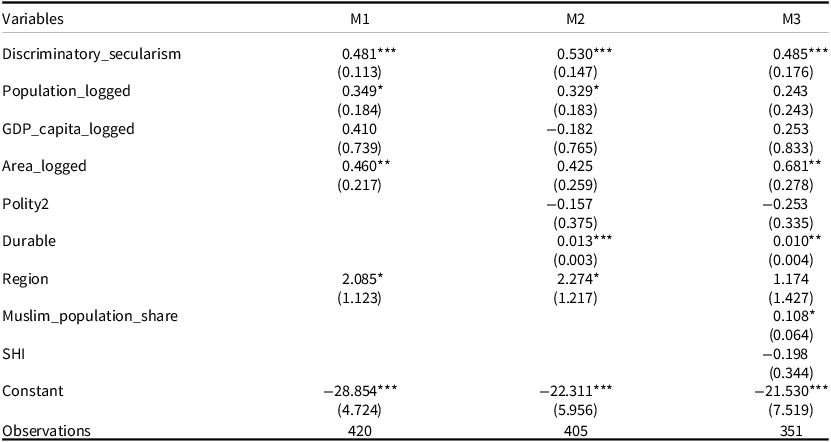
Table 2 presents the results from the negative binomial regression models, designed to test the relationship between discriminatory secularism and the incidence of anti-minority violence. Model 1 controls for general country characteristics (Population_logged, GDP_capita_logged, Area_logged, and Region), Model 2 additionally controls for the political variables Polity2 and Durability, and Model 3, in addition to the above covariates, controls for Muslim_population_share and SHI.
Summary statistics

The results provide robust empirical support for our hypothesis. Across all three model specifications, Discriminatory_secularism yields a positive and statistically significant coefficient, indicating that higher levels of state-imposed restrictions on minority religious practices are associated with increased levels of violence against those minority communities. In each model specification, Discriminatory_secularism is statistically significant with at least 99% confidence.
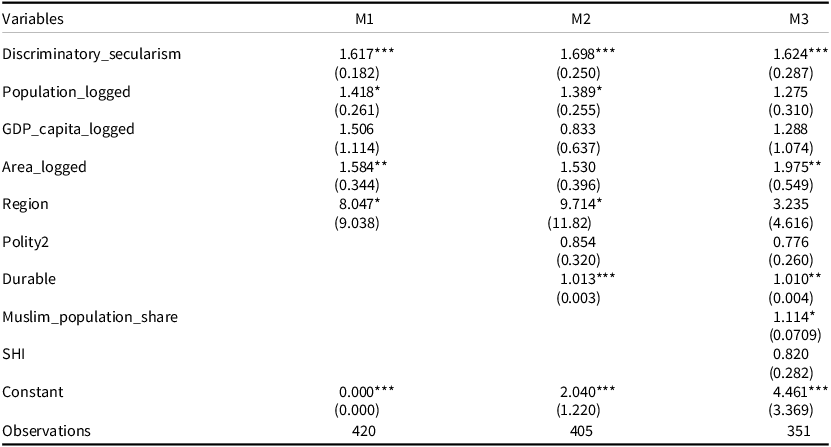
To better understand the substantive effects of discriminatory secularism, we turn to the incidence rate ratios (IRRs) derived from our negative binomial models. IRRs allow us to interpret the expected change in the rate of anti-minority attacks associated with a one-unit increase in the explanatory variable. Table 4 presents these ratios for all three models. The IRRs of 1.617, 1.698, and 1.624 indicate that each additional unit of discriminatory secularism is associated with increases of over 60 percent in anti-minority violence. These results offer compelling evidence across all model specifications that heightened levels of discriminatory secularism are strongly and substantively associated with increased physical violence against religious minorities.
Main models
Robust standard errors in parentheses.
*** p < 0.01,
** p < 0.05,
* p < 0.1.
Incident rate ratios
Robust seeform in parentheses.
*** p < 0.01,
** p < 0.05,
* p < 0.1.
To validate our findings, we conducted an extensive series of robustness checks designed to test for potential biases, alternative explanations, and model specifications. First, to ensure that anti-minority violence did not simply reflect broader levels of violence, we included a control for each country’s level of general terrorism (Online Appendix Table A1). The results remained unchanged – discriminatory secularism continued to be significant with at least 99% confidence. Second, to isolate the effect of discriminatory secularism from possible backlash against violent minority actors, we controlled for Islamist terrorism. The discriminatory secularism index again remained significant with at least 99% confidence (Table A2). Third, to address temporal dependence, we introduced a lagged dependent variable; discriminatory secularism remained statistically significant with at least 95% confidence (Table A3). Fourth, to test for delayed effects, we redefined the dependent variable to capture attacks in period t + 1. Under this specification, discriminatory secularism continued to be significant with at least 99% confidence (Table A4).
Fifth, to account for unobserved heterogeneity across countries, we estimated random-effects panel models. The results once more supported our hypothesis, with discriminatory secularism significant at least 99% confidence (Table A5). Sixth, to address excess zeros in the dependent variable, we employed zero-inflated negative binomial regression; Discriminatory_secularism again retained significance with at least 99% confidence (Table A6). To further rule out reverse causality, we reversed the model specification – using discriminatory secularism as the dependent variable and lagged anti-minority attacks as the key independent variable. The analysis revealed no evidence that past violence drives future restrictions (Table A7).
We also conducted several additional tests. Replacing population and geographic area with a combined (logged) measure of population density yielded consistent results (Table A8). Including a control for Jewish population (logged) to account for religious demographic effects did not substantively alter the findings (Table A9). Excluding the outlier case of France in 2015 produced results consistent with the main models (Table A10).
Our final set of tests aims to distinguish the effects of discriminatory secularism from other forms of secularism or religious discrimination. To control for benign secularism, we use a measure of legislation concerning general religious support from RAS, and the results continued to support our hypothesis (Table A11). To control for hostile secularism, we use a measure of general religious regulation, which applies to all religious groups in society, both majority and minority. The results remain unchanged after the inclusion of this variable (Table A12). Finally, to disentangle religious from secular discrimination, we implemented an interaction between our discriminatory secularism index and a dichotomized measure of religious legislation taken from RAS. The continuous variable measuring legislation concerning general religious support from RAS (ranging from 4 to 17 in our dataset) was dichotomized. Scores of 6 or below were assigned a value of ‘1’, indicating relatively secular states with fewer legislative actions on religion (therefore less secular support), while scores of 7 and above were assigned ‘0’ to denote significant legislative or policy frameworks on aspects of religion. The results support our theoretical expectations with the interaction term positive in two of the three specifications with at least 95% confidence: the positive effect of discrimination on violence is amplified in more secular states (low support), whereas the effect is muted in less secular contexts (Table A13). In sum, across a wide array of specifications and controls, the evidence consistently supports a robust and positive relationship between discriminatory secularism and violence against religious minorities.
Conclusion
This paper has argued that discriminatory secularism – a distinct form of political secularism present in several European democracies – undermines a level religious playing field by imposing restrictions that disproportionately target religious minorities. In the name of secularism, various European states have limited traditional religious practices of certain minority faith communities, such as wearing religious attire in public, infant male circumcision, and ritualistic animal slaughter. We contend that these restrictions often foster a culture of hostility toward minority groups, which can lead to anti-minority violence.
This study advances the scholarship in three significant ways. First, while previous research has documented a connection between governmental restrictions on religious minorities and violent minority backlash (eg Basedau, Fox and Zellman Reference Basedau, Fox and Zellman2023), this study extends the conversation by showing that such restrictions can also incite violence against minorities by majority groups. This study sheds light on the drivers of this majority-perpetrated violence, showing that laws and policies rooted in discriminatory secularism can embolden majoritarian extremists by offering a pretext for anti-minority violence.
Second, this study demonstrates that democracy alone does not prevent anti-minority discrimination (Saiya Reference Saiya2023; Hand and Saiya Reference Hand and Saiya2023; Saiya Reference Saiya2024). In Europe, democratic institutions have often provided a platform for political leaders to rhetorically target minorities and foster societal hostility toward them, despite most European countries being objectively free in terms of political rights. These findings support prior research indicating that democratic states routinely discriminate against religious minorities (Grim and Finke Reference Grim and Finke2010; Fox Reference Fox2020, Reference Fox2021; Fox and Topor Reference Fox and Topor2021).
Third, this study presents and provides evidence for a counterintuitive claim: secularism, rather than religion itself, appears to be the primary driver of violence against religious minorities in European states. The secularist policies underpinning veil bans, prohibitions on ritual animal slaughter, and regulations on infant male circumcision foster a culture of hostility toward religious communities for whom these practices are essential expressions of faith. In other words, societal anti-minority hostility stems not from religion per se but from a religious–secular divide (Fox Reference Fox2019b, Reference Fox2019c).
The findings of this study suggest that European governments should reconsider their religion-related policies for both normative and security reasons. First, the distinctive form of discriminatory secularism prevalent in Europe fundamentally undermines the religious freedoms of minority communities by creating an uneven religious landscape in which majority groups enjoy greater liberties while minorities face restrictions. Indeed, previous research indicates that minority religious freedoms tend to be more robust in democracies outside of Europe’s liberal democracies (Fox Reference Fox2008, Reference Fox2016, Reference Fox2020, Reference Fox2021). Second, as this study demonstrates, discriminatory secularism diminishes social harmony and fosters violence. Ironically, secular policies intended to promote human rights, tolerance, and cohesion often produce the opposite outcome, with anti-minority violence potentially prompting governments to entrench these counterproductive secularist restrictions even further (Farr Reference Farr2008; Toft, Philpott and Shah Reference Toft, Philpott and Shah2011; Saiya Reference Saiya, den Dulk and Oldmixon2014, Reference Saiya2015a, Reference Saiya2015b; Saiya and Scime Reference Saiya and Scime2015; Saiya and Fidler Reference Saiya and Fidler2017; Saiya Reference Saiya2017a, Reference Saiya2017b; Saiya and Manchanda Reference Saiya and Manchanda2025b).
Finally, we propose several directions for future research. First, while this study relies on cross-national quantitative analysis of European states, future work could employ case studies to more clearly elucidate the causal mechanisms linking the repression of religious minorities to violence against them. Second, subsequent research might explore the relationship between political secularism and violence in non-European contexts. Third, future studies could investigate the impact of anti-minority discrimination on other forms of violence, including violence perpetrated by minority groups. We hypothesize that discriminatory secularism fuels both majority-on-minority violence, as shown here, and minority-on-majority violence. Fourth, while our operationalization of discriminatory secularism – focusing on restrictions related to clothing, diet, and circumcision – primarily applies to certain minorities such as Muslims and Jews, it does not capture the experiences of others like Jehovah’s Witnesses and Mormons. These groups, ‘majoritarian minorities’, also face discrimination and potential violence, but our measures cannot fully account for the unique ways in which they encounter discriminatory secularism. Future research can account for this by examining attacks against minorities beyond Jews and Muslims. These avenues offer valuable opportunities to deepen our understanding of how discrimination fosters violence.
Supplementary material
The supplementary material for this article can be found at https://doi.org/10.1017/S1475676526100954.
Data availability statement
Data for this article is available from the authors.
Funding statement
This project was supported by a grant from the Singapore Ministry of Education.
Competing interests
The authors declare no competing interests.
Ethical standards
This study relied exclusively on publicly available secondary data and did not involve human participants.



 Open access

