
There has never been a United States national anthropology. That is, there has never been a federal agency that effectively set policy, goals, methodology and standards for the discipline as practised within the USA, or by Americans conducting research abroad. Nevertheless, from the 1880s, the Bureau of [American] Ethnology sponsored ethnographic, archaeological and linguistic research on Indian tribes. In the 1940s and 50s the State Department, working with a handful of museums and universities, made significant further moves towards a national anthropology. John Victor Murra was an unlikely participant.
Murra was born on 24 August 1916. When he died on 16 October 2006 he was one of the most respected figures in Andean studies, famous for his 'verticality' hypothesis. This postulated that discrete ethnic groups shared economic resources occurring at various altitudes in the Andes. Thus 'islands' of non-contiguous territory were, in Murra's view, often controlled by such groups.
Murra grew up in Bucharest, Romania, and was active in Communist youth groups. After imprisonment for political activity, Murra emigrated in 1934 to Chicago, then a centre of radicalism. In 1936 he volunteered to fight with the Communists in the Spanish Civil War but became disillusioned there and never formally joined the Party. As a Jew and an anti-Fascist, he would probably have been executed had he returned to Romania after the defeat of the Spanish Republican loyalist forces. Fortunately, he was rescued and brought back to the USA by his University of Chicago mentor, the archaeologist and ethnographer Faye-Cooper Cole. Murra had married an American, and thus had grounds for naturalisation. Although the road to citizenship proved long and arduous, Murra's political repositioning had begun.
At the start of World War II, Nelson Rockefeller, coordinator of Inter-American affairs in the State Department, and later Vice-President of the USA, wished to place observers in key positions within Latin America. Their mission was to detect fascist activities and to assess the sympathies of important figures. Archaeology seemed a perfect cover. However, because direct federal funding was politically unacceptable, Rockefeller turned to an established entity, the Institute of Andean Research.
The Institute of Andean Research, founded in 1936, served as an umbrella organisation to receive funds and to co-ordinate the fieldwork of high-status institutions including Columbia, Harvard and Yale Universities, the University of Chicago, the University of California at Berkeley, the American Museum of Natural History, the School of American Research, the Carnegie Institution of Washington and Chicago's Field Museum.
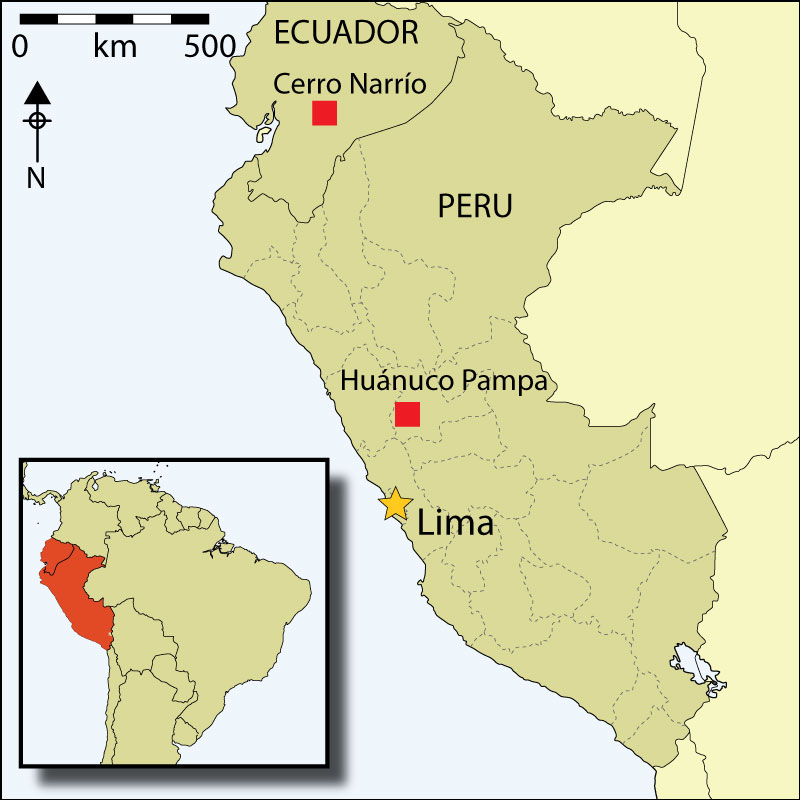
In 1941-42, the State Department supported 11 coordinated projects in Latin America (Reference DaggettDaggett 2009). Murra was field supervisor of 'Project 9B-Ecuador-1941-42'. The result was an essential primary source on Cerro Narrío, an important Formative site in the southern highlands of Ecuador (Reference Collier and MurraCollier & Murra 1943) (Figure 1).
Location of Cerro Narrío and Huánuco Pampa.

On the basis of his Ecuadorian work Murra was invited to contribute to another national project, the mammoth Handbook of South American Indians (Reference Murra and StewardMurra 1946, 1948). As with other US Government anthropology, the Handbook codified Amerindian cultures through a combination of ethnographic, ethnohistoric, archaeological and linguistic approaches.
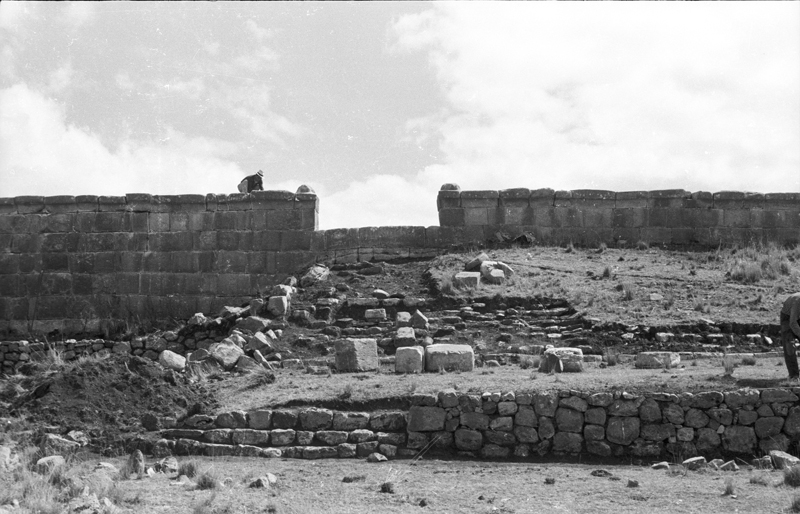
In 1956 Murra completed his library dissertation, The economic organization of the Inca state, for the University of Chicago. He had long wanted to resume Andean fieldwork, but problems obtaining a US passport persisted (Reference BarnesBarnes 2009: 12-13). However, by the late 1950s his difficulties were resolved in his favour. In 1963 he obtained a three-year National Science Foundation grant for his project entitled 'A Study of Provincial Inca Life', centred on the Peruvian highland site of Huánuco Pampa (Figure 2).
Huánuco Pampa, Ushnu central staircase excavation, August 1965. Photograph courtesy of Junius Bird Laboratory for South American Archaeology, American Museum of Natural History.

In his interdisciplinary project design Murra incorporated approaches learned from his other federally-sponsored work, including archaeological, ethnographic, ethnohistoric, linguistic and ethnobotanical components. He recruited a staff of archaeologists including Craig Morris, who later directed work at Huánuco, as well as Luis Barreda Murillo, Manuel Chávez Ballón, John Cotter, César Fonseca, Gordon Haddon, Peter Jenson, Ramiro Matos, Rogger Ravines, Daniel Shea and Donald Thompson. Historians Emilio Mendizábal Losack and Juan Ossio were also enlisted, although Murra attempted most of the ethnohistorical, ethnographic and linguistic work himself. Robert Bird joined as ethnobotanist. Missing from the research design were soil scientists, physical anthropologists, faunal specialists, surveyors, illustrators and architects. Although most of the team became established scholars, in the mid-1960s they were inexperienced. Murra's own practical experience was limited to field school archaeology, pottery washing, and six months in Ecuador.
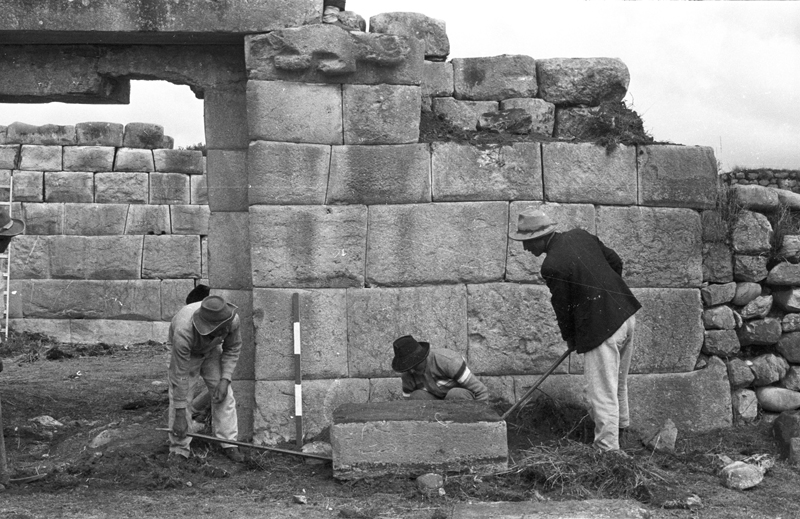
Nevertheless, Murra was endowed with boundless public confidence. With Peruvian government support, he undertook the excavation and restoration of Huánuco Pampa (Figure 3). This phase in the site's history — and Murra's — was never extensively published, and is today largely forgotten. However, Murra donated some two linear feet of field notes and approximately 5000 photographic negatives to the American Museum of Natural History. These documents are currently being digitised, annotated and studied by the author of this short note, to make the information they contain available to other scholars (see Archives below). Gradually, important facets of Huánuco Pampa, John Murra, and US federal archaeology are being revealed.
Huánuco Pampa, Portal 1 wall consolidation, August 1965. Photograph courtesy of Junius Bird Laboratory for South American Archaeology, American Museum of Natural History.
Archives holding work by John Victor Murra
Junius Bird Laboratory for South American Archaeology, Anthropology Division, American Museum of Natural History, New York City. National Anthropological Archives, Smithsonian Institution's Museum Support Center in Suitland (MD).