

Introduction
Politicians and public office holders set diverse strategies to cope with possible reputational harms of adverse events (Hood Reference Hood2011; Weaver Reference Weaver1986). Research on blame avoidance strategies has shown that these can be either anticipatory, aiming to keep blameworthy events off the agenda, or reactive, to manage the blame of a problematic issue that got into the agenda (Hinterleitner Reference Hinterleitner2017; Hinterleitner and Sager Reference Hinterleitner and Sager2017; Hood Reference Hood2011; Sulitzeanu-Kenan and Hood Reference Sulitzeanu-Kenan and Hood2005). Moreover, anticipation and reaction are acknowledged as two separate but consecutive decision situations, each one displaying different dynamics according to its own rationale (Hinterleitner and Sager Reference Hinterleitner and Sager2017, 600).
This article departs from these hypotheses for the analysis of blame avoidance dynamics in air quality policy in Mexico City. As the case shows, authorities from the federal government, Mexico City and its neighbouring metropolitan state, Estado de México (EDOMEX), developed a joint blame avoidance strategy to prevent the occurrence of pollution crises. Anticipating the reputational harms of these events (due to its saliency, proximity, and political connotation) and the unpopularity of the measures to fight them (i.e. driving restrictions), officers from the involved government levels with different partisan orientations manipulated policy instruments to “deny the existence of a crisis” (Resodihardjo Reference Resodihardjo2020). The strategy held until contextual conditions changed, giving place to reactive dynamics involving discursive tactics to shift blame and leading to policy change.
Studies of blame avoidance dynamics in multi-level contexts make two relevant assumptions: (1) politicians and public office holders have a preference to shift blame to other government levels rather than its own (Heinkelmann-Wild and Zangl Reference Heinkelmann-Wild and Zangl2020, 956; Rittberger, Schwarzenbeck, and Zangl Reference Rittberger, Schwarzenbeck and Zangl2017), and (2) an unclear distribution of formal responsibilities makes difficult to assign blame to a single actor (Bach and Wegrich Reference Bach and Wegrich2019). They generally argue that national-level politicians delegate responsibility to local governments and shift the blame towards them (Mortensen Reference Mortensen2013; Tosun and Hartung Reference Tosun and Hartung2018) or tolerate “fuzzy structures” to dilute possible reputational harms (Bache et al. Reference Bache, Bartle, Flinders and Marsden2015). Thus, what might be puzzling from the Mexico City’s case is that instead of trying to shift blame, the government levels jointly developed the strategy, even if they were from different political parties. In that sense, I argue that this situation was only possible because (1) the government levels shared competences on interrelated policy instruments, making them accountable to their own constituencies in the event of a pollution crisis, and (2) power was distributed between the main political parties, reducing opportunities to deflect blame.
The article uses causal process tracing to show the development of the anticipatory strategy and the transit to reactive dynamics. It develops the following mechanism linking the complexity of the structure with the development of a joint anticipatory blame avoidance strategy between government levels: (1) due to the institutional structure, competences of policy instruments are distributed among government levels, (2) political conditions lead to power sharing between diverse parties, (3) actors from different parties and government levels are potential blame takers by their constituencies, (4) the interrelation of the policy instruments reduces the opportunities to shift blame, (5) government levels jointly develop an anticipatory strategy to keep stability and avoid potential reputational harms. The mechanism breakdown came after changes in the institutional context destabilised the arrangements, leading to reactive blame games and ultimately fostering policy change.
This article seeks to contribute to the study of multi-level blame avoidance strategies in three ways. First, by analysing the construction of an anticipatory strategy it theorises on the conditions leading government levels to cooperate rather than shift blame in order to maintain stability. Second, it brings new insights on the role of contextual changes in multi-level blame games. Context has gained relevance to understand blame avoidance dynamics, either regarding the influence of institutional factors and noninstitutional factors (power, resources), the political system (Hinterleitner and Sager Reference Hinterleitner and Sager2015; Johannesson and Weinryb Reference Johannesson and Weinryb2021) or its importance on the actors’ leeway on blame responses (Resodihardjo Reference Resodihardjo2020; Resodihardjo et al. Reference Resodihardjo, Carroll, van Eijk and Maris2016). Here, contextual factors paved the way for transitioning from anticipatory to reactive dynamics. Third, while the interactions between government and opposition parties in blame games have been largely studied (Hansson Reference Hansson2018a; Hinterleitner Reference Hinterleitner2020; Hood Reference Hood2002; Weaver Reference Weaver1986), the combination of partisan politics and government levels in blame avoidance strategies seems to be underexplored (Heinkelmann-Wild and Zangl Reference Heinkelmann-Wild and Zangl2020). In this case, it is an explanatory factor for both, the joint anticipatory strategy and the conditions leading to reactive behaviour fostering policy change.
The article divides as follows. First, it examines in depth the theoretical developments of blame avoidance strategies in multi-level settings, considering its temporal arrangement, the interactions between government levels and partisan politics. To situate the case study, this section also presents a typology combining partisan diversity and the distribution of responsibilities. Next, the article presents the research design and justifies the method selection. Then, to show the main argument, the case analysis divides into the anticipatory strategy, the mechanism breakup and reactive blame games. Lastly, the article addresses its contributions to the literature and raises some reflections on the findings and effects on multi-level blame avoidance strategies in policy stability and change.
Structure, politics, and time in multi-level blame avoidance strategies
Governments deploy diverse strategies to cope with possible reputational harms of blameworthy events and to deal with criticisms from other actors (Hood Reference Hood2002, Reference Hood2011; Weaver Reference Weaver1986), such as opposition parties or other government levels. According to Hood (Reference Hood2002, Reference Hood2011), their tactics fall into three categories: presentational, using arguments to “deal with loss or harm perception dimension of blame” (2011, 17), agency, by selecting institutional arrangements to distribute responsibility, and policy strategies, by selecting policies to minimise the risk of being blamed.
Currently, the research on blame avoidance in multi-level settings has increased its interest on these strategies, suggesting two relevant assumptions for its analysis: (1) politicians and public office holders have a preference to shift blame to other government levels rather than its own (Heinkelmann-Wild and Zangl Reference Heinkelmann-Wild and Zangl2020, 956; Rittberger, Schwarzenbeck, and Zangl Reference Rittberger, Schwarzenbeck and Zangl2017), and (2) an unclear distribution of formal responsibilities makes difficult to assign blame to a single actor (Bach and Wegrich Reference Bach and Wegrich2019). Therefore, when the public perceives loss or harm and reacts to assign responsibility (Hood Reference Hood2011), it will be less clear who is responsible for what in contexts where competences are distributed between government levels. In other words, a complex structure opens opportunities to dilute responsibility, making more difficult for the public to “see through the blame game and assign responsibility” (Hinterleitner and Sager Reference Hinterleitner and Sager2017, 598). Conversely, a clear distribution of competences would make easier to the public to assign responsibility, reducing the opportunities to deflect blame.
Several studies have analysed the role of the above-mentioned factors in blame avoidance strategies. They generally argue that national-level politicians develop agency strategies to delegate responsibility to local governments and shift the blame towards them (Mortensen Reference Mortensen2013; Tosun and Hartung Reference Tosun and Hartung2018). For example, Bache et al. (Reference Bache, Bartle, Flinders and Marsden2015) show that politicians tolerate and even create “fuzzy governance” structures to cope with the effects of blameworthy events. More recently, in their study of the crisis in Berlin’s rapid transit railway system, Bach and Wegrich (Reference Bach and Wegrich2019) showed a blame diffusion effect related to the delegation structure while acknowledging deferred blame from service providers to executive politicians.
Despite the advancements to analyse the way complex structures shape blame avoidance strategies in multi-level settings and how government levels shift blame, its study can be complemented with other elements, first, the focus on the distribution of responsibilities of policy instruments. While there are some references to these devices – i.e. regulations (Tosun and Hartung Reference Tosun and Hartung2018), the explicit theoretical links of their role in multi-level blame avoidance strategies require further development. This is relevant because scholars have since some time recognised the role of policy instruments in blame avoidance strategies. Kent Weaver (Reference Weaver1989) analysed how “policy triggers” – quantitative indicators used to mandate automatic governmental responses – can be manipulated and adjusted to reduce blame-generating pressures and maximise the political agenda. Other research motivated by the work of Paul Pierson (Reference Pierson1994) focuses on the way “low-profile,” “disguised,” or “invisible” policy instruments are used to induce reforms or cutbacks and therefore minimise the political costs of implementing such unpopular measures (Bezès Reference Bezès2007; Jensen et al. Reference Jensen, Arndt, Lee and Wenzelburger2018; Vis Reference Vis2016). Thus, if studies on multi-level blame avoidance strategies emphasise the allocation of competences and other research acknowledges instruments as blame avoidance devices, then it is worth to understand how its distribution among government levels affects the strategies.
In second place, the role of opposition parties in different government levels in combination with the institutional structure needs to be more systematically acknowledged. Ever since Kent Weaver’s seminal work (Reference Weaver1986), blame avoidance literature assumes that opposition parties point out controversies to erode the credibility of the government, show their constituencies that they hold government accountable, or gain agenda access (Hansson Reference Hansson2018a; Heinkelmann-Wild, Kriegmair, and Rittberger Reference Heinkelmann-Wild, Kriegmair and Rittberger2020; Hinterleitner Reference Hinterleitner2020). For example, they can deploy argumentative moves to convince the audience that the government should be blamed (Hansson Reference Hansson2018b, Reference Hansson2018a). In multi-level settings, Heinkelmann-Wild and Zangl (Reference Heinkelmann-Wild and Zangl2020) argue that the extent to which a government level prefers to attribute blame to another at a different level lies on loyalty and interdependence grounds. Loyalty between same scale governments would be stronger than among government levels across party lines. Similarly, mutual dependencies between governments at the same level would deter from blaming each other (Heinkelmann-Wild and Zangl Reference Heinkelmann-Wild and Zangl2020). However, the authors focus on the European Union and thus recognise that party loyalties may offset level loyalties in other contexts.
Considering the structure complexity and political involvement, Johannesson and Weinryb (Reference Johannesson and Weinryb2021, 45) argue that a “clear and transparent collaborative structure with large involvement of political actors will decrease the opportunities for power holders to deflect blame in a credible manner, as these characteristics make it clear to outsiders how responsibility is allocated.” According to this, multi-level blame avoidance strategies depend not only on the complexity of the structure (whether the distribution of responsibilities is clear or blurry) but also on party diversity (or the distribution of political power).
Lastly, blame avoidance strategies follow a temporal arrangement to either anticipate or react to a blame-attracting event (Hinterleitner and Sager Reference Hinterleitner and Sager2017; Sulitzeanu-Kenan and Hood Reference Sulitzeanu-Kenan and Hood2005). Anticipatory behaviour seeks to keep such events off the agenda or reduce their exposure if they occur; reactive behaviour is about managing blame of a problematic issue that has got into the agenda (Hinterleitner Reference Hinterleitner2017; Hinterleitner and Sager Reference Hinterleitner and Sager2017). Anticipatory and reactive behaviours are, according to Hinterleitner and Sager (Reference Hinterleitner and Sager2017), “two consecutive decision situations” that are to be treated as separate phenomena “based on different calculations, require different types of resources and strategies, display different dynamics, and thus have different implications for our understanding of elite behavior” (p. 600). Therefore, such a temporal distinction has implications for the theorisation of blame avoidance strategies. For instance, Hood (Reference Hood2011) argues that agency and policy strategies are mostly used to anticipate blame, while presentational strategies can be adopted either before or after “blame firestorms.”
There are examples of studies looking at the relationship of this temporal arrangement in multi-level blame games. For instance, Bach and Wegrich (Reference Bach and Wegrich2019) explore the connection between complex institutional architectures as anticipatory measures and reactive blame avoidance behaviour. However, a detailed account of the interactions in anticipatory and reactive behaviour within a single case would add up to the Hinterleitner and Sager’s hypothesis pointing to the particular dynamics of each sequence and its effects. For example, while different parties may adopt strategies to shift or allocate blame, they may collaborate in anticipation to unpopular events (Hering Reference Hering2008). Moreover, showing the transition from anticipation to reactive blame games contributes to understand under which conditions the strategies rise and fall and their policy consequences.
Distribution of responsibilities, political power, and their effects on anticipatory blame avoidance strategies
The type of anticipatory strategy depends on the combination between the distribution of responsibilities and party diversity. Figure 1 shows a 2×2 matrix where responsibility attribution can be either clear or fuzzy. The distribution of political power refers to the party diversity among government levels. When it is high, it means that power is distributed between many parties, and low would mean that a coalition or just one political actor (i.e. single party) holds power in all the government levels. Blame games or reactive behaviour may be indistinct because as the above literature has shown, government levels and parties allocate blame to each other in the presence of an adverse event. Drawing on the literature, four possible combinations arise:
Cooperative anticipatory behaviour (Quadrant 1) – When political power is distributed amongst diverse parties with a clear distribution of responsibilities, actors will develop an anticipatory strategy to keep stability because it will be more difficult to deflect blame (Johannesson and Weinryb Reference Johannesson and Weinryb2021). This is the main focus of the article, unveiling first the mechanism leading to the anticipatory strategy and then its breakdown resulting in reactive blame games.
External Delegation (Quadrant 2) – If one party or coalition holds the attribution of responsibilities in all the government levels, then the delegation structure is more easily identified with a particular political actor. Thus, the more government levels depend on the control of one party or coalition, the higher the share of targeted public blame: actors develop agency strategies to delegate blame to external agents (Heinkelmann-Wild et al. Reference Heinkelmann-Wild, Zangl, Rittberger and Kriegmair2021).
Toleration of Fuzzy Structures (Quadrants 3 and 4) – In anticipation of adverse events, government levels can tolerate “fuzzy” structures because an unclear distribution of formal responsibilities makes difficult to assign blame to a single actor (Bache et al. Reference Bache, Bartle, Flinders and Marsden2015; Hinterleitner and Sager Reference Hinterleitner and Sager2017; Hood Reference Hood2011). As the above literature shows, a blurry distribution of responsibilities is a suitable anticipatory strategy for the actors in multi-level contexts, outweighing the effect of power distribution.
Types of anticipatory strategies in multi-level settings.
Source: Own elaboration.

Research design
The case analysis begins by identifying the mechanism linking the complexity of the structure to a joint blame avoidance policy strategy (Beach and Pedersen Reference Beach and Pedersen2013; George and Bennett Reference George and Bennett2005). Blame games involve the interaction between multiple actors and contextual factors (Hinterleitner Reference Hinterleitner2018, Reference Hinterleitner2020), making it more challenging to explain its outcomes in terms of the effects of a limited number of variables. For that reason, causal process tracing is a well-suited method to analyse such type of political behaviour. It helps to identify and explain complex phenomena by developing causal chains and mechanisms in contexts with multiple interaction effects (George and Bennett Reference George and Bennett2005; Hall Reference Hall, Mahoney and Rueschemeyer2003; Kay and Baker Reference Kay and Baker2015). Moreover, the use of this method is helpful to trace the conditions under which the mechanism holds and to look for its eventual breakdown.
The mechanism comprises a series of steps that show how diverse entities engage in activities, transmitting “causal forces” from one step to the next (Beach and Pedersen Reference Beach and Pedersen2013, Reference Beach and Pedersen2018). Entities here varied – the structure, a pollution crisis, policy instruments, politicians, and public office holders, etc. – each one performing an activity, which in turn enables subsequent mechanism steps leading to an outcome – i.e. the anticipatory strategy (see Table 1). Tracing the mechanism breakdown sheds light on the processes leading to the transition from anticipatory behaviour to reactive blame games, allowing to theorise on those factors (Beach and Pedersen Reference Beach and Pedersen2018). In this case, changes in the political context took power away from one of the main political parties. With “nothing to lose” such party destabilised the arrangements, contributing to the mechanism breakdown and leading to reactive blame games.
Mechanism steps and types of evidence

Source: Own elaboration based on Beach and Pedersen (Reference Beach and Pedersen2013).
Each part of the mechanism relies on different evidence types (see Table 1) revealed in the case analysis (Beach Reference Beach2016). Data collection includes secondary qualitative and quantitative data (regulations, court rulings, national and local plans, air pollution indicators, newspaper articles, and academic literature). It also comprises 24 in-person, semi-structured interviews with current and former, mid- and high-level government officials at the local and federal levels, and NGO representatives in the air quality policy domain. Governmental interviews covered, to use Hood’s terms (2011), the “top bananas” and the “meat in the sandwich.” Top bananas or politicians and high-level bureaucrats have a leading role in determining policy choice and its political direction, whereas the meat in the sandwich (or advisors and technocrats) adjust the nuts and bolts of the policy instruments, bringing a good account of the policy details. Also, interviewees came from different administration terms and government levels, bringing a comprehensive perspective of the timing and dynamics of anticipatory and reactive blame avoidance strategies.
The interviews were developed in two rounds: April-May and July-September 2018. In the first round, government officials were selected from the areas in charge of air quality policy at the federal and local levels, whose contact was easily accessible through their respective “transparency portals.” Additionally, one NGO member was interviewed in this round. The snowball sampling nourished the second round, giving access to current and former public officers and more NGO members. Covered topics were the design, adjustment, and implementation of policy instruments and the main drivers for their interactions, emphasising pollution peak management. They were developed in Spanish and translated into English by the author.
The case analysis first demonstrates the blame potential of pollution crises to understand the reasons behind the blame avoidance strategies. Then, it sequentially explains the mechanism of the structure leading to an anticipatory policy strategy. Next, the case analysis depicts the mechanism’s breakdown caused by contextual changes and the comeback of pollution peaks. The last part shows how these events lead to reactive blame games and policy change.
Coping with pollution crises in Mexico City: Of denial and reaction
Uncovering blame avoidance motivations
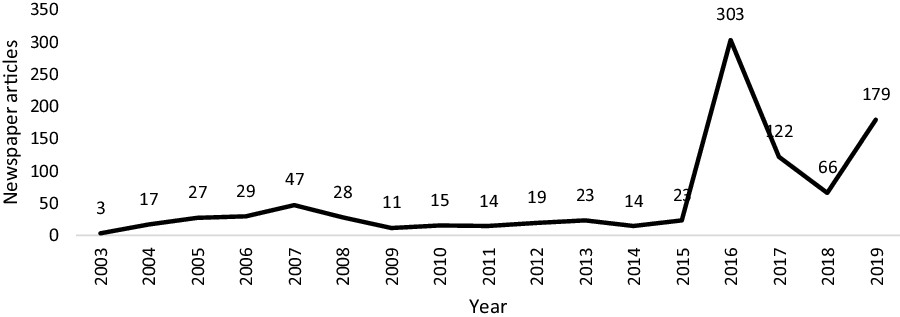
Pollution peaks are blame-generating events in Mexico City due to their proximity (or their immediate effects on people’s lives), saliency (Hinterleitner Reference Hinterleitner2018; Soss and Schram Reference Soss and Schram2007), and its political connotation. Regarding their proximity, public perception studies show that Mexico City inhabitants consider the city highly polluted with significant health effects: more than 80% of teenagers consider the pollution levels as high and very high (Catalán-Vázquez et al. Reference Catalán-Vázquez, Riojas-Rodríguez, Jarillo-Soto and Delgadillo-Gutiérrez2009; Landeros-Mugica et al. Reference Landeros-Mugica, Ortega-Andeane, Reyes-Lagunes and Sosa-Echeverría2014). Additionally, during pollution crises, the government implements various measures to decrease pollutant levels as soon as possible. Such actions imply diverse restrictions (on driving, industry, and business operation) that are far from popular (Bovens and ‘t Hart Reference Bovens and ‘t Hart2016) due to their effects on the socio-economic activities of the population that lives or works in cities (Davis Reference Davis2008). Additionally, these episodes are highly salient issues, receiving considerable media attention. As seen in Graph 1, the number of press articles covering air pollution drastically increased in 2016, when pollution peaks were back after years of stability.
Yearly media coverage on air pollution in Mexico City.
Source: Own elaboration with data extracted using Factiva. The number of articles was obtained through a search in the database Factiva using simultaneously the keywords contaminación, calidad del aire and Ciudad de México (pollution, air quality and Mexico City) for three major national newspapers with a section devoted to Mexico City: La Jornada, Reforma and El Universal.
The air pollution problem in Mexico City also has a political connotation. In the late 1980s, air pollution levels in Mexico City were so high that birds were falling dead from the sky (Rojas Reference Rojas1987). Monitoring stations recorded 47 registries with more than four times the health-threatening levels in 1986 (SEDEMA 2012), and recurring pollution peaks reached their worst in 1992 with 28 days (see Graph 2 below). During that period, Mexico City got the infamous title of the most polluted city in the world. With such unbearable emission concentrations, a growing number of civil society organisations criticised the government’s role in handling environmental issues. For example, in 1985, a group of one hundred artists and intellectuals (known as “the group of the 100”) published a manuscript calling for governmental action to reduce the high air pollution levels, claiming its negative consequences for health and the environment (Aridjis Reference Aridjis1985). They had media connections and ties to the political elites, which helped them to gain visibility (Aridjis and Ferber Reference Aridjis, Ferber, Slovic, Rangarajan and Sarveswaran2019; Quadri de la Torre Reference Quadri de la Torre, Schteingart and D’Andrea1991).
Number of days with pollution peaks and ICA activation levels.
Source: Own elaboration with information from Mexico City’s government (CDMX 2019a).

Additionally, the 1988 presidential elections contributed to politicise the issue, and the authorities ultimately intervened to control the unbearable pollution levels. Plagued by electoral fraud allegations (Lehoucq Reference Lehoucq2007), the government underwent a legitimacy crisis, making it more attentive to social demands (Loaeza Reference Loaeza1995). Indeed, in his inauguration speech, incoming president Carlos Salinas de Gortari positioned the topic among the two priorities for the capital (together with security) and specifically demanded to the recently appointed Mayor, Manuel Camacho, to control pollution (Mexican Congress, 1988) (at that time and until 1997, the president appointed the city’s mayor). In the next years, environmental authorities finally controlled the situation through significant policy actions such as closing an oil refinery inside Mexico City, fuel reformulation, the mandatory use of catalytic converters on cars, and stricter industrial standards (Molina and Molina Reference Molina, Molina, Molina and Molina2002; Roccatti Reference Roccatti and Rabasa2007).
The air pollution problem was then set as a political and social concern, stuck in the inhabitants’ minds. Indeed, those who witnessed the late 80s-early 90s crisis are more aware of the problem than younger generations (Landeros-Mugica et al. Reference Landeros-Mugica, Ortega-Andeane, Reyes-Lagunes and Sosa-Echeverría2014). From thereon, public authorities handle air pollution crises with care due to its blame-generating features. As the following sections show, once the crisis was under control, the next goal was to keep away any signs of a polluted city. In other words, the main objective was to prevent pollution peaks, even at the expense of harmful long-term pollution exposure.
Developing the anticipatory strategy
Interrelated policy instruments and political distribution of power
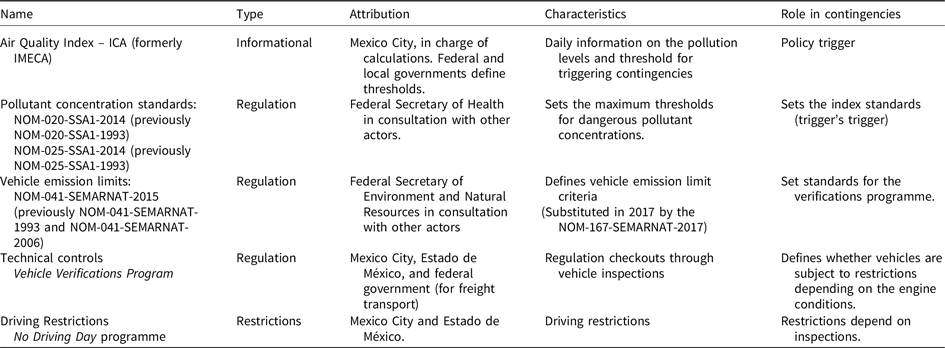
Public awareness of pollution peaks turns them into a sign of air quality policy failure. Situations like this often create blaming opportunities where some actors allocate the fiasco to their partisan opponents (Hinterleitner Reference Hinterleitner2018). However, the distribution of competences of policy instruments to control pollution peaks (Table 2), in combination with political conditions, deterred the actors from capitalising this blaming opportunity and rather worked together to prevent these events.
Policy instruments related to environmental contingencies
Source: Own elaboration.
If a pollution crisis causes reputational harms, then a strategy consists on denying its existence (Hood Reference Hood2011; Resodihardjo Reference Resodihardjo2020). For that purpose, the actors had to prevent the activation of the crisis management protocol called the “Environmental Contingencies Program” because it sends the message that pollution levels are health-threatening and lead to unpopular driving restrictions. To do so, they must calibrate four policy instruments connected by the protocol – regulations and standards, the air quality index, and driving restrictions – and whose competences are distributed among government levels (see Table 2). The protocol works as follows.
It activates when the air quality index (Mexico City’s competence) reaches a certain health-damaging pollution threshold (attached to federally issued regulations called Mexican Official Norms or NOMs). The following action is to set driving restrictions (locally enforced by Mexico City and EDOMEX through the No Driving Day Program) to take pollution concentrations back to the federal government’s health-safety standards (or NOMs) (CDMX, 2019b). Restrictions rely on taking out the most polluting vehicles, which in turn are identified by vehicle inspections (Vehicle Verifications programme) implemented by local and federal authorities. The former check private and public transport and the latter oversee freight transport. Inspection criteria related to the maximum allowed pollutant emissions are also tied to a federal NOM.
Such interrelation of the policy instruments means that each actor has something at stake if or when contingencies activate:
Mexico City’s government is the principal blame taker due to the factors mentioned in the previous section: its citizens see their health as threatened and suffer from the driving restrictions that will affect daily 1.75 million persons (20% of the total population estimated in 8.85 million) (INEGI, 2018).
Citizens from Estado de México share a similar concern: they suffer the consequences of driving restrictions not only in their territory but also in entering the city. Restrictions will affect 32% of the total daily trips made by private vehicles in the metropolitan municipalities (3.17 million), impacting 1.73 million persons per day (INEGI, 2018).
The same applies for federally regulated freight transport if it cannot run through the city, directing their complaints to the Secretary of Communications and Transports (as the article later shows).
In sum, the structure of competences on a blame-generating event, where all the involved actors have something at stake, turned them into potential blame takers, motivating them to develop a joint strategy to adjust policy instruments and avoid the protocol activation.
Regarding the power distribution, a constitutional reform in 1996 set up the direct election of Mexico City’s mayor, fostering political diversity. In 1997–2018, the mayor was from the Democratic Revolution Party (PRD) and different from the presidents’. Another significant change came along in the year 2000. After more than 70 years in the presidency, the Revolutionary Institutional Party (PRI) lost to the National Action Party (PAN). PAN won again the presidency for the 2006 – 2012 term. Estado de México remains unchanged, always headed by the PRI. All those changes meant that between 2000 and 2012, three different political parties ruled in the three concerned governments (Table 3).
Parties and terms per government level

Source: Own elaboration.
Despite the political diversity, and contrasting with political disputes in other arenasFootnote 1 , air quality policy had no considerable disagreements or turnarounds. One example was the work done within the Metropolitan Environmental Commission (a multi-level forum created to discuss environmental issues), where meetings were mostly held to treat crisis protocol-related matters. A former local public officer from Estado de México that worked on the Commission in 2011 recalls that,
The relationship was good regarding contingencies; there wasn’t a coordination problem, the ones that got there had a full disposition to cooperate… IMECA elaboration [the air quality index] was barely touched; there wasn’t much to discuss because the air quality was stable for a lot of time, there weren’t such big crises that we later had. Everything was calm. Even in the verifications program, we both had a common understanding (Respondent 9. 2018. Interviewed by Author. Mexico City).
This quote is only evidence that there were no major disagreements and not necessarily of a blame avoidance strategy (which comes next). However, the reason for a “smooth relationship” between the government levels was that, as shown in graph two, from 2000 to 2015 (the period of political diversity) pollution peaks remained stable with barely one event per year from 2000 to 2005, and none for almost ten years (2006–2015). In contrast, the 2016 events depicted in the final part of the case analysis show that these crises generate reactive blame games through presentational strategies and conflict.
The strategy in motion
The anticipatory strategy consisted of calibrating two sets of instruments comprised on the above-explained crisis protocol. First, the index and the federal regulations (NOMs) are the policy triggers, indicating automatic governmental responses to inform whenever pollution outbreaks reach dangerous levels (or the peaks). Therefore, the triggers must give the authorities enough manoeuvre margin (or to be lax enough) for them to be able to deny crisis. In second place, vehicle inspections and driving restrictions are stabilising instruments, whose control helps to maintain steady pollution levels. Despite having loose triggers, the government levels had to find the right equilibrium that allows to set the less possible unpopular driving restrictions without having sudden emission spikes. Therefore, as this section shows, the strategy consists of adjusting these two types of instruments to avoid the emergence of pollution crises.
Manipulating the triggers
The actor’s first step in the anticipatory strategy was to manipulate the air quality index to prevent the activation of the Environmental Contingencies Program (ECP). The Air Quality Index (ICA), in this case, worked as the “policy trigger,” as defined by Weaver (Reference Weaver1989) (see section two). The pollution index is represented on a 0 to 500 scale, in which 100 is assigned to the limit of health-damaging emissions determined by the federal standards (NOMs). Less than 100 points are considered low risk or “normal,” and when it goes over 100, it implies health hazards (SEMARNAT n.d.). If contingencies were triggered as soon as the indicator goes over 100, then the number of days with bad air quality (Graph 3) would be the same number of days of pollution peaks. However, contingencies are usually triggered at a higher breaking point (Graph 2).
Number of days per year with hazardous pollution levels.
Source: Own elaboration with data from official documents and reports. The data consider the number of days exceeding the standards (limits over 100 ICA points) of either ozone, PM10 or PM2.5. As of 2014, the federal regulations were updated to set tighter pollution standards. The limits over 100 ICA points from 2015 onwards are under the new calculations. Data from 1988 to 2000 were extracted from the Programs to Improve Air Quality in the Metropolitan Area of Mexico City (known as PROAIRE 1 and 2); 2001 to 2007 and 2011 to 2017 from the Annual Reports on Air Quality of SEDEMA; 2008 to 2010 and 2018 from the website of the Secretary of Environment of Mexico City, http://www.aire.cdmx.gob.mx/default.php?opc=%27aqBjnmU=%27 (October 17 2019).

As shown in graph 2, the breaking point to activate the ECP (dotted line) has periods of stagnation and some others of incremental decrease. Keeping higher levels and its eventual reduction resulted from the negotiations among the local and federal authorities. A high-level public officer who worked on the General Direction of Ecology in Mexico City recalls that contingencies stopped because the triggers remained high and were not adjusted during a long time,
These thresholds have always a negotiation margin because they are based on standards or norms that have a scientific base, but that are the ultimate goal, or at least a mid-term aspiration. Certain protection margins are set and what really happened is that such levels didn’t move or moved just a little bit. That’s why contingencies stopped… The pollution levels were so high that the city couldn’t be paralyzed all the time. Therefore, the contingency [pollution index] levels were fixated relatively high. The problem is that they stood that way, nobody adjusted them (Respondent 18. 2018. Interviewed by Author. Mexico City).
Eventually, the authorities decided to lower systematically the levels and avoid having the city “paralysed all the time” to use the above quote wording. The 2002–2010 Program to improve the air quality in the Metropolitan Area of Mexico (PROAIRE 2) sets as one of its goals to update the application levels of the Environmental Contingency Program. For that purpose, “the Secretary of Health, in coordination with the Secretary of Environment and Natural Resources, the Secretary of Environment of Mexico City and the Secretary of Ecology of Estado de México should carry out the necessary analyses to update the Program activation levels” (CAM, 2002, p. 8.113). As Graph 2 shows, they decided to decrease the index by five points per year in the period 2008–2012. According to a former local officer from Estado de México, the reason to set this target was merely related to negotiation between the government levels,
They were five points each year. Always the negotiation between two governments is complex. They always have different points of view. The heads of the [local] executive do not only see the environmental part of the issue, but also the economic sustainability and development, of growth of a metropolitan…where a lot of things must be evaluated (Respondent 6. 2018. Interviewed by Author. Mexico City)
Not only did the government levels decided to gradually decrease the thresholds, but they set a specific goal of five points each year. The target could have been to reach some type of benchmark (i.e. the World Health Organization standards). However, the rationale was not scientific and rather a political calculation of the reputational costs of activating the protocol, which would send the message that the city was polluted, plus the unpopular driving restrictions coming with it. The same logic applies for the federally defined standards setting pollutant emission limits and to which the local index (ICA) calculations are tied to (or the trigger’s trigger).
Just as the index, the federal standards dictating the health-threatening emission thresholds remained barely touched for many years because moving them would imply more contingencies. Regulations for pollutants such as ozone and particulate matter concentrations were first issued in 1994 (NOM-020-SSA1-1993 and NOM-025-SSA1-1993) and updated 20 years later, in 2014 (NOM-020-SSA1-2014 and NOM-025-SSA1-2014).Footnote 2 Its modification has been a long-time claim by the NGOs and academia. Despite the update, they consider that the levels are still not ideal and far from international standards (OCCA 2019, also acknowledged by NGO representatives in interviews 16 and 19).Footnote 3
A former high-level federal public officer recalls that around the year 2000, “they [authorities from the government levels] grabbed a table and said: ‘if we put the levels here, how many contingencies we’ll have?’. There were minor, gradual adjustments but always below the scientific recommendations” (Respondent 21. 2018. Interviewed by Author. Mexico City).
Just as previous studies indicate (Davis Reference Davis2008), tightening regulations would probably lead to more pollution crises, causing generalised social unrest and ultimately affect public opinion. According to the above-quoted public officer, that was the motivation to keep loose standards,
There has been resistance to have stricter standards [Mexican Official Norms] … with such standard everybody was happy, then they saw that they had some impacts at some level so, what did they do, they loosened the standard! We had resistances and setbacks in many cases. Why? It’s logic, everything is associated with the contingencies issue because for the [mass] public’s mind ‘there is a contingency! we’re polluted!’. It has always been a contentious issue (Respondent 21. 2018. Interviewed by Author. Mexico City)
Either the stagnation of the contingency thresholds or their yearly decrease took place precisely during the periods of political diversity (See Table 3 and Graph 2). From 1998 to 2006, the “triggers” remained at 241 points (2.41 times the health-threatening levels), and from 2007 to 2012, it consistently declined five points per year. Combined with the statements from the interviews, it is possible to assume that due to the shared responsibility between the government levels and the political distribution of power, it was a good payoff to participate in a strategy to avoid pollution peaks.
Relying on restrictions for stability
Vehicle emission controls are local and federal competences tied to federal regulations. The national Secretary of Environment and Natural Resources sets the vehicle emission limits through the NOM-041-SEMARNAT-2015. Local and federal authorities use the regulation as guidelines during the inspection processes of particular vehicles (local attribution) and freight transport (federal attribution through the Secretary of Communications and Transports). The federal government established the regulation in 1999 and updated it twice (in 2007 and 2015) without significant changes in pollutant limits. For instance, until the 2015 update, it did not consider nitrous oxides – one of the most dangerous pollutants according to the United States Environmental Protection Agency (EPA 2018). This was because stricter inspection standards take more cars out of daily circulation due to the coupling of the Vehicle Verifications and No Driving Day programmes. In other words, vehicles failing to meet the standards are not allowed to drive one weekday (in some cases during the weekends) and face tighter restrictions during environmental contingencies.
To avoid assuming the cost of unpopular driving restrictions – because stricter inspection standards would take out more cars of daily circulation – the governments chose to (1) incentivise fleet renewal to have more efficient and less pollutant cars and (2) ban old vehicles from daily circulation. For instance, the National Institute of Ecology and the Secretary of Environment of Mexico City jointly agreed to give new cars equipped with less polluting technology a two-year exemption on inspections (in contrast to the mandatory six-month period) and could also skip No driving Day restrictions (Gakenheimer et al. Reference Gakenheimer, Molina, Sussman, Zegras, Howitt, Makler, Lacy, Slott, Villegas, Molina and Molina2002; Respondent 21. 2018. Interviewed by Author. Mexico City). In contrast, vehicles more than eight years old were automatically discarded to get a free pass on the No driving day.
The anticipatory strategy led to stability for many years. Keeping the protocol’s activation levels, high and lax regulations were essential to deny the existence of a crisis. Subsequently, coupling vehicle inspections to driving restrictions instruments allowed the authorities to avoid setting any type of unpopular restrictions. Banning old vehicles to drive once a week and rewarding the more efficient ones meant that vehicle inspection standards did not have to be changed that much because they relied on newer more efficient engines. At the same time, older vehicles were automatically discarded. Actions like these in fact encouraged the city’s fleet renewal (OECD 2015).
The icing on the cake: a blame-absorbing organisation
The strategy culminated with the creation of a blame-absorbing organisation (Hood Reference Hood2011) in case pollution peaks came back. Federal and local governments signed an agreement to give a formal structure to the Metropolitan Environmental Commission. The statutes of the newly created Environmental Commission of the Megalopolis (CAMe) attribute its Executive Coordinator to initiate the environmental contingency protocols during pollution peaks, absorbing the blame coming with it.Footnote 4 The organisation has a fuzzy and ambiguous structure – staff paid by the federal Secretary of Environment, without a fixed location, responsive to a board of governors from seven states – that plays in favour of all its members. If the Commission depends on everyone and no one, the blame falls in the coordinator’s position without pointing directly to any of the involved governments. Interestingly, even its current personnel (at the moment of the interview) identify the Commission as a blame-absorbing organisation or a “political buffer” to use their words. A high-level commission’s officer indicated,
What’s the use of the CAMe, even if it is not recognized as a separate legal entity [because it is formally part of the Secretary of Environment and Natural Resources]? As a political buffer. When we declare a contingency episode, we’re the ones to blame. It is not Mancera [Mexico City’s Mayor, 2012–2018]; it is not Eruviel [Estado de México’s governor, 2012–2018] (Respondent 2. 2018. Interviewed by Author. Mexico City).
Breaking up the anticipatory strategy
Contextual changes realigned the distribution of political power, taking out one of the major political parties out of the arrangements. In consequence, the lack of formal responsibilities increased the National Action Party’s (PAN) opportunities to deflect blame. With nothing at stake after losing the 2012 presidential elections (see Table 3), in 2014, the PAN’s local branch pointed to the unconstitutionality of a clause that automatically discarded eight-year-old cars to be eligible for skipping driving restrictions (due to the previous coupling of the vehicle inspections programme with driving restrictions). The party argued that the criteria were discriminatory and should not be related to the car’s year/model but to their pollutant emissions levels. PAN even provided legal assistance to individuals who wanted to submit a legal recourse and exempt the driving restrictions (Notimex 2014).
PAN’s claims escalated to the Supreme Court of Justice that in 2015 declared unconstitutional to ban vehicles based on their year-model and not on their emission levels (Tesis: 2a./J. 125/2015 (10a.), Registry: 2010225). Although the ruling just intended to provide car users with a legal recourse to contest the measure (and not to modify the programme for everyone), Mayor Miguel Ángel Mancera decided to remove the programme’s year-model criteria. The mayor’s decision was allegedly to compensate for an unpopular measure in 2014 that imposed driving restrictions on Saturdays for old cars (Pantoja Reference Pantoja2015).
Doing this, combined with lax verification standards (NOM-041-SEMARNAT-2015) (yes, the ones previously set to avoid blame coming from the unpopularity of restrictions), allowed old, polluting cars to run daily. Emissions from vehicles with more than ten years are higher than newer ones and four to six times more polluting (Martínez Salgado Reference Martínez Salgado2011). The local Secretary of Environment estimated that 650,000 more cars were in circulation (Pazos Reference Pazos2016), and federal estimates accounted for 1.5 million (Rivera Reference Rivera2016). Such modifications, combined with the 2014 update on pollutant concentration standards (NOM-020-SSA1-2014) and adverse meteorological conditions, created the perfect storm in early-2016. Pollution peaks were back that year.
While meteorological conditions are an environmental factor contributing to pollution peaks, they are not uncommon. Even more so, the metropolitan environmental authority (Environmental Commission of the Megalopolis – CAMe) recognises the periods during the year when pollution spikes. According to the organisation, ozone formation – the main smog component – accelerates with high temperatures, and in the absence of rain and with low wind speed, it stalls in the city (CAMe 2020). Therefore, “when these adverse conditions coincide, it is enough to have just a minor fraction of typical pollutant emissions to reach very high ozone concentrations … Each year, between March and June, these precise conditions are present in the Metropolitan area of Mexico City [emphasis by the author]” (CAMe 2020). In short, the effect of adverse meteorological conditions must be nuanced because the government acknowledges their presence year by year.
With all these elements in play, after ten years without a pollution contingency, on March 14, monitoring stations reported more than 200 points in the pollution index (ICA), activating the Environmental Contingency Program. The long-time blame avoidance strategy used to contain the crises was no longer useful. The breakdown of the anticipatory strategy mechanism led to reactive blame games.
Reactive blame games
Pollution contingencies caused by contextual factors (political changes and meteorological conditions) destabilised previous arrangements, leading to blame allocation, conflict, and policy change. This part shows the unfolding of reactive blame games once the anticipatory strategy was no longer useful. Initially, Mexico City’s mayor used presentational strategies to shift blame to other government levels and the Megalopolitan Environmental Commission. Blame allocation and the effects of the pollution peaks led in turn to reactions from Estado de México and the Federal government. The former retaliated by closing the wastelands used by the city. Federal reactions were in two senses. On the one hand, they negotiated with the city the entrance of federally regulated transport carriers to appease the criticisms of those groups. On the other, presidential intervention “saved the day” by fostering policy change.
Mexico City’s government made the first move. Envisaging the political hit on the local administration, Mayor Mancera used a presentational strategy, highlighting that the city is “doing its job” and shouldn’t be blamed for either high pollution levels or driving restrictions. The mayor shifted the blame to the recently created CAMe for “not doing enough” and just limiting itself to declare precautionary measures.
Yesterday, we had contingency phase one. Why? Not necessarily because of Mexico City. That should be highlighted. Mexico City is doing its job. Here we have the No Driving Day [program]. In the Megalopolitan Zone, we do not have it for all, just for some parts of Estado de México and Mexico City, but we do not have No Driving Day anywhere else, which is from where those gases come from, adding up to what is generated in the city. In other words, this contingency phase is not only Mexico City’s responsibility. We have reiterated the call to the famous CAMe, to this Megalopolitan Commission, that the only thing it has done in recent times is to announce that there is a pre-contingency, and that is because Mexico City has the monitoring stations. You might ask yourselves: how do we know that the [emission] levels are exceeding? Because Mexico City measures them. If we didn’t measure, if we didn’t have these monitoring stations, we wouldn’t have contingencies because nobody has invested in it, nobody has cared over health issues. (El Universal 2016).
It seemed that CAMe’s membership was paying off. Mancera’s description of the commission as “the famous CAMe, to this Megalopolitan Commission (sic)” points to something that he’s barely aware of, as is he doesn’t knows what its job is. He knows it very well; he was just using the commission for what it was precisely intended for, a blame avoidance organisation. As mentioned before, by depending on everyone and no one, the commission is the perfect culprit. Moreover, by indicating that “we do not have No Driving Day anywhere else, which is from where those gases come from,” Mayor Mancera pointed out metropolitan states and the Secretary of Communications and Transports for not doing enough to fight their emission sources. Blame allocation led to an energic reaction from Estado de México’s governor, Eruviel Ávila. Through blame-deflecting response, the governor decided to close the State’s wastelands, historically used by Mexico City, as a way of reacting to Mayor Mancera’s declarations on “each taking charge of its own affairs.”
It is not a question of allocating blame; it is not a question of seeing who are more responsible than others. It is a question of being realistic, of acting responsibly, ethically… I want to tell you that in the case of Mexico City, for the authorities, it has been easier to generate solid waste and deposit it in the neighbor’s house, that is, in Estado de México. And that is why I respectfully and cordially demand that the environmental board of the Megalopolis [CAMe] analyze the treatment of solid waste because Estado de México can no longer receive those eight thousand tons of garbage from Mexico City every day (Fernández Reference Fernández2016).
The conflict lasted only for two days, and the wastelands finally reopened. However, Ávila hit the city where it hurts. He sent a strong message that he would not take the blame for the crisis – as Mancera implied while trying to elude public blame. Mexico City’s mayor then tried to soften the situation. Two days after the outbreak, in an ambiguous declaration, he tried to dilute the blame for the restrictions by acknowledging the collective decisionmaking within the Commission. In other words, the mayor blamed it for the restrictions but at the same time recognised the city’s decision-making role inside the organisation. During a radio interview, he indicated,
The citizens have the perception that these contingencies only happen in Mexico City, and that’s not the case… When this decision is made, it is made by the Commission. Today we are in this vehicle restriction. It is a decision of the Commission. It is supposed to be endorsed by all entities…The last time when stricter driving restrictions were proposed, it was a decision made inside the CAMe. You [addressing to the interviewer] might remember that Mexico City was held responsible, and it was said that it was practically a decision of the head of the government… The main issue here is that people must be informed on the Commission’s nature, its function, and who is in there…There is an organization where all the members endorse the decisions made there. At the moment of stricter driving restrictions, we all signed [the agreement]. All the agreements have been collective (Micha Reference Micha2016).
Regarding the conflict with the Secretary of Communications and Transports (SCT), heavyweight carriers complained to the federal entity because they were not allowed to enter the city during contingency episodes. Such situation is an explanatory factor of why pollution peaks are also a sensitive event for the federal government: it is the recipient of the complaints from the freight transport sector. To solve the issue, the SCT negotiated an agreement with Mexico City and other Megalopolis states regarding the transport inspection criteria. High-level federal public officers in charge of the negotiation recall,
Everything begins with the contingencies of 2016 and the decision to implement the No Driving Day program to everyone… They [the carriers] had to make a line in the highway, standing around the whole day because that day we had the contingency for the vehicles coming from Nuevo León or San Luis Potosí [northern Mexican states]… Then, well, the challenge was how to explain [to Mexico City’s authorities] the logic and the way freight transport works; I mean, it’s not like anybody’s vehicle because you say, “Oops, I don’t drive today, I’ll take an Uber.” Fleets have their proper logistic supply chain, which is programmed several days in advance. Those are vehicles that run long distances. So, the way contingency program was defined, the protocol could be triggered “at the drop of a hat.” What do you do with a vehicle that is coming from a far-away state to Mexico City? That was the conflict: try to explain how freight transport works and why the contingencies program is not practical… local authorities understood that in the end, but it was a very complicated negotiation. It went well, but it was tough (Respondents 14 and 15. 2018. Interviewed by Author. Mexico City).
Finally, these events led to policy change fostered by the president’s intervention to “save the day.” He ordered the Secretary to call for an extraordinary Commission meeting to set a new, stricter norm on vehicle emission levels and reduce the number of polluting vehicles (Reséndiz Reference Reséndiz2016; Reséndiz et al. Reference Reséndiz, Aldaz, Jiménez and Montaño2016). If we dig into the details, he did not have to do such thing: issuing official norms (NOMs) is an attribution reserved to the federal government via the Secretary of Environment and Natural Resources and does not necessarily have to call a Commission meeting for that aim. Indeed, according to the 2014 Federal Law of Metrology and Standardisation, the federal secretaries are legally bounded to create working groups whenever they intend to make a change on the federal regulations (or NOMs). However, as two interviewees from an NGO argue (interviews 16 and 19), the federal government has worked unilaterally on that issue. This was also acknowledged by the city government’s officials (interviews 1 and 12) and is in line with the above quote from a former high-level federal officer (interview 21) indicating that the authorities modified the NOMs discretionally to avoid environmental contingencies.
Asking for a Commission’s meeting was more a strategy to dilute the federal government’s role on air quality and stand up as the hero. A member from the Mexican Center for Environmental Law (CEMDA) – a NGO part of the Commission’s advisory council – identifies the standard’s update as a move through which the Secretary went ahead Mexico City’s government to set up a crisis solution,
With the 2016 crisis the standard [pollutant emissions thresholds] was raised, although not as we wanted. And it really was thanks to SEMARNAT …In the specific case of the 2016 pollution contingency, if you notice, it was Pacchiano [the Secretary of Environment and Natural Resources] who issued the emergent norm. He got ahead of Mancera and… he said ‘here is the norm and you’ll have to comply with it’. That put some pressure for updating the vehicle inspections standards [Mexican Official Norm] (Respondent 19. 2018. Interviewed by Author. Mexico City).
Indeed, the federal government revised and tightened vehicle emissions regulations and inspection standards to take older cars out of circulation. The Secretary of Environment and Natural Resources first issued an emergent regulation in 2016 (NOM-EM-167-SEMARNAT-2016) and released the final standard the next year (NOM-167-SEMARNAT-2017). Although norms on atmospheric pollutant concentrations remain unchanged (after the 2014 update), the index thresholds for triggering environmental contingencies decreased by 30 points, set at 150 (Graph 2).
Conditions and effects of anticipatory and reactive behaviour in multi-level settings: Conclusions and further research
The analysis of the structural and political factors in multi-level anticipatory and reactive behaviour and its effects led to the following conclusions and further research avenues. First, a “cooperative” anticipatory blame avoidance strategy results from the combination the structure of responsibilities and the distribution of political power. The case showed that it is easier to allocate responsibilities when the distribution of policy competences between the government levels is clear for each of their constituencies or regulated groups (i.e. freight transport). Additionally, power was distributed between different political actors (major political parties) creating a situation of “mutually assured blame allocation,” thus decreasing the governments’ opportunities to deflect blame in the case of an adverse event. In short, working jointly in anticipation to a blameworthy event is a better payoff than blame shifting when competences are clear and major political forces share power.
There are two possible research avenues coming from this conclusion. A major assumption of the article is that the anticipatory strategy was only possible because the policy instruments were connected through the Environmental Contingencies Program. In other words, the crisis protocol was the element interrelating the attribution of responsibilities. What would have happened if, for example, there were no driving restrictions implemented during contingencies? Maybe it would have changed the actor’s preferences and make blame shifting more politically profitable than a joint strategy. Therefore, if studies follow the relationship between structure and politics in multi-level blame avoidance dynamics, it would be worth to put more emphasis on the explanatory factors connecting the attribution of responsibilities. Furthermore, the hypothesis connecting structure and politics in anticipatory strategies can also be tested in other contexts with more government levels. This turns the complexity of the structure into a matter of degree. Chances are that in a more complex structure (i.e. with more government levels), the opportunities to deflect blame oust joint anticipatory behaviour.
Given that the coordination to develop an anticipatory strategy depends on a sort of equilibrium between structure and politics, the article demonstrated that contextual perturbations could destabilise the arrangements. While some context shocks could be merely caused by nature or bad luck (adverse meteorological conditions in this case), others can be directly linked to changes in the power balances in two ways. First, as the case showed, when the political conditions redistribute power between political actors it affects their anticipatory blame avoidance behaviour. Contextual changes in this case impacted in the distribution of competences and responsibilities. Therefore, an actor without responsibility (or nothing to lose) can make destabilising moves. A second possibility is that institutional changes destabilise the arrangements by changing the structure of competences. As literature has shown, the allocation of responsibility has such effect when transferred to lower government levels (Bache et al. Reference Bache, Bartle, Flinders and Marsden2015; Tosun and Hartung Reference Tosun and Hartung2018).
Lastly, the article showed the different effects and policy consequences from anticipatory and reactive behaviour. In anticipation, the actors sought to keep stability by denying crisis. By doing so, they implemented measures and devoted their resources to control pollution peaks rather than ending up with long-term pollution. As Graph 3 shows, even if emission levels present a decreasing trend, year by year, and by the most of it, the health-safety standard benchmark of 100 ICA points is not met. In the best-case scenario (back in 2012 and 2014), pollution levels were hazardous by half of the year. The anticipatory strategy did not only succeed on keeping stability but also led to sub-optimal policy outcomes. In contrast, reactive dynamics led to policy change because one of the actors, the federal government in this case, sought to avoid reputational harms by tightening the regulations. However, to strengthen this assumption, research on multi-level blame avoidance strategies must test more systematically the hypothesis connecting anticipatory strategies with stability and reactive blame games with policy change in a single case.
Data availability statement
This study does not employ statistical methods, and no replication materials are available.
Acknowledgement
The author would like to thank Patrick Le Galès and Charlotte Halpern for their valuable comments on early versions of this article. He also thanks the reviewers for their fantastic comments and recommendations to improve the article.
Competing interests
The author declares none.
Founding sources
Ph.D. Scholarship from the National Council of Science and Technology, Mexico.


 Open access

