

The human need for clothes did not start out from any sense of modesty nor a desire to decorate ourselves: naked hunter-gatherers, such as the Australian Aborigines, can easily disprove those theories. This is likewise for theories of clothing origins that are based on social purposes, such as displaying social roles. Of course, these motives – modesty and display – are often the main reason why we wear clothes in the modern world. And, like a lot of modern things, they are rather contradictory: we like to show ourselves, and we also like to cover ourselves. Clothes embody these ambivalent feelings about our bodies.
Display and modesty make more sense as later motives: they arose as reasons to wear clothes once we had already adopted clothing. And yet, these were the motives that finally made clothes indispensable and permanent. The psychosocial need for clothes played a big role in our modern development – in the emergence of agriculture, for example, as we shall see. So, we should not discount the roles of modesty and display, but in searching for original causes, we have a couple of more respectable candidates.
First, is our biological nakedness: we lack natural body cover in the form of fur. As mentioned in the first chapter, this is an unusual trait for any mammal, though not unique: some other species also became naked. And it is true that our own nakedness varies quite markedly and is never complete: we still retain some body hair – some people more than others – but we are nonetheless naked in a biological sense. In a moment, we shall look at the questions of when and why our hominin ancestors lost their fur cover.
| Physical | Protective: thermal (cold); others (e.g., abrasion, insects) |
| Psychological | Decoration/display; modesty/shame; protection from evil spirits |
| Social | Roles/status; luxury value (in complex societies) |
The other clue about the origin of clothes is climate change. We know from fossil evidence that our genus Homo evolved when the global environment was warmer than it is now. On average, temperatures then were 2°C–3°C (3–5 °F)higher (a fair amount as a global average). But soon after humans arrived, the climate started to get cooler and more unstable. For most of their recent evolution, our ancestors were living through a long environmental epoch – the Pleistocene – dominated by ice ages. Only those who lived in the tropics escaped the colder global climate – except it did impact the higher tropical areas, such as central New Guinea, the Andes, and the highlands of Ethiopia. In the tropics, the main impact of climate change was a drier climate and – more noticeable to coastal people – a dramatic drop in sea levels.
So, we have a couple of good reasons for why our ancestors invented clothes. They were naked, and the world got colder. There is really no mystery about why they invented clothes. We saw in the first chapter how people living on the southern tip of South America were at the limit of our naked capacity to cope with cold. As Darwin described, they would sometimes cover their bodies – but only to keep warm. If we take the trouble to consider all of the evidence, the question of clothing origins becomes almost a no-brainer.
Trouble with the Transience of Clothing
We do face a challenge though when we look for clothing in the ice ages: there is none – not a stitch. Fortunately, we can make use of science to help defeat this daunting deficit.1
The key sciences are climatology and physiology. Climatology can tell us how cold the weather was, while the physiology can tell us about the cold limit for naked humans and how much clothing they would have needed to survive. When we combine data from these two sources, we can discover when – and where – people first had to wear clothes.
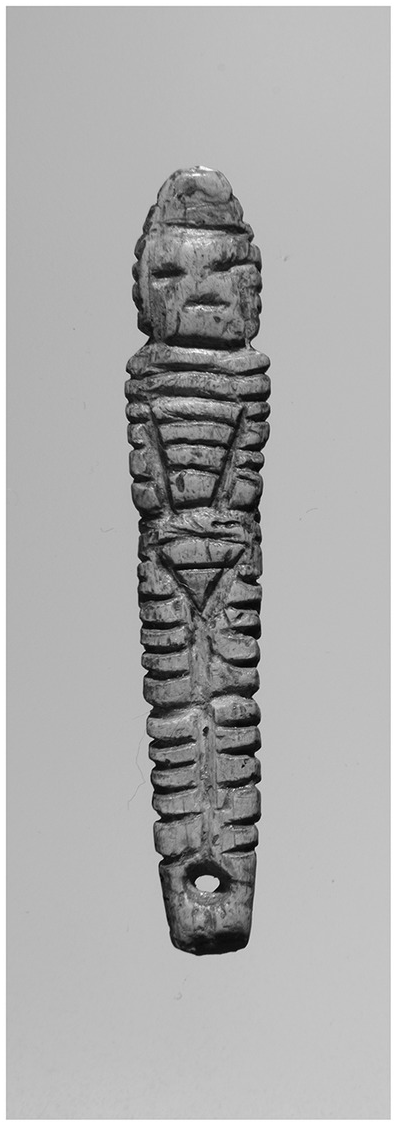
Archaeology is not entirely silent on the subject. The archaeological record tells us that humans did survive during the ice ages in certain locations where we can deduce – from the temperatures and the naked limits – that people must have had clothes at the time. Archaeology gives us other kinds of evidence too, such as the tools that people were using to make the garments. Some tools were clearly connected with clothes – notably the slender eyed needles carved from long animal bones that have been found at many sites of the last ice age. Other tools – stone tools such as scrapers and blades – were used for a range of purposes, including scraping and cutting the skins of animals to make clothes. Archaeologists can use microscopes to study the patterns of wear and tear on the edges of these tools and identify the telltale traces of contact with hide. Moreover, as we shall discover, the human need for clothes may actually have promoted some of these technological innovations during the Paleolithic era. And during the last ice age, we also have works of art that may depict clothes – such as the small figurines found at a site called Malta in Siberia that appear to show people covered by warm clothes.
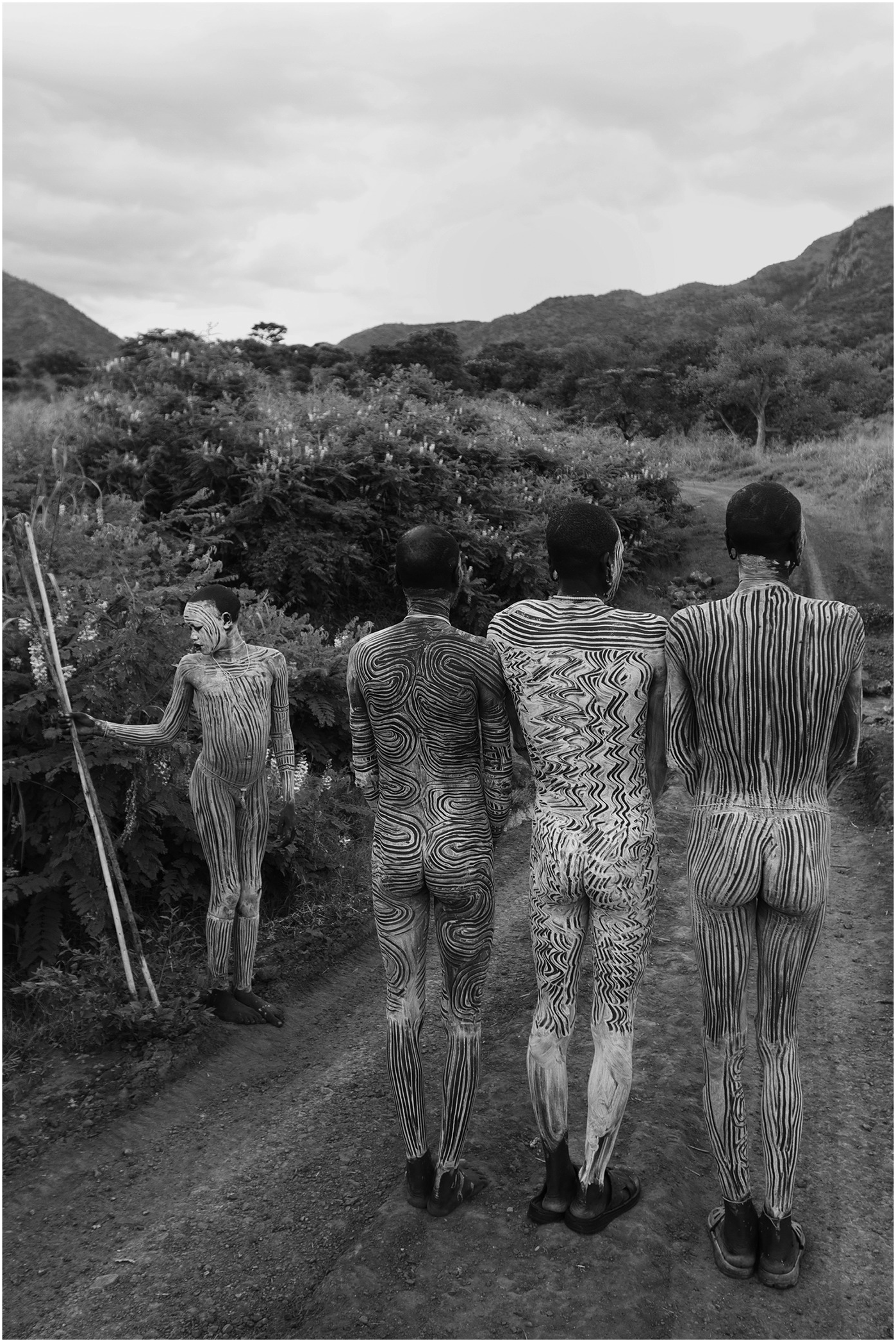
Well-dressed gentlemen, Omo Valley, Africa
Decorating the body for personal and social display is not a reason for humans to invent clothes. On the contrary, for hunter-gatherers in prehistory who used animal skins, the body could be more easily and elaborately decorated without clothes. Only in recent historical times have garments begun to approach the decorative potential of body painting. Shown here are some well-dressed gentlemen from the Suri agro-pastoral peoples, Omo Valley, southern Ethiopia.
Although ice age clothing is invisible archaeologically, there are sources of evidence that allow inferences to be drawn about the origin and development of prehistoric clothing.
| Discipline | Major lines of evidence |
| Ethnography | Cautious extrapolation (ethnographic analogy) |
| Role of “test cases” (e.g., Australia, Andaman Islands) | |
| Archaeology | Hominin presence in cold environments |
| Technologies (e.g., scrapers, blades, needles, spindle whorls) | |
| Art (rock art, figurines) | |
| Physiology | Limits to cold tolerance (hypothermia, frostbite) |
| Clothing physiology | |
| Paleoclimatology | Pleistocene thermal conditions: temperature/wind proxies |
| Moisture levels in Holocene | |
| Molecular biology | Dating of human nakedness (body hair reduction) |
| Dating of clothing origins (body lice) |
The Science of Early Clothing
When we bring together these lines of evidence – the climate, the naked limits, and the archaeological evidence of technologies – we can get a surprisingly clear picture of how clothing was developed, despite the fact that the actual garments disintegrated long ago. And if it is indeed true that our ancestors only invented clothes to keep warm, then we should be able to see a pattern in the archaeology: the technologies should accompany the changes in climate quite closely. And regardless of the global swings in climate, whenever we find that humans were present in the coldest regions (like within the Arctic Circle), we should expect to see signs of decent clothing, such as eyed needles. In other words, we can predict a thermal pattern in the archaeological evidence.
Yet as we can ascertain from examples such as the Australian Aborigines, the presence of clothing does not always lead to the habitual or permanent use of clothes: in their case, they stayed routinely naked. The indigenous garments – kangaroo skins and fur cloaks – did not cover their bodies on a regular basis. And in Tasmania, as the local climate got colder toward the height of the last ice age, we can see more signs of technologies linked to making clothes (like hide-scrapers and bone needles). These tools reflect the likely use of sewn garments made from wallaby skins to battle lower temperatures and wind chill. But as we shall see later, those intriguing technological trends were reversed in Tasmania when the climate improved after the end of the ice age – and the Tasmanians were again naked when Europeans arrived.2
Complex Clothing and Modern Life
There is a crucial step that people must take before clothes become a permanent fixture: the step from simple to complex clothing. The difference between simple and complex clothes relates first to factors affecting the warmth of clothes and, second, to the technology. Simple clothes are loose and only a single layer. Complex clothes are tailored to fit the body and limbs, and complex clothes can also be multilayered. We shall discuss details later, but the difference between these two forms of clothing is profound.
What matters most is whether clothes come to enclose the human body. With complex clothing, the body becomes routinely enclosed and concealed: enclosed from the external environment and concealed from ourselves – a step that has immense psychological significance. For instance, concealing our sexual organs in public on a constant basis has some obvious ramifications. For Aborigines, even when they wore heavy possum cloaks, they still remained open in this regard – and the same was true with the wallaby capes in ice-age Tasmania.
Ice age figurine from the Malta site, Siberia
Pendant figurine from the Malta site, 80 km (50 miles) east of the city of Irkutsk in southern Siberia. The site was occupied between 24,000 and 15,000 years ago, spanning the LGM. The figurine is made from mammoth tusk, measures 4.2 cm in length, and has carved lines that are thought by Russian archaeologists to depict clothing.
Complex clothing is where things get really interesting: it is not merely clothes but a special kind of clothing that becomes a permanent part of us. Shame and modesty only emerged with the advent of complex clothing, and other nonthermal functions got attached to clothes, including the personal desire (and the social need) to adjust our appearance by decorating the visible surface of the self, as a basic kind of screen. For this purpose of display, once the human body was routinely concealed, then the surface of the skin was replaced by the surface of clothes. So, for all of these reasons, with complex clothing there was a transition from thermal to psychosocial necessity. With this transition – which happened only quite late and only in some parts of the world – clothing became imperative for reasons other than climate.
Kangaroo skin worn in southwestern Australia
Photograph taken in the 1860s in the Perth area, southwest Australia, of an Aboriginal man wearing a kangaroo-skin cloak and a nose ornament. Kangaroo cloaks are well-documented by early white visitors in the area, beginning when Jacob Pieterszoon landed in Geographe Bay, near Cape Leeuwin, in 1658 (Heeres, Reference Heeres1899:81).

So, there is quite a lot of ground to cover in this clothing narrative – and quite a lot at stake. We should start the story with the physical causes and the changing environments before getting too entangled in all the repercussions. We shall begin with our biological nakedness because that marks the real beginning from an evolutionary perspective. We can then look at how exposure to cold became critical when the climate changed in the Pleistocene. The thermal properties of clothing become relevant then, especially with regard to wind chill, which leads into the thermal benefits of complex clothing. We can then look at the technology of manufacturing the right level of portable protection whilst remembering that we are dealing here with hunter-gatherers who relied on animal skins and furs, not textiles. And finally, we can look at how this scenario for the origin of clothes pans out in relation to the archaeological evidence.
The Origin of Nakedness
Various theories have been put forward over the years, but we still do not know why our species became naked. As with another distinctive physical trait – upright posture – scientists have been frustrated in their effort to find a convincing reason for why nakedness first evolved. Some theories have fallen out of favor, such as the aquatic theory (that we evolved in water, not on land) and the possible roles of parasites and clothing. These last two theories suggest we lost our fur to get rid of lice or because we already had clothes, and so having heaps of hair was too uncomfortable.3
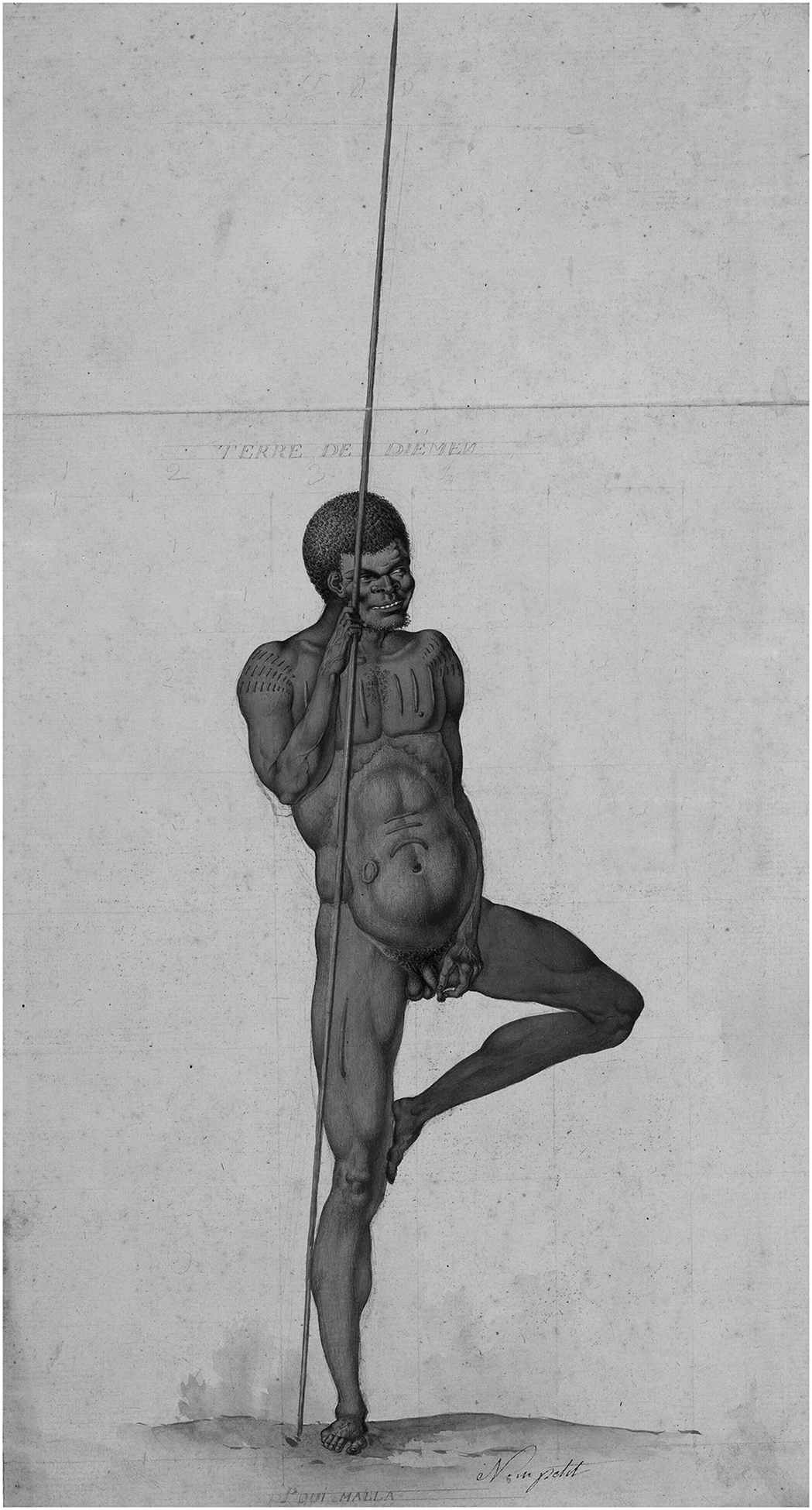
Tasmanian man, standing in what was described by French visitors in 1802 as a typical pose, on one leg with a spear, holding the tip of his penis between thumb and forefinger. He is adorned (or dressed) with elaborate scarification, or cicatrices.
Naked Is Not Necessarily Sexy
Darwin was mystified by nakedness: he could see no obvious advantage in terms of natural selection. Instead, he suggested that nakedness may have resulted from sexual selection: naked skin evolved because we find it sexually attractive. To support his theory, he cited the fact that women are not as hairy as men.4
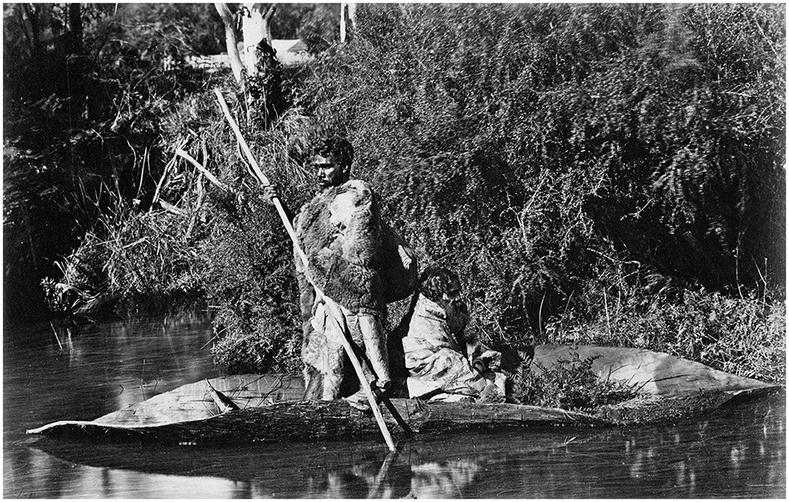
Aboriginal possum-fur cloaks
In the cooler southeast of Australia, Aborigines sometimes wore large fur cloaks sewn from multiple possum skins. These garments, while sewn, were still simple clothes – draped, not fitted, and a single layer. Even in the southeast, however, Aborigines often went naked, as described in early journal accounts. This photo – somewhat staged – was taken at the Coranderrk mission (50 km east of Melbourne) established by the white government. The man standing is wearing the cloak with fur outside, while the seated man has the fur inside. On the mission, among other civilizing endeavors, the Aborigines were taught how to become farmers.
Darwin may have had a point when he said that having naked skin is no great advantage, but he may have been mistaken to see it as an example of sexual selection. For one thing, in most animal species, sexual selection is performed by females and tends to make the males more attractive – as with the feathers of peacocks. So, if having less body fur is sexually attractive for humans and this led to our loss of body hair, then men should be less hairy than women. To explain why women are less hairy than men, the sexual selecting would need to be shifted from females to males. One possibility is that there was a shift from the general promiscuity typical of higher primates to pair-bonding and monogamy among our ancestors, and this may have led to a shift in sexual selection from females to males – in which case, the men would select less hairy women. However, evidence for pair-bonding early in our evolution is contentious. Even among recent hunter-gatherers, stable pair-bonding is far from the norm, and monogamy may have only become more commonplace with the advent of agriculture. In any case, hormonal differences can account for the sex differences in body hair, and there are wide differences – individual and cultural – in preferences for body and facial hair. In the modern world, women often prefer at least some body hair, and men often prefer less hairy women. Whether such preferences were always the case is another matter.5
With sexual selection as the reason for nakedness, the main advantage is that if nakedness is due to its sexual appeal, then this could override the disadvantages that otherwise would ensure its removal by natural selection. There is plenty of evidence for sexual selection in other species; the peacock’s tail is the classic example. Darwin realized that these elaborate, expensive, but useless traits seemed to contradict natural selection, prompting him to think about sexual selection as an additional factor in evolution. However, Darwin was theorizing about nakedness before much was known about human evolution and climate change in the past. Had Darwin known more about the Pleistocene ice ages, he probably would have been even more anxious to have a theory to override the obvious thermal disadvantage of being naked. Unless, we are wrong to assume that nakedness offered no advantage in terms of natural selection. If nakedness can be shown to have had an advantage, especially before the Pleistocene began, there may be no need to invoke sexual selection (with all of its problems). As it happens, one recent theory argues that loss of body hair did confer an advantage – a thermal advantage, in fact, but only after our ancestors became bipedal. Before taking a look at that theory, another theory deserves an honorable mention.
Tasmanian lady with wallaby-skin cape, 1802
Tasmanian lady wearing a wallaby-skin cape and carrying an infant, 1802. The Baudin expedition visited the southeast of Tasmania during the summer (January to February) of 1802. Wallaby-skin capes were said by the French observers to be used by women, apparently not as garments for warmth, modesty, or decorative display but rather for the purpose of carrying items, including their infants.

Neoteny and Loss of Body Hair
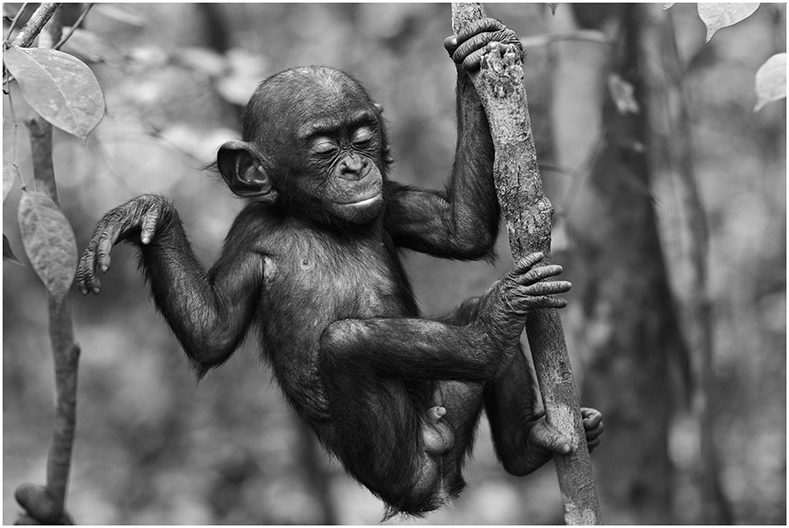
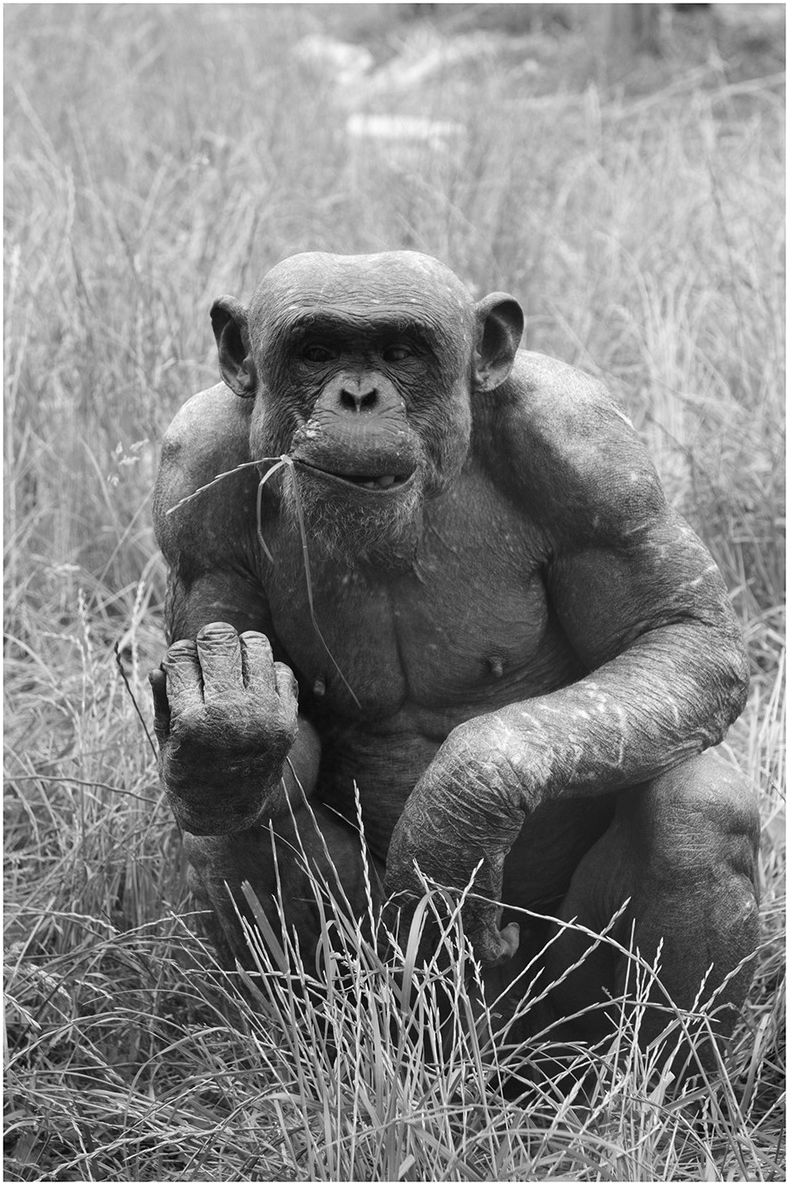
One popular candidate for explaining our nakedness is called neoteny – the general trend over the long course of evolution for hominins to become more childlike in physical form. Quite a few distinctive human traits reflect a general slowing down of development, such as our prolonged lifespan. As a result of this slowing down, we become adults while still retaining relatively juvenile bodies. One of our juvenile features is a large head, another is less body hair. Proponents of this theory point out how we look more like baby chimpanzees than adult chimpanzees – our resemblance to baby chimpanzees is rather disconcerting. The rare bonobo (pygmy chimpanzee) is almost a neotenous version of the common chimpanzee. More striking, perhaps, is how adult chimpanzees who suffer from complete hair loss (alopecia) look even more like humans.
Neoteny is a slowing of body development, and in the case of humans, it would mean we live longer and retain more childlike features – such as having a relatively large head and less body hair. Hence, we look more like the juvenile forms of our nearest evolutionary relatives, chimpanzees, as opposed to looking like adult chimpanzees. The bonobo, or pygmy chimpanzee, is more humanlike in behavior than common chimpanzees, and baby bonobos look even more like us. Shown here is a bonobo infant in the Lola Ya Bonobo Sanctuary, Democratic Republic of Congo.
Neoteny is well known as an evolutionary process in other species, and it happens in plants as well as animals. Neoteny involves a change in the timing of gene expression. We have mostly the same genes as chimpanzees and gorillas; however, in our case the activation of certain genes is delayed or switched off. Paradoxically, neoteny requires an opposite process: an acceleration of sexual development (relative to body form). Unless that occurred, we would all be in danger of facing retirement or dementia before reaching sexual maturity. So, in relation to the maturation of our bodies as primates, we humans are hypersexual, or sexually precocious. In terms of body development, neoteny means we become sexually mature without ever growing as old as gorillas.
Chimpanzee with alopecia
Chimpanzees with complete loss of body hair (alopecia) look even more like humans than those with body hair. Hair loss exposes the typical white skin of chimpanzees, which likely results from evolving with a cover of fur. When our hominin ancestors lost their fur cover, the result was black skin – to protect us from harmful ultraviolet radiation. White skin later reemerged in some populations as they moved outside the tropics – and covered themselves with clothes.
At the genetic level, neoteny means that a tiny change in the genetic code can lead to a massive change in body form. And it involves a whole package of traits, so all the traits are connected. In terms of adaptation, if natural selection were to favor just one of the traits – a larger brain, for instance – then all of the other traits in the package (like nakedness) could be selected indirectly even if they were not adaptive, or even if they were a little maladaptive. The kind of genetic – and possibly epigenetic – changes associated with neoteny relate to controlling the timing of gene expression, which can affect many parts of the genome, rather than involving many actual changes in the genetic code. The code can remain basically the same, but the sequence of when particular genes are turned on and off is altered. With brain growth, for instance, it means that rapid juvenile expansion of the brain is prolonged – both in real time and in relation to body development. With nakedness, it means that we may still have all the genes that promote the growth of body hair, but these genes are not switched on, or they are delayed, and hence their expression is suppressed. Technically, this change in the timing is called heterochrony, whereas neoteny (sometimes called paedomorphism) refers to the end result – a more juvenile adult. The changes in timing can affect different aspects of bodily development at different rates; certain aspects, such as sexual development, may even be accelerated relative to the rest of the body. In terms of natural selection, this change in when the genes are activated, or expressed, is presumably favored because one or more consequences confer some adaptive benefit. In other words, nakedness might have been carried along passively as a part of the package. If nakedness is due to neoteny, then it does not require any adaptive function in its own right; it could even have some disadvantages. All that evolution would require is that the whole package was favored, for whatever reason. Neoteny is an attractive theory of nakedness for this reason alone: it does not presume any adaptive benefit for nakedness. Unfortunately though, it turns out that neoteny is not so good at explaining many of our distinctive features.6
The Thermal Theory and Its Problems
The most popular theories about nakedness involve thermal factors – the adaptive benefit of keeping cool in the African heat. Yet, as so often happens in science (and as happened with neoteny), the situation is a little more complicated. We now realize that a naked skin surface is actually more exposed to heat stress – which is why most tropical mammals still keep a cover of fur: their fur functions as portable shade. So, we no longer accept the simple notion that our ancestors first shed their fur to keep cool. Current ideas focus instead on a possible connection with upright posture. If there was some connection between standing upright and going naked, then this might help to explain why nakedness became adaptive in the special case of early hominins.
Stand Up and Stay Cool
Upright posture may lower the heat load on the body by reducing how much skin surface is exposed to the overhead sun. In this theory, once most of our surface was more vertical and not baking in the overhead sun, a loss of fur on the body uncovered most of our surface to allow more cooling (while retaining some hair cover on the head, to act as shade). The process is cooling by convection: air moving over the skin carries the body heat away from the surface. A fur cover, on the other hand, will inhibit this kind of cooling.
The cooling effect increases further from the ground – so benefitting from the extra height gained with an upright posture. And it becomes more effective if we develop a greater capacity to sweat – to cool by evaporation. In this theory, developed by Peter Wheeler at the Liverpool John Moores University in England, once our ancestors left the shady forests and started to spend more time out on the open savannah – which might have happened due to climate change and a shrinking of forest habitats – the combination of upright posture and a naked skin (with sweating) was advantageous.7
The jury is still out on Wheeler’s theory, and it has attracted its fair share of criticism. A lot comes down to mathematical modeling of thermal variables and heat stresses (which are rather complex) and the validity of assumptions. For example, what if our ancestors already had an upright posture before they moved out onto the savannah? Indeed, the latest fossil discoveries show that upright posture evolved very early in our ancestry – bipedalism defines the point of departure between hominins and the last common ancestor with chimpanzees. Adopting an upright posture may have first happened in forested environments, not on the open savannah.8
Wheeler’s theory of bipedalism and nakedness
Wheeler’s theory claims that upright posture and nakedness evolved as linked adaptations to heat stress. Recent work has refined his theory, suggesting that the loss of body hair evolved when the genus Homo spread into more open habitats between two and three million years ago. Another variation on this theme argues that giraffes evolved their long necks for similar thermal reasons, rather than to reach the leaves of high trees, as Lamarck – and many others – have thought.

If our bipedal ancestors evolved in the shade, then the thermal advantage of having an upright posture – less exposure to the overhead sun – might not apply. Yet, none of the other theories about bipedalism are widely accepted either. Among them we can list popular notions, such as the idea that standing upright helped hominins to carry food, collect fruit from trees, and see predators more easily from a distance – or that walking on two legs freed their hands to make tools. Each theory has its supporters, but none has gained general credence. So, the evolution of upright posture still remains a mystery in adaptive terms. Where does that leave nakedness?
It turns out there might still be a connection between upright posture and nakedness. Even if we cannot blame heat stress for bipedalism, the cooling benefit of nakedness could still apply after our upright ancestors strode out onto the savannah – in fact, it might only have been thermally adaptive after they became bipedal. On four limbs, out on the savannah it is best to retain a fur cover. Walking on two legs though can open up a new adaptive niche for nakedness (and sweating). So, we may have lost our fur to keep cool after all – but only because we were already standing upright.9
How Long Have We Been Naked?
No one is really satisfied that we have a good reason for the origin of human nakedness – there is certainly no consensus on the subject. Neither is anyone satisfied that we know when it happened, which is unfortunate since it bears on the need for clothing among our ancestors. If they still possessed a proper coat of fur during the Pleistocene, then they could have survived in colder conditions without much need for an artificial fur coat – which could be relevant to Neanderthals and the mystery of why they went extinct, as we shall see later. However, there are a few methods we can use to help find out when our ancestors became biologically naked.
Nakedness and Dark Skin
One approach is based on the idea that skin color was related to nakedness. Dark skin may have evolved after nakedness, to protect hominins from the harmful effects of ultraviolet radiation in the tropics. Other primates, such as chimpanzees, have a more convincing cover of body fur – and they have a light skin color. A genetic study indicates that darker skin appeared among our ancestors a million years ago (if not earlier), which suggests they had lost their fur cover by then.10
Only afterwards, when some of our ancestors migrated out of the tropics, did a lighter skin again become adaptive. In higher latitudes, the dangers posed by strong sunlight are reduced whereas a lighter skin will allow more ultraviolet radiation to penetrate, which helps to prevent the vitamin D deficiency that results from lack of sunlight. The evolution of lighter skin in higher latitudes also coincided with people covering their bodies more with clothes, further favoring white skin.
Another clue about when we lost a fur cover comes from the thermal connection with upright posture. In that scenario, nakedness helped a bipedal hominin to stay cool on the open savannah – which implies nakedness evolved around the time when our ancestors first moved into that habitat. On this ecological basis, the origin of nakedness could be placed between two and three million years ago.11
Getting Pubic Lice from Gorillas
Genetic studies of lice also bear on this question of nakedness – not body lice or head lice but a third kind of lice that infest humans and get less publicity: pubic lice. These lice belong to a different species altogether, and their nearest relatives are the species of lice that infest gorillas. In fact, our pubic lice are almost identical to gorilla lice. Genetic analyses estimate that we somehow acquired these critters from gorillas quite recently in evolutionary terms – more recently than the time when we last shared a common ancestor with gorillas. We shall leave aside the tricky question of how we acquired these lice – presumably it required fairly close proximity. Or, maybe some hapless hominin fell into one of their nests.
Pubic lice relate to nakedness because they could only move from gorillas to humans after our own lice had retreated to the head – that is, after we lost the fur on our body. With lice restricted to the scalp, the groin niche was left vacant and available for gorilla lice. The time when this happened should therefore provide us with a proxy for when we became naked. Luckily, the results of this research do not conflict with the estimates derived from other lines of evidence, though the findings could push back the origin of nakedness a little further – to between three and four million years ago.12
Naked before the Ice Age
All these ways of looking at when and why we became naked seem to point in one direction: our ancestors probably lost their fur cover a long time ago, before the beginning of the Pleistocene. We will now look more closely at what happened to the climate and how cold the weather was – and what this would mean for a naked hominin.
Global Cooling
Climate scientists are still searching for the causes of the ice ages. Discovering why the global climate changed back then is important because if climatologists can find out why the climate changed naturally in the past and identify the mechanisms, this could help us to predict how much the climate will change in the future because of human activities – anthropogenic climate change. We want to have more precise estimates about the amount of global warming that will happen by the end of this century – current estimates range widely from 1°C to 6°C. And we need to have a better idea about some of the other ecological consequences, such as rising sea levels. Climatologists say that due to geological movements in the earth’s crust and varying thermal expansion of the ocean masses, the rise in sea level will not be the same all around the world. In the New York area, for instance, the mean sea level is predicted to rise between 0.7 and 0.9 meters (between two and three feet) over the course of this century.13
On the other hand, we also face the prospect of another ice age in the future – the Pleistocene cycles may not yet have ground to a halt. While we all worry about global warming in coming decades, the onset of another ice age would be catastrophic for civilization. A few centuries ago, there was a Little Ice Age just before the Industrial Revolution, when the world may have made a narrow escape from another full ice age. Some climatologists suspect that higher CO2 levels from agriculture might have saved us then, which means our future carbon emissions could actually forestall – or prevent – the onset of another ice age.14
A Wobbly Theory
The reasons for the cycles of ice ages are rather hard to pin down, but the main factor was first identified in the 1920s by Milutin Milankovitch, a Serbian geophysicist. He theorized that regular changes in the earth’s orbit and tilt are the main cause of the cyclic patterns of climate change, and this so-called orbital theory has been largely verified.15
For our purposes, it is important to know when these cycles started and to get some idea of the conditions that prevailed for hominins. The evidence is now quite detailed, and the weather conditions can be reconstructed fairly well. Temperatures, precipitation, and seasonal variations can be estimated with some accuracy – more so for the recent cycles – although it is much harder to estimate wind chill levels.
Chilling Out in the Pleistocene
The Pleistocene began around 2.6 million years ago – which is after our ancestors likely became naked. There were many ice ages during this geological epoch. The exact number depends on whether we define an ice age as a glacial advance, a change in sea level, or a fluctuation in the earth’s climate – the various aspects of these environmental changes did not always coincide. There have been dozens of major swings in global temperature since the start of the Pleistocene, with around ten major glacial advances over the past million years, and most of these cold epochs lasted for around 100,000 years. They were separated by periods of warmer weather (interglacials), each averaging around 10,000 years. Unless this natural cycle of recurring ice ages has come to an end, and we really cannot be sure, then we are now living at the tail end of an interglacial.
Ice Age or Cold Age?
Two things about the ice ages should be stressed here. The first is that although we cannot be sure when our ancestors became naked, it seems likely they were already naked (or nearly so) when the Pleistocene began. The second point is that while the ice ages were first identified and defined on the basis of geology, ice activity was not the most important feature. In the nineteenth century, the Swiss geologist Louis Agassiz proposed the idea of an ice age based on evidence that glaciers were once more widespread in Europe. Yet, it is mere historical accident that we were first alerted to these past upheavals in climate by geological evidence in the form of heightened ice activity in high latitudes.
The ice ages involved a host of environmental changes on a global scale: the expansion of ice sheets and glaciers was only one of the changes (and quite localized). Perhaps the main impact of ice on humans was in the Americas, where the northern ice sheets may have delayed the southward spread of humans. If we were to pick the most definitive feature of the ice ages, it would have to be either the cooling or the drying of the atmosphere, or perhaps the changing sea levels. Most environmental scientists would agree that on a global scale the single most consistent variable was lower temperatures – which means the ice ages should really have been called cold ages. Renaming ice ages as cold ages would also reflect what was probably the most significant aspect of the Pleistocene for a primate that was biologically naked (or at least on its way to becoming naked). According to the fossil evidence, the earliest members of our own species – who presumably were just as naked as us – appeared around 300,000 years ago. At that time, the global climate was slipping into another full-blown ice age.
Measuring the Cold with Isotopes
Our knowledge of the ice age cycles is based largely on temperature indices – or proxies – which reflect the climatic fluctuations. The main proxy is the oxygen isotope ratio. Molecules of water consist of oxygen and hydrogen atoms, and some water molecules are heavier because they contain a heavier kind of oxygen, or isotope. During an ice age, cooler temperatures will mean that water molecules with the heavier isotope cannot evaporate so easily from the oceans, so the global atmosphere will contain more of the lighter molecules.
Climate scientists have measured the changing ratio of oxygen isotopes in the polar ice caps. By drilling deep into the ice sheets, they can extract cores of ice that preserve a record of past precipitation. From these, they can measure the changing ratio of the isotopes over time, and this gives them a good idea of ancient air temperatures. The past fluctuations are classified into warm and cold stages known as Marine Isotope Stages (MIS).16
MIS stages are numbered backwards beginning with our present interglacial, MIS1. In this scheme, the warm periods are assigned odd numbers, and cold periods have even numbers. The very cold LGM (the Last Glacial Maximum around 22,000 years ago) is MIS2, and the last warm interglacial like our own (which lasted from 130,000 to 120,000 years ago) is numbered as MIS5e. The onset of the Pleistocene corresponds to the peak of a warm period, MIS103.17
Why It Got Colder in the Northern Hemisphere
During the ice ages, there was a big difference between the two hemispheres: temperatures dropped much more in the northern hemisphere. The reason for the hemispheric difference relates mainly to how much of the earth’s surface is covered by the oceans, which have a moderating effect. About 70 percent of the earth’s surface is covered by water, but the distribution of surface water is not equal. In the northern hemisphere, water makes up around 60 percent of the surface area whereas in the southern hemisphere the figure is around 80 percent. So, except in the vicinity of Antarctica, temperatures on land in the southern hemisphere tend to be warmer. On average, the seasonal temperature difference on land is larger in the northern hemisphere too, and winter temperatures on land are lower in the northern hemisphere.18
We can see this effect by comparing temperatures during the LGM at the same latitude in both hemispheres. For instance, we can compare Sydney, Australia (latitude 34°S), with Osaka, Japan (latitude 34°N). In Sydney, the average temperature dropped by around 4°C during the LGM, but in Osaka, the drop was much greater, around 10°C. The big hemispheric difference means that with the prehistoric development of clothing, we can expect to see more happening in the northern hemisphere – and indeed, as we shall see later when we look at the archaeology, we do find more evidence for clothes in the northern hemisphere.
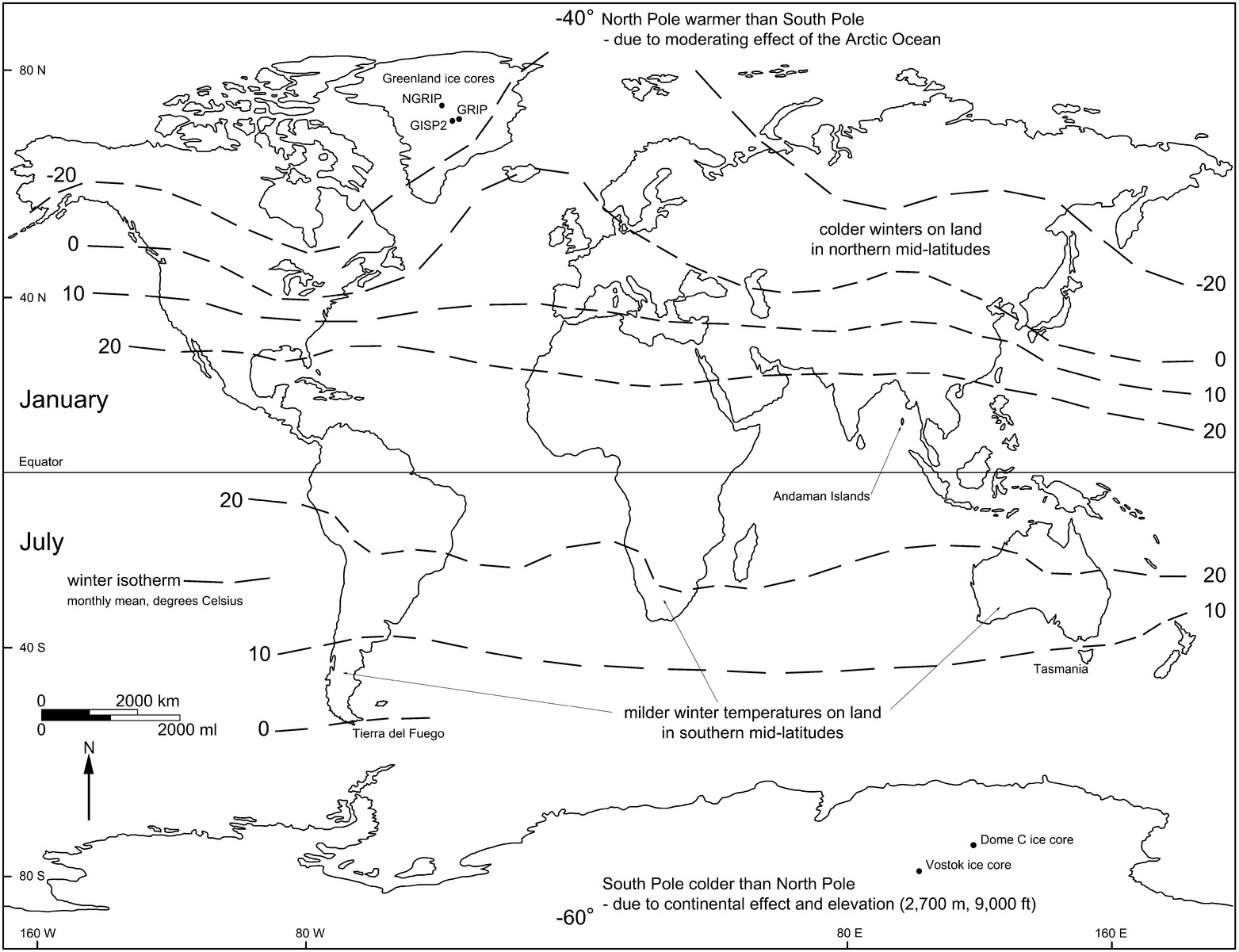
Map of world winter temperatures
Winter temperatures on land are generally lower in the northern hemisphere than in the southern hemisphere (except in Antarctica), especially in the middle latitudes. During the Pleistocene ice ages, the hemispheric difference was more marked. For this reason, prehistoric developments in clothing were more pronounced in the northern hemisphere. Shown here are present monthly average winter temperatures (isotherms, in degrees Celsius) in the northern and southern hemispheres, for January and July, respectively.
A Bigger Chill in Higher Latitudes
Another difference in the amount of cooling during the ice ages occurred with latitude. Further from the equator, the temperature drop was much greater. Even at the height of an ice age, the tropics stayed fairly warm. For instance, during the LGM when the average global temperature dropped by around 4°C, the temperature drop in the Caribbean was only around 2°C. In northern Florida, the drop was 4°C, but in the vicinity of New York City temperatures dropped by much more, by around 10°C. Further away from the ocean in the Chicago area (42°N), the average temperature fell by 20°C. So, there was a greater cooling with increasing latitude and also a bigger drop further from the oceans – as well as a big difference between the two hemispheres.
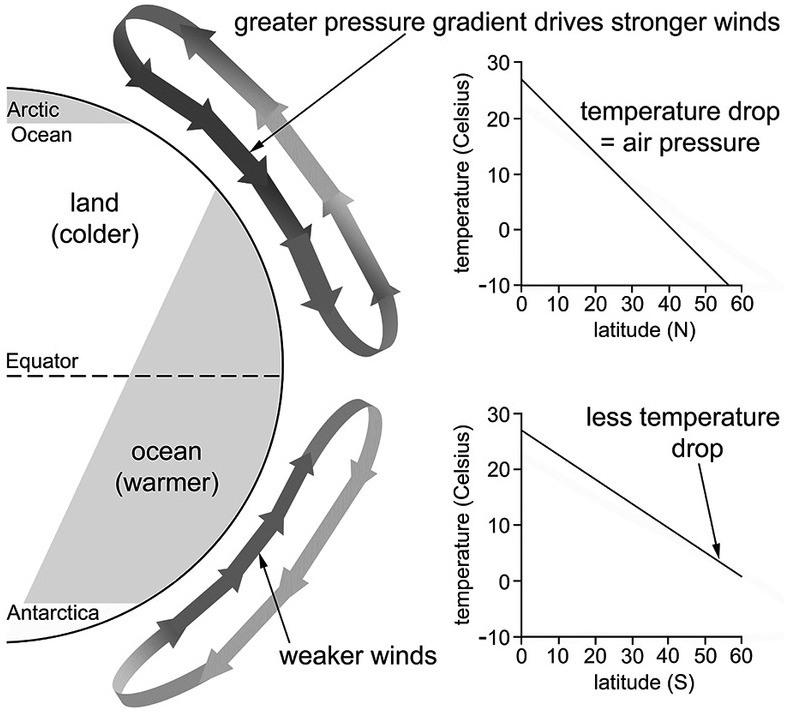
Hemispheric difference in wind strength
Winds tend to be stronger in the middle latitudes of the northern hemisphere compared to the southern hemisphere. In the southern hemisphere, the greater ocean mass has a moderating effect on temperatures, which reduces the temperature difference – and hence the air pressure gradient – between the equator and higher latitudes. Antarctica is an exception: temperatures are lower than at the North Pole due to the continental effect and also elevation.
Why It Got Windy as Well
The greater cooling at high latitudes during an ice age affects wind speeds and, hence, wind chill. A key driver of global wind is the temperature difference between the equator and the poles. Since warm air has high pressure and cold air has lower pressure, the temperature difference between the equator and the poles translates into a pressure difference: air pressure is higher in the tropics. Air pressure should not be confused with air density: cold air has lower pressure but higher density. And, vice versa, warm air is less dense but has higher pressure. So, warm air in the tropics tends to expand and rise whereas cold air at the poles tends to sink. During an ice age, the greater fall in temperature in higher latitudes creates a greater difference in air pressure between the poles and the equator. Air pressure at the poles gets even lower, which draws in more air, more quickly, from the tropics. Since the pressure difference is greater, winds tend to be stronger in the middle latitudes during an ice age, and the wind chill factor can increase markedly – due to the combined effect of lower temperatures and stronger winds. And because the higher latitudes of the northern hemisphere witnessed a greater drop in temperatures on land compared to the land masses in the southern hemisphere, average wind strength (and hence wind chill) in middle latitudes was often greater in the northern hemisphere.
Measuring Past Wind Chill Levels
Although we have good climate proxies for temperature (like the oxygen isotope ratio), we lack reliable proxies for past wind speeds. The deficit in wind data is disappointing because wind chill is so important for cold stress and for estimating how much clothing people needed. However, there are two methods that can give us some idea about average wind velocities in the past. One is the analysis of dust particles, and the other is a marine phenomenon called oceanic upwelling – and both methods indicate that average wind speeds were higher during the ice ages.
Ice ages were associated with much more atmospheric dust. Geological evidence includes the vast wind-blown loess deposits found in the soil of places such as northwest China – which give a yellow tinge to the Yellow River. However, the difficulty with using dust to measure wind strength is that a major cause of more atmospheric dust is dryness, and we know that aridity was a feature of ice age climates. Fortunately, we can separate the effects of aridity and wind speed by looking at the weight of the dust particles. Dryness on its own cannot cause heavier dust particles to be blown away, but with stronger winds, heavier (generally larger) dust particles can be lifted up and transported over greater distances. Although the task is tedious, by carefully analyzing not just the quantity but the size of dust particles, scientists can gain a fair idea about past wind strengths. These analyses of dust size show not only that the colder phases have more wind-borne (aeolian) dust but they generally have larger dust particles, pointing to stronger winds.19
The other wind proxy is oceanic upwelling, which refers to the wind-driven movement of surface sea currents that can cause upwelling of deeper water, especially along the coasts of continents. The deeper water is usually rich in nutrients, and so these areas of upwelling often have more plankton and other marine life; some of the world’s richest fishing locations are found in these regions of oceanic upwelling. We can measure the organic remains preserved in sediments below the sea floor, and this will give us a measure of past wind strengths. The results indicate that upwelling increased in many regions during the Pleistocene. Again, the data are consistent with higher wind velocities during the ice ages, and those stronger winds were driven mainly by the steeper temperature (pressure) gradient between the poles and the equator.20
So, in terms of the environmental conditions for hominins, lower temperatures are just the tip of the iceberg. Wind chill is the most critical factor, and it looks like the colder air temperatures were often made even worse by stronger winds. And with regard to clothing, there are a couple of other things that we need to consider about the climate.
Rapid Climate Swings
One of the most striking aspects of climate change in the ice ages is that it was sometimes a very sudden event. When we think about how hominins coped with the situation – for instance by making better clothes – we should remember that coming up with new adaptations is not easy overnight. Yet, climate scientists have discovered that in geological terms, some of the enormous swings happened almost overnight.
When we look at charts showing the oxygen isotope ratio, the most distinct trend in the last ice age is how the swings become much more frequent and sharper in MIS3, as we approach the LGM. Some of the big swings are almost vertical. In terms of magnitude, one of the warming episodes around 38,000 years ago caused average temperatures in Greenland to jump suddenly by 12°C. Quite a few of these swings are too rapid to be measured accurately at present: their rate of change exceeds the temporal resolution of our records (usually one or two millennia at best). Some of the big oscillations in the middle northern latitudes may have happened on timescales as brief as a century, or even less.
Dust record from Antarctic ice cores
The upper two graphs show temperature and dust records from the Vostok ice core in Antarctica spanning the past four glacial cycles, from 400,000 years ago. The next graph shows a more detailed record of dust volume over the past 25,000 years, from the Dome C ice core (also in eastern Antarctica), covering the end of the last ice age and the Holocene. To distinguish between the effects of aridity and wind strength, climatologists can measure the size of the dust particles, as shown in the bottom graph. The glacial peaks not only contain more dust (reflecting aridity) but they also contain larger (heavier) dust particles, pointing to stronger winds.

Climate change over the last 120,000 years
Global temperature trends over the last 120,000 years, spanning the most recent glacial cycle, based on ice core data from Greenland and Antarctica. The magnitude of cooling is greater in the northern hemisphere; note also the series of rapid climate swings during the latter part of MIS3, when Neanderthals went extinct.

At the end of the last ice age in Europe, there were two rapid warm swings separated by one final cold swing – the last flicker of the ice age. This last cold swing is called the Younger Dryas, and its counterpart in the southern hemisphere is called the Antarctic Cold Reversal (ACR), which was much less severe. In the northern hemisphere, these swings were all fairly large (around 10°C) but what is really surprising is their suddenness. The last warm swing around 11,700 years ago – which marks the start of our present Holocene interglacial – happened over a span of just fifty years while the earlier warm swing around 15,000 years ago may have happened over an incredibly short time span: just three years. In comparison, the intervening cold swing (the Younger Dryas) was almost leisurely – it took 200 years for the climate to swing back again to glacial conditions. Those earlier climate swings in MIS3 could have been just as rapid – we cannot be sure until we get more accurate data.21
In any case, these last flickers of the Pleistocene prove that the natural ecosystem is quite capable of astonishingly brief and massive climate swings. Scientists suspect, too, that the sheer rapidity and severity of the swings may have caused stronger winds – it was almost as though the earth’s atmosphere could hardly keep up with the rapid pace of climate change.22
Averages and Extremes
The other point to keep in mind is that our ancestors needed to cope not just with average temperatures (or average wind chill levels) but with actual conditions that varied on a seasonal and daily basis. What determines whether a species can survive is its ability to endure the extremes, not the averages. Our environmental proxies are rather good with generating average figures but not so good when it comes to telling us about the likely range of variation around those averages. In the world today, even mild cold spells – periods of a few days in winter when temperatures are a little lower than average – are associated with significantly higher mortality rates.23
For example, it is like trying to take into account the risk of a major flood that happens on average only once a century. Our ability to cope not just with the daily and seasonal variations but with the chance of unusually severe conditions is what will ultimately determine whether our adaptations prove successful or not. In wondering whether a tribe of Homo sapiens could survive in central Europe during a certain phase of MIS3, or in northern China during MIS2, what we really need to know is how cold was the coldest night in winter – not the average temperature for the millennium. Alas in this regard, the available data leave us largely in the dark.
Sunny but Freezing
There really are no exact present-day analogs for the ice-age environments. In terms of average temperatures, for example, we might compare northern China in the LGM to a modern-day tundra in northern Siberia. However, some aspects of the prehistoric environment are not replicated. For instance, the difference in latitude means that the intensity of sunlight was different. Compared to present-day tundras in high latitudes, stronger sunlight meant that ice-age environments in middle latitudes were better stocked with plants and animals for hominins, despite the very cold temperatures. So, maybe finding food was less of an issue than in modern-day tundras. Even in the Arctic zone of Siberia during the last ice age, large mammals (such as the woolly mammoth and the woolly rhinoceros) were abundant.24
To further complicate matters, the actual strength of sunlight reaching the earth’s surface during ice ages also differed from today because of cyclic changes in the earth’s orbit and axial tilt. Nonetheless, we can extrapolate from modern meteorological records to get a rough idea of the likely extremes in temperature and wind chill that are masked by the average figures.25
Keeping these extremes in mind is more relevant to clothing than it is to food. Although people might not have liked it much, they could survive for weeks without having a full dinner every night. And like all good hunter-gatherers, they could move around, and they had a variety of fallback options. But to cope with cold weather, the options open to hunter-gatherers were more limited – and the dangers of failing to adapt were dramatic. If they were caught off guard by a sudden cold spell without enough clothes, their survival time could be measured in hours.
Cold Facts and Naked Truths
Our species is better adapted to coping with heat than with cold. Primates in general are adapted to life in tropical climates, but we humans have really gone out on a limb. Our responses to heat are rapid and quite effective – in that regard sweating is our trump card. But our responses to cooling are sluggish and relatively ineffective.
The most obvious sign of this human weakness is nakedness. The thermal function of fur can be seen when we look at what happens to other species when they are deprived of their fur. Rabbits, for instance, can cope down to as low as −45°C, but if they are shorn, they begin to struggle at a mere 0°C. Feathers serve a similar function in birds. At –40°C, a dove can live for days, but if we pluck its feathers, it will start to freeze in a matter of minutes. In fact, warmth was the likely reason why the reptilian ancestors of birds evolved feathers in the first place, not because they were trying to fly.26
The Limits of Cold Tolerance
We are indeed a tropical species: without any clothes, the human body begins to react to cold once the air temperature falls below 27°C. At 20°C, our metabolic rate begins to climb to generate more heat, and the circulation of blood to our skin starts to shut down to conserve heat. At 13°C, we start to shiver – a sign of failure. For comparison, an arctic fox starts to shiver at −40°C. These figures come from laboratory studies and apply to still air conditions. In the real world, there is usually some air movement, even if only a light breeze.
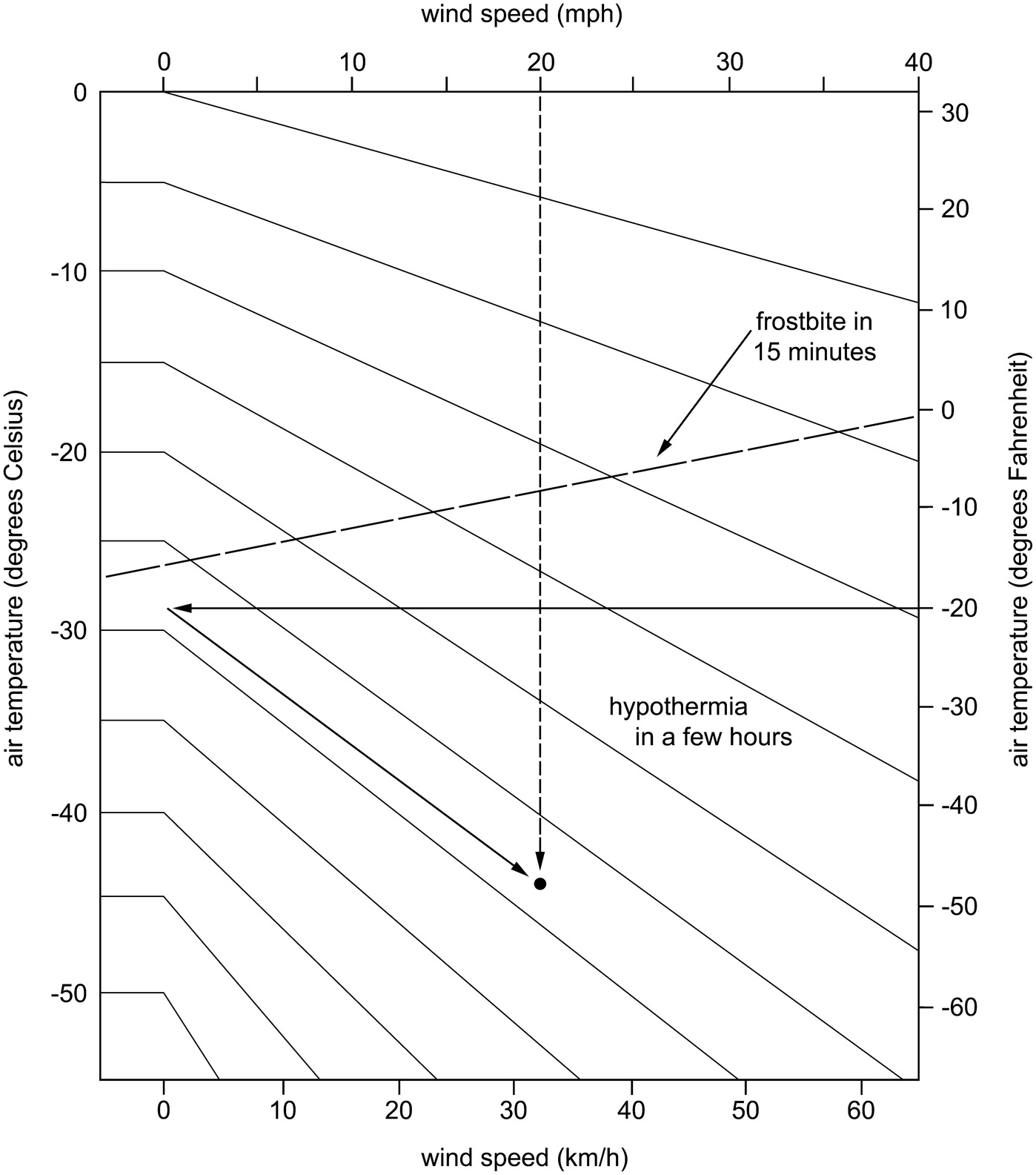
Soon after the Second World War, American scientists working in Antarctica devised the wind chill index. The index has since been revised a few times, but the basic principle remains the same: with any wind, an unclad body will lose heat quickly due to convection. The scientists actually used a bottle of water hung outside their tent: they simply measured how long it took the water to freeze in different wind conditions. More worrying, they found the chilling effect of wind is almost exponential, especially below 0°C (32°F). For instance, with a moderate wind velocity of 10 m/s (22 mph), the wind chill index shows that even mild sub-zero temperatures can be dangerous for people without clothes.27
Wind chill chart
Wind chill refers to the exaggerated cooling effect due to wind at low ambient air temperatures, increasing the risk of frostbite and hypothermia. For example, frostbite can begin in fifteen minutes at a still-air temperature of −20°C, but with a 30 km/hr wind, frostbite can begin in less than fifteen minutes at an air temperature of −10°C. The chart shown here is based on the revised wind chill index adopted in 2001 in the United States and Canada; the example shows an air temperature of −20°F and wind velocity of 20 mph, which results in a wind chill level of nearly −50°F.
Moisture is the other killer. Any water sitting on our body surface will add to heat losses through evaporative cooling. For this reason, sweating becomes an issue. We might think that sweating should be the least of our worries in a cold environment, but that is far from the case. Physical activity generates extra body heat, but it also generates more sweat. Even when we stand still, the sweating mechanism is never completely switched off. Sweating continues at rest and in cold conditions too, though we are not usually aware of it – this is called insensible sweating. And the anxiety caused by cold stress can add even more sweating – a cold sweat. Clothing can make things worse: physical exercise within the warm microclimate of clothes creates more sweat, even when the outside air temperature is low. And as we shall see later when we look at how clothing works, moisture is a big issue with clothing. Once clothes get wet – whether from rain, melting snow, or sweat due to physical activity – the thermal function of clothes as insulation is effectively finished.28
Hypothermia
So, what happens when we get too cold? We develop hypothermia, and hypothermia is very scary. Our body core temperature must remain around 37°C, and we can tolerate only a few degrees of variation from that point. Cold-blooded species, reptiles mainly, can allow their core temperature to fall quite a lot (they rely instead on heat from the environment). Warm-blooded species, such as us, use their metabolism to generate body heat and to maintain a constant core temperature.
When our core temperature falls due to a failure of thermoregulation, the human body goes through stages of hypothermia that will lead rapidly and inevitably to death if not reversed. We have learned about these stages of hypothermia from experimental studies on other mammals and from hospital emergency rooms when people are brought in with accidental hypothermia. Shamefully, we also learned about the dangers of cold exposure from the infamous Nazi experiments on humans in the Second World War – and also from medical studies of frostbite in Chinese captives (including children) carried out by a Japanese military unit stationed in Manchuria.29
When our core temperature drops to 35°C (95°F), movements become clumsy and we begin to have violent bouts of shivering – this stage is called mild hypothermia. Moderate hypothermia begins at 33°C (91°F) when our vision gets blurred, and we soon slip into unconsciousness. Shivering stops at a core temperature of 31°C (88°F). Below 30°C (86°F) is severe hypothermia, when the heart slows down and blood pressure drops, and death can occur at any time. Cardiac arrest is inevitable when the core temperature reaches 15°C (around 60°F).30
Stages of hypothermia, with symptoms and clinical signs. Paradoxical undressing occurs when people suffering from severe hypothermia become confused and remove their clothes; the reason may be due to a sudden dilatation of peripheral circulation causing a sensation of excessive heat on the skin surface. The lowest survived core temperature resulting from accidental hypothermia is 14°C (57°F), and the lowest core temperature from artificially induced hypothermia (e.g., during cardiac surgery) is 9°C (48°F). The longest recorded survival time with immersion hypothermia (in cold water) is sixty-six minutes. Source: Brown et al., Reference Brown, Brugger, Boyd and Paal2012:1930–1936; Parsons, Reference Parsons2014:357.
| Stage | Core temperature | Symptoms | Signs |
|---|---|---|---|
| 1 | 35°C–32°C | shivering | increased metabolic rate |
| clumsy movements | muscle stiffness | ||
| 2 | 32°C–28°C | drowsiness | blood pressure falls |
| shivering ceases | pupils dilated | ||
| 3 | 28°C–24°C | paradoxical undressing | respiratory rate decreases |
| loss of consciousness | pupils non-reactive | ||
| 4 | <24°C | unresponsive | cardiac arrhythmia (ventricular fibrillation) |
| death | cardiac arrest |
Without adequate clothing, exposure times leading to death from hypothermia are measured in hours. Depending on environmental conditions (and on other factors, such as a person’s age and general health), the survival times for modern humans range from 1.5 to 12 hours. Accidental hypothermia generally happens outdoors when people are caught by a sudden change in weather, or if they get lost overnight while hiking in the wilderness. However, death from hypothermia can happen in cities and indoors at room temperatures between 20°C and 15°C (68°F and 59°F) – even in temperate climates such as that of Sydney. Aside from the elderly, people with alcoholism or opiate addictions are at special risk. The lower the ambient air temperature, the shorter the survival time. At −10°C (14°F, either in still air without wind or as an equivalent wind chill temperature), the time to death from hypothermia for healthy adults varies from three to six hours.31
In water, death happens more quickly because heat is lost more rapidly in liquids – water is twenty-four times more conductive than air. And with immersion hypothermia, clothing is useless. With a water temperature of 15°C (around 60°F), maximum survival time is up to five hours; however, at 5°C (around 40°F), the survival time is only two hours, and at near-freezing water temperatures (0°C, 32°F), typical survival time is around thirty minutes.
Not Drowning on the Titanic
When the ocean liner Titanic sank in 1912 after colliding with an iceberg in the North Atlantic, many of the victims (nearly 1,500) probably survived the sinking only to succumb to hypothermia in the water – which was actually a little below freezing point. Most of those who failed to get into lifeboats were wearing life jackets so they could stay afloat indefinitely, and the “unsinkable” ship sank rather gently, taking more than two hours to go down. All the passengers and crew were well-dressed – some first-class passengers had fur cloaks and gowns. Most people from first class managed to get into lifeboats, but more than a hundred (mainly men) did stay aboard until the end. Regardless of class or dress, all their clothes were soon saturated. Once in the water they might as well have been naked – within an hour, their cries for help had faded away. Less than two hours after the world’s largest liner went down, the rescue ship Carpathia arrived on the scene, but by then all the bodies floating in the water were ice cold.32
In 1912, the Titanic, the largest ocean liner in the world, struck an iceberg and sank in the North Atlantic on its maiden voyage to New York. There were too few lifeboats, but many passengers survived the sinking and stayed afloat with the help of life vests only to succumb rapidly to hypothermia in the water. This scene is from the 1958 film, A Night to Remember.

Frostbite and the Shrinking Penis
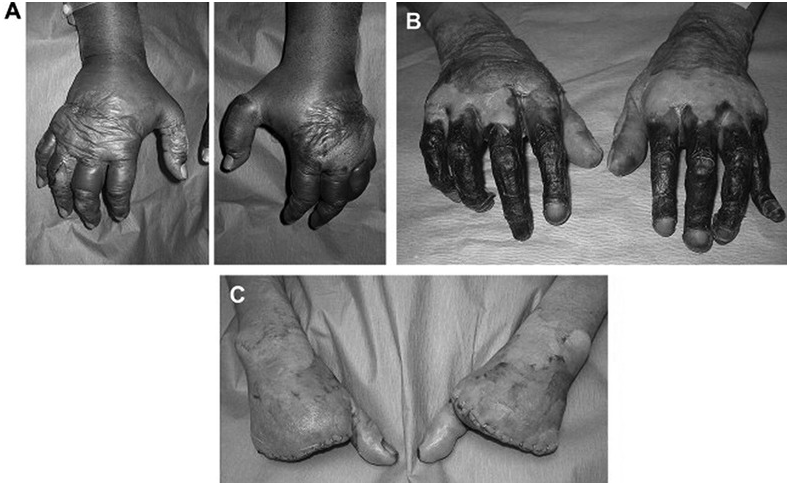
Hypothermia is the greatest danger, but exposure can lead to less lethal injuries – frostbite is the most familiar. Frostbite is not so life-threatening, but gangrene may lead to infection and blood-poisoning (septicemia), which can be fatal. Frostbite affects mainly the fingers, toes, nose, and ears – and sometimes the penis.
Although the well-known shrinkage of the penis with cold exposure serves as its main defense, penile frostbite has become more of a worry with the popularity of outdoor jogging. It can affect healthy men even in major cities, and it can happen quickly. In one case described in The New England Journal of Medicine, a New York physician was afflicted with penile frostbite while taking his usual evening jog after work early in December. The air temperature at the time was −8°C (18°F) with a severe wind chill factor. He was wearing what he thought was enough protection, given that he was generating extra body heat through physical exertion: polyester trousers and underpants together with a T-shirt, long-sleeved shirt, nylon jacket, and gloves. Luckily, as a doctor, he recognized the early symptoms and knew the right treatment: when he got back to his apartment, he was able to salvage the organ with gradual re-warming over fifteen minutes.33
Acclimatization and Its Limits
We can improve our tolerance of cold – but only up to a certain point. There are short-term adjustments called habituation and longer-term adaptations called acclimatization. For example, scientists working in Antarctica typically develop some degree of acclimatization over a period of months: they develop more resilience to cold pain and can manage with less clothing. However, these improvements are marginal, and research suggests there is little difference in the critical lower limits. Although there is no single limit, for modern humans who routinely wear clothes, the short-term safe limit without clothes is around −1°C (30°F). Beyond that point – or if our exposure is prolonged for more than an hour or so – we face the risks of frostbite and hypothermia.34
The main difference occurs among hunter-gatherers who are routinely naked from birth. Whereas the thermal “comfort zone” for us is 21°C to 24°C (70–75°F, with clothes), people who grow up from birth without clothes are better able to cope with cold exposure. Babies are more vulnerable than adults: they can start to develop hypothermia if left naked on their own at a temperature as high as 33°C (91°F). But nevertheless, a certain amount of safe cold exposure during infancy can lead to lifelong acclimatization. As occurs in other animals, there is probably a “critical period” during early infancy when our biological thermostat is set by environmental stimuli. In this way, early exposure to cold helped in developing the hardiness of groups such as the Fuegians in southern South America – whose capacity to tolerate cold weather so astonished Darwin.
Getting into Shape for the Cold
Due to natural selection, there are long-term genetic changes affecting body shape that develop among people in different environments. These differences in body shape and limb proportions are seen in many animal species. A stockier build will lower the surface area and result in reduced heat losses. We can visualize this effect if we compare two ideal bodies of the same volume, but with different shapes. A perfect sphere has the minimum surface area, whereas a long thin cylinder – same volume – has a larger surface area.
For this reason, indigenous peoples in Alaska have a stocky physique, so too did Neanderthals. In warmer places, such as tropical Africa, a slender build is better because it allows the body to lose heat more easily. Among modern human groups, these physical adaptations to climate (along with metabolic and other physiological adaptations) result in significant differences in susceptibility to hypothermia and frostbite. For instance, in the Korean War during the winter of 1950–1951, the US Army found that frostbite injuries were nearly five times more common among African American troops.35
Body shape and climate
Human groups vary in body shape and limb proportions, reflecting adaptation to thermal stresses. Shape influences the relative surface area, which affects the net heat gain or loss. Body size (mass) can also be relevant thermally due to the amount of metabolic heat production. Pygmy groups, for example, may have evolved a smaller body size as a strategy to reduce total heat production in enclosed tropical environments where evaporative cooling from the skin surface is compromised by humidity and dense vegetation cover.
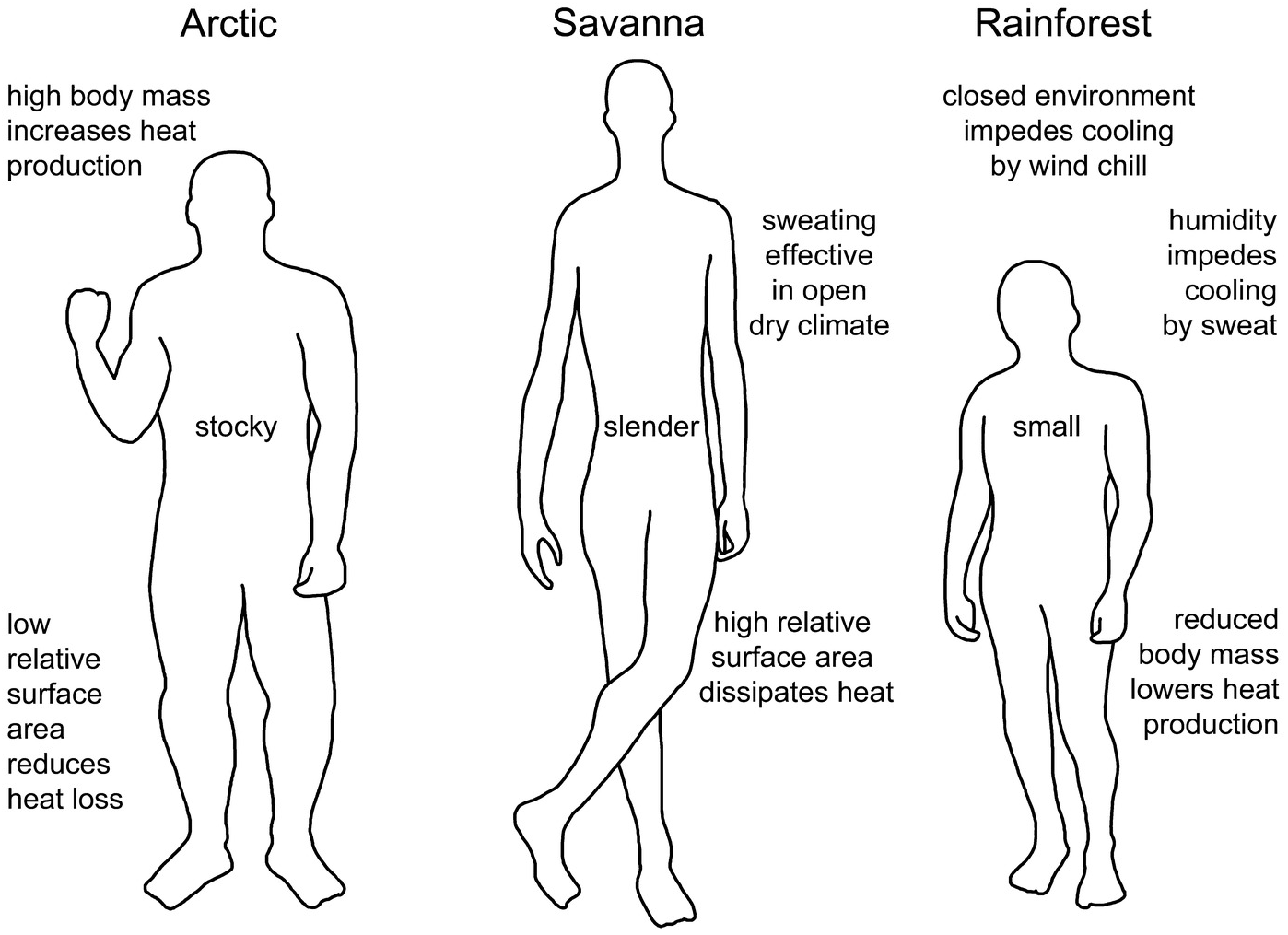
This principle applies to arms and legs (and heads) as well as the torso: people from cold climates have shorter arms and legs, and rounder heads. It applies to other appendages too, such as the penis: among men adapted to warm climates, the penis tends to be longer (though probably not by quite so much, as some might claim). Clothing has an effect too: physical variation with climate is not so obvious where clothes have been worn for many generations.36
The adaptive benefit of shape is accompanied by other adjustments, such as having a more rapid rise in metabolic rate on cold exposure and a lower threshold for shivering. For these reasons, people differ quite a lot in their risk of frostbite. Compared to whites, those whose ancestors came from northeastern Asia (including indigenous Americans) are not as prone to cold injuries whereas people with darker skin (whose ancestors hail from the tropics) are more susceptible to frostbite.
Clothes Can Make Us Feel Colder
The lifelong benefit of early cold exposure has an implication for clothing too: if we are routinely clothed from birth, we surrender a certain amount of cold tolerance. In other words, clothing has the paradoxical effect of making us more sensitive to cold. Once we are accustomed to wearing clothes, we become habituated thermally to the absence of cold, and so we want to wear more clothes to keep warm.
The Unusual Hypothermia of Australian Aborigines
Lacking clothes from birth, Aborigines in pre-colonial Australia could tolerate a surprising amount of cold. Even in the desert areas of central Australia, the weather can get cool: at night, the temperature can sometimes drop to a few degrees below zero. Yet, in their traditional lifestyle, Aborigines in central Australia could sleep comfortably without any clothes. When they were ready to go to sleep, they would construct little windbreaks and lie down behind them, and huddle around small campfires. Studies carried out by scientists measured their metabolic rates and skin temperatures during the night, comparing the Aborigines’ reactions to those of the scientists who tried to sleep in the same manner (though with the benefit of clothes). They found some major differences – and they also reported how the whites were bothered by cold even in their clothes, sleeping only fitfully. In contrast, the locals slept soundly and woke up looking quite fresh in the morning.
The recordings of metabolic rate and skin temperature in the Aborigines revealed some unexpected patterns – quite different from the whites. In fact, the Aboriginal pattern is not like any other human group. First, the skin temperature on their limbs dropped to levels that would cause considerable pain for the rest of us. More surprising though – and most unusual – was the metabolic rate. Our main reaction to cold is to increase our metabolic rate – by as much as twice the normal rate in very cold conditions. But with the Aborigines, their metabolic rate actually fell during the night, and their core temperature dropped by a few degrees, which is quite the opposite to the hyperthermic response of other populations. In effect, the Aborigines allowed themselves to become mildly hypothermic.37
Having a hypothermic response to cold might appear to be a dangerous strategy: if the air temperature were to fall a little further, they could slip into deep hypothermia. Rather than feeling fresh in the morning when they woke up, they might not wake up at all. The likely explanation for this apparently dicey reaction is that it has one big benefit: they do not need to increase their food intake to sustain a higher metabolic rate – they can keep to their usual diet. In fact, their caloric requirements are actually lower in the cold. As for the danger, it can work safely if they are quite sure that nocturnal temperatures will not drop any lower. And this was indeed the case in their traditional societies: Aborigines had a very intimate knowledge of their natural environment – even without thermometers or meteorological records. They knew exactly how cold the weather could get. Their adaptation was unusual but efficient, made possible by the relatively mild climate of Australia and by their close connection with the environment – and by their routine lack of clothes.


