


Introduction
Organizations have increasingly prioritized senior leadership diversity and the decentralization of authority, reflecting a broader societal shift toward inclusivity and equality (Ross, Traylor & Ruggs, Reference Ross, Traylor and Ruggs2025). Particularly within large U.S. firms, there is now a general expectation that these practices will deliver tangible, economic value (Creary et al., Reference Creary, Baskerville, Bermiss, Charles, Roberson, Rogers and Stevens2025). Theoretically, diversity introduces a recombination of knowledge that improves strategic decision-making, while decentralization enables firms to leverage dispersed expertise and adapt to dynamic environments (Reineke, Katila & Eisenhardt, Reference Reineke, Katila and Eisenhardt2025). However, neither research nor practice has consistently evinced these anticipated benefits, with growing evidence of unintended, often detrimental consequences (Hellerstedt, Uman & Wennberg, Reference Hellerstedt, Uman and Wennberg2024).
This has led to a paradox: the adoption of diversity, equity, and inclusion (DEI) initiatives has increased contemporaneously with evidence for their negative effects. For example, between 2020 and 2023, S&P 500 firms discussing DEI in annual reports rose from 14% to 80%, even as a major 2024 meta-analysis found many of diversity’s positive effects to be implausible (cf. McKinsey & Company, 2023; Sieweke, Hentschel, Gazdag & Henningsen, Reference Sieweke, Hentschel, Gazdag and Henningsen2024). In 2024, 97% of HR managers were involved with DEI and 56% with initiatives to ‘flatten’ corporate hierarchies, up from 40% in 2018 (Deloitte, 2024), even as firms are abandoning experiments with flat or cooperative forms in favor of traditional hierarchies (Joseph & Sengul, Reference Joseph and Sengul2025; Weber, Reference Weber2023).
This paradox is most acute for the top management team (TMT) – the firm’s most consequential decision-making body and primary focus of critique in the DEI literature. Both senior leaders and researchers have attempted to resolve this by shifting towards deontological considerations: what began as means to improve decision-making have increasingly become moral ends in themselves, addressing concerns over environmental, social, and governance (ESG) performance but often at the expense of delivering value for firms and their stakeholders (Foss & Klein, Reference Foss and Klein2022b; Wright, Reference Wright2023).
We argue that this shift from instrumental to moral justification can be explained by an unexplored factor: the changing nature of the knowledge problems faced by TMTs. The proscriptions and evidence for diversity and decentralization emerged during an era of uncertainty, where informational variety enhances problem-solving and decentralized authority diversifies decision risk. The contemporary environment, however, has shifted towards ambiguity, which is characterized by multiple, competing interpretations that entail mutually exclusive future states (Quattrone & Zilber, Reference Quattrone and Zilber2025; Townsend, Hunt, McMullen & Sarasvathy, Reference Townsend, Hunt, McMullen and Sarasvathy2018).
Under ambiguity, problems are not resolved via more information and deliberation, but through coalescence on a dominant narrative. This requires fast, decisive action to shape how the environment evolves (Packard & Clark, Reference Packard and Clark2020; Rindova & Courtney, Reference Rindova and Courtney2020). This fundamental shift from uncertainty to ambiguity may explain why the benefits of diversity and decentralization often remain unrealized, implying a need to reconsider concepts that are now broadly maligned: homogeneity and centralization.
We posit that in ambiguous conditions, the need for rapid decisions and strategic clarity means homogenous and hierarchical TMTs will outperform their diverse and decentralized peers. While this may run counter to pressures from advocates, institutional investors, and regulators, it is imperative to clarify when these structures are beneficial or detrimental to improve firm and stakeholder outcomes and to avoid undermining legitimate calls for change (Baker, Larcker, McClure, Saraph & Watts, Reference Baker, Larcker, McClure, Saraph and Watts2024; Battilana, Yen, Ferreras & Ramarajan, Reference Battilana, Yen, Ferreras and Ramarajan2022; Giglio et al., Reference Giglio, Maggiori, Stroebel, Tan, Utkus and Xu2025).
Analyzing a 19-year panel of 922 U.S. firms, our study supports this view. We find that TMT diversity and decentralization are largely beneficial only in uncertain environments, becoming liabilities under ambiguity. These findings do not refute the evinced benefits of these practices but explicate a key boundary condition that challenges normative recommendations. We show that these initiatives may not only harm firm performance but also reduce tangible benefits for stakeholders, particularly employee wellbeing and ethical political activity, implying that a contextually aware evaluation of these practices is pertinent in an increasingly ambiguous world (see Quattrone & Zilber, Reference Quattrone and Zilber2025; Townsend, Hunt, Rady, Manocha & Jin, Reference Townsend, Hunt, Rady, Manocha and Jin2025).
Demonstrating this tension between normative goals and stakeholder outcomes has significant implications for both theory and practice. Our findings prompt consideration of whether popular practices are means for firms to deliver stakeholder value, or moral ends in themselves – and how leaders can or should enact this preference.
Conceptual framework
Diversity and decentralization
Arguments for diversifying and decentralizing decision-making teams reflect the paradigmatic categorization-elaboration model (CEM) of team diversity processes (van Knippenberg, De Dreu & Homan, Reference van Knippenberg, De Dreu and Homan2004). Variety in members’ characteristics promotes information elaboration; each being a source of unique knowledge and the team a fertile ground for synthesis and novel interpretation. This theoretically enables firms to challenge strategic norms and generate novel ideas (Chen, Hsu, Lee & Mack, Reference Chen, Hsu, Lee and Mack2025; Hudson & Morgan, Reference Hudson and Morgan2023). However, the material impact of TMT diversity requires that this individual-level information is incorporated into decision-making (Martins, Reference Martins2020). This is hindered by social categorization, where diversity instead creates barriers to communication (van Knippenberg et al., Reference van Knippenberg, De Dreu and Homan2004). The common cooccurrence of ‘diversity and inclusion’ reflects these dual processes, which mechanistically justify attributing absent or negative effects from diversity to poor integration in teams (Hellerstedt et al., Reference Hellerstedt, Uman and Wennberg2024). If decision-making authority remains centralized in a single team member (e.g., CEO), then any potential benefits of diversity among other members will be unrealized (Del Sordo & Zattoni, Reference Del Sordo and Zattoni2025).
This has been key to the promotion of democratic or ‘flat’ structures, where authority is shared among members (Battilana et al., Reference Battilana, Yen, Ferreras and Ramarajan2022; Lee, Reference Lee2024). This inclusive form of decision-making enables full use of senior leadership teams’ collective intelligence, theoretically driving adaptability and innovation (Mihm, Loch, Wilkinson & Huberman, Reference Mihm, Loch, Wilkinson and Huberman2010). Advocacy for decentralization has thus risen alongside calls for diversity; without it, individual differences may contribute little to team-level outcomes (Martins, Reference Martins2020). However, despite early evidence of benefits, research increasingly shows that diversity’s effects are not uniformly positive (Miller, Chiu, Wesley, Vera & Avery, Reference Miller, Chiu, Wesley, Vera and Avery2022; Sieweke et al., Reference Sieweke, Hentschel, Gazdag and Henningsen2024). Initial gains from experimenting with flatter designs also now show a trend toward firms reverting to (and preferring) traditional hierarchies (Foss & Klein, Reference Foss and Klein2022a; Reineke et al., Reference Reineke, Katila and Eisenhardt2025).
This incongruence between theory and practice can be explained by the mechanisms of the CEM. While theory has long recognized these conflicting forces, practice has focused near-exclusively on the upside, downplaying the potential for social categorization and its associated detriments. Information elaboration processes may fail to emerge if socially salient differences promote comparison over communication (van Knippenberg et al., Reference van Knippenberg, De Dreu and Homan2004). Realizing firm-level benefits relies on a further condition: information (and its elaboration) is not valuable per se, but must be relevant to the decision problems the team is tasked to solve. If individuals lack relevant information, elaboration may only confuse and prolong decision processes (Tasheva & Hillman, Reference Tasheva and Hillman2019). Dispersed authority may worsen this, as attempts to reconcile conflicting decisions reduce the speed, and quality of execution (Hambrick, Humphrey & Gupta, Reference Hambrick, Humphrey and Gupta2015). Decentralized structures thus perform worse than hierarchies when information requirements are ill-defined; the very situations for which they are proposed (Foss & Klein, Reference Foss and Klein2022a; Joseph & Sengul, Reference Joseph and Sengul2025) Benefiting from diversity and decentralization as means to improve decision-making may therefore require proper definition of, and application to, the problems they can truly solve (Hellerstedt et al, Reference Hellerstedt, Uman and Wennberg2024; Reineke et al., Reference Reineke, Katila and Eisenhardt2025).
Uncertainty and ambiguity
Current research and practice emerged from an era of uncertainty, where unknown but probabilistically predictable events can be understood with more or better information (Packard & Clark, Reference Packard and Clark2020). Now, environmental change has led to rising ambiguity, where disputes over the fundamental nature of the problem mean that competing narratives must be reconciled before the relevant information can even be known (Meyer & Quattrone, Reference Meyer and Quattrone2021). Processes and structures that deliver informational benefits may therefore be effective under uncertainty, but only cause greater conflict and indecision in ambiguity (Rindova & Courtney, Reference Rindova and Courtney2020).
Uncertainty has today become synonymous with knowledge problem (Townsend et al., Reference Townsend, Hunt, Rady, Manocha and Jin2025). However, a knowledge problem is more accurately defined as any situation where decision-makers know ‘that a decision, judgment, prediction, observation, or assessment must be made – but [do] not possess certitude regarding either the relevant factors or likely consequences of action.’ (Townsend et al., Reference Townsend, Hunt, McMullen and Sarasvathy2018, p. 660). Uncertainty assumes reducibility: problems can theoretically be solved by understanding the range of possible future states and their antecedents, such that sufficient information enables probabilistic estimation of outcomes. Our profession and discipline has developed largely under this assumption, where the visionary leader or profitable firm achieve this state of superior information faster or more completely than others (cf. March & Simon, Reference March and Simon1958; Townsend et al, Reference Townsend, Hunt, Rady, Manocha and Jin2025).
This assumption does not hold when problems are irreducible to information asymmetries (Townsend et al., Reference Townsend, Hunt, McMullen and Sarasvathy2018). If it is unclear which issues are relevant and what knowledge to apply, no amount of information is sufficient (Meyer & Quattrone, Reference Meyer and Quattrone2021). This is the state of ambiguity. While uncertainty refers to a lack of information, ambiguity occurs when multiple interpretations remain possible no matter how much information is available (Packard & Clark, Reference Packard and Clark2020). Here, the problem is not known, and thus neither are the set of legitimate solutions: these must be shaped through decisions and actions that define a dominant narrative (Rindova & Courtney, Reference Rindova and Courtney2020).
Many ‘uncertainties’ today are better characterized as ambiguities (Townsend et al., Reference Townsend, Hunt, Rady, Manocha and Jin2025). The development of AI is a prominent example. Debate over the need for collaboration and transparency versus the dangers of public access represent two mutually exclusive trajectories, which must be realized by decisions made in the present to open-source or retain proprietary technologies. Geopolitical realignments also exemplify ambiguity, as future trade relations depend on the power of today’s political leaders to impose their conflicting interpretations of desirable future scenarios (e.g., see Quattrone & Zilber, Reference Quattrone and Zilber2025).
Rising ambiguity demands reconsideration of whether decision logics that are effective under uncertainty will continue to apply (Townsend et al., Reference Townsend, Hunt, Rady, Manocha and Jin2025). Ambiguity requires clear, fast, decision-making, and an ability to align stakeholders around a singular narrative for action that can “create new market orders” (Rindova & Courtney, Reference Rindova and Courtney2020, p. 787). This makes the theorized information-based benefits of diversity and decentralization mechanistically dubious (e.g., see Foss & Klein, Reference Foss and Klein2023; Reineke et al, Reference Reineke, Katila and Eisenhardt2025; Weber, Reference Weber2023). Paradoxically, these unprecedented modern challenges may therefore require leadership approaches that are now seen as outmoded.
Homogeneity and centralization
Competitive advantage under ambiguity is achieved by winning the “multi-sided contest to define reality” (Townsend et al., Reference Townsend, Hunt, McMullen and Sarasvathy2018, p. 672). This imperative places the TMT at the center of strategic action (Budanova, Cianciaruso & Marinovic, Reference Budanova, Cianciaruso and Marinovic2021; Cicero, Pierro & van Knippenberg, Reference Cicero, Pierro and van Knippenberg2009). While ambiguity is a macro-environmental condition, its effects on the firm are mediated through the cognitions and behaviors of its senior leaders. The TMT’s composition and structure are therefore the critical micro-level mechanisms through which organizations respond to macro-level challenges.
Setting a clear narrative and influencing stakeholders requires a leadership team capable of rapid, unified action (e.g., see Boone, Van Olffen, Van Witteloostuijn & De Brabander, Reference Boone, Van Olffen, Van Witteloostuijn and De Brabander2004; Zhu, Zhao & Semadeni, Reference Zhu, Zhao and Semadeni2025). This imperative for clarity and speed conflicts with the deliberative, information-based benefits that emerge in diverse and decentralized teams, implying a potential advantage from the homogeneous, centralized teams that preceded (and catalyzed advocacy for) these practices.
Homogeneity in individual attributes promotes a shared interpretation of the environment within teams and alleviates social categorization processes (Hudson & Morgan, Reference Hudson and Morgan2022; Tasheva & Hillman, Reference Tasheva and Hillman2019). This facilitates strategic clarity and reduces the potential that conflict will slow decision-making, meaning that homogeneous teams may be better suited to defining the solutions and obtaining the stakeholder buy-in that are required in ambiguous situations (Hanisch, Graf‐Vlachy, Haeussler, König & Cho, Reference Hanisch, Graf‐Vlachy, Haeussler, König and Cho2025; Watson, Winchester, Luciano & Humphrey, Reference Watson, Winchester, Luciano and Humphrey2025). Centralization refers to a formalized structure with clear roles and an ultimate authority, such as a CEO (Weber, Reference Weber2023). These traditional corporate hierarchies often fail due to their overreliance on a single perspective and the dangers of excessive individual power (Lee, Reference Lee2024). However, when additional information confuses strategic direction and objectives need first be defined to motivate action, these may cease to be problems and become strengths (Pfeffer, Reference Pfeffer2013). Centralized authority is particularly effective during strategic change, suggesting advantages when rapid decisions, unified support, and coherent action are required (Ma & Seidl, Reference Ma and Seidl2018).
A TMT with shared information and interpretations operating under a centralized authority may thus be better suited to operate in ambiguity. Tesla and SpaceX exemplify this, where Elon Musk’s famously centralized authority enabled rapid, decisive action to shape the evolution of two technologically and commercially novel sectors. Similarly, Jeff Bezos’s principle of “disagree and commit,” which promotes debate but demands unified commitment to leaderships’ decisions, enabled Amazon to gain and sustain leadership in cloud computing and e-commerce – sectors that signaled the modern shift toward ambiguity (Townsend et al., Reference Townsend, Hunt, McMullen and Sarasvathy2018). While both have been heavily criticized for their management styles, their firms “dominate the collective imagination” in each market, having defined the bases of competition and set expectations of stakeholders (Furr, Ozcan & Eisenhardt, Reference Furr, Ozcan and Eisenhardt2022: 596).
Empirical research also supports this, with many studies of diverse and/or decentralized teams finding limits to their effectiveness that reflect the mechanisms discussed here (see Table A1 in the Appendices). These studies are fragmented across disciplines and phenomena, perhaps describing why the information-based commonalities across boundary conditions – represented parsimoniously in the delineation between uncertainty and ambiguity (Townsend et al., Reference Townsend, Hunt, McMullen and Sarasvathy2018) – have not been proffered to explain these conflicting effects. Alongside growing advocacy for diversity and decentralization as moral ends, this may explain why their counterparts remain overlooked as beneficial means to achieve strategic goals a modern, ambiguous environment.
Empirical application
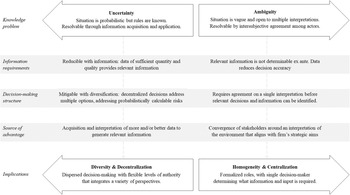
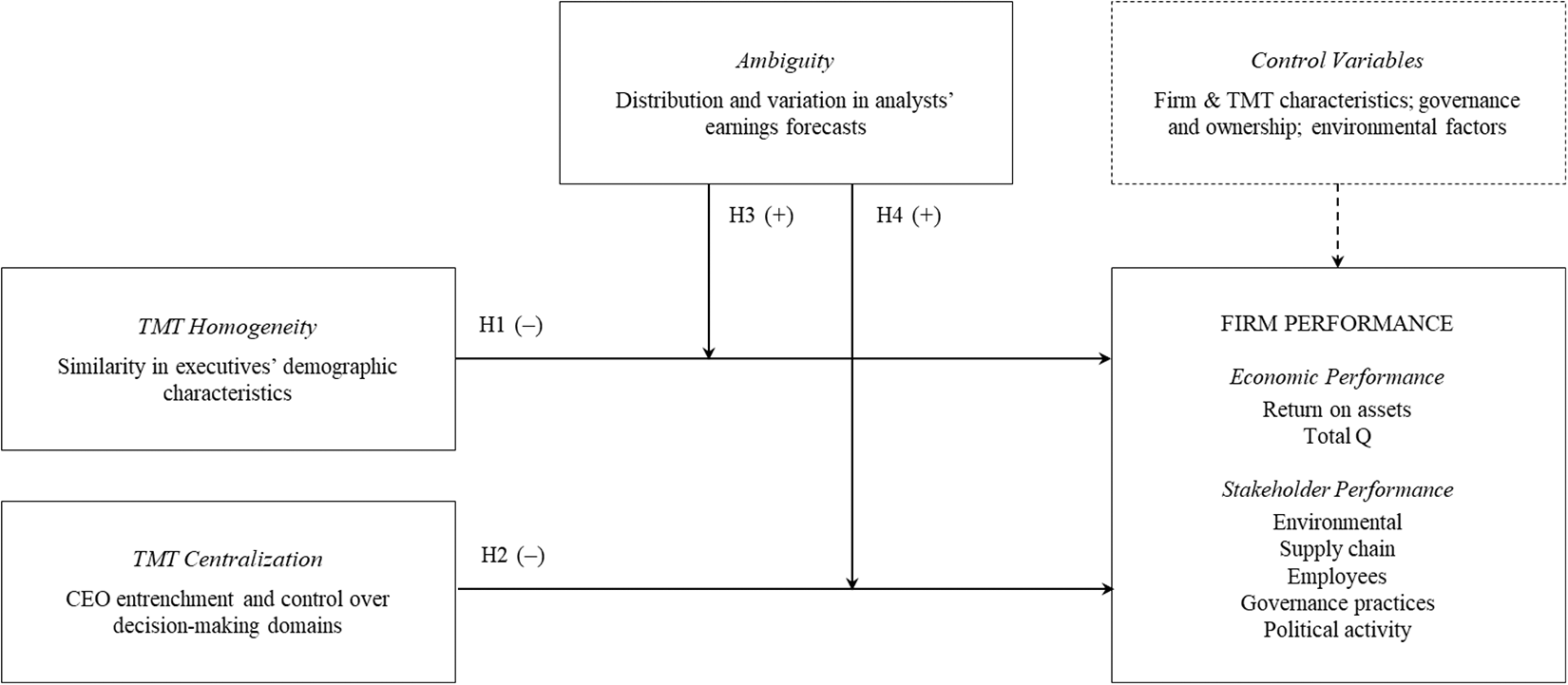
Figure 1 depicts the relations between knowledge problems, information requirements, decision-making structures, and firm outcomes, from which we derive the hypotheses shown in Figure 2. Given the centrality of senior leadership in decision-making under both uncertainty and ambiguity, we examine these relationships at the level of the TMT. There are several theoretical reasons for this focus. First the TMT sets strategic direction and priorities and is the most proximal leadership team to firm-level performance (Hambrick et al., Reference Hambrick, Humphrey and Gupta2015). Second, the TMT determines the prevalence of diversity and decentralization at lower level of the firm, both through explicit policies and initiatives and as behavioral models for middle managers (Martins, Reference Martins2020). Third, the TMT is responsible for communicating with key internal and external stakeholders, making this team critical to determining whether diversity and decentralization are implemented and portrayed as instrumental means or moral ends (Wright, Reference Wright2023).
Conceptual framework.

Empirical model.

We study the effects of TMT homogeneity and centralization, conceptualized as continua with diversity and decentralization, on several outcomes. We examine the conventional firm objective of shareholder value, using financial and market performance as historical and forward-looking measures. These are the focus of the extant literature with which we seek to compare effects; accordingly, our hypotheses primarily concern these standard economic metrics.
We also analyze five key measures of stakeholder value, reflecting a firm’s impact on broader constituents. This allows us to justify (or refute) the logic that we propose to underlie the theory-practice-empirics divide observed in this literature, by testing whether diversity and decentralization deliver tangible benefits to the stakeholders they are purported to serve, or where homogeneity and centralization may be superior means to this end.
Hypotheses
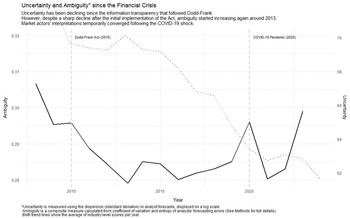
Ambiguity is typically examined as a deviation from environments of uncertainty, where probabilities can be evaluated and decisions optimized through information (Cicero et al., Reference Cicero, Pierro and van Knippenberg2009; Petkova, Wadhwa, Yao & Jain, Reference Petkova, Wadhwa, Yao and Jain2014). While the level of uncertainty has varied (See Fig. 3), the nature of this knowledge problem has been assumed true of the business environment until recent years (Quattrone & Zilber, Reference Quattrone and Zilber2025; Townsend et al., Reference Townsend, Hunt, Rady, Manocha and Jin2025). Based on the mechanisms and evidence discussed above, we therefore predict that diversity and decentralization will be positively associated with firm performance, with the corollary that increasing TMT homogeneity and/or centralization will have a detrimental effect. Briefly; a diverse TMT possesses a breadth of information that can enhance the ability to identify new opportunities, solve problems, comprehensively evaluate options, and thus improve strategic decision-making (Miller et al., Reference Miller, Chiu, Wesley, Vera and Avery2022). These diverse sources of knowledge are optimally employed when they are not only represented but included in decision-making through dispersed participation and delegated authority (Battilana et al., Reference Battilana, Yen, Ferreras and Ramarajan2022; Lee, Reference Lee2024), implying the following hypotheses:
Hypothesis 1 (H1): TMT homogeneity negatively affects firm performance.
Hypothesis 2 (H2): TMT centralization negatively affects firm performance.
Uncertainty and ambiguity, 2010 to 2024.

Our core premise is that rising ambiguity is a key boundary condition that renders the mechanisms underlying H1 and H2 ineffective or even detrimental. Because ambiguous problems are not resolved through additional information, the main theoretical benefit of diversity (the elaboration of different perspectives) is blunted. Under ambiguity, the primary challenge shifts from finding the “correct” answer to creating a coherent one and acting on it decisively to shape the environment (Rindova & Courtney, Reference Rindova and Courtney2020). This elevates the importance of two key mechanisms: decision speed and cognitive alignment (Packard & Clark, Reference Packard and Clark2020; Townsend et al., Reference Townsend, Hunt, McMullen and Sarasvathy2018).
First, TMT homogeneity may be preferable because it fosters greater cognitive alignment. Shared experiences and interpretive frameworks among leaders facilitate a common understanding of the environment, which is critical when external signals are contradictory (Hudson & Morgan, Reference Hudson and Morgan2024; Park & Patel, Reference Park and Patel2015). This alignment reduces the potential for value-destructive conflict and protracted debate, enabling the team to coalesce on a singular narrative required for effective action. This mechanism has been demonstrated across contexts such as leadership transitions, radical innovation, and alliances (Chen et al., Reference Chen, Hsu, Lee and Mack2025; Hanisch et al., Reference Hanisch, Graf‐Vlachy, Haeussler, König and Cho2025), each representing situations in which the future environment and problem parameters will be determined by the actions of firms’ leaders.
Second, this alignment enables superior decision speed. In ambiguous contexts where first-mover advantages are critical, the ability to act quickly and shape market perceptions is paramount (Petkova et al., Reference Petkova, Wadhwa, Yao and Jain2014). Homogeneous teams can reach consensus more rapidly, avoiding the paralysis that can afflict diverse teams struggling to reconcile competing worldviews (Del Sordo & Zattoni, Reference Del Sordo and Zattoni2025; Hudson & Morgan, Reference Hudson and Morgan2023). For analogous reasons, decision decentralization may also impede TMT effectiveness under ambiguity. While dispersed authority can be beneficial for exploring calculable risks under uncertainty, it can preclude the strategic clarity and cohesive implementation necessary in ambiguity (Menz & Scheef, Reference Menz and Scheef2014; Mihm et al., Reference Mihm, Loch, Wilkinson and Huberman2010). Conversely, centralization acts as a structural mechanism to enforce the strategic clarity and unified commitment required. A single point of ultimate authority can curtail excessive deliberation and ensure the rapid and coherent execution of a chosen strategy (Sine, Mitsuhashi & Kirsch, Reference Sine, Mitsuhashi and Kirsch2006). This is particularly effective during periods of strategic change or when objectives are themselves unclear (Cicero et al., Reference Cicero, Pierro and van Knippenberg2009; Ma & Seidl, Reference Ma and Seidl2018). Traditional leadership structures thus often outperform decentralized models in many situations that mirror the information environment under ambiguity – often, precisely the challenges that decentralized structures are purported to address (Reineke et al., Reference Reineke, Katila and Eisenhardt2025; Weber, Reference Weber2023).
Appendix A, Table A1 provides a comprehensive review of studies across empirical contexts that mirror the information-based distinctions between macro-level uncertainty and ambiguity. Collectively, these literatures support the theoretical mechanisms we propose. Based on the differing requirements for cognitive alignment and decision speed, we therefore hypothesize that the effects of homogeneity and centralization will be positively moderated by ambiguity:
Hypothesis 3 (H3): The negative effect of TMT homogeneity on firm performance is positively moderated by environmental ambiguity, such that TMT homogeneity positively affects firm performance when ambiguity is high.
Hypothesis 4 (H4): The negative effect of TMT centralization on firm performance is positively moderated by environmental ambiguity, such that TMT centralization positively affects firm performance when ambiguity is high.
Data and sample
Our focal measures of homogeneity and centralization are operationalized using executive-level data from Execucomp and BoardEx, which contains information on the composition and characteristics of individual executives. We use firm- and industry-level data from Compustat, S&P Capital IQ, and CRSP to derive measures of firm performance and control variables related to firm characteristics. Other organizational outcomes pertaining to key stakeholder groups are obtained from Sustainalytics ESG. Due to the limited availability of this data relative to other key sources,and to ensure comparability with prior research, we focus our hypothesis tests on measures obtained from Compustat and CRSP to ensure the broadest sample coverage and highest data integrity.
Testing our hypotheses requires observable indicators of environmental ambiguity; a construct that is difficult to operationalize and typically relies on subjective measures (Townsend et al., Reference Townsend, Hunt, McMullen and Sarasvathy2018). To develop an objective, external measure that can be applied across firms and industries, we utilize IBES data on the forecasts issued by financial analysts following firms’ earnings announcements. Analysts synthesize firm-specific information with knowledge of industry trends and economic conditions to form forecasts (Crane & Crotty, Reference Crane and Crotty2020). Consensus among these forecasts thus serves as a proxy for clarity about the information environment in which the firm operates (Benner & Beunza, Reference Benner and Beunza2025) – and conversely, lack of consensus can be used to objectively and externally measure ambiguity (Cabrales, Gossner & Serrano, Reference Cabrales, Gossner and Serrano2013; Diether, Malloy & Scherbina, Reference Diether, Malloy and Scherbina2002). This allows us to derive a measure of ambiguity that reflects the collective judgment of market participants rather than relying on internal, subjective assessments from within the firm.
Matching complete records at the firm-year level across these sources results in a final sample of 922 firms across 242 industries (by 4-digit SIC code). The sample covers the period 2004-2023, capturing the more recent shift towards greater ambiguity as opposed to uncertainty in the business environment. As Figure 3 shows and the growth of the literature reflects (Townsend et al., Reference Townsend, Hunt, McMullen and Sarasvathy2018), this shift occurs around 2013, while uncertainty has been gradually reducing with the implementation of information transparency regulations following the 2008 financial crisis. We highlight the COVID-19 pandemic in Figure 3 to illustrate how a shock that imposes a singular narrative on the business environment (i.e., negative expectations due to massively constrained operations during lockdowns) is reflected in our concept and operationalization of ambiguity, which decreases sharply for 2020 only (see also Meyer & Quattrone, Reference Meyer and Quattrone2021; Quattrone & Zilber, Reference Quattrone and Zilber2025).
Measures
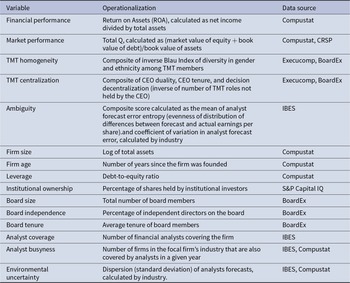
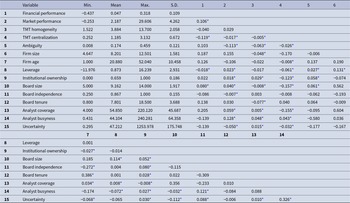
Table 1 summarizes all variable operationalizations and data sources. Table 2 provides descriptive statistics and correlations.
Variable operationalizations and data sources.

All variables are calculated at the firm-year level. Measures based on quarterly earnings are therefore computed as the average of the four quarters within that year. Industries are defined based on 4-digit SIC codes.
Descriptive statistics and correlations.

* p < 0.05.
Dependent variables: financial and market performance
To provide a comprehensive assessment of organizational performance that reflects the varied outcomes previously examined in the literature on TMT diversity and decentralization, we compute two main dependent variables. First, we measure financial performance using Return on Assets (ROA), a widely accepted metric of short-term operational efficiency that can be compared across different industries. ROA is calculated as:
 \begin{equation}RO{A_{it}} = {\text{ }}N{I_{it}}/A{T_{it}}{\text{ }}\end{equation}
Second, we measure market performance using Total Q. The purpose of this variable is to represent the long-term performance prospects of the firm; thus, we utilize a measure that incorporates forward-looking assessments of firm value relative to competitors and levels of risk. Although Tobin’s Q is traditionally used for this purpose, we adopt the modifications proposed by Peters and Taylor (Reference Peters and Taylor2017). This addresses issues of measurement error and bias that have been identified in the standard calculation of Tobin’s Q, most notably the sensitivity to market fluctuations which undermines its validity as a long-term performance metric. Full details of the computation of Total Q are provided in Appendix B. Briefly, this is calculated as:
 \begin{equation}{\text{ }}{Q_{it}} = {\raise0.7ex\hbox{${{V_{it}}}$} \!\mathord{\left/
{\vphantom {{{V_{it}}} {K_{it}^P + K_{it}^I}}}\right.}
\!\lower0.7ex\hbox{${K_{it}^P + K_{it}^I}$}}\end{equation}
\begin{equation}{\text{ }}{Q_{it}} = {\raise0.7ex\hbox{${{V_{it}}}$} \!\mathord{\left/
{\vphantom {{{V_{it}}} {K_{it}^P + K_{it}^I}}}\right.}
\!\lower0.7ex\hbox{${K_{it}^P + K_{it}^I}$}}\end{equation} where Vit is the market value of the firm,  $K_{it}^P{\text{ }}$represents the book value of assets (the denominator of the standard measure of Tobin’s Q), and $K_{it}^I$ the book value of intangible assets, i.e., the sum of the firm’s knowledge and organizational capital.
Independent variables: homogeneity and centralization
To operationalize homogeneity we compute an index representing TMT members’ similarity in two demographic attributes: gender and ethnicity. The “surface-level” nature of these measures is a well-acknowledged limitation in most empirical settings (e.g., Chen et al., Reference Chen, Hsu, Lee and Mack2025; Hudson & Morgan, Reference Hudson and Morgan2023). However, the purpose of our analysis is to re-examine common assumptions under novel contingencies. We therefore focus on these aspects to remain consistent with the extant literature, common DEI metrics, and policy targets, where socially salient, easily observable and measurable demographic indicators remain the dominant approach (Creary et al, Reference Creary, Baskerville, Bermiss, Charles, Roberson, Rogers and Stevens2025; Sieweke et al, Reference Sieweke, Hentschel, Gazdag and Henningsen2024). While other indicators such as functional or experiential diversity have been the subject of increasing inquiry and may also shape decision-making under ambiguity (e.g., Genin, Ma, Bhagwat & Bernile, Reference Genin, Ma, Bhagwat and Bernile2023; Mismetti, Rovelli, Bettinelli & Bergamaschi, Reference Mismetti, Rovelli, Bettinelli and Bergamaschi2025), the inclusion of additional dimensions would reduce comparability of the effects of interest (cf. Miller et al., Reference Miller, Chiu, Wesley, Vera and Avery2022).
We use data from Execucomp to assign executives to the predefined categories of gender and ethnicity. TMT-level diversity is calculated using the Blau Index. This is the most appropriate method of operationalizing diversity when the characteristics of interest are categorical and is conceptually aligned with the notion of diversity as inequality, which is prevalent in the normative literature (Baker et al., Reference Baker, Larcker, McClure, Saraph and Watts2024; Hellerstedt et al., Reference Hellerstedt, Uman and Wennberg2024). Diversity is calculated for gender and ethnicity separately as:
 \begin{equation}Homogeneity = - \mathop \sum \limits_{i = 1}^N p_i^2\end{equation}
 where  $p_i^2{\text{ }}$ represents the proportion of TMT members in each category of gender and ethnicity. This index effectively captures the probability that two randomly selected members of the TMT differ in terms of the specified characteristics. We take the inverse of this, and use the average of the resulting measures to represent TMT homogeneity in our main models.
To measure TMT centralization, we use three key metrics: CEO tenure, CEO duality, and decision centralization within the TMT, collectively capturing the degree to which the CEO holds ultimate authority over strategic decisions (Hambrick et al., Reference Hambrick, Humphrey and Gupta2015). CEO duality is a binary indicator of whether the CEO also holds the position of board chair. CEO tenure is measured as the number of years that the CEO has held the position. Decision centralization is calculated based on the number of roles other than the CEO with accountability for strategic decisions. For each firm-year, we count the number of roles (e.g., CFO, COO, CMO, CHRO) that are not held by the CEO and divide this by the total number of TMT roles. This represents the extent to which responsibility and accountability for strategic decisions are delegated to a specialist role. Accordingly, we use the inverse of this measure to represent centralization. To account for the differing scales of CEO duality, CEO tenure, and decision decentralization, we standardize these three measures before computing the composite index:
 \begin{equation}{\text{ }}Centralation = \frac{{CEO{\text{ }}Duality + CEO{\text{ }}Tenure + Decision{\text{ }}Centralization}}{3}{\text{ }}\end{equation}
Moderator: environmental ambiguity
Operationalizing ambiguity in an generalizable and objective manner is challenging, as most existing research has relied on individual-level measures, such as inference from managers’ behavior (Budanova et al., Reference Budanova, Cianciaruso and Marinovic2021); situation-specific variables, such as in acquisitions (Desyllas, Goossen & Phelps, Reference Desyllas, Goossen and Phelps2024), or firm- and industry-level proxies, such as legitimacy and reputation (Petkova et al., Reference Petkova, Wadhwa, Yao and Jain2014). To overcome these issues, we propose that a general, external measure of ambiguity can be logically derived from common indicators of uncertainty based on the distinctions between the two constructs. The critical factor differentiating ambiguity from uncertainty is the presence of multiple, mutually exclusive interpretations of the environment, where future conditions are contingent upon the interpretation that drives individuals’ actions (Townsend et al., Reference Townsend, Hunt, McMullen and Sarasvathy2018). Quarterly earnings announcements contains an observable manifestation of this: analyst forecasts. Analysts’ earnings per share (EPS) forecasts set a benchmark against which a firm’s actual performance is measured, and thus materially affect market reactions following earnings calls. These forecasts are based on numerous sources of firm-specific, industry, and macroenvironmental information, and thus represent each analysts’ interpretation of the firm’s likely future performance in a given environment. Forecasts influence investors’ decisions and thus significantly affect demand for firms’ stock, with implications for both near-term value and long-term financial viability (Benner & Beunza, Reference Benner and Beunza2025)
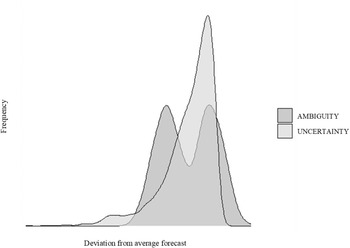
Variables derived from analysts’ forecasts typically use averages to measure consensus and the variance or standard deviation to measure dispersion, with the latter indicating information asymmetry and thus representing higher uncertainty (Bushee, Gow & Taylor, Reference Bushee, Gow and Taylor2018; Crane & Crotty, Reference Crane and Crotty2020). However, high dispersion does not represent the concept of ambiguity. In this situation, it is not the absolute level of variation in analysts’ interpretations that is of interest, but the degree to which these interpretations represent conflicting (i.e., increase/decrease in EPS) predictions about the future state of the firm, industry, and broader macroenvironment (Diether et al., Reference Diether, Malloy and Scherbina2002). This is illustrated in Figure 4, which shows two distributions with equivalent mean and standard deviation. In this example, measuring uncertainty (dispersion) would fail to account for the bimodality (mutually exclusive interpretations) that is present in ambiguity.
Illustration of ambiguity and uncertainty in analysts’ forecasts.

Assessing ambiguity therefore requires information on the shape of the distribution of forecasts. We use the Shannon entropy formula, commonly applied in information theory and finance (Cabrales et al., Reference Cabrales, Gossner and Serrano2013), which captures the complexity and unpredictability in a distribution. To compute this, we first calculate the error for each analyst forecast (the percentage deviation from the actual EPS reported by the firm). We then group forecast errors into 10 equal-width bins that cover the distribution of values, and calculate entropy as:
 \begin{equation}E = \mathop \sum \limits_{i = 1}^k {p_i}lo{g_2}\left( {{p_i}} \right)\end{equation}
where pi represents the probability associated with the i-th bin (i.e., the proportion of errors that fall within a specific range) and k is the number of bins or categories into which the forecasts are divided. Entropy is maximized when forecast errors are evenly distributed, indicating that there is no dominant expectation – whether ‘right’ or ‘wrong’ – among analysts.
We compute ambiguity as the composite of the resulting entropy score and the coefficient of variation in forecast errors, to ensure that our measure also accounts for variability. To derive a firm-year variable that corresponds to the level of our data, we take the annual average of the quarterly scores across firms within the focal firm’s 2-digit SIC code, to account for persistent differences in industry characteristics.
The resulting score represents the degree to which the analysts covering a firm hold multiple and mutually exclusive interpretations of the future prospects within the focal firm’s market, representing the lack of intersubjective agreement under ambiguity (Townsend et al, Reference Townsend, Hunt, McMullen and Sarasvathy2018). As analysts influence both firm and investor behavior (and consequently firm value), deriving this measure from forecasts also captures the second key characteristic of ambiguity: that interpretations of the present environment form the basis of other actors’ decisions and thus shape future conditions (Rindova & Courtney, Reference Rindova and Courtney2020). Crucially, this operationalization does not define ambiguity by the structures or decisions it renders effective, addressing issues with previous measurement approaches that would be especially problematic in our empirical context (Budanova et al., Reference Budanova, Cianciaruso and Marinovic2021; Desyllas et al., Reference Desyllas, Goossen and Phelps2024; Petkova et al., Reference Petkova, Wadhwa, Yao and Jain2014).
Control variables
Three control variables are particularly important for our aims. Our measure of ambiguity is constructed to represent conditions where multiple plausible but incompatible interpretations of available information coexist – i.e., where disagreement is not driven by information reliability (noise) or sparsity (e.g., gaps in firm disclosure or analyst attention), but about how to interpret the same information set. To ensure that the measure does not conflate interpretive ambiguity with these effects, we control for analyst coverage, which adjusts for the risk that ambiguity is an artifact of low information or lack of attention (Benner & Beunza, Reference Benner and Beunza2025), and analyst busyness, capturing the cognitive load and portfolio breath of analysts covering the firm and thus, the likely reliability of their assessments (Crane & Crotty, Reference Crane and Crotty2020). By aggregating this measure to the firm-year level, we also account for differences in the timing of information, ensuring adequate (i.e., legally required) disclosure across firms. Finally, to ensure that we distinguish between dispersion and entropy (see Fig. 4 and Cabrales et al., Reference Cabrales, Gossner and Serrano2013), we control for uncertainty, using the common measure of dispersion in analysts’ forecasts (Bushee et al., Reference Bushee, Gow and Taylor2018).
We also include control variables to comprehensively account for other factors that may influence firm performance independently of our main variables of interest. Firm size (logarithm of total assets) is included, as larger firms’ resources may impact both managerial discretion (and thus the influence of differences in TMT decision-making processes) and performance. Firm age is included, to account for established processes, market positions, and reputation that may increase financial and market performance (Petkova et al., Reference Petkova, Wadhwa, Yao and Jain2014). We include leverage (debt-to-equity ratio) to control for financial constraints and institutional ownership (as a percentage of shares) to account for additional limitations to managerial discretion. We also control for board tenure and board independence to represent differences in oversight of TMT decisions and composition (Darouichi, Kunisch, Menz & Cannella, Reference Darouichi, Kunisch, Menz and Cannella2021). Our model specification also accounts for historical performance and other time-invariant unobserved heterogeneity not captured by these controls, thus addressing endogeneity arising from omitted variables (Antonakis, Bendahan, Jacquart & Lalive, Reference Antonakis, Bendahan, Jacquart and Lalive2010).
Model specification and estimation
The hypothesized relationship between TMT homogeneity, centralization, environmental ambiguity, and firm performance can be specified as follows:
 \begin{align}
{Y_{it}} &= {\text{ }}\alpha {Y_{it - 1}} + {\beta _1}Homogeneit{y_{it - 1}} + {\beta _2}Centralizatio{n_{it - 1}} \nonumber\\
&\quad + {\beta _3}\left( {Homogeneit{y_{it - 1}} \times Ambiguit{y_{it - 1}}} \right) \nonumber\\
&\quad + {\beta _4}\left( {Centralizatio{n_{it - 1}} \times Ambiguit{y_{it - 1}}} \right)\nonumber\\
&\quad + {\beta _5}Ambiguit{y_{it - 1}} + {\beta _k}Control{s_{it - 1}} + {\text{ }}{\mu _i} + {\varepsilon _{it}}{\text{ }}\end{align}
\begin{align}
{Y_{it}} &= {\text{ }}\alpha {Y_{it - 1}} + {\beta _1}Homogeneit{y_{it - 1}} + {\beta _2}Centralizatio{n_{it - 1}} \nonumber\\
&\quad + {\beta _3}\left( {Homogeneit{y_{it - 1}} \times Ambiguit{y_{it - 1}}} \right) \nonumber\\
&\quad + {\beta _4}\left( {Centralizatio{n_{it - 1}} \times Ambiguit{y_{it - 1}}} \right)\nonumber\\
&\quad + {\beta _5}Ambiguit{y_{it - 1}} + {\beta _k}Control{s_{it - 1}} + {\text{ }}{\mu _i} + {\varepsilon _{it}}{\text{ }}\end{align} where  ${Y_{it}}$ represents performance (ROA or Total Q) for firm i in time t and ${Y_{it - 1}}$ is the dependent variable lagged by one period, such that the coefficient α captures the persistence of performance over time. All other independent variables are also measured at time t-1, to ensure that our estimates are not subject to reverse causality concerns; ${\beta _1}$ to ${\beta _4}$ are the coefficients of interest for tests of their respective hypotheses; ${\mu _i}$ represents firm-specific fixed effects, and ${\varepsilon _{it}}$ is the error term.
Equation 6 is estimated using generalized estimating equations (GEE). This is a common approach for estimating panel models that examine senior leadership composition (see Hudson & Morgan, Reference Hudson and Morgan2024). These variables tend to be relatively temporally stable, and GEE can alleviate the estimation issues associated with intertemporal correlation while also handling common causes of endogeneity that are relevant to this context (Antonakis et al., Reference Antonakis, Bendahan, Jacquart and Lalive2010). We specify an autoregressive AR(1) correlation structure, reflecting the assumption that within-firm measures will be more highly correlated at closer points in time; a Gaussian distribution, as our dependent variables are all continuous and normally distributed; and an identity link function. We use robust standard errors to ensure that our estimates are consistent and efficient, and to account for potential autocorrelation and heteroskedasticity.
Results
Shareholder value: financial and market performance
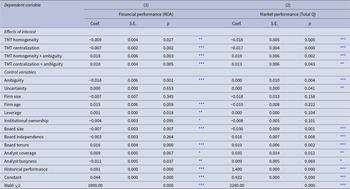
Tables 3 and 4 presents the results of the GEE models examining the effects of TMT homogeneity, centralization, and environmental ambiguity on financial performance (ROA; Model 1) and market performance (Total Q; Model 2); the focal dependent variables for tests of our hypotheses. Results are consistent across the two outcomes, with significant effects that support each of our hypotheses. In support of H1 and H2, we find a negative main effect for both TMT homogeneity (ROA: − 0.009, p = 0.027; Q: −0.018, p < 0.001) and centralization (ROA: −0.007, p = 0.002; Q: −0.017, p < 0.001). The interaction terms are positive for both focal variables, supporting H3 and H4: firm performance is positively affected by TMT homogeneity (ROA: 0.018, p = 0.003; Q: 0.019, p = 0.002) and centralization (ROA: 0.010, p = 0.005; Q: 0.013, p = 0.043) under conditions of ambiguity. Comparing the magnitude of these effects suggests that under ambiguity, homogeneity and centralization have beneficial impacts on financial performance. Homogeneity also has a net positive effect on market performance, whereas centralization may remain a negative influence for some firms.
Effects of TMT homogeneity and centralization on financial and market performance.

* = p < .10, ** = p < .05, *** = p < .01. Standardized coefficients are displayed to aid interpretation of effects.
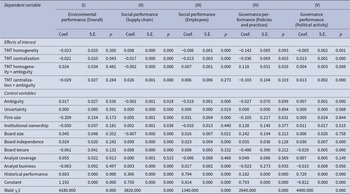
Supplementary analyses: environmental, social, and governance performance.

Standardized coefficients are displayed to aid interpretation of effects. Control variables firm age and leverage omitted to alleviate multicollinearity.
We conduct several robustness checks to ensure the reliability of our results. We report key findings below, with full results provided in Appendix C. First, we estimate the GEE models using an exchangeable correlation structure. This assumes that measurements within a firm are sporadic and the correlation cannot be predicted based on the proximity in time, and is thus less applicable to the empirical context of this study. However, we provide these models as this specification is frequently used in the literature. Results align with the AR(1) models, suggesting that our findings are robust to alternative assumptions regarding the temporal stability of senior leadership characteristics.
Second, we check for multicollinearity by examining the variance inflation factors for the variables in each model. Aside from historical performance, all VIFs are below the threshold of 5 that indicates no issues of multicollinearity, with no variables exceeding 10 (see Appendix C, Table C2).
Third, we disaggregate the components of our diversity index and estimate the models with gender and ethnicity homogeneity as distinct variables (Appendix C, Table C3). Results are consistent with our main models, with one notable difference: for financial performance, gender homogeneity appears to drive most of the positive effect under ambiguity (0.278, p < 0.001), whereas ethnicity is marginally significant (0.135, p = 0.065).
Similarly, we disaggregate decision centralization from our composition measure. This index intentionally does not differentiate the nuanced effects of each individual component because alone, these are conceptually and instrumentally distinct from centralization of decision-making power (see Finkelstein, Reference Finkelstein1992). It is the combination of factors that gives the CEO authority; hence, composite measures are not only typical but expected in work on this subject (Ozgen, Mooney & Zhou, Reference Ozgen, Mooney and Zhou2025). Nevertheless, we estimate models to examine the effects of decision centralization alone, disaggregated from tenure and duality (Appendix C3). The direction and significance remain consistent with our theoretical predictions. However, we refrain from interpreting this as a robustness check per se, as our model specifies centralization as a multidimensional construct (see Pitcher & Smith, Reference Pitcher and Smith2001).
Finally, to further test the robustness of our findings, we check the validity of the motivating assumption that ambiguity – and the consequent implications of TMT homogeneity and centralization – has increased in recent years. First, we estimate our models in subsets of the sample, comparing observations pre- and post-2013 (corresponding to the rise in research interest in this phenomenon discussed above). Results (Appendix C, Table C4.1) both corroborate our main findings and lend support to this assumption, with effects that are larger in magnitude and significance in recent years. Second, we incorporate a linear year trend in all models to account for secular time effects. Results (Appendix C, Table C4.2) are robust to this inclusion, though the interaction between TMT centralization and ambiguity falls just below conventional significance thresholds in the ROA specification (p = .106).
Stakeholder value: environmental, social, and governance performance
We conducted further analyses to investigate whether homogeneity and centralization affect firm performance in terms of impact on key stakeholder groups. Using Sustainalytics ESG, we identify dimensions of environmental, social, and governance performance that represent five outcomes: (i) environmental impact, (ii) responsible supply chain management, (iii) employee wellbeing, (iv) governance policies and practices, and (v) corporate political activity. Details of the components of these measures are provided in Appendix D. Table 4 presents the results, which exhibit varying effects across stakeholder-based outcomes and environmental conditions.
For environmental performance (Model I), TMT homogeneity has no significant effects and TMT centralization has a negative effect (−0.021, p = 0.043), with no changes under ambiguity. Conversely, only homogeneity has significant effects on governance policies and practices (Model IV), with the expected negative main effect (−0.142, p = 0.093) and positive effect under ambiguity (0.118, p = 0.019). Both homogeneity and centralization have highly significant and positive impacts on social performance in the supply chain (Model II) and employee-related (Model III) domains. However, while the effects of homogeneity are consistent with our hypotheses for employee-related outcomes (main effect: −0.006, p < 0.001; interaction: 0.007, p < 0.001), we find the opposite for supply chain impacts, with positive effects diminishing under ambiguity (main effect: 0.008, p < 0.001; interaction: −0.002, p < 0.001). In both models examining social performance, the effects of centralization are consistent with our hypotheses, with negative main effects (supply chain: −0.017, p < 0.001; employees: −0.013, p < 0.001) and positive effects under ambiguity, though this is significant for supply chain-related outcomes only (0.026, p < 0.001). Finally, we find the expected pattern of effects for homogeneity on governance outcomes in the domain of political activity (Model V), though the positive effect under ambiguity is only marginally significant (main effect: −0.005, p = 0.001; interaction: 0.004, p = 0.098). Centralization has highly significant positive effects across conditions (main effect: 0.013, p < 0.001; interaction: 0.013, p < 0.001).
Overall, these findings suggest that diversity and decentralization in TMT decision-making are not universally beneficial in their impact across the stakeholder outcomes considered in evaluating ESG performance. Homogeneity and centralization may be more effective in promoting positive social and governance outcomes, especially in terms of employee wellbeing and corporate political activity. As firms’ ESG evaluations often incorporate measures of diversity and decentralization in senior leadership (Baker et al., Reference Baker, Larcker, McClure, Saraph and Watts2024; Giglio et al., Reference Giglio, Maggiori, Stroebel, Tan, Utkus and Xu2025), these results have important practical implications, suggesting that favorable evaluations against these internal criteria may come at the detriment of tangible benefits to external stakeholders.
Discussion
This study began with a central dilemma in management: why do the widely prescribed practices of senior leadership diversity and decentralization, often pursued as moral ends in themselves, so frequently fail to deliver their expected benefits? We argued that this theory-practice gap can be explained by a failure to distinguish between environmental uncertainty and ambiguity. Our findings offer a clear, context-dependent answer. While these practices are associated with stronger performance in the uncertain environments where their advantages were first theorized, their effects are reversed under conditions of ambiguity. This invites a reassessment of the assumptions underlying these practices, returning to the view that they are not universal ends, but rather context-dependent means for achieving organizational objectives.
As ambiguity becomes a dominant feature of the business environment and evidence for the unintended and detrimental results of DEI and ESG initiatives grows (e.g., Hellerstedt et al., Reference Hellerstedt, Uman and Wennberg2024; Sieweke et al., Reference Sieweke, Hentschel, Gazdag and Henningsen2024; Weber, Reference Weber2023), this invites a reassessment of the assumptions underlying these practices to address the persistent incongruence between theory, proscription, and practice, to realize their intended mutual benefits for firms, employees, and society.
Implications for theory
Our findings offer several contributions to management theory. First, we provide a critical boundary condition to the normative literature on diversity and decentralization (e.g., Battilana et al., Reference Battilana, Yen, Ferreras and Ramarajan2022; Olenick & Somaraju, Reference Olenick and Somaraju2024). By demonstrating that the positive effects of these practices are contingent on the nature of the knowledge problem leaders face, we show that they cannot be treated as universally beneficial ends that firms should uncritically pursue. Our study provides large-scale empirical evidence that their instrumental value as means significantly diminished, and even reversed, under conditions of ambiguity – without disputing the positive effects they can deliver under the appropriate conditions. This helps explain the inconsistent findings reported in recent major reviews (Reineke et al., Reference Reineke, Katila and Eisenhardt2025; Sieweke et al., Reference Sieweke, Hentschel, Gazdag and Henningsen2024) and provides a potential path toward resolving the incongruence between theory and evidence.
Second, we identify a key, and previously underexplored, environmental contingency that has implications across prominent research streams of senior leadership research. For example, studies in upper echelons theory (Hambrick & Mason, Reference Hambrick and Mason1984) posits that TMT characteristics shape firm outcomes, but have struggled to consistently link demographic diversity to performance (Miller et al., Reference Miller, Chiu, Wesley, Vera and Avery2022). Similarly, research on strategic leadership interfaces – the sites of interaction between the CEO, TMT, and board of directors (Simsek, Heavey & Fox, Reference Simsek, Heavey and Fox2018) – has surfaced many unresolved contingencies in how individual characteristics shape team- and firm-level outcomes via their effects on interpersonal dynamics (Georgakakis, Heyden, Oehmichen & Ekanayake, Reference Georgakakis, Heyden, Oehmichen and Ekanayake2022). Our study suggests this may be because the information-processing benefits of diversity are most valuable when problems are reducible through information (i.e., under uncertainty). Under ambiguity, where the core challenge is one of interpretation rather than information, the same diversity can create conflict and hinder the rapid coalescence on a singular narrative required for effective action. Accordingly, strategic leadership researchers across intellectual traditions can benefit from and further develop our findings.
Finally, we contribute to the literature on organizational design and structure. While much recent scholarship has focused on the potential of moving ‘beyond hierarchy’ (Lee, Reference Lee2024) our work highlights the enduring value of more traditional, centralized structures. We provide a theoretical rationale and robust mechanistic framework for why firms may revert to hierarchy when flatter forms exacerbate the very frictions they promise to alleviate (Reineke et al., Reference Reineke, Katila and Eisenhardt2025). Our findings help explain the micro-level challenges of control and accountability that emerge in self-managing systems (Foss & Klein, Reference Foss and Klein2023; Weber, Reference Weber2023) and suggest a need to embrace a view of organizations as ambiguity-shaping, not just ‘uncertainty absorbing’ structures (see Cooren & Seidl, Reference Cooren and Seidl2020; March & Simon, Reference March and Simon1958).
Implications for practice
These contributions to the literature translate into several actionable recommendations for managers. Critically, our findings do not imply a rejection of diversity and decentralization as viable means towards clearly defined ends; nor should they be read as an invitation to resist the implementation of DEI initiatives or workplace democratization. On the basis of the necessarily limited generalizability of a single empirical study, we suggest three careful but impactful actions that managers may take.
First, leaders must separate moral and instrumental motivations. Organizations can and should pursue diversity and inclusion as ethical considerations. However, leadership should clearly differentiate these goals from the day-to-day operational imperative of matching the right team structure to the right problem, in rhetoric and in action. This means being transparent with employees that while the organization is committed to DEI, specific, high-stakes project teams facing deep ambiguity may be structured for cohesion and speed, which might mean less demographic or cognitive diversity in that specific instance (e.g., see Hellerstedt et al., Reference Hellerstedt, Uman and Wennberg2024). With effective communication from senior management, team members may accept that temporary restrictions to decision autonomy in commitment to a collective goal may be the most effective means to achieve the long-term ends sought by the firm, its stakeholders, and – as our analysis of ESG outcomes shows – for themselves (see also Furr et al., Reference Furr, Ozcan and Eisenhardt2022). Fostering a culture where employees understand how changes support broader firm and societal goals will be important to reduce apprehension and sustain engagement (Ross et al., Reference Ross, Traylor and Ruggs2025).
Second, strategic planning and project management activities should diagnose the knowledge problem before designing the team. Leaders should resist the reflexive adoption of decentralization or diversification initiatives on the basis of widespread practice or external advocacy. If faced with the former pressure, focusing on the nature of the primary strategic challenge can provide a competitive edge, especially when ambiguous environments favor the first-movers who can shape how events are perceived (Rindova & Courtney, Reference Rindova and Courtney2020). In the latter case, demonstrating the tangible payoffs for critical stakeholders shown in our study may alleviate legitimacy concerns and resistance (Baker et al., Reference Baker, Larcker, McClure, Saraph and Watts2024; Giglio et al., Reference Giglio, Maggiori, Stroebel, Tan, Utkus and Xu2025). Once the environment has been diagnosed, the best means to the firm’s strategic end can be designed. If the problem is uncertainty (e.g., predicting market share in a stable industry), a diverse team with decentralized authority is likely to be effective. If the problem is ambiguity (e.g., navigating a novel technological shift or a sudden geopolitical crisis), a more homogenous and centrally led team may be better equipped to create a unified vision and execute a decisive strategy.
Finally, senior leadership teams may benefit from maintaining the capacity for centralized action. Even in organizations that embrace decentralization, our findings suggest it is critical to preserve structures and systems that allow a swift return to centralized decision-making when ambiguity emerges (such as in the development of unprecedented technologies) or crisis erupts (such as a pandemic, financial crash, or geopolitical conflict) – both of which are increasingly characteristic of the modern world (Quattrone & Zilber, Reference Quattrone and Zilber2025). This could involve creating clear protocols that allow the CEO or a small executive committee to assume temporary but ultimate authority, ensuring that the organization can act with the speed and unity necessary to shape a narrative rather than be paralyzed by it (Ozgen et al., Reference Ozgen, Mooney and Zhou2025; Pfeffer, Reference Pfeffer2013).
Using our framework to foreground the informational requirements of knowledge problems as a basis for decision-making and design, leaders can synthesize other evidence to create targeted interventions throughout the firm. Conditional effects may vary by organizational layer and function (see Table A1), demonstrating the need to adapt policies and practices for different levels – and for further, integrative research (Joseph & Sengul, Reference Joseph and Sengul2025).
Limitations and future directions
Beyond the areas of theoretical development outlined above, several limitations of this study suggest areas for future research. First, our measures of diversity and decentralization are confined to the TMT, and thus do not fully capture these constructs as implemented at various levels of the firm. Future research could explore whether ambiguity also affects the outcomes of diversity and decentralization at the operational level or within functional departments (see van Knippenberg & Schippers, Reference van Knippenberg and Schippers2007).
Second, we restrict our analysis to broad, generalizable strategic objectives (financial performance, market value, and ESG impact), whereas much of the literature evincing benefits of diversity and decentralization focus on contextual, typically innovation-related, outcomes (Reineke et al., Reference Reineke, Katila and Eisenhardt2025; Zhu et al., Reference Zhu, Zhao and Semadeni2025). Similarly, while we account for industry-specific effects in our measure of ambiguity and modeling approach, this precludes the use of contextual information in developing targeted managerial implications. Research in organizations across varying industries, geographies, and with different strategic goals would therefore enable more targeted and actionable recommendations, and clarify the boundary conditions of the propositions we advance and demonstrate.”
Our focus on publicly traded U.S. firms also limits the generalizability of our findings. The external pressures for DEI and ESG adoption may differ significantly in private firms or non-profit organizations, which are not subject to the same market and regulatory scrutiny (e.g., see Hu, Hung & Li, Reference Hu, Hung and Li2025; Krueger, Sautner, Tang & Zhong, Reference Krueger, Sautner, Tang and Zhong2024). Further limitations of our methodology also restrict the causal inferences that can be made from this study. Research using natural experiments, instrumental variables, or quasi-experimental designs would be valuable in more precisely identifying causal effects.
Given the theoretical mechanisms explicated in our study, other influences on the informational requirements of strategic decisions are likely to have effects similar to environmental ambiguity by analogously shifting the nature of knowledge problems. Emerging economies, new markets, and startups may provide fertile ground for further testing and challenging assumptions. Conversely, our findings may not apply to international settings with different cultural norms, legal frameworks, or market structures (e.g., see Leone, Mocciaro Li Destri & Picone, Reference Leone, Mocciaro Li Destri and Picone2025). Future research should explore whether the contingency of ambiguity affects the efficacy of diversity and decentralization in these varied contexts.
Conclusion
The prevailing assumption that diversity and decentralization are universally beneficial for organizations is not fully supported by the evidence. Our study offers a potential explanation: these practices are powerful tools for solving problems of uncertainty, but they are ill-suited for the challenges of ambiguity. By treating these structures as context-dependent means rather than universal ends, leaders can make more effective, evidence-informed decisions that benefit both their organizations and their stakeholders in an increasingly ambiguous world.
Supplementary material
The supplementary material for this article can be found at https://doi.org/10.1017/jmo.2025.10049.
Generative AI
No form of AI has been used in preparation of this manuscript.
Data availability statement
No data were collected or used for preparation of this manuscript.
Conflicts of interest
The author has no financial or non-financial interests to disclose.
Funding statement
No funds, grants, or other support was received for this work.
Kerry Hudson is Assistant Professor (Lecturer) in Strategy at Cardiff Business School. Her research specializes in the development of organization and management theory to address contemporary sociopolitical and technological challenges, focusing on the interpersonal and interorganizational foundations of agency, decision-making, and power for individuals and organizations. Her research has been published in the Journal of Management Studies, Long Range Planning, Journal of Product Innovation Management, and Corporate Governance: An International Review, among others.


 Open access

