


If you ask me, “which side would you choose?” Well, I’d stick with the most authoritarian ones and not with the “woke” progressives (“progres buena ondita”) because the most authoritarian are more authentic and don’t pretend.
While the far right has been electorally relevant in Europe and the United States for decades, Latin America has only recently witnessed the success of far-right leaders such as Jair Bolsonaro in Brazil, Nayib Bukele in El Salvador, and Javier Milei in Argentina. Far-right parties like Chile’s Republican Party, Uruguay’s Cabildo Abierto, and Perú’s Renovación Popular are also becoming increasingly influential in presidential and legislative elections. This chapter examines why far-right parties, particularly populist radical-right (PRR) parties, have not emerged in Mexico. In many Latin American countries, far-right forces have arisen as a backlash against leftist parties and presidents (Madariaga & Rovira Kaltwasser, Reference Rovira Kaltwasser2020; Zanotti & Roberts, Reference Zanotti and Roberts2021). In Mexico, however, no significant far-right party or movement has materialized in response to the country’s leftward turn following the electoral victory of Andrés Manuel López Obrador (AMLO) and his party, MORENA (Movimiento de Regeneración Nacional), in the 2018 presidential election.
The Mexican party system experienced an electoral shock in 2018 when López Obrador won the presidency. Since Mexico’s transition to democracy in 1997, the Institutional Revolutionary Party (PRI), the National Action Party (PAN), and the Party of the Democratic Revolution (PRD) had been the main contenders in every election. In 2018, however, the electorate largely rejected these parties, which together received roughly 40 percent of the vote, compared to nearly 90 percent in previous election cycles. This study argues that the left’s victory did not trigger a significant far-right backlash because López Obrador’s ideological agenda did not provide the incentives necessary for the rise of a populist radical-right party, a pattern common in Latin America and Europe (Bale & Rovira Kaltwasser, Reference Rovira Kaltwasser, Zanotti and Greve2021; Ignazi, Reference Ignazi1992; Inglehart & Norris, Reference Inglehart and Norris2017; Rovira Kaltwasser, Reference Rovira Kaltwasser2023).
López Obrador’s government employed left-wing populist rhetoric, particularly on economic issues, framing itself as the defender of the “people” against the “corrupt elite” – the PRI and PAN. However, it did not actively pursue progressive policies on sociocultural issues such as gender equality, abortion rights, and LGBTQ+ rights, which often mobilize far-right grievances; this chapter terms this approach “leftism without progressivism.” For the most part, cultural issues were overshadowed by economic priorities – increasing the coverage of welfare policies and the minimum wage, reinvigorating Mexico’s state-owned oil industry and infrastructure projects such as the new Mexico City airport, a new oil refinery, and the Mayan Train – and issues of criminal violence, the increasing militarization in the country, and López Obrador’s attacks on democratic institutions (Aguilar et al., Reference Aguilar, Cornejo and Monsiváis-Carrillo2025).
At the national level, when sociocultural issues emerged, López Obrador often avoided taking clear positions or argued that such issues – e.g., abortion or LGBTQ+ rights – should be decided via referenda (Díaz Domínguez, Reference Díaz Domínguez2020). Consequently, most culture war issues remained confined to local politics or were largely addressed by the courts, preventing strong politicization. When López Obrador did take a stance, it frequently reflected conservative positions on topics ranging from public morality and drug legalization to climate change and immigration. The first left-wing government since Mexico’s democratic transition did not mobilize far-right grievances. López Obrador’s administration did not create a perceived threat to traditional values; instead, it partially satisfied voters who might otherwise have been drawn to a populist radical-right party. In fact, conservative voters are a key group within the Lopezobradorista voting coalition. In the 2021 midterm election, 76 percent of leftist voters and 56 percent of rightist voters supported MORENA. In the 2024 presidential campaign, 71 percent of leftist voters and 63 percent of conservative voters backed MORENA’s presidential candidate, Claudia Sheinbaum (Mexican Election Study – Estudio Nacional Electoral de México; Beltrán et al., 2021, Reference Beltrán, Castro Cornejo, Altamirano and Singer2024).
This chapter is organized as follows. The first section reviews short-lived far-right movements and parties that emerged in Mexico before and after the country’s democratization in 1997. The second section analyzes why López Obrador’s leftism without progressivism failed to provide incentives for the rise of a populist radical-right party. Section 9.3 argues that there is latent demand for such a party in the Mexican electorate, drawing on data from the Mexican Election Study (Beltrán et al., 2021, Reference Beltrán, Castro Cornejo, Altamirano and Singer2024). The last section argues that a window of opportunity may be opening for far-right actors seeking to mobilize conservative voters in the context of Mexico’s first woman-led government, headed by Claudia Sheinbaum, and the emergence of new far-right movements aiming to participate in future elections – such as Eduardo Verástegui’s Viva México movement and emerging conservative figures like businessman Ricardo Salinas Pliego.
9.1 Is There a Far Right in Mexico?
In Mexico, several attempts to establish far-right and extreme-rightFootnote 2 alternatives to the PAN, the mainstream center-right party, have largely failed. Founded in 1939, the PAN emerged as a conservative response to President Lázaro Cárdenas’s reforms, which expanded the state’s economic role, nationalized the oil industry, and promoted land redistribution and socialist education (Loaeza, Reference Loaeza, Mainwaring and Scully2003; Shirk, Reference Shirk2005). The PAN’s electoral coalition included businessmen, liberal intellectuals, and Catholic activists (Mizrahi, Reference Mizrahi2003). While officially advocating for Catholic social teachings (Shirk, Reference Shirk2005), the party tried to remain separate from the Catholic Church, like many Christian democratic parties in Europe (Wuhs, Reference Wuhs2013). Contrary to most conservative political forces in Latin America, the PAN was a consistent pro-democratic party (Wuhs, Reference Wuhs, Luna and Rovira Kaltwasser2014) that helped consolidate a democratic/authoritarian divide in electoral competitions (Moreno, Reference Moreno2007).
During the 1980s and 1990s, the PAN became a “catch-all” party (Loaeza, Reference Loaeza, Mainwaring and Scully2003; Mantilla, Reference Mantilla2016), broadening its appeal beyond Catholic western states to industrial northern regions and major urban centers. To avoid alienating core voters – including the urban middle class – its national campaigns often downplayed conservative stances on issues such as abortion and sexual freedom, emphasizing democracy and market-oriented reforms instead (Díaz Domínguez, Reference Díaz Domínguez2020; Magaloni & Moreno, Reference Magaloni, Moreno, Mainwaring and Scully2003). At the local level, however, the party maintained a more conservative agenda (Beer, Reference Beer2017; Reutersward, 2021), particularly in the Catholic western region of the Bajío, where it dominated subnational elections.
9.1.1 The Political Right before Mexico’s Democratization
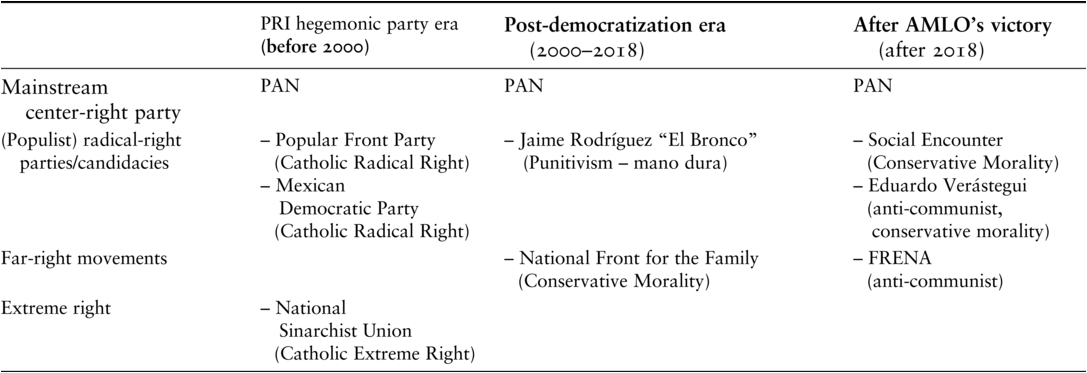
Table 9.1 identifies the parties and candidates that have attempted far-right mobilization before and after Mexico’s democratization, as well as the sociocultural issues they emphasized. The National Sinarchist Union, linked to the Catholic extreme right, and its successors – the Popular Front Party and Mexican Democratic Party – sought to mobilize far-right voters from the late 1930s to the 1990s. The Sinarquismo movement gained influence in western Mexico, particularly in states affected by the Cristero War (1926–1929), a conflict in which the Cristeros – a rural Catholic militia – opposed socialist education and the Mexican state’s postrevolutionary anticlerical policies. The 1917 Constitution had ended the legal recognition of the Church, banned confessional parties and political speech by clergy, prohibited religious education, and placed Catholic property under state control.Footnote 3 Tensions eased in the 1940s after negotiations allowed for peaceful coexistence. The National Sinarchist Union dissolved in the 1950s, and its successors sought to offer a more conservative alternative to the PAN. Between the 1970s and 1990s, the Mexican Democratic Party won a few congressional seats, but in 1997 it lost its legal status due to weak electoral performance. As Mantilla (Reference Mantilla and Haynes2019) notes, these failed attempts illustrate the limits of far-right mobilization in Mexico.
Before democratization in 2000, electoral competition centered on support for democracy versus the PRI’s hegemonic regime rather than a clear ideological divide. Although electoral laws allowed the formation of new parties, ideologically driven groups often joined major opposition parties – the PAN on the center right and the PRD on the center left – to improve their chances of success, particularly as the PRI’s authoritarian dominance waned in the late 1990s, when it lost its congressional majority in 1997 and, for the first time since 1929, the presidency in 2000.
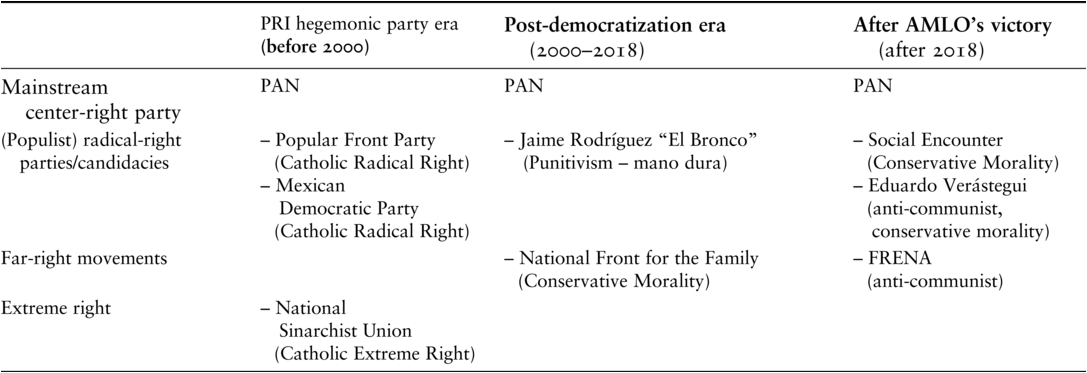
Table 9.1 Long description
The table has three columns titled P R I hegemonic party era, before 2000. Post-Democratization era, 2000 to 2018. After AMLO’s victory, after 2018.
Row 1 is titled Mainstream Center-Right Party.
Column 1 reads. PAN.
Column 2 reads. PAN.
Column 3 reads. PAN.
Row 2 is titled Populist, Radical-Right Parties/Candidacies.
Column 1 reads. Popular Front Party, Catholic Radical Right. Mexican
Democratic Party, Catholic Radical Right.
Column 2 reads. Jaime Rodríguez El Bronco, Punitivism mano dura.
Column 3 reads. Social Encounter, Conservative Morality. Eduardo Verastegui, anti-communist, conservative morality.
Row 3 is titled Far-Right Movements.
Column 1 reads. Blank.
Column 2 reads. National Front for the Family, Conservative Morality.
Column 3 reads. FRENA, anti-communist.
Row 4 is titled Extreme Right.
Column 1 reads. National Sinarchist Union, Catholic Extreme Right.
Column 2 reads. Blank.
Column 3 reads. Blank.
The note below reads. Source: Author’s own elaboration.
9.1.2 The Political Right after Mexico’s Democratization
The PAN won the presidency in 2000 with a heterogeneous anti-PRI coalition, combining its traditional base among the urban, educated middle class of northern and western Mexico with support from across the ideological spectrum, including center-left strategic voters defecting from the PRD (Moreno, Reference Moreno2007; Cornejo, Reference Cornejo2022). However, the Fox (2000–2006) and Calderón (2006–2012) administrations disappointed socially conservative groups, whose expectations for strong opposition to abortion and defense of traditional marriage were unmet.Footnote 4 Fox further alienated conservative Catholics by appointing a liberal physician as Secretary of Health and mandating emergency contraception in public clinics (Amuchástegui et al., Reference Amuchástegui, Cruz, Aldaz and Mejía2010). After the 2006 election, disillusioned conservative PAN activists attempted to form a party to the right of the PAN – the Humanist Party, also known as the Movement for Solidarity Participation – but failed to gather the 200,000 signatures required by law. This first episode highlights the challenges faced by parties in Mexico, where electoral law sets high requirements for new parties.
Because Mexican states regulate marriage and abortion, courts and local politics have played a central role in the country’s culture wars (Beer, Reference Beer2021a). In 2009, Mexico City legalized same-sex marriage, becoming the first jurisdiction in Mexico and Latin America to do so. Although the PAN and the Catholic Church opposed the law, it passed without significant protests. At the time, the PAN was simply not prepared to actively block or delay the legislative process (Diez, 2015). Instead, the party responded at the federal level by challenging the law’s constitutionality before the Supreme Court. In 2010, however, the Court upheld the constitutionality of Mexico City’s same-sex marriage law. Furthermore, in 2015, the Court declared that any law defining marriage as the “union of a male and a female” – several of which had been passed by state congresses in response to Mexico City’s reform – was unconstitutional, thereby legalizing same-sex marriage de facto nationwide.
When the PRI returned to power in 2012, Peña Nieto proposed a constitutional amendment to codify the Court’s ruling. By then, many conservatives had grown disillusioned with the PAN and turned to nonpartisan grassroots organizations. Conservative groups – including far-right organizations such as Unión Nacional de Padres de Familia, Red Familia, Consejo Mexicano de la Familia, and Hazte Oír – formed the Frente Nacional por la Familia (National Pro-Family Alliance). The coalition denounced Peña Nieto’s proposal as an imposition of “gender ideology” and successfully mobilized against it, prompting him to abandon the reform. Although the constitutional amendment failed, all state legislatures eventually legalized same-sex marriage,Footnote 5 even in conservative western states where the PAN held majorities.
Abortion politics followed a similar trajectory. With a few exceptions,Footnote 6 debates largely took place at the state level. In 2007, Mexico City legalized first-trimester abortion. As with same-sex marriage, the Supreme Court was essential to upholding progressive change. The Supreme Court upheld the law in 2008, rejecting challenges from the federal PAN government. In response, between 2008 and 2013, seventeen of Mexico’s thirty-one states passed constitutional amendments protecting “life from the moment of conception.” The conservative movement relied on backroom deals (Reutersward, 2021) backed by Catholic organizations and the PRI and PAN. Their efforts even gathered some support from leftist legislators (Lopreite, Reference Lopreite2014). Once again, however, the Supreme Court advanced progressive change, ruling that embryos do not have the same rights and protections as persons. More recently, in 2023, the Court decriminalized abortion nationwide. By 2025, local congresses in twenty-three of Mexico’s thirty-two states had legalized it.
These battles over abortion and LGBTQ+ rights reveal the central dynamics of Mexico’s culture wars. First, in conservative states, the PAN – often allied with the PRI and supported by Catholic organizations – advanced conservative reforms in reaction to progressive measures passed in Mexico City. Nationally, instead of actively opposing progressive reforms, the PAN largely relied on reactive strategies, such as challenging laws in court, which led far-right actors to view it as an unreliable ally. Second, grassroots organizations on both the right and the left played a major role in channeling activists’ demands beyond parties. On abortion rights, the marea verde movement successfully pushed MORENA – at the local level – to the left and advanced pro-choice reforms in local congresses. On LGBTQ+ rights, the PAN’s unwillingness or inability to mobilize in the streets created an opening for far-right mobilization. Yet the Frente Nacional por la Familia ultimately failed to prevent state legislatures from legalizing same-sex marriage and abortion, and its rapid decline underscored the weakness of far-right mobilization.
Third, the Supreme Court’s assertive jurisprudence has been decisive, forging a progressive coalition despite polarized public opinion on same-sex marriage (Reyes & Cornejo, Reference Reyes and Cornejo2023) and abortion.Footnote 7 Taken together, the Court’s rulings on abortion and same-sex marriage demonstrate its role as the ultimate arbiter of Mexico’s culture wars, advancing progressive change even when elites and public opinion remained divided. This also enabled major parties at the national level to avoid taking clear stances, with politicians repeatedly insisting during campaigns that “the issue was already decided by the Court.”
The Supreme Court’s decisions also allowed the PAN to downplay these issues and, in some cases, adopt a more moderate programmatic stance. For example, presidential candidates Ricardo Anaya (2018) and Xóchitl Gálvez (2024) endorsed same-sex marriage and the Court’s invalidation of state laws defining marriage as the “union of a man and a woman.” While still opposing abortion, they also recognized the Court’s decision striking down laws criminalizing the procedure – originally advanced by conservative Catholics, including PAN activists. As the next section discusses, these dynamics also activated grievances among far-right activists, who denounced the PAN as a “cowardly right-wing” party.Footnote 8
In the 2018 presidential election, the closest figure to a populist radical-right candidate was Jaime Rodríguez, “El Bronco.” Running as an independent, he used anti-establishment, law-and-order rhetoric, claiming that “the very problem of Mexico was the “partidocracia” (partyocracy).Footnote 9 While he did not frame society as elite versus people, as most populist radical-right candidates in Latin America do (Rovira Kaltwasser, Reference Rovira Kaltwasser2023), he argued that citizens “should have the power, and not political parties.”Footnote 10 Rodríguez adopted a hardline stance on organized crime and violence, exceeding even President Calderón’s approach, and proposed reinstating the death penalty for cartel members – a measure abolished in 2005 and unused since 1961. Though his campaign largely avoided sociocultural issues, he explicitly opposed same-sex marriage and abortion. Ultimately, the 2018 election highlighted the limits of reactionary mobilization: Rodríguez captured only 5.4 percent of the vote.
9.1.3 The Political Right after AMLO’s Electoral Victory in 2018
Andrés Manuel López Obrador began his political career in the PRI, working for the federal government in his home state of Tabasco. In the late 1980s, he joined the PRD – an alliance of the PRI’s dissenting left-wing faction and historical leftist groups – rising to the position of party president in the late 1990s. Elected mayor of Mexico City in 2000, he ran for the presidency in 2006 and 2012. In his 2018 campaign, he faced the PRI and PAN, which he commonly called the “PRIAN,” accusing them of being a “corrupt elite,” the mafia del poder, responsible for his previous electoral defeats and the country’s impoverishment under neoliberal policies (Bruhn, Reference Bruhn, Mudde and Rovira Kaltwasser2012). Since 2006, he has framed Mexican society as divided between the pueblo and the mafia del poder (Bruhn, Reference Bruhn, Mudde and Rovira Kaltwasser2012; Castro Cornejo et al., Reference Castro Cornejo, Ley and Beltrán2020; Dussauge-Laguna, Reference Dussauge-Laguna, Bauer, Peters, Pierre, Yesilkagit and Becker2021), asserting that “the greatest wealth of Mexico is the honesty of its people” and that his movement rests on “the conviction that the people are good – they are honest.”Footnote 11
In 2015, López Obrador resigned from the PRD and founded a personalistic party, MORENA (Movimiento de Regeneración Nacional). In the 2018 presidential election, he built a broad, multi-class coalition, receiving similar support across gender, education, age, and urban–rural divides (Aparicio & Cornejo, Reference Aparicio and Cornejo2020). Like his previous campaigns, he avoided detailed policy proposals, focusing instead on valence issues such as condemning corruption in the PRI and PAN governments and criticizing the neoliberal economic model. He also refrained from taking clear stances on contentious issues like abortion or same-sex marriage (Díaz Domínguez, Reference Díaz Domínguez2020). Consistent with his record as mayor of Mexico City, where he governed as a moderate center leftist (Bruhn, Reference Bruhn, Mudde and Rovira Kaltwasser2012), his 2018 platform was less ideologically liberal than the PRD’s, his former party. In the 2018 presidential election, his victory reflected widespread rejection of mainstream parties, fueled by affective polarization and negative partisanship toward the PRI and PAN (Castro Cornejo, Reference Castro Cornejo2023).
Unlike other leftist governments in Latin America, López Obrador did not provoke a strong conservative backlash. The only notable attempt was the short-lived FRENA (Frente Nacional Anti-AMLO), which sought to emulate movements like Spain’s Vox or France’s Yellow Vests. In September 2020, FRENA supporters camped in Mexico City’s main square, demanding López Obrador’s resignationFootnote 12 and framing his government as a “communist” threat tied to the “Foro de São Paulo” (Hernández, 2020). Lacking a clear political agenda, the movement faded after police removed the tents in February 2021 amid the COVID-19 emergency, highlighting the limited appeal of far-right mobilization.
By the end of López Obrador’s presidency, ultra-conservative actor and pro-life activist Eduardo Verástegui attempted an independent run in the 2024 presidential election. Like FRENA, he denounced López Obrador as a “communist who is destroying the country”Footnote 13 but also promoted traditional conservative issues, including defending traditional marriage and opposing same-sex marriage. Verástegui built a more organized network with ties to the American conservative movement and the Trump organization, even hosting the Conservative Political Action Conference (CPAC) in Mexico, with figures such as Eduardo Bolsonaro, Santiago Abascal, José Antonio Kast, and Javier Milei attending. Despite this, he failed to secure the support of 1 percent of registered voters – roughly one million signatures – preventing him from appearing on the ballot.
These examples show that recent attempts to occupy the far right in Mexico – including law-and-order candidates such as Jaime “El Bronco” Rodríguez, movements opposing gender ideology (National Front/Frente Nacional), anticommunist groups like FRENA, and independent campaigns such as Verástegui’s – have largely failed. In 2024, the PAN, PRI, and PRD formed an anti-Lopezobradorista coalition, nominating moderate Xóchitl Gálvez, former PAN senator, while Movimiento Ciudadano – a small opposition, social-democrat party – ran congressman Jorge Álvarez Máynez. MORENA and its allies nominated López Obrador’s close ally Claudia Sheinbaum, former mayor of Mexico City. No far-right – or even traditionally conservative – candidate competed. After six years of Lopezobradorismo, there was no conservative backlash. By avoiding a progressive sociocultural agenda and advancing conservative stances on issues such as immigration, climate change, and public morality, López Obrador’s government appears to have limited the mobilization of far-right voters, illustrating the dynamic of “leftism without progressivism,” as the next section argues.
9.2 No Far-Right Backlash in Mexico: AMLO’s Leftism without Progressivism
This section argues that López Obrador’s government did not provoke a strong conservative backlash. In large part, this is because his administration – while leftist – did not actively advance progressive policies on issues such as gender equality, abortion rights, and LGBTQ+ rights (Ahmari, Reference Ahmari2023; Angelo & Freeman, Reference Angelo and Freeman2021; Rojas, Reference Rojas2022), which often mobilize far-right voters in Latin America and Europe (Bale & Rovira Kaltwasser, Reference Rovira Kaltwasser, Zanotti and Greve2021; Ignazi, Reference Ignazi1992; Inglehart & Norris, Reference Inglehart and Norris2017). This chapter terms that dynamic “leftism without progressivism.” López Obrador often avoided clear stances, downplayed these issues, suggested referendums, and occasionally expressed openly conservative positions, reducing the perception of a threat to traditional values.
9.2.1 Leftism without Progressivism in the Sociocultural Dimension
While leftist parties in the US or Europe rarely combine leftist economic policies with a non-progressive sociocultural agenda, this pattern is common in Latin America (Angelo & Freeman, Reference Angelo and Freeman2021). Leaders such as Hugo Chávez and Nicolás Maduro in Venezuela, Evo Morales in Bolivia, Pedro Castillo in Peru, and Rafael Correa in Ecuador all avoided championing progressive sociocultural policies once in office – either by action or omission. Similarly, López Obrador maintained vague positions on abortion and LGBTQ+ rights during his 2018 campaign, often suggesting these issues be resolved by referendum (Díaz Domínguez, 2021).Footnote 14 In office, he continued to avoid explicit stances: “I am also the owner of my silence; I simply do not have an opinion on this because I do not want to contribute to a confrontation.”Footnote 15 At other times, he argued that abortion was not a priority:
I believe that we should not open these debates. First, let’s manage to cleanse the regime of corruption, which is what has damaged the most and once that is achieved, we will look at other issues, there are many important issues, but we will prioritize. I think the most important thing is to clean the government of corruption.Footnote 16
During an interview in 2015, he went farther, explicitly underestimating the importance of abortion rights and LGBTQ+ politics: “The fundamental thing is honesty, that [the issues of abortion and same-sex marriage] with all due respect and authenticity, I consider it as something not so important, the important thing in Mexico is to end corruption.”Footnote 17
At the start of AMLO’s presidency, many expected Mexico’s first leftist government since the transition to democracy to be an ally of the feminist movement. Instead, López Obrador repeatedly clashed with feminists, whom he labeled “conservative” – a term he often used to delegitimize the opposition: “They have become conservative feminists only to harm us, only for that purpose.”Footnote 18 As several studies argue, this tension reflects a broader pattern in left-wing populism, where gender issues are often subordinated to class interests, favoring the “people” over “women” specifically (Beer, Reference Beer2021b). The AMLO administration did take symbolic steps toward gender equality, including achieving gender parity in the cabinet for the first time in Mexico. Yet, under its policy of “republican austerity,” key institutions such as the Institute for Women (Instituto de las Mujeres), which address gender-based violence, and public nursery and childcare programs, faced drastic budget cuts. Moreover, according to the feminist movement, he was largely indifferent to the record levels of feminicides in Mexico – nearly 5,000 during his administration, a historic highFootnote 19 – and at times appeared to misunderstand the feminist agenda. In a 2017 interview, when asked if he considered himself a feminist, López Obrador responded: “I am respectful of women […] women deserve to go to heaven.”Footnote 20 Later, during his presidency, he questioned whether gender-based violence concerns only women: “Everything they say to me – isn’t that gender-based violence? Or is gender only female? ”Footnote 21
Similar to LGBTQ+ rights, although the López Obrador government did not prioritize gender equality, MORENA as a party has supported certain gender issues, such as abortion rights at the state level. This mirrors the PAN’s approach, where parties at the local level often advance programmatic agendas – for example, promoting pro-life and traditional marriage laws in conservative states. MORENA played a key role in legalizing abortion during the first twelve weeks of pregnancy in twenty-three of Mexico’s thirty-two states. At the federal level, however, both MORENA and López Obrador have been less willing to support this agenda. In his daily press conferences, López Obrador has stated that he considers progressive issues secondary to the economy and even suggested that these topics are, in fact, advanced by neoliberal interests:
What did neoliberalism do? One of the things that they promoted in the world to be able to loot at ease was to create or promote the so-called new rights. So, feminism, environmentalism, the defense of human rights, and the protection of animals were greatly encouraged, even by themselves. All these causes are very noble, but the purpose was to create or promote, develop all these new causes so that people would not turn to see that they were plundering the world and that the issue of inequality in the economy would be left out of the center of the debate.Footnote 22
And not only that, he often explicitly criticizes progressive activists as “allies of the right.” When talking about his political adversaries during his daily press conference, he said: “If you ask me, ‘which side would you choose?’ Well, I’d stick with the most authoritarian ones and not with the ‘woke’ progressives [progres buena ondita] because the most authoritarian are more authentic and don’t pretend.”Footnote 23
Not only did López Obrador fail to endorse a clear progressive agenda, but his government also promoted socially conservative rhetoric (Angelo & Freeman, Reference Angelo and Freeman2021; Dussauge, 2021). For example, the acronym of his party, the National Regeneration Movement (Movimiento de Regeneración Nacional, MORENA), is also the Spanish word for a dark-skinned woman, implicitly referencing Our Lady of Guadalupe (“la Virgen Morena,” as she is colloquially known in Mexico).Footnote 24 López Obrador not only named his party MORENA but also registered his 2018 presidential campaign at the National Electoral Institute on the same day as the celebration of Our Lady of Guadalupe, the country’s most important religious festivity.Footnote 25 In daily press conferences, he frequently criticized opposition politicians for not being “good Christians,” condemned modern society as overly materialistic, and emphasized that the family is the most “important social institution” in Mexico.Footnote 26 In fact, his 2018 candidacy appealed both to observant Catholics and to his traditional left-wing base, with church attendance and support for leaders with religious principles increasing the likelihood of voting for Lopez Obrador (Diaz Domínguez, 2020).
López Obrador also condemned the legalization of marijuana, particularly in the US, on moral grounds: “They [the USA] are not concerned with well-being, only money. Nor do they strengthen moral, cultural, and spiritual values. Nor do they limit drug use; on the contrary, they encourage it even in sports. It’s sad and decadent.”Footnote 27 He also attributed the US fentanyl crisis to the “disintegration of families” and prevailing “individualism,” which he argues have eroded “family values” (Ahmari, Reference Ahmari2023). Early in his presidency, citing a “loss of cultural, moral, and spiritual values” in Mexico, he introduced a “Cartilla Moral” (moral handbook) designed to promote “a way of living based on love for family, neighbor, nature, homeland, and humanity,” reflecting his emphasis on both spiritual and material well-being.Footnote 28 This initiative aligns with his broader rhetoric of “purifying public life”Footnote 29 and the belief that Mexicans already possess the “moral, cultural, and spiritual values” needed to regenerate the country.Footnote 30 As journalist Jorge Zepeda Patterson, closely aligned with López Obrador’s movement, observes, “regeneration” lies at the heart of Lopezobradorismo.
A national regeneration movement involves the improved recovery of something that was there and was lost, suspended or did not reach its potential […] In reality, the Tabasco native comes from a faction emanating from the Mexican Revolution that was truncated in its social aspirations […] López Obrador understands that there was a tendency in the PRI in that direction that fell short and frustrated … [López Obrador] would like to explore it in an updated version the potential that the PRI outlined in its best moments.Footnote 31
On immigration – another key sociocultural issue – López Obrador’s administration was inconsistent. Before taking office, he promised a welcoming approach – “We will offer employment, jobs to Central American immigrants”Footnote 32 – and framed Mexico as a “country of refuge,” issuing thousands of humanitarian visas in his first months.Footnote 33 Yet, only a few months later, his government adopted a more restrictive policy in coordination with the Trump administration, deploying unprecedented numbers of troops to the southern border.Footnote 34 Media reports frequently documented the National Guard teargassing and arresting migrants, reflecting record levels of detentions and human rights violations.Footnote 35
López Obrador’s government also prioritized reviving Mexico’s state-owned oil industry. During his 2018 campaign, he denounced a 2013 reform by the PRI and PAN that opened oil, gas, and electricity to private and foreign investment, especially in renewables. His administration reasserted government control over the energy sector, prioritized fossil fuel development, and dismantled the publicly funded National Institute for Climate Change. These policies align with the economic nationalism of the populist left in Latin America, emphasizing sovereignty and national dignity through resource exploitation (Mudde & Rovira Kaltwasser, Reference Mudde and Rovira Kaltwasser2013). Unlike the progressive left in Latin America and Europe, which opposes extractive industries and promotes renewable energy, the López Obrador administration built a $20 billion oil refinery in southern Mexico, rehabilitated existing refineries, and purchased a US refinery, declaring it “part of the Mexican nation.”Footnote 36 He stated: “We are going to be self-sufficient [stop importing gas and diesel] and make sure that oil prices do not increase,”Footnote 37 adding, “Oil is the best business in the world.”Footnote 38
9.2.2 Leftism without Progressivism: Conservative Political Alliances and Democratic Erosion
Politically, López Obrador’s government built alliances with a range of conservative actors, including the military, evangelical groups, and the Trump administration. During the 2018 presidential campaign, his coalition included a conservative evangelical party, Encuentro Social (Social Encounter). Although less visible than the Frente Nacional por la Familia, Encuentro Social had previously mobilized against “gender ideology,” abortion, and same-sex marriage. In the 2018 election, the party failed to secure the 3 percent of the vote required to maintain national party status, yet it still gained fifty-six seats in the Chamber of Deputies and eight in the Senate, remaining part of López Obrador’s legislative coalition alongside MORENA and the PT (Workers’ Party). While the coalition with Encuentro Social can be seen as a pragmatic move to broaden MORENA’s electoral appeal, evangelical churches enthusiastically supported López Obrador’s distribution of the Cartilla Moral (Moral Handbook),Footnote 39 and several party members later joined his administration.
In law and politics, López Obrador abandoned the more progressive elements of his 2018 campaign, including transitional justice and amnesty laws. In office, he condemned drug legalization, expanded pre-trial detention, and increased the military’s role in civil governance and combating organized crime.Footnote 40 While previous administrations relied on the military for public security, López Obrador went further (Ibarra del Cueto, Reference Ibarra del Cueto2023; Ley & Aparicio, Reference Ley and Aparicio2023). His government dissolved the civilian Federal Police and created the National Guard, two-thirds of whose members came from the military.Footnote 41 Although it was originally intended to have civilian oversight, in 2025 MORENA and its allies approved a constitutional reform formally subordinating the National Guard to the military.
Under López Obrador, the military gained a level of economic and political influence unprecedented since the end of military-led government in the 1940s. It oversaw major infrastructure projects that represented a priority of the AMLO administration – hospitals, highways, stadiums, hotels, Mexico City’s new airport, and the southern tourist train – managed the new publicly owned airline, and policed airports and customs. For the first time in recent history, military officers have held leadership positions in civil government, heading agencies such as the national medicine distribution authority and serving on key federal committees, including the National Committees of Science and Technology and Public Health.
These examples illustrate that López Obrador’s leftism, without accompanying progressivism, did not generate the incentives for a conservative backlash or the emergence of a populist radical right party, due to his government’s weak defense of progressive values. If anything, his administration exhibits several characteristics typical of populist radical-right parties: populist rhetoric that frames Mexican society as divided between the “people” and a “corrupt elite,” socially conservative rhetoric, and conservative stances on numerous sociocultural issues. At the same time, his government took a range of illiberal actions against democratic institutions – another hallmark of populist radical right parties.
Following his inauguration, López Obrador concentrated executive power, weakened civilian control of the military, attacked courts and bureaucratic agencies, and undermined autonomous institutions and democratic checks (Aguilar et al., Reference Aguilar, Cornejo and Monsiváis-Carrillo2025; Aguilar Rivera, Reference Aguilar Rivera2022; Ibarra del Cueto, Reference Ibarra del Cueto2023). He also targeted the Instituto Nacional Electoral (INE) and constitutional safeguards, including the Supreme Court and judiciary (Petersen & Somuano, Reference Petersen and Somuano2021; Ríos-Figueroa, Reference Ríos Figueroa2022). In 2025, his constitutional majority approved a judicial reform that purged the courts and the Supreme Court, proposed to elect all judges by popular vote, and eliminated the judicial career system – fundamentally undermining the separation of powers and raising concerns about the politicization of the courts (Aguiar et al., Reference Aguilar, Cornejo and Monsiváis-Carrillo2025). López Obrador also eroded pluralistic politics by demonizing the opposition, media, and independent institutions, while refusing to recognize dissenting views as legitimate (Sánchez Talanquer, Reference Sánchez Talanquer2020).
9.2.3 Leftism without Progressivism: Economic Austerity and Leftist Rhetoric
Although the López Obrador administration advanced a strong leftist rhetoric on economic issues, its policy record often fell short of progressivism. While rejecting the “neoliberal” model pursued by PAN and PRI governments from 1982 to 2018 and pledging to build an economy that favored “the people,” the administration nonetheless embraced core elements of the Washington Consensus. Central to its economic strategy was fiscal austerity – described by López Obrador as “Franciscan poverty” – under the premise that “there cannot be a rich government in a poor country.” Equating expansive public spending with despilfarro (waste), he vowed not to raise taxes, claiming that curbing corruption and maintaining an “austere” government would suffice to fund social programs (Sánchez Talanquer & Greene, Reference Sánchez-Talanquer and Greene2021). Unsurprisingly, however, decreasing government spending undermined the capacity of the Mexican state to deliver public goods, particularly to the poor who depend on public services the most (Sánchez Talanquer, Reference Sánchez Talanquer2020). For instance, during the COVID-19 pandemic, López Obrador refused to wear a mask and stop organizing political rallies. Mexico also reported the lowest level of fiscal support to mitigate the economic consequences of COVID-19 (e.g., targeted transfers or tax cuts) compared to other countries in Latin America (De la Cerda & Martinez-Gallardo, Reference De la Cerda, Martinez-Gallardo, Ringe and Rennó2022). Moreover, the termination of the Seguro Popular program – a public health insurance scheme covering roughly 60 million informal-sector workers – left 15 million without access to public healthcare. Branded as “neoliberal” by López Obrador, Seguro Popular was replaced with programs lacking comparable coverage (Sánchez Talanquer, Reference Sánchez Talanquer2020).
Nonetheless, López Obrador’s government implemented several economic measures more consistent with its leftist rhetoric. While terminating the conditional cash transfer (CCT) program Progresa–Oportunidades, his administration introduced new direct transfers to marginalized groups, including students, single mothers, and young professionals. It also substantially increased the minimum wage, a reform that is perceived as the main factor why poverty decreased in Mexico during the AMLO administration: extreme poverty decreased from 7 to 5 percent and moderate poverty decreased from 42 to 30 percent of the population.Footnote 42 The AMLO administration also enacted legislative reforms to strengthen labor unions, and expanded infrastructure investment – particularly in the economically disadvantaged south – through flagship projects such as the Mayan Train and the “Dos Bocas” oil refinery. In this sense, Lopezobradorismo reflects a blend of economic leftism – marked by a high degree of politicization – and an absence of progressivism, or even explicit conservatism, on sociocultural issues, which are less politicized and at times muted.
Constitutionally barred from seeking reelection, López Obrador was succeeded by Claudia Sheinbaum, former head of government of Mexico City. It remains uncertain whether MORENA under her leadership will preserve the party’s current ideological coalition. A scientist and longtime collaborator of López Obrador, Sheinbaum has consistently articulated leftist economic and sociocultural positions. Yet her explicit goal of securing a strong legislative majority in Congress – enabling constitutional reforms to further exacerbate executive aggrandizement – heightened her incentive to maintain López Obrador’s broad electoral base. After her formal nomination as MORENA’s presidential candidate, Sheinbaum appeared at a political rally with the same conservative allies who supported López Obrador in 2018: the ultraconservative evangelical party Encuentro Social and the ultraconservative Christian church La Luz del Mundo,Footnote 43 both of which endorsed her candidacy. This was not an isolated case. Unlike the PRD, MORENA actively courts conservative voters and at times nominates former members of the PAN, including figures from its most conservative factions, for national and local offices. During the 2024 electoral cycle, for example, four former PAN members sought MORENA’s gubernatorial nominations: the ultraconservative José María Martínez, as well as Ricardo Sheffield, Alma Alcaraz, and Joaquín Díaz Mena.
9.3 Is There a Demand for the Populist Radical Right in Mexico?
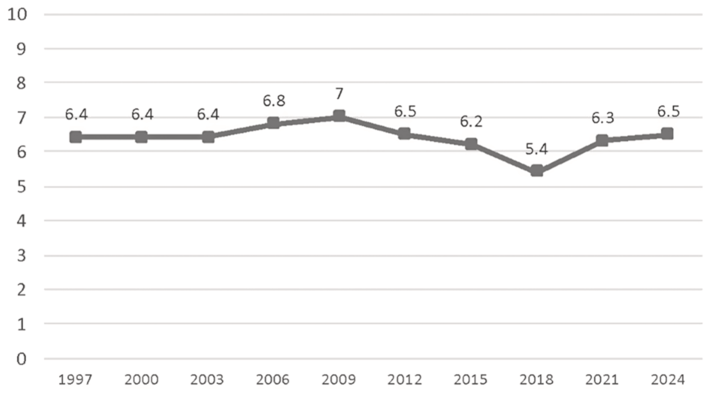
To assess demand for a populist radical right in Mexico, this section relies on data from the Mexican Election Study (Beltrán et al., Reference Beltrán, Castro Cornejo, Altamirano and Singer2024), post-electoral surveys conducted one to two weeks after presidential and legislative elections. On the left–right scale (0 = left, 10 = right), the average voter scored 5.4 in 2018, 6.3 in 2021, and 6.5 in 2024 (Figure 9.1), indicating a generally moderate electorate. Nevertheless, as Table 9.2 shows, except in 2015 and 2018, a sizable share of voters placed themselves at “9” or “10”; in both 2021 and 2024, roughly one-third identified with the far-right end of the spectrum.
Voters’ self-placement on the left–right scale in Mexico (1997–2024).
In politics people sometimes talk of left and right. Where would you place yourself on a scale from 0 to 10 where 0 means the left and 10 means the right?
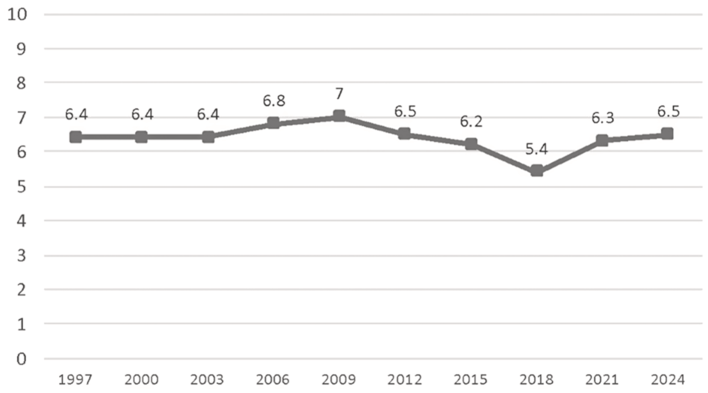
Figure 9.1 Long description
The 27-year data for the line chart comes from the Mexican Election Study and uses the standard survey question where respondents place themselves on a scale from 0 (left) to 10 (right). The chart tracks the mean or median position of the Mexican electorate across ten measurement points between 1997 and 2024. The trend line shows how the average ideological placement has shifted over time, potentially revealing periods of movement toward the left, right, or political center. The chart provides a comprehensive overview of the Mexican electorate's ideological evolution across multiple presidential administrations and party systems, showing both short-term fluctuations and longer-term trends in political identity.
| 0–1 | 2–3 | 4–6 | 7–8 | 9–10 | |
|---|---|---|---|---|---|
| 1997 | 12% | 6% | 32% | 13% | 37% |
| 2000 | 12% | 6% | 32% | 16% | 34% |
| 2003 | 11% | 5% | 34% | 18% | 32% |
| 2006 | 11% | 4% | 23% | 23% | 38% |
| 2009 | 4% | 5% | 26% | 37% | 29% |
| 2012 | 9% | 7% | 30% | 25% | 29% |
| 2015 | 5% | 10% | 37% | 33% | 15% |
| 2018 | 10% | 16% | 37% | 26% | 11% |
| 2021 | 10% | 6% | 34% | 20% | 29% |
| 2024 | 12% | 4% | 32% | 18% | 34% |
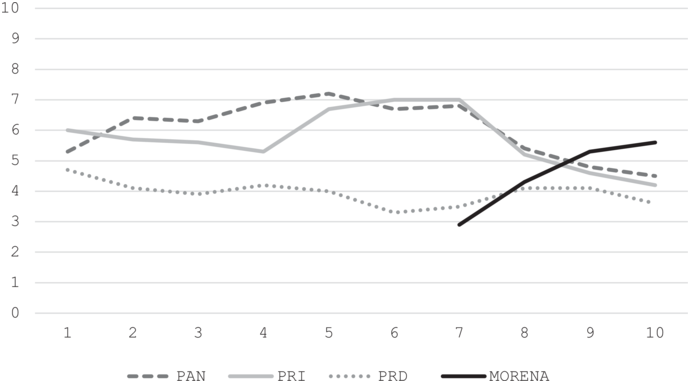
Figure 9.1 presents voters’ perceptions of the ideological placement of Mexico’s major parties. No party is generally viewed as occupying an extreme position, either on the left (0–2) or right (8–10). López Obrador’s party, perceived as leftist in 2015 (2.9), shifted toward the center – 4.3 in 2018 and around 5.5 and 5.6, respectively, in 2021 and 2024. Why is a party that self-identifies as a leftist party increasingly perceived as a centrist party? This trend may reflect the recurrent pattern – except in 2018 – of the incumbent party being placed to the right of the opposition (1997: PRI; 2000–2009: PAN; 2012–2015: PRI; 2021: MORENA), suggesting that for some voters “right” signifies “incumbent” rather than a specific ideology.
A second possibility is that, once in office, incumbent parties are perceived as supporting center-right policies. This pattern was evident in the final years of both PRI and PAN administrations: from 1994 to 2000, the PRI administration advanced market-oriented policies opposed by the PAN in Congress, while from 2000 to 2012 the roles reversed. From 2012 to 2015, however, both parties jointly approved a series of economic reforms under the “Pacto por México,” producing the smallest recorded ideological gap between them in the 2015 midterm elections. In MORENA’s case, incumbency likely contributes to its centrist perception, but the shift is also consistent with this chapter’s broader argument: López Obrador’s government has not consistently advanced a progressive agenda, particularly on sociocultural issues.
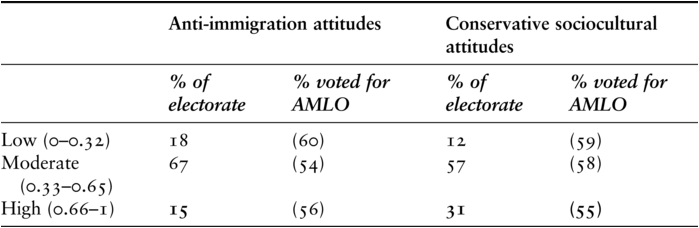
After analyzing left–right identification of the major parties in Mexico, Figure 9.2 focuses on voters’ programmatic preferences – rather than a symbolic attachment to the labels “left” and “right” – particularly on the two major components of populist radical-right parties: nativism and authoritarianism (Rovira Kaltwasser, Reference Rovira Kaltwasser2023). Table 9.3 presents data from two indices constructed from two battery questions included in the 2018 Mexican Election Study (Beltrán et al., Reference Beltrán, Ley and Castro Cornejo2020). These indices aim to identify voters’ anti-immigration attitudesFootnote 44 and conservative attitudes on sociocultural issues (abortion and same-sex marriageFootnote 45). The two indexes were rescaled from 0 to 1 to facilitate interpretation (e.g., higher values mean a more conservative position). As Table 9.3 shows, although few voters in Mexico report a high level of anti-immigration attitudes (scoring 0.66 or more on the 0–1 index: 15 percent), almost a third of voters – 31 percent – report conservative sociocultural values. In other words, the data suggest that there is demand for conservative policies, at least on topics like abortion and same-sex marriage. However, as discussed in the previous sections, a populist radical-right candidate has not mobilized those voters. In fact, as Table 9.2 shows, despite being a leftist candidate, in 2018 López Obrador received fairly similar support from conservative and progressive voters across these two components.
How voters perceive parties’ ideology in Mexico (1997–2024).
Where would you place… on a scale from 0 to 10 where 0 means the left and 10 means the right?
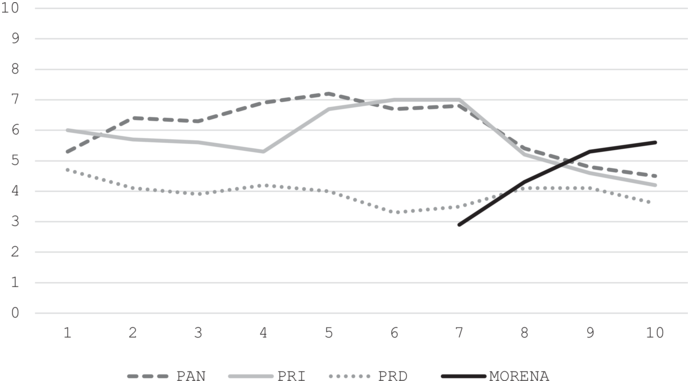
Figure 9.2 Long description
Using data from the Mexican Election Study, the chart employs the standard 0-10 scale where 0 represents the far left and 10 represents the far right. The chart displays separate trend lines for each major Mexican political party, likely including PRI, PAN, PRD, and Morena, showing how voters have positioned these parties ideologically over time. The chart shows whether parties have maintained consistent ideological positioning in the public's view or have experienced notable shifts in their perceived placement. It also illustrates the relative distances between parties on the spectrum and how these perceptual gaps have changed over nearly three decades of Mexican democracy, providing insight into the evolving structure of political competition as seen through voters' eyes.
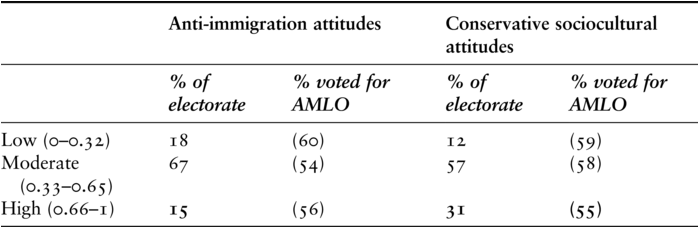
Table 9.3 Long description
The table has two columns titled anti-immigration attitudes and conservative sociocultural attitudes. Each columns have two sub-columns titled percentage in the electorate and percentage voted for AMLO.
For the row titled low, 0 to 0.32 has the following percentages. 18 percent. 60 percent. 12 percent. 59 percent.
For the row titled moderate, 0.33 to 0.65 has the following percentages. 67 percent. 54 percent. 57 percent. 58 percent.
For the row titled high, 0.66 to 1 has the following percentages. 15 percent. 56 percent. 31 percent. 55 percent.
The note below reads. Source: Mexican Election Study, Beltran et al 2024.
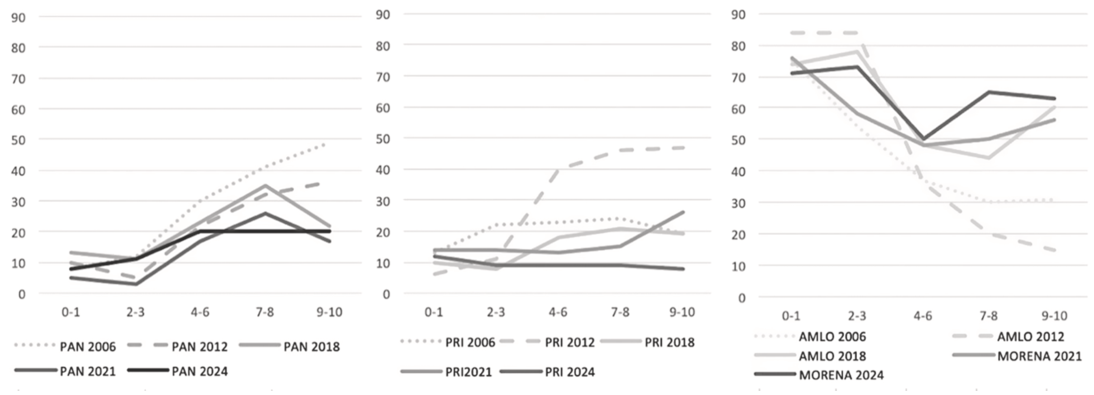
Figure 9.3 shows support for PAN, PRI, and AMLO–MORENA from López Obrador’s first presidential election in 2006 to the most recent presidential election in 2024, across ideological groups based on the left–right scale (0–10 scale). In his first two presidential campaigns, AMLO drew more support from leftist voters than from rightist ones. Beginning with his 2018 presidential campaign, however, the slope in Figure 9.3 becomes less pronounced, and by 2024 it is almost flat. In other words, AMLO in 2018, and MORENA – in the 2021 midterm election and in 2024 with Claudia Sheinbaum as its presidential candidate – received not only strong support from leftist voters but also substantial support from rightist ones.
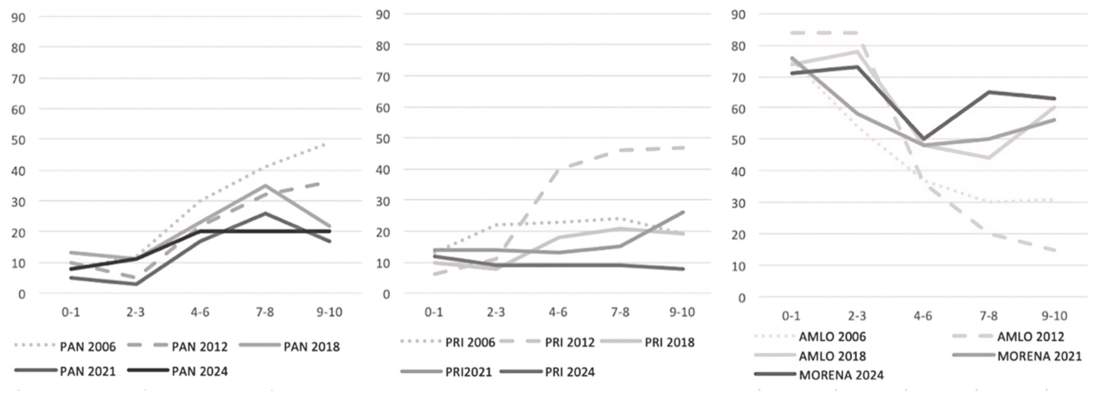
Figure 9.3 Long description
Using data from the Mexican Election Study, it displays voting patterns for the three major political forces, PAN, PRI, and MORENA across different ideological segments of the electorate.
The charts group voters by their self-placement on the left-right spectrum and shows the percentage of each ideological group that voted for each major party coalition in different election years. This visualization reveals how party support is distributed across the political spectrum and how these patterns have evolved over two decades.
The data shows PAN's strength among right-leaning voters, MORENA's dominance among left-leaning segments, and PRI's historical support among centrist voters. The chart also illustrates important shifts, particularly MORENA's ability to capture center-left voters and make inroads into the political center since its emergence.
In 2006 and 2012, AMLO received only 31 percent and 15 percent, respectively, of the vote from respondents placing themselves at 9 or 10 on the left–right scale. By 2018, López Obrador captured 60 percent of this group; MORENA won 56 percent in the 2021 midterms; and Claudia Sheinbaum reached 63 percent in 2024 – the party’s highest level. Thus, Mexico’s first left-wing governments since the democratic transition appealed not only to their traditional base but also consolidated substantial support among rightist voters. In fact, conservative voters became a key group within MORENA’s cross-ideological coalition.
9.4 Conclusion
While populist radical-right parties have emerged as a backlash against leftist parties and presidents in some Latin American countries (Zanotti & Roberts, Reference Zanotti and Roberts2021), no significant far-right party or movement appeared in Mexico in response to López Obrador’s 2018 electoral victory. This chapter argues that because his government did not strongly support progressive policies on gender equality, LGBTQ+ rights, family structures, or racial equality, conservative grievances did not emerge. In other words, there was no perceived threat to traditional values that could trigger far-right mobilization. While some elites have attempted to do so – for example, the FRENA movement, which aimed to activate anti-communist/anti-Foro de São Paulo mobilization against AMLO’s administration – these efforts were largely unsuccessful.
In the 2024 presidential election, MORENA reinforced its catch-all profile, securing unprecedented conservative support: 63 percent of voters who placed themselves at 9–10 on the left–right scale backed Claudia Sheinbaum, including 55 percent who held conservative views on abortion or LGBTQ+ rights. Although a longtime leftist activist, Sheinbaum – like López Obrador – often sidestepped divisive issues during the 2024 campaign, avoiding explicit support for abortion rights.Footnote 46 More recently, she adopted a conservative stance on marijuana legalization, warning that it “can lead to the consumption of other drugs,”Footnote 47 and has continued the Lopezobradorista policy of reinvigorating the state-owned oil industry – despite her background as a climate scientist. Her government has also preserved two core features of Lopezobradorismo: populist rhetoric framing society as a struggle between a corrupt elite and “the people,” and support for a range of illiberal actions against democratic institutions (Aguiar et al., 2025). Sheinbaum championed a judicial reform that purged the Supreme Court and the judiciary, supported the dismantling of the Instituto Nacional de Acceso a la Información (National Institute of Transparency for Access to Information – INAI) – formerly an independent guarantor of public information, now under executive control – and further blurred the boundaries between civil and military authority, entrenching the military’s political and economic role in non-military areas of public life.
While Sheinbaum is likely to maintain leftist economic policies alongside moderate-to-conservative sociocultural stances, two factors could enable far-right mobilization. First, unlike López Obrador – who tightly controlled MORENA and confined progressive initiatives to the local level – Sheinbaum appears less preeminent, potentially reducing her ability to block progressive demands nationally, which could trigger a conservative backlash. Second, a new window of opportunity is opening for the far right. Eduardo Verástegui – who failed to qualify as an independent candidate in 2024 – recently launched the “Viva México” movement to seek party registration for the 2027 midterms. Positioning himself as the voice of an “orphaned” right, Verástegui denounces the PAN as a “cowardly right wing” party,Footnote 48 appealing to a substantial, largely untapped conservative bloc in Mexico: 32 percent oppose same-sex marriage, 48 percent oppose adoption rights for same-sex couples, and 50 percent oppose abortion rights (2024 Mexican Election Study). Other leaders, like multimillionaire businessman Ricardo Salinas Pliego, have also recently emerged in the public arena. An ally of former President López Obrador, and adopting rhetoric similar to that of libertarian, anti-system Javier Millei, Salinas Pliego has harshly criticized the Sheinbaum government and has used his television network to amplify his conservative rhetoric.
Despite stringent legal restrictions, the inclusion of an explicitly far-right party in the electoral ballot could activate conservative voters, reconfigure electoral competition, and erode MORENA’s cross-ideological coalition. Survey evidence shows that highly sexist individuals were less likely to vote in 2024, when both major coalitions nominated women presidential candidates (Konzevik & Castro Cornejo, Reference Konzevik Makowski and Castro Cornejo2025). If able to compete in future elections, a far-right party could mobilize conservative voters, particularly in the context of the administration of Mexico’s first woman president.

 Open access