





Introduction
The emergence of creoles has been a controversial topic since these language varieties, spoken primarily by people of non-European descent in especially former plantation settlement colonies, caught the attention of European philologists and genetic linguists in the late nineteenth century. Except for Herman Paul,Footnote 1 these precursors of modern linguists then conceived of languages as comparable to biological organisms, which were expected to reproduce the features of their parents with the least deviations from them. Language ancestry was conceived of uniparentally, such that there was no convincing explanation for why Latin speciated into different Romance languages that are no longer mutually intelligible. The extent of cognates and of phonetic correspondences between the daughter languages was assumed to reflect degrees of genealogical kinship, though they are not informative regarding whether the correspondences were inherited from the parent or proto-language, whether they were jointly borrowed from a language other than the parent (therefore attributable to language contact), or whether they were homological evolutions.Footnote 2
Assuming that there were Newtonian physics-style regularities in the way that phonological changes occurred, neogrammarians then hypothesized “sound laws” that captured the patterns thereof but provided no explanation for why the changes occurred in the first place, let alone why speciation ensued from the changes. Dismissing or downplaying the role of language contact, the typical explanation for the speciation of Latin into the Romance languages was simply that migrations in different geographic directions would produce change. This is the same explanation provided for the diversification of Proto-Indo-EuropeanFootnote 3 into so many different Indo-European languages. As the relevant places where speakers of the protolanguages differed from one another, divergences occurred that differentiate the daughter languages not only from the protolanguage but also from one another. Although Romanists initiated the theory of substratum (borrowed from geology) in linguistics, they did not capitalize on the fact that indigenous languages in the relevant provinces of the Roman Empire had been spoken by the very people that shifted to Latin, and it is through them that the substrate influence took place.Footnote 4 This is how language contact becomes relevant to historical and genetic linguistics. Still, Neogrammarians’ “sound laws” intended to capture regularities in these changes made no reference to language contact as an actuator of change.
It is critical to also situate the earliest accounts of the emergence of creoles in the context of the colonization of the world outside Europe since the fifteenth century by especially Western Europeans but also Russia for parts of Asia. When, in the nineteenth century, Western Europeans schemed to expand their trade colonies of Africa, Asia, and the Pacific into exploitation colonies, different from their settlement colonies of the New World, they came up with a convenient justification, namely, what the French called “la mission civilisatrice” and the British “the white man’s burden.” According to these colonizers, non-European populations, whom the Europeans intended to subjugate, were “less evolved” and mentally inferior, therefore they had no civilizations. It was putatively the Europeans’ moral responsibility to “civilize” them. Their non-European languages, to which the Europeans often referred as “jargons” (because they were not intelligible to them) were also considered “savage” and “primitive.” This was consistent with Schlegel’sFootnote 5 typological classification of languages, which positioned the Indo-European languages at the top of the hierarchy.
In this colonization context, creoles and pidgins were interpreted as “bastard tongues” (which BickertonFootnote 6 repeated in the title of his book), that is, corrupted versions of European languages in the mouths of the inferior humans.Footnote 7 According to Hesseling,Footnote 8 they are the outcomes of the “misshaping” of the languages typically identified in creolistics as “lexifiers,” that is, the language that contributed the lion’s share of the vocabulary to the new language (variety). Regarding Dutch in the colonies, Hesseling applied this explanation to, for instance, Negerhollands (in the Virgin Islands) but not to Afrikaans, spoken primarily by descendants of the Dutch in South Africa, although it too has diverged significantly from metropolitan Dutch and is considered a new language. Generally, influence from the “primitive languages” of the producers of these new vernaculars was then invoked as the explanation, on the assumption that population movement and contact had played no (significant) role in the successive speciation of the Indo-European languages among Europeans. And these new vernaculars (in the sense of the language varieties used for day-to-day communication, starting with the home) have since then been considered as mixed or hybrid, and therefore as anomalies not consistent with the neogrammarians’ account of change.
In too simplistic a way, Thomason & KaufmanFootnote 9 characterize creoles inaccurately as languages whose vocabularies have been inherited from their (European) lexifiers but the grammars from other sources. To be sure, alternative accounts were provided. For instance, Coelho,Footnote 10 cited by Gilbert 1986,Footnote 11 invoked universals of second language acquisition as the explanation (involving distortions of the target language), while SchuchardtFootnote 12 argued that creoles were actually revealing the ways in which Indo-European languages had speciated. However, these alternative accounts were generally ignored until the second half of the twentieth century, when multiple hypotheses were formulated to account for their characteristics.
To date, creolists are still divided regarding whether creoles and pidgins are the outcomes of exceptional language evolution. Adamant advocates of what DeGraffFootnote 13 calls “creole exceptionalism” include Bakker et al.,Footnote 14 McWhorter,Footnote 15 and Parkvall;Footnote 16 those of non-exceptionalism include Chaudenson,Footnote 17 Mufwene,Footnote 18 DeGraff,Footnote 19 Aboh,Footnote 20 and Aboh & DeGraff.Footnote 21 Nonetheless, these advocates and other creolists agree that creoles are hybrid language varieties (pace “Mixed Languages”)Footnote 22 as underscored by the title of Aboh,Footnote 23 regardless of whether they should be considered as new nonstandard dialects of their lexifiers or separate languages altogether.Footnote 24 Correlated with this issue is the question of whether creoles evolved directly from their lexifiers, without a break in the latter’s transmission, or are the creations of new languages from intermediate pidgins (as “broken language varieties” without a grammar at their incipient stage; e.g., Bickerton).Footnote 25 Exceptionalists assume that there was a break in the transmission of the lexifier. It is, however, very likely that pidgins emerged in geographical complementary distribution with creoles, under differing contact conditions.Footnote 26 They may even have evolved later than creoles.Footnote 27 According to Yakpo,Footnote 28 the English pidgins spoken in West Africa are nineteenth-century offshoots of Sierra Leone’s Krio (a creole that originated in Jamaica). In addition, MufweneFootnote 29 argues that, like creoles, pidgins did not start as broken languages but evolved by gradual divergence away from their lexifiers under the influence of the substrate languages. In the following, I focus on the question of hybridity in language, without any further references to where individual creolists stand regarding the emergence of creoles and pidgins.
We must also bear in mind that academic interest in these vernaculars developed against the backdrop of the late-nineteenth-century European ideology of purity according to which hybrid species (such as the mule) and contact-based language varieties (especially creoles and pidgins) were considered as, respectively, degenerates and corruptions less fit for normal communication. This was an ironic hyperopia that prevented the relevant nineteenth-century European scholars from recognizing that English and the Romance languages were themselves the outcomes of language contact. Against this tradition, Bailey & MaroldtFootnote 30 and Schlieben-LangeFootnote 31 argue that these European languages can be considered as creoles too.
Thus, in the nineteenth century, SchuchardtFootnote 32 was exceptional in arguing that creoles, pidgins, and cases of language convergence (such in the Balkans) should actually prompt us to revisit critically the traditional uniparental account of the speciation of Indo-European languages based almost exclusively on the comparative method. As noted previously, this approach enabled genetic linguists to determine which languages were structurally more similar to, or different from, one another but not how the (dis)similarities of their structures emerged. In other words, structural kinship is not necessarily evidence of genealogical kinship. It should also become apparent that race has always had something to do with the account of the emergence of creoles as exceptional evolutions.Footnote 33 As shown in Language Evolution,Footnote 34 antecedents of this tradition can be identified in the reluctance of several European precursors of genetic linguists, in the early nineteenth century, to include Indic languages in the Indo-European family. Their reason was that speakers of Indic languages were less evolved than the Greeks, the Romans, and therefore Europeans in general, although indigenous scholarship on Sanskrit preceded that on Ancient Greek and Classical Latin.
Hybridization of Language
Hybridity in creoles would not have been considered as exceptional or anomalous if, since the early nineteenth century, languages and dialects had not been conceived of as organisms without internal variation. This position was also the consequence of the incorrect assumption that, as pointed out by Mufwene,Footnote 35 language “acquisition” or “transmission” is vertical and unidirectional, proceeding from caregivers and schoolteachers to children. The assumption overlooks how children keep up with and learn from one another in their respective play or peer groups. In any population, when it comes to culture, including language, there are innovators and copiers, with the roles changing according to forms and structures.Footnote 36 As a matter of fact, interactions in peer groups appear to play a more important role in the ontogenetic development of competence in their vernaculars than interactions with caregivers. Language practitioners align with one another by age, gender, and, later on, by profession and lifestyle; and the desire to align with the others prompts them to learn from one another and, through competition and selection, to converge to group norms. After all, language “acquisition” does not end until one is incapacitated mentally and perhaps also anatomically. Also, despite several paradigm changes in linguistics since Ferdinand de Saussure,Footnote 37 it has been assumed that languages are social institutions that are learned intact from generation to generation with changes introduced in performance, the modern term for what de Saussure identified as parole (“speech”). The position presented here is at variance with this tradition. Even among native speakers only, languages are being reshaped several times over while they are used to meet communicative needs that can be new and need innovations or modifications of current patterns of use. Sometimes innovations are triggered by contact with other languages, just as native technologies can be modified under the influence of foreign technologies. Besides, adults learn some forms and structures from children too, especially among immigrants. Therefore, age is an epiphenomenon in language “transmission,” which is essentially horizontal, regardless of age and status.Footnote 38
In an effort to account for the mixed origins of structural features in creoles, I conceived of the construct of “feature pool,” similar to that of “gene pool” in biology, to explain by competition and selection how coexistent features and patterns from different languages in contact can be recombined into new linguistic systems.Footnote 39 See The Emergence of Hybrid Grammars Footnote 40 for a detailed account.Footnote 41 I identified the process that generates the new system as “feature recombination” (after the biological notion of “gene recombination”). This has been aptly fleshed out by AbohFootnote 42 focusing on Haitian Creole, which arose under a strong but non-exclusive influence of speakers of Gbe languages.
It is in this context that I also thought of idiolects as hybrid linguistic systems at the level of individual practitioners. They are like offspring in animal biology, with the difference that I actually analogized languages with parasitic species in The Ecology of Language Evolution Footnote 43 and then modified the analogy to viruses in Language Evolution. Footnote 44 This approach also made it possible to show the role of polyploidy in what, for convenience’s sake, I will continue to refer to as language transmission or acquisition. Unlike in animal biology, the learner (like the host in virology) gets different inputs, some of which are variants of one another, from the feature pool generated by the ensemble of the idiolects of individuals he/she has interacted with. Things become more complex at the population level, that of language or dialect, as different individuals have different interactional histories and the feature pool projected at the community level is a construct of convenience, which is an ensemble of individual practitioners’ feature pools. Welcome to complexity!
If one adds to this explanation the fact that there is no modern language today that does not reflect ancestry in the contact of languages or dialects that generated new feature pools, then it should be evident that, like every idiolect, every language is a hybrid system (pace Meakins and Stewart).Footnote 45 In Figure 1, every vertical arrow corresponds to an idiolect, a dialect, or a sociolect of the same language, while the lateral arrow corresponds to a/several separate language(s) coming in contact with the lexifier. Note that in the case of the creole vernaculars, the lexifier, corresponding to the vertical arrows in the figure, consisted of nonstandard dialects of English, Dutch, French, Portuguese, or Spanish. The dialects came in contact with one another (thereby evolving into colonial compromise varieties characterized as koinés) and with African languages spoken by the enslaved Africans in the settler plantations and maroon communities of the Caribbean (including Guyane and Surinam), in Palenque de San Basilio (Colombia), in Louisiana, and on the Mascarene islands in the Indian Ocean, or with indigenous languages on Pacific islands and in Australia. By comparison, in the case of the Romance languages, the lexifier consisted of various nonstandard dialects of Latin identified collectively as Vulgar Latin (literally, “Latin of the common people”), while the substrate languages consisted of Celtic and other indigenous languages of the relevant provinces in the Roman Empire.
The Linguistic Feature Pool.
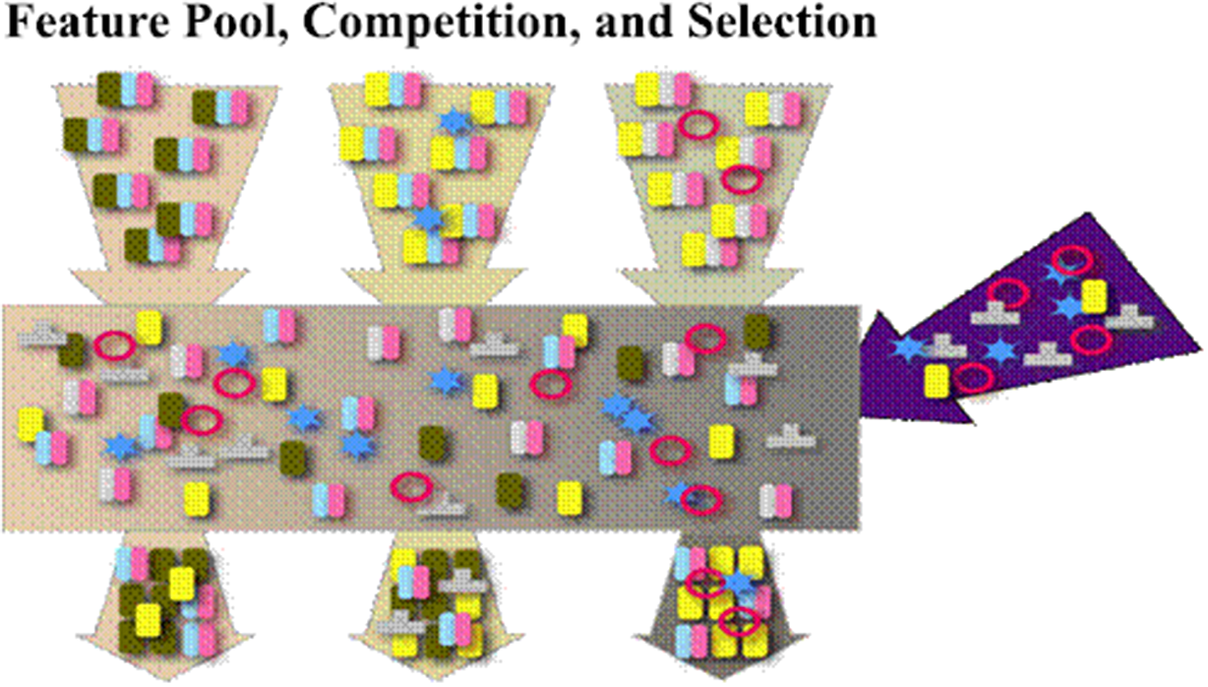
To be sure, the feature pool from which each new language (variety) emerged was different, depending on its contact ecology, namely, which languages came in contact and at what time, what were the demographic strengths of their respective speakers, and how its local population structure facilitated interactions across ethnolinguistic boundaries. Population structure determines whether a particular population prevails politically, economically, or numerically over (an)other population(s), whether the dominant population is interested in learning the dominated population’s language(s) or the latter group(s) bear(s) the burden of learning the former group’s language, and whether things evolve in such a way that the dominated people also have to communicate among themselves or across dominated ethnolinguistic groups in the dominant language.
The latter conditions of social interactions are conducive to what is called language shift, with the heritage vernaculars being replaced by the new, dominant, or superstrate vernacular. The latter typically wins only a Pyrrhic victory because it is modified by influences from the substrate languages. The composition of the general population, regardless of whether it is residentially segregated, changes over time. If practitioners of the superstrate language are the majority, various factors may limit the extent to which elements from the substrate languages in the feature pool can influence the reshaping of the superstrate language. If, however, speakers of the substrate languages are the majority, their features can bear significantly on the selection of features into the emergent new language variety, especially if the overall population is residentially segregated. This was generally the case in the emergence of creoles and the Romance languages, regarding the divergence of their structures from those of their lexifiers. In the case of creoles, which emerged in exogenous colonies, factors such as the Founder Principle/Effect and patterns of population growth also influenced not only how much vocabulary was selected from the lexifier but also the extent to which structures of the latter’s grammar were selected with or without modification during the feature recombination into a new, hybrid linguistic system.Footnote 46
AbohFootnote 47 has shown that even the substrate contributions can be modified during the feature recombination. As a matter of fact, CorneFootnote 48 had argued that, because languages do not differ completely or in all respects typologically, congruence of structures has usually played an important ecological role in favoring the selection of specific features during the restructuring of the relevant lexifiers into creoles. From a uniformitarian perspective, the same was true during the early evolution of English in EnglandFootnote 49 and has been true during the emergence of indigenized varieties of European languages in Europe’s exploitation colonies of Africa and Asia, as noted previously. We must not overlook here the fact that in the latter case the majority of speakers of these colonial languages practice them typically as a second or umpteenth language in their repertoires, namely, as a lingua franca; only a small elite class uses them as their non-indigenous vernaculars. Hybridization has thus been a concomitant of the emergence of new language varieties from older ones, a fact that can be verified since antiquity, thanks to the invention of writing.
Creoles and pidgins are certainly not exceptional, especially as it appears now that the main difference between these two kinds of language varieties lies not in how they developed but in the fact that the former have always functioned as vernaculars whereas the latter started as lingua francas between speakers of different languages. Both creoles and pidgins differ from the varieties claimed to have changed less drastically from their lexifiers in that the segregated population structures in which they emerged facilitated more extensive influence from the substrate languages. Note that the influences do not necessarily amount to features that were not attested in their lexifiers; very often they consist in favoring features of the lexifiers that were (partly) congruent with those of some substrate languages.Footnote 50 In this respect, creoles and pidgins are similar to the colonial varieties of European languages characterized as indigenized, such as Indian and Nigerian Englishes and those identified as “français d’Afrique” or “français africains.” An important difference is that creoles and pidgins are outcomes of naturalistic, aka untutored, language learning, whereas the latter colonial varieties are outcomes of schooling. In both cases, the non-European learners have practiced the European languages in communication more among themselves than with heritage speakers of the lexifiers. These ecological conditions have enabled various xenolectal features to reinforce one another and to naturalize among the practitioners and to become entrenched as part of their new norms. According to Chinua Achebe,Footnote 51 cited by Kachru,Footnote 52 the allochthonous speakers have domesticated the “masters’” languages to where these have been adapted to their communicative needs or traditions, although, to be sure, Africans and Asians use these languages primarily to serve communicative functions introduced by the colonizers.Footnote 53
In the bigger uniformitarian picture, the difference in hybridization lies in the varying extents to which xenolectal features, be they substratal or adstratal, have mixed with those of the lexifier (see, e.g., ClementsFootnote 54 in the case of colonial Portuguese varieties). From geographical and chronological perspectives, varying population structures have produced differing feature pools in which competition and selection have operated. Variation in the timing and rigidity of segregation or degrees of integration accounts for structural differences among the colonial varieties of the European languages. I will now explain this in the next section.
Why the New Varieties of European Languages Differ (So Much) from One Another
The hypothesis of language hybridization in the case of creoles was inspired by the presence in these new vernaculars of structures not attested (to the same extent) even in the seventeenth- and eighteenth-century varieties of their lexifiers. These include, among several others: 1) the lack of articles and the decoupling of number and demonstratives (which express definiteness) in Haitian Creole (French based); 2) the fact that nominal number is not expressed by a suffix, while adjectives behave like verbs in predicative function in Caribbean English creoles; and 3) the fact that generic reference is expressed by a bare noun (without a determiner or an affix) and the prominence of serial predicate constructions in virtually all the creoles lexified by Western European languages. The following examples illustrate these characteristics:
-
(1) Lack of articles in Haitian Creole (if yon is analyzed as the quantifier “one,” and indeed it functions syntactically like other quantifiers, occupying a prenominal position):
chat la “cat def” (“the cat”); chat la yo “cat def pl” (“the cats”); chat sa yo “cat dem pl” (“those cats”); chat yo (“cat pl”) “cats” (indefinite reference); chat “cats” (generic reference); yon chat “one/a cat”Footnote 55
-
(2) Nominal number and predicative adjectives in Caribbean English creoles:
di bway “the boy”; di bway dem “the boy pl” (“the boys”); Bill (an) dem “Bill and his associates/family” (with the dem expressing the associative plural in this case); di big bway “the big boy”; di bway big “the boy [is] big”; di bway de big “the boy [is being/acting] big” (similar to “the boy is being noisy”)
-
(3) Prominence of serial verb constructions:
Uh tell um come kyah me to da hospital (Gullah)
I told him [to] come [and] drive me to the hospital.
Mennen timoun yo vini wè m (Haitian CreoleFootnote 56)
lead child def-pl come see 1sg
Bring the children to see me.
Hybridization is evident from the fact the structures of these constructions also include patterns inherited from the lexifier, such as the basic Subject-Verb-Object word order in (3), the prenominal position of the article in (2), and even the position of the definiteness marker and the demonstrative in (1). Considering that several African languages, especially those of the Bantu family, do not have a significant category of adjective, what is evident here is that the category has been selected from the lexifier, but the predicative pattern without a copula before the adjective is definitely influenced by some of the substrate languages, particularly those of the Kwa family. To be sure, there are some partial congruent patterns between the lexifiers and some substrate languages, for instance, in the following English construction in which the copula is not used before the adjective ready:
-
(4) She arrived ready for the new job.
The point is that creoles are not exceptional in displaying such hybridity. Emonds and FaarlundFootnote 57 show that some features of Middle English that have been kept even in Modern English reflect influence from Old Norse. They include: the use of auxiliary modals such as will and shall to express future; double modal constructions such as should may (precendents of might could and the like in, for instance, American Southern English); the use of have + past participle for past tense in nonfinite clauses, as in will have served; and stranded prepositions in relative clauses and questions, as in the topic that Mary wrote about. Given the contact history of the birth and evolution of English, it would be surprising if it bore no influence of the languages that Anglian and, subsequently, Old English came in contact with. Thus, we may say that the nonheritage features produced in, for instance, the indigenized English varieties of Scottland, Ireland, Africa, and Asia instantiate repetitions of history process-wise. The same account applies to the emergence of the Romance languages, which exhibit features not typical of Latin, such as articles and finite subordinate clauses instead of tensed infinitival subordinate clauses attested in Latin.
The uniparental model of language speciation shows adequately the outcomes of contact-induced restructuring processes, though we must note that the Stammbaum (or cladogram) representing varying degrees of kinship in a language family (e.g., Bantu or Indo-European), designed on principles of taxonomy, has erased the processes themselves. The nineteenth-century ideology of language purity, which fostered the neogrammarians’ rules of regularity of change and the disenfranchising of creoles as contact-based “bastard languages,” was colonial fiction that reflects the dismissal of the significance of language contact in the evolution and speciation of Indo-European languages.
The history of mankind since the dispersal out of Africa has been marked by layers of migrations and contacts between the migrant populations at different stages. Hybridity should be the default in the emergence of modern languages, none of which can be traced directly to the protolanguages that developed in Africa before the dispersal of Homo sapiens out of the continent about 50,000 years ago. Migrations in different directions within and across continents, especially those associated with imperial expansions since antiquity complicate the picture. For instance, Latin (whose origins remain obscure) was influenced by contact with the Celtic languages, which triggered its speciation into the Romance languages, but the latter were also shaped by contact with Arabic in the case of Spanish and with Frankish in the case of French; and then the ensuing modern varieties of the Romance languages were modified by contacts with non-European languages in the colonies. Hybridity also obtains in the ontogenetic development of language, usually referred to as “language acquisition.” The effect of polyploidy, combined with the uniqueness of the interactional histories of every speaker or signer, is quite obvious here, although differences between idiolects shaped by these factors are often subtle. This is the consequence of mutual accommodations among speakers and overlaps in the learners’ interactional histories. No new speaker or signer is a replica of any of the different individuals from whom they have copied (by approximations) various features of their idiolects.
We must also note that languages are cultural phenomena and hybridity is pervasive in cultures, and more so at this age of increased worldwide globalization effected by increased long-distance migrations and improved telecommunication. Visual arts, music styles, literary conventions, culinary practices, clothing fashions, and material technologies (including our mobile phones), to mention just a few, have evolved by hybridization of ideas, revealing osmosis between culture boundaries. The challenge is always to extricate the elements that have been selected from the different cultural practices in contact that have shaped the emergent fashions, styles, conventions, and so on in the relevant cultural domains. For instance, in novels written in English by Nigerian writers, what are—relative to the British conventions—the nonheritage structures as well as lexical items and discourse strategies that are patterned on Nigerian cultural (including linguistic) traditions that make the productions Nigerian? One can ask the same question about literary productions in Anglophone North America. Much of the so-called “postcolonial” literature (although I wonder to what extent Canada and the United States are postcolonial politically) instantiates hybridization. Authors from different nations who write in European languages reflect the indigenization of these languages as they bear influence from the cultural ecologies to which they have been adapted.Footnote 58
Artistic hybridization can be detected quite easily in the domain of music. For instance, European instruments and rhythms have mixed well with some African musical traditions in the Americas and the Caribbean to produce syncretic musical styles such as Reggae, Calypso, Salsa, Zydeco, and the Blues. On the other hand, the adoption of some of these musical styles back in Africa has come along with reindigenization, so that Reggae and Salsa in West Africa have a particular local touch, as does the adaptation of Reggae to North African beat, just as also Jazz is (re-)Africanized in South Africa.
Culinary hybridization is so pervasive that I’m sure there must be several publications on the subject matter. I will just mention here what my travels to different places, thanks to my research on creoles, has made so evident to me. The globalized spice trade since the time the Arabs and Chinese connected Asia and Europe, long before the European colonial expansion, spread various spices around the world, notably peppers. African cuisines hybridized from this cultural contact. The slave trade took Africans to the Americas and the Caribbean, as well as to several (other) islands of the Atlantic and the Indian Ocean. Forming critical masses in these settlements and sometimes constituting majority populations, the Africans produced hybrid cuisines with noticeable African influence, especially in Brazil and the Caribbean, though one cannot deny, for instance, Portuguese input in Brazil, just like the French input in Louisiana. East Indian influence is also noticeable in Caribbean islands where large numbers of Indian contract laborers were brought after the abolition of slavery. And one can go on and on to show how extensive hybridization has been in the culinary domain, including African American “soul food” and in fact the American Southern cuisine.
Conclusions
It appears that cultural hybridization is a ubiquitous and natural way of social life, as populations that come in contact learn from one another. As Wang (2022) formulates it for languages (based on the situation in China):
Each language is a mixed bag of sounds, words, idioms, & constructions of various sizes, a product of many millennia of historical development. Its content comes from a diversity of heterogenous sources, different cultural & multiple linguistic environments.Footnote 59
Hybridization starts with how individuals develop their respective versions of their communal cultural practices (which are not identical), display inter-individual variation, and reflect the counterpart of the outcome of polyploidy in biology. At the population level, it is a more complex process, as it proceeds through individuals learning first- or secondhand from practitioners of the other culture, the accommodations they make to one another, and the competition-and-selection-based emergence of communal norms within the borrowing population.
Creole cultures, including the language varieties called “creoles,” have definitely made us more aware of hybridization as an outcome of population contact, which enables contacts of languages and, generally, of cultures. However, contacts are not a peculiarity of creoles alone. As a matter of fact, an open-minded and broader look at the outcomes of population movements (including colonization ventures) and the ensuing contacts should prompt us to ask what distinguishes creole vernaculars and cultures from other languages and cultures. Should differences between these linguistic and cultural categories be articulated dichotomously or in terms of degrees? SchuchardtFootnote 60 appears to have been correct in arguing in the case of creole vernaculars that they are prompting us to revisit the evolutions of their lexifiers themselves, to realize that they too were hybrid phenomena produced by language contact. Languages as particular aspects of cultures, which are “acquired” through learning by inference, are telling us that specific cultures anywhere in the world have not escaped hybridization. We must of course bear in mind that some of the mixed features are reshaped during the process of integration into new systems.
At the same time, cultures are dynamic and in the state of flux, repeatedly being adapted to their changing ecologies, natural and social, owing largely to migrations at different times in history. This state of affairs accounts for the changing weights of the contributions from different sources. New inputs change the composition of the contact “feature pool” in which competition drives ongoing “feature recombinations.”Footnote 61 Thus, one has to investigate the contact history of whatever phenomenon in some part of world they are interested in and uncover layers of influences within changing population structures. Where slavery was involved, one must periodize their academic narrative, identifying which populations came from where and when, what demographic strengths they represented in relation to one another at different times, and how they were inserted in the current socioeconomic structure, among other factors. It takes this kind of approach to understand, for instance, when and how the Vodun, Candomblé, and Santeria religious practices emerged and why Catholicism can still be recognized in them, albeit variably, as well as why they are not faithful replicas of the African traditions to which they can be traced back. This approach helps us better understand syncretisms as contact-induced evolutions of particular cultural practices. We are indebted to creolistics for the role it has played in underscoring the fact that every evolution is local and must be accounted for in reference to its specific periodized ecology of population movements and contacts, and, from the point of view of culture, also in reference to the specific population structures the contacts have engendered.


 Open access

