


In Heyday: The 1850s and the Dawn of the Global Age, Ben Wilson cites the decade as one of ‘accelerated modernisation and astounding economic boom, of scarcely credible optimism and swaggering self-confidence’.1 Internationally, 1859 saw developments which hastened modern globalisation with an aggressive campaign to extend Western trade in China, and ongoing attempts to bring India to a peaceful acquiescence to British rule in the aftermath of the Uprising of 1857. K. Theodore Hoppen writes that ‘almost no serious scholar has ever seen’ the second half of the century ‘as anything but a period of material improvement for all sections of society’,2 and Cannadine cites these years as unprecedentedly prosperous and stable: ‘the summit of the nation’s global economic pre-eminence’ (Cannadine, p. 319). But the perspective from within the decade itself, and particularly within 1859, would have looked different.
According to Hoppen, ‘the century’s most profound short depression occurred in 1858’ (p. 283), and its aftermath can be seen in some of the political and social upheavals of the following year, which were augmented by the commercial and political impact of fighting in Europe, when, with the help of France, Italy went to war with its Austrian rulers. The Times’ leader column for 1 January 1859 writes complacently of the new year that:
Of one thing only can we be certain,– that, come what may, it will not substantially change the world, or human nature, or nations, or man. Time … will leave the inner part unchanged and changeless ….
A golden thread of absolute identity runs through the long series of various circumstances and sudden events through which you have been drawn. Is it not so with nations, with parties, with classes, with all the personages of this great world?3
This comforting idea portends a reluctance to face change but is undermined by being expressed as a question, and by the rueful reflection that ‘time is more eventful than it was some twelve or fifteen years ago’. In this context, the past might be a comforting lure, a measure of anxiety for the future, and yet, as we will see, the medium by which that future might be achieved.
As we begin to explore what it meant to live in 1859, to be ‘Victorian’ in that moment, we can’t help but see both how challenging that year was, out of which so many enduring texts and events emerged, and also how preoccupied its people were with negotiating their own relationship with their history. By means of an introduction to 1859, this chapter will give an account of a handful of the topics and events that featured most prominently in newspapers in January. They give a snapshot of immediate preoccupations, how those concerns are situated in relation to global and domestic politics, and to history and custom, as well as how they are felt and made manifest in individual lives.
The ‘Homeless Poor’
In 1859, the burgeoning towns and cities which had attracted new workers from the countryside as industrialisation flourished were full of new amenities, entertainments, and possibilities, but they were also evolving spaces full of the inconveniences and irritations generated by expanding buildings, populations, and ambitions, to say nothing of the vulnerability and dangers, the chronic criminality and poverty of the streets, the human casualties who were the dark side of the nation’s prosperity, and the lack of efficient central administrative systems that could cope with the influx of thousands into urban centres. Statistics and narratives on the ‘Homeless Poor’ proliferated in news articles and correspondence in January, and advertising columns carried myriad notices concerning the many refuges open to the needy across the country. The Reformatory and Refuge Union had been set up to co-ordinate financial support for these bodies and to make it easier for the ‘thousands of benevolent persons who still give indiscriminately to beggars’ to channel their support instead to some of ‘the numerous institutions specially adapted to supply immediate, and if possible permanent, relief in cases of real distress’.4 At least thirty such institutions, offering accommodation for nearly 2,000 inmates, existed in London alone. On 15 January, William Driver of the Home for Outcast Boys in Lambeth wrote to the Daily News to suggest that a number of refuges and workhouses in the city actually had spare beds, and that the situation of the destitute in London was neither so desperate nor so widespread as had been thought,5 but this is a rare view in a month when pages of news and coverage of criminal trials reflected the extent of the poverty and poverty-driven crime that was rife in Britain’s cities.
Food provided a readily available set of metaphors for, and measures of, the contemporary moment, and particularly how divided Britain was becoming when food intake was part of the system of contemporary governance. On 12 January, at one of the regular weekly dinners of Punch’s editorial team, Henry Silver recalls their meal of ‘Mock turtle, red mullet, turbot, saddle of mutton &boiled fowl … kidneys, ptarmigan – brown flesh, deuced good, and all of this after reading of the homes of our poor in today’s Times!’6 In a Punch cartoon which appeared shortly after this lunch, we see two fully grown, but barely clothed and unshod men sheltering in a doorway, huddled against the cold. The title ‘THE HOMELESS POOR’ was familiar from newspaper reports of deprivation in London, but the specificities of its caption might be less immediately clear: ‘AH! WE’RE BADLY OFF – BUT JUST THINK OF THE POOR MIDDLE CLASSES, WHO ARE OBLIGED TO EAT ROAST MUTTON AND BOILED FOWL EVERY DAY!’7 (see Figure 1.1). The cartoon sat alongside a series of articles in Punch that referred to a running debate in The Times concerning the best mode of serving dinner. It was a question that captured the public’s attention and mobilised a range of issues.
‘The Homeless Poor’, Punch, 22 January, p. 35.
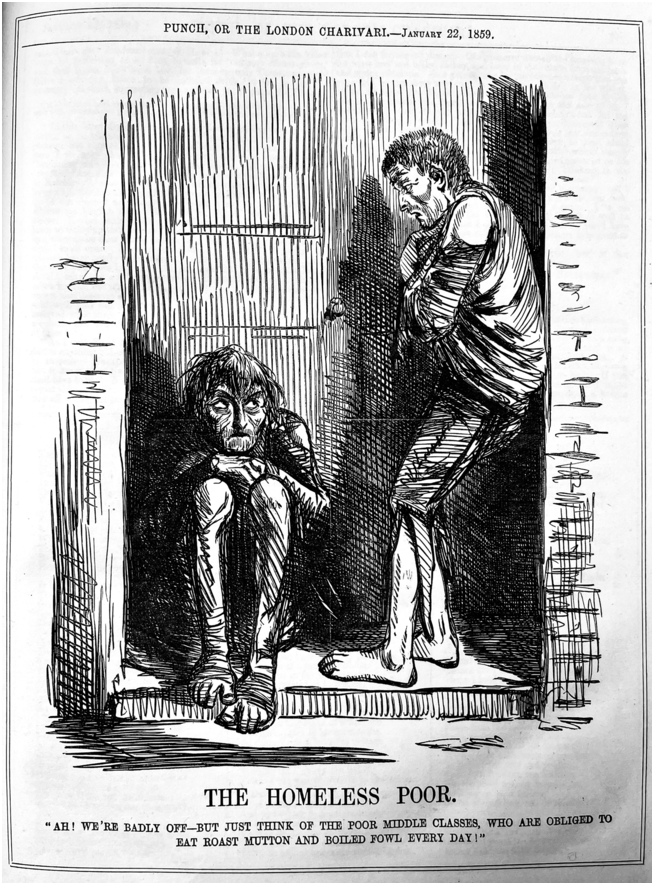
A Times leader had commented unfavourably – and unironically – on the ‘Regulation programme [of dining] with which we are all familiar, even to nausea’.8 Stating that, ‘it is not our wish to moralise over the eupeptic hardships of struggling humanity’, the paper considered instead the troubles of ‘those persons who “entertain”’, not those who are gourmands: ‘Our course is a middle-one; we point at Baker-street’, that is, the emerging English middle classes. That group made up about 20 per cent of the population at the time (Hoppen, p. 33), and The Times here explicitly claims it as an important part of the paper’s demographic. Given years of familiarity with the cuisines of the Continent, India, and America, the paper asked (overlooking the political reasons underlying that familiarity), ‘cannot we hope to take a gastronomic flight beyond the dim soup and cod’s head and shoulders, relieved by three or four evil side-dishes, and followed by the inevitable haunch of mutton and pair of chickens?’ The result of this unimaginative fare was to force men away from their homes in search of ‘two or three dishes which may be palatable to them’. In this dining dilemma, we can see the roots of Mrs Beeton’s Book of Household Management, the declared aim of which was to enable wives to ‘compete with the attractions’ of ‘well-ordered taverns, and dining-houses’.9
Punch worried away at the topic of food during the rest of the month and used the controversy to align predictable dinners with a form of Englishness that was reassuringly known, and very unlike the French, who might surprise with their politics as well as their cuisine. The writer of ‘A Defence of English Dinners’ proclaimed, ‘Monotony is charming to me, especially in diet’, and that it at least keeps in check the horror of modern ‘messes’ which, ‘Indeed, I never taste … but there rankles in my mind a good old-fashioned suspicion that nine French dishes in ten are either toads or snails’.10 Reassurance, diet, anti-French sentiment, and a sense of history are all conflated within an affection for roast beef and a very earnest assertion of robust, masculine, English identity. But Punch mocked The Times’ narrow social focus by posing ‘THE 2 GREAT QUESTIONS OF THE DAY. Park Lane. What shall I have for dinner to-day? Field Lane. Shall I have any dinner to-day?’11
The Daily News suggested that the problem of those who were needy but who were not ‘convicts, paupers, or criminals’ was so pressing at this time because no reliable form of welfare existed for them to safeguard their homes in case of temporary distress. One case epitomised the difficulties of daily life for this group. On 7 January the Daily News reported a case of ‘Suicide in St James’s Park’: ‘a determined act of self-destruction was committed by a man, name at present unknown, who shot himself in a place for public accommodation [public toilets] recently erected in an enclosure of St James’s Park, opposite Marlborough House’.12 His jaw was blown away, and the upper part of his face ‘frightfully mutilated’. According to a witness, John Waters, a Pimlico mechanic: ‘about twenty minutes to ten o’clock, on the day named, having occasion to go to a place of accommodation, situate in an inclosure of the Park, opposite Marlborough-House, he saw the face of a man over the door, who took his hat off, which was followed by the report of a pistol and a heavy fall’.13
The body was taken to St Martin’s workhouse but was refused entry to its deadhouse, the porter telling the stretcher bearers to go instead to the church vaults. Unable to enter the vaults, the bearers left the body, with no covering but a handkerchief over its face, on the stones of the church’s portico. The traffic in St Martin’s Lane was ‘completely stopped by hundreds of persons who assembled on hearing of the shocking occurrence’, and the body had eventually to be taken across the river to Charing Cross Hospital.
The grotesque tableau of the traffic-jamming avidity of the crowds for a sight of the remains is particularly haunting because of the body’s anonymity, the mundane details of the dead man’s clothing, and the presence of a pawn ticket in his pocket: a notice of a pledge of £2.10s for his watch. But this was not an isolated case: Charing Cross Hospital was subsequently ‘besieged by persons who have missed their friends’.14 The body was identified three days later as that of James Wheatley, a forty-seven-year-old gardener, who had recently been dismissed from his job, through no fault of his own, and, according to his wife and his former employer, had taken to drink. The story is a tiny contemporary cameo, evidence of the precariousness of daily life and the many people who simply went missing, as the columns of newspaper advertisements regularly showed. And the upper classes were not immune. In The Times for 1 January, amongst adverts for travel to Paris, Evans’s Self-Acting Kitchen ranges, and Belgian canaries, are notices of second-hand furniture for sale, such as this one:
Costly furniture, late the property of a nobleman, equal to new, to be sold, for less than half the original cost; consisting of a superb walnut drawing-room suite in rich silk brocade … brilliant plate, chimney-glasses in elaborate frames of large dimensions … also a magnificant set of solid oak dining-room furniture, including a remarkably fine Elizabethan sideboard … Parties about furnishing a large house or mansion would find this one of the most desirable opportunities. To be seen at Belgrave-House, 17, Sloane Street, Belgrave-Square.15
The broad arc of Victorian ‘progress’ produced casualties amongst all classes, most poignantly perhaps whilst they were trying to ‘better’ themselves. The Royal Polytechnic Institution on London’s Regent Street had been established for the benefit of society in 1838 and had, ‘during the last 20 years … done so much to improve the public mind and educate the people’.16 On the evening of 3 January, a large crowd was leaving the Polytechnic after ‘witnessing a series of new dissolving views illustrative of the life of Don Quixote’ when one of a pair of staircases linking the auditorium and entrance hall collapsed, depositing bodies and stone slabs in a heap on the floor beneath them. Eight-year-old Emma Pike, who was visiting the Polytechnic with her father, William, a hosier from Newington, a cousin, and two siblings, was killed, and thirty more people were seriously injured.
The horrific accident and ensuing inquests were reported widely in London papers, including the Daily News, Morning Chronicle, Morning Post, Standard, and The Times, and made headlines throughout Britain and Ireland. The coroner noted that there was ‘no doubt that the public mind was very seriously agitated by these deplorable occurrences’.17 What seems particularly to have captivated attention is the fact that an institute described as the ‘fountain of science’ according to the coroner (The Times, 25 January), and devoted to the education so necessary to citizenship in the modern age, should have proved unreliable in managing its own estate. The blame for the accident was attributed to the ‘incautious manner’ of the cutting of the stone stairs in order to insert iron trellis work and supporting brackets. There was briefly a suggestion that the fossil shells found embedded in the stone steps might have weakened them. Ironically fitting though this explanation would have been in a year fascinated by Darwin’s writing on fossils; it was dismissed by the jury, who recommended that building inspectors be appointed by the government to curtail the ‘almost irresponsible power now vested in the hands of companies and individuals in the erection and maintenance of our public places of resort’ (Times, 25 January). A form of public responsibility seems to have been jettisoned in the face of development opportunities. This is not a problem that disappeared with the Victorians.
The Polytechnic’s stairs were just the latest instance of building disasters. The Daily News introduced its account of the accident by stating that it followed ‘closely upon the recent catastrophe at the Victoria Theatre’, when fear of a fire following a gas leak caused such a crush on one set of stairs in the theatre that fifteen young men were suffocated, and the Standard reported the coroner’s comment on 7 January that:
It was a very curious thing that in this country the sacrifice of human life by accident was so enormous and, as had been stated by Dr Farr, in the Registrar General’s report, more persons died from accidental causes than were killed in all our wars. This was an astounding statement, but it was true; and his own experience warranted him in saying that if due precautions were taken for the preservation of human life at least 17 or 18 out of 20 deaths from accidental causes would be prevented.
The Times recorded that just after the Polytechnic accident, a house in Liverpool fell in with the loss of five lives, and ‘within a hundred yards or so of the office in which we sit a block of old tenements fell down the other day at a moment’s warning’.18 Clearly, regulation and reform were needed in this area.
There was a tacit acknowledgement in The Times that a novelist might be needed to record the present time: ‘When Mr Dickens, in his latest work [Little Dorrit], came to the period of the catastrophe, he consummated the fiction by making a house fall in and crush the villain of the story beneath its ruins’. This is just one of a number of references to Dickens in January which suggest that he and his works were acknowledged as a record of contemporary times: Punch describes heartless workhouse beadles as ‘chattering, jangling, loquacious Bumbles’;19 for the Daily News, the ‘management of the Admiralty is in many respects a master-piece of Circumlocution’;20 and it refers in an article on ‘Reformatories and Places of Refuge’ to economists of ‘the Gradgrind school’.21 These references to Oliver Twist, Little Dorrit, and Hard Times suggest that Dickens’s caricatures provided a measure by which the citizens and journalists of 1859 might analyse their times, a mode of ready assessment by which to understand their society’s shortcomings.
The National Portrait Gallery
However, though Dickens is embedded in the times, in a way that invigorates the term ‘Dickensian’ with present energies rather than simply retrospective insights, the instances quoted all operate critically, rather than offering positive inspiration to a moment seeking to reform itself. For that, Thomas Carlyle amongst others would demonstrate that the present had to look to the past. As a historian and biographer, the past was Carlyle’s natural terrain, though the Westminster Review bemoaned the fact that Carlyle was ‘wedded to his dogma of hero-worship’ in his new work, a biography of Frederick the Great of Prussia. The Review was referring to Carlyle’s 1841 book, On Heroes, Hero-worship and the Heroic in History, and it particularly regretted that his energies should be diverted from the needs of the present into ‘dialogizing with the land of shadows’.22 It is a marvellous phrase, but it misrepresents Carlyle’s understanding of historical figures. His essay ‘Thoughts on History’ was written in the run-up to the Reform Act of 1832, when enabling all citizens equally to access the discourse of the historical, and to see themselves in relation to it, played a significant part in the need to construct and affirm a unified nation and body of voters. That need persisted in 1859, and one of its enabling vehicles was the National Portrait Gallery, which opened its doors to the public in January, and of which Thomas Carlyle was one of the first Trustees.
The Gallery had been established in 1856 in the hope that it would prove to be, as Sir Charles Eastlake put it, ‘a not unimportant element of education’, and as the 5th Earl Stanhope, the Gallery’s originator, hoped, a useful ‘incitement to honourable exertion’. The National Portrait Gallery was envisaged from the start as a piece of social engineering that sited a prosperous present and future within the literal observance of the past. In a House of Lords debate, Stanhope declared that the Gallery would consist of portraits of ‘those Persons who are most honourably commemorated in British History as Warriors or as Statesmen, or in Arts, in Literature, or in Science’, and the Earl of Ellenborough in turn enjoined that care should be taken ‘that no persons are selected for a place in the gallery but those thoroughly approved by impartial men competent to decide upon their merits’.23 Ellenborough in due course became one of those men, as a founder member of the Gallery’s Trustees. The motion was duly passed to ask the Queen to consider the founding of the Gallery, and after a slightly stormier discussion in the Commons two months later, the Gallery was established with £2,000 pa of public money, which was used to buy portraits of ‘those Persons who are most honourably commemorated in British History as Warriors or as Statesmen, or in Arts, in Literature, or in Science’.24
The Gallery’s first acquisition was the Chandos portrait of Shakespeare. Given the Trustees’ decision that no portrait, other than that of the monarch or their consort, should be exhibited unless that person had been dead for ten years, the new Gallery was defined from the outset by the process of looking back: it commemorated not the heroes – or indeed the heroines – of the hour, but those of the past. Of the ninety paintings initially available for display, only seventeen had even been painted in the nineteenth century, and of these the most recent was Samuel Drummond’s portrait of Sir Marc Isambard Brunel, Isambard Kingdom Brunel’s father, which was finished in 1835.25 The National Portrait Gallery was a major cultural innovation in a year which was intrigued by portraits and the ability to see the famous at close quarters. As a Gallery concerned to celebrate, and to find guidance for the present in past history and in models of great, but long-dead, individuals, it was also an important statement about the nation itself.
In the Gallery’s cramped home, visitors encountered packed walls and portraits hung four or five deep in a mass of dark images. Paintings were chosen on the basis of the standing of the subject and not the artistic quality of the painting. As space was so restricted, and the number of the portraits relatively few, there was no attempt at chronological arrangement, but ‘all the historical information necessary’ could be found in the Gallery Secretary, George Scharf’s, ‘careful catalogue’.26 The eclectic exhibits listed by the Daily News in its review of the opening included Shakespeare, Handel, Spencer Perceval, Nell Gwyn, Cardinal Wolsey, Queen Anne, William Wilberforce, Clive of India, Judge Jeffreys, John Dryden, John Kemble and his sister Sarah Siddons, admirals, soldiers, and self-portraits by Opie, Joshua Reynolds, Wilkie and Wright of Derby.27 The portrait of Robert Burns was of particular interest as the centenary of his birth was being celebrated in January, with a festival at the Crystal Palace, and a poetry competition.28 The Daily News, whilst applauding the Gallery as an ‘excellent scheme’, is generally scathing about the quality of the art on display.
Admission to the Gallery had to be carefully managed, not least because of the lack of space available: it was housed in two rooms and ‘a small backroom and the walls of a staircase’ (Francis, p. 11) on George Street, Westminster. But Scharf was also anxious about the state of the building, and on 10 January, following the previous week’s serious accident at the Royal Polytechnic Institution, he commissioned a safety inspection of the staircase in George Street. Entry to the Gallery was free, though tickets had to be obtained from print sellers’ shops on Pall Mall and New Bond Street, and the public was only admitted on Wednesday and Saturday afternoons. The Daily News describes these arrangements as obsolete, ‘unnecessary and antiquated restrictions and regulations’, but in the light of the Polytechnic accident they were necessary for public safety. Good behaviour was further enforced by two police constables who were engaged to be at the Gallery during public opening hours, and a ‘young man’ was on hand ‘to take charge of sticks and umbrellas’.29 Cards and labels were placed around the gallery warning visitors not to touch the paintings. The Gallery was effectively a controlled place of social engineering and instruction, where carefully regulated and well-behaved crowds could learn their place within the descended history of their nation, as well as re-establishing the grounds of their difference from the French: in the debates over the establishment of the Gallery, the Earl of Carnarvon had expressed his belief that ‘such an institution was not likely to be inimical to conservatism [as] was shown by the fact, that during the French Revolution [a] decree abolished hereditary dignities and destroyed the public memorials of illustrious men’. He also noted that, ‘the influence of such a gallery would be very great upon the national mind as a means of education, not less than as an incentive to emulation, and that it would tend to strengthen the interest and deepen the reverence which Englishmen felt for the history and institutions of the country’.30
Contemporary influence and history, education and emulation, are mutually confirming, bound irretrievably and symbiotically. So, in 1859, the doors of the new National Portrait Gallery opened proudly onto the past, as seen through the approving lens of the mid- to late-1850s. The year 1859 is awkwardly poised on the cusp of its future, and that awkwardness is all too well reflected in the Gallery’s rather agoraphobic curation and articulation of national greatness.
Politics and the Past
An intuitive impulse to look to the past for instruction is too ubiquitous, even when proved demonstrably misguided, to be remarkable.31 But the inauguration of the Gallery at the beginning of 1859, and its formalisation of that backward-looking instinct, does provide a key-note for the year which could be tactically employed even in the attempt to reform the voting system.
John Bright, the Radical MP for Birmingham, had been agitating during parliament’s Christmas recess for wide-scale political reform by mobilising the people with a sense of their political responsibility and power, not through violence but through public meetings, and by deluging parliament with so many petitions calling for reform that the House could not afford to ignore them.32 Bright’s agenda contained proposals both for the extension of the franchise, the ‘real representation of the people’, as he put it, and for the rationalisation of the distribution of MPs throughout the country. He had also sent ‘schedules’ of his proposals to papers in ‘Edinburgh, Glasgow, Newcastle, Leeds, Liverpool, Manchester, Birmingham, Bristol, and London’, which he hoped would print them promptly, and thus effect a nation-wide saturation of his ideas. His speeches show a faith in the power of collective action, and in meetings, both as the most effective means of diffusing ‘information among the people’ and as beginning to enact the reform desired, for at them the population could ‘feel’ that they are represented.
It was known that Lord Derby’s Tory government was eager to take the momentum for reform away from its more usual Whig and Radical champions, and was simultaneously working on a more moderate reform measure. Hence, Bright’s initiative was not well-received by the more conservative papers. The figure of the French Emperor Louis Napoleon was a useful tool with which to castigate Bright: following a rousing speech in Bradford, the Saturday Review described them both as European potentates drawing in their horns ‘before a storm of public disapprobation’.33 In fact, as the Saturday Review would have known full well, Bright’s speeches were being warmly welcomed throughout the country at what The Times nervously described as ‘monster meetings’.34 The enfranchisement of the working class advocated by Bright would, according to The Times, ‘swamp the whole of the middle classes by the admission to electoral rights of all who have a roof over their heads, which would place all the property of the country at the mercy of the proletariat’.35 Underpinning this description is an anxiety about ‘the people’ – the material form of ‘public opinion’ – and this anxiety finds its voice in responses that echo fears of the French Revolutionary mob, still fresh in the cultural memory only seventy years after the 1789 Revolution began, and with the more recent examples of 1830 and 1848 still more readily to hand. In invoking ‘liberty’, Bright deliberately elided his campaign with the French Revolution, and confirmed his part in a confluence of forces that the government and other conservative voices felt were endangering the country, and which found their focal points in Bright and Louis Napoleon. Bright thus unfortunately ignited customary anti-French feeling, which only strengthened as the year progressed.
Europe
In parallel with the emerging debate about the British Parliament, newspapers reported fears of war in Europe, initially by invoking the menace of the French Emperor. Since July 1858, when Louis Napoleon met the Count of Cavour, Prime Minister of Piedmont and Sardinia, and a leading figure in the movement for Italian reunification, Europe had been braced for the possibility of a war that would seek to oust Austria from the Italian Peninsula.36 On 3 January, The Times carried a breathless postscript from their Paris Correspondent: ‘P.S. I have just heard that during the [New Year’s Day] levée the Emperor told the Austrian Minister, M. Hubner, that he regretted their relations (rapports) were so bad, but that his personal sentiments for the Emperor of Austria were the same as ever.’37 This comment was seized on as an open threat of war against Austria. The Times read Louis Napoleon’s New Year comment as ‘a prelude to a spring campaign’, supported by evidence of the ‘recent naval and military augmentations and preparations’ by the French, and confidently predicted that, once the weather permitted, and a pretext was found, war would be declared between Austria on one side and the Italian states and France on the other.38 But even before the Emperor’s comments had been reported, the Saturday Review had been speculating about the ‘unscrupulous adventurers, sitting over their champagne in the Tuileries’, and The Times editorial bemoaned the onerous burden that its Italian states represented for Austria, and the lurking presence of France.39 Tensions had been building in ‘Austrian Italy’ to the point where ‘discontent and irritation could not be greater without becoming downright insurrection’.40
Britain maintained a deeply felt suspicion of France and its Emperor, which threatened to outweigh its sympathies with Italy, despite recent cooperation between Britain and France in the Crimean War (1854–1856) and their joint efforts in opening up markets in China, where it was believed that ‘countless thousands of the teeming population’ were waiting to engage in European commerce.41 As the journal of Charles Greville recorded, British difficulties in China were not ‘diminished by the fact of being connected with, and therefore more or less dependent on, the French … This local and accidental alliance of necessity introduces delays and complications of all sorts into the affair’.42 Any strategic alliance with the French was apparently unwelcome, despite, as we will see, Britain’s close cultural dependencies.
In her journal, Queen Victoria laments the Emperor and the King of Sardinia’s ‘gratuitous desire to go to war for some pretext or other’.43 She reports on panic in Paris and the ‘universal indignation amongst all right thinking people here’ at the rulers’ ‘disquieting behaviour’ (14 January) but finds comfort in the ‘Excellent feeling in England. Not one newspaper favours war in Italy. They favour the idea of Italian independence, but disapprove the Empr [sic] of the French attacking another Empire without rhyme or reason’ (15 January). The British public and their government were anti-war at this stage: they were war-weary following the Crimean War and the Indian Uprising, and this, combined with anxiety about the state of the British navy, meant that there was no appetite for more aggression, despite considerable popular sympathy for Italy’s situation.
The prevailing tendency to seek political justifications in the past is particularly marked in Britain’s response to the Italian situation, where the peninsular’s Classical legacy is constantly invoked as a reason for wishing to protect it, though not as a sufficiently strong reason for Britain to go to war to defend it. The novelist Margaret Oliphant travelled to Italy in January, following in the footsteps of Keats, with her ailing artist-husband Frank, their two children, and their maid, Jane, in search of some respite for Frank’s tuberculosis.44 Italy was a popular destination for travellers, but first-hand experience of it was often at odds with visitors’ expectations, as Oliphant was to find out, and as the authors of Unprotected Females in Sicily, Calabria, and on the Top of Mount Aetna describe in their chapter on Palermo: ‘The convents and monasteries take it in turn to supply food, that every day the poor may be sure of a meal; there is, besides, an immense, well ordered building, called “Albergo dei Poveri,” where want is investigated and relieved; another aids the indigent nobility, thus making begging an unnecessary speculation’.45 Years of suppression by the Austrians and poor education had done much to diminish Italy’s past glories.
Written shortly after their arrival in Italy, Oliphant’s ‘A Winter Journey’ gives a lightly fictionalised account of her family’s travels and travails in Europe. As Oliphant’s family reached Florence, they were confronted with the city’s history:‘We are no longer among the Gauls and Teutons, but are where the world lived in the old ages, and where the modern arts were born And here is Florence in the dark,- Florence, our journey’s end and temporary habitation – the Florence of Dante and Michael Angelo – the Florence of the Medicis – the City of Imaginations!’46 While newspapers at home struggled to keep up with the shifting relationships of the European powers and British attempts to forestall war, Oliphant articulated what Italy primarily meant to the British people: a seat of culture, and a country rooted in the past. As contemporary writers responded to Italy and its plight this year, we see that ‘past’ becoming an organic part of its modern life.
In times of shifting allegiances, when France, a some-time ally, might be treated as a potential enemy, and political identities were being tested by reform discussions that over-rode customary party boundaries, the past offered interpretative clues and reassuring guidance to more than just archaeologists: as a repository of much of the cultural past of Western Europe, Italy needed to be both celebrated and protected, emotionally and textually if not militarily. As an entity in crisis, with aggressors fighting along fault-lines of both contemporary power and historical prestige, Italy comes to seem an appropriate synecdoche for the state of modern consciousness, torn between living in and with the innovations and shifts of the present, whilst feeling a responsibility to recognise and even to revere the lessons and responsibilities of the past. In attempting to represent this conflicted state of contemporary consciousness, custom becomes a useful tool (see Chapter 5).
Literature
We can get a glimpse of the literary world at the beginning of 1859, or at least the world of fiction, by turning to what Jonathan Farina describes as ‘the first book-length monograph on fiction by a professor of English literature’.47 David Masson was in fact located both within the burgeoning academy, as Quain Professor of English Literature at University College, London, from 1852 to 1865, and beyond it, as the inaugural editor of Macmillan’s Magazine from 1858. British Novelists and Their Styles: Being a Critical Sketch of the History of British Prose Fiction was based on a series of lectures given by Masson at the Philosophical Institution of Edinburgh in spring 1858. In it, he covers the novel from its roots in epic poetry to the present day, ending with a chapter on ‘British Novelists since Scott’. He enumerates thirteen types of contemporary fiction: novels of Scottish, Irish, English Life and Manners, Fashion, Illustrious Criminal, Travellers, American Manners and Society, Oriental, Military, Naval, Supernatural Phantasy, Art and Culture, and the Historical Novel.48 (The question of classification is a powerful concern in British Novelists.) Masson also includes an extensive comparison of Dickens and Thackeray, who were, at the time, Masson claims, the ‘chief representatives’ of ‘Prose Fiction in Britain’ (p. 239).
Masson focusses his analysis of the state of contemporary fiction in a comparison of these two writers, whom he describes as being ‘artists of opposite schools. Thackeray is a novelist of what is called the Realist school; Dickens is a novelist of the Ideal or Romantic school’. Masson continues in parentheses: ‘The terms Real and Ideal have been so run upon of late, that their repetition begins to nauseate, but they must be kept, for all that, till better equivalents are provided’.49 Where Dickens picks up a ‘hint from actual fact’ and runs into ‘a world of semi-fantastic conditions, where the laws need not be those of ordinary probability’, Thackeray rather remains anchored by his:
aim to present life as it is actually and historically – men and women, as they are, in those situations in which they are usually placed, with that mixture of good and evil and of strength and foible which is to be found in their characters, and liable only to those incidents which are of ordinary occurrence. He will have no faultless characters, no demigods – nothing but men and brethren. And from this it results that, when once he has conceived a character he works downwards and inwards in his treatment of it, making it firm and clear at all points in its relations to hard fact, and cutting down, where necessary to the very foundations.50
In other words, Thackeray’s realism is anchored in and guaranteed by the recognition of familiarity, based on a consensual agreement as to what constitutes the ordinary, and where the parameters of unexceptional human fallibility lie. It is a form of realism that rests confidently on the audience’s willingly given consent. This, as we will see, is not the case with George Eliot’s fiction, which would carve out new dimensions for realism.
At the time that Masson was writing about Dickens and Thackeray, the novelists themselves were engaged in a fierce public row that became known as the Garrick Club Affair. As Rosemary Ashton describes in One Hot Summer, the row broke out after Edmund Yates, a young journalist, wrote a mildly satirical portrait of Thackeray in the summer of 1858. Badly offended, Thackeray took the matter to the management committee of the Garrick Club, to which both men belonged, and the older man charged the younger with breaking confidences made whilst at the Club, thereby violating Club rules. Yates was ordered to apologise or to resign. When he did neither, he was expelled from the Club, which prompted him to take legal advice about this move, and to try to take the Club to court in early 1859. However, daunted by the likely costs of the trial, Yates gave up his complaint. Dickens comes into it because Yates was a young colleague of his, and he was known to have been advising Yates behind the scenes, despite his ostensible friendship with Thackeray. Years later, Yates would observe that the ‘whole affair was a struggle for supremacy, or an outburst of jealousy, between Thackeray and Dickens’, and that his part ‘was merely that of the scape goat or shuttlecock’.51
On the face of it, George Eliot’s situation would seem to have little in common with that of either Dickens or Thackeray at the start of 1859. Living in enforced seclusion with a married man, she was not likely to get engaged in a very public spat, nor to make arrangements, as Dickens was doing, for a portrait to be painted by W. P. Frith (who was fresh from the success of his famous ‘Derby Day’, the hit of the previous year’s Royal Academy exhibition), to find a name for a new periodical that was being launched, or to be giving a series of readings in London. The two writers were though both engaged in house-hunting in January, and had to exercise some discretion in their search, in Dickens’s case because he was considering where and how best to house his mistress Ellen Ternan, having very publicly separated from his wife the previous year.52 Charley Dickens had allegedly seen his father and Ternan walking together on Hampstead Heath, which may have led to his championing of Thackeray (Ashton, p. 238).
However, Thackeray, Dickens, and Eliot did share in their inability to take advantage of the Matrimonial Causes Act, passed in 1857, which brought divorce more nearly within the reach of the general population, and the reporting of which was significantly disrupting beliefs about family life and representations of that life in fiction and in newspapers. The novelists’ private narratives complicate the innovations of the headline Act, and demand that we take note of the ways in which such landmark moments are actually experienced, how they land in the present as well as the reconstructed and remembered moment, and it is partly this present experience that this book aims to capture.
Eliot and Lewes found a new home in Wandsworth, and an insight into their household at this time may be gleaned from their efforts to find a servant to look after them. The many columns of advertisements for servants in The Times demonstrate the level of need in the metropolis, but the terms of the ads, with their frequent emphasis on respectability and references, also show how difficult it might have been for Eliot and Lewes to advertise their situation, as well as their specific needs. Eliot writes to her old Coventry friend, Cara Bray:
A servant who will cause me the least possible expenditure of time on household matters, Cooking is a material thing, not because Mr. Lewes is epicurean (for he is stupid of palate) but because he is, amongst his other eminences, eminently dyspeptic. I am anxious therefore to have a cook who is not only honest but soup-making and full of devices
In the end, a very simple ad went into The Times on 25 February: ‘WANTED, a GENERAL SERVANT.-A Lady and gentleman REQUIRE a first-class SERVANT. Wages liberal, according to character and experience. Address, stating all particulars, to Z, care of Mr Polley, newspaper office, Wandsworth.’ The anonymity of ‘Z’, the offer of liberal wages, and the gentle teasing intimacy of ‘Mr Polley’ (Polly was Lewes’s affectionate pet name for Eliot), sum up the situation of the Eliot-Lewes household at this time, to contemplate leaving which, Eliot wrote to Charles Bray, was ‘a terrible sacrifice … quite like the prospect of a tooth-drawing’ (27 February; III, p. 27).
Despite the significant domestic upheaval of moving house and their sometimes fragile health, both Eliot and Lewes were indefatigable writers, who, when they weren’t writing, were reading, often aloud to each other. Lewes records:
The reading of [Walter] Scott’s Life, which Marian has taken for her after dinner book these late weeks, has been a great delight & a great stimulus to work. The book as a book is full of interest, of anecdote, of picture, & gives such a life-like representation of Scott himself. It is also extremely valuable to all literary men, as an exemplar of work. Even I, who have not much to reproach myself with in the way of deficient regularity or industry, feel the book act like a spur.53
Lewes’s journal is one of the key sources we have about his life with Marian Evans Lewes. It’s a vivid record of a working life that moved easily between science, literature, history, and drama; of a man vital with enthusiasm and generosity; and of their domestic life, their shared enthusiasms, daily walks, and their ‘chatting’, a word used frequently by Lewes.
Given their domestic circumstances, Eliot and Lewes’s social life was relatively limited at this time, especially for Eliot, who, when she arrived in London in 1851 to work as a reviewer and the de facto editor of the radical Westminster Review, was at the heart of literary and political London. She gave up that position in 1854 but carried on writing for the periodical. For her, the life of literary London was inimical to the quieter routines of the novelist she had become, even had her personal situation been less equivocal, but the contrast between her former existence and her deliberately sheltered home in Wandsworth is striking.
As the more experienced writer of the two, Lewes negotiated publication terms for Eliot’s work with the Edinburgh firm of John and William Blackwood, a well-established company that published leading writers, including Margaret Oliphant and Anthony Trollope, and whose periodical, Blackwood’s Edinburgh Magazine, was founded in 1817. Just as crucial for Eliot as the firm’s reputation was John Blackwood’s generous concern for his nervous and insecure writer. Following a hint from Lewes that Eliot is ‘prone to despond’ (12 January; Letters, III, p. 5), Blackwood sent a cheque for £400 to her, and some valuable words of encouragement about Adam Bede: ‘I am confident of success, great success. The book is so novel and so true. The whole story remains in my mind like a succession of incidents in the lives of people whom I know’ (29 January; III, p. 6). That sense of familiarity, of a constructed experience of recognition, would be an essential part of the novel’s appeal to its first readers, and was fundamental to Eliot’s aesthetic in its invoking of a past made readily available and newly significant in its readers’ present, that is, as a form of custom. Adam Bede became the most popular novel of the year, and 1859 will investigate how far that popularity rests on the novel’s historical setting, and explicitly upon the implications of its enabling the recognition of a shared, customary history and outlook in a year of political conflict at home and war in Europe.

 Open access