




Introduction
The ocean, despite covering 71% of the surface of our planet, is still largely unknown (Costello et al. Reference Costello, Coll, Danovaro, Halpin, Ojaveer and Miloslavich2010, Webb et al. Reference Webb, Vanden Berghe and O'Dor2010). Life in marine ecosystems is not as evident as in terrestrial ones, especially if we consider that a large part of the organisms that populate the ocean are small or microscopic, others live on the seafloor (some of them at abyssal depths) and, finally, there are those that live far from the coastlines. Currents might be obvious to navigators, but not to people who do not have close contact with the sea. The geology hidden beneath the ocean layer remains largely unexplored (Liu et al. Reference Liu, Ye, Zhu, Guan and Zhang2025), holding mysteries about Earth’s evolution and processes such as tectonic and volcanic activity or mass movements that are yet to be fully understood (Ercilla et al. Reference Ercilla, Casas, Alonso, Casalbore, Galindo-Zaldívar and García-Gil2021, Couvin et al. Reference Couvin, Georgiopoulou and Amy2024).
The Antarctic and Arctic oceans are unique ecosystems with an essential role in regulating the planet’s climate while providing fundamental natural resources (Reid et al. Reference Reid, Fischer, Lewis-Brown, Meredith, Sparrow and Andersson2009, Wassmann et al. Reference Wassmann, Duarte, Agustí and Sejr2011, Grant et al. Reference Grant, Hill, Trathan and Murphy2013, Magruder et al. Reference Magruder, Farrell, Neuenschwander, Duncanson, Csatho, Kacimi and Fricker2024). Although oceanographic research has increased considerably in recent decades, the scientific results of this research have not reached the population in an understandable and clear way, nor at a large scale. This means that the general public has little scientific understanding of the ocean’s biological, physicochemical and geological processes. This lack of knowledge is evident in primary and secondary school curricula, where marine ecosystems - polar or otherwise - are scarcely covered in textbooks, despite their relevance to the functioning of the planet (Santoro et al. Reference Santoro, Selvaggia, Scowcroft, Fauville and Tuddenham2017, Pazoto et al. Reference Pazoto, Duarte and Silva2024).
As global change becomes increasingly evident, it is necessary to increase the scientific culture of society so that the population in general, but particularly children and young people, understand the key role of the global ocean, and especially the polar oceans, in maintaining the health of the planet and mitigating the effects of climate change (Knutti Reference Knutti2019, UNESCO & MECCE 2024).
Thus, over the last decade, a new initiative, called Ocean Literacy, has emerged to meet the need to create a collection of educational and informational materials regarding Ocean Literacy to improve understanding regarding ocean processes, functions and issues, with the ultimate goal of protecting the ocean and the planet. As stated in the Ocean Literacy Portal by IOC-UNESCO, ‘Knowing and understanding the ocean’s influence on us, and our influence on the ocean is crucial to living and acting sustainably’ (https://oceanliteracy.unesco.org/about/).
Within the framework of the Interdisciplinary Thematic Platform (PTI; now Connection) POLARCSIC ‘Observatory of Polar Zones: Horizon 2050’ (https://www.polarcsic.es), whose objectives include increasing social awareness of the changes occurring in polar regions and their environmental consequences, several initiatives have been developed to disseminate existing scientific knowledge and raise awareness of the polar ocean, with special attention given to the Southern Ocean.
Dr Andrés Barbosa’s professional career, to whom this volume pays tribute, was marked by research in Antarctica, which started in 1994, when he had the great opportunity of participating in his first Antarctic campaign. He was interested in trying to understand the mechanisms that explain how penguins respond to climate change, addressing fundamental questions in the field of ecology and evolution. However, in this paper, among other issues, we want to highlight his contribution to the outreach of Antarctic science: ‘The polar regions are very attractive, and we must take advantage of this circumstance to disseminate them,’ said Andrés in an interview with National Geographic (García-Roa Reference García-Roa2023).
Several scientists are in the process of using the importance and beauty of these distant, exotic and unknown regions to communicate polar science to society. In this study, we have selected several activities/materials from multidisciplinary topics designed to develop the skills, values and behaviours we believe are necessary to create an ocean-literate community that raises awareness and promotes respect for and protection of polar ecosystems. The activities presented here are designed to spark public interest in polar research and raise awareness of its crucial role in maintaining the health of our planet. A wide range of initiatives is included, spanning outreach and communication efforts to activities designed to deepen our understanding of polar science and related issues. Additionally, this overview includes an evaluation of the strengths and weaknesses of the various strategies employed to promote education and awareness in this field.
Materials and methods
Over the past 2 decades, numerous outreach activities have been conducted by the authors of this paper, which can be grouped into five categories: 1) the online participation of students in polar oceanographic expeditions, 2) face-to-face talks and workshops on the Antarctic and Arctic ecosystems involving the observation of samples and/or videos, 3) the coordination and editing of the book Observando los polos, which offers a global and multidisciplinary perspective on the current scientific knowledge of polar regions, 4) the creation of the photographic itinerant exhibition ‘A Polar Gaze’ along with an accompanying book and 5) the multi-institutional collaborative project surrounding the XIth Scientific Committee on Antarctic Research (SCAR) International Biology Symposium.
Online participation of students in polar oceanographic expeditions
The online participation of students in polar oceanographic expeditions was implemented through the ICM Divulga educational website (https://icmdivulga.icm.csic.es/expediciones). This practice originated at the Institut de Ciències del Mar (ICM), a centre belonging to the Spanish National Research Council (CSIC), from several oceanographic expeditions in the early 2000s, including Antarctica 2000 and Arctic 2004, whose diaries were made available on different platforms (first on the Agència de Gestió d’Ajuts Universitaris i de Recerca (AGAUR) website, and later on the Fundació Catalana per la Recerca i la Innovació (FCRI; Catalan Foundation for Research and Innovation) Recerca en Acció platform (e.g. https://www.recercaenaccio.cat/ra-aventures-cientifiques/aventures-cientifiques/canvi-climatic-a-lantartida) and now at DIGITAL.CSIC (https://digital.csic.es/handle/10261/228912)).
The online diary format typically includes an introduction to the campaign and team, a weekly chronicle of the expedition’s activities and logistics and an educational component complemented by talks in schools and personalized training for teachers beforehand that has evolved over time. Early expeditions featured email question-and-answer and supplementary educational materials, whereas later campaigns, such as POLAR CHANGE 2023 (Aerosol emissions from POLAR CHANGing Environments), adopted a ‘challenge’ format with the online sharing of student responses. The SSSICE-SO 2023 (Satellite Sea Surface Salinity assessment close to the ice edge in the Southern Ocean) and ARCTIC-MON 2024 (Sea ice thickness in Arctic regions is key to understanding the effects of climate change) expeditions also maintained this ‘challenge’ format, and they innovated with video blogs instead of written diaries. The project primarily targets students from late primary to early secondary education, but it also includes resources for preschool and younger primary levels. The evaluation of the campaign was conducted through in situ oral feedback from participants.
Talks and workshops on the polar ecosystems involving the observation of samples and/or videos
Arctic and Antarctic science dissemination is regularly carried out in workshops and conferences held in educational centres, municipal libraries, civic centres, science festivals or other events. The contents are adapted for primary and secondary school students or for adult audiences. These talks are sometimes scheduled to coincide with events such as Science Week (in November) or the International Day of Women and Girls in Science (11 February). Sessions sometimes included practical workshops to engage the audience and conclude with open discussions, fostering interaction between scientists and the public. This direct engagement aims to bridge the gap between science and the community.
Observando los polos (Observing the poles): a book with a global and multidisciplinary view of the state of scientific knowledge on polar areas
This science communication book from POLARCSIC emerged from a 2019 course organized by the CSIC and the Universidad Menéndez Pelayo at the CSIC Delegation in Barcelona. Written by 56 experts from 15 Spanish institutions, the book’s 12 chapters offer a global and multidisciplinary overview of current scientific knowledge on polar areas (https://www.catarata.org/libro/observando-los-polos_130697). Aimed at a broad audience and written in Spanish, it combines accessibility with scientific rigour, and it includes over 100 visual elements such as photos and figures. Furthermore, it is intended to fill the gap of the almost non-existent scientific literature engaging in outreach and written in Spanish, in contrast to the large number of such books written in English.
The photographic exhibition ‘A Polar Gaze’ and accompanying digital book
This project (https://polarcsic.es/exposicion-una-mirada-polar) is a POLARCSIC outreach initiative in collaboration with the Spanish Association of Young Polar Researchers (APECS Spain; https://apecsspain.wordpress.com) and the Research Group on Science Education and Competencies from the University of Málaga (ENCIC). It comprises a photographic exhibition and a digital book. Its goal is to showcase the beauty and fragility of the polar regions, providing a multidisciplinary understanding of the Arctic and Antarctic regions and emphasizing their similarities and differences. It also aims to raise awareness among young people regarding their importance and vulnerability. The project aims to foster social awareness through visual and artistic means, inspiring scientific vocations. The itinerant exhibition is conceived to be installed in educational, university and cultural centres that request it, typically for 15 days to 1.5 months. The target audience is twofold: the general public and secondary and university students. Additionally, it serves as educational material for primary school students with appropriate guidance.
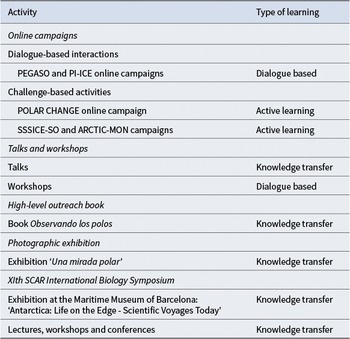
Outreach activities carried out and type of audience learning. Learning is classified according to the degree of bottom-up audience participation into knowledge transfer, dialogue-based learning and active learning.

SCAR = Scientific Committee on Antarctic Research.
A multi-institutional collaborative project surrounding the XIth SCAR International Biology Symposium
The XIth SCAR International Biology Symposium, entitled ‘Life in Antarctica: Boundaries and Gradients in a Changing Environment’, took place in Barcelona from 15 to 19 July 2013. The symposium, led by the ICM, and co-organized by the Barcelona Zoo (https://zoobarcelona.cat/es), CosmoCaixa Museum (https://cosmocaixa.org/ca), Museum of Natural Sciences (https://museuciencies.cat) and Maritime Museum of Barcelona (https://www.mmb.cat), extended beyond its official dates to span nearly the entire year. There were various such events across the city.
The organizers hosted a wide range of activities, including public lectures, school workshops, exhibitions and secondary school conferences. The main objective was to present a pioneering polar research event to the public while engaging Barcelona’s cultural and educational sectors in Antarctic science.
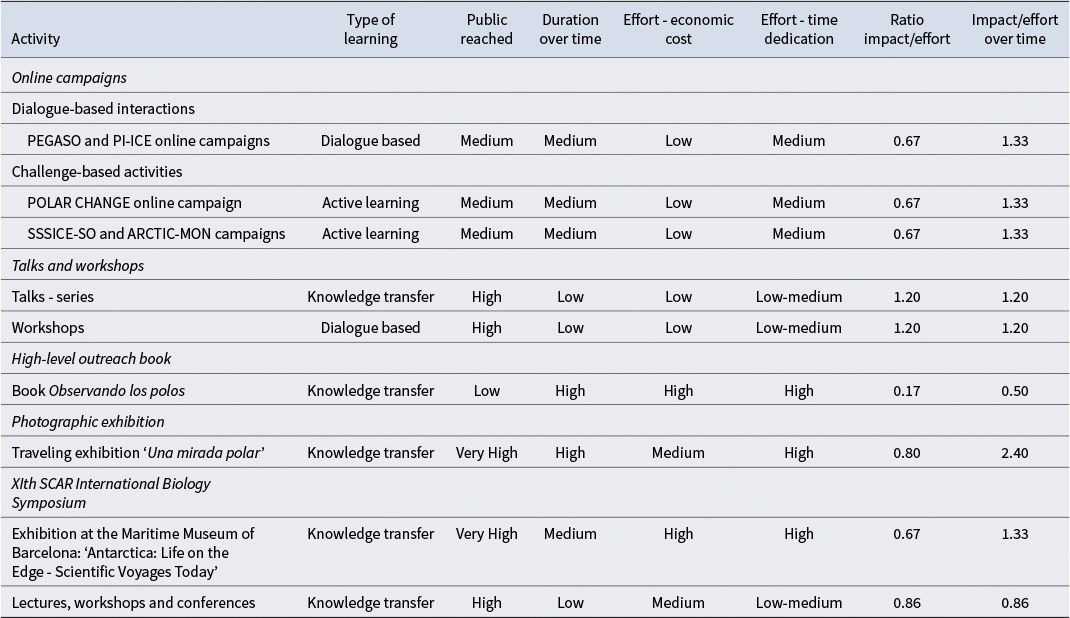
In general, these activities were conceived independently. For the purposes of this study, they have been grouped into three levels according to the degree of participatory learning (Table I). At the first level we place ‘knowledge transfer’: when the audience receives information with minimal direct interaction or knowledge creation, this is essentially the passive reception of scientific content. At the second level is ‘dialogue’: when, in addition to the transfer of knowledge, there is a bidirectional flow of information and feedback between students and scientists, this results in an interactive exchange. And finally, at the third level is ‘active learning’: students independently seek information and create their own work, thereby actively constructing their knowledge in the process.
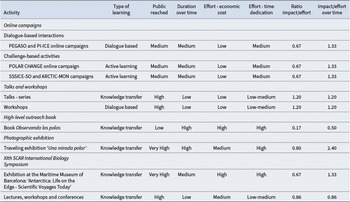
These activities were then ranked according to four key factors: 1) the audience they reached, the effort involved in carrying them out considering both 2) time commitment and 3) economic cost and 4) the duration of their impacts over time (Table II). These factors were grouped into categories: low (assigned a value of 1), medium (assigned a value of 2), high (assigned a value of 3) or very high (assigned a value of 4). The latter category was only used in the case of ‘audience reached’. The levels considered for each category are as follows. For audience reached: low (less than 300 people reached), medium (between 300 and 2000 people reached), high (between 2000 and 10 000 people reached) and very high (more than 10 000 people reached). For duration over time: low (ephemeral, the resource is inaccessible after the event), medium (resources partially accessible after the event) and high (resources fully accessible for a long period - at least several months). For economic cost: low (no extra money dedicated), medium (some money dedicated, less than 5000 euros) and high (more than 5000 euros dedicated). For effort in terms of time dedicated: low (less than half a month dedicated per activity), medium (between half a month and half a year dedicated) and high (more than half a year months dedicated). This categorization allowed us to calculate the impact/effort ratio as the sum of efforts divided by the public reached, as well as the impact/effort ratio over time by multiplying the ratio by the duration category (from 1 to 3).
Outreach activities ranked according to four key factors: the audience they reached, the duration of their impact over time and the effort involved in carrying them out (economic cost and time dedication). The levels considered for ‘audience reached’ were low (fewer than 300 people reached), medium (between 300 and 2000 people reached), high (between 2000 and 10 000 people reached) and very high (more than 10 000 people reached). The levels considered for ‘duration over time’ were low (ephemeral, the resource is inaccessible after the event), medium (resource partially accessible after the event) and high (resource fully accessible for a long period of at least several months). The levels considered for effort in terms of ‘economic cost’ were low (no extra money dedicated), medium (some money dedicated, less than 5000 euros) and high (more than 5000 euros dedicated). The levels considered for effort in terms of ‘time dedicated’ were low (less than half a month dedicated per activity), medium (between half a month and half a year dedicated per activity) and high (more than half a year dedicated per activity). The assignment of values to each category and the ratio calculations are explained in the ‘Materials and methods’ section.
SCAR = Scientific Committee on Antarctic Research.
Results
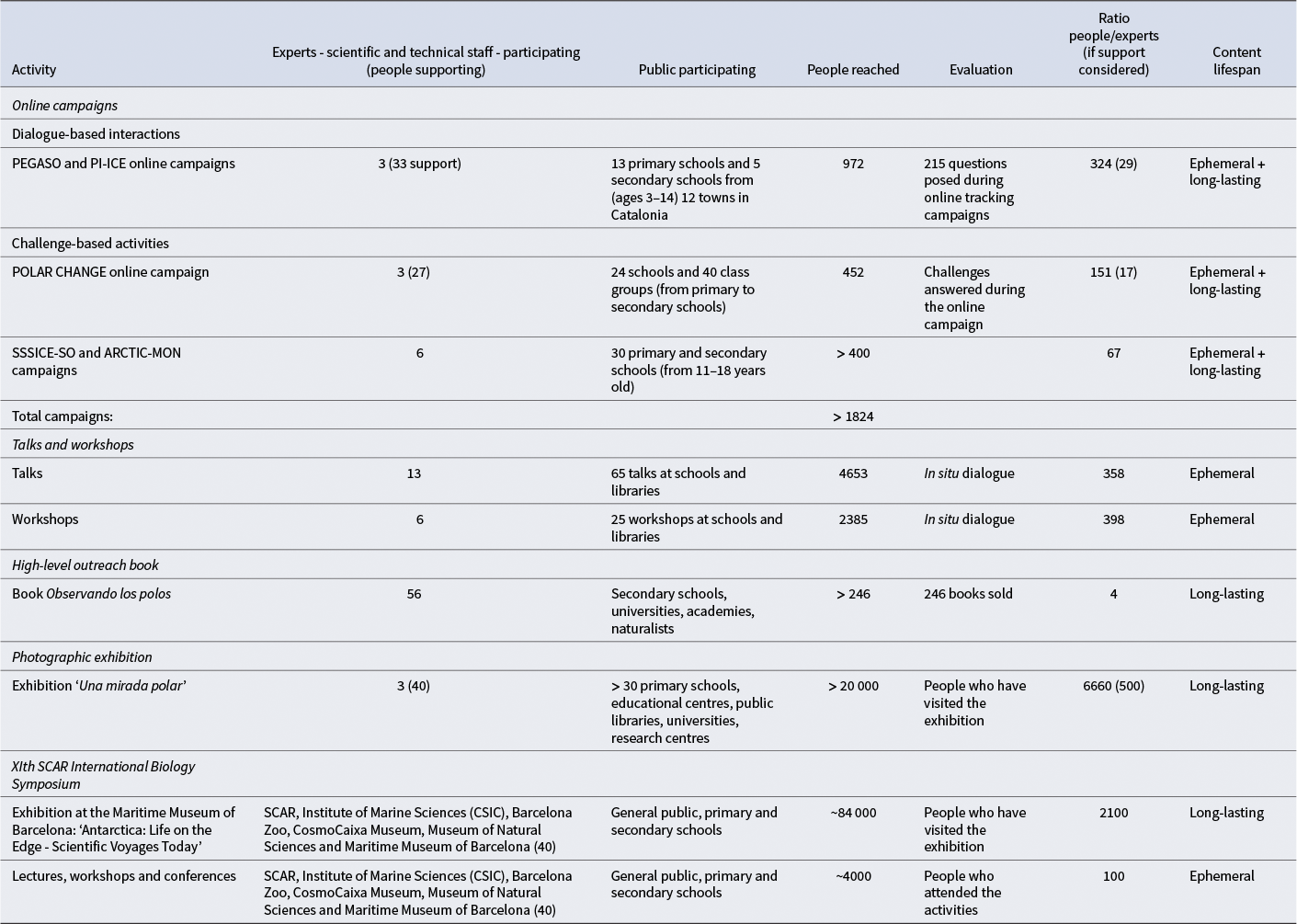
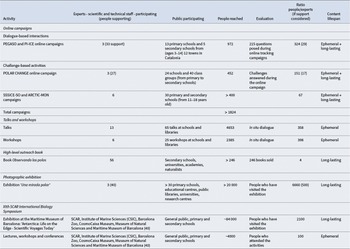
The five groups of activities are summarized in Table III, which provides indicators such as the target audience and experts involved, audience reached and the resource durability. The exhibition ‘Antarctica: Life on the Edge - Scientific Voyages Today’ at the Maritime Museum of Barcelona achieved an extraordinary audience (~84 000 people), followed by the photographic exhibition ‘A Polar Gaze’ (~20 000 people). The talks and workshops conducted from 2018 to mid-2024 reached over 7000 people, followed by the five online expeditions that reached over 1800 people and, finally, the outreach book, with over 250 copies sold. Globally, the outreach activities presented reached over 117 000 people. In the following, we present an analysis of each activity group.
Outreach activities produced to educate on Antarctic science in the classroom and for society. Some indicators such as audience (people reached), effort vs reach and lifespan of the content generated are indicated.
SCAR = Scientific Committee on Antarctic Research.
Five expeditions have been focused on multidisciplinary polar science since 2015, addressing topics such as chemical and biological components in the ocean, trace gases and aerosols produced by plankton in the Southern Ocean and their impacts on the climate (PEGASO - Plankton-Derived Emissions of Trace Gases and Aerosols in the Southern Ocean (in 2015), PI-ICE - Polar atmosphere-ice-ocean Interactions: Impact on Climate and Ecology (in 2019), POLAR CHANGE - Aerosol emissions from polar changing environments (in 2023)). They also cover physical aspects, sea-surface salinity assessment close to the ice edge using satellite observations in the Southern Ocean (SSSICE-SO (in 2023)) and oceanic dynamics and monitoring sea-ice thickness in the Arctic Ocean (ARCTIC-MON (in 2024)). Other topics covered in the online campaigns included astronomy, geography, history and nautical science. Additionally, the initiative explores logistical aspects and communication systems on oceanographic vessels and Antarctic bases, as well as the roles of those professionals involved in the campaigns. Discussions also covered psychological and social aspects such as scientific collaboration, teamwork and life on board a research vessel, as well as contemporary issues such as marine pollution, the climate crisis and the role of women in polar science. Polar campaigns offer a broad spectrum of opportunities that facilitate work on polar topics relevant to many different school disciplines.
The PEGASO and PI-ICE online campaigns were followed by 13 primary schools and 5 secondary schools from 12 towns in Catalonia, reaching a total of 972 students (ages 3–14) and involving 33 members of scientific and technical staff, who answered 215 real-time questions. The shift from dialogue-based interactions to challenge-based activities marked a turning point in how school participation was structured (Fig. 1). The challenge format also significantly expanded the reach of the POLAR CHANGE campaign. A total of 27 scientific and technical staff members participated, engaging 452 students from 24 schools and 40 class groups. The age range also broadened (from primary to secondary school), as each teacher could adapt the challenge to the specific level of their students. The oceanographic campaigns on physics (SSSICE-SO and ARCTIC-MON) were followed by a total of 30 primary and secondary schools, engaging students aged 11–18. In those cases, six members of the ICM participated in the outreach team (Table III). Throughout and beyond the real-time tracking of these campaigns, all diaries and educational materials remain available on the ICM Divulga website for schools and also for the general public, so the scope of these campaigns could become even greater.
POLAR CHANGE oceanographic expedition (February–March 2022) to the Antarctic Ocean. a. Challenges proposed to the students participating in the online expedition. b. POLAR CHANGE researchers sampling the sea ice (March 2022). c. Answers to the marine trophic network challenges by students participating in the online exploration.

A total of 65 talks on polar science and 25 workshops involving the observation of samples and/or videos have been conducted from January 2018 to June 2024 (Table S1). These activities took place in several educational centres, public libraries and museums across 28 localities, and they reached more than 7000 people. The polar themes ranged from biodiversity, marine biology (especially plankton and benthos), climate change, volcanism and how to conduct research at the poles.
The book Observando los polos offers a concise overview of the history and current state of scientific knowledge on polar areas, taking a global and multidisciplinary perspective. Through detailed descriptions of terrestrial and marine ecosystems and the past and future climate evolution of these regions, the chapters cover topics ranging from the geological evolution of the poles to the severe pollution problems that they currently face. This book aims to highlight the similarities and differences between the Arctic and Antarctica, to raise awareness among younger generations of the importance and vulnerability of these regions and to emphasize the need for research to understand and evaluate the role of the Arctic and Antarctica in our planet’s uncertain future in the context of climate change.
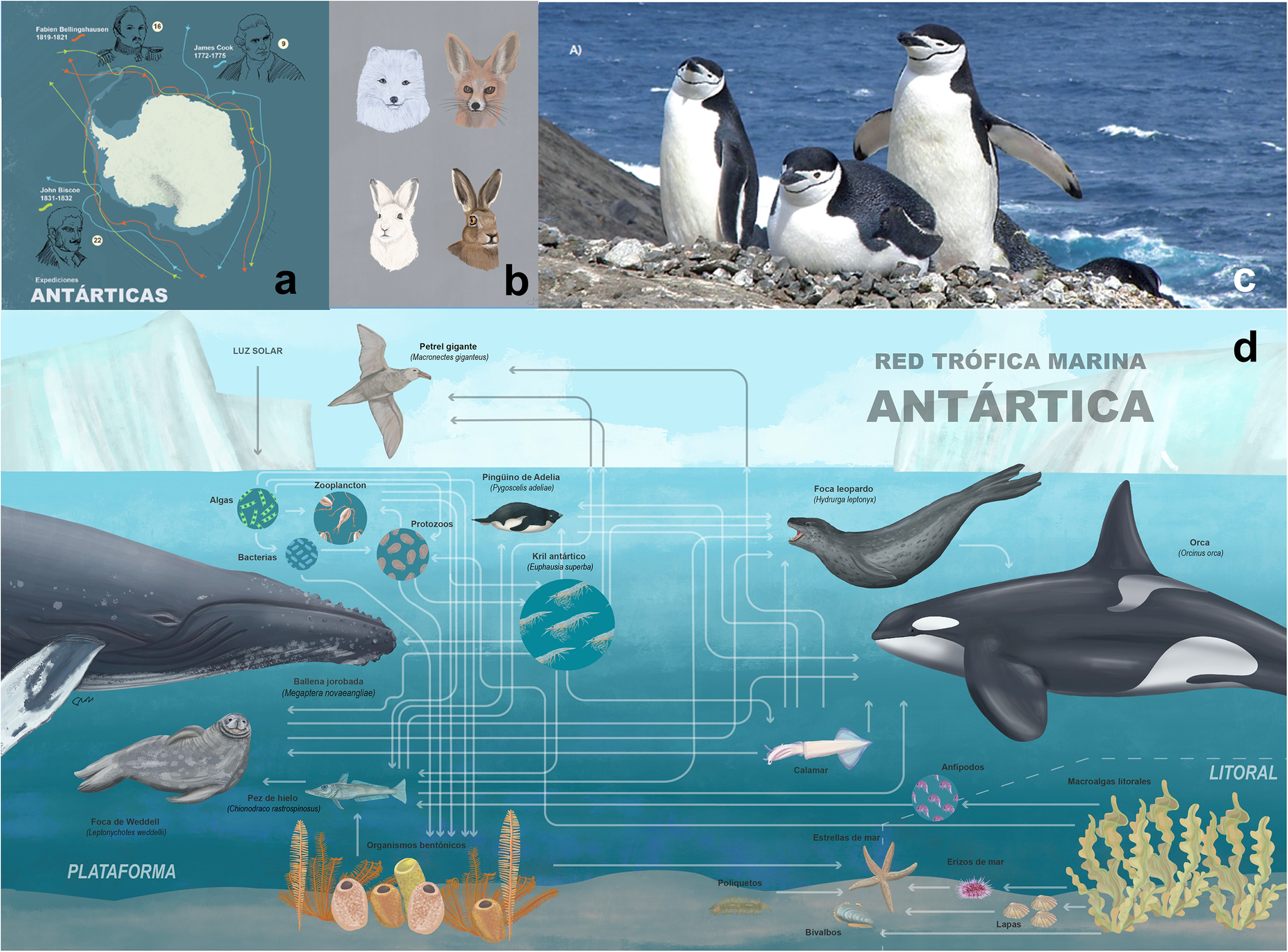
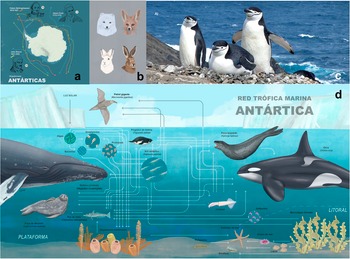
Dr Andrés Barbosa contributed to 4 of the 12 chapters in the book (Fig. 2), with his work in the first chapter being particularly noteworthy. In this chapter, he explores the history and origins of polar exploration, compiling comprehensive timelines that highlight ~50 of the most significant milestones at both poles - an effort of such scope had never been accomplished before. In the second chapter, he delves into the development of Spanish research in the polar regions, as well as management matters, drawing on his extensive experience as the former manager of the Spanish Polar Program. He also authored chapters focused on polar life, providing detailed insights into the fauna inhabiting both the terrestrial and aquatic ecosystems. His deep expertise regarding the avian species of these environments, especially his profound knowledge of penguins, further enriches these sections.
Reproduction of some figures from the book Observando los polos. a. Routes of pioneer Antarctic explorers, by A. Barbosa and N. Schamuells. b. Comparison of ear sizes of Arctic (left) and Antarctic (right) mammals, by A. Barbosa and N. Schamuells. c. Chinstrap penguin (Pygoscelis antarcticus), by A. Barbosa. d. Antarctic marine trophic network, where some of the most representative species are illustrated, by A. Barbosa, J.M. Gili, D. Vaqué and N. Schamuells.
The book has been well received by the public, with a total of 169 copies sold through Catarata (https://www.catarata.org) and an additional 77 copies sold through Editorial CSIC (https://editorial.csic.es/publicaciones), the two publishers responsible for its publication.
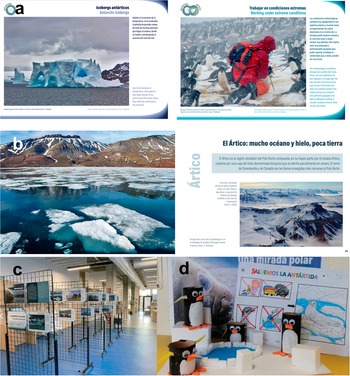
The photographic exhibition ‘A Polar Gaze’ consists of 30 images grouped into three main themes: ‘The Nature of the Poles’ (Block 1), ‘The Poles and Climate Change’ (Block 2) and ‘Polar Research’ (Block 3). Each theme includes 10 images (5 Arctic and 5 Antarctic) printed on DIN A3 polyvinyl chloride (PVC) panels (Fig. 3a). Each photograph is accompanied by a brief text in both Spanish and English explaining in an engaging way the characteristics and uniqueness of the polar regions (Block 1), the changes and alterations they are undergoing due to climate change (Block 2) and the research being conducted in Antarctica and the Arctic by CSIC personnel, along with its scientific and social relevance (Block 3). In addition to the physical exhibition, a digital book (A polar gaze: a visual journey to the ends of the Earth) was created, compiling all of the photographs and texts (Fig. 3b). The book is intended to serve as supporting material for cultural and educational centres during the academic year. Since its release in 2021, the exhibition has been displayed in over 30 different primary schools, educational centres, public libraries, universities, research centres and during scientific conferences at no cost (Fig. 3c). It has been estimated that over 20 000 people have already enjoyed the exhibition, in addition to over 5000 downloads of the digital book. The exhibition has been a wonderful educational resource for schools, since it helps as supporting material to develop other educational projects such as games, videos and research projects (Fig. 3d). In addition, the digital book has been used numerous times as supporting material for other polar exhibitions such as ‘Museo en la Antártida’ at the Casa de la Ciencia (CSIC; https://www.casadelaciencia.csic.es/es/exposicion/museo-antartida).
Photographic exhibition ‘A Polar Gaze’. a. Example of two panels. Irregular iceberg castle type in the Bransfield Strait (left) and nest tagging of Adélie penguins in the Hope Bay penguin colony on the northern Antarctic Peninsula (right; both photographs by Dr Andrés Barbosa). b. Example of one of the pages of the digital book A polar gaze: a visual journey to the ends of the Earth: (left) image of an Antarctic landscape at Spitsbergen Island (Svalbard archipelago, Norway; photograph by Dr Andrés Barbosa); (right) aerial image of the eastern coast of Greenland (photograph by Santiago Giralt). c. ‘A Polar Gaze’ exhibited in the public library of Corró d’Avall (Franqueses del Vallès, Catalonia). d. Example of an educational project derived from the exhibition ‘A Polar Gaze’ at a primary school (CPR Compañía de María, Galicia).

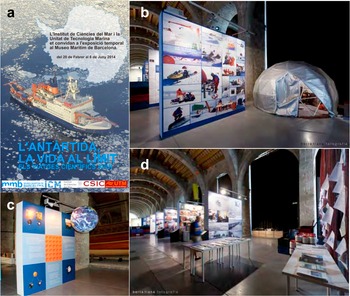
Finally, several side events were organized at the XIth SCAR International Biology Symposium titled ‘Life in Antarctica: Boundaries and Gradients in a Changing Environment’ held in 2013 in Barcelona, reaching more than 88 000 people (Fig. 4). The highlight was the exhibition at the Maritime Museum of Barcelona ‘Antarctica: Life on the Edge - Scientific Voyages Today’, which attracted over 84 000 visitors in just 3.5 months. Another notable event was a special performance at the famous Montjuïc Fountains, created specifically for the congress. Due to its popularity, the show continued every Friday until the end of the year, drawing large crowds, although exact figures are difficult to quantify.
Multi-institutional collaborative project around the XIth Scientific Committee on Antarctic Research (SCAR) International Biology Symposium. a. Exhibition poster entitled ‘Life in Antarctica: Boundaries and Gradients in a Changing Environment’. b. & c. Examples of two panels from the exhibition. d. The exhibition at the Maritime Museum of Barcelona.

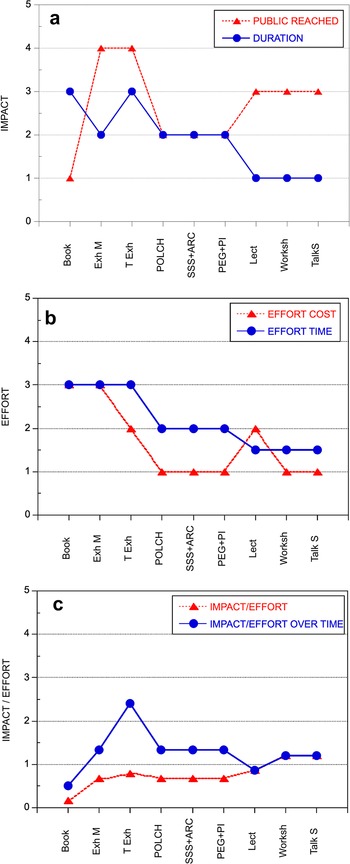
Impact and effort related to the outreach activities. a. Impact in terms of audience (public reached) and duration over time. b. Effort invested in terms of economic costs and time dedication. c. Impact/effort ratio and impact/effort over time ratio. Book = Observando los polos; Exh M = exhibition at the Maritime Museum of Barcelona; T Exh = travelling exhibition; POLCH = challenge-based campaign POLAR CHANGE; SSS+ARC = challenge-based campaigns SSSICE-SO and ARCTIC-MON; PEG+PI = dialogue-based campaigns PEGASO and PI-ICE; Lect = lectures, workshops and conferences at the Maritime Museum of Barcelona; Worksh = workshops; Talk S = talk series.

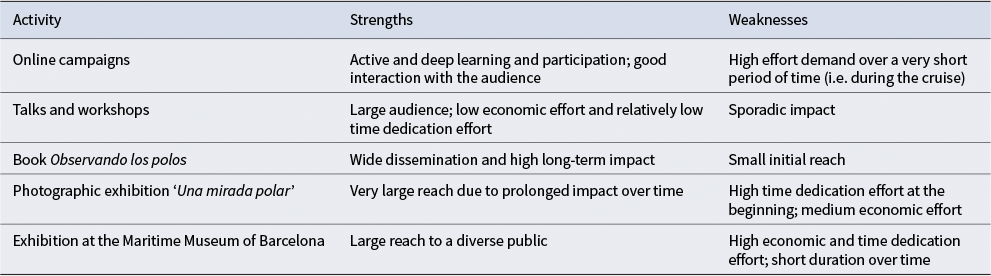
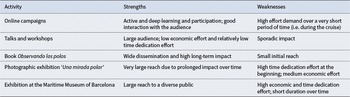
The analysis of these experiences according to the parameters established above is summarized in Table II and plotted in Fig. 5. Knowledge transfer activities such as talks and exhibitions tend to reach a wide audience, having the highest impact in the temporary exhibition coordinated with the symposium at the Maritime Museum of Barcelona. In contrast, active learning activities, such as online campaigns, offer greater interaction, although they have a more limited reach. Figure 5a shows that, in terms of its potential impact, the travelling exhibition has the capacity to yield significant long-term outcomes. The book format reaches the narrowest audience in the short term, but it is a valuable resource that sees increased impact over time (see Fig. 5a). In terms of effort, the book Observando los polos and the Maritime Museum of Barcelona exhibition have the highest economic costs and require the greatest time commitment. Conversely, talks and workshops incur low economic costs and require less time, making them ideal for rapid dissemination (Fig. 5b). However, in terms of impact duration, exhibitions and books have a greater impact duration, allowing their effects to be sustained over the long term. Oceanographic campaigns also see increased impacts over time because their content is published online on the ICM website. However, online activities and talks have shorter-term impacts, implying a more immediate effect (Fig. 5c). In summary, talks and workshops have a high impact with low effort, making them efficient in terms of dissemination. The exhibition at the Maritime Museum of Barcelona and the book require more effort, but their long duration of impact may justify such investment. All of this information is summarized in Table IV, where the main strengths and weaknesses of the five groups of activities are presented.
Discussion and conclusions
Polar ecosystems, such as those found in the Arctic and Antarctic, are particularly vulnerable to the effects of climate change. Global warming is accelerating the melting of sea ice, permafrost and glaciers, thereby affecting biodiversity and the habitats of polar wildlife, which is particularly concerning given that polar ecosystems play a crucial role around the globe (e.g. Smetacek & Nicol Reference Smetacek and Nicol2005, Reid et al. Reference Reid, Fischer, Lewis-Brown, Meredith, Sparrow and Andersson2009, IPCC Reference Lee and Romero2023). In the face of this critical situation, scientists have a responsibility to educate society about this issue (Salazar et al. Reference Salazar, Dominguez-Carrió, Gili, Ambroso, Grinyó and Vendrell-Simón2019, Cardelús et al. Reference Cardelús, Balagué, Vila, Pelegrí, Gili and de Albéniz2021, Mebane et al. Reference Mebane, Benedetti, Barni and Francescato2023). Education plays a key role in promoting public understanding, awareness and adaptive capacity, as well as in reducing vulnerability to anthropogenic or climate-related disasters (Anderson Reference Anderson2010, UNESCO 2015, Feinstein & Mach Reference Feinstein and Mach2020). Recognizing these challenges and guided by a strong social commitment, this study presents different formats for disseminating polar science: some are more far-reaching than others, some are ephemeral and others are long-lasting (Table III), but all are good options for increasing science education. The development and execution of these educational resources have been carried out by scientific staff, who have ensured their scientific rigour. The suitability of each resource is analysed based on the objective being pursued and the resources allocated. The final objective is to present and discuss the suitability of different educational resources to increase scientific understanding of these remote natural environments that are highly relevant to the planet’s climate regulation. These environments are also experiencing strong impacts due to global change. The ultimate goal is to raise public awareness of issues that seem distant but, in reality, have global repercussions.
Online expeditions represented a living activity that was first developed in 2000 (Gili & Segarra Reference Gili and Segarra2000). During such expeditions, there was constant contact with schools and families. The researchers reported on their research work as well as on many general topics about Antarctica, and they answered many questions received aboard the ship, especially from schoolchildren. These experiences included live interviews with the media and visits to the participating schools after the expedition. Subsequently, works with educational and informative content were published on the joint activities between scientists, students and secondary school teachers (Vila et al. Reference Vila, Martínez, Sabater, Gasol and Lupón2004, Vidal & Meló Reference Vidal Meló, del Valles, Esplugas and Gasol2004, Estragués & Marlés Reference Estragués and Marlés2005, Gili & Vendrell Reference Gili and Vendrell2016). Thanks to the successes achieved and to the fact that the ICM is a research centre where polar and non-polar campaigns are frequently carried out, as well as the enthusiasm, dedication and commitment of its staff, students have participated in 36 oceanographic online expeditions since 2004, described at ICM Divulga educational website (http://icmdivulga.icm.csic.es/expedicions). This initiative has become a core component of the ICM’s expeditions since 2015, with 11 out of 20 campaigns specifically followed by schools, including five polar expeditions: PEGASO (2015), PI-ICE (2019), POLAR CHANGE (2023) and SSSICE-SO (2023) in the Southern Ocean and ARCTIC-MON (2024) in the Arctic Ocean (Balagué et al. Reference Balagué, Cardelús, Gili, Simon, Vicioso, Vila, Pelegrí, Gili and de Albéniz2021b). This experience has been recognized as a valuable non-formal educational resource in schools due to its introduction of the polar regions, which are often missing from standard curricula. The activities are designed to encourage curiosity, dialogue, reflection, critical thinking and an interest in science and its methodologies during a crucial stage of both academic and personal development. Effective environmental education needs to start early. When young people grasp the significance of these regions to the planet’s well-being, they are more likely to respect and participate in their conservation. These types of activities also highlight the contributions of professionals working in polar science, particularly the role of women in this field today.
The online expeditions initially were conceived as dialogue-based interactions with a single educational centre. However, growing interest from schools and the desire to increase the scope of this educational resource have led us to consider a change of direction towards challenge-based activities. A strength of learning through challenges is that it promotes hard work and creativity. However, it requires greater involvement of both teachers and students, but it is precisely through active participation that students gain deeper understanding. Live events, which connect students directly with polar researchers, along with pre- and post-expedition talks, have become key opportunities for the passionate engagement of both students and teachers.
Main strengths and weaknesses of the five groups of outreach activities.
A key consideration for generating a greater impact from educational activities is to pay attention to school calendars, avoiding campaigns that might coincide with holidays (e.g. carnival, Halloween) or the end of the school year, when students often are overwhelmed. It is important to consider the impact of time differences when there is a significant difference in time zones between the scientists working at the poles and the pupils in schools (Thomson et al. Reference Thomson, Hofman and Staniforth2010). The use of a shared home language between polar scientists and students is also key to the success of these activities. However, some of these resources can be given in other languages, and so they could also be used in language classes. The use of shared home languages is also evident in the related literature, which is primarily aimed at students and teachers.
The more than 80 talks and workshops held over 6.5 years represent more than one activity per month, reaching ~100 participants monthly. This is in addition to all of the lectures, workshops and conferences held as part of the XIth SCAR International Biology Symposium. Therefore, this is an adequate way to bring attention to these issues. On the other hand, producing a book such as Observando los polos (Balagué et al. Reference Balagué, Cardelús and Vila2021a), in which more than 50 specialists in various fields of polar research have come together to explain, in accessible language, the research being done at the poles, requires the long and sustained efforts of many people. While the short-term reach of this book has been relatively limited, this resource offers high-quality content that remains accessible to the public. Additionally, we are currently developing a new version in the form of an illustrated book, which we anticipate will engage a broader audience.
Finally, the large numbers of visitors to the exhibitions (ranging from 20 000 to 84 000) demonstrate that they are highly effective means of disseminating polar science to a broad audience (Gili et al. Reference Gili, Zapata-Guardiola, Vendrell-Simón, Ambroso and Isla2014). In addition, the more modest and easily transportable ‘A Polar Gaze’ exhibition (Geyer et al. Reference Geyer, Giralt and Madurell2021) continues to be shown in educational and civic centres, thereby steadily increasing the audience that has seen this exhibition.
What key lessons can be learned from these activities? In a research project scenario in which we want to carry out dissemination activities, it is necessary to be clear about the strengths and weaknesses (Table IV) of each of these activities in order to choose the one that best suits our purpose. First, in the process of designing an activity it is imperative to consider the primary objective: namely, to determine whether the intention is to appeal to a more extensive audience in a more superficial manner or to a more limited, targeted audience in a more profound way. Be clear that there is no relationship between depth and the scope of learning. That is, the number of people reached is not necessarily indicative of the depth of learning achieved. For instance, challenge campaigns facilitate deeper learning, but they do not reach as many people as an exhibition. In addition, activities that encourage active and/or dialogue-based learning do not necessarily require more time, so they are highly recommended. Although it would be reasonable to speculate that active learning would lead to greater awareness, there is no such direct relationship, as we will see below.
This study has found that learning from projects presented on blogs and online campaign sites tends to be deeper, as it is grounded in personal engagement and interactive dialogue between students and scientists. This dynamic has been found to be conducive to a sense of stimulation, which is reported by both parties. However, the activities specifically aimed at educational audiences are limited in scope due to their current organization. Consequently, there is a need to enhance the dissemination of these online resources in the future.
Another factor to consider is the extent to which the duration of an activity affects its audience size. Longer activities, such as itinerant exhibitions, tend to reach larger audiences, whereas shorter activities, such as talks and workshops, tend to reach smaller ones. In our particular cases, the audience sizes were significant (over 20 000 for the itinerant exhibition vs ~7000 persons for talks and workshops). Nevertheless, longer activities require greater financial investment and dedication. One-off activities require considerable individual involvement, as many talks and workshops are needed to reach a larger audience.
Finally, the effort spent must be optimized. Although the book Observando los polos is an example of a high-effort and low-impact reference material, its added value lies in its status as a long-lasting one. Moreover, the possibility to fill a knowledge gap in a given language (in our case, in Spanish) due to the lack of this type of outreach material significantly increases its impact and versatility. Its dissemination campaign could be further strengthened by promoting it as an educational reference resource during talks and workshops.
Education and outreach activities on polar topics in the Antarctic region have increased during the last decade (Xavier et al. Reference Xavier, Mateev, Wilmotte, Peña-Aguirre, Jupe and Ramos-García2024), coinciding with the establishment of the Antarctic Treaty Consultative Meetings Intersessional Contact Group (ATCM ICG) on Education and Outreach created as a product of the first ATCM Workshop on Education and Outreach in 2015 (Xavier et al. Reference Xavier, Mateev, Capper, Wilmotte and Walton2019). The success of science education has been measured in a number of ways, but quantitative methodologies are the most commonly applied (Shellock et al. Reference Shellock, Fullbrook, McKinley, Cvitanovic, Kelly and Martin2024). Indicators of success can include how many activities have been carried out. In this study, we have assessed success in terms of how many educational centres have participated and how many people have been reached, for instance. However, there are surveys that assess changes in public awareness of the subject, as well as the number of students who continue pursuing studies in scientific fields (Thomson et al. Reference Thomson, Hofman and Staniforth2010). At the onset of these activities, our intention was not to conduct a comprehensive study; therefore, no measurements were taken prior to or following the activities. They simply operated more or less independently of each other, and student interest was often gauged through informal discussions at the end of the interventions. For instance, the evaluation of online tracking campaigns was conducted through feedback from participants, which has been consistently positive, as the campaigns provide direct interaction with scientists and bring the polar research conducted at the CSIC closer to the students. Furthermore, effective communication between the scientists and the teachers facilitating the activities enabled the smooth exchange of insights and impressions (e.g. schools that have participated over the years have recognized it as a unique and valuable pedagogical resource). In certain instances, the project has been implemented in schools located in highly complex social environments, where teachers have found it to be a highly effective educational tool, providing students with knowledge through real-life experiences. During these online communications, students have shown significant interest in the environmental condition of these remote areas. As these campaigns can also be followed by the general public, they foster mutual learning between scientists, technicians, schools and society as a whole.
Although education regarding the problems faced by polar environments is needed to raise awareness among students and the general public, the relationship between environmental knowledge and pro-environmental behaviour is complex and a significant area of research (e.g. Liu et al. Reference Liu, Teng and Han2020, Hehir et al. Reference Hehir, Stewart, Maher and Ribeiro2021, Cajiao et al. Reference Cajiao, Larson, Leung and Reas2024). Future research should further investigate this connection in order to guarantee that interventions such as those presented herein truly enhance awareness of the necessity to care for and maintain a healthy environment, and to encourage shifts in attitudes that translate into action. To achieve this, we envisage in the near future involving social science professionals in the development of surveys to be administered before and/or after these activities. In other words, we have learned from this work that future polar science outreach activities must be coordinated and accompanied by social impact evaluators in order to be able to draw conclusions regarding their effectiveness at raising awareness.
The elaboration of scientific educational materials often stems from the enthusiasm of the scientific personnel who carry out these tasks on a voluntary basis, taking advantage of the opportunities offered by their work. Dr Andrés Barbosa was a pioneer in communicating Antarctic science, probably due to his combination of scientific excellence and deep passion for Antarctica. He not only served as an inspiration but also contributed significantly to this project by providing wonderful images of his research activities in the Arctic and Antarctica, as well as by providing support for the preparation of the explanatory texts for the exhibition ‘A Polar Gaze’ and contributing with his experience to the original illustrations in the book Observando los polos.
Many researchers dedicate substantial amounts of time and resources to communication activities out of a genuine passion for polar research and the polar regions. In most cases, their efforts exceed institutional expectations and rarely lead to formal recognition. However, they frequently receive extremely positive reactions from their audiences (students or public; Salmon et al. Reference Salmon, Carlson, Zicus, Pauls, Baeseman and Sparrow2011). Such feedback, together with the opportunity to contribute to increasing citizen literacy on polar issues, should be accompanied by a change of mindset in terms of how science is evaluated and funded, as funding for transdisciplinary research remains elusive (Knutti Reference Knutti2019). We also encourage science projects to allocate part of their budget to developing educational materials and hiring assistants to support educational activities, because, as stated by Vendrell et al. (Reference Vendrell-Simón, Vilar Recasens, Galofré Robles, Soler Freixa, Lama Camacho and Mèlich Colom2024), education may be the starting point for creating basic environmental awareness through increasing knowledge and changing attitudes, thus fostering future responsible behaviour.
The last decade has seen an increase in Ocean Literacy, including in the polar areas. Scientists from different environmental disciplines have been engaged in transmitting their knowledge to the public, and to young people in particular. However, a direct link between increased knowledge and environmental action has not been observed (Knutti Reference Knutti2019). To fill this gap, scientists need to go a step further in encouraging action for change. Surely this will involve connected actions in the different areas of our lives, as well as changes to the behaviours of scientific institutions in order to be the pioneers of reducing our carbon footprint. We must start to act.
Supplementary material
To view supplementary material for this article, please visit https://doi.org/10.1017/S095410202510031X.
Acknowledgements
We would like to thank all of the educators and students from the different schools and institutes for their enthusiasm, dedication and motivation during their participation in the online polar oceanographic expeditions. We thank all of the scientific and technical staff who have collaborated in the development of any of the content and tasks that have allowed the development of these online campaigns, especially Elisabet-Laia Sá for her dedication in the Polar Change diary, María Vicioso and Elisabetta Broglio for making possible the online expeditions at the ICM Divulga website and for facilitating communication with schools, as well as the staff of the UTM-CSIC for facilitating communication between Antarctica (the RV BIO Hespérides and the Spanish Antarctic BAE) and the ICM-CSIC. Our thanks also go to the principal investigators of the projects and oceanographic polar campaigns (Rafel Simó, Elisa Berdalet, Manuel Dall’Osto, Carolina Gabarró, Marta Umbert) for their enthusiasm and support in the development of these outreach projects. We are grateful for the comments of the two reviewers, which significantly improved the manuscript.
Financial support
This study is part of the POLARCSIC platform activities and had the institutional support of the ‘Severo Ochoa Centre of Excellence’ accreditation (Grant CEX2024-001494-S funded by AEI 10.13039/501100011033) to the ICM CSIC. The study is part of the CONEXIÓN POLARCSIC and was made possible thanks to the opportunities offered by some polar projects and the enthusiastic people committed to transferring their scientific knowledge to society. We sincerely appreciate the opportunities offered by the project leaders of PEGASO (CTM2012-37615, R. Simó), PI-ICE (CTM2017-89117-R, E. Berdalet and M. Dall’Osto), POLAR CHANGE (PID2019-110288RB-I00, M. Dall’Osto and R. Simó), SSSICE-SO (ARICE-H2020-PONANT ANTARCTIC SEASON 2023–2024, M. Umbert) and ARCTIC-MON (PID2021-125324OB-I00, C. Gabarró). ‘A Polar Gaze’ was partially funded by the Fundación General del CSIC Cuenta la Ciencia project. The book Observando los polos was an initiative of PTI (now Connection) POLARCSIC (https://www.polarcsic.es). The ‘Antarctica: Life on the Edge - Scientific Voyages Today’ exhibition was co-funded by the Maritime Museum of Barcelona and the Institut de Ciències del Mar of Barcelona (CSIC).
Competing interests
The authors declare none.
Author contributions
MV conceived the project. MV, VB, CC, JMG and DV coordinated or were deeply involved in the online polar oceanographic expeditions. MV, VB, CC, AG, JMG and DV conducted face-to-face talks and workshops on polar ecosystems. All authors were involved in editing the Observando los polos book or coordinating the book sections. AG and SG coordinated the exhibition ‘A Polar Gaze’, and MV, VB and CC were involved in the accompanying book’s text revision. JMG coordinated the multi-institutional collaborative exhibition ‘Antarctica: Life on the Edge - Scientific Voyages Today’. All authors participated in writing the manuscript.
Dedication
This work is dedicated to the memory of our colleague and friend Dr Andrés Barbosa.



 Open access

