

Moshenska (Reference Moshenska and Moshenska2017:3) describes public archaeology as “where archaeology meets the world.” This description perfectly encompasses archaeology as communicated online, because what we post can reach a broad audience across the globe. With the increased popularity in recent years of short-form video content on social media platforms like TikTok, Instagram (reels), and YouTube (shorts), topics in archaeology and history can reach a wider audience in a new way. In the United States alone, 135 million Americans (approximately 40% of the US population) use TikTok, and 170 million use Instagram (about 50% of the US population; Statista 2025; Woodward Reference Woodward2025). It is more important than ever for archaeologists to be in online spaces creating educational content, especially because so many young people use social media platforms daily. Online archaeologists who post often may gain a following, big or small, and they interact with the public, sometimes daily, in the comment sections of their videos.
The reach of archaeologists posting online far exceeds that of any in-person public archaeology. In-person public archaeology, of course, is incredibly important because it allows people to see archaeology in real time and possibly participate in it. However, videos allow people to be educated about archaeological discoveries from all over the world without the costs of traveling to view archaeological sites in person. This is what makes archaeological content on social media so accessible to the public.
There are many ways to educate online about archaeology. Some creators make content showing themselves visiting museums, providing a view of exhibits while also giving brief rundowns of a museum’s collection and its main goals. This gives museums visibility, which can increase visitation/ticket sales. Other creators create videos about specific sites, explaining the major discoveries and their overall impact on our understanding of the past. Such videos allow viewers to learn about sites they may have never heard of and could encourage them to search for other archaeological sites. Institutions such as Colonial Williamsburg create videos showing the current state of excavations within their historic district. These enable visitors to continue to learn about the archaeology they saw during their visit and see the outcomes of those excavations.
In her Digital Review for this journal, “TikTok as a Learning Tool for Archaeology,” Khan states that when she reviewed archaeologists’ content on TikTok, she appreciated content that did not show the “glamorized versions of archaeology where we see only pyramids, temples, and rare objects” (Khan Reference Khan2022:453). She notes that archaeologists often post videos about typical day-to-day tasks, showing the realities of working in the field. This kind of content creates a much more realistic view of what we do.
Online archaeologists often face the persistent and odd belief that we professionals are hiding the truth about our archaeological discoveries. Shows like Ancient Aliens and Ancient Apocalypse are very popular, and their pseudoscientific narratives often create an online environment in which archaeologists are constantly spending time disproving the false theories posited. By posting online about our work, we can negate this idea that archaeologists are keeping secrets about the past.
In the twentieth century, leaders in the field like British archaeologist Mortimer Wheeler believed that archaeologists must “reach and impress the public” with their findings (Richardson and Almansa-Sanchez Reference Richardson and Almansa-Sánchez2015:195). As professionals, sharing the information we learn by communicating directly with the public via social media makes archaeology much more accessible.
Creating Archaeological Social Media Content in 2025
Online video content creation has changed significantly over the past 20 years. Smartphones make possible video creation that once required far more equipment and time to produce: users can record, edit, and post their videos all within the same day. Short-form content, or content lasting only a few minutes or less, is currently the most popular type of content online and is most often seen on platforms like TikTok, Instagram, and YouTube.
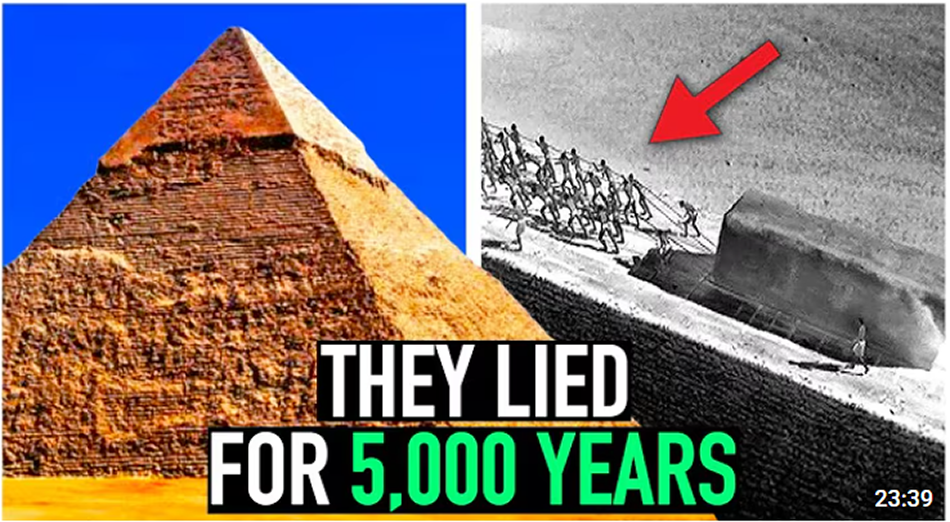
Social media apps provide many tools for video creators to edit and customize their videos to enhance viewer engagement. The videos that often reach the widest audiences tend to fall into the category of “clickbait”—a type of video that catches attention with some hyperbolic opening line or an overdramatized edited video thumbnail. A video thumbnail caption like “This is the exact spot where Christ was crucified” (Figure 1) or “They Lied for 5,000 Years” (Figure 2) can make viewers feel tricked into watching a video that does not hold up to its opener. I follow many archaeologists on multiple platforms, and only very rarely do I see professional archaeologists using this tactic to gain viewership.
@kcash3333 uses a caption in the video thumbnail to capture viewers’ attention (https://www.tiktok.com/@kcash3333/video/7214649653084638507/, accessed Septbember 16, 2025).

@sowierdwithpj posts a video with this thumbnail to catch viewers’ attention (https://www.youtube.com/watch?v=RyDi31IK5N4, accessed September 16, 2025).
Another common type of video, which can be called “engagement bait,” provides information but leaves out important details essential to understanding the full context; in response to this lack of information, many viewers add comments that help fill in those gaps in context. An example of this is a video by creator @stephthearchaeologist, in which she posts a short video of herself with text on screen referencing Spartan women; the video itself provided little context, but there was a detailed description in its caption (Figure 3). Multiple commenters asked for more context or were upset by the lack of context in the video itself.
@Stephthearchaeologist posts a video to garner engagement through “engagement bait” (https://www.tiktok.com/@stephthearchaeologist/video/7552910029666389270, accessed September 22, 2025).

Comments push the video to other viewers, thereby increasing viewership and other engagement, which in turn can take a video further through the algorithm. The algorithm learns what viewers want to see on their social media by what content retains their attention the longest. Online creators therefore compete for their share of the attention economy by trying to manipulate the algorithm, such as by encouraging viewers to comment.
Attention as Resource and Goal
The concept of the “attention economy” builds on the idea of “human attention as a scarce but quantifiable commodity” (Crogan and Kinsley Reference Crogan and Kinsley2012:1). This is important because, as Menzcer and Hills (Reference Menczer and Hills2020) stated, “One of the first consequences of the so-called attention economy is the loss of high-quality information.” Every day, millions of posts are uploaded to social media platforms, flooding viewers with content. Whether a post contains quality information is generally not the most important factor in deciding to upload it; instead, the uploader is usually seeking the most views. Clickbait is a product of the attention economy, as creators seek ways to grab viewers’ attention by the methods mentioned earlier. Archaeological content often does not need to use these methods, because “archaeologist” is not a title held by very many people around the world. Archaeologists should take advantage of their knowledge to create content. They can engage and easily earn viewership just because many people are interested in the ancient world, which they perceive as mysterious and interesting (Perry Reference Perry2019).
Comments: The Feedback Cycle of Social Media
Archaeologists who frequently post online generate varying responses from viewers. Those who provide content meant to combat false information being spread online run the risk of attracting backlash from the public. Some viewers believe that archaeologists are lying to the public, whereas others see these videos as opportunities to learn something new. Publishing content online, although it comes with some risks, can be rewarding because misinformation about archaeology is rampant online and content from professionals helps combat its dissemination.
I recently conducted a survey of archaeologists who engage in social media (Chitwood Reference Chitwood2025). Of the 36 respondents, 34 stated that they enjoy interacting with the public online. They also found that posting led to the creation of connections with other professional archaeologists around the world; some of these connections evolved into friendships with fellow archaeology and history content creators. Educational content creators also mentioned how time-consuming content creation often is, which may result in burnout. But when videos reach an interested audience, the time spent was seen as worthwhile and rewarding. Others also mentioned they do not mind having a smaller following, because it allowed them to interact with people who are genuinely interested in learning about archaeology and history.
Some archaeologists did recall that at times their videos might have reached the “wrong side” of a social media platform. This visit to the “wrong side” occurs when the algorithm sends a video to viewers who, rather than engaging positively, write hateful comments. Often, these comments cause the algorithm to push the content to more like-minded viewers, who then continue the stream of hate, creating an “echo chamber” and increasing the viewers’ much-desired confirmation bias (Guzman et al. Reference Guzmán Rincón, Barragán Moreno, Rodríguez-Canovas, Carrillo Barbosa and Franco2023). For example, one archaeologist stated that when she has videos on the “wrong side,” she often is “talked down to like I’m stupid because I’m a woman.”
Often as archaeologists, we are also activists for the preservation and protection of cultural resources. As current changes in government policies diminish the protection of cultural resources, many archaeologists are responding online. For example, creators like @archpaleomonitor posted to their TikTok describing the National Park Service facilities that are important for the preservation of collections throughout the United States and are threatened by the impending end of their building leases. The loss of these facilities puts the collection of artifacts in their storage areas at risk. One commenter wrote, “This is criminal!! These belong to the American people, NOT fascist billionaires!!!,” and another noted that “Every single day it gets worse.” This video got more than 1,000 views and was shared 27 times. The reactions to it in the comments were mostly a sense of outrage or despair over the government’s decisions. This video reached viewers who agreed with the creator, thereby generating one of the many online echo chambers. Online activism can inform viewers about ongoing problems in our field and the areas adjacent to it. Bringing awareness to these topics online, especially by a professional archaeologist, makes the public feel more involved and a part of the bigger picture.
Archaeologist-Communicators
In this section, I provide a few examples of archaeologists who are engaging the public using short-form video social media platforms.
First is @archpaleomonitor (Archpaleomonitor 2025), an archaeologist from southern California who often uses humorous soundbites to share ideas about archaeology (Figure 4). She also posts more serious videos covering topics like the improper treatment of Indigenous remains or that respond to videos making false claims about archaeological sites in the southwestern United States. This creator generates mostly positive engagement, and in the rare case in which she receives a negative comment, she will usually respond through humor rather than with anger. This is an approach that many use, and as a content creator, I have observed that it works well to prevent further negative interactions. The video shown in Figure 4 aims to educate viewers about the preservation of cultural resources and the impact the government can have on their protection. Comments on it have been positive and supportive, coming from people who care about the preservation of cultural resources in the United States, and the video supports further discussion of the topic.
Screenshot of @archpaleomonitor video on Tiktok explaining the preservation of cultural resources (https://www.tiktok.com/@archpaleomonitor/video/7480602626841759018, accessed August 20, 2025).

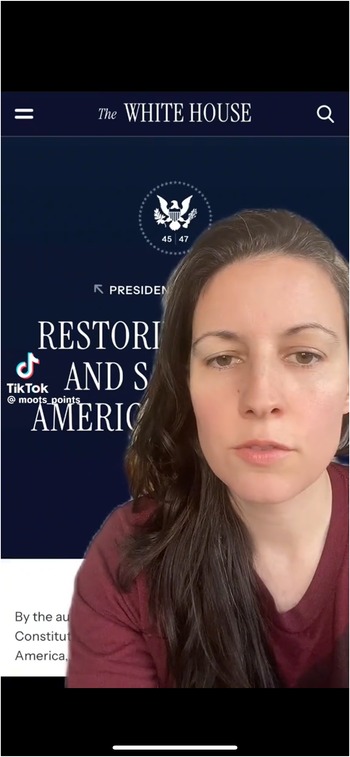
Another communicator is @moots_points (Moots-points 2025), or Hannah Moots, an archaeologist who studies ancient DNA of the Iron Age and the Roman Mediterranean (Figure 5). Every video Dr. Moots posts is full of information about ancient DNA. In the video pictured, she is bringing attention to the current policing of displays and other signage within the Smithsonian Institution regarding the definition of race as a human construct.
Screenshot of @moots_points video explaining race theory (https://www.tiktok.com/@moots_points/video/7486906210793393438, accessed August 20, 2025).

In the video, Moots gives a brief description of where race theory originated and the harmful connotations of the race construct. By sharing it, she highlights how changing museum displays, signage, and communication to the public affect public discourse. This video received more than 200 comments, with some comparing the evolving ideas of race to developments in Nazi Germany. One commenter stated, “So basically they are trying to say that eugenics is good for our modern society,” and another wrote, “They are trying to do everything that dismantles science and knowledge” (Moots-points 2025).
In this third example, I provide a video posted to my own TikTok that generated significant backlash from viewers (Anna_the_archaeologist 2022; Figure 6). In this 2022 video, I commented on National Geographic’s online video showing multiple peoples’ skeletonized remains at an archaeological site with no content warning. My video was only 30 seconds long, and I posted it with the intention of sharing it with other archaeologists I am connected with on TikTok. The video received very little attention for the first week it was online; however, by the second week, the video started to gain traction in the previously mentioned “wrong side” of TikTok. It received around 2,000 comments, many of which I deleted because they were derogatory. Many comments called me a “sensitive Karen” or a “liberal snowflake” for characterizing as unethical the filming and posting of human remains.
Screenshot of @anna_the_archaeologist calling out National Geographic’s video (https://www.tiktok.com/@anna_the_archaeologist/video/7167189246401383723, accessed August 20, 2025).

Although this video generated significant hate, I gained more than 500 followers, and many of the archaeologists with whom I am now connected online found my TikTok through it. In some ways, my attention economy brand was greatly increased by this post that evoked strong feelings. It also generated many comments asking why filming human remains is unethical, leading me to create multiple videos educating on that topic. Rather than trying to change the minds of those commenting negatively, I sought to educate those willing to learn about the ethics of the imagery of human remains.
Videos like this show the potential to influence perceptions of the past among the public (Emmitt Reference Emmitt2022). Although the videos cover complex ideas, people still took the time to view and interact with this content. People will interact with videos that interest them, as well as videos that outrage them. Thousands of people viewed each of these videos, so we hope that they were at least slightly educated on a topic previously unknown to them and only within a few minutes. Social media is powerful in its ability to show people new things and new ideas while also giving them the opportunity to join discussions and even ask questions. No longer are the experts in our field inaccessible to the public, because social media allows for discussions on a scale never seen before. Although some reactions can be challenging in their negativity, they do drive extra attention, which can in turn draw new receptive participants into the conversation. Given the potential public impact of social media, I believe that we benefit ourselves and others by joining in these conversations whether we comment, make videos, or simply observe.
Where Do We Go from Here?
Online education can be rewarding and worthwhile for those who are willing to put in the work to create content. It is important for online creators to find their niche and to cultivate an audience that is genuinely interested in their content. The two keys to posting online are having confidence in your posts and focusing on positive engagement, because focusing only on the negative will quickly burn out any content creator. After all, creators who only respond to negative interactions online can unintentionally box themselves in to interacting only with negative content and receiving only negative reinforcement for content. With increased access to generative AI and its ability to spread misinformation, it is now more important than ever to make real content with which people can engage. As of March 2025, people in the United States were spending approximately 4.5 hours a day on their phones (Consumer Affairs 2025). If, for even one minute a day, they view a video about archaeology, knowledge about topics in archaeology could increase significantly. There is no limit to how many archaeologists can post online and share their knowledge.
A risk of posting online about archaeology is that those who view the videos think, “I can do that,” and they may travel to archaeological sites to loot them. Some even post themselves “doing archaeology” online while looting sites and keeping the artifacts for their personal collection. Creators like @Endless_Search (2025), an account on TikTok run by Jake Auman with more than one million followers, encourages people to buy metal detectors for this purpose. He also films himself looting multiple Native American, plantation, and Civil War sites in North Carolina, South Carolina, and Virginia. Because of the difficulty in identifying locations from online videos, reporting this type of looting is often not possible. Some State Historic Preservation Offices (SHPOs) do monitor online activity related to looting but face the challenge of identifying the individuals involved and the exact locations of these activities. In my experience reporting looting posted online to the Georgia SHPO, I found it is aware of many looters and monitors their social media in hopes that one day these content creators will unintentionally reveal the location of their looting activities.
Social media’s fast-paced nature and worldwide accessibility provide archaeologists opportunities to educate on a much broader scale. Professionals in archaeology already have gained mass followings on multiple platforms because of their skillful science communication. I believe this trend will continue and that archaeologists can very easily find their niche online if they only take the time to get involved in content creation.






 Open access

