

Cremation is a funeral rite practiced by numerous societies on almost every continent (Andreica-Szilagyi Reference Andreica-Szilagyi2016; Cerezo-Román Reference Cerezo-Román2021; Gonçalves et al. Reference Gonçalves, Campanacho, Thompson, Mataloto and Thompson2015; Hershkovitz Reference Hershkovitz1988; Puaux Reference Puaux1989; Williams Reference Williams, Kuijt, Quinn and Cooney2014), including Mesoamerica since at least the Preclassic period (e.g, Beekman Reference Beekman2010:64–67; Bell Reference Bell1972; Duncan et al. Reference Duncan, Balkansky, Crawford, Lapham and Meissner2008; Porter Reference Porter1956: 529–530). The peak in the use of cremation is associated with the Spanish conquest and Christianization (Arnold Reference Arnold2016:396–397; Cerezo-Román and Williams Reference Cerezo-Román, Kuijt, Quinn and Cooney2014:245).
The reasons for burning a person's body are many and go beyond the funeral rite. It may be a form of punishment or a result of interpersonal conflict (Cerezo-Román and Williams Reference Cerezo-Román, Kuijt, Quinn and Cooney2014:22; Thompson Reference Thompson and Thompson2015:8) and thus is done to intentionally destroy the body (Arnold Reference Arnold2016:406–407; Prajapati Reference Prajapati2021:865–866; Williams Reference Williams2004:271). The decision to cremate the body may also be motivated by the desire to reduce the body to more portable forms (Thompson Reference Thompson and Thompson2015:9; Williams Reference Williams2004) or to reduce the amount of burial space needed (Kong Reference Kong2012:417–418); it may be influenced by health concerns as well (Arnold Reference Arnold2016:400; Prajapati Reference Prajapati2021:866–867; Williams Reference Williams2004:271).
Here we consider cremation as a deliberate funerary rite (Arnold Reference Arnold2016:394; Cerezo-Román Reference Cerezo-Román2015:354; Thompson Reference Thompson and Thompson2015:8–9; Williams Reference Williams, Schmidt and Symes2008:240, 251) in which the decision to cremate the body arises from religious beliefs and the eschatological beliefs of past societies (Bartel Reference Bartel1982:47–55; Binford Reference Binford1971; Carr Reference Carr1995; Parker Pearson Reference Parker Pearson and Hodder1982:110–112). According to ethnographical and historical data, cremation acts to release and purify the soul of the deceased, thus facilitating its postmortem journey (Carr Reference Carr1995:177; Cerezo-Román and Williams Reference Cerezo-Román, Kuijt, Quinn and Cooney2014:14–16). This transformation symbolizes the final rite of passage from the deceased to a sacred ancestor. By examining the treatment of remains within burial sites, we can thus reconstruct a funerary system that mirrors the eschatological worldview of past societies (Pader Reference Pader1982; Shanks and Tilley Reference Shanks, Tilley and Hodder1982).
In this article we present the results of a comprehensive bioarchaeological analysis that enables us to reconstruct the various stages of a cremation funeral. We not only examine the biological characteristics of the sample and the technological aspects of cremation but also delve into the ritual behavior of mourners, exploring the symbolic treatment of the deceased's remains as part of the eschatological system. We build on information obtained from preliminary observations (Budziszewski Reference Budziszewski2024) about cremation burial rites at the Los Tamarindos site (Gastelum-Strozzi et al. Reference Gastelum-Strozzi, Peláez-Ballestas, Castro, Rodriguez, Dena, Trujano and Punzo-Díaz2019; Punzo Díaz et al. Reference Punzo Díaz, Rangel Estrada, Ibarra Ávila, Navarro and Castañón Suárez2019, Reference Punzo Díaz, Rangel Estrada, Ibarra Ávila, Navarro, Castañón Suárez, Englehardt, Heredia Espinoza and Beekman2020). The initial publication highlighted the following characteristics of the funerary rite:
• Presence of infant burials (age at death, 3–4 years old)
• Low degree of oxidation of cremains
• Presence of partial burials with cremains from every anatomical region
• Highly fragmented cremains
We substantiate these observations with new bioarchaeological data derived from an additional 20 cremation burials from Los Tamarindos. To achieve our objective of developing novel interpretations of funerary behaviors during the Postclassic period in the Middle Balsas region, we incorporated fragmentation data previously published in FAIRFootnote 1 repositories (Budziszewski Reference Budziszewski2024) and used CT imaging for spatial analysis (Gastelum-Strozzi et al. Reference Gastelum-Strozzi, Peláez-Ballestas, Castro, Rodriguez, Dena, Trujano and Punzo-Díaz2019).
We were able to confirm the initial observations indicating a high degree of fragmentation and thermal alterations. We suggest that the low efficiency of the cremations explains these characteristics. However, postdepositional damage does have a significant impact on the accurate reconstruction of burial rituals, particularly the spatial distribution of remains within vessels. Despite these challenges, we found an intentional arrangement of cremains in one of the burials.
We observed a noteworthy diversity in both the quantity of cremains and the measurements of the largest bone fragments. Taphonomic and postdepositional factors suggest that burials with fewer bones might have undergone deliberate manipulation of human remains. Consequently, some of the larger bone fragments might not have been deposited in secondary burials. This implies that the pre-Tarascan community from Los Tamarindos during the Middle to Late Postclassic periods did not perceive the body of the deceased after cremation as a complete entity. Instead, they regarded it based on the pars pro toto principle: when a part or aspect of something is taken as representative of the whole (Graham et al. Reference Graham, Weaver and Chamberlain2019; Rebay-Salisbury Reference Rebay-Salisbury, Rebay-Salisbury, Stig Sørensen and Hughes2010; Trainor Reference Trainor2010).
Perceptions of the body are deeply rooted in anthropological and sociological personhood and embodiment theories. These perspectives are also integral to archaeological inquiries and theories that examine the lived body's transformations under the influence of biological, cultural, and social factors, as well as the relationship of individuals to the entire community in which they lived (Csordas Reference Csordas1990; Fowler Reference Fowler2004; Gillespie Reference Gillespie2001:75; Sofaer Reference Sofaer2006). In this understanding, during an individual's lifetime the body constantly changes and is (re)constructed. The remains of a deceased incorporate the accumulation of all the social and cultural roles held during the person's life (Harper Reference Harper2010; McClelland and Cerezo-Román Reference McClelland, Cerezo-Román and Williams2016:40; Sofaer Reference Sofaer2006:19–20). Many researchers define the distinction between theoretical interpretive archaeology and atheoretical bioarchaeology (Cheverko et al. Reference Cheverko, Prince-Buitenhuys, Hubbe, Cheverko, Prince-Buitenhuys and Hubbe2020:4; Gillespie Reference Gillespie2001:76–77; McClelland and Cerezo-Román Reference McClelland, Cerezo-Román and Williams2016:40; Parker Pearson Reference Parker Pearson and Hodder1982:100; Sofaer Reference Sofaer2006:1–2, 10). In this publication, by applying the aforementioned theoretical model, we use bioarchaeological data to infer about cultural mortuary behaviors, treating the theory of body perception as an integral part of this inference based on bioarchaeological data.
Our study transcends conventional boundaries by understanding cremains not only through osteological descriptions of their biological profile but also as an expression of the complex social construct imbued with ideological and symbolic significance obtained throughout the individual's lifetime and after death (Fowler Reference Fowler2004; Knudson and Stojanowski Reference Knudson and Stojanowski2008:398–399; Sofaer Reference Sofaer2006:62). Following its transformation during the funerary ceremony, the dead body acquires new postmortem values, both socially and ritually (Cerezo-Román Reference Cerezo-Román2015:354; Harper Reference Harper2010; Williams Reference Williams2004:266–269). Through the burial rites, the deceased attains the status of a venerated ancestor (Ashmore and Geller Reference Ashmore, Geller, Rakita, Buikstra, Beck and Williams2005:82, 90; Joyce Reference Joyce1998:157; Kong Reference Kong2012:430; Thompson Reference Thompson and Thompson2015:9) or becomes part of a collective social commemoration (Appleby Reference Appleby2013:84–85; Gillespie Reference Gillespie2001:76; McClelland and Cerezo-Román Reference McClelland, Cerezo-Román and Williams2016:41; Watson et al. Reference Watson, Cerezo-Román, Nava Maldonado, Guzmán, Villalpando, Schmidt and Symes2015:350; Williams Reference Williams, Schmidt and Symes2008:251). The grave and the remains themselves become the object of cultivation, often in the form of the cult of ancestors. Thus, the dead body becomes a social resource, which as a means of ritual communication can serve both religious and political purposes (Appleby Reference Appleby2013:84–85; Ashmore and Geller Reference Ashmore, Geller, Rakita, Buikstra, Beck and Williams2008:82; Harper Reference Harper2010:309–310; Kaliff and Oestingaard Reference Kaliff and Oestigaard2004:48; Parker Pearson Reference Parker Pearson and Hodder1982:112; Williams Reference Williams2004:264, 285).
In the context of cremation rites, the antemortem characteristics of an individual's personhood are significantly obliterated, both in bioarchaeological and cultural terms. The cremation of the body transforms the deceased's remains into a new postmortem substance (Carr Reference Carr1995; Gillespie Reference Gillespie2001:90; Kaliff and Oestingaard Reference Kaliff and Oestigaard2004). Combining bioarchaeological and cultural data not only yields biological insights into the individual's life but also provides crucial information for subsequent interpretive frameworks. Our biocultural approach acknowledges the enduring cultural and social significance of the body that is acquired during the funerary ceremony.
Mortuary Practices in the Tierra Caliente Region
Archaeological interest in the Michoacán Tierra Caliente region dates to the late nineteenth century, and investigations have been conducted since then (Lumholtz Reference Lumholtz1903). Yet, the region is still archaeologically unexplored, particularly its funerary practices. Earlier publications present the results of fieldwork surveys (Armillas Reference Armillas1945; Goggin Reference Goggin1943; Osborne Reference Osborne1943) and excavations (Esparza López et al. Reference Esparza López, Tirado, Castellanos, Blanco, del Castillo, Castilleros and Jiménez-Reyes2014; Kelly Reference Kelly1947; Lister Reference Lister1947; Paradis Reference Paradis1974; Pepper Reference Pepper, Hodge and Leary1916; Punzo Díaz and Martínez Vázquez Reference Punzo Díaz and Vázquez2018; Spinden Reference Spinden1911), as well as the effects of rescue archaeology (Lorenzo Reference Lorenzo1964; Litvak Reference Litvak1968; Maldonado Cárdenas Reference Maldonado Cárdenas1976; Punzo Díaz et al. Reference Punzo Díaz, Rangel Estrada, Ibarra Ávila, Navarro and Castañón Suárez2019).
Yet, these early reports merely mention isolated discoveries of inhumations (Armillas Reference Armillas1945:83–84; Goggin Reference Goggin1943:46–49; Osborne Reference Osborne1943:69; Pepper Reference Pepper, Hodge and Leary1916:416–418), providing descriptions of grave goods and initial assessments of their relative chronology (Meanwell Reference Meanwell2017:60). Information on burial practices in the region began to emerge in the 1940s when extensive excavations were first conducted. However, their focus was often on the site or microregion as a whole. For instance, Kelly (Reference Kelly1947:175–183) solely reports the presence of skeletal burials, noting the absence of cremation burials or inhumation burials within urns. During the salvage projects led by Litvak (Reference Litvak1968), which preceded the construction of the dams on the Balsas River, a large number of burials were excavated. Subsequently, Maldonado Cárdenas (Reference Maldonado Cárdenas1976) analyzed material obtained during these excavations, including the inhumation burials.
The first report to describe inhumations and cremation burials in detail was based on Lister's (Reference Lister1947:70, 76) fieldwork in the Middle Balsas River basin at the San Miguel Totolapan archaeological site. His description of a cremation burial was similar to the one reported by Spinden (Reference Spinden1911:33–34) at Placeres del Oro (Figure 1). Lister also discovered poorly preserved inhumation burials situated beneath the floors of habitational buildings.
Map showing archaeological sites mentioned in the text with marked borders of the state of Michoacán (map by Adam Budziszewski).

In Cueva La Pintada, archaeologists reported the discovery of skeletal remains in a very poor state of preservation. Among those remains, they encountered few cremains, describing only their general color (Esparza López et al. Reference Esparza López, Tirado, Castellanos, Blanco, del Castillo, Castilleros and Jiménez-Reyes2014:115). The most recent extensive archaeological investigations in the Middle Balsas River basin region were conducted near the modern town of Huetamo, preceding dam construction (Punzo Díaz et al. Reference Punzo Díaz, Rangel Estrada, Ibarra Ávila, Navarro and Castañón Suárez2019, Reference Punzo Díaz, Rangel Estrada, Ibarra Ávila, Navarro, Castañón Suárez, Englehardt, Heredia Espinoza and Beekman2020). During this project, 59 archaeological sites were uncovered, including the Los Tamarindos archaeological site (Gastelum-Strozzi et al. Reference Gastelum-Strozzi, Peláez-Ballestas, Castro, Rodriguez, Dena, Trujano and Punzo-Díaz2019). In addition, skeletal burials were found beneath house floors and within the habitation zone in nearby Cupandario archaeological sites dated to the Postclassic period.
Los Tamarindos Archaeological Site
The Los Tamarindos archaeological site is the Middle Balsas River basin near the modern town of Chigüero (Punzo Díaz et al. Reference Punzo Díaz, Rangel Estrada, Ibarra Ávila, Navarro and Castañón Suárez2019, Reference Punzo Díaz, Rangel Estrada, Ibarra Ávila, Navarro, Castañón Suárez, Englehardt, Heredia Espinoza and Beekman2020). A cluster of 42 funerary urns with human cremains was discovered at the site in a relatively confined space, covering 25 m2 (Figure 2). Radiocarbon (Gastelum-Strozzi et al. Reference Gastelum-Strozzi, Peláez-Ballestas, Castro, Rodriguez, Dena, Trujano and Punzo-Díaz2019) and relative dating based on typology and archaeological material indicate that this archaeological site functioned during the Middle to Late Postclassic periods (Punzo Díaz et al. Reference Punzo Díaz, Rangel Estrada, Ibarra Ávila, Navarro and Castañón Suárez2019, Reference Punzo Díaz, Rangel Estrada, Ibarra Ávila, Navarro, Castañón Suárez, Englehardt, Heredia Espinoza and Beekman2020). In addition to the burials, several grave goods—including a copper bell, crowns of deciduous molars with reduced roots, and an anthropomorphic ceramic figurine—were found outside the urns (Budziszewski Reference Budziszewski2024; Punzo Díaz et al. Reference Punzo Díaz, Rangel Estrada, Ibarra Ávila, Navarro and Castañón Suárez2019, Reference Punzo Díaz, Rangel Estrada, Ibarra Ávila, Navarro, Castañón Suárez, Englehardt, Heredia Espinoza and Beekman2020).
Plan of Los Tamarindos archaeological site (drawn by José Luis Punzo Díaz).

Methods
Fragmentation Analysis
The fragmentation analysis was conducted using Jaskulska's (Reference Jaskulska2020) protocol. The cremains were sieved through Aperture Lab standard stainless steel test sieves with round openings of 10 mm, 5 mm, and 2 mm. The osteological material was divided into three fractions based on the size of the fragments. We weighted each fraction using a Steinberg System (SBS-LW-7500A) scale with 0.1 g precision. The proportions of the weights of the fractions reveal the degree of fragmentation of the burial.
Fragmentation is caused by several factors, including the cremation process (e.g., temperature, duration, combustion), the individual's biological profile, postcremation bone collection, burial conditions (e.g., urn, soil conditions, disturbance), and field and lab excavation methods (McKinley Reference McKinley1994:84–85). It is a numerical representation of the sum of these factors and not an independent measure of the impact of fire on the remains during cremation. However, it offers a standardized and quantitative means of characterizing cremation burials, making the findings conducive to further studies including statistical analyses. Fragmentation is also quantified by measuring the size of the largest bone fragment for both the fractions under 5 mm and under 10 mm.
Each bone fragment in fractions >10 mm and >5 mm was assigned to one of the following groups: (1) skull, (2) torso: axial skeleton with pectoral and pelvic girdles; (3) upper free limb, (4), lower free limb, and (5) unidentified. Subsequently, each anatomical region within the >10 mm and >5 mm fractions was weighed separately. This provided the measure of the proportion of anatomical regions within a burial. During this stage of the analysis, all diagnostic fragments for age, and sex assessment were recorded, along with paleopathological lesions and potential animal bone fragments. Finally, we calculated the rate of anatomical identification (RAI) for each burial, which represents the percentage of identified fragments relative to the total weight (Gonçalves Reference Gonçalves2012).
Bioarchaeological Analysis
Age-at-death assessment for subadult individuals relied on two indicators: the stage of odontogenesis (Ubelaker Reference Ubelaker1999) and of epiphyseal fusion (Cunningham et al. Reference Cunningham, Scheuer and Black2016). For adult individuals, age assessment was based on the cranial suture obliteration (Meindl and Lovejoy Reference Meindl and Lovejoy1985) and the morphological changes in the auricular surface of the ilium (Lovejoy et al. Reference Lovejoy, Meindl, Pryzbeck and Mensforth1985). In cases where there were no diagnostic fragments to apply any of the aforementioned measures, the age of an individual was broadly categorized as adult based on the general morphology of cremains. This determination was made if no bone fragments indicated the presence of non-adult individuals in the burial (McKinley Reference McKinley1994). The assessment of the biological sex of adult individuals was based on the dimorphic traits of the skull (Acsádi and Nemeskéri Reference Acsádi and János1970; Buikstra and Ubelaker Reference Buikstra and Ubelaker1994).
Later, the age-at-death assessments placed the remains into these age cohorts (McKinley Reference McKinley1994:19):
1. Infant (0–4 years old)
a. Young infant (0–2 years old)
b. Older infant (3–4 years old)
2. Juvenile (5–12 years old)
a. Young juvenile (5–8 years old)
b. Older juvenile (9–12 years old)
3. Subadult (13–18 years old)
a. Young subadult (13–15 years old)
b. Older subadult (16–18 years old)
4. Young adult (19–25 years old)
5. Mature adult (26–40 years old)
6. Older adult (>40 years old)
7. Adult (>19 years old)
The minimum number of individuals (MNI) was determined based on the presence of more than one specific and sided bone fragment or a significant number of bones showing different stages of human body development. The total weight of the cremation burials was not used to determine the number of individuals interred in the burials.
Thermal Alterations
In this study, we understood thermal alteration as chromatic and macroscopic structural changes of the bone fragments caused by the impact of fire during the cremation process. Discolorations were evaluated based on the scale developed by Holden and colleagues (Reference Holden, Phakey and Clement1995a, Reference Holden, Phakey and Clement1995b). The structure of the bone fragments was another valuable source of information regarding the degree of oxidation. We used terminology such as “well-burned” or “calcined” to refer to fragments exhibiting structural changes caused by the recrystallization process (Greiner et al. Reference Greiner, Rodríguez-Navarro, Heinig, Mayer, Kocsis, Göhring, Toncala, Grupe and Schmahl2019:515; Symes et al. Reference Symes, Rainwater, Chapman, Gipson, Piper, Schmidt and Symes2008:23–25; Ubelaker Reference Ubelaker and Thompson2015:217–219). Conversely, bones that did not exhibit this trait were described as “brittle.” Finally, we used the term “sandwich effect” to describe the fragments of cremated bones that exhibited different types of chromatic discoloration in the fracture line of the fragment and when the interior and exterior surface of the fragment were colored differently (McKinley Reference McKinley, Schmidt and Symes2008:164–165, Reference McKinley, Grupe and McGlynn2016:21).
Exploration of Funerary Urns
We first measured the total height of the preserved urn to estimate the volume and number of exploration layers. The thickness of the mechanical layers for exploration ranged from 2 to 4 cm, with variations depending on the height of the urn; urns had a minimum of three layers. It is crucial to note that CT imaging played a pivotal role in this analysis (Gastelum-Strozzi et al. Reference Gastelum-Strozzi, Peláez-Ballestas, Castro, Rodriguez, Dena, Trujano and Punzo-Díaz2019). Additional layers were introduced during the explorations if we encountered particularly important arrangements of human remains or fragments that were not discernible in CT imaging.
Results
Despite the difficulty of biological profile reconstruction caused by fragmentation and alteration during the cremation process (Gonçalves et al. Reference Gonçalves, Campanacho, Thompson, Mataloto and Thompson2015; Jaskulska Reference Jaskulska2020; Kurila Reference Kurila2015), we were able to identify the presence of individuals from nearly all age cohorts, ranging from young infant to mature adults (Table 1). Detailed results of the bioarchaeological analysis are presented in Supplemental Text 1.
Biological Profiles and the Diagnostic Traits Used to Assess the Age-at-Death and Sex of Individuals.

a Ubelaker Reference Ubelaker1999
b Cunningham et al. Reference Cunningham, Scheuer and Black2016
c Acsádi and Nemeskéri Reference Acsádi and János1970
d McKinley Reference McKinley1994
e Meindl and Lovejoy Reference Meindl and Lovejoy1985
f Lovejoy et al. Reference Lovejoy, Meindl, Pryzbeck and Mensforth1985
Both the preliminary study sample and the sample discussed here exhibited a highly fragmented pattern of cremains (Figure 3). In the preliminary study, only one burial was dominated by the largest fraction, with the >10 mm fraction accounting for 63.77% of total weight (Budziszewski Reference Budziszewski2024:9). In contrast, the largest fraction was dominant in six of the 20 burials analyzed in this study. However, it is worth noting that burial RT43 contains only 19.3 g of cremains (Table 2), and the majority of burials weighed less than would be expected for a complete archaeological cremation burial (Gonçalves et al. Reference Gonçalves, Campanacho, Thompson, Mataloto and Thompson2015:7685; McKinley Reference McKinley1993:285–286). The arithmetic mean for the weight of all adult burials for the analyzed sample was 463.8 g. However, seven burials in the discussed sample significantly exceeded the mean value, with the largest burial, RT50, weighing 1,189.1 g (Table 2). None of the burials included remains from most of the anatomical regions or were complete burials (Gonçalves et al. Reference Gonçalves, Campanacho, Thompson, Mataloto and Thompson2015:76–77). Among the analyzed burials from Los Tamarindos, only RT44 (skull 19.5%, torso 14.2%, upper limb 15.2%, and lower limb 51.1%) exhibited proportions of anatomical regions that closely aligned with expected values (Figure 4). However, this intriguing case contained only 182 g of cremains, and the RAI was only 45.6%.
Cumulative bar chart of percentage values of fractions describing the fragmentation of analyzed burials (composite by Adam Budziszewski). (Color online)

Total Weight of Burials, the Weight of All Identified Bone Fragments in Burials, and the RAI Ratio.

Cumulative bar chart displaying the proportions of anatomical regions relative to the total weight of the burials. The expected values of anatomical regions for an unburned skeleton were derived from McKinley (Reference McKinley1994:6; composite by Adam Budziszewski). (Color online)

Thermal Alterations
In the previously analyzed sample there were many more blue-gray fragments than white-colored ones in the majority of urns (Budziszewski Reference Budziszewski2024:7). In contrast, the burials analyzed in this study exhibited a higher variability of chromatic discoloration. A significant portion of the nonwhite-colored bone fragments were large fragments of the long bone diaphyses of both limbs and fragments of the axial skeleton, including whole vertebral bodies. Traditional interpretations of chromatic discolorations are correlated with specific temperature ranges and stages of cremation (Fairgrieve Reference Fairgrieve2007; Mayne Correia Reference Mayne Correia, Sorg and Haglund1997; Walker et al. Reference Walker, Miller, Richman, Schmidt and Symes2008). The color black is attributed to carbonization of the organic components of bones and burning under reductive conditions. Gray-blue colors are the result of the complete pyrolysis of the organic components, whereas a white color indicates exposure to temperatures exceeding 800°C and involve calcination, recrystallization, and fusion processes (Fairgrieve Reference Fairgrieve2007; Mayne Correia Reference Mayne Correia, Sorg and Haglund1997). However, even when white-colored bones were dominant, they rarely exhibited a calcined structure, which is associated with bones subjected to high temperatures. Instead, most displayed a brittle structure similar to black and blue-gray cremains. All the brittle fragments were characterized by reduced resistance to mechanical damage. Moreover, in the present sample, we found burials containing bone fragments with the “sandwich” effect.
Spatial Distribution
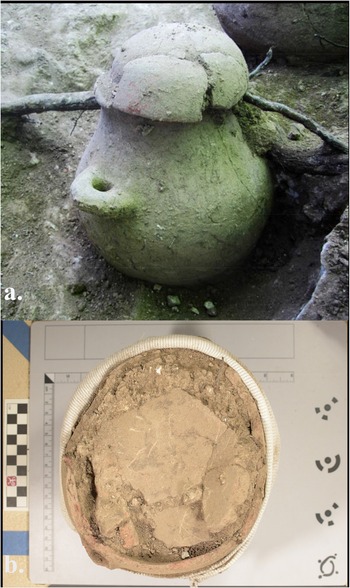
In nearly all the analyzed burials, most cremains were found in the bottom of the funerary urns. This is likely the result of postdepositional processes or the intentional postcremation manipulation of cremains. Damage to the structure of the ceramic vessels, evident in nearly all cases, was primarily caused by postdepositional factors, mainly root activity and the gravitational pressure of compact and solid volcanic soil (Figure 5; Punzo Díaz et al. Reference Punzo Díaz, Rangel Estrada, Ibarra Ávila, Navarro and Castañón Suárez2019, Reference Punzo Díaz, Rangel Estrada, Ibarra Ávila, Navarro, Castañón Suárez, Englehardt, Heredia Espinoza and Beekman2020).
Examples of two cremation funerary urns from Los Tamarindos: (a) RT 50 in situ and RT54 vessel preserved with elastic bandage; (b) destroyed lid fragment during excavation (photos by José Luis Punzo Díaz and Adam Budziszewski). (Color online)

As mentioned, we did observe the intentional arrangement of human remains in one burial (Harvig et al. Reference Harvig, Lynnerup and Ebsen2012:383; Jaskulska Reference Jaskulska2018:57–58). It is visible in the gradual change in the proportion of cremains from specific anatomical regions in subsequent exploration layers (Figure 6). However, we were dealing with a significantly disturbed arrangement in this burial. Therefore, it is crucial to consider both the data from bioarchaeological analysis and CT imaging to confirm the presence of this intentional arrangement. It is important to note that the first two layers contain only 2% of the cremains, and the substantial disruption in the spatial distribution affected mainly the lowest layer (Figure 7).
Cumulative bar chart of the proportions of anatomical regions among the exploration layers. Each bar represents one layer. The table presents the total weight of all burned bones excavated from each exploration layer and its percentage value in relation to the total weight of the cremains (composite by Adam Budziszewski). (Color online)

CT stack of cremation funerary urn RT50. A circle marks the empty spot within the urn fill, representing the point from which the osteological material was dislodged toward the crack at the bottom of the vessel marked with an arrow (composite by Adam Budziszewski).

Discussion
Building on earlier preliminary observations (Budziszewski Reference Budziszewski2024), this present analysis provides a more comprehensive understanding of the Middle to Late Postclassic cremation burial rites of the pre-Tarascan community at the Los Tamarindos archaeological site. The biological dimensions, cremation technology, and cultural behaviors during the funeral affect the amount of cremains deposited into the secondary burials. The description of the community's cosmological perspective in the preliminary publication (Budziszewski Reference Budziszewski2024:12–14) is still relevant.
Having examined 70% of the burials from the site, we can conclude that there was no separate sepulchral zone for children, similar to those found in the Zacapu Basin during the Classic and Epiclassic periods (Pereira Reference Pereira and Béligand2021:100). We found that children were interred alongside adults but in separate funerary vessels in most cases. Moreover, the presence of individuals ranging from young infants to mature adults in the cremation burials at the Los Tamarindos site suggests that this funerary rite was not restricted to a specific segment of the population based on age or biological sex. However, archaeological excavations in the Huetamo area indicate that inhumation was also practiced in the Postclassic period (Esparza López et al. Reference Esparza López, Tirado, Castellanos, Blanco, del Castillo, Castilleros and Jiménez-Reyes2014:115; Lister Reference Lister1947:70; Punzo Díaz et al. Reference Punzo Díaz, Rangel Estrada, Ibarra Ávila, Navarro and Castañón Suárez2019:398). Earlier publications from the Middle Balsas region report similar bi-ritual burial practices (Armillas Reference Armillas1945:84; Lister Reference Lister1947:70; Maldonado Cárdenas Reference Maldonado Cárdenas1976). Lister (Reference Lister1947) reported instances of the interment of cremation burials, as well as inhumations interred under house floors. If indeed, there were bi-ritual funerary rites at the Los Tamarindos site, this would be another very interesting characteristic of the burial practices in this area that could indicate further differentiation within the community. Nevertheless, resolving this issue conclusively requires the direct absolute dating of inhumations from nearby sites, including Cupandario, which may not be possible because of the poor condition of the osteological material (Punzo Díaz et al. Reference Punzo Díaz, Rangel Estrada, Ibarra Ávila, Navarro and Castañón Suárez2019, Reference Punzo Díaz, Rangel Estrada, Ibarra Ávila, Navarro, Castañón Suárez, Englehardt, Heredia Espinoza and Beekman2020).
Macroscopic thermal alterations of bones are the only source of information about the conditions during cremation at the Los Tamarindos site. This sample exhibits a higher proportion of white-colored fragments than at other sites. However, this does not necessarily imply a different maximum temperature during cremation or longer exposure (Budziszewski Reference Budziszewski2024). However, it is impossible to determine the conditions of a funeral pyre during cremation using only macroscopic criteria.
Only a few bones displayed the characteristic “china-like” structure (Cerezo-Román Reference Cerezo-Román2015:360, Reference Cerezo-Román2021:335; McKinley Reference McKinley, Grupe and McGlynn2016; Symes et al. Reference Symes, Rainwater, Chapman, Gipson, Piper, Schmidt and Symes2008:37). This raises questions not only about the maximum temperatures of the pyre but also the efficiency of oxidation during cremation (Andreica-Szilagyi Reference Andreica-Szilagyi2016:57; McKinley Reference McKinley, Schmidt and Symes2008, Reference McKinley, Grupe and McGlynn2016; Squires et al. Reference Squires, Thompson, Islam and Chamberlain2011:2407). Burning at high temperatures and under conditions of constant fuel supply usually results in the formation of almost uniformly white and calcined cremains (Hershkovitz Reference Hershkovitz1988:99; Silva Reference Silva and Thompson2015:138–140). These types of thermal alterations signify the highest degree of bone oxidation (Fairgrieve Reference Fairgrieve2007:137–140; Mayne Correia Reference Mayne Correia, Sorg and Haglund1997:280–282; Walker et al. Reference Walker, Miller, Richman, Schmidt and Symes2008:131–133). However, recent research revealed that multiple complex factors determine changes in human bones and teeth when exposed to fire (Greiner et al. Reference Greiner, Rodríguez-Navarro, Heinig, Mayer, Kocsis, Göhring, Toncala, Grupe and Schmahl2019; Ellingham et al. Reference Ellingham, Thompson, Islam and Taylor2015; Fernández Castillo et al. Reference Fernández Castillo, Ubelaker, Lorente Acosta and Cañadas de La Fuente2013; Schamhl et al. Reference Schmahl, Kocsis, Toncala, Wycisk and Grupe2017; Squires et al. Reference Squires, Thompson, Islam and Chamberlain2011). The burials from Los Tamarindos are characterized by the prevalence of nonwhite and brittle fragments and bones with the “sandwich” effect. Therefore, we can conclude that the cremation process at Los Tamarindos was characterized by low efficiency, either because of a low maximum temperature during cremation, the short duration of fire exposure, or significant disturbances of the funerary pyre, leading to a decrease in the oxygen supply. These initial deductions drawn from the study of macroscopic alterations should be verified using two spectrometric analyses: Fourier-transform infrared spectroscopy (FTIR) and X-ray diffraction (XRD; Legan et al. Reference Legan, Leskovar, Črešnar, Cavalli, Innocenti and Ropret2020; Schamhl et al. Reference Schmahl, Kocsis, Toncala, Wycisk and Grupe2017; Thompson et al. Reference Thompson, Islam and Bonniere2013). By applying these methods, we can infer the duration of exposure to fire and estimate the maximum pyre temperature during cremation.
The low degree of oxidation results in bones lacking a solid texture like “calcined” cremains. This may be an important factor causing the high levels of fragmentation and reducing the weight and amount of bones in the burials we found. During the spatial distribution analysis, we noted that postdepositional factors had a significant impact on the conditions of the burned bones. Bones with a low degree of oxidation underwent significant mechanical stress, resulting in the fragmentation of osteological material. Therefore, the low total weight of cremains and high fragmentation can, at least in part, be explained by the poor resistance to mechanical damage after interment. However, it is important to note that the burials in this archaeological site share a similar degree of fragmentation and thermal alterations.
Focusing on the weights of cremains in burials, we can confirm earlier observations regarding low total burial weights. The largest burial in the previous study contained 395.2 g of cremains (Budziszewski Reference Budziszewski2024:7). Among the burials examined here, we identified examples containing significantly more cremains (see Table 1). Data from modern crematoria indicate considerable variation in weight distribution, ranging from approximately 850 g for women, with most reported values exceeding 1,000 g, to more than 5,000 g for men (Bass and Jantz Reference Bass and Jantz2004:902–903; Gonçalves et al. Reference Gonçalves, Cunha and Thompson2013:1136–1139; May Reference May2011:5–8; McKinley Reference McKinley1993:283–286; Silva et al. Reference Silva, Crubézy and Cunha2009:632–638; Van Deest et al. Reference Van Deest, Murad and Bartelink2011:345–348). This variability is correlated with age, sex, and at-life body weight, among other factors (Gonçalves et al. Reference Gonçalves, Campanacho, Thompson, Mataloto and Thompson2015:72–78). However, because of the nature of archaeological cremation burials and postdepositional factors, contemporary data are of limited use. Consequently, establishing precise cutoff points for archaeological burials, regardless of the population studied, is challenging. Among well-studied cemeteries with reported ranges of cremation burial weights, the total weight of adult burials typically falls within the range of 600 to 900 g. This trend is evident in sites from Europe dating to the Bronze Age, Iron Age, and Early Medieval period (e.g., Gonçalves et al. Reference Gonçalves, Campanacho, Thompson, Mataloto and Thompson2015:76–85; Silva Reference Silva and Thompson2015:132–137; Wahl Reference Wahl, Schmidt and Symes2008:152–153). Few publications report these values for sites from the New World. However, mean weight values for Preclassic Hohokam sites (99.9 g), Classic Hohokam sites (362.7 g), and Trincheras culture (721 g) were reported by Cerezo-Román (Reference Cerezo-Román2015, Reference Cerezo-Román2021). Yet, even though mean weight provides crucial data, it may not be the most appropriate measure for the entire population. It does not reflect variability in the sample, and if we include all age groups, the picture becomes even more blurred. It is more reasonable to present the value of the arithmetic mean by age group (Wahl Reference Wahl, Schmidt and Symes2008).
Furthermore, it is essential to clarify that most burials at the Los Tamarindos site should be considered partial burials. Most of the previously studied burials (Budziszewski Reference Budziszewski2024) were incomplete burials of adults. In contrast, the sample examined in this analysis included a much less common type characterized by significantly higher total weights and the presence of notably larger bone fragments. Remarkably, these burials did not exhibit significantly different levels of fragmentation or thermal alterations. Therefore, the variation in the quantity of bones in the burials cannot be attributed only to differences in conditions during the cremation process. As mentioned earlier, in the vast majority of burials, bones were found only in the lower part of the vessels. And even though we identified an intentional arrangement of cremains in burial RT50, this does not necessarily imply that this burial is unique. This arrangement may be attributed to the specific postdepositional conditions in RT50 that resulted in lower rates of secondary destruction.
Our findings raise other questions: Why was there a notable scarcity of cremains in a significant number of adult burials? Are taphonomy and postdepositional processes solely responsible for these variations, or could the intentional ritual treatment of human remains also play a role? If the latter interpretation holds, why did we observe more ritual activity in a significant number of urns? Could the potentially higher degree of manipulation of remains suggest the greater (especially ritual) significance of individuals in burials with fewer cremains? Additionally, there was no pattern of missing fragments of any specific body part, because almost all burials, excluding those of non-adults, contained bones from all anatomical regions, including the small bones of the hands and feet (Budziszewski Reference Budziszewski2024). Thus, any manipulation of human remains likely occurred after cremation, either during the collection of remains from the pyre or before placing bones in the urn. If the largest bone fragments in burials with low weights were intentionally excluded from the urns and subjected to manipulation, this would explain both why most burials from the site exhibited similar fragmentation and thermal alterations and the variability in total weight and measurements of the largest bone fragments.
Ethnohistoric sources from Postclassic Mesoamerica indicate multiple examples of the intentional manipulation of cremains as a vital part of mortuary rituals (Ashmore and Geller Reference Ashmore, Geller, Rakita, Buikstra, Beck and Williams2005:82, 90; Durán Reference Durán, Heyden and Horcasitas1964; Joyce Reference Joyce1998:152–154; Oliver Reference Oliver, Tiesler and Scherer2018; Weiss-Krejci Reference Weiss-Krejci, Agarwal and Glencross2011). Collecting the debris from an extinguished funerary pyre is a particularly common practice, described both in Mesoamerica and the southwestern United States and California (Beals Reference Beals, Lowie, Kroeber and Olson1933:377–378; Gillespie Reference Gillespie2001:86–89; Kroeber Reference Kroeber1925:253, 313; Oliver Reference Oliver, Tiesler and Scherer2018:348, 356; Ray Reference Ray1973:114–122; White Reference White1953:575). It was most often undertaken by the widows of the deceased, who would then use the pyre debris to smear their faces. It is probable that, during the process of collecting charcoal from the pyre, finer fragments of cremains were also gathered. In addition, Roberto Martínez González (Reference Martínez González2014) draws attention to the symbolic representation of the bodies of Mesoamerican deities on a pars pro toto principle (Graham et al. Reference Graham, Weaver and Chamberlain2019; Rebay-Salisbury Reference Rebay-Salisbury, Rebay-Salisbury, Stig Sørensen and Hughes2010:65; Sofaer Reference Sofaer2006:46; Trainor Reference Trainor2010). A fragment of flesh or even bones could symbolize the presence of an important personage. This is also confirmed by references in the Relación de Michoácan (Alcalá Reference Alcalá2019; Martínez González Reference Martínez González2014:28–30) and in archaeological contexts throughout Mesoamerica, including in habitational, sepulchral, and extramural spheres (e.g., Cerezo-Román Reference Cerezo-Román, Kuijt, Quinn and Cooney2014; Duncan et al. Reference Duncan, Balkansky, Crawford, Lapham and Meissner2008; Lagunas Rodríguez et al. Reference Lagunas Rodríguez, Sánchez and Ayllón1976; Martínez González Reference Martínez González2014; Pereira Reference Pereira1999; Porter Reference Porter1956; Puaux Reference Puaux1989). Moreover, intentional manipulation of some of the burnt osteological material was proposed for the Hohokam culture by Cerezo-Román (Reference Cerezo-Román, Kuijt, Quinn and Cooney2014:163–166, Reference Cerezo-Román2015:368, Reference Cerezo-Román2021:341). These interpretations were supported by ethnographic descriptions of mortuary practices of Indigenous societies from the Southwest, including the practice of ritual separation of human remains and their deposition in several ritual/burial pits located relative to the cardinal directions (Cerezo-Román Reference Cerezo-Román, Kuijt, Quinn and Cooney2014:163–165). This implies that the low bone mass in some Los Tamarindos cremation burials could be explained by intentional practices related to the manipulation of cremains.
Finally, the observation of a disturbed anatomical order in the RT50 burial is an interesting observation for yet another reason. We suggest that the corpse of the deceased was placed on the funerary pyre in the supine position. Otherwise, it would be challenging for mourners to accurately reconstruct the arrangement of the remains, which is clearly correlated to the varying proportions of cranial versus lower limb bones. We assume that mourners must have collected the remains consistently from head to foot (or vice versa) when gathering them from the funeral pyre. However, the absence of an anatomical arrangement in the rest of the examined burials does not imply that those remains also were not originally arranged intentionally. Numerous events during the funeral ceremony and postdepositional processes could have disturbed the arrangement to the extent that we cannot discern the original distribution. Indeed, if there was manipulation of the remains after the cremation, our ability to capture the original arrangement diminishes as the degree of interference increases. Moreover, if the urn was not stabilized during transportation from the cremation site to the place of deposition, the original arrangement may have been disrupted.
These observations allow us to better understand the cremation funerary rites practiced during the Middle to Late Postclassic period at the Los Tamarindos site. It should be noted that regardless of age at death, cremation of the entire body of the deceased occurred. During the later stages of the funerary ceremony, parts of the cremains were subject to manipulation, and only a portion of the cremains was deposited into the secondary burial. This suggests that the body of the deceased after cremation gained new ritual properties and that part of the burned remains became a valuable ritual object. However, we are unable to indicate exactly how the remains were used, whether this type of practice accompanying cremation was found only in the studied site, or whether there are analogies at other sites in the Middle Balsas region. To understand this element of funerary rites more thoroughly, it is necessary to study more cemeteries in the region. It would be especially crucial to capture and analyze the relic of the funeral pyre. Information regarding its stratigraphy and cremation debris, including data on how many cremains were left uncollected from the pyre, holds particular significance at the current stage of research on funerary rites in the Middle Balsas region.
Conclusions
After an extensive exploration of cremation burial practices in Los Tamarindos, our analysis revealed a complex system of mortuary behaviors rooted in the eschatological system of pre-Tarascan society. Based on the thermal alterations, we can conclude that the cremation practiced by the community using the Los Tamarindos site was characterized by low efficiency. It is possible that there may not have been a complete cremation in the sense of the effective burning of all soft tissues.
We were unable to identify distinct burial types based on thermal alterations within the analyzed sample. The primary differentiation lies in the amount of cremains and the presence of larger bone fragments in burials with higher total weights. Our observations suggest that this variability cannot be attributed solely to postdepositional factors or mechanical fragmentation. Instead, we propose that the intentional manipulation of cremains occurred. Given the existence of burials containing a substantial amount of cremains, it is plausible that not all bones were placed in the urns. This suggests that the burned body was not considered an indivisible entity in the eschatological beliefs of local pre-Tarascan society. In some instances, parts of the remains may have functioned symbolically following the pars pro toto principle. This practice could be indicative of the heightened ritual significance attributed to the cremains, akin to the practices of Indigenous communities in northern Mexico and the southwestern United States that practice cremation burial rites (Cerezo-Román Reference Cerezo-Román, Kuijt, Quinn and Cooney2014:162–167, Reference Cerezo-Román2015:365–369, Reference Cerezo-Román2021:339–341).
Acknowledgments
We would like to thank the three anonymous reviewers and for their work with our manuscript.
Funding Statement
This work was supported by the University of Warsaw “The University’s Integrated Development Programme (ZIP).”
Data Availability Statement
Raw numeric data obtained during analysis are available in the dataset published at the FAIR repository, https://doi.org/10.58132/RIOIAJ.
Competing Interests
The authors declare none.
Supplemental Material
For supplemental material accompanying this article, visit https://doi.org/10.1017/laq.2024.22.
Supplemental Text 1. Biological Profile of Individuals.




 Open access

