


Introduction
The shift from aniconic to iconic Buddhist imagery in South and East Asia between the first and third centuries ce is well established, yet its significance is often overlooked in broader discussions of changing materiality and semiotics in the early Buddhist world (Fogelin Reference Fogelin2012). One significant development that would supplement this discussion was the rise of monumental depictions of the Buddha during this period (‘Big Buddha’ or dafo 大佛), which we define here as a physically imposing statue, typically ranging from 3 to 15 metres in height although some statues are over 50 m tall. Big Buddha statues, particularly across modern China, form important elements within rock-carved religious sites (RCR) (Monteith et al. forthcoming) and are strategically positioned within the landscape overlooking rivers, perched on mountains and near important trade settlements. The placement of these statues served to maximize their religious, political and visual impact, with each Big Buddha serving as a devotional focus constructed on a monumental scale that would have required considerable labour both to construct and to maintain.
Big Buddhas represent a distinct phenomenon of monumentality due to their size in relation to the spaces in which they are located, relative to their devotees and environs. The scale of Big Buddha statues indeed evokes a sense of awe within both observers and devotees, even in modern times. The construction of devotional images on an overwhelming scale serves to elicit feelings of reverence, fear and transcendence in the observer, serving to remind individuals of their insignificance in the face of something greater (Burke [1757] Reference Burke and Phillips2008). In the context of Buddhist practice these Buddhas also embody the concept of dependent origination (pratityasamutpada प्रतीत्यसमुत्पाद), emphasizing the interconnectedness of all beings and the vastness of the cosmos (Dhingra Reference Dhingra2021). The positioning of the Big Buddhas within the landscape is also significant in that they form key elements within the sacred geography of the regions in which they are set (Cosgrove Reference Cosgrove, Gregory and Walford1989). Big Buddhas, much like other RCR sites, provide a key insight into the way in which religion was practiced at a local level.
Despite their physical prominence, scholarship on these monumental statues has to date tended to focus on textual and art-historical analyses of well-known and largely imperial-sponsored images (Miyaji Reference Miyaji1988; Reference Miyaji2007; Wong Reference Wong2018; Reference Wong2019). The more anthropological aspects of ‘where?’ and ‘why?’ and ‘who?’ of Big Buddha statues have only been subject to cursory investigation (although see Monteith & Harris Reference Monteith and Harris2019; Peng Reference Peng2017). Similar to the study of many RCR sites, scholarship on Big Buddhas is mostly art historical, prioritizing studies of imagery through the lens of historical texts (Chen Reference Chen2012; Kieschnick Reference Kieschnick2022, 198) rather than consideration of the scale of construction, with the same significance ascribed to smaller images as monumental Buddhas. The underlying issue is that the traditional typological methods are ill-equipped to engage with the physicality of RCR sites and their components. Similarly, whilst textual analysis provides an essential foundation, over-reliance on the recorded histories of social and religious elites means that the narratives of the individuals who constructed and worshipped in these sites are easily overlooked (Monteith et al. Reference Monteith, Tang and Chen2025). For instance, the Monumental Buddha at Leshan, Sichuan Province, exemplifies how such statues are frequently depicted, both in scholarship and public perception, as stand-alone monuments, disconnected from their historical contexts and surrounding landscapes. This tendency obscures their broader significance within the religious, social and architectural networks in which they were originally embedded. Similarly, the world-renowned Bamiyan Buddhas, known better for their destruction by the Taliban in 2001 (Flood Reference Flood2002) rather than for their historical value, are often regarded solely as two isolated niches rather than as elements of a broader complex containing over a hundred caves, and with several smaller caves carved into the rear walls of the Buddha niches themselves (although see Klimburg-Salter Reference Klimburg-Salter1989).
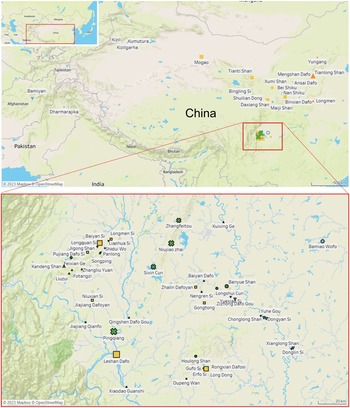
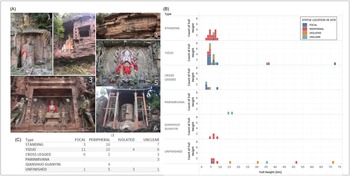
To this end, this paper synthesizes data from a representative sample of 84 Big Buddhas from 67 sites across Asia (Fig. 1; Supplementary table 1). Of these statues, 56 are located in China’s Sichuan region, in part due to the sheer proliferation of RCR sites in the region: over 1000 RCR sites dating to the period 700–1200 ce have been identified in Sichuan to date, significantly more than in the provinces of Gansu, Qinghai and Xinjiang combined (Howard Reference Howard1988). Accordingly, Sichuan serves as the primary case study, with all referenced sites located there unless otherwise specified. Six principal types of ‘Big Buddha’ statues were identified based on form: standing figures, ‘yizuo’ (seated with legs pendent), cross-legged and parinirvana (Fig. 2A, 1–4). For the sake of completeness, thousand-armed Avalokiteśvara images are included, as they are frequently monumental in scale and thus form part of the broader tradition, despite Avalokiteśvara’s status as a bodhisattva rather than a Buddha (Fig. 2A, 5). The final category is unfinished statues, which are often too incomplete for the intended imagery to be ascertained (Fig. 2A, 6). Fieldwork revealed notable variations in iconography, construction techniques and carving quality, emphasizing the role of Big Buddhas as dynamic loci of historical human activity. Rather than applying overarching stereotypes, each site is examined holistically through its unique landscape genetics and socio-political context. The materiality, semiotics and landscape of close to a hundred big and monumental statues have been assessed through observations made at the sites and subsequent ArcGIS analyses. Here, we consider the reasons why Big Buddhas were constructed and how their placement within the landscape reflects local social dynamics. This paper finds that the Big Buddhas of Sichuan, and more broadly across Asia, are often, but not always, later additions imposed upon sites of earlier ritual significance by social and religious elites. Although there are some sites which conform to the paradigm that Big Buddhas, and RCR sites in general, are directly correlated to trade networks, this paper finds that this is an oversimplification which denies the agency of the local populations.
Map of Big Buddhas across Asia with the Sichuan area expanded.

Figure 1 Long description
A map of Big Buddha statues across Asia with a detailed view of the Sichuan area. The map highlights the locations of significant Big Buddha statues, marked by green and yellow symbols. The inset map focuses on the Sichuan region, showing a higher concentration of these statues. Key locations such as Bamiyan in Afghanistan, Mogao in China, and various sites in India and Pakistan are labeled. The map also includes rivers, mountains, and other geographic features to provide context for the placement of these statues.
(A) Six main types of Big Buddhas: (1) Standing Buddha, Donglin Si, Neijiang; (2) Yizuo Buddha, Zhujia Dafo Yan, Renshou; (3) Cross-legged Buddha, Kandeng Shan, Pujiang; (4) Qianshou Guanyin, Xianglong Shan, Neijiang; (5) Parinirvana Buddha, Bamiao Wofo Yuan; (6) Unfinished, Niujiao Zhai, Renshou. (B) Histogram showing the number of Buddhas divided by statue type and location in site. (C) Table showing the number of Buddhas by type and location within the site.

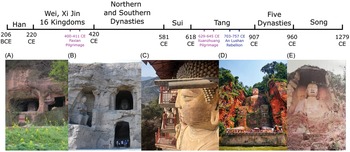
Timeline of Chinese Dynasties show representative sites. Which are from left to right (A) Han Dynasty cliff tombs; (B) Cave 16 Yungang Caves, Datong; (C) Eastern Big Buddhas, Maiji Shan, Tianshui; (D) Leshan Buddha, Leshan; (E) Banyue Shan Big Buddha, c. 1990 (Composition and photographs A–D: Monteith; photograph E: Lei et al. Reference Lei2022, 224, reproduced with permission).

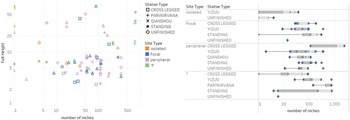
(Left) Scatter graph of the height of the Big Buddhas against number of niches in the site colour coded by site type with shapes indicating different Buddha types; (right) Box plots showing the number of niches in each of these sites.

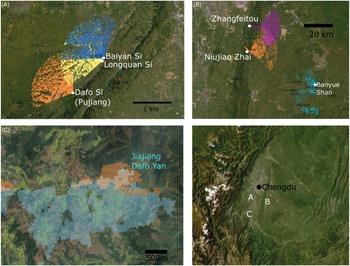
Maps showing the viewsheds of (A) Baiyan Si, Longquan Si and Dafosi overlooking the Pujiang Plain; (B) Zhangfeitou, Niujiao Zhai and Banyue Shan; and (C) the respective viewshed of Jiajiang Dafo Yan and Niuxian Si in Jiajiang. (Images created using ArcGIS Viewshed analysis.)

Figure 5 Long description
Panel A: A map showing the viewsheds of Baiyan Si, Longquan Si, and Dafosi overlooking the Pujiang Plain. The map includes labels for Baiyan Si, Longquan Si, and Dafosi Pujiang. The viewsheds are color-coded with blue and orange. Panel B: A map showing the viewsheds of Zhangfeitou, Niujiao Zhai, and Banyue Shan. The map includes labels for Zhangfeitou, Niujiao Zhai, and Banyue Shan. The viewsheds are color-coded with purple, orange, and blue. Panel C: A map showing the viewsheds of Jiajiang Dafo Yan and Niuxian Si in Jiajiang. The map includes labels for Jiajiang Dafo Yan and Niuxian Si. The viewsheds are color-coded with blue and orange. The maps are created using ArcGIS Viewshed analysis.
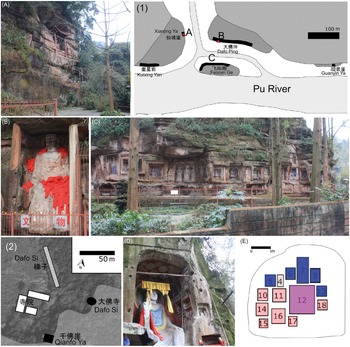
(1) Map showing the relationship between three sections of the Feixian Ge religious rock-carving site and photographs (A) showing the height and inaccessibility of the Big Buddha in Niche 93, Feixian Ge; (B) the unfinished Big Buddha statue in Niche 9, Feixian Ge; and (C) the density of small niches carved into the Feixian Ge section of the site. (2) Map showing the relationship between the two sections of the Pujiang Dafo Si site: (D) photograph showing the Dafo Si section of the site; (E) Diagram showing the arrangement of the niches in the Qianfo Ya section of the site: purple – bodhisattvas; blue – standing figures; red – seated arrangements; grey – unfinished niche.

Background
In its earliest form, Buddhism was aniconic. As Fogelin (Reference Fogelin2003) notes, devotion was primarily directed towards the stupa, exemplified by the archaeological remains of sites like Sanci (c. third century bce)—while the Buddha was symbolized through the bodhi-tree, a seat, or his footprints, rather than through direct depictions. The first iconic images of the Buddha emerged in the polities of Gandhara and Mathura around 100 ce as a product of Greco-Buddhist cultural interactions following the fourth-century bce conquests of Alexander the Great (Rhie Reference Rhie2014). Fogelin correlates this shift with the rise of Mahayana Buddhist schools alongside a trend toward monastic isolationism, though his focus on stupa semiotics overlooks the evolving material narratives embedded within the history of Buddhist statuary.
The movement towards figural representation is correlated by the records of Chinese pilgrims to India during this period, including Faxian (c. 400–411 ce) and Xuanzhuang (c. 640 ce). Early statues generally appear to be life-sized or smaller. While inscriptions refer to statues measuring 3–3.5 m, these were carved on pedestals later separated from their original structures, rendering the actual dimensions unverified (Schopen Reference Schopen1997). As such, there are significant variations in their descriptions of Sarnath, the first place where the Buddha is believed to have taught following his enlightenment at Bodh-Gaya. While Faxian reports the presence of four large towers and two viharas, he does not mention any statuary. This contrasts with Xuanzhuang’s report of the presence of monastic stupas and Buddhist statues including one apparently over 61 m tall. This provides further evidence for the transition from stupa to statues as the main focus of devotion between the period c. 400–600 ce (Fogelin Reference Fogelin2012). This dating has also been affirmed by 14C dating, which places the construction of the Bamiyan Buddhas at c. 550 ce (Krieken-Pieters Reference Krieken-Pieters2006). However, these Big Buddhas are predated by the five caves of Tanyao in the Yungang Grottoes in Datong, Shaanxi (Fig. 3B), which were completed c. 460–465 ce (Su Reference Su1996). These appear to be the earliest monumental or ‘Big’ Buddhas in Asia.
Although Buddhism’s presence in what is now China is evidenced by discoveries such as a hoard of Buddha statues from the Southern Dynasties period (386–581 ce) excavated at Wanfo Si (万佛寺) in Chengdu (Feng Reference Feng1954; Liu & Liu Reference Liu and Liu1958), fewer than 20 RCR sites in Sichuan predate the Tang Dynasty (Yang Reference Yang2021). The earliest RCR sites in Sichuan are characterized by the presence of multiple small niches (face size <1 m2) with most of the monumental statues only appearing following the An Shi Rebellion (755–763 ce) (Fig. 3). This period saw a surge in Buddhist construction as the emperor, elite officials, literati and monks fled Chang’an and resettled in Sichuan (Liu Reference Liu1975). It is posited that this influx of wealthy elites brought about distinct changes in local religious and ritual practices.
Etymologically, the first occurrences of the term Big Buddha or dafo (大佛) occurs in religious texts during the Northern and Southern Dynasties through to the end of the Tang (c. 420–907 ce). However, in these instances dafo only appears where the character da (大) is added before the character for Buddha in the name of a Buddha as an honorific. For example, a Western Jin Dynasty (266–420 ce) translation of the Wanquan Yuxia records ‘the eighth day of the month is the birthday of Sakyamuni Big Buddha’ (初八日釋迦大佛聖誕) (Xu Reference Xu1967). In those records which survive from the Northern Wei, the five caves of Tanyao in the Yungang Caves (c. 460 ce) are described as ‘divine monumental images’ (zhenrong juzhuang 真容巨壮), and even the Leshan Big Buddha (713–803 ce) (Fig. 1D) is described on its stele as a ‘big Maitrya stone statue’ (da mile shixiang 大弥勒石像) (Wu Reference Wu2017). The term dafo begins appearing in place names during the Song Dynasty (960–1279 ce) and becomes increasingly common in the Ming, Qing and Republican eras, as evidenced by gazetteer searches showing 23 instances in Song Dynasty texts, in comparison to 261 in Ming Dynasty texts, 2227 in Qing Dynasty texts and 1203 in Republican Era texts (ZHJDGJK). This absence of contemporaneous references suggests that religious rock carvings were not part of official canonical Buddhist practice and were only later designated as dafo. It remains unclear how these sites were referenced by the common people (laobaixing 老百姓) during the Tang Dynasty.
Although most extant Big Buddha images are found within RCR sites, historical evidence suggests that large, monumental images also existed within free-standing temple structures across Asia during the first millennium ce. Records indicate that each Tang Dynasty capital—Luoyang and Chang’an—hosted over 100 temples (Xu Reference Xu1985). Abandoned cities like Gaochang and Jiaohe in Turfan, Xinjiang, reveal numerous monumental temples, although no monumental imagery has been discovered at these sites (Russell-Smith Reference Russell-Smith, Konczak-Nagel and Liu2021). In contrast, Xuanzang’s pilgrimage accounts describe two monumental statues at the entrance to Kucha, each 90 chi (approximately 23.4 m) tall (Dong Reference Dong2017). The earliest extant Big Buddha outside an RCR site is the standing Guanyin in Dulse Si, Tianjin, in northern China, dated recently c. seventh to early eighth century (Reference YuYu forthcoming). This paper’s dataset also includes the large Parinirvana image in Dafo Si, Zhangye, which is believed to have been constructed in the year 1098 (Tang Reference Tang2019). Both complexes, situated within urban-based temples, are likely linked to official or imperial use, contrasting with the peripheral locations of cave temples. Although there are no extant bronze Big Buddhas dating to the Tang Dynasty in China, this absence might in part be due to an edict by Emperor Shizong (r. 954–959 ce) of the Later Zhou, which made owning a bronze Buddhist statue over five jin (approximately 2.5 kg) punishable by death (Hu Reference Hu1980). This edict occurred as a measure to prevent bronze currency from being melted down to form Buddhas. It is of note that the Empress Wu Zetian was blocked by her ministers from assisting in the constructing a colossal bronze Buddha in the vicinity of Luoyang (Hida Reference Hida2010), further indicating that such projects occurred outside of imperial control. Reports of bronze images and the presence of wooden Big Buddhas serve to remind us that monumental imagery would not have been restricted to RCR sites and to highlight the necessity of analysing these images in terms of their physical contexts.
Analysis
Methods and classification
This study seeks to move build on previous art historical and epigraphical analyses of monumental images (Miyaji Reference Miyaji1988; Reference Miyaji2007; Wong Reference Wong2018; Reference Wong2019) and to engage with the physical actuality of the statues and the sites in which they are set as locales of human activity in the past. In choosing to start from analysis of the sites rather than from the perspective of the historical texts, this paper seeks to move beyond the elite-based narratives which have previously dominated our understanding of the sites (DeCaroli Reference DeCaroli2004; Schopen Reference Schopen1997).
As noted previously, this study draws on 84 Big Buddha images from 67 sites across Asia, with primary focus on the 56 dafo sites identified in the Sichuan Basin. Data were gathered over six fieldwork seasons (2015–2023) from a larger pool exceeding 200 sites in China and Central Asia. Every Chinese RCR site in this study was visited in person, ensuring first-hand, multidisciplinary data collection. At each site, researchers catalogued and documented structures through mapping, measuring and modelling; dimensions, subjects, styles and decorative elements were recorded via photography and rubbings of inscriptions and bas-reliefs. Detailed maps captured the spatial organization of temples, pathways, and ancillary features, while photogrammetry secured accurate measurements of monumental elements. Comprehensive landscape surveys assessed topography, vegetation, hydrology and human infrastructures such as roads, settlements and trade centres, supplemented by local Chinese gazetteers and other historical documents. GIS analyses using a 30 m Digital Elevation Model supported least-cost distance and viewshed evaluations, illuminating factors influencing site selection despite challenges posed by dense Sichuan vegetation.
This study starts from the acknowledgement that each of these Big Buddhas was a locale of human activity in the past, and each was created in a specific location for a specific reason (Ingold Reference Ingold2000). In order to demonstrate this concept, the paper takes into consideration the archaeological biographies, including site structure, viewshed and the surrounding populations, tax and trade of an assemblage of Big Buddha sites in order to understand the relationship between the Big Buddhas and the societies which constructed them.
Ritual activity at RCR sites often predates the construction of the Big Buddha. The sites are formed of multiple actions. Each one of the niches or caves in the site represents an interaction, the intention of a donor, or group of donors, to undertake an act of devotion. These acts of devotion are sometimes incomplete, while others show signs of having been reworked in later time periods: this can include re-carving, painting or additional moulding. Similarly, there are often other caves and niches in a site which were carved at different times.
There are three main situations identified in this paper in which Big Buddha statues occur within a site:
-
1. Isolated constructions (12 per cent). Big Buddhas at which no other constructions which may be dated to the Tang or Song Dynasty on stylistic grounds or through the presence of dated inscriptions. For the most part these are unfinished Buddhas.
-
2. Focal constructions (31 per cent). Sites at which the Big Buddhas were the initial construction at a site with other niches clustered around them.
-
3. Peripheral constructions (44 per cent). These are Big Buddhas which were added to pre-existing sites.
While the placement of most Big Buddhas can be inferred from the structure of their sites, some locations present more complex arrangements. In most cases this is when the carvings within a site are relatively dispersed, making it difficult to ascertain the relationship between the different constructions as can be seen in Renshou Zhalin Dafo Yan (Fig. 2A, 2) or conversely when the constructions in a site are too dense for the relationship between the Big Buddha and the other niches within the site (for instance, Niuxian Si: CWKY et al. 2014). These sites are referred to as unclear and constituted the remaining 17 per cent of the Big Buddhas in this survey.
It has previously been suggested that these Buddhas were constructed to be 1.6 zhang tall, in accordance with an early translation of the ‘Sutra of the Buddha of Infinite Life’ (Sukhāvatīvyūha सुखावतीव्यूह) sutra) which states that statues of the Buddha should be ‘one zhang six in length with thirty-two phases, and eighty good qualities’ (ti chang liu zhang, sanshier xiang, bashi Zhong hao 体长丈六,三十二相,八十种好) (Dharmaraksa 1988). An issue when measuring a Buddha as being 1.6 zhang is whther that is the overall height of the statue, be it seated or standing, or the height of the Buddha depicted. Leaving this issue aside, when the heights of the Buddhas are plotted according to their measurement in metres it is immediately apparent that although there are preferences in the height of the statues (Fig. 3B), several of the heights which occurred repeatedly do not align with the suggested 1.6 zhang height. Several ‘official measures’ have been excavated from tombs (however, there is also a degree of variation in the length of these rulers): the length of a zhang appears to be roughly 3 m (Qiu et al. Reference Qiu, Qiu and Yang1998). For instance, there are nine Big Buddhas seated in yizuo which are 4–5 m tall, which would align with the whole statue being 1.6 zhang tall. There are five Big Buddhas 6–7 m tall, which would be 2 zhang, but interestingly only one which is 5–6 m tall. This indicates that, although in some cases craftspersons familiar with the imperial units worked on Big Buddhas, in other cases there appears to be no correlation between the official measures and the actual size of the statues. This might indicate that in several cases the craftspersons constructing these Buddhas were not using the official imperial measure as a frame of reference. Instead, the scale of the statues appears to have been decided in reference to the scale of the rock faces into which they were carved. This further emphasizes the divide between Buddhas constructed under official and local patronage (Monteith & Harris Reference Monteith and Harris2019).
There are distinct variations in the placement of different types of Big Buddhas within their respective sites. For instance, 55 per cent of the cross-legged Big Buddhas in this dataset are focal constructions, compared to only 32 per cent of Big Buddhas seated in yizuo and 15 per cent of the standing Big Buddhas (Fig. 3C). This is in contrast to the statues in peripheral locations, which account for 18 per cent, 35 per cent and 59 per cent respectively. All four of the large thousand-armed Avalokitesvara statues identified during this study are in peripheral locations.
Although there does not appear to be any direct correlation between the size of the Big Buddha within a site and the number of other interactions at the site (Fig. 4, left), those sites at which the Big Buddha is a later addition to the site (i.e. in a peripheral location) have a greater number of interactions (interquartile range 45–162 niches) at the site than those at which the Big Buddha appear to be the initial construction in a site (interquartile range 25–88 niches) (Fig. 4, right).
Site structure
Incomplete statues
Not all elements within RCR sites are carved to completion. There are many cases of unfinished elements within RCR sites, from small niches through to Big Buddhas, a phenomenon which occurs across Asia and indicates that an icon did not necessarily need to be finished to be a devotional focus (Dehejia & Rockwell Reference Dehejia and Rockwell2016). Given the scale of the physical and human resources that would have been required to construct a Big or Monumental Buddha it is perhaps unsurprising that several of these constructions appear to have been abandoned prior to completion. Examination of those Big Buddha images which were either abandoned prior to completion or built over several successive phases can provide a key insight into the way in which historical populations interacted with these statues.
It is recorded that the Leshan Big Buddha took several decades to build (c. 713–803 ce); this includes a period of hiatus when the project ran out of funds and the local prefect was unwilling to extend further public funds. The arrival of a more pious prefect some decades later saw the completion of the statue. Once completed the project did, however, achieve the stated goal of Haitong, the monk who apparently conceived the project, since the off-cuts from the construction of the Buddha served to calm the rapids at the melding of the three rivers at Leshan for approximately 300 years (Wei Reference Wei2014). The location of the Leshan Buddha at the confluence of three major rivers and closely associated with a prefectural seat are both strong reasons for the competition of the statue. Similarly, the Big Buddha in Rongxian which is also complete, but shows signs of having been completed over several phases, is located at the confluence of two rivers and associated with a historical prefectural seat.
In contrast, there are three monumental statues inolated the Longquan Mountains (龙泉山脉) which are unfinished. Running from south to north, these are Pingqiang Dafo, Niujiao Zhai and Zhangfei Tou. The Pingqiang Buddha, located a mere 20 km upriver from the location of the Leshan Buddha, is only complete to its shoulders. If this carving was also intended to be a monumental yizuo Buddha, then it would have been of a similar scale to the Leshan Buddha once complete. The main difference between these sites and sites such as the Leshan Buddha or the Rongxian Buddha is their isolated location. Although the Pingqiang Big Buddha occupied a major thoroughfare and a precarious riverside location similar to the Leshan Buddha, the absence of a port at the site would have made sustaining interest in a multi-decade project of this scale extremely difficult. Such a construction was likely to have been commissioned by an official, who perhaps ran into trouble on this stretch of the river road, but either passed or moved away and was therefore not able to see the project through to completion. Such commissions by travelling officials have been recorded elsewhere (Yang Reference Yang2021). Similarly, Zhangfei Tou RCR site is set in a completely isolated location, only the head of the Big Buddha has been carved and there are no associated carvings. In contrast to the two other incomplete Buddhas in the Longquan Mountains, the Niujiao Zhai Big Buddha, which is completed to mid-shoulder level, is carved in association with a large number of intricately carved niches.
Another unfinished Big Buddha which also has a very large view is Banyue Shan, which is located on a hill on the north-eastern extremity of the Tuojiang Plain. This Big Buddha is complete to its shoulders (in the same manner as the Pingqiang Buddha); its legs appear to have been constructed from carved stone, which has been restored in recent years (Fig. 3E).
Intrusive niches
Ritual activity at a Big Buddha site extends beyond the construction of the statue itself. Each niche or cave represents a distinct act of devotion, reflecting the intentions of individual or collective donors. Some of these devotional acts remain incomplete, while others show evidence of later reworking through re-carving, painting, or additional moulding.
Although there is no direct correlation between the size of the Buddha and the number of niches in a site (Fig. 4, left), significant inferences can be drawn from the relationship between the smaller and larger carvings within a site. In many instances, additional niches are integrated into the same cave as the Big Buddha, while other sites feature multiple separate niches. An early example is found in the five caves of Tanyao in the Yungang caves, where multiple shallow, intrusive niches on the walls display a distinct praxis compared to the five niches carved around the feet of one of the two monumental standing Buddhas in Bamiyan (Dupree Reference Dupree1967). At the Binxian Dafo site in Shaanxi Province, the Big Buddha niche contains numerous devotional niches, but two flanking caves also feature a large number of intrusive carvings: the eastern cave, originally a central pillar cave later adapted for niches, and an irregular western cave, which appears to have been modified in an ad hoc manner. The extensive overcutting at Binxian Dafo suggests limited oversight. In Sichuan, meanwhile, the earliest Big Buddhas are characterized by the presence of many intrusive niches within the Big Buddha niche and with multiple other niches in the site surrounding and centred upon the Buddha. Erfo Si in Rongxian County and Kandeng Shan in Pujiang County are both clear examples of this type of Big Buddha (Monteith & Harris Reference Monteith and Harris2019; Xia et al. Reference Xia, Long and Lu2004). In each case, over 50 smaller, intrusive niches have been carved by later devotees directly into the walls of the primary niche which contains the Big Buddha; this strongly indicates that the Big Buddha formed the primary ritual focus of the site.
The practice behind carving intrusive niches within Dafo sites has yet to be adequately interrogated. Although this topic requires a full paper, there is sufficient room to touch upon it here as it relates to Big Buddhas. For instance, in the case of Erfosi in Rongxian and Kandeng Shan in Pujiang there are multiple intrusive niches carved into the frame as well as the back and side walls of the niche. It is also of note that all of the niches at this site which are not within the Big Buddha niche date to the Five Dynasties period (Xia et al. Reference Xia, Long and Lu2004). The intrusive niches associated with the cross-legged Big Buddha at Nengren Si, Renshou, Sichuan and the Thousand Armed Avalokitesvara in Xianglong Shan, Neijiang, Sichuan are all restricted to the frame of the niche. This is due to the intensive bas-relief carving on the back wall of the niche, which left no space for intrusive niches to be carved within the niche. Although it seems that the bas-relief may have been intended to prevent later intrusive carvings, further evidence would be required to confirm it.
Placement
Viewshed and visibility
In considering the visibility of a Big Buddha, it is often challenging to determine how prominently a site would have been seen within its surrounding landscape. The presence of vegetation, which can vary over time, has a substantial effect on visibility, influencing how the sculpture was perceived both in historical periods and in the present day. Although terracing and cultivation serve to clear the landscape, thick vegetation quickly reclaims open spaces following abandonment of these efforts. For instance, during a visit to the Luizi Wanfo Site in Danling, Meishan, Sichuan in 2016 the site was occupied by a fruit orchard. The trees were trained low, giving an impression of an enclosed space. On a subsequent visit in 2024, the orchard had been removed as part of preservation efforts, steel railings had been installed around the carvings and CCTV cameras had been put in place. The space between the carvings was now occupied by low-growing grass and thus appeared to be significantly more open. In contrast, the floor of valley in which the Yuhegou site in Zizhong, Neijiang, Sichuan is located was occupied by cultivated fields during a site visit in 2017, but was entirely overgrown with shrubs and vines on a subsequent visit in 2024. These two examples illustrate how dramatically vegetation at a site can change in less than a decade, highlighting the difficulty of determining what vegetation would have been present historically. Vegetation at any given site could range from trees over 20 m tall to completely open land. In this study, sites are considered under both extremes of potential vegetation cover, from full presence to total absence.
The question of external visibility of the Big Buddhas is also affected by the form of the site and the structures which surround the Big Buddha. The earliest Big Buddhas are carved within caves and would not have been externally visible (cf. Yungang Caves in Shanxi and Nan Shiku, Bei Shiku and Mogao Caves in Gansu). In sites such as Kizil and Kizilgaha in Kucha, Xinjiang and in Bamiyan, Afghanistan, however, it appears that the monumental Buddhas would have been visible with only a low structure in front of the caves (Krieken-Pieters Reference Krieken-Pieters2006; Vignato Reference Vignato2013; Vignato et al. Reference Vignato2022). Although many Big Buddha images are now open to the elements and visible, many scholars believe that they would originally have been protected by wooden structures called ge 阁. Although modern examples of such structures exist, often as historical reconstructions (such as Erfo Si and Dafo Si in Rongxian and Kuixing Ge in Jianyang), evidence for their original presence and contemporaneity is limited, and in most cases they appear to post-date the construction of the Big Buddhas. This parallels an account in the Taiping Guanji (太平广记), a Song Dynasty compendium of supernatural stories, anecdotes and folk tales, wherein Chengkong (澄空), a monk living in Taiyuan, constructed a monumental iron Buddha statue exposed to the elements. It was only with the arrival of a pious military provincial prefect 50 years later that a ge was built to protect it (Li 1961).
Of the 84 Big Buddhas examined in this paper, 42 are set in locations with large viewsheds, 25 in sites with restricted viewsheds and 17 with medium or non-descript viewsheds. In terms of what the sites observe, 24 sites are set in locations which overlook roads (11) or navigable rivers (13). There are 15 sites which overlook arable land which would have been cultivated during the Tang and Song periods, while a further 25 sites are set in locations which, due to their mountainous and remote locations, were unlikely to have been cultivated at this time. Mountains were considered to be dangerous places (Wang Reference Wang1985, 299), although they might also have served as places in which the population could seek refuge during times of civil unrest; this could be why there are six Big Buddhas which are carved in the liminal zone between the mountains and the hilly lowlands (Figs 6A, 6B). The placement of these sites strongly indicates that they were intended to create a metaphysical boundary between the civilised and cultivated hilly lowlands and the wild forested mountains.
Twelve Big Buddhas are positioned to observe other religious rock carvings, either within the same site or from a distance, and isolated Buddhas carved in remote locations with a view of an existing site are also relatively common. As an example, the Big Buddha at Jiajiang Dafo Yan is carved in a high location overlooking the site of Jiajiang, Niuxian Si, which contains over 300 niches, including two Big Buddhas (Fig. 5). Although one of these Buddhas has been almost completely destroyed, the other is set in a high location on a cliff and therefore has escaped the same iconoclastic attentions. The extant Buddha is 4 m tall seated cross-legged with no attendant figures. Similar Big Buddhas can also be seen at Pujiang Feixiange (Fig. 6A), and within Jiajiang Niuxian Si itself. These Big Buddhas all appear to be of a similar size (∼4 m), are single seated Buddha figures with no attendant figures, and are set in locations which separate from the sites with which they are associated. They are further characterized by the relative absence of other niches carved in their vicinity. Such Big Buddhas appear to be part of a specific regional tradition.
The manner in which these Big Buddhas are carved, observing yet physically separate from the larger RCR sites with which they are associated, appears to reflect a distinct artistic and ritual tradition. This separation may represent a deliberate choice to distinguish them from the complex arrangements of niches and varied iconography found elsewhere on these sites. The consistency in size, posture and solitary presentation across multiple locations suggests a shared cultural and religious practice, potentially linked to the dissemination of specific Buddhist teachings, or the influence of regional patronage networks. Unlike the more common yizuo Buddhas, these Big Buddhas appear to have served a different function, positioned to observe earlier sites rather than simply to occupy devotional space.
In relation to pre-existing elements within the sites
Several interesting patterns emerge in the placement of Big Buddhas added to pre-existing sites. While the choice of location may in some cases have been determined by the availability of suitable rock faces, other factors appear to have influenced their positioning. At certain sites, for example, the Big Buddhas are deliberately oriented to face pre-existing religious complexes. For instance, Niche 8, an unfinished Buddha carved to its shoulders, and Niche 93 at the Feixian Ge site in Pujiang are positioned to face the section of the cliff with the most intensive carving (Figs 6(1), 6A, 6B, 6C). This contrasts with the placement of the Big Buddha at Pujiang Dafo Si, which faces away from the earlier Qianfo section of the site, characterized by numerous small niches carved around a natural spring, and instead looks out over the Pujiang Plain, which at the time of carving (mid to late Tang Dynasty, c. 780–960 ce) would have been cultivated while the surrounding mountains remained wild. This Buddha is unfinished, with only the head and shoulders constructed and the legs left incomplete. This is indicated by the fact that the intrusive niches within the Big Buddha niche do not extend below the statue’s waist. Likewise, the shape of the small niche to the right of the Buddha, from the observer’s perspective, suggests that the cliff face has not undergone significant alteration since the statue was carved. This implies that there would not have been sufficient space to carve a yizuo Buddha from this section of the cliff, making it likely that the statue was originally intended as a standing figure. The presence of an unfinished niche adjacent to the Big Buddha further reinforces the impression that the extension of the Qianfo section of the site was abandoned before completion (Figs 6(2), 6D, 6E).
In relation to other elements within the landscape
The placement of a site within its landscape offers a profound insight into the cultural, ideological and spatial practices that shaped its construction. Landscapes are socially constructed and symbolically charged networks of space and place; as such, Big Buddhas form integral components of the dynamic interplay between human activity and the natural environment (Clarke Reference Clarke1977; Flannery Reference Flannery1976; Kent Reference Kent1984; Trigger Reference Trigger1996). These monumental statues are not merely isolated artifacts, but are deeply embedded within a larger religious, social and political matrix that reflects the values and priorities of the communities that created them. Even when a Big Buddha appears as the sole structure within a site, its significance must be interpreted in relation to the surrounding natural and anthropogenic features, including temples, pagodas, rock carvings, settlements and road networks, in addition to the natural topography of rivers and mountains (Feng Reference Feng2018; Monteith & Harris Reference Monteith and Harris2019; Niu & Deng Reference Niu and Deng2018).
Spaces are actively produced through human interaction and perception, rather than being passive backdrops (Ingold Reference Ingold1993). In this framework, the placement of a Big Buddha can be seen as a deliberate act of spatial and symbolic engineering, designed to integrate the statue into a pre-existing network of meanings and functions. The choice of location for a Big Buddha statue would have been influenced by a deep understanding of physical, social, religious and political spatial relationships of the surrounding landscape, since it was only through the correct combination of these factors that an RCR site could grow into a focal point for ritual practice, pilgrimage and communal identity. By situating the Big Buddha within this broader landscape, the patron or commissioning authority not only asserted their religious and political authority, but also participated in the ongoing production of a sacred geography that resonated with both local and transregional Buddhist traditions.
One key factor is the placement of Big Buddhas in relation to pagodas. As an abstraction and continuation of the tradition of stupas (Fogelin Reference Fogelin2012), pagodas take multiple forms over time and are intended to represent the entombment of relics of the Buddhas, but are often associated with smaller stupas which contain relics of great monks. As foci of circumambulation, pagodas are often built on top of underground chambers containing treasures and relics, for instance in the case of Famen Si (法门寺), Shaanxi (Han et al. Reference Han1988). In the Tang Dynasty, pagodas associated with Big Buddhas tend to be constructed on top of the Big Buddhas themselves, for instance in Leshan Buddha where the Tang Dynasty Lingbaota (灵宝塔), constructed on the summit of the cliff from which the Leshan Big Buddha was sculpted, is visible from the city even though the Buddha itself is not. This echoes the stupas and temple complexes found on the clifftops at the Yungang Grottoes, Shanxi and the Mogao Grottoes, Gansu. In later dynasties there is a transition with, in some cases, pagodas being constructed in the view of or to be viewed by a Buddha, for instance in the case of Donglin Si in Neijiang or Kuixing Ge in Jiangyang, where in each case there is a pagoda constructed on the other side of the river directly opposite the Big Buddha. The apparent correlation between the placement of a Song Dynasty pagoda in Rongxian and a proposed ritual circuit between the sites of Erfo Si, Jinbi Ya and Long Dong culminating at Dafo Si has also previously been noted (Monteith & Harris Reference Monteith and Harris2019).
Discussion
The above examination of the form and placement of Big Buddha sites has been intended to demonstrate the extent of variation which is present in the site structuration and locations of Big Buddhas. Hereafter we will examine how analysis of the location and structure of Big Buddha sites highlights how the surrounding populations interacted with these sites historically.
Trade and population
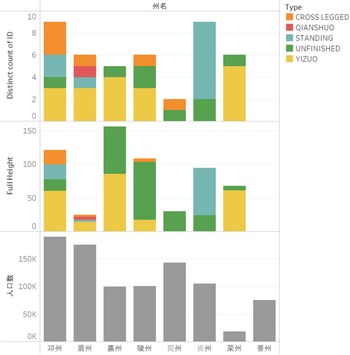
There is a strong correlation between the locations of Big Buddhas, their size, completeness and the degree of development within the site in which they are set. However, this does not appear to relate directly to the overall population of the district in which they are located. Examination of Big Buddhas in different historical districts (zhou 州), a geographical unit a little larger than a modern city district, in comparison to their respective historical populations (Fig. 7) (Chen Reference Chen, Ali, Birkök and Khan2022; Pulleyblank Reference Pulleyblank1961), shows limited correlation. Although Qiongzhou (modern day Qionglai 邛崃 and Pujiang 蒲江 districts) has the highest historical population and number of Big Buddhas (nine), there are the same number of Big Buddhas in Zizhou (modern-day Jianyang 简阳, Neijiang 内江 and Zigong 自贡 districts) with just over half of the population. The presence of salt and iron mines in the historical district of Rongzhou has been put forward as a possible reason for the number of Big Buddhas in the region (SKY et al. Reference Zhou and Chen2017).
Diagram showing the number of sites, collective height and historical population of historical districts (zhou 州) in Sichuan.

Figure 7 Long description
Panel A: A stacked bar chart showing the distinct count of ID for different types of statues across various historical districts in Sichuan. The horizontal axis lists the districts, and the vertical axis represents the distinct count of ID. The types of statues are color-coded: orange for cross-legged, red for qianshuo, teal for standing, green for unfinished, and yellow for yizuo. Panel B: A stacked bar chart displaying the full height of statues for different types across the same districts. The horizontal axis lists the districts, and the vertical axis represents the full height. The types of statues are color-coded similarly to Panel A. Panel C: A bar chart showing the historical population of the districts. The horizontal axis lists the districts, and the vertical axis represents the population in thousands. Each bar represents the population of a district.
The Rongxian Big Buddha is one of four located on the cliffs to the south of the city of Rongxian, representing the largest concentration of Big Buddha statues outside any imperial RCR sites. The unusually high number of such statues in this region may be linked to its abundant mineral resources. To the north, the Changshan mountains hold iron deposits, while to the south, the modern administrative centre of Zigong has been a hub of salt extraction for over two millennia (Song Reference Song2008).
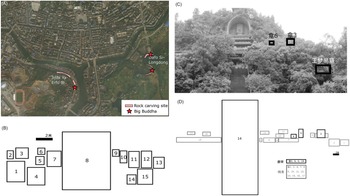
Interestingly, although the area around the modern settlement of Zigong historically formed the core of the salt mining in the area, most carving activity was concentrated in Rongxian. One possible explanation for this is the disruptive nature of salt mining, with its loud operations and the concurrent release of methane gas from the sedimentary salt layers. This may have led officials to designate Rongzhou (now Rongxian) as the county seat, distancing administrative and religious activities from the industrial zones around Zigong while maintaining proximity to the iron mines to the north of Rongxian in the Changshan Mountains. Within Rongxian, it is of interest that although the Big Buddha in the Erfo Si–Jinbi Ya site is clearly the focus of its location (Fig. 8A), the Big Buddha in the Dafo Si–Long Dong site is clearly a later feature within the site, with only two Tang Dynasty niches carved in association with it and no intrusive niches (Fig. 8B). This indicates that the two sites were not only constructed in different eras, but also by separate groups with distinct motivations.
(A) Map showing the location of religious rock-carving sites in Rongxian, Zigong; (B) Elevation showing distribution of niches in Erfo Si, Rongxian; (C) Annotated photograph of Dafo Si, Rongxian; (D) Elevation showing distribution of niches in Dafo Si, Rongxian.

The concentration of completed Buddhas in Rongxian can be contrasted with the three incomplete Big Buddhas located in the Longmen Mountains (龙门山脉), mentioned previously, which are set in isolated locations with large viewsheds: Pingqiang Dafo and Niujiao Zhai, which are finished to their shoulders, and Zhangfei Tou, which is only a head. Pingqiang Dafo and Zhangfei Tou are both isolated constructions. However, the boulders on the slope in front of Niujiao Zhai are carved with tens of large and very finely detailed niches. This means that the Big Buddha at Niujiao Zhai must postdate the construction of the niches. If these niches were created after the construction of the Buddha, it raises the question of why the Buddha was left unfinished. The carvings demonstrate the presence of highly skilled craftspeople at the site who successfully completed numerous smaller projects. If the Big Buddha had already existed at that time, it too would likely have been completed. If construction had been interrupted by some misfortune, it would have discouraged later donors from commissioning niches nearby. This suggests that the Buddha is a later addition to the site, possibly the unrealized vision of an over-ambitious wealthy donor or monk who either died or returned to the capital region before the project could be completed. This would be comparable to the situation at the Big Buddha in Leshan, where construction was suspended for several decades after the departure of a supportive prefect.
In fact, both of the two largest complete Big Buddhas in the Sichuan region are the Leshan Buddha (72 m) and the above Rongxian Buddha (Dafo Si) (37 m), which were each constructed over multiple time periods with significant pauses in their construction. Both sit at the confluence of major rivers—three in the case of Leshan—which would have served as main arteries for transport historically and closely associated with prefectural seats which would have been a locale for both political and mercantile power. However, in each case there are relatively few signs of contemporaneous carvings within the Buddha niches. Leshan Buddha has a total of 85 intrusive niches within the Big Buddha niche (∼5000 m2 of rock space) whilst the Rongxian Big Buddha has none. When contrasted with the 30 niches within the Erfo Si Buddha, which occupy nearly every square centimetre of the walls of the niche (<100 m2 of rock face), this might give some indication of the level of local engagement with the site.
Protection
In some cases, the placement of a Big Buddha suggests that it was intended to serve as a form of ‘protection’, whether safeguarding transport routes, securing a region, warding off malign influences, or even exerting control over nature and the elements. Previous scholarship has highlighted the role of Big Buddhas as protectors of transport and trade (Lee Reference Lee2021; Su Reference Su1996). Evidence for this can be seen in the rock monasteries of Kucha and Turfan, Xinjiang Province, which are located on mountain passes across the Tianshan Mountains forming the northern borders of their respective kingdoms. The placement of the Imperial cave temples of the Northern Wei, which have provided the foundation for the study of Buddhist sites in eastern China, further supports this interpretation. The Yungang Grottoes, which were founded as an Imperial site in the Northern Wei (386–534 ce) in Shanxi, were constructed along the main route connecting the Northern Wei capital at Pingcheng (modern Datong, Shanxi Province) with the former capital at Shengle (modern Helinge’er, Inner Mongolia) (Peng Reference Peng2017). Similarly, after the capital moved to Luoyang in 494 ce, a new set of monumental images was constructed in a mountain pass approximately 10 km south of the city. Both Yungang and Longmen were commissioned directly by the imperial family and served as instruments of imperial propaganda (Lewis Reference Lewis2009). In each case, these sites occupied liminal zones, between new and old territory in the case of Yungang, and between north and south in the case of Longmen, underscoring their strategic and symbolic significance. Finally, rivers in Sichuan historically served as primary routes for transportation and freight, and nine sites in this dataset containing Big Buddhas are directly associated with navigable rivers. Direct evidence for this protective role is noted in an inscription at the Leshan Big Buddha, which records that the monk Haitong ordered the cliffs at the confluence of the Min and Qingyi Rivers to be straightened and a Big Buddha carved into the cliff to prevent the frequent floods that afflicted nearby cities and to make river navigation safer (Lai Reference Lai2007).
There are also several Big Buddha sites which are associated with ‘Han Dynasty’ cliff tombs (yamu 崖墓). The majority of 30,000 cliff tombs identified in the Sichuan region to date (GWJ 2009) are assigned to the Eastern Han and Xi Jin Dynasties (25–420 ce) (Tang Reference Tang1994) with some few being dated to the Song Dynasty (Ren et al. Reference Ran, Li and Zhao2022). However, there are no yamu which have been identified as belonging to the Northern and Southern Dynasties through to Tang Dynasty (618–907 ce) period. This means that there is a gap of some 500 years in the mortuary record. Since less than 1 per cent of the yamu assigned to the Eastern Han and Western Jin period have any elements which allow for them to be dated, most are empty chambers within the rock face. It seems highly probable that cliff tombs continued to be used and constructed through to the mid to late first millennium ce.
In several sites yamu tombs are present in close proximity to big Buddha statues. This means that, even if the tomb significantly predated the construction of the Big Buddhas, it is highly improbable that the persons constructing the Big Buddhas would have been unaware of the tombs. One example is the Big Buddha at the Longquan Si Dafo, a RCR site in Pujiang (蒲江), Chengdu, which is carved less than 10 m from a cliff tomb. The scale of the Buddha completely overpowers the much smaller tomb next to it, the entrance to which is hidden by a crevice in the cliff. This arrangement lends the impression that the Buddha was either constructed to protect the tomb and its occupant(s), or to protect people in the vicinity from negative influences from the tomb. Since the tomb is impossible to date it is presently not possible to ascertain if the tomb was a pre-existing structure or constructed in conjunction with the Big Buddha. However, their close proximity indicates that there would have been some form of connection. Longquan Si is the clearest and most direct example of Big Buddha associated with a yamu; however, there are other examples, including Leshan Buddha which is carved into the same cliff, although at a slight distance from the Mahao (麻浩崖墓) cliff tomb group, which can be dated to the Han to Western Jin Dynasty through typological comparison of the decorations and artefacts found therein (Tang Reference Tang1994). These tombs are also often cited as having the earliest depiction of the Buddha found in China to date within them, although the earliest excavated Buddha with a Chinese inscription dates to 158 ce (Ran et al. Reference Ran, Li and Zhao2022). These associations between Buddhist sites and earlier mortuary contexts echo the placement of early sites in close proximity to megalithic tombs in Northern India (DeCaroli Reference DeCaroli2004).
Traces of cliff tombs were also observed at Gongtong Dafoyan, Sixin Cun, Longmen Si and Oupeng Wan. There are also cases in which later tombs are constructed in association with a Big Buddha, for instance the Song Dynasty tomb found 100 m to the northwest and downhill from the Rongxian Dafo or the later stupa carvings which are located on the path between the Dafo and Long Dong sections of the site (Monteith & Harris Reference Monteith and Harris2019).
She (社) shrines and their appropriation
The construction of a Big Buddha can have multiple motivations. In order to understand these motivations it is necessary to examine how population could and would have interacted with the sites in the past. RCR sites were often carved into the locations of local shrines (she 社) which, although they often took, and still take, the form of trees, may also be boulders and natural springs (see Mus Reference Mus1933). There is therefore the progression, in most cases, from the original site of spiritual significance to the carving of small niches in a site with perceived spiritual significance. This appropriation of sacred locales has previously been observed in South Asian contexts (DeCaroli Reference DeCaroli2004; Schopen Reference Schopen1997) and is usually phrased in terms of a religious practitioner convincing the local population to convert their shrines to a new religious praxis.
Examination of site structures at certain locations reveals a pattern of intensive activity, seemingly undertaken by the local population, with multiple small niches carved in concentrated clusters on specific rock faces. The positioning of these niches demonstrates limited regard for the other niches within the site, with the primary aim of each patron, or group of patrons, being to ensure an optimal location for their contribution to the site. These niches are characterized by being of relatively small size (<1 m2) and containing relatively simple subjects such as Buddha triads and depictions of standing Bodhisattvas. This site form is therefore taken to represent the transition of a local she shrine to an RC Shrine (Monteith et al. forthcoming).
Such shrines represent a very different tradition from that of Big Buddha images. However, at some sites, the Big Buddha appears to have appropriated an original she shrine location, or its construction may have prompted the creation of a new she shrine. At sites where Big Buddhas were constructed by and for local communities, the tradition of carving small niches in significant locations continues, with intrusive niches often added within the frame and niche of the Big Buddha, reflecting active local engagement with the site. Kandeng Shan and Erfosi provide the clearest examples of this type. In these cases, the Big Buddha served as the initial construction and subsequently became the primary ritual focus, as indicated by its central positioning within the site and the presence of intrusive niches, both of which demonstrate the extent of local interaction.
There are other sites in which it is evident that the Big Buddha image has been added to a pre-existing RCR site which may have appropriated an original she shrine. From their form and location within the site it would appear that these Big Buddhas were constructed as a form of appropriation of these sites from local populations by persons wishing to impose their religious or secular authority in a new environment. It is here suggested that such constructions were the imposition of a form of orthodoxy upon these sites by the religious or social elites. For instance, excavations recently undertaken in front of the caves in Kizil have demonstrated that the caves were originally at least 10 m further up the cliff than they appear in the present day. Additionally, it is apparent that the road past the nearby Kizilgarha site originally ran along the opposite side of the river to the carvings, further indicating that the Big Buddhas in these contexts were largely intended to be observed and present within the landscape rather than necessarily visited. This situation is particularly evident in several sites in northwestern China, for instance in Bingling Si in Linxia, Gansu and Xumi Shan in Guyuan, Ningxia. In these sites the earliest constructions date to the Xi Qin 西秦 (which ruled the region around Linxia 385–400 ce and 409–431 ce) and the Northern Wei (386–534 ce) respectively. The Big Buddhas at Xumi Shan, Maiji Shan and Bingling Si all are, or were originally, set at a significant height within the landscape in which they are set and are more visible than the older carvings at the sites. This tradition continues into the Song Dynasty with the addition of standing Amitabha images to those pre-existing. A clear example of this type of site is Chonglong Shan, Zigong. This site is carved around a large cave on a hill to the west of the historical settlement. The construction of a concrete platform built in front of the cave affects the way in which the site is currently perceived, since the ground level is now at least 6 m higher than it would have been at the time of the initial carvings and the natural spring now forms a pool which actually inundates some of the carvings. Both caves and natural springs are recorded as having ritual significance throughout Chinese written history. There are, for instance several tales of people entering caves and finding themselves in distant locales (Campany & Yang Reference Campany and Wang2012, 39). What is interesting is that, although there are nearly 200 niches dating to the Tang and Five Dynasties periods carved in and around the caves, there is only one Big Buddha at Chonglong Shan. It is a Song Dynasty standing Amitabha image and is set on the periphery of the site (Fig. 9). In each case these sites are set in places of significant natural beauty, with natural caves and springs in the vicinity. In each case the earliest Buddhist constructions at the site are on a small scale and not particularly intrusive within the landscape, with Big Buddhas that have been added to the site at a later period. These later Buddhas are prominent and visible within the site and the landscape, reflecting a transition in practice from being within the landscape to dominating the landscape.
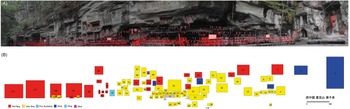
(A) Photograph of Chonglong Shan, Neijiang; (B) Schematic showing the location of the niches in Chonglong Shan, Neijiang.

Figure 9 Long description
Panel A: A photograph of Chonglong Shan, Neijiang, showcasing a cliff face with numerous niches and statues carved into it. The cliff is densely packed with various sizes of statues and niches, indicating a significant devotional site. Panel B: A schematic diagram showing the location of the niches in Chonglong Shan, Neijiang. The diagram uses different colored rectangles to represent niches from various historical periods, including Mid-Tang, Late Tang, Five Dynasties, Song, Ming, and Qing. Each rectangle is labeled with a number, and a legend in the bottom right corner explains the color coding. The diagram provides a detailed layout of the niches, highlighting their distribution and historical context.
Since the model outlined above is based on the presence or absence of specific forms of engagement within RCR sites, it should be noted that from the Song Dynasty onwards there is a decline in intrusive features, with attention shifting towards larger and more intricate carvings. It is possible that the role of smaller intrusive carvings was supplanted by printed, painted and impressed images which, although less permanent, would provide the devotee with a precise image of the deity to which they wished to appeal. Examples of such were recovered from the so-called library cave in the Mogao caves, Dunhuang and are held in the British Museum collection (British Museum Collection 1919,0101,0.14; 1919,0101,0.47; 1919,0101,0.49; https://www.britishmuseum.org/collection). However, the presence of niches dating to the Five Dynasties and Song Dynasties periods in sites which originally appear to have been communal foci, such as Kandeng Shan, Pujiang and Erfo Si, Rongxian, would indicate that communities continued to carve in those sites which they perceived as being part of their local spiritual geography.
Conclusion
Religious or ritual sites do not exist in a vacuum. Instead, they are created and hold significance within a population. The history of each religious rock-carving site and its landscape is highly nuanced and only starts with the earliest carvings in a site. For this reason, each Big Buddha (dafo) site should be seen as a unique expression of its local environment, even though similar narratives or biographies can be observed across different sites. In some cases, Big Buddhas were added to pre-existing religious rock-carving sites, where the initial carvings consisted of smaller, more approachable depictions of the Buddha. While this may indicate a change in religious practice, it could also reflect the co-option of local sites by a wealthy elite. In southern Sichuan, this pattern is evident in the number of Big Buddhas carved in peripheral locations within their respective sites. The construction of these Buddhas mostly occurs after the An Shi rebellion (755–763 ce), which caused a number of monied officials and elite monks to flee from the Central Plains to the Sichuan region. It is suggested that it was these monied elites who were also responsible for the large number of isolated and unfinished Big Buddhas across the region. These should be taken as unsuccessful attempts to appropriate the local religious landscape.
This study provides a unique opportunity to examine the interplay between different social groups through the lens of Big Buddhas constructed between 700 and 1200 ce. It highlights shifts in the semiotics of monumental statuary, which in turn influenced the form of the sites and may have facilitated changes in ritual practice. Understanding Big Buddhas requires looking beyond the physical form of the statuary within religious rock-carving sites and consider how historical populations perceived and interacted with them.
Acknowledgements
This paper would not have been possible without the assistance of Professor Giuseppe Vignato, Dr Yang Xiao and Professor Xia Lidong. Funding received from: Gansu Provincial Cultural Heritage (甘肃省文物局) project 208022400001/ The Fourth Volume of the Majishan Archaeological Report ⟪麦积山石窟考古报告第四卷⟫, Provincial Young Scholar’s Grant 203152500001/ The Landscape Archaeology of Religious Sites on the Silk Road⟪丝绸之路宗教文化遗产的景观考古学调查与研究⟫.
Supplementary material
Supplementary material for this article may be found at https://doi.org/10.1017/S0959774325100310


 Open access

