


Introduction
Clinical trials aim to generate new, generalizable, and transferable knowledge, making them an integral part of the healthcare system. They play a crucial role in informing the delivery of health services and interventions by providing evidence-based recommendations for the prevention, management, and treatment of disease [Reference Kelsey, Patrick-Lake and Abdulai1]. Therefore, inclusive participation is essential to enhance the applicability of findings from clinical trials to all populations.
Despite considerable efforts by health and federal agencies, diversity in clinical trials continues to remain a critical issue, with certain groups consistently underrepresented. The 2020 FDA Drug Trials Snapshots reported that among the 53 novel drugs approved by the FDA, only 8% of participants were Black or African American, and 11% identified as Hispanic [2], compared to their US population percentages, 13.7% and 19.5%, respectively [3]. For females, efforts have led to increased participation in many clinical trials [4]; however, significant inequities remain in research for prevalent chronic diseases and conditions, such as cancer [Reference Pala, De Pas and Conforti5], cardiovascular diseases [Reference Feldman, Ammar and Lo6–Reference Gong, Tan and Ali8], and kidney diseases [Reference Goldstein, Kung and Dailey9]. In addition to the differences in representation by race, ethnicity, and gender, evidence has shown that individuals in lower socioeconomic status (such as those with lower levels of education, low income, or who have no health insurance coverage) are less willing to participate in clinical trials [Reference Kim, Florez and Botto10].
Despite a high burden of cardiovascular disease and its risk factors – such as hypertension (HTN) and type 2 diabetes mellitus (T2D) – among historically underserved populations, recent studies revealed a lack of adequate representation of those populations in cardiovascular clinical trials [11–14]. For instance, the representation of Black or African American and Hispanic/Latino people in clinical trials for FDA-approved new drugs between 2015 and 2019 was 8% and 7%, respectively [Reference Lolic, Araojo and Okeke15]. Furthermore, despite a 50% higher likelihood of being diagnosed with diabetes than their non-Hispanic White counterparts, Black or African American and Hispanic individuals remain consistently underrepresented in T2D clinical trials [16,17]. FDA’s 2015–2017 Drug Trials Snapshots reported that among those who participated in diabetes clinical trials, only 5% were Black or African Americans and 17% were Hispanics [17]. This underrepresentation hinders generalizability, limits the advancement of biomedical knowledge, and influences patients’ trust in new CVD and diabetes treatments [Reference Schwartz, Alsan and Morris18].
Integrating Federally Qualified Health Centers (FQHCs) into clinical research can improve diversity, as they serve a wide range of populations representing various racial, ethnic, geographic, and socioeconomic groups [Reference Inokuchi, Mehta and Burke19,Reference Beeson, Jester and Proser20]. In 2023, nearly 1500 FQHCs provided services at more than 16,000 locations across the country, for over 32.5 million patients [21]. FQHCs are a vital source of primary health care but can also be a valuable resource for community-based knowledge, expertise, and support for research. In addition to providing high-quality care to a diverse population, most of whom are medically underserved and experience significant health disparities, FQHCs have extensive knowledge of the people and communities they serve due to their proximity to the community [Reference Beeson, Jester and Proser20]. These unique characteristics make FQHCs a vital resource for increasing the recruitment of underrepresented populations and improving diversity.
Despite the opportunities that FQHCs offer to enhance clinical trial diversity, significant gaps remain in understanding their engagement in clinical trials. In response, the primary objective of this study was to examine the representation of women, racial and ethnic minorities, uninsured, and people with low levels of education in HTN and T2D clinical trials. By addressing these gaps, our study provides valuable insights into the role of FQHCs in promoting equitable representation in clinical research, ultimately contributing to more inclusive and effective healthcare solutions.
Methods
Data sources and searches
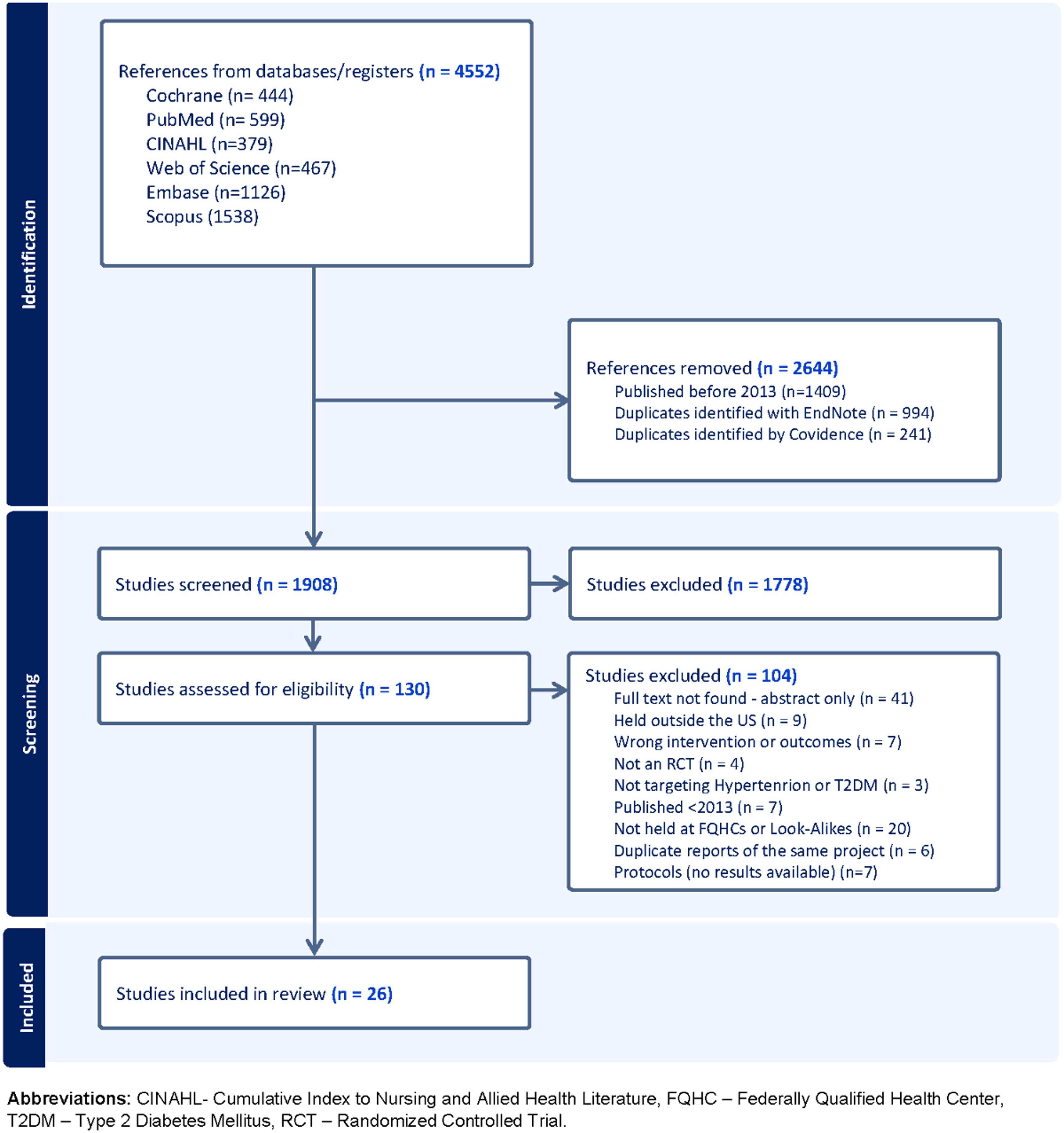
We conducted a systematic review following the Preferred Reporting Items for Systematic Reviews and Meta-Analyses (PRISMA) guidelines (Figure 1) [Reference Moher, Liberati and Tetzlaff22]. The protocol was registered on PROSPERO (ID: CRD42023453760) on October 16, 2023 [Reference Byiringiro, Miller and Himmelfarb23]. PROSPERO is an international database of registered systematic reviews in health and social care, aimed at enhancing transparency and reducing duplication [24].
Prisma flowchart.

Figure 1. Long description
A flowchart illustrating the process of screening and selecting studies for a review. The flowchart is divided into three main sections: Identification, Screening, and Included. In the Identification section, references from various databases and registers totaling 4552 are listed, including Cochrane, PubMed, CINAHL, Web of Science, Embase, and Scopus. References removed total 2644, including those published before 2013 and duplicates identified with EndNote and Covidence. In the Screening section, 1908 studies are screened, and 1778 studies are excluded. 130 studies are assessed for eligibility, and 104 studies are excluded for various reasons such as full text not found, held outside the US, wrong intervention or outcomes, not an RCT, not targeting Hypertension or Type 2 Diabetes Mellitus, published before 2013, not held at FQHCs or Look-Alikes, duplicate reports of the same project, and protocols with no results available. Finally, 26 studies are included in the review.
A comprehensive literature search was conducted in PubMed, Cochrane, CINAHL (Cumulative Index of Nursing and Allied Health Literature), Web of Science, Embase, and Scopus. The search strategy was developed with the assistance of a professional health informationist and focused on clinical trials held at FQHCs or look-alikes addressing HTN or T2D. Look-alikes are the community health centers that qualify for, but are not currently receiving, federal funding [25]. The complete search strategy and a list of articles retrieved from each database are provided in Supplementary File 1.
Study selection
The inclusion criteria of this review included randomized clinical trials, which (1) focused on HTN or T2D among adults 18 years or older, (2) explored any type of medical interventions addressing the disease of focus, (3) engaged one or more FQHCs or look-alikes with or without other non-FQHC sites in the USA (confirmed by looking up the health facility in Uniform Data System Database [UDS]), and (4) were published in 2013 or later. UDS is a publicly available dataset managed by the Health Resources and Services Administration consisting of FQHCs and look-alike data reports [26]. The search was limited to studies published from 2013 onward due to major policy changes in the past decade that have influenced the funding and operations of FQHCs [Reference Chang, J. and Lurie27]. For example, the 2009 American Recovery and Reinvestment Act led to substantial investments in FQHCs, resulting in a significant expansion to over 8000 sites operating across the USA by 2014 [Reference Chang, J. and Lurie27]. Observational and non-randomized interventional studies, as well as gray literature including white papers, non-academic, and opinion pieces were excluded. We excluded these studies to ensure methodological rigor, minimize bias, and focus on high-quality, peer-reviewed randomized clinical trials that aligned with our research objectives. We also excluded studies that did not have a full-text article available, as they lacked sufficient methodological detail for quality assessment and data extraction. Studies conducted in non-FQHC settings within the USA and studies conducted outside the USA were also excluded, as our primary aim was to examine clinical trials that engaged at least one FQHC or FQHC look-alike site in the USA.
Data extraction and quality assessment
Identified articles were exported to EndNote [28] where duplicates were removed, then uploaded to Covidence – a widely used systematic review management software – where additional duplicate records were identified and removed. In Covidence, each clinical trial was independently screened by two investigators from the study team (S.B., R.A.A.B., T.H., E.U., J.K.G., T.T., K.G., K.A., O.B., Y.C., D.B., A.A., & S.G.). The investigators screened titles and abstracts, conducted full-text reviews, and extracted data using a standardized data extraction form integrated into Covidence. At each step of the systematic review, the lead of the systematic review (SB) tagged two investigators from the study team to each of the clinical trial articles. Any disagreements were resolved by a third investigator through consensus in Covidence. The National Heart, Lung, and Blood Institute’s Quality Assessment Tool for Controlled Intervention Studies was used for quality assessment and appraisal [29]. Two investigators independently provided scoring for each study, and discrepancies were resolved by a third investigator. The detailed quality assessment strategy is provided in Supplementary File 2.1.
Data synthesis and analysis
We reported numbers of studies that resulted from article search and those excluded at the different stages of the systematic review using the PRISMA flowchart. Further, we reported summarized characteristics of included studies in tables with the specific diversity populations engaged in clinical trials. We used “metaprop” package in Stata/BE 17 to compute overall pooled proportions of female, Hispanic/Latino, Black/African American, Asian American, uninsured, and limited education (high school or lower level of education) participants of HTN or T2D clinical trials at FQHCs. We used the same package to compute pooled proportions of the above participants by disease type of focus (HTN, T2D, or both). We used meta-regression to evaluate the trend in the proportions of participants over time.
Role of funding source
This review was supported by the American Heart Association Diversity Supplement Grant (23DIVSUP1058025). The funding agency was not involved in the study’s conceptualization or design, data extraction or synthesis, manuscript writing, or the decision to publish.
Results
Search results
Our initial search of articles yielded 4552 articles (Figure 1). Duplicates (n = 1235) and articles published before 2013 (n = 1409) were removed resulting in 1908 articles for title and abstract review. During this stage, we further excluded 1778 articles for being irrelevant to the topic of this systematic review. A total of 130 articles were assessed for eligibility with full text review, in which 103 were excluded. The most common reasons for exclusion were absence of full text article (n = 41) mostly of abstracts from conference proceedings, non-FQHCs setting (n = 20), or conducted outside the USA (n = 9).
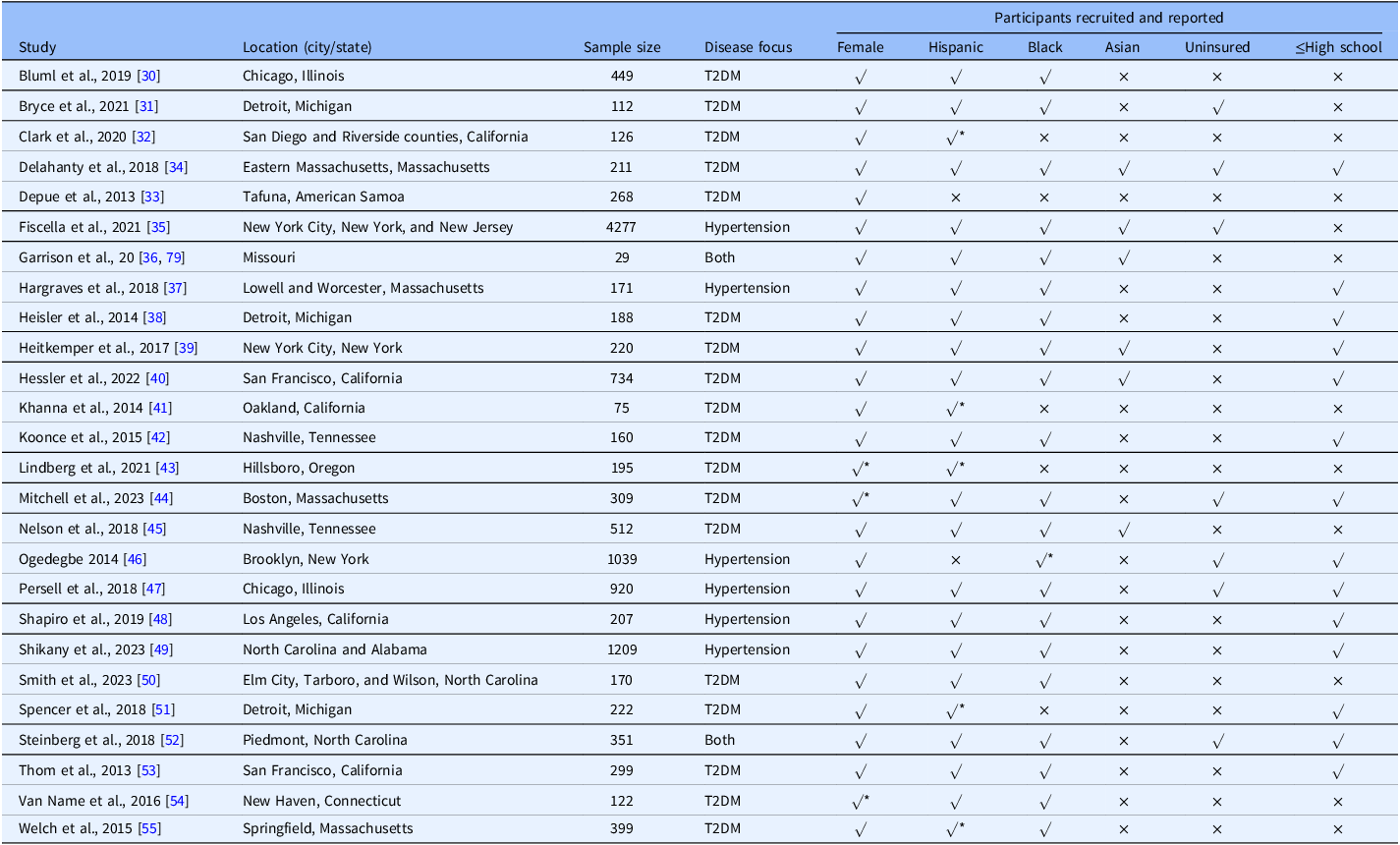
A total of 26 clinical trials were included in the systematic review and meta-analysis (Table 1) [Reference Bluml, Kolb and Lipman30–Reference Welch, Zagarins and Santiago-Kelly55], with 20 of these receiving funding from the National Institutes of Health [Reference Clark, Gallo and Euyoque32–Reference Fiscella, He and Sanders35,Reference Hargraves, Bonollo and Person37–Reference Khanna, Stoddard and Gonzales41,Reference Lindberg, Vega-López and LeBlanc43–Reference Shikany, Safford and Cherrington49,Reference Spencer, Kieffer and Sinco51,Reference Steinberg, Kay and Burroughs52,Reference Van Name, Camp and Magenheimer54,Reference Welch, Zagarins and Santiago-Kelly55]. All 26 clinical trials reported the proportion of female participants. In contrast, only a subset of trials reported on other demographic and socioeconomic characteristics, including Hispanic participants (n = 24) [Reference Bluml, Kolb and Lipman30–Reference Clark, Gallo and Euyoque32,Reference Delahanty, Chang and Levy34–Reference Nelson, Wallston and Kripalani45,Reference Persell, Karmali and Lazar47–Reference Welch, Zagarins and Santiago-Kelly55], Black/African American participants (n = 21) [Reference Bluml, Kolb and Lipman30,Reference Bryce, WolfsonBryce and CohenBryce31,Reference Delahanty, Chang and Levy34–Reference Hessler, Fisher and Dickinson40,Reference Koonce, Giuse and Kusnoor42,Reference Mitchell, Bragg and de la Cruz44–Reference Smith50,Reference Steinberg, Kay and Burroughs52–Reference Welch, Zagarins and Santiago-Kelly55], Asian American participants (n = 6) [Reference Delahanty, Chang and Levy34–Reference Garrison, Schwartz and Moore36,Reference Heitkemper, Mamykina and Tobin39,Reference Hessler, Fisher and Dickinson40,Reference Nelson, Wallston and Kripalani45], uninsured participants (n = 7) [Reference Bryce, WolfsonBryce and CohenBryce31,Reference Delahanty, Chang and Levy34,Reference Fiscella, He and Sanders35,Reference Mitchell, Bragg and de la Cruz44,Reference Ogedegbe, Tobin and Fernandez46,Reference Persell, Karmali and Lazar47,Reference Steinberg, Kay and Burroughs52], and participants with limited education (n = 14) [Reference Delahanty, Chang and Levy34,Reference Hargraves, Bonollo and Person37–Reference Hessler, Fisher and Dickinson40,Reference Koonce, Giuse and Kusnoor42,Reference Mitchell, Bragg and de la Cruz44,Reference Ogedegbe, Tobin and Fernandez46–Reference Shikany, Safford and Cherrington49,Reference Spencer, Kieffer and Sinco51–Reference Thom, Ghorob and Hessler53]. Additional characteristics of included clinical trials are presented as Table S1 in Supplementary File 3.
Characteristics of clinical trials included in the systematic review

*All participants of the clinical trial belonged to the group (e.g., All participants were female, All participants were Hispanic/Latino, etc.). Abbreviations: T2DM, type 2 diabetes mellitus
Quality assessment results
Studies were graded as good, fair, or poor. Of the 26 included studies, one was not rated because of lacking follow-up and outcome data [Reference Hargraves, Bonollo and Person37], one was graded as “Good,”[Reference Persell, Karmali and Lazar47] 14 as “Fair,”[Reference Bryce, WolfsonBryce and CohenBryce31–Reference Garrison, Schwartz and Moore36,Reference Heisler, Choi and Palmisano38,Reference Mitchell, Bragg and de la Cruz44–Reference Ogedegbe, Tobin and Fernandez46,Reference Shikany, Safford and Cherrington49,Reference Steinberg, Kay and Burroughs52,Reference Van Name, Camp and Magenheimer54,Reference Welch, Zagarins and Santiago-Kelly55] and 10 as “Poor.”[Reference Bluml, Kolb and Lipman30,Reference Heitkemper, Mamykina and Tobin39–Reference Lindberg, Vega-López and LeBlanc43,Reference Shapiro, Shu and Goldstein48,Reference Smith50,Reference Spencer, Kieffer and Sinco51,Reference Thom, Ghorob and Hessler53] The most common reason for a “Poor” grade was the high rate of attrition (>20%). Additional details of the quality assessment results are presented in Table S2 in Supplementary File 3.
Representation in hypertension and type 2 diabetes mellitus clinical trials
Participation of Hispanic/Latino, Black/African American, and Asian populations
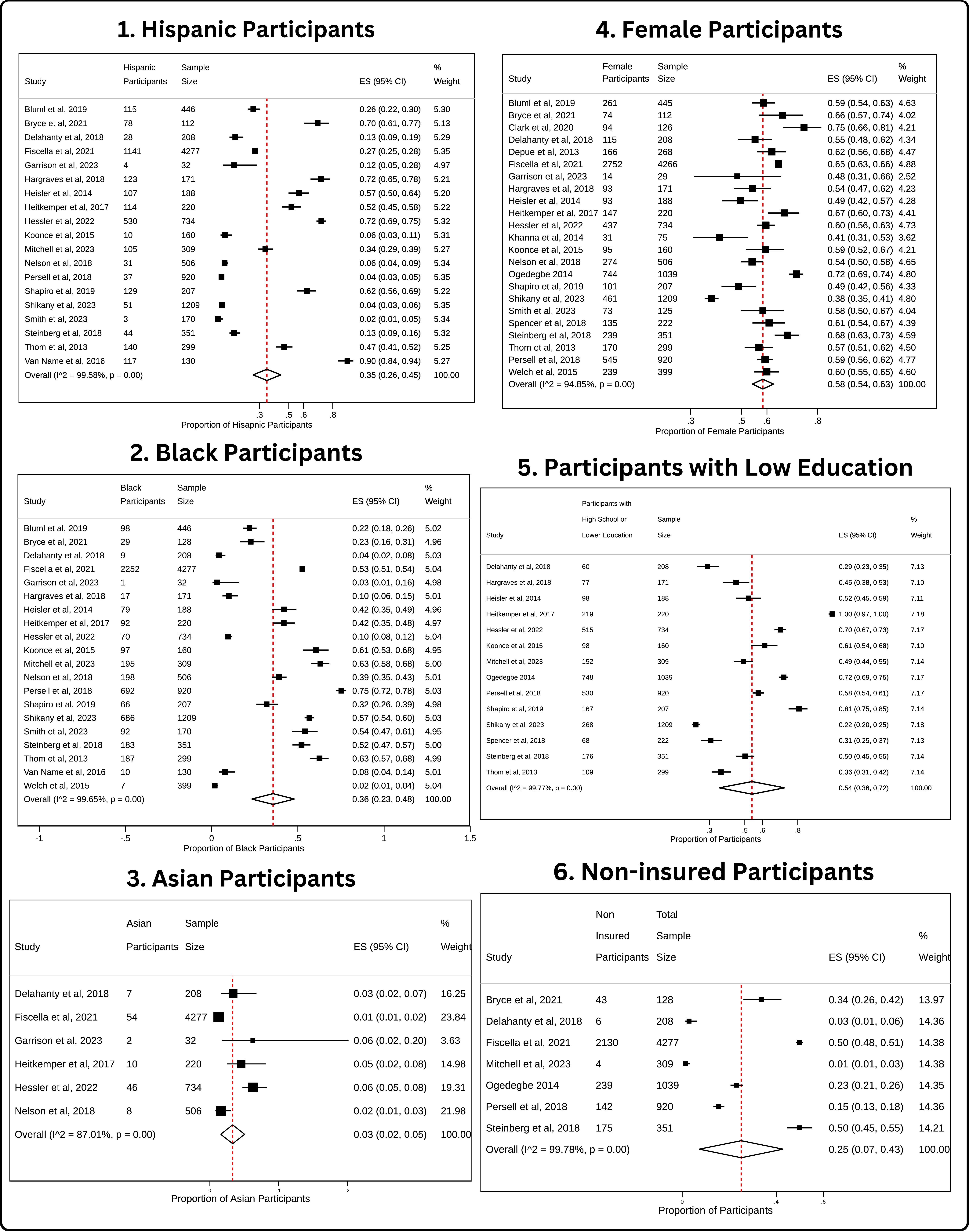
All but two clinical trials reported proportions of participants who were of Hispanic/Latino ethnicity. Five clinical trials consisted of interventions targeted to Hispanic/Latino participants only and were not included in the meta-analysis to prevent overinflation of pooled proportions of Hispanic/Latino participants in studies that targeted multiple populations [Reference Clark, Gallo and Euyoque32,Reference Khanna, Stoddard and Gonzales41,Reference Lindberg, Vega-López and LeBlanc43,Reference Spencer, Kieffer and Sinco51,Reference Welch, Zagarins and Santiago-Kelly55]. The pooled proportion of Hispanic/Latino participants in HTN and T2D clinical trials was 0.35 (95% CI: 0.26, 0.45) (Figure 2.1). Participation in clinical trials varied by disease focus of the research projects (heterogeneity p-value: <0.001), with pooled prevalence of Hispanic/Latino participants of 0.39 (95% CI: 0.22, 0.57), 0.33 (95% CI: 0.19, 0.47), and 0.13 (95% CI: 0.09, 0.16) among clinical trials addressing T2D, HTN, and both conditions, respectively (Figure S1 in Supplementary File 3). A non-statistically significant negative trend of Hispanic/Latino participation in clinical trials at FQHCs over time (coefficient: −0.022, p-value: 0.319) was also identified.
Ethnic, racial, and bio-social representation in hypertension and diabetes clinical trials at Federally Qualified Health Centers.

Twenty-one clinical trials engaged and reported proportions of Black/African American participants. One of the clinical trials had an intervention targeted to Black/African American individuals only and was excluded from the meta-analysis [Reference Ogedegbe, Tobin and Fernandez46]. The pooled proportion of Black/African American participants was 0.36 (95% CI: 0.23, 0.48) (Figure 2.2). There was no clear heterogeneity of Black/African American participation by disease focus of the clinical trial (p-value = 0.252) (Figure S2 in Supplementary File 3), and no temporal variation. The pooled prevalence of Asian Americans who participated in six studies that engaged them was 0.03 (95% CI: 0.02, 0.05) (Figure 2.3).
Female participation
All clinical trials reported proportions of female participants; however, three clinical trials were female-only interventions [Reference Lindberg, Vega-López and LeBlanc43,Reference Mitchell, Bragg and de la Cruz44,Reference Van Name, Camp and Magenheimer54] and were not included in the meta-analysis. The overall proportion of female participants was 0.58 (95% CI: 0.54, 0.63) (Figure 2.4). The pooled proportion of female participants was 0.59 (95% CI: 0.56, 0.62), 0.56 (95% CI: 0.46, 0.67), and 0.67 (95% CI: 0.62, 0.71) in clinical trials addressing T2D, HTN, and both conditions concurrently, respectively (Figure S3 in Supplementary File 3). The meta-regression of proportion of female participants in HTN and T2D clinical trials over time did not show any statistically significant temporal association.
Participation of people with limited education in clinical trials
Fourteen clinical trials assessed and reported participants’ educational level. The pooled proportion of participants with limited education (high school or lower) was 0.54 (95% CI: 0.36, 0.72) (Figure 2.5). In a meta-regression model, there was no association between disease focus of the clinical trial, or publication year with the proportion of participants with high school or lower level of education engaged in clinical trials at FQHCs.
Participation of people without health insurance coverage in clinical trials
Seven studies included and reported data on participation of people without health insurance coverage in HTN and T2D clinical trials. The pooled proportion of uninsured participants was 0.25 (95% CI: 0.07, 0.43) (Figure 2.6).
Discussion
In this systematic review, we observed that trials involving FQHCs tended to include proportions of participants from historically underrepresented groups similar to the patient population served at those health facilities and higher than the general US population. For instance, the pooled proportions of Black/African American and Hispanic/Latino participants in the included trials involving FQHC were 36% and 35%, respectively, which is remarkably higher than the overall proportions of those populations in the USA as of the 2024 US Census data [3]. Our findings suggest that the integration of FQHCs into clinical trials may be an effective strategy to increase diversity in clinical trials.
Given that FQHCs serve over 32 million patients across diverse racial, ethnic, and socioeconomic backgrounds [21], their limited inclusion in clinical trials represents a missed opportunity. Despite the potential of FQHCs to improve diversity in clinical trials, this review identified a relatively small number of HTN and T2DM trials that involved FQHCs. Our review found that the pooled proportions of Black/African American, Hispanic/Latino, and uninsured participants in the included clinical trials align more closely with the demographics of the patient population that FQHCs serve [56], rather than those generally reported in FDA’s clinical trials snapshots or reports [2,57]. This suggests that recruitment efforts may be more likely to reach historically underrepresented populations when FQHCs are involved. Additionally, including FQHCs in clinical trials may provide opportunities to oversample certain populations, such as women, Hispanic/Latino, and Black/African American participants, as demonstrated in studies that focused exclusively on these groups [Reference Castaneda, Bharti and Rojas58,Reference Fam and Ferrante59], which could provide a more comprehensive understanding of their responses to treatment modalities and overall effectiveness of such treatments across diverse populations.
The pooled proportions of clinical trial participants who were uninsured populations was 25%, which is relatively high. In the current review, the status “uninsured” was extracted as is, and we are not sure whether participants included in this category are similar across studies. Nevertheless, this finding is close to the health insurance coverage data of FQHCs’ patient population, which ranged between 23% and 18% between 2019 and 2024 [25]. Enrolling uninsured populations in clinical trials is an ethical necessity. Yet there are multiple barriers including lack of access to insurance and standard of care as part of the study protocol and lack of access to post-trial treatment, which may be necessary in case of side effects or identification of additional conditions [Reference Pascalev, Otado and Adler60]. Furthermore, apart from FQHCs, these populations are not likely to seek care in major academic medical centers hence do not get an opportunity to learn about research opportunities offered in those places. While FQHCs present an opportunity to engage uninsured populations, measures for protecting these populations are also needed in the instance when participation leads to sequelae requiring additional health care needs.
An additional novel finding was the 54% pooled prevalence of clinical trial participation among people with limited educational attainment. Prior studies have shown that lower educational attainment is associated with reduced clinical trial participation, often due to limited awareness, stricter protocol, perceived burden, and mistrust of research processes [Reference Kim, Florez and Botto10,Reference Ford, Howerton and Lai61–Reference Florez, Botto and Kim63]. The unique case for FQHC could be partially explained by the fact that 40% of FQHCs serve rural communities and hence may be more likely to serve people with low educational attainment [64,65]. It is important to note that there was high variability of prevalences of people with limited education across studies. Further research exploring drivers of clinical research participation among people with limited literacy.
For gender representation, we found that female participants comprised 58% of all included clinical trials. This aligns with recent national data showing overall improvement in female representation in clinical trials [Reference Hlávka, Bibbins-Domingo and Helman66,Reference Sosinsky, Rich-Edwards and Wiley67]. However, despite improvements in female participation over the past few years, women remain underrepresented in many cardiovascular clinical trials [Reference Tobb, Kocher and Bullock-Palmer68]. Compared to disease prevalence, women’s participation in HTN clinical trials is about the same, higher in pulmonary HTN, and lower in conditions such as stroke, arrhythmia, coronary heart disease, acute coronary syndrome, and heart failure [Reference Jin, Chandramouli and Allocco69]. Recent reports also reported women’s underrepresentation in diabetes clinical trials compared to men [Reference Herskind and Norgaard70]. The inclusion of FQHCs in such trials may help recruit more female participants, thereby improving their representation. In addition, our meta-analysis showed variations in female participation by disease focus, with higher proportions in trials focusing on both HTN and T2D simultaneously compared to those focused exclusively on either condition. Several factors could explain this, including higher comorbidity rates among women [Reference Naseri, Esmat and Bahee71,Reference Britton, Berry and Hussey72], their healthcare-seeking behavior [Reference Li, Fu and Li73,Reference Thompson, Anisimowicz and Miedema74], and variations in recruitment strategies across trials. Notably, we did not observe a statistically significant temporal trend in female participation over time. More research is needed to understand the differences in female participation based on disease focus.
Despite the potential advantages of increasing representation in clinical trials through FQHC engagement, particular attention must be paid to addressing the high attrition rates observed in these settings. In our systematic review, 10 out of 26 included studies were rated as “poor” quality, primarily due to high participant dropout. For various reasons, underserved populations often utilize healthcare services less than the general population. Since these groups make up a large portion of patients at FQHCs, this lower utilization can hinder clinical trial follow-up efforts at these sites, trending toward an attritional impact [Reference Wallace, Lollo and Duchowny75]. Strategies for reaching and keeping patients engaged, and engaging FQHC leadership and clinical staff in these clinical trials should be defined and mobilized to reduce attrition.
In addition, a critical next step would be strengthening research capacity within FQHCs themselves. FQHCs have the potential to play an active role in generating and managing research data among historically underrepresented populations. However, barriers commonly experienced by FQHCs, including limited research infrastructure, resources, and protected time [Reference Inokuchi, Mehta and Burke19,Reference Beeson, Jester and Proser20,Reference Brandt, Young and Campbell76,Reference Walter and O.’Brien77], may constrain the dissemination of FQHC-led research. Addressing these barriers through targeted funding, training, and academic partnerships could help support the dissemination of FQHC-led research and increase contributions to peer-reviewed literature.
Our study’s findings also have important implications for funders, trial sponsors, and Clinical and Translational Science Award (CTSA) program. Expanding sustainable partnerships between academic institutions and FQHCs may enhance the reach of clinical trials in underserved communities. Funders could prioritize mechanisms that support long-term infrastructure development within FQHCs, including research staff, electronic health records, and data systems to facilitate research, and community engagement capacity. In addition, the CTSA program can play a critical role in facilitating partnerships and providing methodological support [78], thereby helping to ensure that FQHCs are not only recruitment sites but active partners in study design, implementation, and dissemination.
This review has some limitations. There was an inconsistent reporting of socioeconomic indicators across included studies, which limits generalizability of the findings. While we examined diversity related to some socio-demographic and healthcare access-related factors, we were unable to investigate other important factors such as income and language due to inconsistent data. Moreover, we did not conduct stratified analyses by study quality, geographic region, funding source, or trial size, all of which could influence diversity metrics. The limited number of eligible studies and inconsistent reporting of key variables constrained our ability to conduct meaningful subgroup analysis. In addition, by restricting our inclusion criteria to peer-reviewed randomized clinical trials, we may have missed relevant findings from implementation projects, community-based interventions, or pilot studies. This exclusion could have contributed to publication bias. We also excluded gray literature and non-peer-reviewed sources. However, these criteria were chosen to ensure methodological rigor, minimize bias, and focus on high-quality evidence that would be most likely to influence policy decision-making. Additionally, the lack of a comparison group, such as non-FQHC trials, limits our ability to draw causal inferences. This study was designed to characterize the representation of underserved populations within FQHC-engaged trials, rather than to directly compare the impact of FQHC versus non-FQHC trials on diversity. While clinical trials without FQHC involvement certainly exist, many do not consistently report key diversity metrics or site-level characteristics, which complicates their identification and classification and makes direct comparison challenging. Future studies should consider incorporating comparison groups to better assess the specific impact of FQHCs on clinical trial diversity.
Despite these limitations, this study has several strengths. First, to our knowledge, it is the first systematic review and meta-analysis specifically evaluating the representation of underserved populations in HTN and T2D clinical trials conducted at FQHCs. Second, we employed a comprehensive and methodologically rigorous search strategy in collaboration with a professional health sciences librarian to ensure broad and systematic coverage of eligible studies. Finally, the review followed standardized PRISMA guidelines and was registered in PROSPERO, enhancing the transparency of the review process.
Conclusion
This systematic review provides valuable insights into the role of FQHCs in improving diversity in HTN and T2D clinical trials. While our findings suggest a relatively higher recruitment of underrepresented populations in clinical trials involving FQHCs, further research is needed to explore strategies to fully understand the role of FQHCs, especially by their level of engagement. Importantly, FQHC involvement alone may not be sufficient to ensure equitable participation across all groups. Additional strategies, including tailored recruitment approaches and structural support, are likely necessary to achieve equitable representation. Expanding FQHC engagement in clinical trials therefore presents a promising opportunity to improve clinical trial diversity and to ensure that research findings are applicable and effective across diverse populations.
Supplementary material
The supplementary material for this article can be found at https://doi.org/10.1017/cts.2026.10759.
Acknowledgments
The authors acknowledge Dr. Chakra Budhathoki, PhD, MS, for his support with statistical analysis, Stella Seal, MLS, for her support in literature search, and members of the IMPACT (IMproving Participation Among diverse populations in Cardiovascular clinical Trials) Center and COmmunity to increase eNgagemeNt and Enrollment in cardiovascular Clinical Trials (CONNECT) (American Heart Asssociation Grant # 953550) for contributing ideas throughout the project.
Author contributions
Rifath Ara Alam Barsha: Data curation, Formal analysis, Methodology, Writing – original draft, Writing – review & editing; Samuel Byiringiro: Conceptualization, Data curation, Formal analysis, Funding acquisition, Investigation, Methodology, Resources, Software, Visualization, Writing – original draft, Writing – review & editing; Thomas Hinneh: Data curation, Formal analysis, Methodology, Project administration, Validation, Writing – review & editing; Emmanuel Uwiringiyimana: Data curation, Formal analysis, Validation, Writing – review & editing; Juliana Garcia: Data curation, Methodology, Validation, Writing – review & editing; Kimesha Grant: Data curation, Investigation, Methodology, Validation, Writing – review & editing; Oluwatosin Tomiwa: Data curation, Investigation, Validation, Writing – review & editing; Khadijat Adeleye: Data curation, Formal analysis, Methodology, Validation, Writing – review & editing; Brenda Owusu: Data curation, Formal analysis, Validation, Writing – original draft, Writing – review & editing; Yuling Chen: Formal analysis, Investigation, Methodology, Validation, Writing – review & editing; Diana-Lyn Baptiste: Data curation, Investigation, Project administration, Validation, Writing – review & editing; Ashwag Alhabodal: Data curation, Investigation, Methodology, Validation, Writing – review & editing; Serina Gbaba: Formal analysis, Methodology, Project administration, Validation, Writing – review & editing; Payam Sheikhattari: Conceptualization, Supervision, Validation, Writing – review & editing; Hailey N. Miller: Conceptualization, Project administration, Resources, Supervision, Validation, Writing – review & editing; Cheryl R. Dennison Himmelfarb: Conceptualization, Project administration, Resources, Supervision, Validation, Writing – review & editing.
Funding statement
This study is supported by the American Heart Association IMPACT (IMproving Participation Among diverse populations in Cardiovascular clinical Trials) Center (Grant #946222), COmmunity to increase eNgagemeNt and Enrollment in cardiovascular Clinical Trials (CONNECT) (Grant #953550), and Diversity Supplement Grant (23DIVSUP1058025) and the National Institute on Minority Health and Health Disparities, a cardiometabolic health program LINKED with clinical-community support and mobile Health telemonitoring in underserved populations (LINKED-HEARTS Program) (P50MD017348-818).
Competing interests
The authors have no competing interests to declare related to financial, professional, contractual, or personal relationships or situations.


 Open access

