


Chronic fatigue syndrome (CFS) is a disabling disorder characterised by extreme fatigue and other related symptoms (Reference Fukuda, Straus and HickieFukuda et al, 1994), and is most probably of multi-factorial aetiology (Reference Wessely, Hotopf and SharpeWessely et al, 1998). Of the putative biological components, dysfunction of the hypothalamic—pituitary—adrenal (HPA) axis has been implicated because of the links between physical or psychological stress and illness onset, the comorbidity with major depression (found in around a half of most samples) and the predominance of fatigue in disorders of the HPA axis, such as Addison's disease (Reference CleareCleare, 2001). Evidence to date supports mild hypocortisolism in some subjects, but with variability between studies depending on the method used to measure cortisol levels and the likely heterogeneity of patient samples (Reference CleareCleare, 2003). Because of difficulties in interpreting previous studies that themselves use stressful procedures, such as hospital admission, cannulation, blood removal and administering drugs, we used a naturalistic measure of stress — the salivary cortisol response to awakening — to obtain an indication of the status of the HPA axis in CFS.
METHOD
Subjects
Patients aged 18–65 years with CFS were recruited into the study from consecutive referrals to the CFS clinic at King's College Hospital, London. A total of 56 patients agreed to participate. Patients had undergone thorough medical screening to exclude a detectable organic cause for their fatigue, including physical examination and relevant investigation, with a minimum of urinalysis, full blood count, urea and electrolytes, thyroid function tests, liver function tests, 9 a.m. cortisol and erythrocyte sedimentation rate. All patients initially were interviewed using a semi-structured interview (Reference Sharpe, Chalder and PalmerSharpe et al, 1997) for CFS by a psychiatrist: included subjects had to fulfil both of the major international consensus criteria for CFS (Reference Sharpe, Archard and BanatvalaSharpe et al, 1991; Reference Fukuda, Straus and HickieFukuda et al, 1994). Subjects then were interviewed using the Schedules for Clinical Assessment in Neuropsychiatry (SCAN; World Health Organization, 1994) adapted for DSM-IV (American Psychiatric Association, 1994) — subjects who had an exclusionary psychiatric diagnosis according to the clinical diagnostic criteria were therefore excluded at this point. Each subject gave a detailed history including length of illness, the presence of any precipitating factors (such as viral infections) and past psychiatric disorder. Patients who also fulfilled the criteria for fibromyalgia as defined by the American College of Rheumatology were excluded (Reference Wolfe, Smythe and YunusWolfe et al, 1990). These exclusions were made in order to obtain as uniform and homogeneous a sample as possible, minimising comorbidity.
Thirty-five control subjects, recruited from staff, students and volunteers at our institutions, also took part in the salivary cortisol test. Present or past significant medical or psychiatric illness was excluded by a research nurse using a semi-structured interview. Control subjects also were interviewed using the SCAN to exclude major psychiatric illness.
All control subjects and 46/56 patients were free from psychotropic medication, steroids or medication known to affect the HPA axis for a minimum of 2 months prior to endocrine testing. Ten patients were taking medication at the time of testing: nine were taking antidepressants (of whom two were taking additional hypnotics and one was taking sodium valproate) and one was taking pizotifen for migraine. All female subjects were tested during days 1–7 of their menstrual cycle.
The institutional ethics committee approved all procedures. All patients and controls gave written informed consent.
Questionnaires
Subjects filled out the following questionnaires to assess illness characteristics: the Chalder Fatigue Scale (Reference Chalder, Berelowitz and PawlikowskaChalder et al, 1993) and a global fatigue rating scale (Reference Vercoulen, Bazelmans and SwaninkVercoulen et al, 1997) for fatigue severity; the Beck Depression Inventory (Reference Beck, Ward and MendelsonBeck et al, 1961) and General Health Questionnaire—12 (Reference GoldbergGoldberg, 1972) for symptoms of depression and anxiety; the Symptom Checklist (Reference Wittenborn and BuhlerWittenborn & Buhler, 1979) for somatic symptoms; the Medical Outcomes Survey — Short Form 36 (SF—36; Reference Jenkinson, Coulter and WrightJenkinson et al, 1993) and Work and Social Adjustment Scale (Reference MarksMarks, 1986) for disability; and the Pittsburgh Sleep Quality Index (Reference Buysse, Reynolds and MonkBuysse et al, 1989) for sleep disturbance.
Salivary cortisol test
Free cortisol is present in saliva, and salivary cortisol assays have been shown to be an accurate indicator of total plasma cortisol (Reference Tunn, Mollmann and BarthTunn et al, 1992) and plasma free cortisol (Reference Kirschbaum and HellhammerKirschbaum & Hellhammer, 1994). Furthermore, it has been well delineated that cortisol levels rapidly increase after awakening by around 50—60% (Reference Linkowski, Van Onderbergen and KerkhofsLinkowski et al, 1993; Reference Van Cauter, Polonsky and BlackmanVan Cauter et al, 1994; Reference Wust, Wolf and HellhammerWust et al, 2000b ) and remain elevated for at least 60 min (Reference Schmidt-Reinwald, Pruessner and HellhammerSchmidt-Reinwald et al, 1999). Awakening thus acts as a mild stressor and the increase in cortisol gives an indication of the responsivity of the HPA axis; furthermore, it has the advantage that salivary testing can be completed in a naturalistic setting, thus eliminating the confounding stress and anxiety associated with both intravenous cannulation and hospital attendance. Recent work compared the results from this test with the more traditional HPA axis tests, such as the corticotrophin-releasing hormone (CRH) test, adrenocorticotrophic hormone (ACTH) test and social stress tests, and concluded that it is a useful and reliable index of the adrenocortical activity, perhaps most closely correlated with the ACTH test of adrenal reserve (Reference Schmidt-Reinwald, Pruessner and HellhammerSchmidt-Reinwald et al, 1999; Reference Wust, Wolf and HellhammerWust et al, 2000b ). Furthermore, results from the study of over 500 subjects suggest that the response is not significantly affected by age, sleep duration, time of awakening, use of an alarm clock, smoking or use of an oral contraceptive, and is stable over time (Reference Wust, Wolf and HellhammerWust et al, 2000b ).
All tests were undertaken at home on a normal weekday: subjects who were working were instructed to choose any workday except Monday. Subjects were free to wake up according to their normal schedule because the awakening cortisol profile does not appear to be altered by differences in time of awakening (Reference Pruessner, Wolf and HellhammerPruessner et al, 1997). Subjects were asked to take the first sample while still in bed and then not to have breakfast or brush their teeth during the first hour after awakening in order to avoid falsely high cortisol values due to plasma exudates from minor bleeding in the oral cavity (or from meal-stimulated rises in cortisol). For the 10 min prior to each sample, we asked subjects to remain sitting and not to drink anything, smoke or chew gum. Saliva was collected directly upon waking and then 10, 20, 30 and 60 min after waking. During collection, subjects were instructed not to touch the samples with their hands. At each time point, subjects were asked to write down ‘any difficult or tense conversations or other “hassles” that you have experienced in the last hour’. Samples were kept in the refrigerator overnight and sent back in the post in the morning. On arrival at the laboratory they were frozen at -20°C. After thawing, saliva samples were centrifuged at 3000 rev/min for 5 min, which resulted in a clear supernatant of low viscosity. A 50μl aliquot of saliva was used for duplicate analysis. Salivary cortisol was measured using a time-resolved fluoroimmunoassay as described elsewhere (Reference Pariante, Papadopoulos and PoonPariante et al, 2002), except that the rabbit cortisol antibody (product no. 2330–5105, batch no. 21051565; Biogenesis, Poole, Dorset, UK) and the europium-labelled cortisol were diluted 1:4500 and 1:65, respectively, in assay buffer before use. All samples of one subject were analysed in the same run.
Analysis
Data were checked to confirm normal distribution and parametric statistics were used. The primary outcome variable was the total cortisol response to awakening, measured using the integrated area under the curve (AUC). This was calculated by first subtracting the 0-min awakening value from the 10-, 20-, 30- and 60-min values, to obtain baseline-corrected values, and then using the trapezoidal method. The AUC was compared between groups using an independent t-test. Secondary analysis on the main group difference only was undertaken by carrying out post hoc t-tests at each baseline-corrected time point. Exploratory analysis was undertaken to see whether clinical variables were related to the AUC response within the patient group and to define further the dynamics of the salivary cortisol response in the group as a whole. Means and standard deviations are given.
RESULTS
Comparison of patients and controls
Patients and controls were well balanced with regard to age, gender, weight and body mass index. Details of subjects and controls are shown in Table 1. The mean length of illness was 56 months at the time of testing and the mean SF—36 physical functioning sub-scale score was 39.4 (s.d.=22.0).
Comparison of patient and control groups

| Patients with chronic fatigue syndrome (n=56) | Control subjects (n=35) | P 1 | |
|---|---|---|---|
| Age, years (mean (s.d.)) | 39.4 (11.0) | 34.9 (12.8) | 0.09 |
| Gender (% female) | 63 | 60 | 0.81 |
| Weight, kg (mean (s.d.)) | 70.3 (15.8) | 69.0 (15.0) | 0.74 |
| Body mass index (mean (s.d.)) | 23.8 (4.6) | 24.3 (5.4) | 0.69 |
| Smoking (% yes) | 20 | 17 | 0.62 |
| Ethnicity (% White) | 89 | 74 | - |
| Ethnicity (% Black) | 5 | 6 | - |
| Ethnicity (% other) | 5 | 20 | 0.09 |
| Paid employment (%) | 43 | 91 | <0.001 |
| Fatigue score (mean (s.d.)) | 23.8 (6.9) | 11.6 (2.2) | <0.001 |
| GHQ score (mean (s.d.)) | 17.0 (6.9) | 11.1 (4.0) | <0.001 |
| BDI score (mean (s.d.)) | 14.4 (8.8) | 3.5 (4.1) | <0.001 |
| PSQI-global score (mean (s.d.)) | 8.0 (3.8) | 4.1 (3.0) | <0.001 |
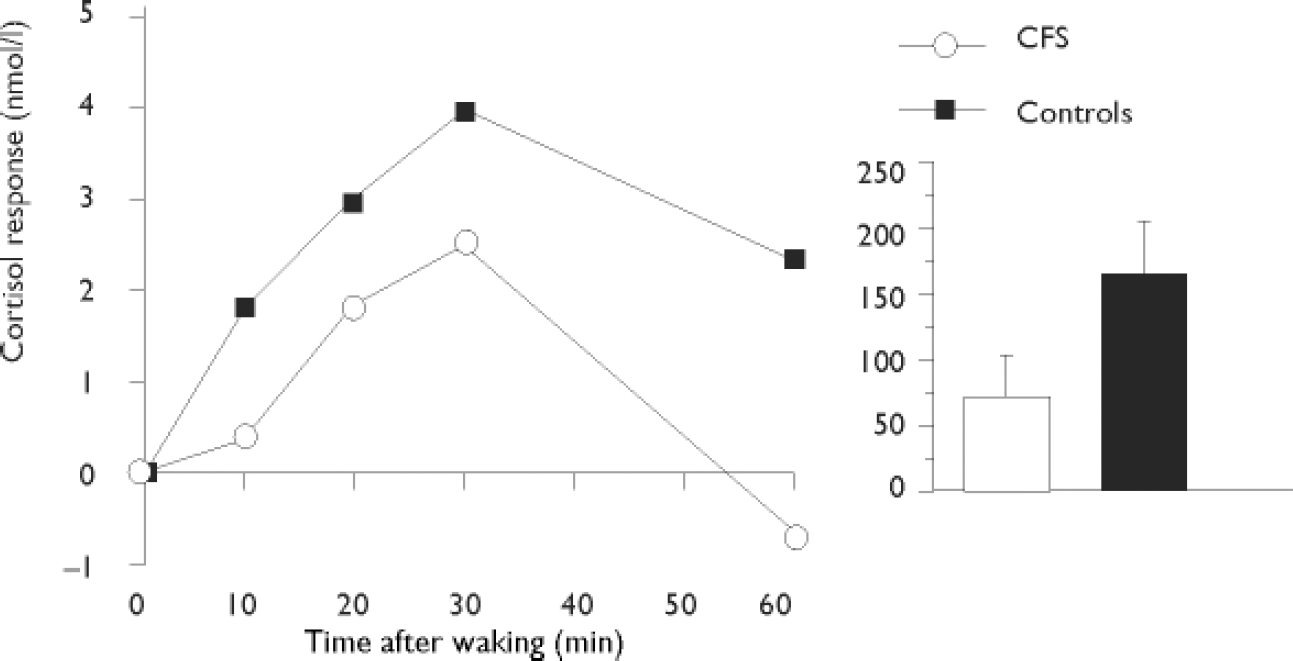
Raw data at each time point are shown in Table 2. The cortisol level in the first sample after awakening was similar in both groups, measuring 10.7 nmol/l (s.d.=4.4) in patients and 9.9 nmol/l (s.d.=3.8) in controls (t=0.89, P=0.38). We therefore used this as a baseline on which to calculate the subsequent rise in response to awakening and compared this between the two groups. These responses are shown in Fig. 1. It should be noted that this method of analysis results in the standard deviations appearing artificially high in relation to the adjusted mean values, because the true mean values for the AUC and individual time points are substantially higher, and the adjusted values are often negative. Comparison of the AUC over the 60-min period revealed that patients (mean=70.7 and s.d.=241.6 nmol/l per hour) had lower awakening responses than controls (mean=172.5 and s.d.=240.0 nmol/l per hour), with the t-test result equalling the cut-off for statistical significance (t=1.96, P=0.05; 95% CI 1–205). Post hoc t-tests at the individual time points revealed significantly lower cortisol responses in patients than controls 10 min after awakening (cortisol response in patients: mean=0.45 and s.d.=3.9 nmol/l; controls: mean=1.88 and s.d.=2.5 nmol/l; t=2.1, P=0.04; 95% CI 0.1–2.7) and 60 min after awakening (cortisol response in patients: mean=-0.43 and s.d.=4.8 nmol/l; controls: mean=2.3 and s.d.=4.8 nmol/l; t=2.2; P=0.03; 95% CI 0.4–5.1).
Cortisol levels at each time point in patients and controls

| Cortisol level (nmol/l) | |||||
|---|---|---|---|---|---|
| 0 min | 10 min | 20 min | 30 min | 60 min | |
| mean (s.d.) | mean (s.d.) | mean (s.d.) | mean (s.d.) | mean (s.d.) | |
| Patients (n=56) | 10.7 (4.38) | 11.1 (4.18) | 12.6 (4.30) | 13.3 (4.85) | 10.2 (3.81) |
| Controls (n=35) | 9.9 (3.81) | 11.7 (4.07) | 13.2 (4.47) | 14.0 (6.18) | 12.2 (6.18) |
Response to awakening in patients with chronic fatigue syndrome (CFS, n=56) and controls (n=35). The graph shows the mean value over time; the bar chart shows the mean area under the curve (AUC), with error bars representing the standard error of the mean. The AUC was significantly reduced in patients, and individual values at 10 min and 60 min were significantly lower in patients (all P≤0.05).
Effect of clinical variables
In order to investigate any effect of comorbid psychiatric illness on the cortisol responses, we split the patients into those without current comorbid depression (n=34) and those with current comorbid depression (n=22) according to the SCAN results. The mean AUC in those without depression (77.3 nmol/l per hour, s.d.=269) did not differ from that in those with depression (60.5 nmol/l per hour, s.d.=197, t=0.25; P=0.80).
In order to investigate the possible effect of medication in this sample, we compared the 46 subjects not taking medication with the 10 who were. The mean AUC was 79.4 (s.d.=253) nmol/l per hour in the drug-free group compared with 30.8 (s.d.=181) nmol/l per hour in those on medication, which is a non-significant difference (t=0.57; P=0.57).
There were no correlations between clinical variables and the AUC response, either in all subjects or within patients alone. Neither the body mass index (r=-0.15) nor the awakening time (r=0.02) was significantly correlated to the awakening response. Awakening time did not differ between patients (mean=07.35 h) and controls (mean=07.40 h; t=-0.28; P=0.78). Smokers' awakening responses (mean=101.8 and s.d.= 238.6 nmol/l per hour) did not differ from non-smokers' responses (mean 104.1 and s.d.=252.2 nmol/l per hour; t=0.03; P=0.97). Females (mean=116.8 and s.d.= 210.9 nmol/l per hour) had non-significantly higher responses than males (mean=98.8 and s.d.=294.0 nmol/l per hour; t=0.34; P=0.74).
Dynamics of cortisol response
We found that in 16/91 tests the peak response was reached at 10 min, in 31/91 at 20 min, in 36/91 at 30 min and in 8/91 at 60 min. Using a previously defined cutoff value for a ‘response’ to the awakening stress of a 2.5 nmol/l rise above baseline (Reference Wust, Wolf and HellhammerWust et al, 2000b ) we found that 61/90 (67%) of subjects overall showed this response, 25/35 (71%) in the controls and 36/56 (64%) in the patients (difference not significant by ω2 test); 4/35 controls (11%) and 12/56 (21%) patients showed a fall in cortisol values after awaking (difference not significant by ω2 test).
DISCUSSION
In this study we have demonstrated an impaired cortisol response to the naturalistic stressor of awakening in a large sample of carefully characterised patients with CFS. More specifically, similar percentages of patients and controls showed a significant rise to awakening, suggesting that this is a valid challenge paradigm; however, the mean response in patients was significantly less than that in controls.
Comparison with prior studies
Problems with previous studies have included those related to the patient samples studied. To address some of the problems related to this issue, in this study we chose to include only subjects meeting the clinical diagnostic criteria for CFS. We used a gold standard assessment instrument for depression — SCAN — in order to assess clearly whether comorbid depressive illness could influence the results. We chose a group largely free from medication that might influence the HPA axis.
We are aware of only one prior study (Reference Gaab, Huster and PeisenGaab et al, 2002b ) in which the salivary cortisol response to awakening was measured, although on a much smaller group of 21 subjects with CFS. That particular study failed to find any significant difference in morning response in patients and controls. However, the authors did find a supersuppression to dexamethasone, consistent with HPA axis underactivity, perhaps related to enhanced glucocorticoid receptor sensitivity.
Nevertheless, our finding of impaired cortisol response is in keeping with the findings from several studies using CRH and synthetic ACTH, which have also found impaired cortisol response (Reference CleareCleare, 2003). It is also in keeping with the findings from our group of reduced total 24-h urinary free cortisol output (Reference Cleare, Blair and ChambersCleare et al, 2001). However, there is disagreement between studies and several have failed to find an impaired cortisol response in patients with CFS (Reference CleareCleare, 2003). Many of these in fact find alterations in ACTH responses to various challenges, including CRH (Reference Demitrack, Dale and StrausDemitrack et al, 1991), ACTH (Reference Scott, Medbak and DinanScott et al, 1998) and insulin-induced hypoglycaemia (Reference Gaab, Huster and PeisenGaab et al, 2002a ), a factor that the present design does not allow to be measured.
Comorbid depression
We found that the presence or absence of depression did not materially alter the finding. This is similar to the finding in our large study of 24-h urinary free cortisol (Reference Cleare, Blair and ChambersCleare et al, 2001), where output was reduced regardless of present or past psychiatric illness. Because the available evidence suggests that the atypical subtype of depression may be associated also with lowered HPA axis function, and has fatigue (or ‘leaden paralysis’) as a prominent symptom, the emerging evidence is that the depression seen in CFS is more in keeping both biologically and phenomenologically with that subtype. We are not aware of published research investigating the cortisol response to awakening in depression itself.
Chronic stress
The previous work that has been undertaken using this test has concluded that chronic social stress (Reference Wust, Federenko and HellhammerWust et al, 2000a ) or a high level of perceived stress (Reference Pruessner, Hellhammer and KirschbaumPruessner et al, 1999) leads to an enhanced awakening response. We did not assess these variables specifically in this study but our results suggest that patients with CFS do not share the characteristics of otherwise healthy individuals under situations of chronic stress. Following on from this, a further hypothesis might be that subjects with CFS are generally less responsive to acute naturalistic stressors. However, although Gaab et al did find a reduced ACTH response to social stress (public speaking) and exercise stress, the salivary cortisol responses were the same but in a relatively small sample of 21 (Reference Gaab, Huster and PeisenGaab et al, 2002a ).
Effect of other confounding factors
Ten of our 56 subjects with CFS were taking prescribed medication liable to affect the HPA axis. Although we did not find a significant difference, the values were lower and this might have represented a type II error. Indeed, we have argued previously that medication is likely to be one of the many factors contributing to HPA axis dysfunction in CFS. It seems most likely that the observed HPA deficits in CFS are of multi-factorial origin rather than representing a single change to the HPA axis. Important factors that may be contributing to HPA axis dysfunction include: disturbed sleep, reduced physical activity, psychiatric comorbidity; effects of early life experiences on the HPA such as childhood abuse; medication effects; presence and response to ongoing psychosocial stressors; and the different influences of these factors during different illness phases (i.e. acute, sub-acute and chronic fatigue of varying durations). Heterogeneity of these factors would appear likely to underlie the inconsistent and divergent findings seen to date. Despite this, there remain suggestions that HPA dysfunction, and in particular low circulating cortisol levels, may be one factor contributing to fatigue chronicity in CFS that is potentially reversible (Reference Cleare, Heap and MalhiCleare et al, 1999).
Characteristics of salivary cortisol test
Finally, we provide further evidence in this paper regarding the characteristics of this novel test. First, in our control group we found a consistent rise of approximately 40% over baseline, similar to previous reports suggesting a rise of around 50% (Reference Wust, Wolf and HellhammerWust et al, 2000b ). Similarly, our finding that around 71% of controls showed a ‘response’ to awakening (2.5 nmol/l or more over baseline, as previously defined) tallies with the figure of 75% reported previously (Reference Wust, Wolf and HellhammerWust et al, 2000b ). We also found that smoking, sleep quality and awakening time do not have a significant effect on the response, in accordance with the previous literature (Reference Wust, Wolf and HellhammerWust et al, 2000b ). A small gender effect has also been reported in the direction of higher response in females (Reference Wust, Wolf and HellhammerWust et al, 2000b ), which is consistent with our findings here. It is of note that we have sampled somewhat more frequently over the first 30 min of awakening than prior studies. We found that around half of the tests showed the peak response before 30 min, suggesting that future studies should include sampling times before 30 min after awakening.
Limitations
One of the limitations of our study relates to the chosen population, which was recruited from those referred to a tertiary care centre. We cannot directly extrapolate these results to those with chronic fatigue seen in the community, where the HPA axis may be less relevant or less affected. For example, recent studies of the early stages of development of chronic fatigue in high-risk samples, such as in the 6 months after Epstein—Barr infection (Reference Candy, Chalder and CleareCandy et al, 2003) or major surgery (Reference RubinRubin, 2003), suggest no link between chronic fatigue and the HPA axis. This has led to the suggestion by some that HPA axis changes occur late in the course of the illness history in CFS, and may be consequent to the illness rather than causal (Reference CleareCleare, 2003).
Another factor to be considered is sample size. Although overall we recruited a relatively large sample of patients compared with previous work in the field, the exploratory analyses looking at the effects of depression and medication use, among other factors, involve sub-groups of the patient sample. Therefore, there is a possibility of type II errors in these analyses.
In conclusion, this study provides further evidence for HPA axis dysfunction in CFS. It advances previous work by undertaking testing in a more naturalistic setting and by using a novel, non-invasive test of the cortisol response to the stress of awakening in a larger sample size than most prior work in the area.
Clinical Implications and Limitations
CLINICAL IMPLICATIONS
-
▪ We found further evidence of impaired function of the hypothalamic—pituitary—further adrenal (HPA) axis in chronic fatigue syndrome (CFS) using a more naturalistic test undertaken in a home setting.
-
▪ The HPA axis responses were not affected by the presence or absence of comorbid depression.
-
▪ Changes to the HPA axis may represent one of the biological factors contributing to the maintenance of fatigue and other symptoms in CFS.
LIMITATIONS
-
▪ The patients were sampled from tertiary care and may not be representative of patients with CFS in general.
-
▪ The sample size was too small to tease out many of the possible factors contributing to the impaired HPA axis response in CFS.
-
▪ Because this is a cross-sectional study, we cannot say whether the observed HPA axis changes are a primary aetiological feature of CFS or occur as a consequence of CFS and its numerous effects on sufferers.
Acknowledgements
We are grateful to the Linbury Trust, who provided a project grant enabling. this study to take place. We thank Lucia Poon, Research Nurse in the Affective. Disorders Unit, Maudsley Hospital, London, for help in the recruitment of. control subjects and Dorothy Blair, Research Nurse in the Chronic Fatigue. Syndrome Unit, King's College Hospital, London, for help in recruitment of. patients.




eLetters
No eLetters have been published for this article.