




1 Introduction
Traditional model theory formulated for first-order logic is well-suited to studying properties of finitary mathematical structures, such as graphs, linear orders, groups, rings, Boolean algebras, etc. It has long been known that natural classes of structures that arise in analysis and topology, such as Banach spaces, operator algebras, measure-preserving group actions, etc., cannot be adequately described as first-order structures. Intuitively speaking, this is due to the infinitary or “continuous” aspects of the structure of interest (e.g., information about convergent sequences or $L^\infty $
functions). The continuous first-order logic developed in the last few decades (see [Reference Yaacov, Berenstein, Henson and Usvyatsov11]) has been highly successful at adapting model-theoretic ideas to studying such analytically-flavored structures.
$L^\infty $
functions). The continuous first-order logic developed in the last few decades (see [Reference Yaacov, Berenstein, Henson and Usvyatsov11]) has been highly successful at adapting model-theoretic ideas to studying such analytically-flavored structures.
In trying to formalize the intuition that structures such as Banach spaces and $C^*$
-algebras are “intrinsically continuous,” hence cannot be described in discrete first-order logic, a subtlety arises: such a result can only be meaningful if formulated in a signature-independent sense. For example,
$C^*$
-algebras are “intrinsically continuous,” hence cannot be described in discrete first-order logic, a subtlety arises: such a result can only be meaningful if formulated in a signature-independent sense. For example, $C^*$
-algebras possess a robust model theory in both continuous first-order logic (see [Reference Farah, Hart, Lupini, Robert, Tikuisis, Vignati and Winter1]) and infinitary equational logic (see [Reference Manes9]), but only by taking the “underlying set” to be the unit ball, rather than the underlying vector space. A priori it is conceivable that yet a different choice of underlying set and signature could even yield a discrete first-order axiomatization.
$C^*$
-algebras possess a robust model theory in both continuous first-order logic (see [Reference Farah, Hart, Lupini, Robert, Tikuisis, Vignati and Winter1]) and infinitary equational logic (see [Reference Manes9]), but only by taking the “underlying set” to be the unit ball, rather than the underlying vector space. A priori it is conceivable that yet a different choice of underlying set and signature could even yield a discrete first-order axiomatization.
Given an abstract category $\mathsf {C}$
, one can regard an arbitrary functor
$\mathsf {C}$
, one can regard an arbitrary functor $U : \mathsf {C} \to {\mathsf {Set}}$
to the category of sets as a possible assignment of “underlying set” to the objects in
$U : \mathsf {C} \to {\mathsf {Set}}$
to the category of sets as a possible assignment of “underlying set” to the objects in $\mathsf {C}$
. Note that if
$\mathsf {C}$
. Note that if $\mathsf {C}$
in fact consists of some concretely defined structures, then by general principles,Footnote
1
every such U admits a syntactic description: U maps each structure
$\mathsf {C}$
in fact consists of some concretely defined structures, then by general principles,Footnote
1
every such U admits a syntactic description: U maps each structure $A \in \mathsf {C}$
to a definable quotient of a disjoint union of definable sets of (possibly infinite) tuples. Such a syntactic specification of a uniform assignment of a set to each structure is called an imaginary sort. When the imaginary sort is finitary (defined in first-order logic, and involving only finite tuples and disjoint unions), then the resulting functor
$A \in \mathsf {C}$
to a definable quotient of a disjoint union of definable sets of (possibly infinite) tuples. Such a syntactic specification of a uniform assignment of a set to each structure is called an imaginary sort. When the imaginary sort is finitary (defined in first-order logic, and involving only finite tuples and disjoint unions), then the resulting functor $U : \mathsf {C} \to {\mathsf {Set}}$
will preserve directed colimits. This also holds more generally for imaginaries in the
$U : \mathsf {C} \to {\mathsf {Set}}$
will preserve directed colimits. This also holds more generally for imaginaries in the $\Sigma _1$
fragment of the infinitary logic
$\Sigma _1$
fragment of the infinitary logic $\mathcal {L}_{\infty \omega }$
, also known (in relation to topos theory) as geometric logic (see [Reference Hodges3, Section 4.3], [Reference Johnstone4, Reference Makkai and Reyes8] for background on imaginaries in finitary and infinitary logic).
$\mathcal {L}_{\infty \omega }$
, also known (in relation to topos theory) as geometric logic (see [Reference Hodges3, Section 4.3], [Reference Johnstone4, Reference Makkai and Reyes8] for background on imaginaries in finitary and infinitary logic).
The following theorem was shown in [Reference Lieberman, Rosický and Vasey7].
Theorem 1.1 (Lieberman–Rosický–Vasey)
There is no faithful directed-colimit-preserving functor U from the category ${\mathsf {Hilb_m}}$
of Hilbert spaces and injective linear contractions to the category of sets.
${\mathsf {Hilb_m}}$
of Hilbert spaces and injective linear contractions to the category of sets.
In light of the discussion above, this means that there is no discrete first-order (or even geometric) axiomatization of the category ${\mathsf {Hilb_m}}$
, even allowing for unconventional choices of “underlying set,” thereby showing that in a strong sense, Hilbert spaces are “intrinsically continuous” structures. Using this result, the authors also showed how to easily deduce that the categories of complete metric spaces, Banach spaces, and (commutative)
${\mathsf {Hilb_m}}$
, even allowing for unconventional choices of “underlying set,” thereby showing that in a strong sense, Hilbert spaces are “intrinsically continuous” structures. Using this result, the authors also showed how to easily deduce that the categories of complete metric spaces, Banach spaces, and (commutative) $C^*$
-algebras, with corresponding injective
$C^*$
-algebras, with corresponding injective $1$
-Lipschitz homomorphisms, also do not admit faithful directed-colimit-preserving functors to
$1$
-Lipschitz homomorphisms, also do not admit faithful directed-colimit-preserving functors to ${\mathsf {Set}}$
.
${\mathsf {Set}}$
.
The main result of this article is a significant strengthening of Theorem 1.1.
Theorem 1.2 (Theorem 3.11)
Every directed-colimit-preserving functor U from the category ${\mathsf {Hilb_r}}$
of Hilbert spaces and linear isometric embeddings to the category of sets is essentially constant on all infinite-dimensional spaces.
${\mathsf {Hilb_r}}$
of Hilbert spaces and linear isometric embeddings to the category of sets is essentially constant on all infinite-dimensional spaces.
A functor is essentially constant if it is naturally isomorphic to a constant functor. In syntactic terms, whereas Theorem 1.1 says that no finitary discrete-set-valued imaginary can capture all of the structure on a Hilbert space, Theorem 1.2 says that no such imaginary can capture any structure whatsoever on infinite-dimensional spaces; it must be a constant disjoint union of singletons. We stress however that, like Theorem 1.1, Theorem 1.2 really concerns ${\mathsf {Hilb_r}}$
as an abstract category and is independent of any prior representation of Hilbert spaces as concrete structures.
${\mathsf {Hilb_r}}$
as an abstract category and is independent of any prior representation of Hilbert spaces as concrete structures.
Note also that Theorem 1.2 concerns the category ${\mathsf {Hilb_r}}$
of Hilbert spaces with model-theoretic embeddings as morphisms (which are elementary embeddings in continuous logic between infinite-dimensional spaces [Reference Yaacov, Berenstein, Henson and Usvyatsov11, Section 15]); whereas Theorem 1.1 concerns the supercategory
${\mathsf {Hilb_r}}$
of Hilbert spaces with model-theoretic embeddings as morphisms (which are elementary embeddings in continuous logic between infinite-dimensional spaces [Reference Yaacov, Berenstein, Henson and Usvyatsov11, Section 15]); whereas Theorem 1.1 concerns the supercategory ${\mathsf {Hilb_m}}$
of Hilbert spaces with injective homomorphisms, which itself lacks all directed colimits.Footnote
2
Our proof of Theorem 1.2 is broadly based on the ideas in the proof of Theorem 1.1 from [Reference Lieberman, Rosický and Vasey7]; the main new technical difficulties all arise from replacing
${\mathsf {Hilb_m}}$
of Hilbert spaces with injective homomorphisms, which itself lacks all directed colimits.Footnote
2
Our proof of Theorem 1.2 is broadly based on the ideas in the proof of Theorem 1.1 from [Reference Lieberman, Rosický and Vasey7]; the main new technical difficulties all arise from replacing ${\mathsf {Hilb_m}}$
with
${\mathsf {Hilb_m}}$
with ${\mathsf {Hilb_r}}$
. In particular, we obtain the analogue of Theorem 1.1 for
${\mathsf {Hilb_r}}$
. In particular, we obtain the analogue of Theorem 1.1 for ${\mathsf {Hilb_r}}$
, which answers a question from [Reference Lieberman, Rosický and Vasey7, Remark 20].
${\mathsf {Hilb_r}}$
, which answers a question from [Reference Lieberman, Rosický and Vasey7, Remark 20].
It is worth remarking that Theorem 1.2 continues to hold if the functor U is defined only on the full subcategory ${\mathsf {Hilb_r}}^{\ge \aleph _0} \subseteq {\mathsf {Hilb_r}}$
of infinite-dimensional spaces to begin with (see Corollary 4.3).
${\mathsf {Hilb_r}}^{\ge \aleph _0} \subseteq {\mathsf {Hilb_r}}$
of infinite-dimensional spaces to begin with (see Corollary 4.3).
In Section 4, we also use Theorem 1.2 to deduce easy consequences for some related categories.
Corollary 1.3 (Corollary 4.1)
Every directed-colimit-preserving functor from the category ${\mathsf {Hilb}}$
of Hilbert spaces and all linear contractions to the category of sets is essentially constant.
${\mathsf {Hilb}}$
of Hilbert spaces and all linear contractions to the category of sets is essentially constant.
Corollary 1.4 (Corollary 4.2)
Every directed-colimit-preserving functor $U : {\mathsf {Hilb_m}} \to {\mathsf {Set}}$
is essentially constant on all infinite-dimensional spaces.
$U : {\mathsf {Hilb_m}} \to {\mathsf {Set}}$
is essentially constant on all infinite-dimensional spaces.
Corollary 1.5 (Corollary 4.4)
There is no faithful directed-colimit-preserving functor U from the category ${\mathsf {Met_r}}$
of complete metric spaces (of diameter
${\mathsf {Met_r}}$
of complete metric spaces (of diameter $\le 1$
) and isometric embeddings, or from the category
$\le 1$
) and isometric embeddings, or from the category ${\mathsf {Ban_r}}$
of Banach spaces and linear isometric embeddings, to the category of sets.
${\mathsf {Ban_r}}$
of Banach spaces and linear isometric embeddings, to the category of sets.
2 Preliminaries
We assume familiarity with basic category theory, including the notions of functor, natural transformation, monomorphism, and colimit (see [Reference Lane6]). A subobject of an object A in a category $\mathsf {C}$
is an equivalence class of monomorphisms
$\mathsf {C}$
is an equivalence class of monomorphisms $i : A_0 \to A$
into A (two such monomorphisms being equivalent iff they fit into a commutative triangle). We adopt the usual abuse of terminology regarding subobjects by treating them as if they were subsets: we write
$i : A_0 \to A$
into A (two such monomorphisms being equivalent iff they fit into a commutative triangle). We adopt the usual abuse of terminology regarding subobjects by treating them as if they were subsets: we write $A_0 \subseteq A$
to denote (the domain of a generic monomorphism representing) a subobject; we call the monomorphism
$A_0 \subseteq A$
to denote (the domain of a generic monomorphism representing) a subobject; we call the monomorphism $i : A_0 \to A$
the inclusion, etc.
$i : A_0 \to A$
the inclusion, etc.
Throughout this article, a Hilbert space will mean a norm-complete inner product space over the field $\mathbb {F} := \mathbb {C}$
or
$\mathbb {F} := \mathbb {C}$
or $\mathbb {R}$
; all arguments will work equally well for both choices of
$\mathbb {R}$
; all arguments will work equally well for both choices of $\mathbb {F}$
. In the complex case, we use the convention that inner products are linear in the first variable and conjugate-linear in the second. For a set X,
$\mathbb {F}$
. In the complex case, we use the convention that inner products are linear in the first variable and conjugate-linear in the second. For a set X, $\ell ^2(X)$
denotes the Hilbert space of square-summable functions
$\ell ^2(X)$
denotes the Hilbert space of square-summable functions $X \to \mathbb {F}$
; when
$X \to \mathbb {F}$
; when $X = \mathbb {N}$
, we also write
$X = \mathbb {N}$
, we also write $\ell ^2 := \ell ^2(\mathbb {N})$
.
$\ell ^2 := \ell ^2(\mathbb {N})$
.
We let ${\mathsf {Hilb}}$
denote the category of Hilbert spaces and linear contractions, meaning linear maps of operator norm
${\mathsf {Hilb}}$
denote the category of Hilbert spaces and linear contractions, meaning linear maps of operator norm $\le 1$
. We let
$\le 1$
. We let ${\mathsf {Hilb_m}} \subseteq {\mathsf {Hilb}}$
denote the subcategory with the same objects but only the monomorphisms, i.e., injective linear contractions, and
${\mathsf {Hilb_m}} \subseteq {\mathsf {Hilb}}$
denote the subcategory with the same objects but only the monomorphisms, i.e., injective linear contractions, and ${\mathsf {Hilb_r}} \subseteq {\mathsf {Hilb_m}}$
denote the further subcategory consisting of only the regular monomorphisms, i.e., linear isometries, meaning linear maps preserving the norm (or equivalently the inner product).
${\mathsf {Hilb_r}} \subseteq {\mathsf {Hilb_m}}$
denote the further subcategory consisting of only the regular monomorphisms, i.e., linear isometries, meaning linear maps preserving the norm (or equivalently the inner product).
3 Hilbert spaces and linear isometries
3.1 Supports of elements
The following notion is derived from [Reference Henry2].
Definition 3.1. Let $\mathsf {C}$
be a category,
$\mathsf {C}$
be a category, $U : \mathsf {C} \to {\mathsf {Set}}$
be an arbitrary functor,
$U : \mathsf {C} \to {\mathsf {Set}}$
be an arbitrary functor, $A \in \mathsf {C}$
be an object,
$A \in \mathsf {C}$
be an object, $A_0 \subseteq A$
be a subobject with inclusion
$A_0 \subseteq A$
be a subobject with inclusion $i : A_0 \hookrightarrow A$
, and
$i : A_0 \hookrightarrow A$
, and $x \in UA$
. We say x is supported on
$x \in UA$
. We say x is supported on $A_0$
in A (with respect to U) if whenever two morphisms
$A_0$
in A (with respect to U) if whenever two morphisms $f, g : A \rightrightarrows B$
in
$f, g : A \rightrightarrows B$
in $\mathsf {C}$
agree on
$\mathsf {C}$
agree on $A_0$
(meaning
$A_0$
(meaning $fi = gi$
), then
$fi = gi$
), then $Uf(x) = Ug(x)$
.
$Uf(x) = Ug(x)$
.
Remark 3.2. If $\mathsf {C}$
has an initial object
$\mathsf {C}$
has an initial object $0$
with a monomorphism to
$0$
with a monomorphism to $A \in \mathsf {C}$
, then to say that
$A \in \mathsf {C}$
, then to say that $x \in UA$
is supported on
$x \in UA$
is supported on $0$
means that
$0$
means that $Uf(x) = Ug(x)$
for every two morphisms
$Uf(x) = Ug(x)$
for every two morphisms $f, g : A \rightrightarrows B$
. We say that x has trivial support in this case.
$f, g : A \rightrightarrows B$
. We say that x has trivial support in this case.
Thus, to say that every $x \in UA$
has trivial support means that
$x \in UA$
has trivial support means that $Uf = Ug$
for every
$Uf = Ug$
for every $f, g : A \rightrightarrows B$
.
$f, g : A \rightrightarrows B$
.
Remark 3.3. Note that the definition of “supported on $A_0$
in A” a priori depends on the object A.
$A_0$
in A” a priori depends on the object A.
For subobjects $A_0 \subseteq A \subseteq B$
with inclusions
$A_0 \subseteq A \subseteq B$
with inclusions $i : A_0 \hookrightarrow A$
and
$i : A_0 \hookrightarrow A$
and $f : A \hookrightarrow B$
, if
$f : A \hookrightarrow B$
, if $x \in UA$
is supported on
$x \in UA$
is supported on $A_0 \subseteq A$
, then
$A_0 \subseteq A$
, then $Uf(x) \in UB$
is supported on
$Uf(x) \in UB$
is supported on $A_0 \subseteq B$
. (Given
$A_0 \subseteq B$
. (Given $g, h : B \rightrightarrows C$
, if
$g, h : B \rightrightarrows C$
, if $gfi = hfi$
, then
$gfi = hfi$
, then $Ug(Uf(x)) = U(gf)(x) = U(hf)(x) = Uh(Uf(x))$
since x is supported on
$Ug(Uf(x)) = U(gf)(x) = U(hf)(x) = Uh(Uf(x))$
since x is supported on $A_0$
.)
$A_0$
.)
Thus, if x has trivial support in A, then x also has trivial support in any $B \supseteq A$
.
$B \supseteq A$
.
Fix now a directed-colimit-preserving functor $U : {\mathsf {Hilb_r}} \to {\mathsf {Set}}$
. Our goal is to show that U is essentially constant on infinite-dimensional spaces. By Remark 3.2, this entails showing that every
$U : {\mathsf {Hilb_r}} \to {\mathsf {Set}}$
. Our goal is to show that U is essentially constant on infinite-dimensional spaces. By Remark 3.2, this entails showing that every $x \in UA$
for infinite-dimensional A has trivial support. As in [Reference Lieberman, Rosický and Vasey7], the crucial technical ingredient is to show that “supports intersect.”
$x \in UA$
for infinite-dimensional A has trivial support. As in [Reference Lieberman, Rosický and Vasey7], the crucial technical ingredient is to show that “supports intersect.”
Lemma 3.4. If A is an infinite-dimensional Hilbert space, $x \in UA$
, and
$x \in UA$
, and $A_0, A_1$
finite-dimensional subspaces of A such that x is supported on
$A_0, A_1$
finite-dimensional subspaces of A such that x is supported on $A_0$
and on
$A_0$
and on $A_1$
, then x is supported on
$A_1$
, then x is supported on $A_0\cap A_1$
.
$A_0\cap A_1$
.
To prove this, we need the following elementary linear algebra fact. Recall from Section 2 that $\mathbb {F}$
denotes the scalar field
$\mathbb {F}$
denotes the scalar field $\mathbb {C}$
or
$\mathbb {C}$
or $\mathbb {R}$
.
$\mathbb {R}$
.
Lemma 3.5. Let $\vec {u}, \vec {v}$
,
$\vec {u}, \vec {v}$
, $\vec {w} \in \mathbb {F}^3$
be unit vectors such that
$\vec {w} \in \mathbb {F}^3$
be unit vectors such that $\vec {u}$
and
$\vec {u}$
and $\vec {v}$
are not parallel. Then there is a finite composition of linear isometric automorphisms
$\vec {v}$
are not parallel. Then there is a finite composition of linear isometric automorphisms $\mathbb {F}^3 \to \mathbb {F}^3$
that fix either
$\mathbb {F}^3 \to \mathbb {F}^3$
that fix either $\vec {u}$
or
$\vec {u}$
or $\vec {v}$
, which takes
$\vec {v}$
, which takes $\vec {u}$
to
$\vec {u}$
to $\vec {w}$
.
$\vec {w}$
.
Proof. Since $\vec {u}$
and
$\vec {u}$
and $\vec {v}$
are not parallel, we have
$\vec {v}$
are not parallel, we have $ \left \lvert { \left \langle {\vec {u}, \vec {v}} \right \rangle } \right \rvert < 1 = \cos (0)$
by the Cauchy–Schwarz inequality. We induct on the least
$ \left \lvert { \left \langle {\vec {u}, \vec {v}} \right \rangle } \right \rvert < 1 = \cos (0)$
by the Cauchy–Schwarz inequality. We induct on the least $n \in \mathbb {N}$
such that
$n \in \mathbb {N}$
such that $ \left \lvert { \left \langle {\vec {u}, \vec {v}} \right \rangle } \right \rvert \le \cos (\pi /2^{n+1})$
(i.e., when
$ \left \lvert { \left \langle {\vec {u}, \vec {v}} \right \rangle } \right \rvert \le \cos (\pi /2^{n+1})$
(i.e., when $\mathbb {F} = \mathbb {R}$
, the least n such that the acute angle between the lines spanned by
$\mathbb {F} = \mathbb {R}$
, the least n such that the acute angle between the lines spanned by $\vec {u}$
and
$\vec {u}$
and $\vec {v}$
is
$\vec {v}$
is $\ge 90^\circ /2^n$
).
$\ge 90^\circ /2^n$
).
First, suppose $n = 0$
, i.e.,
$n = 0$
, i.e., $\vec {u} \perp \vec {v}$
. By conjugating
$\vec {u} \perp \vec {v}$
. By conjugating $\mathbb {F}^3$
by a suitable linear isometry, we may assume that
$\mathbb {F}^3$
by a suitable linear isometry, we may assume that $\vec {u} = \vec {e}_1$
and
$\vec {u} = \vec {e}_1$
and $\vec {v} = \vec {e}_2$
are the standard basis vectors. Let
$\vec {v} = \vec {e}_2$
are the standard basis vectors. Let ${\vec {w} = (a,b,c) \in \mathbb {F}^3}$
. Then there is an isometry
${\vec {w} = (a,b,c) \in \mathbb {F}^3}$
. Then there is an isometry $\mathbb {F}^3 \to \mathbb {F}^3$
fixing
$\mathbb {F}^3 \to \mathbb {F}^3$
fixing $\vec {v}$
taking
$\vec {v}$
taking $\vec {u} \mapsto (a,0,d)$
for some
$\vec {u} \mapsto (a,0,d)$
for some $d \in \mathbb {F}$
(e.g.,
$d \in \mathbb {F}$
(e.g., $d = \sqrt {1- \left \lvert {a} \right \rvert ^2}$
), followed by an isometry fixing
$d = \sqrt {1- \left \lvert {a} \right \rvert ^2}$
), followed by an isometry fixing $\vec {u}$
taking
$\vec {u}$
taking $(a,0,d) \mapsto (a,b,c) = \vec {w}$
.
$(a,0,d) \mapsto (a,b,c) = \vec {w}$
.
Now suppose n is such that the claim is known for any $\vec {u}, \vec {v}$
with
$\vec {u}, \vec {v}$
with $ \left \lvert { \left \langle {\vec {u}, \vec {v}} \right \rangle } \right \rvert \le \cos (\pi /2^{n+1})$
; we must show the same when n is replaced with
$ \left \lvert { \left \langle {\vec {u}, \vec {v}} \right \rangle } \right \rvert \le \cos (\pi /2^{n+1})$
; we must show the same when n is replaced with $n+1$
. By conjugating as above, we may assume
$n+1$
. By conjugating as above, we may assume $\vec {v} = \vec {e}_1$
and
$\vec {v} = \vec {e}_1$
and $\vec {u} = ( \left \langle {\vec {u},\vec {v}} \right \rangle ,a,0),$
where
$\vec {u} = ( \left \langle {\vec {u},\vec {v}} \right \rangle ,a,0),$
where $a := \sqrt {1- \left \lvert { \left \langle {\vec {u},\vec {v}} \right \rangle } \right \rvert ^2}$
. Observe that for any
$a := \sqrt {1- \left \lvert { \left \langle {\vec {u},\vec {v}} \right \rangle } \right \rvert ^2}$
. Observe that for any $\theta \in \mathbb {R}$
, there is an isometry
$\theta \in \mathbb {R}$
, there is an isometry $f_\theta : \mathbb {F}^3 \to \mathbb {F}^3$
fixing
$f_\theta : \mathbb {F}^3 \to \mathbb {F}^3$
fixing $\vec {v}$
and taking
$\vec {v}$
and taking $\vec {u} \mapsto ( \left \langle {\vec {u},\vec {v}} \right \rangle ,a\cos (\theta ),a\sin (\theta )) =: \vec {u}_\theta $
. When
$\vec {u} \mapsto ( \left \langle {\vec {u},\vec {v}} \right \rangle ,a\cos (\theta ),a\sin (\theta )) =: \vec {u}_\theta $
. When $\theta = 0$
, we have
$\theta = 0$
, we have $ \left \langle {\vec {u},\vec {u}_\theta } \right \rangle = \left \langle {\vec {u},\vec {u}} \right \rangle = 1$
; when
$ \left \langle {\vec {u},\vec {u}_\theta } \right \rangle = \left \langle {\vec {u},\vec {u}} \right \rangle = 1$
; when $\theta = \pi $
, we have
$\theta = \pi $
, we have
 $$ \begin{align*} \left\lvert { \left\langle {\vec{u},\vec{u}_\theta} \right\rangle } \right\rvert &= \left\lvert { \left\langle {\vec{u},\vec{v}} \right\rangle } \right\rvert ^2 - a^2 = 2 \left\lvert { \left\langle {\vec{u},\vec{v}} \right\rangle } \right\rvert ^2 - 1 \\ &\le 2\cos(\pi/2^{n+2})^2 - 1 = \cos(\pi/2^{n+1}). \end{align*} $$
Thus there is some $0 \le \theta \le \pi $
such that
$0 \le \theta \le \pi $
such that $ \left \lvert { \left \langle {\vec {u},\vec {u}_\theta } \right \rangle } \right \rvert = \cos (\pi /2^{n+1})$
. By the induction hypothesis, there is a finite composition of isometries fixing either
$ \left \lvert { \left \langle {\vec {u},\vec {u}_\theta } \right \rangle } \right \rvert = \cos (\pi /2^{n+1})$
. By the induction hypothesis, there is a finite composition of isometries fixing either $\vec {u}$
or
$\vec {u}$
or $\vec {u}_\theta $
and taking
$\vec {u}_\theta $
and taking $\vec {u} \mapsto \vec {w}$
; the isometries that fix
$\vec {u} \mapsto \vec {w}$
; the isometries that fix $\vec {u}_\theta $
are a
$\vec {u}_\theta $
are a $f_\theta $
-conjugate of an isometry that fixes
$f_\theta $
-conjugate of an isometry that fixes $\vec {u}$
, so we are done.
$\vec {u}$
, so we are done.
Proof of Lemma 3.4
We may assume that $A_0 \cap A_1$
is codimension
$A_0 \cap A_1$
is codimension $1$
in both
$1$
in both $A_0$
and
$A_0$
and $A_1$
. Indeed, assuming this special case has been shown, we may deduce the general case as follows. If
$A_1$
. Indeed, assuming this special case has been shown, we may deduce the general case as follows. If $A_0 \subseteq A_1$
or
$A_0 \subseteq A_1$
or $A_1 \subseteq A_0$
, then the claim is trivial. If
$A_1 \subseteq A_0$
, then the claim is trivial. If $A_0 \cap A_1$
is codimension
$A_0 \cap A_1$
is codimension $1$
in
$1$
in $A_0$
and codimension
$A_0$
and codimension $n> 0$
in
$n> 0$
in $A_1$
, then letting
$A_1$
, then letting $\vec {v}_0, \dotsc , \vec {v}_{n-1}$
be a basis for
$\vec {v}_0, \dotsc , \vec {v}_{n-1}$
be a basis for $A_1 \cap (A_0 \cap A_1)^\perp $
, we have that x is supported on the linear span of
$A_1 \cap (A_0 \cap A_1)^\perp $
, we have that x is supported on the linear span of $A_0 \cup \{\vec {v}_0, \dotsc , \vec {v}_{n-2}\}$
, and on
$A_0 \cup \{\vec {v}_0, \dotsc , \vec {v}_{n-2}\}$
, and on $A_1$
, which have intersection of codimension
$A_1$
, which have intersection of codimension $1$
in each, whence by the special case, x is supported on said intersection, the linear span of
$1$
in each, whence by the special case, x is supported on said intersection, the linear span of $(A_0 \cap A_1) \cup \{\vec {v}_0, \dotsc , \vec {v}_{n-2}\}$
; by induction on n, we eventually get that x is supported on
$(A_0 \cap A_1) \cup \{\vec {v}_0, \dotsc , \vec {v}_{n-2}\}$
; by induction on n, we eventually get that x is supported on $A_0 \cap A_1$
. Finally, in general if
$A_0 \cap A_1$
. Finally, in general if $A_0 \cap A_1$
is codimension
$A_0 \cap A_1$
is codimension $m> 0$
in
$m> 0$
in $A_0$
, we have that x is supported on
$A_0$
, we have that x is supported on $A_0$
and on the span of
$A_0$
and on the span of $A_1$
together with
$A_1$
together with $m-1$
basis vectors in
$m-1$
basis vectors in $A_0 \cap (A_0 \cap A_1)^\perp $
; by the previous case, we get that x is supported on the span of
$A_0 \cap (A_0 \cap A_1)^\perp $
; by the previous case, we get that x is supported on the span of $A_0 \cap A_1$
together with said
$A_0 \cap A_1$
together with said $m-1$
vectors; now induct on m.
$m-1$
vectors; now induct on m.
So suppose $A_0$
is spanned by
$A_0$
is spanned by $(A_0 \cap A_1) \cup \{\vec {u}\}$
, and
$(A_0 \cap A_1) \cup \{\vec {u}\}$
, and $A_1$
by
$A_1$
by $(A_0 \cap A_1) \cup \{\vec {v}\}$
, where
$(A_0 \cap A_1) \cup \{\vec {v}\}$
, where $\vec {u} \in A_0 \cap (A_0 \cap A_1)^\perp $
and
$\vec {u} \in A_0 \cap (A_0 \cap A_1)^\perp $
and $\vec {v} \in A_1 \cap (A_0 \cap A_1)^\perp $
are unit vectors. Let
$\vec {v} \in A_1 \cap (A_0 \cap A_1)^\perp $
are unit vectors. Let $f, g : A \rightrightarrows B \in {\mathsf {Hilb_r}}$
agree on
$f, g : A \rightrightarrows B \in {\mathsf {Hilb_r}}$
agree on $A_0 \cap A_1$
; we must show that
$A_0 \cap A_1$
; we must show that $Uf(x) = Ug(x)$
.
$Uf(x) = Ug(x)$
.
First, suppose g is surjective. Put $\vec {w} := g^{-1}(f(\vec {u}))$
; then
$\vec {w} := g^{-1}(f(\vec {u}))$
; then $\vec {w}$
is a unit vector, such that
$\vec {w}$
is a unit vector, such that
 $$ \begin{align*} \vec{w} &\perp A_0 \cap A_1, \end{align*} $$
since
 $$ \begin{align*} g(\vec{w}) = f(\vec{u}) &\perp f(A_0 \cap A_1) = g(A_0 \cap A_1). \end{align*} $$
By the preceding lemma applied to the subspace spanned by $\vec {u}, \vec {v}$
, and
$\vec {u}, \vec {v}$
, and $\vec {w}$
, which is orthogonal to
$\vec {w}$
, which is orthogonal to $A_0 \cap A_1$
, find linear isometric automorphisms
$A_0 \cap A_1$
, find linear isometric automorphisms $h_0, \dotsc , h_{k-1} : A \cong A$
each of which fixes either
$h_0, \dotsc , h_{k-1} : A \cong A$
each of which fixes either $(A_0 \cap A_1) \cup \vec {u}$
or
$(A_0 \cap A_1) \cup \vec {u}$
or $(A_0 \cap A_1) \cup \vec {v}$
, hence either
$(A_0 \cap A_1) \cup \vec {v}$
, hence either $A_0$
or
$A_0$
or $A_1$
, such that
$A_1$
, such that $(h_0 \circ \dotsb \circ h_{k-1})(\vec {u}) = \vec {w}$
. Then in the sequence
$(h_0 \circ \dotsb \circ h_{k-1})(\vec {u}) = \vec {w}$
. Then in the sequence
 $$ \begin{align*} g,\; g \circ h_0,\; g \circ h_0 \circ h_1,\; g \circ h_0 \circ h_1 \circ h_2,\; \dotsc,\; g \circ h_0 \circ \dotsb \circ h_{k-1},\; f : A \to B, \end{align*} $$
each consecutive pair of maps agrees on either $A_0$
or
$A_0$
or $A_1$
, so
$A_1$
, so $Ug(x) = Uf(x)$
since x is supported on
$Ug(x) = Uf(x)$
since x is supported on $A_0$
and on
$A_0$
and on $A_1$
. (This argument is a more involved version of [Reference Lieberman, Rosický and Vasey7, Lemma 14].)
$A_1$
. (This argument is a more involved version of [Reference Lieberman, Rosický and Vasey7, Lemma 14].)
If g is not surjective, note that $f(A) + g(A) \subseteq B$
has the same dimension as A. Let
$f(A) + g(A) \subseteq B$
has the same dimension as A. Let $h : A \cong f(A) + g(A)$
be an arbitrary isometric isomorphism, let
$h : A \cong f(A) + g(A)$
be an arbitrary isometric isomorphism, let ${i : f(A) + g(A) \hookrightarrow B}$
be the subspace inclusion, and let
${i : f(A) + g(A) \hookrightarrow B}$
be the subspace inclusion, and let $f', g' : A \rightrightarrows f(A) + g(A)$
be the codomain restrictions of
$f', g' : A \rightrightarrows f(A) + g(A)$
be the codomain restrictions of $f, g$
. Then
$f, g$
. Then $Uf'(x) = Uh(x) = Ug'(x)$
by the surjective case, whence
$Uf'(x) = Uh(x) = Ug'(x)$
by the surjective case, whence $Uf(x) = Ui(Uf'(x)) = Ui(Ug'(x)) = Ug(x)$
.
$Uf(x) = Ui(Uf'(x)) = Ui(Ug'(x)) = Ug(x)$
.
Corollary 3.6. For any $A \in {\mathsf {Hilb_r}}$
and
$A \in {\mathsf {Hilb_r}}$
and $x \in UA$
, there is a unique minimal finite-dimensional subspace of A on which A is supported. We call this the support of x in A, denoted
$x \in UA$
, there is a unique minimal finite-dimensional subspace of A on which A is supported. We call this the support of x in A, denoted $\operatorname {\mathrm {supp}}_A(x)$
.
$\operatorname {\mathrm {supp}}_A(x)$
.
Proof. Since U preserves directed colimits and A is the directed colimit of its finite-dimensional subspaces $A_0 \subseteq A$
, there is some such
$A_0 \subseteq A$
, there is some such $A_0$
, with inclusion
$A_0$
, with inclusion ${i : A_0 \to A}$
, as well as
${i : A_0 \to A}$
, as well as $x_0 \in UA_0$
such that
$x_0 \in UA_0$
such that $x = Ui(x_0)$
. In particular, it follows by Remark 3.3 that x is supported on
$x = Ui(x_0)$
. In particular, it follows by Remark 3.3 that x is supported on $A_0$
(in
$A_0$
(in $A_0$
, hence in A). Let
$A_0$
, hence in A). Let $\operatorname {\mathrm {supp}}_A(x) \subseteq A$
be a finite-dimensional subspace of minimal dimension on which x is supported; by Lemma 3.4, it is in fact the unique minimal support of x in A.
$\operatorname {\mathrm {supp}}_A(x) \subseteq A$
be a finite-dimensional subspace of minimal dimension on which x is supported; by Lemma 3.4, it is in fact the unique minimal support of x in A.
Remark 3.7. By Remark 3.3, for a linear isometric embedding $f : A \hookrightarrow B \in {\mathsf {Hilb_r}}$
and
$f : A \hookrightarrow B \in {\mathsf {Hilb_r}}$
and $x \in UA$
, we have
$x \in UA$
, we have $f(\operatorname {\mathrm {supp}}_A(x)) \supseteq \operatorname {\mathrm {supp}}_B(Uf(x))$
.
$f(\operatorname {\mathrm {supp}}_A(x)) \supseteq \operatorname {\mathrm {supp}}_B(Uf(x))$
.
Thus for a linear isometric isomorphism $f : A \cong B$
, we have
$f : A \cong B$
, we have $f(\operatorname {\mathrm {supp}}_A(x)) = \operatorname {\mathrm {supp}}_B(Uf(x))$
.
$f(\operatorname {\mathrm {supp}}_A(x)) = \operatorname {\mathrm {supp}}_B(Uf(x))$
.
3.2 U is essentially constant
Proposition 3.8. There exists an infinite cardinal $\lambda $
, such that
$\lambda $
, such that $Uf = Ug$
for any pair of linear isometric embeddings
$Uf = Ug$
for any pair of linear isometric embeddings $f, g : A \rightrightarrows B \in {\mathsf {Hilb_r}}$
, where
$f, g : A \rightrightarrows B \in {\mathsf {Hilb_r}}$
, where $\dim (A) = \lambda $
.
$\dim (A) = \lambda $
.
Proof. Following [Reference Lieberman, Rosický and Vasey7, Theorem 18], pick $\lambda> 2^{\aleph _0}$
of countable cofinality such that U maps a Hilbert space of dimension
$\lambda> 2^{\aleph _0}$
of countable cofinality such that U maps a Hilbert space of dimension $\lambda $
to a set of cardinality
$\lambda $
to a set of cardinality $\lambda $
. (For the reader’s convenience, we sketch an elementary argument for the existence of such
$\lambda $
. (For the reader’s convenience, we sketch an elementary argument for the existence of such $\lambda $
that does not use any accessible category theory. Let
$\lambda $
that does not use any accessible category theory. Let $\lambda _0$
be the supremum of
$\lambda _0$
be the supremum of $2^{\aleph _0}$
and the cardinalities of
$2^{\aleph _0}$
and the cardinalities of $U(\mathbb {F}^n)$
for each
$U(\mathbb {F}^n)$
for each $n \in \mathbb {N}$
. Then for any Hilbert space A of dimension
$n \in \mathbb {N}$
. Then for any Hilbert space A of dimension ${\lambda \ge \lambda _0}$
, without loss of generality,
${\lambda \ge \lambda _0}$
, without loss of generality, $A = \ell ^2(\lambda )$
, A is the directed colimit of the subspaces
$A = \ell ^2(\lambda )$
, A is the directed colimit of the subspaces $\ell ^2(F)$
for all finite subsets
$\ell ^2(F)$
for all finite subsets $F \subseteq \lambda $
; for each such F, we have
$F \subseteq \lambda $
; for each such F, we have $ \left \lvert {U(\ell ^2(F))} \right \rvert \le \lambda _0 \le \lambda $
; and there are
$ \left \lvert {U(\ell ^2(F))} \right \rvert \le \lambda _0 \le \lambda $
; and there are $\lambda $
-many such F, hence
$\lambda $
-many such F, hence $ \left \lvert {U(\ell ^2(\lambda ))} \right \rvert = \left \lvert{\operatorname {\mathrm {colim}}_F U(\ell ^2(F))}\right \rvert \le \lambda \cdot \lambda = \lambda. $
It suffices to take any
$ \left \lvert {U(\ell ^2(\lambda ))} \right \rvert = \left \lvert{\operatorname {\mathrm {colim}}_F U(\ell ^2(F))}\right \rvert \le \lambda \cdot \lambda = \lambda. $
It suffices to take any $\lambda \ge \lambda _0$
of countable cofinality, e.g.,
$\lambda \ge \lambda _0$
of countable cofinality, e.g., $\lambda = \sup \{\lambda _0, \lambda _0^+, \lambda _0^{++}, \dotsc \}$
.)
$\lambda = \sup \{\lambda _0, \lambda _0^+, \lambda _0^{++}, \dotsc \}$
.)
Now let A be a Hilbert space of dimension $\lambda $
. Suppose for contradiction that there were
$\lambda $
. Suppose for contradiction that there were $x \in UA$
with
$x \in UA$
with $\operatorname {\mathrm {supp}}_A(x) \subseteq A$
a nontrivial finite-dimensional subspace, say of dimension
$\operatorname {\mathrm {supp}}_A(x) \subseteq A$
a nontrivial finite-dimensional subspace, say of dimension $1 \le n < \aleph _0$
. Observe that
$1 \le n < \aleph _0$
. Observe that $ \left \lvert {A} \right \rvert = \left \lvert {\ell ^2(\lambda )} \right \rvert = \lambda ^{\aleph _0}$
, and A is the union of all subspaces
$ \left \lvert {A} \right \rvert = \left \lvert {\ell ^2(\lambda )} \right \rvert = \lambda ^{\aleph _0}$
, and A is the union of all subspaces $B \subseteq A$
of dimension n, each of which has cardinality
$B \subseteq A$
of dimension n, each of which has cardinality $2^{\aleph _0} < \lambda < \lambda ^{\aleph _0}$
; thus there are
$2^{\aleph _0} < \lambda < \lambda ^{\aleph _0}$
; thus there are $\lambda ^{\aleph _0}$
distinct subspaces
$\lambda ^{\aleph _0}$
distinct subspaces $B \subseteq A$
of dimension n. However, for any such
$B \subseteq A$
of dimension n. However, for any such $B \subseteq A$
of dimension n, there is a linear isometric automorphism
$B \subseteq A$
of dimension n, there is a linear isometric automorphism $f : A \to A$
taking
$f : A \to A$
taking $\operatorname {\mathrm {supp}}_A(x)$
to B, and so there must be
$\operatorname {\mathrm {supp}}_A(x)$
to B, and so there must be $y = Uf(x) \in UA$
such that
$y = Uf(x) \in UA$
such that $\operatorname {\mathrm {supp}}_A(y) = B$
(by the preceding remark). This is a contradiction as
$\operatorname {\mathrm {supp}}_A(y) = B$
(by the preceding remark). This is a contradiction as $ \left \lvert {UA} \right \rvert = \lambda < \lambda ^{\aleph _0}$
by Kőnig’s theorem. Thus every
$ \left \lvert {UA} \right \rvert = \lambda < \lambda ^{\aleph _0}$
by Kőnig’s theorem. Thus every $x \in UA$
has trivial support, which yields the desired claim by Remark 3.2.
$x \in UA$
has trivial support, which yields the desired claim by Remark 3.2.
Corollary 3.9. U is constant on all pairs of morphisms $f, g : A \rightrightarrows B \in {\mathsf {Hilb_r}}$
where
$f, g : A \rightrightarrows B \in {\mathsf {Hilb_r}}$
where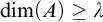 $\dim (A) \ge \lambda $
.
$\dim (A) \ge \lambda $
.
Proof. f and g are the directed colimits of their respective restrictions $f_0, g_0$
to all subspaces
$f_0, g_0$
to all subspaces $A_0 \subseteq A$
of dimension exactly
$A_0 \subseteq A$
of dimension exactly $\lambda $
, and
$\lambda $
, and $Uf_0 = Ug_0$
for all such
$Uf_0 = Ug_0$
for all such $A_0$
by the preceding Proposition; thus since U preserves directed colimits,
$A_0$
by the preceding Proposition; thus since U preserves directed colimits, $Uf = Ug$
.
$Uf = Ug$
.
Lemma 3.10. U maps every $f : A \to B \in {\mathsf {Hilb_r}}$
for
$f : A \to B \in {\mathsf {Hilb_r}}$
for $\dim (A) \ge \aleph _0$
to an injection.
$\dim (A) \ge \aleph _0$
to an injection.
Proof. First, suppose $\dim (B) = \dim (A)$
. Let
$\dim (B) = \dim (A)$
. Let $x, y \in UA$
, and suppose
$x, y \in UA$
, and suppose $Uf(x) = Uf(y) \in UB$
. Since A is infinite-dimensional, it is the directed colimit of all finite-dimensional
$Uf(x) = Uf(y) \in UB$
. Since A is infinite-dimensional, it is the directed colimit of all finite-dimensional $A_0 \subseteq A$
, and so there are
$A_0 \subseteq A$
, and so there are $x_0, y_0 \in UA_0$
for some such
$x_0, y_0 \in UA_0$
for some such $A_0$
, with inclusion
$A_0$
, with inclusion $i : A_0 \to A$
, such that
$i : A_0 \to A$
, such that $x = Ui(x_0)$
and
$x = Ui(x_0)$
and $y = Ui(y_0)$
. Since A and B have the same infinite dimension, and
$y = Ui(y_0)$
. Since A and B have the same infinite dimension, and $A_0 \subseteq A$
is finite-dimensional, there is an isomorphism
$A_0 \subseteq A$
is finite-dimensional, there is an isomorphism $A \cong B$
that takes the inclusion
$A \cong B$
that takes the inclusion $i : A_0 \hookrightarrow A$
to the embedding
$i : A_0 \hookrightarrow A$
to the embedding $fi : A_0 \hookrightarrow A \hookrightarrow B$
:
$fi : A_0 \hookrightarrow A \hookrightarrow B$
:

By assumption, $x_0$
and
$x_0$
and $y_0$
map to the same thing in
$y_0$
map to the same thing in $UB$
along the top-right composite, hence also along the left-bottom, hence also along the left, i.e.,
$UB$
along the top-right composite, hence also along the left-bottom, hence also along the left, i.e., $x = Ui(x_0) = Ui(y_0) = y$
.
$x = Ui(x_0) = Ui(y_0) = y$
.
This proves the result for $\dim (B) = \dim (A)$
. If
$\dim (B) = \dim (A)$
. If $\dim (B)> \dim (A)$
, write
$\dim (B)> \dim (A)$
, write ${f : A \to B}$
as a directed colimit of
${f : A \to B}$
as a directed colimit of $f : A \to B_0$
, where
$f : A \to B_0$
, where $B_0 \subseteq B$
contains
$B_0 \subseteq B$
contains $\operatorname {\mathrm {im}}(f)$
and has the same dimension as A.
$\operatorname {\mathrm {im}}(f)$
and has the same dimension as A.
Theorem 3.11. The restriction of any directed-colimit-preserving functor ${U : {\mathsf {Hilb_r}} \to {\mathsf {Set}}}$
to the full subcategory
${U : {\mathsf {Hilb_r}} \to {\mathsf {Set}}}$
to the full subcategory ${\mathsf {Hilb_r}}^{\ge \aleph _0}$
of infinite-dimensional spaces is naturally isomorphic to a constant functor.
${\mathsf {Hilb_r}}^{\ge \aleph _0}$
of infinite-dimensional spaces is naturally isomorphic to a constant functor.
Proof. From Corollary 3.9, we know U maps parallel pairs of morphisms between sufficiently high-dimensional Hilbert spaces $\ell ^2(\lambda )$
to the same morphism in
$\ell ^2(\lambda )$
to the same morphism in ${\mathsf {Set}}$
. For two arbitrary maps
${\mathsf {Set}}$
. For two arbitrary maps $f, g : A \rightrightarrows B \in {\mathsf {Hilb_r}}$
between infinite-dimensional spaces, consider the square
$f, g : A \rightrightarrows B \in {\mathsf {Hilb_r}}$
between infinite-dimensional spaces, consider the square

Then $U(f \oplus {\mathrm {id}}) = U(g \oplus {\mathrm {id}})$
, and the inclusion
$U(f \oplus {\mathrm {id}}) = U(g \oplus {\mathrm {id}})$
, and the inclusion $B \hookrightarrow B \oplus \ell ^2(\lambda )$
is mapped to an injection by Lemma 3.10, hence
$B \hookrightarrow B \oplus \ell ^2(\lambda )$
is mapped to an injection by Lemma 3.10, hence $Uf = Ug$
. So U is constant on all parallel pairs of morphisms in
$Uf = Ug$
. So U is constant on all parallel pairs of morphisms in ${\mathsf {Hilb_r}}^{\ge \aleph _0}$
.
${\mathsf {Hilb_r}}^{\ge \aleph _0}$
.
This implies that U maps every $f : A \to B \in {\mathsf {Hilb_r}}$
with
$f : A \to B \in {\mathsf {Hilb_r}}$
with $\dim (A) \ge \aleph _0$
to a bijection in
$\dim (A) \ge \aleph _0$
to a bijection in ${\mathsf {Set}}$
. To see this: if
${\mathsf {Set}}$
. To see this: if $\dim (B) = \dim (A)$
, then there exists a linear isometric isomorphism
$\dim (B) = \dim (A)$
, then there exists a linear isometric isomorphism $g : A \cong B$
; thus
$g : A \cong B$
; thus $Uf = Ug$
is a bijection. If
$Uf = Ug$
is a bijection. If $\dim (B)> \dim (A)$
, as in the preceding proof, write f as the directed colimit of its codomain restrictions to
$\dim (B)> \dim (A)$
, as in the preceding proof, write f as the directed colimit of its codomain restrictions to $B_0 \subseteq B$
of the same dimension as A.
$B_0 \subseteq B$
of the same dimension as A.
We now define a natural isomorphism $\phi : U(\ell ^2) \cong U|_{{\mathsf {Hilb_r}}^{\ge \aleph _0}}$
, from the constant functor with value
$\phi : U(\ell ^2) \cong U|_{{\mathsf {Hilb_r}}^{\ge \aleph _0}}$
, from the constant functor with value $U(\ell ^2)$
to the restriction of U to all infinite-dimensional Hilbert spaces A. Let
$U(\ell ^2)$
to the restriction of U to all infinite-dimensional Hilbert spaces A. Let $\phi _A : U(\ell ^2) \to UA$
be
$\phi _A : U(\ell ^2) \to UA$
be $Uf$
for any embedding
$Uf$
for any embedding $f : \ell ^2 \hookrightarrow A$
. This is a natural transformation, since for any morphism
$f : \ell ^2 \hookrightarrow A$
. This is a natural transformation, since for any morphism $g : A \to B \in {\mathsf {Hilb_r}}$
, the square
$g : A \to B \in {\mathsf {Hilb_r}}$
, the square

commutes, as both composites are U applied to a morphism $\ell ^2 \to B$
, hence equal by the first part of this proof; and each
$\ell ^2 \to B$
, hence equal by the first part of this proof; and each $\phi _A$
is invertible by the second part of this proof.
$\phi _A$
is invertible by the second part of this proof.
Example 3.12. The conclusion of Theorem 3.11 cannot be strengthened to assert that U itself is essentially constant. Indeed, let $\overline {\mathbb {N}}$
be the directed-complete linear order
$\overline {\mathbb {N}}$
be the directed-complete linear order $\{0, 1, 2, \dotsc , \infty \}$
, and note that we have a directed-colimit-preserving functor
$\{0, 1, 2, \dotsc , \infty \}$
, and note that we have a directed-colimit-preserving functor ${\mathsf {Hilb_r}} \to \overline {\mathbb {N}}$
taking a finite-dimensional space to its dimension and all infinite-dimensional spaces to
${\mathsf {Hilb_r}} \to \overline {\mathbb {N}}$
taking a finite-dimensional space to its dimension and all infinite-dimensional spaces to $\infty $
. Composing with any directed-colimit-preserving
$\infty $
. Composing with any directed-colimit-preserving $\overline {\mathbb {N}} \to {\mathsf {Set}}$
(which is simply the left Kan extension of an arbitrary functor
$\overline {\mathbb {N}} \to {\mathsf {Set}}$
(which is simply the left Kan extension of an arbitrary functor $\mathbb {N} \to {\mathsf {Set}}$
, e.g., the inclusion on finite ordinals, so taking
$\mathbb {N} \to {\mathsf {Set}}$
, e.g., the inclusion on finite ordinals, so taking $\infty \mapsto \mathbb {N}$
) yields a directed-colimit-preserving
$\infty \mapsto \mathbb {N}$
) yields a directed-colimit-preserving $U : {\mathsf {Hilb_r}} \to {\mathsf {Set}}$
, which need not be constant on finite-dimensional spaces.
$U : {\mathsf {Hilb_r}} \to {\mathsf {Set}}$
, which need not be constant on finite-dimensional spaces.
Similar examples show that the preceding lemma is also false for finite-dimensional A, i.e., U need not even preserve monomorphisms between finite-dimensional spaces: e.g., take $\mathbb {N} \to {\mathsf {Set}}$
above to be the functor mapping n to the quotient of
$\mathbb {N} \to {\mathsf {Set}}$
above to be the functor mapping n to the quotient of $\mathbb {N}$
identifying the first n elements.
$\mathbb {N}$
identifying the first n elements.
4 Other categories
4.1 Hilbert spaces and linear contractions
Recall that ${\mathsf {Hilb}}$
denotes the category of (real or complex) Hilbert spaces and linear contractions. Given a directed-colimit-preserving functor
${\mathsf {Hilb}}$
denotes the category of (real or complex) Hilbert spaces and linear contractions. Given a directed-colimit-preserving functor $U : {\mathsf {Hilb}} \to {\mathsf {Set}}$
, by restricting U to
$U : {\mathsf {Hilb}} \to {\mathsf {Set}}$
, by restricting U to ${\mathsf {Hilb_r}}$
and applying Theorem 3.11, we of course get that U is essentially constant on all infinite-dimensional spaces as well. But we can show more: in contrast to Example 3.12, we have the following.
${\mathsf {Hilb_r}}$
and applying Theorem 3.11, we of course get that U is essentially constant on all infinite-dimensional spaces as well. But we can show more: in contrast to Example 3.12, we have the following.
Corollary 4.1. Any directed-colimit-preserving functor $U : {\mathsf {Hilb}} \to {\mathsf {Set}}$
is essentially constant.
$U : {\mathsf {Hilb}} \to {\mathsf {Set}}$
is essentially constant.
Proof. For any $A \in {\mathsf {Hilb}}$
, let
$A \in {\mathsf {Hilb}}$
, let
 $$\begin{align*} i &:&\kern-20pt A &\to A \oplus \ell^2 &&\kern-20pt = \text{first coordinate injection}, \\j &:&\kern-20pt A \oplus \ell^2 &\to A \oplus A \oplus \ell^2 &&\kern-20pt = \text{first and third coordinate injection}, \\k &:&\kern-20pt A \oplus \ell^2 &\to A \oplus A \oplus \ell^2 &&\kern-20pt = \text{second and third coordinate injection}, \\p &:&\kern-20pt A \oplus A \oplus \ell^2 &\to A &&\kern-20pt = \text{second coordinate projection}; \end{align*}$$
then
 $$ \begin{align*} \begin{aligned} U(0_A) = U(pji) &= Up \circ Uj \circ Ui \\ &= Up \circ Uk \circ Ui \quad \text{by Theorem }{3.11} \\ &= U({\mathrm{id}}_A) = {\mathrm{id}}_{UA}, \end{aligned} \end{align*} $$
i.e., U takes the zero map on every $A \in {\mathsf {Hilb}}$
to the identity. Now whisker the natural transformations
$A \in {\mathsf {Hilb}}$
to the identity. Now whisker the natural transformations

by U to get that U is naturally isomorphic to the constant functor with value $U(0)$
.
$U(0)$
.
We also note that combining the argument of Theorem 3.11 with [Reference Lieberman, Rosický and Vasey7] easily yields the same essential constancy conclusion for the supercategory ${\mathsf {Hilb_m}}$
considered in that paper. (Here, unlike with
${\mathsf {Hilb_m}}$
considered in that paper. (Here, unlike with ${\mathsf {Hilb}}$
, the argument of Example 3.12 shows that we cannot conclude anything for finite-dimensional spaces.)
${\mathsf {Hilb}}$
, the argument of Example 3.12 shows that we cannot conclude anything for finite-dimensional spaces.)
Corollary 4.2. Any functor $U : {\mathsf {Hilb_m}} \to {\mathsf {Set}}$
preserving all existing directed colimits in
$U : {\mathsf {Hilb_m}} \to {\mathsf {Set}}$
preserving all existing directed colimits in ${\mathsf {Hilb_m}}$
is essentially constant when restricted to the full subcategory
${\mathsf {Hilb_m}}$
is essentially constant when restricted to the full subcategory ${\mathsf {Hilb_m}}^{\ge \aleph _0}$
of infinite-dimensional spaces.
${\mathsf {Hilb_m}}^{\ge \aleph _0}$
of infinite-dimensional spaces.
Proof. By [Reference Lieberman, Rosický and Vasey7, Lemma 14], there is a well-defined support $\operatorname {\mathrm {supp}}_A(x) \subseteq A$
for any infinite-dimensional
$\operatorname {\mathrm {supp}}_A(x) \subseteq A$
for any infinite-dimensional $A \in {\mathsf {Hilb_m}}$
and
$A \in {\mathsf {Hilb_m}}$
and $x \in UA$
, which is a finite-dimensional subspace of A. By the proofs of Proposition 3.8 and Corollary 3.9, it follows that U is constant on all parallel pairs
$x \in UA$
, which is a finite-dimensional subspace of A. By the proofs of Proposition 3.8 and Corollary 3.9, it follows that U is constant on all parallel pairs $f, g : A \rightrightarrows B \in {\mathsf {Hilb_m}}$
, where A is of sufficiently high dimension
$f, g : A \rightrightarrows B \in {\mathsf {Hilb_m}}$
, where A is of sufficiently high dimension $\ge \lambda $
for some infinite cardinal
$\ge \lambda $
for some infinite cardinal $\lambda $
. By Lemma 3.10, we still have that U maps every morphism in the subcategory
$\lambda $
. By Lemma 3.10, we still have that U maps every morphism in the subcategory ${\mathsf {Hilb_r}}^{\ge \aleph _0} \subseteq {\mathsf {Hilb_m}}^{\ge \aleph _0}$
to an injection. The proof of Theorem 3.11 (which only uses Lemma 3.10 for a linear isometric embedding
${\mathsf {Hilb_r}}^{\ge \aleph _0} \subseteq {\mathsf {Hilb_m}}^{\ge \aleph _0}$
to an injection. The proof of Theorem 3.11 (which only uses Lemma 3.10 for a linear isometric embedding $A \hookrightarrow A \oplus \ell ^2(\lambda )$
) now applies.
$A \hookrightarrow A \oplus \ell ^2(\lambda )$
) now applies.
4.2 Infinite-dimensional Hilbert spaces
A somewhat strange aspect of Theorem 3.11 is that the conclusion concerns only the restriction of U to the subcategory ${\mathsf {Hilb_r}}^{\ge \aleph _0}$
of infinite-dimensional Hilbert spaces, yet the definition of U on finite-dimensional spaces was essential to its proof (to make sense of the notion of support). Nonetheless, we may easily deduce the corresponding result for functors defined on infinite-dimensional spaces.
${\mathsf {Hilb_r}}^{\ge \aleph _0}$
of infinite-dimensional Hilbert spaces, yet the definition of U on finite-dimensional spaces was essential to its proof (to make sense of the notion of support). Nonetheless, we may easily deduce the corresponding result for functors defined on infinite-dimensional spaces.
Corollary 4.3. For any infinite cardinal $\kappa $
, letting
$\kappa $
, letting ${\mathsf {Hilb_r}}^{\ge \kappa } \subseteq {\mathsf {Hilb_r}}$
be the full subcategory of Hilbert spaces of dimension
${\mathsf {Hilb_r}}^{\ge \kappa } \subseteq {\mathsf {Hilb_r}}$
be the full subcategory of Hilbert spaces of dimension $\ge \kappa $
, every directed-colimit-preserving functor
$\ge \kappa $
, every directed-colimit-preserving functor $U : {\mathsf {Hilb_r}}^{\ge \kappa } \to {\mathsf {Set}}$
is naturally isomorphic to a constant functor.
$U : {\mathsf {Hilb_r}}^{\ge \kappa } \to {\mathsf {Set}}$
is naturally isomorphic to a constant functor.
Proof. Let $V : {\mathsf {Hilb_r}} \to {\mathsf {Set}}$
take the trivial space to
$V : {\mathsf {Hilb_r}} \to {\mathsf {Set}}$
take the trivial space to $\varnothing $
and every other space A to
$\varnothing $
and every other space A to $U(\ell ^2(\kappa ) \otimes A)$
, where
$U(\ell ^2(\kappa ) \otimes A)$
, where $\otimes $
denotes the Hilbert space tensor product (see [Reference Pedersen10, Exercise E3.2.19]), with the obvious extension to morphisms. Then by Theorem 3.11, V is essentially constant when restricted to
$\otimes $
denotes the Hilbert space tensor product (see [Reference Pedersen10, Exercise E3.2.19]), with the obvious extension to morphisms. Then by Theorem 3.11, V is essentially constant when restricted to ${\mathsf {Hilb_r}}^{\ge \aleph _0}$
.
${\mathsf {Hilb_r}}^{\ge \aleph _0}$
.
In particular, U takes every morphism $f : A \to B \in {\mathsf {Hilb_r}}^{\ge \kappa }$
which is isomorphic to a morphism of the form
$f : A \to B \in {\mathsf {Hilb_r}}^{\ge \kappa }$
which is isomorphic to a morphism of the form ${\mathrm {id}}_{\ell ^2(\kappa )} \otimes g$
for some
${\mathrm {id}}_{\ell ^2(\kappa )} \otimes g$
for some $g : C \to D \in {\mathsf {Hilb_r}}^{\ge \aleph _0}$
to a bijection
$g : C \to D \in {\mathsf {Hilb_r}}^{\ge \aleph _0}$
to a bijection $V(g)$
; such f are easily seen (by taking an orthonormal basis for A, then extending it to one for B, and using
$V(g)$
; such f are easily seen (by taking an orthonormal basis for A, then extending it to one for B, and using $\kappa \ge \aleph _0$
) to consist of precisely all linear isometries which either are surjective or have
$\kappa \ge \aleph _0$
) to consist of precisely all linear isometries which either are surjective or have $\ge \kappa $
-codimensional image. But every
$\ge \kappa $
-codimensional image. But every $f : A \to B \in {\mathsf {Hilb_r}}^{\ge \kappa }$
may be composed with some such morphism (e.g., the injection
$f : A \to B \in {\mathsf {Hilb_r}}^{\ge \kappa }$
may be composed with some such morphism (e.g., the injection $B \hookrightarrow B \oplus \ell ^2(\kappa )$
) to yield another such morphism; thus, U takes every morphism in
$B \hookrightarrow B \oplus \ell ^2(\kappa )$
) to yield another such morphism; thus, U takes every morphism in ${\mathsf {Hilb_r}}^{\ge \kappa }$
to a bijection.
${\mathsf {Hilb_r}}^{\ge \kappa }$
to a bijection.
Moreover, U takes every endomorphism $f : A \to A$
which is conjugate to
$f : A \to A$
which is conjugate to ${\mathrm {id}}_{\ell ^2(\kappa )} \otimes g$
for some
${\mathrm {id}}_{\ell ^2(\kappa )} \otimes g$
for some $g : C \to C \in {\mathsf {Hilb_r}}^{\ge \aleph _0}$
to the identity. But every
$g : C \to C \in {\mathsf {Hilb_r}}^{\ge \aleph _0}$
to the identity. But every $f : A \to A \in {\mathsf {Hilb_r}}^{\ge \kappa }$
fits into a commutative square
$f : A \to A \in {\mathsf {Hilb_r}}^{\ge \kappa }$
fits into a commutative square

where $i(\vec {v}) := \vec {e}_0 \otimes \vec {v}$
; thus U takes every endomorphism in
$i(\vec {v}) := \vec {e}_0 \otimes \vec {v}$
; thus U takes every endomorphism in ${\mathsf {Hilb_r}}^{\ge \kappa }$
to the identity. As in the proof of Theorem 3.11, this easily implies that U is constant on any parallel pair
${\mathsf {Hilb_r}}^{\ge \kappa }$
to the identity. As in the proof of Theorem 3.11, this easily implies that U is constant on any parallel pair $f, g : A \rightrightarrows B \in {\mathsf {Hilb_r}}^{\ge \kappa }$
(by assuming
$f, g : A \rightrightarrows B \in {\mathsf {Hilb_r}}^{\ge \kappa }$
(by assuming $\dim (A) = \dim (B)$
via codomain restriction and composing with some
$\dim (A) = \dim (B)$
via codomain restriction and composing with some $h : B \cong A$
), which together with the above yields a natural isomorphism
$h : B \cong A$
), which together with the above yields a natural isomorphism $U(\ell ^2(\kappa )) \cong U$
.
$U(\ell ^2(\kappa )) \cong U$
.
4.3 Metric spaces and Banach spaces
Corollary 4.4. There is no faithful directed-colimit-preserving functor U from the categories ${\mathsf {Met_r}}$
of complete metric spaces (of bounded diameter
${\mathsf {Met_r}}$
of complete metric spaces (of bounded diameter $\le 1$
) and isometric embeddings or
$\le 1$
) and isometric embeddings or ${\mathsf {Ban_r}}$
of Banach spaces and linear isometric embeddings to
${\mathsf {Ban_r}}$
of Banach spaces and linear isometric embeddings to ${\mathsf {Set}}$
, or even from the full subcategories consisting of the non-locally compact spaces.
${\mathsf {Set}}$
, or even from the full subcategories consisting of the non-locally compact spaces.
Proof. Follows from Theorem 3.11 and the faithful forgetful functors ${\mathsf {Hilb_r}} \to {\mathsf {Ban_r}} \to {\mathsf {Met_r}}$
. For the last part, use Corollary 4.3.
${\mathsf {Hilb_r}} \to {\mathsf {Ban_r}} \to {\mathsf {Met_r}}$
. For the last part, use Corollary 4.3.
This strengthens the results in [Reference Lieberman, Rosický and Vasey7, Section 4] for the supercategories ${\mathsf {Met_m}}, {\mathsf {Ban_m}}$
. However, we do not know if, as for
${\mathsf {Met_m}}, {\mathsf {Ban_m}}$
. However, we do not know if, as for ${\mathsf {Hilb_r}}$
by Theorem 3.11, every directed-colimit-preserving functor from these categories to
${\mathsf {Hilb_r}}$
by Theorem 3.11, every directed-colimit-preserving functor from these categories to ${\mathsf {Set}}$
must be essentially constant (on non-locally compact spaces, say).
${\mathsf {Set}}$
must be essentially constant (on non-locally compact spaces, say).
Acknowledgments
We would like to thank the anonymous referee for some helpful comments and suggestions.
Funding
The authors were supported by NSF grant DMS-2224709.


 Open access

