

1. Introduction
Ophiolites, as fragments of ancient oceanic lithosphere (e.g. Dewey & Bird, Reference Dewey and Bird1971; Coleman, Reference Coleman1977), play irreplaceable roles in the recognition and reconstruction of the evolution history of an ancient ocean, including the opening, closure, development of subduction systems and the consequent orogeny (Dilek, Reference Dilek2003; Dilek et al., Reference Dilek, Furnes and Shallo2007; Dilek & Furnes, Reference Dilek and Furnes2011). Investigation of the formation and emplacement age of an ophiolite can unravel the process of accretionary orogenesis (Xiao et al., Reference Xiao, Windley, Yuan, Sun, Han, Lin, Chen, Yan, Liu, Qin, Li and Sun2009a, Reference Xiao, Windley, Allen and Han2013). Furthermore, the ophiolite or ophiolitic mélange is the most basic tectonic member in the subducted wedge of an orogenic belt, which is not only an important marker of the Palaeo-plate boundary but also important for understanding the evolution process of the orogenic belt (Jian et al., Reference Jian, Liu, Zhang, Zhang, Shi, Shi, Zhang and Tao2003; Zhang et al., Reference Zhang, Zhou and Wang2003; Shi, Reference Shi2005; Dilek & Furnes, Reference Dilek and Furnes2011; Furnes & Dilek, Reference Furnes and Dilek2017).
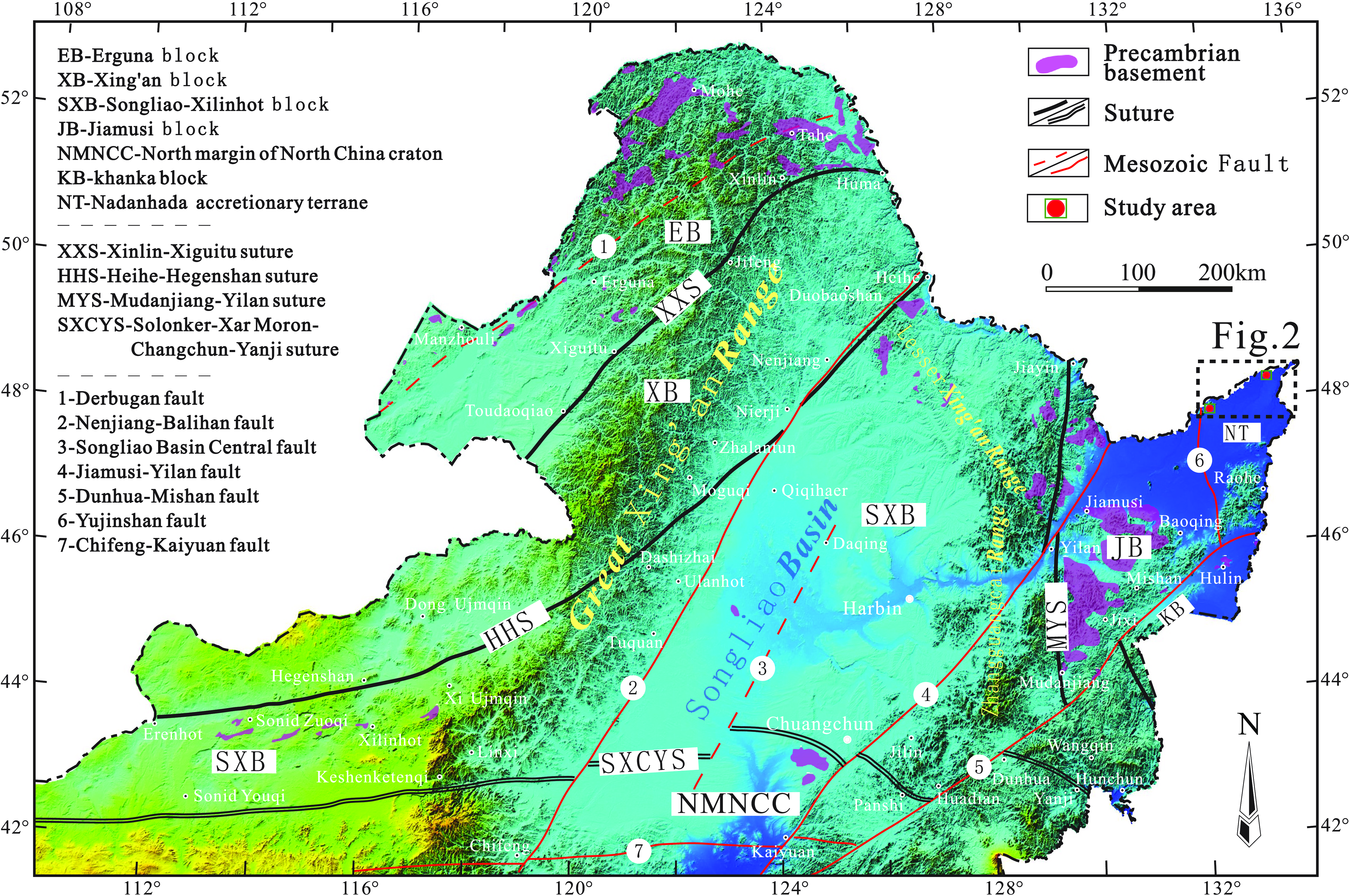
Northeast China (NE China) is located in the eastern part of the Central Asian Orogenic Belt (CAOB), which underwent the complicated subduction-accretionary orogenic processes (Xiao et al., Reference Xiao, Windley, Huang, Han, Yuan, Chen, Sun, Sun and Li2009b; Zhang et al., Reference Zhang, Gao, Li, Hou, Wu, Li, Yang, Li, Li, Zhang, Yang, Keller and Liu2013, Reference Zhang, Hao, Xiao, Wang, Zhou, Qi, Cui and Cai2015; Chen et al., Reference Chen, Zhang, Chen, Dilek, Yang, Meng and Yang2015; Ge et al., Reference Ge, Chen, Yang, Zhao, Zhang and Tian2015; Wang et al., Reference Wang, Ge, Yang, Zhang, Bi, Tian and Xu2015). As we all know, the NE China is tectonically composed of four micro-blocks and an accretionary terrane, i.e. Erguna Block (EB), Xing’an Block (XB), Songliao-Xilinhot Block (SXB), Jiamusi Block (JB) and the Nadanhada Terrane (NT). A large number of ophiolites or ophiolitic complexes are widely distributed in NE China, significantly marking the suture zones among the above-mentioned blocks and terrane. From west to east, they are the Xinlin-Xiguitu, Heihe-Nenjiang-Hegenshan, Mudanjiang-Yilan and Yuejinshan belts (Fig. 1), involving the closure of the ancient oceans of Neoproterozoic-Late Cambrian Xinlin-Xiguitu branch ocean, the Early Cambrian-Late Carboniferous Nenjiang branch ocean, Neoproterozoic Heilongjiang branch ocean, the Late Permian-Middle Jurassic Mudanjiang branch ocean and the subduction of the Mesozoic Palaeo-Pacific ocean, respectively (Zhang et al., Reference Zhang, Zhou, Chi, Wang and Hu2008; Feng et al., Reference Feng, Liu, Li, Jin, Jiang, Li, Wen and Zhao2019; Liu et al., Reference Liu, Feng, Jiang, Jin, Li, Guan, Wen and Liang2019).
Tectonic divisions of the NE China (after Liu et al., Reference Liu, Li, Feng, Wen, Neubauer and Liang2017b).

During the Mesozoic, NE China was affected by the closure of the Mongolian-Okhotsk Sea and the subduction of the Palaeo-Pacific plate, resulting in large-scale tectonic-magmatic activities (e.g. Wu et al., Reference Wu, Jahn, Wilde and Sun2000; Meng et al., Reference Meng, Liu, Cui, Gao, Liu and Tong2014; Feng et al., Reference Feng, Liu, Li, Jin, Jiang, Li, Wen and Zhao2019; Liu et al., Reference Liu, Feng, Jiang, Jin, Li, Guan, Wen and Liang2019; Li et al., Reference Li, Liu, Zhao, Feng, Zhou, Wen, Liang and Zhang2020). Previous studies on Mesozoic volcanic rocks in NE China show that the Mesozoic accretive complexes, the arc magmatic belts of JB and the eastern margin of SXB in NE China are distributed in the south-north direction (e.g. Xu et al., Reference Xu, Pei, Wang, Meng, Ji, Yang and Wang2013; Wilde, Reference Wilde2015; Liu et al., Reference Liu, Li, Feng, Wen, Neubauer and Liang2017b, Reference Liu, Feng, Jiang, Jin, Li, Guan, Wen and Liang2019, Reference Liu, Li, Ma, Feng, Guan, Li, Chen, Liang and Wen2021; Han et al., Reference Han, Liu, Zhou, Zhang and Fan2022). These accretive complexes formed in the Late Triassic to Early Cretaceous and showed a trend of becoming younger from west to east (Sun, Reference Sun2013; Sun et al., Reference Sun, Chen, Zhang, Wilde, Minna, Lin and Yang2014; Li et al., Reference Li, Liu, Zhao, Feng, Zhou, Wen, Liang and Zhang2020). The above facts indicate that the Mesozoic accretive complex in NE China is closely related to the western subduction of the Palaeo-Pacific plate (Li et al., Reference Li, Liu, Zhao, Feng, Zhou, Wen, Liang and Zhang2020; Han et al., Reference Han, Liu, Zhou, Zhang and Fan2022).
To the eastmost of NE China, the typical ophiolites (ophiolitic complexes) are discovered in the Raohe and Yuejinshan areas from the NT. Zhang et al. (Reference Zhang, Shao, Tang, Zhang and Li1997) found that the Yuejinshan Complex is a tectonic mélange with the block-in-matrix texture and proposed that the original rocks are N-MORB-type basalts, which are typical ophiolites. Meanwhile, the concept of the Raohe ophiolite was first proposed by Li (Reference Li1980) and further has been accepted by many scholars (Kojima & Mizutani., Reference Kojima and Mizutani1987; Kojima, Reference Kojima1989; Zhang et al.,Reference Zhang, Mizutani, Kojima and Shan1989; Kang, et al., Reference Kang, Zhang, Liu, Cui and Zhang1990; Mizutani & Kojima, Reference Mizutani and Kojima1992). However, typical mantle peridotites do not develop in ophiolites in the Raohe area (Zhang et al., Reference Zhang, Qian and Wang2000), and the geochemical characteristics of mafic-ultramafic complexes are quite different from typical ophiolites, so some scholars regard it as the OIB-type Complex (Zhang et al., Reference Zhang, Qian and Chen1998, Reference Zhang, Zhou and Wang2003; Zhang and Zhou, Reference Zhang and Zhou2001).
In recent years, the studies on the NT have pointed out that the Yuejinshan Complex and the Raohe Complex are the direct products of the long-term subduction and accretion of the Palaeo-Pacific plate beneath the Eurasian continent (Zeng et al., 2018). However, the research on the evolution process of the NT is still controversial; especially, there is a lack of evidence for the age of the Late Cretaceous. Yu et al. (Reference Yu, Hou, Ge, Zhang and Liu2013) discovered the Late Cretaceous granites in the Tongjiang-Fuyuan area in the northern part of the NT, which is different from the previous research that the granites developed in the late Indosinian belt in Raohe (HBGMR, 1993). According to field surveys and whole-rock geochemical analysis, it is found that the Late Cretaceous granites in the Tongjiang-Fuyuan area were formed in the active continental margin tectonic environment generated by the subduction of the Palaeo-Pacific plate to the East Asian continent (Yu et al., Reference Yu, Hou, Ge, Zhang and Liu2013). Significantly, the typical ophiolites such as siliceous rocks, basalts and gabbros are also developed in the Tongjiang-Fuyuan area; however, they have not been systematically studied.
This study therefore focuses on the ophiolitic rock assemblages such as siliciclastic rocks, basaltic rocks and gabbros together with the granodiorite exposed in the Tongjiang-Fuyuan area in the northern part of the NT, NE China and carried out the systematic studies on field investigations, geochronology and geochemistry, to further reveal the subduction-accretionary process of the Palaeo-Pacific plate.
2. Geological setting and sampling
2.a Regional geology
The NE China comprises multiple micro-continental blocks or terranes, namely the EB, XB, SXB and JB, as well as the easternmost Nadanhada (Tang et al., Reference Tang, Wang, He and Shan1995; Li, Reference Li2006; Zhou & Wilde, Reference Zhou and Wilde2013), and it is tectonically located in the triangular zone of the Palaeo-Asian Ocean, Mongolia-Okhotsk Ocean and the Palaeo-Pacific plate tectonic domains (Tang et al., Reference Tang, Wang, He and Shan1995; Li, Reference Li2006; Zhou et al., Reference Zhou, Wilde, Zhang, Zhao, Zheng, Wang and Zhang2009, Reference Zhou, Cao, Wilde, Zhao, Zhang and Wang2014) (Fig. 1). The EB is distributed in a northeastward direction and is connected with the XB on the southeast side, and the magmatic rock age of EB is mainly Neoproterozoic, Early Palaeozoic, Late Palaeozoic and Mesozoic. (Liu et al., Reference Liu, Chi, Dong, Zhao, Li and Zhao2008; Wu et al., Reference Wu, Sun, Ge, Zhang, Grant, Wilde and Jahn2011; Zhang et al., Reference Zhang, Chen, Yu, Dong, Yang, Pang and Batt2011; Zhou et al., Reference Zhou, Cao, Wilde, Zhao, Zhang and Wang2014; Dong et al., Reference Dong, Ge, Yang, Liu, Bi, Ji and Xu2019; Li et al., Reference Li, Liu, Zhao, Feng, Zhou, Wen, Liang and Zhang2020; Han et al., Reference Han, Liu, Zhou, Zhang and Fan2022). The XB is adjacent to the EB and SXB and is mainly composed of Palaeozoic-Mesozoic magmatic rocks and related volcanic ⁃ sedimentary layers (Zhang et al., Reference Zhang, Chen, Yu, Dong, Yang, Pang and Batt2011; Zhou et al., Reference Zhou, Cao, Wilde, Zhao, Zhang and Wang2014; Dong et al., Reference Dong, Ge, Yang, Liu, Bi, Ji and Xu2019; Li et al., Reference Li, Liu, Zhao, Feng, Zhou, Wen, Liang and Zhang2020; Han et al., Reference Han, Liu, Zhou, Zhang and Fan2022). The SXB is located between the XB and JB, the magmatic rocks are mainly formed in Neoproterozoic, Early Palaeozoic, Late Palaeozoic and Mesozoic (Zhang et al., Reference Zhang, Chen, Yu, Dong, Yang, Pang and Batt2011; Zhou et al., Reference Zhou, Cao, Wilde, Zhao, Zhang and Wang2014; Dong et al., Reference Dong, Ge, Yang, Liu, Bi, Ji and Xu2019; Li et al., Reference Li, Liu, Zhao, Feng, Zhou, Wen, Liang and Zhang2020; Han et al., Reference Han, Liu, Zhou, Zhang and Fan2022). The JB is adjacent to the SXB and NT, the magmatic rocks are dominated by granitic rocks, and the ages are mainly early Palaeozoic Cambrian, Late Palaeozoic Permian, Mesozoic Triassic and Cretaceous (Zhang et al., Reference Zhang, Chen, Yu, Dong, Yang, Pang and Batt2011; Zhou et al., Reference Zhou, Cao, Wilde, Zhao, Zhang and Wang2014; Dong et al., Reference Dong, Ge, Yang, Liu, Bi, Ji and Xu2019; Li et al., Reference Li, Liu, Zhao, Feng, Zhou, Wen, Liang and Zhang2020; Han et al., Reference Han, Liu, Zhou, Zhang and Fan2022). The NT is located in the easternmost part of the NE China and is mainly composed of Yuejinshan complex, Raohe complex and Early Cretaceous magmatic rocks (Zhou et al., Reference Zhou, Cao, Wilde, Zhao, Zhang and Wang2014; Tang et al., Reference Tang, Xu, Wang and Ge2018; Li et al., Reference Li, Liu, Zhao, Feng, Zhou, Wen, Liang and Zhang2020; Han et al., Reference Han, Liu, Zhou, Zhang and Fan2022).
In recent years, the key and difficulty to the study on the tectonics of NE China, as well as the dynamic mechanism of the major tectonic domains, lies in the superposition and transformation of the subduction-accretion of the Palaeo-Pacific plate, and the NT in the easternmost part of NE China happens to be the subduction-accretionary process of Palaeo-Pacific plate tectonic domain (e.g. Kojima & Mizutani, Reference Kojima and Mizutani1987; Mizutani & Kojima, Reference Mizutani and Kojima1992; Zhou et al., Reference Zhou, Cao, Wilde, Zhao, Zhang and Wang2014; Tang et al., Reference Tang, Xu, Wang and Ge2018; Han et al., Reference Han, Liu, Zhou, Zhang and Fan2022).
The NT preserves relatively intact marine sedimentary strata. A stratigraphic palaeontological comparison suggests that the NT in the NE China, the Sikhote-Alin terrane in the Russian Far East and the Menon-Tamba terrane in Japan formed a super Jurassic accretionary terrane on the eastern edge of Eurasia continent before the opening of the Sea of Japan (Mizutani et al. Reference Mizutani, Shao and Zhang1989; Kojima, Reference Kojima1989). In the past half-century, many previous researchers provided different understandings of the tectonic properties of the NT. Wang (Reference Wang1959) regarded the area as a Mesozoic trough folded zone. Li et al. (Reference Li, Han, Zhang and Meng1979) considered the area to be a Late Palaeozoic trough fold zone based on fossils from the Carboniferous to Permian in the tuffs. Ren et al. (Reference Ren, Jiang, Zhang and Qin1980) suggested that the area is a Mesozoic geosyncline on a Variscan folded basement. In addition, since the Carboniferous gill fossils in the limestone of the NT have typical Tethys tectonic domain fossil assemblages (Zhang et al., Reference Zhang, Mizutani, Kojima and Shan1989), Palaeomagnetic evidence and radiolarian fossil comparisons also show that the NT has experienced a long period of migration history at the Mesozoic (Mizutani et al., Reference Mizutani, Shao and Zhang1989; Ren et al., Reference Ren, Zhu, Qiu, Zhou and Deng2015). Therefore, some scholars believe that the NT is an extraneous terrane from low latitudes (Mizutani et al., Reference Mizutani, Shao and Zhang1989; Wu et al., Reference Wu, Sun, Ge, Zhang, Grant, Wilde and Jahn2011; Li et al., Reference Li, Han, Zhang and Meng1979; Zhang & Ma, Reference Zhang and Ma2010). More recently, with the gradual maturation of plate tectonic theory and the identification and study of sedimentary rocks, some scholars have also suggested that the NT is an accretionary terrane formed by the subduction of the Palaeo-Pacific plate beneath the JB (Zhou et al., Reference Zhou, Cao, Wilde, Zhao, Zhang and Wang2014; Sun et al., Reference Sun, Xu, Wilde and Chen2015b; Liu et al., Reference Liu, Li, Feng, Wen, Neubauer and Liang2017b, Reference Liu, Li, Ma, Feng, Guan, Li, Chen, Liang and Wen2021; Li et al., Reference Li, Liu, Zhao, Feng, Zhou, Wen, Liang and Zhang2020).
According to previous studies, the NT is divided into two main tectonic units, e.g. Yuejinshan Complex and Raohe Complex (e.g. Zhou et al., Reference Zhou, Cao, Wilde, Zhao, Zhang and Wang2014, Reference Zhou, Wilde, Zhao and Han2018; Bi et al., Reference Bi, Ge, Yang, Zhao, Xu and Wang2015, Reference Bi, Ge, Yang, Wang, Xu, Yang, Xing and Chen2016, Reference Bi, Ge, Yang, Wang, Dong, Liu and Ji2017a, Reference Bi, Ge, Yang, Wang, Tian, Liu, Xu and Xing2017b; Wilde, Reference Wilde2015; Sun et al., Reference Sun, Xu, Wilde, Chen and Yang2015a; Zeng et al., 2019; Xu et al., Reference Xu, Kong, Cheng and Zhou2020; Zhang et al., Reference Zhang, Liu, Li, Li, Iqbal and Chen2020; Han et al., Reference Han, Liu, Zhou, Zhang and Fan2022). The Yuejinshan Complex is mainly composed of siliceous rocks, metamorphic clastic rocks and mafic-ultramafic rocks. Metamorphic clastic rocks include quartz schist, marble and mica schist, suffering the greenschist-facies metamorphism (Zhang et al., Reference Zhang, Shao, Tang, Zhang and Li1997; Yang et al., Reference Yang, Qiu, Sun and Zhang1998; Bi et al., Reference Bi, Ge, Yang, Wang, Xu, Yang, Xing and Chen2016, Reference Bi, Ge, Yang, Wang, Dong, Liu and Ji2017a, Reference Bi, Ge, Yang, Wang, Tian, Liu, Xu and Xing2017b; Ge et al., Reference Ge, Zhang, Liu, Ling, Wang and Wang2016; Zhou et al., Reference Zhou, Wilde, Zhao and Han2018; Han et al., Reference Han, Liu, Zhou, Zhang and Fan2022). The mafic-ultramafic rocks show a typical ophiolite sequence, which is composed of metabasalt, gabbro and clinopyxroxenite (Zhou et al., Reference Zhou, Cao, Wilde, Zhao, Zhang and Wang2014; Bi et al., Reference Bi, Ge, Yang, Wang, Xu, Yang, Xing and Chen2016, Reference Bi, Ge, Yang, Wang, Dong, Liu and Ji2017a, Reference Bi, Ge, Yang, Wang, Tian, Liu, Xu and Xing2017b; Ge et al., Reference Ge, Zhang, Liu, Ling, Wang and Wang2016; Zhou et al., 2018; Han et al.,Reference Han, Liu, Zhou, Zhang and Fan2022). Due to the destruction of tectonic deformation, the Yuejinshan Complex shows a tectonic mélange with metamorphic clastic rocks as the matrix and mafic-ultramafic rocks as blocks; thus, the Yuejinshan Complex is considered as a set of ophiolitic mélanges (Zhang et al., Reference Zhang, Shao, Tang, Zhang and Li1997; Zhou et al., Reference Zhou, Cao, Wilde, Zhao, Zhang and Wang2014; Dong et al., Reference Dong, Ge, Yang, Liu, Bi, Ji and Xu2019; Han et al., Reference Han, Liu, Zhou, Zhang and Fan2022). The formation of Yuejinshan Complex has been the subject of debate, with some studies suggesting that it was formed in the middle of the Palaeozoic, while others suggest that it may have formed from the Late Triassic to the Early Jurassic (HBGMR, 1993; Zhang et al., Reference Zhang, Shao, Tang, Zhang and Li1997; Yang et al., Reference Yang, Qiu, Sun and Zhang1998). Recent studies have shown that the Yuejinshan Complex formed at around 210–180 Ma and that it represents the first stage of an accretion complex created by subduction-accretion of the Palaeo-Pacific plate (Zhou et al., Reference Zhou, Cao, Wilde, Zhao, Zhang and Wang2014; Yang et al., Reference Yang, Ge, Zhao, Yu and Zhang2015; Bi et al., Reference Bi, Ge, Yang, Wang, Xu, Yang, Xing and Chen2016, Reference Bi, Ge, Yang, Wang, Dong, Liu and Ji2017a, Reference Bi, Ge, Yang, Wang, Tian, Liu, Xu and Xing2017b; Cao et al., Reference Cao, Zhou and Li2019; Han et al., Reference Han, Liu, Zhou, Zhang and Fan2022).
The Raohe Complex is mainly composed of tuffs, siliceous rocks, mafic-ultramafic rocks and clastic rocks and the clastic rocks mainly contain sandstone and mudstone, which form the matrix of the Raohe Complex (Zhou et al., Reference Zhou, Cao, Wilde, Zhao, Zhang and Wang2014; Bi et al., Reference Bi, Ge, Yang, Wang, Xu, Yang, Xing and Chen2016, Reference Bi, Ge, Yang, Wang, Dong, Liu and Ji2017a, Reference Bi, Ge, Yang, Wang, Tian, Liu, Xu and Xing2017b; Ge et al., Reference Ge, Zhang, Liu, Ling, Wang and Wang2016; Zhou et al., 2017; Han et al., Reference Han, Liu, Zhou, Zhang and Fan2022). The Raohe Complex is similar to typical ophiolitic suites in that they are stratified by oceanic plate sediments, pillow basalt, stacked crystal gabbro and ultramafic rocks, which led to the conclusion that the Raohe Complexes are a set of tectonic mélanges associated with the subduction of the oceanic plate (Zhu et al., Reference Zhu, Zhao, Sun, Liu, Han, Hou, Zhang and Eizenhofer2015; Zeng et al., 2019; Zhang et al., Reference Zhang, Liu, Li, Li, Iqbal and Chen2020). The formation ages of basalt and gabbro in the Raohe-Dadai area are 166 ± 2 Ma and 214 ± 5 Ma, respectively (Zhou et al., Reference Zhou, Cao, Wilde, Zhao, Zhang and Wang2014; Han et al., Reference Han, Liu, Zhou, Zhang and Fan2022), and the sedimentary lower limit ages of silty mudstone and sandstone samples are 167 ± 3 Ma and 133 ± 4 Ma (Zhou et al., Reference Zhou, Cao, Wilde, Zhao, Zhang and Wang2014; Sun et al., Reference Sun, Xu, Wilde, Chen and Yang2015a; Zeng et al., 2019; Han et al., Reference Han, Liu, Zhou, Zhang and Fan2022). Additionally, the stapled granite intruded into the Raohe Complex was mainly formed at 126–110 Ma, limiting the final emplacement age of the Raohe Complex to 133–126 Ma (Cheng et al., Reference Cheng, Wu, Ge, Sun, Liu and Yang2006; Zhou et al., Reference Zhou, Cao, Wilde, Zhao, Zhang and Wang2014; Zeng et al., 2019; Han et al., Reference Han, Liu, Zhou, Zhang and Fan2022).
Previous studies on magmatic rocks in NE China showed that the formation age of magmatic rocks was distributed from the Early-Middle Jurassic to the Late Cretaceous (Wu et al., Reference Wu, Sun, Ge, Zhang, Grant, Wilde and Jahn2011; Zhang and Mizutani, Reference Zhang and Mizutani2004, Cheng et al., Reference Cheng, Wu, Ge, Sun, Liu and Yang2006; Reference Zhang, Zhou, Chi, Wang and Hu2008; Wang et al., Reference Wang, Gao, Ren, Liu and Zhang2009; Wilde et al., Reference Wilde, Wu and Zhao2010; Yu et al., Reference Yu, Hou, Ge, Zhang and Liu2013; Ge et al., Reference Ge, Chen, Yang, Zhao, Zhang and Tian2015; Zeng et al., 2018, 2019; Li et al., Reference Li, Liu, Zhao, Feng, Zhou, Wen, Liang and Zhang2020). Late Cretaceous granites were firstly discovered in the Tongjiang-Fuyuan area in the north of NT (Yu et al., Reference Yu, Hou, Ge, Zhang and Liu2013), and these granites were considered to be formed in the tectonic setting related to the subduction of the Palaeo-Pacific plate beneath the East Asian continent.
2.b Sample locations and simple description
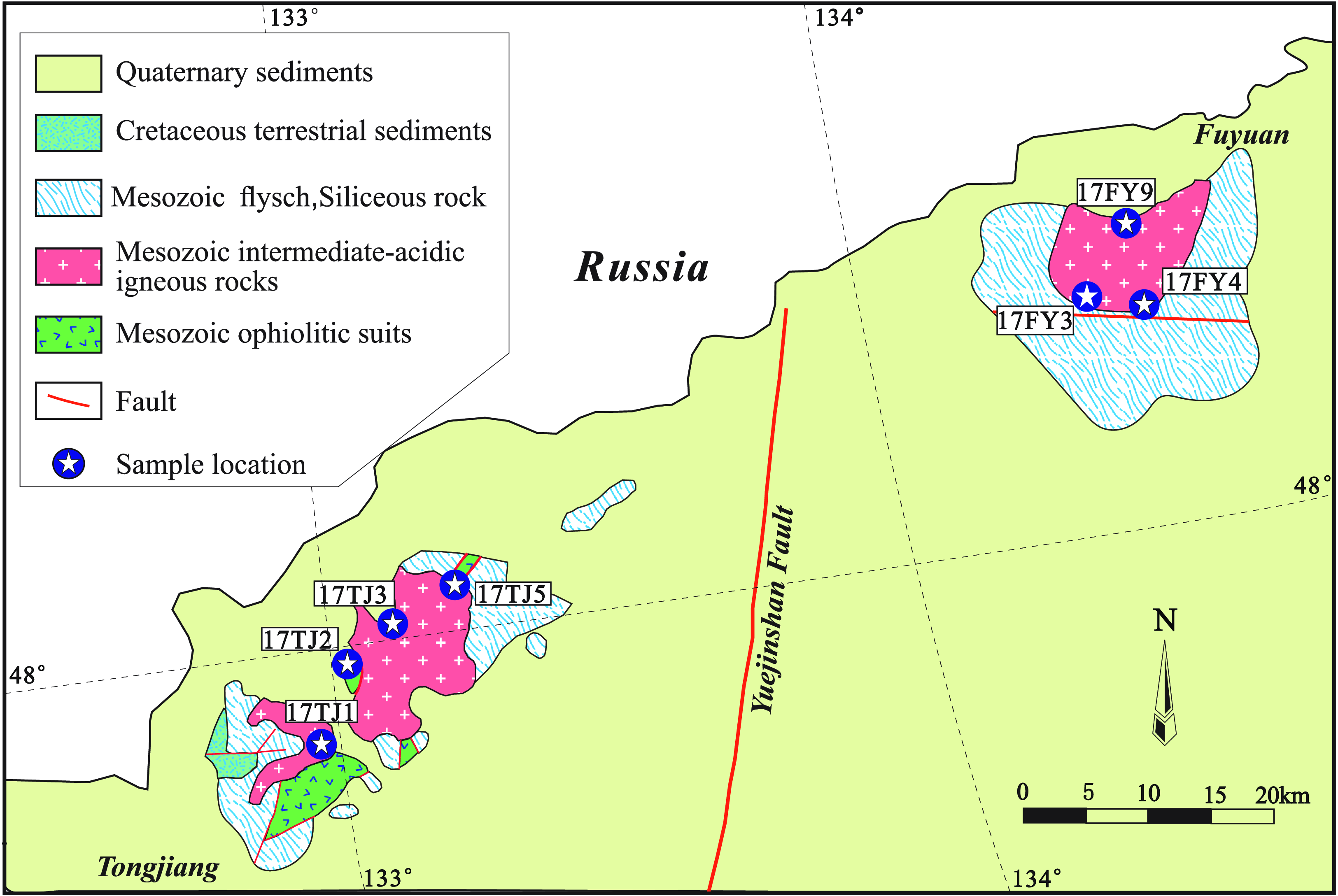
The investigated Tongjiang-Fuyuan area is located at the junction of the JB and the NT (HBGMR, 1993; Yu et al., Reference Yu, Hou, Ge, Zhang and Liu2013; Wang et al., 2017), which is heavily covered and has few exposed rock masses. Through field investigation, it is found that the rocks exposed in the area are mainly composed of siliceous rock, basalt, gabbro and granodiorite, looking like the dismembered ophiolitic suites (Fig. 2).
Geological map of the study area of Tongjiang-Fuyuan (modified after HBGMR, 1993; Yu et al., Reference Yu, Hou, Ge, Zhang and Liu2013).

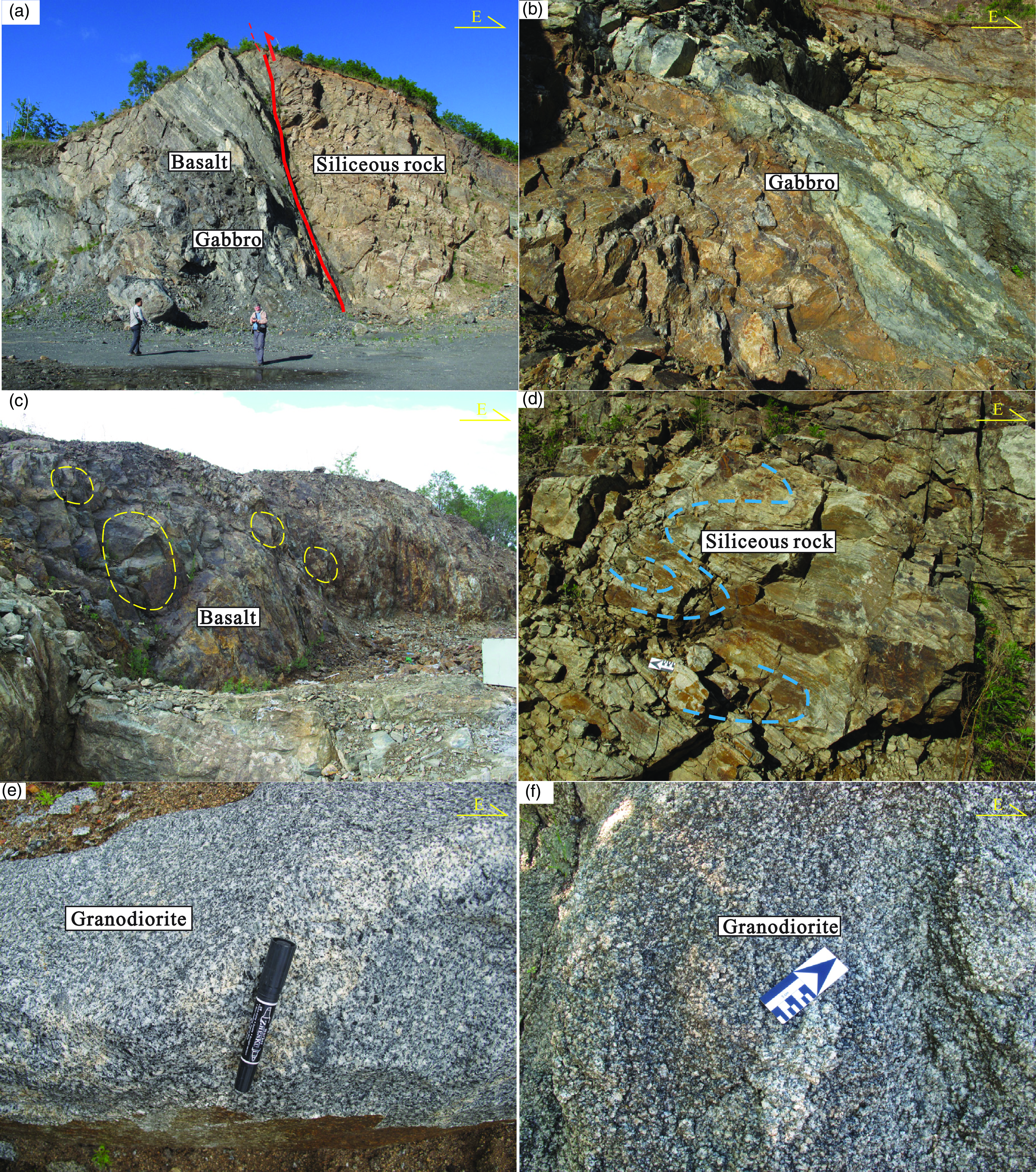
Our petrological investigations suggest that the gabbro, basalt and siliceous rocks developed in the Tongjiang-Fuyuan area are contacted by the top-to-west thrusting faults, indicating a near EW-trending compression (Fig. 3a). The gabbros are greyish green or greyish black with various weathering degree and have the massive or lensed structure (Fig. 3b). The basalts occasionally show the pillow-like structure (Fig. 3c). The siliceous rocks (cherts) are strongly deformed, generally forming the tight folds (Fig. 3d). The granodiorites are grey or white in colour with coarse-grained phanerocrystalline texture and massive structure (Fig. 3e, f).
Field photographs of the basalt, gabbro and granodiorite collected from the Tongjiang-Fuyuan area, NE China. (a) A thrust fault developed between the basalts, gabbro and siliceous rock. (b) Partially weathered gabbro. (c) Basalts with the pillow-like structure. (d) A strongly deformed siliceous rock (cherts) forming the tight folds. € (f) coarse-grained granodiorite.

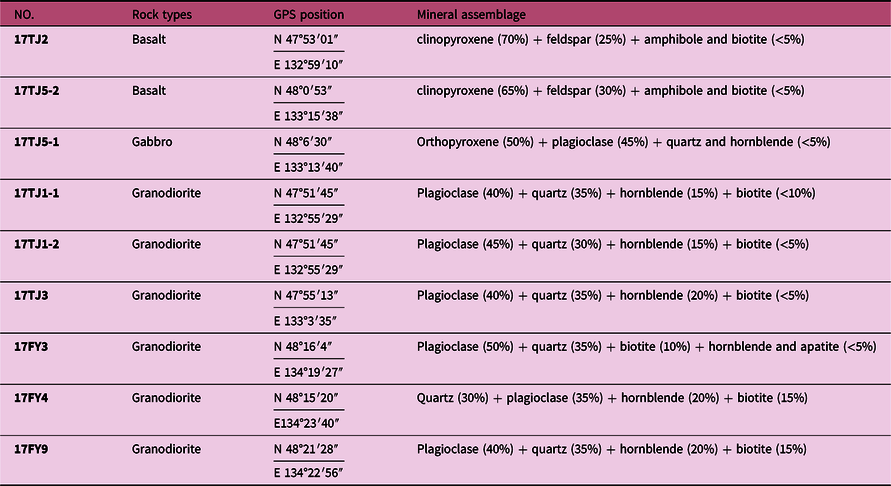
In the study, we collected a total of 9 samples, including 3 mafic rocks and 6 intermediate-acidic intrusive rocks. The detailed sampling locations and petrographic features are available in Figs. 3 and 4 and Table 1. The detailed descriptions for the representative samples are as follows.
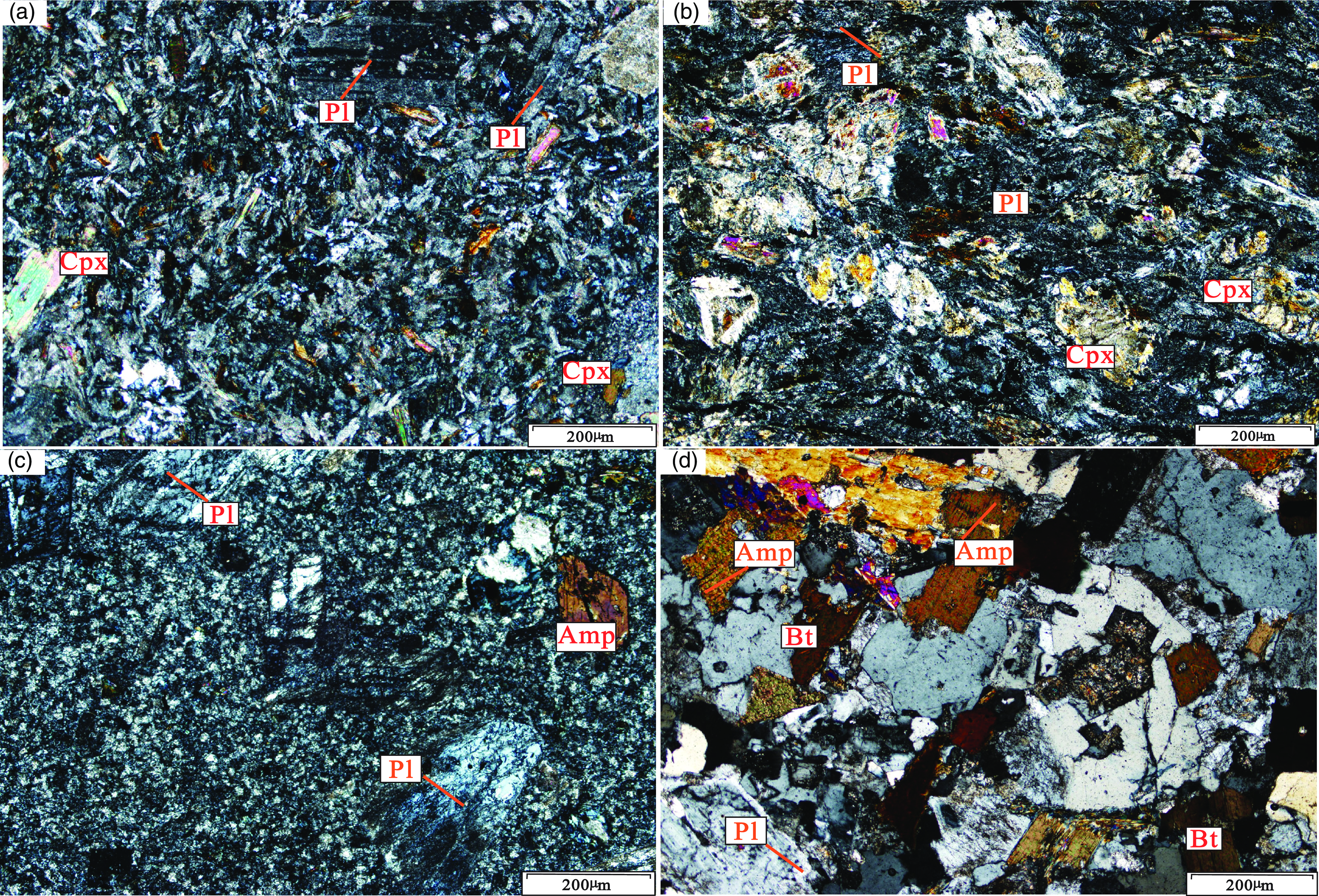
Photomicrographs of the basalt, gabbro and granodiorite rock samples collected from the Tongjiang-Fuyuan area, NE China. (a), Basalt (17TJ2). (b), Gabbro (17TJ5-1). (c), Fine-grained granodiorites (17FY3). (d), Coarse-grained granodiorites (17FY9). Pl = plagioclase; Cpx = clinopyroxene; Bt = biotite; Amp = amphibolite.

Mineral association and petrographic characteristics of the investigated Tongjiang-Fuyuan magmatic rocks

Basalts (17TJ2) exhibit porphyritic textures with phenocrysts of clinopyroxene (70%) and minor plagioclase (25%). Clinopyroxene phenocrysts are 100–150 µm in size and display irregularity and obvious fractures. Minor plagioclase phenocrysts are 90–120 µm in size and display polysynthetic twinning (Fig. 4a). The matrix is composed of plagioclase microlites, granular clinopyroxene, chlorite and opaque minerals (Fe-Ti oxide). Many clinopyroxenes are partially to completely replaced by chlorite and opaque minerals (Fig. 4a).
Gabbros (17TJ5-1) display a diabase structure and consist of orthopyroxene (50%), plagioclase (45%), chlorite and Fe-Ti oxides (opaque minerals). Plagioclases are relatively subhedral and vary from 200 to 400 µm in size. The clinopyroxenes are subhedral and partly replaced by chlorite (Fig. 4b).
Granodiorites (17FY3) display fine-grained granitic textures, and have the mineral assemblage of plagioclase (∼50%) and quartz (∼35%), with a minor amount of hornblende and biotite. Plagioclases are subhedral and vary from 150 to 300 µm. Quartz is subhedral to anhedral and 70–110 µm in size (Fig. 4c).
Granodiorites (17FY9) display coarse-grained granitic textures and are composed mainly of plagioclase (∼40%), quartz (∼35%), hornblende (20%) and biotite (15%). Plagioclases are euhedral and vary from 150 to 200 µm. Quartz is subhedral to anhedral and 200–400 µm in size (Fig. 4d).
3. Analytical methods
3.a Zircon U-Pb dating
Zircons were separated from crushed investigated samples using conventional heavy liquid and magnetic techniques and purified by handpicking under a binocular microscope at the Yuneng Mineral Separation Company in Hebei Province, China. The selected zircons were adhered to the surface of the epoxy resin and polished, and exposed to the surface of the zircon nuclear portion to make a target. The laser ablation-inductively coupled plasma-mass spectrometry (LA-ICP-MS) zircon U-Pb analyses were completed using an Agilent 7500a ICP-MS system equipped with a 193-nm laser at the Key Laboratory of Mineral Resources Evaluation in Northeast Asia, Ministry of Land and Resources, Jilin University.
To achieve the most accurate experimental results, the NIST SRM610, a reference material for synthetic silicate glass developed by the National Institute of Standards and Technology, was used to optimize the instrument. Harvard International Standard zircon 91500 zircon was selected as the experimental external standard to calibrate for elemental and isotopic fractionation. Isotope ratio data processing was performed by GLITTER (Ver. 4.0 Macquarie University). To reduce the effect of ordinary Pb on the test results, the experimental data were calibrated by Andersen (Reference Andersen2002) to correct the isotope ratios. The age calculation was performed using ISOPLOT 4.0.
3.b Bulk rock major and trace elements analyses
After trimming off weathered surfaces, the selected samples were crushed in an agate mill and sifted into fine powders (<200 mesh). Geochemical analyses were conducted at the Key Laboratory of Mineral Resources Evaluation in Northeast Asia, Ministry of Land and Resources, Jilin University. Major element compositions of bulk rock samples were determined using XRF, with analytical uncertainties ranging from 2% to 3%. Trace element concentrations were determined using ICP-MS (Agilent 7500a) after acid digestion of samples in Teflon bombs and dilution in 2% HNO3 in the same laboratory. The accuracy is generally better than 5% for trace and rare earth elements (REE).
4. Analytical results
4.a Zircon LA-ICP-MS U-Pb age
4.a.1 Sample 17TJ3 (Granodiorite)
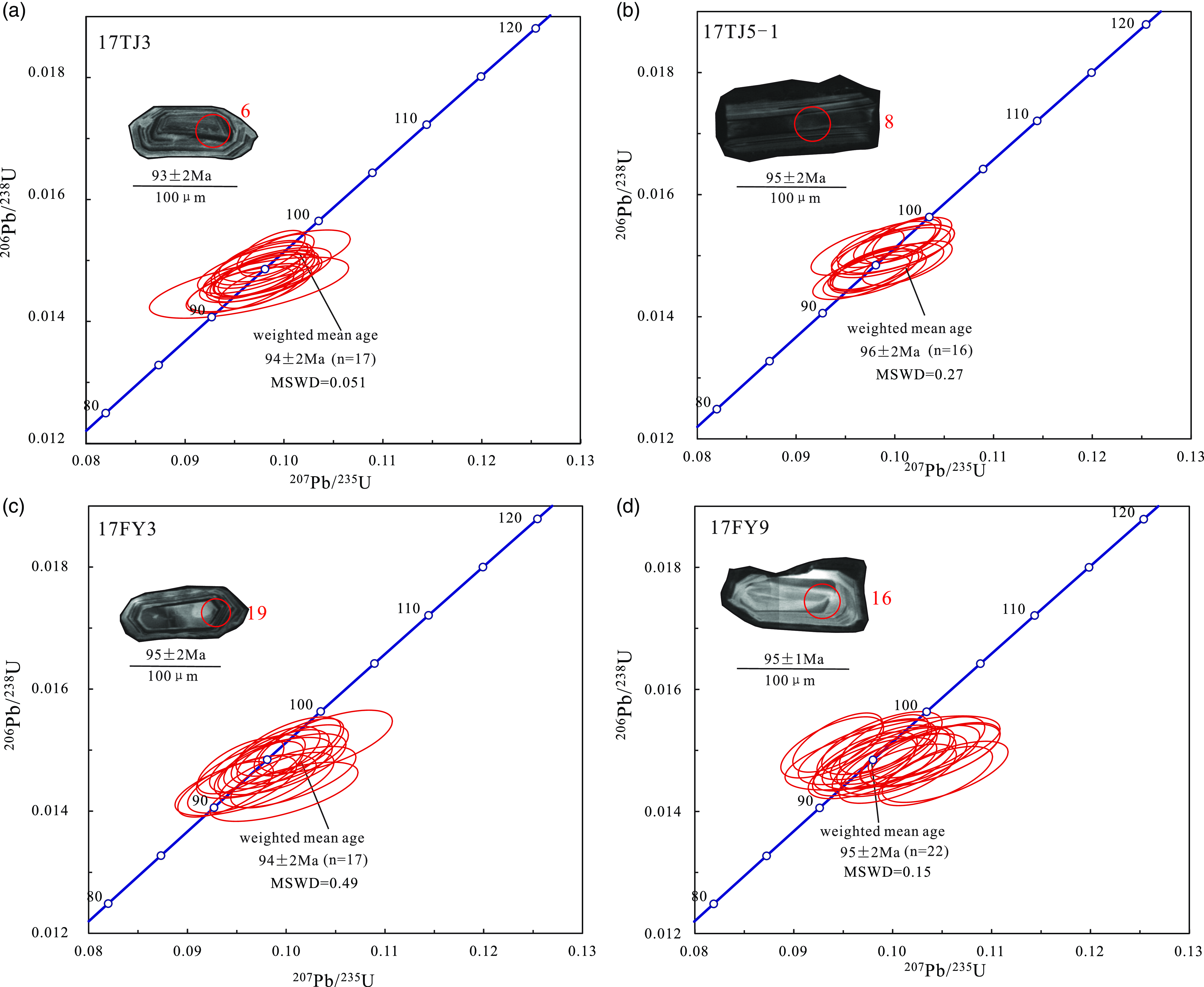
Zircon grains separated from the granodiorite are colourless, euhedral, or broken grains with varying long axial lengths (70–120 μm) and an axial ratio of ca. 1:1 to 2:1 (Fig. 5a). CL imaging reveals that most grains have fine oscillatory zones. Zircons have high U (118–884 ppm) and Th (80–570 ppm) with Th/U ratios of 0.37–0.97 (Table S1), together with the oscillatory zoning shown in the CL images, significantly indicating that they were magmatic zircon. 17 zircons yield apparent 206Pb/238U ages of 90–96 Ma, giving a weighted mean of 93 ± 2 Ma (MSWD = 0.05) (Fig. 5a).
Zircon U-Pb age concordia diagram and representative cathodoluminescence (CL) images of zircons from the Mesozoic magmatic rocks in the Tongjiang-Fuyuan area, NE China.

4.a.2 Sample 17TJ5-1(Gabbro)
Zircons selected from the gabbro are colourless, euhedral to subhedral grains and 50–100 μm in length, with an aspect ratio of 1:1 to 3:1 (Fig. 5b). CL imaging reveals that most grains are fairly dark with weak, banded zones, representing characteristic of mafic igneous origin (Baines et al., Reference Baines, Cheadle, John, Grimes, Schwartz and Wooden2009; Grimes et al., Reference Grimes, John, Cheadle, Mazdab, Wooden, Swapp and Schwartz2009; Koglin et al., Reference Koglin, Kostopoulos and Reischmann2009). Zircons have high U (266–1182 ppm) and Th (87–757 ppm) with Th/U ratios of 0.37–0.59, indicating that they are magmatic origin (Table S1). 16 zircons yield apparent 206Pb/238U ages of 93–97 Ma, giving a weighted mean of 95 ± 2 Ma (MSWD = 0.27) (Fig. 5b).
4.a.3 Sample 17FY3 (Granodiorite)
Zircons from granodiorite are colourless, transparent and subhedral to euhedral in shape. Their sizes range from 50 to 180 μm in length, with aspect ratios of 1.5:1 to 2:1 (Fig. 5c). CL images commonly show the oscillatory zonings for the investigated zircon grains. A total of 17 analyses were made on 17 zircons, they have U and Th contents and Th/U ratios ranging from 279 to 799 ppm, 124 to 270 ppm, and 0.25 to 0.78, respectively (Table S1). 17 zircons yield apparent 206Pb/238U ages of 90–98 Ma, giving a weighted mean of 95 ± 2 Ma (MSWD = 0.49) (Fig. 5c).
4.a.4 Sample 17FY9 (Granodiorite)
Zircons picked out from granodiorite are colourless, subhedral or broken grains. Their grain sizes range from 70 to 180 μm in length, with aspect ratios of 2:1 to 3:1 (Fig. 5d). CL image reveals that most grains have well-developed oscillatory zones, which is suggestive of a magmatic origin. A total of 22 analyses were made on 22 zircons, the zircons have U and Th contents and Th/U ratios in the range of 235–853 ppm, 66–357 ppm and 0.29–0.79 ppm, respectively (Table S1). 22 zircons show the apparent 206Pb/238U ages ranging from 90 Ma to 98 Ma and a weighted mean of 95 ± 1 Ma (MSWD = 0.85) (Fig. 5d).
4.b Bulk rock major and trace elements
4.b.1 Major and trace elements in mafic rocks (basalts and gabbros)
Total 2 basaltic and 2 gabbroic samples were selected from the Tongjiang-Fuyuan area for whole-rock major and trace element analysis (Table S2).
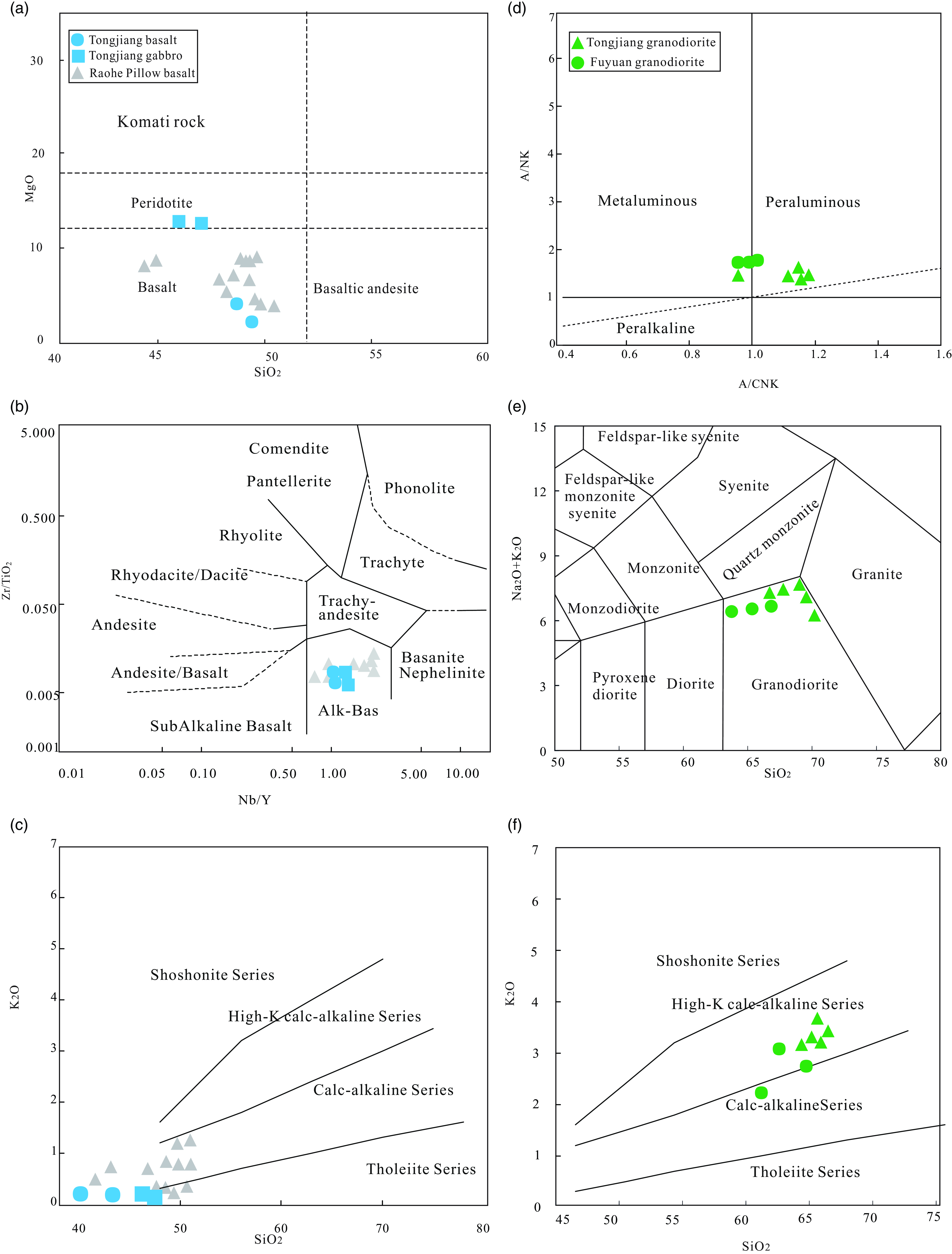
The basalts have SiO2 contents ranging from 42.79 to 49.33 wt%, total FeO from 10.50 to 11.19 wt%, MgO from 3.68 to 19.72 wt% and TiO2 from 1.35 to 1.67 wt%, while the gabbros are characterized by SiO2 (46.49–47.77 wt%), FeO (12.17–12.29 wt%), MgO (12.59–13.07 wt%) and TiO2 (2.06–2.26 wt%) (Table S1). In the MgO-SiO2 diagram (Fig. 6a), the basalts and gabbros plot in the basalt and the peridotite fields, respectively. In the Zr/TiO2-Nb/Y diagram (Fig. 6b), all the Tongjiang-Fuyuan basalts and gabbros and previously documented Raohe pillow basalts plot into the alkali basalt field. By contrast, the Tongjiang-Fuyuan gabbros have lower Al2O3 (11.25–11.45 wt %), higher Fe2O3 T (13.55–13.56 wt%) and lower Mg# [100Mg/ (Mg + Fe2+) = 64–65] than those of the Tongjiang-Fuyuan basalts (Al2O3 = 11.25–11.45 wt%, Fe2O3 T = 11.67–12.44 wt% and Mg# = 70–75). In the K2O-SiO2 diagram (Fig. 6c), the Tongjiang-Fuyuan gabbros and basalts fall into the tholeiite series and are similar to the Raohe pillow basalts in the geochemical characteristics.
Classification diagrams of the intermediate-acidic intrusive rocks in the Tongjiang-Fuyuan area, NE China, MgO-SiO2 (a; after Le Bas M J, Reference Le Bas2000), Zr/TiO2-Nb/Y (b; after Winchester and Floyd, Reference Winchester and Floyd1976), K2O-SiO2 (c; after Maniar and Piccoli, Reference Maniar and Piccoli1989), A/NK-A/CNK (d; after Peccerillo & Taylor, Reference Peccerillo and Taylor1976), Na2O+K2O-SiO2 (e; after Irvine and Barragar, Reference Irvine and Baragar1971), K2O-SiO2 (f; after Maniar & Piccoli, Reference Maniar and Piccoli1989). Data for the Raohe pillow basalts are cited from Zhou et al., Reference Zhou, Cao, Wilde, Zhao, Zhang and Wang2014 and Zeng et al., 2018.

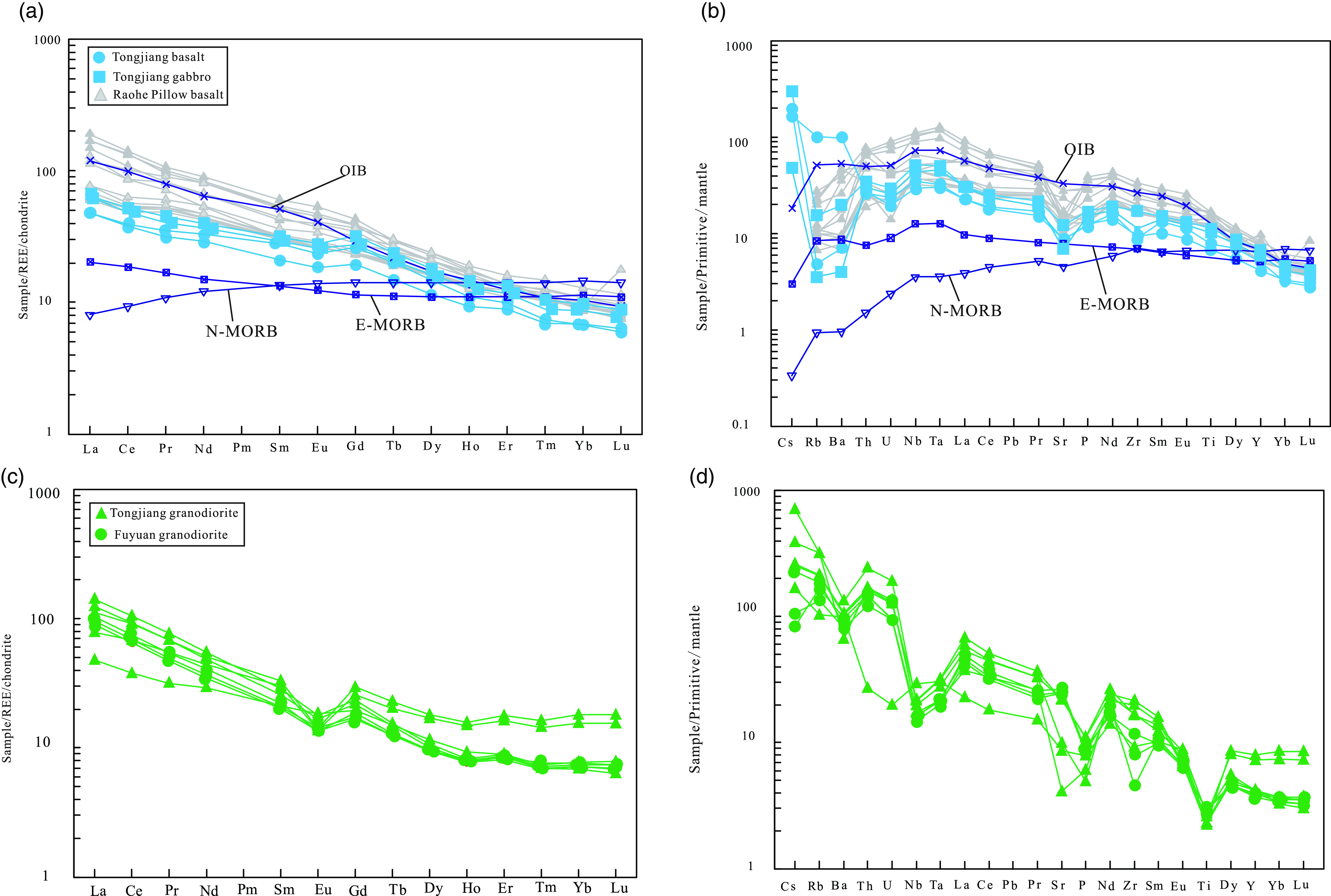
Considering the chondrite-normalized REE patterns, the Tongjiang-Fuyuan basalts have relatively higher ΣREE (86.27–95.27 ppm) and LREE/HREE (4.55–5.21 ppm), and show strong LREE enrichment, with (La/Yb) N ratios ranging from 6.95 to 7.15. All the facts suggest the basalts have the geochemical characteristics of ocean island basalt (OIB) affinity (Fig. 7a). Similarly, the Tongjiang-Fuyuan gabbros (17TJ5-1A, B) also show the characteristics of the OIB-affinity (Fig. 7a).
Chondrite normalized REE patterns (a and c, normalization values after Boynton, Reference Boynton1984) and primitive mantle normalized trace elements spider diagram (b and d, normalization values after Sun and McDonough, Reference Sun and McDonough1989) of Tongjiang-Fuyuan area, NE China. (a, b) basalts and gabbros. (c, d) granodiorites. Data for Raohe pillow basalts are cited from Zhou et al., Reference Zhou, Cao, Wilde, Zhao, Zhang and Wang2014 and Zeng et al., 2018. OIB = ocean island basalt. E-MORB = Enriched mid-ocean ridge basalt. N-MORB = Normal mid-ocean ridge basalt.

In the primitive mantle (PM) normalized multi-element diagram (Fig. 7b), both the Tongjiang-Fuyuan gabbros and basalts show similar patterns to the present-day OIB-affinity, which are geochemically enriched in high field strength elements (HFSE; such as Nb, Ta, Hf and Zr) and relatively enriched in large-ion lithophile elements (LILE; e.g. Rb, Sr and Ba), together with the slightly negative Eu (Eu/Eu* = 0.87–0.91) anomalies (Fig. 7b).
4.b.2 Major and Trace elements in intermediate-acidic rocks (granodiorites)
Total 8 granodiorites were selected from Tongjiang-Fuyuan for whole-rock major and trace element analysis (Table S1).
The granodiorites have SiO2 contents ranging from 65.18 to 71.06 wt%, Na2O from 2.31 to 4.39 wt%, and K2O from 2.26 to 3.98 wt%. Additionally, all the granodiorites are characterized by relatively low TiO2 (0.45–0.60 wt%), Al2O3(14.26–15.87 wt%), Fe2O3 T (3.19–4.28 wt%), MgO (1.02–2.31 wt%) in their geochemical compositions. In the A/NK vs. A/CNK diagram (Fig. 6d), they show quasi-aluminous to weakly peraluminous characteristics. In the Na2O+K2O-SiO2 diagram (Fig. 6e), all the granodiorites fall in the granodiorite category. In the K2O-SiO2 diagram (Fig. 6f), the granodiorites show a transitional character of high K-medium K-Ca alkaline series.
Granodiorites have relatively high ΣREE (124.29–193.57 ppm) and show strongly enriched in LREE and extremely depleted in HREE (LREE/HREE = 5.51–12.03), with (La/Yb) N ratios ranging from 5.04 to18.38 (Fig. 7c). In the primitive mantle (PM) normalized multi-element diagram (Fig. 7d), all granodiorites show enrichment of LILEs (e.g. Rb, Ba and Sr) and depletion of HFSEs (such as Nb, Ta, Zr and Hf) and P, with negative Eu (Eu/Eu*=0.45–0.71) anomaly (Fig. 7d).
5 Discussion
5.a Origin of the Tongjiang-Fuyuan Mesozoic magmatic rocks
5.a.1 Mafic rocks
The active elements of Rb, K, Ba and Sr are greatly affected by weathering in the process of metamorphism and alteration. On the contrary, the trace elements, e.g. Nb, Ta, Zr, Hf and Y, are inactive elements, and their contents will not change due to weathering, alteration and certain metasomatism. Moreover, its content does not vary with the degree of partial melting of mantle rocks and the degree of separation and crystallization of basaltic magma (Li, Reference Li1992; Janney and Castillo, Reference Janney and Castillo1996).
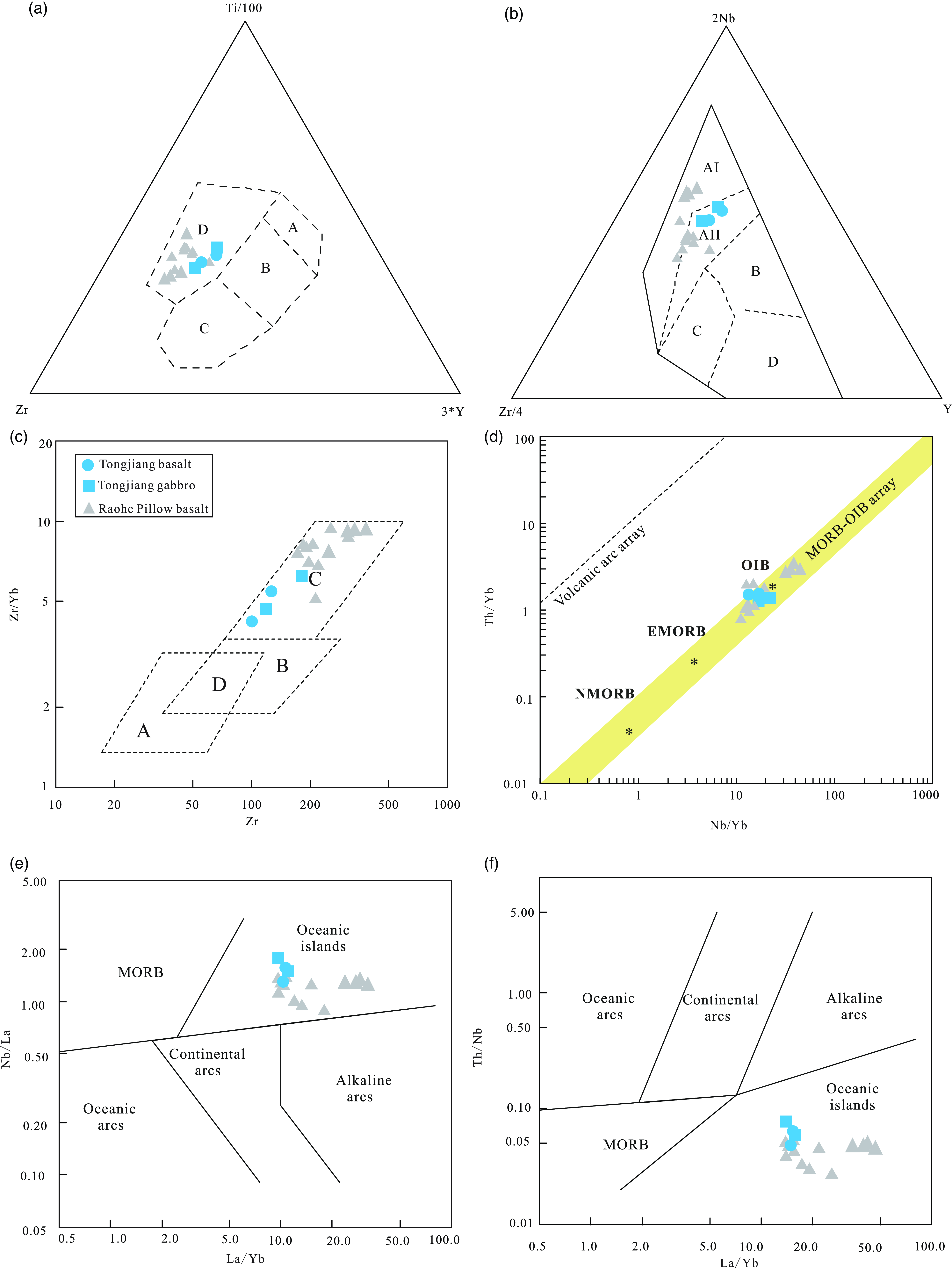
According to the analysis, the mafic rocks (basalts and gabbros) have high TiO2, MgO and low Al2O3, CaO, P2O5 and K2O. Furthermore, these samples exhibit an enrichment in LILEs (Rb, Sr and Ba), and they display right-inclined trend curves on both the trace element spider and rare earth element distribution diagrams, with ΣLREE/ΣHREE ratios ranging from 4.55 to 5.21. Additionally, there is no or slightly negative δEu anomalies (0.87–0.91). All of the analysed mafic rocks have relatively high Nb and Ta contents (Nb > 1.73 ppm, Ta > 0.14 ppm), distinguishing them from arc-related basalts. In the Ti/100-Zr-3*Y (Fig. 8a), Nb*2-Zr/4-Y (Fig. 8b) and Zr/Yb-Zr (Fig. 8c) diagrams, the Tongjiang-Fuyuan basalts and gabbros plot in the within-plate field, consistent with that of the previous reported Raohe pillow basalts. In addition, in the Th/Yb-Nb/Yb diagram (Fig. 8d), the Tongjiang-Fuyuan mafic rocks plot in the MORB-OIB array. Similarly, in the Nb/La-La/Yb (Fig. 8e) and Th/Nb-La/Yb (Fig. 8f) diagrams, they also plot in oceanic islands. In general, Tongjiang-Fuyuan mafic rocks (gabbros and basalts) are mainly formed in intraplate environments and the oceanic island-related tectonic setting. Therefore, it can be concluded that the Tongjiang-Fuyuan mafic rocks are fragments of oceanic island seamount (Fan et al., Reference Fan, Li, Niu, Xie and Wang2021).
Discriminant diagrams of the Tongjiang gabbros and basalts, Ti/100-Zr-3*Y, 2Nb-Zr/4-Y(a,b; after Pearce & Cann, Reference Pearce and Cann1973), Zr/Yb-Zr, Th/Yb-Nb/Yb(c,d; after Pearce & Norry, Reference Pearce and Norry1979), Nb/La-La/Yb and Th/Nb-La/Yb(e,f; after Hollocher et al., Reference Hollocher, Robinson, Walsh and Roberts2012). Data for Raohe pillow basalts are cited from Zhou et al., Reference Zhou, Cao, Wilde, Zhao, Zhang and Wang2014 and Zeng et al., 2018. In the Ti/100-Zr-3*Y diagram, A-Island-arc tholeiite; B-Mid-Ocean ridge basalt/ Calc-alkali basalt/Island-arc tholeiite; C-Calc-alkali basalt; D-Within-plate basalt. In the 2Nb-Zr/4-Y diagram, AI-Within-plate alkali basalt; AII-Within-plate tholeiite; B-Plume-influenced mid-ocean ridge basalt; C-Within-plate tholeiite/ volcanic arc basalt; D-Volcanic arc basalt/ Normal mid-ocean ridge basalt. In the Zr/Yb-Zr diagram, A-Island-Arc Basalts; B-Mid-Ocean Ridge Basalt; C-Within-Plate Basalts; D-Mid-Ocean Ridge Basalt/ Island-Arc Basalt. OIB = Ocean Island basalt. E-MORB = Enriched mid-ocean ridge basalt. N-MORB = Normal mid-ocean ridge basalt.

Compared with the Raohe Complex, the previous studies suggested that they were a set of mafic-ultramafic rocks composed of peridotite, pyroxene peridotite, hornblendite, cumulate gabbro, diabase and pillow basalt (Tian et al., Reference Tian, Zhou, Zheng and Liu2006; Bi et al., Reference Bi, Ge, Yang, Wang, Xu, Yang, Xing and Chen2016, Reference Bi, Ge, Yang, Wang, Dong, Liu and Ji2017a; He et al., Reference He, Sun, Zhang, Wan, Zheng and Li2016, 2017b; Cao et al., Reference Cao, Zhou and Li2019; Han et al., Reference Han, Liu, Zhou, Zhang and Fan2022). Regarding the tectonic setting of these mafic-ultramafic rocks, Zhang and Zhou (Reference Zhang and Zhou2001) suggested that the basalts or pillow lavas developed in the Raohe area were formed in an oceanic environment and have the characteristics of OIB-affinity. Further, Zhou et al. (Reference Zhou, Cao, Wilde, Zhao, Zhang and Wang2014) regarded that the geochemical characteristics of pillow basalts exposed in the Raohe-Guanmen area are similar to those of OIB. As discussed before, the gabbros and basalts in the Tongjiang-Fuyuan area are also originated in intraplate environments and oceanic island-related tectonic settings, exhibiting the characteristics of OIB, which is consistent with characteristics of the Raohe ophiolitic basalts.
As is well known, the OIB-related magma is formed through contributions from different endmember components such as mantle plume, asthenosphere, lithospheric mantle (e.g. Xu, Reference Xu2002; Zeng et al., 2018). Besides, the OIB samples show much higher ratios of Ta/Hf, Th/Yb and Ta/Yb, and such strong enrichment in highly incompatible elements may indicate partial melting of a mantle source (Aldanmaz, Reference Aldanmaz2002). Further, Mg# values (64–75, avg. = 67) of the mafic rocks in this study are lower than the primary magma range (68–75), indicating that the magma undergoes crystallization fractionation. The Tongjiang gabbros and basalts are high in MgO contents (3.68–19.72 wt%, 8.95 wt% on average), enriched in LREEs, and have ‘Th’ peaks on the normalized spider diagram of trace elements (Fig. 7b), implying that the source area may have the characteristics of a mantle plume (Hou et al., Reference Hou, Mo, Zhu and Sheng1996). A similar conclusion has been drawn for the OIB magmatic rocks in the Raohe area (e.g. Wang et al., 2013).
In summary, the Tongjiang-Fuyuan gabbros and basalts in this study show obvious characteristics of OIB and generally relate to the mantle plume within the Palaeo-Pacific plate, consistent with the origin of the Raohe ophiolites (Zhou et al., Reference Zhou, Cao, Wilde, Zhao, Zhang and Wang2014).
5.a.2 Intermediate-acidic intrusive rocks
The granodiorites, collected from the Tongjiang-Fuyuan area, have relatively high SiO2, Al2O3 and Na2O+K2O contents, and low MgO, Fe2O3 and CaO, indicating that the magma originated from partial melting of crustal materials (Barbarin, Reference Barbarin1999). In addition, these samples are enriched in LREEs and LILEs, and deficient in HREEs and HFSEs, indicating that the magma was formed in the lower crust (Taylor & McLennan, Reference Taylor and McLennan1985; Hofmann, Reference Hofmann1988; Wu et al., Reference Wu, Li, Yang and Zheng2007; Zhang et al., Reference Zhang, Zhou, Chi, Wang and Hu2008).
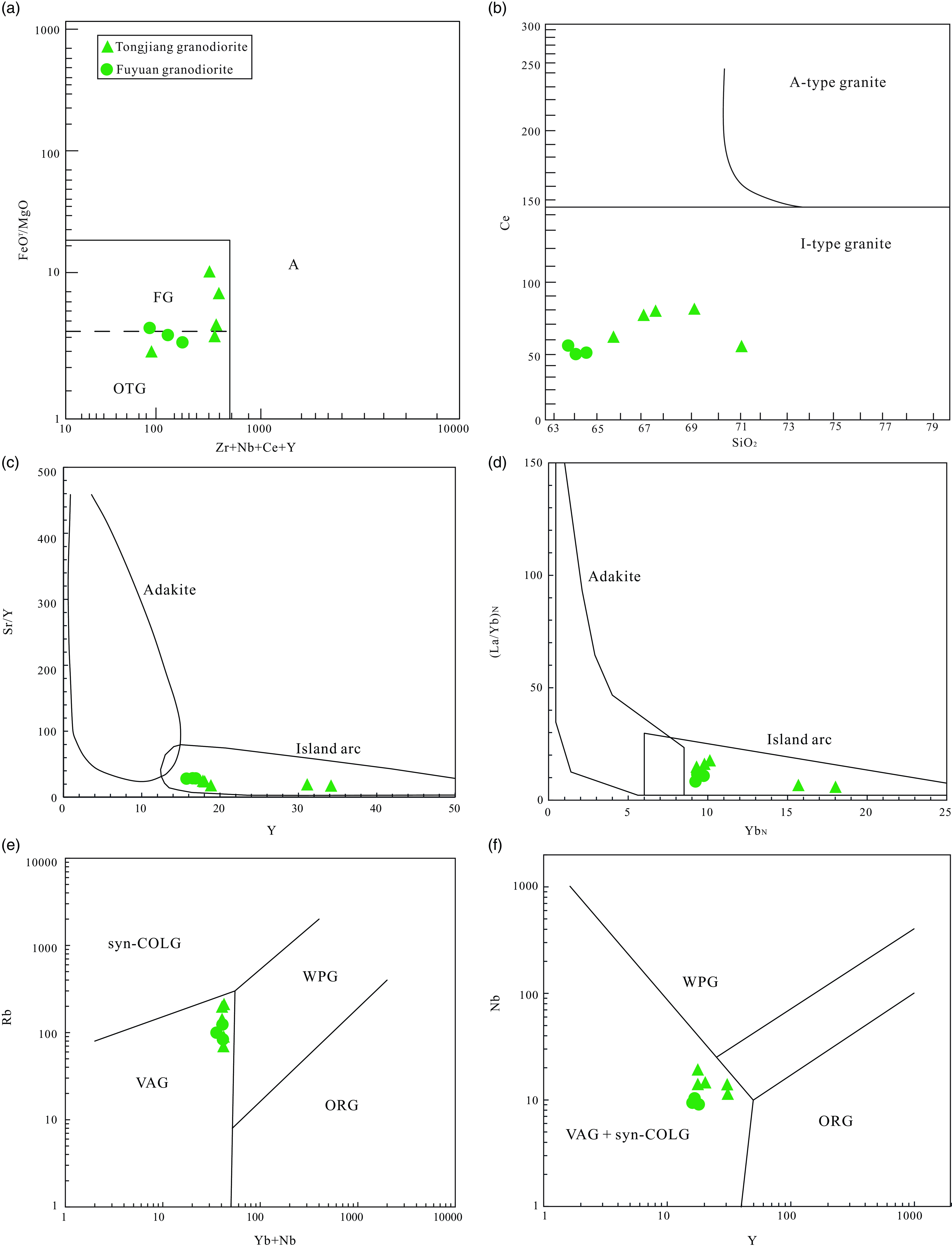
The I-type granites were derived from the lower part of the continental crust at the margin of convergent plates, and the source rocks were probably mantle-derived underplating (Pitcher, Reference Pitcher1993). In the FeOT/MgO-(Zr+Nb+Y+Ce) diagram (Fig. 9a) and Ce-SiO2 diagram (Fig. 9b), the granodiorites plot in the I-type granite field. In the Sr/Y-Y diagram (Fig. 9c) and (La/Yb) N-YbN diagram (Fig. 9d), the granodiorites plot in the island-arc field. Further, in the Rb-Y+Nb diagram (Fig. 9e) and Nb-Y diagram (Fig. 9f), the granodiorites fall within the volcanic island-arc area. Therefore, we propose that the granodiorites from the Tongjiang-Fuyuan area are I-type granites, which may be formed in the lower crust and polluted by mantle-derived materials, and generally formed in a volcanic arc environment.
Discrimination diagrams of Tongjiang-Fuyuan granodiorites, FeOT/MgO-(Zr+Nb+Y+Ce) (a; after Whalen et al., Reference Whalen, Currie and Chappell1987), Ce-SiO2 (b; after Whalen et al., Reference Whalen, Currie and Chappell1987), Sr/Y-Y (c), (La/Yb) N-Yb N (d; after Hansen et al, Reference Hansen, Skjerlie, Pedersen and De La Rosa2002), Rb-Yb+Nb (e), Nb-Y (f; after Pearce et al, Reference Pearce, Harris and Tindle1984). Syn-COLG = syn-collisional-granites; VAG = volcanic arc granites; ORG = oceanic ridge granites; WPG = within-plate granites.

Besides, the REE distribution mode of the granodiorites in this area has a right-inclined trend, and are enriched in LILEs, and deficient in HFSEs, especially Ti, Nb and Ta. Trace element characteristics suggest that the granodiorite in the Tongjiang-Fuyuan area might originate from partial melting of the lower crust (Yu et al., Reference Yu, Wang, Wang, Ren, You and Gao2017). In conclusion, all the facts suggest that the granodiorites from Tongjiang-Fuyuan are island-arc magmatic rocks, and the magma may originate from the partial melting of the lower crust.
5.b Formation age of the Tongjiang-Fuyuan Mesozoic magmatic rocks
Field investigation and rock associations show that the predominant rock types in the Tongjiang-Fuyuan region are siliceous rocks, gabbro, metamorphic sandstone, basalt and so on, which are typical ophiolite mélange types and are present with granodiorite intrusion. The zircon LA-ICP-MS U-Pb data from a gabbroic sample (17TJ5-1) and three granodiorite samples (17TJ3, 17FY3 and 17FY9) yield the weighted mean age of 95 ± 2 Ma (Fig. 5b) and 93–95 Ma (Fig. 5a, c and d).
According to the previous studies, the Raohe Complex is considered as the subduction-accretionary product of the Palaeo-Pacific plate (Zhou et al., Reference Zhou, Cao, Wilde, Zhao, Zhang and Wang2014; Bi et al., Reference Bi, Ge, Yang, Wang, Xu, Yang, Xing and Chen2016, Reference Bi, Ge, Yang, Wang, Dong, Liu and Ji2017a, Reference Bi, Ge, Yang, Wang, Tian, Liu, Xu and Xing2017b; Ge et al., Reference Ge, Zhang, Liu, Ling, Wang and Wang2016; Zhou et al., 2017; Han et al., Reference Han, Liu, Zhou, Zhang and Fan2022), and their formation ages of magmatic rocks (pillow basalt and gabbro) and intermediate acid intrusive rocks (granite) in the Raohe area are 167–168 Ma and 128–129 Ma, respectively (Cheng et al., Reference Cheng, Wu, Ge, Sun, Liu and Yang2006; Zhou et al., Reference Zhou, Cao, Wilde, Zhao, Zhang and Wang2014; Zeng et al., 2019; Han et al., Reference Han, Liu, Zhou, Zhang and Fan2022). In this study, zircon age analysis shows that gabbro and granodiorite in the Tongjiang-Fuyuan area are 93–95 Ma. Therefore, the Tongjiang-Fuyuan mafic rocks and intermediate acid intrusive rocks resemble the Raohe Complex in nature but are younger in age, proving that they are the results of continuous subduction-accretion of the Palaeo-Pacific plate.
In addition, in the northeastern NE China, synchronous magmatism was also discovered by predecessors, for instance, the gabbros (96–101 Ma) in the eastern Jixi Basin (Zhu et al., Reference Zhu, Liu, Ma, Qiu and Ma2009), the diorites (97.5 Ma) in the Shuangyashan Basin (Zhang et al., Reference Zhang, Han, Zhu, Xu, Chen and Song2009), the olive trachyandesites (88 Ma) in the Songliao Basin (Wang et al., Reference Wang, Gao, Ren, Liu and Zhang2009), the dacites (93.2 Ma) in the Suifenhe region (Ji et al., Reference Ji, Xu, Yang, Pei, Jin and Liu2007), the alkaline basalts (81.6 Ma) in Qujiatun of Liaodong (Wang et al., Reference Wang, Xu, Ji, Yang and Pei2006) and so on. All of the Late Cretaceous magmatic rocks were interpreted as the subduction-related magmatism, significantly suggesting the continuous subduction of the Palaeo-Pacific plate beneath the eastern margin of the JB till to Late Cretaceous (∼80 Ma).
5.c Tectonic implications
5.c.1 Subduction and rollback of the Palaeo-Pacific plate
During the Mesozoic, the tectonic evolution of the Northeast Asian continental margin was mainly influenced by the subduction of the Palaeo-Pacific plate, which has been recognized by many geologists. A large number of magmatic belts were formed along the Northeast Asian continental margin along with the subduction of the Palaeo-Pacific plate (e.g. Wu et al., Reference Wu, Li, Yang and Zheng2007, Reference Wu, Sun, Ge, Zhang, Grant, Wilde and Jahn2011; Sun et al., 2013, Xu et al., Reference Xu, Pei, Wang, Meng, Ji, Yang and Wang2013; Reference Sun, Xu, Wilde, Chen and Yang2015a; Wilde, Reference Wilde2015). Notably, a Mesozoic subduction-related magmatic belt with NNE-trending distribution is widely developed in the eastern continental margin of the Northeast Asia, extending from the Russian Far East, via NE China to the SW Japan (e.g. Isozaki, 1997; Lin et al., Reference Lin, Ge, Sun, Wu, Yuan, Min, Chen, Li, Quan and Yi1998; Shao & Tang, Reference Shao and Tang2015; Li et al., Reference Li, Liu, Zhao, Feng, Zhou, Wen, Liang and Zhang2020). In the NE China, these magmatic rocks are mainly distributed in the SXB (Such as Yichun area, Nenjiang area, and Tuanshanzi area; Zhang et al,.2007; Ji et al., Reference Ji, Meng, Wan, Ge, Yang, Zhang, Dong and Jin2019; Pei et al., 2008), in the JB (such as Boli area, Jixi area and Jiamusi area; Sun et al., 2013, Reference Sun, Chen, Zhang, Wilde, Minna, Lin and Yang2014) and in the NT (such as Raohe area, Yuejinshan area, Tongjiang-Fuyuan area; Yu et al., Reference Yu, Hou, Ge, Zhang and Liu2013; Zhou et al., Reference Zhou, Cao, Wilde, Zhao, Zhang and Wang2014, Reference Zhou, Wang and Wang2015). A large number of geochronological and geochemical studies have been carried out on the magmatic rocks from the SXB, JB and NT and proposed that the formation age of various magmatic rocks is mainly Mesozoic, and their tectonic environment is closely related to the westward subduction of the Palaeo-Pacific plate (e.g. Cheng et al., Reference Cheng, Wu, Ge, Sun, Liu and Yang2006; Liu et al., Reference Liu, Chi, Dong, Zhao, Li and Zhao2008; Li et al., Reference Li, Takasu, Liu, Genser, Zhao, Han and Guo2011; Wu et al., Reference Wu, Sun, Ge, Zhang, Grant, Wilde and Jahn2011; Zhang et al., Reference Zhang, Chen, Yu, Dong, Yang, Pang and Batt2011; Yu et al., Reference Yu, Hou, Ge, Zhang and Liu2013; Sun et al, 2013, 2015; Zhou et al., Reference Zhou, Cao, Wilde, Zhao, Zhang and Wang2014, Reference Zhou, Wang and Wang2015; Bi et al, Reference Bi, Ge, Yang, Zhao, Xu and Wang2015; Wang et al., Reference Wang, Ge, Yang, Zhang, Bi, Tian and Xu2015, Reference Wang, Yang, Huang, Hou, Tang and Zhang2016; Yang et al, Reference Yang, Ge, Zhao, Yu and Zhang2015; Zhu et al, Reference Zhu, Zhao, Sun, Liu, Han, Hou, Zhang and Eizenhofer2015; Ge et al, Reference Ge, Zhang, Liu, Ling, Wang and Wang2016, Reference Ge, Zhang, Liu, Ling, Wang and Wang2017, Reference Ge, Zhang, Li and Liu2019; Liu et al, Reference Liu, Zhang, Wilde, Zhou, Wang, Ge, Wang and Ling2017a, 2017b; Zeng et al., 2017, 2018; Dong et al, Reference Dong, Ge, Yang, Liu, Bi, Ji and Xu2019; Ji et al, Reference Ji, Meng, Wan, Ge, Yang, Zhang, Dong and Jin2019; Li et al., Reference Li, Liu, Zhao, Feng, Zhou, Wen, Liang and Zhang2020).
Meanwhile, previous studies show that in the late Early Cretaceous, the magmatic rocks in northeast China are mainly distributed in EB, XB, SXB, JB and NT. (e.g. Zhou et al., Reference Zhou, Cao, Wilde, Zhao, Zhang and Wang2014, Reference Zhou, Wang and Wang2015; Bi et al, Reference Bi, Ge, Yang, Zhao, Xu and Wang2015; Wang et al., Reference Wang, Ge, Yang, Zhang, Bi, Tian and Xu2015, Reference Wang, Yang, Huang, Hou, Tang and Zhang2016; Yang et al, Reference Yang, Ge, Zhao, Yu and Zhang2015; Zhu et al, Reference Zhu, Zhao, Sun, Liu, Han, Hou, Zhang and Eizenhofer2015; Zeng et al, 2017, 2018; Liu et al., Reference Liu, Feng, Jiang, Jin, Li, Guan, Wen and Liang2019; Li et al., Reference Li, Liu, Zhao, Feng, Zhou, Wen, Liang and Zhang2020). The distribution characteristics of magmatic rocks during the Late Early Cretaceous period suggest that the Palaeo-Pacific plate began a wide range of low-angle subduction to Eurasia, and the magmatic range in NE China contracted to the east, suggesting the eastward drift of the Eurasia continent and the rollback of the Palaeo-Pacific subduction plate (e.g. Engebretson et al., Reference Engebretson, Cox and Gordon1985; Maruyama et al., Reference Maruyama, Isozaki, Kimura and Terabayashi1997; Yu et al., Reference Yu, Hou, Ge, Zhang and Liu2013; Sun et al., 2013, Reference Sun, Chen, Zhang, Wilde, Minna, Lin and Yang2014; Li et al., Reference Li, Liu, Zhao, Feng, Zhou, Wen, Liang and Zhang2020).
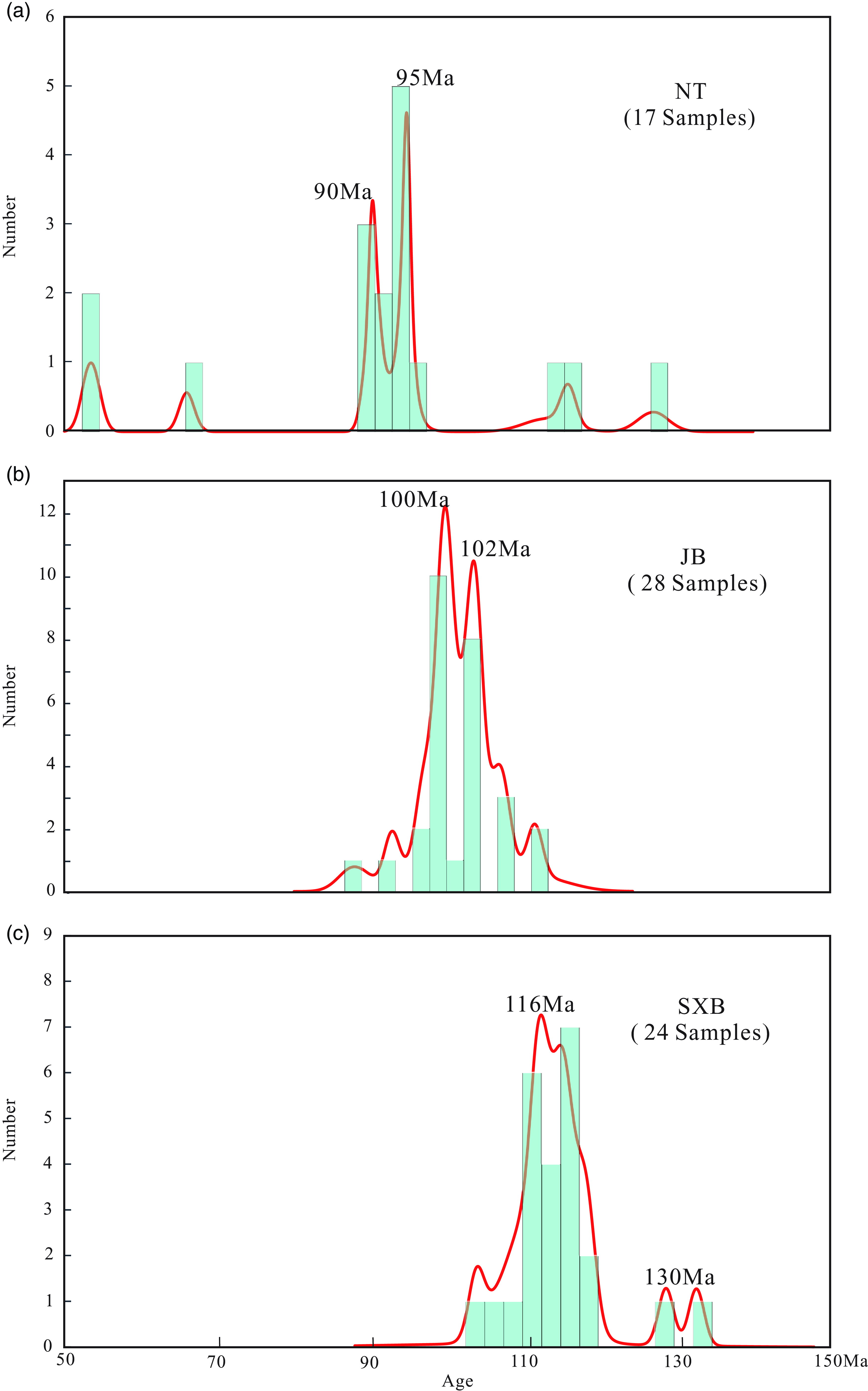
This research gathers various ages from the SXB to the NT based on other investigations on the chronology of magmatic activity in NE China (Fig. 10). The ages of the Mesozoic magmatic rocks in the SXB, JB, and NT areas reveal a west-to-east and old-to-young trend of magmatic activity in NE China, especially during the Cretaceous (145–190 Ma) (Fig. 10). Such a pattern, which indicates the tectonic rollback process of the Palaeo-Pacific plate, is perfectly consistent with the subduction rollback pattern revealed by previous researchers (Sun et al., 2013, Reference Sun, Chen, Zhang, Wilde, Minna, Lin and Yang2014; Li et al., Reference Li, Liu, Zhao, Feng, Zhou, Wen, Liang and Zhang2020).
Age distributions of the Mesozoic subduction-related magmatic rocks in the NT (a), JB (b) and SXB (c).
Data source: Bi et al., Reference Bi, Ge, Yang, Zhao, Xu and Wang2015; Ji et al., Reference Ji, Meng, Wan, Ge, Yang, Zhang, Dong and Jin2019; Pei et al., Reference Pei, Xu, Yang, Ji, Yu and Zhang2008; Sun et al., 2013, Wu et al., Reference Wu, Sun, Ge, Zhang, Grant, Wilde and Jahn2011; Yu et al., Reference Yu, Hou, Ge, Zhang and Liu2013; Reference Sun, Chen, Zhang, Wilde, Minna, Lin and Yang2014; Zhang et al., 2007, Reference Zhang, Chen, Yu, Dong, Yang, Pang and Batt2011; Zhou et al., Reference Zhou, Cao, Wilde, Zhao, Zhang and Wang2014, Reference Zhou, Wang and Wang2015.

5.c.2 Mesozoic tectonic evolution of the eastern NE China
The formation and evolution of the East Asian continental margin have involved complicated tectonomagmatic processes, including subduction, accretion and magmatism. Furthermore, the tectonic processes are characterized by the ‘transform’ nature or strike-slip displacement of individual terranes or blocks of different tectonic history (e.g. Kojima, Reference Kojima1989; Khanchuk, Reference Khanchuk2001, Reference Khanchuk2006; Kirilova, Reference Kirilova2003; Kemkin, Reference Kemkin2008; Isozaki et al., 2010; Abrajevitch et al., Reference Abrajevitch, Zyabrev, Didenko and Kodama2012; Maruyama et al., Reference Maruyama, Isozaki, Kimura and Terabayashi1997; Zonenshain et al., Reference Zonenshain, Kuzmin and Natapov1990a; 2004b; Tazawa, Reference Tazawa2004). The tectonic evolution and crustal formation in NE China are intimately linked to the interaction between the Palaeo-Pacific (so-called Izanagi) and Eurasian plates. Besides, the quasi-continuous magmatism in Late Cretaceous of the NE China (Fig. 10) indicates that the Palaeo-Pacific plate subduction was long-term active. An important implication from the present geochronological work is that during Late Cretaceous the Palaeo-Pacific plate motion probably changed from a parallel or sub-parallel (magmatic quiescence) to oblique (active arc magmatism) relative to the continental margin of Sikhote-Alin (Zhou et al., Reference Zhou, Cao, Wilde, Zhao, Zhang and Wang2014; Tang et al., Reference Tang, Xu, Wang and Ge2018; Han et al., Reference Han, Liu, Zhou, Zhang and Fan2022). Late Cretaceous rapid sea-floor spreading at about 100 Ma (Larson & Pitman, 1972; Larson, 1991) induced highly active subduction and led to voluminous magmatism in the entire circum-Pacific areas (Jahn, Reference Jahn1974).
A large part of the Russian Far East is built up of accretionary complexes that formed along the convergent margin during the Cretaceous. A complex distribution of coeval complexes as well as juxtaposition of different age units indicates a considerable margin-parallel translation of terranes, which was represented by the sinistral strike-slip fault systems in the region, of which the Central Sikhote-Alin Fault is the most celebrated (e.g. Khanchuk, Reference Khanchuk2001, Reference Khanchuk2006; Otsuki, Reference Otsuki1992; Sengor & Natal’in, Reference Sengor and Natal’in1996; Tazawa, Reference Tazawa2004). A palaeomagnetic study led Abrajevitch et al. (Reference Abrajevitch, Zyabrev, Didenko and Kodama2012) to hypothesize that the West Sakhalin Basin has moved from sub-equatorial latitude during the early Cretaceous to about 40°N by the late Cretaceous. Similarly, the NT of NE China was probably accreted to the Asian continental margin from low latitude during the late Mesozoic (Mizutani & Kojima, Reference Mizutani and Kojima1992).
As described earlier, the NT is mainly divided into Yuejinshan Complex and Raohe Complex (Bi et al., Reference Bi, Ge, Yang, Zhao, Xu and Wang2015, Reference Bi, Ge, Yang, Wang, Xu, Yang, Xing and Chen2016, Reference Bi, Ge, Yang, Wang, Dong, Liu and Ji2017a, 2017b; Sun et al., Reference Sun, Xu, Wilde, Chen and Yang2015a; Wilde, Reference Wilde2015; Zeng et al., 2019; Li et al., Reference Li, Liu, Zhao, Feng, Zhou, Wen, Liang and Zhang2020; Xu et al., Reference Xu, Kong, Cheng and Zhou2020; Han et al., Reference Han, Liu, Zhou, Zhang and Fan2022). Zircon chronology and geochemistry indicated that the Yuejinshan Complex mainly consisted of siliceous rocks, MORB and broken seamount fragments (Zhou et al., Reference Zhou, Cao, Wilde, Zhao, Zhang and Wang2014, Reference Zhou, Wilde, Zhao and Han2018; Zhang et al., Reference Zhang, Liu, Li, Li, Iqbal and Chen2020). The formation age of the complex is 210–180 Ma (Zhou et al., Reference Zhou, Cao, Wilde, Zhao, Zhang and Wang2014; Zeng et al., 2018), while their protolith has a formation age of 310–270 Ma (Zhou & Li, Reference Zhou and Li2017; Li et al., Reference Li, Liu, Zhao, Feng, Zhou, Wen, Liang and Zhang2020). Besides, the Yuejinshan Complex may have formed because of the westward subduction of the Palaeo-Pacific plate (Zhou et al., Reference Zhou, Cao, Wilde, Zhao, Zhang and Wang2014; Li et al., Reference Li, Liu, Zhao, Feng, Zhou, Wen, Liang and Zhang2020; Han et al., Reference Han, Liu, Zhou, Zhang and Fan2022). The Raohe complex consists primarily of OIB, limestone, siliceous rock and seamount fragments (Zeng et al., 2019; Li et al., Reference Li, Liu, Zhao, Feng, Zhou, Wen, Liang and Zhang2020). It is emplaced between 133 Ma and 126 Ma (Zeng et al., 2017, 2019), and its protoliths range in age is from 228 Ma to 116 Ma (Cheng et al., Reference Cheng, Wu, Ge, Sun, Liu and Yang2006; Wang et al., Reference Wang, Yang, Huang, Hou, Tang and Zhang2016; Li et al., Reference Li, Liu, Zhao, Feng, Zhou, Wen, Liang and Zhang2020). It is believed that the Raohe Complex is the product of the subduction of the Palaeo-Pacific plate (Zhou et al., Reference Zhou, Cao, Wilde, Zhao, Zhang and Wang2014; Zeng et al., 2019; Li et al., Reference Li, Liu, Zhao, Feng, Zhou, Wen, Liang and Zhang2020; Han et al., Reference Han, Liu, Zhou, Zhang and Fan2022). However, the Late Cretaceous rocks in NT have been scarcely studied, and their link with the Palaeo-Pacific plate subduction is poorly understood.
In this paper, we collect mafic rocks (gabbro, basalt) and intermediate-acidic intrusive rocks (granodiorite) through field investigation in the northern of the NT (Tongjiang-Fuyuan area). Zircon LA-ICP-MS U-Pb results show that the formation age of the Tongjiang-Fuyuan mafic rocks (gabbros) and intermediate-acidic intrusive rocks (granodiorites) is 93–95 Ma. Besides, the results of geochemistry show that mafic rocks (gabbros) and intermediate-acidic intrusive rocks (granodiorites) in the Tongjiang-Fuyuan area are similar to Raohe Complex in nature and younger in age; therefore, it is newly named Tongjiang-Fuyuan Complex in this paper. More significantly, all the Late Cretaceous magmatic rocks show the characteristics of the subduction-related magmatism, we thus interpreted that the Tongjiang-Fuyuan Complex is also the product of the continuous subduction of the Palaeo-Pacific plate.
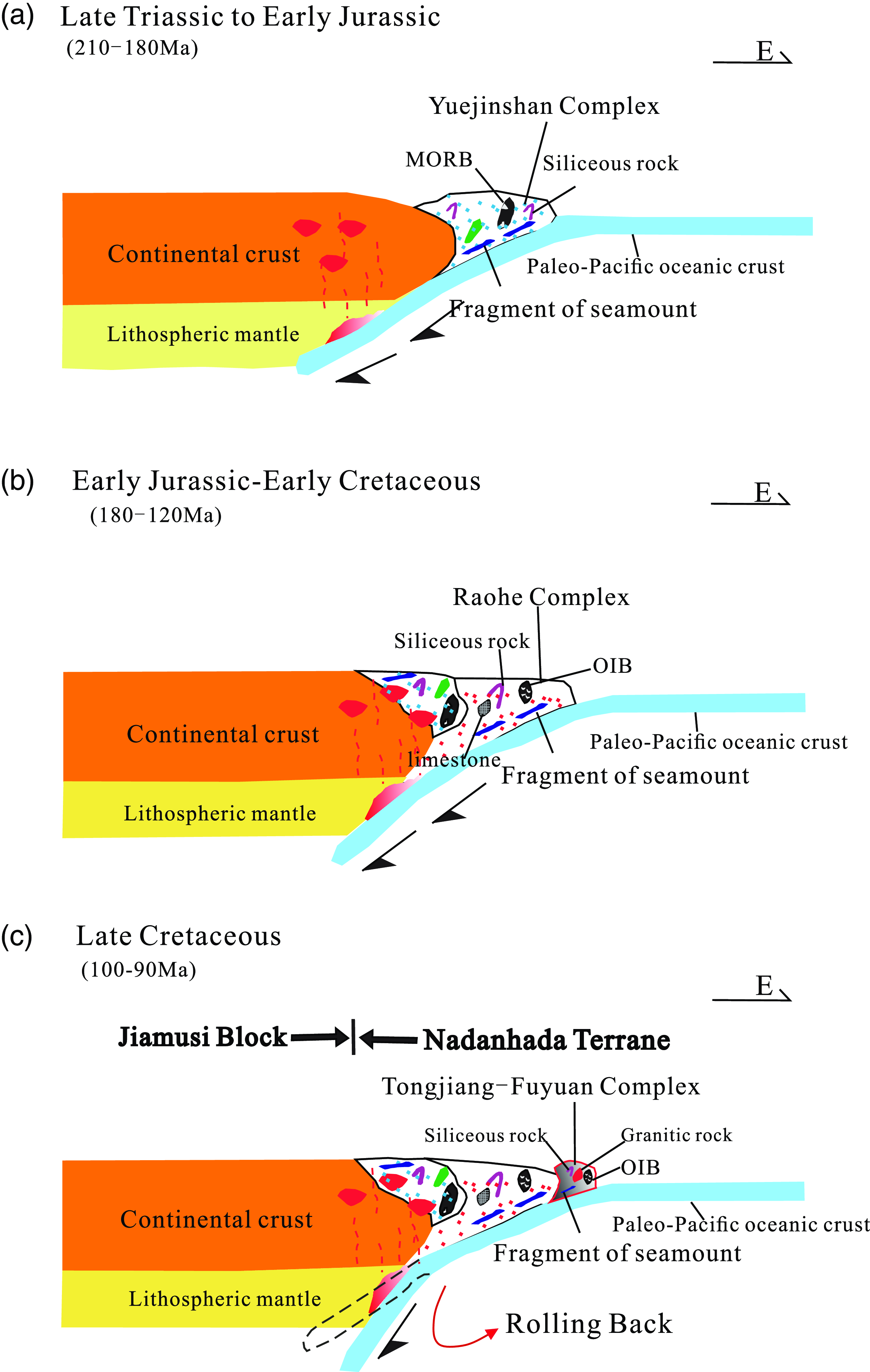
Based on the above evidence and the combination of the previous studies, a tectonic model of subduction accretionary of the Late Triassic to Late Cretaceous Palaeo-Pacific plate in the NT is proposed, which can be divided into three stages. (1) Late Triassic to Early Jurassic (210–180 Ma) is the time when the onset of westward-directed accretion related to Pacific-Plate plate subduction. The Palaeo-Pacific plate subducted westward and formed the emplacement of the Yuejinshan Complex on the eastern margin of the JB (e.g. Zhou et al., Reference Zhou, Cao, Wilde, Zhao, Zhang and Wang2014, Reference Zhou, Wang and Wang2015; Zeng et al., 2018; Li et al., Reference Li, Liu, Zhao, Feng, Zhou, Wen, Liang and Zhang2020) (Fig. 11a). (2) During the Early Jurassic to the Early Cretaceous (180–130 Ma), the Palaeo-Pacific plate with Early Jurassic seamounts collided with the East Asian continental margin and brought associated limestone, bedded chert and siliceous shale, and a large number of terrigenous debris and seamount fragments were tectonically mixed and accumulated in the trench to form the Raohe Complex (e.g. Zhou et al., Reference Zhou, Cao, Wilde, Zhao, Zhang and Wang2014; Li et al., Reference Li, Liu, Zhao, Feng, Zhou, Wen, Liang and Zhang2020; Han et al., Reference Han, Liu, Zhou, Zhang and Fan2022) (Fig. 11b). (3) During the Late Cretaceous (90–100 Ma), the Palaeo-Pacific plate continued to subduct, and with the change of subduction angle, the Palaeo-Pacific plate began to roll back (Yu et al., Reference Yu, Hou, Ge, Zhang and Liu2013; Sun et al., Reference Sun, Chen, Zhang, Wilde, Minna, Lin and Yang2014; Li et al., Reference Li, Liu, Zhao, Feng, Zhou, Wen, Liang and Zhang2020; Han et al., Reference Han, Liu, Zhou, Zhang and Fan2022). Along with the accumulation of seamount fragments, siliceous rocks and OIB as well as the invasion of the granitic rocks, the Tongjiang-Fuyuan Complex was formed (Fig. 11c).
Map of the subduction-accretionary pattern of the Late Triassic-Late Cretaceous Palaeo-Pacific plate (NT as an example).

In short, these successive accretionary complexes, gradually younger to the east in the NE China, significantly indicate the subduction and rollback process of the Palaeo-Pacific plate (Zhang et al., Reference Zhang, Chen, Yu, Dong, Yang, Pang and Batt2011; Sun et al., 2013).
6. Conclusion
Based on the zircon LA-ICP-MS U-Pb ages and geochemical data presented above, we draw the following conclusions.
-
1. Field observation shows that the rock association in the Tongjiang-Fuyuan area resembled the ophiolite suite and was newly defined as the Tongjiang-Fuyuan Complex. Zircon U-Pb ages show the formation age of the Tongjiang-Fuyuan mafic rocks (gabbros), and intermediate-acidic intrusive rocks (granodiorites) are 93–95 Ma, that are slightly younger than the similar rock associations developed in the Raohe Complex.
-
2. As Mesozoic magmatic rocks in the Tongjiang-Fuyuan complex, mafic rocks (gabbros and basalts) show geochemical features similar to those of OIB, and their primitive magmas are generated from the mantle thermal plume. Meanwhile, intermediate-acidic intrusive rocks (granodiorites) are I-type granites, forming in a magmatic arc setting, and probably originated from the partial melting of the lower crust.
-
3. Combined with the coeval igneous rock associations and regional tectonic evolution, we conclude that the Late Cretaceous magmatic rocks in the Tongjiang-Fuyuan area are the result of continuous subduction of the Palaeo-Pacific plate beneath the eastern margin of the JB. Furthermore, the distribution of magmatic rocks, which are gradually younger to the east, significantly reflects the rollback of the subducted Palaeo-Pacific plate.
Supplementary material
The supplementary material for this article can be found at https://doi.org/10.1017/S0016756823000675
Acknowledgements
We sincerely thank the editor and anonymous reviewers for their careful reviews and constructive comments. We thank Dr. Y.J. Hao from the Key Laboratory of Mineral Resources Evaluation in Northeast Asia, Ministry of Natural Resources, for his hip on analysis of the zircon LA-ICP-MS U-Pb ages. This study was funded by the National Key R&D Program of China (2022YFF0800401-2).

 Open access

