

Introduction
In the summer of 2020 Belarus witnessed an unanticipated although not wholly unplannedFootnote 1 – as is often the case for authoritarian contexts – moment of mass mobilization in the aftermath of rigged presidential elections (Benedek and OSCE/ODIHR Reference Benedek2020). Such moments are generally rare and draw our attention to the people directly involved in the mobilization. Who are these people who, in the face of extreme repression, unexpectedly take to the streets en masse in an authoritarian state? And how do they differ from fellow citizens who do not participate in the protests? This article’s aims are rather simple but very important: it seeks to identify a collective profile of individuals who engaged in the anti-Lukashenka protests in Belarus that began in August in 2020, and traces systematically how they differ from non-protesters, be they supporters or opponents of the regime. Only once we have more clarity on who did and did not protest – or, more specifically, how those who protested differ from those who did not – we can begin to explore what motivates and or explains their behaviors. The findings of this article provide a baseline for future analysis of protesters’ motivations. In order to achieve this aim though, it is vital to build on already extensive general theories of who protests when and how, whilst also considering early reports related to the specific case under study.
Comparative social science research has found that protesters in democratizing and/or authoritarian contexts, such as Belarus, distinguish themselves from non-protesters along several dimensions. Protesters tend to belong to particular socio-demographic groups with more biographical availability and access to a variety of resources (Beyerlein and Hipp Reference Beyerlein and Hipp2006b; Earl, Maher, and Elliott Reference Earl, Maher and Elliott2017a; Rosenfeld Reference Rosenfeld2017; Tobin Reference Tobin2012). Those mobilized are more likely to have personal experience of protest and/or belong to networks where this type of experience is concentrated (Diani and McAdam Reference Diani and McAdam2003; Gould Reference Gould1993; Lohmann Reference Lohmann1994; Mateo Reference Mateo2022b, Reference Mateo2022a; Meyer Reference Meyer2004; Onuch Reference Onuch2015). Thus, in the case of Belarus’ 2020 mass mobilization also, we could thus expect that protesters were more likely to be middle class, younger, and characterized by higher human and social capital.
Scholars have also demonstrated that collective action often relies on the formulation of clear political and/or economic grievances and claims (Gould Reference Gould1995; Kawalerowicz and Biggs Reference Kawalerowicz and Biggs2015; Opp Reference Opp1988; Passini and Morselli Reference Passini and Morselli2015; Robertson Reference Robertson2004; Rosenfeld Reference Rosenfeld2017; Tarrow Reference Tarrow2011; Thomson Reference Thomson2018) that are shared across the protesting population and can form a master narrative (Beissinger Reference Beissinger2013; Onuch and Sasse Reference Onuch and Sasse2016a; Polletta Reference Polletta1998; Snow and Benford Reference Snow, Benford, Snow and Benford1992). Because we know that the protesters in Belarus were at least in part triggered by a fraudulent election (Bedford Reference Bedford2021; Kazharski Reference Kazharski2021a; Mateo Reference Mateo2022a; Moshes and Nizhnikau Reference Moshes and Nizhnikau2021; Onuch and Sasse Reference Onuch and Sasse2022a; Petrova and Korosteleva Reference Petrova and Korosteleva2021; Robertson Reference Robertson2022; Sierakowski Reference Sierakowski2020; Wijermars and Lokot Reference Wijermars and Lokot2022), we would expect the protest claims to center on pro-democracy values and orientations in relation to grievances focused on fraudulent elections and the regime’s authoritarian repression.
The formulation of a master narrative requires access to information resources (Garrett Reference Garrett2006; S. A. Greene Reference Greene2022; Jost et al. Reference Jost2018; Onuch, Mateo, and Waller Reference Onuch, Mateo and Waller2020; Tufekci and Wilson Reference Tufekci and Wilson2012) – and thus, it is expected that protesters will distinguish themselves from non-protesters in their media consumption patterns (Aday et al. Reference Aday2013; Bodrunova Reference Bodrunova2021; Couldry, Livingstone, and Markham Reference Couldry, Livingstone and Markham2016; S. A. Greene Reference Greene2022; Kazharski and Kubová Reference Kazharski and Kubová2021). In Belarus, observers have made reference to the protesters’ use of particular social media platforms like Telegram and non-state media channels like Nexta and Belsat (S. A. Greene Reference Greene2022; Herasimenka et al. Reference Herasimenka, Lokot, Onuch and Wijermars2020; Wijermars and Lokot Reference Wijermars and Lokot2022). Hence, we might expect that protesters and non-protesters consumed different media. Lastly, whilst these may not be the articulated protest grievances or claims per se, social science research on mass protest – but also on mass protest in competitive authoritarian and democratizing contexts – has repeatedly found that protesters also distinguish themselves from non-protesters in their preference or support for other at least initially seemingly unrelated (or not immediately seen as connected to the protest triggers) political dispositions and policy aims that do in fact, align with the democratic values and dispositions (de Almeida, Sá, and Faria Reference de Almeida, Sá, Faria and Sanches2022; Ash Reference Ash2022; Li Reference Li2021; Onuch Reference Onuch2014b; Onuch and Sasse Reference Onuch and Sasse2016b, Reference Onuch and Sasse2022a, Reference Onuch and Sasse2022b; Schumaker Reference Schumaker1975; Winters and Weitz-Shapiro Reference Winters and Weitz-Shapiro2014). Thus, taking on board these empirically tested theories – confirmed not only in (competitive) authoritarian and democratizing contexts internationally but also specifically in cases like Ukraine, Georgia, Russia, and Kyrgyzstan – we have some clear expectations about the potential portrait of the median protester in Belarus’ mass mobilization in 2020. But how can we test this empirically?
Empirical data collected during rare moments of mass mobilization are hard to come by and retrospective data collection on protests introduces additional biases and many methodological problems. Ideally, we need to simultaneously collect data during the moment of mass mobilization on protesters and non-protesters in order to understand not only what characteristics protesters share but also how they may differ from non-protesters. In this article, we employ data from an original online protest surveyFootnote 2 among citizens of Belarus who were 18 years of age or older and residing in the country at the time of the protests (MOBILISE, n = 17,174), fielded between August 18th and January 31st, 2021. This survey was designed to capture (a) as many protesters as possible and (b) a large enough sample of non-protesters as a comparative baseline – in the context of a pandemic when on-site face-to-face surveying was not possible. More specifically, this article compares a sample of protesters (n = 11,719) to non-protesters (n = 5,455) and helps us to better understand the profile of the anti-Lukashenka protesters.
In what follows, we first contextualize the case of the 2020 anti-Lukashenka mass mobilization in Belarus. Using established social science literature (as well as early analyses of the protests in Belarus), we revisit in greater detail a series of empirical expectations of who the anti-authoritarian regime protest participants might be, and how they might distinguish themselves from non-protesters. We then present our survey data and provide descriptive statistics about the socio-demographic characteristics of the protesters, self-reported protest grievances and claims, and median protester preferences on a range of attitudes and policies. This portrait of the protesters is followed up by regression analysis to test whether the patterns that appear from the data hold at a statistically significant level when comparing protester and non-protester respondents in our survey.
As noted above, this article does not aim to explain what motivated or mobilized individual protesters but rather designate collective patterns distinguishing protesters from other Belarusian citizens who did not directly engage in this mass political event. We see this a first and important step that can empirically guide future analyses of protesters in the 2020 mass mobilization in Belarus.
Mass Mobilization in Belarus: Flower, Tractor, Telegram [R]evolution
In August 2020, events in Belarus took many observers by surprise. After a contested election campaign and amid opposition accusations of massive fraud, on August 9th the country’s Central Electoral Commission announced that President Lukashenka won more than 80% of the vote and would continue in this role that he already held for 26 years (Central Election Commission 2020). Opposition candidates and organizations immediately took to the streets in response to what they saw as large-scale electoral fraud. As we know from our interlocutors, these initial actions were planned ahead of time and led by activists and social movement organizations. Although this initial series of post-electoral events was not new to Belarus, the scale and duration of societal mobilization that ensued was. The capital Minsk was among ten localities across Belarus that saw protests on that first day, August 9th (Mateo Reference Mateo2020, Reference Mateo2022a). This geographical spread of the protests was rather unexpected in Belarus, as most past protest events were typically concentrated in the capital and a handful of other major cities. In reaction to these initial contentious episodes, Belarusian security forces responded with wholesale violent repression across multiple locations and, in the first few days, arrested over 7,000 people and disrupted the internet in the whole country (De Vogel Reference De Vogel2022; Onuch and Sasse Reference Onuch and Sasse2022b; Shotter and Seddon Reference Shotter and Seddon2020).
To the surprise of the Lukashenka regime, this indiscriminate and disproportional violence had the opposite effect on a cross-section of ordinary Belarusian citizens. As explained to us by our unnamed interlocutorsFootnote 3 who were themselves arrested or whose family members were arrested, those incarcerated were able to see just how diverse the opposition to Lukashenka was – students, white collar and blue-collar workers, men and women, in cities across the country held in the same rooms. In addition, based on their personal observations communicated to us, we also know that their families – often waiting impatiently outside of detention centers – were able to share in their grief and anger, coordinate releases, and thus, form a collective identity: of those opposing indiscriminate regime violence.
As news and images of torture spread through personal networks across the country, a foreign journalist caught up in the events explained that suddenly everyone in Minsk knew of a cousin, a friend, a neighbour, or a neighbour’s niece affected by the repression (Author’s personal correspondence 2020). This shared experience helped to form a coalition across societal cleavages, even if it remained relatively uncoordinated. Youth organized pop-up protests on crosswalks; women formed human chains or stood in groups holding flowers. Within days, some former and current soldiers and police burned their uniforms and ID cards, the “Minsk Tractor Works” factory workers (arguably a symbolic bedrock of Belarusian state industry) went on strike, and doctors and lab workers walked out of their buildings – many to the booming sound of “Peremen”Footnote 4 playing on loudspeakers.
By August 14th and 15th, mass strikes were called in almost all sectors and cities, and weekend marches were organized. The largest ever all-national protest march in Belarus since 1994 was held on August 16, with an estimated 100,000–200,000 participants in Minsk alone. Over the next two months, the protests continued to grow in size, scope, and spread even further across the entire country to both urban and more rural localities. At their height, the protests grew to an estimated 250,000–300,000 in Minsk, with regular “Women’s Marches” on Saturdays giving the movement a powerful momentum, the main protest action taking place every Sunday, and smaller local protests held each Friday, Saturday and Sunday. Presidential challenger Sviatlana Tsikhanouskaya, who was widely seen to have won the elections, had to leave the country as did some of her closest associates. Others associated with her and the newly formed Coordination Council were arrested. Nevertheless, mass protests continued without apparent leadership structures until late October when repression by the security forces reached a new level, also targeting journalists covering the events and reducing the international visual presence of the protests.
The Anti-Lukashenka protesters reclaimed the red-and-white flag of the Belarusian National Republic dating back to 1918–1919 and temporarily used around the breakup of the Soviet Union. Local observers played down the notion of an ethno-national undercurrent to the protests, but many commented on the national awakening the protesters represented, suggesting it was “produced” by the protests (Bekus Reference Bekus2021; Bobrovska Reference Bobrovska2020; Gapova Reference Gapova2021; Kazharski Reference Kazharski2021a; Kulakevich Reference Kulakevich2020; Maxwell Reference Maxwell2020; Petrova and Korosteleva Reference Petrova and Korosteleva2021; Weller Reference Weller2022).Footnote 5 It was also observed that in reflection of the country’s close social, political, and economic linkages to Russia and weak links to the EU, protesters refrained from voicing pro-EU, pro-western slogans and grievances (Liubakova Reference Liubakova2020). Vladimir Putin’s support of Lukashenka was lukewarm in the early stages of the protest and an immediate Kremlin strategy was absent. It took the EU several months to reach a consensus on sanctions against members of the Belarusian regime responsible for the crackdown and Lukashenka himself, although the Baltic and Polish governments moved more quickly and adopted a wider range of sanctions and support measures for the opposition. But in line with early statements by the opposition leaders, the assumption remained that, unlike in Ukraine’s Euromaidan, geopolitical preferences did not map onto the dividing lines between protesters and non-protesters. That being said, Onuch and Sasse (Reference Onuch and Sasse2022b), found that there was a systematic alignment of pro-EU positions with democratic values and being a protester in 2020 in Belarus. Other early assessments focused on the gender makeup of the protesters. Most observers highlighted the notion that this non-violent protest – with women holding flowers at its core – was progressive and liberal (Nechepurenko Reference Nechepurenko2020; Walker Reference Walker2020).
It is estimated that at least 400,000–450,000 people across the country participated in the marches at least once, with some estimates going as high as 550,000. This represents 5–6% of the population who joined in weekly protests in over 100 cities across the country (Mateo Reference Mateo2020). In Minsk it is estimated that 10% of the city’s population participated in the weekly protest marches (Onuch and Sasse Reference Onuch and Sasse2022b, Reference Onuch and Sasse2022a). These estimates rely on crowd estimations and reports of protest size at localities across the country and thus only capture individuals physically present at in-person protests. These numbers are likely to have been even higher if we count other forms of protest and repertoires as well as online activism. An online survey conducted by ZOiS in December 2020 found that about 18% of the adult population between 18-64 years based in cities over 20,000 inhabitants reported taking part in the protests in-person and/or online (Sasse et al. Reference Sasse2021).Footnote 6 Undoubtedly, this was a mass mobilization, “a moment when a cross cleavage coalition of ordinary citizens fills the streets,” when ordinary citizens and not the opposition leaders and activists who are in “the business of protest” become the protagonists (Onuch Reference Onuch2014a). The large protests lasted into October 2020 but began to shrink in size as early as late September when the regime exerted more targeted repression. Smaller localized protests and neighborhood actions continued into early 2021(Mateo Reference Mateo2022b).
The pandemic context and the violent nature of the repression of the protests presented difficulties in the collection of protest data. Few scholars have been able to collect systematic data on the Belarus 2020 mass mobilization protesters – who they were, what they wanted, and how they distinguished themselves from non-protesters. Our data collection, even if forced to go-online as a result of the pandemic, is thus rather unique in its ability to present a portrait of the median protester. We propose that through the analysis of detailed empirical data from our online survey, tracking protesters from August 2020 to January 2021, we can begin to understand that there is little evidence for some of the early assumptions about the protests and the wider societal context in Belarus, and we are thus able to make first corrections as to who the protesters were and were not. Again, to do this we must first ask, what are the expectations in the extant scholarly literature that guide our analysis of what distinguishes protesters from non-protesters, and what are the expectations from the initial Belarus-focused analyses?
Theories of Individual Protest Engagement
Theories of drivers of protest engagement often blend together a variety of micro-level factors with structural and contextual variables. Social science scholarship that has focused specifically on what distinguishes protesters from the non-protesting population – or put otherwise, what correlates with and aids in the mobilization of individuals to join in a protest event – points to six broad categories of characteristics: (1) socio-demographic variables and biographical availability, (2) past protest experience, (3) network embeddedness and perceptions of protest efficacy, (4) collective identities bounded by common grievances and claims, (5) shared political dispositions and claims, and (6) access to information and patterns of media consumption. While research on competitive authoritarian, autocratic, and democratizing contexts – including the post-communist region – has suggested that the nature and level of repression, access to types of information (and media sources), and the types of organizations and social networks that ordinary people may or may not be imbedded in might vary, the theoretical propositions behind mobilization tend to follow the same patterns (Aouragh and Alexander Reference Aouragh and Alexander2011; Auyero and Moran Reference Auyero and Moran2007; D’Andrea Reference D’Andrea2014; De Vogel Reference De Vogel2022; Fu Reference Fu2017; Greene Reference Greene2014; Haciyakupoglu and Zhang Reference Haciyakupoglu and Zhang2015; Landolt and Kubicek Reference Landolt and Kubicek2013; Onuch Reference Onuch2014a; Robertson Reference Robertson2004, Reference Robertson2007, Reference Robertson2009, Reference Robertson2010; Smyth Reference Smyth2018, Reference Smyth2020; Ting Reference Ting2020; Tucker Reference Tucker2007; Tufekci Reference Tufekci2017; Weiss Reference Weiss2014). We thus expect to find distinct patterns and statistically significant variation between protesters and non-protesters in Belarus along the lines listed above. We address the theoretical thinking grounding each of these empirical expectations in turn.
Demographic Factors of Protest Engagement
Researchers of contentious politics repeatedly highlight that protest participants – be it in large protests or in smaller episodes of contention – tend to, on average, have a different socio-demographic profile than non-protesters. These demographic factors are vital for understanding who protests and how as they often (a) result in individuals having access to different types of resources such as information (e.g. among those enrolled in higher education at the time of protests or those in the workforce with a higher level of education) and/or time (among youth, retirees, the unemployed and childless – also called biographical availability); or (b) correlate with psychological traits, such as a willingness to take risks (among male and younger individuals) (Andretta and Della Porta Reference Andretta and Porta2014; Beyerlein and Bergstrand Reference Beyerlein, Bergstrand and Snow2013; Beyerlein and Hipp Reference Beyerlein and Hipp2006a; DiGrazia Reference DiGrazia2014; Earl, Maher, and Elliott Reference Earl, Maher and Elliott2017b; Gerling Reference Gerling2017; Peterie Reference Peterie2004; Schussman and Soule Reference Schussman and Soule2005a; Verhulst and Walgrave Reference Verhulst and Walgrave2009). This expectation was confirmed in analyses of other protests/protester populations in the region (Onuch Reference Onuch2014b; Rosenfeld Reference Rosenfeld2017; Smyth Reference Smyth2020) and thus, we would also expect to find that protesters in Belarus distinguish themselves from non-protesters along these socio-demographic lines.
To this end, higher human capital (specifically education and being middle class) is also a socio-demographic characteristic associated with higher rates of political engagement (Olcese, Saunders, and Tzavidis Reference Olcese, Saunders and Tzavidis2014; Schussman and Soule Reference Schussman and Soule2005b; Sherkat and Blocker Reference Sherkat and Blocker1994). This finding has been replicated in the case authoritarian and democratizing context mass mobilization (Onuch Reference Onuch2014b). Yet, some more recent research has questioned the role of a middle-class status in anti-authoritarian regime protest participation. Rosenfeld (Reference Rosenfeld2017, Reference Rosenfeld2020), has found that because authoritarian contexts also breed a state-dependent middle class, the relationship between socio-economic status and mobilization is not certain and can even be inverted. This is because a large portion of the middle class are winners of the authoritarian regime context and also because many citizens are employed in state owned enterprises. Might this also be the case in Belarus?
In Belarus there is indeed a large state-dependent middle class, and state involvement and control of the workforce is high for all sectors. Moreover, the rise of new private sector industries, such as digital technologies and creative industries, which have been on the rise in the last decade, is weighted more heavily to what we would categorize as “middle class” (Hrechyshkina and Samakhavets Reference Hrechyshkina and Samakhavets2019; Korosteleva Reference Korosteleva, Lane and Myant2007; Trantidis Reference Trantidis2022). We could expect that individuals employed in state enterprises and the bureaucracy would be less likely to be protesters compared to those who work in the private sector in line with Rosenfeld’s (Reference Rosenfeld2017) findings in Russia.
On the other hand, we also know from observational data and reports in the first weeks of the protests, as well as preliminary research by Mateo (Reference Mateo2022b), that working-class industries and specifically factory workers were far more likely to be threatened and reprimanded for their organization of and involvement in strikes and marches. Mateo’s (2021) findings suggest that localities where the dominant form of employment was heavy industry were not only less likely to see protests, but were also more likely to see protests decline over time. Given this mixed evidence, we first draw our expectations from the dominant contentious politics literature which would expect protesters to be more likely to be educated and middle class but also allow for a competing hypothesis that this pattern might be inverted in a post-communist autocratic context where a substantial proportion of the population is likely to be dependent on the state and regime.
Belarus-Specific Demographic Characteristics of 2020 Protesters
While women have been generally found to be less likely to participate in protest events and highly unlikely to participate in violent repertoires (Beyerlein and Hipp Reference Beyerlein and Hipp2006b; McAdam Reference McAdam1986; Onuch and Martsenyuk Reference Onuch and Martsenyuk2014), in the case of the 2020 anti-Lukashenka protests, they have played a very visible role in the organization of mass rallies and marches. Observers have even dubbed the protest wave a Belarusian Women’s Revolution (Galiamina Reference Galiamina2021; Gaufman Reference Gaufman2021; Maliauskaya Reference Maliauskaya2022). Thus, on balance, we do not expect gender to be a main distinguishing feature between the protesters and non-protesters in our sample.
In the case of Belarus, yet another set of demographic factors must be accounted for in our analysis. Although there is weak evidence that language and ethnicity are important dividing factors in Belarusian political behavior and public opinion (Burant Reference Burant1995; Marples Reference Marples1999; McAllister and White Reference McAllister and White2015), we note that scholars have highlighted a national awakening in the last two decades (Brown Reference Brown2005; Goujon Reference Goujon1999; Kittel et al. Reference Kittel, Lindner, Tesch and Hentschel2010; Marples Reference Marples1999; Woolhiser Reference Woolhiser and Ryazanova-Clarke2014). While most analysts have portrayed the events of 2020 as a civic moment, some have even written about an ethno-linguistic awakening (Bekus Reference Bekus2021; Bobrovska Reference Bobrovska2020; Guetta Reference Guetta2021; Kazharski Reference Kazharski2021b, Reference Kazharski2021a; Kazharski and Kubová Reference Kazharski and Kubová2021; Kolarz and Lozka Reference Kolarz and Lozka2020; Kulakevich Reference Kulakevich2020; Maxwell Reference Maxwell2020; Murashcenkova et al. Reference Murashcenkova2022; Petrova and Korosteleva Reference Petrova and Korosteleva2021). Similarly, our interlocutors also reported to us that they were switching to speaking Belarusian and that some people who previously identified as Russian were coming to call themselves Belarusian first and foremost. Whilst the question of ethnic, linguistic, and civic identity is highly complex one and one which two of this article’s authors have written extensively about elsewhere, we would be remiss not to include this in our analysis that is trying to understand the main characteristics of who the Belarussian protesters were. Thus, while we cannot make any sweeping conclusions from such an analysis, it is necessary to assess whether there is indeed any discernible pattern along ethno-linguistic lines when it comes to the portrait of the median protester in Belarus in 2020. For this reason, we feel it is warranted to also expect that protesters are more likely to identify with the Belarusian language and to declare themselves as belonging to the Belarussian nationality. We are implying a causal relationship but rather suggest that there is likely to be a pattern whereby protesters distinguish themselves form non-protesters along these lines.
Protest Experience and Social Network Ties
Scholarship also suggests that demographic factors are likely to be interceded by personal socialization including one’s own past protest participation (Osa Reference Osa2003), or one’s exposure to protesters among friends and family members, but also more generally speaking having the chance to interact with actors involved in contentious activities (Peterie Reference Peterie2004; Sherkat and Blocker Reference Sherkat and Blocker1994; Verhulst and Walgrave Reference Verhulst and Walgrave2009). These factors are all considered pathways to protest. And operate based on an individual’s embeddedness in a variety of key social networks and organizations (Diani and McAdam Reference Diani and McAdam2003; Gould Reference Gould1993, Reference Gould1995). This embeddedness need not be in formal organizations alone: it can – and often does – rely on informal and personal network ties (both weak and strong). Simply put, an individual who has colleagues, neighbors, friends, family, or – in the case of more formal networks – fellow church parishioners or club members willing to engage in a protest, they are typically also more likely to do the same. In fact, research shows that they are much more likely to attend a protest together. For the postcommunist context, Nikolayenko (Reference Nikolayenko2017) and Onuch (Reference Onuch2014a, Reference Onuch2015) have demonstrated this in the case of the EuroMaidan, and Mateo (Reference Mateo2022a) has demonstrated that in the case of Belarusian mass mobilization. Mateo found that localities where protests first rose and continued the longest also had pre-existing networks and organizations (even if often very loosely bounded). Therefore, we might expect Belarusian protesters to be more likely than non-protesters to be embedded in social networks and have some experience of past protest engagement.
Political and Economic Disappointment as Drivers of Collective Frames and Identities
Even if people have certain socio-demographic characteristics, similar patterns of network embeddedness, or past experience of protest, they may still not protest. It is understood that a central feature of the mobilization process is the creation of a shared sense of collective identity. This is often linked to a common understanding of claims (what should be done about a systemic problem) and grievances (what is wrong or unjust in a given society), which together make up a master narrative or a master frame of the contentious episode (Snow and Benford Reference Snow, Benford, Snow and Benford1992).
We also know that grievances have been particularly conceptualized as the basis of negative coalitions at the heart of mass mobilization (Beissinger Reference Beissinger2013). The most important grievances are understood to be personal and collective experiences of economic decline and deprivation (Ash Reference Ash2022; Giugni and Grasso Reference Giugni and Grasso2015; Gurr Reference Gurr1970; Kerbo Reference Kerbo1982; Tucker Reference Tucker2006) and perception political injustice and disappointment with political elite, state institutions, or even global systems (Tilly Reference Tilly2003). These two types of grievances are often also understood through a right-based lens. In the case of the post-communist context, Onuch (Reference Onuch2014a, Reference Onuch2014b) has written extensively on how when ordinary citizens view basic and universal rights as being taken away en mass, and in an indiscriminate manner, protest grievances are often articulated in a right-based discourse. Both have been found to be motivating and mobilizing factors and typically forming the foundations of master frames (or narratives) of a given protest event.
The Belarusian context provides both economic decline (Cojocaru Reference Cojocaru2017; Gray and Cameron Reference Gray and Cameron2019; Mazol Reference Mazol2017) and political disaffection as potential grievances motivating protest engagement in the periods leading up to the 2020 presidential election, and thus, we can test if both economic and political grievances distinguish protesters and non-protesters or if one is more important than the other. Because the protests are directly related to the August 9th election result, we expect electoral fraud to be a particularly important political trigger and grievance – and therefore in line with Tucker (Reference Tucker2007) we expect that political grievances would be more important in distinguishing Belarusian protesters form non-protesters.
Related to the above, although the immediate trigger behind a protest wave might be a fraudulent election or unjust and indiscriminate state violence, often protesters will also belong to particular political constituencies in a given polity. These might be partisan groups or groupings delineated by underlying policy preferences, attitudes, and values. The focus has been on how political dispositions towards the state and citizenship and certain value attributes (like progressive/liberal values in the case of so called “pro-democracy” protests and conservative/illiberal ones in the case of anti-migrant, religious, or pro-regime protests) correlate to and even drive protest engagement (Onuch Reference Onuch2014a, Reference Onuch2014b; Onuch and Sasse Reference Onuch and Sasse2022a). Research has shown that citizens are likely to participate in politics because they see their contributions as their duty as citizens (Riker and Ordeshook Reference Riker and Ordeshook1968). It is hypothesized that this political disposition aligns with liberal value positions (civil and human rights claims). Thus, we would expect that protesters in Belarus are more likely to hold “pro-democratic” views than non-protesters.
Media Diets and the Telegram Hypothesis
Finally, all of the factors distinguishing protesters from non-protesters mentioned above are likely to also be connected to, overlap with and even be endogenous to the information available to would be protesters and the media sources they can and do access. As noted by Greene (Reference Greene2022), regime opponents tended to reside in entirely different media ecosystems than Lukashenka supporters. Particular types of media consumption and information access more generally, are often portrayed as a key mediating factor that allows citizens to go from holding particular grievances to attributing blame (Hale, Shevel, and Onuch Reference Hale, Shevel and Onuch2018; Lee Reference Lee2014; Onuch, Mateo, and Waller Reference Onuch, Mateo and Waller2020). In authoritarian contexts access to and consumption of state media has been found to be negatively correlated to protest participation, and protesters have been found to have a more diverse “media diet,” accessing a variety of alternative sources of information.
With the rise of internet penetration and high usage of the use of handheld “smart” digital devices, in recent years scholars have focused on the analysis of the role of a variety of information communication technologies (ICTs), and social media specifically. Scholars have repeatedly claimed that social media play a key role in driving contemporary protest (Castells Reference Castells2012; Litvinova Reference Litvinova2020). Whilst initial observations focused on the Telegram App as a driver of mobilization, this claim has already been addressed as misleading (Herasimenka Reference Herasimenka2019; Herasimenka et al. Reference Herasimenka, Lokot, Onuch and Wijermars2020; Wijermars and Lokot Reference Wijermars and Lokot2022). Nevertheless, we would still expect that (a) protesters would have a more diverse set of media that they turn to (Greene Reference Greene2022) and (b) that they would be more frequent users of a variety of non-state media sources (Nexta or Belsat – in the case of Belarus) and access these sources via social media apps like Telegram.
In the following section we present our data and highlight some initial descriptive statistics from our protester survey following up on these theoretical and empirical propositions.
Data: MOBILISE Belarus Protest Survey
In this article we employ data from an original online protest survey among citizens of Belarus ages 18 and older who were residing in the country (MOBILISE 2020/2021, n = 17,174), fielded between August 18 and January 31, 2020. This article compares anti-Lukashenka protesters (n = 11,719) to non-protesters (n = 5,455) to better understand the differences between them.
We note that this survey was not intended to be nationally representative. This survey is a protest survey first and foremost, and its aim was to collect as many protester responses as possible during the protest wave, but also collect enough non-protester responses to be able to compare these two groups. Protest surveys always employ non-probability sampling and recruitment precisely because the actual population of the protesters is unknown. While scholars who collect protest survey data on-site and face-to-face are able to employ different approaches and methods to randomize their protester sample (often times counting protesters and interviewing every Xth individual), we were not able to conduct the survey face-to-face and instead conducted the survey online employing a strategy of social-media-driven recruitment of protest participants. This approach was taken as: (1) in the middle of a pandemic it was neither practical nor was it ethically possible to collect face-to-face on-site protest survey data – as other researchers who have to respond to ethics boards in their institutions, we were simply not permitted to conduct face-to-face research in 2020 either through our own team or by employing partners on the ground; and 2) an online nationally representative survey would have captured only a very small number of protest participants, and this sub-sample could be highly unrepresentative of the actual population of protesters (Ogan, Giglou, and d’Haenens Reference Ogan, Giglou and d’Haenens2017; Onuch Reference Onuch2011, Reference Onuch2014a, Reference Onuch2014b; Rosenfeld Reference Rosenfeld2017). And while we make no claims about the Belarusian population as a whole, we nonetheless note that the general patterns found among our survey respondents (such as similar sample distributions and policy positions) hold in national surveys conducted before (Toal, O’Loughlin, and Bakke Reference Toal, O’Loughlin and Bakke.2020; O’Loughlin and Toal Reference O’Loughlin and Gerard2022), at the height (Greene Reference Greene2022), and during the denouement of the protests (Sasse et al. Reference Sasse2021). Thus, we are more confident that we have fairly high-quality data that finds similar patterns to the surveys collected by other modes and means.
Sampling and Recruitment
The MOBILISE Belarusian Protest Survey (Onuch et al. Reference Onuch, Mateo and Waller2020/2021) was run online employing the SurveyMonkey platform and its sampling design was social-media-generated, employing existing best practices (Andrews, Nonnecke, and Preece Reference Andrews, Nonnecke and Preece2003; Samuels and Zucco Reference Samuels and Zucco2013). Using mainly Facebook and Instagram adverts (while also allowing for link sharing across personal networks and Telegram channels), each collector (i.e. each targeted advert) had its own link which we also cross-referenced with a question posed to the respondent about where they found the link. On Facebook/Instagram we employed Facebook’s own advert/recruit algorithm but we specifically targeted users age 18 and over, who reside in Belarus, speak Belarusian, and/or had Belarus as their main listed interest.Footnote 7 Based on the literature about the nature and efficacy of such recruitment (Kaye and Johnson Reference Kaye and Johnson1999; Samuels and Zucco Reference Samuels and Zucco2013; Van Selm and Jankowski Reference Van Selm and Jankowski2006; Wright Reference Wright2005) which has highlighted that middle aged people and women are more likely to respond to such calls, we also ran two separate adverts targeting men and youth respectively. Two targeted advert texts were used: (a) “Are you Belarusian? … ” and (b) “Have you participated in protests? … ” followed up with “ … please take this short survey.” We ran these adverts in Belarusian, Russian, and English. As expected, the most successful recruitment language was Russian. Respondents could also select or switch the language they completed the survey in on the welcome page. The survey was available in Russian, Belarusian and English. In our robustness checks we control for the collector, advert, and language.
The survey began by asking a series of questions confirming the inclusion in the survey: age (only those 18 and over could continue), citizenship (only Belarusian citizens are included in our analysis), and residency (only those who were physically in Belarus are included in our analysis). Following these inclusion/exclusion questions, the respondents were asked if they participated in any of the recent protests from August 9th (online, in-person, or both online and in-person). Those who selected any one of these three options were then asked if they participated in anti-Lukashenka or pro-Lukashenka protest events. All of these self-confirmed protest participants were then directed to the battery of survey items that make up our “protest survey.” Subsequently, they were taken to the second section of the survey which asked a variety of typical political behavior and attitudinal questions, as well as a standard series of items about socio-economic status, protest experience, and their demographics. All those who did not report being protest participants in the first question were taken directly to the second half of the of the survey – which was thus answered by all respondents allowing for our comparison between protesters and non-protesters. The survey took about 25–35 minutes to complete in full, making it a rather long online survey. As is typical with online surveys that contain more than 10 questions, the drop-off rate is higher than in face-to-face surveys. The completion rate for the full survey is over 40% – a very respectable outcome under the circumstances when compared to other online surveys.
In total 40,344 (37,785 in Russian, 2,486 in Belarusian, and 73 in English) respondents began the survey. For our analysis here we are not interested in comparisons with Belarusian migrants. Accordingly, we dropped all those who were not residing in Belarus at the time of the survey and all those who reported not being citizens of Belarus (remaining n = 32,900). Of these, 31,221 respondents answered the question about protest participation – the first question after the inclusion/exclusion criteria (21,966 were self-declared in-person protest participants of which 11,828 were repeat protesters). Of the 31,221 respondents having answered the protest participation question, 17,174 completed the survey in full (which we consider as having noted at least one response in the final battery of questions about basic socio-demographic information).
Apart from age, gender, citizenship, and location of residence (all asked at the very beginning of the survey), the majority of demographic characteristics were collected during the last stage of the survey as is known best practice when surveying populations and especially when the topic is considered sensitive. For this reason, we only analyze those respondents who completed at least one question in the final section as to allow for better comparison. This is not problematic for our analysis as we have no reason to believe that protesters who did not complete this survey in full were any different from non-protesters who completed it. In the end, this article compares protesters (n = 11,719) to non-protesters (n = 5,455). In our analysis we count those who self-declared having participated in the anti-Lukashenka protests in-person as our “protester” category – this amounts to just under 69% of our survey sample (see figure 1).Footnote 8
Participation in 2020 post-Presidential Elections’ protests
Note: % of respondents who answered: Have you participated in any of the ongoing protests in Belarus (or abroad if you are based outside of Belarus) that began following the Presidential Elections of August 9, 2020?

Who are the Belarusian Protesters?
Demographics: A Cross Cleavage Coalition but with Limits
First, we find that the mean age of the protesters in our sample is 39, while the mean age of the non-protesters is 43. Women make up 52.3% of our protester sample (Men 47.7%) whereas women make up 52.9% of our overall survey sample. Thus, according to our survey data, men and women were equally likely to participate in the protests. Our protest sample also had a higher proportion of those who considered Belarusian their native language, a category that measures symbolic identification rather than actual language practice: 38.7% as compared to 32.5% for the whole sample (31.6% and 32.6% declaring Russian and 15.1% and 14.3% declaring both as their native language respectively). With regard to language embeddedness (employing a language at work or in one’s private life), the overall sample and the protester sample respectively reported language spoken at work as Belarusian 1.5%–1.8%%, Russian 72.7%–78%, and both around 5%, and in their private life Belarusian 3%, Russian 64.7%–69%%, and both 13%. When it came to language preference (the language the actual survey was taken in) protesters were similarly unlikely to select Belarusian: 7.4% of the protester sample versus 5.8% of the whole sample. We find similar patterns for nationality (Belarusian 71.7%–65%, Russian 4%–5.3%, Polish 4%, Ukrainian 1.1%), religion (Orthodox 50%–55%, Catholic 8%, Protestant: 2%, Non-believer/Atheist 34%–30%) and education (tertiary or scholarly education 66%–64%.) Unsurprisingly, from self-reported data which our team coded, more than half of our protesters are from Minsk. Much of these descriptive statistics match expectations from participant observations of the protests, national surveys, and authors’ video observation of the protests.
Of those who self-declared to be protest participants, 50% reported joining in during the first three days of protests on/after Sunday, August 9th. Another 31% of the protest participants told us that they first joined during the first week. Thus, approximately 81% can be considered to be “early risers.”
Socio-Economic Status
We asked for a standard seven-point affordability scale statement about the family financial situation, arguably a more accurate measure of socio-economic status than income. We find little evidence that there is substantial difference along socio-economic affordability lines between protesters and non-protesters (figures 2 and 3).
Family financial situation – Whole sample
Note: % of respondents declaring which statement best describes their family financial situation

Family financial situation – Protesters only
Note: % of respondents declaring which statement best describes their family financial situation

Past Protest Experience
While much of the descriptive statistics above are in line with both observational reports and theoretical expectations around protesters, we do find some interesting case-specific characteristics among the protest participants. Whilst social science theory would have us expect that a plurality, if not a majority would have some (no matter how small) past activist or protest experience, in this case we find that 72% of our self-declared protesters did not participate in any previous protests in Belarus. We also find some interesting dynamics of declared voting behavior. Of our anti-Lukashenka protest participants, 14% stated that they did not vote for opposition candidate Tsikhanouskaya.
Looking at past protest experience – reported vote choice and the distribution of their family financial situation – we can indeed say that a diverse cross-cleavage coalition formed among the protestorate.
Social Network Ties
One of the most interesting findings from our protester data is how weakly embedded the protesters are in a variety of networks. 28% of the protesters in our survey belong to a social movement or civil society organization (e.g., trade unions, church, sport, cultural, humanitarian, Womens, LGBT, environment, self-help, community, volunteer, or human/civil rights). And even more surprisingly, 26% of the protesters report that the first time they went to the protests they went alone, not intending to meet anyone, and a further 65% said that when they first joined the protests, they went alone but met up with people. From comparative research we know that in most protests of this kind only 10% of protesters (or fewer) report attending entirely on their own (Onuch and Santos Reference Onuch and Santos2020). The Belarusian protesters are thus primarily “lone wolves,” and not very well networked – at least not at the start of the protests in August. It is highly likely (and video evidence of activist organization confirms this) that the protests aided in connecting and networking the Belarusian population.
Grievances and Claims
We find that the main protest grievances and claims – as reported by the protesters – are political in nature. The dominant reasons for protesting are believing that the election was fraudulent, that the mass arrests and violence were unjust (both 99%), the fact that Lukashenka has been in power too long (92.8%) and that he tried to dismiss the opposition as drug addicts and unemployed in his public reactions to the protests (90%). A remarkable 24%–26% said that their own or their family’s personal experience of state repression was the main reason for their protest. While it is clear that political grievances are dominant among the motivating factors, it is important to note that, even if not articulated as a main claim, 96% of the protesters in our sample agreed that an important motivating factor for their mobilization was that they wanted a better economic future and hoped that the protests would be a way to achieve this. Moreover, 76% strongly agreed/agreed that poverty and the economic crisis are the most pressing problems in Belarus.
Overwhelmingly, the protesters reported political and specifically civic claims as central to their plight, but they are split three ways as to the best way forward: 35% said that, above all, they would like to see Lukashenka removed from power, 30% said that they wanted major systemic change as well as Lukashenka stepping down, while 20% were ready to accept any president emerging from new free and fair elections (figure 4). Most importantly, here we find that while economic grievances might have motivated some to join in the protests, only 5.7% of our protesters would like to see meaningful economic improvements in Belarusian society in addition to political change.
Expected main outcome from the protest
Note: % of respondents who answered: What outcome would you like to see in Belarus as a result of these recent protests?

Other Key Political Dispositions
In line with our expectation, the protesters seem to hold pro-democratic views (see figure 5) and score more highly on interpersonal trust (in average, 4.9 for non-protesters against 6.3 for the protesters sub-sample).
Democratic preference
Note: % of respondents declaring which statement best describes their political preference

Operationalization and Analysis
In order to be more confident in our findings, we need to explore the patterns distinguishing protesters from non-protesters with further statistical analysis. To do so, we ran a logistic regression where our dependent variable was binary, with 1 denoting a survey respondent being a protest participant and 0 denoting a non-protester. Our main model only includes those individuals who state that they participated in the protests at least once in person. Those who said they only participated online are not included in our main analysis. We did run a robustness check including the “online protesters” as “protesters” and the results were comparable. In the following, we present the full effects of our independent variables on being a protest participant. We do not interpret these effects as drivers of protest participation per se but rather as correlates of being a protest participant as opposed to being a non-protester.Footnote 9
We divide our analysis and variable inclusion in line with the causal stage appropriate for the inclusion of each variable/a set of variables whilst trying to omit any collinearity and endogeneity issues.
We first include variables capturing socio-demographic and biographical availability – which for us is (a) Age in years, (b) binary variable denoting Female Sex, (c) Education as six categories, (d) a 7-point scale of the respondents Family Financial Situation (see figure 6 above for details) with 1 denoting financially worst off and 7 denoting best off. We also include three ethnicity and language variables, all binary, with 1 denoting the respondents having selected Belarusian as their Nationality, as the Survey Language, and as their Native Language, following Onuch and Hale (Reference Onuch and Hale2022). In robustness checks we switched the Belarusian variables for Russian and Polish variants and tested for language embeddedness (language use in private life and at work).
Demographics and being anti-lukashenka protester

We find that while sex and one’s family financial situation are not correlates of being a protester, education, civic and ethnic identity, and language practice are all strongly and positively correlated with being a protester, and older age is negatively correlated with being a protester. Moreover, a very small proportion of our sample selected to do the survey in Belarusian, but we find that declaring one’s native language to be Belarusian increases the probability that they are a protester by 11%. This finding suggests that protesters distinguish themselves along these identity issues and language practices from non-protesters.
Controlling for all the above factors, we next include variables denoting political and economic grievances based on a survey item capturing agreement with the statement that corruption is the main problem in Belarusian society and another survey item on the main problems facing Belarus being the economic crisis and poverty. Both are coded as binary variables whereby all those who stated that they fully or somewhat agree receive a 1 and all other respondents receive a 0.
We find that agreeing with the proposition that corruption in Belarusian society is the main problem increases the probability that an individual is a protester by 17% at the 99% statistical significance level (see figure 7). Agreeing with the view that the economy is the most concerning problem facing Belarus increases the likelihood that someone is a protester by 8%. Thus, at this stage, we do not find conclusive evidence that aside from being generally aggrieved protesters were more likely to hold political or economic grievances than non-protesters.
Corruption and economy are main problem

To avoid collinearity with other key variables of interest that may also capture economic and political grievances, we omit these two variables in later analyses.
Next, we include three economic evaluation variables. The first two capture sociotropic evaluation of the economic situation in Belarus and egotropic evaluation of the respondent household’s economic situation over the 12 months prior to the survey being completed (both coded as binary variables where 1 denotes the respondent having reported that either the situation “has deteriorated somewhat” or “is much worse” and 0 denoting all others). The third is a binary variable on whether the respondent perceived themselves to a “winner of transition,” with 1 denoting respondents who reported that they “won” or “mostly won” as a result of the transition since 1991.
Interestingly, and in line with arguments made by Rosenfeld (Reference Rosenfeld2017), we find that being a winner of transition is negatively correlated with being a protester (see figure 8). This is a substantial finding as it distinguishes Belarusian protesters from those in neighboring Ukraine and Russia – where protesters often see/saw themselves as winners of the transition. In Belarus, the transition to market economy and even competitive authoritarianism never fully occurred and thus, those who benefitted from this new authoritarian system and state-controlled economy would also be supporters of the Lukashenka regime. Similarly, we find that those who evaluate their own or the national economic situation as having deteriorated are 10% and 22% more likely to be protesters respectively. But as can be observed in Appendix Table 1, when we account for political behavior and dispositions in later stages of the analysis these economic effects do not hold up, suggesting that political factors and grievances are indeed more important in distinguishing protesters from non-protesters in Belarus.
Economic and evalution + transition winner

Next, we include variables associated with political behavior and political dispositions. Here we first capture past personal protest experience and network embeddedness. This includes two binary variables where 1 denotes having participated in any past mass protest, being a member of any civil society organization. Being a member of a civic organization is negatively correlated with being a protester in Belarus, further underlining that protesters were not well networked prior to the start of the protests. However, we find that having participated in past protests increased the likelihood that an individual was protester by 17%.
As we did not have a survey item precisely measuring the perception of a personal civic duty, we instead employ a classic item asking respondents which system is most preferable for Belarus (“Democracy is preferable to any other kind of system; under some circumstances, an authoritarian government is preferable; for people like me, it doesn’t matter what the system is”). We created a binary variable whereby those respondents who selected that democracy is most preferable are denoted with a 1 and coded as being “Pro-Democracy.” Protesters are 10% more likely to have selected this option than non-protesters.
Because these factors can be connected to one’s partisan views, we control for respondents retrospectively reporting that they voted for Tsikhanouskaya or Lukashenka. Unsurprisingly, this is one of the strongest correlates of being a protest participant (see figure 9). The former is positively correlated with being a protest participant by 17% and the latter is negatively correlated with being a protest participant by 58%.
Political disposition and being anti-lukashenka protester

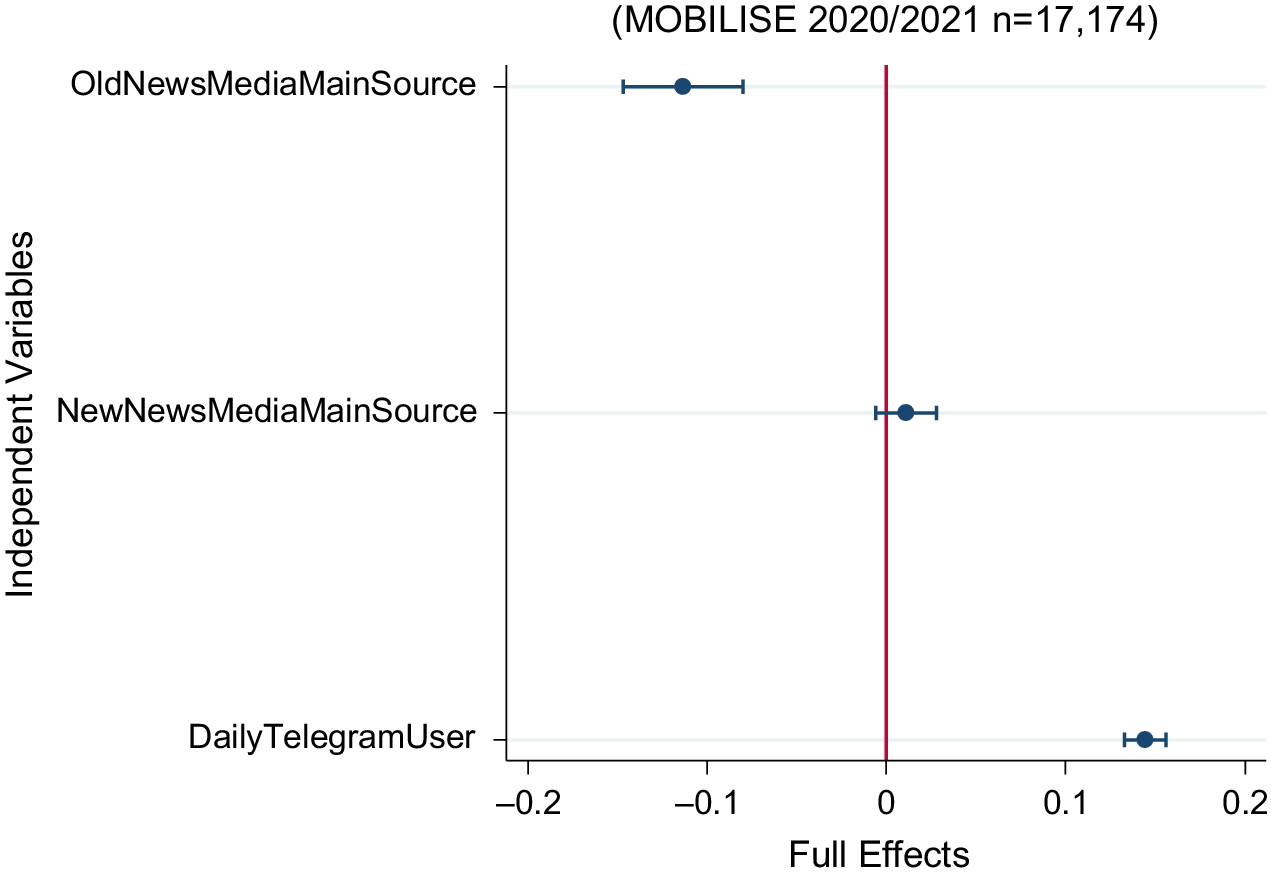
We then included three variables capturing media consumption, accounting for two types of media and the main sources for political news. Old News Media source denotes all those respondents who selected that “Television, Radio, or Newspapers (offline)” are their main source for political news with a 1 and all others with a 0. New News Media source denotes all those respondents who selected “Newspapers (online), Social media or other websites” as their main source for political news with a 1 and all others with a 0. We also account for whether the respondent described themselves as a Daily Telegram User with a binary variable.
We find rather robust evidence that in the case of Belarus (again, unlike in Ukraine in 2013/2014 and Egypt in 2011) respondents who relied on Old News Media were 11% less likely to be protest participants (see figure 10). We find no evidence that people who use social media more generally or other new digital/internet-based sources are more or less likely to be protest participants. But when we account for the frequency of use, and specifically for high frequency use of the Telegram app, we find those individuals to be 14% more likely to be protest participants. We note that this is not our strongest predictor but still a fairly substantial and robust one.
Media consumption and anti-lukashenka protest participation
Conclusions
Our data are a unique source of information on protesters and non-protesters throughout a long protest wave. While not claiming to be representative for the whole population, the survey captures underlying characteristics and attitudes of the protesters and finds clear distinctions between protesters and non-protesters. These distinctions also provide a corrective to some of the early assumptions circulating about the Belarusian case of mass mobilization. Our data both confirm and modify some of the central expectations derived from the comparative politics literature on contention.
First, the evidence for a cross-cleavage coalition is mixed: on the one hand, we seem to have a highly educated middle class protestorate that is more financially stable but also evaluating their personal and the national economic situation as negative. On the other hand, those who were economic winners of transition are more likely to be non-protesters.
Second, we find persuasive evidence that the main protester grievances and claims are not economic but rather political in nature and therefore distinguish protesters from non-protesters. In fact, once we control for partisanship, political dispositions, and values, we find that these variables absorb the effects of the economic factors.
Third, we find that nationality, ethnicity, and language practice do play a role in distinguishing protesters from non-protesters. This finding needs to be further analyzed and explored, but it signals that identity factors underpin protest engagement Belarus, even if they may not have been among the key drivers of mobilization. Whether this is new identity “awakening” or it was already present prior to the protests we cannot say based on our data.
Fourth, media consumption patterns vary between protesters and non-protesters – with protesters using more independent media, social media and other platforms – but the overall effect is less pronounced than expected.
Taken together, our findings both place the Belarusian case of mass mobilization within the broader comparative study of protest, while also highlighting specific dimensions which need to be explored further with regard to Belarus and may enrich other case studies of protest in authoritarian settings. On the whole, this article provides a portrait and baseline for understanding who the Belarusian protesters where and opens up the potential for further analyses on how the protesters’ profile may have changed over time from the early risers to the late joiners.
Financial Support
The collection and analysis of the data employed in this article has been supported by the Open Research Area-funded project MOBILISE (www.mobilise.com); German Research Foundation DFG-396856214 and Research Councils, UK, ES/S015213/1.
Acknowledgements
We gratefully acknowledge the research assistance provided by Alice Lackner during the data cleaning stage.
Disclosures
None.
Appendix
Full Effects of Factors on Probability of Being an Anti-Lukashenka Protest Participant

Calculated using Logit model.


 Open access

