


Introduction
Inappropriate antimicrobial use has been identified as a global health threat and is the major contributor to the rise of antimicrobial resistance in health care settings, communities, and across the One Health ecosystem. Reference Shlaes, Gerding and John1,Reference Davey, Marwick and Scott2 To address the overuse of antimicrobials, health care organizations have adopted antimicrobial stewardship programs (ASPs) as required practices. Reference Davey, Marwick and Scott2 Antimicrobial stewardship programming pediatric hospitals have demonstrated that antimicrobial stewardship (AS) strategies can decrease antimicrobial utilization, prescribing errors, as well as cost or apparent negative impact on pediatric patient safety. Reference Araujo da Silva, Albernaz de Almeida Dias and Marques3–Reference Smith, Gerber and Hersh5
Many ASPs are often based on policy- and practice-based interventions however recent research has shown that antimicrobial prescribing behaviors are influenced by psychosocial factors, such as attitudes, social expectations, norms, emotions, and beliefs. Reference Schuts, Hulscher and Mouton6–Reference Rycroft-Malone, McCormack and Hutchinson9 However, these findings have rarely translated into incorporating social and behavioral determinants of antimicrobial prescribing (AP) for AS interventions, Reference Charani, Edwards and Sevdalis10 especially in pediatric inpatient settings. For example, in patient-centered rounds at our hospital AP occurs within a wide social network with multiple interactions of team members such as senior and junior staff physicians and resident physicians, nurse practitioners (NPs), and pharmacists however, only occasionally, do consultants including infectious disease (ID) physicians participate.
Although education is one of the cornerstones of AS, passive measures (lectures, printed materials, updating antibiotic guidelines) have been found to be only marginally effective, and without sustained effect, in changing AP. Reference Gyssens11–Reference Bowes, Yasseen and Barrowman13 When designing AS educational interventions, research that seeks to understand the local culture and psychosocial factors affecting antimicrobial prescribing behaviours as well as how to engage multidisciplinary staff, has been shown to improve implementation and compliance. Reference Charani, Castro-Sanchez and Sevdalis7,Reference Michie, Fixsen and Grimshaw8,Reference Courtenay, Rowbotham and Lim14
A validated framework for identifying the areas for behavioral change interventions is the implementation-relevant, theory-based approach called the Theoretical Domain Framework (TDF). Reference Michie, Fixsen and Grimshaw8 The TDF represents a number of domains and theoretical constructs that help the user categorize known barriers and facilitators to practice change and select implantation strategies in AS. Reference Atkins, Francis and Islam15 Another construct that refers to non-medical factors arising from the social environment influencing the choice to prescribe is the Social Determinants of Antimicrobial Prescribing (SDAP). Reference Charani, Castro-Sanchez and Sevdalis7,Reference Barlam, Tamma and Trivedi16 In pediatrics, four SDAPs have been identified: 1) relationship between clinicians, (social norms such as prescribing etiquette, hierarchy, and norm of noninterference) 2) relationships between clinicians and patients, (patient pressure or demand, environmental restraints on time they have for patient encounters) 3) risk, fear, uncertainty, identity, and emotion, (prescribing in the setting of managing uncertainty while navigating risk) and 4) perception and misperceptions of the problem, (how clinicians perceive the problem of antimicrobial use, resistance, their own and others’ prescribing habits, and the role of guidelines in AS). Reference Barlam, Tamma and Trivedi16 We sought to determine how can we tailor an AS educational curriculum for the pediatric intensive care unit (PICU) and clinical teaching unit (CTU) teams to address their needs to optimize uptake for an AS curriculum. The objectives of this research study were:
-
1. To explore the educational needs (what, who, when, and how) for the PICU and CTU teams regarding AS practice in their targeted learning environment.
-
2. To identify determinants of AP behavior for clinicians on the PICU and CTU teams.
Methods
We applied a mixed-methods study design using quantitative and qualitative approaches (Appendix A) to understand the determinants of current and desired behaviors around AP for patient-centered clinical rounds. The study was conducted in a 141-bed tertiary care pediatric hospital in Canada with the PICU and CTU teams.
Quantitative phase
The quantitative phase (August 1, 2016, and January 31st, 2017) included pharmacists on the PICU and CTU teams recording inappropriate AP on pre-piloted, anonymized AS concern cards as an audit (Appendix 2). An ID physician (first author CC) reviewed each clinical case for appropriateness and the data was collected using REDCap) Reference Harris, Taylor and Minor17,Reference Harris, Taylor and Thielke18 and analyzed using descriptive epidemiologic terms such as frequencies in Microsoft Excel™ (Version 16).
Qualitative phase
The qualitative phase (February-August 2017) included 23 semi-structured individual in-person interviews with PICU physicians, NPs and pharmacists (PICU group n = 8), hospital pediatricians and pharmacists (CTU group, n = 11), and senior resident physicians hereon referred to as residents who had completed both PICU and CTU rotations (resident group n = 4). Convenience sampling was used, and participants were recruited until theoretical saturation was attained. The semi-structured interview guide was developed based on the initial quantitative phase results as well as a literature search around drivers of AS and AP around the TDF and adapted to different healthcare professional groups (Appendix C).
All interviews (60-75 minutes each) were recorded, transcribed verbatim, and anonymized and coded in QSR International’s NVivo Qualitative Data Analysis Software version 12.0. 19 Initially to ensure consistency in coding, three coders (CC, CG, and AK) independently coded one interview transcript, and nodes and sub-nodes were compared. Nodes are concepts identified in the data when coding the transcripts. A theme node would contain many references or topics related to that node. A sub-node is a pervasive idea that fits into a node identified in the data. One node may contain many sub-nodes. Two coders then coded all the remaining transcripts. The concepts arising from nodes and sub-nodes were then attributed to the domains of the TDF. Two researchers (authors CC and CG) analyzed the data using a pragmatic worldview (aimed at future actionable educational initiatives) and an abductive reasoning approach. Reference Kaushik and Walsh20 The deductive nodes were mapped to the TDF by analyzing the data line by line for the PICU and CTU respondents (for resident transcripts, some concepts were attributed to the CTU nodes and some to the PICU nodes depending on what their references were). Nodes and sub-nodes were identified according to frequency as well as impact and analyzed within each group (PICU physicians and nurse practitioners, CTU physicians, residents, and pharmacists) and across the two teams: the PICU and CTU. The inter-rater reliability was calculated, and sub-nodes with less than 95% agreement were resolved by discussion until consensus was achieved.
After coding data into TDF nodes, the TDF domains were categorized into SDAP clusters, according to the nodes that emerged from the TDF. Within each SDAP, overarching themes (that were formed by an aggregate of nodes) were generated inductively. This was then discussed with a third researcher (author AK) and the various themes were identified within these clusters and regrouped, as some of the domains such as emotion-generated nodes were applied to more than one SDAP. Re-analyzing the themes and nodes within the SDAPs was carried out until facilitators and barriers for AS practice for the PICU and CTU teams emerged within each SDAP and until additional analysis did not provide further insight into the relationship between themes.
The qualitative phase used the TDF and SDAPs to identify determinants of AP in the form of facilitators and barriers for AS practice. These facilitators and barriers alongside other information obtained from the quantitative phase of the study served as a needs assessment. The research for both the quantitative and qualitative components was approved by the Conjoint Health Research Ethics Board at the University of Calgary (REB16-1819). Informed consent was not required from individual patients to participate in the study.
Results
The results are described in the following sections: 1. Behavior determinants: Facilitators and Barriers to AP on the PICU and CTU, 2. Educational needs for the PICU and CTU. Since the quantitative data supported the qualitative data at multiple stages (triangulation), the results of both phases are presented below. The inter-rater reliability of the interview coding was considered high with over 95% agreement across all nodes and sub-nodes. The breakdown of the quantitative responses and qualitative respondents’ characteristics is shown in Table 1.
Demographics of responses in the quantitative phase and respondents in qualitative phase

Behavioral determinants of AP: facilitators and barriers
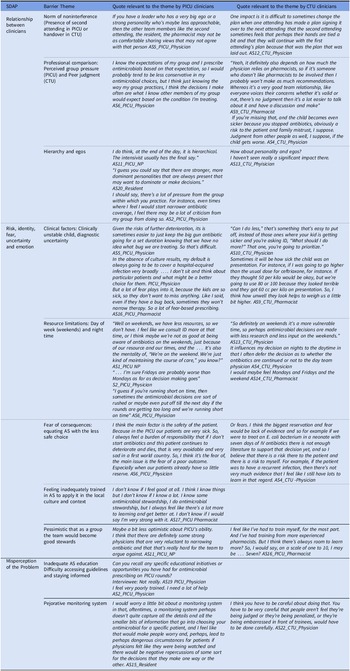
The analysis identified facilitators and barriers across each of the three identified SDAPs for AP in the PICU and CTU. Based on the TDF nodes that initially emerged, the codes clustered in the TDF domains within three of the SDAP groups as follows: SDAP1 – Relationship between clinicians, SDAP2 – Risk, identity, fear, uncertainty, emotion, and SDAP3 – Misperception of the problem. A pictorial description of how the TDF domains fit within the SDAP groups and the facilitators and barriers that emerged from this analysis are shown in Figures 1 and 2 respectively.
Facilitators for antimicrobial prescribing for the Pediatric Intensive Care Unit and Clinical Teaching Unit

Barriers to antimicrobial prescribing for the Pediatric Intensive Care Unit and Clinical Teaching Unit

Facilitators across the various SDAPs to AP
Most facilitators to appropriate AP were common to both the PICU and CTU, such as collaboration and trust, shared decision-making, guideline accessibility, accountability associated with AS, and the goals of feeling empowered as a prescriber and doing right by the patients (optimizing patient care). These are outlined with corresponding quotes in Table 2.
Themes arising for the Pediatric Intensive Care Unit (PICU) and Clinical Teaching Unit (CTU) teams as facilitators for antimicrobial prescribing (AP) and antimicrobial stewardship (AS) across three social determinants of antimicrobial prescribing (SDAP)

Differences in facilitators between the PICU and CTU
Some facilitators were unique to each unit. The PICU relied more heavily on shared decision-making and advocacy from pharmacy, while the CTU identified presence of trainees on the team as a facilitator and as a group, felt more optimistic about AS compared to the PICU.
Collaboration and shared decision-making were valued by both the PICU and CTU, but the CTU physicians relied more on collaboration for AP. The PICU physicians saw collaboration as contributing to the discussion but viewed their role as the ultimate decision-makers on AP. Both the PICU and CTU physicians identified themselves as role models, but the CTU physicians saw the AP decision as a collaborative one, while the PICU physicians viewed themselves as the ultimate decision-makers who considered contributions from the team. This dynamic is tied into hierarchy as a barrier (Table 3).
“So the pharmacist can maybe bring up the fact that he wants to advocate for a different antibiotic, but because of the hierarchy, it’ll be the intensivist that makes the decision, and we don’t always necessarily change our mind even if we’ve been suggested that we should”. AS19_PICU_Physician
Themes arising for the Pediatric Intensive Care Unit (PICU) and Clinical Teaching Unit (CTU) teams as barriers for antimicrobial prescribing (AP) and antimicrobial stewardship (AS) across three social determinants of antimicrobial prescribing (SDAP)

The PICU seemed to rely more heavily on actual shared decision-making with pharmacists (mentioned by all the PICU respondents). The PICU respondents identified the pharmacists as a source of information and education for AS. The CTU physicians identified pharmacists’ presence as important, but relied on them less for AP decisions, and instead considered pharmacists to be “contributing” to decisions, especially around certain aspects such as dosage and duration.
“I think the pharmacist is very important and I do think they’re terribly under utilized on the teams.” AS10_CTU_Physician
“Whether your attending is open to suggestions, or you have an attending who just wants to make their own decisions. Yeah, the dynamics of the team. If it’s a team where everybody works together and everybody’s opinion is valued, then it’s good. If it’s attendings’ choice, then sometimes issues, I think, are not brought up that should be brought up. AS3_Pharmacist
Barriers across the various SDAPs to AP
Barriers to appropriate AP in both the PICU and the CTU included: Norm of noninterference and Professional comparisons. Whereas these barriers were common to both the PICU and CTU, there were some subtle differences with the PICU identifying concerns with the norm of noninterference in AP from the second attending physician and their peer comparison was perceived as group pressure towards broader and longer antimicrobial treatment (and away from AS practices). The CTU on the other hand, identified the norm of noninterference from the sign-over physician while the peer comparison was more associated with peer judgment (with respondents stating that they were concerned that if there was a poor patient outcome secondary to them narrowing antimicrobials, they would feel their group would consider them to have made a poor judgment and choices and that this negatively impacted their AS choices). Other barriers included Clinical status of the child, Diagnostic uncertainty, Environmental resources limitations (such as time of day, days of week, and size of team), Fearing consequences, Difficulty accessing guidelines, Feeling inadequately trained in AS and a Pejorative monitoring system (where the prescribers feel put down or judged by the monitoring system). Barriers across the SDAPs are shown in Table 3 below.
Differences in barriers between PICU and CTU
The most notable differences in barriers (noted as shaded in Table 3) were hierarchy and egos in the PICU (on the side of the PICU attending as well as ID consulting physicians) whereas all the CTU respondents denied that this was a concern. Similarly, 75% of all the PICU respondents expressed pessimism about the group’s ability to be good stewards. Residents perceived the CTU as being more committed to appropriate AP. They also noted that there was a positive trend in the PICU with regards to better AS practices as a group over the course of their training. Overall, the resident group felt more optimistic about the PICU’s AS practices than the PICU physicians as well as the NPs felt about AS practices themselves. All respondents in both the PICU and CTU denied that medico-legal concerns for consequences contributed to their decision-making.
Education needs of the PICU and CTU: The who, where, when, and what of AS education
The educational needs of the PICU and CTU teams were assessed via both the quantitative and qualitative phases of the research. Whereas some education-specific information was gleaned from the TDF domain nodes such as knowledge and skills, respondents were also specifically asked to reflect on previous AS education, and on the practical implementation aspect of AS education for the PICU and CTU teams. This is depicted in Table 4.
Education needs of the Pediatric Intensive Care Unit (PICU) and Clinical Teaching Unit (CTU): The who, where, when and what of antimicrobial stewardship (AS) education

Discussion
Using mixed-methods research design with a psychosocial approach, we identified facilitators and barriers affecting AP and AS practice on PICU and CTU teams and mapped them to SDAPs. We explored the SDAP1: Relationship between clinicians and identified facilitators such as collaboration and trust, shared decision-making, while the barriers identified were peer judgment and hierarchy. We identified psychosocial factors that related to SDAP 2: Risk, identity, uncertainty, fear, and emotion for AP on PICU and CTU teams (e.g. facilitators included reliance on guidelines, individual and group optimism/pessimism around AS, being backed up in AS practices by the ID service and pharmacy while barriers included: fear of consequences in the face of decompensating clinical patients, diagnostic uncertainty, feeling inadequately trained in AS and environmental constraints such as time of day and day of week). Factors related to SDAP3 were: (Mis)perception of the problem, tied closely to AS goals, also emerged out of the data (goals that facilitated AP were: optimizing care for the patient and feeling empowered as a prescriber, as well as appreciation of the accountability that comes with AS, while barriers included a pejorative monitoring system).
The study also generated important factors to consider for the PICU and CTU with respect to their educational needs: what, when, where, how, and by whom factors of education. Our findings can be used to help build an education framework for AS for the PICU and CTU, based on behavioral and social determinants of AP. This understanding of the steward-prescriber relationship and psychosocial factors of AP within this setting as well as an assessment of the educational needs, could allow for a grassroots approach to curriculum development.
Strengths and limitations
Our study has many strengths. The study used an established framework, the TDF, to explore the theoretical mechanisms of action and change to understand AP. By using the SDAPs, we combined the social and behavioral constructs in the analysis which allowed for the engagement of broad groups of influencers: the PICU and CTU physicians, NPs, resident physicians, and the pharmacists from PICU and CTU. The broad engagement ensured the voices of the prescribers were heard, while also engaging them to allow for the “buy-in” aspect, boosting the feasibility and implementation of future interventions. Our study also looked at education for the entire PICU and CTU teams, which represents a more real-life and pragmatic approach to prescriber education. Often AS education is targeted towards a certain group, and few have directed education towards pharmacists and other members of the prescribing team. Reference Satterfield, Miesner and Percival12,Reference Courtenay, Rowbotham and Lim14,Reference Dyar, Pulcini and Howard21–Reference Borek, Wanat and Atkins23 In reality, the AP decision is a very social decision that requires consideration of team dynamics and multiple team members, especially in institutions that have patient-centered clinical rounds.
Our study is not without limitations. Our study utilized an opportunistic (convenience) sampling strategy and relied on self-reporting of data which may have recall bias. It is possible that the respondents were more motivated towards AS and biased in their views on this topic. However, we included a varied sample of clinicians with multiple perspectives. The observational component, in the quantitative phase of the study further improved the integration of the data while also allowing for triangulation of the data. Having the quantitative data available enhanced the granularity of the qualitative interview guide as well as added depth to the data, improving the validity of the findings.
Gender bias might also have influenced the results. All the NPs identified as women and there was a predominance of women CTU respondents as well. This does reflect the pediatric hospital context, as our site only has women NPs in the CTU and PICU. This gender difference might be impacting the qualitative results. Previous work that applied a gender lens to AP has shown that concordance (woman physician-woman patient) may have a lower overall AP in the community. Reference Eggermont, Smit and Kwestroo24 Whereas we do not have evidence of this in the pediatric inpatient setting, the gender imbalance is a limitation, as gender plays a role in team collaboration and hierarchy, which were issues identified as salient for AP in our work. Reference Bear and Woolley25
Implications for future research
Future research needs to examine experiential learning, especially around institutional and ASP-related goals such as intervention buy-in and uptake, antimicrobial utilization patterns, patient-centered outcomes, and ultimately antimicrobial resistance patterns. Barriers identified in the PICU such as hierarchy and ego, group pressure, and pessimism around the group AS practices, indicate a need for cultural change in this setting. Ultimately, a culture of AS practice will foster a better culture of collaboration and shared decision-making, which are facilitators identified by the PICU team for better AP. Overcoming hierarchy and group pressure contributes to PICU team education goals of feeling empowered as prescribers and optimizing patient care, which are at the heart of safe, patient-centered pediatric care.
Conclusions
This work identifies barriers and facilitators to AS among PICU and CTU teams as well as gaps in psychosocial-based AS education. The work presented here broadens the scope of research on understanding how teams in a tertiary pediatric care center make AP decisions.
Supplementary material
The supplementary material for this article can be found at https://doi.org/10.1017/ash.2024.8.
Financial support
This research was supported by the Department of Pediatrics Innovation Award from Alberta Health Services and the Cumming School of Medicine’s Office of Health and Medical Education Scholarship award for Medical Education Research.
Competing interests
The authors have no conflicts of interest to declare.




 Open access

