1 Trump’s Attack
In less than a year, Donald Trump’s second term unwound a federal commitment to expertise in which both parties had invested for more than a century and a half. There was universal consensus that the system was full of flaws—some of them large, like increasing rigidity that made navigating the process lengthy and costly, the easy access of special interests to seats of policy making privilege, and shrinking public trust. But despite the problems, America’s expertise had grown into the envy of every democracy across the globe.
But for Trump, the pathologies of the existing system ran deep. Expertise builds on experts. Experts have political power because they know things others don’t. That power makes it hard to rein them in and, for Trump, that fueled has constant criticism of an unaccountable “deep state.” Investing in government’s expertise was the driving force of government reform since the Gilded Age. Unwinding that expertise was Trump’s goal. It took him months to unwind what it took presidents since Chester A. Arthur to build up.
Fueling that expertise was a robust theory of public administration, both to guide government’s growing expertise and to hold it accountable. When Trump unraveled the focus on expertise, the foundations of public administration became unwound along with it. This is more than just a conclusion that matters to insiders. The rise of Trumpism left big questions unanswered. How could government effectively produce the goods and services that the people counted on? Because the American separation of powers focused so heavily on channeling and controlling expertise, what was to become of the very core of American democracy? And because Trumpism replaced so many elements of public administration with demands for personal loyalty to the president, his lieutenants, and the policies they promoted, was the understanding of accountability, by people and policymakers alike forever changed?
Analysts struggled to put a label on these changes. Some authors concluded that Trump’s America was becoming more authoritarian.Footnote 1 The patterns of authoritarianism were there: growing executive power, declining protection of civil liberties, eroding the rule of law along, and decaying voice of the people – or, at least, many of the people, who felt locked out of the rising power of Trumpism.Footnote 2 Steven Levitsky and Daniel Ziblatt were even more apocalyptic, contending that this is “how democracies die.”Footnote 3
Jonathan Rauch argued that Trump was not so much authoritarian as he was patrimonial, less focused on insisting his followers submit to his authority and more about building power as a symbolic father.Footnote 4 The clearest statement of this core of Trumpism came in a post on X (formerly known as Twitter), “He who saves his Country does not violate any Law,” which in turn is widely attributed to Napoleon Bonaparte and, before that in a different formulation, to the Roman philosopher Cicero.Footnote 5 Trump certainly did not hesitate to use the power of his office to intimidate others and to punish foes. But there was a deeply personal quality to his presidency.
The authoritarian and patrimonial roads, however, both led to the same place. There’s no disagreement that Trump has used pulled the threads of government to concentrate more power in himself, the presidency, and the executive branch of government. This reach for power has come at the expense of the other two branches of government. Especially in his second administration, even the small Republican majority was a pliable partner, when it was in session, which wasn’t often. The lower courts put up speed bumps, but the Supreme Court did little to slow most Trump policies. Madison envisioned a balance of powers in which the other two branches kept the executive in check, but that did not happen in the first months of Trump’s second term. Indeed, after one especially egregious challenge to the other branches of government, I heard an analyst muse out loud, “Madison must be rolling over in his grave.” I checked the records posted by the US Geological Survey and, sure enough, there had been a flurry of earthquakes near his gravesite in Montpelier, Virginia.
Trump’s ongoing assault on the basic traditions of American government, his efforts to concentrate power in the presidency, and his eagerness to challenge the powers of the government’s other branches all raised enormous questions about the future of American democracy as Madison and the other founders created it. Trumpism, at its core, was a powerful effort to elevate the president’s Article II powers in the Constitution, which painted the president’s role with a broad brush. It says that “executive Power shall be vested in a President,” and that the president “shall take Care that the Laws be faithfully executed.”
Since the country’s founding, there have been constant disputes, especially with Congress, about just what this means, and how far a president can expand these “executive powers.” Trumpism worked hard, quickly and aggressively, to increase the control of everything touching the executive branch of government and, in the process, to shift the balance of powers toward the president. The future of Trumpism will depend on how it manages to reset that balance of powers and what checks the other branches raise up. That, in turn, will define the future of public administration, as an instrument of executive decisions.
It’s scarcely surprising that Trumpism can be defined as the tensions between Article II and the rest of the Constitution. Indeed, the frictions between executive power and American democracy date from the country’s first days. Jefferson’s Declaration of Independence contains some of the strongest aspirations about humankind ever put in writing, and they helped rally colonists to the unlikely cause of challenging the most powerful military on earth. What truly sustained them, however, was the long list of twenty-seven grievances against the king, from cutting off trade to taking away state charters to obstructing justice. These grievances grew out of the king’s administration of the colonies. Without those specific complaints against the king’s bureaucracy, it’s hard to see how there would have been an American revolution – or an American democracy to follow. The founders worked through the big questions of just how far the president’s power ought to go, from the dispute between Hamilton and Burr, which cost Hamilton his life and later generated a hit Broadway musical, to debates about whether small-government Jefferson went too far in making a big-government purchase of the Louisiana Territory.
The fundamental questions about just how much power the federal government had—and should have—led to Civil War, ongoing struggles about the government’s role in protecting civil rights, and just how ambition the federal government, in particular, ought to have in using tax dollars and constraining individual freedom.
American history, therefore, is no stranger to deep conflicts. In the Financial Times, however, John Burn-Murdoch argued that Trump’s “blitz on America’s citizens, institutions and — by many estimations — the constitution itself ranks as arguably the most rapid episode of democratic and civil erosion in the recent history of the developed world.”Footnote 6
Trumpism’s scale is, by any measure, enormous. Moreover—and this is the central argument of this book—Trump showed an uncanny instinct for identifying the right problems plaguing the country. However, as I will show, his administration repeatedly pursued the wrong solutions to these problems. Indeed, this is the defining nature of Trumpism: capitalizing on the public’s dislike for much of what government does while using those worries to fundamentally shift the very foundation of America governance: the wrong solutions to the right problems.
This is the argument of the book. It’s surely guaranteed to set the teeth on edge of partisans on both sides of the political debate. But neither side has good alternatives to the fundamental problems that Trumpism identified.
That debate sharpened the question of what it takes to run a government, effectively, efficiently, and accountably. Perhaps the best collection of building blocks is in Luther Gulick’s best captured 1937 paper, “Notes on the Theory of Organization.”Footnote 7 Gulick was a professor at Columbia University and president of the famed Institute of Public Administration, a center of much of the important work in the field during the middle of the twentieth century.
Amid the New Deal, Franklin D. Roosevelt became convinced that government needed a new theory of action. FDR appointed Gulick to a special committee, including Charles Merriam and Louis Brownlow as chair, to develop a plan for improving the management of the executive branch.Footnote 8 Gulick’s paper, prepared for the committee, was the intellectual guide for how best to transform the government.
The paper continues to provide a thoughtful guide to the key puzzles of governance and, it turns out, to Trumpism as well. Gulick wrote that seven core problems were at the core of government work, captured in the acronym POSDCORB: planning, organizing, staffing, directing, coordinating, reporting, and budgeting. Gulick viewed these processes not as ends in themselves but as the foundations for an efficient and effective government. Congress failed to pass most of the Brownlow Committee’s recommendations, but Gulick’s work has endured as perhaps the most succinct guide to running a government.
As public administration sailed through the very difficult post–World War II waters, in which its role and power came under attack from economics and the growing public policy movements, Gulick’s work, including his POSDCORB argument, fell to the side. That is unfortunate, because of the power of his contribution remains enormous, and five of his seven elements chart the core of the Trumpism debates: organizing, in particular whether the structure of government organizations have waste and overlap; staffing, whether government had too many employees with too many bad habits, like seeking to increase their number; directing, whether these employees became too independent, resistant to policy direction from elected officials (and, hence, leading to the “deep state”); reporting, which led the Trump team to seek control of the government’s data systems as prime levers of power; and budgeting, whether the government had a financial system that had grown out of anyone’s control.
Gulick’s goal was a more efficient government shaped by experts. That fueled the growth of government to the 2010s, but in empowering experts Gulick set the stage for the attacks on government that Trumpism brought. In particular, conservatives charged that government had be
Even though Gulick’s work was never explicitly mentioned anywhere in Trumpism, these five elements defined his core attack, as well as that of fellow conservatives. They charged that government had been taken over by a “deep state,” an argument popularized by former member of Congress Mike Lofgren in 2014, who criticized “a hybrid entity of public and private institutions ruling the country,” insulated from elected officials.Footnote 9 It was a government that circled the wagons around existing organizations, to prevent tinkering with their underlying bases of power. It was a government in which left-leaning bureaucrats “sabotaged” the policy of duly elected right-leaning officials, becoming a separate and unaccountable power center.Footnote 10 These forces, in turn, reinforced the perspective of a government full of waste, to the point that tech entrepreneur Elon Musk believed he had a “good shot” at cutting $2 trillion from the federal government’s $6.8 trillion budget. He bought into the idea that government bureaucrats sought to maximize their power, budgets, and autonomy, and he thought he could use the cut-it-to-its-roots approach he had applied to Twitter to the federal government as well.Footnote 11
Accompanying the attacks on government processes and institutions came attacks on the people who worked for government. “We want the bureaucrats to be traumatically affected,” said Russell Vought, Trump’s first-term budget director who came back to head the office again in the second administration. “When they wake up in the morning, we want them to not want to go to work, because they are increasingly viewed as the villains. We want their funding to be shut down … We want to put them in trauma.”Footnote 12 That is just what the Trump administration did.
The administration did indeed have a point. Musk’s broad assault on the executive branch touched on the need to reform the government’s organization, staffing, directing, reporting, and budgeting. Moreover, as Musk sensed and Project 2025 argued, many parts of government’s status quo had become wrapped up in thick procedures. Compliance with those procedures had become ends in themselves, disconnected from the broader effort to produce policy outcomes. In fact, Nicholas Bagley pointed to the danger of the “procedure fetish,” which can “exacerbate the very problems they aim to fix.” This argument then fueled the emergence of the “abundance” movement, which contends that left-leaning policies can be rescued only by remedying the preoccupation with process.Footnote 13
Gulick’s POSDCORB thus served a double role in the times of Trump: it fueled the very elements of government at which Trumpism directed its attack. As I will show, it also continues to provide a roadmap of the basic problems that government must follow if it is to be equipped to do what the people want done. In the sections that follow, I will use Gulick’s map to chart the dimensions of Trumpism, and its implications for governance.
Let me start with the proceduralism that grew up from the left after World War II.
2 Planning: Uprooting Proceduralism
The federal bureaucracy finds itself trapped between two partisan poles. The right continually charges that federal administrators are unresponsive and unaccountable because they are captive of the woke left. The left counters that it is only following the law and protecting important values like environmental protection and civil rights, and that it needs to write new rules to prevent the recurrence of old problems. The right says that this hamstrings policy implementation. The left says that the right is trying to unwind policies with which it disagrees by attacking underlying procedures.
Both sides have valid arguments, but this isn’t a case of “both-side-ism.” The increasing burden of administrative rules undoubtedly has made it hard to get anything done, and that fueled Trumpism’s campaign against federal rules and procedures.
The Historical Roots of Modern Proceduralism
Tensions about federal rules and procedures have always simmered in American government, but it was the administration of Franklin D. Roosevelt in the 1930s that launched each side on constantly colliding paths.
Franklin D. Roosevelt came into office amid a staggering economic collapse, with hungry people out of work and forced from their homes. He responded with a massive expansion of federal government programs, especially through a collection of new “alphabet soup agencies,” including SSA (the Social Security Administration), the WPA (Works Progress Administration), the CCC (Civilian Conservation Corps), the TVA (the Tennessee Valley Administration) – about seventy in all. The strategy was simple: flood the economy with cash. In addition to Social Security, intended as retirement income for older Americans, there were big building projects like the Hoover Dam and many smaller ones, including many municipal buildings and fire stations scattered throughout the country.Footnote 14
The administration paid much more attention to getting the money out fast than in building tools to ensure accountability. Conservatives were enraged. They charged that FDR had gone too far and challenged many of the alphabet soup agencies in court. They piled up impressive early wins, and including the Supreme Court’s 1935 decision in Schechter Poultry Corporation v. U.S. In the National Industrial Recovery Act, Congress had permitted the federal government to regulate many industries, including chicken raising, by allowing business groups to set their own codes of conduct.Footnote 15 Chief Justice Charles Evans Hughes concluded that Congress had not prescribed what the standards should be and had, in turn, delegated to administrators decisions that properly ought to rest with lawmakers. Then, in U.S. v. Butler(1936), the Supreme Court held that another alphabet soup agency, the Agricultural Adjustment Act, was unconstitutional because it strayed into policy questions reserved for the states.Footnote 16
The Court repeatedly returned to the principle that FDR had pressed Congress to delegate too much power to administrators, and that Congress had complied. FDR became so frustrated with these losses that he proposed increasing the size of the US Supreme Court to install more friendly judges. His court-packing campaign failed and harmed him far more than the Court he was attacking.Footnote 17 Several retirements on the Court helped tip the balance back to FDR’s advantage, but the New Deal framed the core questions: just how far could presidential power go? And what guardrails should there be on the exercise of that power? The left eventually got the upper hand in establishing new agencies empowered to spend lots of money. The initial battles to establish new agencies and spend lots of money. Conservatives counterattacked that FDR had gone too far.
World War II intervened before the debate could be resolved, but after the war two new laws put a corral around executive power. In 1946, Congress passed the Administrative Procedure Act, which required agencies provide the public with information about proposed rules and give them a chance to comment on them.Footnote 18 It set up a standard process for issuing new rules and trial-like hearings for adjudicating cases. Congress established judicial review for both rulemaking and adjudication, with the courts given the power to overrule regulatory actions that didn’t fit with the law or that were “arbitrary” or “capricious.”Footnote 19 As administrative power expanded, Congress created a clear accountability practice be defining the steps that agencies had to follow in issuing new rules (a constraint from the legislative branch) and making their actions subject to judicial review (from government’s third branch).
Then in 1949, Congress passed the Classification Act, which standardized the government’s personnel system.Footnote 20 Personnel specialists assigned each government position a classification, including the skills required to perform its tasks. It then created a testing process to assess who best met those skill requirements. For example, the personnel process would define what an “accountant” was, what skills an accountant needed, and how applicants could demonstrate those skills, often through written tests. All “accountants” throughout the government would receive the same salary and benefits. The agency that was recruiting for an accountant position could hire from among the best applicants, typically by choosing from among the three top-scoring applicants (the “rule of three”). Employees received protection against political pressure in doing their jobs.
Salary was based on position, not on the person. The system required equal pay for equal work; the protection of employees from unfair dismissal; and hiring based on merit (which is why, of course, it’s more broadly known as the “merit system”). Most of all, it clarified the government’s prohibition against patronage hiring, continuing the tradition established through the Pendleton Civil Service Reform Act of 1883.Footnote 21
The APA gave administrators vast power. It instructed them on how to regulate, but it did not specify on which issues to promulgate rules. It certainly did not tell them how intrusive or costly their regulations could be. As issues became more complicated, Congress found it easier to delegate big decisions to administrators. During the “War on Poverty” in the 1960s, for example, Congress required local officials to provide “maximum feasible participation” in decisions about how to use federal antipoverty money. Each of those words became the subject of enormous dispute. The result, Daniel Patrick Moynihan, concluded, was instead “maximum feasible misunderstanding.”Footnote 22
The Growth of a Rule-Bound Democracy
In the years that followed, the Clean Air Act granted EPA discretion to set air quality standards at a level “requisite” to protect public health. That led to endless court cases and a 1984 case, Chevron v. National Resources Defense Council, which required the courts to give “deference” to the expertise of administrators in setting clean air standards.Footnote 23 Congress gave the FDA responsibility for determining which medical devices and drugs were “safe” and “effective.” Congress, of course, was in no position to decide itself, drug by drug, but its broad delegation of power to the FDA led to more court battles and fierce political pushback by companies that believed the agency had treated their inventions unfairly. Congress did not have the expertise to resolve these questions on its own, but by delegating big decisions to regulators, individual members of Congress could plant symbolic flags on important puzzles without having to define clearly how they wanted them solved. And then, of course, members of Congress could use the underground channels of influence to shape policy hidden from public scrutiny.
This power generated enormous political heat among regulators and flooded the federal courts with challenges, which in turn required armies of attorneys to litigate the cases. (How else to explain the tremendous improvement of downtown Washington restaurants since the early 1970s?) One senior EPA administrator once told me, “We just assume that every regulation will be litigated, so we begin preparing for that in advance.” That led, in turn, to a trend toward defensive rulemaking, with regulators writing more detailed rules in anticipation of legal battles later. That only made rules more complicated and required more time to produce.
The more Congress’s policy ambitions grew–and they expanded enormously through the 1960s and 1970s in particular–the more questions Congress left unanswered in law: in part because it was easier to set broad goals than to dictate the details; and in part because increasingly complex issues made it harder for Congress to anticipate and decide all the important issues. That inevitably left the big implementation issues to administrators and, inevitably, to even more litigation. The result was an even larger collection of rules, both in response to judicial rulings and in anticipation of future court action, with power drifting away from the regular order of the lawmaking process. Philip Hamburger, in fact, wondered whether the whole system of administrative law had itself become unlawful.Footnote 24 It fed the conservative counterrevolution against regulation on the grounds that far too much power had drifted to regulators.
Meanwhile, the federal personnel system developed its own sclerosis. The relatively straightforward hiring process detailed in the Classification Act became vastly more complicated. There is not much that activists on both the left and right agree on, but one area of common ground is this: the civil service system is broken.
Public employee unions waded in to protect their members and to boost the case for feds to pay dues to protect them. While only about one-fourth of all federal employees belong to unions, these unions represented about half of all federal employees (because only half of employees whose offices are represented by unions are actually union members.). These unions tend to support Democratic candidates, which only fuels the ongoing Republican efforts to weaken unions, which in turn fuels the unions’ counterattack. Union membership among all public sector workers is five times higher than in the private sector.Footnote 25 For unions struggling to retain their political leverage, public sector unions became far more important, because private sector union membership dropped from 33 percent in the middle of the last century to just 6 percent in 2024.Footnote 26 The fight to retain the unions’ role in the federal government thus became in a far larger battle.
The unions worked especially hard to protect the total number of jobs in the federal workforce and to prevent employees from being fired. Protections against dismissal were part of the Classification Act, but over time those protections grew into the lore that “it’s impossible to fire a federal employee,” an argument that the right uses when they compare government workers with the considerably less secure positions of private sector employees. That rhetoric proved especially important during the Trump administration.
Research by David Lewis found that only about one-fourth of top federal managers surveyed in 2020 believed that their agency dealt effectively with poor performers.Footnote 27 Critics used numbers like these to make their point about impossible-to-remove feds. Private sector managers believe that they do better at dealing with poor performers – but more than half of them report problems, too. It turns out that managing hard things is hard no matter where managers are managing.
Comparing the number of employees dismissed for cause in the public and private sectors is impossible because no one keeps the numbers. The number of “separations” – exits from an organization because of retirement, layoffs, and firings – was 1.1 percent in the federal government in August 2024 (before, of course, the massive Trump personnel cuts). The rates were not wildly different in roughly similar private sector industries, like finance (2.1 percent), health care and social assistance (2.7 percent), and IT (2.7 percent), especially after accounting for changes in the size and mission of private sector companies.Footnote 28
Moreover, the federal government’s own data shows that about 10,000–12,000 feds are terminated for reasons of discipline or performance each year.Footnote 29 In a workforce of 2.2 million persons, that certainly isn’t a large number – just 0.005 percent. Removing poor performers isn’t impossible; but it is very hard.
Making sense of the federal merit system is complicated as well by the existence of so many hiring authorities. Federal agencies have more than 100 different hiring authorities at their disposal. They use only about 20.Footnote 30 There are scores of regulations, but most are never used. But among the processes in play, there are many merit systems, not just one. That vastly complicates the challenge for outsiders to understand precisely what’s happening – or to impose accountability.
The process in turn fed the refrain from the right that government ought to be run more like the private sector, even though private sector managers often shy away from the tough decisions of managing their own poor performers. But the central argument is clear and unassailable: It’s difficult to deal with poor performers in government; supervisors remove relatively few poor performers; rules in the system make it hard for managers to do so; and, over time, the defenses against removal have gotten thicker. Right-leaning reformers blame this squarely on the left, and they have a point.
Moreover, personnel advocates, mainly from the left, have promoted a growing number of social policy goals in the selection of federal employees. These goals are universally admirable, but they share a common characteristic: they are unrelated to building the competence of the federal workforce. Indeed, they might erode in important respects. Consider:
Veterans’ preference.In 1944, Congress voted to give returning veterans a special preference in federal hiring.Footnote 31 There was widespread concern that the post-war economy wouldn’t be able to generate enough jobs to employ the vets, and no one wanted the vets to suffer a penalty for serving in the military. The act provided bonus points to vets, which in turn would nudge their applications for federal jobs ahead of other applicants with similar qualifications.
Veterans’ preference stretched back to the Revolutionary War, but the 1944 law both formalized and greatly expanded it. The law generated enormous political support in the decades since, to the point that it is perhaps the most untouchable part of the federal civil service. It has proven remarkably effective in bringing vets into the federal government. Vets account for about 30 percent of all federal employees, even though they represent only about 6 percent of the U.S. population.
Veterans’ preference means that other qualified applicants often have no shot at federal jobs. Moreover, veterans tend to leave government sooner than non-veterans with similar qualifications: they are both less satisfied with their positions and resign at 1.6 times the rate of non-vets.Footnote 32 Higher rates of turnover make it that much harder for agencies to build the expertise they need, while the preference system makes it that much harder to convince non-vets to apply for federal jobs. Still, despite the problems and many proposals for reform, there’s no sign that veterans’ preference is about to disappear.
Diversity.The 1978 Civil Service Reform Act made diversity an important criterion in federal hiring.Footnote 33 About 40 percent of the federal workforce identifies as an ethnic or racial minority, far higher than the 24 percent of the total labor force. However, women remain underrepresented in the civil service, especially at the upper levels. Hispanics in the federal workforce hold only about 9 percent of federal jobs, compared with their share of 19 percent in the U.S. population.
Critics from the right complain that social goals, coupled with the protections provided by civil service laws, have created a separate power center, uncontrollable by elected officials that undermines the goals of an elected conservative government. For conservatives like the Heritage Foundation’s Kevin Roberts, it’s just one more example of the “weaponization of the federal government.”Footnote 34
The most fundamental point is that the straightforward proposition of old Progressives – that the federal government’s civil service system ought to focus squarely on finding the best and the brightest to work for the government – is under assault, from multiple sides.
Apart from these important symbolic and political arguments, the cumulative changes in the personnel system miss the single most important issue with the civil service system: Proceduralism – an obsession with the system’s entry points – has become more important than its goals – bringing experts into government. This is certainly not to say that helping veterans or pursuing diversity doesn’t matter. It surely does. But when those goals undermine the system’s fundamental purpose – ensuring that government has the capacity to do what the people and their elected representatives want done – that is a genuine crisis.
The left has stoked the fires of proceduralism, both in the personnel system and in the contests about other government regulations. That, in turn, fed complaints from the right that experts – presumed to be from the left – had captured the process and insulated the process from reform and responsiveness by building walls of rules around it. The left has a strong argument about the dangers that demands for political responsiveness can pose for expertise in government. The right has a strong argument that many of the constraints that hogtie government come from the vast accumulation of rules that have gummed up the system and that have, indeed, frustrated policymakers trying to make policy changes.
One anecdote illustrates the problem. I had the good fortune of a long lunch meeting with the head of personnel for a very large and important federal agency. It was the last day on the job for the official. The official was in a relaxed and thoughtful mood, so I asked a deliberately broad question, “What do you make of the current state of the merit system?” The quick reply: “Veterans’ preference.” The 140-year tradition of hiring officials based on merit was, in the official’s mind, had boiled down into a procedure that, in the official’s mind, made hiring based on merit extraordinarily difficult. No one objected to ensuring that those who gave service to the country ought to have a prime place at the table of federal hiring, but federal hiring officials on the other hand increasingly viewed veterans’ preference as an impediment to the basic goals of the personnel system.
Proceduralism had triumphed. Along the way, the principal goal of the merit system had been lost: hire the best people available to do the government’s work and protect them from political interference as they do it. Merit had drifted away from a way to accomplish the government’s core mission to a way to hire veterans. We surely owe returning veterans a strong shot at getting a good federal job. The purpose of the federal government’s personnel system, however, is not to employ veterans but to deliver results to the American people.
The rule-encrusted ship that was the federal government thus set the stage for Trumpism. Project 2025 was, at its core, a 900-page indictment of the inflexibility that had grown up in federal management – and, in the minds of the authors, of the dominance of the woke left in government. They had a very good point. But their solutions took policymaking down a tangled and dangerous road that sought to toss overboard the bipartisan consensus that had shaped the basic values of government for more than 140 years. At the core of that effort was the Department of Government Efficiency, or DOGE for short.
3 Organizing: DOGEing the Bureaucracy
Backed by donations totaling approaching a billion dollars, a loose alliance of conservative think tanks got to work after the 2020 election, preparing for what they hoped would be Trump’s restoration. The alliance concluded that members of the first Trump administration seriously erred by failing to move far enough, fast enough. They came away determined not only to put Trump back into the presidency but also to ensure they did not repeat that mistake. Policy proposals emerged, like Project 2025, produced by the Heritage Foundation, and quieter efforts from organizations like the America First Policy Institute and the Center for Renewing America. They wanted to help Trump win and to prepare his second presidency to start work on day one.
Trump did indeed win. The conservative alliance was ready to act. But no one suspected that DOGE would swamp their years of preparation.
Billionaire Elon Musk led DOGE. He had poured $290 million into Trump’s campaign, which ensured that he had Trump’s ear. In the months leading up to the 2024 election, he and Trump talked at length about how he could bring his business instincts to Trump’s administration, and he convinced the president to launch a new “Department of Government Efficiency.” On the evening of his inauguration, Trump signed an executive order that created DOGE and giving it a mandate to maximize governmental efficiency and productivity.”Footnote 35
DOGE began with an enormous splash, firing federal employees and abolishing government agencies. Four months later, in a clash of egos that insiders had predicted was inevitable, the two angrily parted ways. “Such ingratitude,” Musk sputtered on his social media platform X.Footnote 36 But in that short time, Musk led perhaps the biggest change ever in the executive branch of government.
DOGE created a steady stream of big headlines, but no one was sure just what a “DOGE” was. Its name said it was a “department,” but only Congress can create one and Congress hadn’t acted. Some observers suggested it was a federal advisory committee, but it did not abide by the rules long established for them. Musk acted as DOGE’s leader, but his legal position was fuzzy as well. He was neither a political appointee nor a regular government employee. Instead, the White House made him a “special government employee,” a position with a limited term of office designed to bring in experts for short-term advisory roles. (Full disclosure: I was once a “special government employee,” with the responsibility for advising the Department of Veterans Affairs on how to improve its performance system. I had no policymaking authority, as was the case for all “special government employees.”) Nevertheless, with a fuzzy license and the president’s support, Musk launched a campaign of destruction throughout the federal government. Musk and his DOGE grabbed the executive branch’s steering wheel and drove the administration’s work during its first months.
The “DOGE” name was a playful pun, borrowed from a company issuing a virtual currency, the “Dogecoin.” The currency had begun as a joke to test whether its founders could actually create a new currency. The answer, of course, turned out to be “yes,” but the founders still did not take themselves seriously. They decided they needed a mascot, the Shiba Inu, a small Japanese hunting dog, and pictures of the dog remain everywhere on its website, including its swag store.Footnote 37 Dogecoin quickly proved it was no joke and, in February 2026, Dogecoin had a market capitalization of $18.3 billion. More than $2 billion in Dogecoin traded hands every day.
Musk couldn’t resist attaching his work to the rising power of the tech bros and borrowed the DOGE acronym for his own work. DOGE – Musk’s DOGE – quickly became as wild and woolly as the crypto markets. In its first two weeks, Musk and DOGE virtually wiped out the US Agency for International Development, the federal government’s major foreign aid operation, by pushing out all but 300 of the agency’s 10,000 employees. That left just a dozen people in the Africa bureau, with many employees stranded abroad without any way to get home and no way to communicate with headquarters. Paid-for food assistance piled up in warehouses, and recipients panicked.Footnote 38 Musk publicly savaged the agency, calling it “a criminal organization” and writing, “Time for it to die.”Footnote 39 He bragged afterwards, “We spent the weekend feeding USAID into the woodchipper.”Footnote 40 It was the first organization to face his bulldozer.
USAID had been created and funded by Congress. How did Musk, a man with an uncertain role and only the power the president delegated him to wield, shut it down? His chief strategy was transforming a little-used personnel policy to clean out the agency’s staff. He killed it by gutting its capacity. Firing feds became the model for gutting the capacity of agencies across the government.
On the night of the inauguration, the Office of Personnel Management issued a wonky memo that reminded agency heads that they had the power to put employees on paid leaves of absence when, among other things, “the absence is in the interest of the agency or of the Government as a whole.”Footnote 41 The regulation permitting these leaves was originally intended to provide employees with pay for a short period during an investigation into charges against them, or when their agency was reorganizing their work. or reorganize their work. With the help of clever work by the administration’s attorneys, Musk and OPM translated that into a license to permanently put whole groups of federal employees on paid leaves of absence, using “interest of government” clause as a license to dismiss them. This strategy wiped out the standard rights of appeal that the merit system provides and eviscerated the Merit Systems Protection Board, which hears appeals.
The federal government had a process for managing reductions-in-force of federal employees. The administration believed that the process was cumbersome and unnecessary, and top officials believed that their interpretation of the paid leave rule gave them the power to dismiss feds that they wanted.Footnote 42 Legal scholars, however, concluded that this expansive use of paid leaves of absence to fire federal workers violated federal law. Nick Bednar from the University of Minnesota’s Law School argued, “This use of administrative leave likely violates the plain text of the Administrative Leave Act of 2016,” the law that created the administrative leave system to begin with. He continued, “An unfettered power of administrative leave allows presidents to effectively dismantle entire agencies. Congress cannot have intended for presidents to use administrative leave in a way that would make it impossible for agencies to administer the programs Congress enacts into law.”Footnote 43
Subsequent legal challenges proved unsuccessful, largely because individual federal employees did not have the resources to mount an effective suit and the courts ruled that the unions representing them did not have standing to sue. The administrative leave strategy gave Musk and others in the administration a blank check in firing federal employees – and in dramatically shifting the balance of power.
Moreover, in the years after the end of the first Trump administration, many analysts warned that a second administration would bring back the “Schedule F” policy announced a few months before the end of his first term. Schedule F allowed the president and his appointees to convert government employees in policymaking or policy-influencing positions into a new federal schedule, which removed their civil service protections and made it possible for them to be dismissed at will.Footnote 44 Joe Biden issued his own executive order to remove Schedule F but, in yet another January 20, 2025 executive order, Trump recreated it, this time as “Schedule Policy/Career,” or PC for short.Footnote 45 The great fear of all but the far right was that a second Trump administration would reimpose Schedule F. As Musk rolled out DOGE, however, Schedule F was not even a blip on the radar.
Following on the heels of the USAID shutdown, DOGE used the same strategy on the Voice of America, the Woodrow Wilson International Center for Scholars, the Federal Mediation and Conciliation Service, the Federal Executive Institute, large parts of the Department of the Interior, and many offices of the Department of Education, following Project 2025’s recommendation to shut the agency down. DOGE also closed the Consumer Financial Protection Bureau, championed by Sen. Elizabeth Warren (D-Mass.).
DOGErs marched into the US Institute of Peace and demanded employees leave as they shut down that agency as well. In a court challenge, however, DOGE discovered that the agency had been created by Republican President Ronald Reagan and had independent funding from Congress. The courts ruled that the DOGE takeover was illegal and ordered it reopened. After having been forcibly removed in March, the organization’s acting president reoccupied the building two months later. White House spokesperson Anna Kelly criticized the court action, saying that “President Trump is right to reduce failed, useless entities like USIP to their statutory minimum, and the rogue judge’s attempt to impede on the separation of powers will not be the last say on the matter.” She was wrong about one thing. The court did indeed have the last say.Footnote 46 Trump himself later used the building for the first meeting of his Board of Peace.
Musk had skill in grabbing headlines surpassed only by the president. He appeared at an event with Argentine President Javier Milei, who had popularized the use of a chainsaw in cutting government. Milei presented Musk with a chainsaw engraved in Spanish with Milei’s own slogan, “Viva la libertad, carajo” (in English, that translates to “Long live freedom, damn it!”). Clad in black with a “Make America Great Again” hat, Musk waved the chainsaw above his head and told the crowd, “Waste is pretty much everywhere.” It was part of what he asserted was an aggressive effort to reverse the “treason” of the Biden administration.Footnote 47
At first, the effort was scattered but it gradually gained a strategic focus: slash government employment in as many places as he could, eliminate agencies he believed were wasting money, and seize information systems to give him leverage on the government’s central nervous system. Musk pledged to cut federal spending by $2 trillion and “delete entire agencies.” He continued, “If we don’t remove the roots of the weed, then it’s easy for the weed to grow back,” and he argued that ripping up the existing bureaucracy was the key to restoring democracy. “We really have here rule of the bureaucracy as opposed to rule of the people – democracy,” he explained.Footnote 48 Being “DOGEd,” in fact, became a Washington idiom, an often mysterious but extraordinarily powerful force reshaping the executive branch.
Trump made little effort to hide his own disdain for the federal bureaucracy and for the people who worked in it. In his first major speech to a Joint Session of Congress in March 2025, he said,
My administration will reclaim power from this unaccountable bureaucracy. And we will restore true democracy to America again. And any federal bureaucrat who resists this change will be removed from office immediately. Because we are draining the swamp. It’s very simple. And the days of rule by unelected bureaucrats are over.Footnote 49
Trump’s promises, backed with Musk’s forays, led to an overwhelming and unprecedented rollback of the federal bureaucracy.
DOGE created enormous energy, but it raised a perennial question: Does the president have unilateral power to shrink or close government agencies? When it came to the “O” in POSDCORB, how much power did the president himself have? On one side is the argument that Congress creates federal agencies and funds them, and only Congress can eliminate agencies or take away their funding. On the other side is an argument to which we’ll return, that Article II of the Constitution vests the executive power in the president, and that this power includes reorganizing agencies and their programs.
For a time during the twentieth century, Congress granted the president substantial reorganization power. Franklin D. Roosevelt gained substantial flexibility, and a series of reorganization acts afterwards broadened that authority. The laws allowed the president to reorganize agencies unless one or both houses rejected the plan, and presidents extensively used that authority more than 100 times between 1932 and 1984. In 1984, Congress flipped the process. It required the president to submit reorganization plans to Capitol Hill for review, and Congress had to approve the plans before the president could act. That authority expired at the end of the year, and Congress since has been unwilling to grant the president reorganization authority.Footnote 50 That left the state of play clearly in Congress’s hands: Congress created agencies, and only Congress could eliminate them.
DOGE and the Trump administration rejected that principle.
The Administrative Theory of Public Organizations
There is a rich and venerable tradition of theory about public organizations, dating back to the late nineteenth century, the development of hierarchy as a formal theory, and the notion of separating policymaking from the capacity to implement policy. It matured during public administration in the 1930s, especially with the Brownlow Committee report and the war-fighting effort during the 1940s. After the war, two commissions led by former president Herbert Hoover explored how to improve the structure of government to improve its efficiency. Organization theory in public administration produced venerable classics, including Harold Seidman’s Politics, Position, and Power, Herbert Simon’s Administrative Behavior, and Francis E. Rourke’s Bureaucracy, Politics, and Public Policy.Footnote 51
And then, at the core of it all, was Dwight Waldo’s The Administrative State. In 1948, Dwight Waldo contended that public administration needed to be understood as the way a nation brings political values to life.Footnote 52 Waldo’s classic, his doctoral dissertation in political theory, was notable in several respects. It pushed aside the instrumentalist approaches to public administration that had grown up over the previous sixty-five years. It powerfully linked administration and politics and set the stage for the next sixty-five years of work in the field.
Critics complained that traditional public administration theory had failed to produce clear guidance about what to do and, instead, developed “on the one hand – and on the other hand” arguments that provided interesting background but little direction.Footnote 53 Moreover, by encouraging both scholars and practitioners to think in terms of an administrative state and political values, it inadvertently also fed into the growing critique of public administration from the right, which boiled over with Trumpism.
In 1971, economist William A. Niskanen emerged from the public-choice perspective to contend that bureaucrats are rational, and that rational bureaucrats work to maximize their, discretion, prestige, budgets, and power. It laid out the most serious challenge to public administration theory of the post–World War II era. It laid the foundation for reform ideas like privatization, to replace bureaucratic incentives with market competition, and it launched the rational-choice approach to administrative theory.Footnote 54
Even more fundamentally, it provided conservatives with the ammunition for attacking the federal bureaucracy. If bureaucrats aimed at increasing their power and budgets, the only way to control them was to reduce their power and discretion. There was a direct line from Niskanen’s theory to Musk’s DOGE. Rational choice theory, in turn, is easily connected with the “unitary executive” theory advanced by the right. If bureaucrats were power-maximizing, accountability was lost. To regain accountability, the argument went, the president should assert the executive’s constitutional power to ensure that the laws are faithfully executed.
Unitary Executive Theory
The founders spent a great deal of energy defining the role of the “people’s house” in Article I of the Constitution, which defines the composition and role of Congress. It is twice as long as Article II, which lays out presidential powers, and the very vagueness of the presidential powers in the Constitution invites a president to take an expansionist approach. Empowering the president to ensure the “faithful execution” of the law gives the president authority to define just what that means, and just what Congress wrote when it passed the laws to begin with. Disputes between the two branches end up in the US Supreme Court, but the Court tends to take smaller bites of big issues and only rarely draws clear lines separating Congress and the president.
From the president’s perspective, the great advantage of Article II is that it casts presidential power so broadly and with so few constraints. As a result, the exercise of presidential power has only the guardrails that the other two branches choose to exercise – and what voters are prepared to accept. Trump was determined to push hard against – or break through – those guardrails. Congress was silent on his effort. The lower federal courts created speed bumps, but the Supreme Court flattened many of them, especially through expanded use of the “emergency docket,” a legal process I will describe shortly. The result was a dramatic assertion of presidential power that even Alexander Hamilton, the founders’ champion of the role of the executive, would scarcely recognize.
As Trump fought off charges that he sought to overturn the 2020 election, his lawyers pushed hard on the boundaries of the president’s power. In a brief submitted to the US Supreme Court, Trump’s attorney John Sauer contended, “A former President enjoys absolute immunity from criminal prosecution for his official acts.” Sauer’s argument, in turn, built on the Court’s landmark 1803 decision, Marbury v. Madison, in which Chief Justice John Marshall held, “By the constitution of the United States, the President is invested with certain important political powers, in the exercise of which he is to use his own discretion, and is accountable only to his country in his political character, and to his own conscience.” When it came to presidential decisions, Marshall wrote, “being entrusted to the executive, the decision of the executive is conclusive.” Sauer then painted what he claimed was “an unbroken line of [presidential] authority” since then.
As a result, Trump’s attorneys asserted, a president – and a former president – have “absolute immunity from criminal prosecution for his official acts.”Footnote 55 This claim of immunity rested on Trump’s claim that the Constitution vested great power in the president and that constraints on that power were limited. In 2025, Trump made an even broader claim, posting “He who saves his Country does not violate any Law.”Footnote 56 Critics treated the claim with derision, but there was a line of argument stretching back to the country’s founding that, he believed, justified this position.
It begins with debates during the drafting of the Constitution in 1787. The Virginia Plan, advanced especially by James Madison, argued the country needed a strong president and an effective executive branch. Against considerable opposition, especially among his fellow Virginians, he promoted an executive with substantial power. He and some other founders like Hamilton looked back to America’s original governing plan, the Articles of Confederation, which among its other weaknesses had no executive to carry out national policy. Congress struggled to pass laws. When it managed to do so, the job fell to the states, which often were unable or uninterested or both. Correcting that problem was one of the most important reasons that the framers met in Philadelphia.
Virgina’s Edmund Randolph and George Mason wanted a six-person executive, with members appointed by Congress. They opposed concentrating the executive power in a single person and pointed to ancient Rome, in which two consuls prevented the concentration of power. Their opponents, especially Hamilton, reminded them that the consul system often led to confusion about who was in charge and that it eventually broke down under the strain – and under Julius Caesar’s ambition.Footnote 57 The founders sided with Madison’s plan for three branches of government, including a single executive balanced by an independent legislature and judiciary. Article II in the new Constitution therefore gave the president executive power. It did not, however, spell out in much detail how the president should exercise that power, beyond requiring the president to faithfully execute the law.
Conservatives have contended that this meant the framers intended for the president to have few constraints on his executive power. For the framers, however, the idea of a “unitary executive” meant a single executive instead of the multi-headed Roman model. In Federalist 70, Alexander Hamilton argued the need for “energy in the executive,” but here again the energy came through a singular, instead of a plural, executive. Debate continued over the following decades about just how much power that executive ought to have, but the basic executive issue – one instead of many – was settled in favor of a unitary executive in the executive branch. That was the model the founders intended.
The notion that the Constitution gave the president broad discretion over the executive branch emerged during the Reagan administration, when the concept of a “unitary executive” took on a very different meaning. Conservatives had become convinced that big-government Democrats had gradually built larger, more powerful, less responsive bureaucracies, and that Republican presidents like Richard Nixon and Gerald Ford had been complicit. So, too, was Congress, which after creating bureaucracies did little to control how the bureaucrats exercised their power. Conservative thinkers began contending the solution had to come through a president who exercised strong power over the bureaucracy, using the license that Article II provided, according to their reading.
For example, a 1981 executive order required federal agencies to get approval from the director of the Office of Management and Budget before issuing any new rules.Footnote 58 That tightened the reins on administrative freedom across the executive branch and brought decisions directly into the president’s inner orbit. Subsequent administrations, Democratic and Republican alike, gradually added more control mechanisms, especially strengthening the role of the Office of Information and Regulatory Affairs, Office of Federal Procurement Policy, centralized clearance of policy, and selective intervention into agency decisions. The regular issuance of a “presidential management agenda” reinforced the effort. Together they aimed at creating a more unitary source of power – not in the sense of a single-headed executive branch, but with a president using more power unconstrained by the other branches of government.
The agencies had become too independently powerful, the argument went. Congress created them but did not adequately supervise them. The Constitution vested the president with executive power, which they understood to be sole control over the executive function. It also charged the president to see that the laws be “faithfully executed,” with the president defining what “faithful” execution meant. It is an understatement that not all scholars agreed with that position. In conservative circles, however, the “unitary executive” theory became an important way to ensure a more effective government – and to rein in the power of left-leaning bureaucrats. The theory in turn grew into a case for Trumpism.Footnote 59
Trump’s say-so didn’t make it so, of course. The federal courts became a battleground for defining how much power the president had. In the 2020 case, Seila Law v. Consumer Financial Protection Bureau, the US Supreme Court held that the Consumer Financial Protection Board’s structure was unconstitutional because it limited the president’s power in removing its director. In the oral argument for the case, the solicitor general in the first Trump administration, Noel J. Francisco, said that in the earliest days of the country, “the executive power included a power to oversee executive officers through removal.” Moreover, he said, “the key structural constraint at issue here is the one set forth in Article II, that the executive power shall be vested in a President and that he shall take care that the laws will be faithfully executed. The only way he can do that is if he’s fully accountable for the decisions of his principal officers.”Footnote 60 For the president to exercise the responsibilities of the office, the president needed the power of removal of officials who did not pursue the policies the president set, the attorneys argued.
The Court sided with Francisco in a 5–4 decision, ruling that it was essential that the president hold federal agencies – even independent bureaus like the CFPB – accountable for their work by the ability to dismiss their heads. In the second Trump administration, the Justice Department continued this line of argument in contending the president had the power to dismiss members of the Merit Systems Protection Board, the National Labor Relations Board, and the Consumer Products Safety Commission. The Court permitted firing of all these officials.Footnote 61
Trump also issued an executive order requiring regulatory agencies, including independent regulatory agencies like EPA, the Securities and Exchange Commission, and the Nuclear Regulatory Commission, to submit all their proposed regulations to the Office of Information and Regulatory Affairs for approval. The order began with a reminder that “The Constitution vests all executive power in the President and charges him with faithfully executing the laws.” Previous administrations had unwisely “allowed so-called ‘independent regulatory agencies” to operate with minimal Presidential supervision” and had “been permitted to promulgate significant regulations without review by the President.” These developments, the executive order concluded, “undermine such regulatory agencies’ accountability to the American people,” so the order required centralized review and approval.Footnote 62 This policy gave the White House control of the administrative apparatus.
Each of these steps individually was important. They changed the agencies’ leadership and trimmed the power of regulatory agencies, and the strategy broadened out to encompass more agencies. These steps were part of a concerted strategy, years in the making, of imposing a unitary executive theory on the executive branch of government.
The theory’s supporters claimed that this was what the country’s founders had in mind. It is impossible, however, to determine how the founders really wanted the president to control the bureaucracy because they just didn’t think much about the bureaucracy. Their focus was, instead, on the grand bargains to balance powers within the new government. In the country’s early years, the executive branch didn’t have much of a bureaucracy. During the Washington administration, federal employment was only several hundred; by the Jefferson administration, it was just 3,905 people, and most of them were postmasters, who often worked as shopkeepers in their spare time, and customs collectors, who tended to stay in their jobs for decades. By 1824, the State Department had but thirteen employees in Washington.Footnote 63 There really was no theory of public administration because there was not much public administration. It makes little sense, therefore, to look to the founders for guidance on how to assemble and control an administrative state. Government was so small that it was little surprise that differences of opinion often became personal, like the duel between Aaron Burr and Alexander Hamilton.
The founders were masters of ambiguity, so debates about what they believed about a unitary executive, as understood in the twenty-first century, can easily rage on without resolution.Footnote 64 Because of the ambiguity of the country’s earliest years, it’s possible to read many different ideas into their words and laws and policies. And, of course, the founders did not provide guidance about how to deal with the challenges of freedom of speech through social media, or the right to privacy through abortion.
But this ambiguity provided conservatives (and progressives as well, of course) with the foundation for interpreting the Constitution in ways that advantaged their position. Trumpism seized on the unitary executive theory – the idea that the president had unitary control over the executive branch, its employees, its structures, and its policies – to advance its idea that the president could exercise unfettered control over its agencies, budgets, and personnel.
That, in turn, provided Musk what he believed was his license to radically transform the federal government. When he left the administration, there was internal grumbling about what he had done where and about strategic mistakes his opponents believe he made. But it hinged just as much on the personal frictions between Trump and Musk. His departure was not because the administration’s leaders believe he had gone too far. That, in turn, radically transformed the “O” – organization – in the administration.
That led to an even more aggressive effort to remove federal employees, as the “S” – staffing – step in Trump’s assertion of executive power.
4 Staffing: Cutting Personnel
When it came to the staffing function, the Trumpists were decidedly ambiguous. They issued policy that supported merit-based hiring in principle, but they did not believe that employees ought to be protected from dismissal by the president if the president wanted to remove them from federal service.Footnote 65 DOGE dominated and, as it faded from the scene, OMB Director Russell Vought stepped in with aggressive cuts throughout the government.
Americans understood that making government effective required expertise, but because that expertise created threats to democratic rule, it had to be politically responsive. This dilemma of responsiveness and expertise, of course, was not a peculiarly American problem. In Great Britain, its early nineteenth century government struggled to control the British East India Company, a business that had its roots in trade with India, but which became enormously powerful as that trade grew. The company came to control much of India and, with that control, came enormous political power. Its dominance over the market for tea aggravated relations between Britain and its North American colonies, led to the Boston Tea Party, and helped spark the revolution.
The Civil Service in American Political Life
By the 1850s, the British government increasingly worried about how to ensure that that the company was not controlling the country’s foreign policy. The solution, many experts agreed, was for the government to create its own experts, hired based on merit and protected from political interference. That led to an 1854 plan by Stafford H. Northcote, who later became chancellor of the exchequer, and Charles Edward Trevelyan, the Treasury’s permanent secretary, Stafford H. Northcote, for the creation of a British merit system. The Northcote-Trevelyan Report concluded, “the Government of the country could not be carried on without the aid of an efficient body of permanent officers, occupying a position duly subordinate to that of the Ministers who are directly responsible to the Crown and to Parliament.”Footnote 66
After the Civil War, the US struggled with precisely the same problem, especially in countering the rising power of robber barons in the oil, railroad, and steel industries. On one hand, the giant companies of the Gilded Age resisted governmental oversight. On the other hand, even if the federal government wanted to attempt leverage over the robber barons, the patronage system enveloping the government made it impossible to build and sustain expertise. Moreover, rewarding political friends with jobs was always important, but the pressures to do so were often unpleasant and overwhelming.
The Treasury Secretary in the Cleveland administration, Lucius Quintus Cincinnatus Lamar, surely had the most captivating name of any cabinet secretary in US history; he was named after a Roman statesman in the fifth century BCE, known for his devotion to civic virtue. But the parade of supplicants for federal jobs challenged his virtue and ruined many a meal. “I eat my breakfast and dinner and supper always in the company of some two or three eager and hungry applicants for office; go to bed with their importunities in my ears,” he complained.Footnote 67 It was such a problem for Abraham Lincoln that he had a secret door installed at the back of his second floor White House office, what is now the Lincoln Bedroom and what he called “the shop,” to escape the parade of constituents who regularly lined the stairs.
Following the assassination of President James Garfield, shot by a crazed supporter who thought he deserved a plum European diplomatic post, Congress passed the Pendleton Act of 1883, named after Sen. George H. Pendleton (D-Oh.). The act was remarkable for its simplicity: just 2625 words, much of which focused on the postal system, where much of the patronage system existed.Footnote 68 The basics of the Pendleton Act are familiar to anyone who has studied the American civil service system: positions classified according to the skills required; exams to assess those skills; selection for positions based on the exams; a probationary period for new employees; and protection of employees for pressure to make political contributions or participate in political activities.
The Pendleton Act focused on the standards for hiring new employees. The only protection it afforded employees was for political pressure on the job. For a government that had been mired in patronage for decades. The consensus among historians is that Jackson removed about ten percent of government workers in his first term, and twenty percent across both terms, a monumental change.Footnote 69 (To this day, there is a debate about whether Jackson’s spoils-system hiring was a lot or a little, but there is no debate about whether the Pendleton Act cut it down to size.)
As both Woodrow Wilson and Frank J. Goodnow wrote, government’s problem was obtaining the expertise it needed for effective administration, which meant it could not base its hiring decisions on patronage, but it needed to ensure those experts were responsive to political officials, which meant the system needed accountability. The merit system provided an answer to the first problem. The second problem was more difficult. Wilson believed that experts could hone their craft from the best sources and then serve democracy and their rulers. “If I see a murderous fellow sharpening a knife cleverly, I can borrow his way of sharpening the knife without borrowing his probable intent to commit murder with it.,” he said.Footnote 70
In Politics and Administration, Frank J. Goodnow built on Wilson’s argument. Policymakers focused on ends. Administrators built the expertise to deliver the means. Policymakers held experts accountable for how they did their job.Footnote 71 It was a neat – but flawed – resolution of the problems of corruption and performance that had plagued American government for most of the nineteenth century. It did, however, break the back of the spoils system and establish the foundation for a bipartisan approach to the merit system that endured remarkably well – until the Trump administration.
The Pendleton Act was only half of the reform story, however. It created rules about how to hire federal employees. But under what circumstances could they be fired? Congress took up that question in 1912, with the Lloyd-LaFolette Act. The act reinforced protections for civil servants against removal from office except for cause.Footnote 72
During the Trump administration, this was the dividing line. Trumpists favored the pre-Lloyd-LaFollette days, with hiring based on merit but removal based on the president’s discretion. At first, these pre-protection days covered only ten percent of the government workforce – another feature that Trumpists applauded. But then the Pendleton Act principle covered nearly two-thirds of the federal workforce by 1907, and Lloyd-LaFollette created protections against removal of federal employees.Footnote 73
Still, the period between the Pendleton and Lloyd-LaFolette acts was a benchmark for the Trumpists. In making the case for Schedule PC, the administration discussed “merit” nearly sixty times, and its 23-page guidance on hiring senior executives refers to “merit” ten times. Despite the constant genuflection toward merit, however, Trumpism read American history as giving the president the power to remove any federal employee at any time for any reason. It contended that this was the power Washington had, and it was a power that continued after the passage of the Pendleton Act until Lloyd-LaFollette. The protections that grew afterwards, in fact, drove the creation of the “deep state” because it gave civil servants strong protections and prevented the president from exercising unitary executive power.
Therefore, in creating Schedule PC, with its provision for at-will firing, the administration contended it was acting completely within the law. In its extended case for the new schedule, published in the Federal Register, the Trump administration looked back to the time after the Pendleton Act. The discussion of the rule is 38 pages long and contains an exceptionally thorough, theory-based case for the administration’s position. At the core, the discussion claimed that “employees in the new civil service remained at-will.”Footnote 74 To support the principle, the administration said that “the law prohibited executive branch officials from dismissing classified employees because they declined to render political services.” In the Federal Register, the administration contended, “The reformers who created the Pendleton Act made a conscious decision to keep the civil service at-will.”Footnote 75
Then the discussion quoted George William Curtis, a noted reformer, who had famously argued, “if the front door [is] properly tended, the back door [will] take care of itself” – that is, an effective system of hiring makes it unnecessary to worry about firing. Moreover, Curtis said, “it is better to take the risk of occasional injustice from passion and prejudice, which no law or regulation can control, than to seal up incompetency, negligence, insubordination, insolence, and every other mischief in the service, by requiring a virtual trial at law before an unfit or incapable clerk can be removed.”Footnote 76 For the administration, Curtis was invaluable: he had impeccable reform credentials; he believed in merit in hiring; and he seemed to be arguing that there should be few constraints on dismissing federal employees. If a reformer believed that hiring based on merit hiring mattered more than preventing firing at-will, then the administration had a powerful case for sweeping away the rules that had encrusted the system since.Footnote 77
The Trump administration traced support for this position even deeper into American history. The discussion pointed particularly to a speech by James Madison, who sat as an elected member of the first House of Representatives. Madison said,
If the president should possess alone the power of removal from office, those who are employed in the execution of the law will be in their proper situation, and the chain of dependence be preserved; the lowest officers, the middle grade, and the highest, will depend, as they ought, on the president, and the president on the community.Footnote 78
For Trumpists, this quotation from Madison is important for two reasons. First, it asserted that the author of the Constitution himself believed that the president had dismissal power over anyone in the executive branch. Who could quarrel with Madison’s view? Second, it traced that power down to the lowest offices in the government. Madison seemed to support the idea that the president had the authority to make every federal employee at-will.
However, the Federal Register’s discussion, and thus the case for the Trump administration’s personnel reforms, rests on a very shaky foundation. Let me consider Madison’s argument, at-will employment under the Pendleton Act, and Curtis’s case for reform.
First, on Madison: In his speech to the House, Madison was not making the case for a presidential power to dismiss all executive branch employees at will. Rather, Madison was speaking in a debate about the president’s power to fire the cabinet officials he had appointed and which Congress had confirmed. Some members of Congress argued that, since the Senate had voted to confirm these officials, the Senate also had to approve their dismissal. Madison and others took the position that the Senate certainly did have the power to confirm these officials, but that the Constitution did not give them a role in the removal of these officials.
The debate stretched on for a month, with the sides evenly divided and Vice President John Adams called upon several times to break ties in the Senate. The champion of executive power, Alexander Hamilton, seemed to have waffled on the question.Footnote 79 The founders had threaded the tiny eye of ratification’s needle by leaving out a resolution of many important issues, and this question of balancing presidential and congressional power was one of the first big questions that surfaced.
Madison and his colleagues found a way to sidestep the main issue by focusing instead on who might retain the records when a presidential appointee, especially a cabinet secretary, left office. He proposed making the records question the central one and suggested that the president ought to have the power to maintain the records. They quietly pushed the question of dismissal to the background. The clever strategy laid the groundwork for what became known as the “Decision of 1789,” which reinforced Madison’s position that Congress did not have to approve a president’s decision to remove a cabinet official. That soon became practice, without a firm policy decision ever having been made. It took until a 1926 US Supreme Court case, Myers v. United States, for a formal ratification of the policy that the president did indeed have the power to remove the appointed top officials, without congressional approval.Footnote 80
None of that debate, however, extended to individuals other than presidential political appointees confirmed by the Senate. Rather than providing support for the president’s power to treat all federal employees as at-will, it reinforced Madison’s skill at sketching the broad constitutional principles and sidestepping the most divisive issues as much as possible. Madison’s speech did not provide support for the idea that all federal employees were at-will and that the president had the power to remove them. Indeed, it would have been impossible for Madison to speak at length in 1789 about removing members of the bureaucracy, since at that point there was no bureaucracy.
Second, on the Pendleton Act: The Pendelton Act laid out principles for merit-based hiring.Footnote 81 No employee could be asked for “any political service” or contribution. Standards for removal were very narrow: “habitually using intoxicating beverages” or taking a bribe. The act created a “chief examiner” with a salary of $3,000 per year and required the Secretary of the Interior to provide an office that was “furnished, heated, and lighted,” along with the necessary stationery. Employees had to be hired based on merit. When it came to dismissing them, at-will or otherwise, there is no evidence one way or another. It was a law aimed at eliminating patronage in the hiring of federal employees.Footnote 82
Third, on whether Curtis favored at-will employment: Curtis had the best view on the power of removal in the late nineteenth century because of his service as chair of Ulysses S. Grant’s 1871 commission, the first great statement of civil service principles in American history. Curtis and his colleagues on the commission concluded that vacancies should be filled from among the top three individuals selected by competitive examination and that no one should have to pay a kickback in exchange for a government job, the foundation for the principles captured on the Pendleton Act.Footnote 83 Curtis and the other reformers of the Progressive era focused most of their attention on improving the hiring of federal workers. He believed that the stronger the merit-based hiring process, the less need there would be for attention to removal, and he wanted to provide leaders with as much flexibility – and as little red tape – as possible in managing their organizations.
The Trump discussion is indeed correct in noting that Curtis believed that dismissals would not matter much if managers got hiring, based on merit, right. That is an important lesson for both public and private managers today: it is far harder to clean up a bad hiring decision than to avoid making that decision to begin with. But this is also a lesson to which the Trump administration paid little attention. Its efforts focused on making it easier to fire quickly instead of to hire smarter.
Curtis, moreover, went into far more detail on this idea than the Trumpists suggested in their Federal Register treatise. The Pendleton Act was the product of Charles J. Guiteau’s assassination of President Garfield in 1881, and President Arthur signed it into law in January 1883. Seven months later, Curtis gave a speech to the National Civil Service Reform League, which he headed. In the speech, Curtis did warn about the risks of requiring “a virtual trial at law before an unfit or incapable clerk can be removed.”Footnote 84 He went on, however, to make this point, which the Trumpists do not note in their argument,
The public hold upon such employees of every kind is through the elective officers who appoint them. But the public interest in them is solely that they shall be appointed and removed in the way least harmful to the public service and to the general welfare. It is for this reason that when, as in a recent case, a high appointing officer, the commissioner of internal revenue, misused his authority by removing an admirable subordinate to make place for a favorite, a powerful demand was properly made in the press that the President should dismiss the officer who had flagrantly abused his official trust to the injury of the public service and the discredit of the government. The universal public attention which is now directed to such acts, and the sharp censure with which they are exposed and condemned, is but one of the illustrations of the general determination that the system which inevitably breeds such abuses shall be reformed.
Curtis was in fact making precisely the opposite argument of what the Trumpists suggested. He recognized that poor performers existed. He believed that they could and should be removed. But he never made the case that such a removal should, under any circumstances, be made to promote responsiveness to a political official. “Such abuses shall be reformed,” he said, and that is precisely what Lloyd-LaFollette did.
Massachusetts Republican Senator George F. Hoar agreed. He said that even though the bill “does not even … deal directly with the question of removals,” but “it takes away every possible temptation to improper removals.”Footnote 85 The Lloyd-LaFollette Act sought to do just that. The law said that
… no person in the classified civil service of the United States shall be removed therefrom except for such cause as will promote the efficiency of said service and for reasons given in writing, and the person whose removal is sought shall have notice of the same and of any charges preferred against him, and be furnished with a copy thereof, and also be allowed a reasonable time for personally answering the same in writing.Footnote 86
The chain of Progressive reforms – the policies promoted by the Progressives of the late nineteenth and early twentieth centuries, a movement different from that of the twenty-first century liberals – was unbroken, from Grant’s commission chaired by Curtis, the Pendleton Act, the broader reform movement stretching into the early twentieth century, and the Lloyd-LaFollette Act. This was a movement that stretched forty years in constant arc, beginning with the principles explicitly favoring merit hiring and continuing to principles explicitly opposing at-will removals. The Trumpist historical argument that contends the Progressives supported at-will employment simply is not true.
This “progressive” label often proves jarring on twenty-first century ears, especially because the Progressives saw themselves as instruments of a muscular government. At the beginning of the movement during the late nineteenth century, the Progressives were mostly Republicans, set up in opposition to Democrats who resisted their efforts to expand the scope of governmental power. Over time, especially with the administration of Franklin D. Roosevelt, the Democrats embraced Progressive ideas and Republicans attacked his plans as the tools of “big government.” The political party that had given birth to the Progressive movement thus became its biggest foe; the party that originally opposed it took on the “progressive” label. Moreover, one can speculate on the connections between the two Roosevelt presidents, fifth cousins Theodore (a Republican) and Franklin (a Democrat). Would Theodore have been a Democrat instead of a Republican had he been elected during the Depression of the 1930s? And would Franklin have been a Republican instead of as a Democrat had he served thirty years before? The one certainty is that their respective approaches to the presidency defined the role of experts in government for more than a century.
Trumpism’s Assault on the Merit System
That led Trumpists to launch a two-pronged assault on the merit system. In one prong, the administration asserted that Article II of the Constitution gave the president the power to fire any federal employee, at any time, for any reason. On the second prong, it claimed the power to hire an unlimited number of political appointees, for any agency, for the life of the administration.
First, on firing: An administrative law judge, a civil servant empowered to exercise judicial powers, was hearing a case involving Elizabeth Oyer, an attorney dismissed from the Justice Department. In her role at Justice, she reviewed requests for pardons, including the review of cases involving individuals convicted of crimes and whether they could regain the right to possess a gun. The case of actor Mel Gibson came to her desk. In 2011, he was convicted of a misdemeanor involving domestic violence. Oyer concluded that the nature of the crime made it unwise to approve Gibson for possession of a gun. The next day, she was fired. Gibson was a strong supporter of Trump, and a senior Justice Department official leaned on her to approve the gun permit. She had refused, and her dismissal came soon thereafter. Department officials denied that the Gibson case had anything to do with her firing, but she believed otherwise and appealed.Footnote 87
Administrative law judges are civil servants empowered to decide appeals like Oyer’s, and can be hired at agencies like the Social Security Administration. In this case, the judge worked for the Merit Systems Protection Board, created by Congress in 1978 to hear appeals for individuals who believed that their merit protection rights had been violated. Oyer filed her appeal. The Justice Department replied with a brief that contended the facts of the case did not matter, because “Article II [of the Constitution] vests executive power in the President, and his duly appointed Attorney General, including the authority to manage the operations and personnel.”Footnote 88
For years, conservative activists have argued that the Constitution and, especially, its Article II, Section I, gave the president sweeping powers over the executive branch: “The executive Power shall be vested in a President of the United States of America.” That in turn, the Justice Department’s attorneys contended, allowed the president and his attorney general the power to fire employees at will. What was striking about the attorney’s brief was that it contended the facts of the case were immaterial. All that mattered was the assertion that the Constitution gave the president and the attorney general full power. The argument was brief yet broad. The case for the president’s power did not carry any limitations, according to the attorneys. Oyer concluded, “It’s all part of a master strategy to clear the way to install loyalists throughout government.”Footnote 89
Second, on hiring: during the same week, the White House issued an executive order creating a new Schedule G in the public service, following on Schedule PC, which previously had been Schedule F. (The schedules follow in alphabetical order as they are created; presidents have the power to create new ones.) With Schedule G, Trump gave himself the authority to create “positions of a policy-making or policy-advocating character normally subject to change as a result of a Presidential transition.”Footnote 90
The executive order says it focuses on “improving the operations of the Department of Veterans Affairs,” but it provides the power to create an unlimited number of positions across the government, without any standard for filling them and without any restriction on dismissing the people who hold them. At its core, this executive order creates a blank check on political appointments, without the need for approval beyond the administration making them. Of course, that argument would also empower Democrats to do the same, but the Trumpists were not worrying about that, perhaps because they wanted to seize as many levers of power as quickly as they could and perhaps in part because they believed that grabbing control of those levers would make it more difficult for the Democrats to win them back.
The federal government already has more political appointees than any of the world’s largest democracies – about 4,000, 1,200 of whom require Senate confirmation. That’s vastly more than in Germany and the UK, for example, which have fewer than 200. In Japan, the number typically is less than 30. The Trump administration sought to drive the number of political appointees in the US even higher. Political scientist David E. Lewis, however, found that “Programs and agencies run by political appointees tend to perform worse than other programs and agencies,” and that weakened the case for the Trump strategy – except on the grounds of capturing power.Footnote 91 This was a strategy aimed at strengthening Trump’s hold on the bureaucracy and of permanently shifting its base – a kind of administrative gerrymander.
There is a profound paradox at this bit of Trumpism. On one hand, it is impossible to escape the conclusion that Trump’s work rests on considerable support from his unshakable base and from his electoral victory. The size of that margin – and of his 2024 mandate – is surely open to debate, but what matters is that he claimed a mandate, operated on it, and was not significantly challenged, especially by the other branches of government. In fact, noted political analyst Norman Orstein wondered, “Who will step up and restore any sense of checks and balances?”Footnote 92 Trump was able to drive his policies through the political system with relatively few constraints.
Moreover, every careful observer would have had to conclude that there was much in the existing administrative system that needed fixing. Trump not only showed an uncanny ability to seize the agenda and build political support around his work. He also had a powerful instinct for grabbing onto issues that required genuine reform.
On the other hand, many of the changes that Trump made to the nation’s administrative system did genuine damage to government’s capacity to do its work and to the trustworthiness of a system of neutral competence that had emerged, with the support of Republican and Democratic administrations alike, over more than a century. The result was more than just a revolutionary series of policy changes. It was an erosion of the norms that had guided public administration, in both practice and theory.
One can applaud Trumpism’s instinct for seizing on problems that needed to be fixed and for surfacing them in public view, in ways no previous administration had managed for a very long time. But one should also question the underlying damage done to the American administrative state – and chart the consequences that this means for the conduct of government and the trust that Americans have in it.
Several deep pathologies are wired into Trumpism’s approach to public administration. Within public administration, there has long been a search for balance between political responsiveness and administrative competence. Trumpism paid little attention to competence in the quest for responsiveness. Political control was paramount. Moreover, Trumpism took a decidedly mechanistic view of government, with a focus on vertical, hierarchical control at a time when society in general – and government in particular–was becoming increasingly horizontal. Hierarchical control was paramount. Trumpism became unmoored from the laws that Congress passed and focused instead on strengthening executive power. Presidential authority was paramount. The disconnects plagued the administration’s ability to get things done.
Finally, at a time when information and technology were becoming increasingly important in creating a new central nervous system for measuring government’s results and connecting its pieces, Trumpism sought to pry apart privacy protections surrounding government information and ignored its potential for producing better results. Uncovering every potential for political retribution was paramount. Trumpism might have had the instincts for the right problems, but it systematically undermined the potential for building a more effective, more responsive, more trustworthy government.
When it came to the “S” – staffing of government – the Trump administration disconnected itself from the government’s need for capacity. It focused far more instead on the “D” – directing government to ensure it is responsive to its will.
In the first year of the second Trump administration, DOGE and related efforts inflicted enormous damage on the executive branch. Musk did not manage savings in the trillions, as promised. In fact, it was impossible to determine just how large savings might have been—or, indeed, if there were any savings at all. In part, this was because Musk and his allies throughout government moved as fast as they could and didn’t stop to count the savings. In part, this was also because Musk’s efforts ate away at government’s capacity to measure savings.
But the administration did dramatically shrink the size of the federal workforce. From January to November 2025, the federal workforce shrank by 220,000, a 10 percent reduction. Cuts ranged from 69 percent in the Department of Education and 38 percent in the Department of Housing and Urban Development to 6 percent reductions in NASA and the VA. Employment in the Department of Homeland Security remained flat, although the administration made large cuts in FEMA while increasing the number of employees in Customs and Border Protection and Immigration and Customs Enforcement.Footnote 93
Musk and DOGE fell far short of the promised reductions. But, on the other hand, it left no part of the executive branch untouched. The pace of change slowed markedly after Musk left DOGE, and DOGE itself became a far less formidable force. The massive cuts went far beyond what Project 2025 and other conservative gameplans had intended, and the Project 2025 efforts had to wait until the DOGE winds subsided. But if DOGE had not been what either Musk intended or Project 2025 had planned, it produced an enormous impact. And it bulldozed much of government in ways that prepared the ground for other Trump efforts.
5 Directing: Responding to Elected Officials
Trump came into his second term with a sharp focus on reducing the power of career civil servants and eliminating as many of them as he could. In his address to a joint session of Congress in May 2025, he said, “My administration will reclaim power from this unaccountable bureaucracy, and we will restore true democracy to America again. Any federal bureaucrat who resists this change will be removed from office immediately. Because we are draining the swamp, it’s very simple, and the days of rule by unelected bureaucrats are over.”Footnote 94
This was a recurrent theme in Trump II: the bureaucracy was a deep swamp, unelected and unaccountable; the bureaucracy resisted presidential policy; and those who continued to resist would be fired. When it came to Directing, Trump and his senior officials wanted to direct career officials to political responsiveness. Nowhere was that more important than in the Justice Department, but a New York Times investigation interviewing with sixty former attorneys said that the department was “unraveling,” as the new administration traded the deep traditions of political impartiality and high competence for following the administration’s campaign of retribution.Footnote 95 Meanwhile, important work, like the number of food safety inspections in other countries, dramatically shrank.Footnote 96
The continuing attack on the career service not only undercut the morale of the federal government’s workers. It undermined the principle of neutral competence established in the Pendleton Act and nurtured ever since. The concept, established by Woodrow Wilson in his 1887 essay, was that administrators would be chosen based on merit, would faithfully administer the policies set by political leaders within the rule of law, and would perform their work without political bias. The Trump administration flatly rejected this long-standing principle.
Can Experts Be Politically Neutral?
The principle of neutral competence creates a dilemma. Doing what government wants done requires experts. Experts inevitably accumulate power because they know things that non-experts do not; otherwise, of course, they would not be expert – and non-experts would have no use for them. That bureaucratic power challenges the control of policymakers, which leads policymakers to seek new ways to strengthen their leverage. Moreover, a restive public never wants to cede its own influence over government to a cabal of experts and policymakers, so there has been constant pressure for public participation in government and public access to governmental decisions. And, to ensure that the process does not freeze out some parts of the public, rules have emerged to promote equal engagement and protection.Footnote 97
These forces have created a procedural overhang that has made the government increasingly sluggish. As Jennifer Pahlka pointed out, “In many domains, new rules are layered upon old ones; seldom is there a corresponding effort to reconcile or eliminate outdated, redundant, or conflicting provisions.” She explained that this creates “policy clutter,” which “creates a dense and often contradictory web that makes effective implementation difficult.”Footnote 98
It also created the rich soil on which Trumpism grew. In July 2025, DOGE released a report on “Deregulation Opportunity” that claimed half of all regulations could be eliminated, with an annual savings of $3.3 trillion.Footnote 99 The administration’s strategy, however, was far less the elimination of unnecessary rules than on eliminating government and, more generally, waging war on experts. Universities were a particular target. There was a very conscious strategy of DOGE-ing experts in regulatory agencies like EPA and the FDA. The administration slashed funding for medical grants from the National Institutes of Health and social science grants from the National Science Foundation.
This war on expertise led to a particularly nasty battle between the secretary of the Department of Health and Human Services, Robert F. Kennedy, Jr., and the director of the Centers for Disease Control and Prevention, Susan Monarez. She was a long-time government expert who had been on the job for just twenty-seven days before she and Kennedy had an epic collision. Kennedy was a long-time vaccine skeptic and wanted to scale back vaccinations in general and the Covid vaccination in particular. He had called the CDC a “cesspool of corruption” and wanted to “force the public health agencies to come clean about Covid vaccines,” claiming that experts had “lied or concealed critical health information.”Footnote 100 Kennedy pressed Monarez to back away from her support of Covid vaccines and fire her senior staff.
Monarez countered that she was following the science and refused to back down. When Kennedy pushed her out, her attorneys said that the secretary was “weaponizing public health for political gain” and “putting millions of American lives at risk.” Kennedy replied, “The agency is in trouble and we need to fix it.” He continued, “It may be that some people should not be working here anymore.” He previously had called the CDC a “cesspool of corruption” and vowed Three of the agency’s most senior leaders preempted Kennedy by announcing their own resignations. The New York Times headlined its story, “Kennedy’s Push to Fire Director Devolves into Chaos.”Footnote 101
Expertise had become weaponized. As Tom Nichols notes in The Death of Expertise,“Many of the world’s most advanced democracies now have movements whose voters seem to have no fundamental principle other than a kind of generalized defiance toward established knowledge.”Footnote 102 We’ve replaced knowledge with a crusade against expertise, where pursuing personal values trumps building the capacity to get things done. Experts have become seen as practicing politics, not pursuing knowledge. That made it easier for politicians to dismiss experts who disagreed with them and replace them with other administrators who shared their views.
Declining Trust with Rising Politicization of Knowledge
That has spilled over into public distrust about the bureaucracy in general, which has tended to swing with the party in power. Democrats trust the bureaucracy when there’s a Democratic president; it’s the reverse when there’s a Republican president. That in turn has undercut public support for a nonpartisan civil service, which declined from 87 percent in 2024 to 66 percent in 2025. The share of those surveyed who disagreed with the proposition that presidents should have the power to fill any government job with individuals who agree with their policies dropped from 71 percent in 2024 to 47 percent in 2025, and over that period the number of people who believed that the president ought to have the power to fire any bureaucracy at any time for any reason rose from 25 percent to 34 percent.Footnote 103
The reason for the shifts in public opinion is easy to understand. The Trump administration carried on a sustained campaign against the bureaucracy and bureaucrats. In the DOGE strategy, that meant firing as many employees as possible because that would weaken what the administration viewed as hotbeds of resistance. But it also eroded the government’s capacity to get things done, a challenge the grew with every passing month of the administration. It is easy to argue that administrators are lazy or that they resist a new administration’s policy. It is far harder to contend that the administration needs the expertise of administrators to get things done, and to trust the neutral competence of the career officials they find.
The “D” – directing – of the administration’s strategy fell easily to attacks on bureaucrats as bastions of the deep state. Other administrators complained about bureaucrats, of course. But the Trump administration took attacks on the bureaucrats’ political neutrality to an unprecedented level, and it used that attack as the motivation for trimming the bureaucracy at every turn.
If the “D” sought to undermine administrative power, the Trump administration also sought far more control over the “R” – reporting – to give it more leverage over the policies it cared about. As Trumpism leaned into the future, the “R” piece was its vanguard.
6 Reporting: Seizing Control of Information
Since there have been political leaders, they have recognized the importance of “R,” especially in writing down rules. Hammurabi composed his famous code, around 1750 BCE, and is widely recognized not only as one of the fullest early writings but the first preserved collection of laws. The Ten Commandments followed a few hundred years later, captured by Moses in the Book of Exodus. The Romans quickly understood that ruling a vast empire required a common set of laws that could be carried around wherever its governance went. In the early part of the sixth century CE, the Roman Emperor Justinian ordered the existing rules and laws be codified in a single document, the Corpus Juris Civilis, and it provided the legal foundation for much of the western world for the next millennium.
In the twentieth century, Weber included formal, written rules and regulations as one of his principles of administration. Classical public administration brought the principle of written rules into the “R” of POSDCORB and then incorporated that principle into their work in support of the effort to win World War II. For example, my dissertation adviser, James W. Fesler, a relatively junior scholar at the beginning of the war, became the official historian of the War Production Board. That might sound like a rather prosaic job, but the board was responsible for allocating the very limited supplies of rubber, oil, glass, and plastics needed to manufacture weapons and keep the war effort going. As historian, Fesler kept track of the board’s work and produced policy analyses of its impact. Writing things down became a habit because documenting government’s work had become essential to understanding what government did and how (sometimes whether) it mattered.
Musk’s team not only recognized the importance of these written records. From his private sector experience, he understood the critical value of using advanced information technology for track government’s work—and for leveraging major changes in governmental activity. In particular, Musk came to government convinced it was riddled with waste, fraud, and abuse. Control of information, he believed, would give him knowledge of just where that waste, fraud, and abuse happened, and on how he could wring it out, at least in his perspective.
Musk led that effort in his relatively short time at the White House. He made information technology a prime tool in his effort to gain control of its operations.
Data for Control
Career officials in the Social Security Administration and IRS put up a stiff fight against an insistent effort by DOGErs to gain control over sensitive databases. The DOGErs said they wanted access to the information to improve their ability to fight fraud and abuse. Moreover, by gaining control over both databases, they believed they could cross-match the information, both to find people who were cheating the government and to identify illegal migrants, who should not be receiving benefits at all. Musk was no fan of Social Security, having called it a “the biggest Ponzi scheme of all time” in a podcast with conservative commentator Joe Rogan and having repeatedly claimed that the program was full of fraud.Footnote 104
Even Social Security’s friends admitted it had serious problems. The software running the system dates from the 1980s, written in COBOL, and designed to work with magnetic tape storage, all in 60 million lines of code. Tape storage (strips of tape, sometimes half a mile long, magnetized so they could record data) did not permit random access (that is, instantly producing information on an individual’s account), the agency has few experts left who understand both the technology and the software.Footnote 105 If ever there was a time to modernize the system – and the system badly needed to be updated – and if ever there was the potential – Musk and his team were rich in IT skills – it was at the beginning of Trump II. The DOGErs, however, were not interested in managing the desperately needed IT upgrade. They were looking for fraud. It was a team initially made up of young coding experts, including one with the self-anointed nickname “Big Balls,” a 19-year-old with a high-school education and a few months of internship with one of Musk’s companies.
One of the DOGE team’s first product was what became known as the “vampire” table Musk posted of the number of people in the agency’s database, organized by age. The table showed tens of millions of people over the age of 120, including 131,000 over the age of 160.Footnote 106 That finding percolated into the president’s address to Congress, where Trump said:
We’re also identifying shocking levels of incompetence and probable fraud in the Social Security program for our seniors, and that our seniors and people that we love rely on. Believe it or not, government databases list 4.7 million Social Security numbers from people aged 100 to 109 years old. [Booing] It lists 3.6 million people from ages 110 to 119. I don’t know any of them.
I know some people that are rather elderly but not quite that elderly. 3.47 million people from ages 120 to 129, 3.9 million people from ages 130 to 139. 3.5 million people from ages 140 to 149… . . 1.3 million people from ages 150 to 159. And over 130,000 people, according to the Social Security databases, are age over 160 years old.Footnote 107
Weeks before, Musk had posted on X, “Having tens of millions of people marked in Social Security as “ALIVE” when they are definitely dead is a HUGE problem. Obviously. Some of these people would have been alive before America existed as a country. Think about that for a second … ”Footnote 108
But it was certainly not the case that dead people, going back to the Revolution, were receiving Social Security. The numbers were an artifact of the COBOL programming. When an individual’s personal information, like a birth date, was either missing or incomplete, the information defaulted to a point originally selected by the coders, often 1875 because of historical quirks. If a person has an uncertain birth date, the system recorded their age as 150 (or perhaps more). Musk, moreover, referred to a database including nearly 400 million people, more than quintuple the number of 2024 beneficiaries. Many people in the Social Security database are indeed dead but remain there because of yet other COBOL peculiarities. It would be possible to rewrite the code to solve the problem, but Social Security officials had long ago concluded it was not worth investing a lot of money for a very small return.Footnote 109
The DOGErs, meanwhile, hopscotched through the agency’s files trying to find the fraud they had been dispatched to locate. Senior agency officials were unsuccessful in trying to explain the nuances to the DOGE team.Footnote 110 They wanted to run the Social Security numbers against the IRS system. That led to DOGE demands for access to two of the most sensitive databases in the country; both the Social Security and IRS systems contained detailed, confidential information about most Americans, and access was restricted to a very small handful of people. Good-government groups challenged the DOGE demand, and the case got to the US Supreme Court with remarkable speed.
The Court overruled a lower court’s decision and gave the DOGErs access records that were not “anonymized,” or stripped of personally identifiable information, at both Social Security and the IRS. The opinion was unsigned and the vote wasn’t published, although the Court said that Justices Kagan, Jackson, and Sotomayor would have denied the government’s request. Jackson wrote a stinging dissent, warning about the “unfettered access” to information protected by the Privacy Act of 1974.Footnote 111
In early 2026, a whistleblower revealed that DOGE staff members had gotten access to some of the most sensitive personal data in the Social Security system. DOGErs improperly shared data with people on the outside of government. Another DOGE signed an agreement with a political advocacy group to share confidential data, to “find evidence of voter fraud and to overturn election results in certain states.”Footnote 112
One former National Security Agency official said that the tales were a sign of a fundamental problem with the DOGE strategy. “DOGE going into all these agencies with largely unfettered access with a wrecking ball and no understanding of the business logic and structure behind the code, database, and configured business logic, related payment systems, and integrated decision trees, poses real risks to the privacy and persona-level data of millions of people across all of those records.”Footnote 113 Musk’s much-publicized effort gathered strength through recruitment of allies, former interns, and true believers, many of who were largely unaware of the programs and processes they were investigating and who often produced allegations without believable evidence.
Moreover, Social Security Chief Data Officer Charles Borges said that DOGE staffers had uploaded the entire Social Security database to the cloud, putting the personal information for 300 million Americans potentially at risk, violating internal agency safeguards, and going around a court order preventing the sharing of the information. Richard Forno, the associate director at the University of Maryland at Baltimore County’s Cybersecurity Institute, said the risks were substantial. “It’s a cybersecurity failure, it’s a management failure,” he explained. “This is not supposed to happen in a properly functioning government bureaucracy.”Footnote 114
Meanwhile, in late summer 2025, Coristine was assaulted in downtown Washington. His story caught the attention of the president, who capitalized on it as a pretense for a large-scale deployment of the National Guard in DC. Trump said that the city had become “lawless,” a “nightmare of murder and crime,” and was “one of the most dangerous cities anywhere in the world.” He pledged to rid the city of “crime, bloodshed, bedlam, and squalor and worse.” He put the city’s homeless in his sights as well. “The Homeless have to move out, IMMEDIATELY. We will give you places to stay, but FAR from the Capitol,” he posted.Footnote 115
A debate broke out immediately about just how serious crime was in the Nation’s Capital, with city officials pointing to a downward trend and administration officials charging that the city was cooking the books. It echoed charges made months earlier about Los Angeles as justification for the deployment of the National Guard and of the Marines. Depending on the political perspective of those viewing the issue, the administration was either cynically exploiting urban centers to appeal to its political base or tackling big problems that local governments could not handle. In neither case did the data support the administration’s position. In both cases, the administration said that the data were faulty. In a visit to the White House exhibits on August 22, 2025, the president said bluntly, “I don’t want to see phony numbers,” suggesting that’s just what the DC government had been producing. Tourists visiting from the Midwest deserved a safe place to go. At the moment, he said, ‘they’re going home in a body bag.”Footnote 116
The debate became white hot, to the point that two National Guard members were ambushed on a Washington street, just a few blocks from the White House. One of the members of the Guard died; the other was critically injured. The teens who had assaulted Coristine received sentences of probation, with no jail time.
The administration set out to use government databases to advance its policy agenda. Musk faded from the government after his departure in the early summer of 2025, but his DOGErs became embedded across the government, with former DOGE employees gaining regular government jobs. US Immigration and Customs Enforcement (ICE) obtained to the sensitive Medicaid records of 80 million Americans. The records included not only health diagnoses but also home addresses and banking information. ICE hoped to use the data to track down illegal migrants.Footnote 117
Federal officials demanded that the states release databases of SNAP recipients (Supplemental Nutrition Assistant Program, the program that used to be called “food stamps”) or risk having their federal funding canceled. ICE officials sought California records for a program providing financial support to legal immigrants who are not eligible for Social Security. DOGE in particular sought detailed access to IRS records so it could match the information with migrants.Footnote 118 It was all part of a data mining strategy launched in a March 2025 executive order aimed at “promoting inter-agency data sharing are important steps toward eliminating bureaucratic duplication and inefficiency while enhancing the Government’s ability to detect overpayments and fraud.”
Data As Politics
The Trump administration treated data as a political tool. Of course, all facts that matter in government are political: They have meaning only to the degree to which they shape political decisions, and all facts capture values, including what they measure and what inevitably they leave out. But to a degree not seen before in the federal government, the Trump administration took conscious action to treat all information in terms of its political value to the administration’s policies: To focus on information that would advance its goals, to refuse to collect or disclose information that did not, and to view all information from outside the administration with suspicion unless it proved politically valuable.
The administration set out to use government databases to advance its policy agenda. As Musk faded from the government, his DOGE apparatus became embedded across the government, less an independent force but as an integrated thrust into federal operations. For example, US Immigration and Customs Enforcement obtained to the sensitive Medicaid records of 80 million Americans. The records included not only health diagnoses but also home addresses and banking information. ICE hoped to use the data to track down illegal migrants.Footnote 119 A few months later, a federal judge ruled that the IRS had violated federal law “approximately 42,695 times” when it turned over addresses to ICE.
Federal officials demanded that the states release databases of SNAP recipients (Supplemental Nutrition Assistant Program, the program that used to be called “food stamps”) or risk having their federal funding canceled. ICE officials sought California records for a program providing financial support to legal immigrants who are not eligible for Social Security. DOGE in particular sought detailed access to IRS records so it could match the information with migrants.Footnote 120 It was all part of a data mining strategy launched in a March 2025 executive order aimed at “promoting inter-agency data sharing are important steps toward eliminating bureaucratic duplication and inefficiency while enhancing the Government’s ability to detect overpayments and fraud.”
Reducing duplication, overlap, and inefficiency are goals everyone shares. But the executive order provided a sweeping license for interconnecting databases that previously had been kept organizationally separate and independently secure. DOGE’s instinct was that the information systems provided an unvaluable tool not only to root out waste, fraud, and abuse, but also for advancing some of the administration’s other objectives, like the mass deportation of migrants.Footnote 121 Then, when the respected Bureau of Labor Statistics published a jobs report on August 1 that showed the creation of fewer than expected jobs – and worse, from the administration’s point of view, that job production was lower than originally reported – Trump fired the commissioner within hours, claiming that the numbers had been “rigged” or “manipulated.” Financial analysts worried that Trump’s action would make it hard to trust BLS numbers going forward, for fear that negative numbers were not as bad as they were in fact and that good numbers might be rosier than conditions warranted.
Meanwhile, the US Office of Personnel Management refused to divulge detailed information about personnel downsizing across government, at least until late 2025, and it announced it would not conduct the Federal Employee Viewpoint Survey until 2026, even though Congress in 2003 required OPM to collect FEVS information on a bank of questions. It was part of the administration’s ongoing effort to publicize information that it believed would advance its policies, not to collect information it thought would not, and to put the collection of information through a political lens. One group created a “dearly departed datasets for Halloween 2025” to memorialize data throughout the government that the Trump administration had either terminated or eliminated key elements.Footnote 122
In the traditional administrative theory, information certainly had a political purpose, but its primary purpose was the transmit rules down the hierarchy and feedback about results back up.Footnote 123 In Trumpworld, information became disconnected from its role in improving government efficiency. Instead, it had value only to the degree it helped advance the Trump administration’s narrative. That significantly shifted the role of “R.”
And when it came to the “B” – budgeting – that became even more true.
7 Budgeting: Controlling Resources
One of the enduring truths about the growing breakdown of governmental norms focuses on the budgetary process. Not since 1997 has Congress managed to pass all the regular appropriations bills on time and, since the creation of the modern budgetary process, Congress has done so only three additional times (1977, 1989, 1995). Aaron Wildavsky wrote at length in 1978 about the importance of the norm of annual budgets. He said that “the annual budget on a cash basis is integral to the traditional process.”Footnote 124 That norm steadily evaporated, largely because of congressional dysfunction. Indeed, presidents continued to submit their budget proposals on time. Congress failed to act on them in a timely way.
But all that changed even more fundamentally during the second Trump administration. As had previously been the case, Biden submitted to Congress his annual budget request, a detailed 188-page document.Footnote 125 In contrast, Trump’s first budget, for fiscal year 2026 (beginning on October 1, 2025), was a relatively brief 46-pages, consisting primarily of spreadsheet-like tables, and it covered only discretionary spending, which amounted to only about one-fourth of the total (with the remainder taken up by entitlements and interest payments).Footnote 126 Missing, too, was most of the background information that provided the meat on the skeleton of the proposal.
Not only did the administration ignore most of the budget process. It aggressively used “rescission” authority, a formal request to Congress to eliminate budget authority. The second Trump administration proposed not spending $51.6 billion of spending, which amounted to about forty percent of all rescissions in the previous fifty years.Footnote 127
The Struggle over Impoundment
Even more important, however, the administration decided to “impound” – refuse to spend – about $410 billion that Congress had appropriated, including the cancellation of funds provided for clean energy projects and money for electric vehicle infrastructure projects.Footnote 128 In a series of cases, the US Government Accountability Office used power Congress had delegated to rule that the administration had illegally withheld funding for these projects as well as for money appropriated for FEMA and for grants to state library programs. In just the first five months of the administration, GAO began 39 investigations into impoundment cases.Footnote 129
The administration went to war with GAO on the issue. In a June 2025 letter, it said that “GAO’s views on this matter are wrong and legally indefensible” on the impoundment of funds for electric vehicle infrastructure.Footnote 130 OMB Director Russell Vought sidestepped the controversy saying that his agency was conducting a “programmatic review,” and “GAO, quite frankly, is improper to continue to call it an impoundment.” GAO contended that a refusal by the administration to spend money that Congress had appropriated was in fact an impoundment, which Congress prohibited in the 1974 Impoundment Control Act, passed in response to Watergate.Footnote 131
The Balance of Budgetary Powers
During the 2024, presidential campaign, Trump pledged he would restore the president’s impoundment power. The administration claimed two things: the Constitution gives the president power to oversee the execution of programs in the executive branch, including their funding; and that the president is in a better position to decide how to use tax dollars once they are appropriated than is Congress.Footnote 132 GAO continued to issue rulings against the administration. The administration continued to challenge and then ignore them. The issues were heading to the federal courts. And the friction became crucial in the administration’s decision about who to recommend as the successor to Gene Dadaro, whose fifteen-year term as comptroller general and head of GAO expired at the end of December 2025. The agency recognized that its future as an independent watchdog was at stake. So, too, was the crucial question of where control over the “B” function should – and would – rest: In the White House, the Congress, or in an uneasy balance between them, as in fact Congress intended.
It was all part of the administration’s carefully organized plan to “drain the swamp” and uproot the “deep state.
8 Demolishing the Deep State
Along with many other voices from the right-wing, Trump long condemned the federal bureaucracy as captive of the “deep state,” of left-leaning zealots unresponsive to presidential policy and unaccountable to anyone but themselves. That belief led, in turn, to wholesale purges of the workforce to bring it more into alignment with the president’s views.
But what evidence is there that the left controls the bureaucracy?
More Ideological Battles over the Bureaucracy
Research about the political leaning of federal career civil servants paints a very different picture. David E. Lewis has shown that turnover among careerists with new presidential administrations is low. Arrivals and departures, therefore, don’t generally reflect the policies of new presidents. Federal workers lean to the left overall, but there are big differences in the ideological views of employees in different agencies. Law enforcement and defense agencies, for example, tend to have more conservative careerists; welfare and regulatory agencies, in contrast, have more liberal ones. Agency missions act as magnets, drawing employees whose views match the goals that the agencies hire them to promote. And, in general, civil servants report that they do their best to be responsive to presidents’ views and are careful to draw boundaries between their work life and personal ideas. Professionalism, not activism, drives their work.Footnote 133
Federal employee donations to the 2024 presidential elections, however, showed that Trump might have at least some argument. Donations from federal employees totaled $4.2 million. Trump received 16 percent of the total. Almost two-thirds of his donations came from the departments of Defense and Homeland Security, with another 8 percent from the Department of Transportation. Harris, in comparison, received almost all donations from the Department of Education, Environmental Protection Agency, Department of Energy, Department of Commerce, and the Department of State. Trump, in fact, had referred to “the Deep State” Department. In 2020, however, 60 percent of federal employees leaned toward Biden; Trump had the support of 32 percent of the federal workforce.Footnote 134
Research, therefore, suggests that the issue is much more complicated than Trump’s criticism might suggest. But it also shows that Trump does have a point in contending that federal workers in general – and workers in some federal agencies in particular – are personally unfriendly to his policies. James Sherk, when he was an analyst at the America First Policy Institute between his service in the first and second Trump administrations, told stories about how the bureaucracy resisted policies in the first Trump administration.Footnote 135
The underlying realities, however, are far more important and complex. The fundamental “deep state” argument is that the bureaucracy is increasingly full of professionals who resist the president’s policies. The reality is that the bureaucracy is increasingly full of professionals whose job it is to leverage other professionals, outside the federal government, who shape how the policies work. If the president becomes frustrated by the inability to control the bureaucracy, it is because the bureaucracy increasingly is not in control of what the government does. This is an extension of what I called “government by proxy” in 1988 and what H. Brinton Milward has christened “hollow government.”Footnote 136
This takes us to the core issue in the “deep state” battle: Trump and Trumpism tend to take a vertical, siloed view of a government that has become ever more horizontal.
There’s inevitable frustration that comes from seeking leverage over a horizontal system by giving orders, as if government operated hierarchically. But it does not, and it has not for a very long time.Footnote 137 When talking about his successor, five-star General Dwight Eisenhower, Harry Truman said, “He’ll sit here and he’ll say, ‘Do this! Do that!’ And nothing will happen. Poor Ike – it won’t be a bit like the Army.”Footnote 138 Eisenhower was far more adroit than Truman expected, but his comment points to the inescapable reality that was emerging even in the early 1950s. Government in general – and the federal government in particular – simply does not work by giving commands and shaking up the hierarchy. The reality of governance, of every kind that matters, is the certainty of horizontal networks. On the other hand, Trumpism grew on the core belief that the president could pull power to the center and then wield it through orders from the top.
The reality thus conflicts with belief. Trump’s attack on the “deep state” grows from the frustration of thinking about government from a vertical perspective that doesn’t really exist – and that hasn’t existed for some time – coupled with a determination to force the basic realities of horizontal governance into a vertical strategy. Compounding the problem is a deep-seated belief of Trumpists that higher-level career government professionals actively seek to undermine the policy decisions of elected officials, which is inevitable when any new appointee comes into government and discovers experts who tell them that the world is more complicated than they thought.
More Distrust of Experts
One of the most important building blocks of Trump’s coalition is distrust of highly educated and deeply experienced elites.Footnote 139 That came through in his campaign against prestigious universities, but nothing is more fundamental to that distrust than antagonism toward senior experts in government.Footnote 140 A 2024 Pew survey found that 76 percent of Americans had a “great deal” or “fair” amount of confidence that scientists would act in the best interest of the public and the country, down from 86 percent in 2019, before the Covid pandemic. However, 48 percent of Americans thought that scientists should stick to their research; 51 percent thought it was a good idea for scientists to be involved in making policy decisions. Only 43 percent thought that scientists made better decisions than other people. Moreover, confidence in scientists was much higher among Democrats (88 percent) than among Republicans (66 percent, in the 2024 survey). Polarization has increased the divide on trust. So, too, has a growing perception of incompetence, lack of integrity, and lack of transparency.Footnote 141
A deeper look at the Trump “deep state” argument, therefore, requires a careful examination of how – and where – the professional levels of the bureaucracy have increased. Trump and his associates most often accused the Federal Bureau of Investigation, the Central Intelligence Agency, parts of the intelligence community, and the Department of Justice as being the vanguard of the “deep state.” Is this true, at least as measured by increases in the number of professional employees?
More Power for Proxies
Answering that question requires laying the foundation in the historical development of the federal bureaucracy, especially with the major transformation that occurred during and after World War II. A major part of the US victory was the strong alliance between the private defense industry and the government, through an enormous expansion of government contracts, which continued after the war. The country’s growing ambition led to the interstate highway system and the space program, both of which relied on contractors. Accompanying the expanding ambition was the War on Poverty, which operated through grants to state and local governments. Medicare and Medicaid both expanded through contractors who provided and managed healthcare, and Medicaid had a heavy involvement of state government through yet more grants.
Other policy tools expanded as well. There was an expansion of social and environmental regulations, which relied on more professionals in the federal government to write and administer the contracts, grants, and regulations. As the professional class expanded, the number of lower-level positions shrank, as the federal government contracted out more of its blue-collar jobs.
Through the 1950s, blue-collar and clerical workers held most federal jobs. But then things fundamentally changed. With the 1960s, the number of professional employees grew with the War on Poverty, the creation of the Centers for Medicare and Medicaid Services, the expansion of social regulatory agencies like the EPA, and the overall expansion of contract-based agencies throughout the government. Ronald Reagan created a commission headed by industrialist J. Peter Grace to examine where more of the federal government could be privatized, and that led to a substantial reduction in federal blue-collar employment. It soon became almost impossible to see a government employee providing food in a government cafeteria, security in a federal office building, or janitorial services in offices, hallways, and restrooms. Contractors replaced most of these blue-collar workers. Then the spread of information technology, first desktop computers and then laptops, meant that the government needed many fewer clerical employees (Figure 1).Footnote 142
The level of professional federal employees dramatically increased from the 1930s to 2010s
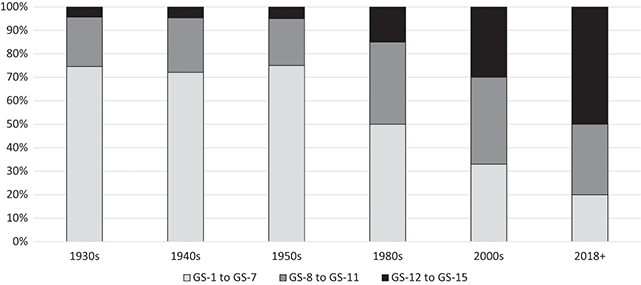
Figure 1 Long description
From the 1930s to the present, the professional level of federal employees had increased dramatically. A very useful level of professionalization is the percentage of the federal workforce in positions rated GS-12 to GS-15. In the 1930s, professional employees were just 4.4 percent of the total workforce. That grew to 15.0 percent in the 1980s, 30 percent in the 2000s, and half of all employees in 2018 and later.
At the same time, government’s reliance on contractors increased, especially for management service contractors, who provided help on everything from drafting congressional testimony and press releases to statistical analysis and policy advice.Footnote 143 A whole industry grew up around this mission. Booz Allen Hamilton, for example, received 98 percent of its $11 billion in annual revenue from the federal government, which made it a target for DOGE’s budget cutters. Accenture, another big service contractor, received 11 percent of its revenue from the government, and Leidos sold national security and technology services to the feds. These companies, along with many more, acquired the “Beltway Bandit” label (which came from a 1960s gang that used the newly constructed Capital Beltway to stage its burglaries and then escaped at a speed impossible given the congestion around the Beltway today).Footnote 144 Hundreds of contractors added to the Beltway traffic congestion, although the Trump administration aimed to trim that workforce, along with reductions in the rest of the federal workforce. In the administration’s first four months, DOGE claimed $3.1 billion in savings through the elimination of more than 2,775 contracts.Footnote 145 The simple fact, however, is that no one knew how much DOGE had saved.Footnote 146
The federal workforce thus underwent a dramatic transformation. Even though the country’s population greatly increased, the number of federal employees did not. However, the distribution of skills within the federal government changed dramatically, with professional employees increasing to match the decline in lower-level employees.Footnote 147 That included one of Trump’s favorite targets, the FBI, where the number of higher-level professionals increased by 36 percent between 1998 and 2024. However, more than 60 agencies, ranging from the Department of Education’s Office of Federal Student Aid and the Department of Energy’s Office of Management to the Food and Drug Administration to the St. Lawrence Seaway Development Corporation, had an even larger growth of high-level professionals. If the FBI was part of the “deep state,” were these agencies even “deeper”?
The answer, of course, was no.
The real story is that the “deep state” argument was a rhetorical tool – a politically useful one – to allow Trump to attack one of the least-liked institutions of American government, the bureaucracy. The “state” got “deeper,” however, not in the organizations typically savaged by Trump officials in the media but where government’s proxies – grantees and contractors expanded the most. The growth of professionals in agencies administering grants was, by far, the largest from 1998 (the earliest year in which detailed agency employment numbers are available) to 2024 (Table 1). Agencies managing contracts came next. Agencies dealing with the basic administration of government were in between, while regulatory and entitlement agencies grew far less – half the rate of grant and contract agencies.
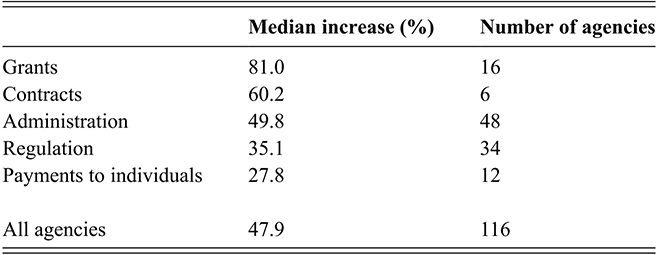
Table 1 Long description
From 1988 to 2024, the level of professional employees in the federal bureaucracy, as measured by the number of employees between GS-11 and GS-15 in the civil service, increased by 47.9 percent overall. The increase was greatest for employees managing grant programs, with an 81 percent increase; and for employees managing contracts, with a 60.2 percent increase. Employees engaged in overall administration increased at the average rate, while employees in regulatory programs grew only 35.1 percent and those managing payments for individuals increased 27.8 percent. The story, therefore, is that professionals overall have greatly increased in number, but most in those programs where their jobs are to oversee non-federal employees who actually deliver goods and services.
Over this period, the ratio of federal employees to the population stayed about the same, but the makeup of the federal workforce changed dramatically. Blue-collar and clerical employment shrank. Professional employment grew. Professional employment grew fastest in those governmental tools where a small number of employees oversaw many private sector agents who did the federal government’s work.
And, most important, if accountability too often seemed fuzzy, it was because the federal government’s real work was being done by non-federal employees. Accountability was an extended, indirect process – certainly nothing like the vertical, hierarchical model on which Trumpism’s model and criticism were erroneously based.
In the 1990s, Paul C. Light recognized the growing “thickening” of bureaucracy, with more layers accumulating between top political appointees and federal workers on the front lines. This phenomenon, he shows, vastly complicates accountability because it diffuses just who is responsible for what.Footnote 148 The increase in top-level professional careerists concentrated especially in proxy programs like contracts and grants vastly complicates the already difficult problem. The “deep state” is deepest and hardest for presidents to control in those programs where the number of senior professionals is greatest. It’s no wonder that presidents – and especially Trump – complain about the problem. There certainly might be pockets of resistance to his policies, but the problem is far larger and rooted much more deeply than is often recognized. So, when Trump complains about the “deep state,” he has a point – just not the one he has in mind.
More Congressional Acquiescence
Congress, of course, had the power to step in at any point to rein in the administration. The Republican majority, however, chose not to challenge the president and the Democratic minority did not have the power to do so. So, the story about congressional constraints on presidential power – at least for the Republican Congress during the second Trump administration – is a simple one: there weren’t any. The great champion of presidential power, Alexander Hamilton, contended in The Federalist Papers that Congress could impose restraints on executive power. Those constraints work, however, only if Congress chooses to use them. Congress’s descent into gridlock made it hard for it to use those tools. Trump’s ironclad grip over the Republican party made the exercise of those tools even less likely.
More Emergencies Licensing Executive Action
Most presidents declare emergencies, and they do so for two reasons. An emergency declaration allows a president to expand powers beyond what would ordinarily be permitted, and the declaration itself creates a news peg with which the president can attract attention to a particular issue – and point out the president’s own concern. In examining the emergencies that presidents have declared since the passage of the National Emergencies Act in 1976, the nonpartisan Brennan Center concluded that the act “makes the process easy for a president to renew a state of emergency and difficult for Congress to end it, in effect requiring a veto-proof supermajority for the latter. Among others, these weaknesses have left the president’s emergency powers susceptible to abuse.”Footnote 149
From 1981, the beginning of the Reagan administration, to 2025, the start of Trump’s second term, presidents declared an average of seven emergencies in each four-year term. In the first seven months of the second Trump administration, the president declared ten emergencies, ranging from an emergency at the Southern border and a drug emergency on the Canadian border to threats from Brazil to crime in Washington. The emergencies, in turn, allowed the president to take hundreds of actions, from tariffs to immigration barriers to energy deregulation.Footnote 150 Presidential discretion to declare emergencies and then take broad action to counter them is “a very big gap in our law, and it’s very dangerous,” said Martin H. Reish, a constitutional law scholar at Northwestern University’s Pritzker School of Law. An “emergency,” explained Elizabeth Goiten at the Brennan Center, “seems to be in the eye of the beholder.”Footnote 151 A libertarian critic at the Antonin Scalia Law School, Ilya Somin, contended that Trump “is declaring bogus emergencies for the sake of trying to expand his power, undermine the Constitution and destroy civil liberties.”Footnote 152
The president’s supporters would certainly disagree with these conclusions. Just about everyone would agree that the emergency declarations have allowed the president to strengthen support in his political base. And it’s clear that the emergencies have licensed Trump to expand executive power, with no congressional oversight and withy few judicial options for slowing or blocking his actions. The National Emergencies Act was designed to allow the president to act quickly but in the short term to counter big problems facing the country, beyond what the separation of powers would normally allow.
Trump justified each announcement in terms of big problems the country faced, but they cumulated into a broader strategy of growing, unchecked executive power. These declarations also signaled another important aspect of Trumpism and public administration: A high level of cleverness and legal skill in the staff surrounding Trump, which armed him with the expanded power he sought. Each of these declarations required the identification of a problem and an outline of how the president proposed to solve it. The creation of this broad fabric of presidential power was not the work of a single individual but the product of a proficient and ambitious team. Trump had a group of attorneys around him who became very good at weaving the fabric of growing executive power.
More Emergencies at the Supreme Court
The extraordinary contentiousness of Trump’s policies and his efforts to expand presidential power guaranteed that opponents would challenge every one of his major initiatives. The challenges got a slow start and then picked up speed in the federal district courts and then the courts of appeals. The decisions against the administration enraged Trump, who regularly attacked judges and the decisions they reached with a broad collection of complaints, calling them “rogue,” “deranged,” and “radical lunatics.”
In March 2025, Trump invoked the Alien Enemy Act to deport Venezuelan gang members. The act, passed in 1798, allowed the president, either in a declared war or during an “invasion” or “predatory incursion” by “any foreign nation or government” to restrain either citizens or foreign nationals. Until Trump invoked it, it had been used only three times before in American history: The War of 1812, World War I, and World War II. It had never previously been used outside the setting of armed conflict.Footnote 153 Several different groups, including the American Civil Liberties Union, Democracy Forward, the New York Civil Liberties Union, and the Legal Aid Society filed suit to stop Trump’s use of the law. US District Judge James Boasberg issued an injunction halting the administration’s action, and Trump was furious. He called Boasberg a “Radical Left Lunatic of a Judge, a troublemaker and agitator,” and said he “should be IMPEACHED!!!”Footnote 154 he added that other judges who had ruled against him ought to be deported as well.
Chief Justice John Roberts, a George W. Bush appointee, issued an extremely rare rebuke of the president. “For more than two centuries, it has been established that impeachment is not an appropriate response to disagreement concerning a judicial decision. The normal appellate review process exists for that purpose,” he said.Footnote 155
But that scarcely discouraged Trump from further attacks. Judges in the US District Court for the District of Maryland had issued a series of injunctions stopping the president on a series of his decisions, so Trump filed suit against the entire district court, an unprecedented step. The Justice Department complained, “Every unlawful order entered by the district courts robs the Executive Branch of its most scarce resource: time to put its policies into effect.” But in a series of cases, judges in the Maryland district ruled against Trump.Footnote 156 It had become commonplace for the president’s actions to end up in court. It was anything but to find the judges themselves as the objection of litigation. One retired federal judge said anonymously, “They are trying to intimidate, threaten and just run over the courts in ways that we have never seen.”Footnote 157 The courts could issue rulings, but they had little enforcement power. Judges quietly worried that the continued attacks by the administration were undermining their legitimacy and weakening their standing in articulating the rule of law. The problem grew with complaints by federal judges in early 2026 that the Trump administration had violated three dozen orders in immigration cases alone.
Through August 2025, the federal courts were exceptionally busy handling challenges to Trump administration actions, with more than 330 cases. Of 31 issues that reached a decision, the administration won just 8 (or 26 percent).Footnote 158 There was inexorable progress for the administration as cases gradually wound their way toward the 6–3 conservative supermajority on the Court, thanks to Trump’s appointments. The administration based its arguments on different approaches to the unitary executive theory, and the conservative justices proved sympathetic to those arguments. The administration’s low success rate in its first months was not necessarily a sign of its long-range prospects.
Moreover, the Supreme Court used a technique called the “emergency docket” or “shadow docket” to flash a green light for the administration’s work.Footnote 159 A typical US Supreme Court case might take a year or more to reach a decision, from the time that the Court decides to accept the case, through the filing of briefs and the scheduling of oral arguments, until the Court announced a decision. Many issues, especially the most pressing cases involving the Trump administration’s invocation of executive power, would not fit that timetable; by the time the Court worked through its usual schedule, the issue could well be moot.
For example, if the administration decided to deport planeloads of migrants to El Salvador and human rights groups believed that was improper, the migrants would have been out of the country, past the point of being returned, by the time the Court might decide that the action had been improper. The Court, however, can consider cases on a fast track, without full briefs or oral arguments, and it can issue an emergency decision, without a full opinion. The docket is the record of proceedings; an emergency docket is the fast track; and the decision is typically just a few paragraphs outlining the issue in the case and the decision, often preliminary, without a formal vote. The emergency docket might suggest that the Court will hear the full range of issues later, but for the same reasons that a full procedure can be impracticable, an emergency docket decision is often final because it tends to render other options moot.
Through early August 2025, the Court issued eighteen “interim” or “emergency” or “shadow” opinions. Depending on how one counts victories, the administration won most of those issues.Footnote 160 Moreover, “the Court’s interim orders, influenced by its view of likelihood of success on the merits, has enabled Trump to change the reality on the ground in the executive branch in ways that will not be easily reversible, if at all, no matter what the Court does later,” Jack Goldsmith concluded.Footnote 161 The emergency docket gave more support to the president’s unitary executive claims than many observers predicted. Given the opportunity to pump the brakes, the Court did not. Liberals on the high court were singularly unsuccessful in slowing the pace of the administration’s work. And, without full opinions, it was hard to determine just where the justices sat on the fundamental issues.
The New York Times ran a story in July 2025 headlined, “Supreme Court Keeps Ruling in Trump’s Favor, but Doesn’t Say Why.” Within ten weeks, the Court granted “emergency relief” to the Trump administration’s position seven times, without explanation, and then about the same number of rulings with only a very brief justification.Footnote 162 Big decisions with little explanation helped pave Trumpism’s road to success.
The emergency docket certainly was not new. In the second Trump administration, however, it took on an importance not previously seen, both in licensing the administration’s actions and in failing to take advantage of opportunities to prevent them.
All these issues reinforced the administration’s own sense that it did not have sufficient control over the executive branch, and its determination to stretch every bit of executive power to change that. As I have shown, the second Trump administration either radically transformed or completely pushed aside the key elements of POSDCORB and, in the process, increasingly grabbed for a legal foundation to justify its actions. The arguments for a unitary executive, with total control of everything with the government’s executive functions, had been bubbling on the right since the 1980s. Trump found that theory extraordinarily useful in advancing his policies, increasing his control over the executive branch, and weakening the balance of powers to a point that Madison would scarcely recognize.
Meanwhile, in November 2025, DOGE fizzled out. The director of the Office of Personnel Management, Scott Kupor, said that that the entity “doesn’t exist” when asked about its status, a shutdown eight months ahead of schedule.Footnote 163 Kupor added that he expected that the federal workforce would be reduced by 317,000 workers in 2025, far larger than previous estimates and rivaling the downsizing during Bill Clinton’s “reinventing government” initiative.Footnote 164 The big difference is that Clinton’s downsizing came through voluntary departures spurred by buyouts. The Trump downsizing came through a combination of carrots, like its deferred resignation program that allowed employees to leave their jobs in exchange for pay through the end of the fiscal year, and sticks, especially the brutally unpredictable reductions in force. DOGE in general turned out to be less than met the eye; its workforce reductions were much more.
9 Public Administration in 2035 and Beyond
The scale and pace of change in the first months of the second Trump administration stunned much of the country and surprised even its supporters. The administration drove far harder than Project 2025 had anticipated. In the four years of the Biden administration, writers in the field had warned about the second coming of Schedule F. That provision did not even get a seat at the table of Trump’s change. The work of the second Trump administration emerged on a far larger scale, with much deeper implications, than in its first administration. Indeed, it was far broader than the advocates of Project 2025 might have expected and the administration’s opponents feared. It’s likely that no one, save perhaps OMB Director Russell Vought, who had developed a detailed game plan in the interregnum, imagined how far the Trump administration would go in its first year.
As Musk slid from the Washington scene, Vought regained the position as management strategist in chief that he had expected to fill from the very beginning of the second term. He had crafted a plan to launch into a major overhaul from the first days of the new administration, only for Musk’s muscle to blot out the sun and grab the power Vought had expected to wield. Had Vought taken the driver’s seat from day one, he would have begun from scratch dismantling the progressive agenda at a rapid pace, but Musk did that job for him. So instead of moving behind the steering wheel with much undoing to accomplish, he inherited a government that Musk had either demolished or terrified. That put him in an even stronger position to assert the president’s Article II powers, most of which revolved around his role at OMB.
Driving Off the Map
No existing map of public administration anticipated or charted the strategy of Trumpism. The president and his followers rejected the classical public administration of the Progressives, the ambitions of the Great Society liberals, and even the instincts of Ronald Reagan’s allies for deregulation and a balanced budget. It was a strategy that toppled the traditional POSDCORB building blocks, undermined the merit system, and paved the way for massive restructuring of executive branch agencies, all without congressional involvement or judicial caution. In terms of the American system of governance, “revolutionary” only begins to capture the moment.
However, it would be a mistake to rely on ideological differences to completely dismiss Trumpism. One of the movement’s genuine strengths was its uncanny ability to exploit the weak spots of the existing administrative regime, and no one was better at this than Trump himself. The administrative state had indeed grown powerful, harder to manage and hold accountable. The performance that taxpayers got certainly was not what they wanted. The system had become rule-bound and, too often, ineffective. Trust plummeted. Meanwhile, insiders like Vought found ways around and through regulations that got in the way of what they wanted to do. Trumpism had discovered the virtues of condemning government’s virtues that worked once upon a time, but which had turned into handcuffs. American government has always had a reform instinct. In Trumpism, reform meant condemning a hidebound system and burning it to the ground.
That leads to the fundamental administrative paradox of Trumpism. The president and his followers often had just the right instinct for the problems that needed to be solved. By the end of the first year of his second term, most progressives quietly acknowledged that if they could roll back the calendar to January 19, 2025, they wouldn’t want to do so. They knew that the system had big problems to solve and that Trump had surfaced them. That was a recognition that did not easily come.
However, Trumpism failed to devise the right answers or develop new strategies. Musk was a master of “creative destruction,” a concept advanced by economist Joseph Schumpeter that contended old ideas had to be dismantled before new ones could arise to replace them. Schumpeter in 1942 contended that capitalism advances most strongly through constant revolutions from within, and with new revolutions rising up. He wrote about the importance that “industrial mutation” played in capitalism, adding, “This process of Creative Destruction is the essential fact about capitalism.”Footnote 165
The notion of destroying first before rebuilding lay at the core of Musk’s vision of government reform, and Trump eagerly adopted it. It certainly worked for Musk in creating Tesla and Space X. But in government, where people’s lives and the long-term stability of governance are at stake, it was a far riskier strategy.
Trumpism often had an instinct for the right problems. But, in its “creative destruction,” it tore down without knowing what it wanted to build back. The administration proved lightning fast in rolling out new ideas, faster than its opponents could keep up. Even if the administration lost some of its battles, its skill at keeping the opposition off guard provided a political momentum that proved hard to stop and that was destined to produce a revolution in public administration.
But it focused on symbols and on inputs. It failed to connect them to the more effective results the people craved. Its strategy was not “more with less,” but “less with less,” from environmental regulation to medical research to government-funded health care to programs for the homeless to immigration. There certainly was a public appetite for cutting way back on government, but when the cost of those cuts became clear during the government shutdown in October and November 2025, when air travel became gummed up and food for the poor was cut off, public support for Trumpism suffered.
In short, Trumpism built political strength on instincts for identifying problems people cared about. The president and his allied proved extraordinarily effective in attacking those problems and uprooting important parts of government. But after having destroyed the parts of government it believed was responsible for the problems, the Trump administration very rarely had ideas about what to put in its place. Along the way, it destroyed much of government’s capacity to administer the laws Congress had passed.
Government is ultimately about delivering results to people. The creative destruction was a powerful force. But it didn’t have a plan for what came next, beyond the strategies laid out in Project 2025, most of which had never been tested and many of which were clearly unworkable.
Fundamental to that issue was that, despite its diagnosis of the right problems, Trumpism followed risky, often dangerous instincts toward solving the country’s problems. By disconnecting the bureaucracy from building the capacity to administer the law, it increasingly made the bureaucracy a political tool rather than an instrument of policy implementation. Trumpism took a narrow vertical, siloed view of public administration, even though the most important points of leverage in the governance system were increasingly horizontal.
The country badly needed right instincts to produce a road map for public administration, leading to 2035 and beyond. Effective government, as William D. Eggers and I argued in Bridgebuilders, has become less like pulling the levers on a government service vending machine and more about establishing government leaders as conductors of a large orchestra playing complex music. Organizing government is always about creating political symbols, but Trumpism tended to focus more on the symbols than results, which pushed government farther from the results people wanted. Information has become the central nervous system of government and the language of talking about results, but Trumpism saw information as a mechanism for identifying those it wanted to punish. Budgeting matters as a way of directing the public’s resources toward producing outcomes rather than creating symbols of what we care about, but Trumpism pushed the traditional norms of balanced budgets to the curb.
Trumpism might well have had great instincts about the problems, but its strategies and tactics missed these important points of leverage. Voters have often forgiven much about government’s performance problems, and they of course focus most on the big political issues that worry them the most. But they are unlikely to reward a government that fails to deliver the results they want or does not treat their hard-earned tax dollars with appreciation and respect.
And this leads to the challenges that Trumpism lays out for the field of public administration itself. It is no exaggeration to say that Trump’s movement created the biggest crisis – and opportunity – for public administration since its founding at the end of the nineteenth century. Trumpism has forced a redefinition of the field’s core issues and core strategies, and it left no part of the field’s orthodoxy untouched.
Public Administration for the Future
That suggests a game plan focused on the big problems facing the worlds of public administration theory and practice.
How can public administration redefine its purpose? Much like the lively debate that surrounded public administration in the early 1900s, the Great Depression, and the reexamination of the 1970s, public administration finds itself in a similar inflection point destined to redefine it for the next generation. It can move beyond hierarchy to agile strategies aimed at producing results, quickly and efficiently.
How can public administration connect with the people? The field will not thrive – or even survive these issues – if it does not become more outward-facing. An inward-facing approach hinging on processes, structures, outputs, outcomes, or tech-speak will not allow the field to meet the challenges of Trumpism on its own terms. Public administration needs to frame its work in terms that Americans see and experience and appreciate in their daily lives.
How can public administration build trust? Americans will not trust an approach that produces different benefits for different people. They expect a field that is free from political bias and that delivers quality goods and services to everyone, regardless of where they live or who they are. Public administration has the opportunity to transform its processes to instruments of trustworthiness.
How can public administration produce more effective results? People expect that government will respect their hard work and will treat them with appreciation. Connecting all the elements of the field, even the traditions of POSDCORB, with fresh approaches to producing better results, more quickly and more cheaply, is a central challenge for the coming decades.
How can public administration redefine accountability? Given the rise of the “deep state” critique and its obvious resonance with many Americans, one of the field’s biggest problems is that people just don’t think it is accountable, either to elected officials or to the people. Regardless of how government officials and academic researchers view the “deep state” critique, it is impossible to escape the conclusion that Trumpism latched onto something real and profound. The field’s most fundamental issue is understanding this phenomenon, its roots and its challenges, and crafting a new approach to democratic accountability for the information age, including all the tools that artificial intelligence offers.
Trumpism confronted public administration in a way never seen before in its history. It raises questions, the New York Times suggests, about whether “we are losing our democracy.”Footnote 166 This confrontation, however, was one that the field was destined to face, one way or another; its core issues are ones that the field has no choice but to solve. Public administration, therefore, does not have a choice about whether to deal with these issues. It does have the choice of being captured by them or of building a new trajectory for the field’s next generation.
Robert Christensen
Brigham Young University
Robert Christensen is the George W. Romney Professor of Public and Nonprofit Management at Brigham Young University.
Jaclyn Piatak
University of North Carolina at Charlotte
Jaclyn Piatak is co-editor of NVSQ and Professor of Political Science and Public Administration at the University of North Carolina at Charlotte.
Rosemary O'Leary
University of Kansas
Rosemary O'Leary is the Edwin O. Stene Distinguished Professor Emerita of Public Administration at the University of Kansas.
About the Series
The foundation of this series are cutting-edge contributions on emerging topics and definitive reviews of keystone topics in public and nonprofit administration, especially those that lack longer treatment in textbook or other formats. Among keystone topics of interest for scholars and practitioners of public and nonprofit administration, it covers public management, public budgeting and finance, nonprofit studies, and the interstitial space between the public and nonprofit sectors, along with theoretical and methodological contributions, including quantitative, qualitative and mixed-methods pieces.
The Public Management Research Association
The Public Management Research Association improves public governance by advancing research on public organizations, strengthening links among interdisciplinary scholars, and furthering professional and academic opportunities in public management.