


1 Introduction
People often judge the morality of other people’s decisions, and their tendency to do so has widespread consequences for every day social engagement, as well as for political, legal, and social policy. Our aim is to examine whether judgments of moral responsibility and blame are affected by whether a decision-maker’s choice was risky or not. Our focus is on whether the decision-maker’s choice was a sure-thing or a risk, whether it was framed in terms of gains or losses, and whether the outcome turned out to be good or bad. We examine the idea of “moral echoing”, that is, a tendency for participants to praise a decision-maker most for a good outcome when the decision-maker made the typical choices of the sure-thing in a gain frame or the risk in a loss frame (the choices which echo those made by the typical participant), and to blame the decision-maker most when a bad outcome followed the atypical choices of a risk in a gain frame or a sure-thing in a loss frame.
1.1 Risky and sure options framed as gains and losses
We ask whether moral judgments about other people’s choices echo the typical decisions that most people make. We examine whether people’s moral judgments about a decision-maker’s choices are affected by whether they were risky or not, which arises from the observation that people’s own decisions are affected by riskiness. Consider the well-known Asian disease problem:
Imagine that the US is preparing for the outbreak of an unusual Asian disease, which is expected to kill 600 people. Two alternative programs to combat the disease have been proposed. Assume that the exact scientific estimates of the consequences of the programs are as follows:
Program A: If Program A is adopted, 200 people will be saved.
Program B: If Program B is adopted, there is 1/3 probability that 600 people will be saved, and 2/3 probability that no people will be saved.
When the options are framed in terms of lives saved, most people chose Program A, the sure option, exhibiting a tendency to be risk averse (Reference Tversky and KahnemanTversky & Kahneman 1981). A second version of the problem provides options framed as losses:
Program A: If Program C is adopted 400 people will die.
Program B: If Program D is adopted there is 1/3 probability that nobody will die, and 2/3 probability that 600 people will die.
When the options are framed in terms of people dying, most people chose Program B, the risky option, exhibiting a tendency to be risk seeking for losses (Reference Tversky and KahnemanTversky & Kahneman 1981). The preference reversal is generally considered inconsistent because equivalent outcomes are treated differently (Reference Gubbins and ByrneKahneman & Tversky, 1979; Reference Tversky and KahnemanTversky & Kahneman 1992). The framing effect has been observed for many different contents, including moral contents such as lives saved or lost (e.g., Reference Fagley and ColemanFagley, Coleman & Simon, 2010; Reference Reyna, Chick, Corbin and HsiaReyna, Chick, Corbin & Hsia, 2013; Reference Spence and PidgeonSpence & Pidgeon 2010; Reference Ritov and ZamirRitov & Zamir 2014) and non-moral contents such as financial investments (Reference Roszkowski and SnelbeckerRoszkowski & Snelbecker, 1990; Reference Druckman and McDermottDruckman & McDermott, 2008).
We predict that people’s judgments of moral responsibility and blame or praise for a decision-maker’s choice of a risk or sure thing will exhibit a framing effect, echoing their own typical decisions. Hints of moral echoing can be gleaned from the observation that people tend to be more forgiving of others who are similar to them (Reference BurgerBurger, 1981; Reference Chaikin and DarleyChaikin & Darley, 1973), and their judgments of the morality of another person’s choice are affected by their own assessment of its moral acceptability (Reference AlickeAlicke, 2000; see also Reference Goodwin and DarleyGoodwin & Darley, 2008). In moral dilemmas, people judge that the typical choices — the sure option in the gain frame and the risky option in the loss frame — are more acceptable than the atypical choices (Reference Shenhav and GreeneShenhav & Greene, 2010; see also Petrinovich & O’Neill 1996). They penalize others more for causing certain death than for imposing an equivalent risk of death (e.g. Viscusi, 2000; Reference SunsteinSunstein, 2005). Hence we expect that people’s moral judgments about a decision-maker’s risky or sure choices will exhibit a moral echoing effect, modulated by their thoughts about the outcome: a decision-maker will be praised most for a good outcome after the typical choices, and will be blamed most for a bad outcome after the atypical choices.
1.2 Good and bad outcomes
We examine moral judgments about a decision-maker’s choices when a future outcome is hypothesized to turn out to be good or bad in Experiment 1, and when a past outcome is known to have turned out to be good or bad in Experiment 2. We expect that decision-makers will be praised for a good outcome after typical choices — the sure-thing in a gain frame and the risk in a loss frame — and blamed for bad outcomes after atypical choices — the risk in the gain frame and the sure-thing in a loss frame. Moral responsibility is not a valenced judgment — a decision-maker can be acclaimed by being judged morally responsible (in a good way) for a good outcome and censured by being judged morally responsible (in a bad way) for a bad outcome. Hence we expect the standard framing effect for good outcomes — the decision-maker will be judged more morally responsible for a good outcome following the typical choices; and we expect a “mirror-image” framing effect for bad outcomes — the decision-maker will be judged more morally responsible for a bad outcome when the decision-maker makes the atypical choices.
Knowledge that an outcome was good or bad affects judgments of the quality of a decision-maker’s thinking, and his or her competence, even though people know they should not consider outcomes in such evaluations (Reference Baron and HersheyBaron & Hershey, 1988). This outcome bias may arise because a bad outcome tends to overshadow an assessment of the decision-maker’s intentions (Reference Sezer, Zhang, Gino and BazermanSezer, Zhang, Gino & Bazerman 2016). The good or bad outcome may call attention to arguments that make the choice seem good or bad (Reference Baron and HersheyBaron & Hershey 1988). A similar mechanism has been proposed for hindsight bias, the tendency for people with outcome knowledge to believe they would have predicted the outcome (Reference FischhoffFischhoff, 1975; Reference Hawkins and HastieHawkins & Hastie 1990; Reference Roese and VohsRoese & Vohs 2012). The outcome of a decision can affect people’s judgments of its morality. An agent’s decision is considered more important for a good outcome than a bad outcome, and people are generally assumed to intend good outcomes (Reference Pizarro, Uhlmann and SaloveyPizarro, Uhlman & Salovey, 2003). The worse the outcome is, the greater the tendency for people to judge an agent to be responsible and blameworthy (e.g. Walster, 1966; Reference BurgerBurger, 1981; Reference Darley and ShultzDarley & Shultz, 1990; see also Reference Mitchell and KalbMitchell & Kalb, 1981; Reference Ames and FiskeAmes & Fiske, 2013). Hence, we expect that moral judgments of responsibility and praise or blame will exhibit a moral echoing effect.
1.3 Moral judgments and non-moral judgments
We examine the idea of moral echoing for judgments of moral responsibility and blame or praise for a decision-maker. We also examine non-moral judgments about whether the decision-maker caused the outcome and was in control of it, judgments about how it could have turned out differently, and judgments about whether the decision-maker experienced relief or upset about the outcome. We suggest that moral echoing may be confined to inferences about moral and social regulations, and it may arise because people infer that the moral principles they apply to their own decisions are the same principles that others should apply to theirs (Reference Hawkins and HastieHaidt 2001; Reference MikhailMikhail 2007). Hence, we do not expect to observe an echoing effect for judgments outside the moral or social realm: we do not expect that people will judge that a decision-maker causes or controls a good outcome when the decision-maker makes the typical choices of the sure-thing in a gain frame or the risk in a loss frame, and causes or controls a bad outcome following the atypical choices of a risk in a gain frame or a sure-thing in a loss frame. Their moral judgments are based on deontic inferences about what should happen, which may be particularly sensitive to perspective (Reference Quelhas and ByrneQuelhas & Byrne 2003; Reference Rasga, Quelhas and ByrneRasga, Quelhas & Byrne 2016), whereas their judgments of causality or controllability are based on epistemic inferences about what can happen.
2 Experiment 1
The aim of the experiment was to examine whether participants’ moral judgments about a decision-maker’s choices are affected by (a) whether the decision-maker choses a sure option or a risky option, (b) whether the options are framed as gains or losses, and (c) whether the participant supposes that the outcome is good or bad. We focused on participants’ moral judgments of blame or praise and their judgments of moral responsibility. We also examine non-moral judgments of cause, control, counterfactual thoughts, and emotions.
2.1 Method
2.1.1 Participants
The participants were 207 volunteers recruited via the online platform, Crowdflower at Crowdflower.com.Footnote 1 There were 63 women and 144 men, aged between 18 to 59 years. A further 3 participants were eliminated prior to any data analysis on the basis of three criteria used to screen participants: (1) participants were asked to select the name of the protagonist from a list of four names, and asked how many lives were at stake in total; participants who answered both questions incorrectly were eliminated, (2) participants were asked to participate only if they had not taken part in something similar before; they were asked at the end of the experiment whether they had done something similar before and if so, what its subject was, and participants who had taken part in something similar before were eliminated, (3) participants with identical worker IDs were eliminated. Participants were assigned at random to one of eight conditions, which varied the decision-maker’s choice, the frame, and the outcome: sure gain bad-outcome n=25 and risky gain bad-outcome n=21, sure loss bad-outcome n=23 and risky loss bad-outcome n=25, sure gain good-outcome n=43 and risky gain good-outcome n=21, sure loss good-outcome n=23 and risky loss good-outcome n=26. Participants were given a nominal $.15 for their participation.
2.1.2 Materials and design
All participants were presented with the Asian disease problem. The design was a fully between-participants one: 2 (decision-maker’s choice: sure-thing vs. risk) x 2 (frame: gain vs. loss) x 2 (hypothetical outcome: good vs. bad). Participants in the sure-thing conditions were informed that the decision-maker, John, had chosen program A (the sure option), and those in the risky conditions were told that John had chosen program B (the risky option). For participants in the gain conditions the options were framed in terms of gains, that is, people being saved, and for those in the loss conditions the equivalent options were framed in terms of losses, that is, people dying. Participants in the good outcome conditions were implicitly asked, through the phrasing of question, to suppose things turned out well: “John would be morally responsible for people being saved.” Those in the bad outcome conditions were asked to suppose things turned out badly: “John would be morally responsible for people dying.” In addition, the judgments about the hypothetical outcome were framed in terms of gains and losses appropriately for each condition, i.e., in the gain conditions the judgments referred to people being saved (good outcome) or not being saved (bad outcome) whereas in the loss conditions the judgments referred to people dying (bad outcome), or not dying (good outcome). Appendix A gives the complete text.
Before they were given any information about which option the decision-maker had chosen, participants first rated each of the two options as morally acceptable on a likert scale anchored at 1=completely disagree, and 5=completely agree to check that participants tended to make the typical choices of a sure-thing in a gain frame, and a risk in a loss frame. Participants then made 6 judgments about the decision-maker’s choice, on 1–5 scales anchored at 1=completely disagree and 5=completely agree (illustrated here for the good outcome gain frame). Two of the judgments were moral judgments: (1) John would be morally responsible for people being saved, and (2) John would deserve to be praised for people being saved. The remaining four were non-moral judgments, (3) John would cause people to be saved, (4) John would be in control of people being saved, (5) John would be relieved about people being saved. The wording of the judgments was identical in all conditions except that the final words were framed according to the condition, e.g., “…for people being saved/not being saved” in the gain frame for good and bad outcomes respectively and “…for people dying/not dying” in the loss frame for bad and good outcomes respectively; in the good outcome conditions the blame/praise judgment referred to praise, and the relief/upset judgment referred to relief, and in the bad outcome conditions the judgments referred to blame and upset respectively. The sixth measure was a composite counterfactual score derived from 4 judgments about imagined alternatives. They were instructed, “Imagine you are a member of a committee formed to review the preparations for the outbreak and to predict how things could turn out. What is the most likely way you would complete the thought, “Things could turn out differently if…”. They provided their judgments on a 1–5 scale (1=completely disagree and 5=completely agree) for each of 4 counterfactuals: (a) “…if John took more risks”, (b) “…if John were a more moral person”, (c) “…if John recommends the other program”, and (d) “…if there were additional programs available”. They received the judgments in the fixed order of responsibility, relief/upset, blame/praise, cause, control, and counterfactuals.
2.1.3 Procedure
The materials were presented via SurveyGizmo (see http://www.surveygizmo.com/, which participants were directed to from the online platform Crowdflower https://www.crowdflower.com/). The participants were asked to read the story carefully and to answer the questions in the order in which they were asked. They were told there were no right or wrong answers. The scenario was presented on screen and after participants had read it they pressed the “next” button on screen to read each of the judgment tasks. Each judgment task was presented separately on screen and participants provided their answer by clicking on one of the scale numbers on screen. The scenario remained on screen throughout. The experiment took approximately 10 minutes to complete.
2.2 Results
2.2.1 Moral acceptability
Participants were required at the outset to first indicate their own judgment of the moral acceptability of the risk and sure-thing options, as a check that they tended to make the typical choices, before they read about the decision-maker’s choice. Their judgments showed a framing effect, as indicated in a 2 (frame: gain vs. loss) x 2 (choice: sure vs. risky option) ANOVA with repeated measures on the second factor. There was an interaction of choice and frame F(1,199)=24.49, p<.001, ηp2=.11, as well as a main effect of each one: choice, F(1,199)=4.11, p<.05, ηp2=.02, frame, F(1,199)=19.37, p<.001, ηp2=.09. Contrasts, with a Bonferroni corrected alpha of p<.02 for 4 comparisons, showed the interaction arises because participants judged the risk to be more morally acceptable than the sure-thing when the outcomes were framed as losses, F=(1,96)=32.31, p<.001, ηp2=.25, the sure option to be more morally acceptable when it was framed as a gain than a loss F(1,205)=47.06, p<.001, ηp2=.19, and no other comparisons were significant (largest F=3.62, smallest p<.06), as Figure 1A shows.
Judgments of (a) initial acceptability, (b) moral responsibility, (c) blame/praise, (d) cause, (e) control, (f) relief/upset, and (g) counterfactuals for sure and risky options in gain and loss frames for supposed good and bad outcomes in Experiment 1. Error bars are standard error of the mean.

For each of the 6 judgments about the decision-maker we report first the effects of outcome in a 2 (hypothetical outcome: good vs. bad) x 2 (decision-maker’s choice: sure vs. risky) x 2 (frame: gain vs. loss) between participants ANOVA. Next, we test framing effects for good outcomes and for bad outcomes in a 2 (decision-maker’s choice: sure vs. risky) x 2 (frame: gain vs. loss) ANOVA. We also report correlations of each judgment with the other judgments.
Results on the relationship between participants’ own judgments and their answers to other questions are described in Appendix B, for both experiments. These results do not affect any conclusions described in the main text.
2.2.2 Moral judgments
A moral echoing effect was found for moral responsibility and blame and praise judgments, that is, participants tended to credit the decision-maker most for a good outcome when he made the typical choices of the sure-thing in a gain frame or the risk in a loss frame, and to discredit him most when there was a bad outcome and he made the atypical choices of a risk in a gain frame or a sure-thing in a loss frame.
Moral responsibility.
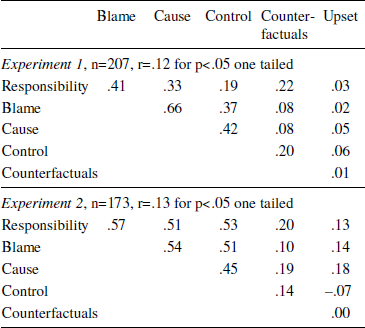
There was a main effect of outcome, F(1,199)=12.03, p <.001, ηp2=.06, as the decision-maker was judged more responsible for good outcomes than bad ones, and outcome, choice, and frame interacted F(1, 199)=9.02, p< .01, ηp2=.04; there were no other differences (largest F=.3, smallest p<.58). Contrasts, with a Bonferroni corrected alpha of p<.004 for 12 comparisons, showed the decision-maker was judged morally responsible for a good outcome more than a bad outcome when he chose the risk in a loss frame, F(1,199)=12.28, p<.001, ηp2=.058, or the sure-thing in a gain frame, F(1,199)=11.69, p<.001, ηp2=.055. No other contrasts from the set of 12 showed significant differences (largest F=3.65, smallest p<.058). Next we assessed framing effects: moral responsibility judgments showed a standard framing effect for good outcomes, the decision-maker was judged more morally responsible for a good outcome when he made the typical choices, a sure-thing in a gain frame, a risk in a loss frame, as the interaction of frame and choice shows, F(1,109)=4.38, p<.05, ηp2=.039; and they showed a mirror-image framing effect for bad outcomes, the decision-maker was judged more morally responsible for a bad outcome when he made atypical choices, the risk in a gain frame or the sure-thing in a loss frame, as the interaction of frame and choice shows, F(1,90)=4.66, p<.05, ηp2=.049, as Figure 1B illustrates. Moral responsibility judgments correlated with blame/praise judgments, r=.41, p<.001; cause r=.33, p<.001, control r=.19, p<.01, and counterfactual judgments r=.22, p<.01, but not with relief/upset judgments r=.03, p<.63, as Table 1 shows.
Judgments of (a) initial acceptability, (b) moral responsibility, (c) blame/praise, (d) cause, (e) control, (f) relief/upset, and (g) counterfactuals for sure and risky options in gain and loss frames for supposed good and bad outcomes in Experiment 1. Error bars are standard error of the mean.

Blame/praise.
There was a main effect of outcome F(1,199)=40.47, p<.001, ηp2=.17, as the decision-maker was praised for good outcomes more than he was blamed for bad ones, and of choice F(1,199)=4.93, p<.05, ηp2=.02, as the decision-maker was judged more deserving of blame/praise when he chose the risky option than the sure one, and outcome, choice, and frame interacted F(1,199)=11.05, p<.001, ηp2=.05; there were no other differences (largest F=1.43 smallest p<.23). Contrasts show the decision-maker was praised for a good outcome more than blamed for a bad one when he chose the risk in a loss frame F(1, 199)=29.36, p<.001, ηp2=.13, or when he chose the sure thing in a gain frame, F(1,199)=24.24, p<.001, ηp2= .11. He was praised most for a good outcome when he chose the risk rather than the sure-thing in a loss frame F(1,199)=7.23, p<.008, ηp2=.035, he was blamed least for a bad outcome when he chose the sure-thing rather than the risk in a gain frame F(1,199)=7.46, p<.007, ηp2=.036. No other contrasts from the set of 12 showed significant differences on the Bonferroni corrected alpha (largest F=5.88, smallest p=.016). Next, the praise judgments show a standard framing effect for good outcomes, the decision-maker was praised for a good outcome when he made the typical choices, a sure-thing in a gain frame, a risk in a loss frame, as the interaction of frame and choice shows, F(1, 109)=6.45, p<.05, ηp2=.056; and the blame judgments showed a mirror-image framing effect for bad outcomes, the decision-maker was blamed more for a bad outcome when he made atypical choices, the risk in a gain frame or the sure-thing in a loss frame, as the interaction of frame and choice shows, F(1,90)=4.66, p<.05, ηp2=.049, as Figure 1C illustrates. Blame/praise judgments correlated with moral responsibility judgments as reported above, and with cause r=.66, p<.001 and control r=.37, p<.001, but not with counterfactual judgments r=.08, p<.23, or relief/upset judgments r=.02, p<.8.
Judgments of (a) initial acceptability, (b) moral responsibility, (c) blame/praise, (d) cause, (e) control, (f) relief/upset, and (g) counterfactuals for sure and risky options in gain and loss frames for supposed good and bad outcomes in Experiment 1. Error bars are standard error of the mean.

The results for moral judgments show a moral echoing effect: a decision-maker is credited with a good outcome when he made the typical choices, he is discredited when there is a bad outcome and he made atypical choices, the risk in a gain frame or the sure-thing in a loss frame.
2.2.3 Non-moral judgments
There is no echoing effect for the non-moral judgments of cause, control, counterfactuality and relief or upset. They show a strong effect of outcome, but for the most part, no framing effects.
Causal judgments.
There was a main effect of outcome F(1, 199)=32.03, p<.001, ηp2=.14, as the decision-maker was judged to have caused good outcomes more than bad ones; and no other differences (largest F=3.24, smallest p<.072). Causal judgments did not show a framing effect, there was no interaction of frame and choice for good outcomes, F (1,109)=2.21, p=.14, and none for bad outcomes, F(1,90)=1.16, p=.28, as Figure 1D illustrates. Causal judgments correlated with moral responsibility and blame/praise judgments as reported above, and with control judgments r=.42, p<.001, and with counterfactual judgments r=.18, p<.01 but not with relief/upset judgments r=.05, p<.49.
Judgments of (a) initial acceptability, (b) moral responsibility, (c) blame/praise, (d) cause, (e) control, (f) relief/upset, and (g) counterfactuals for sure and risky options in gain and loss frames for supposed good and bad outcomes in Experiment 1. Error bars are standard error of the mean.

Control judgments.
There were no effects of outcome, choice, or frame (largest F=2.3, smallest p<.13). Control judgments did not show a framing effect, there was no interaction of frame and choice for good outcomes, F<1, and none for bad outcomes F(1,90)=3.67, p=.059, ηp2=.04, as Figure 1E shows. Control judgments correlated with moral responsibility, blame/praise judgments and cause as reported above, and with counterfactual judgments r=.20, p<.01; they did not correlate with relief/upset judgments r=.06, p<.42.
Judgments of (a) initial acceptability, (b) moral responsibility, (c) blame/praise, (d) cause, (e) control, (f) relief/upset, and (g) counterfactuals for sure and risky options in gain and loss frames for supposed good and bad outcomes in Experiment 1. Error bars are standard error of the mean.

Relief/upset judgments.
There was a main effect of outcome, F(1,199)=10.28, p<.01, ηp2=.05, as the decision-maker was judged to be more upset about a bad outcome than relieved about a good outcome, and there were no other effects (largest F=3.62, smallest p=.06). Relief/upset judgments did not show a framing effect, there was no interaction of frame and choice for good outcomes, F <1, and none for bad outcomes, F<1, as Figure 1F shows. Relief/upset judgments did not correlate with any of the other judgments, as reported above, nor with counterfactual judgments r=.014, p<.83.
Judgments of (a) initial acceptability, (b) moral responsibility, (c) blame/praise, (d) cause, (e) control, (f) relief/upset, and (g) counterfactuals for sure and risky options in gain and loss frames for supposed good and bad outcomes in Experiment 1. Error bars are standard error of the mean.

Judgments of (a) initial acceptability, (b) moral responsibility, (c) blame/praise, (d) cause, (e) control, (f) relief/upset, and (g) counterfactuals for sure and risky options in gain and loss frames for supposed good and bad outcomes in Experiment 1. Error bars are standard error of the mean.

2.2.4 Counterfactuals
The composite score of the overall agreement with the four counterfactuals showed no main effect of outcome, a main effect of choice, F(1,199)=7.85, p<.01, ηp2=.04, outcome interacted with frame, F(1, 199)=4.29, p<.05, ηp2=.02; and there were no other differences (largest F=3.05, smallest p < .08). The counterfactual judgments show a framing effect when participants supposed the outcome was good, as the interaction of frame and choice for good outcomes shows, F(1,109)=5.18, p<.05, ηp2=.05; there was no interaction of frame and choice for bad outcomes, F<1. Counterfactual judgments correlated with moral responsibility and control judgments as reported above, but not with blame/praise, cause, or relief/upset judgments also as reported above.
2.3 Discussion
Decision-makers were not judged to have caused or to be in control, or to feel relief for a good outcome when they chose the sure-thing in a gain frame, and the risk in a loss frame, nor were they judged to have caused or to be in control of, or to feel upset for, a bad outcome when they chose the risk in a gain frame, and the sure-thing in a loss frame. Decision-makers were judged to have alternatives when the outcome was good and they chose the sure-thing in a gain frame, and the risk in a loss frame, but not when the outcome was bad.
The results show that participants own moral judgments, before they hear about what the decision-maker did, show a framing effect. Their moral judgments about a decision-maker who makes these choices also show a framing effect, which depends on their supposition about whether the outcome is good or bad. This moral echoing effect leads them to credit a decision-maker for a good outcome when he chose the sure-thing in a gain frame, and the risk in a loss frame, and to discredit him when there is a bad outcome and he chose the risk in a gain frame, and the sure-thing in a loss frame.
It is noteworthy that moral and non-moral judgments show a strong effect of outcome. Participants judged the decision-maker to be more morally responsible for good outcomes than bad ones, and they praised him more for good outcomes than they blamed him for bad ones. Their non-moral judgments also showed an effect of outcome, they judged him to cause good outcomes more than bad ones, and they considered he would be upset about a bad outcome more than relieved about a good outcome; there were no effects of outcome for judgments of control or for counterfactual alternatives. The next experiment examines the moral echoing effect for known good and bad outcomes.
3 Experiment 2
The aim of the experiment was to replicate and extend the moral echoing effect discovered in Experiment 1 for moral judgments about the decision-maker’s choices when participants were told that the outcome was good or bad.
3.1 Method
3.1.1 Participants
The participants were 173 volunteers recruited from the online platform, Crowdflower (see Crowdflower.com).Footnote 2 There were 53 women and 120 men, aged between 18 and 75 years. A further 6 participants were eliminated prior to any data analysis on the basis of the same 3 criteria used to screen participants in the previous experiment. Participants were assigned at random to one of eight conditions: sure gain good-outcome n=21 and risky gain good-outcome n=20, sure loss good-outcome n=23 and risky loss good-outcome n=23, sure loss bad-outcome n=24 and risky loss bad-outcome n=20, sure gain bad-outcome n=22 and risky gain bad-outcome n=20. They were compensated $.15 for their time.
3.1.2 Materials, design and procedure
The materials, design and procedure were the same as the previous experiment except that participants were told the outcome had turned out well, framed as “As a result of his decision a lot of people were saved” (gain frame), or “As a result of his decision a lot of people did not die” (loss frame), or they were told it had turned out badly, framed as “As a result of his decision a lot of people were not saved” (gain frame), or “As a result of his decision a lot of people died” (loss frame). Participants made the same judgments as the previous experiment. The imagined alternatives in the experiment were counterfactuals about the past, i.e., they were phrased “Things could have turned out differently if…”.
3.2 Results
3.2.1 Moral acceptability
As in the previous experiment participants tended to make the typical choices: there was a main effect of frame, F(1,171)=3.99, p<.05, ηp2=.02, no main effect of choice F(1,171) =3.54, p<.062, and an interaction of the two F(1,171)=30.98, p<.001, ηp2=.15, as Figure 2A shows. Once again contrasts show that participants judged the sure thing to be more morally acceptable than the risk when the choices were framed as gains, F(1,82) =13.41, p<.001, ηp2=.14 and the risk to be more acceptable than the sure thing when the choices were framed as losses, F(1,89) =17.87, p<.001, ηp2=.17. The sure thing was more acceptable when it was framed in terms of gains than losses F(1,169)=30.44, p<.001, ηp2=.15, and the risk was more acceptable when it was framed in terms of losses than in terms of gains F(1,169)=9.07, p<.01, ηp2=.05. The same set of analyses were carried out as in the previous experiment on the 6 judgments about the decision-maker.
Judgments of (a) initial moral acceptability, (b) moral responsibility, (c) blame/praise, (d) cause, (e) control, (f) relief/upset, and (g) counterfactuals for sure and risky options in gain and loss frames for known good and bad outcomes in Experiment 2. Error bars are standard error of the mean.

A moral echoing effect was again found for moral responsibility and blame and praise judgments, replicating the results of the first experiment and extending them to known outcomes.
Moral responsibility.
As in Experiment 1, there was a main effect of outcome, F(1,165)=14.8, p<.001, ηp2=.08, an interaction of frame and outcome F(1,165)= 7.96, p<.001, ηp2=.046, a marginal interaction of frame, choice and outcome F(1,165) = 3.66, p<.058, ηp2=.022, and no other differences (largest F=2.01, smallest p<.16). The three way marginal interaction arises because the decision-maker was judged responsible for good outcomes more than bad ones for the sure thing in a gain frame F(1,165)=13.51, p<.001, ηp2=.08, and for the risk in a loss frame F( 1, 165)=4.3, p=.04, ηp2 =.025, and for the risk in a gain frame F(1,165)=8.31, p<.004, ηp2=.048. No other contrasts showed significant differences on the Bonferroni corrected alpha for 12 comparisons (largest F=5.88 smallest p<.016). Next, moral responsibility judgments did not show a framing effect for good outcomes, there was no interaction of frame and choice, F<1, but there was a mirror-image framing effect for bad outcomes, the decision-maker was judged more morally responsible for a bad outcome following an atypical choice, the risk in a gain frame or the sure-thing in a loss frame, as the interaction shows, F(1,82) =4.84, p<.05, ηp2=.056 (Figure 2B). Moral responsibility judgments correlated with blame/praise judgments r=.57, p<.001, and with cause r=.51, p<.001, control r=.53, p<.001, and counterfactual judgments r=.2, p<.01, but not with relief/upset judgments, r=.13, p<.09, as Table 1 shows.
Judgments of (a) initial moral acceptability, (b) moral responsibility, (c) blame/praise, (d) cause, (e) control, (f) relief/upset, and (g) counterfactuals for sure and risky options in gain and loss frames for known good and bad outcomes in Experiment 2. Error bars are standard error of the mean.

Blame/praise.
As in Experiment 1, there was a main effect of outcome, F(1,165)=33.36, p<.001, ηp2=.17, an interaction of frame, choice and outcome F(1,165)=15.17, p<.001, ηp2=.08, and no other differences (largest F =1.41, smallest p<.24). The interaction arises because the decision-maker was blamed more for a bad outcome when he chose the sure-thing than the risk in a loss frame F(1,165) =9.53, p<.002, ηp2=.055, and more in the loss frame than a gain frame F(1,165)=10.12, p<.01, ηp2=.058; he was praised for a good outcome more than blamed for a bad outcome when he chose the risk in a loss frame, F(1,165) =24.5, p<.001, ηp2=.13, and the sure-thing in a gain frame, F(1,165)=22.22, p<.001, ηp2=.12. No other contrasts showed significant differences on the Bonferroni corrected alpha for 12 comparisons (largest F=4.62, smallest p<.033). Next, praise judgments showed a standard framing effect for good outcomes, the decision-maker was praised for a good outcome when he made the typical choices, a sure-thing in a gain frame, a risk in a loss frame, as the interaction of frame and choice for good outcomes shows, F(1,83) =3.14, p<.08, ηp2=.036; and the blame judgments showed a mirror-image framing effect for bad outcomes, the decision-maker was blamed more for a bad outcome following an atypical choice, the risk in a gain frame or the sure-thing in a loss frame, as the interaction of frame and choice shows F(1,82) =14.23, p<.001, ηp2=.15, see Figure 2C. Blame/praise judgments correlated with moral responsibility judgments, as described above, and with cause r=.54, p<.001, and control r=.51, p<001, but not with relief/upset judgments r=.14, p<.08 or counterfactual judgments r=.10, p<.21.
Judgments of (a) initial moral acceptability, (b) moral responsibility, (c) blame/praise, (d) cause, (e) control, (f) relief/upset, and (g) counterfactuals for sure and risky options in gain and loss frames for known good and bad outcomes in Experiment 2. Error bars are standard error of the mean.

There was no echoing effect for the non-moral judgments of cause, control, counterfactuality and relief or upset, as Figures 2D–G show. The non-moral judgments show a strong effect of outcome, but for the most part, no framing effects, replicating Experiment 1. For brevity we report these results in Appendix C.
Judgments of (a) initial moral acceptability, (b) moral responsibility, (c) blame/praise, (d) cause, (e) control, (f) relief/upset, and (g) counterfactuals for sure and risky options in gain and loss frames for known good and bad outcomes in Experiment 2. Error bars are standard error of the mean.

3.3 Discussion
The results replicate the findings of the first experiment for supposed good and bad outcomes and extend them to known good and bad outcomes. Participants’ moral judgments once again show a moral echoing effect that leads them to credit a decision-maker for a good outcome when the decision-maker chose the sure-thing in a gain frame or the risk in a loss frame, and to discredit the decision-maker when a bad outcome followed the choice of the risk in a gain frame or the sure-thing in a loss frame. Once again, it is noteworthy that participants judged the decision-maker to be more morally responsible for known good outcomes than known bad ones and to be more worthy of praise for good outcomes than blame for bad ones.
4 General Discussion
The two experiments show that people’s judgments of the morality of another person’s decisions are affected by whether the decision-maker chose a sure-thing or a risk, framed in terms of losses or gains. Participants’ own moral judgments, before they hear about what a decision-maker did, show a framing effect, they judge that a risk is more morally acceptable than a sure-thing when the outcomes are framed as prospective losses, lives that may be lost, and a sure-thing is more morally acceptable than a risk when the outcomes are framed as prospective gains, lives that may be saved, as both experiments show. A striking result is that their judgments about a decision-maker’s choices show a moral echoing effect, that is, a tendency to credit a decision-maker most for a good outcome when the decision-maker made the typical choices of the sure-thing in a gain frame or the risk in a loss frame, and to discredit the decision-maker most when there is a bad outcome and the decision-maker made the atypical choices of a risk in a gain frame or a sure-thing in a loss frame. Hence, participants’ moral judgments about a decision-maker who makes the typical choices show a framing effect that differs depending on whether the outcome is good or bad. When they suppose or know the outcome turned out well, their judgments show the standard framing effect: they praise the decision-maker and judge the decision-maker to be morally responsible for making the typical choices; when they suppose or know the outcome turned out badly, their judgments show a mirror-image framing effect: they blame the decision-maker and judge the decision-maker morally responsible for making the atypical choices. There is no echoing effect for non-moral judgments about whether the decision-maker caused the outcome, controlled it, felt relieved or upset about it, or for counterfactuals about how it could have turned out differently.
Another striking result is that judgments about the morality of the decision-maker’s choice were affected by whether the outcome was good or bad. Participants judged the decision-maker to be more morally responsible for good outcomes than bad ones, they praised the decision-maker more for good outcomes than they blamed the decision-maker for bad ones, they judged the decision-maker to cause good outcomes more than bad ones, and they considered that a decision-maker would be upset about a bad outcome more than relieved about a good outcome. There were few effects of good or bad outcomes for judgments about whether the decision-maker controlled the outcome and for counterfactuals about how it might have turned out differently.
The moral echoing effect may reflect an essentially rational assessment by participants that the risky or sure option is “right” or “wrong” depending on the gain or loss frame. They tend to prefer the sure option in a gain frame, and the risky option in a loss frame, and so they may simply consider the risky option to be “right” in a loss frame and “wrong” in a gain frame, and they may consider the sure option to be “right” in a gain frame and “wrong” in a loss frame. The moral echoing effect may occur because participants judge favorably a decision-maker who makes the “right” choice, that is, the option that the participant evaluates as the best available — the risky option in the loss frame, or the sure option in the gain frame. Similarly, they judge unfavorably a decision-maker who makes the “wrong” choice — the risky option in the gain frame, or the sure option in the loss frame. Hence, a fruitful avenue for future studies could be to examine directly the relation between a decision-maker’s own choice and their judgment of another person’s choice in a large-scale correlational analysis, as well to test the moral echoing effect for moral contents other than harm such as the domain of purity violations (e.g., Reference Parkinson and ByrneParkinson & Byrne, 2017). We consider three alternative accounts of the cognitive processes that may result in the moral echoing effect next.
4.1 The mental representation of possibilities
One possible account is that the moral echoing effect occurs because of the cognitive processes that construct models of the risky and sure options (Reference McCloy, Byrne and Johnson-LairdMcCloy, Byrne & Johnson-Laird 2010). The framing effect itself may arise because, when people make judgments about risky and sure options, they mentally represent the possible choices in different ways. Risky options require people to consider multiple alternatives whereas sure options require them to consider a single possibility. The sure option, “If Program A is adopted, 200 people will be saved” can be mentally represented by envisaging a single possibility, whereas the risky option “If Program B is adopted, there is 1/3 probability that 600 people will be saved, and 2/3 probability that no people will be saved” is mentally represented by envisaging several alternative possibilities, and the possibilities may be annotated to capture the likelihood of each one (e.g., 1/3, or 2/3), as Table 2 (1), shows (Reference McCloy, Byrne and Johnson-LairdMcCloy, et al., 2010; Reference Johnson-Laird, Legrenzi, Girotto, Legrenzi and CaverniJohnson-Laird, Legrenzi, Girotto & Legrenzi, 1999; Reference Johnson-Laird, Khemlani and GoodwinJohnson-Laird, Khemlani & Goodwin, 2015).
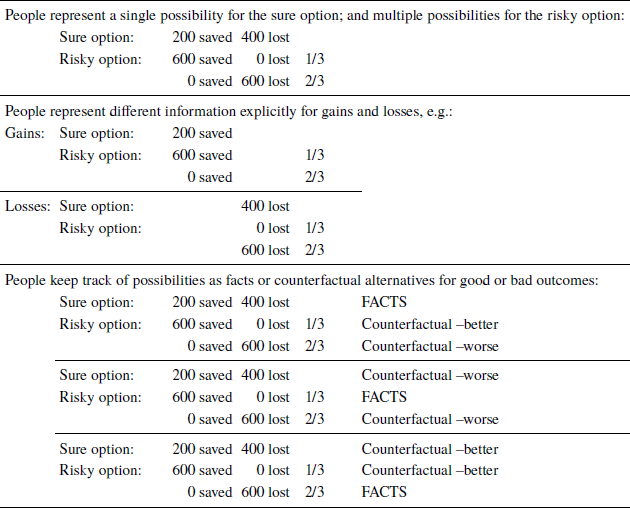
Framing the options as gains or losses affects which information is explicitly included in the mental representation of the different possibilities. When the options are presented as gains, the sure and risky options are mentally represented by envisaging partial information, that is, only the information corresponding to gains (lives saved). In this partial representation, the sure option explicitly represents only a good possibility (200 saved), whereas the risky option represents one good possibility (600 saved) and one bad possibility (0 saved), as Table 2(2) shows. The representation of partial information about the sure-thing and the risk makes some aspects of each option more salient than others, e.g., it makes salient the good aspects of the sure-thing. In contrast, when the options are presented as losses, the sure and risky options are mentally represented by envisaging different partial information, that is, only the information corresponding to losses (lives lost). In this partial representation, the sure option explicitly represents only a bad possibility (400 lost), whereas the risky option represents one bad possibility (600 lost) and one good possibility (0 lost). Once again the representation of partial information about the sure-thing and the risk makes some aspects of each option more salient than others, e.g., it makes salient the bad aspects of the sure-thing, as Table 2 shows.
Thus, the cognitive mechanism that leads to the observed preference reversal may arise from the representation of partial information for gains and losses. People choose the sure option when the options are framed as gains because it contains only an explicit representation of a good possibility (200 saved) whereas the risky option contains an explicit representation of one bad possibility (0 saved); in contrast they choose the risky option when the options are framed as losses because the sure option contains only an explicit representation of a bad possibility (400 lost), whereas the risky option contains an explicit representation of one good possibility (0 lost). On this account, the process of representing information parsimoniously leads to the framing effect, which may be overcome by the process of deliberately fleshing out the full information to represent it explicitly.
Finally, the moral echoing effect may arise because, when people suppose or know the outcome is good or bad, they may keep track of the epistemic status of the possibilities as facts or as counterfactual alternatives corresponding to better or worse alternatives. For example, suppose the outcome was good. When you are told that the risky option was chosen, it implies all 600 lives were saved (and so the facts are that 600 people were saved, the other possibilities are now counterfactual possibilities). The counterfactual possibilities are that things could only have turned out worse — if the risky option had not turned out well, or if the sure option had been chosen, as Table 2 step 3 shows. In contrast, when you are told that the sure option was chosen, it implies that 200 lives were saved (and so the facts are that 200 people were saved and the other possibilities are now counterfactual). The counterfactual possibilities are that things could have turned out better (if the risky option had turned out well), or they could have turned out worse (if the risky option had not turned out well). Hence, when you suppose a good outcome, when the risky option was chosen, things could only have turned out worse; when the sure option was chosen things could have turned out better or worse, as Table 2(3), shows. Hence, thinking about counterfactual possibilities when the outcome was good may lead the risky option to be perceived to have been the best one and a decision-maker will be praised most and considered most morally responsible for choosing it.
A different conclusion follows when the outcome was bad. When you are told that the risky option was chosen, that implies that no lives were saved (0 saved is the facts, the other options are counterfactual). The counterfactual possibilities are that things could only have turned out better, if the risky option had turned out well, or if the sure option had been chosen. But when you are told the sure option was chosen that implies that 200 lives were saved, and the counterfactual possibilities are that things could have turned out better — if the risky option had turned out well — or they could have turned out worse — if the risky option had not turned out well — as outlined earlier. Hence, thinking about counterfactual possibilities when the outcome is known to have been bad may lead people to perceive the sure option to have been the best one and a decision-maker to be blamed least and considered least morally responsible for choosing it.
4.2 Biases
Another possibility is that the differential effects of good and bad outcomes arise because of biases in judgment such as an outcome bias (Reference Baron and HersheyBaron & Hershey, 1988; Alicke, 1992, 2000). A simple outcome bias account should predict that judgments of cause and control would show an amplified judgment pattern for risky choices, compared to sure ones because the risky choice results in either the best outcome (most number of lives saved) or the worst outcome (least number of lives saved). However, in both experiments reported here, participants judged agents to be more causal and in control when they chose the sure option than the risky one, for both good and bad outcomes. The data go against the predictions of an outcome bias account. The results suggest that people do not judge that the decision-maker is more responsible, or deserving of praise or blame for the risky option, also contrary to an outcome bias account. Instead, moral judgments appeared to favor the most “acceptable” choices dependent on framing, for example, blaming the decision-maker more for a bad outcome in a loss frame if he chose the sure option than the risky option, even though the risky option resulted in a greater number of lives lost.
The effects of outcomes may also reflect a sort of hindsight bias, the tendency for people with outcome knowledge to believe they would have predicted the outcome (Reference FischhoffFischhoff, 1975; Reference Hawkins and HastieHawkins & Hastie, 1990; Reference Roese and VohsRoese & Vohs, 2012). However, there were few differences between the supposed outcomes and the known outcomes in Experiments 1 and 2. It is particularly noteworthy that there were few differences between judgments of prospective responsibility and retrospective responsibility. Judgments of prospective responsibility may be associated with the decision-maker’s role more than his or her choice (Reference Hamilton and HagiwaraHamilton & Hagiwara, 1992; Reference VincentVincent, 2011). For example, a teacher may be considered responsible for the welfare of students, regardless of whether the teacher chooses to take them outside on a class trip or not. However, past known outcomes may prompt judgments of retrospective responsibility in which people consider the impact of a choice on the outcome. For example, if an accident occurs, a teacher who chose to take a class outside on a trip might be judged to be more responsible for the accident than one who kept them inside.
4.3 Heuristics and deliberation
A final possibility is that moral judgments may be susceptible to framing effects in part because assessments of moral responsibility and blame depend on a mix of deliberative cognitive processes and automatic, heuristic, or emotional processes (Reference AlickeAlicke, 2000; Malle, Monroe & Guglielmo 2014). Such dual process accounts of thinking have been advanced in explanations of moral judgments (e.g., Reference Cushman and YoungGreene, Sommerville, Nystrom, Darley & Cohen 2001; Reference Fagley and ColemanMoore, Lee, Clark & Conway 2011; Gubbins & Byrne 2014; but see Baron & Gürçay, 2017, for counter-evidence). Similarly, the framing effect has been interpreted as arising from a heuristic or short-cut process to make decisions, an automatic process affected by emotional cues associated with loss (Reference Hawkins and HastieKahneman, 2011; Reference Loewenstein, Weber, Hsee and WelchLoewenstein, Weber, Hsee & Welch, 2001; Glockner & Herbold, 2011). More deliberative, controlled processes may over-ride the framing effect (Reference De Martino, Kumaran and DolanDe Martino, Kumaran, Seymour and Dolan, 2006; Reference Kahneman and FrederickKahneman & Frederick 2007; Reference Gilovich, Griffin and KahnemanGilovich, Griffin & Kahneman, 2002; Reference Whitney, Rinehart and HinsonWhitney, Rinehart & Hinson, 2008; but see Reference Igou and BlessIgou & Bless, 2007; Reference Kuo, Hsu and DayKuo, Hsu & Day, 2009). Hence, the idea that moral judgments are made, at least some of the time, by relying on heuristic or emotional processes may explain why they exhibit a framing effect. In contrast, non-moral judgments about cause and control and counterfactual alternatives may not be as susceptible to framing effects. They may tend to evoke deliberative processes (Reference McEleney and ByrneMcEleney & Byrne 2006; Reference Sloman and LagnadoSloman & Lagnado ,2005), and if so, the framing effect may be overridden for such judgments.
Nonetheless, judgments of moral responsibility and blame are influenced by a consideration of whether the agent caused the outcome and whether the agent had control over the outcome (Reference ShaverShaver, 1985; Reference WeinerWeiner, 1995; Reference Pizarro, Uhlmann and BloomPizarro, Uhlman & Bloom, 2003; Reference Schlenker, Britt, Pennington, Murphy and DohertySchlenker et al., 1994; Reference TetlockTetlock, 2000). Responsibility and blame are also influenced by whether the agent could have changed the outcome (Reference Nario-Redmond and BranscombeNario Redmond & Branscombe, 1996; Reference Alicke, Buckingham, Zell and DavisAlicke, Buckingham, Zell & Davis 2008). For example, when people listen to a lawyer suggesting a counterfactual about an attack in which changes to the victim’s behavior change the outcome, they ascribe higher blame to the victim and lower blame to the attacker (Reference Branscombe, Owen, Garstka and Coleman.Branscombe, Owen, Garstka & Coleman, 1996; Reference N’gbala and BranscombeN’gbala & Branscombe 1995). Conversely, people do not imagine an alternative to an action that leads to a bad outcome when the action conforms to a moral norm or obligation (McCloy & Byrne 2000; Walsh & Byrne 2007; Alicke, et al 2008; see Byrne 2016 for a review). Decision making in non-moral domains shares many commonalities with decision-making in moral domains (Reference Uttich and LombrozoUttich & Lombrozo, 2010; Reference Cushman and YoungCushman & Young, 2011; Reference Ritov and BaronRitov & Baron, 1999; Reference Baron and RitovBaron & Ritov 2004; Reference Bucciarelli, Khemlani and Johnson-LairdBucciarelli, Khemlani & Johnson-Laird 2008; Reference Sezer, Zhang, Gino and BazermanZamir 2014). It is also noteworthy that moral and non-moral judgments were correlated with each other in both experiments. Conversely, there was no echoing effect even for emotion judgments about relief or upset. Hence it may be unlikely that the observation of an echoing effect for moral judgments, and none for non-moral judgments, arises because of a difference between them in heuristic and deliberative processes.
4.4 Conclusions
In everyday life, people’s decisions are affected by whether the choices they are presented with are risky or sure options. The experiments we report show that their judgments about the morality of other people’s decisions are also affected by whether the decision-maker chose a sure option or a risky option. The results show a moral echoing effect that may have widespread implications for moral judgments in every day life. It suggests that a decision-maker will be credited for a good outcome when he or she made the typical choices of the sure-thing in a gain frame or the risk in a loss frame, and he or she will be discredited when there is a bad outcome and he or she made the atypical choices of a risk in a gain frame or a sure-thing in a loss frame.
Appendix A: Materials
Experiment 1
Unknown Outcomes
Imagine that John is in charge of the preparations for an outbreak of an unusual flu-like disease, which is expected to kill 600 people in Ireland. John must choose between the two alternative programs to combat the disease that have been proposed. Assume that the exact scientific estimates of the consequences of the programs are as follows:
Gain Frame:
If Program A is adopted, 200 people will be saved. If Program B is adopted, there is a 1/3 probability that 600 people will be saved and a 2/3 probability that no people will be saved.
Loss Frame:
If Program A is adopted, 400 people will die If Program B is adopted, there is a 1/3 probability that no people will die and a 2/3 probability that 600 will die
Judgments
1. Program A is morally acceptable
2. Program B is morally acceptable
Sure choice: Suppose that John recommends Program A. Risky choice: Suppose that John recommends Program B.
Gain Frame, Good outcome:
3. John would be morally responsible for people being saved
4. John would be relieved about people being saved
5. John would deserve to be praised for people being saved
6. John would cause people to be saved
7. John would be in control of people being saved
Loss Frame, Good outcome:
3. John would be morally responsible for people not dying
4. John would be relieved about people not dying
5. John would deserve to be praised for people not dying
6. John would cause people to not die
7. John would be in control of people not dying
Gain Frame, Bad outcome
3. John would be morally responsible for people not being saved
4. John would be upset about people not being saved
5. John would deserve to be blamed for people not being saved
6. John would cause people to not be saved
7. John would be in control of people not being saved
Loss Frame, Bad outcome
3. John would be morally responsible for people dying
4. John would be upset about people dying
5. John would deserve to be blamed for people dying
6. John would cause people to die
7. John would be in control of people dying
All conditions
8. Imagine you are a member of a committee formed to review the preparations for the outbreak and to predict how things could turn out. What is the most likely way you would complete the thought, “Things could turn out differently if…”
(a) …if John recommends the other program
(b) …if John were a more moral person
(c) …if John took more risks
(d) …if additional programs are proposed other than programs A and B
Experiment 2
Known Outcomes
Imagine that John is in charge of the preparations for an outbreak of an unusual flu-like disease, which is expected to kill 600 people in Ireland. John must choose between the two alternative programs to combat the disease that have been proposed. Assume that the exact scientific estimate of the consequences of the programs are as follows:
Gain Frame:
If Program A is adopted, 200 people will be saved. If Program B is adopted, there is a 1/3 probability that 600 people will be saved and a 2/3 probability that no people will be saved.
Loss Frame:
If Program A is adopted, 400 people will die If Program B is adopted, there is a 1/3 probability that no people will die and a 2/3 probability that 600 will die
Judgments
1. Program A is morally acceptable
2. Program B is morally acceptable
Sure Choice: Suppose that John recommends Program A. Risky Choice: Suppose that John recommends Program B. Gain Frame, good outcome: As a result of his decision, a lot of people were saved.
3. John was morally responsible for people being saved
4. John was relieved about people being saved
5. John deserves to be praised for people being saved
6. John caused people to be saved
7. John was in control of people being saved
Loss Frame, good outcome
As a result of his decision, a lot of people did not die.
3. John was morally responsible for people not dying
4. John was relieved about people not dying
5. John deserves to be praised for people not dying
6. John caused people to not die
7. John was in control of people not dying
Gain Frame, Bad outcome
As a result of his decision, a lot of people were not saved.
3. John was morally responsible for people not being saved
4. John was upset about people not being saved
5. John deserves to be blamed for people not being saved
6. John caused people to not be saved
7. John was in control of people not being saved
Loss Frame, Bad outcome
As a result of his decision, a lot of people died.
3. John was morally responsible for people dying
4. John was upset about people dying
5. John deserves to be blamed for people dying
6. John caused people to die
7. John was in control of people dying
All conditions
8. Imagine you are a member of a committee formed to review the preparations for the outbreak and evaluate how things turned out. What is the most likely way you would complete the thought, “Things could have turned out differently if…”
(a) …if John had recommended the other program
(b) …if John were a more moral person
(c) …if John had taken more risks
(d) …if additional programs had been proposed other than programs A and B
Appendix B: Participants’ judgmentsFootnote 3
A simple analysis shown in Table A1 tested whether participants’ own personal judgments had any effect on their other judgments. Here the expected effect of framing is defined in terms of the triple interaction term between gain/loss, sure/risky, and outcome (the three classifications that define the 8 groups of participants), with each variable coded as 1/–1, so that their product is positive when a dependent measure (e.g., blame) is expected to be greater in terms of the usual framing effect. The expected effect of personal judgments is defined as the difference between sure and risky ratings — recall that the participant rated both, in the same outcome condition as the judgment they were evaluating — multiplied by sure/risky, so that the result is positive when the participant’s ratings are greater for the option given to the group the participant is in. That is, participants who themselves favored the sure outcome would be expected to assign less blame for the choice of that option.

It is apparent that personal judgments have little or no effect on moral judgments (“Personal” rows), even though these judgments do show the expected framing effect (“Framing” rows) in terms of this simple analysis. They do affect the judgments of being upset by the outcome, but this is not subject to the usual framing effect. (And it would still not be significantly subject to framing if the “personal” effect were included as a predictor, where it could be a nuisance variable.)
Appendix C: Statistical analysis of non-moral judgments in Experiment 2
Causal judgments. There was a main effect of outcome, F(1, 165)=33.5, p<.001, ηp2=.17 as the decision-maker was judged to have caused the good outcome more than the bad outcome, an interaction of the three variables, F(1,165)=4.78, p<.03, ηp2=.028, and of choice and outcome F(1,165)=4.61, p<.05, ηp2=.027, and no other differences (largest F=2.77, smallest p < .098). The three-way interaction arises because the decision-maker was judged to have caused a good outcome more than a bad outcome when choosing the risk in a loss frame F(1,165)=17.79, p<.001, ηp2=.097, or in a gain frame F(1,165) = 12.77, p<.001, ηp2=.07, or the sure thing in a gain F(1,165)=14, p<.001, ηp2=.08. No other contrasts showed significant differences on the Bonferroni corrected alpha of .004 (largest F=5.78, smallest p =.017). Causal judgments did not show a framing effect, there was no interaction of frame and choice for good outcomes, F(1,83) =1.57, p=.21, and no interaction of frame and choice for bad outcomes, F(1,82) =3.23, p=.08,as Figure 2D shows. Causal judgments correlated with moral responsibility and blame/praise judgments as reported in the text, and with control r=.45, p<.001, relief/upset judgments r=18, p<.02 and counterfactual judgments r=.19, p<.015.
Control judgments There was a main effect of outcome F(1,165) = 5.84, p<.05, ηp2=.034 as the decision-maker was judged more in control of good outcomes than bad outcomes, an interaction of the three variables, F(1,165)=3.84, p<.052, ηp2=.023, and no other differences (largest F=3.19, smallest p<.076). The interaction arises because the decision-maker is judged more in control of a good outcome than a bad outcome when choosing the sure-thing in a gain frame F(1,165)=8.03, p<.005, ηp2=.05. No other contrasts showed significant differences (largest F=4.6, smallest p<.03). Control judgments did not show a framing effect for good outcomes as there was no interaction of frame and choice for good outcomes, F<1, but when participants knew the outcome was bad there was a framing effect, as the interaction of frame and choice for bad outcomes shows, F(1,82)=5.1, p<.027, ηp2=.059, see Figure 2E. Control judgments correlated with moral responsibility, blame/praise judgments as reported in the text and with cause as reported above, but not with relief/upset judgments r=–.07, p<.34 or counterfactual judgments r=14, p<.06.
Judgments of (a) initial moral acceptability, (b) moral responsibility, (c) blame/praise, (d) cause, (e) control, (f) relief/upset, and (g) counterfactuals for sure and risky options in gain and loss frames for known good and bad outcomes in Experiment 2. Error bars are standard error of the mean.

Relief/upset judgments There were no effects of outcome, frame or choice, F<1. There were no framing effects for good-outcomes or bad-outcomes, F<1 in both cases, as Figure 2F shows. Relief/upset judgments correlated only with causal judgments as reported above, they did not correlate with moral responsibility, blame/praise judgments or control also as reported above, or counterfactual judgments r=-.001, p<.99.
Judgments of (a) initial moral acceptability, (b) moral responsibility, (c) blame/praise, (d) cause, (e) control, (f) relief/upset, and (g) counterfactuals for sure and risky options in gain and loss frames for known good and bad outcomes in Experiment 2. Error bars are standard error of the mean.

Counterfactuals There was no main effect of outcome but outcome interacted with choice, F(1,165)=4.72, p<.05, ηp2=.02, and choice interacted with frame F(1,165)=3.79, p<.053, ηp2=.02 and there were no other differences (largest F=2.23, smallest p<.14). Contrasts to decompose the outcome by choice interaction showed that participants agreed that things could have turned out differently for a bad outcome more when the decision-maker chose the sure thing than the risk, F(1,165)=6.78, p<.01, ηp2=.04, and there were no other significant differences (largest F=3.54, smallest p<.062). Contrasts to decompose the frame by choice interaction showed that partcipants agreed that things could have turned out differently more when the decision-maker chose the sure thing rather than the risk in a loss frame F(1, 165)=6.26, p<.016, ηp2=.04, and there were no other differences (largest F=3.74, smallest p<.055). Counterfactual judgments did not show a framing effect for bad outcomes, there was no interaction of frame and choice for bad outcomes, F<1, as Figure 2G shows, but there was a framing effect for good outcomes, as the interaction of frame and choice for good outcomes shows, F(1,83)=5.23, p=.03, ηp2=.06. Counterfactual judgments correlated with moral responsibility and causal judgments as reported above, but not with blame/praise, control, or relief/upset judgments also as reported above.
Judgments of (a) initial moral acceptability, (b) moral responsibility, (c) blame/praise, (d) cause, (e) control, (f) relief/upset, and (g) counterfactuals for sure and risky options in gain and loss frames for known good and bad outcomes in Experiment 2. Error bars are standard error of the mean.


 Open access

