

Introduction
One of the most challenging aspects of the archaeology of hunter-gatherer societies has been the study of the socio-historical role of social aggregation processes. This offers a promising line of research to understand social interaction and co-operation between groups who are otherwise dispersed but who regularly establish ties of social identification. Aggregation processes can be seen as a result of social choices within a particular set of conditions that both reproduce and transform the social order.
During the 1980s several projects attempted to study the dynamics of aggregation events on the basis of single archaeological sites (Reference ConkeyConkey 1980; Reference HofmanHofman 1994) but difficulties in identifying material correlates of aggregation processes led to a dramatic decrease in interest.
Our project, Social aggregation: a Yámana society's short term episode to analyse social interaction, funded by the Wenner-Gren Foundation, is designed to identify the material markers which throw light on the nature of the social relationships and networks embedded in social aggregation events developed by hunter-gatherer and fisher societies who lived at the uttermost tip of South America. The project's ethnoarchaeological approach involves the critical use of comparative data from historically documented populations to develop applicable models and methods that relate to material culture variation (Reference VilaVila & Estévez 2001), while also increasing socio-historical knowledge in our case study.
Tierra del Fuego data
In the mid-Holocene, the channels and islands from the Beagle Channel to Cape Horn were peopled by nomadic hunter-gatherers specialised in the exploitation of maritime resources; they moved along the Fuegian littoral using some kind of nautical craft (Reference OrqueraOrquera & Piana 1999). During historical times, these societies were known as Yamana and their long-standing system collapsed as a result of the arrival of the Europeans, who left a rich written record about them. Nearly all the known archaeological sites recorded in the region are shell middens which form isolated domes or annular structures on the ground (for a picture of this archaeological landscape see Reference HardyHardy & Piqué 2009, Figure 3). They are interpreted as resulting from the accumulation of human residues around the perimeters of dwelling units which repeatedly occupied the same spot (Reference OrqueraOrquera & Piana 1999; Reference EstÉvezEstévez & Vila 2006). The historical sources show that temporary concentrations of Yamana people occurred when cetacean or sardine beaching took place and offered enough resources to stage the celebration of young people's initiation ceremonies (Reference GusindeGusinde 1986).
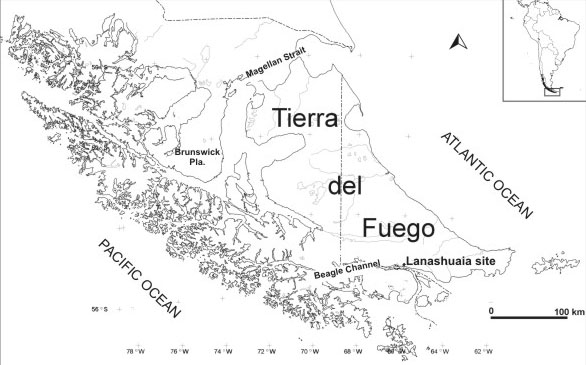
Location map.

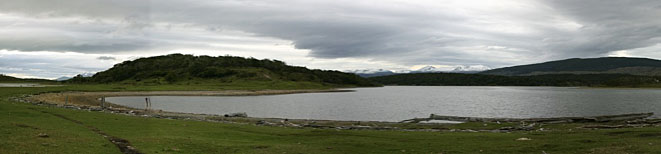
View of Lanashuaia Bay, Tierra del Fuego.

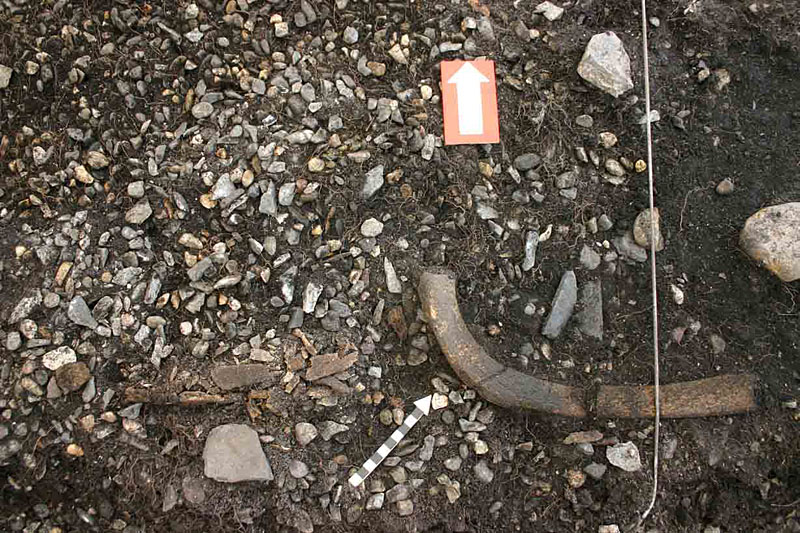
Whale bones in stratigraphic context at Lanashuaia Bay.

Preliminary results from Lanashuaia on the Beagle shore suggest that the site is the result of an aggregation event with various shell middens corresponding to simultaneous occupations. The spatial organisation of these middens, which are evenly spaced and arranged in a linear fashion, their depositional pattern and the presence of minke whale bones (Balaenoptera bonaerensis) and offshore fish remains are good indicators of short term aggregation (Reference PianaPiana et al. 2000). Our project proposes to adopt interrelated methodological strategies which will target four specific concerns. These are: contemporaneity of occupations; artefact diversity; social practices and spatial organisation.
Prospects
To test contemporaneity radiocarbon dating and refitting techniques of faunal and lithic remains, as well as improved DNA analyses on whale bones to establish whether they belong to the same individual or species, will be employed.
To approach diversity, we start from the premise that, if the site formation corresponds to a concentration episode, then the samples taken from shell midden layers in each dwelling unit should exhibit a more homogeneous composition. Techniques to evaluate richness and evenness will be applied to address this topic.
To evaluate social practices, zooarchaeological, bone and lithic technology, use-wear and residue analyses will be conducted. These studies, combined with the spatial distribution of activities - mapping of archaeological remains and spatial patterning using GIS -, should enable us to distinguish between areas of production and consumption and to infer the organisational principles behind this type of aggregation.
In sum, the study of the dynamics underlying aggregation will generate a deeper understanding of the social organisation of hunter-gatherer communities and lead to the identification and assessment of social cooperation.