

Introduction
Familial relationships are fundamental in defining individual and group identities at various scales, organizing social life and shaping lived experience throughout the life course. Anthropology’s foundational obsession with kinship structures evolved from the traditional Western definition of relatedness as determined by family trees and biogenetic commonality, but by the 1960s this had shifted to exploring kinship as a social process—a framework that is finding renewed traction in response to recent ‘family first’ and ‘crisis of the family’ narratives privileging normative biological family units (see summary in Johnson & Paul Reference Johnson and Paul2016). By the 1970s, bioarchaeological family studies had developed into distinct lines of inquiry: either investigations identifying biological or social kin within common burial grounds, called ‘kinship analysis’ (Stojanowski & Schillaci Reference Stojanowski and Schillaci2006); or analysis of post-marital residence patterns. Perhaps because of this structural division in investigation lines, bioarchaeological kinship studies have made little contribution to understanding biocultural identity at the critical functional level of kin-related household units (Johnson & Paul Reference Johnson and Paul2016).
With its synthetic approach examining the human skeleton as the locus for mutually constitutive biological and social processes, bioarchaeology has perhaps more immense potential to clarify how family units contributed to identity and how nested social identities shaped past social relationships than other subfields of archaeological inquiry (Buikstra et al. Reference Buikstra, DeWitte and Agarwal2022; Gregoricka Reference Gregoricka2021; Johnson Reference Johnson and Buikstra2019; Reference Johnson, Knudson and Stojanowski2020). Nonetheless, Western notions of biological ancestry driving social constructions of kinship have persisted in the bioarchaeology of the Americas. As demonstrated by Indigenous American scholarship (TallBear Reference TallBear2019) and echoed by many scholars critically engaging with pre-Hispanic Amerindian ontologies (e.g. Alberti & Laguens Reference Alberti, Laguens, Lozada and Tantaleán2019; Allen Reference Allen, Lozada and Tantaleán2019; Armando Muro et al. Reference Armando Muro, Jaime Castillo, Tomasto-Cagigao, Lozada and Tantaleán2019; Marshall & Alberti Reference Marshall and Alberti2014; Swenson Reference Swenson2015), kinship is often actively made and remade through communities and households of practice rather than passively acquired only through chromosomal inheritance. In the Andes, insufficient emphasis on social and biological (genetic) foundations of family reflects well-developed but methodologically isolated approaches in archaeometry, molecular anthropology, biodistance/body modification and ethnography/ethnohistory.
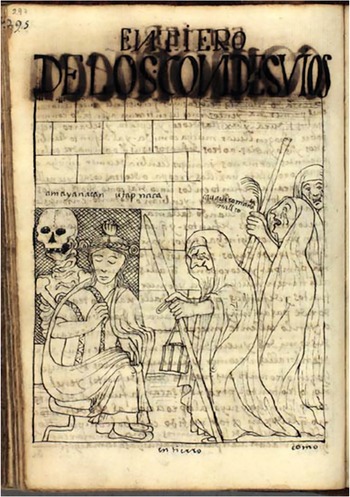
Ethnographic and ethnohistorical records have greatly informed bioarchaeological interpretations in the pre-Hispanic Andes. Texts and drawings by the Spanish chroniclers and Indigenous informants offer a window into the cultural logics of community organization at the time of conquest in the mid-fifteenth century. One of the best-known sources is work by Felipe Guamán Poma de Ayala, the son of wealthy Inca nobles who learned to speak Spanish as a child and served as a translator and aid to Spanish missionaries and administrators (Poma de Ayala Reference Poma de Ayala2004). Guamán Poma wrote and illustrated texts with fine-line drawings depicting daily, ritual and political practices that bear on kinship-affirming practices, like burial in family mortuary structures (Fig. 1). However, critics rightfully question whether ethnohistoric analogy extends to people from hundreds and thousands of years prior (Sillar & Joffré Reference Sillar and Joffré2016), cautioning against ‘Andean exceptionalism’ that might obscure finding commonalities with neighbouring regions (e.g. Covey Reference Covey2015a; Murra Reference Murra1984). Despite decades of cutting-edge research through genetic (i.e. inherited or birth identity) and mortuary studies (i.e. ascribed or identity in death) rooted in Western kinship thinking, we do not yet grasp how kinship was practised and constructed incrementally in the messy middle between birth and death. Human skeletons, as loci of both genetic code and embodied cultural meaning, offer critical insights into how kinship was understood throughout Andean prehistory.
Chullpa (funerary tower) and ancestral remains. Illustration by Felipe Guamán Poma de Ayala, Nueva corónica y buen gobierno (c. 1615), fol. 295. MS GKS 2232 4º, Royal Danish Library (Det Kongelige Bibliotek), Copenhagen. (Courtesy of the Royal Danish Library, Copenhagen.)

Therefore, here I build on exceptional scholarship of Andean kinship (e.g. Weismantel & Wilhoit Reference Weismantel, Wilhoit and Bamford2019) to explore kinship trouble in Andean bioarchaeology through bibliometric and text analysis of the research landscape over the past quarter-century. First, I briefly explain how kinship—defined here as nested hierarchies of relatedness—has been approached in the Andes from biological and sociocultural perspectives, before exploring relational, non-Western animistic ontologies of kin. I then describe literature analysis methods, report trends and highlight how isotopic analyses of kinship and databases of individual life histories provide a productive common ground for thinking through embodied biocultural practices of kin-making.
Archaeology of ayllus
Andean scholars writing from many different theoretical and methodological approaches have been heavily influenced by the concept of ayllu, described as kinship-based social units or family or household clans organized around common ancestors, places of origin tied to land claims, and shared economic productivity (Bastien Reference Bastien1985; Jennings & Berquist Reference Jennings and Berquist2023; Kellett Reference Kellett2022). Ayllus often exist in structural opposition to each other, informing the practice of social roles and obligations in ritual activities and daily life. Membership in an ayllu structures individual and group social identities, the manifestation of those identities in material culture and customs (like dress, craft production and food consumption), and differential access to resources scattered unevenly across cultural, natural and supernatural landscapes. Ayllus can scale from small household groups farming a singular plot of land to lineages extended through time marking generational land tenure holdings throughout entire regions. Remarkably, ayllus were stable enough to be nested within larger states and empires—their complex rules of social, natural and cosmological balancing were eventually leveraged by the Inca and then infiltrated by the Spanish to control group interactions to facilitate consolidated rule. Ayllu was without parallel to European colonists and generations of Andean archaeologists, leading to centuries of incongruities when mapping material culture and spatial organization trends onto extant theories of kinship from the Old World. Ethnographers detail the moral economies, ritual obligations and kin idioms of Andean ayllus (Allen Reference Allen2002; Platt Reference Platt2009), but debates persist over their longevity and about how they contributed to post-marital residence patterns, identity and social inequality.
Foundational work in archaeology and ethnohistory used colonial documents to frame ayllus as vertically organized, reciprocity-based units embedded in ‘vertical archipelagoes’ (Murra Reference Murra1980, Reference Murra1984). From contexts dating to mid-first millennium ce, archaeologists have inferred ayllu organization from settlement segmentation and corporate labour signatures, like at Tiwanaku and Lake Titicaca basin sites (Janusek Reference Janusek2004; Stanish Reference Stanish2003) or from mortuary groupings in Wari imperial contexts (Isbell Reference Isbell1997). Others have emphasized how Inka provincial landscapes and plaza planning indexed dual organization and mit’a (mandatory labour) logistics within nested ayllu hierarchies (Bauer Reference Bauer2010; Covey Reference Covey2015b; D’Altroy Reference D’Altroy2014). Across periods, archaeologists have emphasized ayllu’s resilience and malleability—as both a social ontology and a pragmatic corporate form mediating territory, labour and identity under shifting state regimes, although questions remain about the antiquity of ayllu-like structures (Jennings & Berquist Reference Jennings and Berquist2023). Given how fundamental ayllu has been to conceptualizing kin-related social organization in Andean archaeology and ethnography, next I very briefly examine how archaeogenetics studies have approached ayllu and consider how relational approaches might bolster genetic ones.
Archaeogenetic approaches to ayllu
Ancient DNA (aDNA) studies in South American bioarchaeology have shifted recently from mitochondrial DNA analyses of continental-scale migrations to whole genome approaches carried out at local laboratories focused on regionally significant questions (Bauer Reference Bauer2010). For example, Parolin et al.’s (Reference Parolin, Cortés, Basso and Scattolin2019, 228–9) summary of recent aDNA research in the Central and southern Andes, excluding the North Coast, covers sites from the earliest Archaic Period populations to the Late Horizon (Inca era) and Colonial period groups and comparative modern populations. These aDNA studies have focused on reconstructing post-marital residence, long-distance migrations and the peopling of the Americas, but except for studies examining biological relatedness in mortuary groups, most do not explore how kinship was defined and practised among contemporaries. Bioarchaeologists have recently emphasized (Buikstra et al. Reference Buikstra, DeWitte and Agarwal2022; Johnson Reference Johnson and Buikstra2019, Reference Johnson, Knudson and Stojanowski2020) how kin membership in Indigenous Amerindian groups is flexible and not bounded by genetic kinship, but this perspective seems rarely engaged with by many genetic studies.
Bioarchaeologists have summoned ayllus to test genetic relationships within cemetery groups, whether through molecular likeness (aDNA) or using cranial and dental morphometrics and non-metrics as phenotypic proxies for genetic affinity (see Table 2, below, and supplementary Table S1 for references). Robust studies of stylistic variation in cranial vault modification (CVM) or intentional vault modification (IVM)—the binding of pliable infant cranial bones to form heads into shapes of their ancestral/ethnic origin places—also frequently leverages aDNA and morphology to test relatedness between inherited and ascribed identity in burial or material culture groupings, possibly attributed to ayllu. However, immigration and lifetime experiences move people to live with, among, and become people they were not necessarily born or raised to be. Therefore, genetic and morphometric ancestry markers provide useful deep-time context but fall short of capturing complex lived experiences of geography, biological family versus fictive kin, and community versus ancestral identities that shape definitions and kinship habitus constituting ‘realized families’ (Bourdieu Reference Bourdieu1996).
Relational approaches to kinship relations: space and substance
Kinship then, is far from a foregone genetic conclusion, and instead should be considered a process of becoming that makes familial bonds (Johnson & Paul Reference Johnson and Paul2016). Sahlins (Reference Sahlins2013, 2–3) considers kin as the ‘mutuality of being’ among people ‘intrinsic to one another’s existence’. These kinds of relational, fluid, and sometimes imagined or fictive kinship processes were and are widespread among Amerindian people. These kinship concepts were probably related to broader ontological schema and religious practices of animism that unified households, communities and complex polities (Bird-David Reference Bird-David1999; Gose Reference Gose2018; Lozada Reference Lozada, Lozada and Tantaleán2019). These kinship relationships were structured, contested, and (re)made through public rituals and private practices focused on organizing geographic space and corporeal substances.
Lévi-Strauss’s ‘house society’ model, where family revolves around shared spatial usage, fits well with ethnographic understandings of Andean kinship (Gose Reference Gose, Seligmann and Fine-Dare2019; Leinaweaver Reference Leinaweaver2008; Reference Leinaweaver2009; Weismantel & Wilhoit Reference Weismantel, Wilhoit and Bamford2019). Andean kin groups tend to grow outwardly from a house-based familial core to kin within one’s own ayllu, to configurations of ayllus into communities, and then into complementary communities bound by reciprocity obligations. Those responsibilities are defined at geographically nested levels, ultimately extending into the maintenance of hierarchical systems of apus or mountain gods that balance dangerous and generative forces between ancestors and the landscapes they inhabit (Allen Reference Allen2002; Nash Reference Nash2009). Thus, kinship identities are heavily relational, and roles and relationships are constantly revised as people move throughout shifting socio-spatial reconfigurations throughout the life course. Many of these relationships in the Andes traverse vertically stratified ecozones where discrete pockets of resources are exchanged with distant communities that cannot produce them. These vertical exchange relationships are primarily established through planned inter-zonal marriages that effectively build new kinship ties (Hirsch Reference Hirsch2018; Murra Reference Murra1984; Platt Reference Platt2009).
Other ethnographic approaches emphasize how common substances, rather than spaces, define and reproduce kin groups. Weismantel (Reference Weismantel1995) observes that Andean households perform familial identity by eating together, becoming ‘people of a kind’, corporeally constituted by the same cosmic substances and earthly molecules. As people eat and drink together, they co-constitute their kin relationality (Allen Reference Allen, Lozada and Tantaleán2019; De La Cadena Reference De La Cadena2015). This occurs gradually and incrementally as generations co-define kin by feeding and being fed the same foods and substances (Van Vleet Reference Van Vleet2002; Weismantel Reference Weismantel1995). This relationality is preconfigured with landscapes and inanimate worlds and shifts along with changing food exchange and consumption networks (Salas Carreno Reference Salas Carreno2016). Because the body registers changes in geographic and substance relationality at life-long and generational scales, the following analysis investigates trends in bioarchaeological studies of kinship in the Andes and explores how relational kinship ontologies might be assessed with bioarchaeological correlates.
Materials and methods: bibliometric and content analysis of Andean studies
Bibliometric analysis of kinship keywords
Given that I was interested in assessing which bioarchaeological correlates might map onto relational kinship schema, I used a Google Scholar search in the Publish or Perish software for MacOS (Harzing Reference Harzing2007) to search for four methods-based keyword strings (Table 1). I began with general bioarchaeology terms and moved into more specific methods known to have been employed in Andean kinship studies. I limited the search hits to produce the 200 most relevant publications since 2000 for each string (800 total records) and then eliminated publications that did not actually include Andean cases. Many publications were returned as results for more than one of the search term strings (Table 1), so the total of 279 publications returned for all four search strings does not reflect 279 distinct publications.
Summary of the 200 most relevant sources produced by the Publish or Perish bibliometric tool in response to each set of search terms (row order presented here is not significant to the analysis). This corpus of publications was then trimmed to those verified to include Andean cases, report new data, and test an explicitly kinship-related hypothesis resulting in 25 publications.

From this verified corpus of 100 Andean cases, I then limited the results to publications that presented original bioarchaeological data or used new methods to re-analyse data from published skeletal individuals—this culling was necessary to avoid potential bias from re-publication by specific researchers or methods. Finally, since I was interested in how bioarchaeological correlates were applied to kinship, I confirmed that each of the resulting studies explicitly tested a kinship-related hypothesis, rather than merely asserting possible kinship relationships in discussions (e.g. Alaica et al. Reference Alaica, González La Rosa and Knudson2020; Andrushko Reference Andrushko2021; Kemp et al. Reference Kemp, Tung and Summar2009; Knudson & Torres-Rouff Reference Knudson and Torres-Rouff2009; Scaffidi & Tung Reference Scaffidi and Tung2020).
Pursuant to these criteria, I excluded genetic studies of special populations, like assemblages of human trophy heads from museum collections (Forgey & Williams Reference Forgey, Williams, Rakita, Buikstra, Beck and Williams2005) and sacrificial victims (Sutter & Verano Reference Sutter and Verano2007), as they likely do not reflect a once-living community of kin. I also excluded studies of single individuals from special contexts, like the capacochas or child sacrifices of the Inka (de la Fuente Castro et al. Reference de la Fuente Castro, Cortés and Raghavan2024; Sandoval et al. Reference Sandoval, Fujita, Jota, Pinotti and Santos2023) or proposed father and son homicide victims from pre-Hispanic Argentina (Nores et al. Reference Nores, Rena, Angeletti, Demarchi, Modesti and Fabra2020), given they cannot test hypotheses about kinship practices with a sample size of only one or two individuals. Following this logic, I also excluded genetic or biodistance studies focusing on peopling of the Americas or regional population history without explicitly addressing contemporaneous kin relationships (Bongers et al. Reference Bongers, Nakatsuka and O’Shea2020; Cucina et al. Reference Cucina, Arganini, Coppa, Candilio, Pilloud and Hefner2016; Fehren-Schmitz et al. Reference Fehren-Schmitz, Haak and Mächtle2014; Reference Fehren-Schmitz, Reindel, Cagigao, Hummel and Herrmann2010; Kemp et al. Reference Kemp, Tung and Summar2009; Lindo et al. Reference Lindo, Haas, Hofman and Apata2018; Motti et al. Reference Motti, Pauro and Scabuzzo2023; Nakatsuka et al. Reference Nakatsuka, Lazaridis and Barbieri2020; Parolin et al. Reference Parolin, Cortés, Basso and Scattolin2019; Popović et al. Reference Popović, Molak and Ziółkowski2021; Posth et al. Reference Posth, Nakatsuka and Lazaridis2018; Sutter Reference Sutter2005; Reference Sutter2021; Tung et al. Reference Tung, Smith, Creanza, Monroe, Bolnick and Kemp2019) or methodological studies that did not explicitly test kinship hypotheses (Rhode & Arriaza Reference Rhode and Arriaza2006).
Finally, despite many excellent contributions, I also excluded book-length manuscripts and dissertations/theses, given it was difficult to disentangle consideration of kinship concepts in introduction and concluding chapters from cumulative data in results chapters (Juengst Reference Juengst2023; Kurin Reference Kurin2016). After applying the third criteria (testing kinship hypotheses and disseminating new data), all search term strings produced mutually exclusive, non-overlapping publication lists. Note that I rely on underlying publications to confirm norms of bioarchaeological ethics were met in their study, rather than collecting data on ethics statements in those works—which, while an important charge, is beyond this work’s immediate scope.
Text, content, and geographic distribution analysis
Next, I used ChatGPT Plus (5.0) to conduct text frequency analysis of each publication (excluding references) for kinship-related keywords: relationship(s), related, relatedness,Footnote 1 kin, kinship, affinity(ies), affine(s), ancestor(s), descendent(s), family(ies), familial, household(s) and community(ies). Since I targeted conceptualizations of kin as close, contemporaneous and recently deceased ancestors, I avoided search terms related to broader population history and ethnicity that do not necessarily map on to more focal, contemporaneous scales of relatedness. Essentially, ayllus and relationally defined kinship were treated as the independent variable, while the keywords above and methods were dependent—I identified which types of genetic, phenotypic, isotopic, or bioarchaeological analyses (other than routine biological sex, age and palaeopathology observations) were used in each study and explored which keywords were correlated. I also mapped types of kinship correlates analysed in each study at the site level to explore potential geographic patterning of methods or theoretical approaches. Finally, the predominant research questions/hypotheses and findings of each study were assigned to one of three thematic categories: community composition (proportion of non-locals, number of ayllus, etc.), social identity and biological affinity of mortuary groups, or genetic/biocultural continuity from earlier to later periods. Note that text analysis necessarily precluded relevant Spanish-language publications (e.g. Barberena et al. Reference Barberena, Tessone and Novellino2022) although I include this work in publication and geographic trend analysis.
Results
Publication trends: authorship, venues, and methods
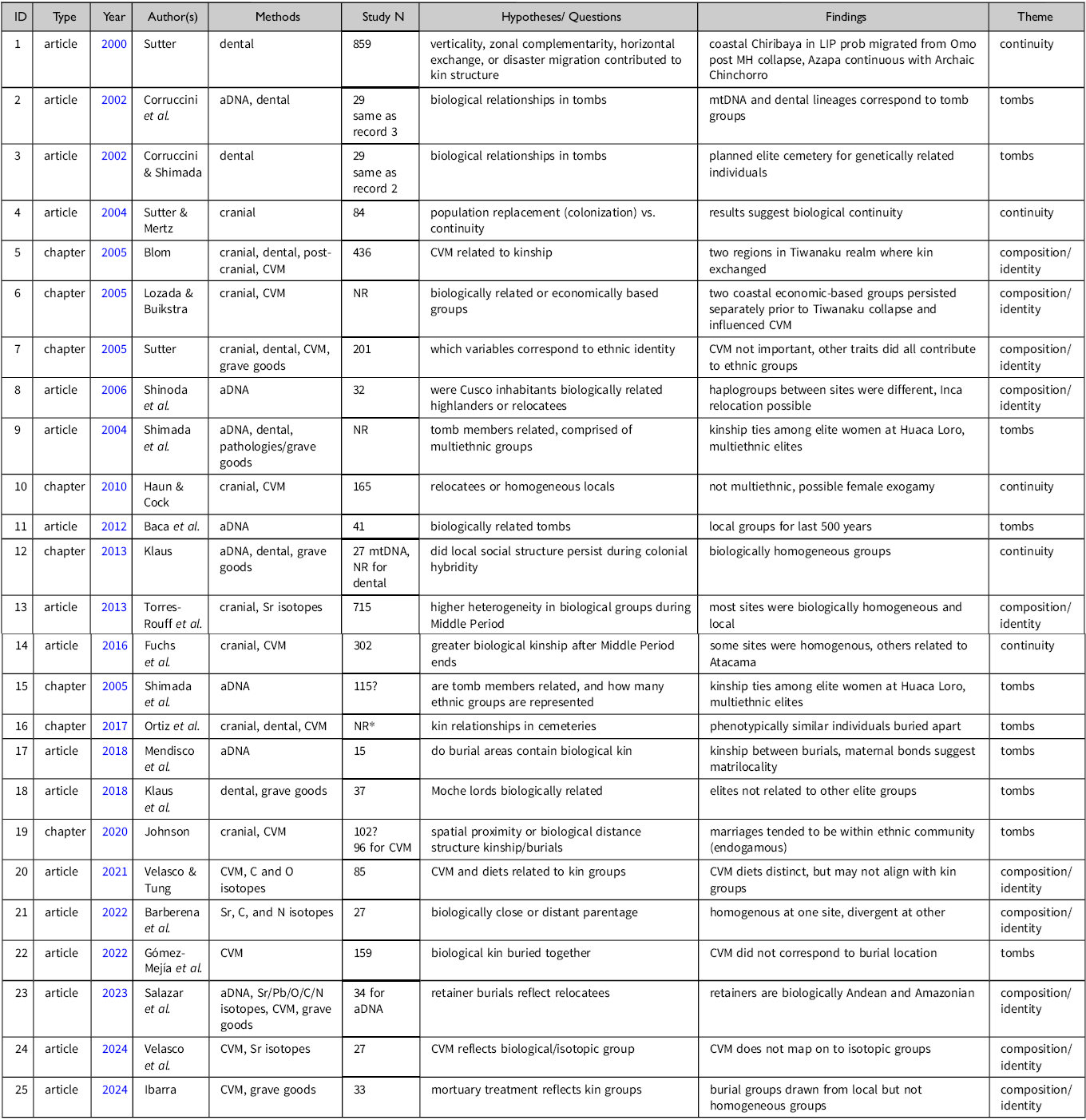
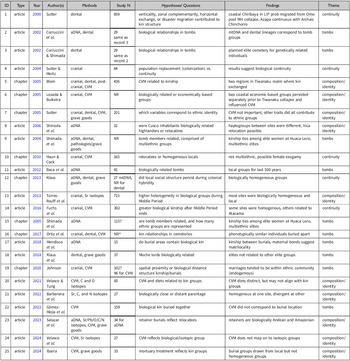
The number of publications verified to meet inclusion criteria was surprisingly low (Table 2; Supplementary Table S1), including eight book chapters and 17 journal articles (N=25). Over 20 MA theses or PhD dissertations tested kinship hypotheses, but they were rarely published subsequently as peer-reviewed articles (but see Black Reference Black2023; Johnson Reference Johnson2016; Pink Reference Pink2013; Velasco Reference Velasco2016), and thus are not included here. There are consistently one or two publications every year or two since 2000, with a maximum of four in 2004. There are 11 publications from 2000–2009, seven from 2010–2019 and seven so far from 2020–2024. This demonstrates a decrease in bioarchaeological kinship studies from the 2000s to the 2010s and raises the possibility of a resurgence in kinship interest so far this decade.
Bibliometric analysis results of Andean cases with original data testing a kinship-related hypothesis (N=25). This summary includes methods used, research questions and findings, and research themes.
*Not reported.
Table S1 lists full publication details for the 25 publications meeting this study’s criteria. Four authors wrote multiple pieces within this set of 25 publications. Johnson wrote multiple kinship pieces (Reference Johnson and Buikstra2019; Reference Johnson, Knudson and Stojanowski2020; Reference Johnson, Brughmans, Mills, Munson and Peeples2023), but only one is included in this textual analysis since only the 2019 publication included original data. Article placement included the American Journal of Physical Anthropology (N=4), Journal of Archaeological Science/Reports (N=2), Latin American Antiquity (N=2) and regional journals from Chile and Argentina (N=2). Bioarchaeology International, Science Advances, Dental Anthropology, Journal of Anthropological Archaeology, Journal of Field Archaeology, Current Anthropology and BMC Genetics published one each. While selection of book chapter or journal venues is equally split through time, there are no publications in American Journal of Physical Anthropology (now American Journal of Biological Anthropology) in the last decade, and with two exceptions, kinship publications have trended away from biological journals recently (although the sample is too small for statistical testing)—possibly in order to permit greater theoretical engagement on the topic.
Nine studies utilized a single method, usually aDNA, but two studies used only CVM (Gómez-Mejía et al. Reference Gómez-Mejía, Aponte, Pezo-Lanfranco and Eggers2022; Ibarra Reference Ibarra2024). The 16 other studies combined chemical or morphometric methods. Nearly half relied on CVM data (N=12), followed by nine each relying on dental or cranial biodistance data, eight on increasingly advanced forms of aDNA analyses and four on stable or radiogenic isotopes. In addition to complex multivariate statistics required for genetic and phenotypic biodistance studies, Johnson (Reference Johnson, Brughmans, Mills, Munson and Peeples2023) made the case for social network analysis of biodistance data and compellingly employs graph theory to reconstruct kinship networks across regions.
Content analysis results: questions, terminology, and geographic distribution
Most studies questioned community composition (proportion of non-locals, number of ayllus, etc.) and social identity (N=11), biological affinity of mortuary groups (N=10), or genetic/biocultural continuity from earlier to later periods (N=4). Continuity studies taper off in 2013 (Table 2), while the other two question types persist. Very few aDNA and biodistance studies report data by individual in an intelligible way. However, Salazar et al.’s (Reference Salazar, Burger and Forst2023) supplement (Table 1) offers a laudable example of multi-line synthesis (isotopic, phenotypic, genetic, CVM and contextual data) by radiocarbon-dated individual. Although not included in textual analysis given it compiles prior data, Ringbauer et al. (Reference Ringbauer, Steinrücken, Fehren-Schmitz and Reich2020) provide another exemplar aDNA study that explicitly interrogates kinship between well-contextualized individuals. They compile 46 publicly available full genomes and report fewer close kin parents during the Middle Horizon than afterward, when instability likely promoted close kin mating within insular communities.
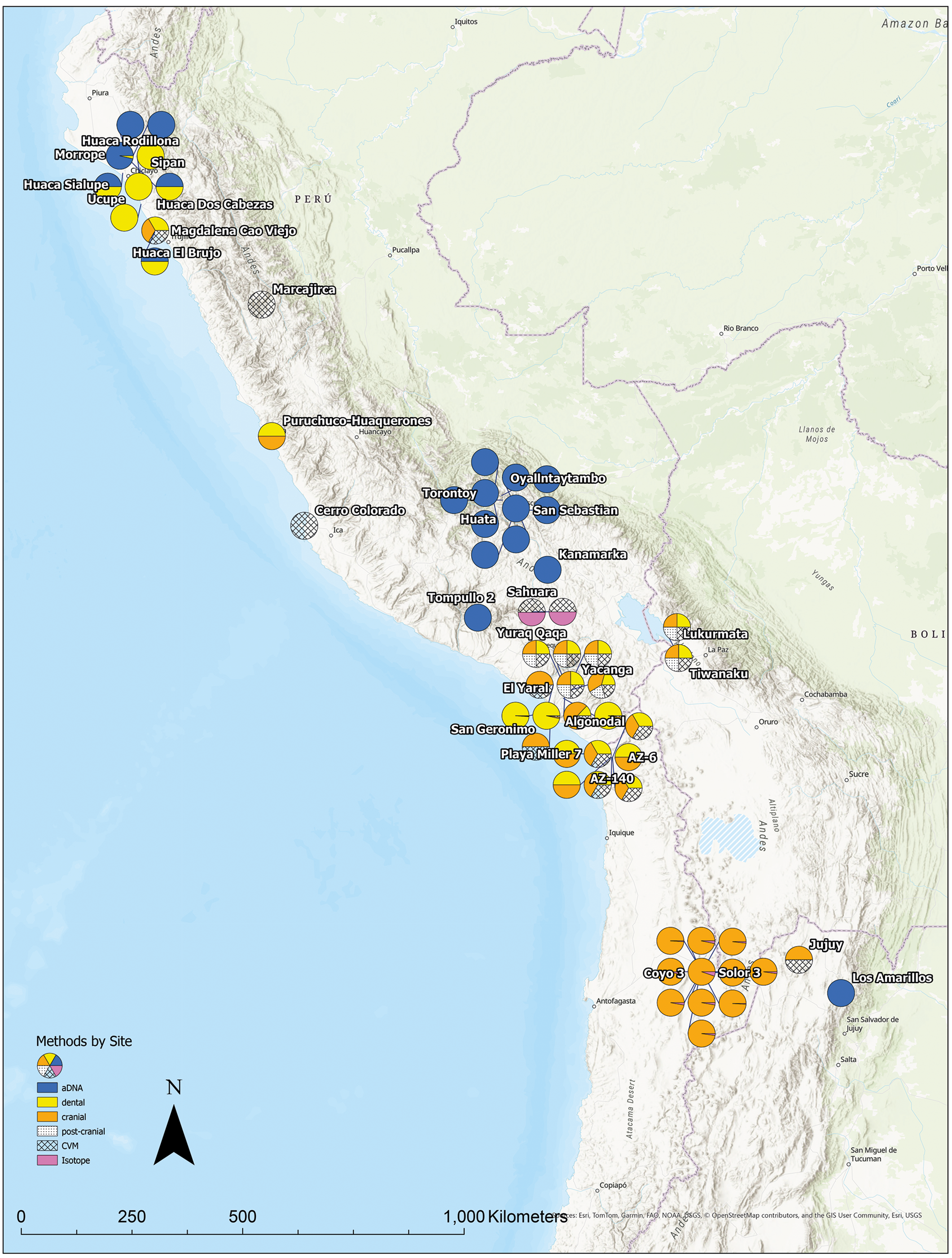
With some smaller sites aggregated, a total of 72 sites or site groups were mapped with coordinate uncertainty reported (Table S2). Some biases are present in the spatiotemporal and cultural patterning of the study methods, which do not map onto research question patterns, but are limited in spatio-temporal contexts (Fig. 2). For example, aDNA studies of kinship are focused almost exclusively on the Moche elites of the later first millennium ce and Inca elites from Cusco’s highlands during the mid-second millennium. Footnote 2 CVM and phenotype studies are more frequent in regions with extensive diachronic sampling and where multiple ethnic groups are suspected to have lived together. Overall, the Peruvian Central Coast and highlands, northern highlands and southern Peru outside of the Moquegua and Ilo Valleys remain poorly represented, along with the northern, eastern and southern extents of the Central Andean range.
Map of sites and populations included among the 25 studies analysed, highlighting distinct methodologies and variables used (N=72 sites or site groups).
Rank order of kinship terms showed nearly identical usage for aDNA and biodistance studies, which prioritized discussions of relationships, kinship, and communities (Table 3). CVM studies tended to emphasize kinship first, followed by relationships, community and family. Discussions of households ranked low for all methods. Across the corpus of documents, discussions of community and relationships were the most correlated, followed by kinship and households and relationships and kinship. The weakest correlations were kinship and community and kinship and affinity (see Fig. 3 for R2).
Rank order (1 is most frequent) and count of how many times kinship-related terminology from each term group appeared in each publication (N=24 publications analysed, as the last publication was in Spanish).

*Indicates a truncation query that returns various endings and spellings after the symbol.
Word frequency correlation heatmap for the five classes of kinship-related terms for 24 publications analysed by this study (subsample numbers for the term groups are reported in Table 3).

Discussion: persistent problems and the promise of relationality
The last ∼25 years of Andean bioarchaeological kinship studies have shown a staggering advancement in methodological rigour, accessibility and sheer quantity of individuals analysed. However, genetic (aDNA) studies seem to remain fixed on the deep past and less interested in engaging with how kinship is produced, maintained and contested at smaller temporal scales. CVM and phenotypic studies share a similar bias against tackling household and community levels of kinship. But as Johnson points out (Reference Johnson, Brughmans, Mills, Munson and Peeples2023), network analysis of genotypic and phenotypic data has potential to connect the dots between kin individuals and groups beyond the constraints of a tomb or town borders. Following Salazar et al.’s (Reference Salazar, Burger and Forst2023) example to build collaborative, multi-method databases of individuals would greatly increase the success of network analyses. However, this study shows intense geographic bias as phenotype and aDNA studies are absent in many periods and places. This could be due to poor preservation of skeletal tissues beyond the arid coastal deserts and damage from looting events that limit recovery of aDNA. This could also reflect low scholarly interest in non-elite populations outside of Moche and Inca lineages. Studying legacy collections across cultures and geographies with new methods and promoting explicit, ontologically informed kinship theories will be crucial to advancing this research area.
Interestingly, isotopic methods are beginning to be employed together with genetic and morphometric approaches. While isotopic data are only recently beginning to converse with other molecular and bioarchaeological data and explicit kinship questions, they offer immense potential to demonstrate how the consumption of similar substances in similar spaces can constitute biological and fictive kin alike. For example, biogeochemical analyses (Scaffidi et al. Reference Scaffidi, Tung and Knudson2021; Socha et al. Reference Socha, Sykutera and Orefici2022) are beginning to hint that trophy head victims were sometimes adopted and ate as family for extended periods prior to sacrifice. Outsiders and insiders alike become molecularly entwined as they eat together from the same places regardless of biological affinity. On the other hand, Velasco et al. (Reference Velasco, Kamenov and Krigbaum2024) emphasize how family units could extend geographically across community and vertical ecozone boundaries, where biogeochemistry between affines may differ. While Johnson (Reference Johnson and Buikstra2019) urges kinship analyses at the household and regional levels, Tessone et al. (Reference Tessone, Barberena and Knudson2024) offer an avenue to operationalize this pursuits. Combining isotopic life histories of individuals and generations with genealogical and traditional bioarchaeological data will uncover currently hidden relationships within and across communities and time.
My analysis was limited by English keywords and exclusion of older and harder to locate publications not digitally indexed. Newer AI-based text extraction would better capture the older scholarship so critical to understanding the evolution of bioarchaeological thought on kinship in the Andes. Also, because total and subsample numbers were frequently missing or difficult to disentangle for different methods or previously published data, I had to rely on word counts rather than number of individuals analysed to describe trends. Funding agencies and professional norms must give equal weight to synthetic projects and holistic, collaborative, multi-correlate studies relative to excavation and analysis of new skeletal populations to elucidate kinship connections across local and regional scales. Finally, it is odd that, given kinship analysis studies relationships between individuals, it is rare to encounter descriptive lists of individuals tested within complex aDNA and biodistance studies. Collaborative and transparent databases are critical for relating contextualized individuals within and between local and broader regional populations.
Conclusions
In sum, this study demonstrated a shifting in emphasis on kinship questions in Andean bioarchaeology over the last 25 years and proposes integrating isotopic and material culture analysis more intentionally in future kinship studies. We must continue to explore the antiquity of ayllus to understand how these structures began and evolved into those described by ethnographers and historians. We must also contextualize skeletal research with localized cultural logics of relational identity from the material record (e.g. ceramics, art, architecture, etc.), as these are essential points of entry for making sense of kinship trouble in our respective regions. Andean kinship studies will clearly benefit from defining familial relationality in a more dynamic and ontologically informed way. Perhaps doing so will enable us to take kinship studies ‘beyond the bloodline’ (Butler et al. Reference Butler, Bradway and Freeman2022) and explore how families, ayllus, communities and regional kinship bonds were made and remade through their interactions with each other and similar environmental substances.
Supplementary material
To view supplementary material for this article, please visit https://doi.org/10.1017/S0959774326100456
Acknowledgements
I thank the editors, discussants, and the other authors in this special issue for their insightful comments and feedback on the ideas and analyses presented in this work. No external funding was used for these analyses.



 Open access

