





Introduction
Losers of globalization, including the working-class, rural, or economically disadvantaged citizens, are frequently associated with support for populist parties or authoritarian candidates. This is not only reflected in public discourse but also in empirical research, which shows that individuals who are disadvantaged, or who perceive themselves as disadvantaged, are more likely to support authoritarianism and express specific policy preferences, such as opposition to immigration and globalization (e.g., Inglehart and Norris Reference Inglehart and Norris2016; Kriesi, Grande, Lachat et al. Reference Kriesi, Grande, Lachat, Dolezal, Bornschier and Frey2008; Zürn and De Wilde Reference Zürn and de Wilde2016). Moreover, recent studies emphasize that beyond traditional socio-economic factors, such as class or geographical background, perceived societal marginalization, such as status anxiety, perceived deprivation, or lack of recognition, is crucial for understanding populist support and the rise of authoritarianism (e.g., Elad-Strenger and Kessler Reference Elad-Strenger and Kessler2024; Habersack and Wegscheider Reference Habersack and Wegscheider2024; Kriesi and Schulte-Cloos Reference Kriesi and Schulte-Cloos2020; Mutz Reference Mutz2018; Spruyt, Keppens, and van Droogenbroeck Reference Spruyt, Keppens and van Droogenbroeck2016; Steiner, Schimpf, and Wuttke Reference Steiner, Schimpf and Wuttke2023).
Despite extensive research on the left behind and their support for populism and authoritarianism, two questions have not been addressed to date: (1) Is feeling left behind related to general democratic orientations (democratic attitudes, understandings of politics, and governance preferences)? and (2) How do different dimensions of perceived societal marginalization (cultural, economic, and political) relate to democratic orientations?
Exploring these questions provides meaningful insights into how deep the divide between globalization’s winners and losers could be and whether subjective feelings of being left behind are linked to turning away from democracy. This is particularly important because democratic stability relies on a shared commitment to core democratic values and an agreed-upon vision for governance (Easton Reference Easton1965, Reference Easton1975; Lipset Reference Lipset1959). Understanding the relationship between feeling left behind and democracy is therefore essential for assessing the threat that perceived marginalization poses to democratic legitimacy and for identifying ways to bridge societal gaps.
This article provides an initial overview of the link between subjective societal marginalization, assessed across cultural, economic, and political dimensions, and democratic orientations. By considering these perceptions alongside socio-economic indicators of disadvantage (namely occupation, income, and residence), I extend existing research and provide a more comprehensive understanding of how the left behind relate to democratic orientations. To this end, I examine how feelings of being left behind are associated with democratic support, democratic satisfaction, understandings of politics, and governance preferences. The analysis focuses on the United States and Germany, two established and wealthy democracies currently facing challenges from authoritarian populism. Although both countries share similar challenges, such as rising economic inequality, they differ in social polarization, political trust, and democratic satisfaction, which are closely related to social conflict.
Despite the connection between a lack of recognition and dissatisfaction with democracy, I find that only a lack of cultural recognition is consistently linked to ‘undemocratic’ attitudes, namely lower democratic satisfaction, lower generic support for democracy, an authoritarian and a majoritarian understanding of politics, and higher support for authoritarian forms of governance. By contrast, a lack of economic recognition is not linked to lower democratic support and is associated with both a social democratic and authoritarian understanding of politics. A perceived lack of political recognition, finally, is associated with higher dissatisfaction with democratic performance but also with higher democratic support, a liberal and social democratic understanding of politics, and higher support for direct democratic decision-making through referendums. These findings suggest that subjective perceptions affect democratic orientations in ways that go beyond party or policy preferences, and they challenge the frequently oversimplified image of the left behind as inherently undemocratic. Moreover, a lack of cultural recognition is far less prevalent among respondents than a lack of political recognition, which is potentially reassuring news regarding democratic regression and possible remedies.
The article is structured as follows: I first review relevant literature on subjective and objective disadvantage and then discuss how feelings of being left behind in particular might be related to democratic orientations. Next, I outline the methodology and operationalization. In the results section, I first present descriptive distributions and analyze the relationships between each of the three dimensions of societal marginalization (lack of cultural, economic, and political recognition) and socio-economic factors. Using regression analysis, I then assess the associations of these dimensions and the socio-economic factors with democratic satisfaction, democratic support, understandings of politics, and governance preferences. Finally, I summarize the findings, discuss their implications, and provide an outlook for future research.
Theoretical framework
Several theoretical frameworks explain democratic erosion by emphasizing large-scale socio-economic, cultural, and political transformations associated with globalization. The underlying assumption is that the far-reaching changes disproportionately affect certain segments of the population in negative ways, while others benefit, creating new lines of inequality and conflict (Kriesi, Grande, Lachat et al. Reference Kriesi, Grande, Lachat, Dolezal, Bornschier and Frey2006, Norris and Inglehart Reference Norris and Inglehart2019). Importantly, disadvantage refers not only to material loss or socio-economic status but also to perceived declines in social status, societal recognition, or political influence. The disparity between those negatively affected and those benefitting can lead to feelings of anger, resentment, or alienation. This can result in a sense of being or feeling left behind, which in turn shapes political perspectives and behavior (see also Cramer Reference Cramer2016; Hochschild Reference Hochschild2016).
The transformations due to globalization can be broadly categorized into three dimensions. The cultural dimension captures shifts in traditional values, norms, and social status. These shifts can lead to perceived threats due to increased multiculturalism and progressive social change, especially among those who have traditionally held a privileged status in Western societies (see e.g., Gest Reference Gest2016; Mutz Reference Mutz2018; Norris and Inglehart Reference Norris and Inglehart2019). The economic dimension refers to the transformation of the labor market, including global outsourcing, automation, and a shift toward a knowledge-based economy with specialization and professionalization. These changes can lead to job insecurity, declining wages, and economic vulnerability among those that are working in affected sectors (see e.g., Algan, Guriev, Papaioannou et al. Reference Algan, Guriev, Papaioannou and Passari2017; Burgoon, van Noort, Rooduijn et al. Reference Burgoon, van Noort, Rooduijn and Underhill2019; Ivarsflaten Reference Ivarsflaten2008; Kriesi, Grande, Lachat et al. Reference Kriesi, Grande, Lachat, Dolezal, Bornschier and Frey2006). Lastly, globalization also affects the political dimension: extensive de-nationalization and the transfer of power to supranational or international bodies can create challenges regarding inclusiveness, transparency, and responsiveness. This can result in a perceived distance between political actors and citizens, as well as political dissatisfaction and alienation (see Kriesi and Schulte-Cloos Reference Kriesi and Schulte-Cloos2020; Lavenex Reference Lavenex, Kriesi, Lavenex, Esser, Matthes, Bühlmann and Bochsler2013).
In the following, I define who the left behind are, examine how (perceived) marginalization is generally linked to democracy, and then outline how different dimensions of perceived marginalization (cultural, economic, and political) are related to democratic orientations (democratic attitudes, understandings of politics, and governance preferences).
Being left behind or feeling left behind?
Groups commonly described as left behind are often identified as being particularly affected by modernization and globalization across objective and subjective dimensions. The term encompasses both those who are objectively disadvantaged based on socio-economic factors, such as having lower formal education, lower income, or belonging to a lower social class, and those who feel marginalized in more subjective terms.
‘Objective’ factors are especially emphasized by researchers focusing on the economic dimension (e.g., Kriesi, Grande, Lachat et al. Reference Kriesi, Grande, Lachat, Dolezal, Bornschier and Frey2008). From this perspective, globalization-driven socio-economic divides create clear winners and losers of globalization. Losers are characterized by socio-economic factors such as low education, low income, or employment in vulnerable sectors.
More recently, a growing body of research highlights the importance of subjective feelings of disadvantage and marginalization as a significant contributor to social conflict. These approaches argue that globalization and modernization have reshaped social identities, leading some to feel that their status is threatened or that their group’s societal importance is declining (see e.g., Bonikowski Reference Bonikowski2017; Gest Reference Gest2016; Gidron and Hall Reference Gidron and Hall2017). Several authors state that white, male workers without a college degree constitute a group in Western democracies that experiences downward mobility and feels threatened in their status (Lamont Reference Lamont2018; Norris and Inglehart Reference Norris and Inglehart2019). Subjective feelings of disadvantage often correlate with socio-economic factors. Steiner, Schimpf, and Wuttke (Reference Steiner, Schimpf and Wuttke2023) show, for example, that income, skill level, and residency, among other factors, are associated with different types of a perceived lack of recognition in Germany. However, they are not exclusive to traditionally disadvantaged groups. Concepts such as relative deprivation, subjective social status, and status threat are based on perceptions that might not align with objective measures (Chan and Goldthorpe Reference Chan and Goldthorpe2007; Gidron and Hall Reference Gidron and Hall2017; Richards, Heath, and Carl Reference Richards, Heath and Carl2021; Sosnaud, Brady, and Frenk Reference Sosnaud, Brady and Frenk2013). For example, subjective deprivation is shaped by individuals’ comparisons with others and assumptions about what they should have or deserve (Runciman Reference Runciman1966). Importantly, feeling status-threatened requires that individuals have something to lose (Iversen and Soskice Reference Iversen and Soskice2001). Therefore, status anxiety, or fear of decline, is often more prevalent among those with a middle position on the social ladder (‘last place aversion’; Kuziemko, Buell, Reich et al. Reference Kuziemko, Buell, Reich and Norton2014). Steiner, Mader, and Schoen (Reference Steiner, Mader and Schoen2024) further show that individuals who are not objectively disadvantaged can still identify as globalization losers and that this has distinct political consequences. Taken together, this literature underscores that feeling left behind cannot be reduced to objective socio-economic disadvantage.
Subjective perceptions of disadvantage, however, have far-reaching consequences because they are closely linked to self-worth and identity. According to social identity theory, individuals’ sense of self is influenced by the knowledge that they belong to a social group (Tajfel Reference Tajfel1974), making group identity a critical source of self-worth. Consequently, individuals seek a positive evaluation of their groups and may perceive a devaluation of their social identity as a psychological threat (Branscombe, Ellemers, Spears et al. Reference Branscombe, Ellemers, Spears, Doosje, Ellemers, Spears and Doosje1999; Mummendey, Kessler, Klink et al. Reference Mummendey, Kessler, Klink and Mielke1999). Feelings of not being recognized can therefore foster a sense of being left behind, not only at the individual but also at the group level. Such perceptions have been linked to resentment, anger, and political disengagement, as well as to support for political actors or movements that promise to restore recognition or status (Bollwerk, Schlipphak, and Back Reference Bollwerk, Schlipphak and Back2022; Elad-Strenger and Kessler Reference Elad-Strenger and Kessler2024; Engler and Weisstanner Reference Engler and Weisstanner2021; Hochschild Reference Hochschild2016). These emotional and cognitive responses provide an important mechanism through which feeling left behind can be linked to political attitudes more broadly.
It is important to note, however, that there are no universal criteria for determining disadvantage, and the line between objective and subjective disadvantage is often blurred. For example, although white males in Western societies still hold substantial privilege, they can perceive social transformations driven by gender and racial equality movements over recent decades as a decline in their social standing, particularly if they have limited access to alternative sources of status (Gidron and Hall Reference Gidron and Hall2017). The categorization of being and/or feeling in this article is therefore not an evaluation; rather, it is intended to illustrate that the individuals encompassed by the term left behind could be traditionally economically disadvantaged groups, groups that perceive themselves as disadvantaged, or both.
Based on these considerations and previous research, I expect that objective and subjective forms of disadvantage are related but distinct.
Expectation 1 : Being left behind (defined by socio-economic factors) and feeling left behind (defined by subjective perceptions of disadvantage) are related but distinct.
Feeling left behind and democracy
Given the importance of subjective perceptions for self-worth, recent studies emphasize subjective disadvantage, such as perceived exclusion, subjective social status, group relative deprivation, or lack of recognition, as key predictors of populist attitudes and support for radical right parties (e.g., Gest, Reny, and Mayer Reference Gest, Reny and Mayer2018; Gidron and Hall Reference Gidron and Hall2017, Reference Gidron and Hall2020; Mutz Reference Mutz2018; Spruyt, Keppens, and van Droogenbroeck Reference Spruyt, Keppens and van Droogenbroeck2016; Steiner, Schimpf, and Wuttke Reference Steiner, Schimpf and Wuttke2023; Versteegen Reference Versteegen2025). Objective socio-structural characteristics such as rural residence, low income, low education, or lower social class are also frequently associated with support for populist, authoritarian, or radical right parties (Ivarsflaten Reference Ivarsflaten2005; Lipset Reference Lipset1959; Lubbers, Gijsberts, and Scheepers Reference Lubbers, Gijsberts and Scheepers2002; Oesch Reference Oesch2008; Rydgren and Ruth Reference Rydgren and Ruth2013). Groups with these characteristics are often highlighted in explanations of political developments such as Donald Trump’s electoral success in 2016 (Rodríguez-Pose Reference Rodríguez-Pose2018) or the Brexit vote (Goodwin and Heath Reference Goodwin and Heath2016). Although both have been linked to authoritarianism and populism, numerous studies suggest that subjective perceptions often matter more than objective socio-economic conditions in shaping political attitudes and behavior, or that they help explain why some groups are more inclined toward specific political orientations (e.g., Spruyt, Keppens, and van Droogenbroeck Reference Spruyt, Keppens and van Droogenbroeck2016). However, populist attitudes or support for populist actors does not automatically translate into opposition to democracy per se. For example, recent research suggests that the relationship between populist attitudes and support for liberal democracy is more complex than often assumed (e.g., Wuttke, Schimpf, and Schoen Reference Wuttke, Schimpf and Schoen2023; Zaslove and Meijers Reference Zaslove and Meijers2024).
Regarding democratic attitudes and preferences more broadly, numerous studies link socio-structural factors (and therefore, being left behind) to democratic satisfaction, political trust, or governance preferences (e.g., Aarts, Thomassen, and van Ham Reference Aarts, Thomassen, van Ham and Thomassen2014; Kołczyńska Reference Kołczyńska2020; Lago Reference Lago2022; Zumbrunn and Freitag Reference Zumbrunn and Freitag2023). By contrast, subjective perceptions of disadvantage have rarely been studied in relation to democratic orientations. An important exception is a recent study by Filsinger and Wamsler (Reference Filsinger and Wamsler2026), who show that subjective group relative deprivation is associated with lower democratic support and greater openness to authoritarian alternatives. However, this study does not consider different dimensions of disadvantage or various conceptions of democracy and governance.
In the following, I therefore focus on how feeling left behind is linked to democratic orientations while accounting for objective measurements of being left behind. I focus on three aspects: (1) satisfaction with and general support for democracy, (2) understandings of politics, and (3) governance preferences. Including satisfaction and general support builds on existing research (e.g., Filsinger and Wamsler Reference Filsinger and Wamsler2026) and provides a first overview. Since abstract support for democracy does not reveal whether citizens share a common conception of its principles or how politics should function (e.g., Schedler and Sarsfield Reference Schedler and Sarsfield2007), I also examine citizens’ understandings of politics. A shared conception of democracy is considered essential for democratic stability (Claassen Reference Claassen2020; Linz and Stepan Reference Linz and Stepan1996), while differing conceptions have been shown to influence democratic resilience and the potential for democratic backsliding (Wunsch, Jacob, and Derksen Reference Wunsch, Jacob and Derksen2025). Lastly, considering governance preferences extends the analysis to the procedural level, focusing on how political decisions should be made. By integrating these three aspects, I capture both citizens’ conceptions of democracy and their preferences for how politics should operate in practice (König, Siewert, and Ackermann Reference König, Siewert and Ackermann2022), providing a comprehensive overview of the link between feeling left behind and democratic orientations.
Two main pathways help explain the link between feeling left behind and democratic orientations: first, dissatisfaction with the status quo, and second, the resulting openness to alternative forms of governance. First, perceiving oneself or one’s group as left behind is closely connected to dissatisfaction with the (political) status quo. If the current system is perceived as unresponsive, unfair, or failing to recognize one’s concerns and values, it may be rejected (Ceka and Magalhães Reference Ceka and Magalhães2020). This dissatisfaction can stem not only from material considerations (i.e., whether individuals economically benefit from the current status quo) but also from perceptions of political distance and a lack of representation. The high social status of political elites in established democracies, for example, may lead to the impression that politicians do not understand everyday life realities, or even that they look down on certain social groups (Noordzij, Koster, and van der Waal Reference Noordzij, Koster and van der Waal2021a, Reference Noordzij, Koster and van der Waal2021b). In addition, this perceived distance and exclusion may not only refer to political actors but also to experiences of exclusion or a lack of recognition by society more broadly. Such experiences of societal exclusion may extend into the political sphere, shaping both political attitudes and behavior (Smith, Pettigrew, and Pippin Reference Smith, Pettigrew, Pippin and Bialosiewicz2012; Spruyt, Keppens, and van Droogenbroeck Reference Spruyt, Keppens and van Droogenbroeck2016).
Second, dissatisfaction with the status quo can go beyond evaluations of current performance and shape more fundamental views of democracy as a system of governance. When democracy is seen as illegitimate or unresponsive, citizens who feel left behind may support alternative conceptions of governance and decision-making models in the hope of a better social and economic status or better representation (Ceka and Magalhães Reference Ceka and Magalhães2020; see also Filsinger and Wamsler Reference Filsinger and Wamsler2026).
One prominent alternative in this context is authoritarian governance. Authoritarianism can serve as a psychological response to feelings of exclusion, diminished social value, and disorientation (Osborne, Costello, Duckitt et al. Reference Osborne, Costello, Duckitt and Sibley2023). Strong leaders and authoritarian systems promise order and stability, offer clear hierarchies, and can restore perceived social status by creating sharp distinctions between in- and out-groups (Neerdaels, Tröster, and van Quaquebeke Reference Neerdaels, Tröster and van Quaquebeke2022; Schoel, Bluemke, Mueller et al. Reference Schoel, Bluemke, Mueller and Stahlberg2011). Authoritarian governance may also be seen as a way to protect traditional values (e.g., Norris and Inglehart Reference Norris and Inglehart2019) and improve economic conditions (Neundorf, Gerschewski, and Olar Reference Neundorf, Gerschewski and Olar2020).
At the same time, there are alternative forms of governance and understandings of politics that those who feel left behind might be drawn to. Participatory forms of governance, such as referendums or citizen forums, may receive greater support because they offer citizens a more direct voice in decision-making processes (see e.g., Bengtsson and Mattila Reference Bengtsson and Mattila2009). Similar to autocratic governance, technocratic governance could be seen as an alternative because it places decisions in the hands of actors perceived as competent and capable of delivering effective solutions (Bertsou Reference Bertsou2022).
Based on the presented literature and mechanisms, I formulate the following expectations:
Expectation 2 : Feeling left behind (defined by subjective perceptions of disadvantage) is more strongly associated with lower satisfaction with democracy, lower democratic support, an authoritarian understanding of politics, and greater openness to authoritarian forms of governance than being left behind (defined by socio-economic factors).
Expectation 3a : Feeling left behind is associated with lower satisfaction with democracy, lower democratic support, an authoritarian understanding of politics, and greater openness to authoritarian forms of governance.
Expectation 3b : Feeling left behind is associated with a preference for alternative decision-making mechanisms over representative decision-making.
Dimensions of marginalization and democracy
Finally, I argue that the relationship between feeling left behind and democratic orientations depends on the specific dimension on which marginalization is perceived.
Several studies point to the importance of different dimensions of perceived deprivation or marginalization (Ferwerda, Gest, and Reny Reference Ferwerda, Gest and Reny2025; Gest, Reny, and Mayer Reference Gest, Reny and Mayer2018; Habersack and Wegscheider Reference Habersack and Wegscheider2024; Steiner, Schimpf, and Wuttke Reference Steiner, Schimpf and Wuttke2023). However, these studies mostly focus on linking different forms of subjective perceptions to populist or radical right attitudes and primarily emphasize individual-level perceptions rather than group-based marginalization (exceptions include, e.g., Filsinger Reference Filsinger2023; Filsinger and Wamsler Reference Filsinger and Wamsler2026; Marchlewska, Cichocka, Panayiotou et al. Reference Marchlewska, Cichocka, Panayiotou, Castellanos and Batayneh2018). By contrast, Bollwerk, Schlipphak, and Back (Reference Bollwerk, Schlipphak and Back2022) and Bollwerk, Wetzel, Schlipphak et al. (Reference Bollwerk, Wetzel, Schlipphak and Back2024) differentiate between group-based cultural, economic, and political perceived societal marginalization and show that the dimensions relate differently to a variety of variables, including satisfaction with democracy. Furthermore, disadvantage has been shown to be multidimensional, with different relationships to vote intention or undemocratic regime preferences (Magalhães and Cancela Reference Magalhães and Cancela2025; Zumbrunn and Freitag Reference Zumbrunn and Freitag2023). These studies distinguish between economic, cultural, and political dimensions of disadvantage; however, they do not explicitly focus on individuals’ subjective perceptions of disadvantage across these dimensions.
In this article, I distinguish between economic, cultural, and political dimensions of feeling left behind and examine how these dimensions may differentially relate to democratic attitudes, understandings of politics, and governance preferences. These dimensions correspond to the cultural, economic, and political transformations associated with globalization, which have been discussed above. As research on this question remains limited, I discuss potential relationships based on the existing literature rather than formulating explicit expectations.
Cultural marginalization, defined as the perception that one’s values, norms, way of life, and opinions are losing recognition or legitimacy, is closely tied to social identity and may evoke particularly strong emotional reactions (e.g., Branscombe, Ellemers, Spears et al. Reference Branscombe, Ellemers, Spears, Doosje, Ellemers, Spears and Doosje1999; Cramer Reference Cramer2016; Parker and Barreto Reference Parker and Barreto2014). Perceived cultural threat, especially in the context of rapid societal or globalization-driven change, may, in turn, lead to support for actors or systems that promise to restore order, reinforce traditional values, or limit pluralism (Malka, Lelkes, Bakker et al. Reference Malka, Lelkes, Bakker and Spivack2022; Norris and Inglehart Reference Norris and Inglehart2019). This may increase openness to an authoritarian understanding of politics and governance, e.g., in the form of a strong leader or executive authority.
By contrast, perceiving oneself as left behind in economic terms reflects how one’s work or effort is neither valued nor recognized. This may not only be associated with dissatisfaction but also be linked to openness to actors who promise economic fairness or redistribution. Citizens who perceive themselves as not recognized on the economic dimension may therefore show a social democratic understanding of politics that puts emphasis on redistributive policies (Melli and Azzollini Reference Melli and Azzollini2025).
Finally, political marginalization, understood as feeling unseen or unheard by political elites, may be particularly linked to preferences for participatory forms of governance that promise greater political voice. This connects to the political dimension discussed above, where perceived political distance results from the growing importance of transnational or supranational institutions and from the feeling that politicians do not represent or care about one’s perspective. Citizens perceiving political marginalization may thus be more supportive of models that offer direct representation or opportunities for citizen input (see, e.g., Pilet, Bol, Vittori et al. Reference Pilet, Bol, Vittori and Paulis2023 and Werner, Marien, and Felicetti Reference Werner, Marien and Felicetti2020).
Taken together, I argue that the relationship between subjective marginalization and democracy may follow different pathways depending on whether marginalization is experienced on the cultural, economic, or political dimension. This paper therefore examines how different forms of perceived societal marginalization – alongside objective socio-economic factors such as occupation, income, and urbanity – relate to democratic orientations.
Method and operationalization
To assess how the left behind are linked to specific democratic attitudes, understandings of politics, and governance preferences, I use original survey data collected via an online survey in March 2023 in Germany and the US.Footnote 1 The survey vendor ‘Bilendi’ recruited and incentivized the respondents. Quotas by gender, age, and income in both countries and additionally by type of region in Germany were applied. As a result, the data mirror the population distribution across gender, age (18-74), income, and, in Germany, urban-rural classification. 2,579 respondents from Germany and 2,606 respondents from the US participated in the survey.Footnote 2
First, I examine how the different dimensions of perceived marginalization, operationalized as lack of recognition, are distributed within each country and investigate the relationship between a lack of recognition and socio-economic (objective) factors. In the next step, I conduct linear regression analyses with a lack of cultural, economic, and political recognition and socio-economic factors to get an overview of how they are linked to democratic satisfaction, democratic support, understanding of politics, and governance preferences.
Subjective disadvantage and socio-economic disadvantage
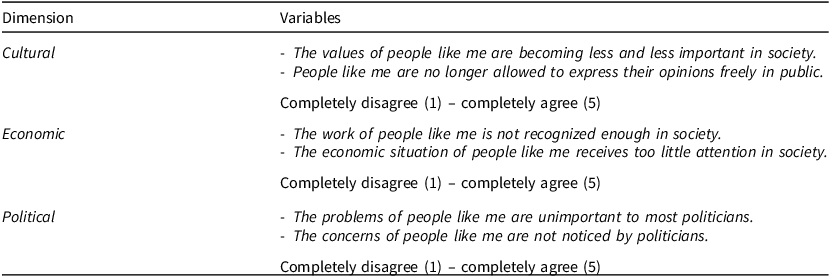
To include the three dimensions of perceived lack of recognition, I use a selection of items from the Perceived Societal Marginalization (PSM) scale introduced by Bollwerk, Schlipphak, and Back (Reference Bollwerk, Schlipphak and Back2022). Based on this scale, two items per dimension were combined into an index (each measured on a 5-point Likert scale). Table 1 presents the items and their allocation to the three dimensions.
Operationalization of societal recognition
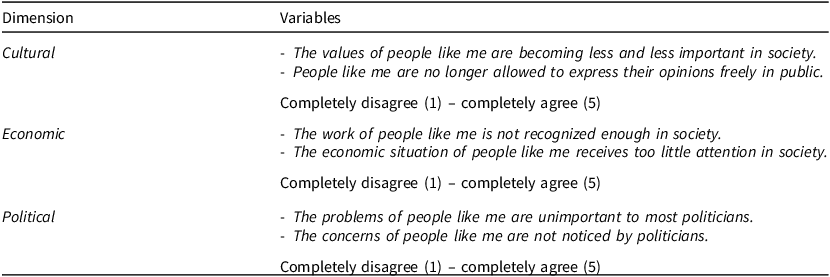
To capture objective disadvantage, I focus on socio-economic factors that are commonly associated with the left behind, including income, residence, and occupation. I use binary variables in the regression analyses to categorize these factors (low-income vs. other; manual workers vs. other occupations; rural vs. urban).
Additionally, I control for several covariates that have been shown to be related to both different dimensions of lack of recognition and democratic attitudes more generally. These include ideology (left–right), region (Eastern Germany/Rust Belt vs. others), gender (male/non-male), age, and education (low education vs. other).Footnote 3
All regressions were additionally run with the inclusion of individual-level factors of subjective disadvantage commonly used in studies of populism, specifically relative deprivation, subjective social status, and subjective social position.
For the wording and distribution of all items used, see Online Appendix 3.
Democratic support and satisfaction, understandings of politics, and institutional governance preferences
For a comprehensive picture of the relationship between the left behind and democratic orientations, I focus on democratic attitudes, understanding of politics, and governance preferences (the wording of the items can be found in Online Appendix 3). These can be summarized in three blocks as shown in Table 2.
Democratic orientations

Table 2. Long description
The table presents a comparison of democratic attitudes, understanding of politics, and governance preferences. It consists of three columns and multiple rows. The first column lists democratic attitudes, including democratic satisfaction and democratic relevance. The second column categorizes understanding of politics into liberal, authoritarian, majoritarian, and social democratic. The third column outlines governance preferences, such as representative, authoritarian, lottocratic, direct democratic, and technocratic. Each row aligns a specific democratic attitude with corresponding understandings of politics and governance preferences.
Standardized items on democratic relevance and satisfaction were used to measure general democratic support and satisfaction. To assess understanding of politics, respondents were asked to rate the importance of various characteristics of a democracy on a 7-point scale ranging from not at all important to extremely important. The statements on the characteristics of a good democracy are based on an index introduced by Wunsch, Jacob, and Derksen (Reference Wunsch, Jacob and Derksen2025) and combined with items of the European Social Survey on understandings of politics and evaluations of democracy (2023). Each statement/rating is assigned to one of the four understandings: liberal, authoritarian, majoritarian, and social democratic (see also Wunsch Reference Wunsch2025). The corresponding items are then combined to create an additive index for each understanding.
To assess respondents’ preferences for different governance models, namely representative, authoritarian, technocratic, and citizen-centered models (such as direct democracy and lottocracy), participants were asked to rate their support for various forms of decision-making in their country on a 7-point scale, ranging from strongly oppose to strongly support.
Results
Descriptive results
Different dimensions of lack of recognition
Looking at the dimensions of perceived lack of recognition separately, a lack of political recognition emerges as the most widespread among respondents in both countries, with mean scores of around 3.8 in both countries on a scale from 1 to 5. The mean values in the US and Germany are generally similar (with the exception of a higher mean of lack of cultural recognition in the US).
When respondents who rated their perceived lack of recognition above 4 (on a 5-point scale) are categorized as perceiving a lack of recognition, 37% of German respondents and 33% of American respondents perceive a lack of political recognition. In terms of cultural and economic recognition, some 24% of American respondents perceive a lack of cultural recognition and 26% a lack of economic recognition, compared with 18% (cultural) and 25% (economic) in Germany.
Next, I examine the number of areas in which respondents feel marginalized. In Germany, 55% of respondents report no perceived lack of recognition, while just over 19% feel not recognized in one area. In contrast, 10% perceive a lack of recognition across all areas. In the US, the patterns are similar.
The correlation matrix shows that the dimensions of perceived lack of recognition are strongly correlated, with a Pearson’s r of just over 0.5 between lack of economic and cultural recognition and lack of political and cultural recognition in both countries. Lack of political and economic recognition shows the highest correlation, at 0.6 (in the US) to 0.7 (in Germany), suggesting that the dimensions are related to a similar degree in both samples.Footnote 4 A factor analysis using the items measuring lack of recognition confirms three distinct dimensions (cultural, economic, and political) across both countries. These results are reported in Online Appendix 3.
As might be expected, individual-level measures of subjective perceptions of disadvantage (relative deprivation, subjective social class, and subjective social position) are closely related to lack of recognition. Respondents who can be classified as ‘deprived’, as well as those who self-identify as lower and working class, show significantly higher mean scores on all dimensions of lack of recognition in both countries. Moreover, perceived social position is negatively correlated with lack of recognition across all dimensions in both countries, i.e., respondents who perceive themselves to occupy a high(er) social position are less likely to perceive a lack of recognition (Online Appendix 5).
Being left behind, feeling left behind, or both?
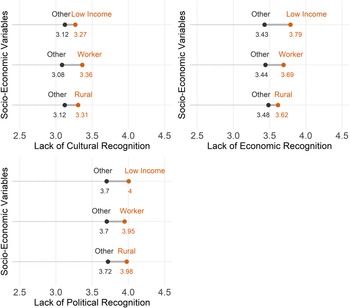
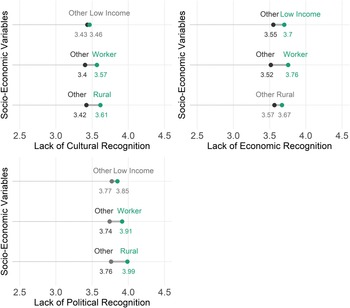
To explore how objective socio-economic factors commonly linked to being left behind (such as low income, manual occupational classes, and rural residency) relate to perceived lack of recognition, I conduct mean value comparisons (see also Steiner, Schimpf, and Wuttke Reference Steiner, Schimpf and Wuttke2023 for a similar approach). The results, presented in Figure 1, show that in Germany these groups consistently have significantly higher mean scores for perceived lack of recognition across all dimensions. A similar pattern is observed in the US (Figure 2), although some effects are not statistically significant. Overall, the analysis confirms that socio-economic factors are associated with perceived lack of recognition across various dimensions.
Mean value comparisons – socio-economic factors and lack of recognition. Germany.
Note: Differences in perceived lack of recognition across socio-economic groups in the German sample. Dots represent means. All differences are statistically significant at p < 0.05, except for means shown in light grey.

Figure 1. Long description
Three scatter plots compare socio-economic factors with lack of cultural, economic, and political recognition in Germany. Each plot shows the mean values for different socio-economic groups: low income, worker, and rural. (like below). The x-axis represents the lack of recognition, while the y-axis represents socio-economic variables. The plots include data points for low income, worker, and rural categories. The values for lack of cultural recognition range from 2.5 to 4.5, for lack of economic recognition from 2.5 to 4.5, and for lack of political recognition from 2.5 to 4.5. Each category shows slight variations in recognition levels. The data points are color-coded, with black representing ‘Other’ and orange representing specific socio-economic variables. The plots indicate that different socio-economic groups experience varying levels of recognition across cultural, economic, and political dimensions.
Mean value comparisons – socio-economic factors and lack of recognition. US.
Note: Differences in perceived lack of recognition across socio-economic groups in the US sample. Dots represent means. All differences are statistically significant at p < 0.05, except for means shown in light grey.
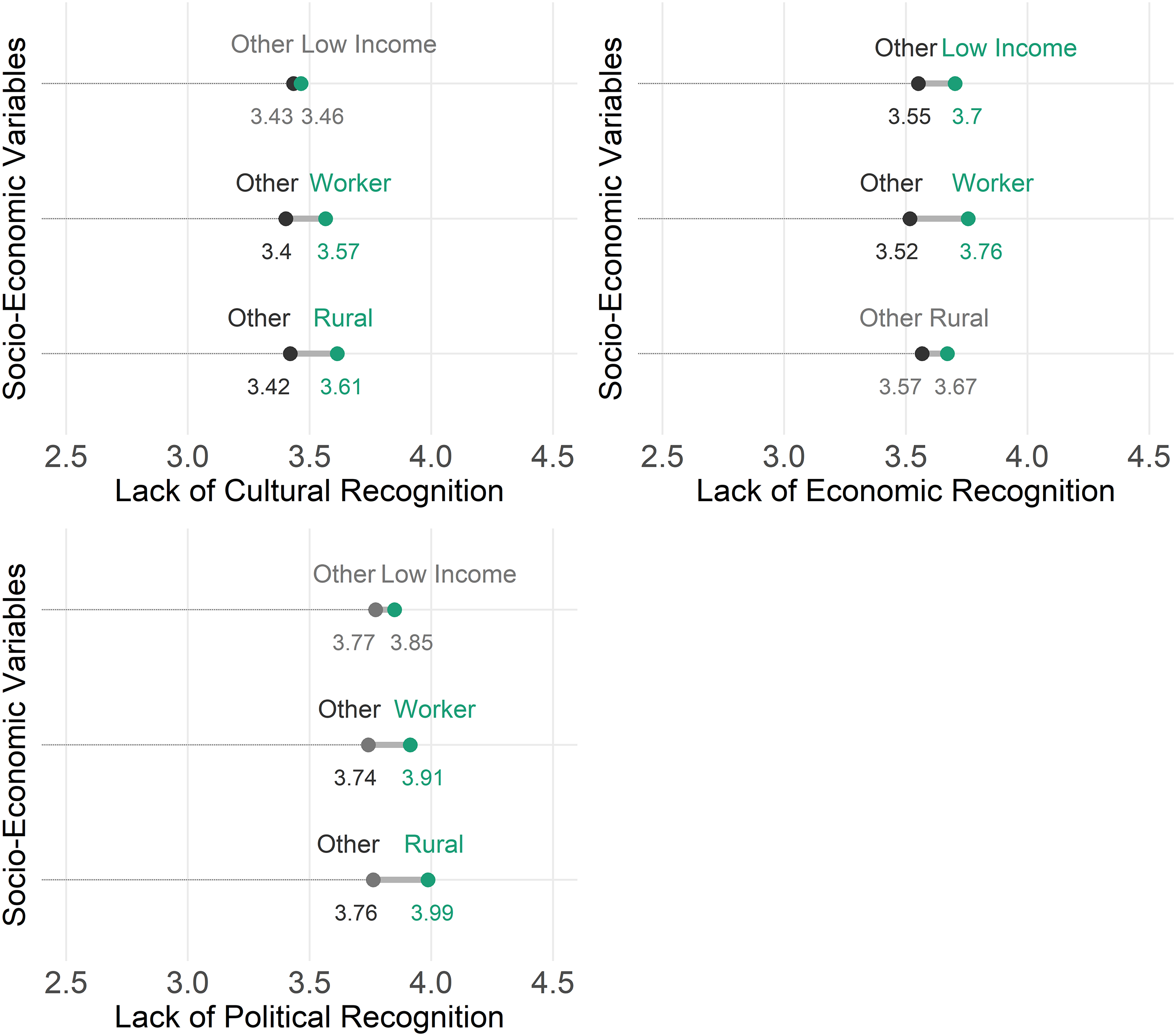
Figure 2. Long description
The image contains three scatter plots that compare socio-economic variables with lack of cultural, economic, and political recognition in the US. Each plot shows the mean values for different socio-economic groups: low income, worker, and rural. The x-axis represents the lack of recognition (cultural, economic, and political), while the y-axis represents socio-economic variables. In the first plot, lack of cultural recognition is compared with socio-economic variables, showing values around 3.4 to 3.7 for different groups. The second plot compares lack of economic recognition with socio-economic variables, with values ranging from 3.5 to 3.7. The third plot shows lack of political recognition compared with socio-economic variables, with values from 3.7 to 4.0. Each data point is labeled with specific values for the respective groups. The plots indicate that different socio-economic groups experience varying levels of recognition deficits.
Looking at group distributions, in Germany, approximately 46% of low-income respondents report feeling politically not recognizedFootnote 5 , compared to approximately 35% of higher-income respondents. Similarly, approximately 21% of low-income respondents perceive a lack of cultural recognition, compared to 17% of respondents from higher-income groups. In the US, notable differences are observed between rural and urban residents in terms of political recognition. Approximately 43% of rural respondents perceive a lack of political recognition, compared to 32% of urban respondents, respectively.
Regression analyses using the three dimensions of lack of recognition as dependent variables show that being a manual worker is significantly associated with higher levels of lack of recognition across all dimensions in both countries. This is also true for the covariate ideology: being more right-leaning is associated with a higher lack of recognition across all dimensions. In Germany, this is also true for individuals living in rural areas and less educated respondents (Online Appendix 4).
These findings demonstrate that socio-economic disadvantage is clearly associated with perceived lack of recognition, but that the two do not overlap completely. This confirms findings of previous research and supports Expectation 1.
Regression analyses
In the next step, regression analyses were conducted to examine how the three dimensions of lack of recognition and socio-economic factors of disadvantage are related to democratic attitudes, understandings of politics, and governance preferences. All regression analyses were conducted with the different types of lack of recognition as continuous variables, whereas socio-economic factors were included as binary variables. All regressions were additionally run with individual-level measurements of subjective disadvantage (Online Appendix 6).Footnote 6
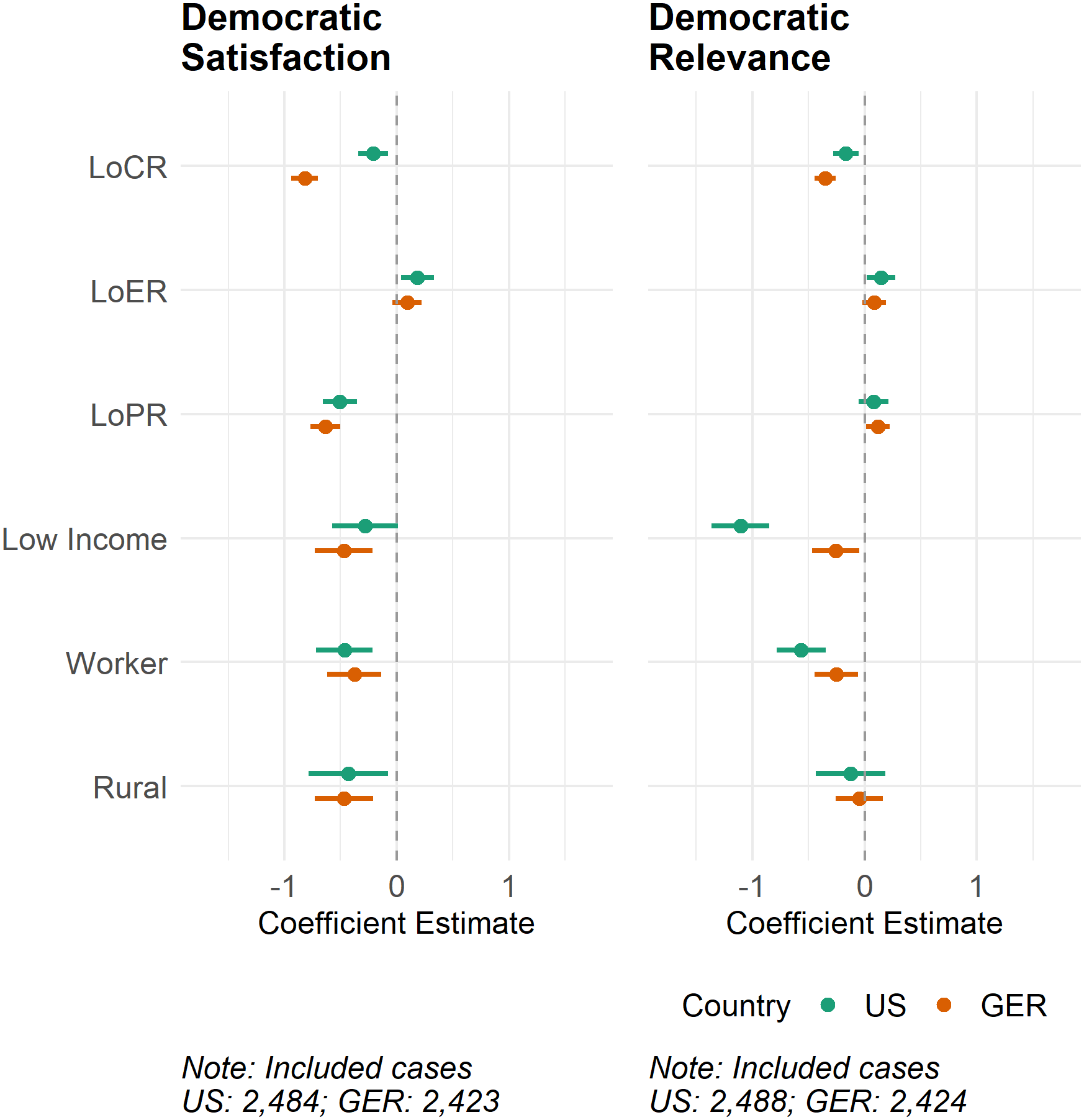
Democratic satisfaction and relevance . First, I examine how lack of recognition, along with socio-economic factors, relates to democratic satisfaction and democratic support (measured by democratic relevance; Figure 3). All regressions include the following covariates: ideology (left–right), region (Eastern Germany/Rust Belt state vs. other), education (low education vs. other), gender (male vs. non-male), and age. In both Germany and the US, a perceived lack of political recognition and lack of cultural recognition are associated with lower democratic satisfaction. Respondents with the highest lack of cultural recognition score (5) have predicted democratic satisfaction values of 5.3 in Germany and 6.6 in the US when all other variables are held at their mean or reference categories (see Online Appendix 7 for full documentation of the predicted values; democratic satisfaction was measured on a scale from 1 to 11). Conversely, respondents with the lowest lack of cultural recognition score (1) have higher predicted satisfaction levels: 8.5 in Germany and 7.4 in the US. This indicates greater satisfaction among respondents who feel that their values and voice are recognized. A similar pattern emerges for political recognition. Based on the predicted values, the democratic satisfaction difference between respondents with the lowest and highest lack of political recognition is approximately 2.5 scale points in Germany and 2 scale points in the US. Socio-economic factors still play a role in both countries: being a manual worker and living in a rural area are negatively associated with satisfaction with democracy, as are (only in Germany) having a low income or living in Eastern Germany.
Regression analyses – democratic satisfaction and democratic relevance.
Note: Coefficient plots for two linear regression models with democratic satisfaction and democratic relevance as dependent variables. Shown are point estimates of coefficients with 95% confidence intervals. LoCR = Lack of Cultural Recognition; LoER = Lack of Economic Recognition; LoPR = Lack of Political Recognition. All regression analyses include ideology, region, education, gender, and age as covariates.
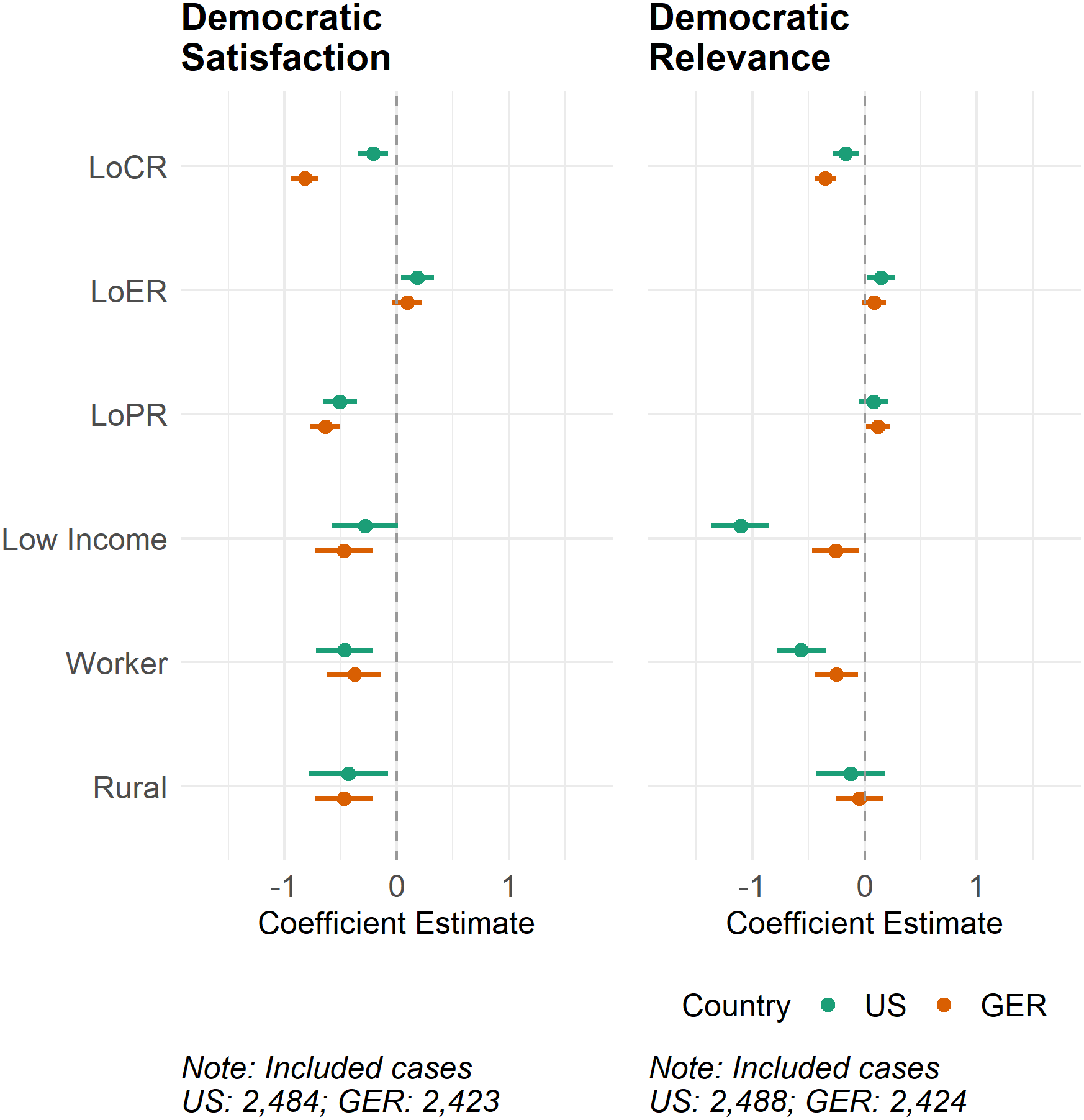
Figure 3. Long description
The image contains two side-by-side graphs comparing democratic satisfaction and democratic relevance across different variables and groups in the US and Germany. Each graph displays coefficient estimates for various variables and groups, including LoCR, LoER, LoPR, Low Income, Worker, and Rural. The US data is represented by green dots, while the German data is represented by orange dots. The x-axis represents the coefficient estimate, ranging from -1 to 1. The y-axis lists the different variables and groups. The graph shows the relationship between the different variables and groups and democratic satisfaction and relevance for the two countries. All values are approximated.
Focusing on democratic support, I find that in both countries, a lack of cultural recognition is associated with lower democratic relevance, while a lack of political recognition is associated with higher democratic relevance in Germany. However, when comparing predicted values, the difference in democratic relevance between respondents with the highest and lowest lack of political recognition is more modest, with approximately 0.5 scale points in Germany (whereas democratic relevance was measured on a scale from 1 to 11). In contrast, a lack of cultural recognition seems to play a larger role. Respondents with the lowest lack of cultural recognition (i.e., highest cultural recognition) have predicted democratic relevance values of 10.6 in Germany and 9.8 in the US. This is compared to 9.2 in both countries for those with the highest lack of cultural recognition (i.e., respondents that don’t feel culturally recognized). All predicted values are calculated while holding all other variables constant at their means or reference categories. These contrasts are especially noteworthy given the high levels of democratic relevance across the sample (mean value over 9 in both countries). Various socio-economic variables are also linked to democratic relevance. In both the US and Germany, being a manual worker and having a low income are negatively associated with democratic support.
The results highlight that while respondents who perceive a lack of recognition may be dissatisfied with the functioning of democracy, they do not necessarily express lower overall support for democracy. The same applies to those who are objectively disadvantaged: although respondents living in rural areas report lower satisfaction with democracy, this does not automatically translate into significantly lower democratic support. Groups that are associated with both lower democratic satisfaction as well as lower democratic support are respondents that perceive a higher lack of cultural recognition, manual workers, and (only in Germany) respondents with low income.
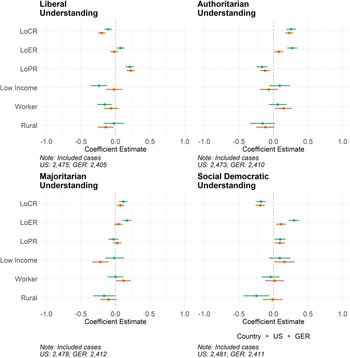
Understanding of politics. Examining the associations between lack of recognition, socio-economic factors, and understandings of politics (Figure 4) reveals clear patterns across four distinct conceptions of politics: liberal, authoritarian, majoritarian, and social democratic.
Regression analyses – understandings of politics.
Note: Coefficient plots for linear regression models with understandings of politics (liberal, authoritarian, majoritarian, and social democratic) as dependent variables. Shown are point estimates of coefficients with 95% confidence intervals. LoCR = Lack of Cultural Recognition; LoER = Lack of Economic Recognition; LoPR = Lack of Political Recognition. All regression analyses include ideology, region, education, gender, and age as covariates.
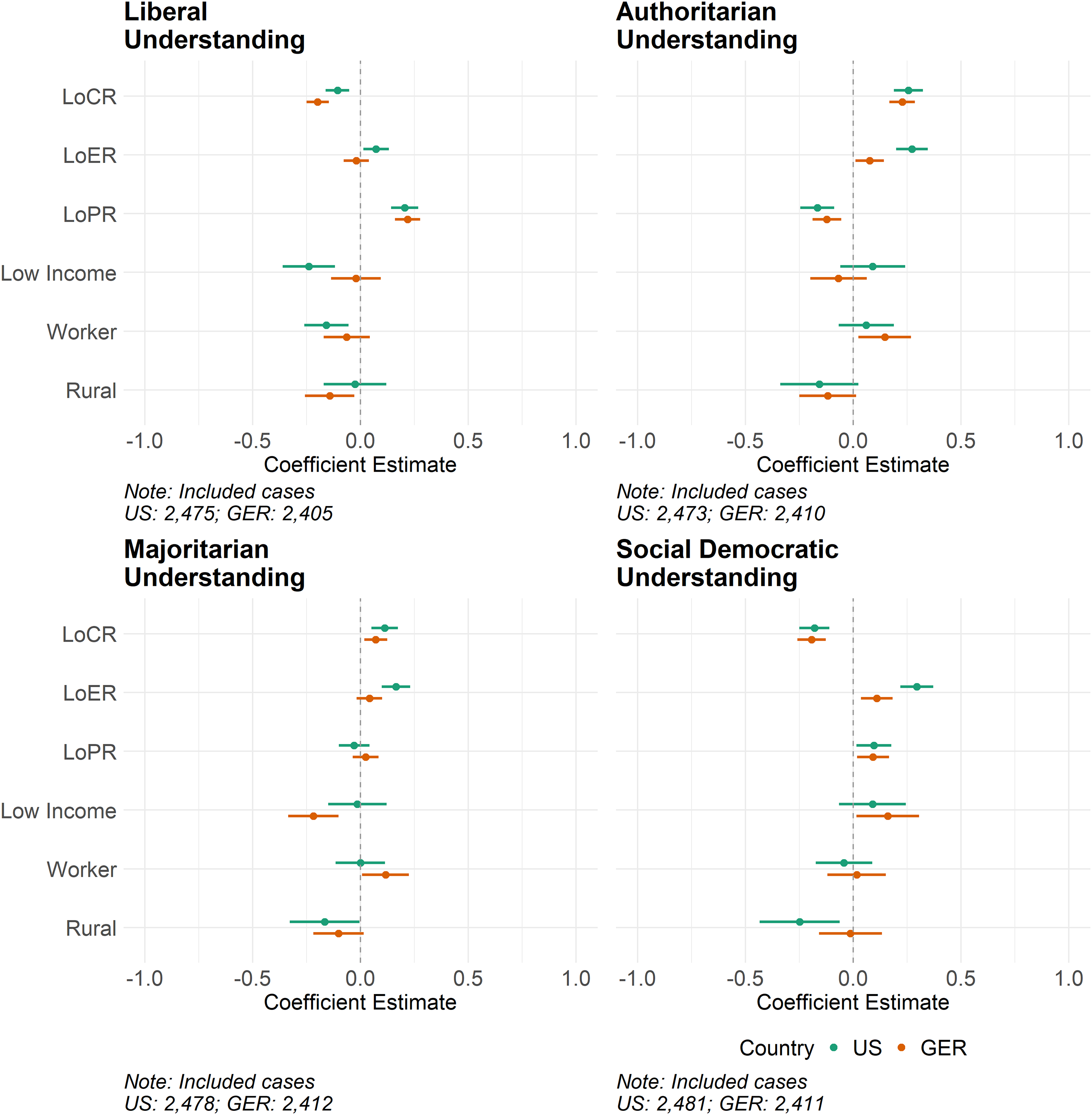
Figure 4. Long description
The image contains four scatter plots, each representing different political understandings: Liberal, Authoritarian, Majoritarian, and Social Democratic. Each plot compares coefficient estimates for various categories: LoCR, LoER, LoPR, Low Income, Worker, and Rural. The US data is represented by green dots, while German data is represented by orange dots. The x-axis represents the coefficient estimate ranging from -1.0 to 1.0. Each plot shows how these estimates vary between the two countries for each political understanding. The included cases for each plot are noted at the bottom, with the US and Germany having similar sample sizes. The plots aim to explore the divide between globalization’s winners and losers and its impact on democratic values and governance.
A lack of cultural recognition is negatively associated with a liberal understanding of politics in both countries, while a lack of political recognition is positively associated. In both countries, the difference in predicted values for liberal understanding between respondents with the lowest and highest lack of political recognition is about one scale point (measured on a scale from 1 to 7). This suggests that respondents who feel politically not recognized place more importance on the liberal aspects of democracy. Conversely, respondents with the highest lack of cultural recognition have predicted values about 0.4 scale points lower in the US and 0.8 points lower in Germany compared to those who feel culturally recognized. Additionally, there are country-specific patterns: in the US, low income and being a manual worker are negatively associated with a liberal understanding of politics. In contrast, in Germany, only rural residence shows a negative association.
The relationships between an authoritarian understanding of politics and lack of recognition also differ by dimension. In both countries, a lack of cultural recognition and a lack of economic recognition are positively associated with an authoritarian understanding of politics, while a lack of political recognition is negatively associated. When examining the predicted values for the US (with all other variables held at their means or reference categories), the difference in authoritarian understanding between respondents with the highest and lowest lack of economic and cultural recognition is approximately one scale point (whereas authoritarian understanding was measured on a scale from 1 to 7). For instance, a respondent with the highest lack of cultural recognition has a predicted authoritarian understanding value of 4, compared to 3 for those who feel culturally recognized in the US. In Germany, similar differences in predicted values are observed for cultural recognition, whereas the difference between respondents with the highest and lowest lack of economic recognition is more modest. In both countries, respondents with a higher lack of political recognition tend to have lower predicted authoritarian understanding values, though the differences are less pronounced. Regarding socio-economic variables, only being a manual worker is associated with an authoritarian understanding in Germany. In both countries, covariates such as lower education, ideology, younger age, and (in Germany) living in Eastern Germany are positively associated with an authoritarian understanding.
Regarding a majoritarian or social democratic understanding of politics, I again find that different patterns emerge across different dimensions of perceived lack of recognition.
A majoritarian understanding of politics is positively associated with a lack of cultural recognition. However, the differences in predicted values between respondents with the lowest and highest lack of cultural recognition are modest: around 0.4 scale points in the US and 0.3 scale points in Germany. In the US, a lack of economic recognition is also positively associated with a majoritarian understanding. Additionally, being a manual worker is positively associated with a majoritarian understanding in the German sample. In contrast, low income in Germany and living in a rural area in the US are negatively associated with this understanding.
Turning to a social democratic understanding of politics, the results show that a perceived lack of economic and a perceived lack of political recognition are positively associated with this understanding, whereas a lack of cultural recognition is negatively associated. Respondents with the highest lack of economic recognition – those who feel that their work or financial situation is not acknowledged in society – have a predicted social democratic understanding value of 5.2 (on a scale from 1 to 7) in both countries when all other variables are held at their mean or reference categories. This compares to predicted values of 4.1 in the US and 4.8 in Germany among respondents who feel economically recognized. The differences between respondents with the highest and lowest lack of political recognition are less pronounced, yet still statistically significant, in both countries. The association between perceived economic disadvantage and social democratic principles is in the expected direction, since the latter emphasize the government’s responsibility to protect citizens from poverty and reduce income inequality. Among socio-economic factors, only low income in Germany is positively associated with a social democratic understanding, while rural residency is negatively associated in the US.
These findings suggest that a lack of economic and a lack of political recognition align with social democratic views that favor equality and government support. However, a lack of cultural recognition (and, in the US, economic recognition) is associated with majoritarian beliefs that prioritize the interests of the majority over the protection of minorities and pluralism.
Overall, the results show that a lack of recognition is associated with how people understand politics, but in nuanced ways. A lack of political recognition is associated with liberal and social democratic views. In contrast, a lack of cultural recognition is positively associated with an authoritarian and majoritarian understanding of politics. A lack of economic recognition is associated with both an authoritarian and a social democratic understanding of politics in both countries. In the US, it is additionally associated with a majoritarian understanding of politics. These findings show that individuals who feel that their work and financial situation are not acknowledged by society tend to support principles aimed at reducing economic inequality and protecting against poverty while also holding more authoritarian views.
Governance preferences. As to whether these abstract understandings of politics are also reflected in participants’ concrete governance preferences, Figure 5 shows the results of the regression analyses examining the relationship between different types of lack of recognition and socio-economic factors on the one hand and different modes of decision-making on the other.
Regression analyses – governance preferences.
Note: Coefficient plots for linear regression models with governance preferences (representative, authoritarian, direct democratic, lottocratic, and technocratic) as dependent variables. Shown are point estimates of coefficients with 95% confidence intervals. LoCR = Lack of Cultural Recognition; LoER = Lack of Economic Recognition; LoPR = Lack of Political Recognition. All regression analyses include ideology, region, education, gender, and age as covariates.
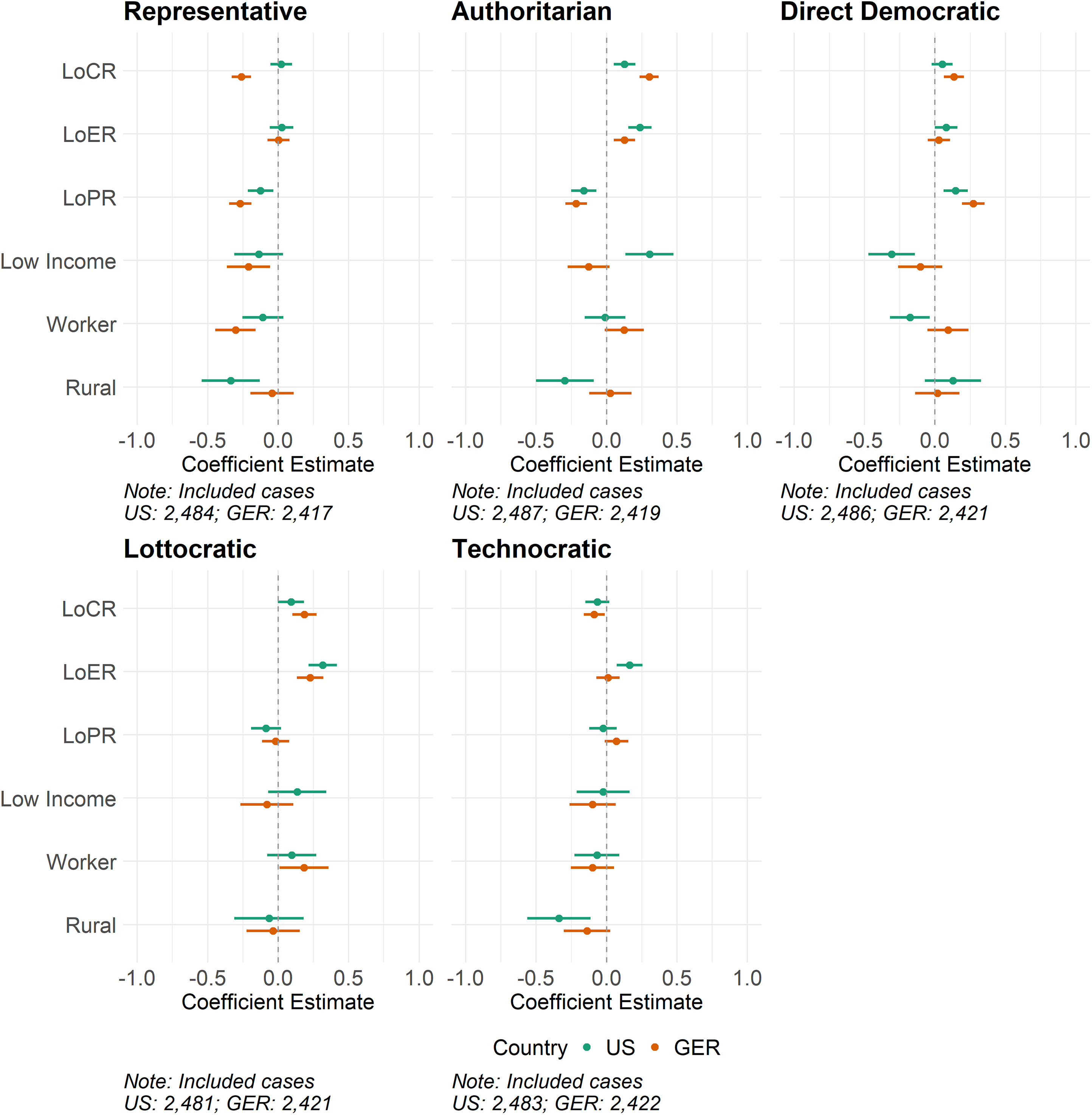
Figure 5. Long description
The image contains five separate graphs comparing governance preferences across different political systems and countries. Each graph represents a different political system: Representative, Authoritarian, Direct Democratic, Lottocratic, and Technocratic. The x-axis of each graph represents the coefficient estimate ranging from -1.0 to 1.0, while the y-axis lists different groups: LoCR, LoER, LoPR, Low Income, Worker, and Rural. The graphs compare data from the United States and Germany, with green dots representing the US and orange dots representing Germany. Each dot indicates the coefficient estimate for each group within the respective political system. The included cases for each graph are noted at the bottom, specifying the number of cases from the US and Germany. The graphs show how different groups’ preferences vary across political systems and countries, highlighting the differences in governance preferences.
A lack of cultural (in Germany) and a lack of political recognition are negatively associated with support for representative governance, the status quo in Germany and the US. In Germany, respondents with the highest lack of political recognition have a predicted value of 4.3 (on a scale from 1 to 7), compared to 5.4 among those who feel politically recognized. In the US, the difference is more modest but still statistically significant. In Germany, the difference between those with the lowest and highest lack of cultural recognition is about one point on the scale, suggesting that perceptions of one’s values losing importance or perceived restrictions on free expression are linked to lower support for the current form of governance. Socio-economic factors also play a role. In Germany, manual workers and respondents with low incomes tend to rate representative governance more negatively. In the US, living in a rural area is associated with a more negative rating.
In contrast, the analysis of authoritarian forms of governance – a strong president with the ability to override parliament and military rule (see Online Appendix 6) – shows that a lack of cultural and a lack of economic recognition are positively associated with support of authoritarian governance in both countries, while a lack of political recognition is negatively associated with such support. In Germany, respondents with the highest lack of cultural recognition have a predicted value of 3.6 for authoritarian governance, which is about 1.2 scale points higher (on a 1-7 scale) than among respondents with the lowest lack of cultural recognition. In the US, the difference is not as large but still statistically significant. There, a lack of economic recognition shows a stronger association: respondents with the highest lack of economic recognition have a predicted value of 3.6, compared to 2.6 for those who feel economically recognized, holding all other variables constant at their mean or reference categories. In Germany, the corresponding differences are less pronounced but still significant. The pattern is reversed for political recognition: feeling not recognized by politicians is associated with lower support for authoritarian governance. This finding aligns with the observation that respondents who perceive a lack of political recognition also place greater importance on the liberal aspects of democracy. Socio-economic factors play a minor role. In the US, low income is positively associated with a preference for authoritarian governance, while living in a rural area is negatively associated.
Examining preferences for direct democratic and lottocratic forms of governance reveals notable differences. A lack of political recognition (and a lack of cultural recognition in Germany) is positively associated with support for referendums as a form of direct democratic governance. In both the US and Germany, respondents with a high lack of political recognition have a predicted value of 5.4 (on a scale from 1 to 7), compared to 4.9 and 4.3, respectively, among those that feel politically recognized. These results show that respondents who feel not recognized by politicians are more open to democratic alternatives, particularly in Germany. The association between a lack of cultural recognition and support for direct democratic reforms in Germany is weaker but still significant. This suggests that German respondents that perceive a lack of cultural recognition are not solely inclined toward authoritarian alternatives. In the US, being a manual worker and having a low income are both negatively associated with support for direct democratic options. The results for lottocratic governance with citizen forums as decision-makers show that a lack of cultural and a lack of economic recognition are positively associated with it. Economic recognition shows the strongest association. Respondents with the lowest economic recognition have predicted values of around 4 in both countries, which is roughly one scale point higher than those who feel recognized on the economic dimension. The differences for cultural recognition are more modest but still significant.
Regarding technocratic governance, where experts make political decisions, most included variables show no significant effects. Next to a weak negative association between a lack of cultural recognition and support for technocratic governance in Germany, a lack of economic recognition is positively associated with a preference for technocratic governance in the US. Respondents with the highest lack of economic recognition have predicted values that are 0.7 scale points higher than those with the lowest lack of economic recognition, holding all other variables constant at their respective means and reference categories. Additionally, rural residency in the US is negatively associated with support for technocratic governance.
The regression results on governance preferences highlight the importance of the dimension on which a lack of recognition is perceived. Respondents who perceive a lack of political recognition tend to reject both the status quo (representative system) and authoritarian forms of governance, showing a preference for direct democratic decision-making via referendums instead. By contrast, in Germany, those who perceive a lack of cultural recognition tend to support lottocratic and direct democratic forms of governance. Notably, a lack of cultural recognition is also positively associated with higher support for authoritarian forms of governance, including decision-making by a strong, assertive president capable of bypassing parliament or decision-making through military rule in both countries. German respondents who perceive a lack of cultural recognition also strongly reject representative decision-making. A lack of economic recognition is positively associated with support for authoritarian forms and a lottocratic form of governance and, in the US, with support for technocratic decision-making. These findings indicate that while a lack of recognition correlates with a preference for alternatives to the status quo, the specific type of the preferred alternative depends on the area in which a lack of recognition is perceived. Only a lack of cultural recognition and a lack of economic recognition are linked to a higher support for authoritarian forms of governance. Respondents who perceive a lack of political recognition favor citizens as decision-makers, but only via referendums. Those experiencing a lack of recognition on the other two dimensions tend to support a broader range of alternative governance models.
In terms of expectations, the relationship between lack of recognition and democratic attitudes, understanding of politics, and preference for alternative forms of governance depends primarily on the subgroup of the left behind that is examined (meaning Expectation 3a and Expectation 3b cannot be fully confirmed). The results of the analyses support Expectation 3a for a lack of cultural recognition, which shows the most consistent associations across democratic orientations (especially in Germany). In contrast, a lack of economic and political recognition shows more variable associations across democratic attitudes, understandings of politics, and governance preferences. On the other hand, Expectation 3b is largely supported, especially regarding the relationship between a lack of recognition on different dimensions and preferences for alternative forms of governance. While socio-economic factors tend to align with previous findings regarding democratic orientations, they do not consistently provide a clear pattern across both countries. For instance, being a manual worker is associated with being less satisfied with democracy and showing lower democratic support. Moreover, German respondents working in manual occupations have a more authoritarian and majoritarian understanding of politics and reject representative governance. However, manual workers do not express stronger support for authoritarian decision-making. Expectation 2 cannot be fully confirmed since the comparison of effect sizes in each regression reveals that the associations of socio-economic factors are not consistently weaker than those for lack of recognition. However, the analysis of democratic attitudes, understandings of politics, and governance preferences shows that different dimensions of lack of recognition are consistently and significantly associated with the dependent variables, a pattern not observed for socio-economic factors.
Subsequent analyses of country differences (see Online Appendix 9) reveal that most differences between the two countries observed descriptively are statistically significant. Overall, a lack of cultural recognition appears to be more strongly associated with democratic dissatisfaction, lower democratic relevance, a weaker liberal understanding of politics, and higher support for authoritarian alternatives in Germany than in the US. Conversely, a lack of economic recognition has stronger and more distinct effects in the US than in Germany, particularly with regard to authoritarian and majoritarian understandings, as well as support for authoritarian or expert decision-making. Additionally, a lack of economic recognition shows an even stronger relationship with a social democratic understanding of politics in the US. These findings suggest that different types of perceived marginalization are linked to democratic attitudes, understandings of politics, and governance preferences in distinct ways and that these relationships vary depending on the country context.
Finally, including individual-level measurements of subjective disadvantage (deprivation, subjective social position, and subjective social class) in the regression analyses does not substantively alter the associations between the dimensions of lack of recognition and democratic orientations (Online Appendix 6). This shows that different dimensions of lack of recognition have unique explanatory power for general democratic attitudes, understandings of politics, and governance preferences.
Discussion
This article extends previous research on the left behind – which typically focuses on their connection to populist attitudes, support for right-wing populist parties, or support for specific policies – by exploring the relationship between feeling left behind on different dimensions and democratic attitudes, understanding of politics, and governance preferences while also including socio-economic factors. This provides an initial overview of the relationship between the left behind and democracy.
The analysis highlights the limitations of prior classifications of the left behind, as they often overlook the different dimensions of feeling left behind. The results show that (1) socio-economic factors are associated with subjective perceptions of marginalization, but they do not fully overlap; and (2) subjective perceptions of marginalization, such as whether individuals feel their group is being recognized or marginalized in society and politics, are linked to democratic satisfaction, democratic support, understandings of politics, and governance preferences in different ways. Using an innovative group-level measure of perceived societal marginalization (Bollwerk, Schlipphak, and Back Reference Bollwerk, Schlipphak and Back2022), the findings underscore the consistent role that the perception of a lack of recognition plays. This suggests that previous studies that focus solely on societal marginalization on a single dimension (e.g., economic disadvantage) or aggregate multiple dimensions may not be able to capture the complexity of feeling left behind and its diverse implications for democracy.
A perceived lack of recognition may be generally associated with dissatisfaction with the functioning of democracy and/or lower levels of support for representative decision-making (the status quo). How a lack of recognition is related to differing democratic orientations depends, however, on its dimension: the feeling that ‘people like me’ are no longer free to express their opinions and that their values are becoming less important is the only dimension consistently linked to ‘undemocratic’ attitudes. Respondents in the US and Germany who perceive such a lack of cultural recognition (24% of US respondents and 18% of German respondents) express lower support for democracy, are linked to an authoritarian and a majoritarian understanding of politics, and show higher support for a strong president who can override parliament, as well as military rule.
The frequently reported lack of political recognition, i.e., the perception that politicians do not address the concerns of ‘people like me’ (33% in the US and 37% in Germany), on the other hand, is associated with democratic dissatisfaction but also with higher generic support for democracy, a liberal understanding of politics, and higher support for referendums as a form of direct democratic decision-making.
A perceived economic marginalization is associated with a tendency towards authoritarian attitudes. Respondents who perceive a lack of economic recognition (26% in the US and 25% in Germany) are more likely to have a majoritarian (US only) and an authoritarian understanding of politics. They also show higher support for a strong president and military rule in both countries. However, a lack of economic recognition is also associated with a social democratic understanding of politics and support for lottocratic and technocratic forms of governance. Those who feel economically marginalized are therefore also more likely to support measures aimed at reducing inequality and poverty, as such policies have the potential to improve their (perceived) economic situation.
Despite the prominence of subjective perceptions of disadvantage, objective socio-economic factors (such as low income, manual occupation, and rural residency) are still linked to a range of democratic attitudes, understandings of politics, and governance preferences. For example, being a manual worker is positively associated with dissatisfaction with democracy, lower democratic relevance, and (in Germany only) an authoritarian understanding of politics. The regression analyses further show that individual-based subjective perceptions of disadvantage (deprivation, subjective class, and subjective social status) still matter, but the effects do not show a clear pattern.
A comparison of the US and Germany revealed that the distribution of the perceived lack of recognition across cultural, political, and economic dimensions is remarkably similar, with only minor differences. For example, a perceived lack of cultural recognition is more prevalent in the US than in Germany. While both countries display clear patterns across all dimensions, certain effects, especially those related to cultural recognition, are significant only in Germany. In contrast, economic recognition plays a stronger role in the US. For instance, a lack of economic recognition is associated with a majoritarian understanding of politics in the US, a relationship that is not observed in Germany. Overall, cultural recognition appears to be more strongly connected to democratic orientations in Germany, while economic recognition is more influential in the US. These patterns suggest that the different dimensions of recognition interact with democratic attitudes, understandings of politics, and preferences in country-specific ways. The greater salience of economic recognition in the US may reflect its higher levels of economic inequality, which could amplify the sense that one’s work and financial situation are not recognized. Since this is the first application of the societal marginalization scale in the US, future research should further explore the underlying causes of these cross-national differences.
In conclusion, this analysis demonstrates that feeling left behind can refer to different dimensions, each with distinct implications for democracy. Only a lack of cultural recognition is associated with lower support for democracy, an authoritarian and a majoritarian understanding of politics, and preferences for authoritarian governance in the form of a strong president or military rule. These findings are in line with research emphasizing cultural indicators and threat perceptions to explain authoritarian and populist success. In contrast, a perceived lack of political recognition is linked to higher support for democracy, a liberal understanding of politics, and also a desire for more citizen-centered decision-making. This shows that especially citizens that perceive themselves as not recognized by politicians place more importance on the liberal features of democracy and direct democratic involvement.
The findings provide a basis for future research. The results underscore the importance of subjective perceptions and of distinguishing between various forms of marginalization, such as cultural, political, and economic, when investigating the left behind and their relationship with democracy. Future research could deepen the findings of this initial overview by exploring the causal links between different dimensions of feeling left behind and democratic orientations. Additionally, it will be crucial to examine the interplay between subjective perceptions and objective socio-economic disadvantages as well as other potential areas of perceived marginalization that were not captured by this analysis (e.g., infrastructure- or access-related perceived disadvantages; Steiner, Schimpf, and Wuttke Reference Steiner, Schimpf and Wuttke2023).
Further research is also needed to explore the precise nature and stability of the perceived lack of recognition across different dimensions and possible multiplier effects. While a lack of cultural recognition can theoretically affect individuals across the political spectrum, it currently appears to be more prevalent among those on the right of the ideological spectrum. However, this pattern may change depending on the broader political climate and public opinion. Political parties, candidates, and media can ‘activate’ feelings of resentment and shape how individuals perceive their place in society (see e.g., Ares Reference Ares2022; Mols and Jetten Reference Mols and Jetten2016). The prominence of these feelings in political discourse can lead to varying levels of perceived recognition. This could be especially relevant for future studies on the US, where the second Trump presidency and authoritarian developments could also increase feelings of marginalization on the cultural (and political) dimensions among left-wing and progressive citizens – while remaining a central narrative within the conservative right.
Furthermore, it is unclear at what point a perceived lack of recognition becomes a threat to democracy, or in other words, where the ‘tipping point’ lies. Since some of these relationships may not be strictly linear, a more detailed exploration of their exact nature is necessary. Additionally, a lack of recognition across multiple dimensions may intensify the impact of feeling left behind on democratic orientations. However, further investigation is needed to determine whether individuals who perceive themselves as marginalized or not recognized on multiple dimensions are more likely to endorse authoritarian values or support authoritarian alternatives.
The evidence that different types of subjective perceptions of marginalization have distinct implications for democracy is especially crucial when considering potential remedies: while targeting inequality and poverty has been proposed as a means to reintegrate the left behind, the present findings suggest that such policies alone may not fully address the cultural or political exclusion experienced by certain groups. For citizens who feel unseen by politics and politicians, citizen-centered reforms such as regularly held referendums could be more effective in increasing satisfaction with democracy. Exploring ways to more effectively engage diverse segments of the left behind, while addressing the complex dimensions of their perceived marginalization, will play an essential role for the future of liberal democracies.
Supplementary material
The supplementary material for this article can be found at https://doi.org/10.1017/S1475676526101431.
Data availability statement
Replication material (data set and R code) is included in the online Supporting Information.
Acknowledgements
I am grateful to André Bächtiger for his comments throughout the development of this manuscript. I also thank Franziska Maier, Niklas Donth, and Simon Stocker for their very helpful comments and suggestions on earlier versions. Finally, I am grateful to the anonymous reviewers for their valuable feedback.
Financial support
This work was supported by the European Union (ERC, DDME, Grant No 101054111). Views and opinions expressed are, however, those of the author(s) only and do not necessarily reflect those of the European Union or the European Research Council Executive Agency. Neither the European Union nor the granting authority can be held responsible for them.
Competing interests
The author declares no conflict of interest.
Ethical standards
The survey was approved by the Committee for Responsibility in Research (Ethics Committee) of the University of Stuttgart before implementation (reference number 23-012).



 Open access

