





INTRODUCTION
Secale cereale L. (rye) in Europe is a secondary crop. Its wild progenitors originate from the eastern mountains of Turkey and northwestern part of Iran and Transcaucasia (Zohary Reference Zohary, Davis, Harper and Hedge1971; Hillman Reference Hillman1978; Behre Reference Behre1992; Zohary et al. Reference Zohary, Hopf and Wiess2012; Nesbitt Reference Nesbitt2002). Rye is a crop that can grow under difficult environmental conditions. It has a wide ecological amplitude, can cope with frost as well as with drought much better than other cereals (Miedaner Reference Miedaner2014:66). It is considered that the introduction of rye in Europe happened unintentionally with the Neolithic spread of domestic hulled wheats as a weedy species. The rare earliest archaeobotanical finds in Europe date to LBK times and are interpreted as a (tolerated) weed. It was not until the Bronze Age and more specifically the Iron Age for rye to start to be a crop in its own right that was cultivated on a regular base in Europe. Only in the Roman Iron Age did it become a main crop, during the fourth and fifth centuries AD, especially northeast of the river Rhine (Behre Reference Behre1992; Jones Reference Jones2007; Zohary et al. Reference Zohary, Hopf and Wiess2012). Technological innovations like harvesting close to the ground and the invention of the mouldbord-plough (Behre Reference Behre1992) as well as the inclusion of rye into Mediterranean bread-baking techniques during the Roman period (Sigaut Reference Sigaut, Chevalier, Marinova and Peña-Chocarro2014:110) triggered the full-fledged cultivation of rye. It eventually developed to become one of the main crops in many parts of Europe during the Middle Ages (e.g., Behre Reference Behre1992; Rösch Reference Rösch1998; Jones Reference Jones2007; Grabowski Reference Grabowski2011; Reuter Reference Reuter and Waksman2020) and it is argued to have emerged as a crop independently at different times and places (Hillman Reference Hillman1978; Behre Reference Behre1992). The specificities of the genetic differences between the wild ancestor and the domesticated species of rye have been analyzed thoroughly elsewhere (Behre Reference Behre1992; Zohary et al. Reference Zohary, Hopf and Wiess2012; Hagenblad et al. Reference Hagenblad, Oliveira, Forsberg and Leino2016; Skuza et al. Reference Skuza, Szućko and Strzała2019; Filatova et al. Reference Filatova, Claasen, Torres, Krause-Kyora, Holtgrewe Stukenbrock and Kirleis2021; Rabanus-Wallace et al. Reference Rabanus-Wallace, Hackauf, Mascher, Lux, Wicker, Gundlach, Baez, Houben, Mayer and Guo2021).
The earliest rye discoveries in Europe, in the form of grains were made in Germany, Austria (Ladenbauer-Orel Reference Landenbauer-Orel1953; Piening Reference Piening1982; Kreuz Reference Kreuz1990), and Hungary (Gyulai Reference Gyulai2014) and date to the Neolithic period. The Bronze Age is better represented, with rye finds from Germany (Effenberger Reference Effenberger2018; Hopf and Blankenhorn Reference Hopf and Blankenhorn1987), Hungary (Gyulai Reference Gyulai2014), UK (Barclay and Fairweather Reference Barclay and Fairweather1984; Greig Reference Greig and Needham1991), and eastern Europe (Wasylikowa et al. Reference Wasylikowa, Cârciumaru, Hajnalová, Hartyányi, Pashkevich, Yanushevich, Zeist, van Wasylikowa and Behre1991). From the Iron Age, rye is considered to be cultivated. Supporting evidence are the discoveries from Austria (Werneck Reference Werneck1954), Poland (Wasylikowa et al. Reference Wasylikowa, Cârciumaru, Hajnalová, Hartyányi, Pashkevich, Yanushevich, Zeist, van Wasylikowa and Behre1991), Germany (Körber-Grohne and Piening Reference Körber-Grohne and Piening1979; Rösch Reference Rösch1998) etc. By the medieval period, after 1000 AD, rye had become one of the most important crops, especially for central and northern Europe (Behre Reference Behre1992; Rösch Reference Rösch1998; Grabowski Reference Grabowski2011; Gyulai Reference Gyulai2014; Grikpėdis and Motuzaite Matuzevičiūtė Reference Grikpėdis and Motuzaite Matuzevičiūtė2016; Filatova et al. Reference Filatova, Claasen, Torres, Krause-Kyora, Holtgrewe Stukenbrock and Kirleis2021), and its cultivation parallels specific agrarian techniques like crop rotation or eternal rye cultivation. Monoculture of rye in Germany included the cultivation of rye for up to 20 years in a row, manured by plaggen soils, but without fallow or rotation, a practice that is known as eternal cultivation of rye (Ewiger Roggenbau in German). It was realized in particular on the poor morainic soils in NW Germany through the so-called Plaggenwirtschaft, a technique where earthen sods are extracted from heathlands, enriched with nitrogen and phosphates in cattle stables and in the following year brought as manure on the arable fields for rye cultivation. This technique led to heavy devastation and soil erosion where sods were extracted and the establishment of so-called Eschböden where the sods were accumulated (Behre Reference Behre2000).
In Romania, rye is relatively well documented starting as a possible weed most probably associated with hulled wheat in the Neolithic and becomes a main crop in the Middle Ages, with a different ratio in the plant economy used by different human communities. The discoveries of rye at Văleni and Mănăstioara sites assigned to the final stages of the Neolithic period (also known as Eneolithic, Copper Age or Chalcolithic) are curious due to the high quantities found (Table 1). At Văleni, rye was found in two samples mixed with common wheat (Triticum aestivum), emmer (Triticum dicoccum), barley (Hordeum vulgare) (Cârciumaru Reference Cârciumaru1996), and at Mănăstioara, rye is the dominant species (Monah Reference Monah2007).
Some examples of rye finds in Romania, along with rye quantity, and their chronological distribution.
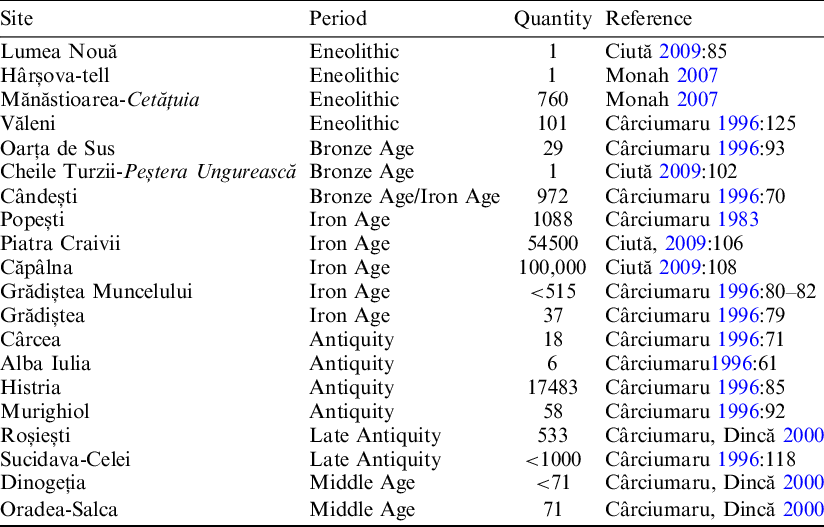
In comparison to the rest of the Balkan Peninsula, the cultivation of rye is of interest due to its high proportions, compared to other cereal grains in the Early Medieval Period. These values could be linked to the migrations and poor conditions of living in the northern Balkan area (Reuter Reference Reuter and Waksman2020).
This paper focuses on the rye deposit from Cunești site in Romania, assigned to the final stage of the Neolithic–Eneolithic (Anghelescu Reference Anghelescu1955; Comșa Reference Comșa2001). It was discovered in 1954 and is considered one of the oldest rye discoveries in Romania (Cârciumaru Reference Cârciumaru1996:169). After more than 50 years, this material has been reanalyzed. Our approach included archaeobotanical re-evaluation, stable isotopic analysis, 3D morphometric analysis, and radiocarbon (14C) dating.
MATERIALS AND METHODS
The Site
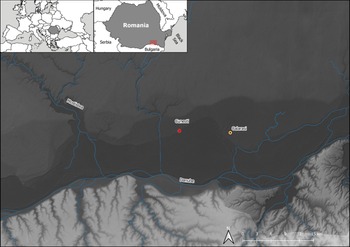
The site is a tell-type settlement (Măgura Cuneşti), located on the gentle slope of the Danube terrace, on the bank of the Belicîne gorge, at the southern limit of Cuneşti village, Romania, ca. 10 km north of the Danube (Figure 1). It was investigated in the 1930s and the 1980s, and the stratigraphy had approximately 4 m height, with 11 occupational levels that belong to the Gumelniţa culture, A2 and B1 phases (ca. 4500–4000 cal. BC). The top levels of the tell settlement were affected by a late feudal necropolis (Comșa Reference Comșa2001; Ștefan Reference Ștefan2011; Lazăr et al. Reference Lazăr, Ștefan and Vasile2013), which also is disturbed by the current cemetery of Cunești village (only the western edge). Before the damming of the Danube (in the 1970s), the mound was frequently flooded and eroded. The damming works, completed by 1980, led to the destruction of a significant part of the southern part of the tell site (Culică Reference Culică1973; Comșa Reference Comșa2001).
Geographical location of the Cunești site.

Flooding in the spring of 1954 occurred when the Danube over spilled in the lower plain area and reached the village of Cunești. A large portion of the southern part of the tell collapsed, but this event made a burnt dwelling visible. In this feature, a large quantity of sherds was found and collected, as well as several complete pots (n=3). According to the excavation’s author, the charred grains were found in three large pots, each of 60 L volume, which is typical for Gumelnița communities (Anghelescu Reference Anghelescu1955; Comșa Reference Comșa2001).
Archaeobotanical Samples
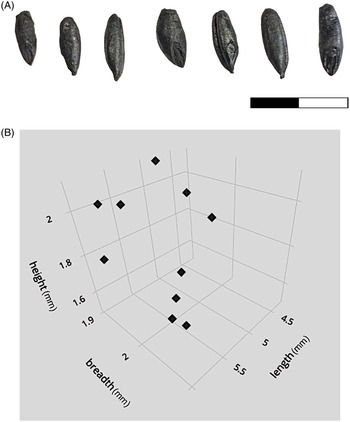
The archaeobotanical batch from Cunești contains more than 1000 grains of charred rye (Figure 2), without any other associated seeds or fruits.
(A) Secale cereal grains from Cunești site (scale bar = 1 cm). (B) 3D plotting of the length, breadth, and height of the 10 analyzed rye caryopses.

Morphometric Analysis
The morphometric analysis was conducted on 10 charred caryopses, analyzed using a binocular magnifier (Olympus Stereo Zoom Binocular Microscope, Olympus Corporation, Tokyo, Japan) at Babeş-Bolyai University in Cluj-Napoca (Romania). The standard morphological analysis was based on the shapes of the dorsal, ventral, lateral, and cross-section views, the position and shape of the embryo on the dorsal face, and the hilum on the ventral face (Figure 2). The length (L), breadth (B), and height (H) of the caryopses were measured using the stereomicroscope. The average, median, and variance were determined following Jacomet (Reference Jacomet2006).
Radiocarbon Dating
From the identified rye grains from Cunești, 4 were selected for radiocarbon analysis: 1 was sent to RoAMS Laboratory of Applied Nuclear Physics Department (Măgurele, Romania), and 3 to the Leibniz Laboratory for Radiometric Dating and Stable Isotope Research (Kiel, Germany). The Kiel lab produced the date on a combination of 2 grains. Radiocarbon dates were calibrated using the R package oxcAAR (Martin et al. Reference Martin, Schmid, Knitter and Tietze2021) with the calibration curve from Reimer et al. (Reference Reimer, Austin, Bard, Bayliss, Blackwell, Ramsey, Butzin, Cheng, Edwards and Friedrich2020).
Stable Isotopes
Eight charred grains were selected for stable isotope analysis (δ13C and δ15N). From these samples, one was selected (C-1) to check for external contamination of the grains following Vaiglova et al. (Reference Vaiglova, Snoeck, Nitsch, Bogaard and Lee-Thorp2014). C-1 was crushed and analyzed by Fourier transform infrared spectroscopy with attenuated total reflection (FTIR-ATR) using a Vector 22 from Bruker from the Unit of Molecular Spectroscopy (UEM) of the Services of Support to Research (SAI) of the University of A Coruña (UDC). The sample was measured once, and the background was subtracted, and a baseline correction was carried out using the software OPUS. The spectrum was normalized. To test for contamination the following peaks were observed: 870 and 720 for carbonates; 3300, 1450, and 1085 for nitrates and 3690, 1080, and 1010 for humic acids.
As no peaks were detected at those wavelengths, the grains were subjected directly to isotope-ratio mass spectrometry (IRMS). The IRMS analyses were carried out in the Unit of Instrumental Techniques of Analysis (UTIA) of the SAI of the UDC. The samples were combusted and analyzed directly at the DeltaV Advantage (ThermoScientific) coupled with an interphase ConfloIV to an elemental analyzer Flash IRMS EA IsoLink CNS (Thermo Scientific), with an analytical reproducibility greater than 0.2‰ for carbon and greater than 0.2‰ for nitrogen. Stable carbon and nitrogen isotope compositions were calibrated relative to VPDB and AIR.
As secondary standards the following standards were employed: USGS 40 (–4.52‰), USGS41a (+47.55‰), IAEA-N-1 (+0.4‰), IAEA-N-2 (+20.3‰) and USGS-25 (–30.4‰) for δ15N, and USGS 40 (–26.39‰), USGS41a (+36.55‰) NBS 22 (–30.031‰), IAEA-CH-6 (–10.449‰) and USGS 24 (–16.049‰) for δ13C. To test the precision (standard deviation) acetanilide was employed as the internal standard, resulting in ± 0.15‰ (n=10). Quantifications of each sample were done by duplicate. The results are presented under the delta (δ) notation, which reflects the proportion between both isotopes in the sample concerning the proportion in an international standard (Vienna PeeDee Belemnite (VPDB) for carbon and atmospheric air (AIR) for nitrogen), as shown in the following equation: δX (‰) = (Rsample/Rstandard)−1*1000, where X is the heavier isotope and R is the 15N/14N or 13C/12C ratio.
To check if the grains show diagenetic alteration, the correlation of δ13C vs. C:N, δ13C vs. %C, δ15N vs. C:N and δ15N vs. %N, have been checked as suggested in Vaiglova et al. (Reference Vaiglova, Lazar, Stroud, Loftus and Makarewicz2022). To analyze how these plants were cultivated, we used δ15N and the carbon isotope discrimination (Δ13C), which are related to the amount of manure (Fraser et al. Reference Fraser, Bogaard, Charles, Styring, Wallace, Jones, Ditchfield and Heaton2013) and water availability during the period of growth (Farquhar et al. Reference Farquhar, O’Leary and Berry1982, Reference Farquhar, Ehleringer and Hubick1989; Araus et al. Reference Araus, Febrero, Buxo, Camalich, Martin, Molina, Rodriguez-Ariza and Romagosa1997) respectively. Δ13C is calculated with this equation from Farquhar et al. (Reference Farquhar, O’Leary and Berry1982): Δ13C (‰) = [(δ13Cair – δ13Cp)/(1+ δ13Cp)]*1000, where δ13Cair of the seed radiocarbon date are –6.4‰ (data from the CU-INSTAAR/NOAA-CMDL database http://web.udl.es/usuaris/x3845331/AIRCO2_LOESS.xls) (Ferrio et al. Reference Ferrio, Araus, Buxó, Voltas and Bort2005), and δ13Cp is the plant carbon isotope composition.
As the studies on stable isotopes of archaeological rye are scarce, we could compare our results with those from Hamerow et al. (Reference Hamerow, Bogaard, Charles, Forster, Holmes, McKerracher, Neil, Ramsey, Stroud and Thomas2020) (England, late 9th–mid 12th AD) and Treasure (Reference Treasure2020) (East Iberia, 10th–12th AD). Statistical calculations and plots were made using Past 4.05 (Hammer et al. Reference Hammer, Harper and Ryan2001). Plots were edited with Adobe Illustrator CS3.
RESULTS
Grain Measurements
The obtained values for length, breadth, and height (Figure 2 and Table 2) fit into the ranges previously described in the literature for Secale cereale archaeological caryopses. The variance in the length shows the typical traits of a secondary crop (Jacomet Reference Jacomet2006; Westling and Jensen Reference Westling and Jensen2020).
Average, median, and variance of measurements on the 10 analyzed rye caryopses.

Radiocarbon Dates
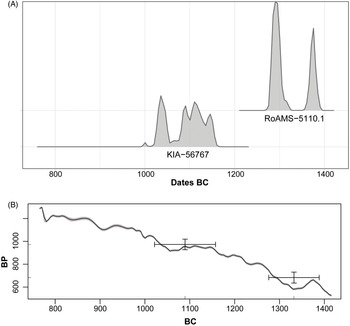
RoAMS-5110.1 yielded a date of 683 ± 24 BP, which calibrated (2σ) is 1276–1314 AD (63.44%) and 1361–1388 AD (32.01%), so between the 13th and 14th centuries AD. On the other hand, KIA-56767 produced a date of 973 ± 23 BP, which calibrated (2σ) is 1022–1054 AD (28.31%) to 1076–1158 AD (67.14%), so 11th and 12th centuries AD. Both 14C dates (Table 3 and Figure 3) indicate that those rye grains are not from the Neolithic period, but from the Middle Age, and that aligns this material with the expansion of rye as the main crop in Europe (Behre Reference Behre1992; Filatova et al. Reference Filatova, Claasen, Torres, Krause-Kyora, Holtgrewe Stukenbrock and Kirleis2021) during this period of time.
14C dates obtained on rye grains from Cunești site. δ13C was measured on the AMS.

(A) Calibrated dates. (B) Dates plotted in the calibration curve.

Stable Isotopes
Isotopic results are shown in Table 4 with the correction for charred plants suggested by Nitsch et al. (Reference Nitsch, Charles and Bogaard2015) of +0.31‰ for δ15N and -0.11‰ for δ13C. The average values of this rye grains are 8.7‰ (± 1.0) for δ15N, -21.3‰ (± 1.3) for δ13C, 14.2 (± 2.8) for atomic C:N, and 15.2 (± 1.3) for Δ13C.
Stable isotope results of rye grains from Cunești. δ15N and δ13C are corrected following Nitsch et al. (Reference Nitsch, Charles and Bogaard2015).

DISCUSSION
Archaeological “Context”: the Err of “Intuitive” Chronology
Invariably, the archaeological context is the key to achieving higher accuracy of resulted data regardless of the sample or investigation type, including radiocarbon. This case from Cunești proves the veracity of this assertion. According to the research author (Anghelescu Reference Anghelescu1955), the great floods of the spring of 1954 required the museum team to supervise the district sites, especially those in the Danube valley, which were exposed to the destruction. On March 12, 1954, when the flooding reached the base of the Cunești tell settlement, some burnt levels, hearth, and wall fragments were observed in the mound center. The rescue operations were performed in challenging conditions (working in the water, ice, and low temperatures) in order to recover the artifacts and ecofacts in the time available.
Consequently, considering how the rescue excavation at Cunești was carried out, it is not difficult to explain how the medieval seeds were mixed among the Neolithic ceramics and to assume that the rye batch was stored in Gumelnita vessels. Specific post-depositional processes, especially the great floods, played a significant role in the movement of the grains between different layers. In addition, the accidental nature of the discovery could also explain the two different 14C ages obtained for this batch (see the section “Reconsidering the Chronology of Rye in Romania”).
Radiocarbon Dating: Clarifying the Chronology
The KIA-56767 measurement had a δ13C of –18.7‰, and RoAMS-5110.1 of –40.7‰. Although, apparently, we must consider with caution the dating of RoAMS-5110.1 because it is outside the δ13C range of C3 plants (–34‰ to –22‰ (O’Leary Reference O’Leary, Wada, Yoneyama, Mingawa, Ando and Fry1995), the value reported by the RoAMS lab is correct. This δ13C data obtained on the AMS was used for 14C age correction. Moreover, the higher negative value of the RoAMS 5110.1 sample (–40.7‰) is explained by the beam fractionation in the High Voltage 1 MV AMS system and during the graphite generation in AGE3 system. On the other hand, the rye grain used as sample for 14C dating could have suffered from an unidentified process which caused a depletion of the heavy isotopes of carbon. One possible explanation is that the decomposition of the tissue by methanogenic bacteria (Schenk et al. Reference Schenk, Sawakuchi, Sieczko, Pajala, Rudberg, Hagberg, Fors, Laudon, Karlsson and Bastviken2021) may have occurred in an anaerobic environment, such as during flooding or due to the preservation of the sample itself. Also, the decomposition process could alter the 14C composition by adding younger carbon. Notwithstanding, we consider both radiocarbon dates reliable. The 14C age differences between KIA-56767 and RoAMS-5110.1 are the result of the archaeological context explained in the sections “Archaeological ‘Context’: the Err of ‘Intuitive’ Chronology” and “Reconsidering the Chronology of Rye in Romania”.
Reliability of the Isotopic Results
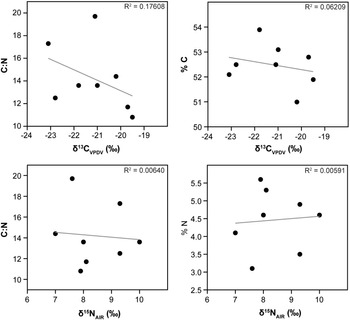
The correlation of δ13C vs. C:N, δ13C vs. %C, δ15N vs. C:N and δ15N vs. %N have been checked (Figure 4). The relation between the different parameters of the isotopic results shows no correlation, which indicates that the isotopic values do not change with %N, %C, or C:N, pointing to the preservation of these grains being good.
Correlations between the different isotopic parameters.

Cultivation Conditions of the Cunești Rye
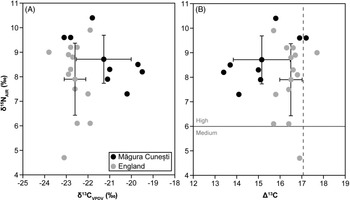
To graphically compare our results with other published data, we represented our values in a bivariate plot together with rye data from the British Isles (Hamerow et al. Reference Hamerow, Bogaard, Charles, Forster, Holmes, McKerracher, Neil, Ramsey, Stroud and Thomas2020) (Figure 4). Due to the scarcity of rye isotopic studies, it was not possible to compare with a more similar environment. In Figure 5A, the rye from Cunești is divided into two groups: group 1 with higher δ15N and lower δ13C (C-4, C-5, and C-7), and group 2 with lower δ15N and less negative δ13C (C-1, C-2, C3, C-6, and C-8). Group 1 is similar to English rye, but with a slightly higher δ15N, and group 2 has more positive δ13C values.
(A) Bivariate plot of δ1 3C vs. δ1 5N and the mean and standard deviation of rye grains from Cunești site and data from England from Hamerow et al. (Reference Hamerow, Bogaard, Charles, Forster, Holmes, McKerracher, Neil, Ramsey, Stroud and Thomas2020). (B) δ1 5N and Δ1 3C from the same data. Gray continuous line indicates the limit between medium and high manure contribution. Gray dashed line represents the mean of rye crops subject to severe drought in the experiment of Kottmann et al. (Reference Kottmann, Schittenhelm and Giesemann2014).
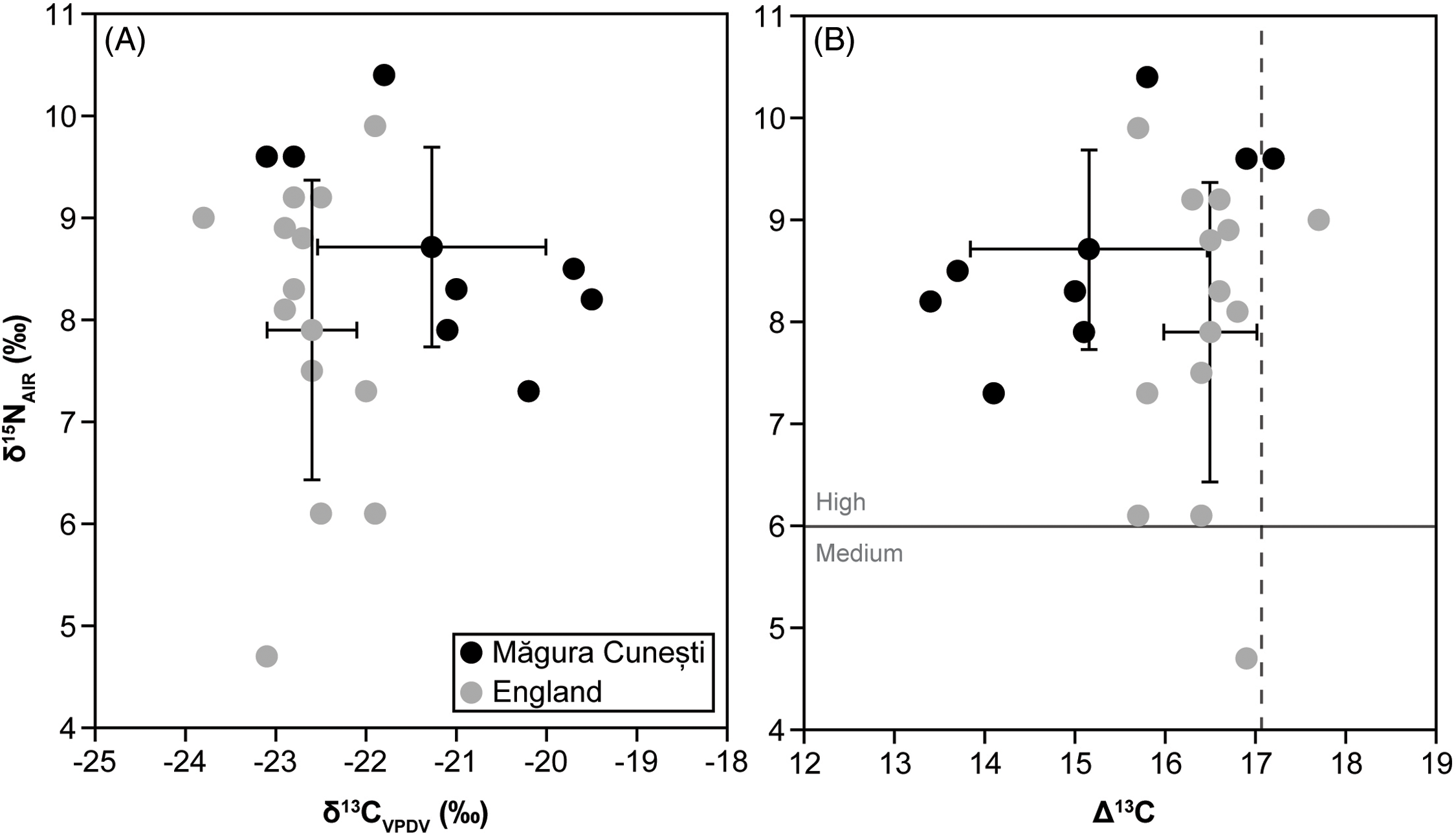
Figure 5B represents the conditions when the plants grew. Our δ15N values suggest that the rye from Cunești was cultivated in fields with a high amount of manure, following the classification from Fraser et al. (Reference Fraser, Bogaard, Charles, Styring, Wallace, Jones, Ditchfield and Heaton2013), and that it was higher for group 1 than group 2. Δ13C shows higher water availability for group 1 than group 2. There are no established thresholds for the amount of watering in rye, as exist for wheat, barley and pulses (Araus et al. Reference Araus, Febrero, Buxo, Camalich, Martin, Molina, Rodriguez-Ariza and Romagosa1997; Wallace et al. Reference Wallace, Jones, Charles, Fraser, Halstead, Heaton and Bogaard2013). In the experiment of Kottmann et al. (Reference Kottmann, Schittenhelm and Giesemann2014) with modern rye, the authors found that the average Δ13C of the crops subject to severe drought was 17.1, of mild drought was 19.2, and for well-watered crops, 21.3. Except for C-5 which is 17.2, all of our values are lower than 17.1. The rye data from the East of the Iberian Peninsula (10th–12th) (n: 10; 15.7 ± 1.1; range: 17.8–13.6) (Treasure Reference Treasure2020) and England (n: 13; 16.5 ± 0.5; range: 17.7–15.7) (Hamerow et al. Reference Hamerow, Bogaard, Charles, Forster, Holmes, McKerracher, Neil, Ramsey, Stroud and Thomas2020) indicate that this cereal was cultivated in dryland farming during this time, as expected. While both groups 1 and 2 show that they grew in dryland, group 1 received more manure and water. This could be due to the previous status of the fields more than different management. We can suggest that these grains come from at least two different fields, one more fertilized and irrigated than the other, or from different areas of the same field with different conditions. These grains were found in two pits, which indicate they were part of some kind of reserve or storage, which makes sense if the grains come from different harvest fields.
The KIA-56767 dating of the rye from Cunești falls into the Medieval Climate Anomaly (MCA) (950–1250 AD), a period characterized by warmer climate conditions (Mann et al. Reference Mann, Zhang, Rutherford, Bradley, Hughes, Shindell, Ammann, Faluvegi and Ni2009). In Romania, there were gradually wetter conditions between 950 and 1150 AD (Feurdean et al. Reference Feurdean, Galka, Kuske, Tantau, Lamentowicz, Florescu, Liakka, Hutchinson, Mulch and Hicker2015), with warmer winters and summer temperatures similar to the present (Landrum et al. Reference Landrum, Bliesner, Wahl, Conley, Lawrence, Rosenbloom and Teng2013). After the MCA period, the climate became dry until the 18th century (Feurdean et al. Reference Feurdean, Galka, Kuske, Tantau, Lamentowicz, Florescu, Liakka, Hutchinson, Mulch and Hicker2015), which includes the period in which RoAMS-5110.1 is dated.
Local conditions could explain why the archaeological rye shows smaller Δ13C values than in the modern experiment from Kottmann et al. (Reference Kottmann, Schittenhelm and Giesemann2014). East Iberian and Cunești ryes are from areas with less precipitation than the British Isles (Wibig Reference Wibig1999), so the differences in Δ13C could just be related to the influence of the Atlantic Ocean more than a different management of the rye.
Reconsidering the Chronology of Rye in Romania
The accidental nature of the rye discovery from Cunești explains the 14C age differences, as stated in the section “Archaeological ‘Context’: the Err of ‘Intuitive’ Chronology”. Moreover, this archaeological situation indicates the existence of at least two medieval features (probably pits) for storing rye with two different dates. This means that the archaeobotanical discovery from Cunești must be reconsidered as coming from at least two batches from historical periods placed a few hundred years apart. On that basis, our interpretative scenario regarding the Cunești case follows this model:
-
In the proximity of the Neolithic mound, 400 m east of the tell settlement, an early medieval settlement contemporary with our rye grains was documented. The medieval settlement was identified in the erosion caused by the floods in the Danube terrace in 1954, during the same archaeological rescue works (Anghelescu Reference Anghelescu1955). This medieval site has never been archaeologically investigated. The numerous floods of the Danube and the creation of the system of dams during the communist period have led to drastic changes in the configuration of the landscape. The medieval site is now completely destroyed.
-
In the Middle Age, in the south of Romania, cereals were stored in supply pits, usually dug in high places located in areas above risk of flooding. In the case of Cunești, the Neolithic tell was a mound and the highest point in the zone.
-
Storing grains over the winter in the medieval period did not involve depositing the seeds in pots (as in antiquity or other eras) but in burnt pits. These features were not recorded directly by the archaeologists who recovered the materials in 1954 during the Danube floods. On the other hand, the “burnt pieces of the earth” identified in the area where the carbonized rye also appeared, as Anghelescu (Reference Anghelescu1955) notes, represent possible evidence for our scenario. Taking into account the fact that rye grains were found in the vicinity of the hearth of a “burnt pit-house, where the shapes of vessels could be seen in situ under the broken adobe walls” (Anghelescu Reference Anghelescu1955:311), we consider that the confusion could easily have been made by anyone, in the difficult conditions of archaeological research.
-
We explain the presence of rye seeds in association with Neolithic ceramics based on post-depositional processes. The base of the medieval pits where the grains were stored touched the Neolithic levels, and the “sliding” of the rye vertically is natural. As it was a rescue operation of some archaeological materials from a great flood rather than an archaeological excavation, the Cunești situation can be accepted, but conveys an important lesson.
-
The difference in the 14C data obtained in the two laboratories (Magurele and Kiel) shows that the grains come from at least two medieval features, which are not contemporary but are both dated in the Middle Ages, on the same horizon as the nearby early medieval settlement.
-
Therefore, the early medieval settlement 400 m from the tell site functioned for several hundred years, and the people there used the Neolithic mound as a winter storage area for cereals because it was the highest non-flooding point in the area. The tell was about 5–6 m higher than the area of the early medieval settlement, based on analysis of the Romanian Artillery Firing Plans (1915–1959, 1:20.000) dated before the 1970s, when the process of damming the Danube at Cunești was carried out, which affected the entire landscape.
Regarding the other Romanian finds of rye so far dated to the Eneolithic through archaeological contextualisation, these remains are suspicious for not belonging to the period in question due to the sparsity of cultivated rye findings elsewhere in the Fertile Crescent and Europe. For instance, the rye from Văleni (Cârciumaru Reference Cârciumaru1996) was found in two samples, each with common wheat as the predominant species but with broomcorn millet (Panicum miliaceum) and corn cockle (Agrostemma githago) in each. Other documented species in these batches are white mustard (Sinapis alba) and gold-of-pleasure (Camelina sativa). At Mănăstioara, the predominant species found was rye, but mixed with wheat, barley and also corn-cockle (Monah Reference Monah2007). Following the big dating programme on ancient millet grains (Filipović et al. Reference Filipović, Meadows, Dal Corso, Kirleis, Alsleben, Akeret, Bittmann, Bosi, Ciută and Dreslerová2020) it is known that the spread of millet to Europe happened only in the 2nd half of the 2nd mill. BC. The occurrence of millet, together with gold-of-pleasure, a typical Iron Age crop, first cultivated in Europe in the 2nd millennium BC (Zohary et al. Reference Zohary, Hopf and Wiess2012; Effenberger Reference Effenberger2018; Brock et al. Reference Brock, Ritchey and Olsen2022) and corn cockle growing as weed species in arable fields since Bronze Age and being a prominent weed of medieval and early modern times winter crops, at least for Văleni suggests a date much younger than Eneolithic for the plant remains, more likely from the range of Bronze Age to medieval or early modern times.
This sporadic documentation of rye in the Eneolithic (Gumelnița and Cucuteni sites) has been viewed with caution since the time of the first archaeobotanical analyses of these batches (Cârciumaru Reference Cârciumaru1996) because such an early appearance of this species is not supported by the continuation of its cultivation in the historical stages immediately following, as would be expected. For instance, the appearance of rye in the northern Balkans Bronze Age was only recorded at a few sites (Table 1). With that in mind, we must question the discoveries of rye from Neolithic contexts, especially in the absence of direct 14C dating on the plant remains (Cârciumaru Reference Cârciumaru1996:168–169).
CONCLUSIONS
This paper presents a re-evaluation of charred plant remains archived in a museum collection. Cereal caryopses represent the most direct evidence of past human activity related to crop cultivation. These materials are thus of high value for reconstructing the history of the domestication process. However, archived material from long-ago excavations often come along with specific research biographies. Thus, sometimes remains were mistakenly confirmed as domestic crops, erroneously identified as certain species, or incorrectly ascribed to a specific archaeological period (e.g., Grikpėdis et al. Reference Grikpėdis and Motuzaite Matuzeviciute2018). In general, understanding the complex stratigraphies of multi-period sites and the archaeological deposits’ formation is challenging to be critically assessed (Schiffer Reference Schiffer1987). This sometimes is hampered by sparse documentation of the circumstances of artifact and ecofact recovery making bias difficult to track. For the rye example from the multi-period site of Cunești, we could show that the rescue “excavation” during a flood event hindered the ascription to the correct (pre)historical time since the archaeological contextualisation was hardly possible and adequate documentation difficult. The current situation proves that discoveries of archaeological grains without radiocarbon dates are insufficient to infer past human activity. In particular, tiny, charred plant remains are prone to move through stratigraphic sequences through root channels, affected by bioturbation or of past and/or modern human activities like burning, tilling or digging (e.g., Motuzaite Matuzeviciute et al. Reference Motuzaite Matuzeviciute, Staff, Hunt, Liu and Jones2013). Millet is an excellent example of how direct dating has enabled an improved interpretation of the use of crops in (pre)history. Based on direct AMS dating, the existence of “Neolithic” millet grains in Europe could be excluded. A coherent chronological localisation of the distribution of millet in Europe is now assured, falling into the second millennium BC (Filipović et al. Reference Filipović, Meadows, Dal Corso, Kirleis, Alsleben, Akeret, Bittmann, Bosi, Ciută and Dreslerová2020). The case of rye from Cunești touches on the earliest stages of agriculture in the region. Its appearance in the Eneolithic did not correspond to expectations or knowledge about its domestication history (Zohary et al. Reference Zohary, Hopf and Wiess2012). Direct AMS dating now shows that the history of rye domestication does not have to be rewritten, and investigated charred grains belong to the Middle Ages according to the current state of research.
The resulting 14C dates (11th–12th/13th–14th centuries AD) revealed that the investigated rye grains come, in fact, from at least two features (so minimum two batches). Considering this situation, we will target new radiocarbon dates on this rye discovery in the future to clarify the archaeological entanglements.
In this historical period rye was one of the most important main crops in Europe due to its high tolerance to drought and cold that this species has alongside its ability to grow in conditions that are not suitable for wheat cultivation (Gyulai Reference Gyulai2014). However, the differences between the two 14C dates confirm this at least for the Early Middle Ages in southern Romania. Moreover, the resemblance of our isotopic data with those from other parts of Europe with an analogous chronology suggests that rye was possibly managed in a similar way. It was cultivated in dryland and taking advantage of the fact that the fields had been fertilized for the cultivation of other cereals in previous years.
Last but not least, the current study represents an initial step to eliminate rye as a specific Eneolithic plant species in Europe. To further this intention, in the near future, we will also revisit the rye batches from Mănăstioarea and Văleni (Table 1), thus far considered to belong to the Cucuteni communities.
ACKNOWLEDGMENTS
Thanks to Aurora Grandal d’Anglade for the access to the laboratory of Molecular Paleontology of the University Institute of Geology (IUX) of the University of A Coruña (Spain). Many thanks also to Tiberiu Sava (Horia Hulubei National Institute for R&D in Physics and Nuclear Engineering, Romania) for clarification about δ13C value reported by RoAMS lab, Cristina Covataru (ICUB, Romania) for support with old maps, and Steve Mills (Cardiff University, UK) for proofing the text.
FUNDING
The work of the University of Bucharest and Horia Hulubei National Institute for R&D in Physics and Nuclear Engineering teams (Romania) were supported by two grants from the UEFISCDI and Ministry of Research, Innovation, and Digitization, contract number 351PED/2020 (CALIB-RO) and 41PFE/2021 (ACCENT), within PNCDI III. The Kiel University team was supported by the Deutsche Forschungsgemeinschaft (German Research Foundation) within the programs CRC 1266 “Scales of Transformations in Prehistoric and Archaic Societies” (project number 2901391021—SFB1266) and the EXC 2150 ROOTS “Social, Environmental, and Cultural Connectivity in Past Societies” (project number 390870439). A. García-Vázquez was supported by a Research Fellowship for Visiting Professors within the Research Institute of the University of Bucharest (ICUB) under the project “Multi-isotopic approach to the life at the Gumelnița site” (515/10.01.2022).





 Open access

