




What are the long-term effects of mass state repression on citizen attitudes towards the state? Under what conditions do people express or withhold these attitudes? I address these questions here by studying the legacy of Mao’s violent collectivization and forced labour campaigns during the Great Leap Famine (1958–1961), which led to as many as 45 million deaths in what is widely regarded as the worst in human history (hereafter, the Famine).Footnote 1 Drawing on a corpus of over 300 interviews with survivors conducted between 2010 and 2016, I use a mixed-methods approach to examine how the Famine impacts the way survivors speak about a repressive regime that remains in power. Exploiting variation in county-level mortality rates, I find that the degree of exposure to state violence has consequences for how respondents recall their Famine experiences: interviewees who experienced more intense levels of state violence do not voice more explicitly negative attitudes towards the state but do harbour more latent resentment.Footnote 2
Furthermore, I use the establishment and subsequent dissolution of communal canteens – a key repressive institution through which the state acted as the sole food distributor during a time of extreme scarcity – as an analytical lever to show that survivors are more willing to express both explicit and unspoken negative political attitudes in the context of a long-dead institution. Communal canteens were a hallmark of collectivization and the Famine era, but were dismantled in 1961 and have since been recognized by the regime as a failure. Taken together, these findings suggest that intense state repression can have long-lasting, alienating effects on citizens’ political attitudes, and for some groups of citizens, a failure to voice negative opinions about the state may not indicate a lack of widespread discontent.Footnote 3
This study makes three primary contributions. First, it leverages a unique data source – hundreds of interviews with survivors of the Famine – and a multi-method approach to add important nuance to discussions of the long-term effects of state repression. In this study, I apply a variety of natural language processing (NLP) techniques to interview transcripts to gain a systematic understanding of how survivors talk about their experiences of the Famine. I then hand-code all transcripts to transform text into data suitable for hypothesis testing using regression analysis. This novel, mixed-methods approach using oral history data at scale allows us to generalize across individual experiences in a manner not usually possible with purely qualitative research. At the same time, qualitative analysis and a close reading of select interviews allows the study to retain the first-hand, human element of these accounts, facilitating the examination of the micro-foundations of when, how and why some survivors express negative political attitudes while others do not.
Second, this paper also enhances our substantive understanding of China’s Great Leap Famine.Footnote 4 Almost nothing was known about the Famine until the 1980s, when the Chinese government released its official population data regarding the Great Leap years. This disclosure precipitated the first wave of studies on the Famine, which were primarily related to population and demographics.Footnote 5 The Famine has since been chronicled extensively through histories,Footnote 6 anthropological and sociological studies,Footnote 7 and memoirs.Footnote 8
With the notable exception of Zhou Xun’s collection of interviews with Famine survivors, first-hand accounts of the Famine are rare.Footnote 9 The collection of oral histories I analyse here comprise hundreds of raw and unvarnished accounts of suffering, starvation and survival in rural China during this catastrophic period. Taken together, the interviews bring to life daily experiences, state–society dynamics, communist ideology and central policy planning at the grassroots. Furthermore, there is surprisingly little extant work on the Famine in the wider political science and Chinese politics literature. Recent work has primarily focused on elite and bureaucratic politics, aiming to determine the institutional causes of the Famine.Footnote 10 Drawing on unique, primary data to bridge the gap between a rigorous quantitative approach and single-village or single-county studies that draw on rich but geographically limited qualitative data, this study supplements a small body of literature that looks instead at grassroots politics within rural communitiesFootnote 11 and explores the long-term, heterogeneous effects of the Famine.Footnote 12
Finally, this study also speaks to the wider political science literature on legacies of authoritarian repression. As Yuhua Wang notes in his study of the long-term impacts of the Cultural Revolution, scholars have primarily studied the legacies of authoritarian repression after the regime has collapsed; we know comparatively little about the long-term effects of repression while the same regime remains in power.Footnote 13 Moreover, this paper contributes to an ongoing debate about the long-term effects of state repression on citizens’ political attitudes and whether they deterFootnote 14 or inciteFootnote 15 citizen opposition decades later. Building on a growing vein of research that demonstrates that long-defunct repressive institutions can continue to exert influence on contemporary political attitudes,Footnote 16 I develop and test theories that explain the conditions under which citizens exposed to state violence decades ago express their political attitudes today.
This paper proceeds as follows. Next, I provide background and context on the Great Famine and describe my theoretical expectations. I then discuss the data and measures before presenting the empirical strategy and findings. The final section concludes.
The Great Leap Famine
Roughly a decade after taking power in 1949, Mao Zedong 毛泽东 and the Chinese Communist Party (CCP) launched the Great Leap Forward, a mass social and political campaign that aimed to rapidly transform the Chinese countryside from an agrarian economy into a modern communist society. In pursuit of these goals, the campaign imposed radical and far-reaching policies to collectivize agriculture and to induce massively accelerated industrial development.
Mao closely connected the success of the Great Leap Forward with the cleansing of rightists from the Party’s ranks. Amid a charged atmosphere of ideological fervour – where a single political misstep could lead to humiliation, demotion, firing and even death – officials at every level were desperate to prove their political loyalty regardless of their true beliefs. At Mao’s behest, top officials disseminated boastful reports of record-setting grain procurement, precipitating a disastrous chain reaction that exerted intense pressure on lower-level officials to exaggerate their grain output to meet progressively unrealistic targets. After fabricated statistics reported that China’s grain harvest had surpassed that of the US during the summer of 1958, Mao claimed victory and shifted the campaign’s focus to industry. Unharvested crops rotted in the fields as millions of farmers were diverted to work on large-scale water conservation and iron-smelting projects.Footnote 17 By the end of 1958, food shortages began to take effect, and by the middle of 1959, much of the country was experiencing a full-blown famine that would eventually lead to the deaths of between 30 and 45 million people in what is now commonly euphemized as “the three difficult years” (sannian kunnan 三年困难).
Famine intensity and state violence
Although it is difficult – if not impossible – to fathom the loss of life during the Famine, its intensity varied massively across localities. In general, rural areas were harder hit than urban areas. State violence and repression were inextricably linked to Famine intensity and mortality rate. Ruthless, career-minded officials – such as Wu Zhipu 吴芝圃 in Henan and Li Jingquan 李井泉 in Sichuan – are notorious for turning a blind eye to suffering and demanding ever-greater outputs, thereby contributing to the scale of mortality in their jurisdictions.
At the peak of the Famine in 1960, provincial death rates varied significantly, ranging from 6.8 per 1,000 people in Shanghai to 68.6 per 1,000 in Anhui province, with a nationwide average of roughly 17 deaths per 1,000.Footnote 18 However, provincial-level data can obscure important variation. The precedents for violence were often set at more local levels. In his study of Sichuan province, Chris Bramall finds that differences in local cadre responses to central government policy were decisive in determining the intensity of the Famine at the local level.Footnote 19
Indeed, this local variation in violence is evident in many of the interviewees’ accounts. For instance, interviewees in two counties in south-west Yunnan province told very different stories about their Famine experiences. In Yimen county 易门县, the mortality rate was 45.2 per 1,000 people, one of the highest in the dataset.Footnote 20 Interviewees recalled overzealous cadres and how all food supplies were channelled into the communal canteens.Footnote 21 One woman described conditions in her village and the massive loss of life in her own family:
I went to work at Xiaohe Reservoir 小河水库, my feet and my face were swollen [from oedema]. I almost died there. So many men and women died … We had to attend criticism meetings, sometimes till midnight, and go back to work at sunrise. My husband was criticized and humiliated … The older people died. They gave more to those who worked more, and less to those who had done less. My father starved to death – he had yellow water flooding out of his body [oedema]. He had three sisters and a younger brother who all died.Footnote 22
In contrast, about 60 miles away in Shuangbai county 双柏县, where the mortality rate was 17.8 per 1,000 people, interviewees described their experiences as difficult but not as bad as elsewhere. According to one man, “we worked and they gave us something to eat.”Footnote 23 When there were food shortages, they were able to forage in nearby forests for wild fruit and vegetables. One woman recalled being able to cook at home, suggesting that the communal kitchens were not entirely dominant and villagers had some agency over food production. She remembered: “I could cook half a small bowl of rice every day. I’d cut taro into small pieces and cook it with vegetables and rice … We ate quietly and when the vice-captain passed by, we hid our food. When we planted rice and millet, we had some grain to eat, so we weren’t too hungry.”Footnote 24
In the sample I analysed, 16 of 307 interviewees (about 5 per cent) explicitly recalled witnessing or hearing about cadres beating to death or otherwise killing villagers. More systematic estimates show that at least 6 to 8 per cent of all Famine victims died directly at the hands of local cadres and militias. Given scholarly estimates of the death toll, this means at least 2.5 million victims were beaten or tortured to death.Footnote 25 This estimate does not include the tens of millions who died one step removed from direct official cruelty – by starvation, overwork, disease, suicide or other terrible means.
In sum, local Famine mortality was directly connected to the decision making and violence of officials. Notably, in the interviews I study here, although there were some references to central and provincial officials, generally the villagers were re-living their day-to-day experiences, vividly recalling the local cadres, brigade leaders and production team captains with whom they regularly interacted, rather than opining on national-level leaders and politics. This aligns with other scholarship on the Famine that incorporates oral histories. For instance, Felix Wemheuer observes that “the villagers see themselves as victims of the Communist Party and its policies … Most of my interviewees lost their belief in Mao Zedong during the famine. However, the central state played no important role in the memories of the villagers.”Footnote 26 For the purposes of this study, the “state” refers to the local state, primarily subcounty-level officials and institutions that villagers interacted with during the Famine years and reflected on in their interviews.
Communal canteens as sites of repression
During the summer of 1958, central directives established the “people’s commune,” a new administrative unit that assumed responsibility for managing critical resources such as food, labour and land. By October 1958, 99 per cent of the rural population was organized into about 26,000 communes, each administering to approximately 5,000 households, with some merging as many as 20,000.Footnote 27
The construction of the communal canteens served both administrative and ideological purposes. Organizationally, canteens provided a solution for “state simplification,” which was aimed at improving the legibility of the labour force by dividing and consolidating villages into conveniently mapped public eating sites.Footnote 28 Ideologically, the family – culturally synonymous with the number of “mouths” (kou 口) a household feeds – was regarded as “a major impediment” to communism, and one that Mao aspired to eliminate.Footnote 29
Collectivization – and communal dining in particular – was seen as a means to achieve these ends. Thousands of homes were razed in the name of administrative efficiency as new commune borders were drawn up with little regard for the “natural villages” that had formed organically over thousands of years based on kinship networks.Footnote 30 Private farming was prohibited, and local officials went from door to door, confiscating pots and pans to melt down into pig iron. Peasants’ food stores and livestock were requisitioned.Footnote 31 The dismantling of the family unit and concentration of power and resources into official hands gave the state unprecedented control over village life.
People were funnelled into one of the 2.65 million people’s commune canteens (renmin gongshe da shitang 人民公社大食堂) established during the autumn of 1958. By the end of 1958, more than 3.4 million communal kitchens fed roughly 90 per cent of the country’s rural population.Footnote 32 Initially, the canteens symbolized communist bounty and largess – villagers were encouraged to consume as much free food as they wanted; however, the abundance did not last.
The collectivization of labour and establishment of canteens were inextricably linked to the regime’s effort to radically redefine women’s role in society and redirect female labour from servicing the household to servicing the state. Indeed, “the very success of the Great Leap Forward … hinged in no small part upon the ability of local leaders to gain access to women’s labour.”Footnote 33 Women were mobilized to take on new agricultural and industrial roles, often far from their home villages.
Evidence suggests that before the real food shortages set in, women were liberated from burdensome household duties, as the collectivization of farm work expanded their networks and influence in village communities.Footnote 34 However, this diversion of labour also meant that women – mostly those with young children – assumed responsibility for the commune’s agricultural output in addition to their usual daily responsibilities of childcare, care for the elderly and housework.Footnote 35 Overwhelmed by this additional burden, women’s health and well-being suffered. Women recalled strapping their infants to their backs while they dug the fields and laid roadbeds.Footnote 36 Others remembered miscarriages,Footnote 37 forced abortions during the later stages of pregnancyFootnote 38 and losing multiple young children to starvation.Footnote 39 A woman in Chuxiong Yi Autonomous Region 楚雄彝族自治州 in Yunnan relayed a harrowing, yet typical, account:
I gave birth to my first child in 1961 in a cattle pen. My husband was gone, so my aunt-in-law helped me to deliver the baby. When the child was less than a month old, I had to go to work since no elders could take care of it. I mostly operated the waterwheel, so I had to bring my child to the riverbank … when my baby was not even a year old, he was hungry and ate ash and dirt and died. I was so desperate … The next March, I was pregnant again, but my health was poor and my son only lived a week.Footnote 40
The corpus of interviews is filled with tales of female anguish – the impossible choices women faced in feeding themselves, children and elderly family members, the pain and humiliation of untreated gynaecological diseases, being worked to the bone inside and outside the home, and the unavoidable presence of death.Footnote 41
For all villagers, communal canteens quickly became a key institution of monitoring and repression. Unable to provide food for themselves, peasants in most localities were forced to rely on the canteens for their entire food supply. In Ralph Thaxton’s political ethnography of “Da Fo village” in hard-hit Henan province, he reports that “public dining halls became the locus of Maoist state power over village society … [local officials] managed the mess halls to reinforce their dominance over village life and to make sure villagers surrendered to the labor directives of the commune.”Footnote 42 Indeed, many interviewees described the weaponization of food during a period of extreme scarcity, expressing variations of the phrase “if you did not work, you did not eat.”
Often, food deprivation was even more arbitrary; whether one ate or not could depend entirely on who happened to be holding the ladle on any given day. One man from Xianning 咸宁, Hubei, recounted: “After the porridge was boiled, it was poured into a big vat. If you had a good relationship with the official, he would scoop the grains from the bottom, if not, you would only get water skimmed off the top.”Footnote 43 Deliberate food deprivation was a primary cause of death during the Famine. In one report following an inspection of brigades in Neijiang 内江, Sichuan, it was estimated that 80 per cent of those who died of hunger had been denied food as a form of punishment.Footnote 44
Unchecked official corruption further diminished the already inadequate food supply. Accounts of officials abusing their positions to steal supplies from commune stores abound. A man in Shangluo 商洛, Shaanxi, recounted: “Those who cooked, measured grain and managed were all greedy. They took a little bit at a time from the villagers, until eventually it was all gone.”Footnote 45 A village doctor in Xiangzidian village 湘子店村, Shaanxi, bitterly remembered:
Eating at the canteen, the tendency for officials to boast and exaggerate was severe: when we produced 500 jin 斤 of grain, it was reported as 10,000, or even 20,000 … The head of Shanyang county 山阳县 said that people ate two liang 量 of egg and four liang of meat every day. In fact, we could hardly get congee … while the people starved, the captain, brigade leader and small groups ate like fat pigs.Footnote 46
This imbalance is corroborated by the cadres themselves. A man from Zengpu village 曾铺村, Hubei, who climbed the ranks from an assistant accountant to become village Party secretary, recalled, “I was in the brigade at that time, so to be honest, I didn’t starve … In terms of life and rice, I was more important than the masses.”Footnote 47
In addition to the withholding and misappropriation of food, the central location of canteens made them a prime site for the public discipline and humiliation of suspected rightists and rule-breakers. As food became increasingly scarce, and officials could no longer dole out rations as rewards, they relied more and more on punishment. As a public gathering place, the canteen was the venue for many a grim scene. Indeed, “sites of public struggle meetings were invariably inside or near the grounds of the public dining halls, which gave the party cadres in charge of the sessions a captive audience.”Footnote 48 A farmer in Lincang 临沧, Yunnan, recalled:
I remember Xiao Fagui in Huamulin village 花木林村 stole two bags of corn to eat. He didn’t take much, but he was strangled and beaten. He was tied up with a vine on a pole outside the canteen, where everyone could see him. His daughter came at night to bring him rice and untie him, but they found him again. They tied him up with the kind of leather you use to drive livestock, saying that if they let him go, he would steal again. His other children were too afraid, but his daughter went back again. She found him hanging by the neck, dead.Footnote 49
Still, during the Famine years, communal canteens represented a source of state-provided food during a time of extreme scarcity. It stands to reason, then, that survivors might reflect on the canteens in a positive way; however, this is clearly not the case. The canteens, along with the horrors experienced within them, left such a deep impression that some interviewees remembered the period simply as “the time of eating in the canteens” (chi shitang de shihou 吃食堂的时候). The canteens were widely acknowledged as sites of repression. In the spring of 1961, Gansu province’s first secretary wrote:
The masses deeply detest and loathe the communal kitchens … The masses say: “The communal canteen is a dining hall (a place for getting food), a tribunal (a place where kitchen staff beat and scold people) and a bordello (where team leaders and managers hire the prettiest girls as kitchen staff and mess around with them).”Footnote 50
Although difficult to gauge, some research suggests that without the canteens, the number of starvation deaths might have been reduced by a third or more.Footnote 51
In 1961, the regime dismantled and disavowed the canteens. A Central Committee work meeting convened in Beijing amended the “Regulations for agriculture” to specify that grain rations should be distributed directly to villagers and gave local villages the autonomy to decide the fate of the canteens. In most parts of the country, the collective canteen system ended immediately thereafter.Footnote 52 Although the official documents and Party histories written in the decades following the Great Leap Forward make no mention of the Great Famine, they do acknowledge that rural collectivization and the canteens had been a mistake, “initiated without careful investigation and study and without prior experimentation.”Footnote 53 In the wake of the Famine, the central leadership launched the “Anti-five winds” campaign in an attempt to correct course and shift blame onto overzealous grassroots cadres, citing the canteen as an important manifestation of the excessive leftism that ravaged the country during the Famine years.Footnote 54
Theoretical Expectations
Building on qualitative analysis of the interview data and existing literature, I develop a theory to explain how and why Famine victims voice or withhold negative attitudes towards a repressive regime that remains in power. It is well established that memories of traumatic events, such as war, famine and genocide, persist in collective consciousness long after the event itself,Footnote 55 continuing to affect public attitudes towards the government. However, existing studies provide conflicting answers to the question of whether state repression incites or deters citizen opposition decades later.
In the Chinese politics literature, a recent wave of studies has used survey data to examine the long-term impacts of violent events, such as the Famine,Footnote 56 the Cultural RevolutionFootnote 57 and the crushing of the Tiananmen Square 天安门广场 student movement,Footnote 58 on current political attitudes – namely, political trust. Across the board, scholars find that exposure to such events does indeed undermine trust in government. However, when and why citizens choose to express these attitudes (or not) is less clear. Arturas Rozenas and Yuri Zhukov offer an explanation in their study of Stalin’s “Terror by hunger” in Soviet Ukraine (1932–1934).Footnote 59 They find that communities exposed to a greater intensity of state violence behaved more loyally towards Moscow when the regime could credibly threaten punishment. However, when that threat of retribution waned, the same communities demonstrated fiercer opposition. Thus, the legacy of repression is contingent on the contemporary political context: it is the current political opportunity structure and likelihood of punishment that informs citizens’ choices to express political disloyalty.
Taking this finding as a point of departure, I theorize that even decades later, people who experienced more intense state violence will be less likely to voice negative political attitudes if the same repressive regime remains in power. I expect this to be particularly salient if the regime has credibly maintained or renewed its repressive capacity. This is certainly the case in China, where the CCP has invested heavily in domestic security maintenance since the 1989 Tiananmen student protests.Footnote 60 Intuitively, social and political psychology studies have found that intense and traumatic experiences that cause the deaths of family members, neighbours and friends leave a lasting impression on one’s memory.Footnote 61 As such, given that the CCP-led regime in China today is the same one that perpetrated mass violence during the Great Famine, I expect that survivors who experienced or witnessed more intense firsthand repression during the Famine will be less likely to voice explicitly negative political attitudes but more likely to possess unspoken negative sentiments regarding the state:
H1: People in counties that experienced higher levels of state violence will be less likely to voice explicit negativity towards the state (H1a), but will possess more latent negative sentiments towards the state (H1b).
Importantly, lacking systematic, individual-level data on citizens’ direct exposure to violence, I assume citizens living in geographic areas with higher mortality rates were more exposed to state violence, through direct or indirect experience. Some interviewees experienced this trauma personally, while others had routine access to anecdotal evidence of local deaths through day-to-day interactions with citizens from nearby communes as the Famine unfolded. Anecdotal evidence is vivid, concrete and easy to process – and especially influential where emotional engagement is high, such as in situations associated with violence or threat.Footnote 62 This aligns with a large body of literature that demonstrates that direct and indirect experience with traumatic events through spatial proximity filters down to impact individuals’ political attitudes and behaviour.Footnote 63
Furthermore, I anticipate that survivors – aware of the current political opportunity structure – will be strategic when expressing negative political attitudes. Disaffected citizens have adapted to the increasingly repressive environment in China, adopting coping mechanisms that allow them to avoid confrontation and stay in the state’s good graces while also maintaining a degree of political agency.Footnote 64 One such strategy is “stay[ing] a safe distance from red lines and focus[ing] on less controversial issues.”Footnote 65
Indeed, rather than directly criticizing or speaking negatively about the state, I expect citizens will be more likely to voice such negative attitudes in the context of specific repressive institutions that no longer exist and have since been disavowed by the regime. Existing studies show that proximity and exposure to obsolete coercive institutions, such as Nazi-era concentration campsFootnote 66 and slavery in the American South,Footnote 67 continue to shape attitudes decades after those institutions have ceased to exist. Communal canteens are specific repressive institutions that can conjure visceral memories and emotions. Oral history studies with survivors of such atrocities often (re)orient their narratives towards specific and tangible “sites of memory.”Footnote 68 These “sites,” and the recollection of specific experiences associated with them, can elicit strong emotional reactions, including outrage, blame and anger. Furthermore, because the canteens were disbanded and disavowed by the regime in the aftermath of the Famine, they may be perceived as less politically sensitive: the central state’s official record has criticized the canteens, so interviewees may feel that they can as well.
Still, discussions of the Famine remain off-limits in China. Unlike many atrocities, there is no public discourse or commemoration around the millions of victims and survivors of the Famine. For many – but not all – survivors, their interviews constituted a unique opportunity to talk and vent about this extremely traumatic experience. In many cases, interviews began in a halting and stilted manner, only to gain momentum as interviewees tapped into a flood of long-repressed memories. Clearly, many of these interviewees wanted to discuss and express their feelings about their trauma and the people and institutions they hold responsible.Footnote 69 However, cognizant of the current political environment, they tended to do so carefully and intentionally: rather than speak ill of a repressive regime that remains in power, many interviewees expressed negative political attitudes in the context of the communal canteens, a long-dead, officially disavowed institution. This observation leads to a second hypothesis:
H2: People who speak about their experiences in the communal canteens will be more likely to both hold unspoken resentment (H2a) and voice explicit negative political attitudes (H2b) towards the state.
Data and Measures
The Memory Project
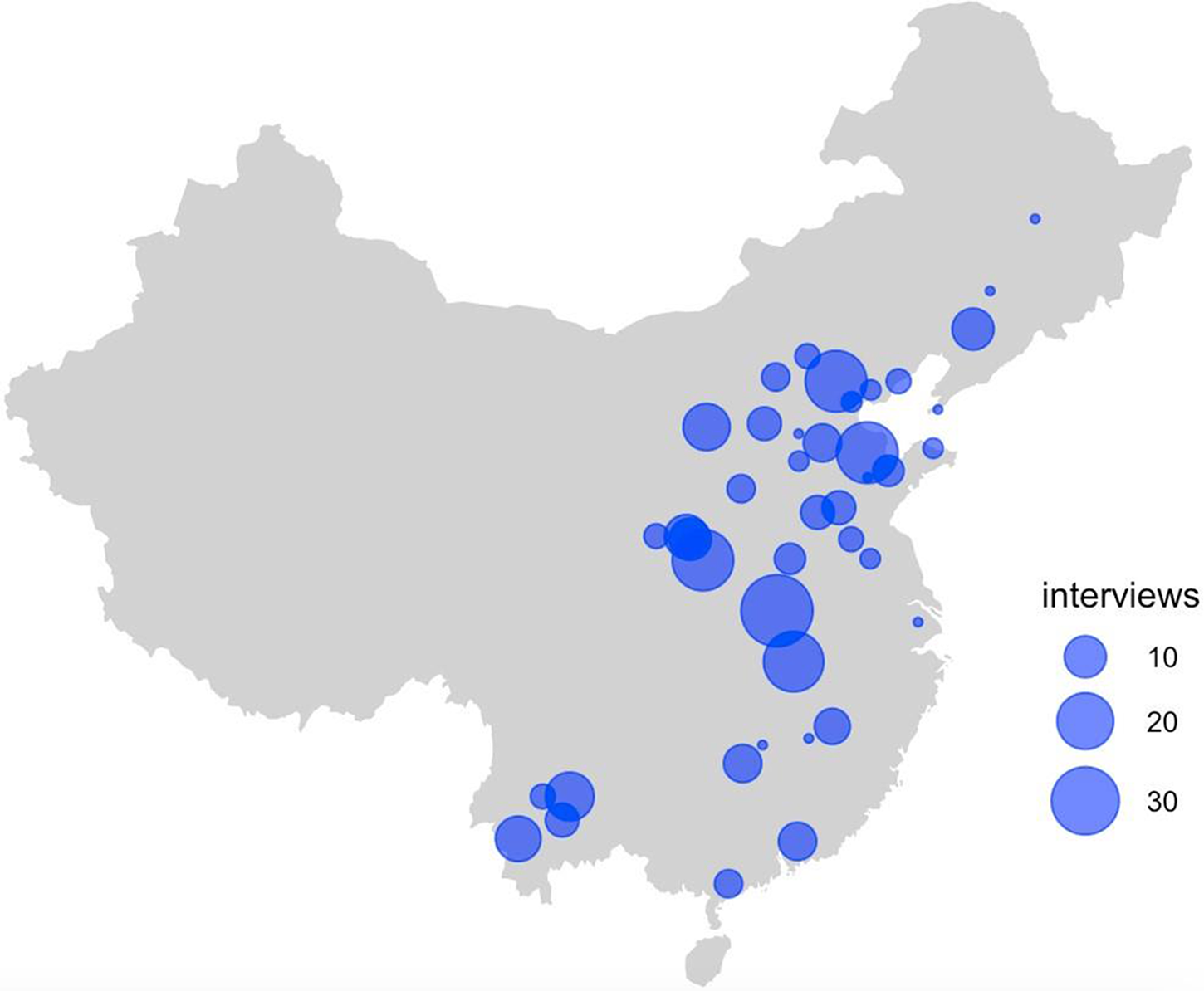
Data for this study are primarily gathered from The Memory Project (minjian jiyi jihua koushu shi 民间记忆计划口述史), a collection of hundreds of oral histories of the Great Famine. Beginning in 2009, Chinese documentary filmmaker Wu Wenguang 吴文光 recruited and trained over 100 young filmmakers who were then dispatched to their hometowns in rural China to interview elders about their experiences during the Famine. The interviews took place between 2010 and 2016 and were recorded on video. For this study, I gathered and processed 307 full interview transcripts from 53 filmmakers in 55 counties, across 16 provinces (see Figure 1).
Distribution of Great Famine Interviews by Prefecture

Working with these data presents both challenges and opportunities. The benefits are significant, given the sensitive topic and vulnerability of the studied population. Through oral histories, researchers can derive meaning and perspective from those whose stories may not otherwise be heard or documented historically, thereby contributing to a deeper understanding of particular events and fostering a communal, experiential knowledge.Footnote 70 Compared to surveys, oral history interviews encourage narrators to provide more detail through follow-up questions. Likewise, oral history narrators typically disclose more personal revelations than participants in semi-structured interviews, where the interviewer is moving down a list of questions, or those in focus groups, where there is less privacy.Footnote 71
While the sample studied here is by no means probabilistic or representative, it offers a high-quality, reliable and singular data source that can provide a high level of internal validity. The non-random nature of the data collection has distinct advantages, as a personal connection with an interviewer can lead interviewees to speak more candidly. As in many politically sensitive contexts, in China, trust and rapport are critical to collecting truthful interview data. Rural villagers, in particular, are often suspicious of outsiders and are uncomfortable being interviewed by strangers.Footnote 72 The interviews in the sample were generally conducted in the interviewee’s homes in a local dialect. The octa- and nonagenarian interviewees spoke in thick, local dialects, which are often incomprehensible to native Mandarin speakers from other parts of China. The interviews were then transcribed by the interviewers, ensuring accurate translations.
It is also important to recognize the limitations of using these data. The Memory Project is essentially an amateur, crowd-sourced documentary film repository. While the filmmakers were trained in documentary film methods, they were not trained social science researchers, leading to wide variation in the substance and style of the interviews. For example, interviewers had different relationships with their home villages. Some were born and raised there and formed an immediate rapport with their interviewees; others were returning home after decades away. In Appendix C in the online supplementary material, I address interviewer effects and demonstrate that my results are robust to different model specifications that take this variation into account.
Furthermore, oral records are inherently subjective, irreplicable and incomplete.Footnote 73 Critics of oral histories point to the “unreliable” nature of memory due to the interviewees’ mental and physical aging, the personal biases of interviewers and respondents, and the influence of public and political narratives of historical experiences.Footnote 74 In this collection of interviews, interviewees often forgot or misremembered certain dates, places and names. However, for the purposes of this study, the “unreliability” of oral histories can help, rather than hinder, our learning about the long-term effects of state repression. How people speak and behave in the present is not just a function of some pure experience – it also reflects how that experience has been shaped and distorted by the active and ongoing construction of memory.Footnote 75 Precisely because oral history is a “post-hoc” representational practice,Footnote 76 it is an “invaluable resource for researching the construction and communication of meaning in the present.”Footnote 77
Particularly in a setting such as China, where narratives are tightly controlled by the regime, oral histories can shed light on narratives that have otherwise been silenced because they diverge from “official” accounts of events. Alternative narratives are difficult to find. Access to the population of interest – rural elders who lived through the Famine – is severely limited and becoming even more so as access to the field is increasingly restricted. Furthermore, in the years since they were interviewed, several interviewees have passed away.Footnote 78
Methodology and measures
H1 attempts to estimate the relationship between Famine survivors’ exposure to state violence and their attitudes towards the state. The key independent variable of interest is stateviolence, measured by the county-level mortality rate in 1960, which is widely considered to be the worst year of the Famine. I use the interview data to construct two key dependent variables to approximate negativity towards the state: explicit negative sentiments (talkpolneg) and latent negative sentiments (sentiment). Talkpolneg is a hand-coded binary variable that indicates whether or not the interviewee spoke in clearly negative terms about state officials, politics or policies. Sentiment is an indicator of how positively or negatively an interviewee discussed their Famine experience. This score is derived from sentiment analysis, a NLP method designed to “determine valence, emotions, and other affectual states from text.”Footnote 79 Examining the relationship between interviewees speaking about canteens and how they discussed politics in H2, the key independent variable is canteen – a hand-coded binary variable that captures whether or not the interviewee explicitly talked about their experiences in the canteens.
Several models include a series of control variables that could plausibly explain both interviewer attitudes and Famine severity: interviewee and interviewer characteristics, as well as economic, geographic and demographic factors that could impact local Famine conditions. I further control for factors that could directly impact the production of food: the presence of natural resources, natural disasters and a suitability index for rice cultivation. Finally, I control for several political factors: excess grain procurement ratio – a proxy for political radicalismFootnote 80 – and death rate during the Cultural Revolution (1966–1971)Footnote 81 to ensure that I am capturing the impact of state violence during the Famine and not subsequent episodes of state-inflicted violence.Footnote 82 For more details on methodology, measures and data, see Appendix A in the online supplementary material.
Empirical Strategy and Results
I use a mixed-methods approach to analyse the data. The combination of qualitative analysis of the interviews, descriptive text analysis of the transcripts and regression analysis provides a deep, multifaceted look at this unique data source, which could not be gleaned by one method alone.Footnote 83
Descriptive text analysis
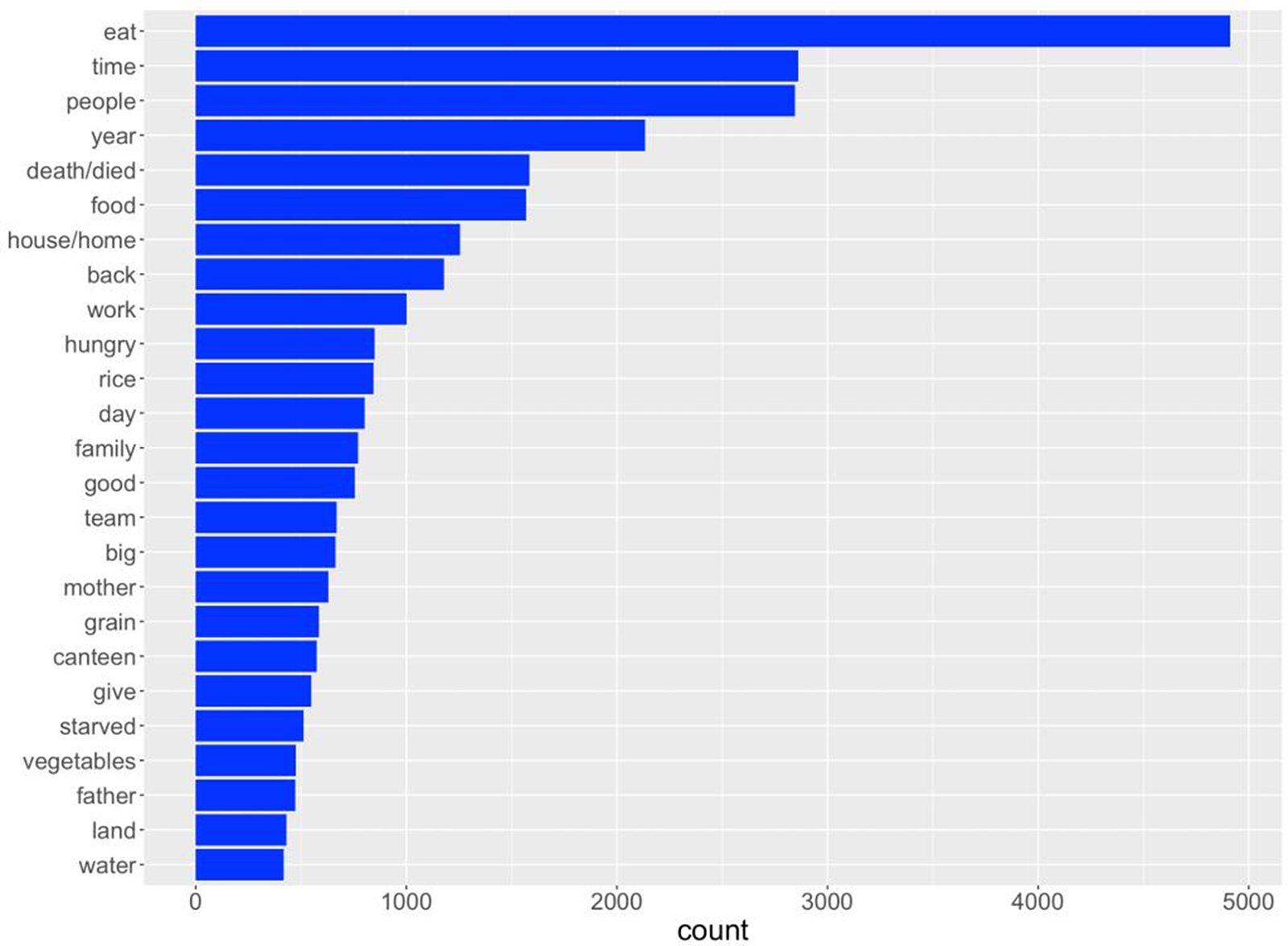
I first provide a descriptive analysis of the interview corpus using several NLP methods.Footnote 84 Figure 2 presents a simple visualization of the words interviewees use most frequently in the interviews. “Eat” is the most frequently used word by far, with nearly 5,000 mentions across the 307 interviews.Footnote 85 Predictably, interviewees emphasize and repeat words relating to food (“rice,” “grain,” “vegetables”), words that convey extreme food scarcity (“death/died,” “hungry,” “starve(d)”), and features that defined their daily lives (“work,” “family,” “canteen”).
Most Frequently Used Words in Great Famine Interviews

Next, I construct a structural topic model (STM) to examine how different interviewees might talk about the same underlying topic using different word choices. STMs are an unsupervised, generative model of word counts that allow researchers to discover topics and estimate their relationship to document metadata.Footnote 86
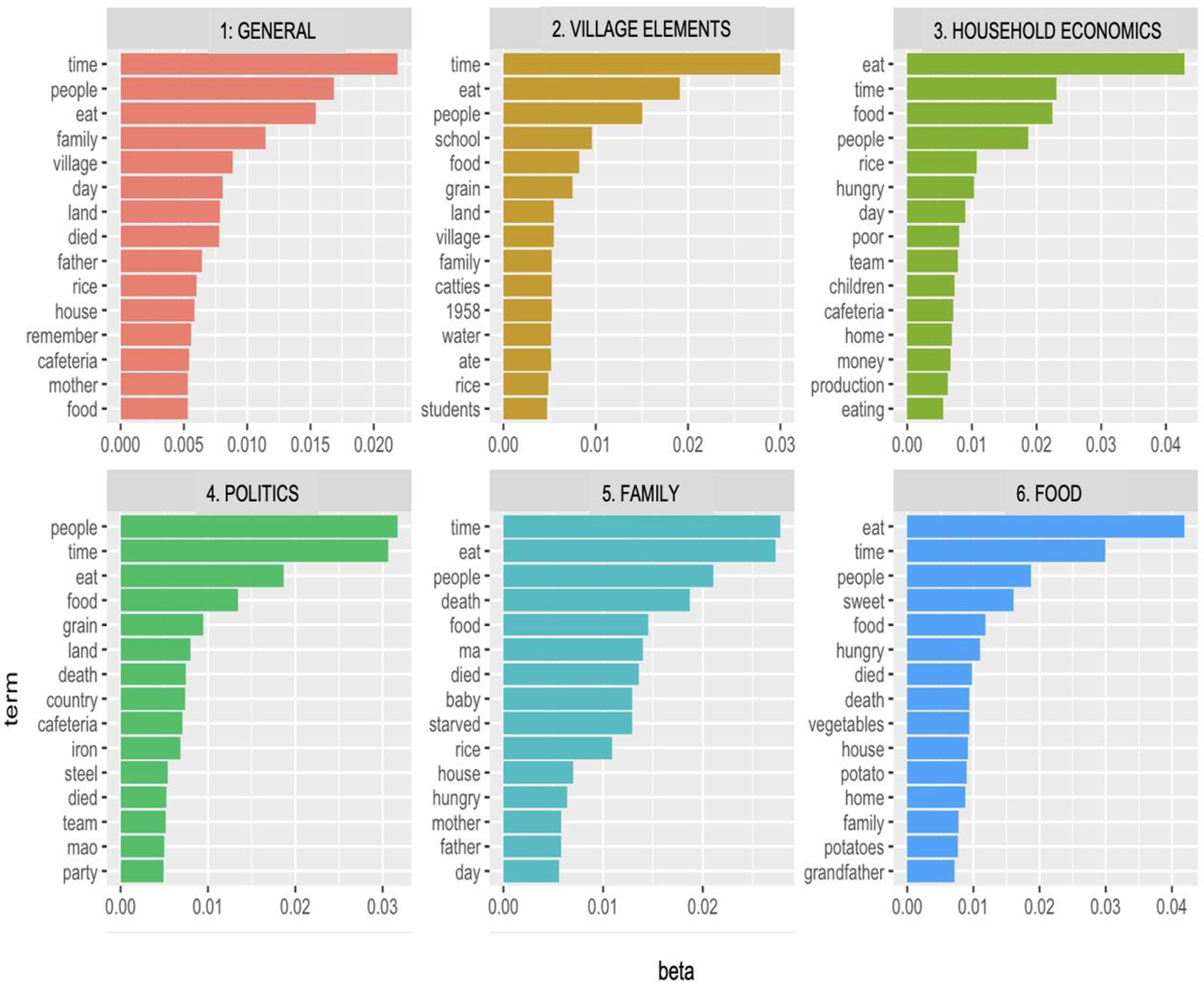
The output of the STM (Figure 3) shows highest word probabilities for each topic, and that different words are associated with different topics. The words with the highest betas in each topic are indistinguishable – the first three words for all six topics are “eat,” “people” and “time.” This is not unexpected, as the interviews are naturally dominated by a single topic: the Famine. However, looking past the top three words, there is, in fact, significant and defined variation among topics. For instance, while Topic 1 is more general, Topic 2 is about village elements, Topic 3 focuses on the household economic situation and scarcity, Topic 4 is about politics, Topic 5 focuses on family and Topic 6 is about specific types of food.Footnote 87
Structural Topic Modelling of Great Famine Interviews

Hypothesis testing
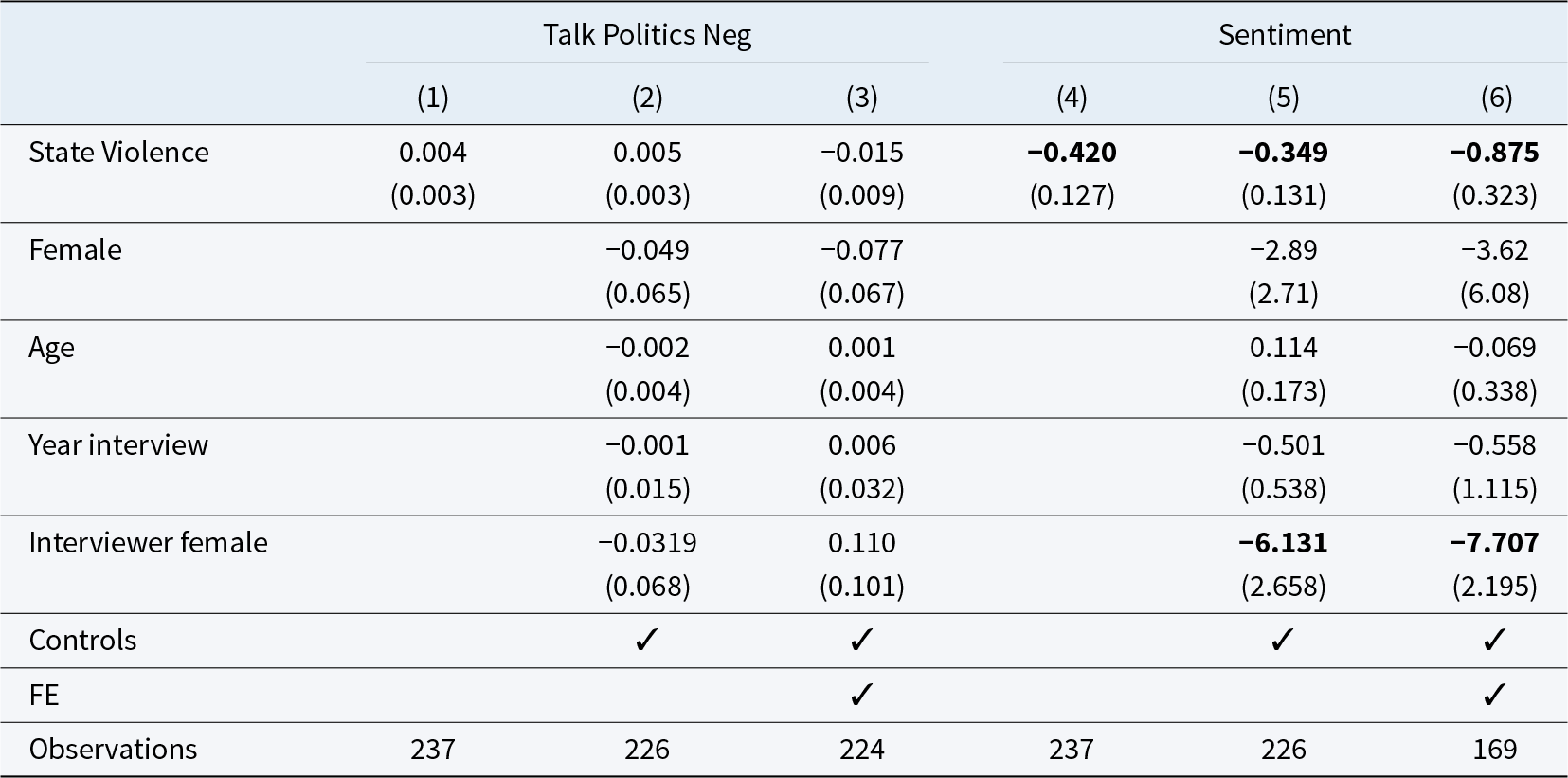
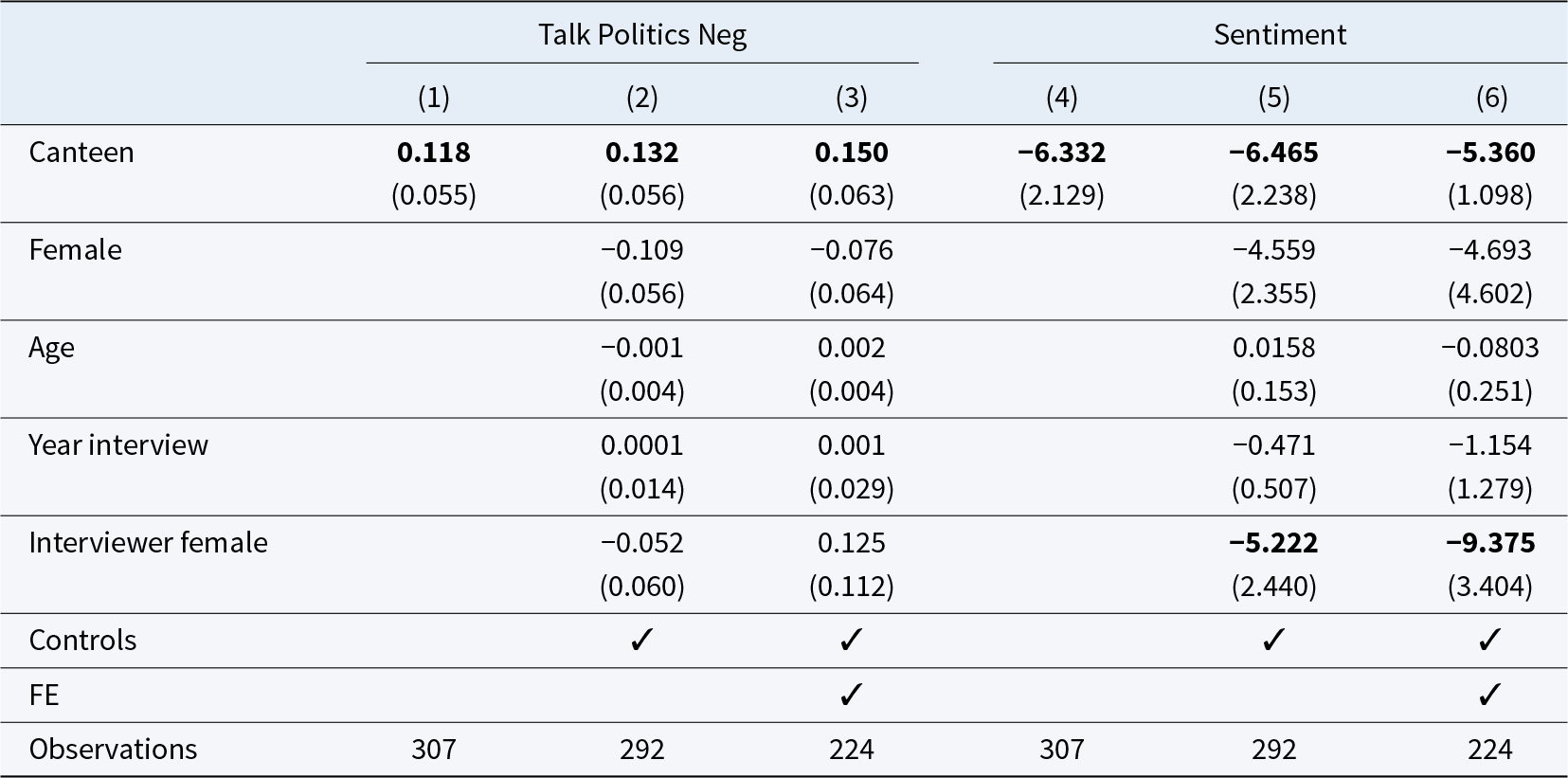
Drawing on data derived from the entire body of interviews, I use OLS regressions to test my hypotheses. In testing both H1 (Table 1) and H2 (Table 2), Models (1) and (4) test the bivariate relationship between the key independent and dependent variables; Models (2) and (5) control for interviewer and interviewee characteristics; and Models (3) and (6) use the full battery of control variables and province-level fixed effects.
Impact of State Repression on Respondent Attitudes

Notes: Significant results at p < 0.05 in bold. Robust standard errors in parentheses. In FE models, standard errors are clustered at the province level.
Impact of Canteen Recollection on Negative Attitudes Towards the Government
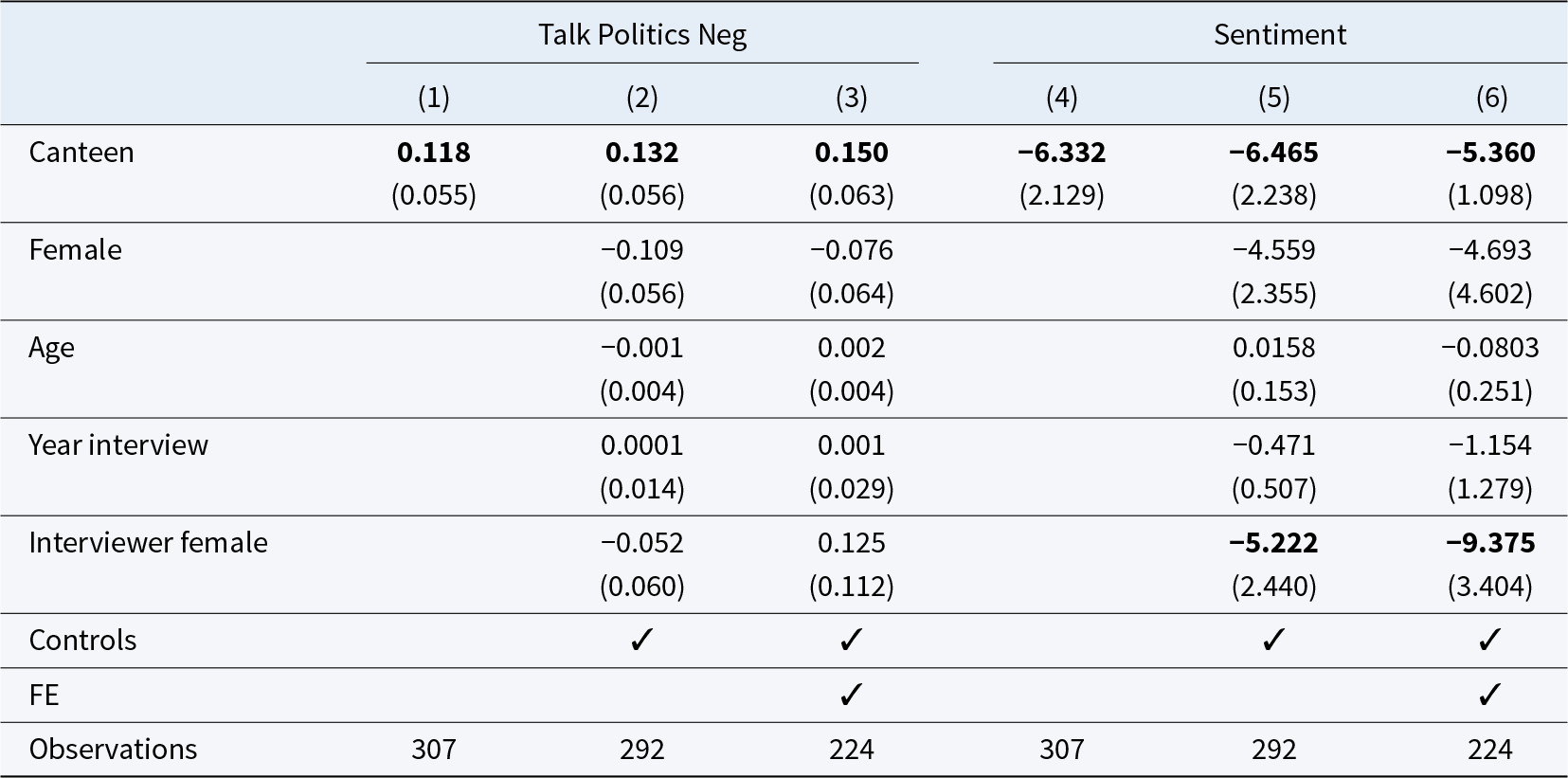
Notes: Significant results at p < 0.05 in bold. Robust standard errors in parentheses. In FE models, standard errors are clustered at the province level.
The results in Table 1 partially support my theoretical expectations. Contrary to my hypothesis that survivors would be less likely to express negative political attitudes, Models (1), (2) and (3) find no significant relationship between state violence and the expression of negative political attitudes (H1a). However, Models (4), (5) and (6) show that interviewees from counties that experienced greater violence do possess more unspoken negative sentiments towards the state (H1b). State violence and sentiment score are inversely related, indicating that the more intense the violence, the more negative survivor accounts are likely to be. While interviewees do not necessarily withhold explicit criticism, nor do they publicly voice more explicitly negative attitudes towards the state, instead allowing negative sentiments to filter through in their choice of words and descriptions of the Famine.
I next test the relationship between the recollection of communal canteens and political attitudes (H2). Here, I find strong support for my hypotheses. As shown in Table 2, all model specifications yield statistically significant results, indicating that people who speak about canteens both hold more latent resentment towards the state (H2a) and voice more explicitly negative opinions about the state (H2b).
Models (1), (2) and (3) show that those who talk about their time in the canteens are between 11.8 and 15 per cent more likely to speak negatively about the government. Models (4), (5) and (6) indicate that interviewees who speak about their experiences in the canteens also possess more latent negative sentiments towards the state: respondents who discuss the canteens have sentiment scores 5.3 to 6.4 points lower than those who do not.
I consider that public political narratives initiated after the Famine could bias results. The negativity could be the result of the deliberate cultivation of resentment towards local leaders as part of the “Anti-five winds” campaign and is thus a reflection of villagers accepting a narrative that largely absolves the centre of blame. However, there is little evidence to suggest that villagers accept the official story regarding responsibility for the Famine or parrot official campaign rhetoric: of the 307 interviewees, only 25 (8 per cent) attribute the Famine (either primarily or as a contributing factor) to natural disasters, and 9 (3 per cent) cite foreign debt or China’s international relations as a major factor. This is consistent with other studies of the Famine that find that the campaign was “more or less taken over by popular skepticism.”Footnote 88 Wemheuer finds that “the language of the villagers, cadres and peasants is not influenced by official Party historiography … ‘three years of natural disaster,’ left-wing radicalism or utopian socialism – did not play any role in the memories of the old villagers.”Footnote 89 Thaxton concludes that the campaign “proved incomplete and, often, ineffective … and failed to provide institutionalized reassurances that the Party’s local political base could be trusted to move beyond the politics engendering the Great Leap Famine.”Footnote 90
I further consider the potential for interviewer bias. In both Tables 1 and 2, female interviewers elicit significantly more negative sentiments from their interviewees than their male counterparts. This may be because women are often perceived as better listeners or as more empathetic than men, especially on sensitive topics.Footnote 91 Whatever the case, it is reasonable to assume that interviewer gender, training, body language – any number of idiosyncrasies – could impact interviewee responses. In Appendix C in the online supplementary material, I apply interviewer fixed effects to baseline regressions and show that results for key findings hold.
In a time of extreme scarcity, canteens were often the sole source of food. Despite this, survivors are not nostalgic about good times in the canteens. Instead, survivors associate canteens with the subsequent disaster, often speaking about them in terms of short-sighted excess, harsh repression and bad politics. Considered alongside the qualitative evidence presented above, the canteens stand out as a vivid feature of everyday life, evoking emotional responses from interviewees.
Conclusion
For decades, CCP leaders have wilfully erased any vestige of the Famine from China’s history. Official narratives make no explicit mention of the Famine, only obliquely referencing “mistakes” made during the Great Leap Forward.Footnote 92 Textbooks gloss over it, archival documents from the time remain hidden, public discourse is censored, and artists and writers who tell stories from the Famine are persecuted.
Using a novel, mixed-methods approach to analyse hundreds of interviews with Famine survivors, I examine how and why citizens express or withhold political commentary in their discussions of the man-made tragedy. I find that the intensity of state violence impacts how respondents detail their Famine experiences: interviewees exposed to more intense state violence do not explicitly voice more negative attitudes towards the state; however, they harbour significantly more latent resentment. I also show how attitudes are linked to specific institutions. The recollection of the communal canteens – key sites of repression during the Famine years that are now obsolete – is highly correlated with expressions of negativity and blame towards the state, both explicit and unspoken. Even under current political conditions, with the same repressive regime in power, citizens find ways to air their grievances.
This study has implications for gauging popular support in enduring authoritarian regimes. Despite protracted official attempts at erasure, this study shows that people have not forgotten the horrors of the Famine: intense state repression can have long-lasting, alienating effects on citizens’ political attitudes, creating “silent dissidents” who hold negative views of the regime but do not express them publicly out of political fear.Footnote 93 Other studies have demonstrated that such lingering resentment may also be passed down. As both WangFootnote 94 and Yuyu Chen and David YangFootnote 95 show in the cases of the Cultural Revolution and Famine, respectively, not only does the negative impact of state violence on political trust persist among the survivors themselves for decades, but it can also be transmitted to younger family members not directly exposed to state violence. Further examining the extent to which past experiences of state repression shape collective memory and impact broader support for the regime and its leaders represents an interesting avenue for future research.
Supplementary material
The supplementary material for this article can be found at https://doi.org/10.1017/S0305741025101720.
Acknowledgements
I thank Melanie Manion, Timur Kuran, Adriane Fresh, Livia Schubiger, Hongshen Zhu, Zeren Li, Peng Peng, Xiaoshu Gui, Griffin Riddler, Ying Chi and Xinru Pan for their constructive comments and feedback. Gavin Xu provided excellent research assistance. I am especially indebted to Luo Zhou, the Chinese studies librarian at Duke University Libraries, the Memory Project filmmakers, and all the Famine survivors who relived their experiences for this project. All mistakes are my own.
Competing interests
None.
Viola ROTHSCHILD is an assistant professor of comparative politics at the College of the Holy Cross.


 Open access

