





1 Introduction
Ulam’s measure problem [Reference Marcin UlamUla30] studies when there is a total two-valued measure on the powerset of a set. To identify some of the obstructions, Ulam introduced the Ulam matrices, which in particular he used to show that there is no total countably-additive two-valued measure on the powerset of the first uncountable cardinal, $\aleph _1$
. This is done by inspecting saturation properties of the corresponding ideal of null sets. As it turns out, roughly around that time Sierpiński [Reference SierpińskiSie34] in his work on the Continuum Hypothesis (
$\aleph _1$
. This is done by inspecting saturation properties of the corresponding ideal of null sets. As it turns out, roughly around that time Sierpiński [Reference SierpińskiSie34] in his work on the Continuum Hypothesis ( $\text {CH}$
, the assertion that
$\text {CH}$
, the assertion that $\mathbb R$
has size
$\mathbb R$
has size $\aleph _1$
) had formulated some colouring principles which are in effect generalizations of Ulam’s matrices. Having made this connection, and anticipating applications in infinite combinatorics, in [Reference Inamdar and RinotIR23, Reference Inamdar and RinotIR24], we initiated the study of Sierpiński-type colourings in some generality.
$\aleph _1$
) had formulated some colouring principles which are in effect generalizations of Ulam’s matrices. Having made this connection, and anticipating applications in infinite combinatorics, in [Reference Inamdar and RinotIR23, Reference Inamdar and RinotIR24], we initiated the study of Sierpiński-type colourings in some generality.
The simplest of all, the principle $\operatorname {{\mathsf{onto}}}(J,\theta )$
for an ideal J over a cardinal
$\operatorname {{\mathsf{onto}}}(J,\theta )$
for an ideal J over a cardinal $\kappa $
asserts the existence of an edge-colouring of the complete graph on
$\kappa $
asserts the existence of an edge-colouring of the complete graph on $\kappa $
,
$\kappa $
, $c:[\kappa ]^2\rightarrow \theta $
, satisfying that for every J-positive set B, there exists a vertex
$c:[\kappa ]^2\rightarrow \theta $
, satisfying that for every J-positive set B, there exists a vertex $\eta <\kappa $
such that the bipartite subgraph
$\eta <\kappa $
such that the bipartite subgraph $\{(\eta ,\beta )\mid \beta \in B\text { above }\eta \}$
attains all colours, that is,
$\{(\eta ,\beta )\mid \beta \in B\text { above }\eta \}$
attains all colours, that is, $c[\{\eta \}\circledast B]=\theta $
. This elegant principle as well as some of its weaker variants are all sufficient to imply that every J-positive set may be partitioned into
$c[\{\eta \}\circledast B]=\theta $
. This elegant principle as well as some of its weaker variants are all sufficient to imply that every J-positive set may be partitioned into $\theta $
many J-positive sets (see [Reference Inamdar and RinotIR24, §4] for exact statements). It also allows to characterize classical large cardinals, for instance, a regular uncountable cardinal
$\theta $
many J-positive sets (see [Reference Inamdar and RinotIR24, §4] for exact statements). It also allows to characterize classical large cardinals, for instance, a regular uncountable cardinal $\kappa $
is weakly compact iff
$\kappa $
is weakly compact iff $\operatorname {{\mathsf{onto}}}(J^{\text {bd}}[\kappa ],3)$
fails, and is ineffable iff
$\operatorname {{\mathsf{onto}}}(J^{\text {bd}}[\kappa ],3)$
fails, and is ineffable iff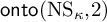 $\operatorname {{\mathsf{onto}}}(\text {NS}_\kappa ,2)$
fails.Footnote
1
Deeper applications to infinite combinatorics have quickly emerged [Reference Lambie-Hanson and RinotLHR23, Reference Carvalho, Inamdar and RinotCIR26, Reference Kostana, Rinot and ShelahKRS26], for instance, Shalev [Reference ShalevSha24] using our results constructed a partial order previously obtained by Todorčević and Kuzeljević [Reference Kuzeljevic and TodorcevicKT23] under an additional axiomatic assumption.
$\operatorname {{\mathsf{onto}}}(\text {NS}_\kappa ,2)$
fails.Footnote
1
Deeper applications to infinite combinatorics have quickly emerged [Reference Lambie-Hanson and RinotLHR23, Reference Carvalho, Inamdar and RinotCIR26, Reference Kostana, Rinot and ShelahKRS26], for instance, Shalev [Reference ShalevSha24] using our results constructed a partial order previously obtained by Todorčević and Kuzeljević [Reference Kuzeljevic and TodorcevicKT23] under an additional axiomatic assumption.
As for this paper, being the third part of the series, the various technical results of [Reference Inamdar and RinotIR23, Reference Inamdar and RinotIR24], and in particular [Reference Inamdar and RinotIR24, Theorem A] clarify the picture considerably, leaving us with a more focused goal in this paper, to take care of the remaining extreme cases, and to consider an important class of ideals that was previously out of our reach. The classes of ideals we studied earlier were characterized mainly by their additivity (or completeness degree – closure under arbitrary unions of a given size), and here the classes of ideals are determined by their indecomposability spectrum (closure under increasing unions of a given length). As will be seen momentarily, this subtle difference will enable to solve a problem left open in Shelah’s monograph [Reference ShelahShe94a].
As an advertisement, we note that this paper can be read without a familiarity with the previous parts of this series, taking results from there as a black box to draw corollaries. Indeed, this paper can be read by anyone with background in set theory; the last two sections also assume familiarity with walks on ordinals [Reference TodorčevićTod87].
Our first result is the following improvement of the characterization of large cardinals mentioned earlier.
Theorem A. Suppose that $\theta <\kappa $
is a pair of infinite regular cardinals.
$\theta <\kappa $
is a pair of infinite regular cardinals.
-
• If there exists a $\kappa $
-Aronszajn tree, then
$\operatorname {{\mathsf{onto}}}(J^{\mathrm {bd}}[\kappa ],\theta )$
holds;
$\kappa $
-Aronszajn tree, then
$\operatorname {{\mathsf{onto}}}(J^{\mathrm {bd}}[\kappa ],\theta )$
holds; -
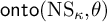
• If the ineffable tree property fails at
$\kappa $
, then
$\operatorname {{\mathsf{onto}}}(\mathrm {NS}_\kappa ,\theta )$
holds.



Our second result is an instance of $\operatorname {{\mathsf{unbounded}}}^+(\ldots )$
with a provably optimal number of colours. In fact, all the results here are sharp as will be explained soon.
$\operatorname {{\mathsf{unbounded}}}^+(\ldots )$
with a provably optimal number of colours. In fact, all the results here are sharp as will be explained soon.
Theorem B. Suppose that $\kappa $
is a regular uncountable cardinal that is not strongly inaccessible, and let
$\kappa $
is a regular uncountable cardinal that is not strongly inaccessible, and let $\theta $
denote the least cardinal to satisfy
$\theta $
denote the least cardinal to satisfy $2^\theta \ge \kappa $
.
$2^\theta \ge \kappa $
.
Then $\operatorname {{\mathsf{unbounded}}}^+(J^{\mathrm {bd}}[\kappa ], \theta )$
holds.
$\operatorname {{\mathsf{unbounded}}}^+(J^{\mathrm {bd}}[\kappa ], \theta )$
holds.
This takes care of the remaining cases left open by our previous works. Moving on to deal with indecomposable ideals, our next result improves a theorem of Eisworth [Reference EisworthEis12, §3], by itself an improvement of classical theorems of Chang [Reference ChangCha67, §1], Kunen and Prikry [Reference Kunen and PrikryKP71], and, of course, Ulam’s original [Reference Marcin UlamUla30].
Theorem C. Suppose $\lambda $
is an infinite cardinal, and J is a uniform ideal over
$\lambda $
is an infinite cardinal, and J is a uniform ideal over $\lambda ^+$
.
$\lambda ^+$
.
If J is $\operatorname {\mathrm {cf}}(\lambda )$
-indecomposable and
$\operatorname {\mathrm {cf}}(\lambda )$
-indecomposable and $\sup \{\theta \in \operatorname {\mathrm {Reg}}(\lambda ^+)\mid J\text { is }\theta \text {-indecomposable}\}=\lambda $
, then
$\sup \{\theta \in \operatorname {\mathrm {Reg}}(\lambda ^+)\mid J\text { is }\theta \text {-indecomposable}\}=\lambda $
, then  holds.
Compared to the classical proof approach used by Ketonen [Reference KetonenKet73], Prikry [Reference PrikryPri73], Kanamori [Reference KanamoriKan76], as well as in the more recent work of Shelah [Reference ShelahShe94b, §3] and its extensions by Eisworth [Reference EisworthEis10, Reference EisworthEis12] that involve the notion of a least function modulo an ideal, the proofs here use the two-dimensional last function isolated by Zhang and Rinot in [Reference Rinot and ZhangRZ21, Definition 2.10] in the context of walks on ordinals.
As further evidence of the utility of our method, we have the following theorem. Its first clause improves a corollary arising from [Reference Lambie-Hanson and RinotLHR23, Theorem 4.13(2) and Lemma 3.38(3)]. Its second clause improves a theorem of Prikry and Silver [Reference PrikryPri73, Theorem 4] and a theorem of Eisworth [Reference EisworthEis10, Theorem 2]. Its third clause improves a milestone result of Hajnal [Reference HajnalHaj69] which was the first to address limit cardinals.
Theorem D. Suppose $\mu <\kappa $
is a pair of infinite regular cardinals, and J is a
$\mu <\kappa $
is a pair of infinite regular cardinals, and J is a $\mu $
-complete uniform ideal over
$\mu $
-complete uniform ideal over $\kappa $
. Consider
$\kappa $
. Consider $T:=\{\tau <\kappa \mid J\text { is }\operatorname {\mathrm {cf}}(\tau )\text {-indecomposable}\}$
.
$T:=\{\tau <\kappa \mid J\text { is }\operatorname {\mathrm {cf}}(\tau )\text {-indecomposable}\}$
.
-
• if
$\square (\kappa ,{<}\mu )$
holds and
$T\neq \emptyset $
, then
$\operatorname {{\mathsf{unbounded}}}^+(J,\kappa )$
holds; -
• if there is a family of less than
$\mu $
many stationary subsets of T that do not reflect simultaneously, then holds; -
• if there is a family of less than
$\mu $
many stationary subsets of T that do not reflect simultaneously at regulars, and
$\sup \{\theta \in \operatorname {\mathrm {Reg}}(\kappa )\mid J\text { is }\theta \text {-indecomposable}\}=\kappa $
, then holds.




 holds;

 holds.
 We now present an application to Ramsey theory of the higher infinite. In his Cardinal Arithmetic book, Shelah proved [Reference ShelahShe94b, Conclusion 4.8(2)] that for a weakly inaccessible $\kappa $
and a regular
$\kappa $
and a regular $\chi <\kappa $
, if
$\chi <\kappa $
, if $E^\kappa _{\ge \chi }$
admits a stationary set that does not reflect at regulars, then the strong anti-Ramsey principle
$E^\kappa _{\ge \chi }$
admits a stationary set that does not reflect at regulars, then the strong anti-Ramsey principle $\operatorname {\mathrm {Pr}}_1(\kappa ,\kappa ,\theta ,\chi )$
holds for every
$\operatorname {\mathrm {Pr}}_1(\kappa ,\kappa ,\theta ,\chi )$
holds for every $\theta <\kappa $
. Whether this may be improved to get
$\theta <\kappa $
. Whether this may be improved to get $\theta =\kappa $
remained open, yet it was clear that an affirmative answer would follow from a particular extension of Hajnal’s 1969 theorem weaker than the third clause of Theorem D.
$\theta =\kappa $
remained open, yet it was clear that an affirmative answer would follow from a particular extension of Hajnal’s 1969 theorem weaker than the third clause of Theorem D.
Theorem E. Suppose that $\kappa $
is weakly inaccessible,
$\kappa $
is weakly inaccessible, $\chi \in \operatorname {\mathrm {Reg}}(\kappa )$
, and
$\chi \in \operatorname {\mathrm {Reg}}(\kappa )$
, and $E^\kappa _{\ge \chi }$
admits a stationary subset that does not reflect at regulars. Then
$E^\kappa _{\ge \chi }$
admits a stationary subset that does not reflect at regulars. Then $\operatorname {\mathrm {Pr}}_1(\kappa ,\kappa ,\kappa ,\chi )$
holds.
$\operatorname {\mathrm {Pr}}_1(\kappa ,\kappa ,\kappa ,\chi )$
holds.
This is the final cut. A combination of [Reference Inamdar and RinotIR24, Theorem A] and [Reference Lambie-Hanson and RinotLHR21, Theorem 3.3] yields that Theorem A cannot be improved to get $\theta =\kappa $
. By [Reference Inamdar and RinotIR23, Theorem 9.10], the number of colours in Theorem B cannot be more than
$\theta =\kappa $
. By [Reference Inamdar and RinotIR23, Theorem 9.10], the number of colours in Theorem B cannot be more than $\theta $
. By [Reference Ben-David and MagidorBM86, Theorem 1] and [Reference Keisler and TarskiKT64, Theorem 4.16], neither the first nor the second requirement of Theorem C can be dropped. By [Reference Lambie-Hanson, Rinot and ZhangLHRZ25, Theorem C], neither the requirement that J be
$\theta $
. By [Reference Ben-David and MagidorBM86, Theorem 1] and [Reference Keisler and TarskiKT64, Theorem 4.16], neither the first nor the second requirement of Theorem C can be dropped. By [Reference Lambie-Hanson, Rinot and ZhangLHRZ25, Theorem C], neither the requirement that J be $\mu $
-complete nor the focus on stationary subsets of T in Theorem D can be dropped. By [Reference Lambie-Hanson and RinotLHR21, Corollary 6.6], Theorem E cannot be improved to get
$\mu $
-complete nor the focus on stationary subsets of T in Theorem D can be dropped. By [Reference Lambie-Hanson and RinotLHR21, Corollary 6.6], Theorem E cannot be improved to get $\operatorname {\mathrm {Pr}}_1(\kappa ,\kappa ,\kappa ,\chi ^+)$
.
$\operatorname {\mathrm {Pr}}_1(\kappa ,\kappa ,\kappa ,\chi ^+)$
.
1.1 Organization of this paper
In Section 2, we collect various notation that we will use throughout the paper. We also define here the Sierpiński-type colouring principles which are the subject of this paper and prove some basic results about them.
In Section 3, we prove Theorem A. Our focus here is the effect of the failure of tree properties on the colouring principle $\operatorname {{\mathsf{onto}}}(\ldots )$
.
$\operatorname {{\mathsf{onto}}}(\ldots )$
.
In Section 4, we prove Theorem B. Our focus here is to obtain the maximum possible number of colours for the principle $\operatorname {{\mathsf{unbounded}}}^+(\ldots )$
.
$\operatorname {{\mathsf{unbounded}}}^+(\ldots )$
.
In Section 5, we prove some results about the new principle  which we introduce in this paper. This is where our focus shifts to ideals characterised by their indecomposability spectrum.
In Section 6, we push further, aiming for the maximum number of colours for ideals characterised by their indecomposability spectrum. Theorems C and D are proved here.
In Section 7, we give some applications to anti-Ramsey theory. Theorem E is proved here.
2 Preliminaries
2.1 Conventions
Throughout the paper, $\kappa $
stands for a regular uncountable cardinal,
$\kappa $
stands for a regular uncountable cardinal, $\lambda $
stands for an infinite cardinal, and
$\lambda $
stands for an infinite cardinal, and $\theta ,\mu ,\nu ,\chi $
stand for arbitrary cardinals. We assume the reader is comfortable with walks on ordinals; our conventions in this respect may be found in [Reference Inamdar and RinotIR25, §4]. The definitions of square principles such as
$\theta ,\mu ,\nu ,\chi $
stand for arbitrary cardinals. We assume the reader is comfortable with walks on ordinals; our conventions in this respect may be found in [Reference Inamdar and RinotIR25, §4]. The definitions of square principles such as $\square (\kappa ,{<}\mu )$
may be found in [Reference Meir Brodsky and RinotBR19, Definition 1.16].
$\square (\kappa ,{<}\mu )$
may be found in [Reference Meir Brodsky and RinotBR19, Definition 1.16]. $\operatorname {\mathrm {Reg}}(\kappa )$
denotes the collection of all infinite regular cardinals below
$\operatorname {\mathrm {Reg}}(\kappa )$
denotes the collection of all infinite regular cardinals below $\kappa $
, and
$\kappa $
, and $\operatorname {\mathrm {Sing}}(\kappa )$
denotes the collection of all limit singular ordinals below
$\operatorname {\mathrm {Sing}}(\kappa )$
denotes the collection of all limit singular ordinals below $\kappa $
. For
$\kappa $
. For $A,B$
sets of ordinals, we denote
$A,B$
sets of ordinals, we denote $A\circledast B:=\{(\alpha ,\beta )\in A\times B\mid \alpha <\beta \}$
and we write
$A\circledast B:=\{(\alpha ,\beta )\in A\times B\mid \alpha <\beta \}$
and we write $[B]^2$
for
$[B]^2$
for $B\circledast B$
. For
$B\circledast B$
. For $\theta \neq 2$
,
$\theta \neq 2$
, $[B]^\theta $
stands for the collection of all subsets of B of size
$[B]^\theta $
stands for the collection of all subsets of B of size $\theta $
. Let
$\theta $
. Let $E^\kappa _\theta :=\{\alpha < \kappa \mid \operatorname {\mathrm {cf}}(\alpha ) = \theta \}$
, and define
$E^\kappa _\theta :=\{\alpha < \kappa \mid \operatorname {\mathrm {cf}}(\alpha ) = \theta \}$
, and define $E^\kappa _{\le \theta }$
,
$E^\kappa _{\le \theta }$
, $E^\kappa _{<\theta }$
,
$E^\kappa _{<\theta }$
, $E^\kappa _{\ge \theta }$
,
$E^\kappa _{\ge \theta }$
, $E^\kappa _{>\theta }$
,
$E^\kappa _{>\theta }$
, $E^\kappa _{\neq \theta }$
analogously. For a set of ordinals A, we write
$E^\kappa _{\neq \theta }$
analogously. For a set of ordinals A, we write $\operatorname {\mathrm {ssup}}(A) := \sup \{\alpha + 1 \mid \alpha \in A\}$
,
$\operatorname {\mathrm {ssup}}(A) := \sup \{\alpha + 1 \mid \alpha \in A\}$
, $\operatorname {\mathrm {acc}}^+(A) := \{\alpha < \operatorname {\mathrm {ssup}}(A) \mid \sup (A \cap \alpha ) = \alpha> 0\}$
,
$\operatorname {\mathrm {acc}}^+(A) := \{\alpha < \operatorname {\mathrm {ssup}}(A) \mid \sup (A \cap \alpha ) = \alpha> 0\}$
, $\operatorname {\mathrm {acc}}(A) := A \cap \operatorname {\mathrm {acc}}^+(A)$
, and
$\operatorname {\mathrm {acc}}(A) := A \cap \operatorname {\mathrm {acc}}^+(A)$
, and $\operatorname {\mathrm {nacc}}(A) := A \setminus \operatorname {\mathrm {acc}}(A)$
. For a stationary
$\operatorname {\mathrm {nacc}}(A) := A \setminus \operatorname {\mathrm {acc}}(A)$
. For a stationary $S\subseteq \kappa $
, we write
$S\subseteq \kappa $
, we write $\operatorname {\mathrm {Tr}}(S):= \{\alpha \in E^\kappa _{>\omega }\mid S\cap \alpha \text { is stationary in }\alpha \}$
; we say that S reflects (resp. reflects at regulars) iff
$\operatorname {\mathrm {Tr}}(S):= \{\alpha \in E^\kappa _{>\omega }\mid S\cap \alpha \text { is stationary in }\alpha \}$
; we say that S reflects (resp. reflects at regulars) iff $\operatorname {\mathrm {Tr}}(S)$
is nonempty (resp. contains a regular cardinal). A family
$\operatorname {\mathrm {Tr}}(S)$
is nonempty (resp. contains a regular cardinal). A family $\mathcal S$
of stationary subsets of
$\mathcal S$
of stationary subsets of $\kappa $
is said to reflect (resp. reflect at regulars) iff
$\kappa $
is said to reflect (resp. reflect at regulars) iff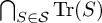 $\bigcap _{S\in \mathcal S}\operatorname {\mathrm {Tr}}(S)$
is nonempty (resp. contains a regular cardinal). For two functions
$\bigcap _{S\in \mathcal S}\operatorname {\mathrm {Tr}}(S)$
is nonempty (resp. contains a regular cardinal). For two functions $f,g$
from ordinals to ordinals, we let
$f,g$
from ordinals to ordinals, we let
 $$ \begin{align*}\Delta(f,g):=\min\{\operatorname{\mathrm{dom}}(f),\operatorname{\mathrm{dom}}(g),\delta\mid \delta\in\operatorname{\mathrm{dom}}(f)\cap\operatorname{\mathrm{dom}}(g)\ \&\ f(\delta)\neq g(\delta)\}.\end{align*} $$
2.2 Ideals
For an ideal J over $\kappa $
, the collection of J-positive sets is denoted by
$\kappa $
, the collection of J-positive sets is denoted by $J^+:=\mathcal P(\kappa )\setminus J$
. We say that J is uniform iff
$J^+:=\mathcal P(\kappa )\setminus J$
. We say that J is uniform iff $J\supseteq J^{\text {bd}}[\kappa ]$
. For a cardinal
$J\supseteq J^{\text {bd}}[\kappa ]$
. For a cardinal $\theta $
, J is weakly
$\theta $
, J is weakly $\theta $
-saturated if there is no family of
$\theta $
-saturated if there is no family of $\theta $
-many pairwise disjoint elements of
$\theta $
-many pairwise disjoint elements of $J^+$
. Given
$J^+$
. Given $B\in J^+$
, we write
$B\in J^+$
, we write $J\restriction B$
for
$J\restriction B$
for $J\cap \mathcal P(B)$
. The ideal J is
$J\cap \mathcal P(B)$
. The ideal J is $\nu $
-complete iff it is closed under unions of length less than
$\nu $
-complete iff it is closed under unions of length less than $\nu $
; it is
$\nu $
; it is $\theta $
-indecomposable iff for every function
$\theta $
-indecomposable iff for every function $f:B\rightarrow \theta $
with
$f:B\rightarrow \theta $
with $B\in J^+$
, there exists a
$B\in J^+$
, there exists a $T\in [\theta ]^{<\theta }$
such that
$T\in [\theta ]^{<\theta }$
such that $f^{-1}[T]$
is in
$f^{-1}[T]$
is in $J^+$
.
$J^+$
.
-
•
$\mathcal J^\kappa _\nu $
denotes the collection of all
$\nu $
-complete ideals over
$\kappa $
extending
$J^{\text {bd}}[\kappa ]$
; -
•
$\mathcal I^\kappa _\theta $
denotes the collection of all
$I\in \mathcal J^\kappa _\omega $
that are
$\theta $
-indecomposable.


Note that $\mathcal J^\kappa _\theta \cap \mathcal I^\kappa _\theta =\mathcal J^\kappa _{\theta ^+}$
. In particular,
$\mathcal J^\kappa _\theta \cap \mathcal I^\kappa _\theta =\mathcal J^\kappa _{\theta ^+}$
. In particular, $\mathcal I^\kappa _\omega =\mathcal J^\kappa _{\omega _1}$
. Also note that if
$\mathcal I^\kappa _\omega =\mathcal J^\kappa _{\omega _1}$
. Also note that if $\mathcal I^\kappa _\theta $
contains a proper ideal, then
$\mathcal I^\kappa _\theta $
contains a proper ideal, then $\operatorname {\mathrm {cf}}(\kappa ) \neq \theta $
.
$\operatorname {\mathrm {cf}}(\kappa ) \neq \theta $
.
Example 2.1. Given a bijection $\pi :\kappa \leftrightarrow \kappa \times \kappa $
, let J be the collection of all
$\pi :\kappa \leftrightarrow \kappa \times \kappa $
, let J be the collection of all $A\subseteq \kappa $
such that
$A\subseteq \kappa $
such that $\sup \{\eta _0<\kappa \mid \sup \{\eta _1<\kappa \mid \pi ^{-1}(\eta _0,\eta _1)\in A\}=\kappa \}<\kappa $
. Then
$\sup \{\eta _0<\kappa \mid \sup \{\eta _1<\kappa \mid \pi ^{-1}(\eta _0,\eta _1)\in A\}=\kappa \}<\kappa $
. Then $J\in \mathcal J^\kappa _\kappa $
.
$J\in \mathcal J^\kappa _\kappa $
.
2.3 Sierpiński-type colouring principles
In reading the next definition, recall that a colouring $c:[\kappa ]^2 \rightarrow \theta $
is upper-regressive if
$c:[\kappa ]^2 \rightarrow \theta $
is upper-regressive if $c(\alpha ,\beta )<\beta $
for all
$c(\alpha ,\beta )<\beta $
for all $\alpha <\beta <\kappa $
.
$\alpha <\beta <\kappa $
.
Definition 2.2. For a family $\mathcal A\subseteq \mathcal P(\kappa )$
and an ideal J over
$\mathcal A\subseteq \mathcal P(\kappa )$
and an ideal J over $\kappa $
:
$\kappa $
:
-
(i)
$\operatorname {{\mathsf{onto}}}^{++}(\mathcal A,J,\theta )$
asserts the existence of a colouring
$c:[\kappa ]^2\rightarrow \theta $
with the property that, for every
$A\in \mathcal A$
and every sequence
$\langle B_\tau \mid \tau <\theta \rangle $
of elements of
$J^+$
, there is an
$\eta \in A$
such that
$\{ \beta \in B_\tau \setminus (\eta +1)\mid c(\eta ,\beta )=\tau \}\in J^+$
for every
$\tau <\theta $
; -
(ii)
$\operatorname {{\mathsf{onto}}}^+(\mathcal A,J,\theta )$
asserts the existence of a colouring
$c:[\kappa ]^2\rightarrow \theta $
with the property that, for all
$A\in \mathcal A$
and
$B\in J^+$
, there is an
$\eta \in A$
such that
$$ \begin{align*}\{\tau<\theta\mid \{\beta\in B\setminus(\eta+1)\mid c(\eta,\beta)=\tau\}\in J^+\}=\theta;\end{align*} $$
-
(iii)
$\operatorname {{\mathsf{unbounded}}}^+(\mathcal A,J,\theta )$
asserts the existence of an upper-regressive colouring
${c:[\kappa ]^2\rightarrow \theta }$
with the property that, for all
$A\in \mathcal A$
and
$B\in J^+$
, there is an
$\eta \in A$
such that
$$ \begin{align*}\operatorname{\mathrm{otp}}(\{\tau<\theta\mid \{\beta\in B\setminus(\eta+1)\mid c(\eta,\beta)=\tau\}\in J^+\})=\theta;\end{align*} $$
-
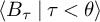
(iv)
asserts the existence of an upper-regressive colouring
${c:[\kappa ]^2\rightarrow \theta }$
with the property that, for all
$A\in \mathcal A$
and
$B\in J^+$
, there are an
$\eta \in A$
and a set
$T\in [\theta ]^\theta $
such that, for every pair
$\sigma <\tau $
of ordinals from T,
$\{\beta \in B\setminus (\eta +1)\mid \sigma \le c(\eta ,\beta )<\tau \}\in J^+$
.













 asserts the existence of an upper-regressive colouring



Convention 2.3. If we omit $\mathcal A$
, then we mean that
$\mathcal A$
, then we mean that $\mathcal A:=\{\kappa \}$
. As for the second parameter, we may also assign a family
$\mathcal A:=\{\kappa \}$
. As for the second parameter, we may also assign a family $\mathcal J$
of ideals instead of a single ideal, in which case we mean that the colouring c witnesses the instance for all
$\mathcal J$
of ideals instead of a single ideal, in which case we mean that the colouring c witnesses the instance for all $J\in \mathcal J$
simultaneously.
$J\in \mathcal J$
simultaneously.
It is not hard to see that (i) $\implies $
(ii)
$\implies $
(ii) $\implies $
(iii)
$\implies $
(iii) $\implies $
(iv) in Definition 2.2. In [Reference Inamdar and RinotIR24, §4], one can find methods for proving nontrivial implications between instances of the above. The principles appearing in Clauses (i)–(iii) were introduced in [Reference Inamdar and RinotIR23], and their connection to Ulam matrices is discussed in Section 5 of that paper. Clause (iv) is new and is still sufficient to deduce non-weak saturation, as stated in Clause (1) of the upcoming lemma. The other clauses of the lemma will only be used in Sections 5 and 6, hence we recommend that the reader skip it on a first pass.
$\implies $
(iv) in Definition 2.2. In [Reference Inamdar and RinotIR24, §4], one can find methods for proving nontrivial implications between instances of the above. The principles appearing in Clauses (i)–(iii) were introduced in [Reference Inamdar and RinotIR23], and their connection to Ulam matrices is discussed in Section 5 of that paper. Clause (iv) is new and is still sufficient to deduce non-weak saturation, as stated in Clause (1) of the upcoming lemma. The other clauses of the lemma will only be used in Sections 5 and 6, hence we recommend that the reader skip it on a first pass.
Lemma 2.4. Suppose that  holds with $\mathcal A\neq \emptyset $
and
$\mathcal A\neq \emptyset $
and $\mathcal I\subseteq \mathcal J^\kappa _\omega $
. Then:
$\mathcal I\subseteq \mathcal J^\kappa _\omega $
. Then:
-
(1) For every
$I\in \mathcal I$
, every
$B\in I^+$
may be decomposed into
$\theta $
-many
$I^+$
-sets. -
(2) If
$\mathcal A=\{\nu \}$
and
$\theta =\vartheta ^+$
for a regular uncountable cardinal
$\vartheta <\nu $
, then
$\operatorname {{\mathsf{unbounded}}}^+(\{\nu \}, \mathcal I,\vartheta )$
holds. -
(3) Suppose
$\theta =\omega $
.-
• If
$\mathcal A=\{\nu \}$
and
$\mathfrak d\le \nu $
, then
$\operatorname {{\mathsf{onto}}}^+(\{\nu \},\mathcal I,\omega )$
holds. -
• If
$\mathcal A=J^+$
for some countably-complete proper ideal J over
$\kappa $
and
$\mathfrak d\le \kappa $
, then
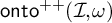
$\operatorname {{\mathsf{onto}}}^{++}(\mathcal I,\omega )$
holds.
-
-
(4) Suppose
$\theta $
is regular uncountable, and
$\vartheta \le \theta $
.-
• If
$\mathcal A=\{\nu \}$
and
$\mathcal C(\theta , \vartheta )\le \nu $
,Footnote
2
then
$\operatorname {{\mathsf{onto}}}^+(\{\nu \},\mathcal I,\vartheta )$
holds. -
• If
$\mathcal A=J^+$
for some
$\vartheta ^+$
-complete proper ideal J over
$\kappa $
and
$\mathcal C(\theta ,\,\vartheta )\le \kappa $
, then
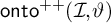
$\operatorname {{\mathsf{onto}}}^{++}(\mathcal I,\vartheta )$
holds.
-













Proof. Fix a colouring $c:[\kappa ]^2\rightarrow \theta $
witnessing
$c:[\kappa ]^2\rightarrow \theta $
witnessing  .
.
(1) Given $B\in I^+$
with
$B\in I^+$
with $I\in \mathcal I$
, find
$I\in \mathcal I$
, find $\eta <\kappa $
and
$\eta <\kappa $
and $T\in [\theta ]^\theta $
such that, for every pair
$T\in [\theta ]^\theta $
such that, for every pair $\sigma <\tau $
of ordinals from T,
$\sigma <\tau $
of ordinals from T, $\{\beta \in B\setminus (\eta +1)\mid \sigma \le c(\eta ,\beta )<\tau \}\in I^+$
. For each
$\{\beta \in B\setminus (\eta +1)\mid \sigma \le c(\eta ,\beta )<\tau \}\in I^+$
. For each $\sigma \in T$
, let
$\sigma \in T$
, let
 $$ \begin{align*}B_\sigma:=\{\beta\in B\setminus(\eta+1)\mid \sigma\le c(\eta,\beta)<\min(T\setminus(\sigma+1))\}.\end{align*} $$
Then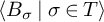 $\langle B_\sigma \mid \sigma \in T\rangle $
is a pairwise disjoint family of
$\langle B_\sigma \mid \sigma \in T\rangle $
is a pairwise disjoint family of $I^+$
-subsets of B. By replacing
$I^+$
-subsets of B. By replacing $B_{\min (T)}$
with
$B_{\min (T)}$
with $B\setminus \bigcup _{\sigma \in T\setminus \{\min (T)\}}B_\sigma $
, we then get a decomposition of B into
$B\setminus \bigcup _{\sigma \in T\setminus \{\min (T)\}}B_\sigma $
, we then get a decomposition of B into $\theta $
many
$\theta $
many $I^+$
-sets.
$I^+$
-sets.
(2) Suppose that $\theta =\vartheta ^+$
for a regular uncountable cardinal
$\theta =\vartheta ^+$
for a regular uncountable cardinal $\vartheta <\nu $
. By [Reference ShelahShe94b, Claim 2.4(b)], we may fix a
$\vartheta <\nu $
. By [Reference ShelahShe94b, Claim 2.4(b)], we may fix a $\vartheta $
-bounded C-sequence
$\vartheta $
-bounded C-sequence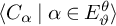 $\langle C_\alpha \mid \alpha \in E^\theta _\vartheta \rangle $
Footnote
3
such that, for every club
$\langle C_\alpha \mid \alpha \in E^\theta _\vartheta \rangle $
Footnote
3
such that, for every club $D\subseteq \theta $
, there exists
$D\subseteq \theta $
, there exists $\alpha \in E^\theta _\vartheta $
such that
$\alpha \in E^\theta _\vartheta $
such that $\sup (\operatorname {\mathrm {nacc}}(C_\alpha )\cap D)=\alpha $
. Let
$\sup (\operatorname {\mathrm {nacc}}(C_\alpha )\cap D)=\alpha $
. Let $\langle (\varsigma _\eta ,\alpha _\eta )\mid \eta <\nu \rangle $
be a listing of the elements of
$\langle (\varsigma _\eta ,\alpha _\eta )\mid \eta <\nu \rangle $
be a listing of the elements of $\nu \times E^\theta _\vartheta $
. Define a colouring
$\nu \times E^\theta _\vartheta $
. Define a colouring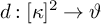 $d:[\kappa ]^2\rightarrow \vartheta $
by letting for all
$d:[\kappa ]^2\rightarrow \vartheta $
by letting for all $\eta <\beta <\kappa $
:
$\eta <\beta <\kappa $
:
 $$ \begin{align*}d(\eta,\beta):=\begin{cases}\operatorname{\mathrm{otp}}(C_{\alpha_\eta}\cap c(\varsigma_\eta,\beta)),&\text{if }\eta<\nu\ \&\ c(\varsigma_\eta,\beta)<\alpha_\eta;\\ 0,&\text{otherwise}.\end{cases}\end{align*} $$
To see that d witnesses $\operatorname {{\mathsf{unbounded}}}^+(\{\nu \},\mathcal I,\vartheta )$
, let
$\operatorname {{\mathsf{unbounded}}}^+(\{\nu \},\mathcal I,\vartheta )$
, let $I\in \mathcal I$
and let
$I\in \mathcal I$
and let $B\in I^+$
. Pick
$B\in I^+$
. Pick $\varsigma <\nu $
and
$\varsigma <\nu $
and $T\in [\theta ]^\theta $
such that, for every pair
$T\in [\theta ]^\theta $
such that, for every pair $\sigma <\sigma '$
of ordinals from T,
$\sigma <\sigma '$
of ordinals from T, $\{\beta \in B\setminus (\varsigma +1)\mid \sigma \le c(\varsigma ,\beta )<\sigma '\}\in I^+$
. Let
$\{\beta \in B\setminus (\varsigma +1)\mid \sigma \le c(\varsigma ,\beta )<\sigma '\}\in I^+$
. Let $D:= \operatorname {\mathrm {acc}}^+(T)$
. Find
$D:= \operatorname {\mathrm {acc}}^+(T)$
. Find $\eta <\nu $
such that
$\eta <\nu $
such that $\varsigma _\eta =\varsigma $
and
$\varsigma _\eta =\varsigma $
and $\sup (\operatorname {\mathrm {nacc}}(C_{\alpha _\eta })\cap D)=\alpha _\eta $
. Let
$\sup (\operatorname {\mathrm {nacc}}(C_{\alpha _\eta })\cap D)=\alpha _\eta $
. Let $X:= \{\gamma \in C_{\alpha _\eta } \mid \min (C_{\alpha _\eta } \setminus (\gamma +1)) \in D\}$
, so that
$X:= \{\gamma \in C_{\alpha _\eta } \mid \min (C_{\alpha _\eta } \setminus (\gamma +1)) \in D\}$
, so that $Z:= \{\operatorname {\mathrm {otp}}(C_{\alpha _\eta } \cap (\gamma +1)) \mid \gamma \in X\}$
is in
$Z:= \{\operatorname {\mathrm {otp}}(C_{\alpha _\eta } \cap (\gamma +1)) \mid \gamma \in X\}$
is in $[\vartheta ]^\vartheta $
.
$[\vartheta ]^\vartheta $
.
Claim 2.4.1. Let $\tau \in Z$
. Then
$\tau \in Z$
. Then $B^{\eta , \tau }:= \{\beta \in B\setminus (\eta +1)\mid d(\eta ,\beta )=\tau \}$
is in
$B^{\eta , \tau }:= \{\beta \in B\setminus (\eta +1)\mid d(\eta ,\beta )=\tau \}$
is in $I^+$
.
$I^+$
.
Proof. Let $\gamma \in X$
be such that
$\gamma \in X$
be such that $\operatorname {\mathrm {otp}}(C_{\alpha _\eta }\cap (\gamma +1))=\tau $
and let
$\operatorname {\mathrm {otp}}(C_{\alpha _\eta }\cap (\gamma +1))=\tau $
and let $\delta :=\min (C_{\alpha _\eta } \setminus (\gamma +1))$
. As
$\delta :=\min (C_{\alpha _\eta } \setminus (\gamma +1))$
. As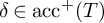 $\delta \in \operatorname {\mathrm {acc}}^+(T)$
, we may pick
$\delta \in \operatorname {\mathrm {acc}}^+(T)$
, we may pick $\sigma <\sigma '$
from T such that
$\sigma <\sigma '$
from T such that $\gamma <\sigma <\sigma '<\delta $
, so that the following set is in
$\gamma <\sigma <\sigma '<\delta $
, so that the following set is in $I^+$
:
$I^+$
:
 $$ \begin{align*}B':=\{\beta\in B\setminus(\eta+1)\mid \sigma\le c(\varsigma,\beta)<\sigma'\}.\end{align*} $$
Now, for every $\beta \in B'$
,
$\beta \in B'$
,
 $$ \begin{align*}d(\eta, \beta)= \operatorname{\mathrm{otp}}(C_{\alpha_\eta} \cap c(\varsigma_\eta,\beta)) =\operatorname{\mathrm{otp}}(C_{\alpha_\eta}\cap(\gamma+1))= \tau,\end{align*} $$
as sought.
This completes the proof.
(3) By the definition of $\mathfrak d$
, we may fix a family
$\mathfrak d$
, we may fix a family $\mathcal F\subseteq {}^\omega \omega $
of size
$\mathcal F\subseteq {}^\omega \omega $
of size $\mathfrak d$
such that for every
$\mathfrak d$
such that for every $g:\omega \rightarrow \omega $
there exists an
$g:\omega \rightarrow \omega $
there exists an $f\in \mathcal F$
such that
$f\in \mathcal F$
such that $g(m)\le f(m)$
for every
$g(m)\le f(m)$
for every $m<\omega $
. Let
$m<\omega $
. Let $\mu $
be the least cardinal such that
$\mu $
be the least cardinal such that $\mathfrak d\le \mu $
and
$\mathfrak d\le \mu $
and $\mathcal A\subseteq \mathcal P(\mu )$
, and suppose
$\mathcal A\subseteq \mathcal P(\mu )$
, and suppose $\mu $
is no more than
$\mu $
is no more than $\kappa $
. Let
$\kappa $
. Let $\langle (\varsigma _\eta ,f_\eta )\mid \eta <\mu \rangle $
be a listing of the elements of
$\langle (\varsigma _\eta ,f_\eta )\mid \eta <\mu \rangle $
be a listing of the elements of $\mu \times \mathcal F$
. For every function
$\mu \times \mathcal F$
. For every function $f:\omega \rightarrow \omega $
, let
$f:\omega \rightarrow \omega $
, let $f^*:\omega \rightarrow \omega $
denote some strictly increasing function satisfying
$f^*:\omega \rightarrow \omega $
denote some strictly increasing function satisfying $f^*(n+1)>f(f^*(n)+1)$
for every
$f^*(n+1)>f(f^*(n)+1)$
for every $n<\omega $
. Finally, fix a colouring
$n<\omega $
. Finally, fix a colouring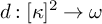 $d:[\kappa ]^2\rightarrow \omega $
such that for all
$d:[\kappa ]^2\rightarrow \omega $
such that for all $\eta <\beta <\kappa $
with
$\eta <\beta <\kappa $
with $\eta <\mu $
and
$\eta <\mu $
and $\varsigma _\eta < \beta $
,
$\varsigma _\eta < \beta $
,
 $$ \begin{align*}d(\eta,\beta)=\min\{n<\omega\mid c(\varsigma_\eta,\beta)<f_\eta^*(n+1)\}.\end{align*} $$
We claim that if $\mathcal A=\{\mu \}$
, then d witnesses
$\mathcal A=\{\mu \}$
, then d witnesses $\operatorname {{\mathsf{onto}}}^+(\{\mu \},\mathcal I,\omega )$
, and if
$\operatorname {{\mathsf{onto}}}^+(\{\mu \},\mathcal I,\omega )$
, and if $\mathcal A=J^+$
for some countably-complete proper ideal J over
$\mathcal A=J^+$
for some countably-complete proper ideal J over $\kappa $
, then d witnesses
$\kappa $
, then d witnesses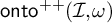 $\operatorname {{\mathsf{onto}}}^{++}(\mathcal I,\omega )$
. We shall focus on verifying the latter, moreover showing that given a sequence
$\operatorname {{\mathsf{onto}}}^{++}(\mathcal I,\omega )$
. We shall focus on verifying the latter, moreover showing that given a sequence $\langle (I_n,B_n)\mid n<\omega \rangle $
such that
$\langle (I_n,B_n)\mid n<\omega \rangle $
such that $I_n\in \mathcal I$
and
$I_n\in \mathcal I$
and $B_n\in I_n^+$
for every
$B_n\in I_n^+$
for every $n<\omega $
, there exists an
$n<\omega $
, there exists an $\eta <\kappa $
such that
$\eta <\kappa $
such that $\{ \beta \in B_n\setminus (\eta +1)\mid d(\eta ,\beta )=n\}\in I_n^+$
for every
$\{ \beta \in B_n\setminus (\eta +1)\mid d(\eta ,\beta )=n\}\in I_n^+$
for every $n<\omega $
.
$n<\omega $
.
For each $n<\omega $
, let
$n<\omega $
, let $A_n$
denote the set of all
$A_n$
denote the set of all $\varsigma <\kappa $
for which there is a
$\varsigma <\kappa $
for which there is a $T\in [\omega ]^\omega $
such that, for every pair
$T\in [\omega ]^\omega $
such that, for every pair $\sigma <\tau $
of integers from T,
$\sigma <\tau $
of integers from T, $\{\beta \in B_n\setminus (\varsigma +1)\mid \sigma \le c(\varsigma ,\beta )<\tau \}\in I_n^+$
. As c witnesses
$\{\beta \in B_n\setminus (\varsigma +1)\mid \sigma \le c(\varsigma ,\beta )<\tau \}\in I_n^+$
. As c witnesses  ,
, $A_n$
must be in
$A_n$
must be in $J^*$
. So, as J is a countably-complete proper ideal, we may pick a
$J^*$
. So, as J is a countably-complete proper ideal, we may pick a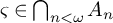 $\varsigma \in \bigcap _{n<\omega }A_n$
. For each
$\varsigma \in \bigcap _{n<\omega }A_n$
. For each $n<\omega $
, fix
$n<\omega $
, fix $T_n\in [\omega ]^\omega $
witnessing that
$T_n\in [\omega ]^\omega $
witnessing that $\varsigma \in A_n$
, and then let
$\varsigma \in A_n$
, and then let $g_n:\omega \leftrightarrow T_n$
be the order-preserving bijection. Define
$g_n:\omega \leftrightarrow T_n$
be the order-preserving bijection. Define $g:\omega \rightarrow \omega $
via
$g:\omega \rightarrow \omega $
via $g(m):=\max \{g_n(m)\mid n\le m\}$
. Find
$g(m):=\max \{g_n(m)\mid n\le m\}$
. Find $\eta <\mu $
such that
$\eta <\mu $
such that $\varsigma _\eta =\varsigma $
and
$\varsigma _\eta =\varsigma $
and $g(m)\le f_\eta (m)$
for every
$g(m)\le f_\eta (m)$
for every $m<\omega $
.
$m<\omega $
.
Claim 2.4.2. Let $n<\omega $
. Then
$n<\omega $
. Then $B_n^\eta :=\{\beta \in B_n\setminus (\eta +1)\mid d(\eta ,\beta )=n\}$
is in
$B_n^\eta :=\{\beta \in B_n\setminus (\eta +1)\mid d(\eta ,\beta )=n\}$
is in $I_n^+$
.
$I_n^+$
.
Proof. Set $\sigma :=g_n(f^*_\eta (n))$
and
$\sigma :=g_n(f^*_\eta (n))$
and $\tau :=g_{n}(f^*_\eta (n)+1)$
. Clearly,
$\tau :=g_{n}(f^*_\eta (n)+1)$
. Clearly,
 $$ \begin{align*}f^*_\eta(n)\le g_n(f^*_\eta(n))=\sigma<\tau\le g(f^*_\eta(n)+1)\le f_\eta(f^*_\eta(n)+1)<f^*_\eta(n+1),\end{align*} $$
and hence $B_n^\eta $
covers
$B_n^\eta $
covers
 $$ \begin{align*}\{\beta\in B_n\setminus(\max\{\varsigma,\eta\}+1)\mid \sigma\le c(\varsigma,\beta)<\tau\},\end{align*} $$
which belongs to $I_n^+$
.
$I_n^+$
.
(4) Let $\mathcal X \subseteq [\theta ]^\vartheta $
be a family of sets of ordertype
$\mathcal X \subseteq [\theta ]^\vartheta $
be a family of sets of ordertype $\vartheta $
witnessing the value of
$\vartheta $
witnessing the value of $\mathcal C(\theta , \vartheta )$
, so that for every club
$\mathcal C(\theta , \vartheta )$
, so that for every club $D \subseteq \theta $
there is an
$D \subseteq \theta $
there is an $X \in \mathcal X$
such that
$X \in \mathcal X$
such that $X \subseteq D$
. Let
$X \subseteq D$
. Let $\mu $
be the least cardinal such that
$\mu $
be the least cardinal such that $|\mathcal X|\le \mu $
and
$|\mathcal X|\le \mu $
and $\mathcal A\subseteq \mathcal P(\mu )$
, and suppose
$\mathcal A\subseteq \mathcal P(\mu )$
, and suppose $\mu $
is no more than
$\mu $
is no more than $\kappa $
. Let
$\kappa $
. Let $\langle (\varsigma _\eta ,X_\eta )\mid \eta <\mu \rangle $
be a listing of the elements of
$\langle (\varsigma _\eta ,X_\eta )\mid \eta <\mu \rangle $
be a listing of the elements of $\mu \times \mathcal X$
. Define a colouring
$\mu \times \mathcal X$
. Define a colouring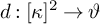 $d:[\kappa ]^2\rightarrow \vartheta $
by letting for all
$d:[\kappa ]^2\rightarrow \vartheta $
by letting for all $\eta <\beta <\kappa $
with
$\eta <\beta <\kappa $
with $\varsigma _\eta < \beta $
:
$\varsigma _\eta < \beta $
:
 $$ \begin{align*}d(\eta,\beta):=\begin{cases}\sup(\operatorname{\mathrm{otp}}(X_\eta\cap c(\varsigma_\eta,\beta))),&\text{if }\eta<\mu\ \&\ c(\varsigma_\eta,\beta)<\sup(X_\eta);\\ 0,&\text{otherwise}.\end{cases}\end{align*} $$
We claim that if $\mathcal A=\{\mu \}$
, then d witnesses
$\mathcal A=\{\mu \}$
, then d witnesses $\operatorname {{\mathsf{onto}}}^+(\{\mu \},\mathcal I,\vartheta )$
, and if
$\operatorname {{\mathsf{onto}}}^+(\{\mu \},\mathcal I,\vartheta )$
, and if $\mathcal A=J^+$
for some
$\mathcal A=J^+$
for some $\vartheta ^+$
-complete proper ideal J over
$\vartheta ^+$
-complete proper ideal J over $\kappa $
, then d witnesses
$\kappa $
, then d witnesses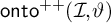 $\operatorname {{\mathsf{onto}}}^{++}(\mathcal I,\vartheta )$
. We shall focus on verifying the latter, moreover showing that given a sequence
$\operatorname {{\mathsf{onto}}}^{++}(\mathcal I,\vartheta )$
. We shall focus on verifying the latter, moreover showing that given a sequence $\langle (I_\tau ,B_\tau )\mid \tau <\vartheta \rangle $
such that
$\langle (I_\tau ,B_\tau )\mid \tau <\vartheta \rangle $
such that $I_\tau \in \mathcal I$
and
$I_\tau \in \mathcal I$
and $B_\tau \in I_\tau ^+$
for every
$B_\tau \in I_\tau ^+$
for every $\tau <\vartheta $
, there exists an
$\tau <\vartheta $
, there exists an $\eta <\kappa $
such that
$\eta <\kappa $
such that $\{ \beta \in B_\tau \setminus (\eta +1)\mid d(\eta ,\beta )=\tau \}\in I_\tau ^+$
for every
$\{ \beta \in B_\tau \setminus (\eta +1)\mid d(\eta ,\beta )=\tau \}\in I_\tau ^+$
for every $\tau <\vartheta $
. As in the proof of Clause (3), fix
$\tau <\vartheta $
. As in the proof of Clause (3), fix $\varsigma <\kappa $
and a sequence
$\varsigma <\kappa $
and a sequence $\langle T_\tau \mid \tau <\vartheta \rangle $
of elements of
$\langle T_\tau \mid \tau <\vartheta \rangle $
of elements of $[\theta ]^\theta $
such that, for every
$[\theta ]^\theta $
such that, for every $\tau <\vartheta $
, for every pair
$\tau <\vartheta $
, for every pair $\sigma <\sigma '$
of ordinals from
$\sigma <\sigma '$
of ordinals from $T_\tau $
,
$T_\tau $
, $\{\beta \in B_\tau \setminus (\varsigma +1)\mid \sigma \le c(\varsigma ,\beta )<\sigma '\}\in I_\tau ^+$
. Denote
$\{\beta \in B_\tau \setminus (\varsigma +1)\mid \sigma \le c(\varsigma ,\beta )<\sigma '\}\in I_\tau ^+$
. Denote $D_\tau :=\operatorname {\mathrm {acc}}^+(T_\tau )$
. If
$D_\tau :=\operatorname {\mathrm {acc}}^+(T_\tau )$
. If $\vartheta <\theta $
, then let
$\vartheta <\theta $
, then let $D:=\bigcap _{\tau <\vartheta }D_\tau $
, and if
$D:=\bigcap _{\tau <\vartheta }D_\tau $
, and if $\vartheta =\theta $
, then let
$\vartheta =\theta $
, then let $D:=\bigtriangleup _{\tau <\vartheta }D_\tau $
. Find
$D:=\bigtriangleup _{\tau <\vartheta }D_\tau $
. Find $\eta <\mu $
such that
$\eta <\mu $
such that $\varsigma _\eta =\varsigma $
and
$\varsigma _\eta =\varsigma $
and $ X_\eta \subseteq D$
.
$ X_\eta \subseteq D$
.
Claim 2.4.3. Let $\tau <\vartheta $
. Then
$\tau <\vartheta $
. Then $B_\tau ^\eta :=\{\beta \in B_\tau \setminus (\eta +1)\mid d(\eta ,\beta )=\tau \}$
is in
$B_\tau ^\eta :=\{\beta \in B_\tau \setminus (\eta +1)\mid d(\eta ,\beta )=\tau \}$
is in $I_\tau ^+$
.
$I_\tau ^+$
.
Proof. Let $\gamma \in X_\eta $
be such that
$\gamma \in X_\eta $
be such that $\operatorname {\mathrm {otp}}(X_\eta \cap \gamma )=\tau $
and let
$\operatorname {\mathrm {otp}}(X_\eta \cap \gamma )=\tau $
and let $\delta :=\min (X_\eta \setminus (\gamma +1))$
. As
$\delta :=\min (X_\eta \setminus (\gamma +1))$
. As $\delta \in D\setminus (\tau +1)$
, we infer that
$\delta \in D\setminus (\tau +1)$
, we infer that $\delta \in D_\tau =\operatorname {\mathrm {acc}}^+(T_\tau )$
. Thus we may pick
$\delta \in D_\tau =\operatorname {\mathrm {acc}}^+(T_\tau )$
. Thus we may pick $\sigma <\sigma '$
from
$\sigma <\sigma '$
from $T_\tau $
such that
$T_\tau $
such that $\gamma <\sigma <\sigma '<\delta $
. Consequently, the following set is in
$\gamma <\sigma <\sigma '<\delta $
. Consequently, the following set is in $I_\tau ^+$
:
$I_\tau ^+$
:
 $$ \begin{align*}B':=\{\beta\in B_\tau\setminus(\max\{\varsigma, \eta\}+1)\mid \sigma\le c(\varsigma,\beta)<\sigma'\}.\end{align*} $$
Now, for every $\beta \in B'$
,
$\beta \in B'$
,
 $$ \begin{align*}d(\eta, \beta)= \sup(\operatorname{\mathrm{otp}}(X_\eta \cap c(\varsigma_\eta,\beta))) =\sup(\operatorname{\mathrm{otp}}(X_\eta\cap(\gamma+1)))= \sup(\tau+1) = \tau,\end{align*} $$
as sought.
This completes the proof.
Remark 2.5. Various results from [Reference Inamdar and RinotIR23, Reference Inamdar and RinotIR24] have analogues for this new colouring principle  with similar proofs making the obvious changes. As two concrete examples, we point to [Reference Inamdar and RinotIR23, Lemma 5.12(2)] and [Reference Inamdar and RinotIR23, Lemma 6.15(2)].
Lemma 2.6. Let $\mathsf {p}$
be one of the four colouring principles of Definition 2.2, and suppose
$\mathsf {p}$
be one of the four colouring principles of Definition 2.2, and suppose $\mu <\kappa $
.
$\mu <\kappa $
.
-
(1) If
$\nu \in [\mu ,\kappa )$
is a cardinal such that
$\mathsf {p}(\mathcal A, \mathcal J^\nu _\mu , \theta )$
holds, then for every
$I\in \mathcal J^\kappa _\mu \setminus \mathcal I^\kappa _\nu $
, there is a
$B \in I^+$
such that
$\mathsf {p}(\mathcal A, I \restriction B, \theta )$
holds; -
(2) If there exists a cardinal
$\nu \in [\mu ,\kappa )$
such that
$\mathsf {p}(\mathcal I^\kappa _\nu , \theta )$
and
$\mathsf {p}(\mathcal J^\nu _\mu , \theta )$
both hold, then every
$I\in \mathcal J^\kappa _\mu $
is not weakly
$\theta $
-saturated.


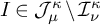

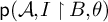


Proof. (1) Suppose that $\nu \in [\mu ,\kappa )$
is a cardinal and
$\nu \in [\mu ,\kappa )$
is a cardinal and $c: [\nu ]^2 \rightarrow \theta $
is a map witnessing that
$c: [\nu ]^2 \rightarrow \theta $
is a map witnessing that $\mathsf {p}(\mathcal A, \mathcal J^\nu _\mu , \theta )$
holds. Now given
$\mathsf {p}(\mathcal A, \mathcal J^\nu _\mu , \theta )$
holds. Now given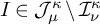 $I\in \mathcal J^\kappa _\mu \setminus \mathcal I^\kappa _\nu $
, fix a function
$I\in \mathcal J^\kappa _\mu \setminus \mathcal I^\kappa _\nu $
, fix a function $f:B\rightarrow \nu $
such that
$f:B\rightarrow \nu $
such that $B\in I^+$
but
$B\in I^+$
but $f^{-1}[H]\in I$
for all
$f^{-1}[H]\in I$
for all $H\in [\nu ]^{<\nu }$
. Clearly, the f-image of any J-positive subset of B has size
$H\in [\nu ]^{<\nu }$
. Clearly, the f-image of any J-positive subset of B has size $\nu $
and hence
$\nu $
and hence $J:=\{ f[X]\mid X\in I\restriction B\}$
belongs to
$J:=\{ f[X]\mid X\in I\restriction B\}$
belongs to $\mathcal J^\nu _\mu $
. Finally, define
$\mathcal J^\nu _\mu $
. Finally, define $d: [\kappa ]^2\rightarrow \theta $
via
$d: [\kappa ]^2\rightarrow \theta $
via $d(\eta , \beta ) := c(\eta , f(\beta ))$
, or
$d(\eta , \beta ) := c(\eta , f(\beta ))$
, or $d(\eta , \beta ) := 0$
in case the former requirement would be ill-defined or contradict a needed instance of upper-regressiveness. Then d witnesses that
$d(\eta , \beta ) := 0$
in case the former requirement would be ill-defined or contradict a needed instance of upper-regressiveness. Then d witnesses that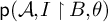 $\mathsf {p}(\mathcal A, I \restriction B, \theta )$
holds.
$\mathsf {p}(\mathcal A, I \restriction B, \theta )$
holds.
(2) Suppose that $\nu \in [\mu ,\kappa )$
is a cardinal such that
$\nu \in [\mu ,\kappa )$
is a cardinal such that $\mathsf {p}(\mathcal I^\kappa _\nu , \theta )$
and
$\mathsf {p}(\mathcal I^\kappa _\nu , \theta )$
and $\mathsf {p}(\mathcal J^\nu _\mu , \theta )$
both hold. Now, given
$\mathsf {p}(\mathcal J^\nu _\mu , \theta )$
both hold. Now, given $I\in \mathcal J^\kappa _\mu $
, there are two options. If
$I\in \mathcal J^\kappa _\mu $
, there are two options. If $I\in \mathcal I^\kappa _\nu $
, then, by
$I\in \mathcal I^\kappa _\nu $
, then, by $\mathsf {p}(\mathcal I^\kappa _\nu , \theta )$
, every I-positive set may be decomposed into
$\mathsf {p}(\mathcal I^\kappa _\nu , \theta )$
, every I-positive set may be decomposed into $\theta $
-many I-positive sets, and we are done. Otherwise, by Clause (1), there exists some
$\theta $
-many I-positive sets, and we are done. Otherwise, by Clause (1), there exists some $B\in I^+$
that may be decomposed into
$B\in I^+$
that may be decomposed into $\theta $
-many I-positive sets.
$\theta $
-many I-positive sets.
Corollary 2.7. Suppose that $\theta <\kappa $
is a pair of regular uncountable cardinals and for every
$\theta <\kappa $
is a pair of regular uncountable cardinals and for every $\mu \in \operatorname {\mathrm {Reg}}(\kappa )\setminus \theta $
one of the following holds:
$\mu \in \operatorname {\mathrm {Reg}}(\kappa )\setminus \theta $
one of the following holds:
-
•
$\chi (\mu )>1$
;Footnote
4
-
•
$\mu $
is not greatly Mahlo; -
•
$\mu $
is not weakly compact in
$\mathsf L$
; -
•
$\mu>\theta $
and there is a
$\mu $
-Aronszajn tree.


Then every $\theta $
-complete
$\theta $
-complete $\kappa $
-incomplete uniform ideal over
$\kappa $
-incomplete uniform ideal over $\kappa $
is not weakly
$\kappa $
is not weakly $\theta $
-saturated.
$\theta $
-saturated.
Proof. Note that by [Reference Lambie-Hanson and RinotLHR21, Lemma 2.12], the second and third items imply the first item.
Let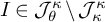 $I\in \mathcal J^\kappa _\theta \setminus \mathcal J^\kappa _\kappa $
and then let
$I\in \mathcal J^\kappa _\theta \setminus \mathcal J^\kappa _\kappa $
and then let $\lambda $
be the least cardinal such that I is not
$\lambda $
be the least cardinal such that I is not $\lambda $
-complete. Note that
$\lambda $
-complete. Note that $\lambda $
must be a successor cardinal
$\lambda $
must be a successor cardinal $\lambda =\mu ^+$
for some
$\lambda =\mu ^+$
for some $\mu \in [\theta ,\kappa )$
. So,
$\mu \in [\theta ,\kappa )$
. So,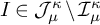 $I\in \mathcal J^\kappa _\mu \setminus \mathcal I^\kappa _\mu $
. By Lemma 2.6(1), it thus suffices to prove that
$I\in \mathcal J^\kappa _\mu \setminus \mathcal I^\kappa _\mu $
. By Lemma 2.6(1), it thus suffices to prove that $\operatorname {{\mathsf{unbounded}}}^+(\mathcal J^\mu _\mu , \theta )$
holds.
$\operatorname {{\mathsf{unbounded}}}^+(\mathcal J^\mu _\mu , \theta )$
holds. $\blacktriangleright $
If
$\blacktriangleright $
If $\chi (\mu )>1$
, then
$\chi (\mu )>1$
, then $\operatorname {{\mathsf{unbounded}}}^+(\mathcal J^\mu _\mu ,\mu )$
holds by [Reference Inamdar and RinotIR24, Theorem A], which is enough by monotonicity [Reference Inamdar and RinotIR24, Corollary 4.18(1)].
$\operatorname {{\mathsf{unbounded}}}^+(\mathcal J^\mu _\mu ,\mu )$
holds by [Reference Inamdar and RinotIR24, Theorem A], which is enough by monotonicity [Reference Inamdar and RinotIR24, Corollary 4.18(1)]. $\blacktriangleright $
If
$\blacktriangleright $
If $\mu>\theta $
and there is a
$\mu>\theta $
and there is a $\mu $
-Aronszajn tree, then by the upcoming Theorem 3.1,
$\mu $
-Aronszajn tree, then by the upcoming Theorem 3.1, $\operatorname {{\mathsf{onto}}}(J^{\text {bd}}[\mu ], \theta )$
holds, and by [Reference Inamdar and RinotIR24, Theorem 4.1(1)] this implies that
$\operatorname {{\mathsf{onto}}}(J^{\text {bd}}[\mu ], \theta )$
holds, and by [Reference Inamdar and RinotIR24, Theorem 4.1(1)] this implies that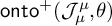 $\operatorname {{\mathsf{onto}}}^+(\mathcal J^\mu _\mu , \theta )$
holds.
$\operatorname {{\mathsf{onto}}}^+(\mathcal J^\mu _\mu , \theta )$
holds.
3 The tree property and the ineffable tree property
In this section we prove Theorem A, and then draw conclusions.
Theorem 3.1. Suppose that $\kappa $
is a regular uncountable cardinal admitting a
$\kappa $
is a regular uncountable cardinal admitting a $\kappa $
-Aronszajn tree. For every
$\kappa $
-Aronszajn tree. For every $\theta \in \operatorname {\mathrm {Reg}}(\kappa )$
,
$\theta \in \operatorname {\mathrm {Reg}}(\kappa )$
, $\operatorname {{\mathsf{onto}}}(J^{\mathrm {bd}}[\kappa ],\theta )$
holds.
$\operatorname {{\mathsf{onto}}}(J^{\mathrm {bd}}[\kappa ],\theta )$
holds.
Proof. The case $\kappa =\theta ^+$
is covered by [Reference Inamdar and RinotIR23, Corollary 7.3], so suppose that we are given a
$\kappa =\theta ^+$
is covered by [Reference Inamdar and RinotIR23, Corollary 7.3], so suppose that we are given a $\theta \in \operatorname {\mathrm {Reg}}(\kappa )$
with
$\theta \in \operatorname {\mathrm {Reg}}(\kappa )$
with $\theta ^+<\kappa $
. By Shelah’s club-guessing theorem [Reference ShelahShe94b, Claim 2.7], we may pick a sequence
$\theta ^+<\kappa $
. By Shelah’s club-guessing theorem [Reference ShelahShe94b, Claim 2.7], we may pick a sequence $\vec C=\langle C_\delta \mid \delta \in E^\kappa _\theta \rangle $
such that:
$\vec C=\langle C_\delta \mid \delta \in E^\kappa _\theta \rangle $
such that:
-
• For every
$\delta \in E^\kappa _\theta $
,
$C_\delta $
is a club in
$\delta $
of order-type
$\theta $
; -
• For every club
$C\subseteq \kappa $
, there exists a
$\delta \in E^\kappa _\theta $
such that
$C_\delta \subseteq C$
.


As there is a $\kappa $
-Aronszajn tree, a standard argument (see [Reference Meir Brodsky and RinotBR17, Appendix]) yields a
$\kappa $
-Aronszajn tree, a standard argument (see [Reference Meir Brodsky and RinotBR17, Appendix]) yields a $\kappa $
-Aronszajn subtree of
$\kappa $
-Aronszajn subtree of $({}^{<\kappa }2,{\subseteq })$
,Footnote
5
i.e., a
$({}^{<\kappa }2,{\subseteq })$
,Footnote
5
i.e., a $T\subseteq {}^{<\kappa }2$
satisfying all of the following:
$T\subseteq {}^{<\kappa }2$
satisfying all of the following:
-
(i) For every
$t\in T$
and
$\alpha <\operatorname {\mathrm {dom}}(t)$
,
$t\restriction \alpha \in T$
; -
(ii) For every
$\alpha <\kappa $
, the set
$T_\alpha :=\{ t\in T\mid \operatorname {\mathrm {dom}}(t)=\alpha \}$
satisfies
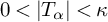
$0<|T_\alpha |<\kappa $
; -
(iii) For every
$f:\kappa \rightarrow 2$
, there exists an
$\alpha <\kappa $
such that
$f\restriction \alpha \notin T$
.





For every $\gamma <\kappa $
, denote
$\gamma <\kappa $
, denote $T\restriction \gamma :=\bigcup _{\alpha <\gamma }T_\alpha $
. Fix an injective enumeration
$T\restriction \gamma :=\bigcup _{\alpha <\gamma }T_\alpha $
. Fix an injective enumeration $\langle a_\eta \mid \eta <\kappa \rangle $
of T. Finally, define
$\langle a_\eta \mid \eta <\kappa \rangle $
of T. Finally, define $c:[\kappa ]^2\rightarrow \theta $
as follows. Given
$c:[\kappa ]^2\rightarrow \theta $
as follows. Given $\eta <\beta <\kappa $
, if
$\eta <\beta <\kappa $
, if $\operatorname {\mathrm {dom}}(a_\eta )\in E^\kappa _\theta $
and
$\operatorname {\mathrm {dom}}(a_\eta )\in E^\kappa _\theta $
and $a_\eta \nsubseteq a_\beta $
, then let
$a_\eta \nsubseteq a_\beta $
, then let
 $$ \begin{align*}c(\eta,\beta):=\sup(\operatorname{\mathrm{otp}}(C_{\operatorname{\mathrm{dom}}(a_\eta)}\cap\Delta(a_\eta,a_\beta)));\end{align*} $$
otherwise, just let $c(\eta ,\beta ):=0$
.
$c(\eta ,\beta ):=0$
.
To see that c witnesses $\operatorname {{\mathsf{onto}}}(J^{\text {bd}}[\kappa ],\theta )$
, let an arbitrary
$\operatorname {{\mathsf{onto}}}(J^{\text {bd}}[\kappa ],\theta )$
, let an arbitrary $B\in [\kappa ]^\kappa $
be given. Denote
$B\in [\kappa ]^\kappa $
be given. Denote
 $$ \begin{align*}T^{\leadsto B}:=\{ t\in T\mid |\{ \beta\in B\mid t\sqsubseteq a_\beta\}|=\kappa\}.\end{align*} $$
Claim 3.1.1. $T^{\leadsto B}$
maintains properties (i)–(iii), and there exists a club
$T^{\leadsto B}$
maintains properties (i)–(iii), and there exists a club $C\subseteq \kappa $
such that for every
$C\subseteq \kappa $
such that for every $\gamma \in C$
and every
$\gamma \in C$
and every $t\in (T^{\leadsto B})\restriction \gamma $
, there are two incompatible extensions of t in
$t\in (T^{\leadsto B})\restriction \gamma $
, there are two incompatible extensions of t in $(T^{\leadsto B})_\gamma $
.
$(T^{\leadsto B})_\gamma $
.
Proof. It is clear that Clauses (i) and (iii) hold for $T^{\leadsto B}$
. To see that Clause (ii) holds, it suffices to verify that
$T^{\leadsto B}$
. To see that Clause (ii) holds, it suffices to verify that $(T^{\leadsto B})_\alpha $
is nonempty for every
$(T^{\leadsto B})_\alpha $
is nonempty for every $\alpha <\kappa $
. As
$\alpha <\kappa $
. As $\emptyset $
is clearly in
$\emptyset $
is clearly in $T^{\leadsto B}$
, we opt to showing that
$T^{\leadsto B}$
, we opt to showing that $T^{\leadsto B}$
is in fact normal, i.e., for every
$T^{\leadsto B}$
is in fact normal, i.e., for every $t\in T^{\leadsto B}$
and every
$t\in T^{\leadsto B}$
and every $\alpha <\kappa $
above
$\alpha <\kappa $
above $\operatorname {\mathrm {dom}}(t)$
, there exist an
$\operatorname {\mathrm {dom}}(t)$
, there exist an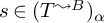 $s\in (T^{\leadsto B})_\alpha $
with
$s\in (T^{\leadsto B})_\alpha $
with $t\subseteq s$
. Thus, given t and
$t\subseteq s$
. Thus, given t and $\alpha $
as above, since
$\alpha $
as above, since $|T\restriction \alpha |<\kappa =|\{ \beta \in B\mid t\sqsubseteq a_\beta \}|$
, the set
$|T\restriction \alpha |<\kappa =|\{ \beta \in B\mid t\sqsubseteq a_\beta \}|$
, the set $B':=\{ \beta \in B\mid t\sqsubseteq a_\beta \ \&\ a_\beta \notin T\restriction \alpha \}$
has size
$B':=\{ \beta \in B\mid t\sqsubseteq a_\beta \ \&\ a_\beta \notin T\restriction \alpha \}$
has size $\kappa $
. As
$\kappa $
. As $|T_\alpha |<\kappa =|B'|$
, the pigeonhole principle implies the existence of an
$|T_\alpha |<\kappa =|B'|$
, the pigeonhole principle implies the existence of an $s\in T_\alpha $
for which
$s\in T_\alpha $
for which $|\{ \beta \in B'\mid a_\beta \restriction \alpha =s\}|=\kappa $
. Clearly,
$|\{ \beta \in B'\mid a_\beta \restriction \alpha =s\}|=\kappa $
. Clearly, $t\subseteq s\in (T^{\leadsto B})_\alpha $
.
$t\subseteq s\in (T^{\leadsto B})_\alpha $
.
Combining normality together with Clause (iii), we infer that every node of $T^{\leadsto B}$
admits two incompatible extensions in
$T^{\leadsto B}$
admits two incompatible extensions in $T^{\leadsto B}$
. Using Clause (ii), we then infer that there exists a club
$T^{\leadsto B}$
. Using Clause (ii), we then infer that there exists a club $C\subseteq \kappa $
such that for all
$C\subseteq \kappa $
such that for all $\gamma \in C$
and
$\gamma \in C$
and $t\in (T^{\leadsto B})\restriction \gamma $
, there are two incompatible extensions
$t\in (T^{\leadsto B})\restriction \gamma $
, there are two incompatible extensions $s_0,s_1$
of t in
$s_0,s_1$
of t in $(T^{\leadsto B})\restriction \gamma $
. By normality, for each
$(T^{\leadsto B})\restriction \gamma $
. By normality, for each $i<2$
, we may find a
$i<2$
, we may find a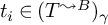 $t_i\in (T^{\leadsto B})_\gamma $
extending
$t_i\in (T^{\leadsto B})_\gamma $
extending $s_i$
. This shows that C is as sought.
$s_i$
. This shows that C is as sought.
Let C be as given by the claim. Recalling the choice of $\vec C$
, we now fix a
$\vec C$
, we now fix a $\delta \in E^\kappa _\theta $
such that
$\delta \in E^\kappa _\theta $
such that $C_\delta \subseteq C$
. Pick
$C_\delta \subseteq C$
. Pick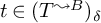 $t\in (T^{\leadsto B})_\delta $
. For every
$t\in (T^{\leadsto B})_\delta $
. For every $\gamma \in C_\delta $
, as
$\gamma \in C_\delta $
, as $\gamma ^+:=\min (C_\delta \setminus (\gamma +1))$
belongs to C, we may pick a node
$\gamma ^+:=\min (C_\delta \setminus (\gamma +1))$
belongs to C, we may pick a node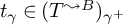 $t_\gamma \in (T^{\leadsto B})_{\gamma ^+}$
such that
$t_\gamma \in (T^{\leadsto B})_{\gamma ^+}$
such that $t_\gamma \restriction (\gamma +1)=t\restriction (\gamma +1)$
and
$t_\gamma \restriction (\gamma +1)=t\restriction (\gamma +1)$
and $t_\gamma \neq t\restriction \gamma ^+$
, so that
$t_\gamma \neq t\restriction \gamma ^+$
, so that $\gamma <\Delta (t,t_\gamma )<\gamma ^+$
. Pick
$\gamma <\Delta (t,t_\gamma )<\gamma ^+$
. Pick $\eta <\kappa $
such that
$\eta <\kappa $
such that $t=a_\eta $
.
$t=a_\eta $
.
For each $\gamma \in C_\delta $
, as
$\gamma \in C_\delta $
, as $t_\gamma \in T^{\leadsto B}$
, we may pick some
$t_\gamma \in T^{\leadsto B}$
, we may pick some $\beta _\gamma \in B$
above
$\beta _\gamma \in B$
above $\eta $
with
$\eta $
with $t_\gamma \sqsubseteq a_{\beta _\gamma }$
. Then
$t_\gamma \sqsubseteq a_{\beta _\gamma }$
. Then $\Delta (a_\eta ,a_{\beta _\gamma })=\Delta (t,t_\gamma )$
and so recalling that
$\Delta (a_\eta ,a_{\beta _\gamma })=\Delta (t,t_\gamma )$
and so recalling that $\gamma <\Delta (t,t_\gamma )<\min (C_\delta \setminus (\gamma +1))$
, we infer that
$\gamma <\Delta (t,t_\gamma )<\min (C_\delta \setminus (\gamma +1))$
, we infer that
 $$ \begin{align*}c(\eta,\beta)=\sup(\operatorname{\mathrm{otp}}(C_{\operatorname{\mathrm{dom}}(a_\eta)}\cap\Delta(a_\eta,a_{\beta_\gamma})))=\sup(\operatorname{\mathrm{otp}}(C_\delta\cap(\gamma+1)))=\operatorname{\mathrm{otp}}(C_\delta\cap\gamma).\end{align*} $$
Therefore, $c[\{\eta \}\circledast B]=\{\operatorname {\mathrm {otp}}(C_\delta \cap \gamma )\mid \gamma \in C_\delta \}=\theta $
.
$c[\{\eta \}\circledast B]=\{\operatorname {\mathrm {otp}}(C_\delta \cap \gamma )\mid \gamma \in C_\delta \}=\theta $
.
Remark 3.2. The preceding is optimal and cannot be improved to get $\operatorname {{\mathsf{onto}}}(J^{\text {bd}}[\kappa ],\kappa )$
. Indeed, by [Reference Inamdar and RinotIR24, Corollary 3.18],
$\operatorname {{\mathsf{onto}}}(J^{\text {bd}}[\kappa ],\kappa )$
. Indeed, by [Reference Inamdar and RinotIR24, Corollary 3.18], $\operatorname {{\mathsf{unbounded}}}(J^{\text {bd}}[\kappa ], \kappa )$
holds iff
$\operatorname {{\mathsf{unbounded}}}(J^{\text {bd}}[\kappa ], \kappa )$
holds iff $\kappa $
admits a nontrivial C-sequence, whereas, by [Reference Lambie-Hanson and RinotLHR21, Theorem 3.3], it is consistent (from large cardinals) that all C-sequences over
$\kappa $
admits a nontrivial C-sequence, whereas, by [Reference Lambie-Hanson and RinotLHR21, Theorem 3.3], it is consistent (from large cardinals) that all C-sequences over $\kappa $
are trivial, and yet, there is a
$\kappa $
are trivial, and yet, there is a $\kappa $
-Souslin tree.
$\kappa $
-Souslin tree.
Theorem 3.3. Suppose that $\kappa $
is a regular uncountable cardinal and the ineffable tree property fails. Then for every
$\kappa $
is a regular uncountable cardinal and the ineffable tree property fails. Then for every $\theta \in \operatorname {\mathrm {Reg}}(\kappa )$
,
$\theta \in \operatorname {\mathrm {Reg}}(\kappa )$
,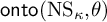 $\operatorname {{\mathsf{onto}}}(\mathrm {NS}_\kappa ,\theta )$
holds.
$\operatorname {{\mathsf{onto}}}(\mathrm {NS}_\kappa ,\theta )$
holds.
Proof. As in the beginning of the proof of Theorem 3.1, we may assume that we are given a $\theta \in \operatorname {\mathrm {Reg}}(\kappa )$
with
$\theta \in \operatorname {\mathrm {Reg}}(\kappa )$
with $\theta ^+<\kappa $
, and pick a
$\theta ^+<\kappa $
, and pick a $\theta $
-bounded club-guessing sequence
$\theta $
-bounded club-guessing sequence $\vec C=\langle C_\delta \mid \delta \in E^\kappa _\theta \rangle $
. As the ineffable tree property fails, we may fix a subset
$\vec C=\langle C_\delta \mid \delta \in E^\kappa _\theta \rangle $
. As the ineffable tree property fails, we may fix a subset $T\subseteq {}^{<\kappa }2$
satisfying all of the following:
$T\subseteq {}^{<\kappa }2$
satisfying all of the following:
-
(i) For every
$t\in T$
and
$\alpha <\operatorname {\mathrm {dom}}(t)$
,
$t\restriction \alpha \in T$
; -
(ii) For every
$\alpha <\kappa $
, the set
$T_\alpha :=\{ t\in T\mid \operatorname {\mathrm {dom}}(t)=\alpha \}$
satisfies
$0<|T_\alpha |<\kappa $
; -
(iii) There exists a sequence
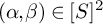
$\langle b_\beta \mid \beta <\kappa \rangle \in \prod _{\beta <\kappa }T_\beta $
such that for every stationary
$S\subseteq \kappa $
, there are
$(\alpha ,\beta )\in [S]^2$
with
$b_\alpha \nsubseteq b_\beta $
.







For every $\gamma <\kappa $
, denote
$\gamma <\kappa $
, denote $T\restriction \gamma :=\bigcup _{\alpha <\gamma }T_\alpha $
. Fix an injective enumeration
$T\restriction \gamma :=\bigcup _{\alpha <\gamma }T_\alpha $
. Fix an injective enumeration $\langle a_\eta \mid \eta <\kappa \rangle $
of T. Define
$\langle a_\eta \mid \eta <\kappa \rangle $
of T. Define $c:[\kappa ]^2\rightarrow \theta $
as follows. Given
$c:[\kappa ]^2\rightarrow \theta $
as follows. Given $\eta <\beta <\kappa $
, if
$\eta <\beta <\kappa $
, if $\operatorname {\mathrm {dom}}(a_\eta )\in E^\kappa _\theta $
and
$\operatorname {\mathrm {dom}}(a_\eta )\in E^\kappa _\theta $
and $a_\eta \nsubseteq b_\beta $
, then let
$a_\eta \nsubseteq b_\beta $
, then let
 $$ \begin{align*}c(\eta,\beta):=\sup(\operatorname{\mathrm{otp}}(C_{\operatorname{\mathrm{dom}}(a_\eta)}\cap\Delta(a_\eta,b_\beta)));\end{align*} $$
otherwise, just let $c(\eta ,\beta ):=0$
.
$c(\eta ,\beta ):=0$
.
To see that c witnesses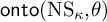 $\operatorname {{\mathsf{onto}}}(\text {NS}_\kappa ,\theta )$
holds, let a stationary
$\operatorname {{\mathsf{onto}}}(\text {NS}_\kappa ,\theta )$
holds, let a stationary $B\subseteq \kappa $
be given. Denote
$B\subseteq \kappa $
be given. Denote
 $$ \begin{align*}T^{\leadsto B}:=\{ t\in T\mid \{ \beta\in B\mid t\sqsubseteq b_\beta\}\text{ is stationary}\}.\end{align*} $$
Claim 3.3.1. $T^{\leadsto B}$
maintains properties (i) and (ii), and there exists a club
$T^{\leadsto B}$
maintains properties (i) and (ii), and there exists a club $C\subseteq \kappa $
such that for every
$C\subseteq \kappa $
such that for every $\gamma \in C$
and every
$\gamma \in C$
and every $t\in (T^{\leadsto B})\restriction \gamma $
, there are two incompatible extensions of t in
$t\in (T^{\leadsto B})\restriction \gamma $
, there are two incompatible extensions of t in $(T^{\leadsto B})_\gamma $
.
$(T^{\leadsto B})_\gamma $
.
Proof. It is clear that Clause (i) holds for $T^{\leadsto B}$
. To see that Clause (ii) holds, it suffices to show that
$T^{\leadsto B}$
. To see that Clause (ii) holds, it suffices to show that $T^{\leadsto B}$
is normal, and this follows in a proof similar to that of Claim 3.1.1, this time using the fact that
$T^{\leadsto B}$
is normal, and this follows in a proof similar to that of Claim 3.1.1, this time using the fact that $\text {NS}_\kappa $
is a
$\text {NS}_\kappa $
is a $\kappa $
-complete ideal.
$\kappa $
-complete ideal.
Next, as seen in the proof of Claim 3.1.1, in order to find a club C as in the statement of the claim, it suffices to prove that every node $t\in T^{\leadsto B}$
admits two incompatible extensions in
$t\in T^{\leadsto B}$
admits two incompatible extensions in $T^{\leadsto B}$
. Towards a contradiction, suppose that this is not the case, as witnessed by a node t. This means that
$T^{\leadsto B}$
. Towards a contradiction, suppose that this is not the case, as witnessed by a node t. This means that $Z:=\{ z\in T^{\leadsto B}\mid z\subseteq t\text { or }t\subseteq z \}$
is a chain. Since
$Z:=\{ z\in T^{\leadsto B}\mid z\subseteq t\text { or }t\subseteq z \}$
is a chain. Since $T^{\leadsto B}$
is normal, it follows that for every
$T^{\leadsto B}$
is normal, it follows that for every $\beta <\kappa $
, we may let
$\beta <\kappa $
, we may let $z_\beta $
denote the unique element of
$z_\beta $
denote the unique element of $Z\cap {}^\beta 2$
. Recalling Clause (iii), we infer that
$Z\cap {}^\beta 2$
. Recalling Clause (iii), we infer that $\{\beta \in B\mid b_\beta =z_\beta \}$
is nonstationary. As
$\{\beta \in B\mid b_\beta =z_\beta \}$
is nonstationary. As $t\in T^{\leadsto B}$
, altogether,
$t\in T^{\leadsto B}$
, altogether,
 $$ \begin{align*}\{\beta\in B\mid t\sqsubseteq b_\beta\ \&\ b_\beta\neq z_\beta\}=\{\beta\in B \mid \operatorname{\mathrm{dom}}(t)\le\Delta(b_\beta,z_\beta)<\beta\}\end{align*} $$
is stationary. By Fodor’s lemma, pick $\epsilon \ge \operatorname {\mathrm {dom}}(t)$
such that
$\epsilon \ge \operatorname {\mathrm {dom}}(t)$
such that $\{\beta \in B\mid \operatorname {\mathrm {dom}}(t)\le \Delta (b_\beta ,z_\beta )=\epsilon \}$
is stationary. As
$\{\beta \in B\mid \operatorname {\mathrm {dom}}(t)\le \Delta (b_\beta ,z_\beta )=\epsilon \}$
is stationary. As $|T_{\epsilon +1}|<\kappa $
, we may pick
$|T_{\epsilon +1}|<\kappa $
, we may pick $z\in T_{\epsilon +1}$
such that
$z\in T_{\epsilon +1}$
such that
 $$ \begin{align*}B':=\{\beta\in B\mid \operatorname{\mathrm{dom}}(t)\le\Delta(b_\beta,z_\beta)=\epsilon<\beta\ \&\ b_\beta\restriction(\epsilon+1)=z\}\end{align*} $$
is stationary. Then $B'$
witnesses that
$B'$
witnesses that $z\in T^{\leadsto B}$
. Furthermore, picking a
$z\in T^{\leadsto B}$
. Furthermore, picking a $\beta \in B'$
, we see that
$\beta \in B'$
, we see that $\operatorname {\mathrm {dom}}(t)\le \Delta (z,z_\beta )<\epsilon +1=\operatorname {\mathrm {dom}}(z)$
, which means that
$\operatorname {\mathrm {dom}}(t)\le \Delta (z,z_\beta )<\epsilon +1=\operatorname {\mathrm {dom}}(z)$
, which means that $t\subseteq z$
and
$t\subseteq z$
and $z\neq z_{\epsilon +1}$
, contradicting the fact that Z is a chain.
$z\neq z_{\epsilon +1}$
, contradicting the fact that Z is a chain.
Let C be as given by the claim. Fix a $\delta \in E^\kappa _\theta $
such that
$\delta \in E^\kappa _\theta $
such that $C_\delta \subseteq C$
. Pick
$C_\delta \subseteq C$
. Pick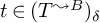 $t\in (T^{\leadsto B})_\delta $
. For every
$t\in (T^{\leadsto B})_\delta $
. For every $\gamma \in C_\delta $
, as
$\gamma \in C_\delta $
, as $\gamma ^+:=\min (C_\delta \setminus (\gamma +1))$
belongs to C, we may pick a node
$\gamma ^+:=\min (C_\delta \setminus (\gamma +1))$
belongs to C, we may pick a node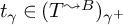 $t_\gamma \in (T^{\leadsto B})_{\gamma ^+}$
such that
$t_\gamma \in (T^{\leadsto B})_{\gamma ^+}$
such that $\gamma <\Delta (t,t_\gamma )<\gamma ^+$
. Pick
$\gamma <\Delta (t,t_\gamma )<\gamma ^+$
. Pick $\eta <\kappa $
such that
$\eta <\kappa $
such that $t=a_\eta $
.
$t=a_\eta $
.
For each $\gamma \in C_\delta $
, as
$\gamma \in C_\delta $
, as $t_\gamma \in T^{\leadsto B}$
, we may find some
$t_\gamma \in T^{\leadsto B}$
, we may find some $\beta _\gamma \in B$
above
$\beta _\gamma \in B$
above $\eta $
with
$\eta $
with $t_\gamma \sqsubseteq b_{\beta _\gamma }$
. Then
$t_\gamma \sqsubseteq b_{\beta _\gamma }$
. Then $\Delta (a_\eta ,b_{\beta _\gamma })=\Delta (t,t_\gamma )$
and hence
$\Delta (a_\eta ,b_{\beta _\gamma })=\Delta (t,t_\gamma )$
and hence
 $$ \begin{align*}c(\eta,\beta)=\sup(\operatorname{\mathrm{otp}}(C_{\operatorname{\mathrm{dom}}(a_\eta)}\cap\Delta(a_\eta,b_{\beta_\gamma})))=\sup(\operatorname{\mathrm{otp}}(C_\delta\cap(\gamma+1)))=\operatorname{\mathrm{otp}}(C_\delta\cap\gamma).\end{align*} $$
Therefore, $c[\{\eta \}\circledast B]=\theta $
.
$c[\{\eta \}\circledast B]=\theta $
.
Theorem B of [Reference Inamdar and RinotIR24] deals with the instance $\operatorname {{\mathsf{onto}}}^{++}(\mathcal J^\kappa _\kappa ,\theta )$
. Unfortunately, its statement omits a regularity requirement for
$\operatorname {{\mathsf{onto}}}^{++}(\mathcal J^\kappa _\kappa ,\theta )$
. Unfortunately, its statement omits a regularity requirement for $\theta $
, where the bug is in the proof of [Reference Inamdar and RinotIR24, Corollary 5.5] that incorrectly infers that at successors of singulars, the existence of a stationary set nonreflecting at regulars yields a stationary set that does not reflect at all. The correct statement reads as follows.
$\theta $
, where the bug is in the proof of [Reference Inamdar and RinotIR24, Corollary 5.5] that incorrectly infers that at successors of singulars, the existence of a stationary set nonreflecting at regulars yields a stationary set that does not reflect at all. The correct statement reads as follows.
Fact 3.4 (Reference Inamdar and RinotIR24, Theorem B)
Suppose that $\kappa $
is a regular uncountable cardinal admitting a stationary set that does not reflect at regulars. Then, for every
$\kappa $
is a regular uncountable cardinal admitting a stationary set that does not reflect at regulars. Then, for every $\theta \in \operatorname {\mathrm {Reg}}(\kappa )$
,
$\theta \in \operatorname {\mathrm {Reg}}(\kappa )$
, $\operatorname {{\mathsf{onto}}}^{++}(\mathcal J^\kappa _\kappa ,\theta )$
holds.
$\operatorname {{\mathsf{onto}}}^{++}(\mathcal J^\kappa _\kappa ,\theta )$
holds.
The next corollary provides a characterization when $\operatorname {{\mathsf{onto}}}^{++}(\mathcal J^\kappa _\kappa ,\theta )$
holds for
$\operatorname {{\mathsf{onto}}}^{++}(\mathcal J^\kappa _\kappa ,\theta )$
holds for $\kappa $
strongly inaccessible. This cannot be extended to
$\kappa $
strongly inaccessible. This cannot be extended to $\kappa $
weakly inaccessible, since [Reference Inamdar and RinotIR23, Theorem 9.10] shows that
$\kappa $
weakly inaccessible, since [Reference Inamdar and RinotIR23, Theorem 9.10] shows that $\operatorname {{\mathsf{unbounded}}}(J^{\text {bd}}[\kappa ],\aleph _1)$
may fail at
$\operatorname {{\mathsf{unbounded}}}(J^{\text {bd}}[\kappa ],\aleph _1)$
may fail at $\kappa $
a weakly inaccessible.
$\kappa $
a weakly inaccessible.
Corollary 3.5. Suppose that $\kappa $
is a strongly inaccessible cardinal.
$\kappa $
is a strongly inaccessible cardinal.
Then the following are equivalent:
-
(1)
$\kappa $
is not weakly compact; -
(2)
$\operatorname {{\mathsf{onto}}}^{++}(\mathcal J^\kappa _\kappa ,\theta )$
holds for every
$\theta <\kappa $
; -
(3)
$\operatorname {{\mathsf{onto}}}(J^{\mathrm {bd}}[\kappa ],3)$
holds.




Proof.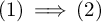 $(1)\implies (2)$
: By possibly enlarging
$(1)\implies (2)$
: By possibly enlarging $\theta $
, we may assume it is an infinite regular cardinal. By Theorem 3.1 together with [Reference Inamdar and RinotIR24, Theorem 4.1(1)],
$\theta $
, we may assume it is an infinite regular cardinal. By Theorem 3.1 together with [Reference Inamdar and RinotIR24, Theorem 4.1(1)], $\operatorname {{\mathsf{onto}}}^+(\mathcal J^\kappa _\kappa ,\theta ^+)$
holds. Then, by [Reference Inamdar and RinotIR24, Corollary 4.18(4)],
$\operatorname {{\mathsf{onto}}}^+(\mathcal J^\kappa _\kappa ,\theta ^+)$
holds. Then, by [Reference Inamdar and RinotIR24, Corollary 4.18(4)], $\operatorname {{\mathsf{onto}}}^{++}(\mathcal J^\kappa _\kappa ,\theta )$
holds.
$\operatorname {{\mathsf{onto}}}^{++}(\mathcal J^\kappa _\kappa ,\theta )$
holds.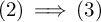 $(2)\implies (3)$
: This is trivial.
$(2)\implies (3)$
: This is trivial.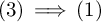 $(3)\implies (1)$
: By [Reference Inamdar and RinotIR23, Corollary 10.8].
$(3)\implies (1)$
: By [Reference Inamdar and RinotIR23, Corollary 10.8].
Corollary 3.6. Suppose that $\kappa $
is a strongly inaccessible cardinal.
$\kappa $
is a strongly inaccessible cardinal.
Then the following are equivalent:
-
(1)
$\kappa $
is not ineffable; -
(2)
$\operatorname {{\mathsf{onto}}}^{++}(\mathrm {NS}_\kappa ,\theta )$
holds for every
$\theta <\kappa $
; -
(3)
$\operatorname {{\mathsf{onto}}}(\mathrm {NS}_\kappa ,2)$
holds.



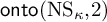
Proof.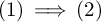 $(1)\implies (2)$
: By possibly enlarging
$(1)\implies (2)$
: By possibly enlarging $\theta $
, we may assume it is an infinite regular cardinal. By Theorem 3.3 together with [Reference Inamdar and RinotIR23, Proposition 2.26(4)],
$\theta $
, we may assume it is an infinite regular cardinal. By Theorem 3.3 together with [Reference Inamdar and RinotIR23, Proposition 2.26(4)], $\operatorname {{\mathsf{onto}}}^+(\text {NS}_\kappa ,\theta ^+)$
holds. Then, by [Reference Inamdar and RinotIR24, Corollary 4.18(4)],
$\operatorname {{\mathsf{onto}}}^+(\text {NS}_\kappa ,\theta ^+)$
holds. Then, by [Reference Inamdar and RinotIR24, Corollary 4.18(4)], $\operatorname {{\mathsf{onto}}}^{++}(\text {NS}_\kappa ,\theta )$
holds.
$\operatorname {{\mathsf{onto}}}^{++}(\text {NS}_\kappa ,\theta )$
holds.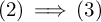 $(2)\implies (3)$
: This is trivial.
$(2)\implies (3)$
: This is trivial.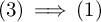 $(3)\implies (1)$
: By [Reference Inamdar and RinotIR23, Lemma 11.1].
$(3)\implies (1)$
: By [Reference Inamdar and RinotIR23, Lemma 11.1].
4 Getting the maximal number of colours
In this section we prove Theorem B. In reading the statement of the next lemma, recall that $\log _\lambda (\kappa )$
stands for the least cardinal
$\log _\lambda (\kappa )$
stands for the least cardinal $\theta \le \kappa $
such that
$\theta \le \kappa $
such that $\lambda ^\theta \ge \kappa $
.
$\lambda ^\theta \ge \kappa $
.
Lemma 4.1. Suppose that $\kappa $
is a regular uncountable that is not strongly inaccessible. If
$\kappa $
is a regular uncountable that is not strongly inaccessible. If $\log _2(\kappa )$
is a singular cardinal, then there exists a singular cardinal
$\log _2(\kappa )$
is a singular cardinal, then there exists a singular cardinal $\nu $
with
$\nu $
with $\log _2(\kappa ) \leq \nu <\kappa $
such that
$\log _2(\kappa ) \leq \nu <\kappa $
such that $\lambda ^{\operatorname {\mathrm {cf}}(\nu )}<\kappa \le \nu ^{\operatorname {\mathrm {cf}}(\nu )}$
for every
$\lambda ^{\operatorname {\mathrm {cf}}(\nu )}<\kappa \le \nu ^{\operatorname {\mathrm {cf}}(\nu )}$
for every $\lambda <\nu $
.
$\lambda <\nu $
.
Proof. Suppose that $\theta :=\log _2(\kappa )$
is a singular cardinal.
$\theta :=\log _2(\kappa )$
is a singular cardinal.
Claim 4.1.1. There are cardinals $\mu ,\nu $
such that
$\mu ,\nu $
such that $\mu <\theta \le \nu <\kappa $
and
$\mu <\theta \le \nu <\kappa $
and $\nu ^\mu \ge \kappa $
.
$\nu ^\mu \ge \kappa $
.
Proof. Let $\chi $
be the least cardinal such that
$\chi $
be the least cardinal such that $\theta ^\chi \ge \kappa $
. If
$\theta ^\chi \ge \kappa $
. If $\chi <\theta $
, then the pair
$\chi <\theta $
, then the pair $(\nu ,\mu ):=(\theta ,\chi )$
is as sought. Otherwise, it is the case that
$(\nu ,\mu ):=(\theta ,\chi )$
is as sought. Otherwise, it is the case that $\chi =\theta $
. Let
$\chi =\theta $
. Let $\langle \vartheta _j\mid j<\operatorname {\mathrm {cf}}(\theta )\rangle $
be some strictly increasing sequence of infinite cardinals, converging to
$\langle \vartheta _j\mid j<\operatorname {\mathrm {cf}}(\theta )\rangle $
be some strictly increasing sequence of infinite cardinals, converging to $\theta $
. As
$\theta $
. As $\kappa $
is regular and as each
$\kappa $
is regular and as each $\vartheta _j$
is smaller than
$\vartheta _j$
is smaller than $\chi $
, it follows that
$\chi $
, it follows that $\nu :=\sup _{j<\operatorname {\mathrm {cf}}(\theta )}\theta ^{\vartheta _j}$
is some cardinal lying in
$\nu :=\sup _{j<\operatorname {\mathrm {cf}}(\theta )}\theta ^{\vartheta _j}$
is some cardinal lying in $[\theta ,\kappa )$
. Finally,
$[\theta ,\kappa )$
. Finally, $\mu :=\operatorname {\mathrm {cf}}(\theta )$
is smaller than
$\mu :=\operatorname {\mathrm {cf}}(\theta )$
is smaller than $\theta $
and it is easy to see that
$\theta $
and it is easy to see that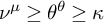 $\nu ^\mu \ge \theta ^\theta \ge \kappa $
.
$\nu ^\mu \ge \theta ^\theta \ge \kappa $
.
Fix the least cardinal $\mu $
for which there exists a cardinal
$\mu $
for which there exists a cardinal $\nu \in (\mu ,\kappa )$
with
$\nu \in (\mu ,\kappa )$
with $\nu ^\mu \ge \kappa $
. By the preceding claim,
$\nu ^\mu \ge \kappa $
. By the preceding claim, $\mu $
exists and is smaller than
$\mu $
exists and is smaller than $\theta $
. Fix the least
$\theta $
. Fix the least $\nu \in (\mu ,\kappa )$
such that
$\nu \in (\mu ,\kappa )$
such that $\nu ^\mu \ge \kappa $
. In particular,
$\nu ^\mu \ge \kappa $
. In particular, $\nu ^\nu \ge \kappa $
, so that
$\nu ^\nu \ge \kappa $
, so that $\nu \ge \theta $
.
$\nu \ge \theta $
.
Claim 4.1.2. $\nu $
is a singular cardinal of cofinality
$\nu $
is a singular cardinal of cofinality $\mu $
.
$\mu $
.
Proof. Suppose not. $\blacktriangleright $
If
$\blacktriangleright $
If $\nu =\chi ^+$
for some cardinal
$\nu =\chi ^+$
for some cardinal $\chi $
, then Hausdorff’s formula implies that
$\chi $
, then Hausdorff’s formula implies that $\kappa \le \nu ^\mu =\max \{\nu ,\chi ^\mu \}$
, so since
$\kappa \le \nu ^\mu =\max \{\nu ,\chi ^\mu \}$
, so since $\nu <\kappa $
, we get that
$\nu <\kappa $
, we get that $\chi ^\mu \ge \kappa $
. However,
$\chi ^\mu \ge \kappa $
. However, $\mu <\theta \le \nu =\chi ^+$
and
$\mu <\theta \le \nu =\chi ^+$
and $\theta $
is a limit cardinal, so
$\theta $
is a limit cardinal, so $\mu <\chi $
, and then
$\mu <\chi $
, and then $\chi $
contradicts the minimality of
$\chi $
contradicts the minimality of $\nu $
.
$\nu $
. $\blacktriangleright $
If
$\blacktriangleright $
If $\nu $
is a limit cardinal and
$\nu $
is a limit cardinal and $\operatorname {\mathrm {cf}}(\nu )>\mu $
, then
$\operatorname {\mathrm {cf}}(\nu )>\mu $
, then $\nu ^\mu =\sup _{\mu <\chi <\nu }\chi ^\mu $
. However, by the minimality of
$\nu ^\mu =\sup _{\mu <\chi <\nu }\chi ^\mu $
. However, by the minimality of $\nu $
,
$\nu $
, $\chi ^\mu <\kappa $
whenever
$\chi ^\mu <\kappa $
whenever $\mu <\chi <\nu $
, and then the regularity of
$\mu <\chi <\nu $
, and then the regularity of $\kappa $
implies that
$\kappa $
implies that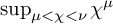 $\sup _{\mu <\chi <\nu }\chi ^\mu $
is smaller than
$\sup _{\mu <\chi <\nu }\chi ^\mu $
is smaller than $\kappa $
. This is a contradiction.
$\kappa $
. This is a contradiction. $\blacktriangleright $
If
$\blacktriangleright $
If $\nu $
is a limit cardinal and
$\nu $
is a limit cardinal and $\operatorname {\mathrm {cf}}(\nu )<\mu $
, then let
$\operatorname {\mathrm {cf}}(\nu )<\mu $
, then let $\langle \chi _j\mid j<\operatorname {\mathrm {cf}}(\nu )\rangle $
be a strictly increasing sequence of cardinals greater than
$\langle \chi _j\mid j<\operatorname {\mathrm {cf}}(\nu )\rangle $
be a strictly increasing sequence of cardinals greater than $\mu $
that converges to
$\mu $
that converges to $\nu $
. By the minimality of
$\nu $
. By the minimality of $\nu $
,
$\nu $
, $(\chi _j)^\mu <\kappa $
for every
$(\chi _j)^\mu <\kappa $
for every $j<\operatorname {\mathrm {cf}}(\nu )$
. So the regularity of
$j<\operatorname {\mathrm {cf}}(\nu )$
. So the regularity of $\kappa $
implies that
$\kappa $
implies that $\chi :=\sup _{j<\operatorname {\mathrm {cf}}(\nu )}(\chi _j)^\mu $
is smaller than
$\chi :=\sup _{j<\operatorname {\mathrm {cf}}(\nu )}(\chi _j)^\mu $
is smaller than $\kappa $
. However,
$\kappa $
. However, $\chi ^{\operatorname {\mathrm {cf}}(\nu )}\ge \nu ^\mu \ge \kappa $
. So the fact that
$\chi ^{\operatorname {\mathrm {cf}}(\nu )}\ge \nu ^\mu \ge \kappa $
. So the fact that $\operatorname {\mathrm {cf}}(\nu )<\mu $
contradicts the minimality of
$\operatorname {\mathrm {cf}}(\nu )<\mu $
contradicts the minimality of $\mu $
.
$\mu $
.
By the minimality of $\nu $
,
$\nu $
, $\lambda ^\mu <\kappa $
for every
$\lambda ^\mu <\kappa $
for every $\lambda <\nu $
.
$\lambda <\nu $
.
Breaking our convention for a moment, in the next lemma $\kappa $
is not assumed to be regular. In reading it for the first time, one may want to keep in mind the relaxed case of
$\kappa $
is not assumed to be regular. In reading it for the first time, one may want to keep in mind the relaxed case of $\mu =\operatorname {\mathrm {cf}}(\nu )<\nu <\varkappa =\operatorname {\mathrm {cf}}(\kappa )=\kappa $
that arises by the preceding lemma.
$\mu =\operatorname {\mathrm {cf}}(\nu )<\nu <\varkappa =\operatorname {\mathrm {cf}}(\kappa )=\kappa $
that arises by the preceding lemma.
Lemma 4.2. Suppose that $\mu <\nu <\varkappa \le \kappa $
are cardinals such that
$\mu <\nu <\varkappa \le \kappa $
are cardinals such that $\lambda ^\mu <\varkappa \le \kappa \le \nu ^\mu $
for every
$\lambda ^\mu <\varkappa \le \kappa \le \nu ^\mu $
for every $\lambda <\nu $
. Then:
$\lambda <\nu $
. Then:
-
(1) For every
$\theta \in \operatorname {\mathrm {Reg}}(\nu )$
,
$\operatorname {{\mathsf{unbounded}}}^+(\{\nu \},[\kappa ]^{<\varkappa },\theta )$
holds; -
(2) For every
$\theta \in \operatorname {\mathrm {Reg}}(\nu )$
such that
$\theta ^+<\nu $
,
$\operatorname {{\mathsf{onto}}}^+(\{\nu \},[\kappa ]^{<\varkappa },\theta )$
holds; -
(3) If
$\operatorname {\mathrm {cf}}(\nu )<\nu <\operatorname {\mathrm {cf}}(\varkappa )$
and
$\mu ^{\operatorname {\mathrm {cf}}(\nu )}<\varkappa $
, then
$\operatorname {{\mathsf{unbounded}}}(\{\nu '\},[\kappa ]^{<\varkappa },\nu )$
holds for
$\nu ':=\max \{\nu ,\mu ^{\operatorname {\mathrm {cf}}(\nu )}\}$
; -
(4) If
$\mu ^{\operatorname {\mathrm {cf}}(\nu )}\le \nu <\operatorname {\mathrm {cf}}(\kappa )$
and
$2^\nu =\kappa $
, then
$\operatorname {{\mathsf{onto}}}^+([\kappa ]^{<\kappa },\nu )$
holds.












Proof. Let $\langle g_\beta \mid \beta <\kappa \rangle $
be an injective enumeration of a family of functions from
$\langle g_\beta \mid \beta <\kappa \rangle $
be an injective enumeration of a family of functions from $\mu $
to
$\mu $
to $\nu $
. We commence with a trivial observation.
$\nu $
. We commence with a trivial observation.
Claim 4.2.1. Let $B\in [\kappa ]^\varkappa $
and
$B\in [\kappa ]^\varkappa $
and $\theta <\nu $
. Then there exists an
$\theta <\nu $
. Then there exists an $i<\mu $
such that
$i<\mu $
such that $|\{ g_\beta (i)\mid \beta \in B\}|>\theta $
.
$|\{ g_\beta (i)\mid \beta \in B\}|>\theta $
.
Proof. Suppose not, and let B be a counterexample, so that $X:=\{g_\beta (i)\mid i<\mu , \beta \in B\}$
has size no more than
$X:=\{g_\beta (i)\mid i<\mu , \beta \in B\}$
has size no more than $\lambda :=\max \{\theta ,\mu \}$
which is smaller than
$\lambda :=\max \{\theta ,\mu \}$
which is smaller than $\nu $
. As B is a subset of
$\nu $
. As B is a subset of ${}^\mu X$
of size
${}^\mu X$
of size $\varkappa $
, it follows that
$\varkappa $
, it follows that ${\lambda }^\mu \ge \varkappa $
, contradicting the hypothesis.
${\lambda }^\mu \ge \varkappa $
, contradicting the hypothesis.
We now turn to prove each of the clauses.
(1) Let $\theta \in \operatorname {\mathrm {Reg}}(\nu )$
. Let
$\theta \in \operatorname {\mathrm {Reg}}(\nu )$
. Let $\langle C_\delta \mid \delta \in E^\nu _\theta \rangle $
be some
$\langle C_\delta \mid \delta \in E^\nu _\theta \rangle $
be some $\theta $
-bounded C-sequence. Fix a bijection
$\theta $
-bounded C-sequence. Fix a bijection $\pi :\nu \leftrightarrow \mu \times \nu $
. Finally pick
$\pi :\nu \leftrightarrow \mu \times \nu $
. Finally pick $c:[\kappa ]^2\rightarrow \theta $
such that for every
$c:[\kappa ]^2\rightarrow \theta $
such that for every $\eta <\nu <\beta <\kappa $
, letting
$\eta <\nu <\beta <\kappa $
, letting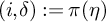 $(i,\delta ):=\pi (\eta )$
,
$(i,\delta ):=\pi (\eta )$
,
 $$ \begin{align*}c(\eta,\beta):=\begin{cases} \operatorname{\mathrm{otp}}(C_\delta\cap g_\beta(i)),&\text{if } \delta \in E^\nu_\theta\text{ and }g_\beta(i)<\delta;\\ 0,&\text{otherwise}. \end{cases}\end{align*} $$
As $\theta \le \nu <\operatorname {\mathrm {cf}}(\varkappa )$
, the proof of [Reference Inamdar and RinotIR24, Proposition 2.9(1)] shows that any witness to
$\theta \le \nu <\operatorname {\mathrm {cf}}(\varkappa )$
, the proof of [Reference Inamdar and RinotIR24, Proposition 2.9(1)] shows that any witness to $\operatorname {{\mathsf{unbounded}}}(\{\nu \},[\kappa ]^{<\varkappa },\theta )$
moreover witnesses
$\operatorname {{\mathsf{unbounded}}}(\{\nu \},[\kappa ]^{<\varkappa },\theta )$
moreover witnesses $\operatorname {{\mathsf{unbounded}}}^+(\{\nu \},[\kappa ]^{<\varkappa },\theta )$
. Thus, we verify that c witnesses
$\operatorname {{\mathsf{unbounded}}}^+(\{\nu \},[\kappa ]^{<\varkappa },\theta )$
. Thus, we verify that c witnesses $\operatorname {{\mathsf{unbounded}}}(\{\nu \},[\kappa ]^{<\varkappa },\theta )$
. To this end, let
$\operatorname {{\mathsf{unbounded}}}(\{\nu \},[\kappa ]^{<\varkappa },\theta )$
. To this end, let $B\in [\kappa ]^\varkappa $
and we shall show that there exists an
$B\in [\kappa ]^\varkappa $
and we shall show that there exists an $\eta <\nu $
such that
$\eta <\nu $
such that $c[\{\eta \}\circledast B]$
has size
$c[\{\eta \}\circledast B]$
has size $\theta $
.
$\theta $
.
Without loss of generality,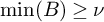 $\min (B)\ge \nu $
. Using Claim 4.2.1, fix an
$\min (B)\ge \nu $
. Using Claim 4.2.1, fix an $i<\mu $
such that
$i<\mu $
such that $X:=\{ g_\beta (i)\mid \beta \in B\}$
has size
$X:=\{ g_\beta (i)\mid \beta \in B\}$
has size $>\theta $
. Then fix the least
$>\theta $
. Then fix the least $\delta <\nu $
such that
$\delta <\nu $
such that $\operatorname {\mathrm {otp}}(X\cap \delta )=\theta $
. Consequently,
$\operatorname {\mathrm {otp}}(X\cap \delta )=\theta $
. Consequently, $\delta \in E^\nu _\theta $
,
$\delta \in E^\nu _\theta $
, $\sup (X \cap \delta ) = \delta $
, and
$\sup (X \cap \delta ) = \delta $
, and $Y:=\{ \operatorname {\mathrm {otp}}(C_\delta \cap \xi )\mid \xi \in X\cap \delta \}$
is a subset of
$Y:=\{ \operatorname {\mathrm {otp}}(C_\delta \cap \xi )\mid \xi \in X\cap \delta \}$
is a subset of $\theta $
of size
$\theta $
of size $\theta $
. Pick
$\theta $
. Pick $\eta <\nu $
such that
$\eta <\nu $
such that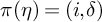 $\pi (\eta )=(i,\delta )$
. Then
$\pi (\eta )=(i,\delta )$
. Then $c[\{\eta \}\circledast B]$
covers Y, as sought.
$c[\{\eta \}\circledast B]$
covers Y, as sought.
(2) Suppose $\theta \in \operatorname {\mathrm {Reg}}(\nu )$
is such that
$\theta \in \operatorname {\mathrm {Reg}}(\nu )$
is such that $\theta ^+<\nu $
. By Clause (1),
$\theta ^+<\nu $
. By Clause (1), $\operatorname {{\mathsf{unbounded}}}^+(\{\nu \}, [\kappa ]^{<\varkappa },\theta ^+)$
holds. As
$\operatorname {{\mathsf{unbounded}}}^+(\{\nu \}, [\kappa ]^{<\varkappa },\theta ^+)$
holds. As $\theta $
is regular, by [Reference Inamdar and RinotIR24, Corollary 4.12],
$\theta $
is regular, by [Reference Inamdar and RinotIR24, Corollary 4.12], $\operatorname {{\mathsf{projection}}}(\theta ^+,\theta ^+,\theta ,1)$
holds. Then, by [Reference Inamdar and RinotIR24, Lemma 4.17(2)],
$\operatorname {{\mathsf{projection}}}(\theta ^+,\theta ^+,\theta ,1)$
holds. Then, by [Reference Inamdar and RinotIR24, Lemma 4.17(2)], $\operatorname {{\mathsf{onto}}}^+(\{\nu \},[\kappa ]^{<\varkappa },\theta )$
holds, as well.
$\operatorname {{\mathsf{onto}}}^+(\{\nu \},[\kappa ]^{<\varkappa },\theta )$
holds, as well.
(3) Denote $\theta :=\operatorname {\mathrm {cf}}(\nu )$
. Suppose that
$\theta :=\operatorname {\mathrm {cf}}(\nu )$
. Suppose that $\theta <\nu <\operatorname {\mathrm {cf}}(\varkappa )$
and that
$\theta <\nu <\operatorname {\mathrm {cf}}(\varkappa )$
and that $\nu ':=\max \{\nu ,\mu ^{\theta }\}$
is smaller than
$\nu ':=\max \{\nu ,\mu ^{\theta }\}$
is smaller than $\varkappa $
. Let
$\varkappa $
. Let $\langle \nu _j\mid j<\theta \rangle $
be a strictly increasing sequence of cardinals, converging to
$\langle \nu _j\mid j<\theta \rangle $
be a strictly increasing sequence of cardinals, converging to $\nu $
, and fix a bijection
$\nu $
, and fix a bijection $\pi :\nu '\leftrightarrow \nu \times {}^{\theta }\mu $
. Use Clause (2) to fix a colouring
$\pi :\nu '\leftrightarrow \nu \times {}^{\theta }\mu $
. Use Clause (2) to fix a colouring $c:[\kappa ]^2\rightarrow \theta $
witnessing
$c:[\kappa ]^2\rightarrow \theta $
witnessing $\operatorname {{\mathsf{onto}}}^+(\{\nu \},[\kappa ]^{<\varkappa },\theta )$
. Define
$\operatorname {{\mathsf{onto}}}^+(\{\nu \},[\kappa ]^{<\varkappa },\theta )$
. Define $d:[\kappa ]^2\rightarrow \theta $
as follows. Given
$d:[\kappa ]^2\rightarrow \theta $
as follows. Given $\eta <\nu '<\beta <\kappa $
, let
$\eta <\nu '<\beta <\kappa $
, let $(\bar \eta ,f):=\pi (\eta )$
, and then let
$(\bar \eta ,f):=\pi (\eta )$
, and then let $d(\eta ,\beta ):=g_\beta (f(c(\bar \eta ,\beta )))$
.
$d(\eta ,\beta ):=g_\beta (f(c(\bar \eta ,\beta )))$
.
To see that d witnesses $\operatorname {{\mathsf{unbounded}}}(\{\nu '\},[\kappa ]^{<\varkappa },\nu )$
, let
$\operatorname {{\mathsf{unbounded}}}(\{\nu '\},[\kappa ]^{<\varkappa },\nu )$
, let $B\in [\kappa ]^\varkappa $
, and we shall find an
$B\in [\kappa ]^\varkappa $
, and we shall find an $\eta <\nu '$
such that
$\eta <\nu '$
such that $c[\{\eta \}\circledast B]$
has size
$c[\{\eta \}\circledast B]$
has size $\nu $
.
$\nu $
.
Without loss of generality,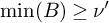 $\min (B)\ge \nu '$
. As c witnesses
$\min (B)\ge \nu '$
. As c witnesses $\operatorname {{\mathsf{onto}}}^+(\{\nu \},[\kappa ]^{<\varkappa },\theta )$
, we may pick some
$\operatorname {{\mathsf{onto}}}^+(\{\nu \},[\kappa ]^{<\varkappa },\theta )$
, we may pick some $\bar \eta <\nu $
such that for every
$\bar \eta <\nu $
such that for every $j<\theta $
,
$j<\theta $
, $B_j:=\{\beta \in B\mid c(\bar \eta ,\beta )=j\}$
is in
$B_j:=\{\beta \in B\mid c(\bar \eta ,\beta )=j\}$
is in $([\kappa ]^{<\varkappa })^+$
. By Claim 4.2.1, for each
$([\kappa ]^{<\varkappa })^+$
. By Claim 4.2.1, for each $j<\theta $
, there exists some
$j<\theta $
, there exists some $i_j<\mu $
such that
$i_j<\mu $
such that $X_j:=\{ g_\beta (i_j)\mid \beta \in B_j\}$
has size
$X_j:=\{ g_\beta (i_j)\mid \beta \in B_j\}$
has size $>\nu _j$
. Define
$>\nu _j$
. Define $f:\theta \rightarrow \mu $
via
$f:\theta \rightarrow \mu $
via $f(j):=i_j$
. Pick an
$f(j):=i_j$
. Pick an $\eta <\nu '$
such that
$\eta <\nu '$
such that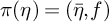 $\pi (\eta )=(\bar \eta ,f)$
. Then, for every
$\pi (\eta )=(\bar \eta ,f)$
. Then, for every $j<\theta $
,
$j<\theta $
,
 $$ \begin{align*}d[\{\eta\}\circledast B_j]=\{ g_\beta(f(c(\bar\eta,\beta)))\mid \beta\in B_j\}=\{g_\beta(f(j))\mid \beta\in B_j\}=X^j\end{align*} $$
is a subset of $\nu $
of size
$\nu $
of size $>\nu _j$
. As
$>\nu _j$
. As $\sup _{j<\theta }\nu _j=\nu $
,
$\sup _{j<\theta }\nu _j=\nu $
, $d[\{\eta \}\circledast B]$
is a subset of
$d[\{\eta \}\circledast B]$
is a subset of $\nu $
of size
$\nu $
of size $\nu $
, as sought.
$\nu $
, as sought.
(4) Suppose that $\mu ^{\operatorname {\mathrm {cf}}(\nu )}\le \nu <\operatorname {\mathrm {cf}}(\kappa )$
. It follows that
$\mu ^{\operatorname {\mathrm {cf}}(\nu )}\le \nu <\operatorname {\mathrm {cf}}(\kappa )$
. It follows that $\operatorname {\mathrm {cf}}(\nu )<\nu <\operatorname {\mathrm {cf}}(\kappa )$
and
$\operatorname {\mathrm {cf}}(\nu )<\nu <\operatorname {\mathrm {cf}}(\kappa )$
and $\mu ^{\operatorname {\mathrm {cf}}(\nu )}\le \nu <\kappa $
, so that
$\mu ^{\operatorname {\mathrm {cf}}(\nu )}\le \nu <\kappa $
, so that $\operatorname {{\mathsf{unbounded}}}(\{\nu \},[\kappa ]^{<\kappa },\nu )$
holds by Clause (3). As
$\operatorname {{\mathsf{unbounded}}}(\{\nu \},[\kappa ]^{<\kappa },\nu )$
holds by Clause (3). As $\nu <\operatorname {\mathrm {cf}}(\kappa )$
, it is the case that
$\nu <\operatorname {\mathrm {cf}}(\kappa )$
, it is the case that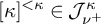 $[\kappa ]^{<\kappa }\in \mathcal J^\kappa _{\nu ^+}$
, so, by [Reference Inamdar and RinotIR24, Proposition 2.9(1)], moreover
$[\kappa ]^{<\kappa }\in \mathcal J^\kappa _{\nu ^+}$
, so, by [Reference Inamdar and RinotIR24, Proposition 2.9(1)], moreover $\operatorname {{\mathsf{unbounded}}}^+(\{\nu \}, [\kappa ]^{<\kappa },\nu )$
holds. In particular, we may fix a colouring
$\operatorname {{\mathsf{unbounded}}}^+(\{\nu \}, [\kappa ]^{<\kappa },\nu )$
holds. In particular, we may fix a colouring $c:[\kappa ]^2\rightarrow \nu $
witnessing
$c:[\kappa ]^2\rightarrow \nu $
witnessing $\operatorname {{\mathsf{unbounded}}}^+([\kappa ]^{<\kappa },\nu )$
. Suppose now that
$\operatorname {{\mathsf{unbounded}}}^+([\kappa ]^{<\kappa },\nu )$
. Suppose now that $2^\nu =\kappa $
, and fix a bijection
$2^\nu =\kappa $
, and fix a bijection $\pi :\kappa \leftrightarrow \kappa \times {}^\nu \nu $
. Define
$\pi :\kappa \leftrightarrow \kappa \times {}^\nu \nu $
. Define $d:[\kappa ]^2\rightarrow \nu $
as follows. Given
$d:[\kappa ]^2\rightarrow \nu $
as follows. Given $\eta <\beta <\kappa $
, let
$\eta <\beta <\kappa $
, let $(\bar \eta ,f):=\pi (\eta )$
, and then let
$(\bar \eta ,f):=\pi (\eta )$
, and then let $d(\eta ,\beta ):=f(c(\bar \eta ,\beta ))$
. To see that d witnesses
$d(\eta ,\beta ):=f(c(\bar \eta ,\beta ))$
. To see that d witnesses $\operatorname {{\mathsf{onto}}}^+([\kappa ]^{<\kappa },\nu )$
, let
$\operatorname {{\mathsf{onto}}}^+([\kappa ]^{<\kappa },\nu )$
, let $B\in [\kappa ]^\kappa $
be given. By the choice of c, we may fix
$B\in [\kappa ]^\kappa $
be given. By the choice of c, we may fix $\bar \eta <\kappa $
and
$\bar \eta <\kappa $
and $X\in [\nu ]^\nu $
such that for every
$X\in [\nu ]^\nu $
such that for every $\xi \in X$
, the set
$\xi \in X$
, the set $B_\xi :=\{\beta \in B\setminus (\bar \eta +1)\mid c(\bar \eta ,\beta )=\xi \}$
is in
$B_\xi :=\{\beta \in B\setminus (\bar \eta +1)\mid c(\bar \eta ,\beta )=\xi \}$
is in $[\kappa ]^\kappa $
. Fix
$[\kappa ]^\kappa $
. Fix $f\in {}^\nu \nu $
such that
$f\in {}^\nu \nu $
such that $f[X]=\nu $
. Find
$f[X]=\nu $
. Find $\eta <\kappa $
such that
$\eta <\kappa $
such that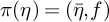 $\pi (\eta )=(\bar \eta ,f)$
. Then, given
$\pi (\eta )=(\bar \eta ,f)$
. Then, given $\tau <\nu $
, pick
$\tau <\nu $
, pick $\xi \in X$
such that
$\xi \in X$
such that $f(\xi )=\tau $
, and note that
$f(\xi )=\tau $
, and note that $\{\beta \in B\setminus (\eta +1)\mid d(\eta ,\beta )=\tau \}$
covers
$\{\beta \in B\setminus (\eta +1)\mid d(\eta ,\beta )=\tau \}$
covers $B_\xi \setminus (\eta +1)$
and hence it is in
$B_\xi \setminus (\eta +1)$
and hence it is in $[\kappa ]^\kappa $
.
$[\kappa ]^\kappa $
.
Corollary 4.3. Suppose that $\kappa $
is not strongly inaccessible.
$\kappa $
is not strongly inaccessible.
Then $\operatorname {{\mathsf{unbounded}}}^+(\mathcal J^\kappa _\kappa ,\theta )$
holds for
$\operatorname {{\mathsf{unbounded}}}^+(\mathcal J^\kappa _\kappa ,\theta )$
holds for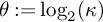 $\theta :=\log _2(\kappa )$
.
$\theta :=\log _2(\kappa )$
.
Proof. By [Reference Inamdar and RinotIR24, Theorem 4.1(2)], it suffices to prove that $\operatorname {{\mathsf{unbounded}}}^+(J^{\text {bd}}[\kappa ],\theta )$
holds. Meanwhile, by [Reference Lambie-Hanson and RinotLHR18, Lemma 2.7],
$\operatorname {{\mathsf{unbounded}}}^+(J^{\text {bd}}[\kappa ],\theta )$
holds. Meanwhile, by [Reference Lambie-Hanson and RinotLHR18, Lemma 2.7], $\operatorname {\mathrm {U}}(\kappa ,\kappa ,\theta ,2)$
holds. In particular,
$\operatorname {\mathrm {U}}(\kappa ,\kappa ,\theta ,2)$
holds. In particular, $\operatorname {\mathrm {U}}(\kappa ,2,\operatorname {\mathrm {cf}}(\theta ),2)$
holds. Then by [Reference Inamdar and RinotIR24, Lemma 5.12(1)],
$\operatorname {\mathrm {U}}(\kappa ,2,\operatorname {\mathrm {cf}}(\theta ),2)$
holds. Then by [Reference Inamdar and RinotIR24, Lemma 5.12(1)], $\operatorname {{\mathsf{unbounded}}}^+(J^{\text {bd}}[\kappa ],\operatorname {\mathrm {cf}}(\theta ))$
holds. So, if
$\operatorname {{\mathsf{unbounded}}}^+(J^{\text {bd}}[\kappa ],\operatorname {\mathrm {cf}}(\theta ))$
holds. So, if $\theta $
is regular, then we are done.
$\theta $
is regular, then we are done.
Hereafter, suppose that $\theta $
is singular. By Lemma 4.1, we may fix a singular cardinal
$\theta $
is singular. By Lemma 4.1, we may fix a singular cardinal $\nu $
with
$\nu $
with $\theta \leq \nu <\kappa $
such that
$\theta \leq \nu <\kappa $
such that $\lambda ^{\operatorname {\mathrm {cf}}(\nu )}<\kappa \le \nu ^{\operatorname {\mathrm {cf}}(\nu )}$
for every
$\lambda ^{\operatorname {\mathrm {cf}}(\nu )}<\kappa \le \nu ^{\operatorname {\mathrm {cf}}(\nu )}$
for every $\lambda <\nu $
.
$\lambda <\nu $
. $\blacktriangleright $
If
$\blacktriangleright $
If $\theta <\nu $
, then appealing to Lemma 4.2(2) with
$\theta <\nu $
, then appealing to Lemma 4.2(2) with $\mu :=\operatorname {\mathrm {cf}}(\nu )$
,
$\mu :=\operatorname {\mathrm {cf}}(\nu )$
, $\varkappa :=\kappa $
and the successor of
$\varkappa :=\kappa $
and the successor of $\theta $
, we get that
$\theta $
, we get that $\operatorname {{\mathsf{onto}}}^+(\{\nu \},[\kappa ]^{<\kappa },\theta ^+)$
holds. In particular,
$\operatorname {{\mathsf{onto}}}^+(\{\nu \},[\kappa ]^{<\kappa },\theta ^+)$
holds. In particular, $\operatorname {{\mathsf{onto}}}^+(J^{\text {bd}}[\kappa ],\theta )$
holds.
$\operatorname {{\mathsf{onto}}}^+(J^{\text {bd}}[\kappa ],\theta )$
holds. $\blacktriangleright $
If
$\blacktriangleright $
If $\theta =\nu $
, then appealing to Lemma 4.2(3) with
$\theta =\nu $
, then appealing to Lemma 4.2(3) with $\mu :=\operatorname {\mathrm {cf}}(\nu )$
and
$\mu :=\operatorname {\mathrm {cf}}(\nu )$
and $\varkappa :=\kappa $
, we get that
$\varkappa :=\kappa $
, we get that $\operatorname {{\mathsf{unbounded}}}(\{\nu '\},[\kappa ]^{<\kappa },\nu )$
holds for some cardinal
$\operatorname {{\mathsf{unbounded}}}(\{\nu '\},[\kappa ]^{<\kappa },\nu )$
holds for some cardinal $\nu '<\kappa $
. In particular, by [Reference Inamdar and RinotIR24, Proposition 2.9(1)],
$\nu '<\kappa $
. In particular, by [Reference Inamdar and RinotIR24, Proposition 2.9(1)], $\operatorname {{\mathsf{unbounded}}}^+(J^{\text {bd}}[\kappa ],\theta )$
holds.
$\operatorname {{\mathsf{unbounded}}}^+(J^{\text {bd}}[\kappa ],\theta )$
holds.
Remark 4.4. It remains open whether $\operatorname {{\mathsf{unbounded}}}^+$
may be improved to
$\operatorname {{\mathsf{unbounded}}}^+$
may be improved to $\operatorname {{\mathsf{onto}}}$
in the preceding. This is connected to the problem of whether
$\operatorname {{\mathsf{onto}}}$
in the preceding. This is connected to the problem of whether $\operatorname {{\mathsf{onto}}}(J^{\text {bd}}[\theta ^+],\theta )$
must hold for every singular cardinal
$\operatorname {{\mathsf{onto}}}(J^{\text {bd}}[\theta ^+],\theta )$
must hold for every singular cardinal $\theta $
.
$\theta $
.
5 Small number of colours, but for indecomposable ideals
In this short section, we provide two sufficient conditions for  to hold. Our first result improves [Reference Lambie-Hanson and RinotLHR23, Lemma 3.38(3)], and has to do with subadditive colourings. Recall that a colouring $c:[\kappa ]^2\rightarrow \theta $
is subadditive of the second kind iff
$c:[\kappa ]^2\rightarrow \theta $
is subadditive of the second kind iff $c(\alpha ,\beta )\le \max \{c(\alpha ,\gamma ),c(\beta ,\gamma )\}$
for all
$c(\alpha ,\beta )\le \max \{c(\alpha ,\gamma ),c(\beta ,\gamma )\}$
for all $\alpha <\beta <\gamma <\kappa $
.
$\alpha <\beta <\gamma <\kappa $
.
Definition 5.1 (special case of [Reference Lambie-Hanson and RinotLHR18, Definition 1.2]) $\operatorname {\mathrm {U}}(\kappa , 2, \theta , 2)$
asserts the existence of a colouring
$\operatorname {\mathrm {U}}(\kappa , 2, \theta , 2)$
asserts the existence of a colouring $c:[\kappa ]^2 \rightarrow \theta $
such that, for every
$c:[\kappa ]^2 \rightarrow \theta $
such that, for every $A\in [\kappa ]^\kappa $
,
$A\in [\kappa ]^\kappa $
, $\sup (c"[A])=\theta $
.
$\sup (c"[A])=\theta $
.
By [Reference Lambie-Hanson and RinotLHR23, Theorem 4.13], for every pair $\theta <\kappa $
of infinite regular cardinals, a weak form of
$\theta <\kappa $
of infinite regular cardinals, a weak form of $\square (\kappa )$
is sufficient to get a fully subadditive witness to
$\square (\kappa )$
is sufficient to get a fully subadditive witness to $\operatorname {\mathrm {U}}(\kappa ,2,\theta ,2)$
.
$\operatorname {\mathrm {U}}(\kappa ,2,\theta ,2)$
.
Proposition 5.2. Suppose that $\theta \in \operatorname {\mathrm {Reg}}(\kappa )$
, and
$\theta \in \operatorname {\mathrm {Reg}}(\kappa )$
, and $c:[\kappa ]^2\rightarrow \theta $
is a witness for
$c:[\kappa ]^2\rightarrow \theta $
is a witness for $\operatorname {\mathrm {U}}(\kappa ,2,\theta ,2)$
which is subadditive of the second kind.
$\operatorname {\mathrm {U}}(\kappa ,2,\theta ,2)$
which is subadditive of the second kind.
Then c witnesses  .
.
Proof. Let $A\in [\kappa ]^\kappa $
,
$A\in [\kappa ]^\kappa $
, $I\in \mathcal I^\kappa _\theta $
and
$I\in \mathcal I^\kappa _\theta $
and $B\in I^+$
be given. For all
$B\in I^+$
be given. For all $\eta <\kappa $
and
$\eta <\kappa $
and $\tau <\theta $
, denote
$\tau <\theta $
, denote $B^{\eta ,\ge \tau }:=\{ \beta \in B\mid c(\eta ,\beta )\ge \tau \}$
.
$B^{\eta ,\ge \tau }:=\{ \beta \in B\mid c(\eta ,\beta )\ge \tau \}$
.
Claim 5.2.1. There exists an $\eta \in A$
such that
$\eta \in A$
such that $B^{\eta ,\ge \tau }\in I^+$
for all
$B^{\eta ,\ge \tau }\in I^+$
for all $\tau <\theta $
.
$\tau <\theta $
.
Proof. Otherwise, we may find a function $g:A\rightarrow \theta $
such that
$g:A\rightarrow \theta $
such that $B^{\eta ,{\geq } g(\eta )}\in I$
for every
$B^{\eta ,{\geq } g(\eta )}\in I$
for every $\eta \in A$
. Fix
$\eta \in A$
. Fix $\tau <\theta $
for which the following set is cofinal in
$\tau <\theta $
for which the following set is cofinal in $\kappa $
:
$\kappa $
:
 $$ \begin{align*}A':=\{\eta\in A\mid g(\eta)=\tau\}.\end{align*} $$
As c witnesses $\operatorname {\mathrm {U}}(\kappa ,2,\theta ,2)$
, we may pick
$\operatorname {\mathrm {U}}(\kappa ,2,\theta ,2)$
, we may pick $(\eta _0,\eta _1)\in [A']^2$
such that
$(\eta _0,\eta _1)\in [A']^2$
such that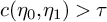 $c(\eta _0,\eta _1)>\tau $
. As
$c(\eta _0,\eta _1)>\tau $
. As $B\in I^+$
and
$B\in I^+$
and $B^{\eta _0,{\geq } g(\eta _0)}\cup B^{\eta _1,{\geq } g(\eta _1)}\in I$
, we may pick a
$B^{\eta _0,{\geq } g(\eta _0)}\cup B^{\eta _1,{\geq } g(\eta _1)}\in I$
, we may pick a $\beta \in B\setminus B^{\eta _0,{\geq } g(\eta _0)}\cup B^{\eta _1,{\geq } g(\eta _1)}$
above
$\beta \in B\setminus B^{\eta _0,{\geq } g(\eta _0)}\cup B^{\eta _1,{\geq } g(\eta _1)}$
above $\eta _1$
. As
$\eta _1$
. As $\eta _0<\eta _1<\beta $
and c is subadditive of the second kind,
$\eta _0<\eta _1<\beta $
and c is subadditive of the second kind,
 $$ \begin{align*}\tau<c(\eta_0,\eta_1)\le\max\{c(\eta_0,\beta),c(\eta_1,\beta)\}<\max\{g(\eta_0),g(\eta_1)\}=\tau.\end{align*} $$
This is a contradiction.
Let $\eta $
be given by the preceding claim, and then define a function
$\eta $
be given by the preceding claim, and then define a function $f:\kappa \rightarrow \theta $
via
$f:\kappa \rightarrow \theta $
via $f(\beta ):=c(\eta ,\beta )$
. By the choice of
$f(\beta ):=c(\eta ,\beta )$
. By the choice of $\eta $
, for every
$\eta $
, for every $\tau <\theta $
,
$\tau <\theta $
, $f\restriction B^{\eta ,\ge \tau }$
is a function from an
$f\restriction B^{\eta ,\ge \tau }$
is a function from an $I^+$
-set to
$I^+$
-set to $\theta \setminus \tau $
, so by the
$\theta \setminus \tau $
, so by the $\theta $
-indecomposability of I, there exists some
$\theta $
-indecomposability of I, there exists some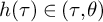 $h(\tau )\in (\tau ,\theta )$
such that the following set is in
$h(\tau )\in (\tau ,\theta )$
such that the following set is in $I^+$
:
$I^+$
:
 $$ \begin{align*}B_\tau:=\{\beta\in B^{\eta,\ge\tau}\mid f(\beta)<h(\tau)\}.\end{align*} $$
Fix a sparse enough $T\in [\theta ]^\theta $
such that, for all
$T\in [\theta ]^\theta $
such that, for all $\tau \in T$
and
$\tau \in T$
and $\sigma <\tau $
,
$\sigma <\tau $
, $h(\sigma )<\tau $
. Then
$h(\sigma )<\tau $
. Then $\eta $
and T are as sought.
$\eta $
and T are as sought.
The next corollary is a variant of Theorem 3.1.
Corollary 5.3. Suppose that $\theta \in \operatorname {\mathrm {Reg}}(\kappa )$
, and there exists a tree of height
$\theta \in \operatorname {\mathrm {Reg}}(\kappa )$
, and there exists a tree of height $\kappa $
with a
$\kappa $
with a $\theta $
-ascent path but no branch of size
$\theta $
-ascent path but no branch of size $\kappa $
. Then
$\kappa $
. Then  holds.
Proof. By Proposition 5.2 and [Reference Lambie-Hanson and RinotLHR23, Lemma 3.7].
Definition 5.4. $\mathcal C(\theta , \vartheta )$
denotes the least cardinality of a family of sets
$\mathcal C(\theta , \vartheta )$
denotes the least cardinality of a family of sets $\mathcal X \subseteq [\theta ]^\vartheta $
such that for every club subset
$\mathcal X \subseteq [\theta ]^\vartheta $
such that for every club subset $D\subseteq \theta $
, there is an
$D\subseteq \theta $
, there is an $X \in \mathcal X$
such that
$X \in \mathcal X$
such that $X \subseteq D$
.
$X \subseteq D$
.
Recall that for $f,g\in {}^\theta \theta $
, one writes
$f,g\in {}^\theta \theta $
, one writes $f\le ^{\text {bd}}g$
iff
$f\le ^{\text {bd}}g$
iff $\{\eta <\theta \mid f(\eta )> g(\eta )\}\in J^{\text {bd}}[\theta ]$
, and for
$\{\eta <\theta \mid f(\eta )> g(\eta )\}\in J^{\text {bd}}[\theta ]$
, and for $\tau < \theta $
, one writes
$\tau < \theta $
, one writes $f\le ^{\tau }g$
iff
$f\le ^{\tau }g$
iff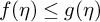 $f(\eta )\le g(\eta )$
for every
$f(\eta )\le g(\eta )$
for every $\eta \in [\tau ,\theta )$
.
$\eta \in [\tau ,\theta )$
.
-
•
$\mathfrak b_\theta $
stands for the least size of an unbounded family in
$({}^\theta \theta ,{\le ^{\text {bd}}})$
; -
•
$\mathfrak d_\theta $
stands for the least size of a cofinal family in
$({}^\theta \theta ,{\le ^{\text {bd}}})$
.


The next lemma must be well-known, but we could not find a reference for it.
Lemma 5.5. Suppose that $\theta $
is a regular uncountable cardinal. Then
$\theta $
is a regular uncountable cardinal. Then $\mathcal C(\theta ,\theta )=\mathfrak d_\theta $
.
$\mathcal C(\theta ,\theta )=\mathfrak d_\theta $
.
Proof. Denote $\nu :=\mathcal C(\theta ,\theta )$
.
$\nu :=\mathcal C(\theta ,\theta )$
. $\blacktriangleright $
To see that
$\blacktriangleright $
To see that $\nu \le \mathfrak d_\theta $
, fix a sequence
$\nu \le \mathfrak d_\theta $
, fix a sequence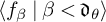 $\langle f_\beta \mid \beta <\mathfrak d_\theta \rangle $
of functions from
$\langle f_\beta \mid \beta <\mathfrak d_\theta \rangle $
of functions from $\theta $
to
$\theta $
to $\theta $
that is cofinal in
$\theta $
that is cofinal in $({}^\theta \theta ,{\le ^{\text {bd}}})$
. For all
$({}^\theta \theta ,{\le ^{\text {bd}}})$
. For all $\tau <\theta $
and
$\tau <\theta $
and $\beta <\mathfrak d_\theta $
, let
$\beta <\mathfrak d_\theta $
, let $C_{\tau ,\beta }:=\{ \gamma \in \operatorname {\mathrm {acc}}(\theta \setminus \tau )\mid f_\beta [\gamma ]\subseteq \gamma \}$
. Now, given any club
$C_{\tau ,\beta }:=\{ \gamma \in \operatorname {\mathrm {acc}}(\theta \setminus \tau )\mid f_\beta [\gamma ]\subseteq \gamma \}$
. Now, given any club $D\subseteq \theta $
, let
$D\subseteq \theta $
, let $\pi :\theta \rightarrow D$
denote the inverse collapsing map. Pick
$\pi :\theta \rightarrow D$
denote the inverse collapsing map. Pick $\tau < \theta $
and
$\tau < \theta $
and $\beta <\mathfrak d_\theta $
such that
$\beta <\mathfrak d_\theta $
such that $\pi \le ^\tau f_\beta $
. Towards a contradiction, suppose that
$\pi \le ^\tau f_\beta $
. Towards a contradiction, suppose that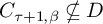 $C_{\tau +1,\beta }\nsubseteq D$
and fix
$C_{\tau +1,\beta }\nsubseteq D$
and fix $\gamma \in C_{\tau +1,\beta }\setminus D$
. In particular,
$\gamma \in C_{\tau +1,\beta }\setminus D$
. In particular, $\bar \gamma :=\sup (D\cap \gamma )$
and
$\bar \gamma :=\sup (D\cap \gamma )$
and $\tau $
are both smaller than
$\tau $
are both smaller than $\gamma $
. Put
$\gamma $
. Put $\eta :=\max \{\bar \gamma ,\tau \}+1$
so that
$\eta :=\max \{\bar \gamma ,\tau \}+1$
so that $\bar \gamma <\eta < \gamma $
. Then
$\bar \gamma <\eta < \gamma $
. Then $\bar \gamma <\eta \le \pi (\eta )\le f_\beta (\eta )<\gamma $
. Altogether,
$\bar \gamma <\eta \le \pi (\eta )\le f_\beta (\eta )<\gamma $
. Altogether, $\pi (\eta )$
is an element of D lying in the interval
$\pi (\eta )$
is an element of D lying in the interval $(\bar \gamma ,\gamma )$
. This is a contradiction.
$(\bar \gamma ,\gamma )$
. This is a contradiction. $\blacktriangleright $
To see that
$\blacktriangleright $
To see that $\mathfrak d_\theta \le \nu $
, fix a sequence
$\mathfrak d_\theta \le \nu $
, fix a sequence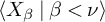 $\langle X_\beta \mid \beta <\nu \rangle $
of cofinal subsets of
$\langle X_\beta \mid \beta <\nu \rangle $
of cofinal subsets of $\theta $
, such that, for every club D in
$\theta $
, such that, for every club D in $\theta $
, for some
$\theta $
, for some $\beta <\nu $
,
$\beta <\nu $
, $X_\beta \subseteq D$
. For each
$X_\beta \subseteq D$
. For each $\beta <\nu $
, define
$\beta <\nu $
, define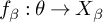 $f_\beta :\theta \rightarrow X_\beta $
via
$f_\beta :\theta \rightarrow X_\beta $
via $f_\beta (\eta ):=\min (X_\beta \setminus (\eta +1))$
. Now, given any function
$f_\beta (\eta ):=\min (X_\beta \setminus (\eta +1))$
. Now, given any function $f:\theta \rightarrow \theta $
, consider the club
$f:\theta \rightarrow \theta $
, consider the club $D:=\{\delta <\theta \mid f[\delta ]\subseteq \delta \}$
. Fix
$D:=\{\delta <\theta \mid f[\delta ]\subseteq \delta \}$
. Fix $\beta <\nu $
such that
$\beta <\nu $
such that $X_\beta \subseteq D$
, and we shall show that
$X_\beta \subseteq D$
, and we shall show that $f\le ^0f_\beta $
. Indeed, for every
$f\le ^0f_\beta $
. Indeed, for every $\eta <\theta $
,
$\eta <\theta $
, $\delta :=f_\beta (\eta )$
is an element of D above
$\delta :=f_\beta (\eta )$
is an element of D above $\eta $
and hence
$\eta $
and hence $f(\eta )<\delta =f_\beta (\eta )$
.
$f(\eta )<\delta =f_\beta (\eta )$
.
Proposition 5.6. Suppose that $\theta $
is an infinite regular cardinal, and
$\theta $
is an infinite regular cardinal, and $\mathfrak b_\theta =\mathfrak d_\theta =\kappa $
.
$\mathfrak b_\theta =\mathfrak d_\theta =\kappa $
.
Then  and
and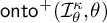 $\operatorname {{\mathsf{onto}}}^+(\mathcal I^\kappa _\theta ,\theta )$
both hold.
$\operatorname {{\mathsf{onto}}}^+(\mathcal I^\kappa _\theta ,\theta )$
both hold.
Proof. By Clauses (3) and (4) of Lemma 2.4 together with Lemma 5.5, in our case,  implies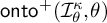 $\operatorname {{\mathsf{onto}}}^+(\mathcal I^\kappa _\theta , \theta )$
. Thus, we may focus on proving that
$\operatorname {{\mathsf{onto}}}^+(\mathcal I^\kappa _\theta , \theta )$
. Thus, we may focus on proving that  holds.
As $\mathfrak b_\theta =\mathfrak d_\theta =\kappa $
, we may fix a sequence
$\mathfrak b_\theta =\mathfrak d_\theta =\kappa $
, we may fix a sequence $\vec g=\langle g_\beta \mid \beta <\kappa \rangle $
that is increasing and cofinal in
$\vec g=\langle g_\beta \mid \beta <\kappa \rangle $
that is increasing and cofinal in $({}^\theta \theta ,{\le ^{\text {bd}}})$
. Define a colouring
$({}^\theta \theta ,{\le ^{\text {bd}}})$
. Define a colouring $c:[\kappa ]^2\rightarrow \theta $
by letting for all
$c:[\kappa ]^2\rightarrow \theta $
by letting for all $\eta <\theta \le \beta <\kappa $
:
$\eta <\theta \le \beta <\kappa $
:
 $$ \begin{align*}c(\eta,\beta):=g_\beta(\eta).\end{align*} $$
To see that c witnesses  , let
, let $A\in [\theta ]^\theta $
,
$A\in [\theta ]^\theta $
, $I\in \mathcal I^\kappa _\theta $
and
$I\in \mathcal I^\kappa _\theta $
and $B\in I^+$
be given. For all
$B\in I^+$
be given. For all $\eta ,\tau <\theta $
, denote
$\eta ,\tau <\theta $
, denote $B^{\eta ,\ge \tau }:=\{ \beta \in B\mid g_\beta (\eta )\ge \tau \}$
.
$B^{\eta ,\ge \tau }:=\{ \beta \in B\mid g_\beta (\eta )\ge \tau \}$
.
Claim 5.6.1. There exists an $\eta \in A$
such that
$\eta \in A$
such that $B^{\eta ,\ge \tau }\in I^+$
for all
$B^{\eta ,\ge \tau }\in I^+$
for all $\tau <\theta $
.
$\tau <\theta $
.
Proof. Otherwise, we may define a strictly increasing function $g:\theta \rightarrow \theta $
such that
$g:\theta \rightarrow \theta $
such that $B^{\eta ,{\geq } g(\eta )}\in I$
for every
$B^{\eta ,{\geq } g(\eta )}\in I$
for every $\eta \in A$
. Pick
$\eta \in A$
. Pick $\alpha <\kappa $
such that
$\alpha <\kappa $
such that $g\le ^{\text {bd}} g_\alpha $
. Since
$g\le ^{\text {bd}} g_\alpha $
. Since $\vec g$
is increasing, it follows that we may define a function
$\vec g$
is increasing, it follows that we may define a function $f:B\setminus \alpha \rightarrow \theta $
via
$f:B\setminus \alpha \rightarrow \theta $
via
 $$ \begin{align*}f(\beta):=\min\{\eta<\theta\mid g\le^\eta g_\beta\}.\end{align*} $$
As I is $\theta $
-indecomposable, we may now fix a large enough
$\theta $
-indecomposable, we may now fix a large enough $\eta \in A$
such that the following set is in
$\eta \in A$
such that the following set is in $I^+$
:
$I^+$
:
 $$ \begin{align*}B':=\{\beta\in B\setminus\alpha\mid f(\beta)\le\eta\}.\end{align*} $$
For every $\beta \in B'$
, since
$\beta \in B'$
, since $f(\beta )\le \eta $
, it is the case that
$f(\beta )\le \eta $
, it is the case that $g\le ^\eta g_\beta $
, in particular,
$g\le ^\eta g_\beta $
, in particular, $g_\beta (\eta )\ge g(\eta )$
, and hence
$g_\beta (\eta )\ge g(\eta )$
, and hence $B^{\eta ,{\geq } g(\eta )}$
contains the positive set
$B^{\eta ,{\geq } g(\eta )}$
contains the positive set $B'$
. This is a contradiction.
$B'$
. This is a contradiction.
Let $\eta $
be given by the preceding claim, and then define a function
$\eta $
be given by the preceding claim, and then define a function $f:\kappa \rightarrow \theta $
via
$f:\kappa \rightarrow \theta $
via $f(\beta ):=g_\beta (\eta )$
. By the choice of
$f(\beta ):=g_\beta (\eta )$
. By the choice of $\eta $
, for every
$\eta $
, for every $\tau <\theta $
,
$\tau <\theta $
, $f\restriction B^{\eta ,\ge \tau }$
is a function from an
$f\restriction B^{\eta ,\ge \tau }$
is a function from an $I^+$
-set to
$I^+$
-set to $\theta \setminus \tau $
, so by the
$\theta \setminus \tau $
, so by the $\theta $
-indecomposability of I, there exists some
$\theta $
-indecomposability of I, there exists some $h(\tau )\in (\tau ,\theta )$
such that the following set is in
$h(\tau )\in (\tau ,\theta )$
such that the following set is in $I^+$
:
$I^+$
:
 $$ \begin{align*}B_\tau:=\{\beta\in B^{\eta,\ge\tau}\mid f(\beta)<h(\tau)\}.\end{align*} $$
Fix a sparse enough $T\in [\theta ]^\theta $
such that, for all
$T\in [\theta ]^\theta $
such that, for all $\tau \in T$
and
$\tau \in T$
and $\sigma <\tau $
,
$\sigma <\tau $
, $h(\sigma )<\tau $
. Then
$h(\sigma )<\tau $
. Then $\eta $
and T are as sought.
$\eta $
and T are as sought.
Remark 5.7. A tweak of the proceeding proof establishes that for every infinite regular cardinal $\theta $
with
$\theta $
with $\mathfrak b_\theta =\mathfrak d_\theta =\kappa $
,
$\mathfrak b_\theta =\mathfrak d_\theta =\kappa $
, $\operatorname {{\mathsf{onto}}}^{++}(\mathcal I^\kappa _\theta ,\,\vartheta )$
holds for every cardinal
$\operatorname {{\mathsf{onto}}}^{++}(\mathcal I^\kappa _\theta ,\,\vartheta )$
holds for every cardinal $\vartheta <\theta $
.
$\vartheta <\theta $
.
6 Weak saturation of indecomposable ideals
The study of indecomposable ideals on a cardinal $\kappa $
started in the 1960s and 1970s, focusing on ultrafilters, that is, weakly
$\kappa $
started in the 1960s and 1970s, focusing on ultrafilters, that is, weakly $2$
-saturated ideals. The next batch of results from the 1990’s to the 2010’s expanded to weak
$2$
-saturated ideals. The next batch of results from the 1990’s to the 2010’s expanded to weak $\theta $
-saturation for
$\theta $
-saturation for $\theta $
typically smaller than
$\theta $
typically smaller than $\kappa $
. In this section, we focus on weak
$\kappa $
. In this section, we focus on weak $\kappa $
-saturation. In particular, we shall prove here Theorems C and D.
$\kappa $
-saturation. In particular, we shall prove here Theorems C and D.
For the purpose of this section, we introduce a variant of $\operatorname {{\mathsf{unbounded}}}^+(\mathcal A,J, \theta )$
that arises naturally in our context. Note that whenever
$\operatorname {{\mathsf{unbounded}}}^+(\mathcal A,J, \theta )$
that arises naturally in our context. Note that whenever $\mathcal T$
is an ideal over
$\mathcal T$
is an ideal over $\theta $
extending
$\theta $
extending $[\theta ]^{<\theta }$
, the following principle implies the former.
$[\theta ]^{<\theta }$
, the following principle implies the former.
Definition 6.1. $\operatorname {{\mathsf{unbounded}}}^+(\mathcal A,J, \mathcal T)$
asserts the existence of an upper-regressive colouring
$\operatorname {{\mathsf{unbounded}}}^+(\mathcal A,J, \mathcal T)$
asserts the existence of an upper-regressive colouring $c:[\kappa ]^2\rightarrow \theta $
with the property that, for all
$c:[\kappa ]^2\rightarrow \theta $
with the property that, for all $A\in \mathcal A$
and
$A\in \mathcal A$
and $B\in J^+$
, there is an
$B\in J^+$
, there is an $\eta \in A$
such that
$\eta \in A$
such that
 $$ \begin{align*}\{\tau<\theta\mid \{\beta\in B\setminus(\eta+1)\mid c(\eta,\beta)=\tau\}\in J^+\}\notin\mathcal T.\end{align*} $$
Convention 2.3 applies to this principle as well. The utility of the new principle is that, in the presence of an instance of $\operatorname {{\mathsf{onto}}}$
over
$\operatorname {{\mathsf{onto}}}$
over $\theta $
, it may enable us to pump up
$\theta $
, it may enable us to pump up $\operatorname {{\mathsf{unbounded}}}^+$
to
$\operatorname {{\mathsf{unbounded}}}^+$
to $\operatorname {{\mathsf{onto}}}^+$
over
$\operatorname {{\mathsf{onto}}}^+$
over $\kappa $
. The proof of the following is similar to that of [Reference Inamdar and RinotIR23, Lemma 5.12] and [Reference Inamdar and RinotIR24, Lemma 4.14(2)] and is left to the interested reader.
$\kappa $
. The proof of the following is similar to that of [Reference Inamdar and RinotIR23, Lemma 5.12] and [Reference Inamdar and RinotIR24, Lemma 4.14(2)] and is left to the interested reader.
Proposition 6.2. Suppose that $\operatorname {{\mathsf{unbounded}}}^+(\mathcal A, \mathcal J,I)$
holds with
$\operatorname {{\mathsf{unbounded}}}^+(\mathcal A, \mathcal J,I)$
holds with $\mathcal J\subseteq \mathcal J^\kappa _\omega $
and I an ideal over
$\mathcal J\subseteq \mathcal J^\kappa _\omega $
and I an ideal over $\theta $
. Let
$\theta $
. Let $\vartheta $
be another cardinal.
$\vartheta $
be another cardinal.
-
(1) If there are cardinals
$\mu \le \nu $
such that
$\mathcal A=\{\nu \}$
and
$\operatorname {{\mathsf{onto}}}(\{\mu \},I,\vartheta )$
holds, then
$\operatorname {{\mathsf{onto}}}^+(\{\nu \},\mathcal J,\vartheta )$
holds; -
(2) If
$\mathcal A=J^+$
for some
$J\in \mathcal J^\kappa _{\vartheta ^+}$
, and
$\operatorname {{\mathsf{onto}}}^{++}(I,\vartheta )$
holds, then so does
$\operatorname {{\mathsf{onto}}}^{++}(\mathcal J,\vartheta )$
.






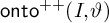

Note however that in the case that $\theta $
is a successor cardinal the new principle hardly conveys any new information. This is due to the next proposition whose proof is similar to that of [Reference Inamdar and RinotIR23, Lemma 6.15] and is left to the reader.
$\theta $
is a successor cardinal the new principle hardly conveys any new information. This is due to the next proposition whose proof is similar to that of [Reference Inamdar and RinotIR23, Lemma 6.15] and is left to the reader.
Proposition 6.3. For $\nu \le \lambda $
and a collection
$\nu \le \lambda $
and a collection $\mathcal J\subseteq \mathcal J^\kappa _\omega $
, the following are equivalent:
$\mathcal J\subseteq \mathcal J^\kappa _\omega $
, the following are equivalent:
-
(1)
$\operatorname {{\mathsf{unbounded}}}^+(\{\nu \},\mathcal J,\lambda ^+)$
holds; -
(2) there is a colouring simultaneously witnessing
$\operatorname {{\mathsf{unbounded}}}^+(\{\nu \},\mathcal J,I)$
for all
${I\in \mathcal J^{\lambda ^+}_{\lambda ^+}}$
.



In stating our results, we make use of the following piece of notation.
Definition 6.4. For $I\in \mathcal J^\kappa _\omega $
, let
$I\in \mathcal J^\kappa _\omega $
, let $T^*(I):=\{\tau <\kappa \mid I\text { is }\operatorname {\mathrm {cf}}(\tau )\text {-indecomposable}\}$
.
$T^*(I):=\{\tau <\kappa \mid I\text { is }\operatorname {\mathrm {cf}}(\tau )\text {-indecomposable}\}$
.
We commence with a warm-up. We remind the reader that our conventions concerning walks on ordinals [Reference TodorčevićTod87, Reference TodorcevicTod07] can be found in [Reference Inamdar and RinotIR25, §4]. In particular, familiarity with the functions $\operatorname {\mathrm {tr}}(\cdot ,\cdot )$
,
$\operatorname {\mathrm {tr}}(\cdot ,\cdot )$
, $\operatorname {\mathrm {Tr}}(\cdot ,\cdot )$
,
$\operatorname {\mathrm {Tr}}(\cdot ,\cdot )$
, $\lambda (\cdot ,\cdot )$
,
$\lambda (\cdot ,\cdot )$
, $\lambda _2(\cdot ,\cdot )$
,
$\lambda _2(\cdot ,\cdot )$
, $\rho _2(\cdot ,\cdot )$
and
$\rho _2(\cdot ,\cdot )$
and $\eth _{{\cdot },{\cdot }}$
will be assumed hereafter.
$\eth _{{\cdot },{\cdot }}$
will be assumed hereafter.
Lemma 6.5. Suppose that S is a nonreflecting stationary subset of $\kappa $
. Consider the collection
$\kappa $
. Consider the collection $\mathcal I:=\{ I\in \mathcal J^\kappa _\omega \mid S\cap T^*(I)\text { is stationary}\}$
. Then:
$\mathcal I:=\{ I\in \mathcal J^\kappa _\omega \mid S\cap T^*(I)\text { is stationary}\}$
. Then:
-
(1) There is a proper ideal
$J\in \mathcal J^\kappa _\kappa $
and a colouring
$c:[\kappa ]^2\rightarrow \kappa $
witnessing
$\operatorname {{\mathsf{unbounded}}}^+(J^+,I,\mathrm {NS}_\kappa \restriction (S\cap T^*(I)))$
for every
$I\in \mathcal I$
; -
(2)
$\operatorname {{\mathsf{onto}}}^{++}(\mathcal I,\vartheta )$
holds for every cardinal
$\vartheta <\kappa $
; -
(3) If
$\diamondsuit (S)$
holds, then so does
$\operatorname {{\mathsf{onto}}}^+(\mathcal I,\kappa )$
.




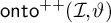


Proof. (1) Fix a bijection $\pi :\kappa \leftrightarrow \kappa \times \kappa $
and let J be the corresponding ideal from Example 2.1. Fix a C-sequence
$\pi :\kappa \leftrightarrow \kappa \times \kappa $
and let J be the corresponding ideal from Example 2.1. Fix a C-sequence $\vec C=\langle C_\delta \mid \delta <\kappa \rangle $
that avoids S, i.e.,
$\vec C=\langle C_\delta \mid \delta <\kappa \rangle $
that avoids S, i.e., $\operatorname {\mathrm {acc}}(C_\delta )\cap S=\emptyset $
for every
$\operatorname {\mathrm {acc}}(C_\delta )\cap S=\emptyset $
for every $\delta <\kappa $
. We shall walk along
$\delta <\kappa $
. We shall walk along $\vec C$
, and let
$\vec C$
, and let $\operatorname {\mathrm {tr}}$
,
$\operatorname {\mathrm {tr}}$
, $\lambda $
, etc. be the induced characteristic maps. Define a colouring
$\lambda $
, etc. be the induced characteristic maps. Define a colouring $c:[\kappa ]^2\rightarrow \kappa $
as follows. Given
$c:[\kappa ]^2\rightarrow \kappa $
as follows. Given $\eta <\beta <\kappa $
, consider
$\eta <\beta <\kappa $
, consider $(\eta _0,\eta _1):=\pi (\eta )$
, and then set
$(\eta _0,\eta _1):=\pi (\eta )$
, and then set $c(\eta ,\beta ):=\min (\operatorname {\mathrm {Im}}(\operatorname {\mathrm {tr}}(\eta _0,\beta ))\cap \operatorname {\mathrm {Im}}(\operatorname {\mathrm {tr}}(\eta _1,\beta )))$
, provided that the latter is well-defined. Otherwise, just let
$c(\eta ,\beta ):=\min (\operatorname {\mathrm {Im}}(\operatorname {\mathrm {tr}}(\eta _0,\beta ))\cap \operatorname {\mathrm {Im}}(\operatorname {\mathrm {tr}}(\eta _1,\beta )))$
, provided that the latter is well-defined. Otherwise, just let $c(\eta ,\beta ):=0$
.
$c(\eta ,\beta ):=0$
.
Let $I \in \mathcal I$
, and we shall show that c witnesses
$I \in \mathcal I$
, and we shall show that c witnesses $\operatorname {{\mathsf{unbounded}}}^+(J^+,I,\text {NS}_\kappa \restriction (S\cap T^*(I)))$
. Let
$\operatorname {{\mathsf{unbounded}}}^+(J^+,I,\text {NS}_\kappa \restriction (S\cap T^*(I)))$
. Let $A\in J^+$
and
$A\in J^+$
and $B\in I^+$
be given. Consider
$B\in I^+$
be given. Consider $A_0:=\{\eta _0<\kappa \mid \sup \{\eta _1<\kappa \mid \pi ^{-1}(\eta _0,\eta _1)\in A\}=\kappa \}$
, and note that, since
$A_0:=\{\eta _0<\kappa \mid \sup \{\eta _1<\kappa \mid \pi ^{-1}(\eta _0,\eta _1)\in A\}=\kappa \}$
, and note that, since $A\in J^+$
, the following set is a club in
$A\in J^+$
, the following set is a club in $\kappa $
:
$\kappa $
:
 $$ \begin{align*}E:=\{\delta\in\operatorname{\mathrm{acc}}^+(A_0)\mid \forall \eta_0\in A_0\cap\delta\, \sup\{\eta_1<\delta\mid \pi^{-1}(\eta_0,\eta_1)\in A\cap\delta\}=\delta\}.\end{align*} $$
Claim 6.5.1. The following holds:
 $$ \begin{align*}S\cap T^*(I)\cap E\subseteq \{ \delta<\kappa\mid \exists \eta\in A\cap\delta\, \{ \beta\in B\mid c(\eta,\beta)=\delta\}\in I^+\}.\end{align*} $$
Proof. Fix $\delta \in S\cap T^*(I)\cap E$
. As I is
$\delta \in S\cap T^*(I)\cap E$
. As I is $\operatorname {\mathrm {cf}}(\delta )$
-indecomposable, we may fix some
$\operatorname {\mathrm {cf}}(\delta )$
-indecomposable, we may fix some $\epsilon <\delta $
for which the following set is in
$\epsilon <\delta $
for which the following set is in $I^+$
:
$I^+$
:
 $$ \begin{align*}B':=\{\beta\in B\setminus(\delta+1)\mid \lambda(\delta,\beta)\le\epsilon\}.\end{align*} $$
To justify, note that as $\vec C$
avoids S and as
$\vec C$
avoids S and as $\delta \in S$
, for every
$\delta \in S$
, for every $\beta \in B \setminus (\delta +1)$
,
$\beta \in B \setminus (\delta +1)$
, $\lambda (\delta , \beta ) < \delta $
; and secondly, as
$\lambda (\delta , \beta ) < \delta $
; and secondly, as $B\setminus (\delta +1)$
is in
$B\setminus (\delta +1)$
is in $I^+$
and I is
$I^+$
and I is $\operatorname {\mathrm {cf}}(\delta )$
-indecomposable, such an
$\operatorname {\mathrm {cf}}(\delta )$
-indecomposable, such an $\epsilon < \delta $
can indeed be found.
$\epsilon < \delta $
can indeed be found.
Pick $\eta _0\in A_0\cap \delta $
above
$\eta _0\in A_0\cap \delta $
above $\epsilon $
, and then pick an
$\epsilon $
, and then pick an $\eta _1$
with
$\eta _1$
with $\min (C_\delta \setminus \eta _0)<\eta _1<\delta $
such that
$\min (C_\delta \setminus \eta _0)<\eta _1<\delta $
such that $\eta :=\pi ^{-1}(\eta _0,\eta _1)$
is in
$\eta :=\pi ^{-1}(\eta _0,\eta _1)$
is in $A\cap \delta $
. For every
$A\cap \delta $
. For every $\beta \in B'$
,
$\beta \in B'$
,
 $$ \begin{align*}\lambda(\delta,\beta)\le\epsilon<\eta_0<\eta_1<\delta<\beta\end{align*} $$
and hence $\delta \in \operatorname {\mathrm {Im}}(\operatorname {\mathrm {tr}}(\eta _0,\,\beta ))\cap \operatorname {\mathrm {Im}}(\operatorname {\mathrm {tr}}(\eta _1,\,\beta ))$
. In addition,
$\delta \in \operatorname {\mathrm {Im}}(\operatorname {\mathrm {tr}}(\eta _0,\,\beta ))\cap \operatorname {\mathrm {Im}}(\operatorname {\mathrm {tr}}(\eta _1,\,\beta ))$
. In addition,
 $$ \begin{align*}\min(C_{\delta}\setminus\eta_0)<\eta_1\le\min(C_{\delta}\setminus\eta_1),\end{align*} $$
and hence $c(\eta ,\,\beta )=\delta $
.
$c(\eta ,\,\beta )=\delta $
.
The conclusion now follows from Fodor’s lemma.
(2) By Clause (1) and Proposition 6.2(2), it suffices to prove that $\operatorname {{\mathsf{onto}}}^{++}(J^{\text {bd}}[\kappa ], \vartheta )$
holds for every cardinal
$\operatorname {{\mathsf{onto}}}^{++}(J^{\text {bd}}[\kappa ], \vartheta )$
holds for every cardinal $\vartheta <\kappa $
. Now, since
$\vartheta <\kappa $
. Now, since $\kappa $
admits a nonreflecting stationary set, the main result of [Reference RinotRin14] implies that
$\kappa $
admits a nonreflecting stationary set, the main result of [Reference RinotRin14] implies that $\operatorname {\mathrm {Pr}}_1(\kappa ,\kappa ,\kappa ,\omega )$
holds (see Definition 7.3). In particular,
$\operatorname {\mathrm {Pr}}_1(\kappa ,\kappa ,\kappa ,\omega )$
holds (see Definition 7.3). In particular, $\kappa \nrightarrow [\kappa ;\kappa ]^2_\vartheta $
holds for every
$\kappa \nrightarrow [\kappa ;\kappa ]^2_\vartheta $
holds for every $\vartheta \le \kappa $
. By [Reference Inamdar and RinotIR24, Theorem 5.4(2)], then,
$\vartheta \le \kappa $
. By [Reference Inamdar and RinotIR24, Theorem 5.4(2)], then, $\operatorname {{\mathsf{onto}}}^{++}(J^{\text {bd}}[\kappa ],\vartheta )$
holds for every
$\operatorname {{\mathsf{onto}}}^{++}(J^{\text {bd}}[\kappa ],\vartheta )$
holds for every $\vartheta <\kappa $
, as sought.
$\vartheta <\kappa $
, as sought.
(3) By Clause (1), and Proposition 6.2(1), recalling [Reference Inamdar and RinotIR23, Corollary 8.6].
Our next result establishes the first clause of Theorem D.
Lemma 6.6. Suppose that $\square (\kappa ,{<}\mu )$
holds with
$\square (\kappa ,{<}\mu )$
holds with $\mu <\kappa $
. Then there exists a proper ideal
$\mu <\kappa $
. Then there exists a proper ideal $J\in \mathcal J^\kappa _\kappa $
such that, for every
$J\in \mathcal J^\kappa _\kappa $
such that, for every $\Theta \in [\operatorname {\mathrm {Reg}}(\kappa )]^{<\kappa }$
,
$\Theta \in [\operatorname {\mathrm {Reg}}(\kappa )]^{<\kappa }$
, $\operatorname {{\mathsf{unbounded}}}^+(J^+,\bigcup _{\theta \in \Theta }\mathcal I^\kappa _\theta \cap \mathcal J^\kappa _\mu ,\mathrm {NS}_\kappa )$
holds.
$\operatorname {{\mathsf{unbounded}}}^+(J^+,\bigcup _{\theta \in \Theta }\mathcal I^\kappa _\theta \cap \mathcal J^\kappa _\mu ,\mathrm {NS}_\kappa )$
holds.
Proof. Fix a bijection $\pi :\kappa \leftrightarrow \kappa \times \kappa $
and let J be the corresponding ideal from Example 2.1. Let
$\pi :\kappa \leftrightarrow \kappa \times \kappa $
and let J be the corresponding ideal from Example 2.1. Let $\Theta \in [\operatorname {\mathrm {Reg}}(\kappa )]^{<\kappa }$
. By [Reference Meir Brodsky and RinotBR19, Lemma 2.5], we may fix a witness
$\Theta \in [\operatorname {\mathrm {Reg}}(\kappa )]^{<\kappa }$
. By [Reference Meir Brodsky and RinotBR19, Lemma 2.5], we may fix a witness ${\vec {\mathcal C}=\langle \mathcal C_\delta \mid \delta <\kappa \rangle }$
for
${\vec {\mathcal C}=\langle \mathcal C_\delta \mid \delta <\kappa \rangle }$
for $\square (\kappa ,{<}\mu )$
such that for every club
$\square (\kappa ,{<}\mu )$
such that for every club $D\subseteq \kappa $
, for every
$D\subseteq \kappa $
, for every $\theta \in \Theta $
, there exists a
$\theta \in \Theta $
, there exists a $\delta \in E^\kappa _\theta $
such that
$\delta \in E^\kappa _\theta $
such that $\sup (\operatorname {\mathrm {nacc}}(C)\cap D)=\delta $
for all
$\sup (\operatorname {\mathrm {nacc}}(C)\cap D)=\delta $
for all $C\in \mathcal C_\delta $
. Let
$C\in \mathcal C_\delta $
. Let $\vec C=\langle C_\delta \mid \delta <\kappa \rangle $
be a transversal for
$\vec C=\langle C_\delta \mid \delta <\kappa \rangle $
be a transversal for $\vec {\mathcal C}$
. We shall walk along
$\vec {\mathcal C}$
. We shall walk along $\vec C$
, and let
$\vec C$
, and let $\operatorname {\mathrm {tr}}$
,
$\operatorname {\mathrm {tr}}$
, $\lambda _2$
, etc. be the induced characteristic maps. Define a colouring
$\lambda _2$
, etc. be the induced characteristic maps. Define a colouring $c:[\kappa ]^2\rightarrow \kappa $
as follows. Given
$c:[\kappa ]^2\rightarrow \kappa $
as follows. Given $\eta <\beta <\kappa $
, consider
$\eta <\beta <\kappa $
, consider $(\eta _0,\eta _1):=\pi (\eta )$
. Let
$(\eta _0,\eta _1):=\pi (\eta )$
. Let $\gamma :=\min (\operatorname {\mathrm {Im}}(\operatorname {\mathrm {tr}}(\eta _0,\beta ))\cap \operatorname {\mathrm {Im}}(\operatorname {\mathrm {tr}}(\eta _1,\beta )))$
, and then set
$\gamma :=\min (\operatorname {\mathrm {Im}}(\operatorname {\mathrm {tr}}(\eta _0,\beta ))\cap \operatorname {\mathrm {Im}}(\operatorname {\mathrm {tr}}(\eta _1,\beta )))$
, and then set $c(\eta ,\beta ):=\min (C_\gamma \setminus \eta _1)$
, provided that the latter is well-defined. Otherwise, just let
$c(\eta ,\beta ):=\min (C_\gamma \setminus \eta _1)$
, provided that the latter is well-defined. Otherwise, just let $c(\eta ,\beta ):=0$
.
$c(\eta ,\beta ):=0$
.
To see that c witnesses $\operatorname {{\mathsf{unbounded}}}^+(J^+,\bigcup _{\theta \in \Theta }\mathcal I^\kappa _\theta \cap \mathcal J^\kappa _\mu ,\text {NS}_\kappa )$
, let
$\operatorname {{\mathsf{unbounded}}}^+(J^+,\bigcup _{\theta \in \Theta }\mathcal I^\kappa _\theta \cap \mathcal J^\kappa _\mu ,\text {NS}_\kappa )$
, let $A\in J^+$
,
$A\in J^+$
, $\theta \in \Theta $
,
$\theta \in \Theta $
, $I\in \mathcal I^\kappa _\theta \cap \mathcal I^\kappa _\mu $
and
$I\in \mathcal I^\kappa _\theta \cap \mathcal I^\kappa _\mu $
and $B\in I^+$
be given. Derive from A the sets
$B\in I^+$
be given. Derive from A the sets $A_0$
and E as in the proof of Lemma 6.5.
$A_0$
and E as in the proof of Lemma 6.5.
Claim 6.6.1. The following set is stationary:
 $$ \begin{align*}T:=\{ \tau<\kappa\mid \exists \eta\in A\cap\tau\, \{ \beta\in B\mid c(\eta,\beta)=\tau\}\in I^+\}.\end{align*} $$
Proof. Let D be an arbitrary club in $\kappa $
, and we shall find a
$\kappa $
, and we shall find a $\tau $
in
$\tau $
in $D\cap T$
. Fix
$D\cap T$
. Fix $\delta \in E^\kappa _\theta $
such that
$\delta \in E^\kappa _\theta $
such that $\sup (\operatorname {\mathrm {nacc}}(C)\cap D\cap E)=\delta $
for all
$\sup (\operatorname {\mathrm {nacc}}(C)\cap D\cap E)=\delta $
for all $C\in \mathcal C_\delta $
. As I is
$C\in \mathcal C_\delta $
. As I is $\mu $
-complete, we may fix a
$\mu $
-complete, we may fix a $C\in \mathcal C_\delta $
for which the following set is in
$C\in \mathcal C_\delta $
for which the following set is in $I^+$
:
$I^+$
:
 $$ \begin{align*}B':=\{\beta\in B\setminus(\delta+1)\mid C_{\eth_{\delta,\beta}}\cap\delta=C\}.\end{align*} $$
As $\operatorname {\mathrm {cf}}(\delta )=\theta $
and as I is
$\operatorname {\mathrm {cf}}(\delta )=\theta $
and as I is $\theta $
-indecomposable, we may fix some
$\theta $
-indecomposable, we may fix some $\epsilon <\delta $
for which the following set is in
$\epsilon <\delta $
for which the following set is in $I^+$
:
$I^+$
:
 $$ \begin{align*}B":=\{\beta\in B'\mid \lambda_2(\delta,\beta)\le\epsilon\}.\end{align*} $$
Pick $\eta _0\in A_0\cap \delta $
above
$\eta _0\in A_0\cap \delta $
above $\epsilon $
. Fix
$\epsilon $
. Fix $\tau \in \operatorname {\mathrm {nacc}}(C)\cap D\cap E$
above
$\tau \in \operatorname {\mathrm {nacc}}(C)\cap D\cap E$
above $\min (C\setminus \eta _0)$
. As
$\min (C\setminus \eta _0)$
. As $\tau \in E$
, we may then fix an
$\tau \in E$
, we may then fix an $\eta _1$
with
$\eta _1$
with $\sup (C\cap \tau )<\eta _1<\tau $
such that
$\sup (C\cap \tau )<\eta _1<\tau $
such that $\eta :=\pi ^{-1}(\eta _0,\eta _1)$
is in
$\eta :=\pi ^{-1}(\eta _0,\eta _1)$
is in $A\cap \tau $
. For every
$A\cap \tau $
. For every $\beta \in B"$
,
$\beta \in B"$
,
 $$ \begin{align*}\lambda(\eth_{\delta,\beta},\beta)\le\epsilon<\eta_0<\eta_1<\tau<\delta<\beta,\end{align*} $$
and hence $\eth _{\delta ,\beta }\in \operatorname {\mathrm {Im}}(\operatorname {\mathrm {tr}}(\eta _0,\beta ))\cap \operatorname {\mathrm {Im}}(\operatorname {\mathrm {tr}}(\eta _1,\beta ))$
. In addition,
$\eth _{\delta ,\beta }\in \operatorname {\mathrm {Im}}(\operatorname {\mathrm {tr}}(\eta _0,\beta ))\cap \operatorname {\mathrm {Im}}(\operatorname {\mathrm {tr}}(\eta _1,\beta ))$
. In addition,
 $$ \begin{align*}\min(C_{\eth_{\delta,\beta}}\setminus\eta_0)\le\sup(C\cap\tau)<\eta_1\le\min(C_{\eth_{\delta,\beta}}\setminus\eta_1),\end{align*} $$
and hence $\min (\operatorname {\mathrm {Im}}(\operatorname {\mathrm {tr}}(\eta _0,\beta ))\cap \operatorname {\mathrm {Im}}(\operatorname {\mathrm {tr}}(\eta _1,\beta )))=\eth _{\delta ,\beta }$
from which it follows that
$\min (\operatorname {\mathrm {Im}}(\operatorname {\mathrm {tr}}(\eta _0,\beta ))\cap \operatorname {\mathrm {Im}}(\operatorname {\mathrm {tr}}(\eta _1,\beta )))=\eth _{\delta ,\beta }$
from which it follows that
 $$ \begin{align*}c(\eta,\beta)=\min(C_{\eth_{\delta,\beta}}\setminus\eta_1)=\min(C\setminus\eta_1)=\tau,\end{align*} $$
as sought.
The conclusion now follows from Fodor’s lemma.
We now derive two corollaries. The first is the following result whose original proof went through generic elementary embeddings.
Corollary 6.7 (Reference Rinot and ZhangRZ23, Lemma 4.6)
Suppose that $\lambda $
is a regular uncountable cardinal and
$\lambda $
is a regular uncountable cardinal and $\square (\lambda ^+,{<}\lambda )$
holds. Then every
$\square (\lambda ^+,{<}\lambda )$
holds. Then every $\lambda $
-complete uniform filter over
$\lambda $
-complete uniform filter over $\lambda ^+$
is not weakly
$\lambda ^+$
is not weakly $\lambda $
-saturated.
$\lambda $
-saturated.
Corollary 6.8. Suppose that $\square (\kappa ,{<}\omega )$
holds.
$\square (\kappa ,{<}\omega )$
holds.
-
(1) For all
$\theta ,\,\vartheta \in \operatorname {\mathrm {Reg}}(\kappa )$
,
$\operatorname {{\mathsf{onto}}}^{++}(\mathcal I^\kappa _\theta ,\,\vartheta )$
holds; -
(2) If
$\kappa =\vartheta ^+$
, then
$\operatorname {{\mathsf{onto}}}^{++}(\mathcal I,\vartheta )$
holds for
$\mathcal I:=\{I\in \mathcal J^\kappa _\omega \mid T^*(I)\neq \emptyset \}$
; -
(3) If
$\kappa =\vartheta ^+$
and holds, then
$\operatorname {{\mathsf{onto}}}^+(\mathcal I,\kappa )$
holds for
$\mathcal I$
of Clause (2); -
(4) If
$\diamondsuit (S)$
holds for some stationary
$S\subseteq \kappa $
that does not reflect at regulars, then
$\operatorname {{\mathsf{onto}}}^+(\mathcal I_\theta ^\kappa ,\kappa )$
holds for all
$\theta \in \operatorname {\mathrm {Reg}}(\kappa )$
.






 holds, then


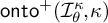

Proof. (1) Let $\theta ,\, \vartheta \in \operatorname {\mathrm {Reg}}(\kappa )$
. By the upcoming Clause (2), we may assume that
$\theta ,\, \vartheta \in \operatorname {\mathrm {Reg}}(\kappa )$
. By the upcoming Clause (2), we may assume that $\kappa>\vartheta ^+$
. So, by Shelah’s club-guessing theorem [Reference ShelahShe94b, Claim 2.7]
$\kappa>\vartheta ^+$
. So, by Shelah’s club-guessing theorem [Reference ShelahShe94b, Claim 2.7] $\mathcal C(\kappa ,\vartheta )=\kappa $
. Now, the conclusion follows from Lemma 6.6 and Lemma 2.4(4).
$\mathcal C(\kappa ,\vartheta )=\kappa $
. Now, the conclusion follows from Lemma 6.6 and Lemma 2.4(4).
(2) By Lemma 6.6, in particular, $\operatorname {{\mathsf{unbounded}}}^+(J^+, \mathcal I,J^{\text {bd}}[\kappa ])$
holds for some ideal
$\operatorname {{\mathsf{unbounded}}}^+(J^+, \mathcal I,J^{\text {bd}}[\kappa ])$
holds for some ideal $J\in \mathcal J^{\kappa }_\kappa $
. So, by Proposition 6.2(2), it suffices to prove that
$J\in \mathcal J^{\kappa }_\kappa $
. So, by Proposition 6.2(2), it suffices to prove that $\operatorname {{\mathsf{onto}}}^{++}(J^{\text {bd}}[\kappa ],\vartheta )$
holds. The latter follows from [Reference Inamdar and RinotIR24, Theorem 5.3(2)] and Lemma 7.2 below.
$\operatorname {{\mathsf{onto}}}^{++}(J^{\text {bd}}[\kappa ],\vartheta )$
holds. The latter follows from [Reference Inamdar and RinotIR24, Theorem 5.3(2)] and Lemma 7.2 below.
(3) By Proposition 6.2(1), it suffices to prove that $\operatorname {{\mathsf{onto}}}(J^{\text {bd}}[\kappa ],\kappa )$
holds. By [Reference Inamdar and RinotIR23, Lemma 8.3], for every successor cardinal
$\operatorname {{\mathsf{onto}}}(J^{\text {bd}}[\kappa ],\kappa )$
holds. By [Reference Inamdar and RinotIR23, Lemma 8.3], for every successor cardinal $\kappa $
,
$\kappa $
,  implies $\operatorname {{\mathsf{onto}}}(J^{\text {bd}}[\kappa ],\kappa )$
.
$\operatorname {{\mathsf{onto}}}(J^{\text {bd}}[\kappa ],\kappa )$
.
(4) Suppose that $\diamondsuit (S)$
holds for some stationary
$\diamondsuit (S)$
holds for some stationary $S\subseteq \kappa $
that does not reflect at regulars. By [Reference Inamdar and RinotIR23, Corollary 8.6], then,
$S\subseteq \kappa $
that does not reflect at regulars. By [Reference Inamdar and RinotIR23, Corollary 8.6], then, $\operatorname {{\mathsf{onto}}}(J^{\text {bd}}[\kappa ],\kappa )$
holds. Thus, letting
$\operatorname {{\mathsf{onto}}}(J^{\text {bd}}[\kappa ],\kappa )$
holds. Thus, letting $\theta \in \operatorname {\mathrm {Reg}}(\kappa )$
, we get from Lemma 6.6 and Proposition 6.2(1) that
$\theta \in \operatorname {\mathrm {Reg}}(\kappa )$
, we get from Lemma 6.6 and Proposition 6.2(1) that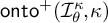 $\operatorname {{\mathsf{onto}}}^+(\mathcal I_\theta ^\kappa ,\kappa )$
holds.
$\operatorname {{\mathsf{onto}}}^+(\mathcal I_\theta ^\kappa ,\kappa )$
holds.
Remark 6.9. An extra hypothesis in Clause (3) is necessary, as $\square (\omega _1,{<}\omega )$
trivially holds, whereas, by [Reference LarsonLar07, Corollary 6.8],
$\square (\omega _1,{<}\omega )$
trivially holds, whereas, by [Reference LarsonLar07, Corollary 6.8], $\operatorname {{\mathsf{onto}}}(\text {NS}_{\omega _1},\omega _1)$
may consistently fail.
$\operatorname {{\mathsf{onto}}}(\text {NS}_{\omega _1},\omega _1)$
may consistently fail.
We next deal with the failure of simultaneous reflection, getting non-weak saturation via  instead of $\operatorname {{\mathsf{unbounded}}}^+$
. By a theorem of Prikry and Silver [Reference PrikryPri73, Theorem 4], whenever I is the dual ideal of a normal ultrafilter over
$\operatorname {{\mathsf{unbounded}}}^+$
. By a theorem of Prikry and Silver [Reference PrikryPri73, Theorem 4], whenever I is the dual ideal of a normal ultrafilter over $\kappa $
, every finite family of stationary subset of
$\kappa $
, every finite family of stationary subset of $T^*(I)$
reflects simultaneously. We now generalize it, along the way, establishing the second clause of Theorem D.
$T^*(I)$
reflects simultaneously. We now generalize it, along the way, establishing the second clause of Theorem D.
Lemma 6.10. Suppose $I\in \mathcal J^\kappa _\mu $
, and there is a family of less than
$I\in \mathcal J^\kappa _\mu $
, and there is a family of less than $\mu $
many stationary subsets of
$\mu $
many stationary subsets of $T^*(I)$
that do not reflect simultaneously.
$T^*(I)$
that do not reflect simultaneously.
Then  holds for some proper ideal $J\in \mathcal J^\kappa _\kappa $
.
$J\in \mathcal J^\kappa _\kappa $
.
Proof. Fix a bijection $\pi :\kappa \leftrightarrow \kappa \times \kappa $
and let J be the corresponding ideal from Example 2.1. Fix a C-sequence
$\pi :\kappa \leftrightarrow \kappa \times \kappa $
and let J be the corresponding ideal from Example 2.1. Fix a C-sequence $\vec C=\langle C_\delta \mid \delta <\kappa \rangle $
, a cardinal
$\vec C=\langle C_\delta \mid \delta <\kappa \rangle $
, a cardinal $\nu <\mu $
, and a sequence
$\nu <\mu $
, and a sequence $\langle S_i\mid i<\nu \rangle $
of stationary subsets of
$\langle S_i\mid i<\nu \rangle $
of stationary subsets of $T^*(I)$
such that for every
$T^*(I)$
such that for every $\delta \in \operatorname {\mathrm {acc}}(\kappa )$
, for some
$\delta \in \operatorname {\mathrm {acc}}(\kappa )$
, for some $i<\nu $
,
$i<\nu $
, $\operatorname {\mathrm {acc}}(C_\delta )\cap S_i=\emptyset $
. We shall walk along
$\operatorname {\mathrm {acc}}(C_\delta )\cap S_i=\emptyset $
. We shall walk along $\vec C$
, and let
$\vec C$
, and let $\operatorname {\mathrm {tr}}$
,
$\operatorname {\mathrm {tr}}$
, $\lambda _2$
, etc. be the induced characteristic maps. Define
$\lambda _2$
, etc. be the induced characteristic maps. Define $c:[\kappa ]^2\rightarrow \kappa $
as follows. Given
$c:[\kappa ]^2\rightarrow \kappa $
as follows. Given $\eta <\beta <\kappa $
, consider
$\eta <\beta <\kappa $
, consider $(\eta _0,\eta _1):=\pi (\eta )$
. Let
$(\eta _0,\eta _1):=\pi (\eta )$
. Let $\gamma :=\min (\operatorname {\mathrm {Im}}(\operatorname {\mathrm {tr}}(\eta _0,\beta ))\cap \operatorname {\mathrm {Im}}(\operatorname {\mathrm {tr}}(\eta _1,\beta )))$
, and then set
$\gamma :=\min (\operatorname {\mathrm {Im}}(\operatorname {\mathrm {tr}}(\eta _0,\beta ))\cap \operatorname {\mathrm {Im}}(\operatorname {\mathrm {tr}}(\eta _1,\beta )))$
, and then set $c(\eta ,\beta ):=\min (C_\gamma \setminus \eta _1)$
, provided that the latter is well-defined. Otherwise, just let
$c(\eta ,\beta ):=\min (C_\gamma \setminus \eta _1)$
, provided that the latter is well-defined. Otherwise, just let $c(\eta ,\beta ):=0$
.
$c(\eta ,\beta ):=0$
.
To see that c witnesses  , let
, let $A\in J^+$
and
$A\in J^+$
and $B\in I^+$
be given. Derive from A the sets
$B\in I^+$
be given. Derive from A the sets $A_0$
and E as in the proof of Lemma 6.5.
$A_0$
and E as in the proof of Lemma 6.5.
Claim 6.10.1. The following set is stationary:
 $$ \begin{align*}T:=\{\tau<\kappa\mid \exists\eta\in A\cap\tau\,\exists\delta<\kappa\, \{ \beta\in B\mid \tau\le c(\eta,\beta)<\delta\}\in I^+\}.\end{align*} $$
Proof. Let D be an arbitrary club in $\kappa $
, and we shall find a
$\kappa $
, and we shall find a $\tau $
in
$\tau $
in $D\cap T$
. By possibly shrinking, we may assume that
$D\cap T$
. By possibly shrinking, we may assume that $D\subseteq E$
. Pick
$D\subseteq E$
. Pick $\delta \in S_0\cap \bigcap _{i<\nu }\operatorname {\mathrm {acc}}^+(D\cap S_i)$
. For every
$\delta \in S_0\cap \bigcap _{i<\nu }\operatorname {\mathrm {acc}}^+(D\cap S_i)$
. For every $\beta \in B$
above
$\beta \in B$
above $\delta $
, there is an
$\delta $
, there is an $i<\nu $
such that
$i<\nu $
such that $\operatorname {\mathrm {acc}}(C_{\eth _{\delta ,\beta }})\cap S_i=\emptyset $
. As
$\operatorname {\mathrm {acc}}(C_{\eth _{\delta ,\beta }})\cap S_i=\emptyset $
. As $\nu <\mu $
and I is
$\nu <\mu $
and I is $\mu $
-complete, we may fix
$\mu $
-complete, we may fix $i<\nu $
and
$i<\nu $
and $B'\subseteq B\setminus (\delta +1)$
in
$B'\subseteq B\setminus (\delta +1)$
in $I^+$
such that, for every
$I^+$
such that, for every $\beta \in B'$
,
$\beta \in B'$
, $\operatorname {\mathrm {acc}}(C_{\eth _{\delta ,\beta }})\cap S_i=\emptyset $
. As
$\operatorname {\mathrm {acc}}(C_{\eth _{\delta ,\beta }})\cap S_i=\emptyset $
. As $\delta \in S_0$
, I is
$\delta \in S_0$
, I is $\operatorname {\mathrm {cf}}(\delta )$
-indecomposable, so we may find a large enough
$\operatorname {\mathrm {cf}}(\delta )$
-indecomposable, so we may find a large enough $\eta _0\in A_0\cap \delta $
such that the following set is in
$\eta _0\in A_0\cap \delta $
such that the following set is in $I^+$
:
$I^+$
:
 $$ \begin{align*}B":=\{\beta\in B'\mid \lambda_2(\delta,\beta)<\eta_0\}.\end{align*} $$
As I is $\operatorname {\mathrm {cf}}(\delta )$
-indecomposable, we may next find some
$\operatorname {\mathrm {cf}}(\delta )$
-indecomposable, we may next find some $\varepsilon <\delta $
such that the following set is in
$\varepsilon <\delta $
such that the following set is in $I^+$
:
$I^+$
:
 $$ \begin{align*}B"':=\{\beta\in B"\mid \min(C_{\eth_{\delta,\beta}}\setminus\eta_0)\le\varepsilon\}.\end{align*} $$
Pick $\tau \in S_i\cap D\cap \delta $
above
$\tau \in S_i\cap D\cap \delta $
above $\varepsilon $
. For every
$\varepsilon $
. For every $\beta \in B"'$
, as
$\beta \in B"'$
, as $\operatorname {\mathrm {acc}}(C_{\eth _{\delta ,\beta }})\cap S_i=\emptyset $
, it is the case that
$\operatorname {\mathrm {acc}}(C_{\eth _{\delta ,\beta }})\cap S_i=\emptyset $
, it is the case that $\sup (C_{\eth _{\delta ,\beta }}\cap \tau )<\tau $
. As
$\sup (C_{\eth _{\delta ,\beta }}\cap \tau )<\tau $
. As $\tau \in S_i\cap E$
, I is
$\tau \in S_i\cap E$
, I is $\operatorname {\mathrm {cf}}(\tau )$
-indecomposable and we may find a large enough
$\operatorname {\mathrm {cf}}(\tau )$
-indecomposable and we may find a large enough $\eta _1<\tau $
with
$\eta _1<\tau $
with $\pi ^{-1}(\eta _0,\eta _1)\in A\cap \tau $
such that the following set is in
$\pi ^{-1}(\eta _0,\eta _1)\in A\cap \tau $
such that the following set is in $I^+$
:
$I^+$
:
 $$ \begin{align*}B"":=\{\beta\in B"'\mid \sup(C_{\eth_{\delta,\beta}}\cap\tau)<\eta_1\}.\end{align*} $$
Let $\eta <\tau $
be such that
$\eta <\tau $
be such that $\pi (\eta )=(\eta _0,\eta _1)$
. For every
$\pi (\eta )=(\eta _0,\eta _1)$
. For every $\beta \in B""$
,
$\beta \in B""$
,
 $$ \begin{align*}\lambda(\eth_{\delta,\beta},\beta)<\eta_0<\eta_1<\tau<\delta\le\eth_{\delta,\beta}\le\beta\end{align*} $$
and hence $\eth _{\delta ,\beta }\in \operatorname {\mathrm {Im}}(\operatorname {\mathrm {tr}}(\eta _0,\beta ))\cap \operatorname {\mathrm {Im}}(\operatorname {\mathrm {tr}}(\eta _1,\beta ))$
. In addition,
$\eth _{\delta ,\beta }\in \operatorname {\mathrm {Im}}(\operatorname {\mathrm {tr}}(\eta _0,\beta ))\cap \operatorname {\mathrm {Im}}(\operatorname {\mathrm {tr}}(\eta _1,\beta ))$
. In addition,
 $$ \begin{align*}\min(C_{\eth_{\delta,\beta}}\setminus\eta_0)\le\varepsilon<\tau\le\min(C_{\eth_{\delta,\beta}}\setminus\eta_1)<\delta,\end{align*} $$
and hence $c(\eta ,\beta )\in [\tau ,\delta )$
, as sought.
$c(\eta ,\beta )\in [\tau ,\delta )$
, as sought.
Let T be given by the claim. Pick two functions $f:T\rightarrow A$
and
$f:T\rightarrow A$
and $g:T\rightarrow \kappa $
such that for every
$g:T\rightarrow \kappa $
such that for every $\tau \in T$
,
$\tau \in T$
, $f(\tau )<\tau <g(\tau )$
and
$f(\tau )<\tau <g(\tau )$
and
 $$ \begin{align*}\{ \beta\in B\mid \tau\le c(f(\tau),\beta)<g(\tau)\}\in I^+.\end{align*} $$
Find a stationary $T'\subseteq \{\tau \in T\mid g[\tau ]\subseteq \tau \}$
on which f is constant with value, say,
$T'\subseteq \{\tau \in T\mid g[\tau ]\subseteq \tau \}$
on which f is constant with value, say, $\eta $
. Then for every pair
$\eta $
. Then for every pair $\sigma <\tau $
of elements of
$\sigma <\tau $
of elements of $T'$
, the set
$T'$
, the set $\{ \beta \in B\mid \sigma \le c(\eta ,\beta )<\tau \}$
covers
$\{ \beta \in B\mid \sigma \le c(\eta ,\beta )<\tau \}$
covers $\{ \beta \in B\mid \sigma \le c(f(\sigma ),\beta )<g(\sigma )\}$
, and hence it is in
$\{ \beta \in B\mid \sigma \le c(f(\sigma ),\beta )<g(\sigma )\}$
, and hence it is in $I^+$
.
$I^+$
.
Corollary 6.11 (Eisworth, [Reference EisworthEis10, Theorem 2])
Suppose $I\in \mathcal J^\kappa _\mu $
and let
$I\in \mathcal J^\kappa _\mu $
and let $S^*(I):=\{\tau \in T^*(I)\cap \operatorname {\mathrm {Sing}}(\kappa )\mid I\text { is weakly }\operatorname {\mathrm {cf}}(\tau )\text {-saturated}\}$
. If there is a
$S^*(I):=\{\tau \in T^*(I)\cap \operatorname {\mathrm {Sing}}(\kappa )\mid I\text { is weakly }\operatorname {\mathrm {cf}}(\tau )\text {-saturated}\}$
. If there is a $\theta \in \operatorname {\mathrm {Reg}}(\kappa )$
such that I is weakly
$\theta \in \operatorname {\mathrm {Reg}}(\kappa )$
such that I is weakly $\theta $
-saturated and
$\theta $
-saturated and $\theta $
-indecomposable then every family of less than
$\theta $
-indecomposable then every family of less than $\mu $
many stationary subsets of
$\mu $
many stationary subsets of $S^*(I)$
reflects simultaneously.
$S^*(I)$
reflects simultaneously.
Proof. Suppose there is a $\theta \in \operatorname {\mathrm {Reg}}(\kappa )$
such that I is weakly
$\theta \in \operatorname {\mathrm {Reg}}(\kappa )$
such that I is weakly $\theta $
-saturated and
$\theta $
-saturated and $\theta $
-indecomposable. In particular, I is weakly
$\theta $
-indecomposable. In particular, I is weakly $\kappa $
-saturated. In particular, by Lemma 2.4(1),
$\kappa $
-saturated. In particular, by Lemma 2.4(1),  fails. Then, by Lemma 6.10, every family of less than $\mu $
many stationary subsets of
$\mu $
many stationary subsets of $T^*(I)$
reflects simultaneously. In particular, every family of less than
$T^*(I)$
reflects simultaneously. In particular, every family of less than $\mu $
many stationary subsets of
$\mu $
many stationary subsets of $S^*(I)$
reflects simultaneously.
$S^*(I)$
reflects simultaneously.
The proof of Lemma 6.10 can be tweaked to weaken the hypothesis ‘ $I\in \mathcal J^\kappa _\mu $
’ to ‘
$I\in \mathcal J^\kappa _\mu $
’ to ‘ $I\in \mathcal I^\kappa _\nu $
’ provided that the form of non-simultaneous-reflection of the sequence
$I\in \mathcal I^\kappa _\nu $
’ provided that the form of non-simultaneous-reflection of the sequence $\langle S_i\mid i<\nu \rangle $
of stationary subsets of
$\langle S_i\mid i<\nu \rangle $
of stationary subsets of $T^*(I)$
is more tamed. To keep this paper accessible, we avoid formulating this fact in full generality, and settle for demonstrating this variation through the upcoming proof of Theorem C.
$T^*(I)$
is more tamed. To keep this paper accessible, we avoid formulating this fact in full generality, and settle for demonstrating this variation through the upcoming proof of Theorem C.
Lemma 6.12. Suppose that $\kappa =\lambda ^+$
for an infinite cardinal
$\kappa =\lambda ^+$
for an infinite cardinal $\lambda $
. Let
$\lambda $
. Let
 $$ \begin{align*}\mathcal I:=\{I\in\mathcal I^{\kappa}_{\operatorname{\mathrm{cf}}(\lambda)}\mid \sup\{\theta\in\operatorname{\mathrm{Reg}}(\kappa)\mid I\text{ is }\theta\text{-indecomposable}\}=\lambda\}.\end{align*} $$
Then  holds for some proper ideal $J\in \mathcal J^\kappa _\kappa $
.
$J\in \mathcal J^\kappa _\kappa $
.
Proof. By Lemma 6.5, we may assume that $\lambda $
is a singular cardinal. Fix a bijection
$\lambda $
is a singular cardinal. Fix a bijection $\pi :\kappa \leftrightarrow \kappa \times \kappa $
and let J be corresponding ideal from Example 2.1. Fix a C-sequence
$\pi :\kappa \leftrightarrow \kappa \times \kappa $
and let J be corresponding ideal from Example 2.1. Fix a C-sequence $\vec C=\langle C_\delta \mid \delta <\kappa \rangle $
such that
$\vec C=\langle C_\delta \mid \delta <\kappa \rangle $
such that $\operatorname {\mathrm {otp}}(C_\delta )<\lambda $
for every
$\operatorname {\mathrm {otp}}(C_\delta )<\lambda $
for every $\delta <\kappa $
. We shall walk along
$\delta <\kappa $
. We shall walk along $\vec C$
, and let
$\vec C$
, and let $\operatorname {\mathrm {tr}}$
,
$\operatorname {\mathrm {tr}}$
, $\lambda _2$
, etc. be the induced characteristic maps. Define
$\lambda _2$
, etc. be the induced characteristic maps. Define $c:[\kappa ]^2\rightarrow \kappa $
as follows. Given
$c:[\kappa ]^2\rightarrow \kappa $
as follows. Given $\eta <\beta <\kappa $
, consider
$\eta <\beta <\kappa $
, consider $(\eta _0,\eta _1):=\pi (\eta )$
. Let
$(\eta _0,\eta _1):=\pi (\eta )$
. Let $\gamma :=\min (\operatorname {\mathrm {Im}}(\operatorname {\mathrm {tr}}(\eta _0,\beta ))\cap \operatorname {\mathrm {Im}}(\operatorname {\mathrm {tr}}(\eta _1,\beta )))$
, and then set
$\gamma :=\min (\operatorname {\mathrm {Im}}(\operatorname {\mathrm {tr}}(\eta _0,\beta ))\cap \operatorname {\mathrm {Im}}(\operatorname {\mathrm {tr}}(\eta _1,\beta )))$
, and then set $c(\eta ,\beta ):=\min (C_\gamma \setminus \eta _1)$
, provided that the latter is well-defined. Otherwise, just let
$c(\eta ,\beta ):=\min (C_\gamma \setminus \eta _1)$
, provided that the latter is well-defined. Otherwise, just let $c(\eta ,\beta ):=0$
.
$c(\eta ,\beta ):=0$
.
To see that c witnesses  , let
, let $A\in J^+$
,
$A\in J^+$
, $I\in \mathcal I$
and
$I\in \mathcal I$
and $B\in I^+$
be given. Derive from A the sets
$B\in I^+$
be given. Derive from A the sets $A_0$
and E as in the proof of Lemma 6.5.
$A_0$
and E as in the proof of Lemma 6.5.
Claim 6.12.1. The following set is stationary:
 $$ \begin{align*}T:=\{\tau<\kappa\mid \exists\eta\in A\cap\tau\,\exists\delta<\kappa\, \{ \beta\in B\mid \tau\le c(\eta,\beta)<\delta\}\in I^+\}.\end{align*} $$
Proof. Let D be an arbitrary subclub of E, and we shall find a $\tau $
in
$\tau $
in $D\cap T$
. Fix a strictly increasing sequence
$D\cap T$
. Fix a strictly increasing sequence $\langle \lambda _i\mid i<\operatorname {\mathrm {cf}}(\lambda )\rangle $
of cardinals from
$\langle \lambda _i\mid i<\operatorname {\mathrm {cf}}(\lambda )\rangle $
of cardinals from $\{\theta \in \operatorname {\mathrm {Reg}}(\lambda )\mid I\text { is }\theta \text {-indecomposable}\}$
such that
$\{\theta \in \operatorname {\mathrm {Reg}}(\lambda )\mid I\text { is }\theta \text {-indecomposable}\}$
such that $\sup _{i<\operatorname {\mathrm {cf}}(\lambda )}\lambda _i=\lambda $
. Pick
$\sup _{i<\operatorname {\mathrm {cf}}(\lambda )}\lambda _i=\lambda $
. Pick
 $$ \begin{align*}\delta\in E^{\kappa}_{\operatorname{\mathrm{cf}}(\lambda)}\cap\bigcap_{i<\operatorname{\mathrm{cf}}(\lambda)}\operatorname{\mathrm{acc}}^+(D\cap E^{\kappa}_{\lambda_i}).\end{align*} $$
As I is $\operatorname {\mathrm {cf}}(\lambda )$
-indecomposable, we may find an
$\operatorname {\mathrm {cf}}(\lambda )$
-indecomposable, we may find an $i<\operatorname {\mathrm {cf}}(\lambda )$
such that the following set is in
$i<\operatorname {\mathrm {cf}}(\lambda )$
such that the following set is in $I^+$
:
$I^+$
:
 $$ \begin{align*}B':=\{\beta\in B\setminus(\delta+1)\mid \operatorname{\mathrm{otp}}(C_{\eth_{\delta,\beta}})<\lambda_i\}.\end{align*} $$
As I is $\operatorname {\mathrm {cf}}(\delta )$
-indecomposable, we may find a large enough
$\operatorname {\mathrm {cf}}(\delta )$
-indecomposable, we may find a large enough $\eta _0\in A_0\cap \delta $
such that the following set is in
$\eta _0\in A_0\cap \delta $
such that the following set is in $I^+$
:
$I^+$
:
 $$ \begin{align*}B":=\{\beta\in B'\mid \lambda_2(\delta,\beta)<\eta_0\}.\end{align*} $$
As I is $\operatorname {\mathrm {cf}}(\delta )$
-indecomposable, we may next find some
$\operatorname {\mathrm {cf}}(\delta )$
-indecomposable, we may next find some $\varepsilon <\delta $
such that the following set is in
$\varepsilon <\delta $
such that the following set is in $I^+$
:
$I^+$
:
 $$ \begin{align*}B"':=\{\beta\in B"\mid \min(C_{\eth_{\delta,\beta}}\setminus\eta_0)\le\varepsilon\}.\end{align*} $$
Pick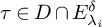 $\tau \in D\cap E^\delta _{\lambda _i}$
above
$\tau \in D\cap E^\delta _{\lambda _i}$
above $\varepsilon $
. For every
$\varepsilon $
. For every $\beta \in B"'$
, as
$\beta \in B"'$
, as $\operatorname {\mathrm {otp}}(C_{\eth _{\delta ,\beta }})<\lambda _i=\operatorname {\mathrm {cf}}(\tau )$
, it is the case that
$\operatorname {\mathrm {otp}}(C_{\eth _{\delta ,\beta }})<\lambda _i=\operatorname {\mathrm {cf}}(\tau )$
, it is the case that $\sup (C_{\eth _{\delta ,\beta }}\cap \tau )<\tau $
. As I is
$\sup (C_{\eth _{\delta ,\beta }}\cap \tau )<\tau $
. As I is $\operatorname {\mathrm {cf}}(\tau )$
-indecomposable, we may find a large enough
$\operatorname {\mathrm {cf}}(\tau )$
-indecomposable, we may find a large enough $\eta _1<\tau $
with
$\eta _1<\tau $
with $\pi ^{-1}(\eta _0,\eta _1)\in A\cap \tau $
such that the following set is in
$\pi ^{-1}(\eta _0,\eta _1)\in A\cap \tau $
such that the following set is in $I^+$
:
$I^+$
:
 $$ \begin{align*}B"":=\{\beta\in B"'\mid \sup(C_{\eth_{\delta,\beta}}\cap\tau)<\eta_1\}.\end{align*} $$
Let $\eta <\tau $
be such that
$\eta <\tau $
be such that $\pi (\eta )=(\eta _0,\eta _1)$
. For every
$\pi (\eta )=(\eta _0,\eta _1)$
. For every $\beta \in B""$
,
$\beta \in B""$
,
 $$ \begin{align*}\lambda(\eth_{\delta,\beta},\beta)<\eta_0<\eta_1<\tau<\delta\le\eth_{\delta,\beta}\le\beta\end{align*} $$
and hence $\eth _{\delta ,\beta }\in \operatorname {\mathrm {Im}}(\operatorname {\mathrm {tr}}(\eta _0,\beta ))\cap \operatorname {\mathrm {Im}}(\operatorname {\mathrm {tr}}(\eta _1,\beta ))$
. In addition,
$\eth _{\delta ,\beta }\in \operatorname {\mathrm {Im}}(\operatorname {\mathrm {tr}}(\eta _0,\beta ))\cap \operatorname {\mathrm {Im}}(\operatorname {\mathrm {tr}}(\eta _1,\beta ))$
. In addition,
 $$ \begin{align*}\min(C_{\eth_{\delta,\beta}}\setminus\eta_0)\le\varepsilon<\tau\le\min(C_{\eth_{\delta,\beta}}\setminus\eta_1)<\delta,\end{align*} $$
and hence $c(\eta ,\beta )\in [\tau ,\delta )$
, as sought.
$c(\eta ,\beta )\in [\tau ,\delta )$
, as sought.
The conclusion now follows.
Remark 6.13. It is also true that for every $\chi <\lambda $
,
$\chi <\lambda $
, $\operatorname {{\mathsf{unbounded}}}^+(\mathcal I^{\lambda ^+}_{\operatorname {\mathrm {cf}}(\lambda )}\cap \mathcal I^{\lambda ^+}_{\ge \chi },\lambda ^+)$
holds, where
$\operatorname {{\mathsf{unbounded}}}^+(\mathcal I^{\lambda ^+}_{\operatorname {\mathrm {cf}}(\lambda )}\cap \mathcal I^{\lambda ^+}_{\ge \chi },\lambda ^+)$
holds, where $\mathcal I^{\lambda ^+}_{\ge \chi }:=\bigcap _{\theta \in \operatorname {\mathrm {Reg}}({\lambda ^+})\setminus \chi }\mathcal I^{{\lambda ^+}}_{\theta }$
. While
$\mathcal I^{\lambda ^+}_{\ge \chi }:=\bigcap _{\theta \in \operatorname {\mathrm {Reg}}({\lambda ^+})\setminus \chi }\mathcal I^{{\lambda ^+}}_{\theta }$
. While $\operatorname {{\mathsf{unbounded}}}^+(\ldots )$
is stronger than
$\operatorname {{\mathsf{unbounded}}}^+(\ldots )$
is stronger than  , the class $\mathcal I$
addressed by Lemma 6.12 is considerably richer than
$\mathcal I$
addressed by Lemma 6.12 is considerably richer than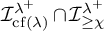 $\mathcal I^{\lambda ^+}_{\operatorname {\mathrm {cf}}(\lambda )}\cap \mathcal I^{\lambda ^+}_{\ge \chi }$
, so we omit the (rather long) proof for the smaller class.
$\mathcal I^{\lambda ^+}_{\operatorname {\mathrm {cf}}(\lambda )}\cap \mathcal I^{\lambda ^+}_{\ge \chi }$
, so we omit the (rather long) proof for the smaller class.
Corollary 6.14 (Kunen–Prikry, [Reference Kunen and PrikryKP71, Theorem 0.2])
Suppose that I is a $\operatorname {\mathrm {cf}}(\lambda )$
-indecomposable ideal over
$\operatorname {\mathrm {cf}}(\lambda )$
-indecomposable ideal over $\lambda ^+$
whose dual is an ultrafilter. Then
$\lambda ^+$
whose dual is an ultrafilter. Then $\lambda $
is singular and
$\lambda $
is singular and $\sup \{\theta \in \operatorname {\mathrm {Reg}}(\lambda )\mid I\text { is }\theta \text {-indecomposable}\}<\lambda $
.
$\sup \{\theta \in \operatorname {\mathrm {Reg}}(\lambda )\mid I\text { is }\theta \text {-indecomposable}\}<\lambda $
.
Proof. $\lambda $
must be singular, since otherwise
$\lambda $
must be singular, since otherwise $E^{\lambda ^+}_\lambda $
is a non-reflecting stationary set, contradicting Lemma 6.5. Next, appeal to Lemma 6.12, bearing in mind Lemma 2.4(1).
$E^{\lambda ^+}_\lambda $
is a non-reflecting stationary set, contradicting Lemma 6.5. Next, appeal to Lemma 6.12, bearing in mind Lemma 2.4(1).
Remark 6.15. This result of Kunen and Prikry was first proved by Chang [Reference ChangCha67, §1] under the additional hypothesis that $2^\lambda =\lambda ^+$
.
$2^\lambda =\lambda ^+$
.
Corollary 6.16 (Eisworth, [Reference EisworthEis12, Lemmas 3.2 and 3.3])
Suppose that I is a $\operatorname {\mathrm {cf}}(\lambda )$
-indecomposable weakly
$\operatorname {\mathrm {cf}}(\lambda )$
-indecomposable weakly $\lambda $
-saturated ideal over the successor of a singular cardinal
$\lambda $
-saturated ideal over the successor of a singular cardinal $\lambda $
. Then
$\lambda $
. Then $\sup \{\theta \in \operatorname {\mathrm {Reg}}(\lambda )\mid I\text { is }\theta \text {-indecomposable}\}<\lambda $
.
$\sup \{\theta \in \operatorname {\mathrm {Reg}}(\lambda )\mid I\text { is }\theta \text {-indecomposable}\}<\lambda $
.
We now arrive at the third clause of Theorem D. Its proof simply combines the ideas of Lemmas 6.10 and 6.12.
Theorem 6.17. Suppose:
-
(1)
$I\in \mathcal J^\kappa _\mu $
; -
(2) there is a family of less than
$\mu $
many stationary subsets of
$T^*(I)$
that do not reflect simultaneously at regulars; -
(3)
$\sup \{\theta \in \operatorname {\mathrm {Reg}}(\kappa )\mid I\text { is }\theta \text {-indecomposable}\}=\kappa $
.



Then  holds for some proper ideal $J\in \mathcal J^\kappa _\kappa $
.
$J\in \mathcal J^\kappa _\kappa $
.
Proof. Fix a bijection $\pi :\kappa \leftrightarrow \kappa \times \kappa $
and let J be corresponding ideal from Example 2.1. Using Clause (2), we fix a C-sequence
$\pi :\kappa \leftrightarrow \kappa \times \kappa $
and let J be corresponding ideal from Example 2.1. Using Clause (2), we fix a C-sequence $\vec C=\langle C_\delta \mid \delta <\kappa \rangle $
with
$\vec C=\langle C_\delta \mid \delta <\kappa \rangle $
with $\nu <\mu $
, and a sequence
$\nu <\mu $
, and a sequence $\langle S_i\mid i<\nu \rangle $
of stationary subsets of
$\langle S_i\mid i<\nu \rangle $
of stationary subsets of $T^*(I)$
such that:
$T^*(I)$
such that:
-
• for every
$\delta \in \operatorname {\mathrm {Sing}}(\kappa )$
,
$\min (C_\delta )=\operatorname {\mathrm {otp}}(C_\delta )$
, and -
• for every
$\delta \in \operatorname {\mathrm {Reg}}(\kappa )$
,
$\operatorname {\mathrm {acc}}(C_\delta )\cap S_i=\emptyset $
for some
$i<\nu $
.




We shall walk along $\vec C$
, and let
$\vec C$
, and let $\operatorname {\mathrm {tr}}$
,
$\operatorname {\mathrm {tr}}$
, $\lambda _2$
, etc. be the induced characteristic maps. Define
$\lambda _2$
, etc. be the induced characteristic maps. Define $c:[\kappa ]^2\rightarrow \kappa $
as follows. Given
$c:[\kappa ]^2\rightarrow \kappa $
as follows. Given $\eta <\beta <\kappa $
, consider
$\eta <\beta <\kappa $
, consider $(\eta _0,\eta _1):=\pi (\eta )$
. Let
$(\eta _0,\eta _1):=\pi (\eta )$
. Let $\gamma :=\min (\operatorname {\mathrm {Im}}(\operatorname {\mathrm {tr}}(\eta _0,\beta ))\cap \operatorname {\mathrm {Im}}(\operatorname {\mathrm {tr}}(\eta _1,\beta )))$
, and then set
$\gamma :=\min (\operatorname {\mathrm {Im}}(\operatorname {\mathrm {tr}}(\eta _0,\beta ))\cap \operatorname {\mathrm {Im}}(\operatorname {\mathrm {tr}}(\eta _1,\beta )))$
, and then set $c(\eta ,\beta ):=\min (C_\gamma \setminus \eta _1)$
, provided that the latter is well-defined. Otherwise, just let
$c(\eta ,\beta ):=\min (C_\gamma \setminus \eta _1)$
, provided that the latter is well-defined. Otherwise, just let $c(\eta ,\beta ):=0$
.
$c(\eta ,\beta ):=0$
.
To see that c witnesses  , let
, let $A\in J^+$
and
$A\in J^+$
and $B\in I^+$
be given. Derive from A the sets
$B\in I^+$
be given. Derive from A the sets $A_0$
and E as in the proof of Lemma 6.5.
$A_0$
and E as in the proof of Lemma 6.5.
Claim 6.17.1. Let $B\in I^+$
. Then the following set is stationary:
$B\in I^+$
. Then the following set is stationary:
 $$ \begin{align*}T:=\{\tau<\kappa\mid \exists\eta\in A\cap\tau\,\exists\delta<\kappa\, \{ \beta\in B\mid \tau\le c(\eta,\beta)<\delta\}\in I^+\}.\end{align*} $$
Proof. Let D be an arbitrary subclub of E, and we shall find a $\tau $
in
$\tau $
in $D\cap T$
. Denote
$D\cap T$
. Denote $\Theta :=\{\theta \in \operatorname {\mathrm {Reg}}(\kappa )\mid I\text { is }\theta \text {-indecomposable}\}$
. Fix an elementary submodel
$\Theta :=\{\theta \in \operatorname {\mathrm {Reg}}(\kappa )\mid I\text { is }\theta \text {-indecomposable}\}$
. Fix an elementary submodel $M\prec H_{\kappa ^+}$
with
$M\prec H_{\kappa ^+}$
with $\{D,\Theta ,\langle S_i\mid i<\nu \rangle \}\in M$
such that
$\{D,\Theta ,\langle S_i\mid i<\nu \rangle \}\in M$
such that $\delta :=M\cap \kappa $
is in
$\delta :=M\cap \kappa $
is in $T^*(I)\setminus \nu $
.
$T^*(I)\setminus \nu $
.
As I is $\operatorname {\mathrm {cf}}(\delta )$
-indecomposable, we may fix a large enough
$\operatorname {\mathrm {cf}}(\delta )$
-indecomposable, we may fix a large enough $\eta _0\in A\cap \delta $
such that the following set is in
$\eta _0\in A\cap \delta $
such that the following set is in $I^+$
:
$I^+$
:
 $$ \begin{align*}B_0:=\{\beta\in B\setminus(\delta+1)\mid \lambda_2(\delta,\beta)<\eta_0\}.\end{align*} $$
As I is $\operatorname {\mathrm {cf}}(\delta )$
-indecomposable, we may then fix a large enough
$\operatorname {\mathrm {cf}}(\delta )$
-indecomposable, we may then fix a large enough $\theta \in \Theta \cap \delta $
such that the following set is in
$\theta \in \Theta \cap \delta $
such that the following set is in $I^+$
:
$I^+$
:
 $$ \begin{align*}B_1:=\{\beta\in B_0\mid \min(C_{\eth_{\delta,\beta}}\setminus\eta_0)<\theta\}.\end{align*} $$
The definition of $B_2\subseteq B_1$
now splits into two cases:
$B_2\subseteq B_1$
now splits into two cases:
-
‣ If
$\{\beta \in B_1\mid \eth _{\delta ,\beta }\in \operatorname {\mathrm {Sing}}(\kappa )\}$
is in
$I^+$
, then denote that set by
$B_2$
. Recalling that
$\delta =M\cap \kappa $
, pick a
$\tau \in D\cap E^\kappa _\theta $
below
$\delta $
. For every
$\beta \in B_2$
,
$\operatorname {\mathrm {otp}}(C_{\eth _{\delta ,\beta }})=\min (C_{\eth _{\delta ,\beta }})<\theta =\operatorname {\mathrm {cf}}(\tau )$
, and hence it is the case that
$\sup (C_{\eth _{\delta ,\beta }}\cap \tau )<\tau $
. -
‣ Otherwise, for almost all
$\beta \in B_1$
, there is an
$i<\nu $
such that
$\operatorname {\mathrm {acc}}(C_{\eth _{\delta ,\beta }})\cap S_i=\emptyset $
. As
$\nu <\mu $
and I is
$\mu $
-complete, we may fix
$i<\nu $
and
$B_2\subseteq B_1$
in
$I^+$
such that, for every
$\beta \in B_2$
,
$\operatorname {\mathrm {acc}}(C_{\eth _{\delta ,\beta }})\cap S_i=\emptyset $
. Recalling that
$\delta =M\cap \kappa $
, pick a
$\tau \in D\cap S_i\cap [\theta ,\delta )$
. For every
$\beta \in B_2$
,
$\tau \notin C_{\eth _{\delta ,\beta }}$
and hence it is the case that
$\sup (C_{\eth _{\delta ,\beta }}\cap \tau )<\tau $
.















As I is $\operatorname {\mathrm {cf}}(\tau )$
-indecomposable, we may now find a large enough
$\operatorname {\mathrm {cf}}(\tau )$
-indecomposable, we may now find a large enough $\eta _1<\tau $
such that
$\eta _1<\tau $
such that $\pi ^{-1}(\eta _0,\eta _1)\in A\cap \tau $
and the following set is in
$\pi ^{-1}(\eta _0,\eta _1)\in A\cap \tau $
and the following set is in $I^+$
:
$I^+$
:
 $$ \begin{align*}B_3:=\{\beta\in B_2\mid \sup(C_{\eth_{\delta,\beta}}\cap\tau)<\eta_1\}.\end{align*} $$
Let $\eta <\tau $
be such that
$\eta <\tau $
be such that $\pi (\eta )=(\eta _0,\eta _1)$
. For every
$\pi (\eta )=(\eta _0,\eta _1)$
. For every $\beta \in B_3$
,
$\beta \in B_3$
,
 $$ \begin{align*}\lambda(\eth_{\delta,\beta},\beta)<\eta_0<\eta_1<\tau<\delta\le\eth_{\delta,\beta}\le\beta\end{align*} $$
and hence $\eth _{\delta ,\beta }\in \operatorname {\mathrm {Im}}(\operatorname {\mathrm {tr}}(\eta _0,\beta ))\cap \operatorname {\mathrm {Im}}(\operatorname {\mathrm {tr}}(\eta _1,\beta ))$
. In addition,
$\eth _{\delta ,\beta }\in \operatorname {\mathrm {Im}}(\operatorname {\mathrm {tr}}(\eta _0,\beta ))\cap \operatorname {\mathrm {Im}}(\operatorname {\mathrm {tr}}(\eta _1,\beta ))$
. In addition,
 $$ \begin{align*}\min(C_{\eth_{\delta,\beta}}\setminus\eta_0)<\theta\le\tau\le\min(C_{\eth_{\delta,\beta}}\setminus\eta_1)<\delta,\end{align*} $$
and hence $c(\eta ,\beta )\in [\tau ,\delta )$
, as sought.
$c(\eta ,\beta )\in [\tau ,\delta )$
, as sought.
The conclusion now follows.
Remark 6.18. Similarly to Remark 6.13, for $\kappa $
weakly inaccessible, and a stationary
$\kappa $
weakly inaccessible, and a stationary ${S\subseteq E^\kappa _{\ge \chi }}$
that does not reflect at regulars,
${S\subseteq E^\kappa _{\ge \chi }}$
that does not reflect at regulars, $\operatorname {{\mathsf{unbounded}}}^+(\mathcal I^\kappa _{\ge \chi },\text {NS}_\kappa \restriction S)$
holds; and if furthermore
$\operatorname {{\mathsf{unbounded}}}^+(\mathcal I^\kappa _{\ge \chi },\text {NS}_\kappa \restriction S)$
holds; and if furthermore $\diamondsuit (S)$
holds, then so does
$\diamondsuit (S)$
holds, then so does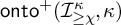 $\operatorname {{\mathsf{onto}}}^+(\mathcal I^\kappa _{\ge \chi },\kappa )$
. As the class of ideals addressed by the preceding theorem is considerably richer, we omit the proof for the smaller class.
$\operatorname {{\mathsf{onto}}}^+(\mathcal I^\kappa _{\ge \chi },\kappa )$
. As the class of ideals addressed by the preceding theorem is considerably richer, we omit the proof for the smaller class.
Remark 6.19. Theorem 6.17 is optimal as You and Yuan recently announced that the first $\omega $
-Mahlo cardinal
$\omega $
-Mahlo cardinal $\kappa $
may consistently carry a uniform ultrafilter that is
$\kappa $
may consistently carry a uniform ultrafilter that is $\theta $
-indecomposable for every uncountable cardinal
$\theta $
-indecomposable for every uncountable cardinal $\theta <\kappa $
.
$\theta <\kappa $
.
Theorem 6.17 improves results of Chudnovsky, Prikry and Silver (see Theorems 3, 3.1, 6 and 7 of [Reference PrikryPri73]). It also improves Clauses $(\alpha )$
and
$(\alpha )$
and $(\beta )$
of Shelah’s [Reference ShelahShe94b, Claim 3.3]. We close this section by revisiting Shelah’s proof of Clause (
$(\beta )$
of Shelah’s [Reference ShelahShe94b, Claim 3.3]. We close this section by revisiting Shelah’s proof of Clause ( $\gamma $
), verifying that it in fact gives an instance of one of our colouring principles. It has to do with a certain system of almost disjoint sets, as follows.
$\gamma $
), verifying that it in fact gives an instance of one of our colouring principles. It has to do with a certain system of almost disjoint sets, as follows.
Definition 6.20 (Shelah, [Reference ShelahShe82, p. 440]) $\operatorname {\mathrm {ADS}}_\lambda $
asserts the existence of a sequence
$\operatorname {\mathrm {ADS}}_\lambda $
asserts the existence of a sequence $\langle A_\tau \mid \tau <\lambda ^+\rangle $
of cofinal subsets of
$\langle A_\tau \mid \tau <\lambda ^+\rangle $
of cofinal subsets of $\lambda $
of order-type
$\lambda $
of order-type $\operatorname {\mathrm {cf}}(\lambda )$
, with the property that, for every
$\operatorname {\mathrm {cf}}(\lambda )$
, with the property that, for every $\beta <\lambda ^+$
, there is an
$\beta <\lambda ^+$
, there is an $f_\beta :\beta \rightarrow \operatorname {\mathrm {cf}}(\lambda )$
such that
$f_\beta :\beta \rightarrow \operatorname {\mathrm {cf}}(\lambda )$
such that $\langle A_\tau \setminus A_\tau (f_\beta (\tau ))\mid \tau <\beta \rangle $
consists of pairwise disjoint sets.
$\langle A_\tau \setminus A_\tau (f_\beta (\tau ))\mid \tau <\beta \rangle $
consists of pairwise disjoint sets.
It is easy to see that $\operatorname {\mathrm {ADS}}_\lambda $
holds whenever
$\operatorname {\mathrm {ADS}}_\lambda $
holds whenever $\lambda $
is regular. To connect the upcoming result with the results of Section 3, we mention that
$\lambda $
is regular. To connect the upcoming result with the results of Section 3, we mention that $\operatorname {\mathrm {ADS}}_\lambda $
follows from the existence of a special
$\operatorname {\mathrm {ADS}}_\lambda $
follows from the existence of a special $\lambda ^+$
-Aronszajn tree [Reference Cummings, Foreman and MagidorCFM01, Theorem 4.1].
$\lambda ^+$
-Aronszajn tree [Reference Cummings, Foreman and MagidorCFM01, Theorem 4.1].
Proposition 6.21. If $\operatorname {\mathrm {ADS}}_\lambda $
holds then so does
$\operatorname {\mathrm {ADS}}_\lambda $
holds then so does $\operatorname {{\mathsf{unbounded}}}^+(\{\lambda \},\mathcal I^{\lambda ^+}_{\operatorname {\mathrm {cf}}(\lambda )},\lambda ^+)$
.
$\operatorname {{\mathsf{unbounded}}}^+(\{\lambda \},\mathcal I^{\lambda ^+}_{\operatorname {\mathrm {cf}}(\lambda )},\lambda ^+)$
.
Proof. Suppose $\langle A_\tau \mid \tau <\lambda ^+\rangle $
and
$\langle A_\tau \mid \tau <\lambda ^+\rangle $
and $\langle f_\beta \mid \beta <\lambda ^+\rangle $
witness together that
$\langle f_\beta \mid \beta <\lambda ^+\rangle $
witness together that $\operatorname {\mathrm {ADS}}_\lambda $
holds. Define an upper-regressive map
$\operatorname {\mathrm {ADS}}_\lambda $
holds. Define an upper-regressive map $c:\lambda \times \lambda ^+\rightarrow \lambda ^+$
, as follows. Given
$c:\lambda \times \lambda ^+\rightarrow \lambda ^+$
, as follows. Given $\eta <\lambda \le \beta <\lambda ^+$
, if there exists a
$\eta <\lambda \le \beta <\lambda ^+$
, if there exists a $\tau <\beta $
such that
$\tau <\beta $
such that $\eta \in A_\tau \setminus A_\tau (f_\beta (\tau ))$
, then let
$\eta \in A_\tau \setminus A_\tau (f_\beta (\tau ))$
, then let $c(\eta ,\beta )$
be equal to this unique
$c(\eta ,\beta )$
be equal to this unique $\tau $
. Otherwise, set
$\tau $
. Otherwise, set $c(\eta ,\beta ):=0$
.
$c(\eta ,\beta ):=0$
.
To show that c witnesses $\operatorname {{\mathsf{unbounded}}}^+(\{\lambda \},\mathcal I^{\lambda ^+}_{\operatorname {\mathrm {cf}}(\lambda )},\lambda ^+)$
, let
$\operatorname {{\mathsf{unbounded}}}^+(\{\lambda \},\mathcal I^{\lambda ^+}_{\operatorname {\mathrm {cf}}(\lambda )},\lambda ^+)$
, let $I\in \mathcal I^{\lambda ^+}_{\operatorname {\mathrm {cf}}(\lambda )}$
and
$I\in \mathcal I^{\lambda ^+}_{\operatorname {\mathrm {cf}}(\lambda )}$
and $B\in I^+$
be given. For each
$B\in I^+$
be given. For each $\tau <\lambda ^+$
, we may find
$\tau <\lambda ^+$
, we may find $i_\tau <\operatorname {\mathrm {cf}}(\lambda )$
such that
$i_\tau <\operatorname {\mathrm {cf}}(\lambda )$
such that $B_\tau ^{i_\tau }:=\{ \beta \in B\setminus (\tau +1)\mid f_\beta (\tau )\le i_\tau \}$
is in
$B_\tau ^{i_\tau }:=\{ \beta \in B\setminus (\tau +1)\mid f_\beta (\tau )\le i_\tau \}$
is in $I^+$
. Pick
$I^+$
. Pick $i<\operatorname {\mathrm {cf}}(\lambda )$
for which
$i<\operatorname {\mathrm {cf}}(\lambda )$
for which $T:=\{ \tau <\lambda ^+\mid i_\tau =i\}$
has size
$T:=\{ \tau <\lambda ^+\mid i_\tau =i\}$
has size $\lambda ^+$
. Then find
$\lambda ^+$
. Then find $\eta <\lambda $
for which
$\eta <\lambda $
for which $T':=\{\tau \in T\mid A_\tau (i)=\eta \}$
has size
$T':=\{\tau \in T\mid A_\tau (i)=\eta \}$
has size $\lambda ^+$
.
$\lambda ^+$
.
Now, let $\tau \in T'$
. For every
$\tau \in T'$
. For every $\beta \in B_\tau ^i$
,
$\beta \in B_\tau ^i$
, $f_\beta (\tau )\le i$
and
$f_\beta (\tau )\le i$
and $A_\tau (i)=\eta $
, and hence
$A_\tau (i)=\eta $
, and hence $c(\eta ,\beta )=\tau $
. So
$c(\eta ,\beta )=\tau $
. So $B_\tau :=\{\beta \in B\mid c(\eta ,\beta )=\tau \}$
covers
$B_\tau :=\{\beta \in B\mid c(\eta ,\beta )=\tau \}$
covers $B_\tau ^{i_\tau }$
and hence it is in
$B_\tau ^{i_\tau }$
and hence it is in $I^+$
.
$I^+$
.
In summary, in the context of successors of regulars, we have identified three $\mathsf {\text {ZFC}}$
generalizations of Ulam’s theorem, each having its own merit.
$\mathsf {\text {ZFC}}$
generalizations of Ulam’s theorem, each having its own merit.
Corollary 6.22. For every infinite regular cardinal $\lambda $
, all of the following hold:
$\lambda $
, all of the following hold:
-
(1)
; -
(2)
$\operatorname {{\mathsf{unbounded}}}^+(\{\lambda \},\mathcal I^{\lambda ^+}_\lambda ,\lambda ^+)$
; -
(3)
$\operatorname {{\mathsf{onto}}}^{++}(\mathcal I^{\lambda ^+}_\lambda ,\lambda )$
.
 ;
;
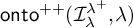
Proof. (1) By Proposition 5.2 and [Reference Lambie-Hanson and RinotLHR23, Lemma 3.14(1)].
(2) By Proposition 6.21, since $\lambda $
is regular.
$\lambda $
is regular.
(3) By Lemma 6.5(2), since $E^{\lambda ^+}_\lambda $
is a nonreflecting stationary set.
$E^{\lambda ^+}_\lambda $
is a nonreflecting stationary set.
7 Contributions to the theory of strong colourings
Definition 7.1 (Reference Erdős, Hajnal and RadoEHR65, §18)
For a pair $\theta \le \kappa $
of cardinals:
$\theta \le \kappa $
of cardinals:
-
•
$\kappa \nrightarrow [\kappa ]^2_\theta $
asserts the existence of a colouring
$c:[\kappa ]^2\rightarrow \theta $
such that, for every
$B\in [\kappa ]^\kappa $
,
$c"[B]^2=\theta $
. -
•
$\kappa \nrightarrow [\kappa ;\kappa ]^2_\theta $
asserts the existence of a colouring
$c:[\kappa ]^2\rightarrow \theta $
such that, for all
$A, B\in [\kappa ]^\kappa $
,
$c"A\circledast B=\theta $
.



The following lemma was promised in the proof of Corollary 6.8 above.
Lemma 7.2. $\square (\kappa ,{<}\omega )$
implies
$\square (\kappa ,{<}\omega )$
implies $\kappa \nrightarrow [\kappa ;\kappa ]^2_\kappa $
.
$\kappa \nrightarrow [\kappa ;\kappa ]^2_\kappa $
.
Proof. First, note that by [Reference Rinot and TodorcevicRT13], we may assume that $\kappa $
is not the successor of a regular cardinal. In particular,
$\kappa $
is not the successor of a regular cardinal. In particular, $\kappa \ge \aleph _3$
. Now, appeal to [Reference RinotRin14, Theorem 2.6] with
$\kappa \ge \aleph _3$
. Now, appeal to [Reference RinotRin14, Theorem 2.6] with $\mu := \aleph _0$
in the notation there to get a colouring
$\mu := \aleph _0$
in the notation there to get a colouring $d:{}^{<\omega }\omega _1\rightarrow \omega $
such that for every sequence
$d:{}^{<\omega }\omega _1\rightarrow \omega $
such that for every sequence $\langle (\eta _i,\sigma _i)\mid i\in I\rangle $
with
$\langle (\eta _i,\sigma _i)\mid i\in I\rangle $
with
-
(i) I is an uncountable subset of
$\omega _1$
; -
(ii)
$\eta _i$
and
$\sigma _i$
are elements of
${}^{<\omega }\omega _1$
; -
(iii)
$i\in \operatorname {\mathrm {Im}}(\eta _i)\cap \operatorname {\mathrm {Im}}(\sigma _i)$
for every
$i\in I$
,




there is a pair $i<j$
of ordinals in I such that
$i<j$
of ordinals in I such that $d(\eta _i{}^\frown \sigma _j)=\ell (\eta _i)$
, the length of
$d(\eta _i{}^\frown \sigma _j)=\ell (\eta _i)$
, the length of $\eta _i$
.
$\eta _i$
.
Next, assuming $\square (\kappa ,{<}\omega )$
, by [Reference Lambie-Hanson and RinotLHR21, Theorem 5.27], we may fix a
$\square (\kappa ,{<}\omega )$
, by [Reference Lambie-Hanson and RinotLHR21, Theorem 5.27], we may fix a $\square (\kappa ,{<}\omega )$
-sequence
$\square (\kappa ,{<}\omega )$
-sequence $\vec {\mathcal C}=\langle \mathcal C_\alpha \mid \alpha <\kappa \rangle $
such that, for every
$\vec {\mathcal C}=\langle \mathcal C_\alpha \mid \alpha <\kappa \rangle $
such that, for every $\tau <\kappa $
, the following set is stationary:
$\tau <\kappa $
, the following set is stationary:
 $$ \begin{align*}H_\tau:=\{ \alpha\in E^{\kappa}_{\omega_2}\mid \forall C\in\mathcal C_\alpha\,[\min(C)=\tau]\}.\end{align*} $$
By systematically replacing various ordinals by their successors, we may also assume that $C\cap \operatorname {\mathrm {acc}}(\kappa )\subseteq \operatorname {\mathrm {acc}}(C)\cup \{\min (C)\}$
for every
$C\cap \operatorname {\mathrm {acc}}(\kappa )\subseteq \operatorname {\mathrm {acc}}(C)\cup \{\min (C)\}$
for every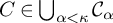 $C\in \bigcup _{\alpha <\kappa }\mathcal C_\alpha $
.
$C\in \bigcup _{\alpha <\kappa }\mathcal C_\alpha $
.
Let $\vec C=\langle C_\alpha \mid \alpha <\kappa \rangle $
be a transversal of
$\vec C=\langle C_\alpha \mid \alpha <\kappa \rangle $
be a transversal of $\vec {\mathcal C}$
, and let
$\vec {\mathcal C}$
, and let $\operatorname {\mathrm {tr}}$
,
$\operatorname {\mathrm {tr}}$
, $\rho _2$
, etc. be the induced characteristic maps of walking along
$\rho _2$
, etc. be the induced characteristic maps of walking along $\vec C$
. By [Reference Lambie-Hanson and RinotLHR21, Lemma 4.12],
$\vec C$
. By [Reference Lambie-Hanson and RinotLHR21, Lemma 4.12], $\chi (\vec C)\ge \sup (\operatorname {\mathrm {Reg}}(\kappa ))\ge \aleph _2$
. By [Reference Lambie-Hanson and RinotLHR21, Definition 4.2], this means that for every
$\chi (\vec C)\ge \sup (\operatorname {\mathrm {Reg}}(\kappa ))\ge \aleph _2$
. By [Reference Lambie-Hanson and RinotLHR21, Definition 4.2], this means that for every $\Delta \in [\kappa ]^\kappa $
, there exists some
$\Delta \in [\kappa ]^\kappa $
, there exists some $\alpha <\kappa $
such that
$\alpha <\kappa $
such that $\Delta \cap \alpha \nsubseteq \bigcup _{\beta \in b}C_\beta $
for every
$\Delta \cap \alpha \nsubseteq \bigcup _{\beta \in b}C_\beta $
for every $b\in [\kappa ]^{\aleph _1}$
.
$b\in [\kappa ]^{\aleph _1}$
.
Define a function $h:\kappa \rightarrow \omega _1$
via:
$h:\kappa \rightarrow \omega _1$
via:
 $$ \begin{align*}h(\alpha):=\begin{cases} \min(C_\alpha),&\text{if }0<\alpha\ \&\ \min(C_\alpha)<\omega_1;\\ 0,&\text{otherwise}. \end{cases}\end{align*} $$
Define another function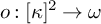 $o:[\kappa ]^2\rightarrow \omega $
via
$o:[\kappa ]^2\rightarrow \omega $
via
 $$ \begin{align*}o(\alpha,\beta):= \begin{cases} d(h\circ\operatorname{\mathrm{tr}}(\alpha,\beta))-1,&\text{if }d(h\circ\operatorname{\mathrm{tr}}(\alpha,\beta))>0;\\ 0,&\text{otherwise}, \end{cases}\end{align*} $$
Finally, our colouring $c:[\kappa ]^2\rightarrow \kappa $
is defined via
$c:[\kappa ]^2\rightarrow \kappa $
is defined via
 $$ \begin{align*}c(\alpha,\beta):=\min(C_{\operatorname{\mathrm{Tr}}(\alpha,\beta)(o(\alpha,\beta))}).\end{align*} $$
To see that c witnesses $\kappa \nrightarrow [\kappa ;\kappa ]^2_\kappa $
, let sets
$\kappa \nrightarrow [\kappa ;\kappa ]^2_\kappa $
, let sets $A,B\in [\kappa ]^\kappa $
and a prescribed colour
$A,B\in [\kappa ]^\kappa $
and a prescribed colour $\tau <\kappa $
be given. For every
$\tau <\kappa $
be given. For every $\gamma <\kappa $
, let
$\gamma <\kappa $
, let $\beta _\gamma :=\min (B\setminus (\gamma +1))$
. For each
$\beta _\gamma :=\min (B\setminus (\gamma +1))$
. For each $i<\omega _1$
, find some
$i<\omega _1$
, find some $\varepsilon _i<\kappa $
for which the following set is stationary
$\varepsilon _i<\kappa $
for which the following set is stationary
 $$ \begin{align*}G_i:=\{\gamma\in H_i\mid \lambda_2(\gamma,\beta_\gamma)=\varepsilon_i\}.\end{align*} $$
Recalling that $\chi (\vec C)\ge \aleph _2$
, and as the following set is in
$\chi (\vec C)\ge \aleph _2$
, and as the following set is in $[\kappa ]^\kappa $
:
$[\kappa ]^\kappa $
:
 $$ \begin{align*}\Delta:=(H_\tau\cap\bigcap\nolimits_{i<\omega_1}\operatorname{\mathrm{acc}}^+(\operatorname{\mathrm{acc}}^+(A)\cap H_i))\setminus((\sup\nolimits_{i<\omega_1}\varepsilon_i)+1),\end{align*} $$
we may fix a large enough $\alpha ^*<\kappa $
such that
$\alpha ^*<\kappa $
such that $\Delta \cap \alpha ^*\nsubseteq \bigcup _{\beta \in b}C_\beta $
for every
$\Delta \cap \alpha ^*\nsubseteq \bigcup _{\beta \in b}C_\beta $
for every $b\in [\kappa ]^{\aleph _1}$
.
$b\in [\kappa ]^{\aleph _1}$
.
For each $i<\omega _1$
, let
$i<\omega _1$
, let $\gamma _i:=\min (G_i\setminus (\alpha ^*+1))$
. Letting
$\gamma _i:=\min (G_i\setminus (\alpha ^*+1))$
. Letting $b:=\{ \eth _{\gamma _i,\beta _{\gamma _i}}\mid i<\omega _1\}$
, we then pick
$b:=\{ \eth _{\gamma _i,\beta _{\gamma _i}}\mid i<\omega _1\}$
, we then pick $\xi \in \Delta \cap \alpha ^*\setminus \bigcup _{\beta \in b}C_\beta $
. As
$\xi \in \Delta \cap \alpha ^*\setminus \bigcup _{\beta \in b}C_\beta $
. As $\operatorname {\mathrm {cf}}(\xi )=\omega _2$
,
$\operatorname {\mathrm {cf}}(\xi )=\omega _2$
, $\epsilon :=\sup _{i<\omega _1}\lambda _2(\xi ,\beta _{\gamma _i})$
is smaller than
$\epsilon :=\sup _{i<\omega _1}\lambda _2(\xi ,\beta _{\gamma _i})$
is smaller than $\xi $
. Consequently, for each
$\xi $
. Consequently, for each $i<\omega _1$
, we may pick a
$i<\omega _1$
, we may pick a $\delta _i\in \operatorname {\mathrm {acc}}^+(A)\cap H_i\cap \xi $
above
$\delta _i\in \operatorname {\mathrm {acc}}^+(A)\cap H_i\cap \xi $
above $\max \{\epsilon ,\tau \}$
.
$\max \{\epsilon ,\tau \}$
.
Next, as $\mathcal C_\xi $
is finite, we may pick some
$\mathcal C_\xi $
is finite, we may pick some $C\in \mathcal C_\xi $
for which the following set is uncountable:
$C\in \mathcal C_\xi $
for which the following set is uncountable:
 $$ \begin{align*}I:=\{i\in\omega_1\setminus\{\tau\}\mid C_{\eth_{\xi,\beta_{\gamma_i}}}\cap\xi=C\}.\end{align*} $$
Claim 7.2.1. $\{\delta _i\mid i\in I\}\cap C=\emptyset $
.
$\{\delta _i\mid i\in I\}\cap C=\emptyset $
.
Proof. Suppose not, and pick $i\in I$
with
$i\in I$
with $\delta _i\in C$
. So
$\delta _i\in C$
. So $\delta _i\in C\cap E^\kappa _{\omega _2}\subseteq C\cap \operatorname {\mathrm {acc}}(\kappa )\subseteq \operatorname {\mathrm {acc}}(C)\cup \{\min (C)\}$
.
$\delta _i\in C\cap E^\kappa _{\omega _2}\subseteq C\cap \operatorname {\mathrm {acc}}(\kappa )\subseteq \operatorname {\mathrm {acc}}(C)\cup \{\min (C)\}$
. $\blacktriangleright $
If
$\blacktriangleright $
If $\delta _i\in \operatorname {\mathrm {acc}}(C)$
, then
$\delta _i\in \operatorname {\mathrm {acc}}(C)$
, then $C\cap \delta _i\in \mathcal C_{\delta _i}$
, and since
$C\cap \delta _i\in \mathcal C_{\delta _i}$
, and since $\delta _i\in H_i$
, this would mean that
$\delta _i\in H_i$
, this would mean that $\min (C)=i$
, contradicting the fact that
$\min (C)=i$
, contradicting the fact that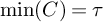 $\min (C)=\tau $
.
$\min (C)=\tau $
. $\blacktriangleright $
Otherwise,
$\blacktriangleright $
Otherwise, $\delta _i=\min (C)$
, contradicting the fact that
$\delta _i=\min (C)$
, contradicting the fact that $\delta _i>\tau $
.
$\delta _i>\tau $
.
It follows that for each $i\in I$
,
$i\in I$
, $\zeta _i:=\min (C\setminus \delta _i)$
is an element of
$\zeta _i:=\min (C\setminus \delta _i)$
is an element of $\operatorname {\mathrm {nacc}}(C)$
bigger than
$\operatorname {\mathrm {nacc}}(C)$
bigger than $\delta _i$
. For each
$\delta _i$
. For each $i\in I$
, pick
$i\in I$
, pick $\alpha _i\in A\cap \delta _i$
above
$\alpha _i\in A\cap \delta _i$
above $\max \{\epsilon ,\sup (C\cap \delta _i),\lambda _2(\delta _i,\zeta _i)\}$
, and finally set:
$\max \{\epsilon ,\sup (C\cap \delta _i),\lambda _2(\delta _i,\zeta _i)\}$
, and finally set:
-
•
$\eta _i:=h\circ (\operatorname {\mathrm {tr}}(\eth _{\xi ,\beta _{\gamma _i}},\beta _{\gamma _i}){}^\smallfrown \langle \eth _{\xi ,\beta _{\gamma _i}}\rangle )$
; -
•
$\sigma _i:=h\circ \operatorname {\mathrm {tr}}(\alpha _i,\zeta _i)$
.


Claim 7.2.2. Let $i\in I$
. Then:
$i\in I$
. Then:
-
(i)
$i\in \operatorname {\mathrm {Im}}(\eta _i)$
; -
(ii)
$i\in \operatorname {\mathrm {Im}}(\sigma _i)$
.


Proof. (i) As $\lambda _2(\gamma _i,\beta _{\gamma _i})=\varepsilon _i<\xi <\alpha ^*<\gamma _i<\beta _{\gamma _i}$
, it is the case that
$\lambda _2(\gamma _i,\beta _{\gamma _i})=\varepsilon _i<\xi <\alpha ^*<\gamma _i<\beta _{\gamma _i}$
, it is the case that
 $$ \begin{align*}\operatorname{\mathrm{tr}}(\eth_{\xi,\beta_{\gamma_i}},\beta_{\gamma_i})=\operatorname{\mathrm{tr}}(\eth_{\gamma_i,\beta_{\gamma_i}},\beta_{\gamma_i}){}^\smallfrown\operatorname{\mathrm{tr}}(\eth_{\xi,\beta_{\gamma_i}},\eth_{\gamma_i,\beta_{\gamma_i}}).\end{align*} $$
By the choice of $\xi $
, we have
$\xi $
, we have $\xi \notin \ C_{\eth _{\gamma _i,\beta _{\gamma _i}}}$
, so that the sequence
$\xi \notin \ C_{\eth _{\gamma _i,\beta _{\gamma _i}}}$
, so that the sequence $\operatorname {\mathrm {tr}}(\eth _{\xi ,\beta _{\gamma _i}},\eth _{\gamma _i,\beta _{\gamma _i}})$
is nonempty. Altogether,
$\operatorname {\mathrm {tr}}(\eth _{\xi ,\beta _{\gamma _i}},\eth _{\gamma _i,\beta _{\gamma _i}})$
is nonempty. Altogether, $h(\eth _{\gamma _i,\beta _{\gamma _i}})\in \operatorname {\mathrm {Im}}(\eta _i)$
. As
$h(\eth _{\gamma _i,\beta _{\gamma _i}})\in \operatorname {\mathrm {Im}}(\eta _i)$
. As $\sup (C_{\eth _{\gamma _i,\beta _{\gamma _i}}}\cap \gamma _i)=\gamma _i\in H_i$
, it is the case that
$\sup (C_{\eth _{\gamma _i,\beta _{\gamma _i}}}\cap \gamma _i)=\gamma _i\in H_i$
, it is the case that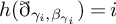 $h(\eth _{\gamma _i,\beta _{\gamma _i}})=i$
.
$h(\eth _{\gamma _i,\beta _{\gamma _i}})=i$
.
(ii) As $\lambda _2(\delta _i,\zeta _i)<\alpha _i<\delta _i<\zeta _i$
, it is the case that
$\lambda _2(\delta _i,\zeta _i)<\alpha _i<\delta _i<\zeta _i$
, it is the case that $h(\eth _{\delta _i,\zeta _i})\in \operatorname {\mathrm {Im}}(\sigma _i)$
. As
$h(\eth _{\delta _i,\zeta _i})\in \operatorname {\mathrm {Im}}(\sigma _i)$
. As $\sup (C_{\eth _{\delta _i,\zeta _i}}\cap \delta _i)=\delta _i\in H_i$
, it is the case that
$\sup (C_{\eth _{\delta _i,\zeta _i}}\cap \delta _i)=\delta _i\in H_i$
, it is the case that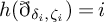 $h(\eth _{\delta _i,\zeta _i})=i$
.
$h(\eth _{\delta _i,\zeta _i})=i$
.
Using the choice of d, pick a pair $i<j$
of ordinals in I such that
$i<j$
of ordinals in I such that $d(\eta _i{}^\frown \sigma _j)=\ell (\eta _i)$
.
$d(\eta _i{}^\frown \sigma _j)=\ell (\eta _i)$
.
Claim 7.2.3. $\operatorname {\mathrm {tr}}(\alpha _j,\beta _{\gamma _i})=\operatorname {\mathrm {tr}}(\eth _{\xi ,\beta _{\gamma _i}},\beta _{\gamma _i}){}^\smallfrown \langle \eth _{\xi ,\beta _{\gamma _i}}\rangle {}^\smallfrown \operatorname {\mathrm {tr}}(\alpha _j,\zeta _j)$
.
$\operatorname {\mathrm {tr}}(\alpha _j,\beta _{\gamma _i})=\operatorname {\mathrm {tr}}(\eth _{\xi ,\beta _{\gamma _i}},\beta _{\gamma _i}){}^\smallfrown \langle \eth _{\xi ,\beta _{\gamma _i}}\rangle {}^\smallfrown \operatorname {\mathrm {tr}}(\alpha _j,\zeta _j)$
.
Proof. As $C_{\eth _{\xi ,\beta _i}}\cap \xi =C$
with
$C_{\eth _{\xi ,\beta _i}}\cap \xi =C$
with $\min (C\setminus \delta _j)=\zeta _j$
and as
$\min (C\setminus \delta _j)=\zeta _j$
and as
 $$ \begin{align*}\lambda_2(\xi,\beta_{\gamma_i})\le\max\{\epsilon,\sup(C\cap\delta_j),\lambda_2(\delta_j,\zeta_j)\}<\alpha_j<\delta_j<\zeta_j<\xi<\gamma_i<\beta_{\gamma_i},\end{align*} $$
it is the case that
 $$ \begin{align*}\operatorname{\mathrm{tr}}(\alpha_j,\beta_{\gamma_i})=\operatorname{\mathrm{tr}}(\eth_{\xi,\beta_{\gamma_i}},\beta_{\gamma_i}){}^\smallfrown\operatorname{\mathrm{tr}}(\alpha_j,\eth_{\xi,\beta_{\gamma_i}}),\end{align*} $$
and
 $$ \begin{align*}\operatorname{\mathrm{tr}}(\alpha_j,\eth_{\xi,\beta_{\gamma_i}})=\langle \eth_{\xi,\beta_{\gamma_i}}\rangle{}^\smallfrown\operatorname{\mathrm{tr}}(\alpha_j,\zeta_j),\end{align*} $$
as needed to show.
Consequently, $d(h\circ \operatorname {\mathrm {tr}}(\alpha _j,\beta _{\gamma _i}))=\rho _2(\eth _{\xi ,\beta _{\gamma _i}},\beta _{\gamma _i})+1$
, so that
$d(h\circ \operatorname {\mathrm {tr}}(\alpha _j,\beta _{\gamma _i}))=\rho _2(\eth _{\xi ,\beta _{\gamma _i}},\beta _{\gamma _i})+1$
, so that $\operatorname {\mathrm {Tr}}(\alpha _j,\beta _i)(o(\alpha _j,\beta _i))=\eth _{\xi ,\beta _{\gamma _i}}$
and
$\operatorname {\mathrm {Tr}}(\alpha _j,\beta _i)(o(\alpha _j,\beta _i))=\eth _{\xi ,\beta _{\gamma _i}}$
and $c(\alpha _j,\beta _i)=\min (C_{\eth _{\xi ,\beta _{\gamma _i}}})$
. Finally, as
$c(\alpha _j,\beta _i)=\min (C_{\eth _{\xi ,\beta _{\gamma _i}}})$
. Finally, as $\sup (C_{\eth _{\xi ,\beta _{\gamma _i}}}\cap \xi )=\xi \in H_\tau $
, we infer that
$\sup (C_{\eth _{\xi ,\beta _{\gamma _i}}}\cap \xi )=\xi \in H_\tau $
, we infer that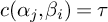 ${c(\alpha _j,\beta _i)=\tau} $
, as sought.
${c(\alpha _j,\beta _i)=\tau} $
, as sought.
Our next result has to do with the following generalization of Definition 7.1.
Definition 7.3 (Shelah, [Reference ShelahShe88]) $\operatorname {\mathrm {Pr}}_1(\kappa , \kappa , \theta , \chi )$
asserts the existence of a colouring
$\operatorname {\mathrm {Pr}}_1(\kappa , \kappa , \theta , \chi )$
asserts the existence of a colouring ${c:[\kappa ]^2 \rightarrow \theta }$
such that for every
${c:[\kappa ]^2 \rightarrow \theta }$
such that for every $\sigma <\chi $
, every pairwise disjoint subfamily
$\sigma <\chi $
, every pairwise disjoint subfamily $\mathcal B \subseteq [\kappa ]^{\sigma }$
of size
$\mathcal B \subseteq [\kappa ]^{\sigma }$
of size $\kappa $
, and every
$\kappa $
, and every $\tau < \theta $
, there are
$\tau < \theta $
, there are $a,b\in \mathcal A$
with
$a,b\in \mathcal A$
with $\sup (a)<\min (b)$
such that
$\sup (a)<\min (b)$
such that $c[a \times b] = \{\tau \}$
.
$c[a \times b] = \{\tau \}$
.
By [Reference ShelahShe94b, Conclusion 4.8(2)], for every weakly inaccessible $\kappa $
, if
$\kappa $
, if $E^\kappa _{\ge \chi }$
admits a stationary set that does not reflect at regulars, then for every
$E^\kappa _{\ge \chi }$
admits a stationary set that does not reflect at regulars, then for every $\theta <\kappa $
,
$\theta <\kappa $
, $\operatorname {\mathrm {Pr}}_1(\kappa ,\kappa ,\theta ,\chi )$
holds. We now improve it to get
$\operatorname {\mathrm {Pr}}_1(\kappa ,\kappa ,\theta ,\chi )$
holds. We now improve it to get $\theta =\kappa $
. The following is Theorem E.
$\theta =\kappa $
. The following is Theorem E.
Theorem 7.4. Suppose that $\kappa $
is weakly inaccessible,
$\kappa $
is weakly inaccessible, $\chi \in \operatorname {\mathrm {Reg}}(\kappa )$
, and
$\chi \in \operatorname {\mathrm {Reg}}(\kappa )$
, and $E^\kappa _{\ge \chi }$
admits a stationary set that does not reflect at regulars. Then
$E^\kappa _{\ge \chi }$
admits a stationary set that does not reflect at regulars. Then $\operatorname {\mathrm {Pr}}_1(\kappa ,\kappa ,\kappa ,\chi )$
holds.
$\operatorname {\mathrm {Pr}}_1(\kappa ,\kappa ,\kappa ,\chi )$
holds.
Proof. By the main result of [Reference RinotRin14], we may assume that every stationary subset of $E^\kappa _{\ge \chi }$
reflects. In particular, by [Reference Rinot and ZhangRZ21, Lemma 6.1], we may fix regular uncountable cardinals
$E^\kappa _{\ge \chi }$
reflects. In particular, by [Reference Rinot and ZhangRZ21, Lemma 6.1], we may fix regular uncountable cardinals $\sigma ^1<\sigma ^0$
smaller than
$\sigma ^1<\sigma ^0$
smaller than $\kappa $
together with stationary sets
$\kappa $
together with stationary sets $S^1\subseteq E^\kappa _{\sigma ^1}\cap \operatorname {\mathrm {Sing}}(\kappa )$
and
$S^1\subseteq E^\kappa _{\sigma ^1}\cap \operatorname {\mathrm {Sing}}(\kappa )$
and $S^0\subseteq E^\kappa _{\sigma ^0}\cap \operatorname {\mathrm {Sing}}(\kappa )$
such that neither of them reflect at inaccessibles. Following [Reference Rinot and ZhangRZ21, §6], we fix a
$S^0\subseteq E^\kappa _{\sigma ^0}\cap \operatorname {\mathrm {Sing}}(\kappa )$
such that neither of them reflect at inaccessibles. Following [Reference Rinot and ZhangRZ21, §6], we fix a $\sigma ^1$
-bounded C-sequence
$\sigma ^1$
-bounded C-sequence $\vec e=\langle e_\delta \mid \delta \in S^1\rangle $
and another C-sequence
$\vec e=\langle e_\delta \mid \delta \in S^1\rangle $
and another C-sequence $\vec C=\langle C_\alpha \mid \alpha <\kappa \rangle $
such that all of the following hold:
$\vec C=\langle C_\alpha \mid \alpha <\kappa \rangle $
such that all of the following hold:
-
(i) for every
$\delta \in S^1$
,
$\langle \operatorname {\mathrm {cf}}(\gamma )\mid \gamma \in \operatorname {\mathrm {nacc}}(e_\delta )\rangle $
is strictly increasing, converging to
$\delta $
; -
(ii) for every club
$D\subseteq \kappa $
, there exists a
$\delta \in S^1$
with
$e_\delta \subseteq D$
; -
(iii) for every
$\alpha <\kappa $
,
$|C_\alpha |=\operatorname {\mathrm {cf}}(\alpha )$
; -
(iv) for every
$\alpha <\kappa $
, if
$\operatorname {\mathrm {acc}}(C_\alpha )\cap S^1\neq \emptyset $
, then
$\min (C_\alpha )\ge \operatorname {\mathrm {cf}}(\alpha )>\sigma ^1$
; -
(v) for every
$\alpha <\kappa $
, for every
$\delta \in (\operatorname {\mathrm {acc}}(C_\alpha )\cup \{\alpha \})\cap S^1$
,
$\sup (e_\delta \setminus C_\alpha )<\delta $
.


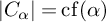






By [Reference Rinot and ZhangRZ21, Lemma 6.4], for every $(\delta ,\beta )\in S^1\circledast \kappa $
, there exists an ordinal
$(\delta ,\beta )\in S^1\circledast \kappa $
, there exists an ordinal $\Lambda (\delta ,\beta )<\delta $
such that the following two hold:
$\Lambda (\delta ,\beta )<\delta $
such that the following two hold:
-
(a)
$\operatorname {\mathrm {nacc}}(e_\delta )\setminus \Lambda (\delta ,\beta )\subseteq \operatorname {\mathrm {nacc}}(C_{\eth _{\delta ,\beta }})$
; -
(b) for every
$\gamma \in \operatorname {\mathrm {nacc}}(C_{\eth _{\delta ,\beta }})\cap [\Lambda (\delta ,\beta ),\delta )$
,
$\sup (e_\delta \cap \gamma )\le \lambda (\gamma ,\beta )<\gamma $
.



Let I be the collection of all $X\subseteq \kappa $
such that, for some club
$X\subseteq \kappa $
such that, for some club $D\subseteq \kappa $
, for every
$D\subseteq \kappa $
, for every $\delta \in S^1$
,
$\delta \in S^1$
, $\sup (\operatorname {\mathrm {nacc}}(e_\delta )\cap D\cap X)<\delta $
. It is not hard to see that I is an ideal. In fact, I is a countably-complete ideal, since
$\sup (\operatorname {\mathrm {nacc}}(e_\delta )\cap D\cap X)<\delta $
. It is not hard to see that I is an ideal. In fact, I is a countably-complete ideal, since $S^1\subseteq E^\kappa _{>\omega }$
. It is clear that
$S^1\subseteq E^\kappa _{>\omega }$
. It is clear that $J^{\text {bd}}[\kappa ]\subseteq \text {NS}_\kappa \subseteq I$
, and by the choice of
$J^{\text {bd}}[\kappa ]\subseteq \text {NS}_\kappa \subseteq I$
, and by the choice of $\vec e$
, I is proper.
$\vec e$
, I is proper.
Claim 7.4.1.
I is not weakly $\kappa $
-saturated.
$\kappa $
-saturated.
Proof. As $S^1\subseteq E^\kappa _{<\sigma ^0}$
, I is
$S^1\subseteq E^\kappa _{<\sigma ^0}$
, I is $\theta $
-indecomposable for every
$\theta $
-indecomposable for every $\theta \in \operatorname {\mathrm {Reg}}(\kappa )\setminus \sigma ^0$
; indeed, it is easy to see that if
$\theta \in \operatorname {\mathrm {Reg}}(\kappa )\setminus \sigma ^0$
; indeed, it is easy to see that if $\langle X_i \mid i< \theta \rangle $
is a
$\langle X_i \mid i< \theta \rangle $
is a $\subseteq $
-increasing sequence of sets in I whose membership in I is witnessed, respectively, by the sequence
$\subseteq $
-increasing sequence of sets in I whose membership in I is witnessed, respectively, by the sequence $\langle D_i \mid i< \theta \rangle $
of clubs in
$\langle D_i \mid i< \theta \rangle $
of clubs in $\kappa $
, then
$\kappa $
, then $D:= \bigcap _{i< \theta } D_i$
witnesses that
$D:= \bigcap _{i< \theta } D_i$
witnesses that $X:= \bigcup _{i< \theta } X_i$
is in I. It follows that
$X:= \bigcup _{i< \theta } X_i$
is in I. It follows that $S^0$
is a stationary subset of
$S^0$
is a stationary subset of $T^*(I)$
that does not reflect at regulars. So, by appealing to Theorem 6.17, we infer that I is not weakly
$T^*(I)$
that does not reflect at regulars. So, by appealing to Theorem 6.17, we infer that I is not weakly $\kappa $
-saturated.
$\kappa $
-saturated.
Next, as $E^\kappa _{\ge \chi }$
admits a stationary set that does not reflect at regulars, [Reference Rinot and ZhangRZ21, Theorem C(3)] implies in particular that
$E^\kappa _{\ge \chi }$
admits a stationary set that does not reflect at regulars, [Reference Rinot and ZhangRZ21, Theorem C(3)] implies in particular that $\operatorname {\mathrm {P\ell }}_1(\kappa ,1,\chi )$
holds. This has two implications relevant to us:
$\operatorname {\mathrm {P\ell }}_1(\kappa ,1,\chi )$
holds. This has two implications relevant to us:
-
• By [Reference Rinot and ZhangRZ21, Lemma 2.18(2)], to prove that
$\operatorname {\mathrm {Pr}}_1(\kappa ,\kappa ,\kappa ,\chi )$
holds, it suffices to prove that
$\kappa \nrightarrow [\kappa ]^2_\kappa $
holds; -
• By [Reference Rinot and ZhangRZ21, Corollary 2.22], we may fix a colouring
$o:[\kappa ]^2\rightarrow \omega $
witnessing
$\kappa \nrightarrow [\kappa ]^2_\omega $
.



Fix a map $h:\kappa \rightarrow \kappa $
witnessing that I is not weakly
$h:\kappa \rightarrow \kappa $
witnessing that I is not weakly $\kappa $
-saturated. We shall walk along
$\kappa $
-saturated. We shall walk along $\vec C$
, and let
$\vec C$
, and let $\operatorname {\mathrm {Tr}},\operatorname {\mathrm {tr}},\lambda $
and
$\operatorname {\mathrm {Tr}},\operatorname {\mathrm {tr}},\lambda $
and $\rho _2$
be the induced characteristic maps. Define
$\rho _2$
be the induced characteristic maps. Define $c:[\kappa ]^2\rightarrow \kappa $
via
$c:[\kappa ]^2\rightarrow \kappa $
via
 $$ \begin{align*}c(\alpha,\beta):=h(\operatorname{\mathrm{Tr}}(\alpha,\beta)(o(\alpha,\beta))).\end{align*} $$
To see that c witnesses $\kappa \nrightarrow [\kappa ]^2_\kappa $
, let
$\kappa \nrightarrow [\kappa ]^2_\kappa $
, let $B\in [\kappa ]^\kappa $
be given along with a prescribed colour
$B\in [\kappa ]^\kappa $
be given along with a prescribed colour $\tau <\kappa $
. By [Reference Inamdar and RinotIR24, Claim 3.15.1], we may fix a club
$\tau <\kappa $
. By [Reference Inamdar and RinotIR24, Claim 3.15.1], we may fix a club $D\subseteq \kappa $
such that, for every
$D\subseteq \kappa $
such that, for every $\gamma \in D$
, for every
$\gamma \in D$
, for every $\beta \in B\setminus \gamma $
, for every
$\beta \in B\setminus \gamma $
, for every $n<\omega $
,
$n<\omega $
, $\sup \{\alpha \in B\cap \gamma \mid o(\alpha ,\beta )=n\}=\gamma $
.
$\sup \{\alpha \in B\cap \gamma \mid o(\alpha ,\beta )=n\}=\gamma $
.
Now, by the choice of h, let us pick a $\delta \in S^1$
such that
$\delta \in S^1$
such that $\sup \{\gamma \in \operatorname {\mathrm {nacc}}(e_\delta )\cap D\mid h(\gamma )=\tau \}=\delta $
. Pick
$\sup \{\gamma \in \operatorname {\mathrm {nacc}}(e_\delta )\cap D\mid h(\gamma )=\tau \}=\delta $
. Pick $\beta \in B$
above
$\beta \in B$
above $\delta $
and then pick
$\delta $
and then pick $\gamma \in \operatorname {\mathrm {nacc}}(e_\delta )\cap D$
above
$\gamma \in \operatorname {\mathrm {nacc}}(e_\delta )\cap D$
above $\Lambda (\delta ,\beta )$
such that
$\Lambda (\delta ,\beta )$
such that $h(\gamma )=\tau $
. Denote
$h(\gamma )=\tau $
. Denote $n:=\rho _2(\gamma ,\beta )$
. By Clauses (a) and (b),
$n:=\rho _2(\gamma ,\beta )$
. By Clauses (a) and (b), $\lambda (\gamma ,\beta )<\gamma $
, so since
$\lambda (\gamma ,\beta )<\gamma $
, so since $\gamma \in D$
, we may find some
$\gamma \in D$
, we may find some $\alpha \in B$
with
$\alpha \in B$
with $\lambda (\gamma ,\beta )<\alpha <\gamma $
such that
$\lambda (\gamma ,\beta )<\alpha <\gamma $
such that $o(\alpha ,\beta )=n$
. As
$o(\alpha ,\beta )=n$
. As $\lambda (\gamma ,\beta )<\alpha <\gamma <\delta <\beta $
, it follows that
$\lambda (\gamma ,\beta )<\alpha <\gamma <\delta <\beta $
, it follows that $\operatorname {\mathrm {tr}}(\alpha ,\beta )=\operatorname {\mathrm {tr}}(\gamma ,\beta ){}^\smallfrown \operatorname {\mathrm {tr}}(\alpha ,\gamma )$
and hence
$\operatorname {\mathrm {tr}}(\alpha ,\beta )=\operatorname {\mathrm {tr}}(\gamma ,\beta ){}^\smallfrown \operatorname {\mathrm {tr}}(\alpha ,\gamma )$
and hence
 $$ \begin{align*}c(\alpha,\beta)=h(\operatorname{\mathrm{Tr}}(\alpha,\beta)(o(\alpha,\beta)))=h(\operatorname{\mathrm{Tr}}(\alpha,\beta)(\rho_2(\gamma,\beta)))=h(\gamma)=\tau,\end{align*} $$
as sought.
Competing interests
The authors have no competing interests to declare.
Acknowledgements
The problem left open in Shelah’s book was communicated to the second author by Todd Eisworth during a visit to the Fields Institute for Research in Mathematical Sciences in November 2012. He thanks Eisworth for bringing it to his attention.
The main results of this paper were presented by the second author at the conference in honor of Saharon Shelah’s 80th birthday in Vienna, July 2025. He thanks the organisers for the invitation and the audience for their feedback.
The first author is supported by the Israel Science Foundation (grant agreements 2066/18 and 665/20). The second author is partially supported by the Israel Science Foundation (grant agreement 203/22).
We thank the referee for a thorough reading of this manuscript and for providing thoughtful feedback.


 implies


 Open access

