





Introduction
International nongovernmental organizations (INGOs) and transnational social movements (TSMOs) play a vital, yet contested and debated role in responding to global challenges such as climate change. The scholarly debate centers around whether the INGOs serve to amplify grassroots concerns using their access to governmental agencies, the EU and the UN or if, given their established standing and ties with private interests, they tend to temper the voices of the movement (Choudry & Kapoor, Reference Choudry and Kapoor2013; Hermansen et al., Reference Hermansen, McNeill, Kasa and Rajao2017; Tarrow, Reference Tarrow2005). The Sustainable Development Goals (SDGs) have been adopted as a global framework shaping advocacy. In this context, the role of INGOs in combating climate change (Abbott et al., Reference Abbott, Green and Keohane2016; Koliev et al., Reference Koliev, Park and Duit2023) as envisioned by the UN SDG 13 makes a good case for exploring these questions.
Civil society engagement has had a positive impact on global governance and on the implementation of international standards at the domestic level (Andrews, Reference Andrews2011; Cusack, Reference Cusack1999; Keck & Sikkink, Reference Keck and Sikkink1998; Putnam et al., Reference Putnam, Leonardi and Nanetti1993; Rasmussen & Reher, Reference Rasmussen and Reher2019; Sikkink, Reference Sikkink2017). While the Transnational Advocacy Networks (TANs) literature focused on the role of INGOs in helping domestic NGOs to advocate for globally relevant issues (Keck & Sikkink, Reference Keck and Sikkink1998), others focused on the tension between INGOs and social movements, emphasizing how INGOs dominate the field of advocacy, moderating and coopting the voice of social movements (Bob, Reference Bob2001; Choudry & Kapoor, Reference Choudry and Kapoor2013; Tarrow, Reference Tarrow2005).
More recently, scholars have considered actors beyond TANs, especially in relation to climate governance. The shifts in global power dynamics necessitate a “transcalar” approach (Pallas & Bloodgood, Reference Pallas and Bloodgood2022) that encourages an analysis of multiple actors at multiple levels. In addition to TANs, these scholars emphasize paying attention to local NGOs and local political opportunities (Hale et al., Reference Hale, Held and Brown2017; Hermansen et al., Reference Hermansen, McNeill, Kasa and Rajao2017; Pallas & Bloodgood, Reference Pallas and Bloodgood2022). For example, Hermansen et al. (Reference Hermansen, McNeill, Kasa and Rajao2017) emphasized the importance of NGOs in mediating between different actors in advocacy, policy design, and outcomes (Hermansen et al., Reference Hermansen, McNeill, Kasa and Rajao2017).
Spain provides a good case to examine these issues. The government of Spain designated SDG 13, climate action, as a priority and incorporated NGOs and movement actors in SDG consultations through formalized processes. Simultaneously, there is a vibrant presence of grassroots social movements, both domestic and transnational, that deploy contentious tactics. This makes Spain a fitting case to analyze how INGOs advocate across different levels of governance and how networks among these actors allow for movement voices, both domestic and transnational, to find their way into SDG-based climate discussions.
The specific focus of this study is to examine how INGOs navigate climate advocacy under SDG 13 across domestic, EU and UN political opportunity structures; and to understand the network relationships between INGOs and social movements in order to explain how grassroots voices show up in these spaces. The study utilizes official government documents, published material from nonstate organizations, and 24 semistructured interviews conducted by the author. Adopting a transcalar approach, the study demonstrates that INGOs work in a consensus-building network environment with domestic grassroots movements. The voices of these anti-capitalist contentious domestic environmental movements are present in the formal network spaces, while less institutionalized TSMOs remain on the margins of policy development.
Thus, a transcalar (Pallas & Bloodgood, Reference Pallas and Bloodgood2022) analysis reveals the Spanish case as a complex constellation of actors situated at different locations in the overall climate struggle. While political opportunity structures still have an impact on the way in which the voices of advocates show up in the board rooms, by examining the network relationship between these actors in conjunction with these opportunity structures, it is possible to differentiate between movement actors and explain how some voices are incorporated and others are tempered.
Theoretical framework: Transcalar approach to understanding political opportunity and networks
Theories of political opportunity, collective action frames, mobilizing structure, and repertoires of contention argue for the importance of political and economic structures in shaping social movement activity (Kitschelt, Reference Kitschelt1986; McAdam et al., Reference McAdam, McCarthy and Zald1996; Tarrow, Reference Tarrow2011; Tilly, Reference Tilly1978). Extending beyond the nation-state, IGOs have an impact in shaping the global political landscape (Boli & Thomas, Reference Boli and Thomas1999; Keck & Sikkink, Reference Keck and Sikkink1998) and influence TSMOs (Della Porta & Diani, Reference Della Porta and Diani1999, p. 249) by structuring access, legitimating actors and setting policy frames. In this context, the UN and the EU influence the political opportunities, collective action frames as well as the mobilizing structures for INGOs and social movements. The SDGs have been a major focus of the international community, shaping all forms of advocacy.
TANs focus on how INGOs help translate global goals into issues in the local arena providing support for domestic advocacy actors (Keck & Sikkink, Reference Keck and Sikkink1998). While Hale et al. (Reference Hale, Held and Brown2017) argue that there are pathways for social movement activists to get their views heard through the INGOs that help provide them access, Tarrow (Reference Tarrow2005) suggests effective synergies between the transnational movements and the INGOs, who have greater access to powerful decision-makers, are difficult to forge. If successfully established, these relations can lead to cooptation and the taming of domestic social movement voices (Choudry & Kapoor, Reference Choudry and Kapoor2013, Tarrow, Reference Tarrow2005, p. 34). Professionalized NGOs may depoliticize grassroots agendas, but a deeper examination of the relationship between NGOs and social movements reveals the complexities of this relationship (Choudry & Kapoor, Reference Choudry and Kapoor2013). Research on climate governance shows that cooperation can expand access while taming confrontation: environmental NGOs engaged in institutional initiatives may gain influence, yet temper their demands, raising cooptation concerns (Hermansen et al., Reference Hermansen, McNeill, Kasa and Rajao2017).
As the global advocacy environment has changed with new actors, technologies and strategic choices, Pallas and Bloodgood (Reference Pallas and Bloodgood2022) argue for a shift away from a transnational focus to a “transcalar” analysis, necessitating attention to the impact of diverse local, regional, and national organizations all taking part in global issue advocacy. Similarly, Pouliot and Thérien (Reference Pouliot and Thérien2023) characterize global policy-making as a patchwork of actors working on multiple levels. This multilayered approach focuses the theoretical framework of this study on political opportunity structures as well as networks among organizations. The transcalar approach allows for understanding how actors operate at different levels, negotiating advocacy positions and outcomes. Here, the SDGs are not simply a top-down advocacy agenda, but they are contested across scales, as domestic opportunity structures intersect with EU policy baselines and UN frameworks, and as networked coalitions negotiate positions across diverse organizations.
This approach provides a useful framework for analyzing advocacy around SDG 13, climate action, in Spain. Even as local implementation processes are important due to strong federalism, the EU (Green Deal) and the UN (Paris Agreement) have important roles in shaping advocacy by setting baseline expectations (Chaves-Avila & Savall-Morera, Reference Chaves-Avila and Savall-Morera2019). Thus, before the domestic political structures, international policy frameworks shape the opportunity structures within which climate advocates operate. At the same time, the relationship among INGOs, domestic NGOs and social movements produces compromises in multiple network settings, tempering some voices and incorporating and elevating others. The transcalar focus on SDG 13, climate action in Spain, helps to reveal the interplay between political opportunities and networks among organizations and social movements.
Methodology: The case of SDG 13 advocacy in Spain
UN member states adopted the SDGs in 2015, agreeing to 17 goals articulated through specific metrics designed to move toward a world that is sustainable, prosperous, and just. Yet, the SDGs do not provide a blueprint for how to get there and “remain full of ambiguities and polysemous formulations” (Pouliot & Thérien, Reference Pouliot and Thérien2023, p. 104). Each state and local government has been developing their own road maps for achieving the goals, requiring a transcalar understanding of advocacy in this context. The inclusion of local perspectives in policy development and implementation is a central priority for the SDGs (Kindornay, Reference Kindornay2019; Lucci, Reference Lucci2015). Nonstate actors, including INGOs, businesses, universities and other civic actors have been key in shaping their implementation. The SDGs also provide a degree of flexibility that allows society to debate how to achieve these goals. This creates the context for this study, an examination of the interaction and relationships among the layers of organization that seek to shape policy in Spain.
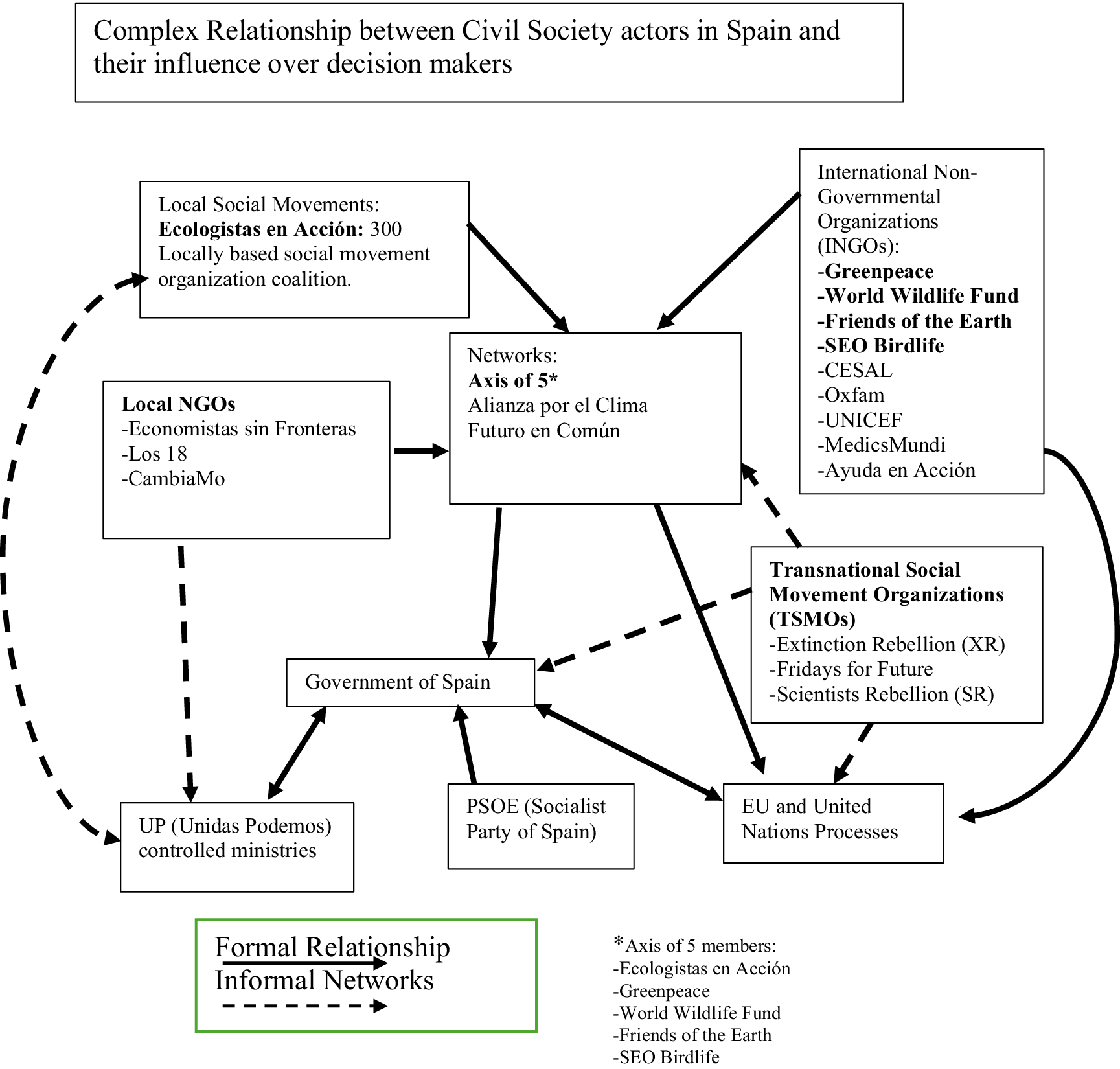
Spain’s civil society participation in the implementation process for SDG 13 makes a great case to examine the dynamics of political opportunities as well as networks between these organizations. Spanish civil society participates in the SDGs through a formal government mechanism, an Advisory Council, that also includes representation from different stakeholders (Rico Motos & Alarcón, Reference Rico Motos and Alarcón2022). The advisory council includes two environmental organizations from the “Axis of 5,” a coalition of the five largest environmental advocacy groups in Spain (see Figure 1). Spain’s Voluntary National Reports to the UN have been prepared through consultation with this council. In 2022 (when the interviews were conducted), Spanish implementation review included SDG 13 as a top priority area. SDG 13 is relevant to a broad spectrum of organizations as the goal encompasses both mitigation of and adaptation to climate change, a goal that is interconnected with virtually all other SDGs.
Complex relationship between civil society actors in Spain and their influence over decision-makers.

Fig. 1. Long description
A flowchart with a legend at the bottom defining solid arrows as Formal Relationship and dashed arrows as Informal Networks.
At the top level, three groups of actors are shown. On the left, Local Social Movements: Ecologistas en Acción: 300 Locally based social movement organization coalition. In the center, Local N G O s including Economistas sin Fronteras, Los 18, and CambiaMo. On the right, International Non-Governmental Organizations I N G O s including Greenpeace, World Wildlife Fund, Friends of the Earth, S E O Birdlife, C E S A L, Oxfam, U N I C E F, MedicsMundi, and Ayuda en Acción.
In the middle layer, these actors point toward Networks: Axis of 5 asterisk, Alianza por el Clima, and Futuro en Común. A note at the bottom defines the Axis of 5 members as Ecologistas en Acción, Greenpeace, World Wildlife Fund, Friends of the Earth, and S E O Birdlife. To the right of the networks are Transnational Social Movement Organizations T S M O s including Extinction Rebellion X R, Fridays for Future, and Scientists Rebellion S R.
At the bottom level are the decision-makers. The Government of Spain is the central node, receiving formal input from Networks and the P S O E Socialist Party of Spain. To the left, U P Unidas Podemos controlled ministries receive informal input from Local N G O s and T S M O s, and have a formal bidirectional relationship with the Government of Spain. To the right, E U and United Nations Processes receive formal input from Networks and I N G O s, and have a formal bidirectional relationship with the Government of Spain. T S M O s also maintain informal networks with the E U and United Nations Processes.
The Axis of 5, which includes Greenpeace, Ecologistas en Acción (a network of 300 anti-capitalist social movement organizations), Friends of the Earth, the World Wildlife Fund (WWF) and SEO Birdlife, represent the strongest coalition focused on environmental issues in Spain. They are included individually and as coalition partners in all government consultations as well as in different civil society networks. The presence of networked international and domestic NGOs along with TSMOs like Extinction Rebellion, Fridays for Future and Scientists Rebellion provide a rich foundation for transcalar analysis of this issue in Spain, as do the political opportunity structures created through government advisory councils, the EU and the UN.
The study followed the social science relevant aspects of the consolidated criteria for reporting qualitative studies guidelines (Tong et al., Reference Tong, Sainsbury and Craig2007). The researcher obtained IRB approval from their university prior to research. Consistent with snowball case selection best practices (Parker et al., Reference Parker, Scott and Geddes2019), based on the landscape of climate advocacy in Spain, the subject selection for interviews started with the Axis of 5 organizations considered central to the SDGs and climate change in association with government consultative councils. A second starting point was the Futuro en Común, a prominent network that addresses the whole range of SDGs, composed of over 50 civil society organizations. Futuro en Común is regularly called upon by the government to consult about the SDGs. Organizational representatives were selected by the organizations, as a message requesting an interview was initially sent to a general e-mail address. The rest of the organizations and social movement representatives were selected through snowball sampling (Merton, Reference Merton, Lazarfeld and Stanton1949) by asking the initial interviewees to suggest others who are important in their advocacy world. Snowball sampling is useful in this context (Audemard, Reference Audemard2020) given the goal is to understand the networks as well as the landscape of political advocacy around climate. A total of 24 semistructured in person interviews were conducted by the author in Spanish capital Madrid. Most interviews took place at the offices of the interviewees. Some interviews were conducted in public spaces like cafes as some social movements do not have offices. The subjects included Spanish civil society organization representatives, government officials, and social movement activists. Interviewees were asked open-ended questions pertinent to understanding the relationships among organizations and their advocacy strategies (see Appendix for a list of organizations and questions). These interviews were conducted and audio recorded between January and May 2022, each lasting between 30 minutes and 2 hours. The interviews were held in Spanish after which the author and a team of interpreters from the Universidad Autónoma de Madrid transcribed the interviews into English. The in-person interview process for the research was time bound to end in June 2022. By that point, the author had already determined that a saturation point was reached as later interviews and subject suggestions were found to have a more tangential relationship with climate advocacy.
The interviewees were asked about their organizational goals and strategies toward SDG 13 (see Appendix for questions), their relationship with different government agencies as well as their relationships with other NGOs and social movements in their work around SDG 13. In addition, the author also observed meetings and events organized by Futuro en Común, the main SDG coalition, and attended events organized by movement activists. The author examined reports, newsletters, official internet pages, social media accounts, and press releases for 2022 to understand the network framing. The goal was to understand the advocacy and action among the Axis of 5 and the transnational movements, including Extinction Rebellion, Scientists Rebellion and Fridays of Future and Futuro en Común. The author also analyzed the 24 transcribed interviews and her meeting observations using NVivo, where the three themes emerged in shaping INGO engagement with SDG 13. The themes centered around INGO representation of the voices for climate change including political opportunity structures, network relations, and within the networks, the differences in strategy and organizational structures. The author was the sole reader of the interviews and coded the interviews around these three themes as they emerged. The next sections describe the results of this data gathering focusing on each of these three themes.
Navigating political opportunity structures
The UN and the EU fundamentally shape the opportunity structure for civil society involvement in climate policy in Spain. While the national governments are the focus of much of climate advocacy (Luhtakallio et al., Reference Luhtakallio, Ylä-Anttila and Lounela2022), the interviews revealed that the Spanish government largely follows the EU’s lead on climate policy, setting baseline expectations. Those interviewed expressed that the EU green policy and UN Paris Agreement set a low bar for climate action, essentially setting a minimum baseline in their strategy considerations. While these policies on climate are deemed to lower the bar for advocates, the interviewees cited a separate European agreement, the Aarhus Convention (the UN Economic Commission of Europe Convention on Access to Information, Public Participation in Decision-making, and Access to Justice in Environmental Matters) as centrally important to shaping political opportunities by requiring the inclusion of civil society in the development of climate policy. Thus, INGOs have greater institutional access, representation and influence in Spain due to EU requirements that civil society be consulted in policy development. The involvement of civil society is institutionalized through two consultative bodies with relevance to SDG 13: the Council on Sustainable Development and the Advisory Council on Environment (CAMA). Both are made up of representatives from business, labor and NGOs, allowing for direct and regular access to government representatives.
Although UN and EU mandates ensure some level of NGO input in the SDG process, interviews revealed that partisan politics is used to limit the opportunities available to groups advocating on climate policy. Some NGO representatives and movement activists feel that the SDGs have not been given priority and that their voices have been subsumed within the governing coalition. At the time of the interviews, winter and spring 2022, Spain’s governing coalition was made up of PSOE (the Socialist Party) which controlled the key ministries of the Prime Minister and Labor and Economy. Coalition partner Unidas Podemos (UP) controlled the Ministry of Ecological Transition and Demographic Change and the Ministry of Social Rights and Agenda 2030, which had a coordinating role for the SDGs rather than a policy-making role. This Ministry organized the Council for Sustainable Development to give voice to civil society on the SDGs, but these entities have no policy mandate. Thus, NGOs have avenues of input, but interviewees often felt that their influence was limited given that the UP representatives who led the Council on Sustainable Development and the Ministry of Social Rights and Agenda 2030 would subsequently work with PSOE to develop actual policies. Thus, the political opportunities provided by the government structures, like these councils and committees, were also shaped by the political coalition structure where, on climate, important policy decisions were being made outside of the realm of the ministries coordinating SDG efforts.
These partisan impediments are rooted in a history in which the UP sees itself as having a special role representing social movements in government (Romanos, Reference Romanos, Muro and Lago2020, p. 467). Prior to the adoption of the SDGs globally, in Spain, during 2000s, the rise of movements for housing, education, and gender rights coincided with the return to power of the socialist party, PSOE. Dissatisfied with the PSOE, these social movements, known collectively as the 15M movement, had an anti-neoliberal, anti-austerity position which they advanced through civil disobedience and nonviolent direct action (Martinez & Domingo San Juan, Reference Martinez and Domingo San Juan2020; Romanos & Sabada, Reference Romanos and Sabada2022). M15 pressed for changes, and some reforms were implemented, yet many considered the changes to be inadequate (Romanos et al., Reference Romanos, Sola and Rendueles2022). The UP party was born of the 15M movement, adopting the movement’s slogan “yes we can” and their anti-elite positioning in their decentralized organization and program (Martin, Reference Martin2015, p. 110; Martinez & Domingo San Juan, Reference Martinez and Domingo San Juan2020, p. 25). While the social movements are generally considered nonpartisan and independent, leaders in the UP considered themselves to be movement representatives. Yet, when serving in a government coalition with PSOE, the UP made compromises to remain a viable political partner in government. According to several interviewees, these compromises involved a divergence from the goals pursued by social movement organizations, including those related to climate change.
These concerns were collectively expressed during an event organized by Futuro en Común on April 25, 2022 titled “Coherence of Policies for Sustainable Development.” NGO speakers were critical of the government climate policies being adopted following the release of the EU’s Recovery and Resilience Plan which promised a 69 billion Euro investment in Spain with 40% of these investments dedicated to climate objectives, especially the “Green and Digital Transition” (see Plan de recuperación para Europa en España 2022). NGO representatives felt that the climate policies derived from the Plan lacked transparency and emerged outside of the process in which they had been involved. Similarly, advocates were critical of the European Green Deal which aims to “transform the EU into a modern, resource-efficient and competitive economy, ensuring no net emissions of greenhouse gases by 2050, economic growth decoupled from resource use, and no person and no place left behind” (See the European Green Deal). INGOs interviewed expressed concern that the 2030 Agenda discussions in which they participated were being disregarded in the climate related decisions made by the government considering new EU-based policies and plans.
Many INGO representatives expressed that despite having access to consultation with ministries that are in the portfolio of the UP, major climate relevant decisions were being made by the office of the PSOE affiliated Prime Minister Pedro Sanchez. UP representatives, while claiming to be the voice of the grassroots movements, explicitly acknowledged the party’s willingness to deprioritize climate action. The compromises were clearly articulated by the Secretary of State for Agenda 2030, Enrique Santiago, from the UP stating that “the government response needs a political compromise” and that the “politics of government cannot address everything like climate change especially when there is Covid recovery and a war in Ukraine” (April 25, 2022, Coherence of Government Futuro en Común Event).
The marginalization of the SDGs was also brought up by the chair of the Mixed Commission of the Senate on the SDGs:
In the Congress of Deputies some commissions are more important than others… Labor Commission and Economic Commission are not the same as the SDG Commission; we don’t have same relevance or media attention… the deputies in these committees are not as well-known and with less possibility of having a public impact internally and externally. (personal interview).
The political opportunity structures discussed in this section demonstrate that civil society has limited leverage in shaping climate policy. Broader international agreements and standards established at the intergovernmental level set a low bar that provides limited leverage points. In addition, civil society involvement in the policy process, while guaranteed by EU agreements, still allows them to be channeled into minority-party-controlled ministries with power limited to a coordination role, while actual climate policy is set and implemented by the prime minister representing the dominant coalition partner.
INGO SDG networks
Building coalitions is a core strategy of popular advocacy organizations that generally lack power relative to dominant actors in the political sphere. Yet the coming together of different organizations, even those with similar values and goals, requires some measure of compromise. Such is the case with the Axis of 5, the coalition of major environmental organizations operating in Spain. From the perspective of climate activists, this can result in a weakening of advocacy around climate issues. This occurs even more so as coalitions widen beyond environmental considerations to include the whole range of SDGs, as is the case with Futuro en Común. Yet, despite the need for compromise associated with coalition work, all NGO representatives emphasized that they are stronger and more effective working in alliance with one another.
While all members of the Axis of 5 address climate change as a goal, how it fits among their other environmental concerns varies. Umbrella organizations that include environmental advocates among many others like Futuro en Común seek to coordinate a common position through negotiation among all participating organizations. Addressing climate change is one goal among many others adopted by the 50 international and domestic NGOs in the network. A representative from Futuro en Común described this challenge and its impacts:
We are finding innovative ways to bring together different organizations from different political points of view. We must be very careful because each organization has different positions. We debate very slowly to reach a consensus… This is how you achieve impact. But sometimes we reduce our expectations or say nothing… (Interview with Representative from Futuro en Común).
Because Futuro en Común has a role in all the climate related Advisory Councils, its positions are at the forefront of climate advocacy. From the perspective of some organizations, climate related positions are weakened in the consensus building process of the large network organization.
While advocacy organizations can all agree on the goal of ending the use of fossil fuels, the policies about how to get there become grounds for debate and compromise. It is key to understand the complex dynamics of climate advocacy and that the priorities of these organizations are varied even among Axis of 5. Greenpeace explicitly prioritizes environmental protection; yet others emphasize a “just transition” with an anti-capitalist position like Ecologistas en Acción. Others, such as SEO Birdlife, prioritize biodiversity. These priority divergences lead organizations to reach different conclusions about particular government policies. For example, when asked about the Spanish government Law 7/2021, on Climate Change and Energy Transition, representatives of Axis of 5 organizations offered different perspectives. A Greenpeace representative said the law was “not ambitious enough” and it was “outdated by the time it passed.” The SEO Birdlife representative was satisfied with the law but felt the “law posed a threat to biodiversity.”
These INGOs were ultimately able to converge on the positions articulated through Futuro en Común around climate advocacy. This includes a demand that the government phase out subsidies for fossil fuels by 2025, increasing ecologically focused employment in key sectors, and eliminating food waste and reducing food footprint (Futuro en Común, Reference Común2021, p. 9). These positions were the product of compromises reached through the network of organizations all advocating on the basis of different SDG priorities. Understanding these coalitions and networks is important to understanding how particular goals, such as climate advocacy, are conveyed to policymakers.
Networks and coalitions
An analysis of climate advocacy networks in Spain reveals evidence for how domestic social movements had on-going and meaningful presence in these networks while TSMOs remain largely peripheral (see Figure 1). Ecologistas en Acción is itself a coalition of over 300 domestic environmental movement organizations in Spain. They are represented in Futuro en Común and are among the Axis of 5, thus ensuring that the voices of wide range of local anti-capitalist social movements are included in major coalition policy advocacy. Domestic movement organizations are also integrated in other environmental advocacy coalitions. For example, the Alliance for the Climate focuses solely on climate and energy legislation. The Alliance includes representation of all major CSOs and labor unions along with both domestic and transnational movement organizations. Domestic movement organizations have effectively integrated some of their positions into the larger network demands. For example, the large mainstream INGOs have moved to challenge EU and government policy that favored big corporations and supported positions toward community-based energy and just transitions reflecting the influence of these locally based anti-capitalist social movement organizations.
Yet, the analysis of interviews reveals, unlike the inclusion of organized local social movements, the TSMOs were more difficult to involve in formal networks. Extinction Rebellion (XR) and Scientists Rebellion (SR) are two transnational climate movement groups that perform civil disobedience to target powerful interests considered responsible for climate change. XR and SR are connected to a global movement with strong climate demands that do not specifically articulate the pathways for social and political transformation in response to climate challenges. XR aspires to be a “horizonalist movement” that is leaderless, decentralized, inclusive, and participatory (Berglund & Schmidt, Reference Berglund and Schmidt2021, p. 44). These movements ask for immediate and drastic action on climate change. They lack resources, therefore networking with other organizations could aid in their mobilization. Yet the movement representatives interviewed expressed doubts about the INGOs. INGO representatives in turn expressed that TSMO’s lack of organizational structure limits formal engagement with them.
Among the three transnational organizations present in Spain, Fridays for Future was viewed as a more compatible ally among NGOs. The interviewees from mainstream organizations expressed a desire to work with Fridays for Future. Like XR and SR, the youth-based organization does not have a strong policy position. According to INGO representatives, Fridays’ youth demand timely change on climate through “colorful and innovative actions” but “lack resources to develop policies.” For some INGOs, the incorporation of activists from Fridays is an opportunity to draw attention to their issues. SEO Birdlife representative explained synergies with Fridays for Future and SR, bringing an understanding for Birdlife’s priorities on biodiversity vis-à-vis climate movements.
We have a youth board with strong links with Fridays for Future and Greta movement. We have a scientific board whose members work with Scientists Rebellion… We are a project based scientific organization, but we also have strong relations with all these organizations … We think the Fridays work very well on climate change. Climate change for us is a secondary goal. We care about it because it affects nature conservancy, so we stand behind them and try to support them in the things that they want and need. We try to keep a dialogue with them regarding the conflict between biodiversity and renewable laws. We give them the data and let them build their own opinion because we understand the way that movement was created and how they work is very different from us. (interview with SEO Birdlife representative).
Yet, relations are not always smooth. As a representative from Greenpeace pointed out the differences in position of XR and Fridays:
I would like to highlight that XR in Spain does not have that much visibility or power like in other countries so it is not as relevant… Fridays for Future is more relevant here. In the case of Fridays, we help them a lot in terms of mobilization and organization. We also work with XR but even though we have these agreements to help and encourage each other, at the end of the day we are different organizations and each act in their own way. We have different tactics and messaging despite having the same goal and vision. We all want change but we want to have real political impact. We have a more realistic position. We all want to stop using fossil fuels in 5 years but this idea is not realistic so it does not mobilize the population to create real change. We need to adapt our demands and petition to create a political change accordingly. With Fridays we work with them on a lot of issues. They have the strength and visibility to demand change. We try to act based on science and expect a more realistic transition. We have to think about the means we have for change. (Greenpeace interview)
The interviews point to how the Fridays’ youth activists are coveted by INGOs. As a youth led movement, participants are sympathetic in the eyes of policymakers and the general public, thus they bring certain strategic advantages, while others, such as XR, are at times viewed as simply “unrealistic” and “unorganized.” However, in all cases, these transnational movements are not easily incorporated into established domestic climate networks.
INGOs and TSMOs differ not only on policy approaches, but also on the process through which climate decisions should be made. TSMOs demand that People’s Assemblies guide processes for climate futures (Berglund & Schmidt, Reference Berglund and Schmidt2021, pp. 50–51). Yet there is also some distrust of these assemblies among the movement activists who perceive INGO domination of the process:
I have worked with Citizens Climate Assembly… The assembly of citizens in Spain has just started… there is going to be 100 people who will be chosen by lottery to assess the proposals about climate change, inequality and energy transition with the government. It is a good start, but it has not been carried out well. This program has not paid attention to what social movements want. The organization of these assemblies, there is an experts panel with big NGOs like Greenpeace, WWF, there are 4–5 large organizations but XR did not want to be there, because the conditions were not right and we did not trust the process… The process was not suitable for the urgency of climate change… NGOs have more tolerance for these kinds of things. In XR we are more radical than these NGOs. (interview with Extinction Rebellion activist).
The refusal of some of the activists to participate even in Citizen Assemblies where decision-making is closer to the ground, demonstrates the difficulty in establishing networks between the transnational movements and INGOs.
Analysis and conclusion
The SDGs create a common framework from which states and civil society organizations work on global issues, including climate change. INGOs are the main actors in TANs (Keck & Sikkink, Reference Keck and Sikkink1998) working on these issues. A major debate is whether these INGOs serve to advance the goals of social movements or whether they coopt and undermine movement goals. Some emphasize the pathways that social movement activists can forge to get their views incorporated through their connections with INGOs (Hale et al., Reference Hale, Held and Brown2017; Hermansen et al., Reference Hermansen, McNeill, Kasa and Rajao2017). However, others suggest that movement positions are compromised as established INGOs carry their message into the institutional decision-making fora (Choudry & Kapoor, Reference Choudry and Kapoor2013; Tarrow, Reference Tarrow2005). Here, a transcalar analysis of climate advocacy in Spain suggests that this is not an either-or proposition. The analysis indicates that how movement voices get carried through INGOs is contingent on particular political opportunities and network relationships among these actors.
Political opportunity structures internationally and domestically can affect INGO activities (Benford & Snow, Reference Benford and Snow2000; Dellmuth & Bloodgood, Reference Dellmuth and Bloodgood2023; Gamson & Meyer, Reference Gamson, Meyer and Tilly1996; Gerő et al., Reference Gerő, Fejős, Kerényi and Szikra2023; Henry et al., Reference Henry, Sundstrom, Winston and Bala-Miller2019; Klandermans, Reference Klandermans1984; Snow & Benford, Reference Snow and Benford1988). The interviews in this study reveal that the political opportunity structures associated with climate policy at the domestic level are framed first and foremost by the policies of the EU and the UN Paris Climate Agreement. The Spanish government uses supranational and international agreements as a basis for tailoring their own policy positions. While they create a low base for environmental advocacy, the EU creates opportunities for INGOs by requiring civil society input in the climate policy processes. In Spain, this gives them a seat at the table on the government’s consultative councils where they can directly advocate for the SDGs in general and climate provisions in particular. These councils are the formal mechanisms through which INGOs can help to shape national policy. While these international agreements create certain opportunities for INGOs, the influence of these consultative mechanisms is shaped by the partisan make-up of Spain’s coalition government, which allocates relatively less power to ministries relevant to the SDGs. Thus, in this case the opportunities afforded to INGOs by international forces, are in turn limited by domestic coalition politics.
In addition to the political opportunities shaping INGO positions, network relations between the INGOs and social movements also influence their advocacy (Buffardi et al., Reference Buffardi, Pekkanen and Smith2017; Diani, Reference Diani2015). The interviews point to a complex relationship between social movement organizations and INGOs (see Figure 1). A transcalar approach (Pallas & Bloodgood, Reference Pallas and Bloodgood2022) reveals that well-established and tightly networked domestic anti-capitalist environmental social movements in Spain are fully integrated into all relevant government consultative councils through their participation in networks with INGOs. Domestic social movement organizations are also incorporated into networks like the Alliance for the Climate and the Futuro en Común. These networks between movement groups and INGOs provide avenues through which these networks challenge the positions developed by the EU and UN in the context of the liberal international order.
An example of this influence cited by interviewees was the way in which INGOs incorporated demands for the development of more local community-based energy supplies as opposed to sustainable energy solutions promoted by large energy conglomerates. This reflects the social justice orientation of Spain’s domestic environmental movements, but which is less central to the traditional environmental agendas of established INGOs. The close ties developed in their advocacy networks allowed the domestic movements to exercise this influence and shape INGO positioning on this issue.
While these domestic movement groups are deeply embedded in networks and coalitions with INGOs allowing them to shape advocacy frames, this is not necessarily the case with TSMOs like Extinction Rebellion (XR), Scientists Rebellion (SR), and Fridays for Future. The loose structures of these TSMOs make it difficult for them to network consistently with other climate advocates. While interactions between the transnational movements and INGOs occur sporadically, there is a disjuncture not only regarding organizational structure, but also in terms of technical policy focus. These TSMOs lack the means to develop specific policy goals and instead seek to drive home broader messages about the dangers of climate change through dramatic acts of civil disobedience, media actions, and manifestos. Domestic movement groups also engage in street level activism, but their close network ties enable them to maintain relations with INGOs and thus their channels into the policy process.
This is not to suggest that INGOs have no connection at all with these transnational movement actors. Interviews revealed that INGOs may engage with these groups in limited ways for specific projects. For example, some INGOs have provided training for activists in Fridays for Future. At other times, INGOs and transnational actors work together on protest mobilization. So while some ties exist, they are not the kinds of relations that INGOs have with domestic movement groups that are integrated into formal networks. As we saw, domestic movement groups influenced INGO agendas in regard to local energy development. There is no clear parallel with transnational movement groups. Their dramatic demands and actions help garner attention to issues generally, but broad calls for the end of fossil fuel use without specific policy proposals do not allow them to directly influence INGO positions.
Debates about the role of INGOs in relation to social movements have too often presented a simple binary. Either INGOs coopt and undermine social movements (Choudry & Kapoor, Reference Choudry and Kapoor2013; Tarrow, Reference Tarrow2005) or they are benevolent agents providing access and voice in the halls of power for grassroots interests that are otherwise completely blocked from policy spheres (Florini & Institution, Reference Florini and Institution2005, Habermas, Reference Habermas1992, Hale et al., Reference Hale, Held and Brown2017, Keck & Sikkink, Reference Keck and Sikkink1998, Meyer et al., Reference Meyer, Boli, Thomas and Thomas1987). This study suggests a more complicated picture. In some ways, INGOs may be incompatible with movement groups and fail to represent their interests or goals, but in other instances, they are responsive to grassroots voices and act to authentically elevate them. The research here on one issue, climate advocacy, in one national setting, Spain, reveals elements of both. The analysis suggests that outcomes depend on political opportunity structures and the way in which organizations are networked.
Political opportunity structures influence the actions of all advocates. In this case, larger intergovernmental institutions, like the EU and the UN, shape the options available to civil society. While the EU helps guarantee some form of access to the policy development process, this is tempered by domestic political opportunities. In Spain, under the government at the time, partisan coalition politics limited the access civil society can have to the actual centers of climate policy power. The larger structural features of the national and international environment shape the possibility for INGO influence and in turn, that of grassroots voices that they may claim to represent.
The way in which these structures of opportunity are utilized is also influenced by the relationships that INGOs have with grassroots movements. Scholars argued that the monopoly of large and dominant organizations is challenged by competitors in Spain (Aguilar, Reference Aguilar, Muro and Lago2020; Pape et al., Reference Pape, Brandsen, Pahl, Pieliński, Baturina, Brookes, Chaves-Ávila, Kendall, Matančević, Petrella, Rentzsch, Richez-Battesti, Savall-Morera, Simsa and Zimmer2020). Yet, this challenge does not necessarily stand in the way of cooperation through networks. An analysis of how movements and INGOs are networked helps us understand the extent to which INGOs reflect grassroots interests in their policy advocacy. In this case, INGOs are deeply networked with domestic environmental movements in Spain. This has enabled movement organizations to shape INGO positioning on climate policy in important ways. Other movement entities, in particular loosely coordinated transnational movement groups, are not well networked with INGOs. This, along with organizational incompatibilities, limits the extent of TSMO influence via the INGO pathway to policy-making.
This is a single case based on a single issue, so generalizability is limited. However, there is enough evidence to reveal that examinations of the roles that INGOs play in policy advocacy in relation to social movements benefits from transcalar analysis that includes consideration of organizational networks and political opportunity structures.
Acknowledgments
The author gratefully acknowledges financial support for the research for this study by the Fulbright U.S. Scholars Program, which is sponsored by the U.S. Department of State and Fulbright Spain. Its contents are solely the responsibility of the author and do not necessarily represent the official views of the Fulbright Program, the Government of the United States, or the Fulbright Commission in Spain. The author would like to thank Marta Pedrajas for the initial contacts with NGOs, and colleagues at Universidad Autónoma de Madrid, especially Juan Pan-Montojo, and Verónica Román Mínguez whose team of six student interpreters volunteered to assist with the interview transcriptions.
Funding statement
The author has no relevant financial or nonfinancial interests to disclose. The author certifies that they have no affiliations with or involvement in any organization or entity with any financial interest or nonfinancial interest in the subject matter or materials discussed in this manuscript. The author has no financial or proprietary interests in any material discussed in this article.
Competing interests
The author has no competing interests to declare that are relevant to the content of this article.
Appendix
Organization representatives interviewed from:
INGOs
-
- Greenpeace
-
- World Wildlife Fund
-
- Friends of the Earth
-
- SEO Birdlife
-
- CESAL
-
- Oxfam
-
- UNICEF
-
- MedicsMundi
-
- Ayuda en Acción
-
- Cruz Roja
-
- Enraize Derechos
NGOs
-
- Ecologistas en Acción
-
- Economistas sin Fronteras
-
- Los18
-
- CambiaMo
Networks of NGOs
-
- Futuro en Común
TSMOs
-
- Extinction Rebellion (XR)
-
- Fridays for Future
-
- Scientists Rebellion (SR)
Government agencies
-
- Ministry of Foreign Affairs, Directorate of Politics of Sustainable Development
-
- Agency for International Cooperation for Development
-
- Ministry of Social Rights and Agenda 2030
-
- Ministry of Consumer Affairs
-
- Mixed Commission for the Coordination and Monitoring of the Spanish Strategy to achieve the SDGs
Questions:
-
What is your occupation and position in [name of organization]?
-
What are your primary professional duties and responsibilities?
-
Please describe the aims and activities of your civil society organization/social movement/government agency.
-
Are you familiar with the United Nations SDGs?
-
What are some of the tactics your agency/organization uses to advocate for change in SDG 13 climate change?
-
For NGO/INGO/TSMOs.
-
What government agencies are relevant to target for change and have they been responsive to your demands?
-
Has your organization engaged with the formation and/or implementation of the SDGs?
-
If yes:
-
What if any state or international organizations have you engaged with in relation to the SDGs? In what capacity?
-
Have you worked in coalition with other NGOs and/or social movements in relation to SDG 13? On what issues?
-
Were there differences between your organization and the others in the way in which you approach climate change?
-
For government representatives:
-
What are some of the priorities of the government toward the SDGs?
-
How do you communicate with the civil society?
-
Are there social movements among these organizations? How are your relationships with social movements?
-
How is the government responding to the climate change?
-
What do you think is the role of social movements and civil society in this process? Do you think they have an impact on your work?

 Open access

