1 Introduction and Methodology
The Great Palace of Constantinople served as the residence of the Byzantine emperors for a millennium and stands as one of the most significant examples of aulic architecture during the Late Roman and medieval periods. The objective of this Element is to provide a comprehensive examination of the palatial complex, addressing specific challenges along the way.Footnote 1
The Great Palace was located at the southeastern corner of the Byzantine peninsula, within the first region of Constantinople, in close proximity to the city’s most prominent monumental landmarks, such as Hagia Sophia, the Hippodrome, the Augoustaion square, and the Baths of Zeuxippos. From the first hill, the complex descended southward down the slope, towards the shore of the Marmara Sea. This was achieved by a series of artificial terraces. The total area of the complex encompassed approximately 16 hectares. However, the palace would only reach such dimensions through successive expansions. The original core, known as Daphne, was established by Constantine (r. 306–337) at the same time as the construction of his new capital. Situated in the upper part of the hill, it was adjacent to the Hippodrome. Upon entering the palace through the Chalke – its main gate, located near the Great Church – one would encounter the barracks of the guard, arranged across several porticoes. Beyond the barracks were various significant halls dating back to the Late Antique period, including the Augousteus, the Nineteen Couches, and the Consistory. This palace remained the heart of the imperial residence until the sixth century, when it gradually ceded importance to the lower complex, by the seashore. The Lower Palace was the result of the amalgamation of several noble residences, such as the Palace of Hormisdas and the houses of various Theodosian princesses. By the tenth century, the Chrysotriklinos had become the focal point of this complex, around which were situated the imperial private quarters, the palatine churches of the Pharos Terrace, and the maritime façade known as Boukoleon.
Prior to embarking upon the study of the palace, it is important to mention some of the main approaches to the complex. In the mid nineteenth century, Jules Labarte is credited with the first comprehensive modern study of the palace.Footnote 2 At the turn of the century, subsequent authors, such as Jean Ebersolt, integrated a more meticulous analysis of the sources with first-hand knowledge of the area’s topography.Footnote 3 In the mid twentieth century, significant archaeological findings were made, which will be discussed in Section 3.9.1. Rodolphe Guilland’s studies from this period were particularly noteworthy, despite being limited to textual analysis.Footnote 4 Cyril Mango’s book on the Chalke Gate, published around that time, represents one of the most significant approaches to the palace, integrating, for the first time, analysis of archaeological, textual, and visual sources.Footnote 5 In the subsequent decades, there was a shift towards prioritising the analysis of archaeological remains over a broader study of the palace. From the 1990s onwards, along with the beginning of new excavations, there has been a revival of interest in the palace from a topographical and typological perspective. In this context, some of the most noteworthy authors include Jan Kostenec, Jonathan Bardill, Michael Featherstone, Albrecht Berger, and Nigel Westbrook, with the latter offering the most recent interpretation of the palace.Footnote 6
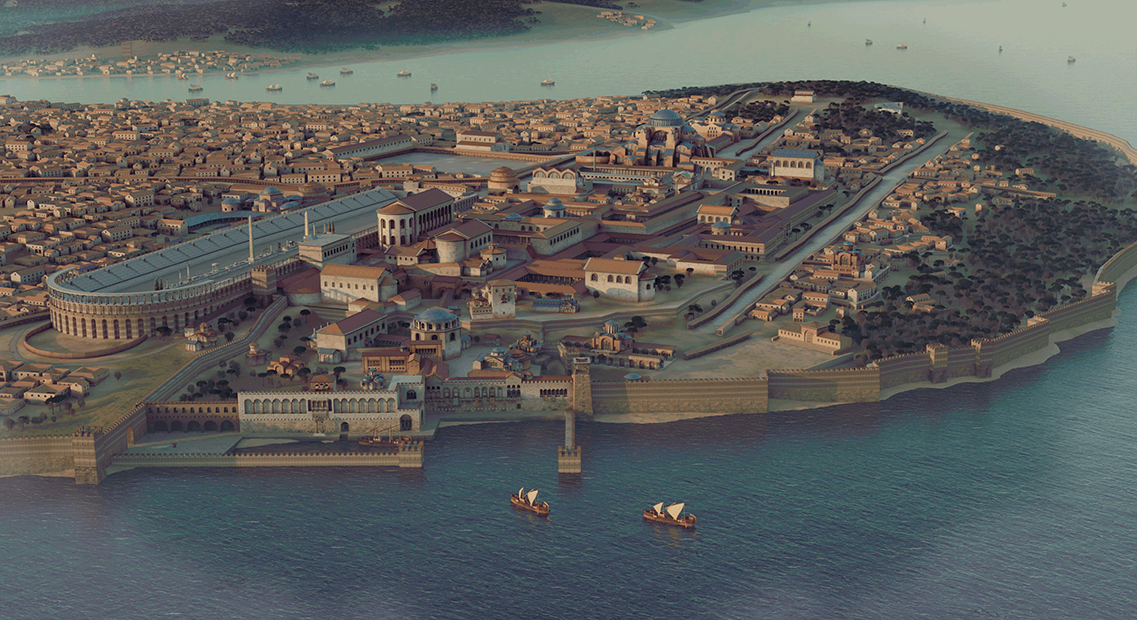
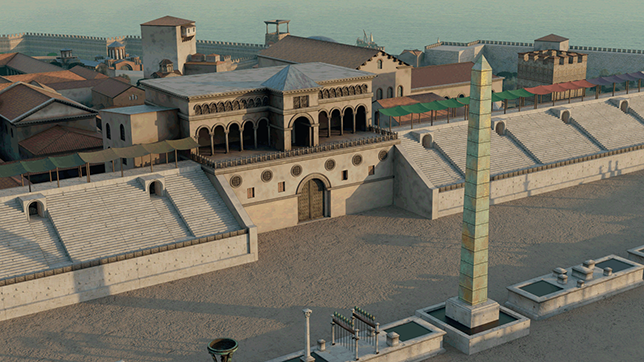
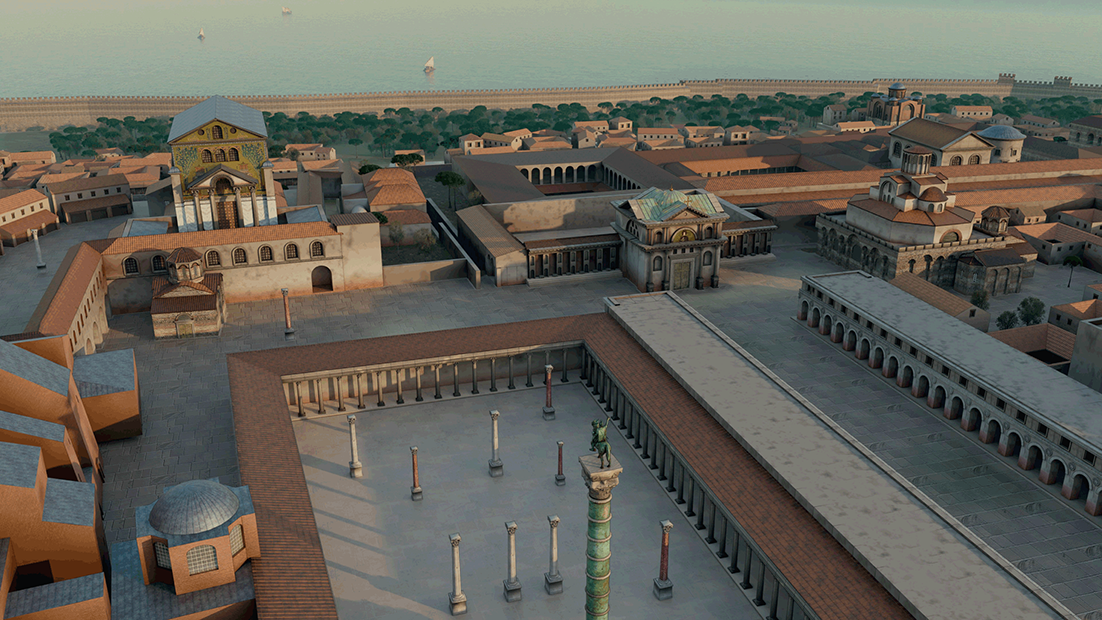
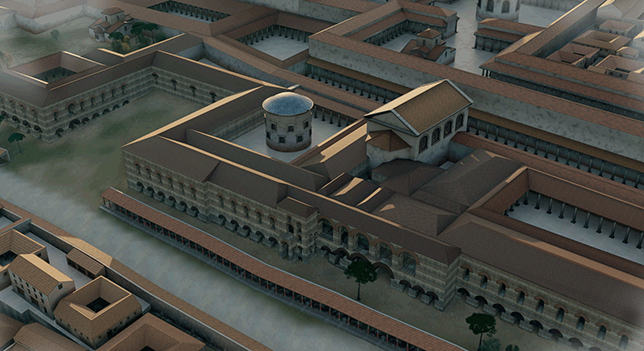
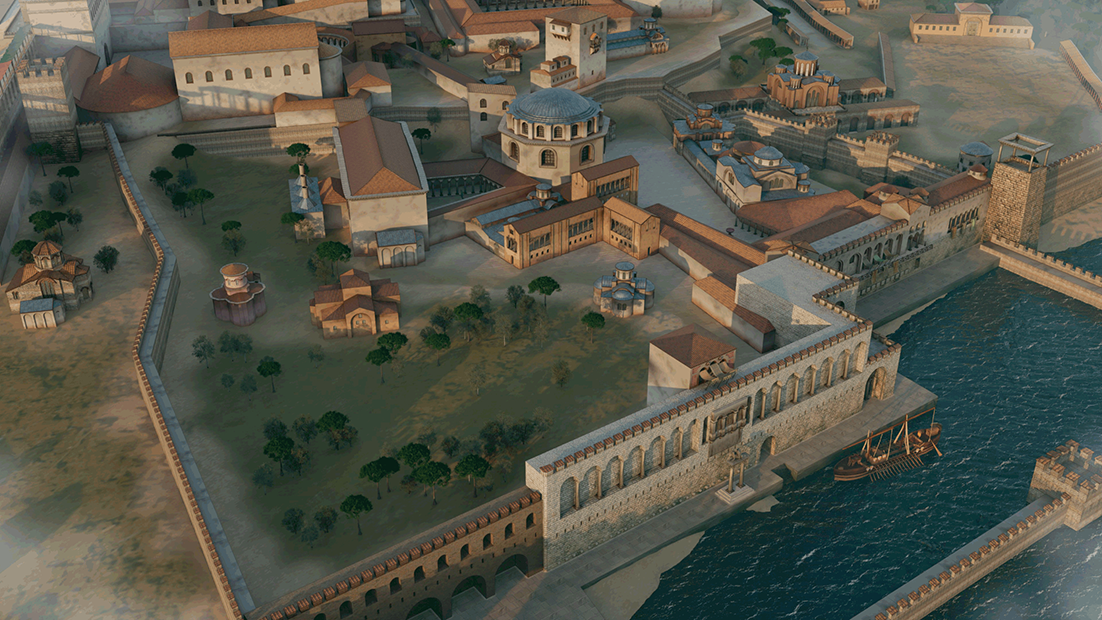
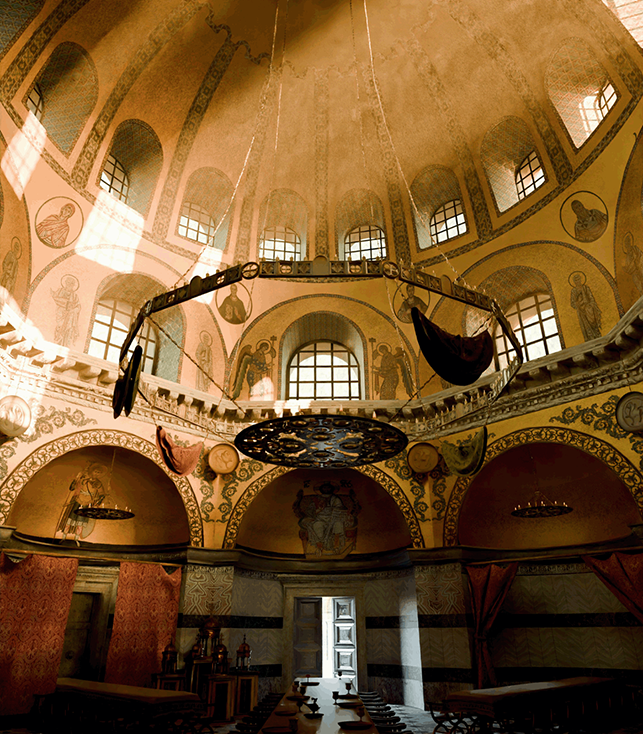
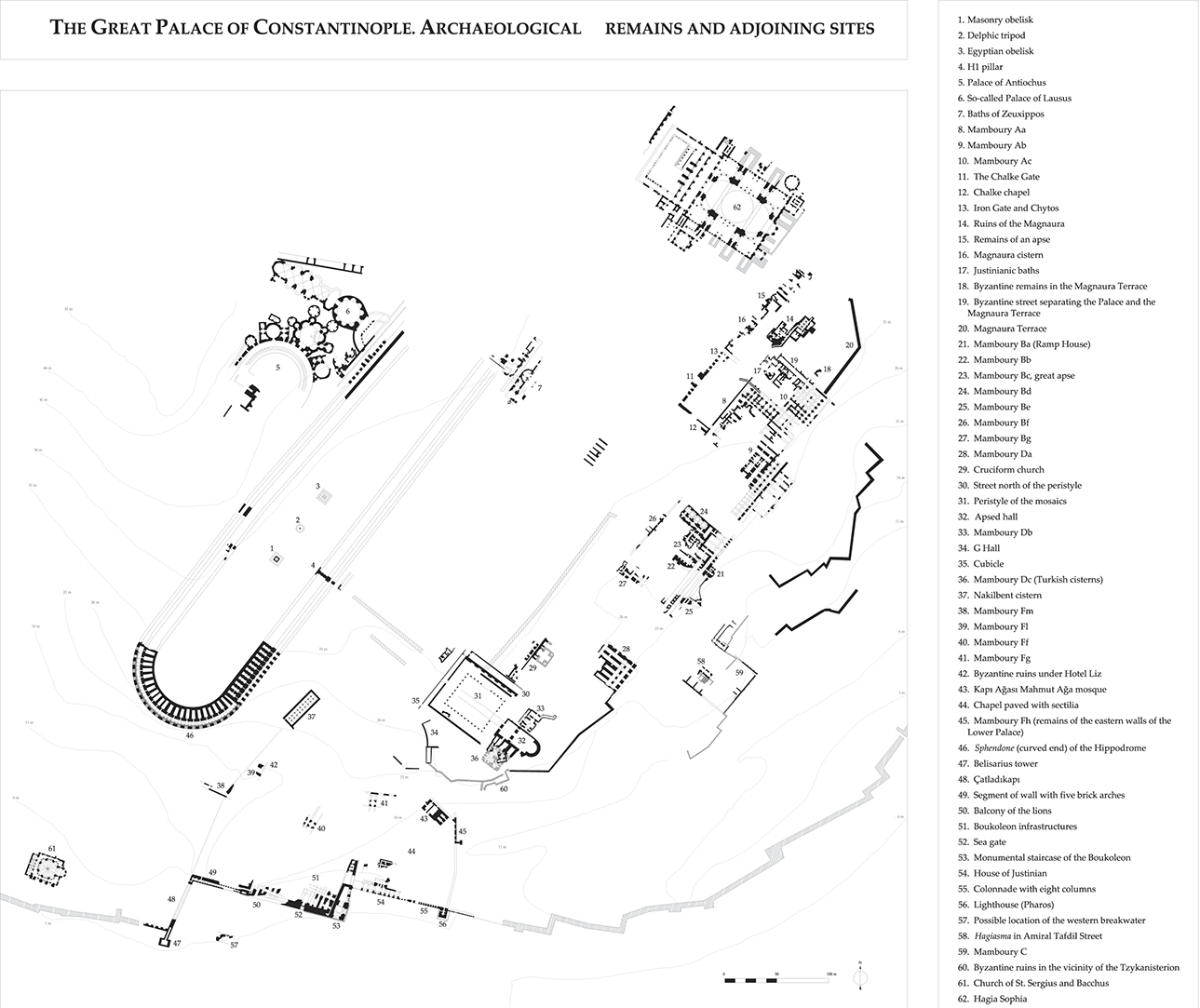
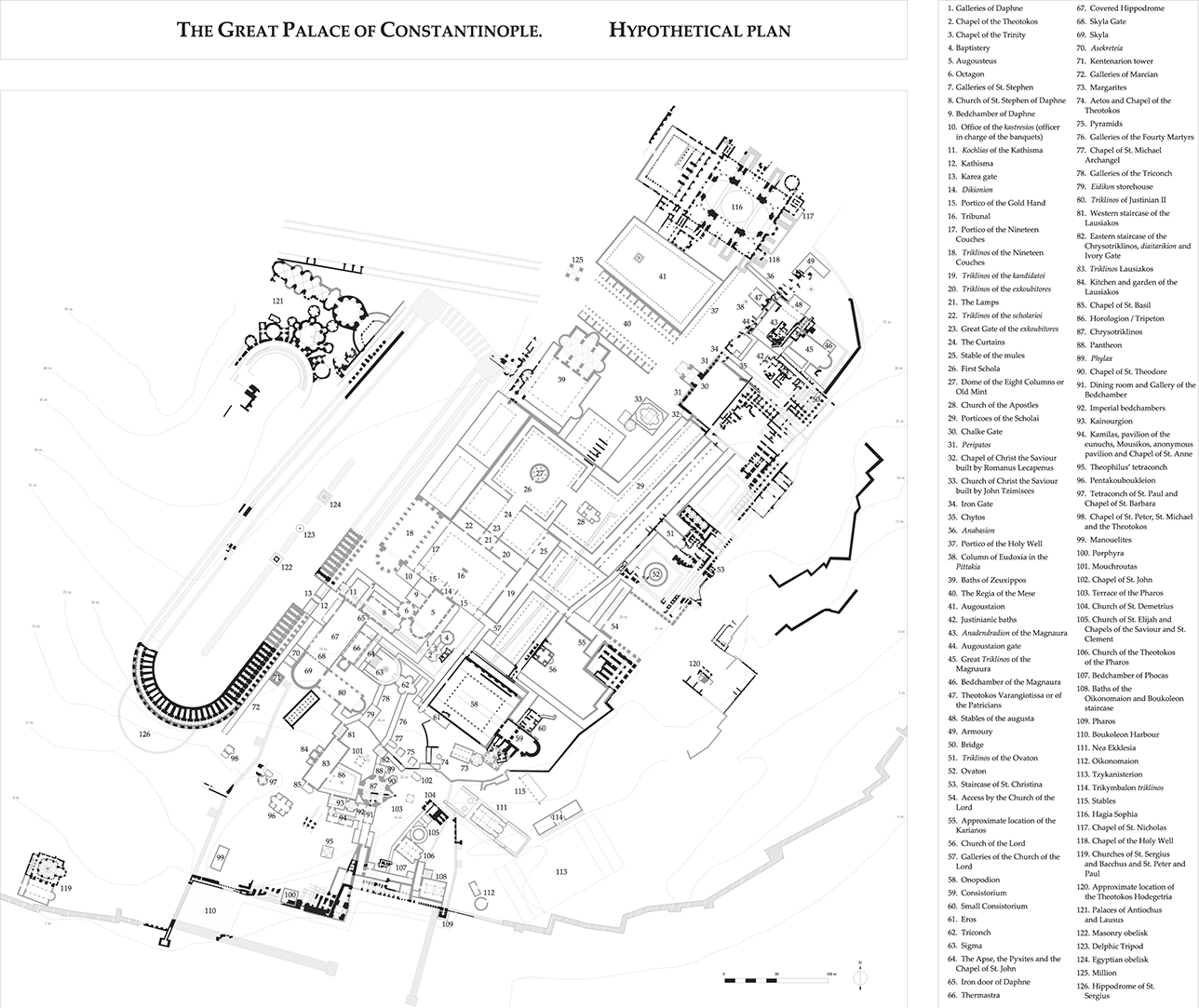
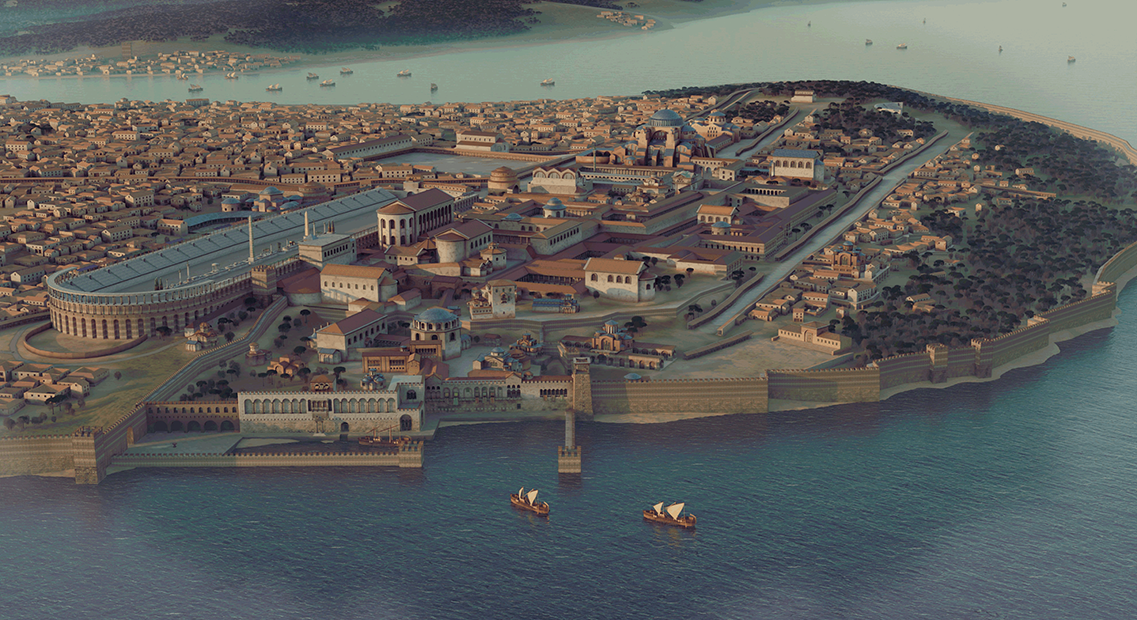
The primary objective of the present approach is to elucidate the historical development and functional evolution of the palace buildings, with the ultimate goal of establishing a topographically coherent layout of the ensemble (Plan 2 – hypothetical). For this purpose, it will be necessary to examine a range of sources, including archaeological, written, and visual materials. Once the location and features of the structures have been identified, they will be compared with better-known examples in order to determine their appearance and possible typological parallels. Some of the preceding approaches to the palace have been complemented by reconstructive drawings and, in more recent times, by 3D virtual reconstructions, such as the one found in the Byzantium1200 project.Footnote 7 For this approach a new reconstruction has likewise been created (Figure 1), with the goal of conveying a general idea of the palace and its layout, including decorative elements and furnishings, which are essential for the understanding of medieval architecture.
3D reconstruction of the Great Palace of Constantinople in the tenth century.
2 Evidence for the Study of the Palace
2.1 Archaeological Evidence
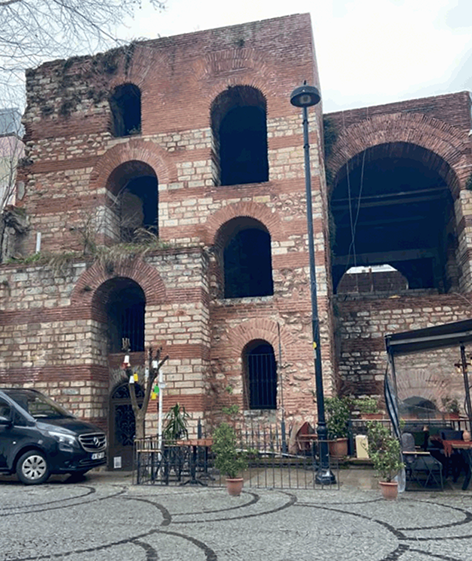
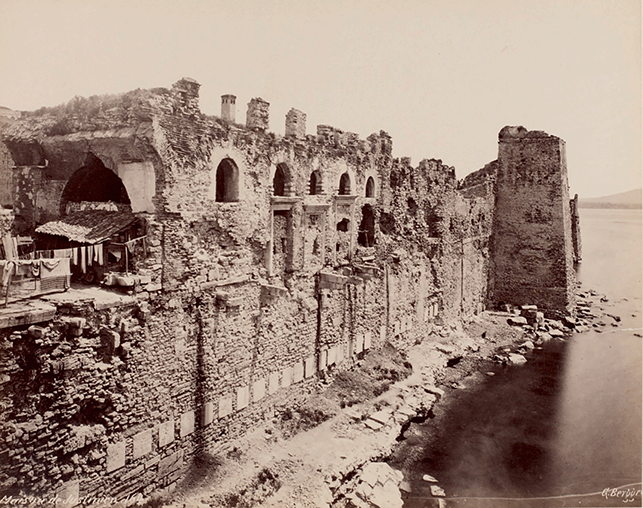
A comparison of the entire area occupied by the palace with the surviving evidence may lead to the conclusion that the archaeological remains are scarce (Plan 1 –archaeological). On occasion, Ottoman buildings, such as the Blue Mosque, have been erected over areas previously occupied by some central elements of the complex, such as the Constantinian Daphne. Nonetheless, some significant ensembles have survived, like the façade of the Boukoleon over the Marmara, while others of great relevance have been excavated, such as the mosaic peristyle or the Chalke Gate. Consequently, the archaeological remains should be regarded as the primary source of information for a topographical study of the palace. The first comprehensive archaeological survey of the area is credited to Ernest Mamboury and Theodor Wiegand, who documented much of the Byzantine evidence that emerged in the eastern end of the peninsula at the beginning of the twentieth century. Of particular interest are the remains found beneath the Palace of Justice, which burned down in 1933. The surveyed areas labelled as Mamboury Aa, Ab, and Ac comprised the infrastructure of what were once the Palace Gate, barracks, administrative offices, and a series of galleries that traversed the palace from north to south. Further south, the team proceeded along the galleries towards the Marmara Sea and documented the Mamboury B, featuring a polygonal apse and the sole standing structure of the Upper Palace, a kochlias or spiral staircase known as the Ramp House. Continuing southward, the Mamboury D group, which comprised additional galleries, the infrastructure of a rectangular chamber, and a cistern, hinted at the next significant discovery in the area: the mosaic peristyle.Footnote 8
The peristyle was discovered in 1935 by a British team. The war interrupted the excavations, which were resumed in 1952 and confirmed that a large apsed hall overlooked the eastern side of the courtyard.Footnote 9 In the 1980s and 1990s, a team from the Austrian Academy of Sciences undertook the appropriate restoration of the peristyle and transformed it into a museum.Footnote 10 The archaeological site was notable not only for its size, comparable in plan to that of Hagia Sophia, but also for the mosaic that adorned the four porticoes forming the peristyle. Despite the significance of the discovery, there is currently no consensus regarding the dating, patronage, and identity of the complex.
Over the past few decades, Turkish archaeologists have been particularly active in the area surrounding the Palace of Justice. The excavation of the Mamboury Aa complex was resumed, with the uncovering of the Chalke Gate and a chapel. In a northward direction, parallel to Hagia Sophia, significant findings were made, including the apse of another chapel, Late Roman mosaics, a bath complex dating to the reign of Justinian (r. 527–565), and infrastructures featuring frescoes, likely associated with the Magnaura.Footnote 11 It is similarly important to acknowledge the contributions of Eugenia Bolognesi, who initiated a comprehensive review, regrettably unfinished, of all the archaeological remains of the palace. However, she provided one of the most crucial insights for studying the ensemble: the systematisation of the terraces upon which the palace was raised.Footnote 12
2.2 Written Sources
The most extensive body of information about the palace is derived from written sources. Among them, the most significant is the Book of Ceremonies, which was compiled in the mid tenth century at the behest of Constantine VII (r. 913–959). The emperor, raised as a hostage in the palace, was aware of the crucial role that ceremonies played in reflecting the integrity of the imperial institution. This was defined by the Byzantines as order, taxis, a key concept of imperial discourse. Therefore, the purpose of the Book of Ceremonies is to compile the imperial ritual to ensure its accurate execution and transmission to future generations, thus maintaining the harmony of the State.Footnote 13
The Book of Ceremonies is the result of a revision undertaken during the reign of Nicephorus II Phocas (r. 963–969). It consists of two books. The first one begins with religious ceremonies, describing the major fixed feasts, such as Christmas. It then proceeds to the movable ones, and some of particular interest to the Macedonian dynasty, such as the inauguration of the Nea Ekklesia. Subsequently, the text proceeds to delineate civil ceremonies: coronations, wedding rites, and promotions. Finally, we find the protocols necessary for the Hippodrome and the emperor’s interaction with the factions. The first book ends with a fragment from a lost work by Peter the Patrician, a contemporary of Justinian. The second book begins with some chapters that follow the organisation of the first volume, featuring processions, receptions, and promotions. However, the structure becomes increasingly complex thereafter, likely due to the inclusion of materials that were never properly organised, such as rituals illustrated with historical events, a brief history of the Byzantine emperors, a list of imperial tombs, inventories of palace warehouses, and salary lists. Finally, a manual for banquets composed in 899, the Kletorologion of Philotheos, and a list of bishoprics, attributed to Epiphanius of Salamis, were appended.
The importance of the Book of Ceremonies for the understanding of the palace lies in the method chosen to systematise the rituals, which was based on a detailed account of processions. This required a meticulous description of the itineraries through the palace, detailing in strict order the connections between the halls, chambers, and galleries. The Book of Ceremonies also addresses logistics and ornamentation, describing the veils, thrones, tables, and couches displayed during banquets and audiences, as well as the lamps and precious objects that were hung from arches and domes. This is important not only in its own right but also because it often provides additional insights into the architecture, such as the number of arches or the presence of an apse. Thus, after a proper interpretation of the itineraries, we can achieve a reasonably accurate depiction of the palace as it stood at the time of the compilation.
However, the Book of Ceremonies has its limitations: it was written by and for individuals familiar with the palace, and it never mentions anything that is not absolutely necessary. Therefore, we have to rely on other sources, such as histories, topographic records, and travel accounts. Some important texts in this regard, including detailed descriptions of the palace, are Theophanes Continuatus, the Patria of Constantinople, and the Embassy of Liudprand, bishop of Cremona, among many others.
2.3 Visual Evidence
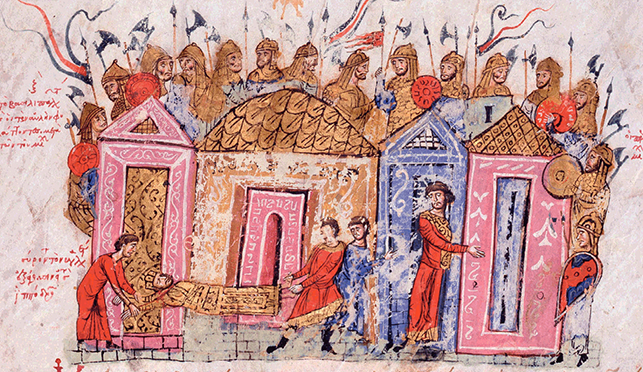
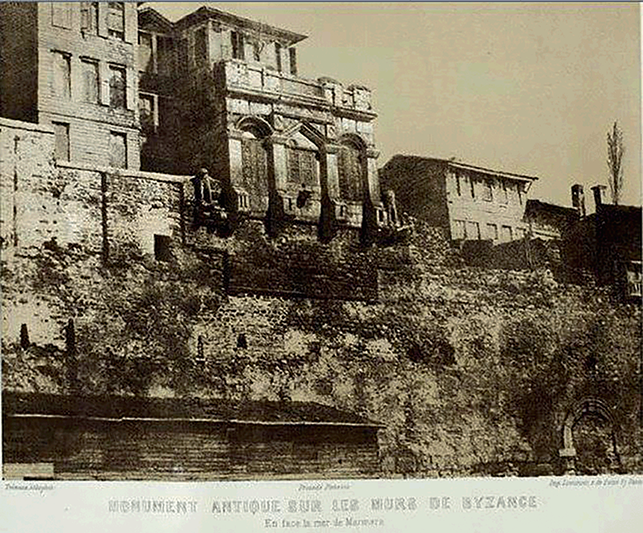
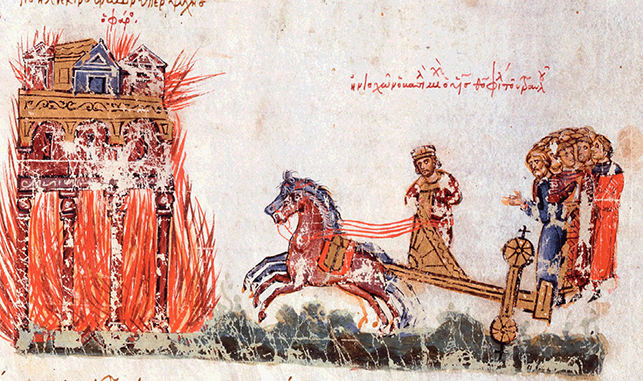
Although little remains of the palace, visual representations of certain buildings have survived. Some of these, such as the Late Antique base of the Egyptian obelisk or the twelfth-century Madrid Scylitzes manuscript (BNE, VITR/26/2), are contemporaneous with the complex and are therefore of considerable importance. However, most of them date from the Ottoman period, when Turkish miniaturists and Western travellers shared a common interest in recording the ruined monuments of the Byzantine past, which they regarded as both marvellous and exotic. Notable examples include the maps by Cristoforo Buondelmonti and Matrakçi Nasuh, engravings by Pieter Coecke Van Aelst and Willey Reveley, and even daguerreotypes, such as Pierre Tremaux’s 1850 photograph of the Boukoleon balcony.
3 The Upper Palace
According to Bolognesi, the Upper Palace was built on three terraces:
(a) At 32 and 31 m.a.s.l. stood the main avenue of the city, the Mese, the Hippodrome, the Baths of Zeuxippos, and the Augoustaion square. In addition, the Chalke Gate and the Palace of Daphne were situated at the same level, along with the barracks of the guard and the administrative offices. This area roughly corresponds to Atmeydanı Square, Sultan Ahmet Park, the Four Seasons Hotel and its surroundings, and the Blue Mosque.
(b) At 26 m.a.s.l., on the eastern flank of the palace, the Mamboury galleries B and D, as well as the peristyle of the mosaics, can be found. These structures run through Kutlugun Sk. and Akbiyik Cd., where remnants of some of them, like the Ramp House, are still visible. The museum of the mosaics is situated beneath the southeastern corner of the Blue Mosque, within the present-day Arasta Bazaar.
(c) At 21 m.a.s.l., Bolognesi documented the floor of the infrastructure that supported the previous buildings. This level would have served as a transition between the Upper and Lower Palaces.Footnote 14
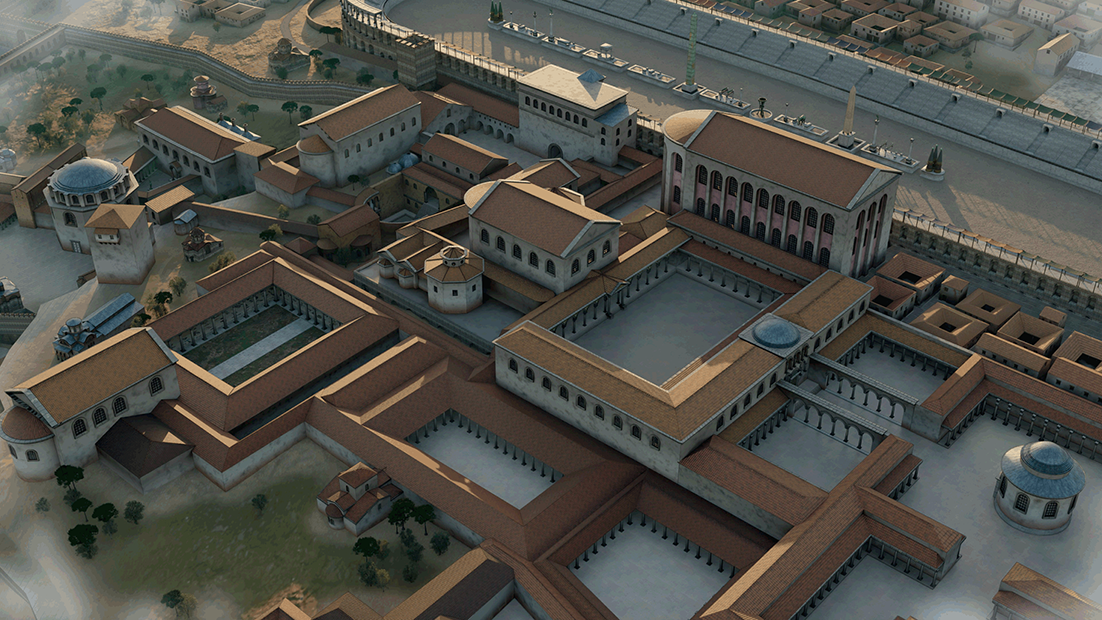
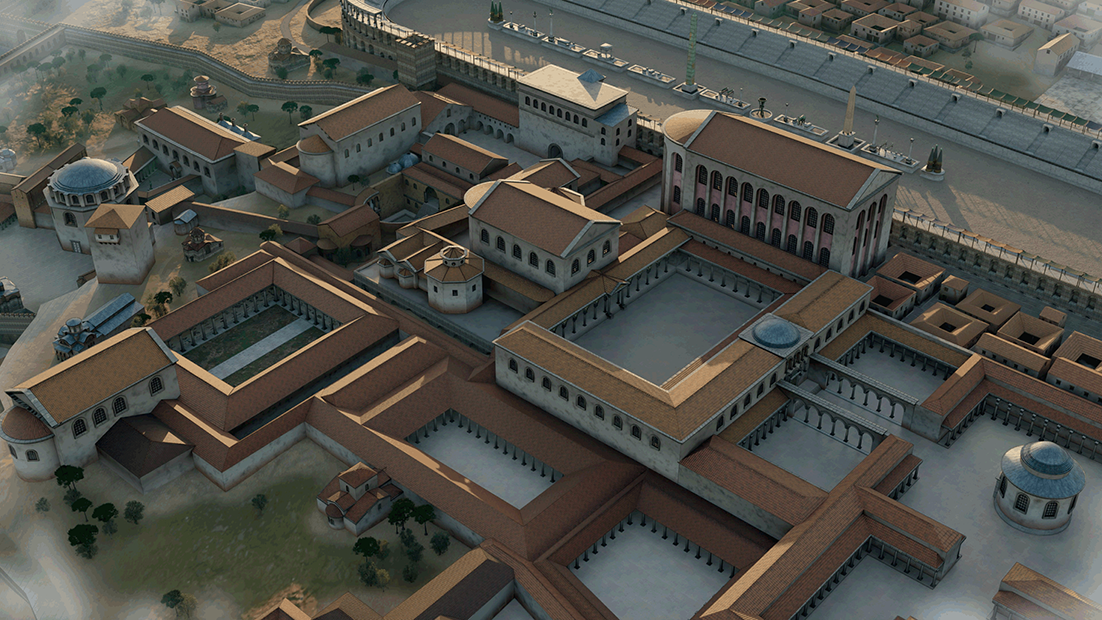
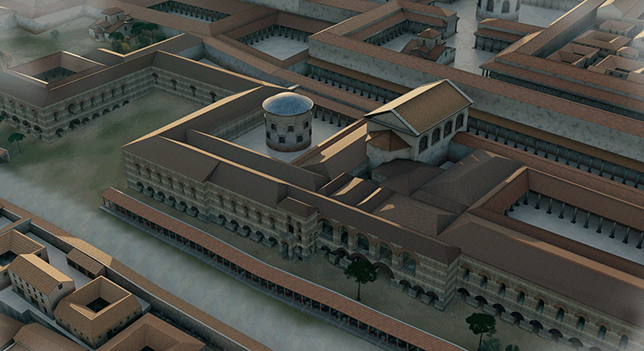
Besides the presence of these levels, it is essential to highlight that the Upper Palace was organised along two axes, one to the west and another to the east. This allows for a systematic study of the upper complex. Starting from the original core, we will follow these routes clockwise until we return to our starting point. The western route will take us through Daphne and the Kathisma, the Tribunal and the Nineteen Couches, the barracks of the scholarioi and the exkoubitores, and the Chalke Gate. Upon reaching the northernmost point in the Magnaura, we will descend along the eastern axis, passing through the Ovaton, the barracks of the kandidatoi, and the peristyle of the mosaics. Subsequently, we will return to the vicinity of Daphne, at the courtyard known as the Covered Hippodrome. Finally, we will address the expansions of the Upper Palace over the centuries (Figure 2).
View of the Upper Palace.
3.1 Daphne
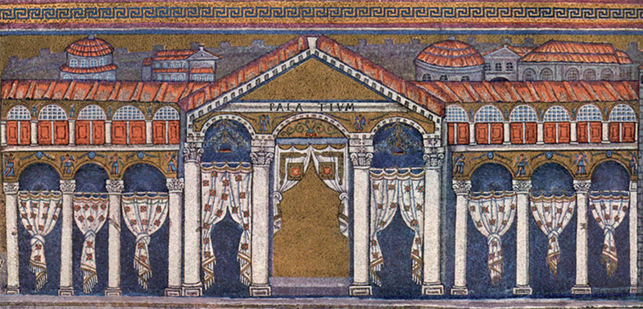
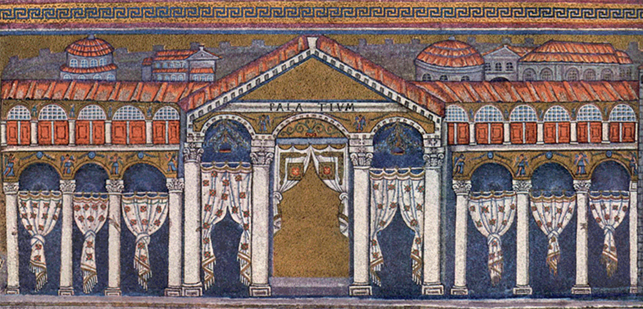
Although not explicitly stated in the sources, it is thought that Daphne was the original core established by Constantine, and it is already documented in the fifth century. Its name likely originates from the triumphant symbolism associated with laurel wreaths in Late Antiquity. This is corroborated by the denomination of some of the buildings that were part of the complex, such as the chapel of St Stephen (his name coinciding with the word for crown or wreath), the portico of the Gold Hand, and the Stepsimon or coronation hall. The complex became emblematic, subsequently serving as a model for the imperial palace in Ravenna, which was given the same name (ad Laureta) (Figure 3).Footnote 15 Nothing remains of Daphne and its neighbouring structures, and the Blue Mosque now stands on its former site.
Mosaic of the Palatium in Sant’Apollinare Nuovo, Ravenna, sixth century.
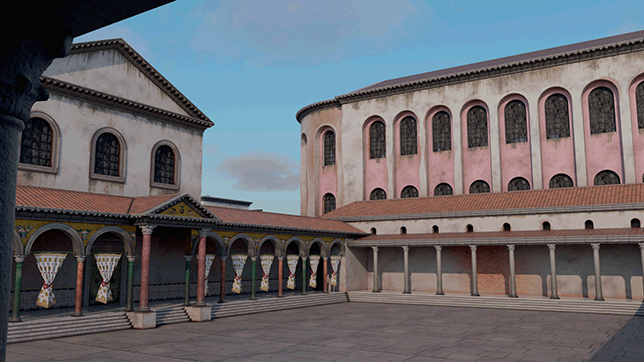
Initially, the term Daphne may have encompassed the entire palace. However, by the tenth century, it referred only to the Augousteus triklinos (audience or banqueting hall) and adjacent rooms. At that time, the complex continued to serve as a significant ceremonial venue, although the emperor’s main residence had already shifted to the Lower Palace. Access to the Augousteus was gained from the Covered Hippodrome or the Triconch via a series of internal galleries.Footnote 16 Before reaching the hall, adjacent to the Galleries of Daphne, two chapels were located, one consecrated to the Virgin and another to the Trinity. It is known that both chapels were connected to each other, and that the latter had an adjoining chamber where relics were kept. Further on was the baptistery.Footnote 17 The Augousteus was the main audience hall of the foundational complex. It was closely associated with the emperor’s residence, and he would frequently traverse it to reach his private chamber in Daphne, to access the Kathisma of the Hippodrome, or, alternatively, to reach the grand portico of the Upper Palace, known as the Tribunal (Figure 4). The Augousteus plays a pivotal role in the Book of Ceremonies, serving as the venue for the coronation of the empress and the solemn appearance of the emperor, already crowned, before the court. Consequently, it is referred to as Stepsimon, Stepahana, or Domus Coronaria.Footnote 18
View of the Tribunal, with the Augousteus and its portico, the Gold Hand, and the triklinos of the Nineteen Couches.
We know some details about the Augousteus’s structure and elements. The assembly of courtiers was typically arranged in a Π-shaped configuration, which suggests a rectangular plan.Footnote 19 It is beyond doubt that an apse was present at the southern end of the structure.Footnote 20 The aforementioned internal galleries must have reached the triklinos from its eastern side, as the chapels had to be oriented in this direction. It is also known with certainty that the Octagon, situated adjacent to the Augousteus in the west, served as a dressing room where the cubicularii (attendants of the imperial bedchamber) attired the emperor prior to his appearance before the court.Footnote 21 To the north, the hall opened onto the portico of the Gold Hand in the Tribunal through a single great door, from which curtains bearing designs of birds were hung.Footnote 22 Thanks to these clarifications, it can be inferred that the Augousteus had a rectangular plan with an apse and opened onto a portico. In summary, it had the canonical appearance of a typical triclinium from Late Antiquity, exactly like the one unearthed by the mosaic peristyle.Footnote 23 Furthermore, the presence of additional structures suggests that the building had a north–south orientation.
As previously stated, the western side of the Augousteus provided access to the Octagon. Besides its function as a dressing room, the Octagon also served to distribute access to several spaces. The emperor’s private chamber was situated on one side of the building, while the chapel of St Stephen was located on the opposite side.Footnote 24 Looking west, this chapel, or more likely a passageway connected to it, led to the spiral staircase leading to the Kathisma of the Hippodrome.Footnote 25 St Stephen was the most important chapel in Daphne. Originally, it was used as a winter chamber but was later consecrated to the First Martyr by Pulcheria (r. 450–453).Footnote 26 Its primary function was to host the imperial wedding liturgy and the blessing of water on Epiphany. Inside the chapel were preserved the Cross of Constantine, sceptres, diptychs, and gold insignias belonging to the kandidatoi.Footnote 27 The only known feature of the structure is a narthex.Footnote 28
3.2 The Kathisma
In Rome, the Palatine Hill overlooked the valley of the Circus Maximus. The propaganda potential of connecting the circus to the Palace was quickly recognised by the emperors. Augustus (r. 27 BC–AD 14) erected the original Pulvinar, which Trajan (r. 98–117) later transformed into a monumental tribune. By the late third century and during the Tetrarchic period, the hippodrome–palace formula had already been established, with significant examples such as the urban palaces of the Sessorium in Rome, Milan, Sirmium, Thessalonica, Nicomedia, and Antioch, as well as the villa of Maxentius along the Appian Way.Footnote 29 While historical accounts agree in suggesting Constantine’s desire to emulate Rome, his construction of a palace adjacent to the circus merely reflected the customs of his era. In Constantinople, the imperial box overlooking the circus was designated as Kathisma and remained in use, albeit deteriorated, until the late twelfth century.Footnote 30 It is probable that it was destroyed by fire in 1204.Footnote 31
The Kathisma was situated on the eastern flank of the Hippodrome, although its precise location remains a matter of debate. The majority of authors posit that the Kathisma stood in front of one of the main monuments of the arena, such as the Egyptian obelisk, the bronze serpent, or the masonry obelisk. The latter appears to be the most plausible hypothesis, as the masonry colossus stands in front of a thick pillar of the Hippodrome’s infrastructure (Mamboury H1), and because it is the sole monument of the spina (a central strip dividing the arena of a circus) mentioned in connection with the Kathisma (Figure 5).Footnote 32
View of the Kathisma.
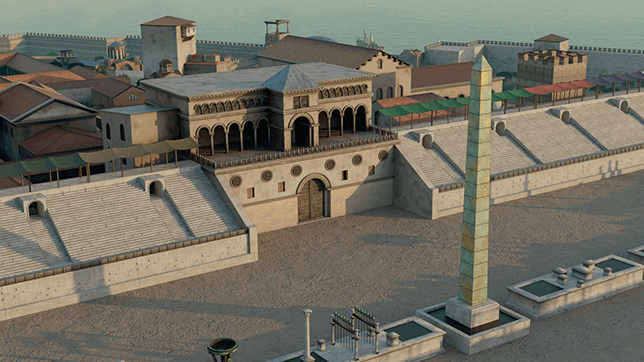
Arriving from the Galleries of St Stephen, one would reach the kochlias. The original staircase, being too narrow for imperial processions, was enlarged by Justinian.Footnote 33 Upon ascending, the emperor would not arrive at the intermediate level but rather at the uppermost one, designated as the parakyptika (overlooking galleries). From this point, he could observe the arena privately, behind a screen. Once the preparations had been completed, he descended via a stone staircase to a private chamber on the main level. There, the cubicularii dressed him in the chlamys and crown. Afterwards, he passed through a small dining room to reach the great dining hall, where he was greeted by the court. Finally, the large door leading to the imperial box would open and the emperor sat on his throne to watch the races. The box and the flanking porticoes of the senators were also reformed under Justinian, shortly after his accession to the throne, in 528.Footnote 34 Upon returning to the palace, the emperor could access the kochlias directly without having to ascend to the parakyptika.Footnote 35
The lower level of the Kathisma on the circus side was known as skamma, stama, or Π. This name referred to the recessed area in front of the imperial box, where athletes contended and victorious charioteers received their prizes. Sometimes this area is also referred to as Daphne of the Hippodrome, after the laurel wreaths awarded to the victors.Footnote 36 The Karea Gate, which opened onto the Hippodrome, led through a passage to the Covered Hippodrome, within the palace. The denomination of this gate likely originated from a nearby statue of Artemis, as it coincided with the name of the main festival of the goddess in the Peloponnese.Footnote 37
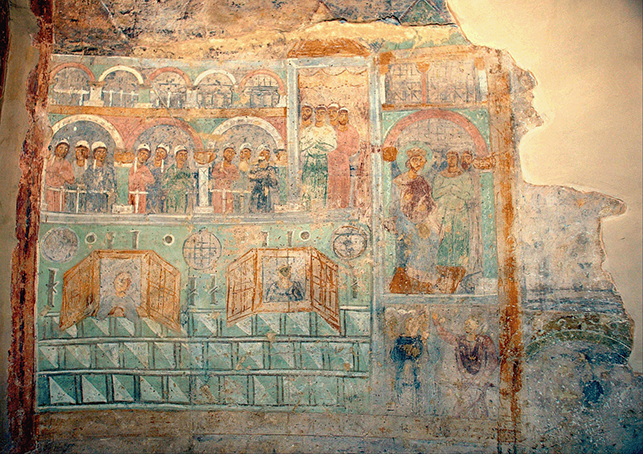
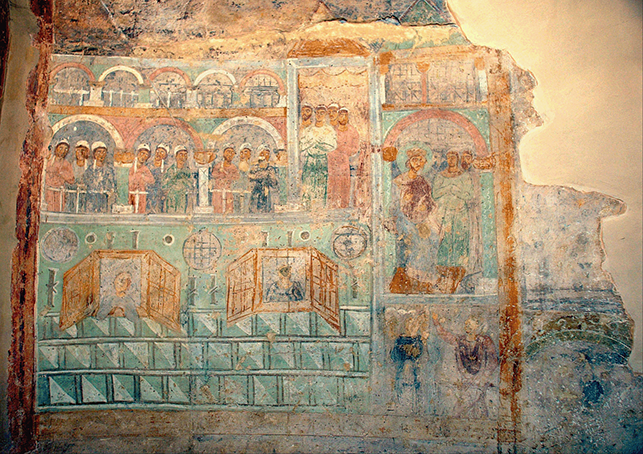
Due to its public nature and its connection with the Hippodrome, the Kathisma is among the most visually documented monuments of the palace. Consequently, we can picture the exterior appearance of the Kathisma and visualise many of its elements as described in the sources. In addition to the well-known bases of Theodosius’s obelisk, evidence from the 5th and 6th centuries includes the bases of the monuments celebrating the charioteer Porphyrius, the Kugelspiel of Berlin, and various consular diptychs featuring the stama. Their medieval counterparts are the eleventh-century fresco from Hagia Sophia in Kiev (Figure 6) and the miniatures from the Scylitzes manuscript (fols. 55 r–55 v). The different levels of the Kathisma are depicted in these artefacts with the main floor featuring the imperial throne, its canopy, and, in the background, an arcade under which the courtiers stand. On the upper level we can clearly observe the parakyptika with the lattice. These images also represent some of the changes undergone by the Kathisma. For instance, in the earliest examples, we can see multiple gates and staircases ascending from the arena to the upper levels. Except for the Karea, these features are absent in the Kiev fresco, having been suppressed by Justinian after the Nika riots.Footnote 38
Kathisma of the Hippodrome in a fresco from St Sophia in Kiev, eleventh century.
3.3 The Tribunal and the Gold Hand
The Tribunal was the main porticoed courtyard (exaeron, araia) of the Upper Palace (Figure 4).Footnote 39 It was overlooked by the Augousteus and the triklinos of the Nineteen Couches, the former from the portico of the Gold Hand, to the south, and the latter from the portico of the Nineteen Couches, to the west.Footnote 40 The triklinoi of the guard, namely, the hall of the kandidatoi to the east and the halls of the exkoubitores and the scholarioi to the north, protected the Tribunal from the remaining sides. The main function of the Tribunal was to provide an open space for the courtiers and the palatine regiments to assemble and acclaim the emperors. In this regard, we know that the dances of the circus factions were celebrated there until the reign of Heraclius (r. 610–641).Footnote 41
The most significant feature of the Tribunal was the Gold Hand, that is, the southern portico of the courtyard. Its columns were made of polychrome marbles taken as spolia from Delphi. At its centre stood the dikionion, a monumental porch with two columns that led to the Augousteus. While the origin of its name remains unknown, the Gold Hand is undoubtedly related to the coronation rituals and the Daphne complex. When the crowned emperors left the adjoining hall through the great door, they stood beneath the dikionion, flanked by patricians and senators. The veil hanging from the columns was then removed, and the emperor was acclaimed by the court gathered in the Tribunal.Footnote 42
3.4 The Triklinos of the Nineteen Couches
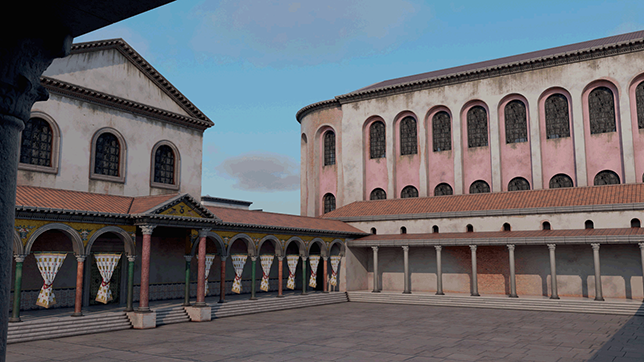
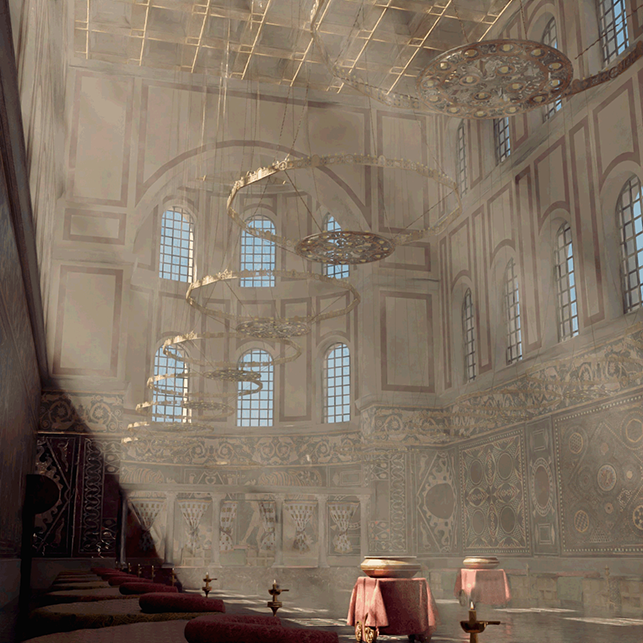
The largest hall in the palace was the triklinos of the Nineteen Couches (Figure 4). Since its foundation, its primary function was to host banquets held by the emperor. The hall was constructed by Constantine, and it may have been operational as early as 325, as the celebrations accompanying the Council of Nicaea were held there. At that time, it was already characterised by the succession of couches placed on each side and the splendid coffered ceiling adorned with jewelled crosses.Footnote 43 It served a number of other purposes, including the display of the deceased emperors.Footnote 44 The southern end of the triklinos, where the imperial table was placed, was aligned with the portico of the Gold Hand, to which it was connected through a door. This section of the hall stood above several steps and was separated from the rest of the space by a railing adorned with silver columns.Footnote 45 The most significant pieces of evidence about the location of the banquet hall are that, as previously stated, it overlooked the Tribunal and that, according to Liudprand, it was very close to, or even adjoining, the Hippodrome, with a north–south orientation.Footnote 46 The Nineteen Couches remained in use until the tenth century, when it was restored by Constantine VII, who added a new coffered ceiling composed of octagons carved with gilded vine leaves.Footnote 47 From this point onwards, the hall is no longer mentioned in the sources.
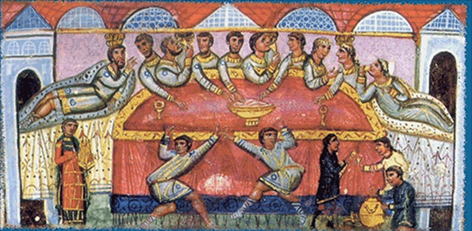
As inferred from its name, this triklinos was renowned for its distinctive arrangement of nineteen tables with a sigma shape, where guests would dine while reclining on couches (akoubita), following the ancient Roman custom (Figure 7). The emperor’s table was situated at one end, while the remaining eighteen tables were arranged on either side, in two rows of nine tables facing each other. With twelve guests per table, the total number amounted 228. Courtiers were arranged hierarchically, both on their couches and the hall, with proximity to the emperor indicating the person’s importance.Footnote 48 Foreign dignitaries frequently attended these gatherings, which featured various spectacles: Liudprand of Cremona and Harun ibn-Yahya described the tableware, all of gold and silver, and how the food was transported along the hall in large golden vessels, so heavy that they had to be carried on carts guided by a pulley mechanism hanging from the ceiling. Singers entertained during the dinner, while the evening concluded with a series of balancing acts and acrobatics.Footnote 49
A banquet featuring akoubita and sigma-shaped tables from the Book of Job, eleventh century. Monastery of St Catherine, Sinai, Cod. Sin. Gr. 3, fol. 17v. From Weitzmann, Kurt and Galavaris, George, The Monastery of Saint Catherine at Mount Sinai: The Illuminated Greek Manuscripts. Vol. 1 (Princeton: Princeton University Press, 1990), pl. 17, fig. b.
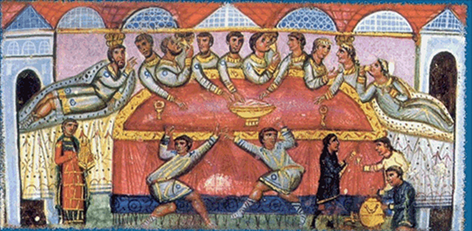
The typology of this hall has been the subject of significant debate regarding terminological and morphological issues. The problem was first raised by Richard Krautheimer, who proposed that, around the year 800, Pope Leo III (r. 795–816) copied the Nineteen Couches in his eleven-apsed triclinium in the Lateran Palace. After comparing the ritual and the furniture, he concluded that the Nineteen Couches must have also had nineteen apses. To this day, authors such as Martin Luchterhandt, Kostenec, or Westbrook have supported this theory.Footnote 50 Others, like Simon Malmberg, Isabella Baldini-Lippolis, and Salvatore Cosentino, lean towards a strictly basilical solution, without lateral apses.Footnote 51
Regarding terminology, it is important to point out that the mention of akoubita and sigma-shaped tables does not imply the existence of apses, as can be seen in some trapezai (refectories) on Mount Athos, which follow the model established in the Great Lavra by St Athanasios in the tenth century. Moreover, not a single text mentions the presence of apses in the hall. In fact, Liudprand states that the name of the Nineteen Couches ‘did not emerge from the structure itself’.Footnote 52 In any case, the papal protocols cited by Krautheimer do not refer to the eleven-apsed basilica but rather another hall known as the Basilica Magna, which only had three apses. Consequently, the comparison is purely superficial.
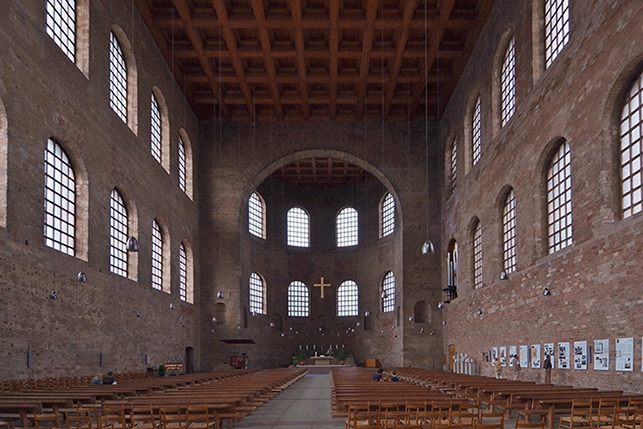
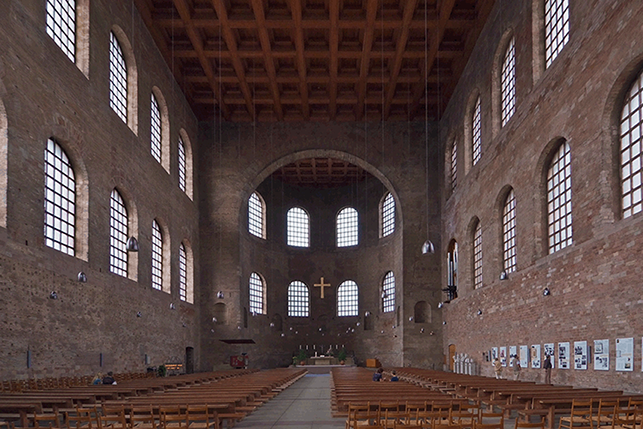
To complete our morphological characterisation of the Nineteen Couches, it is also important to consider how it was connected to the Tribunal. As it was the largest hall in the palace, scholars have often placed it in a central position, presiding over the Tribunal, and have even associated it with the dikionion, thus displacing the Augousteus. However, the Nineteen Couches did not have a frontal access but rather a lateral one. The triklinos had only two entrances, one to the north and the other to the south, next to the imperial couch.Footnote 53 Given that the hall was adjacent to the circus and oriented in a north–south direction, the only feasible solution would be to place the doors on the eastern side. This configuration resembles strictly contemporary examples consisting of large basilicas laterally attached to porticoes, as in the Tetrarchic palaces of Sirmium, Milan, and, especially, Thessaloniki. The latter is an exact parallel to the present interpretation of the Nineteen Couches.Footnote 54 It also has nine recesses on each side, likely implying the presence of windows and, maybe, couches. This is a feature shared by the Constantinian basilica in Trier as well (Figure 8). This conclusion is of significant importance, as it not only assists in visualising the Nineteen Couches but could also contribute to a more accurate characterisation of the functions of these grand structures, which are often described as audience halls. Given their size and morphology, it is more likely that they were banquet halls, just like the Nineteen Couches in Constantinople (Figure 9).
The Basilica of Constantine in Trier, early fourth century.
The triklinos of the Nineteen Couches.
3.5 The Barracks of the Imperial Guard
As in most royal residences, in Constantinople barracks stretched between the private and ceremonial quarters and the main gate. The barracks consisted of a succession of porticoes, cubicles, and monuments, which not only served as living quarters for the soldiers but also housed various administrative offices. This area is broadly referred to as the Scholai, from the Latin schola, meaning a small room, in reference to the aforementioned cubicula.Footnote 55 The barracks were built by Constantine but burned down during the Nika Revolt and were later rebuilt by Justinian.Footnote 56
It has been mentioned that the triklinoi of the three corps of palatine troops were adjacent to the Tribunal. The hall of the kandidatoi was attached to the eastern portico of the court, serving as a connection with the eastern itinerary, while those of the exkoubitores and the scholarioi were adjacent to the northern portico. The first monument on the way to the gate, also adjacent to the northern side of the Tribunal, was the Dome of the Lamps or Heptakandelon. Its name derived from the ceremonial display featuring a menorah upon which the Mandylion of Edessa was hung.Footnote 57 This superimposition might have represented the fulfilment of the Old Testament promises through the incarnation of Christ.
One exited the Lamps through the Great Gate of the Exkoubitores, which led to the Curtains.Footnote 58 It is unclear whether this refers to an actual veil hanging above the gate or a portico adorned with drapes. Nearby stood a stable, as the emperor enjoyed the privilege to ride up to this place after crossing the Chalke.Footnote 59 After passing through the Curtains, one would reach the first Schola, presided over by the Rotunda of the Eight Columns. This building must have been ancient, as it was also known as the Old Mint.Footnote 60 Its form and alleged early date of construction suggest that it was likely a Constantinian structure, and thus might have resembled various Late Antique centralised typologies, such as the mausoleum of Diocletian and the treasury of the palace in Sirmium.Footnote 61
Although we know there should have been seven Scholai, one for each regiment, apart from the first, only the fifth is mentioned in the Book of Ceremonies.Footnote 62 Nearby stood the last significant monument before reaching the Palace Gate, the Church of the Holy Apostles, which may also have been the work of Constantine. Its dedication coincides with that of his mausoleum, and we know that the emperor took great care to ensure his bodyguards were Christians.Footnote 63
3.6 The Chalke Gate and Its Surroundings
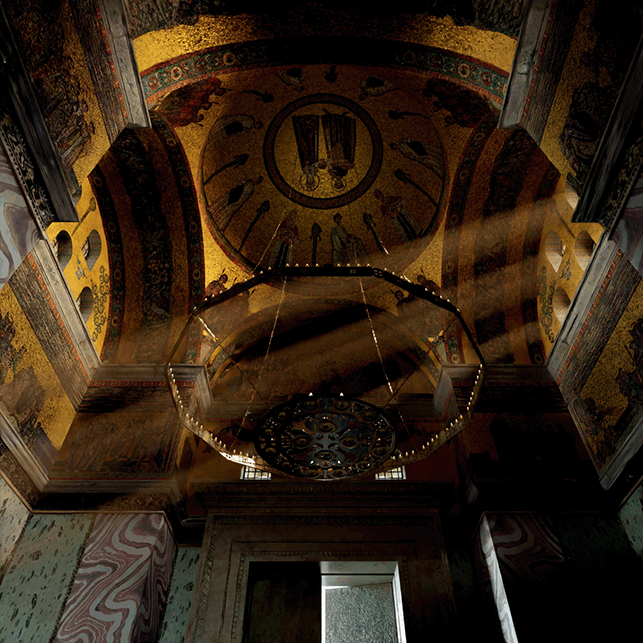
Constantine constructed a vestibule for his palace, which he surmounted with a painting depicting the emperor and his sons slaying a serpent symbolising Licinius.Footnote 64 A visual representation of this propylaeum may be achieved by comparing it with the vestibule of Theodoric’s palace in Ravenna, as depicted in Sant’Apollinare Nuovo (Figure 3). This construction might have emulated the one in Constantinople and was also known as Chalke. However, the Constantinian gate was destroyed during a revolt in Anastasius’s reign (r. 491–518), around 495. He assumed the reconstruction of the edifice, but it was subsequently destroyed during the Nika riots of 532.Footnote 65 The ruins that we know today correspond to the final reconstruction undertaken by Justinian. Although it predates this period, it is from that moment onwards when its designation, Chalke, became popular. The term was used to describe either the grand bronze doors or the roof, made from the same material. In the Byzantine period, the gate led directly to the Mese, the main avenue of the city. This initial section of the street was known as the Regia and featured two-storey porticoes (Figure 10). At the far end stood the Milion, a triumphal arch in the shape of a tetrapylon (quadrifrons triumphal arch). This layout followed a typical scheme found in Late Antique urban palaces, as evidenced in Split or Antioch.Footnote 66
The Chalke Gate and its surroundings, including the Magnaura and the Church of the Saviour.
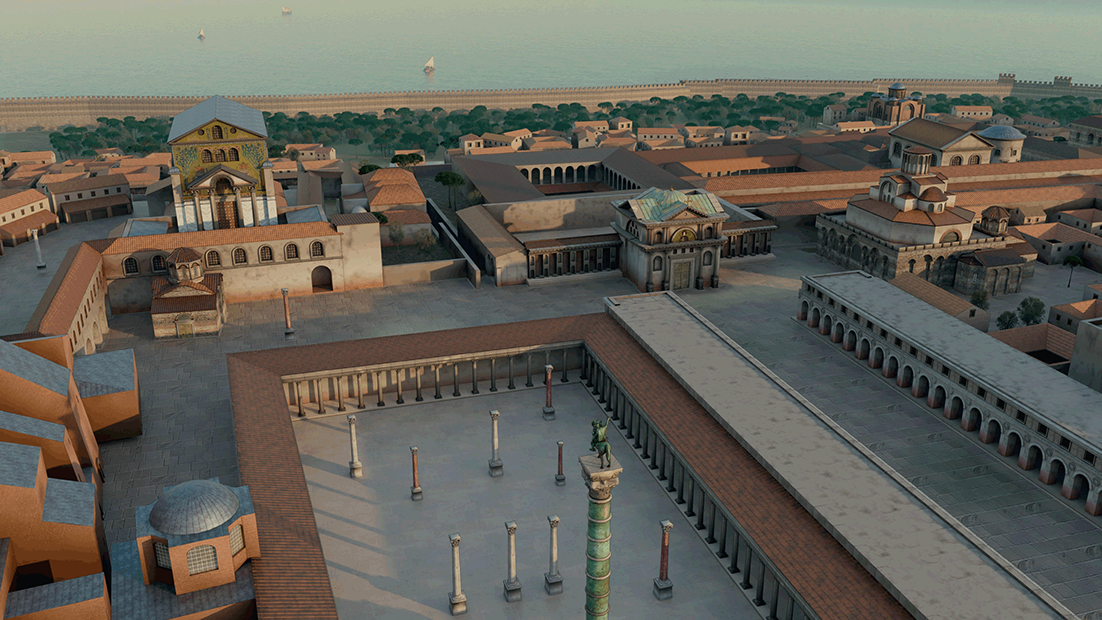
The ruins of the main gate of the palace lay under the remains of the Ottoman Palace of Justice, between the eastern boundary of Sultanahmet Square and the Four Seasons Hotel. After the fire that destroyed it, in 1933, Mamboury surveyed the area and labelled it as zone Aa.Footnote 67 Between 1997 and 2008, a Turkish team conducted extensive excavations east of Sultanahmet Square and Hagia Sophia. Successive campaigns uncovered the remains of the Gate, which Mango had placed in the same location fifty years earlier.Footnote 68
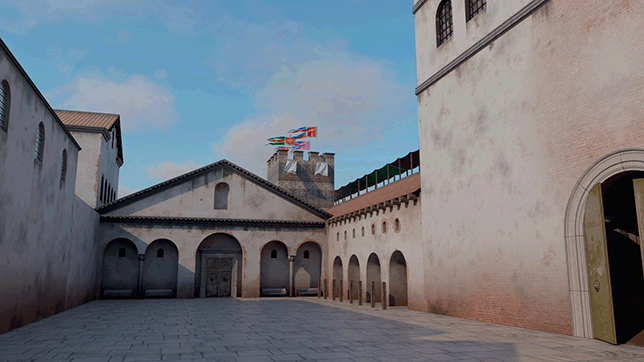
The excavations revealed a rectangular courtyard. The western enclosing wall, 2.5 m thick, was pierced by a large gate over 6 m wide. On either side of the gate, two thick pillars projecting from the wall indicated the presence of the vestibule. Flanking these pillars, the courtyard wall was adorned with niches and columns standing on marble steps. On the northern wall of the courtyard, a smaller vestibule was uncovered, opening onto a narrow passage. It had a rectangular plan and a two-arched entrance supported by a marble pillar. A small rectangular chapel was attached to the south wall.Footnote 69
The discovered ruins accurately match Procopius’s description: the Gate had the plan of an almost square rectangle. From each of the corners, a thick pillar ascended. The two eastern pillars projected from the enclosing wall, as it has been revealed in the course of excavations. Above, four arches spanned between each of the four pillars. The resulting space between the pillars and these arches was closed with four pendentives, upon which rose a dome. The decoration comprised polychrome marbles and mosaics, depicting the victories of Belisarius, contemplated by Justinian and Theodora, who, surrounded by the court, stood at the centre of the dome (Figure 11).Footnote 70 This architectural model corresponds to a typology widespread in the Late Antique Mediterranean, known as projecting porch. It was likely present in the vestibule erected in Cartagena by Comentiolus, Byzantine governor of Spain, and is well documented in the Islamic sphere with examples from the palaces of Amman and Khirbat al-Mafjar, in the Levant, and Ajdabiya, in Libya.
Interior of the Chalke Gate.
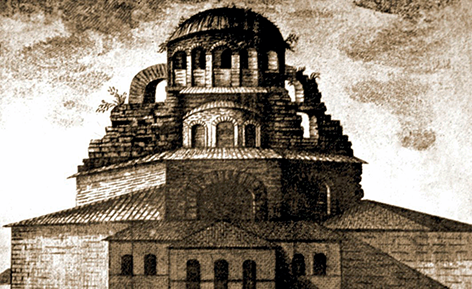
The remaining elements unearthed are also mentioned in the sources. The porticoed gallery flanking the vestibule was known as the peripatos. The northern, smaller porch was known as the Iron Gate, while the chapel to the south was likely the one erected by Romanus Lecapenus (r. 920–944) in honour of Christ the Saviour. In close proximity to this chapel, John Tzimisces (r. 969–976) constructed another, larger one, with the same dedication.Footnote 71 It featured two semi-domes and a large central dome, and was probably standing on a platform that gave the church additional height. Several representations of the structure exist, including Nasuh’s map of Istanbul, Reveley’s view of Hagia Sophia, and an engraving by Gugas Inciciyan (Figure 12). The building was demolished in 1804, and no remains have been discovered.Footnote 72
The Church of the Saviour in the 1790s, engraving by Gugas Inciciyan, from Eyice, ‘Arslanhane ve Çevresinin Arkeolojisi’, figure 4.

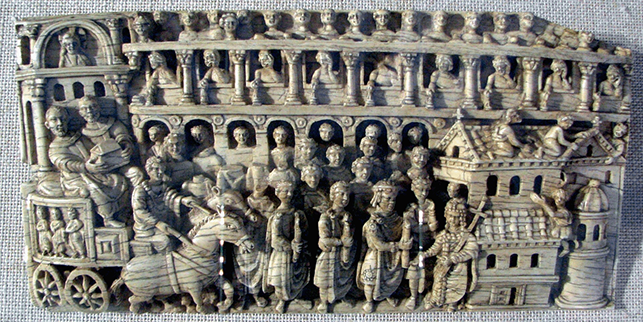
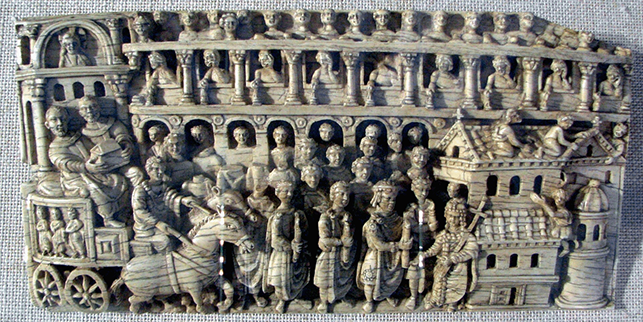
Being the main public façade of the palace, the Chalke became a showcase of imperial will. For instance, upon the declaration of war, weapons and shields were hung from the gate.Footnote 73 In this regard, the Chalke played a crucial role in demonstrating the emperors’ support for either the iconoclastic or orthodox faction. According to tradition, an icon of Christ had presided over the Chalke Gate since at least the reign of Maurice (r. 582–602). Leo III (r. 717–741) is said to have dismantled it to express his rejection of icons. Nowadays, it is widely acknowledged that this account is likely apocryphal. It is believed that Irene (r. 769–802) installed the mosaic of Christ above the gate for the first time. The icon was then dismantled by Leo V (r. 813–820), only to be definitively restored by Theodora (r. 830–856) in 843, marking the Triumph of Orthodoxy.Footnote 74 While its dating and attribution are controversial, the Trier ivory, depicting a translation of relics, likely portrays the Chalke Gate and the two-storied portico of the Regia around that time (Figure 13).Footnote 75
The Trier Ivory, mid ninth century. Treasury of the Cathedral.
Following the iconoclastic period, the Chalke Gate assumed additional roles, functioning as a court of justice and a prison.Footnote 76 Emperor Isaac II (r. 1185–1195) removed the bronze doors, but the vestibule survived the Byzantine Empire, albeit in a ruined state.Footnote 77 This is how we see it in various representations, such as the Nuremberg Chronicle and an engraving by Van Aelst.Footnote 78 The building may have been finally demolished in the first half of the seventeenth century, likely to salvage materials.Footnote 79
3.7 The Great Triklinos of the Magnaura
During the Middle Byzantine period, the Magnaura served as the primary audience hall of the palace. It also accommodated part of the imperial wedding ceremony, the emperors’ public addresses during Lent, a court of justice, and a government-sponsored school.Footnote 80 Despite its importance, it was situated outside the palace, adjoining the complex at its northern end. It was close to Hagia Sophia, approximately parallel to the Augoustaion square, which gave its name to one of the gates leading out of the Magnaura complex.Footnote 81 The hall itself stood on a semicircular terrace constructed in the early seventh century, together with a commemorative column and an armoury.Footnote 82 The monumental complex was completed during the reign of Heraclius.Footnote 83 The curvature of this terrace can still be discerned along the İshak Paşa Cd. ramp as it ascends towards Hagia Sophia. Some archaeological remains may be associated with the relative position of the Magnaura. Of particular note is a basement dating back to the sixth century, which was later embellished with frescoes in the 8th and 9th centuries.Footnote 84 Also noteworthy is the presence of a cistern that, according to written sources, might have been the same that provided delicious fish for the emperor’s table.Footnote 85
The Patria state that the hall’s name originated from the cry uttered by the elderly Emperor Anastasius upon his death, as he was caught in a thunderstorm: ‘O mother (mana), I perish by the breeze (aura) [of fire]’.Footnote 86 However, it is merely an adaptation of the Latin Magna Aula. Although the construction of the Magnaura is traditionally attributed to Constantine, it achieved its greatest renown during the 9th and 10th centuries, when it hosted memorable state receptions for foreign ambassadors.Footnote 87
The location and date of the complex have stirred controversy regarding its possible identification with the Senate of the Augoustaion, reconstructed by Justinian following the Nika riots, as proposed by Mango (Figure 10).Footnote 88 Other scholars, such as Rudolf Stichel, posit that the Curia and the Magnaura were distinct buildings.Footnote 89 The argument put forth by this author is based on the presence of monumental columns in the Augoustaion, which are purported to match those described by Procopius as adorning the Senate’s porch. Nevertheless, it is known that a considerable number of commemorative columns stood in the Augoustaion.Footnote 90 Furthermore, the Senate did not directly open onto it; instead, it was situated on the other side of the street or square running east of the Augoustaion, the Pittakia, whose main feature was the column of Eudoxia.Footnote 91 The base of this monument was discovered to the southeast of Hagia Sophia and can be seen today in the garden of the Great Church. Aside from its location, the most compelling evidence supporting the identification of Senate and Magnaura arises from the correspondence between the morphology described in independent historical sources and the Book of Ceremonies.
Describing the hall’s morphology is a complex task. While traditional views support a three-aisled basilica, Berger, for instance, has proposed the possibility of a central dome.Footnote 92 According to the sources, the complex consisted of two elements: the triklinos itself and a porticoed courtyard planted with trees known as anadendradion. The Magnaura had a conch at the eastern end, beneath which the emperor’s throne was placed. The presence of a conch is also highlighted in the accounts describing the Senate of the Augoustaion.Footnote 93 The throne was the most characteristic element of the hall and was designed to emulate the throne of King Solomon, from which it took its name. It was situated behind a railing, above a flight of steps, and flanked by automata shaped like lions. These figures could stand, roar, and move their tails. A tree of gold with singing birds stood above the ensemble, and a mechanism allowed the enthroned emperor to ascend to the ceiling of the hall. The entire spectacle would unfold as the thunderous organs filled the air.Footnote 94 Regarding the hall itself, we only know that it had a rectangular floor plan, as evidenced by the fact that two rows of seven lamps were hung there during receptions, indicating two short sides to the east and west, and two long sides to the north and south.Footnote 95 A bedchamber was adjacent to the building.Footnote 96
The façade of the Magnaura was notable for its porch, which, according to the Book of Ceremonies, consisted of four large columns and a great arch.Footnote 97 This is consistent with Procopius’s description of the Senate’s porch, which comprised two pilasters adjacent to the wall and four immense columns of white marble supporting a vault.Footnote 98 Under this arch, a green marble omphalion (circular marble plaque) marked the emperor’s position during ceremonies.Footnote 99 From there, a monumental flight of stairs led to the garden. Courtiers, bodyguards, and leaders of the circus factions would be arranged on these steps in hierarchical order, flanking the emperor, who stood on the highest step. The courtyard had two porticoes, and a row of trees, the actual anadendradion (garden), which was decorated with chains, silks, precious objects, and lamps, as if they were colonnades. The northern portico was adjacent to the empress’s stable, while the southern one led to the palace through a bridge. The western end of the courtyard opened to the public thoroughfare by the aforementioned Gate of the Augoustaion.Footnote 100 This side was closed off by the anabasion, a raised passage built by Justinian, which allowed access from the palace to the Great Church. The anabasion started at the Iron Gate of the Chalke, in a place called Chytos, and led to the southeastern gallery of Hagia Sophia, through a door that now opens to the void.Footnote 101 A portion of this passage can be observed in the engraving of the Nuremberg Chronicle and in Matrakçı Nasuh’s map of Istanbul.Footnote 102
During excavations in the vicinity of the Chalke Gate, a polygonal apse was uncovered in an area corresponding to the space between the Magnaura and the Augoustaion. This structure plausibly aligns with the Chapel of the Varangians, also known as the Chapel of the Patricians. According to Byzantine sources, it was located behind Hagia Sophia, between the Chalke Gate and the Chapel of the Holy Well, exactly where the apse was found.Footnote 103
3.8 The Eastern Itinerary: The Galleries of Eros and the Triklinos of the Ovaton
As mentioned in the introduction, the entire eastern flank of the palace is lined with the remains of galleries running north–south:
(a) The first ensemble of relevance consists of a thick wall made of stone ashlar, which must have formed the southern end of the Magnaura’s terrace. This wall bordered a street 40 m long and 4 m wide. The Mamboury Ac2 group was situated directly south of the street, already within the palace proper. It comprised a terrace formed by a network of chambers separated by brick cruciform pillars. Further south, the Mamboury Ab group marks the actual beginning of the galleries heading southward.Footnote 104
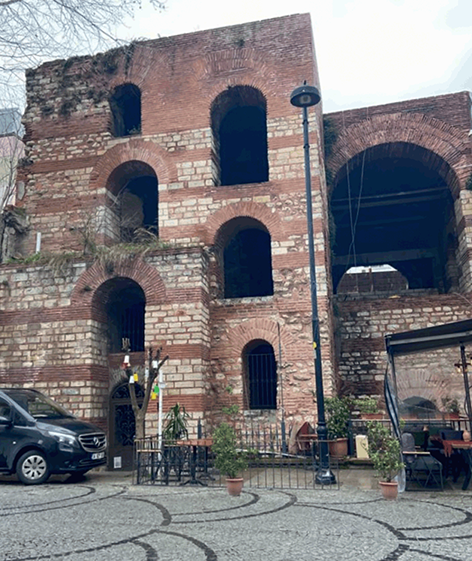
(b) These galleries extended to the Mamboury B complex, whose main feature is the Ramp House (Ba), a kochlias or three-storey spiral staircase divided into nine sections, which gave access to one of the upper terraces of the palace, at 26 m.a.s.l (Figure 14). A small apse on the upper level suggests the presence of a chapel. A few metres northwest of the ramp, the foundations of a grand polygonal apse (Bc) were documented, surrounded by galleries (Bb) and cisterns (Bd). Further south, a series of passages led to a fountain (Bg). Near this source, the remains of a ramp similar to Ba were also documented, but practically destroyed (Be). From here, after creating a recess, the galleries proceeded southward until reaching the next significant complex, Mamboury D.Footnote 105
The Ramp House in Akbiyik Cd.
The itinerary corresponding to these remains is designated by the Book of Ceremonies as the passageways leading to the Hall of Eros, one of the southernmost chambers of the Upper Palace.Footnote 106 This route is fairly well documented, especially thanks to the bridal ritual, which allows for many identifications. Firstly, it must be noted that a street separated the area ascribed to the Magnaura terrace and the palace proper. We know that to transition between the two, one had to cross a bridge located south of the great triklinos. This would have served to cross over the 40 m long street found to the north of the Mamboury Ac2 group.Footnote 107 Kostenec suggested that the Ramp House (Ba) matched the staircase of St Christina, down which empresses descended to take a bath three days after their wedding night.Footnote 108 This assumption is supported by several lines of evidence. Firstly, the staircase is the first in the galleries leading outside the palace. Secondly, the ramp is associated with the apse of an important building, and we know that the staircase of St Christina was associated with the triklinos of the Ovaton. Finally, the itineraries suggest that this complex was located at an intermediate point along the eastern route, and the ruins effectively occupy a central position within the route of the galleries running from the Magnaura to the southern end of the Upper Palace (Figure 15).
View of the Ovaton and the Mamboury B complex.
Following this reasoning, the polygonal apse (Bc) would correspond to the triklinos of the Ovaton. We know that in order to reach the staircase of St Christina, it was necessary to pass ‘at the side of the Ovaton’, and then ‘behind the Ovaton’, which aligns with the position of the apse, the adjacent galleries, and the ramp.Footnote 109 This hall, also known as the triklinos of the Dome or Troullos, was given its name due to its connection with the archive of the treasury, which, in accordance with the tradition of skeuophylakia (treasuries) had a centralised plan and was topped by a dome.Footnote 110 The building is attributed to either Constantine or Anastasius.Footnote 111 The triklinos of the Ovaton was primarily known for hosting the Sixth (680–681) and Quinisext (696) councils, after which they were known as Trullan Councils.Footnote 112 The building was still in use in the late twelfth century, as the wedding of Alexius II (r. 1180–1183) and Agnes of France (1180) was celebrated there.Footnote 113
3.9 The Peristyle of the Mosaics and the Consistorium
3.9.1 Archaeological Remains
Mamboury Da emerges from the slope at the southern end of the B structures, representing the southeastern corner of a recess formed by the galleries. This indicates that the galleries continued further southward. Two additional ensembles were documented to the southwest of these remains. Db, dated to the sixth century, was a cruciform chamber with a groined vault, featuring four small rectangular spaces between the arms of the cross. This was preceded to the west by an antechamber, built with earlier materials, possibly from the fifth century. Mamboury Dc, comprising several cisterns, was discovered 20 m to the south of the aforementioned structure.Footnote 114
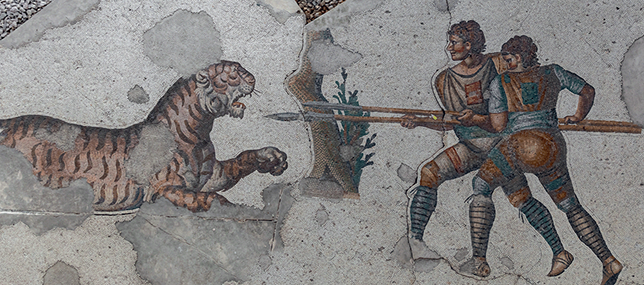
Since the beginning of the century, the Scottish magnate Sir David Russell and his spiritualist friend, Wellesley Tudor Pole, had been contemplating the possibility of excavating in the area, following a revelation during séances conducted by Russian monks exiled from the Revolution.Footnote 115 At last, in 1935, the excavation began under the direction of James Houston Baxter, a professor of church history at the University of Glasgow. Works revealed a peristyle paved with a magnificent mosaic displaying hunting scenes and the remains of a cruciform church. After the Second World War, in 1952, Sir David Talbot Rice led a second campaign, which unearthed the Apsed Hall overlooking the courtyard.
The peristyle boasted monumental dimensions of 65 × 55.5 m, while the hall measured 32 × 16.5 m. The Mamboury Db complex was adjacent to the hall on its northern side, while the cisterns in Dc were adjacent to it on the southern side. A street and a sequence of galleries divided this primary ensemble from a secondary one located north of the peristyle, notable for the remains of a cruciform church. A passageway ran along the western end of the peristyle, while an elongated hall was attached to the southern outer wall. The peristyle was situated above the southeastern edge of the terraces of the Upper Palace, with the piano nobile (main floor) at approximately 26 m.a.s.l. This meant that the earth beneath the site had been disturbed and originated from elsewhere, complicating the dating process. Nevertheless, it was determined that the filling must have occurred between 500 and 540.Footnote 116
One of the earliest elements of the ensemble was the Paved Way, a two-level brick viaduct that ran through the centre of the courtyard in an east–west direction, deviating slightly from its axis. The surface was paved with marble slabs. It is important to note that the viaduct always terminated in front of the foundations of the hall, suggesting that a significant building may have already stood at the eastern end of the courtyard in the earliest phases of the complex.Footnote 117 A fundamental structure for the study of the peristyle, and the next one in chronological order, is a cistern located beneath the southern portico. The structure was clearly older than this portico, as it was crossed by the latter’s foundations. The bricks used in the construction of the structure bore stamps typical of the sixth century, featuring two lines of text or a cruciform shape, signed by a certain Gaius.Footnote 118
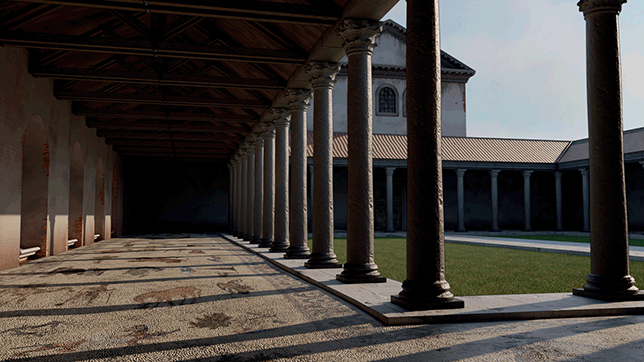
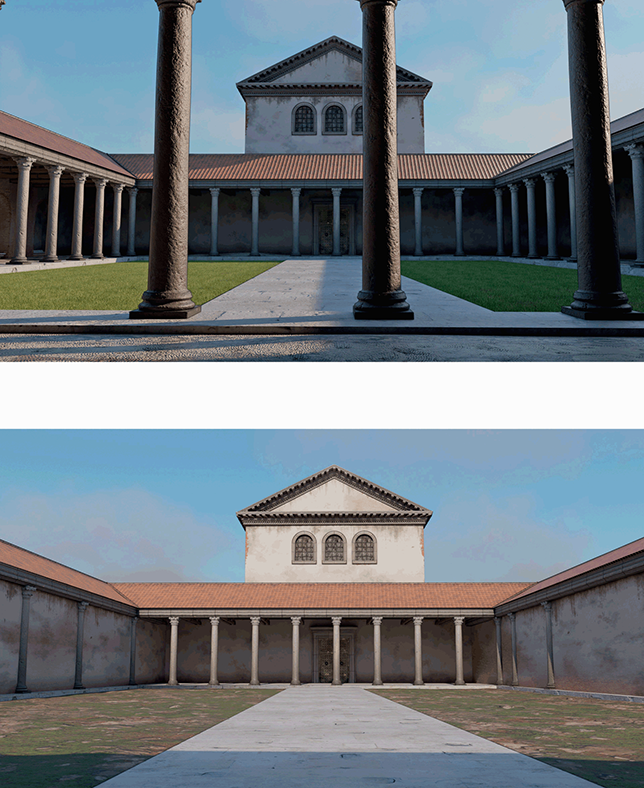
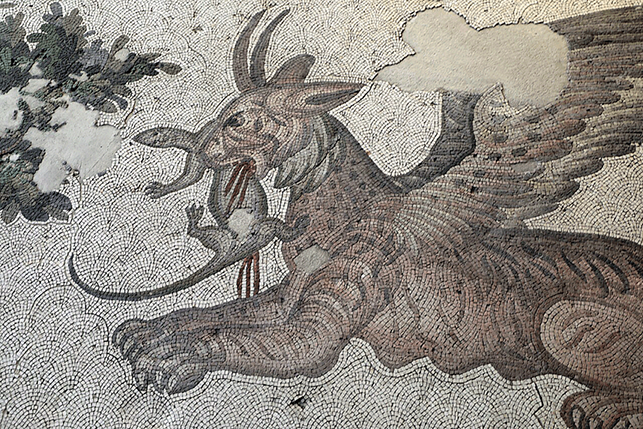
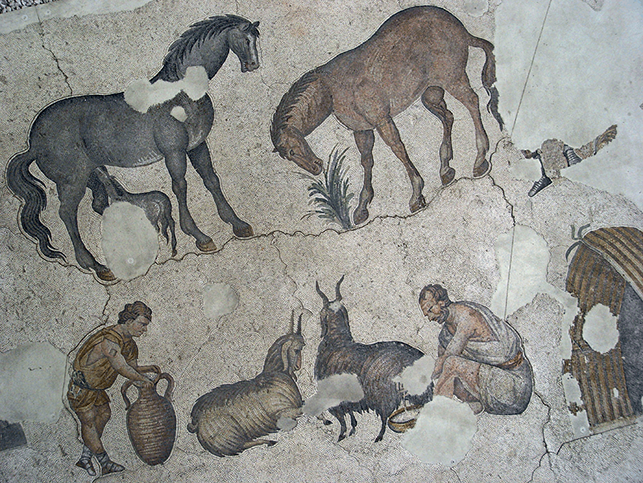
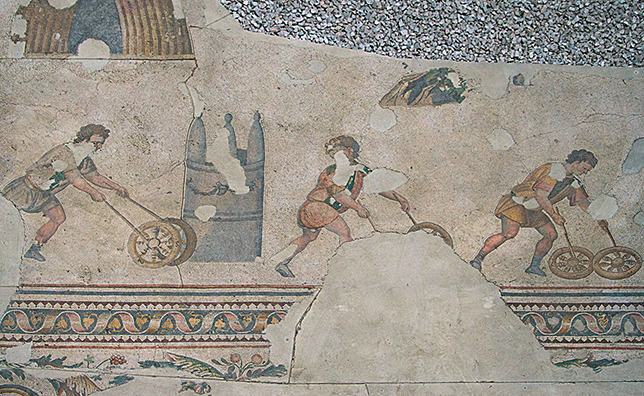
The subsequent phase of construction pertains to the peristyle and the hall. The peristyle comprised four porticoed galleries. The initial entry to the complex was located at the northwestern extremity of the peristyle (Figure 16). The northern portico, aligned with the entrance, featured recesses with built-in marble benches. In the 1980s and 1990s, an Austrian team resumed excavations at the site. Works uncovered evidence suggesting that, despite sharing the same plan, two successive peristyles must have existed on the site. The first peristyle may have been decorated with a bichrome mosaic floor in black and white, while the second and final peristyle was embellished with the magnificent hunting-themed mosaics (Figures 20–23). The pottery discovered in the layer of debris between the two floors provided a terminus post quem for the mosaic peristyle, indicating that it was constructed after the year 475.Footnote 119 The hall also stood upon earlier buildings, as evidenced by a complex network of infrastructures with successive phases. Its foundations revealed that the structure was divided into an antechamber by a thick wall pierced by three arches. This vestibule led to the actual hall through three doors corresponding to the inferior arches. The presence of pillars under the apse indicated that the floor level in this area was higher than that of the rest of the chamber.Footnote 120
The northern portico of the peristyle of the mosaics in the late sixth century.
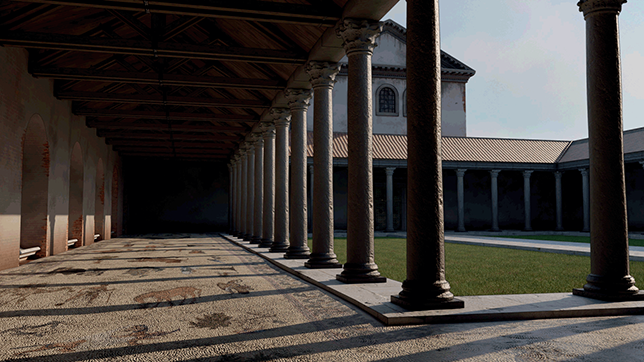
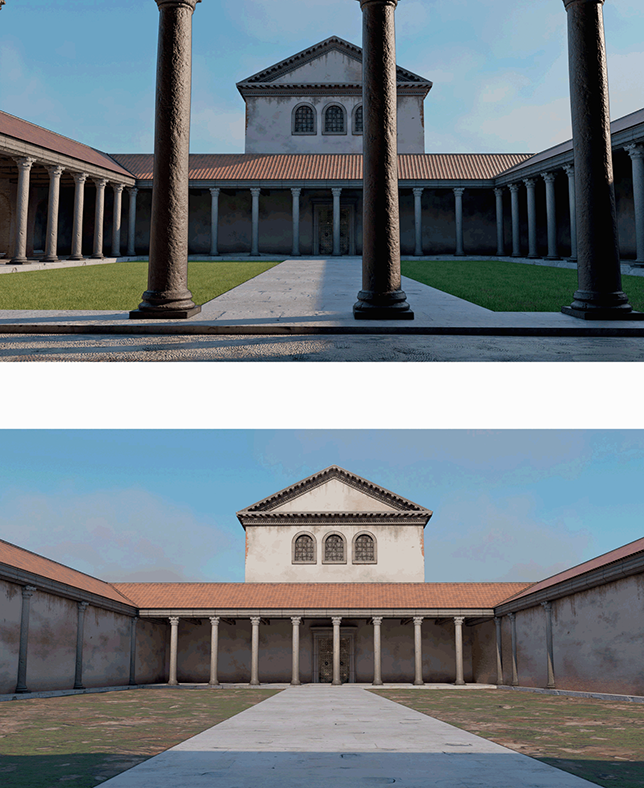
The mosaic remained exposed for an extended period, resulting in damage that required repairs. The broken sections were subsequently filled in with opus signinum (Roman waterproof mortar). Later, the complex underwent significant transformations. The north and south porticoes were walled, and repurposed into long galleries, while the western one was eliminated. The mosaic was meticulously protected by the application of marble slabs, which ultimately ensured its preservation. The Paved Way regained its central position when a new main door was opened at the western end of the courtyard, aligned with the viaduct. The final intervention involved the walling of the recesses with benches in the northern portico. At some point in the late twelfth century, the site was subjected to extensive damage, as evidenced by the discovery of weaponry and armour in a context suggestive of violence and fire (Figure 17).Footnote 121
The peristyle of the mosaics before and after the reform that removed the porticoes.
3.9.2 Previous Datings and Identifications of the Site
Paradoxically, the discovery of the mosaic has presented a challenge in determining the date of the site, as numerous approaches have favoured the stylistic examination of the pavement over a strictly archaeological and topographic point of view. In this context, the narrative surrounding the date of the mosaic reflects the broader perception of Late Roman and Byzantine art. The assumption was that the more ‘Classical’ or ‘Hellenistic’ the features of an iconography, the earlier its date, and vice versa. Considerations such as the coexistence of diverse levels of artistic quality, disparities between centre and periphery, and the persistence of prestigious models in specific contexts, like the court, were overlooked.
For instance, in the initial excavation report, the analysis of hairstyles and clothing led researchers to propose a date around the year 410, despite this being at odds with the archaeological evidence. In any case, all such dating was based on the erroneous presumption that the site was the terrace of the Pharos.Footnote 122 The sixth century was only considered after stylistic comparisons were established with Syrian mosaics.Footnote 123 While Talbot Rice placed a greater emphasis on archaeology, he still relied heavily on stylistic labels such as ‘Medieval’, ‘Classical’, ‘Hellenistic’ or even ‘neo-Attic’ to suggest a date between 450 and 500. This was the case even when the author explicitly suggested that the work was executed later.Footnote 124
Victor Lazarev proposed a date in the mid sixth century, after comparing the mosaic with silver plates from the reigns of Justinian and his successors.Footnote 125 Following initial reservations, Mango and Irving Lavin also unequivocally pointed to the sixth century.Footnote 126 Some years later, Per J. Nordhagen sparked a new trend, suggesting a later date for the mosaic. According to him, the mosaic’s style would reflect a revival imitating the sixth century, believed to have been introduced by Justinian II (r. 685–695 and 705–711) around the year 700. Accordingly, the hall would be identified with the triklinos of Justinian II.Footnote 127 The proposal was so successful that some authors even spoke of a ‘Justinian II style’.Footnote 128
Although stylistic analysis has never been entirely abandoned, the 1970s saw the emergence of some criticism based on iconography and archaeology. For example, John W. Hayes studied the pottery, establishing a temporal framework for the creation of the mosaic, which he dated between 520 and 540.Footnote 129 Anthony Cutler showed that the mosaic incorporated models from different periods and geographical contexts, invalidating the stylistic dating hypothesis.Footnote 130 Gisela Hellenkemper-Salies undertook a significant reassessment of both the archaeological data and the mosaic’s style, which led her to conclude that works were likely completed around 475. Nevertheless, her arguments have since been superseded, and the value of her work is essentially bibliographic.Footnote 131 During this time, Salvador Miranda, a Mexican architect, concluded that, in topographical terms, the peristyle should be identified with the triklinos Augousteus.Footnote 132
James Trilling’s approach stands as the most comprehensive contribution to the mosaic’s style, which he links to North African examples. Nonetheless, his article draws heavily on an iconological reading, as he implies that the depictions of violence mirror emperor Heraclius’s troubled soul.Footnote 133 Chuck Morss’s readings focus on a purely stylistic analysis, demonstrating a clear link between the mosaic and Syrian and the Levantine examples dated to the mid sixth century.Footnote 134
It has been previously noted that Austrian archaeologists dated the mosaic after 475. Furthermore, they expressed a preference for attributing it to Justinian.Footnote 135 Subsequently, several proposals have been put forward. Bolognesi suggested that we are dealing with a structure known as the Apsis, related to the Triconch complex built by Theophilus (r. 829–842).Footnote 136 This interpretation, but from an iconographic perspective, has been adapted by Gianclaudio Macchiarella, who dated the mosaic to the ninth century.Footnote 137 Kostenec, espousing Trilling’s arguments, proposed that the ensemble was constructed by Heraclius to host the performances of the circus factions, and was subsequently transformed by Theophilus into a warehouse known as the Karianos.Footnote 138 Featherstone has suggested that we may be dealing with another of Theophilus’s constructions, the Margarites.Footnote 139
The interpretation that merits the most consideration, given its foundation on archaeological evidence, is that of Bardill. In accordance with Miranda’s perspective, Bardill postulated that the Apsed Hall is the Augousteus. Despite it being a Constantinian building, the mosaic and the main structures should be dated to around the year 600.Footnote 140 He postulated that the Paved Way had two phases, the lower one corresponding to the 4th or 5th centuries, and the upper one to the sixth century, based on the different size of the bricks found in each of the arcades. With regard to the cistern beneath the southern portico, he demonstrated that it could be dated after 518 or 533, when the use of cruciform monograms was introduced. After considering the size of the bricks, the use of the dative case, and the presence of cruciform monograms, he believed that the cistern was built at the end of the sixth century, further delaying the date of the whole complex built above it at least to the early seventh century. However, he admitted that the ceramic materials present in the earth fill and beneath the porticoes do not preclude a date as early as the year 500. After coins of Justinian, Phocas (r. 602–610), and Constantine IV (r. 668–685) were found upon the removal of the western portico, he suggested a terminus post quem for the reform of the marble pavement around the year 700. When analysing the Apsed Hall, Bardill argued that he could only identify phases dating back to the beginning of the sixth century at the earliest. While he acknowledged a succession of constructive phases and reinforcements, the main phase should be dated around the year 600. Bardill’s assessment was particularly influenced by the size of the materials and a stamp found on a brick utilised during a reinforcement phase, which is securely dated to either the years 583/584 or 598/599, corresponding to the reign of Maurice.Footnote 141
3.9.3 Chronological Analysis of Stamped Bricks
The initial certainty that must be considered before dating the peristyle is that the earth fill took place, according to Bardill, as early as around the year 500. However, as demonstrated by Hayes, it is unlikely that it occurred later than the year 540. Prior to the final fill, the upper arcade of the Paved Way may have been exposed, forming a raised walkway. This interpretation, rather than the two proposed constructive phases, would explain the observed difference in brick sizes. The height of this pre-existing walkway would have determined the level at which the peristyle was constructed.
Bardill proposed that the cistern under the southern portico was built in the late sixth century. However, this is not likely if we consider that the cistern preceded the earth fill, which has a terminal date of 540. He based his dating on the size of the bricks, the cruciform stamps, and the presence of the dative case. Though it is accurate to state that the bricks decrease in size over the course of the sixth century, Bardill himself admitted that there is a significant deviation in the measurements and that these cannot be employed as an absolute criterion for dating.Footnote 142 He also acknowledged that the size may vary depending on the function and size of the building, as he pointed out when studying the fifth-century baths located near the Kalenderhane Mosque.Footnote 143 However, the cistern was undoubtedly constructed after 518 or 533, as evidenced by the presence of the cruciform monogram. Although most stamps on the bricks appear in the genitive case, the dative case is not a solid argument for supporting a later date either. Concerning the bricks stamped by Gaius (1364.1a and 1365.1a), Bardill’s own classification places similar examples in constructions dating to the first half of the sixth century, such as St Polyeuctus, Hagia Sophia, Hagia Eirene, the Basilica Cistern, and the ruins of the Hospice of Sampson.Footnote 144 Consequently, it can be inferred that the cistern was constructed between the years 518 or 533, when the cruciform monograms first appear, and the 540s, as inferred from the earth fill.
An analysis of the bricks found in the peristyle yields similar conclusions. Bardill types 666, 785.1 c, 880.1a, 1257.1a, 1342.3b, 1342.8a, and 1344.1 c were notably prevalent in the walls of the peristyle and several drainage conduits. These types were also found in the cross-shaped church to the north, as well as in sixth-century contexts such as Mamboury A, B, and C. Outside the palace, this type is also found in St Polyeuctus, the reconstruction of Zeuxippos, Hagia Sophia, Hagia Eirene, repairs to the Balaban Ağa Mosque dating to the sixth century, and the north church of the Kalenderhane complex from the mid sixth century. During the renovation of the marble floor, stamps 619.1a and 620.1a were repurposed in a conduit. The same stamps were also found beneath the hall and in the southern cistern. This stamp features the abbreviation ‘skri-’, which may refer to the rank of skriniarios or skribon. If it refers to the latter, the brick must be dated after 545, when this position was first recorded.Footnote 145 Similar examples can be found in Zeuxippos, in interventions undertaken in the palace of Antiochus during the sixth century, and again in Kalenderhane, with a similar date.
Beneath the remnants of the western portico, a coin of Justinian was discovered. Initially, it was thought that this suggested the emperor’s involvement in covering the mosaic, a view partially shared by Bardill, who proposed that the coin was deposited during this phase.Footnote 146 However, considering the chronology of the bricks and the stratum, which coincided with the boundary between the Late Roman level and subsequent renovations, it is more probable that the coin was deposited during the construction of the peristyle.Footnote 147
Regarding the infrastructures of the hall, Bardill admitted that a significant building already stood there by the year 500, as evidenced by repairs dated to the early sixth century.Footnote 148 It can be reasonably assumed that the Paved Way led to that building. Two significant groups of stamped bricks were unearthed below the hall. The first, dating to the early sixth century, was believed by Bardill to be the result of a massive reuse of building materials. Conversely, the group contemporary to the construction of the hall would be later, dating to the end of the century. In this group, nine out of ten stamps were of the ‘skri-’ type.Footnote 149 Another significant brick bore a stamp dated to 583/584 or 598/599, during the reign of Maurice (231.1b). This brick might be the main reason behind Bardill’s dating of the complex to the late sixth century. However, only one specimen was discovered, detached from one of the vaults, which suggests that it originated from a restoration. This view would be further reinforced if the brick was promptly placed in 583/584, as a violent earthquake occurred that year.Footnote 150
In conclusion, in the fifth century there was already a significant complex standing in the location of the peristyle, judging by the Paved Way and the infrastructures of the Apsed Hall. The analysis of stamps from the peristyle and the hall suggests that the main constructive phase took place in the mid sixth century, as it is also inferred from the terminus ante quem of the earth fill around 540 and the apparition of the ‘skri-’-type stamps, probably dated from 545 onwards. This chronology aligns with the finding of Justinian’s coin and the dating of the bricks. It can thus be reasonably concluded that the primary construction phase of the complex occurred during the latter half of this emperor’s reign.
3.9.4 The Consistorium and the Church of the Lord
It is this author’s opinion that the archaeological site should be identified with the Consistorium. To support this identification, it is essential to elaborate on the features of the building. The Consistorium was the main audience hall of the palace in Late Antiquity, where courtiers conducted the adoratio or proskynesis (prostration or obeisance) and foreign ambassadors were received by the emperor. It was also the place where he dictated laws before his council, the consistory, which gave its name to the building.Footnote 151 The hall is first documented as early as 467, when an embassy from the Western Emperor Anthemius (r. 467–472) was received there. It also played an important role during the proclamation of Leo I (r. 457–474), Anastasius, and Justin I (r. 518–527).Footnote 152 Despite its early importance, the Consistorium holds a marginal position in the Book of Ceremonies, as by the tenth century it had been replaced by the Magnaura and the Chrysotriklinos. Even its name was forgotten, becoming known as ‘the hall where the baldachin stands and where the magistroi are appointed’.Footnote 153
The position of the Consistorium and its connections with other elements of the complex can be reasonably ascertained through its neighbouring structures. It was the last significant hall along the eastern route. The Church of the Lord was situated north of the building, the triklinos of the kandidatoi standing exactly opposite the chapel. As previously stated, the latter was adjacent to the eastern side of the Tribunal.Footnote 154 This position rendered the site a crucial junction where the eastern and western itineraries converged. The Consistorium was also near the ancient baths and not far from the Covered Hippodrome. However, the connection with these structures ended following the construction of the Triconch.Footnote 155 In any case, these clarifications are crucial, as they reinstate the position of the Consistorium at the southernmost edge of the Upper Palace. On the other hand, the position of the Church of the Lord roughly corresponds to the cruciform church to the north.
The Consistorium was preceded by the Onopodion, an area of uncertain nature. Here, courtiers, coming from the Gold Hand, would customarily greet the emperor before proceeding into the hall. Our knowledge of the Onopodion is limited to the fact that access was gained through a bronze door covered with a veil that led onto a marble floor. This door was located exactly in front of the Consistorium. Additionally, a triple door of the Onopodion is referenced.Footnote 156 Scholars such as Berger and Kostenec speculated that this space likely took on a horseshoe shape, given its name, meaning donkey hoof.Footnote 157 Guilland, however, proposed that it might have been a gallery wide enough for a donkey to pass through.Footnote 158 Prior to entering the Consistorium, another enigmatic chamber, known as the Indians, is referenced.Footnote 159
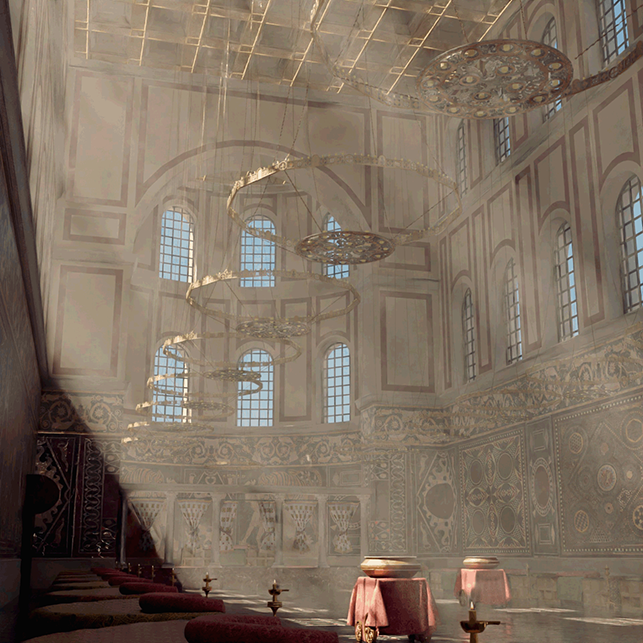
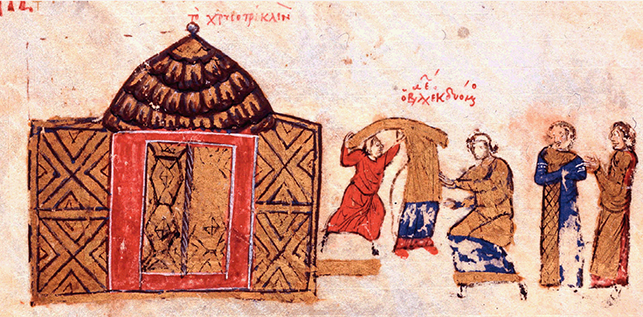
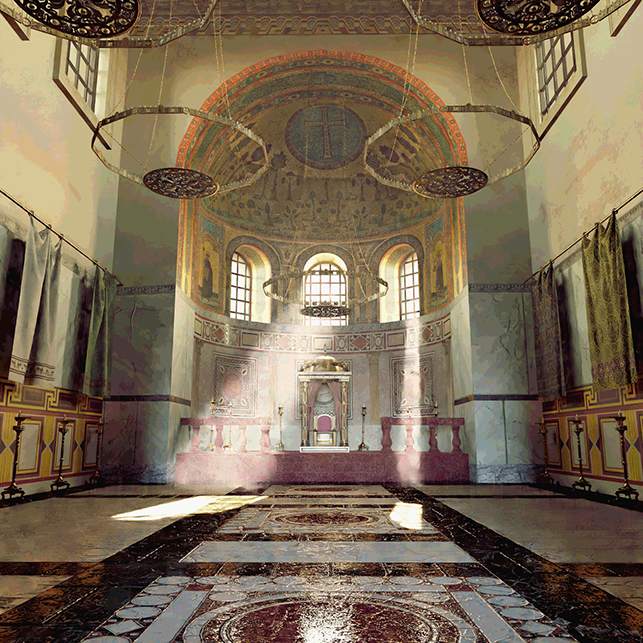
In the sixth century the Consistorium was preceded by a space or antechamber known as the Anticonsistorium.Footnote 160 From here, one accessed the hall known as the Grand Consistorium, through three ivory doors that were usually covered with veils.Footnote 161 The Consistorium featured a floor adorned with porphyry omphalia, indicating the position where ambassadors were to kneel before the emperor. At the far end of the chamber, above three porphyry steps, stood the baldachin of the imperial throne.Footnote 162 The Grand or Summer Consistorium was adjacent to the Small or Winter Consistorium, where courtiers would often dress following their promotions.Footnote 163
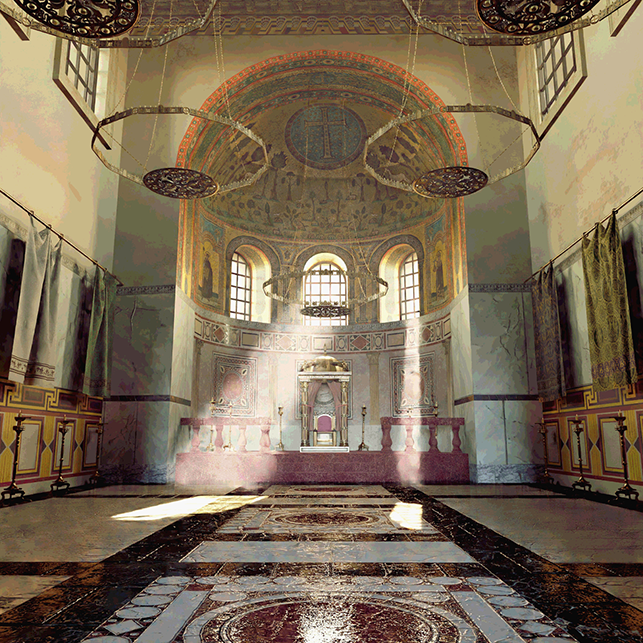
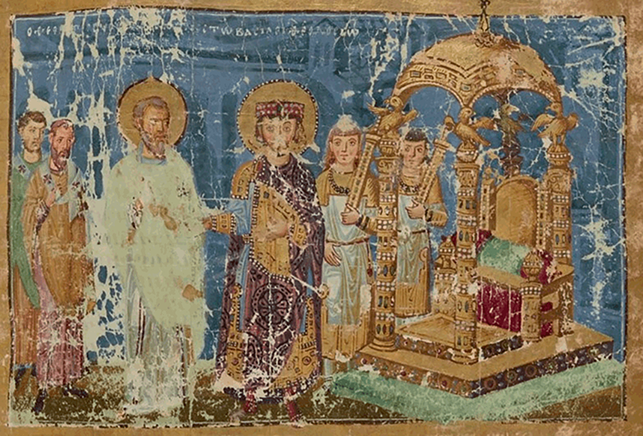
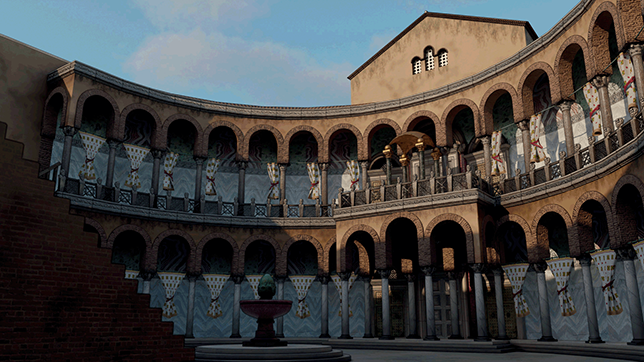
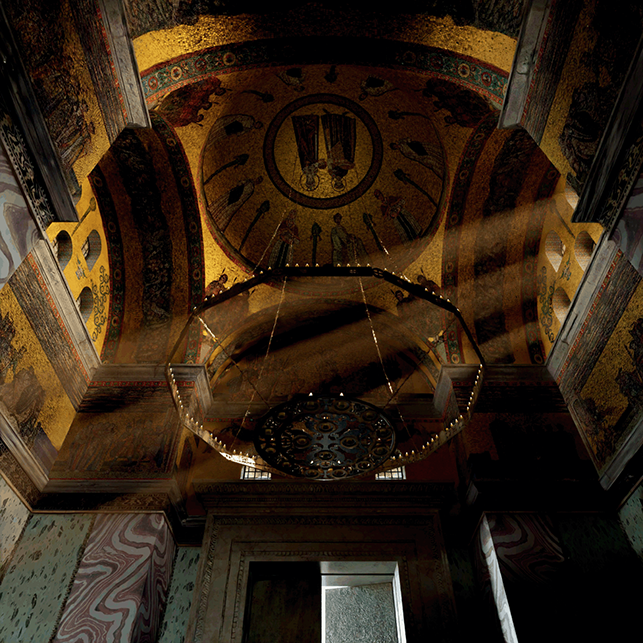
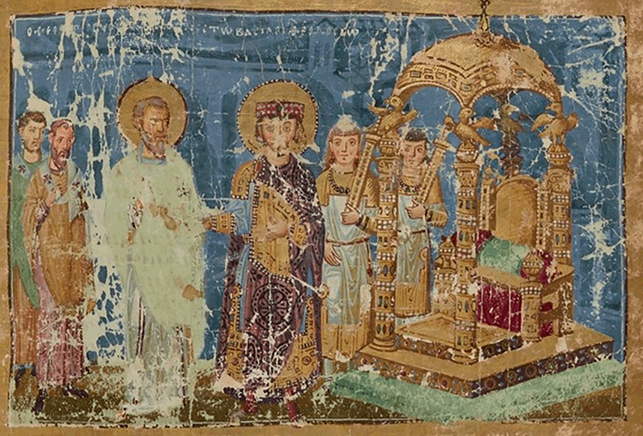
The hall’s most distinctive feature was the baldachin (Figure 18). Corippus, who chronicled an embassy during the reign of Justin II (r. 565–578), described it as a structure supported by four columns and topped with a hemispherical dome that symbolised the vault of Heaven. Each corner was surmounted by the figure of a winged victory, bearing a laurel wreath. The entire structure was crafted from gold and adorned with precious stones and purple silks.Footnote 164 Several accurate representations of the artefact have come down to us: in the two ivories featuring Ariadne, the empress is depicted beneath the baldachin. Four centuries later, during Basil I’s reign (r. 867–886), it is found again in a manuscript of the homilies of St Gregory (fol. 239 r) (Figure 19). The only difference from Corippus’s description is the replacement of victories with eagles holding wreaths.
Interior of the Apsed Hall interpreted as the Consistorium.
The baldachin of the Consistorium in the Homilies of St. Gregory, 2nd half of the ninth century. Paris, BNF, Par. gr. 510, fol. 239 r.
The location of the Church of the Lord has already been outlined. However, it is worth noting that it was also identified as one of the main entrances to the palace, in this case, on its eastern flank.Footnote 165 According to the Patria, Constantine was the builder of the church.Footnote 166 The only information available regarding the structure is that it possessed bronze doors, a narthex, and a sanctuary.Footnote 167 The interior of the church was used to store the insignia of high-ranking members of the hierarchy, including the Caesar, as well as the labara (military pennants, often decorated with a Chi-Rho) and dragon standards of the guards.Footnote 168
3.9.5 Identifying the Peristyle (I): Topographical Analysis
The site’s immediate characteristics, including the triclinium-peristyle layout and the scale of the complex, indicate that we are facing one of the main triklinoi of the Upper Palace, that is, the Augousteus, the Nineteen Couches, the Hall of Justinian II, or the Consistorium. As previously stated, Miranda and Bardill already suggested the Augousteus. However, the identification does not seem feasible: its location does not correspond with the site, and its orientation probably does not either. Some recognisable annexes, such as the Octagon, are absent, and the chronology of materials does not correspond to the Constantinian period. Nordhagen opted to identify the complex with the triklinos of Justinian II. The location appears more suitable, as this hall abutted the southern terraces. Nevertheless, it did so from the western side, not far from the curved end of the Hippodrome. Moreover, the construction of the building occurred around the year 700, when the peristyle had already been in existence for at least a century. The Nineteen Couches can be dismissed with minimal consideration, as it had a north–south orientation and was adjacent to the Hippodrome. In contrast, the Consistorium shares several features with the complex. Firstly, topographic coincidences will be listed:
(a) North of the Consistorium stood the Church of the Lord, which also served as an eastern entrance to the palace. To the north of the peristyle, the remains of a church were discovered, situated near the recess between groups Mamboury B and D. Given the upward slope of the area, it is possible that this structure was linked to the aforementioned access to the imperial residence.
(b) The Consistorium was situated on the eastern flank of the Upper Palace, like the excavated structures.
(c) Prior to the construction of the Triconch, the Consistorium was positioned opposite the Covered Hippodrome and the baths, at the southernmost point of the upper terraces, much like the peristyle complex.
(d) The Book of Ceremonies places important elements to the north and west of the Consistorium, namely the Church of the Lord and the Onopodion. However, nothing is mentioned east or south. This leads to the conclusion that, similarly to the peristyle, the Consistorium was situated at the southeastern corner of the Upper Palace.
The morphology of the site and that of the Consistorium also exhibit significant parallels:
(a) In the sixth century, the Consistorium was preceded by the Anticonsistorium, where ambassadors sat while waiting to be granted entrance to the hall. Marble benches were discovered in the northern portico of the peristyle, aligned with the entrance to the courtyard.
(b) The Consistorium was accessed through three ivory doors. Their material suggests that they did not open directly to the outside but rather to an antechamber. Entrance to the main room of the apsidal hall was via a vestibule and three doors, as evidenced by the infrastructure.
(c) The Consistorium had a smaller adjoining chamber known as the Winter Consistorium, and the Apsed Hall had a northern extension labelled Mamboury Db.
(d) In the Consistorium, the throne stood upon a dais with three porphyry steps. In the hall, the area of the apse was raised above the rest of the chamber.
The Onopodion deserves special attention. It has been just suggested that the Anticonsistorium was the original peristyle, and there is evidence to infer that the Onopodion was its later designation. After the renovation, when the porticoes of the peristyle were removed, a door was opened at the western end of the courtyard, which led directly to the Apsed Hall via the Paved Way. The Onopodion, situated in front of the Consistorium, featured a bronze door opening onto a marble platform that led to the hall. The marble dais mentioned in the Book of Ceremonies is designated as marmarinon poulpiton, meaning marble pavement, and is likely to have referred to the marble slabs that covered the Paved Way. The name of this place may have originated from its purpose, as it is known that ambassadors frequently brought horses as gifts for the emperor, which were then brought into the Consistorium itself.Footnote 169 It is possible that the Paved Way was left intact in order to prevent damage to the mosaic when the animals were led into the hall.
The successive interventions that were identified during the excavation also help to elucidate the shifts in ritual that are observed in the Book of Ceremonies. In the sixth century, ambassadors would access the complex through the door on the western end of the northern gallery, then wait on the marble benches, and finally enter the hall through the eastern portico. It seems probable that they would leave by traversing the southern and western porticoes, eventually arriving back at the same door through which they had entered. In subsequent centuries, the Book of Ceremonies implies that the Onopodion was not exactly a portico, in accordance with the space resulting from the renovations.Footnote 170 Following these itineraries, the emperor would access the Onopodion through a door situated opposite the Consistorium, after crossing a marble platform, mirroring the complex’s appearance following the removal of the porticoes and the opening of a new door aligned with the Paved Way.
3.9.6 Identifying the Peristyle (II): Chronological Analysis
It is necessary to ascertain whether the history of the Consistorium and related buildings aligns with that of the excavated site. The Paved Way is the oldest surviving element of the complex and likely dates back to the fifth century. It is possible that this coincides with the construction of the first Consistorium, which may have occurred during the Theodosian period. In any case, the Consistorium’s existence by the year 467 is beyond any doubt.
During this phase, the area occupied by the complex must have been smaller, as the cistern built after 518 that was found beneath the southern portico was not aligned with any of its structures. The erection of the peristyle is believed to have occurred at the same time or shortly after the earth fill. This must have happened after the construction of the cistern but before the 540s. It is likely that the main phase, which featured the figurative mosaic, commenced around that date. The reference to the Consistorium’s ivory doors, dating to the coronation of Justin I in 518, indicates that, in broad terms, the hall’s morphology, with its triple entrance, predated the main phase and was maintained after subsequent renovations.Footnote 171 If we accept that Maurice’s brick indicates a restoration, it can be concluded that the building was already finished and had undergone restoration works in the 580s. Finally, the reform that suppressed the porticoes is likely to have taken place in the late seventh century, as deduced from the terminus determined by a coin of Constantine IV. The complex was destroyed towards the end of the twelfth century or the beginning of the thirteenth century, possibly in connection with the sack of the city during the Fourth Crusade.
Considering this chronology, the candidates for the construction of the peristyle are Justinian, Justin II, and Tiberius II (r. 578–582). Given the length of Justinian’s reign and the significant building initiatives he led as emperor, he is the most likely candidate for the construction of the peristyle. In addition to the coin discovered during the excavations, there are other indications that point to Justinian. As mentioned above, in 528 he undertook the renovation of the Kathisma. It is possible that this intervention coincided with the commencement of works in the Consistorium because, at the same time, laws were not issued in this hall of the Great Palace, as was customary, but in a different one at Iucundianae, in the Hebdomon.Footnote 172 It is also noteworthy that Justinian decreed that the senators should participate in the meetings of the consistory and relocated its sessions to the palace, which could have coincided with a renovation of the Consistorium.Footnote 173 If these assumptions are correct, the peristyle would have been constructed sometime in the 530–550s, coinciding with the earth fill, and prior to 547, 551, or 557, when the descriptions of several embassies already imply the configuration of the complex during the mosaic phase.Footnote 174 While no emperor is credited with the construction or renovation of the Consistorium, it is worth noting that, according to Procopius:
practically the whole Palace is new, and, as I have said, was built by the emperor Justinian; but it is impossible to describe it in words and it must suffice for future generations to know that it happens to be entirely the work of this emperor.Footnote 175
3.9.7 Identifying the Peristyle (III): The Meaning of the Mosaic
To understand the iconography of the mosaic, it is of the utmost importance to stress the identity of the complex. We are not dealing with the pavement of an aristocratic villa, a church, or a synagogue. Rather, we are facing the portico of an audience hall within the imperial palace. It thus becomes necessary to inquire whether the iconography of the mosaic lends support to the identification with the Consistorium. Indeed, the Consistorium is the sole edifice within the palace that can be related with potential allusions to the mosaic. The first and most significant of these is the reference to a space in front of the Consistorium, which the Book of Ceremonies refers to as the Indians.Footnote 176 It is evident that the mosaic incorporates numerous elements that would have been readily identifiable to its contemporaries as Indian, particularly in the northern portico, which is aligned with the main doorway and is the place where the benches are situated. The mosaic scenes can be classified in several groups, although there is considerable overlap between them, including hunting scenes and animal fights, which are presented either from a realistic (Figure 20) or mythological (Figure 21) point of view. There are numerous depictions of rural life and agricultural activities as well (Figure 22). Hippodrome-themed scenes are also depicted from a symbolic perspective, with children playing hoops around the metae (turning points of a circus) (Figure 23). References to the factions are found throughout the mosaic, as is the case with the hunters dressed in their respective colours. Finally, a single triumphal scene has survived, depicting the arrival of the child Dionysus and his retinue or thiasos.
Peristyle of the mosaics: members of the factions hunting a tiger.
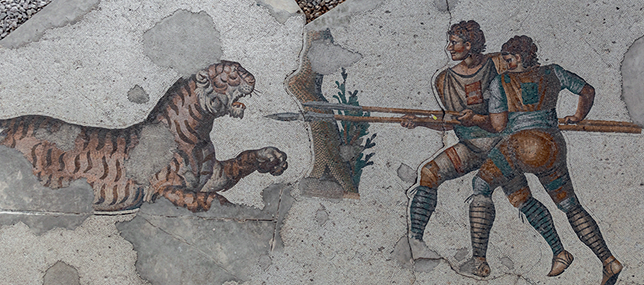
Peristyle of the mosaics: a manticore.
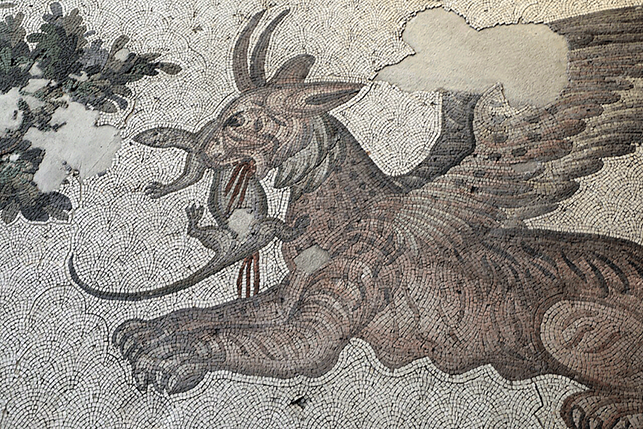
Peristyle of the mosaics: bucolic scenes.
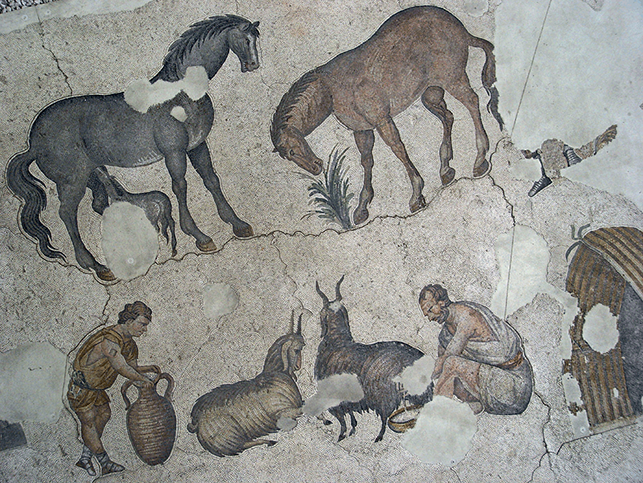
Peristyle of the mosaics: children playing hoops in the Hippodrome.
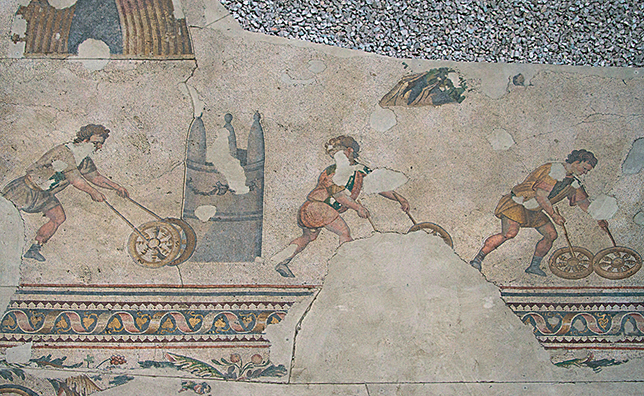
The Dionysian procession symbolises the arrival of the child-god in India, possibly in the mythical city of Nisa, which may be identified with the reclining woman, who is evidently a personification.Footnote 177 The thiasos is accompanied by local fauna, including a satyr, an elephant, and a white camel.Footnote 178 Additionally, the presence of other animals, such as lynxes, panthers, the enormous tiger at the entrance, and trained monkeys hunting birds, further reinforce the notion of an Indian setting.Footnote 179 Similarly, the depiction of fantastical creatures, including griffins and a manticore, which ancient sources consistently associate with India, further substantiate this hypothesis.Footnote 180 These creatures, along with the menacing monsters, collectively evoke a land as fantastical and threatening as the beasts themselves were perceived to be.Footnote 181 The portrayal of exotic creatures from distant lands alludes to the universal aspirations of the Roman Empire, which claimed the dominium mundi. This mosaic is not an isolated case; other examples, such as those at Villa del Casale or Mount Nebo, also exhibit this symbolism. In the Sicilian mosaic, the limits of the world are conveyed by the fauna. At the northern end of the portico stands the personification of Africa, surrounded by elephants and panthers. Hunters are depicted capturing the animals, which are later transported to Italy, located in the middle of the pavement. At the eastern end sits the personification of India, accompanied by a tiger and an elephant. In contrast to Africa, India was not particularly well known to the Romans. In order to evoke this sense of mystery, mythological animals such as a griffin and a phoenix were also incorporated beside the personification.Footnote 182 In Mount Nebo, Indians and Persians, accompanied by exotic animals, represent the boundaries of the known world.Footnote 183 The Indian element was also adopted in the imperial milieu, combining its character of exotic refinement with its meaning of universality. This is exemplified by a silver missorium depicting a personification of India and by the Barberini Ivory, in which Persians and Indians, accompanied by exotic animals, present gifts to the emperor.Footnote 184
However, the mosaic does not merely contain references to the remote and exotic ends of the world. Examples of scenes related to the Hippodrome can be observed, such as the one with children playing hoops. For Roman and Byzantine writers, this was an unmistakable symbol of cosmic order and social harmony.Footnote 185 The mosaic depicts children throughout, not only in the circus scene. This iconography may be related to a paternalistic attitude frequently observed in imperial discourse. The emperor was regarded as the pater Patriae, and his subjects were viewed as his children, for whose welfare he was responsible. In particular, Justinian employed this propagandistic device extensively. In other scenes, such as that of the mother suckling her child, the imagery may be understood as a more direct reference to Rome itself.Footnote 186
Finally, we will analyse the georgic and hunting scenes and the venationes (animal hunts in the arena). This is where we find the second possible reference to the mosaic in written sources. In his eulogy to Justin II, Corippus used these themes to describe the reception of an Avar embassy in the Consistorium:
[The emperor is] like a farsighted shepherd who has pastured bulls and woolly sheep in the grassy meadows over a long period, and knows all the names which he has given to the bulls; he rejoices that his dear flock is growing, he enters the pen, separates the weaker ones and brings together the lambs, calling them all by well-known names; when they hear his voice they follow and recognise their master, and baa into the air and greedily take the green grass which he has brought.Footnote 187
The emperor is thus the good shepherd of his flock, his subjects, who by their obedience earn the favour of the ruler. In the context of the mosaic, these scenes represent the Roman people in an idealised manner. Conversely, violent scenes present the opposite situation:
As Hyrcanian tigers when New Rome gives spectacles to its people, under the direction of their trainer do not roar with their usual savagery but enter, go all round the edge, and look up at the circus full of thousands of people, and by their great fear learn gentleness: they lay down their fury and are happy to wear the cruel chains, to come right into the middle, and they love in their pride the very fact that they are stared at. Their eyes range over the benches and the enthusiastic crowds and they lie down in adoration before the throne of the emperor.Footnote 188
After this interpretation, the depiction of beasts being slain might point to all those, here specifically foreign peoples, who refuse to submit to imperial authority. It is deemed imperative that they acknowledge the supremacy of Rome; otherwise, they are doomed to be hunted like prey and paraded in the Hippodrome. The preceding passages are of significant importance, as they describe a reception in the Consistorium and bear a striking resemblance to several scenes in the northern portico, through which the ambassadors were required to pass before reaching the hall. These include the fight with the tiger just after crossing the threshold and, later, several pastoral scenes. It is worth emphasising the close relationship between the iconological interpretation of the mosaic presented here and the functions of the Consistorium, where the meetings of the emperor’s privy council were held and foreign embassies were received. In conclusion, the pavement’s iconography can be understood as an idealised representation of the Empire, as reflected in the bucolic and circus scenes. On the other hand, the hunting episodes represent the ominous fate awaiting traitors and external enemies. When considered alongside the Indian repertoire, these scenes symbolise the submission of the entire orb to imperial rule ‘in such powerful vigour that under its control, exercised both at home and abroad, the whole world was subjected to the Roman yoke … not only eastward and westward, but also laterally, to both bounds of the earth’s circle’.Footnote 189
3.10 The Covered Hippodrome and the Skyla
The Covered Hippodrome was a courtyard of the palace, notable for its role as an access and nodal point between different areas of the imperial residence. The structure acquired its designation due to its resemblance to a circus and because its curved end, known as the hemicycle of the Skyla, was roofed.Footnote 190 The enclosure of the Skyla is thought to have been constructed during the reign of Tiberius II, who is credited with the creation of the Skyla Gate, which separated the covered area from the courtyard proper.Footnote 191 Later, Justinian II took advantage of this fact and transformed this space into the vestibule of his triklinos. The Scylitzes Matritensis contains a representation of the court in the miniature depicting the assassination of Leo V (fol. 26 v) (Figure 24).
The Covered Hippodrome in the Scylitzes manuscript, second half of the twelfth century. Madrid, BNE, VITR/26/2, fol. 26v.
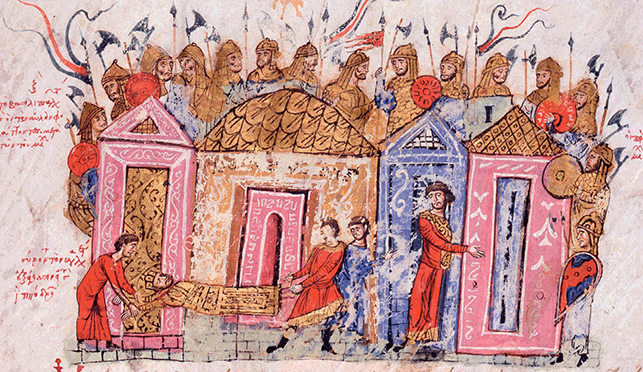
The Patria attribute its construction to Constantine and assert that emperors used to leave the palace by chariot through this courtyard.Footnote 192 The attribution is consistent, as spaces with a similar layout have been documented in the Tetrarchic palaces of Milan and Sirmium, closely connected to the circuses of these cities.Footnote 193 This function also seems correct because the courtyard was used as a stable.Footnote 194 For this reason, it was also known as Kaballarios.Footnote 195 As previously stated, the Covered Hippodrome was an important junction, connecting the Upper and Lower Palaces via the Galleries of Daphne and the triklinos of Justinian II, respectively. The baths of the Constantinian residence, the Thermastra, were also immediately adjacent to the courtyard.Footnote 196 Besides, the complex comprised two major entrances to the palace from the city: the Karea Gate, opening directly onto the arena of the circus after passing under the Kathisma, and the Galleries of Marcian, which ran parallel to the sphendone (curved end of a Roman circus).Footnote 197 Along these galleries, under the infrastructure of the Hippodrome, the Palatine Court of Justice known as the Veil and its related archives were located. This complex dedicated to the administration of justice is often referred to as asekreteia.Footnote 198 Due to its strategic location within the palace, the Covered Hippodrome housed a garrison of soldiers and was therefore known as Spatharikion (Figure 25).Footnote 199
The Covered Hippodrome and the Skyla.
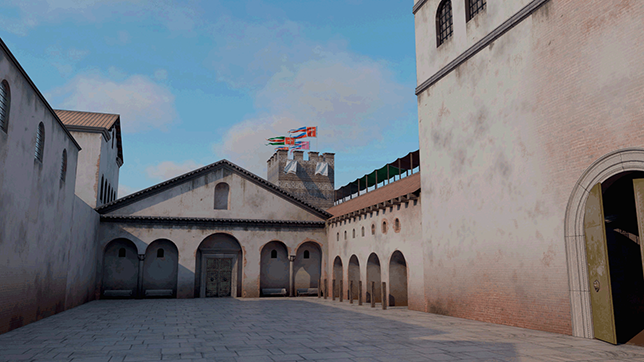
3.11 Additions to the Upper Palace
3.11.1 The Triklinos of Justinian II
Following the interventions undertaken during the reign of Justinian, the area occupied by the Upper Palace was almost filled. The only remaining space was to the south, at the edge of the terraces at 26 m.a.s.l., and it was there where subsequent extensions were carried out.
The first significant expansion of the palace in over a hundred years was undertaken by Justinian II, who, between 692 and 694, built the hall bearing his name, the two phialai (ritual fountains) of the factions, the walls of the Lower Palace and, according to the Patria, also the triklinos Lausiakos.Footnote 200 The main function of Justinian’s triklinos was to host imperial banquets. Additionally, it served as a gathering point for courtiers, who awaited there for the start of the daily processions after having entered the palace through the Covered Hippodrome. Thus, the triklinos of Justinian was also known as the procession hall.Footnote 201 The western end of the hall led directly to the Skyla through a door.Footnote 202 At the southeastern end, another door opened onto two distinct routes: the staircase leading down to the Lower Palace and the balcony overlooking the fountain of the green faction, located in the lower level as well.Footnote 203 This indicates that the hall rose almost on the edge of the terrace.Footnote 204 The location of the triklinos can also be determined with relative certainty, as several sources place it near a cistern likely to be identified with the one beneath Nakilbent Sk.Footnote 205
The triklinos was decorated with gold mosaics and polychrome marbles, including several omphalia.Footnote 206 The emperor’s table occupied a special place at the eastern end of the hall, separated from the main space by a railing.Footnote 207 The triklinos of Justinian II retained its splendour until 1295, when a gust of wind blew the roof off. In 1345 the remains of the building were still used as a prison.Footnote 208
3.11.2 The Pavilions of Theophilus and Basil I
The next enlargement took place during the reign of Theophilus, who built several pavilions, a number of which stood within the Upper Palace. These buildings were described in detail by the Continuator of Theophanes, who also listed them in order, in accordance with the itineraries from the Book of Ceremonies.Footnote 209
Close to the entrance of the palace by the Church of the Lord stood the Karianos, so named due to the presence of steps carved in Carian Marble. It was initially used by Theophilus as a winter dormitory and, later, as a dressing room.Footnote 210 The next complex on the itinerary was the Sigma-Triconch (Figure 26). As its name suggests, the Triconch had three apses, one facing east and the other two facing north and south. The eastern apse was raised and supported by four porphyry columns.Footnote 211 It was constructed above a foundation with a similar configuration, although the apses faced west, south, and east. The northern space was referred to as the Mysterion because the echo made it impossible to share a secret there. To the west, through tripartite entrances with bronze and silver doors, both levels opened onto the portico of the Sigma, named after its semicircular plan. The superior level was supported by fifteen columns made of Docimian marble. In the centre, a canopy supported by four columns of Thessalian marble stood above the imperial throne. The lower level was supported by nineteen marble columns. To the west lay a courtyard paved with marble slabs. Centrally positioned within this space was a fountain featuring a silver rim and a pinecone-shaped spout. Two additional lion-headed spouts on either side enabled the flooding of the courtyard. Some scholars have compared these features to the saradib, cryptoporticoes cooled by pools, typical of Islamic architecture, which may have inspired Theophilus.Footnote 212 Other examples of two-storey triconch buildings opening onto courtyards can be found in the Levant, including the Palace of Trajan at Bosra and Qasr ibn-Wardan, dating to the sixth century. The Umayyads seem to have implemented a similar type at Qasr al-Qastal.Footnote 213 Thus, the Islamic origin of the Sigma complex remains a matter of debate.
The Triconch of Theophilus and the Sigma.
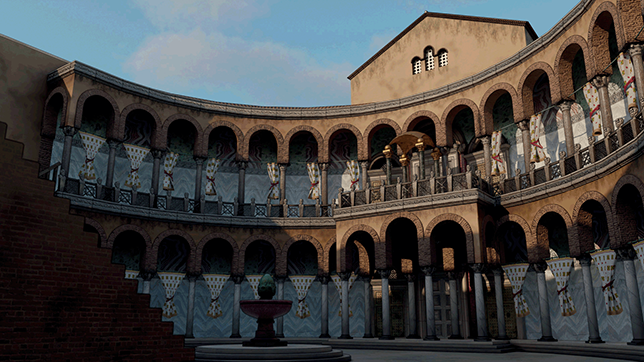
The western end of the courtyard was enclosed by several buildings. At the centre, a staircase of Proconnesian marble led to the upper levels. Above the staircase was an arch supported by two columns known as the Apsis, a term often used by the Book of Ceremonies to refer to the whole complex. The chamber on the lower level was called Pyxites, while the corresponding room on the superior level served as a dormitory for the palace clergy. A chapel dedicated to St John also stood within this complex.Footnote 214 The cornices surrounding the courtyard were decorated with verses written by courtly poets. Further west the ensemble was connected to the Thermastra and from there to the Covered Hippodrome. To the north it communicated with the Galleries of Daphne, and to the northeast with the Galleries of the Church of the Lord. Meanwhile, the galleries departing from its southern side led to the Lower Palace.Footnote 215
The following pavilion was, somewhat ironically, named Eros, despite its actual purpose as an armoury. It was therefore decorated with images of panoply. According to the Continuator’s itinerary, this structure was located to the east of the Triconch. It must have been one of the southernmost buildings of the Upper Palace, since, as we have seen, the passageways that ran along its eastern side were known as the Galleries of Eros. For this reason, it is tempting to identify it with a hall attached to the southern portico of the mosaic peristyle, as it stands at the very end of the eastern galleries.Footnote 216 South of the Eros stood the Margarites, that is, the Pearl. Theophilus used this pavilion as a summer bedroom, as opposed to the Karianos. The Margarites comprised two parts. The western structure was supported by eight pink marble columns and decorated with mosaics of animals and fruit trees. The floor was paved with Proconnesian marble and sectilia (inlaid polychrome marble floors). The dormitory itself, located to the east, was supported by four columns. Two porches were located on the exterior of the structure, one to the east and one to the south, each supported by four green marble columns. The position of these porches is significant, as it implies that the building must have stood at the southeastern corner of the upper terraces.
A few decades later, Basil I undertook the last expansion of the Great Palace. He constructed additional buildings at the southern edge of the terraces, overlooking the halls of the Lower Palace. We only know that one was referred to as the Pyramids due to the shape of its roof, while another was called Aetos, Eagle, because of its considerable height. The latter was also related to a chapel of the Theotokos.Footnote 217
3.12 Connections between the Upper and Lower Palaces
The southern end of the terraces of the Upper Palace stood at approximately 26 m.a.s.l., above infrastructures and vaulted chambers at about 21 m.a.s.l. The subterranean chambers supporting the edge of the terrace were probably considered part of the Thermastra due to the presence of an underground level associated with the hypocaust.Footnote 218 Through this intermediate floor, it was possible to descend in two directions to the main level of the Lower Palace at 16 m.a.s.l. The first descent, to the west, led to the triklinos Lausiakos, while the second provided access to the diaitarikion, a sentry post and office of the papias, keyholder of the palace.Footnote 219 As we shall see, these entrances coincide with the two main staircases that connected the upper and lower precincts, and thus it is quite likely that they were connected to them in some way.
The western staircase connected the triklinos of Justinian II and the Lausiakos.Footnote 220 Galleries departing from the Triconch also led to this staircase, after passing through the eidikon, an imperial storeroom.Footnote 221 The so-called Galleries of the Forty Martyrs also extended from the Triconch, in this case leading to the eastern staircase, which descended directly to the Pantheon, the northern vestibule of the Chrysotriklinos.Footnote 222 The sources refer to a chapel dedicated to St Michael near the edge of the terrace, in connection with this staircase.Footnote 223 It is possible that it was incorporated into the staircase itself, as was the oratory at the top of the Ramp House.
It is necessary to address a problem related to the eastern staircase and the so-called Ivory Door before concluding this section. Determining the position of this access is important in order to clarify the topography of the area and to situate historical events, such as the assassination of Emperor Leo V. However, there are two opposing traditions: one situates the Ivory Door and the magnicide next to the chapel of St Stephen in Daphne, while the other places it near the Church of the Pharos, in connection with the eastern staircase leading down to the Lower Palace. Guilland, followed by most scholars, recognised the problem and leaned towards the first option, as no sources seemed to point to the Lower Palace.Footnote 224 However, Genesius does explicitly mention the Church of the Pharos.Footnote 225 This reference corroborates the second account and aligns more closely with the indications of the Book of Ceremonies, which mentions the Ivory Door in connection with the vestibule of the Chrysotriklinos, the aforementioned Pantheon.Footnote 226 In the vicinity was the Ivory Prison, named after the door.Footnote 227 This fact reinforces the proposed location for the access, as the prison was likely part of the diaitarikion, the papias’ office, which, as previously noted, was related to the Chrysotriklinos staircase and the Pharos Terrace.
4 The Lower Palace
Bolognesi proposed that the Lower Palace comprised three descending terraces. The first of these was the platform known as the Chrysotriklinos or Pharos Terrace, which was located at 16 m.a.s.l. However, it has not been reliably documented by archaeology. The second terrace, situated at 11 m.a.s.l., provided support for the piano nobile of the maritime façade, namely the group of buildings known as the Boukoleon, and has been documented. Finally, at 6 m.a.s.l., Bolognesi posited the existence of a third terrace, comprising the infrastructure of the preceding level and offering direct access to the sea from the palatine harbour.Footnote 228
To the west, the first notable structure was the triklinos Lausiakos, which, as previously stated, was situated adjacent to one of the staircases descending from the Upper Palace. The eastern side of the hall communicated with a portico known as the Tripeton or Horologion, due to the presence of a clock. In turn, the eastern side of the Tripeton also led to the Chrysotriklinos, which was the undisputed heart of the Lower Palace. In the tenth century, this space was used for both imperial audiences and banquets. The Chrysotriklinos had several annexes, such as the Pantheon, which provided access to the eastern staircase, and the Chapel of St Theodore. To the east of the Golden Hall extended the Pharos Terrace, which was overlooked by several churches, including those of St Demetrios and the Theotokos. To the south, the imperial apartments were also attached to the Chrysotriklinos. Finally, to the southwest, an open area was covered with gardens, pavilions, and chapels. At the end of the tenth century, Nicephorus Phocas surrounded the complex with walls. Beyond the eastern boundary of these walls stood the Nea Ekklesia, built by Basil I, and the polo field, known as the Tzykanisterion.
The maritime façade, or Boukoleon, was divided in two sections. The western part, now destroyed, was notable for a balcony with marble lions, while the eastern part, popularly known as the House of Justinian, had a terrace overlooking the imperial docks below. From there, access to the palace could be gained via the monumental staircase located between the two sections of the façade (Figure 27).
View of the Lower Palace.
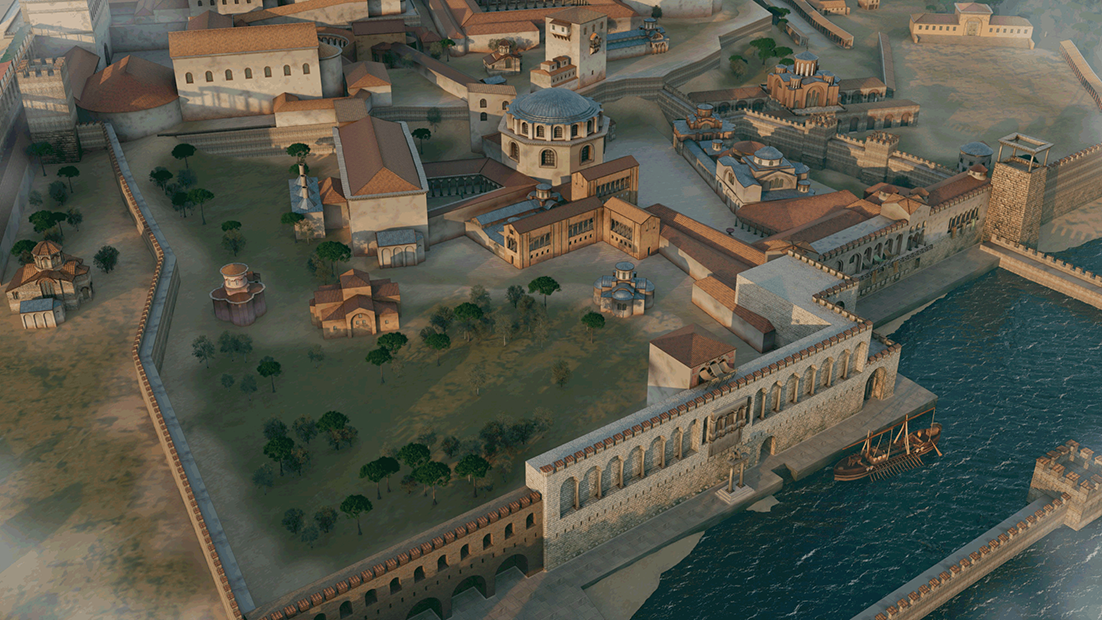
4.1 The Origin of the Lower Palace
The Lower Palace has its origins in a series of aristocratic residences that were situated along the banks of the Marmara. The most notable of these was the Palace of Hormisdas, constructed by Constantine for the brother of the Persian emperor Shapur II (r. 309–379). Even at this early stage, the complex already had direct access to the sea via a small harbour.Footnote 229 During the reign of Theodosius II (r. 408–450), the Notitia Urbis Constantinopolitanae mentions several residences owned by imperial women. Thus, we have records of the domus of Marina and Galla Placidia, and another residence inhabited by the latter’s mother, known as the palatium placidianum.Footnote 230 These palaces lay along the shore, extending from the present-day Kalyon Hotel to the site later occupied by the Church of St Sergius and Bacchus.
During the reign of his uncle Justin, Justinian resided in the Palace of Hormisdas, which by that time had probably incorporated the noble houses of the Theodosian period. Procopius highlights the splendour of this residence, which Justinian renovated and connected to the Great Palace.Footnote 231 One of the main reasons for this renovation was a fire that took place in 548. After the conflagration, the emperor maintained the palatial status of the eastern section of the complex but donated a significant part to the monastery of Hormisdas.Footnote 232 From the reign of Justinian onwards, there is evidence that emperors were moving southwards, closer to the sea. However, in logistical terms, the Palace of Hormisdas continued to be considered a separate complex until the 690s, when specific offices associated with it disappeared definitively.Footnote 233
Nevertheless, it seems that some of its most important elements predate Justinian’s reign. For example, the Patria attribute the founding of the Boukoleon and the Tzykanisterion to Theodosius II, and place the assassination attempt of his favourite, Paulinus, in the staircase of the Pantheon.Footnote 234 The Tzykanisterion, known as lusorium (recreational space), certainly existed during the reign of this emperor, and he is also credited with the renovation of the sea walls, which could point to the Boukoleon.Footnote 235 In this regard, the Patria might be recalling early interventions, while reflecting the architectural background and toponymy from a much later period. The Lausiakos hall, traditionally attributed to Justinian II, may in fact date back to the early fifth century, as evidenced by its name, which may be derived from the eunuch Lausus.Footnote 236 This dynamic is even observed in the Chrysotriklinos. Many sources attribute its construction to Justin I, Justin II, or Tiberius II.Footnote 237 However, as noted by Bologesni, it is certain that the building was already in existence in 532, when a synod held in the Palace of Hormisdas is described as happening ‘in …eptaconcho triclinio’.Footnote 238 The Patria ascribe the construction of the edifice to Marcian (r. 450–457).Footnote 239 It is possible that he was the actual builder, since we know that he had constructed some galleries not far from there, near the Covered Hippodrome.
In summary, in contrast to other sections of the palace, such as the Constantinian Daphne, the Lower Palace was not the outcome of a unified, centralised initiative. The formation of the complex was the consequence of the agglomeration of several aristocratic residences from the 4th, 5th, and 6th centuries, whose main buildings were preserved at all costs. In addition to topographical proximity and utilitarian criteria, the aristocratic pedigree of these domus and the prestige ascribed by the Byzantines to Late Antique monuments must have played an important role in this process.Footnote 240
4.2 The Triklinos Lausiakos
As previously noted, the Patria associate this chamber with Justinian II. Nevertheless, the name of the hall may suggest an earlier origin, perhaps in the fifth century. The Lausiakos was frequently traversed by processions crossing the Lower Palace, yet its precise function remained ambiguous. It appears that it served as a monumental antechamber for the Chrysotriklinos. As previously stated, both this triklinos and that of Justinian II were situated in proximity to the Nakilbent cistern.
There is no evidence regarding the layout of the hall; however, the arrangement of the courtiers in rows on either side points to a rectangular plan.Footnote 241 Emperor Theophilus ordered the Lausiakos to be decorated with mosaics, and the roof was replaced with the coffering of the palace of the usurper Basiliscus (r. 475–476).Footnote 242 The triklinos is depicted in the Madrid Scylitzes as the setting for the torture of the Graptoi, presenting it as a rectangular building with a gabled roof (fol. 51 v). The Lausiakos had several gates and annexes. To the east, a bronze door covered by an arch led to the portico of the Horologion.Footnote 243 The kitchens of the Lower Palace were also attached to the Lausiakos and could be accessed directly through another bronze door.Footnote 244 Additionally, the southern side of the edifice was adjacent to the chapel of St Basil.Footnote 245 Finally, a door, which must have been situated on the north side, led to the Thermastra.Footnote 246 Along one side of the triklinos was a garden, which probably coincided with the location of the fountain of the greens.Footnote 247
4.3 The Portico of the Horologion
The portico of the Horologion lay between the Lausiakos and the Chrysotriklinos.Footnote 248 The main function of this courtyard was to serve as a waiting room for the courtiers before entrance was allowed to the receptions and banquets held in the Golden Hall. Despite its designation, the clock that gave its name to the portico is only mentioned a couple of times.Footnote 249 Although it has been assumed that it was a sundial, it is possible that the horologion was in fact a mechanical clock, as the corps of the horologioi, experts in the operation of clocks, served within the palace.Footnote 250 It is also possible that it was associated with the watchtower system devised by Leo the Mathematician to warn of Arab attacks from Cilicia, which resulted in the installation of a clock located in the palace.Footnote 251
Although usually thought of as separate spaces, Featherstone realised that the portico of the Horologion and the place called Tripeton were actually one and the same.Footnote 252 However, the origin of its name is obscure. Considering its etymology, it could refer to a portico covered only on three sides, but it may also allude to the ritual that awaited courtiers entering the Chrysotriklinos, who had to kneel three times before the emperor.
4.4 The Chrysotriklinos
As mentioned above, the Chrysotriklinos was the centre of the Lower Palace, and served as an audience and banqueting hall. It has also been suggested that, despite repeated attributions to sixth-century emperors, the building is likely to have been constructed at least a century earlier, possibly during the reign of Marcian. In any case, the building is mentioned as late as the fourteenth century.Footnote 253
Due to its prominent role, the Chrysotriklinos is one of the best-known buildings within the palace. The floor plan of the hall was octagonal. Each of the eight sides had an apse, except for the western side, which led to the Horologion and was covered by a barrel vault. With the exception of the eastern conch above the throne, all the vaults were covered with veils. A large cornice ran along the top of the vaults. Above it rose the drum, with a large window on each of its eight sides. The building was covered by a ribbed dome of sixteen segments, each pierced by a window.Footnote 254 The miniaturist of the Scylitzes Matritensis was well informed about the architecture of the Chrysotriklinos, which he depicted as a cylinder-shaped building crowned by a dome (fol. 14 r) (Figure 28).
The Chrysotriklinos in the Scylitzes manuscript, second half of the twelfth century. Madrid, BNE, VITR/26/2, fol. 14 r.
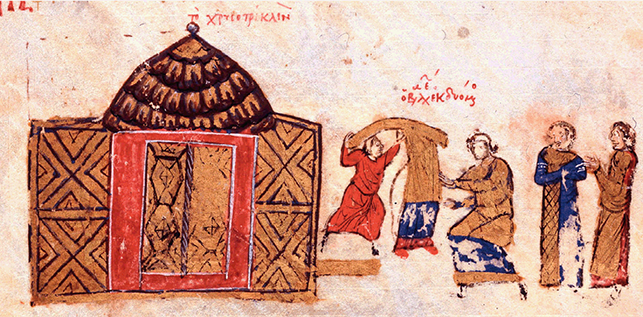
The features listed above reflect a striking duality. The lower part is almost identical to Late Roman examples of centralised halls, such as the so-called Temple of Minerva Medica in Rome or the Octagon of the Palace of Galerius in Thessaloniki.Footnote 255 Conversely, the dome, probably supported by eight pendentives, ribbed and pierced with windows, is typical of Justinianic architecture, Hagia Sophia being the most remarkable example. This may explain the confusion of the sources regarding the construction of the building. The hall could date back to the fifth century or even to the foundation of the House of Hormisdas in the fourth century. However, the dome may have been destroyed by an earthquake or fire, later repaired by Justin II following new architectural trends, and then decorated by Tiberius II.Footnote 256
As an octagonal building in the centre of the palace, the Chrysotriklinos opened to many places. The northern vault led to the hall known as the Pantheon and subsequently to the eastern staircase. The Pantheon also opened onto the Phylax, a storehouse for imperial regalia. The northeastern vault provided access to the Chapel of St Theodore, where imperial gold and silver objects were kept, along with the Rod of Moses. The eastern vault opened to the Pharos Terrace, while the southeastern vault does not seem to have led anywhere. In contrast, the southern vault led to the private dining room, which in turn provided access to the imperial chambers. From there, it was also possible to pass through to the sea façade or to descend to the Boukoleon Harbour. The southwestern and northwestern vaults lacked doors. Finally, as previously stated, the western one led to the Tripeton after crossing a threshold flanked by two columns.Footnote 257 The doors and the cornice were covered with silver during the reign of Constantine VII.Footnote 258
The Chrysotriklinos hosted banquets during Renewal Week and on relevant occasions for the Macedonian dynasty, such as the feast of St Elijah and the anniversary of the consecration of the Nea Ekklesia. The Kletorologion of Philotheus explains that the most select guests would be seated at a large central table made of gold that could accommodate thirty people. The remaining guests sat at smaller tables on the sides, each with eighteen places. This brought the total number of guests to 102.Footnote 259 However, before being allowed to sit down, a strict protocol was followed. After being introduced into the hall in groups, guests had to prostrate themselves three times before the emperor, then retire and wait on both sides of the great table. Only when all the groups had been introduced were they allowed to sit down.Footnote 260 This ritual was similar to that used for receptions, which took place mainly during the promotion of dignitaries. The person being promoted would enter the hall to receive the insignia, flanked on either side by members of the court. Once there, he had to perform the three prostrations mentioned above until he reached the emperor’s feet, which he had to kiss.Footnote 261
The numerous ceremonies that were held in the hall have provided us with a great deal of information regarding its furnishings. In addition to the curtains, the windows, cornice, and dome were decorated with precious enamels, votive crowns in the colours of the factions and golden doves.Footnote 262 The most illustrious object exhibited within the Chrysotriklinos was the Pentapyrgion. It was a cabinet made of gold in the shape of a five-towered building on which precious objects were displayed.Footnote 263 At some banquets, the emperor and the patriarch were served at a separate small golden table created by Constantine VII, which was decorated with gems and pearls and placed beneath the eastern vault.Footnote 264 A large chandelier was suspended from the centre of the dome.Footnote 265 Additionally, the hall was furnished with several couches and thrones. Three of them, made of gold, are attributed to Constantine, Maurice, and Theophilus. A fourth may have belonged to Arcadius (r. 395–408), and there is also a mention of the throne of the Kathisma being brought to the Chrysotriklinos. In addition, two couches were positioned facing each other on either side of the hall: the Couch of Lamentation, where the body of the deceased emperor was displayed, and the Couch of Joy, less documented, but that, following the analogy, might have served to present the newborn heirs before the court. Finally, gold and silver plates were also displayed on a silver stand.Footnote 266
Constantine VII covered the Chrysotriklinos with mosaics depicting a rose garden.Footnote 267 However, the main decorative programme dates back to the reign of Michael III (r. 842–867). A poem by Christophorus Mazarinus, a courtier of the mid ninth century, provides a description of the mosaics. The verses mention the emperor and the patriarch, the angelic court, the Virgin, and Christ with a strong triumphant tone proclaiming the extinction of iconoclasm.Footnote 268 On the one hand, Christ himself was depicted enthroned just above the imperial throne. Conversely, the Virgin Mary, situated above the western door, acted as an intercessor and a conduit to salvation. In conclusion, by devising this programme, the emperors manifested their subordination to Christ, recognised as the heavenly king and, at the same time, brought an end to more than a century of iconoclastic state policy, validating the veneration of icons in a manner similar to what happened at the Chalke Gate (Figure 29).
Interior of the Chrysotriklinos.
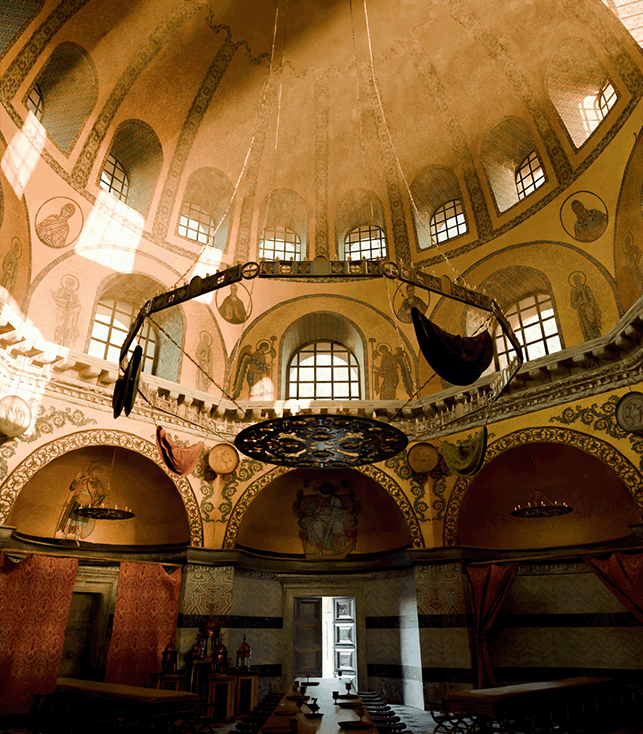
4.5 The Pharos Terrace
The Terrace of the Pharos or the Chrysotriklinos extended to the east of the Golden Hall.Footnote 269 Further east, the terrace ended in a slope, dominated by the churches of Our Lady of the Pharos, St Elijah, St Demetrius, and several smaller chapels. To the south and west, the terrace was bordered by a gallery known as the makron or stenopos, which ran from the imperial apartments in the Chrysotriklinos towards the churches.Footnote 270 Consequently, the emperor could walk directly across the terrace, in the open air, or through the gallery, under cover, in order to reach the aforementioned churches. The terrace was paved with marble, and a porphyry omphalion marked the position of the emperor (Figure 27).Footnote 271
The Church of the Theotokos of the Pharos was the main chapel of the palace, and housed important relics, including the arma Christi (instruments of torture used during the scourging and crucifixion of Christ), the True Cross, the Mandylion, and the Keramion. It also contained a venerable icon of the Virgin, considered to be the Lady of the Palace (Oikokyra).Footnote 272 The church was constructed by Constantine V (r. 741–775) and was often chosen for imperial weddings.Footnote 273 After the Fourth Crusade, the King of France Philip II (r. 1180–1223) acquired the relics, which led to the construction of the Sainte Chapelle in Paris.Footnote 274 The church was situated at the southern end of the terrace, in the shadow of the Pharos, after which it was named.Footnote 275 It was described by the Patriarch Photius, Nicholas Mesarites, its guardian, and the crusader Robert de Clari.Footnote 276 At least after a renovation in the time of Michael III, the church had a narthex with windows and a silver door. The interior was adorned with polychrome marble columns and slabs. A substantial proportion of the ornamentation consisted of silver. The upper walls and vaults were covered with mosaics depicting saints, prophets, and apostles. The central umbrella-shaped dome was surmounted by Christ Pantokrator surrounded by angels, while the apse was crowned by an image of the Virgin of the orans type. The iconostasis was constructed using green marble from the sarcophagus of the founder of the church, whose remains were burnt because of his adherence to iconoclasm. The pavement was composed of sectilia with zoomorphic motifs and the roof was covered with lead sheets.
The Church of the Pharos was directly connected to the chapel of St Elijah both through the narthex and the interior of the building.Footnote 277 This church, built by Basil I, had a circular plan and was surrounded by an annular gallery. The interior was covered with mosaics. It had seven altars, probably corresponding to the same number of niches or apses. The church was used to keep important artefacts such as manuscripts and relics, including those of St Clement and Agathangelus. St Elijah had two chapels attached to it, also constructed by Basil I. One was dedicated to St Clement and the other to Christ the Saviour. The latter was notable for its decoration, comprising gold, gems, pearls, and silver inlay. The railing had silver columns and gold decorations and was presided over by an enamel icon of Christ.Footnote 278 It is possible that this chapel might be the same as a rectangular oratory found in the area, paved with a sumptuous opus sectile dating from the same period.Footnote 279
The third main church on the terrace was dedicated to St Demetrius by Leo VI (r. 886–912), following a vision in which the saint guaranteed him succession to the throne.Footnote 280 The church was described by Gregory, a court official in the mid tenth century.Footnote 281 According to his account, the structure was supported by four columns in the shape of a tetrakion (monument supported by four columns).Footnote 282 The vaults were covered with mosaics depicting a sky full of stars, the walls were adorned with images of saints, and the central dome featured Christ emerging from the sky as the sun. The pavement was inlaid with pearls and enamel. The structure can be considered a canonical example of a cross-in-square Byzantine church, similar to the contemporary foundations of Lips and Myrelaion. Indeed, it is likely to have been one of the earliest examples of this type in Constantinople. The Byzantine infrastructure supporting the Ağası Mahmut Ağa Mosque may be identified with the platform of St Demetrius. Although Bolognesi has identified it with a rather marginal chapel dedicated to St John, it seems more plausible to consider it as Leo’s church, given its position and dimensions, which are similar to the aforementioned examples.Footnote 283
Apart from the chapel of St John, St Demetrius was the northernmost church on the terrace, and the position of its main door suggests that it faced the eastern door of the Chrysotriklinos.Footnote 284 Moreover, it was also connected with the Church of the Theotokos, likely via the narthex.Footnote 285 If this was the case, St Demetrius, St Elijah, and the Theotokos would have been juxtaposed and linked via the narthex, conforming to a layout similar to that observed in the complexes of Lips and Pantokrator.
4.6 The Boukoleon
The seaward façade of the palace, known as Boukoleon, extended from the now-lost Belisarius Tower, in Çatladıkapı, to the Pharos tower, spanning over 240 m. Today, it overlooks the Kennedy Cd. The structure comprised two sections. The western one, whose main feature was the Balcony of the Lions (Figure 30), and the eastern one, which corresponded to the loggia known as the House of Justinian (Figure 31). Between them stood the monumental staircase leading to the upper levels.
Photograph of the Balcony of the Lions by Pierre Tremaux, ca. 1850.
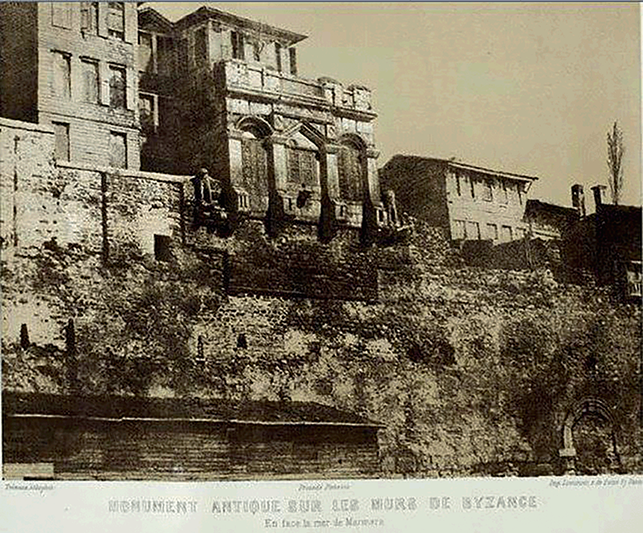
Photograph of the so-called House of Justinian by Guillaume Berggren, ca. 1880.
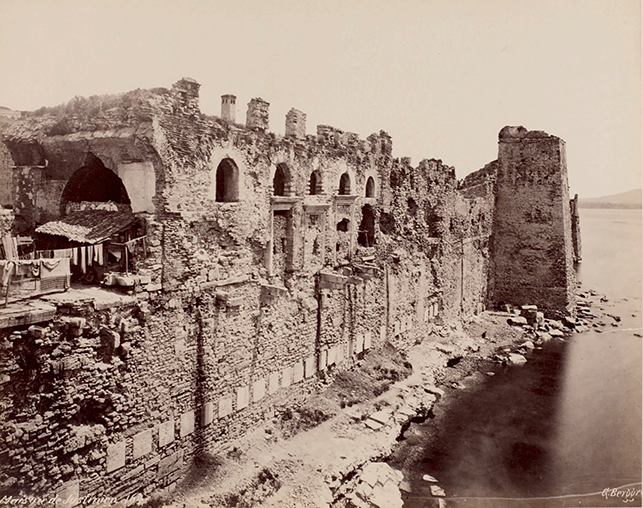
The Byzantine sources are unanimous in their assertion that the name of the complex originated from a statue of a lion attacking an ox, which was situated in the harbour, surmounting two columns.Footnote 286 The precise date of the monument’s construction remains uncertain, but the façade was first referred to by that name in the early ninth century.Footnote 287 The monument remained upright at least until the sixteenth century. However, by the late seventeenth century, a description noted that the columns had fallen and the statue had toppled in such a way that it seemed as though the ox was drinking from the sea.Footnote 288
4.6.1 The Western Façade
The earliest evidence of this section of the seawalls is found in the Scylitzes manuscript. The illustration depicts with remarkable accuracy the western façade, with the Balcony of the Lions flanking a pavilion, and several poterns on the lower level (fol. 15 r). Despite the relocation of the lions to the Archaeological Museum, the complex was demolished in 1871 to make way for the Orient Express.Footnote 289 Nevertheless, numerous travellers from the 18th and 19th centuries made drawings of the monument, providing insight into the appearance of this section of the wall.Footnote 290 A number of contributions merit particular attention, including those of Ambroise Tardieu, Thomas Hope, John Foster Junior, Eugène Flandin, and Mary A. Walker. Of special significance is the sole surviving photograph, a daguerreotype taken by Charles Texier in the 1850s (Figure 30). The balcony, which was likely constructed to emphasise a pavilion above, consisted of three blind openings separated by pilasters, resting on what appear to be spoliated triglyphs. The side openings were surmounted by an arch, while the central one was topped by a gable. All three were enclosed by carved marble slabs, resembling doors, similar to those in the upper gallery of Hagia Sophia. The entire composition was guarded by the marble lions standing at either side. Originally, at least the part of the wall to the left of the balcony was flanked by seven arches supported by columns. Two poterns opened at the sea level. To the west of the wall proper, there was another section of brick wall with five broad arches, which extended as far as Çatladıkapı. The whole complex is approximately 150 m long.
The archaeological surveys of the remaining structures at the site revealed that the complex was constructed on multiple layers, with the incorporation of abundant spolia from different periods. The earliest dated phases date back to the fifth century.Footnote 291 The jetty, built of large blocks of stone, ran along the wall.Footnote 292 An inscription on one of the poterns mentions an emperor named Constantine, probably Constantine VII, who is known to have devised the decoration of the palatine harbour with statues of animals.Footnote 293
4.6.2 The Eastern Façade
The so-called House of Justinian extends to the Pharos and is 83 m long. The core of the complex consists of a loggia with seven arches, built with bricks. Marble from older monuments was used for the mouldings, corbels, and balustrades. The balcony was flanked by two pavilions with tribela bays (a structure with three openings supported by two columns). Between the eastern pavilion and the Pharos stood an arcade supported by eight white marble columns. In the lower area, another potern was documented, as well as the total thickness of the quay, which reached 12 m.Footnote 294 Like the western façade, this section also comprised multiple layers, with the earliest materials dating also to the 5th and 6th centuries.Footnote 295 The tribela pavilions corresponded to a second phase, with a terminus post quem after the seventh century. In contrast, the loggia and the central staircase were added in a third phase, dated from the eighth century onwards.Footnote 296 The gallery with the marble columns to the east was dated to the ninth century, and the Pharos was definitely ascribed to the Byzantine period.Footnote 297
4.6.3 The Monumental Staircase and the Breakwaters
The monumental staircase situated between the two sections of the wall opened onto the quay through two large arches, 8 m wide and 12 m high. Although the staircase has not been preserved, its infrastructure, consisting of a cistern supported by columns, has survived in fairly good condition.Footnote 298 The existence of a primitive staircase or ramp, which would have formed part of a second phase, has been documented as well. In contrast, the present staircase is attributed to a third phase.Footnote 299 Furthermore, it is of interest to note that the Liber Insularum by Cristophorus Buondelmonti offers insight into the presence of two breakwaters on either side of the complex, which served to protect the Palatine harbour. It seems possible that some vestiges of the western structure may still be extant.Footnote 300
4.6.4 Chronology of the Sea Wall
Bolognesi and Mango were able to establish a chronology of the successive phases listed above. The earliest infrastructures date back to the fifth century and may be associated with the attribution of the Boukoleon to Theodosius II. The first maritime wall was dated to the sixth century. The second phase is attributed to Justinian II, who is known to have built the first walls of the Lower Palace. The third phase, which encompasses the tribela pavilions and the staircase, may have been the work of Theophilus, who extended the terraces overlooking the sea. It is believed that the marble-columned arcade to the east was constructed by Basil I, who also built a bath in the area, while the loggia was probably added by Constantine VII. Finally, many of the entrances were walled during the Late Byzantine period.Footnote 301
4.6.5 The Boukoleon in the Sources
As mentioned above, Constantine VII showed a particular interest in enhancing the Boukoleon. He ordered the restoration of the maritime façade and the addition of numerous sculptures. He constructed a fish pond, decorated the imperial apartments above the sea with frescoes, and installed a porphyry fountain topped by a silver eagle in front of them.Footnote 302
In regard to the western façade, it seems reasonable to suggest that the pavilion allegedly situated above the Balcony of the Lions is, in fact, the so-called Porphyra. This chamber was renowned for accommodating the birth of heirs to the throne and other rituals associated with the women of the court. The structure had a square floor plan with a pyramidal roof, and its walls were covered with porphyry. It was the southernmost building of the Lower Palace, and the sole pavilion overlooking the sea, standing above the statue of the lion and the ox.Footnote 303 A Venetian witness described the statue of the ox and the lion as standing exactly beneath the Balcony of the Lions.Footnote 304 In conclusion, the combination of these accounts situates the Porphyra above the Balcony of the Lions. In this section of the quay, there was also a rarely mentioned monument, namely a fountain or phiale, which might be identified with the pool of Constantine VII. It was positioned there for the guards and imperial sailors, who were always required to be present and ready to serve the emperor.Footnote 305
According to several accounts, the monumental staircase appears to have led directly to the imperial quarters in the Chrysotriklinos.Footnote 306 However, a passage must have also extended eastward, through the loggia in the western section, towards the Pharos and the so-called chamber of Nicephorus Phocas, where this emperor was assassinated, as inferred from various sources that mention people accessing the Church of the Theotokos from the harbour.Footnote 307 The accounts of several conspiracies related to this chamber deserve further attention. Phocas’s executors were hoisted up with ropes from the harbour and led to the chamber where the emperor was sleeping, located directly above the port.Footnote 308 Furthermore, the account of an attempted assassination of Alexius Comnenus (r. 1081–1118) provides insight into the fact that this chamber was adjacent to the Theotokos of the Pharos.Footnote 309 In particular, it was connected to the southern side of the church.Footnote 310 Finally, in connection with this chamber, it is important to mention the Boukoleon staircase, which descended to the polo field and the Nea Ekklesia and should not be confused with the monumental staircase of the harbour. To reach it, the emperors would leave the Chrysotriklinos and walk along the galleries on the southern side of the terrace (the area corresponding to the loggia), until they arrived at the vicinity of the Chamber of Phocas, from where they could descend via the said staircase and reach the Nea.Footnote 311
To conclude, it is worth mentioning the lighthouse. Although the upper portion of the structure has not survived, the Scylitzes Matritensis depicts it topped by four columns (fol. 77 v) (Figure 32). This information is corroborated by the account of a Russian pilgrim, thus reassessing the reliability the miniatures as a source.Footnote 312
The Pharos in the Scylitzes manuscript, second half of the twelfth century. Madrid, BNE, VITR/26/2, fol. 77 v.
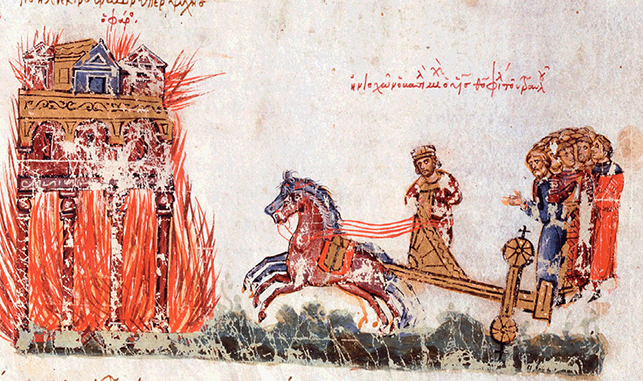
4.7 Additions to the Lower Palace
4.7.1 The First Walls and the Phialai of Justinian II
Concurrent with the construction of his triklinos, Justinian II initiated the first expansion of the Lower Palace. Firstly, he constructed a wall surrounding the enclosure, which demonstrates that by the year 700 the Lower Palace was regarded as an integral component of the imperial residence. Subsequently, he devised the phialai, ceremonial fountains that were intended to host the receptions of the circus factions, which had previously been held in the Tribunal of Daphne. Despite the common designation of these spaces as ‘fountain courts’, there is no evidence to suggest that the architectural display extended beyond the basins themselves.Footnote 313
The fountain of the greens was located just below the triklinos of Justinian II, dominated by a balcony attached to the hall, which allowed the emperor to observe the performances below. Given its location, it seems highly probable that the basin was located in the garden of the Lausiakos. The phiale of the blues stood east of the Pharos Terrace, on a lower level. It was also overlooked by a balustrade at the end of the terrace, in this case surmounted by a baldachin.Footnote 314 It is possible that, after the construction of the Triconch, Basil I considered these fountains superfluous and relocated them to the atrium of the Nea Ekklesia.
4.7.2 The Pavilions of Theophilus and Basil I (II)
Theophilus also made considerable contributions to the Lower Palace. Initially, he extended the terraces overlooking the sea and sealed off a cistern, thereby creating space for gardens and pavilions.Footnote 315 Subsequently, he directed the construction of a multitude of pavilions situated south of the Chrysotriklinos.
The first pavilion, a three-storey building, was known as Kamilas. The top floor was supported by six green marble columns and the walls were covered with green marble slabs. The interior was adorned with mosaics and paved with white marble. Additionally, the structure comprised two chapels. The imperial library was located on the middle floor. The lower floor was the private dining room, which was directly attached to the Chrysotriklinos. The next pavilion, neighbouring the previous one, was not designated by any specific name. It encompassed two levels. The upper floor was supported by four columns and paved with white marble. The ground floor housed the quarters of the eunuchs in the service of the empress. Later, another hall was built with four rooms supported by mosaic-covered arches, possibly a tetraconch. The floors were made of white marble, and the walls were painted with frescoes. Two of the apses faced northeast towards the second pavilion. The other two, oriented northwestward, were directed towards the Lausiakos. Moreover, this tetraconch was not far from the Porphyra, which, in turn, held the southernmost position on the terrace. The third pavilion, named Mousikos, housed the empress’s dressing room. The floor was paved with white marble and the walls decorated with frescoes. Its denomination came from the harmony of the marbles that covered the walls. The edifice was supported by seven white marble columns, five to the south and two to the east. The Mousikos had a twin pavilion attached to the west. Its upper floor was supported by three columns to the south and two to the west. From there a staircase led directly to the empress’s chamber in the Chrysotriklinos.Footnote 316 Given the functions of this ensemble, it is evident that it was conceived as the gynaeceum (women’s quarters) of the palace.
Basil I completed Theophilus’s expansion with more pavilions and chapels. The most important was the Kainourgion or New Pavilion.Footnote 317 However, despite its name, it was in essence a reproduction of Theophilus’s Margarites. It consisted of a three-aisled basilica with sixteen columns, eight of green marble and eight of alabaster, carved with vegetal, zoomorphic, and geometric motifs. Attached to the basilica was a square chamber, probably covered by a dome, decorated with mosaics depicting the triumphant emperor and his sons giving thanks to God. The opus sectile pavement featured images of peacocks and eagles.Footnote 318 The Book of Ceremonies provides an accurate description of the location of the Kainourgion. The eastern end of the structure led to the imperial chamber south of the Chrysotriklinos, while the western end gave access to the Tripeton.Footnote 319 Not far from here, next to the fourth pavilion of Theophilus, Leo VI erected a chapel in honour of St Anne, whose veneration was particularly appropriate within the women’s quarters.Footnote 320 To the west of the Kainourgion, Basil I constructed the Pentakouboukleion, a multi-purpose hall where distinguished visitors such as Olga of Kiev were entertained and banquets were held.Footnote 321 In addition to this, Basil erected a tetraconch chapel in honour of St Paul, which was subsequently enlarged by his son, Leo, who added a chapel dedicated to St Barbara. The frescoes were later restored by Constantine VII.Footnote 322 Further west, outside the palace walls, Basil built a chapel dedicated to St Peter, comprising two smaller oratories dedicated to the Virgin and St Michael.Footnote 323
Lastly, Basil constructed the bath of the Oikonomion on the site of the phiale of the blues, situated just behind the apse of the Pharos Church.Footnote 324 Consequently, the bath stood in close proximity to the Tzykanisterion, the Nea Ekklesia and the treasury of the church, from which it took its name. The original structure comprised a large pool, seven rooms and twelve porticoes. However, it was largely dismantled by Tzimisces, who spoliated the materials for the construction of the Chalke Church.Footnote 325 Despite the extensive plundering, the bath remained in existence until the fourteenth century.Footnote 326 As previously mentioned, Bolognesi located these baths in the vicinity of the colonnaded arcade near the Pharos.
4.7.3 The Nea Ekklesia and the Tzykanisterion
The Nea Ekklesia, the most significant religious foundation established by Basil I, was situated in close proximity to the palace. It was dedicated to a number of Christian figures, including Christ himself, the Virgin, St Nicholas, St Elijah, and the Archangel Michael. The latter two were the most important patrons, and the emperor regarded them as his personal protectors.Footnote 327 The church is primarily described in the biography of its founder, Symeon’s chronicle, and in the account of the Arab hostage Harun ibn-Yahya.Footnote 328 It had five domes covered in mosaics. The church could be accessed through ten doors, four of which were crafted from gold and six from silver. Next to the main entrance there was a portrait of the founder and an image of Christ, which may have been ancient sculptures of Solomon and Asclepius, whose identity had been lost over time. The floor was made of opus sectile and the walls were covered with polychrome marble. Many of these materials were taken from Justinian’s mausoleum in the Holy Apostles. At the time of its foundation, the Nea had an exquisite set of cloths and silks donated by Danielis, Basil’s adoptive mother. Its collection of polykandela (candelabra) and bronze liturgical objects was also remarkable. Although the church survived until the fall of Byzantium, it was stripped of its exquisite decoration by Isaac Angelos (r. 1185–1195).Footnote 329 While the description bears resemblance to churches such as Constantine Lips or St Sophia in Kiev, it is challenging to draw a parallel with the available information.Footnote 330 Regardless, there is no doubt that the Nea boasted important dimensions, exquisite decoration, and precious furnishings.
Access to the church was provided by a narthex on the south side of the church, facing the sea, which the emperors used after descending the Boukoleon staircase. Later, they would return to the palace via an elevated passage from a terrace on the roof of the church.Footnote 331 The Nea Ekklesia had two courtyards. The western one had two fountains, probably the old phialai of the factions. The southern basin was crafted from porphyry with serpents carved around it and had a spout in the form of a pinecone. The fountain was surrounded by columns supporting a cornice with additional spouts. The north basin was constructed from yellow marble and exhibited a comparable display to that of the previous one. Here, the brazen spouts above the cornice had the shape of animals. The eastern courtyard had two arcaded galleries to the north and south, with vaults painted with images of the saints. Between the said porticoes there was a delightful garden. Immediately to the east of this garden lay the Tzykanisterion, next to which stood the church treasury, the aforementioned Oikonomion, and the watchman’s house.
The first polo field was built by Theodosius II. Next to it, Michael III built a magnificent stable. Basil I dismantled this Tzykanisterion to allow for the construction of the Nea, and it was subsequently relocated in a slightly more southerly position. The structure was later expanded by Constantine Ducas (r. 1074–1078/1081–1087).Footnote 332 A large triklinos, the Trikymbalon, was associated with the polo field. We only know that it was embellished by Basil I with bronze doors taken from the Forum.Footnote 333
Mango, Grotowski, and Effenberger have suggested that the Nea was situated at a considerable distance to the north of the Boukoleon.Footnote 334 However, as we have seen, it was attached to the palace, with direct access from the elevated passage and the Boukoleon staircase. Mango’s proposed location coincides with a hagiasma or sacred spring and the church labelled as San Luca on Vavassore’s map of Constantinople. It is highly probable that this is, in fact, the convent of the Hodegetria, renowned for its icon of the Virgin attributed to the Evangelist.Footnote 335
4.7.4 The Walls of Nicephorus Phocas
Nicephorus Phocas built a thick wall around the Lower Palace. The wall was composed of two sections. The first commenced at the Tower of Belisarius and the second at the Pharos, both running up north, towards the Upper Palace. The western section ended in a large tower known as the Kentenarion, located at the southern end of the Covered Hippodrome.Footnote 336 Some parts of the eastern section survived until the nineteenth century, including a gateway flanked with columns, which has since disappeared.Footnote 337
4.7.5 The Comnenian Additions and the Abandonment of the Palace
Manuel Comnenus (r. 1143–1180) added the last pavilions to the Great Palace.Footnote 338 The first was called Manouelites after its builder. It was located in the westernmost part of the enclosure, facing the sea. The structure had two floors decorated with porphyry and gold mosaics. Manuel also ordered the porphyry basin from the chamber of Phocas to be moved there. The architectural design of the Manouelites was notably innovative, featuring an audience hall on the first floor, perhaps as a result of Western influence.Footnote 339 Thus, the building might have resembled the palaces of Nymphaion and Tekfur Sarayı.Footnote 340
The second pavilion built by Manuel, only known from Mesarites’ description, was the Persian-inspired Mouchroutas.Footnote 341 The building, attached to the Chrysotriklinos, consisted of two floors connected by a brick staircase decorated with white, green, and blue tiles as well as porphyry slabs. The upper floor was crowned by a dome surrounded by colourfully painted decorations forming recesses. The Islamic influence is evident, evoking the Turkish guests who were welcomed at the Comnenian court, such as John Axouch and the Sultan Kilij Arslan. Indeed, the description of the building makes it almost identical to a pavilion constructed by the latter on the walls of Iconium.Footnote 342 The name of the building is a Greek adaptation of the Arabic term ‘makhrut’, which translates as ‘to carve’ or ‘to sculpt’. This points directly to the presence of muqarnas, a decorative system typical of Islamic architecture, and mirrors the roofing of contemporary hybrid Sicilian buildings such as the Capella Palatina in Palermo.Footnote 343
Despite their preference for the Blachernai Palace, situated in the northwestern corner of the city, next to the walls, the Comnenes never abandoned the Great Palace. Indeed, they preferred it as the venue for the most solemn receptions. In any case, the complex was presumably already in a considerable state of decay, with many of its buildings having already stood for several centuries. Isaac II took an unprecedented step, indiscriminately plundering some of the most significant buildings within the palace, including the Chalke Gate and the Nea Ekklesia.Footnote 344
During the reign of his successor, Alexius III (r. 1195–1203), the Great Palace underwent a symbolic demise. The imperial residence was permanently relocated to Blachernae and the races in the Hippodrome were discontinued, with Alexius instructing that they be parodied in his new abode.Footnote 345 Although the lower part of the palace was still in use during the time of the Latin emperors, these events marked the end of its role as the heart of the Empire, after nearly a thousand years, and foreshadowed the severe institutional and identity crisis that the Byzantines would face after the fall of Constantinople in 1204.
Archaeological remains of the Great Palace. Also available to view online as supplementary material at www.cambridge.org/calahorra
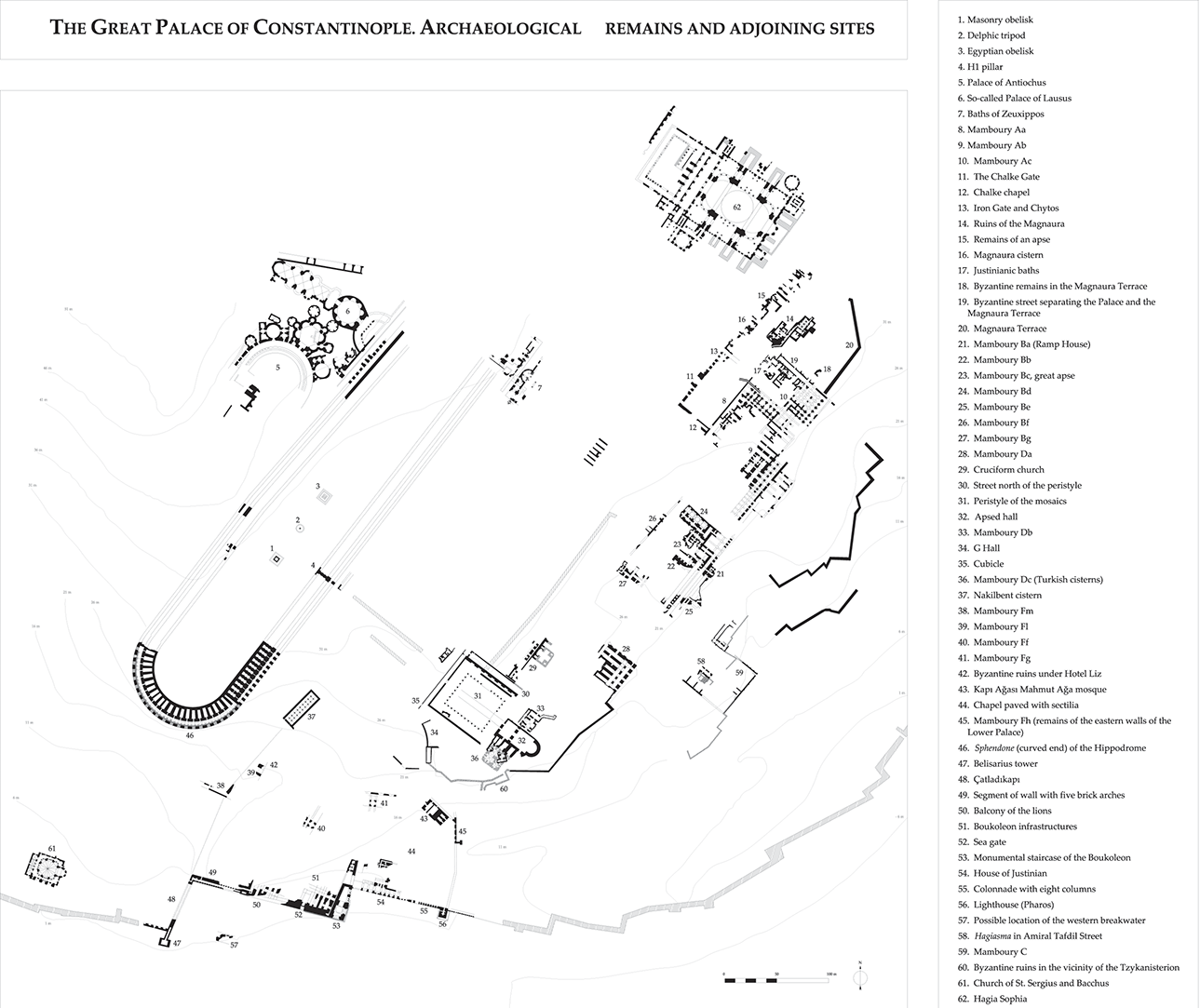
Integration of the archaeologically documented remains of the Great Palace and our proposed planimetric reconstruction. Also available to view online as supplementary material at www.cambridge.org/calahorra
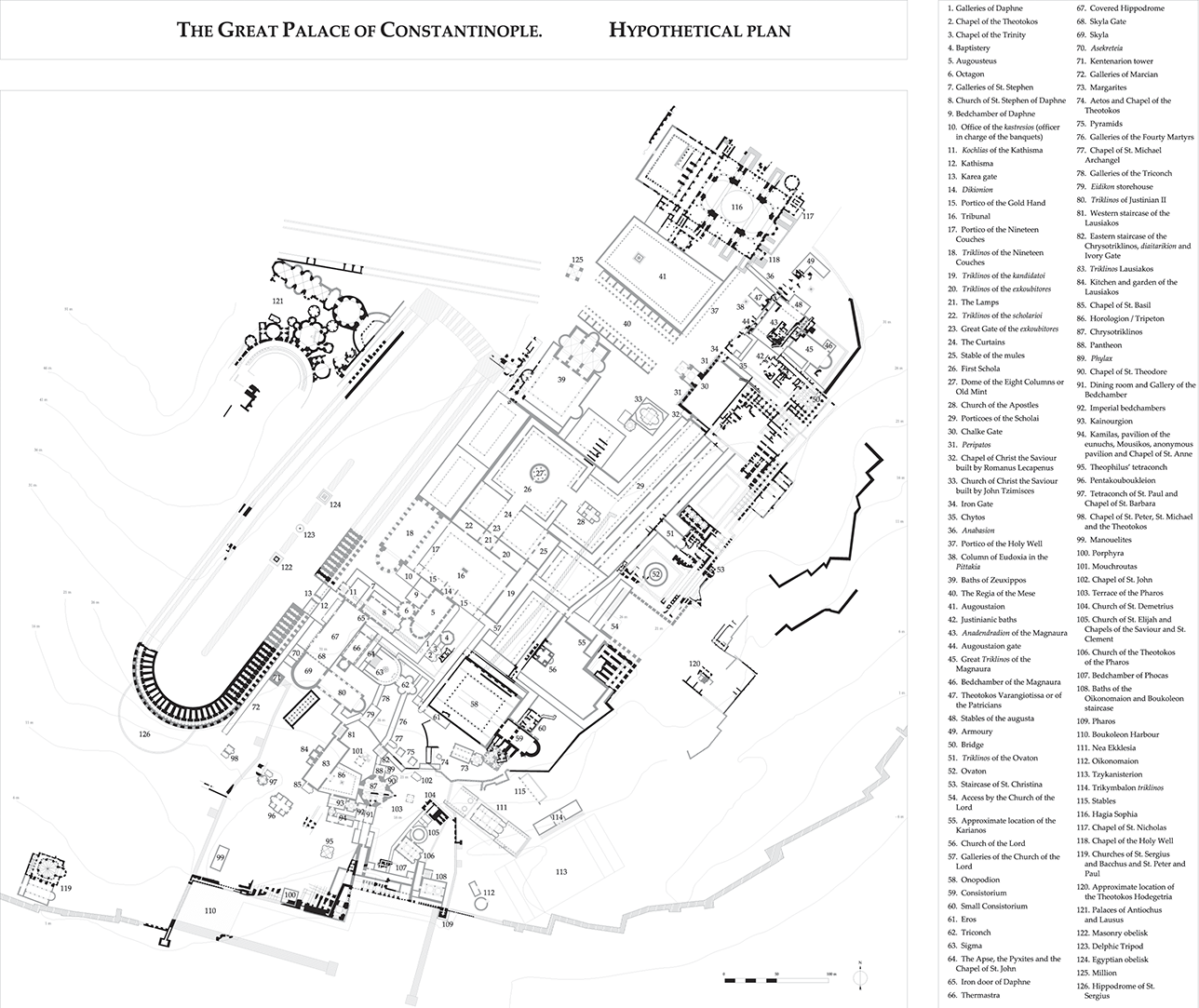
Peter Frankopan
University of Oxford
Peter Frankopan is Professor of Global History at Oxford University, where he is also Director of the Centre for Byzantine Research and Senior Research Fellow at Worcester College. He specialises in the history of the Eastern Mediterranean from antiquity to the modern day, and is the author of the best-sellers The Silk Roads: A New History of the World (2015) and The New Silk Roads: The Future and Present of the World (2018).
About the Series
Telling the history of Constantinople through its monuments and people, leading scholars present a rich and unbiased account of this ever-evolving metropolis. From its foundation to the domination of the Ottoman Empire to contemporary Istanbul, numerous aspects of Constantinople’s narrative are explored in this unrivalled series.